




Abstract
Athletes have again started to take a visible stance on various political and social issues, which has stirred fierce controversies. Existing research has a strong US bias, and, to extend the range of research, we conducted a German survey on the perceived legitimacy of athletes’ political activism. The evidence suggests that the US debate cannot simply be transferred to other political and cultural contexts. The German respondents did not generally disapprove of athletes employing sporting venues as political stages. However, they are primarily willing to accept political activism in cases where the claims made are congruent with their political beliefs and with hegemonic political values. The perceived legitimacy of more controversial forms of athletes’ political activism depends on political ideology, political activism and political tolerance. For international sport governing bodies, the results indicate a dilemma: western audiences approve of athletes’ political activism, which is congruent with their own political values, but seem unwilling to accept activism making other claims.
Keywords
Introduction
After decades during which sport stars seem to have been primarily occupied with maximizing their brand value, athletes have again started to take a visible stance on political issues. The activism of African American athletes such as Colin Kaepernick and LeBron James against racial discrimination in the United States has stirred fierce controversies and was even a subject of presidential election campaigns. However, apart from the United States, little is known about the public’s acceptance of athletes’ political activism.
The cliché of apolitical sports has by now been widely debunked by social scientists. The insight that sport is politically significant and represents a policy domain in its own right has given rise to vibrant research on sport and politics (Gift and Miner, 2017). Scholars have employed a broad range of theoretical and methodological approaches. They have studied the internal politics of sport governing bodies (Darby, 2005), explored how states try to employ mega sport events to create ‘soft power’ (Grix and Kramareva, 2017), conducted comparative studies on sport politics (e.g. Bergsgard et al., 2009), analysed regulatory politics in the European Union (e.g. Parrish, 2003) and examined sport’s role for national identification (Elling et al., 2014) as well as public support for the hosting of mega sport events (Johnston et al., 2021).
This contribution focuses on sport’s role as a vehicle for political ideologies, which has been recently emphasized by scholars who follow Foucault’s (1980: 93) claim that ‘power is everywhere’ (Seippel et al., 2018). Thus, recent scholarship emphasizes that traditional sports discourse has privileged existing societal structures and cultural patterns, such as inequality, heteronormativity and male hegemony (Lenskyj, 2013; Valiente, 2022). Sport discourses are therefore understood as a ‘site of struggle’ over power relations between different social groups (Van Sterkenburg and Knoppers, 2004), which has inspired calls to use sports to promote progressive causes (e.g. Agyemang, 2012).
As a matter of fact, political activism by athletes has indeed experienced a resurgence. Although Muhammed Ali, Tommie Smith, John Carlos and Billie Jean King had taken a visible stance on political and social issues during the 1960s and 1970s, subsequent generations of athletes preferred to ‘stick to sports’ (Broussard, 2020). The recent protests of African American elite athletes against racial discrimination in the United States (Falcous et al., 2019) provoked an uproar by white and conservative fans, who insisted on the apolitical character of sports. Studies suggest that indeed a majority of US fans show an aversion to the politicization of sports (Thorson and Serazio, 2018), which has materialized in a partial consumer boycott (Brown and Sheridan, 2020; Watanabe et al., 2019). The racial politics in the United States certainly have a very specific dynamic of their own. Yet, in the wake of increased polarization within western societies (Carothers and O’Donohue, 2019), political activism for various causes seems to be on the rise (Hutter and Weisskircher, 2022) and popular culture has turned into a site of ideological struggle. Athletes’ political activism is therefore not only found in the United States but all around the world; however, this geographic diversity is unfortunately hardly reflected by existing research (e.g. Magrath, 2022). We aim to mitigate the US bias in research by presenting empirical evidence from Germany where the relationship between sport and politics has been particularly complex.
After the willing collaboration of the bourgeois German sport movement with the Nazi regime, sport in West Germany was reconstructed after World War II as an apolitical sphere. The autonomy of sport even gained the status of a constitutional doctrine. However, the Cold War motivated West German political elites to re-politicize sports in the late 1960s. The federal government established the still valid doctrine that sport is a ‘means of national representation’ and started heavily subsidizing elite sports (Balbier, 2006). After the Cold War, the federal government discovered sport’s potential to generate soft power, which was best evidenced when Germany hosted the International Federation of Association Football (FIFA) World Cup in 2006 (Grix and Houlihan, 2014). Recently, sport’s role as a means of national representation seems to have been reinterpreted to include public advocacy for values considered important. There were calls to boycott the FIFA World Cups hosted by Russia in 2018 and Qatar in 2022 as both countries do not adhere to German human right standards (Thorhauer, 2022). German politicians tried to use the Union of European Football Associations (UEFA) EURO championships in 2021 to protest against a Hungarian law believed to discriminate against sexual minorities (Horeni, 2021). In 2022, the captain of the German national soccer team intended to protest against the suppression of homosexuals in Qatar by wearing a rainbow armband. After FIFA had banned the gesture, the German team posed with hands covering their mouths, while a German federal minister, who was present at the match, wore the rainbow armband (Ehrhardt, 2022). The strong willingness to use international sports as a political venue suggests that Germany might represent an outlier case (Seawright and Gerring, 2008). Our quantitative study represents, therefore, an entrée to the subject, which explores German attitudes toward athletes’ political activism.
Hence, our first question is intended to examine the acceptance of athletes’ activism and its limits:
1. Do Germans accept different forms of athlete activism as a legitimate form of political expression?
Our second question is intended to place the controversy about athletes’ political activism in the broader context of the legitimacy of political protests. Accordingly, we ask:
2. How does the acceptance of athletes’ political activism relate to individual attitudes?
We address these research questions based on a representative survey conducted in Germany in May 2022.
Theoretical background
The contested legitimacy of athletes’ political activism
We understand political activism by athletes as a specific form of political protest or activism to which general insights on perceived legitimacy and individual attitudes towards political protests apply (Andrews et al., 2016). Hence, we take guidance from Kelman (2001: 55) who defined legitimacy as the acceptance or rejection of a claim depending ‘on whether that claim is seen as just or rightful’. Moreover, Kelman’s (2001) insight that the legitimacy of a claim depends on the evaluation of its content and of the claimant is extremely instructive for defining athletes’ political activism.
It is important to realize that the belief that sport is an apolitical sphere has strong historical and institutional roots. Modern sports were created in the United Kingdom by a vivid and resourceful, albeit socially exclusive, civil society. British governments adhered for a long time to the liberal doctrine that sport was a sphere of private life offering a break and retreat from politics (Allison, 2001). These ideas inspired the founding father of the modern Olympics, Pierre de Coubertin, to create the Olympic Games as an ‘apolitical meeting venue where loyalty to the rules of the game and the beauty of the competition would enable people otherwise known as enemies to become friends’ (Næss, 2018: 147). Accordingly, the myth of apolitical sport became institutionalized. The fact that the inclusive nature of sports has been linked to the suppression of the freedom of political expression of athletes is not only paradoxical, but also hypocritical. The neutrality or apolitical character of sport is a fiction given the political significance and manifold political ties of sport (Meier and García, 2021). Nevertheless, sport audiences seem still to expect that sport offers a retreat from divisive politics. Furthermore, in particular in the United States, athletes have been regularly dismissed in public discourse as unqualified political claimants and, due to their popularity, as a dangerous influence (Serazio and Thorson, 2020). The fact that sport authorities have imposed rather strong restrictions on athletes’ freedom of political expression inspires a broad definition of athletes’ political activism, which avoids the common distinctions between different forms of political participation (e.g. Giugni and Grasso, 2022). Hence, we follow previous scholarship, which has defined ‘athlete activism’ as referring to individual athletes who use their popularity to take a stand within debates around political or societal issues (e.g. Frederick et al., 2018; Schmidt et al., 2019). Given the myth of apolitical sport, athletes are prone to be perceived as illegitimate claimants. However, following Kelman (2001), the content of claims has also to be taken into account.
Potential determinants of the legitimacy of athletes’ political activism
The perceived legitimacy of a claim’s content depends on the values, reasons and justification that support it. In his classic piece, Rokeach (1973) distinguishes, amongst others, social and personal values as well as instrumental and terminal values. Social values are society-centred – that is, they describe preferred states for society – whereas personal values are self-centred. In addition, instrumental values refer to preferred ‘modes of conduct’, whereas terminal values point to ‘end states of existence’ (Rokeach, 1973: 7). Political claims in particular are debated and legitimized within a normative reference system in which values and ideologies function as powerful means of justification (Lehner, 2015). Hence, recipients of a claim supposedly assess its very content against the background of values in order to decide whether the concern raised refers to end states that are – in their point of view – just and worthwhile. They may also assess whether the claim is put forward in a manner consistent with procedural norms – that is, in line with the preferred modes of conduct.
Suchman (1995) argues that statements that resonate with a society’s core cultural and political values can claim ‘moral legitimacy’ and, vice versa, lack moral legitimacy if they contradict these values. Most political activism by athletes hardly involves claims blatantly challenging society’s core values but seems to resonate at least with some social values represented in society’s political discourse. Therefore, personal values may shape individual legitimacy judgements. According to theories of psychological balance (Heider, 1958), individuals strive to maintain a sense of consistency in their lives and to reach ‘a harmonious state’ (Heider, 1958: 180). Hence, people evaluate claims as legitimate if they resonate with their personal values, and as illegitimate if not. The scarce evidence on the perception of athletes’ political activism supports this idea (Mudrick et al., 2019). Hence, we assume that Respondents are more likely to perceive athletes’ political activism as legitimate when the protests’ content is congruent with their own political beliefs (H1).
The link between the support of a political claim and its perceived legitimacy is, however, more complex than psychological balance theory suggests. Political ideology also impacts respondents’ attitudes towards political protests. A left political orientation increases not only the likelihood that people will participate in protests, but also that they perceive such forms of political participation as legitimate (Zlobina and Gonzalez Vazquez, 2018). Political ideology might also relate to the disapproval of athletes’ political activism. In particular, US scholars have argued that the myth of apolitical sports conceals that traditional sports discourse has been rather conservative and has privileged existing societal structures (e.g. Falcous et al., 2019). Hence, National Football League (NFL) player Colin Kaepernick’s kneeling during the US anthem has triggered critical reactions from conservative sport fans (Schmidt et al., 2019). Kaepernick was accused of being anti-American, which allowed Donald Trump to weaponize the kneeling controversy as it fitted into the emergence of explicit white identity politics (Falcous et al., 2019). Empirical studies indicate that these forms of athletes’ political activism provoked boycotts in particular from conservative consumers (Brown and Sheridan, 2020; Watanabe et al., 2019). Hence, conservative sports fans in the United States seem to adhere to the doctrine that athletes should ‘stick to sports’ (Frederick et al., 2017). Thus, we hypothesize that Respondents with a rather left political ideology are more likely to perceive athletes’ political activism as legitimate (H2).
Given that athletes’ political activism has been strongly delegitimized, it is likely to be perceived as a ‘creative’ or ‘alternative’ form of political influencing (Micheletti and McFarland, 2016). Therefore, we assume that, irrespective of political ideology, individuals with their own experiences of so-called ‘alternative’ forms of political participation – that is, demonstrations, strikes or petitions – perceive athlete activism as more legitimate: Respondents who have been active in political protests are more likely to perceive athletes’ political activism as legitimate (H3).
Any procedural understanding of democracy entails normative ideas about desirable ‘modes of conduct’ – that is, the acceptance of rules and rights and the willingness to apply them equally (Saffon and Urbinati, 2013). In democracies, these rules include the fundamental right to freedom of expression (Scanlon, 2003). The ability to allow for dissenting opinions refers to political tolerance, which is a person’s willingness to extend constitutional rights – to speak publicly or to run for office – to all those with whom they disagree (Sullivan et al., 1993). Hence, political tolerance should affect the relationship between support of a claim and the perception of its legitimacy: Respondents showing a higher degree of political tolerance are more likely to perceive athletes’ political activism as legitimate (H4).
Finally, it is important to emphasize that the myth of apolitical sports corresponds to the motives of sport fans, which tend to centre around eustress, escapism and entertainment (Wann, 1995). Before the recent resurgence of athletes’ political activism, athletes and sport organizations alike had internalized the idea that sports and politics should be separated in order to avoid antagonizing fans (Cunningham and Regan, 2012). Indeed, adverse fan reactions to athletes’ political activism in the United States are well documented (e.g. Brown and Sheridan, 2020; Frederick et al., 2018; Mudrick et al., 2019; Schmidt et al., 2019). Thus, we assume: The more respondents are interested in sports, the less they are likely to perceive athletes’ political activism as legitimate (H5).
Research design and methods
Study design
This study analyses data from the ‘Political Activism in Elite Sports’ project (PoleS). We conducted a large-scale representative survey (n = 1002) for the population living in Germany (⩾14 years). Forsa, a well-known German polling company, integrated this survey into its existing nation-wide online panel. The survey employed computer-assisted web interviewing. The recruitment procedure used telephone surveys with random digit dialling. All respondents participated voluntarily. Data collection took place in May 2022. The study was approved by the ethics committee of the University of Muenster.
The measures
Legitimacy of and support for athletes’ political activism
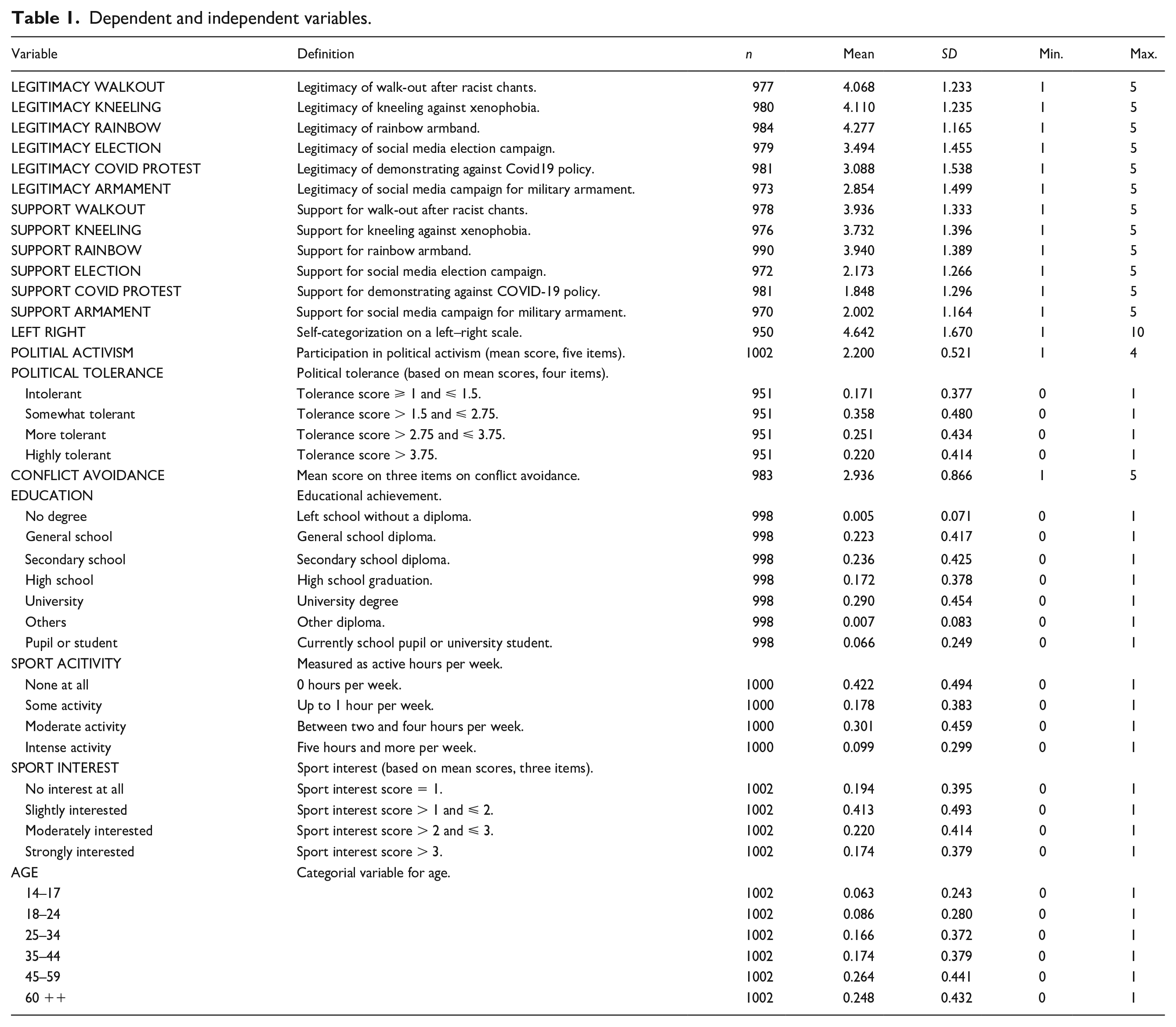
In order to measure the perceived legitimacy of athletes’ activism, we presented the respondents with six scenarios of political activism involving German soccer players. The scenarios focused on national soccer team players because the national team is highly popular and has been described as the last ‘campfire’ around which an increasingly diverse nation still gathers (Meier et al., 2018). The items alluded to a number of actual incidents but were complemented with purely hypothetical scenarios in order to achieve a balance between progressive and conservative causes. The intended balance was disturbed by the fact that the study was designed before the military escalation of the Russian-Ukrainian conflict but conducted after the beginning of the war.
In order to measure the legitimacy of different forms of political speech, respondents were asked to rate on a 5-point Likert scale whether they believed that the athlete was allowed to engage in that particular political action. In addition, we also asked them to rate whether they personally support this action.
Independent variables
Dependent and independent variables.
Analytic strategy
The descriptive and bivariate analyses are presented first. Regarding multivariate analyses, we had to take into account that the dependent variables proved highly skewed and violated the normality assumption. Accordingly, instead of ordinary least square regressions, we employed ordinal logistic regressions using the ‘ologit’ command in Stata 16.
Findings
A simple graphic depiction illustrates that a clear majority of respondents perceives athletes’ activism as legitimate (Figure 1). However, respondents regard examples of athletes’ political activism that refer to rather left-leaning or progressive causes – like anti-discrimination and LGBTIQ+ rights – as more legitimate than other claims. The diagrams also suggest that perceived legitimacy relates to support for the content of a claim.
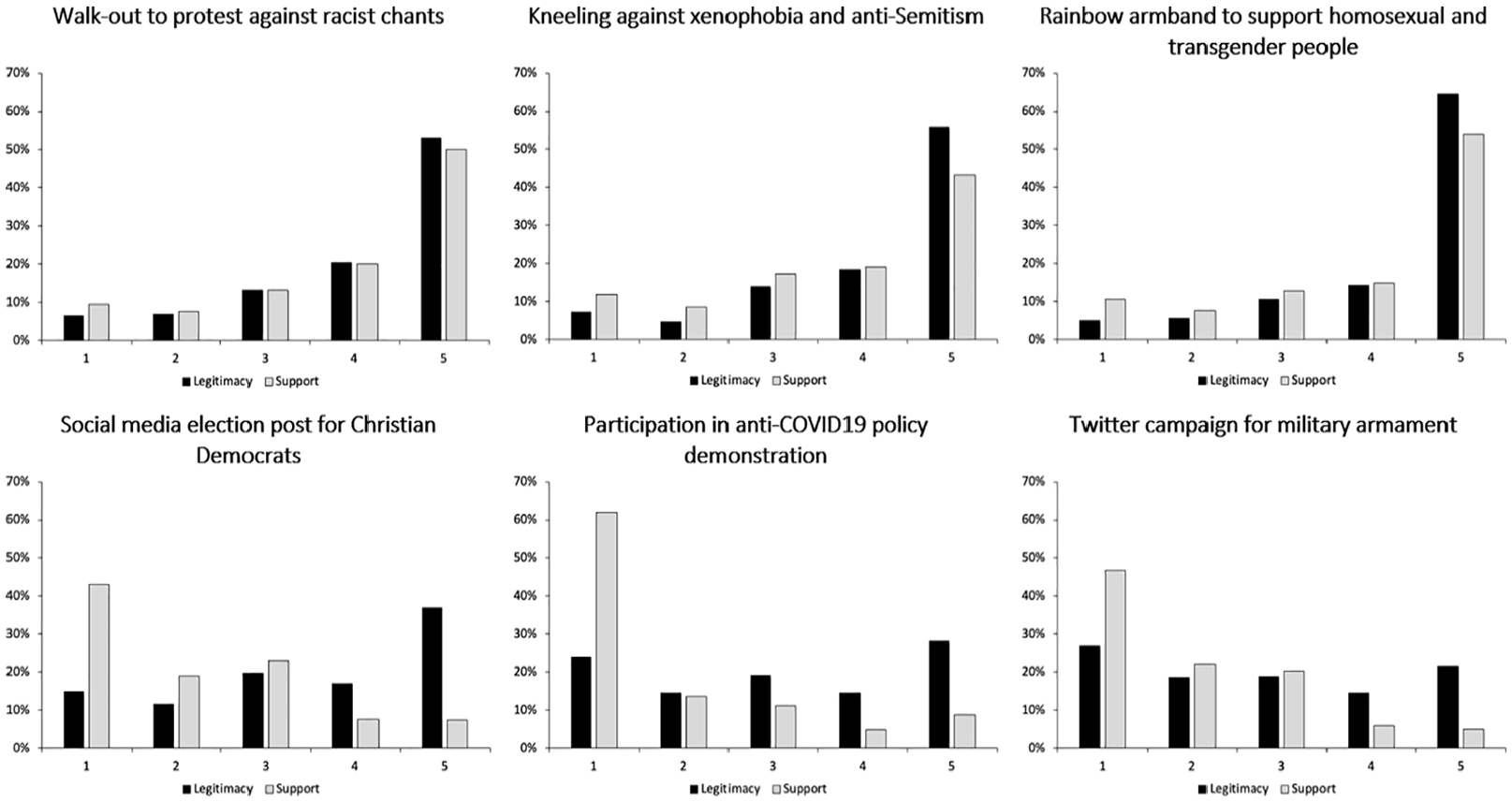
Legitimacy of and support for different forms of athletes’ political activism.
The bivariate analyses (Table 2) support the idea that respondents are more likely to perceive forms of activism as legitimate when these are congruent with their own beliefs. The correlation is substantially higher for left-leaning or progressive than for other causes. However, the dominant disapproval of the latter forms of activism does not translate fully into perceived illegitimacy. The bivariate analyses further suggest that an ideological self-identification as right is associated with lower legitimacy ratings for progressive political activism. People who are more prone to engage in political activism perceive any form of athletes’ political activism as more legitimate. In contrast, political tolerance only comes into play with regard to the more controversial forms of political activism by athletes. Here, people showing higher levels of political tolerance are significantly more likely to perceive these forms of activism as legitimate. Although respondents with stronger interests in sports tend to perceive athletes’ political activism as less legitimate, the bivariate correlation is only significant in one case. Sport activity seems also only marginally relevant. Most of the findings point to a positive effect of educational achievement on perceived legitimacy and support the idea that younger respondents are more likely to perceive athlete activism as legitimate.
Bivariate correlations between legitimacy of different acts of political activism and independent variables.
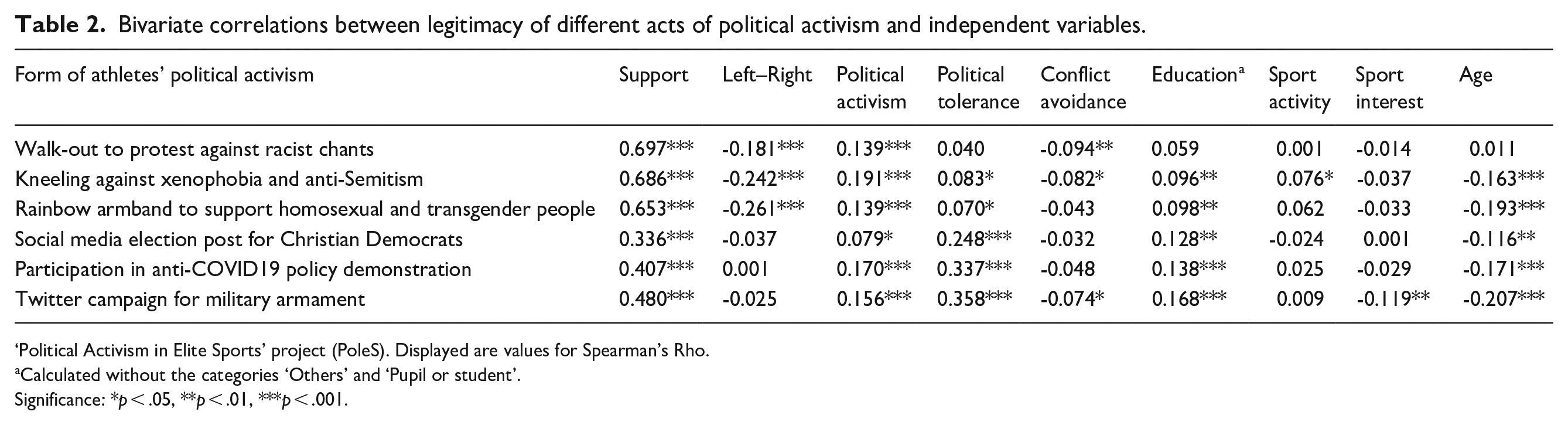
‘Political Activism in Elite Sports’ project (PoleS). Displayed are values for Spearman’s Rho.
Calculated without the categories ‘Others’ and ‘Pupil or student’.
Significance: *p < .05, **p < .01, ***p < .001.
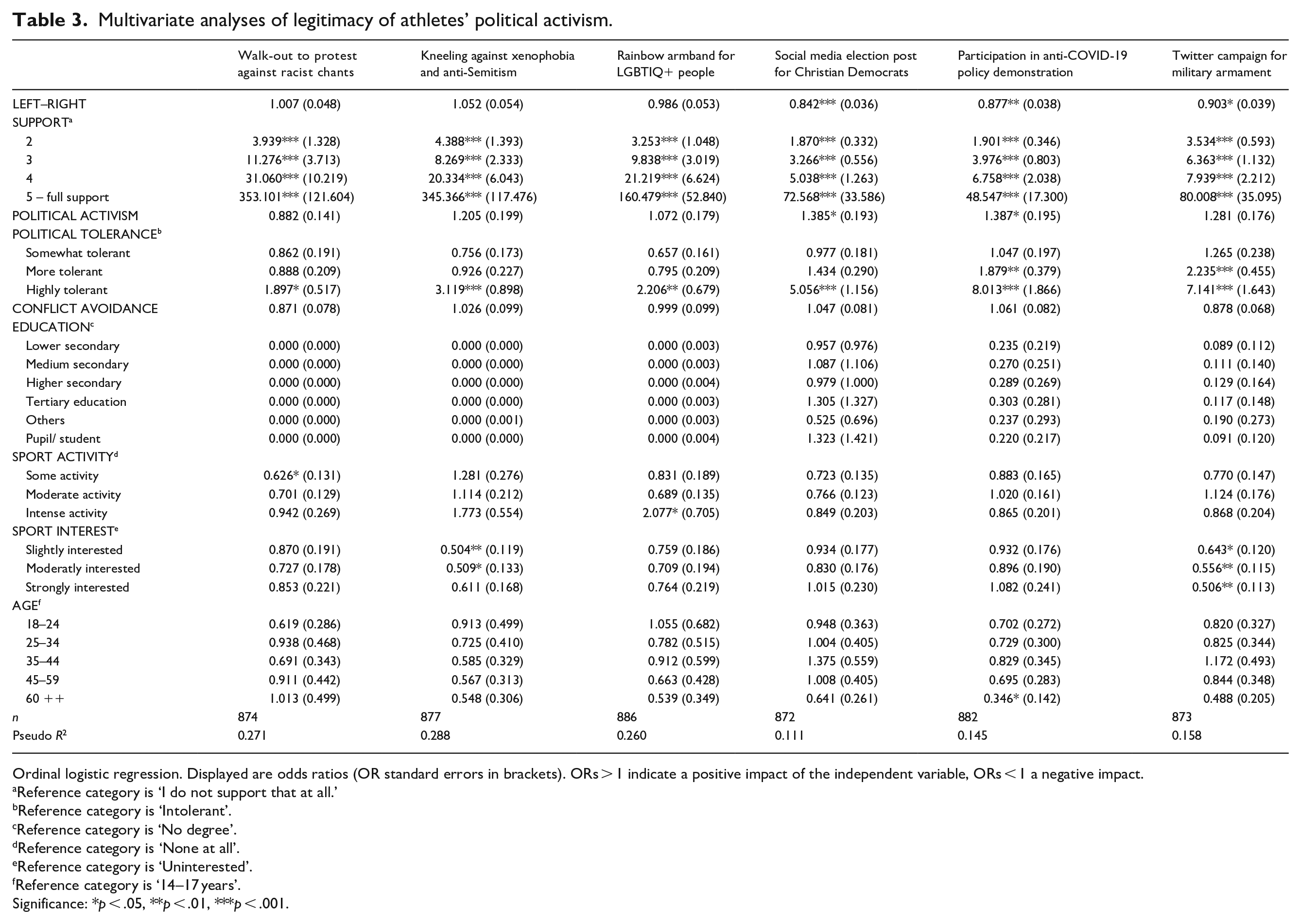
The multivariate analyses (Table 3) qualify these findings. First, the results suggest that support for a specific political action is the key predictor for perceived legitimacy of athletes’ political activism. Hence, the basic idea of balance theory that people are more willing to accept political protests which are congruent with their own political beliefs is strongly supported. For forms of athletes’ political activism that are least controversial – walk-out to protest against racist chants, kneeling against xenophobia and anti-Semitism and wearing a rainbow armband to support homosexual and transgender people – the only significant explanatory variable, except support, is political tolerance. Highly tolerant individuals are more likely to consider these forms of activism as legitimate.
Multivariate analyses of legitimacy of athletes’ political activism.
Ordinal logistic regression. Displayed are odds ratios (OR standard errors in brackets). ORs > 1 indicate a positive impact of the independent variable, ORs < 1 a negative impact.
Reference category is ‘I do not support that at all.’
Reference category is ‘Intolerant’.
Reference category is ‘No degree’.
Reference category is ‘None at all’.
Reference category is ‘Uninterested’.
Reference category is ‘14–17 years’.
Significance: *p < .05, **p < .01, ***p < .001.
All other explanatory factors only come into play when more controversial forms of athletes’ political activism are involved. For these scenarios – social media election support for Christian Democrats, participation in an anti-COVID-19-policy demonstration and a Twitter campaign for military armament – our hypotheses receive some support. People who are politically more tolerant and identify more strongly as left are more likely to perceive these forms of political activism as legitimate. With the exception of the Twitter campaign for military armament, people who have engaged in political activism themselves are significantly more likely to grant the privilege of political activism to athletes. Respondents who are strongly interested in sports were only significantly less likely to grant legitimacy to the Twitter campaign for military armament.
Discussion and conclusion
Key findings
Our study on the perceived legitimacy of athletes’ political activism in Germany serves to qualify some claims made in the fierce US debate. Germans do not generally disapprove of athletes employing sporting venues as a political stage. In contrast to our theoretical reasoning about sport as a neutral sphere, German respondents perceive highly public forms of athletes’ political activism during competitions also as legitimate. At the same time, our data indicate that the most important factor for the perceived legitimacy of athletes’ political activism is support for the specific political claim.
Germans are willing to accept political activism by athletes primarily in cases where the claim in question is congruent with their own political beliefs and values, which supports ideas of cognitive consistency and psychological balance (Heider, 1958). By implication, tolerance for athletes’ political activism that an individual would not support is clearly limited. Of particular interest is that rather ‘left’ or progressive political claims opposing racism, anti-Semitism and discrimination of sexual minorities are strongly supported. There seems to be little polarization among Germans about the support for these claims, irrespective of the respondents’ ideological self-categorization.
The legitimacy of other forms of athletes’ activism is clearly more controversial. Although a majority of the respondents does not support the content of these claims, the rejection does not fully translate into a denial of their legitimacy. The perceived legitimacy of the more controversial forms of athletes’ political activism depends on a number of individual attitudes. Respondents who identify as politically left or are more tolerant are more likely also to perceive conservative forms of athletes’ political activism as legitimate. The findings suggest that left and more tolerant individuals strongly value free speech as an essential procedural characteristic of democracy and are, thus, more willing to accept controversial opinions (Sullivan et al., 1993).
German versus US debates on athletes’ political activism
In contrast to the US, our findings provide little support for the idea that athletes’ political activism is strongly rejected by dedicated sport fans or will even provoke boycotts by them. Our results should thus serve as a caveat against a simplified transfer of US debates to other contexts. German sport fans appear only slightly more right-wing in terms of ideological self-categorization compared with individuals not interested in sports. A possible explanation might be that European sports were not as politicized and militarized as the US professional sport industry after the terrorist attacks on 11 September 2001 (Falcous et al., 2019). Without denying that sport in general and soccer in particular have been a vehicle for political ideologies and values (Mutz et al., 2022; Seippel et al., 2018), fan identification, in particular within European soccer, has drawn from different ideological sources, such as class pride and ethnic, regional or religious identifications. Even national team soccer is not exclusively linked to a particular – conservative or ethnic-exclusive – vision of the nation (Meier et al., 2018). Although the debate about athletes’ political activism is highly dominated by the specific dynamics of US racial politics (Magrath, 2022), athletes’ activism has been much better received in other contexts (Valiente, 2021). A common theme in the US debate about fans’ responses to the activism of African American athletes has been that whites tend to perceive assertive racial minorities as rejecting conventional beliefs and holding status-delegitimizing worldviews (Cunningham and Regan, 2012). Therefore, resistance against athletes’ political activism has been characterized as ideological fog concealing the support for the political status quo (Serazio and Thorson, 2020). Yet although immigration, xenophobia and racism are also issues in European sports, European sport is less strongly shaped by racial tensions when compared to the United States, where a majority of white fans feel challenged by assertive black athletes. Rather, Germans accept political activism by athletes, especially when it is dedicated to the promotion of rights for ethnic and sexual minorities.
Practical implications
The practical implications of our results for the sport governing bodies are straightforward. There is no general disapproval of athletes’ political activism. The audience – even dedicated sport fans – will accept such activism as long as the claims made are congruent with their political beliefs. Sport governing bodies could afford to permit athletes’ political activism making claims related to hegemonic political values. Yet athletes and sport governing bodies are ill advised to allow controversial forms of political activism. Here, the audience’s tolerance seems to be clearly limited. Experience from Germany suggests that such forms of athletes’ political activism represent a potential threat to the legitimacy of sport organizations. The support of German national soccer player Mesut Özil for Turkish president Erdogan, for instance, provoked a fierce debate about failed integration of immigrants as well as everyday racism among German soccer (Waas, 2023).
Given that values resonate quite differently in world regions and cultures (Inglehart and Welzel, 2005), controversial political activism is likely to create even bigger problems for international sport governing bodies. The appearance of the German national team in Qatar illustrates that countries from the Global North have adopted an activist stance trying to impose a particular interpretation of values on other countries. Sport governing bodies are well advised to consider carefully what forms of athlete activism and which political messages they accept.
Limitations
Our case study comes with limited generalizability as Germany shows many idiosyncrasies. Thus, further studies taking more diverse legacies regarding the nexus between politics and sport into account are necessary to gain a better understanding of the legitimacy of athletes’ political activism. Our scenarios are also not ideally designed because only the progressive claims presented employ athletic competitions as venues for activism. Hence, the study design does not allow for disentangling the independent effect of the use of sporting competitions as political stage by athletes. Future research could also use more controversial protest scenarios in order to explore limits of acceptance.
In addition, athletes’ political activism in niche sports might be differently received. For instance, the captain of the German hockey team wore a rainbow armband ‘as a matter of course’ during the 2023 World Cup in India, whereas the captain of the German handball team did not wear an armband claiming that it would disturb his play. Both decisions went largely unnoticed by the media and the public and – unlike a few weeks earlier at the men’s FIFA World Cup – did not stimulate any controversial discussions. Finally, we did not control for some potentially relevant variables, such as frustration with institutionalized politics (Hay, 2007). In our study, the growing dissatisfaction with the actual practice of institutionalized politics in Germany (Weisskircher and Hutter, 2019) might have contributed to the low popularity of the support of the election campaign of a candidate from the Christian Democrats.
Conclusion
Germans perceive political activism by athletes as legitimate, but only under the condition that the content of the claims made conforms to hegemonic political values. Anti-discrimination and minority rights represent such hegemonic values in Germany. The personal support for a claim and the perception of its legitimacy highly correlate. All other forms of political activism are judged more critically, although Germans do not generally respond with a ‘stick to sports’ attitude when athletes publicly take a political stance. Moreover, stronger left-identified, more tolerant and politically active respondents are more likely to accept athletes’ political activism.
Footnotes
Appendix 1
Results of exploratory factor analyses of independent measures.
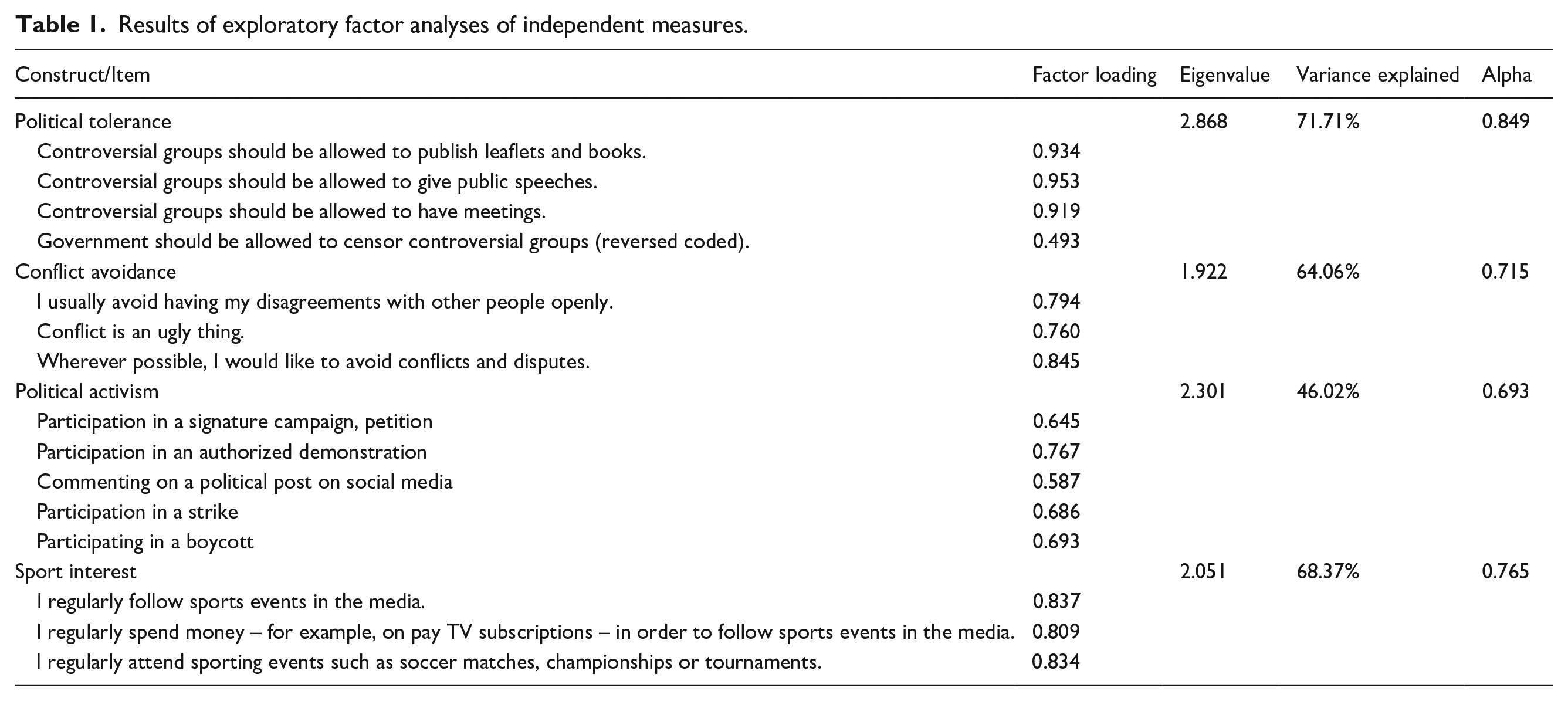
| Construct/Item | Factor loading | Eigenvalue | Variance explained | Alpha |
|---|---|---|---|---|
| Political tolerance | 2.868 | 71.71% | 0.849 | |
| Controversial groups should be allowed to publish leaflets and books. | 0.934 | |||
| Controversial groups should be allowed to give public speeches. | 0.953 | |||
| Controversial groups should be allowed to have meetings. | 0.919 | |||
| Government should be allowed to censor controversial groups (reversed coded). | 0.493 | |||
| Conflict avoidance | 1.922 | 64.06% | 0.715 | |
| I usually avoid having my disagreements with other people openly. | 0.794 | |||
| Conflict is an ugly thing. | 0.760 | |||
| Wherever possible, I would like to avoid conflicts and disputes. | 0.845 | |||
| Political activism | 2.301 | 46.02% | 0.693 | |
| Participation in a signature campaign, petition | 0.645 | |||
| Participation in an authorized demonstration | 0.767 | |||
| Commenting on a political post on social media | 0.587 | |||
| Participation in a strike | 0.686 | |||
| Participating in a boycott | 0.693 | |||
| Sport interest | 2.051 | 68.37% | 0.765 | |
| I regularly follow sports events in the media. | 0.837 | |||
| I regularly spend money – for example, on pay TV subscriptions – in order to follow sports events in the media. | 0.809 | |||
| I regularly attend sporting events such as soccer matches, championships or tournaments. | 0.834 |
Funding
The authors received no financial support for the research, authorship and/or publication of this article.
