



Abstract
This article examines the interplay between corruption, personality traits and political trust. It argues that individuals’ personality traits may condition the effect of corruption experience on trust and that these traits also affect how individuals are exposed to corrupt experiences. Using data from the AmericasBarometer 2010, the study finds that openness, conscientiousness, agreeableness and emotional stability amplify the negative effect of corruption on trust in the police. However, only extraversion amplifies the negative effect of corrupt experiences on trust in government. The study also finds that openness, extraversion, agreeableness and emotional stability are linked to exposure to corruption. The study contributes to the literature by showing that personality affects exposure to corruption and constrains the effect of corruption on political trust.
Introduction
Corruption is undoubtedly the most blatant example of poor institutional quality and affects authoritarian countries and emerging economies, as well as developed democracies (Warren, 2004). Although previous studies have argued that individuals observing corruption lower their political trust (Rothstein, 2011; Torcal and Christmann, 2021), this relationship is not unequivocal, as citizens who have paid more bribes also have been shown to only minimally decrease their trust (Morris and Klesner, 2010). Therefore, we must determine if corrupt experiences, or information thereof, will lead people to react and adjust their views accordingly.
People differ in whether they tend to be calm or tense, social or shy, or organized or impulsive. These are examples of personality traits that affect how you think, feel and behave, both politically and in your private life (Bakker et al., 2021). Moreover, personality traits are comparatively stable characteristics that appear before peoples’ first experiences of politics. Interestingly, a growing amount of research has found traits influencing political beliefs and attitudes, such as ideology, policy positions and political trust (Bromme et al., 2022; Gerber et al., 2010).
Most studies have used the big five framework to study the effect of personality on trust, which asserts that individual differences can be categorized according to five domains: openness, conscientiousness, extraversion, agreeableness and emotional stability (Mondak, 2010). However, the studies on the link between the big five and political trust have made contradictory findings. For example, extraversion, openness and conscientiousness have been found to have a positive, negative or no relationship with political trust (Freitag and Ackermann, 2016; Mondak and Halperin, 2008). As researchers do not yet know the reason for these contradictory findings, while having a good reason to expect traits to affect political trust, essential lessons are left to learn about the mechanisms.
Two crucial findings underlie the arguments of this article. First, personality traits affect individuals’ perception of corruption (Canache et al., 2019), and second, traits affect exposure to corruption in general (Cawvey et al., 2018a). I argue, therefore, that how an individual scores on personality traits magnifies or constrains the effect of corrupt experiences on political trust and thus can help explain these contradictory findings.
This article tests two pathways: first, if personality traits respond differently to corruption. To test this, I combine several large-scale population-based surveys from the 2010 AmericasBarometer covering 24 countries in both North America and Latin America. All personality traits are related to reduced political trust if asked for a bribe. Moreover, openness, conscientiousness, agreeableness and emotional stability amplify the impact of police bribery on trust in the police. Second, I investigate if people with certain personality traits are more or less likely to be selected into corrupt experiences. I find that people high in openness and extraversion are more likely to be asked for bribes, whereas people high in agreeableness and emotional stability are less likely to be asked for bribes. However, a mediation analysis shows that the corruption selection effect cannot explain the total impact of personality traits on political trust.
The remainder of the article is divided into five sections. The following section reviews findings from previous research on corruption experiences, traits and political trust. The third section develops the theoretical argument for how each personality trait process corruption experiences and is selected for corruption, and why these factors matter for political trust formation. The fourth section discusses data and empirical strategy. The fifth section tests the two pathways. Lastly, the sixth section is a concluding discussion on the lessons from the studies on traits, corruption and political trust.
The relationship between trust and corruption
The past decades have seen a surge in headlines depicting a plummeting level of political trust in society, but the reality is not as dire (Norris, 1999). A decline in political trust is concerning since it is connected to tax compliance, voter turnout, economic performance and capacity to solve collective action problems (Marien and Hooghe, 2011; Scholz and Lubell, 1998; Stockemer et al., 2013). However, having high political trust is not a virtue that should be pursued regardless of institutional behaviour, and adjusting one’s trust levels is an essential aspect of political accountability. Therefore, if institutions deliver services as promised fairly and efficiently, there are good reasons to trust institutions. Nevertheless, if institutions are corrupt and services are not delivered, the rational response is to have low trust in institutions. A reduction of trust in response to wrongdoings should evoke a response by officials since plummeting trust damages their legitimacy and, in turn, may undermine their electoral support (Letki et al., 2022; Norris, 1999).
In this article, political trust is defined as a relational concept where individuals evaluate the trustworthiness of institutions depending on their experience (See Bauer and Freitag, 2017; Meer and Ouattara, 2019). For example, the government enjoys the highest levels of trust in Argentina and Chile, whereas European governments are among the least trusted institutions. Likewise, in most countries, political parties are the least trusted institutions, but in Colombia and Mexico, the bureaucracies are awarded the lowest levels of trust (Meer and Ouattara, 2019). As political trust varies, it is advisable to study one institution at a time when conducting cross-country analysis, as their role is more comparable between countries.
Regarding the drivers of trust, the literature has pointed towards institutional performance being especially important. Good institutional performance, or institutional quality, is often defined as transparency, effective delivery of policies and impartial conduct, but the most notable example is the lack of corruption (Rothstein, 2011). Earlier studies of institutional performance focused on characteristics and delivery outcomes, and the turn to focus on individuals’ perceptions of these outcomes is fairly new (Canache et al., 2019). Notably, a common assumption was that corruption diminishes trust (Rothstein, 2011). However, research has shown that how individuals receive and process information differs (Mondak, 2010), which should affect corruption perceptions. Previous studies have also uncovered that individual-level factors like gender, education and ideology affect political trust (Zmerli and Meer, 2017). In summary, this allows for variation between individuals observing malfeasance and to what extent this affects their trust levels. 1
One-size-fits-all corruption?
One factor that could explain variation in political trust is corruption. Corruption, defined as the misuse of public power for private gain, can be observed by individuals through several chains. Although corruption is illegal and politicians will aim to conceal their misbehaviour, citizens can gain knowledge about corruption; for example, through media reports or their own experiences of interacting with government officials (Bauhr, 2017).
In the ideal case, if public officials commit wrongdoings, individuals will observe them, reduce their political trust and hold officials accountable. Citizens can take the first step in evaluating politicians and institutions, as individuals in multiple Latin American countries are equally good at perceiving corruption compared to financial experts (Canache and Allison, 2005). Counter-intuitively, previous studies have observed that voters do not throw the rascals out, and corrupt politicians keep being re-elected (Letki et al., 2022). Therefore, research should perhaps relax the underlying expectation that corruption leads individuals to dramatically lower trust, which often goes untested in the literature.
A critical factor for the effect of corruption on attitudes is that there are individual-level differences in exposure to corruption. For example, age, education and personality traits have been found to affect general corruption exposure (Cawvey et al., 2018a; Morris and Klesner, 2010).
Although most people shun corruption, individual and contextual differences exist in how permissibly they view it (Letki et al., 2022; Vera, 2020). For example, individuals often differentiate between need, speed and greed corruption. As a result, people may be more inclined to accept corrupt behaviour when it is necessary to receive fair treatment (need) (Bauhr, 2017) or if it decreases the waiting time for permits or licences (speed) (Azfar et al., 2001). Moreover, the literature has also established that people do not always evaluate bribes as negative and allow corrupt politicians to stay in power if they are competent and deliver jobs (Chang and Kerr, 2017).
Similarly, being well informed in a corrupt context was negatively related to political trust, which entails acknowledging that you cannot change the system and becoming resigned instead of indignant (Chong et al., 2015). In conclusion, individuals can be expected to exhibit different reactions and exposure to corruption.
In their seminal article, Mondak and Halperin (2008: 361) suggested that ‘explanations of political behaviour centred primarily on predictors other than personality may gain considerable additional nuance if analysts give careful attention to the possibility that individuals’ traits may magnify or constrain the effects of other processes’. With this in mind, personality traits affect exposure to corruption, interactions with bureaucrats and how these interactions translate into political trust.
Personality traits and trust
Personality research emerged in the 1930s and is a growing field. The assumptions underlying trait psychology are that personality traits exist, are measurable, vary between individuals and affect individual behaviour, and that people perceive their own and others’ personalities (McCrae and Costa, 2008).
Although there are many personality theories, 2 the most widely used models are the big five framework and the five-factor theory (Goldberg, 1992; McCrae and Costa, 2008). They are similar in that they claim that most personality differences can be characterized into five domains.
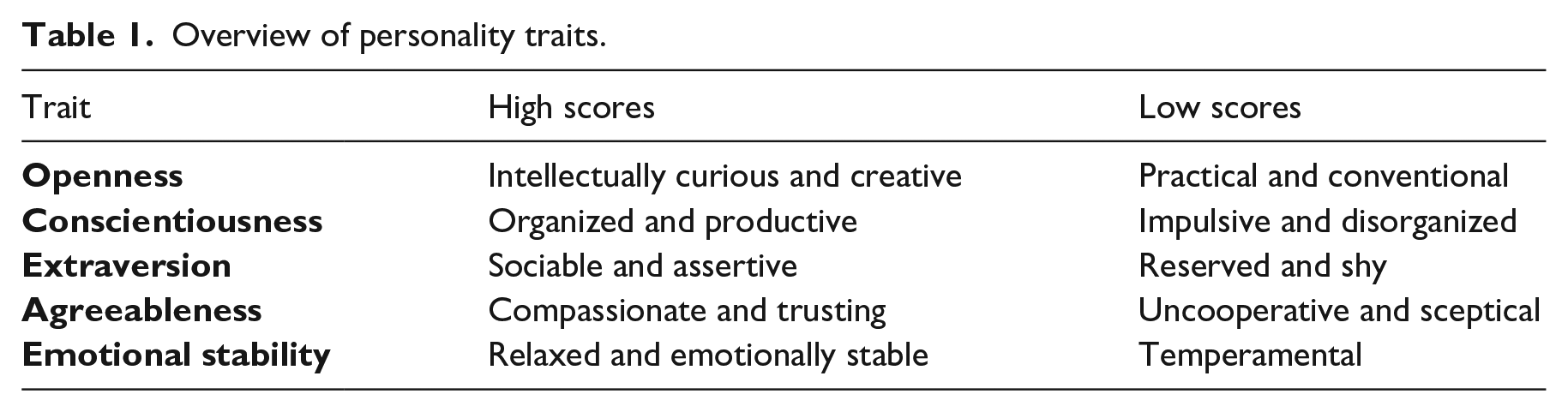
Personality models rest on the last assumption – that people can assess and describe themselves and others, and an assumption that language develops so that only words that depict valuable individual differences remain (John et al., 2008). The central mode is to collect data by asking individuals to rate to what extent adjectives describing attributes like anxiety or sociability, or behaviour like being talkative or active, relate to them. The next step is to use scaling and dimensionality methods to estimate latent personality traits, and it was this method that found the big five domains. Each domain has a continuum from low to high, where individuals are scored (see Table 1 for a description of the endpoints).
Overview of personality traits.
Researchers have shown that traits are partially genetically heritable, based on early childhood socialization, change moderately over a lifetime, are distinct from values and ideology and are equal across the globe (Funk et al., 2013; Kajonius and Giolla, 2017).
Although there are a growing number of studies on the link between personality traits and trust, there are many contradictory findings (Bromme et al., 2022; Vitriol et al., 2019). The direction of the relationship between political trust and the traits openness, conscientiousness and extraversion varies quite a lot between studies. They notably vary between having a negative or a positive association or no association. Agreeableness and emotional stability, by contrast, are found to be either positively related or not related to political trust. To find the reason for this variation, I will scrutinize the traits with the most contradictory results in more detail.
The link between trust and traits in previous research
The literature has found that openness is positively, negatively or not related to political trust (Bromme et al., 2022; Vitriol et al., 2019). Previous literature has expected highly open individuals to have low political trust because they engage in critical thinking and question the status quo, making them seek information on how political institutions work (Cawvey et al., 2018b; Mondak et al., 2017).
However, in-depth political knowledge can be beneficial since politicians and institutions sometimes deliver on their promises. For example, openness is negatively related to political trust in Latin America and positively related in countries like Germany, the Netherlands and Switzerland. One explanation for the contradictory findings could be that the studies use different measures for trust and personality or use different sampling strategies. However, this would not explain the high variation within Latin America, where the same sampling strategy and measurements were applied to all countries and respondents (Vitriol et al., 2019). In that study, the less corrupt country Uruguay showed a positive correlation between openness and political trust, whereas the more corrupt country Venezuela had a negative correlation. One study has also found that open individuals are more exposed to bribery than their conventional counterparts (Cawvey et al., 2018a). Therefore, taking corruption experiences into account may help us better understand the variation in political trust.
The next trait is conscientiousness, which has been found to have a positive, negative or no relationship with political trust (Bromme et al., 2022; Vitriol et al., 2019). The literature has put forth two diverging expectations; either their sense of duty makes highly conscientious individuals highly trusting of institutions, or their cautious disposition and low generalized trust make them less trusting (Cawvey et al., 2018b). Moreover, conscientiousness was also negatively related to participation in corrupt activities (Agbo and Iwundu, 2016), making it possible that conscientiousness is related to exposure to corruption.
The following trait is extraversion, and people scoring high on this trait have been found to have higher, lower or no different political trust compared to their more introverted counterparts (Bromme et al., 2022; Vitriol et al., 2019). There have been contradictory expectations as their social nature leads to more frequent political discussions and being reached by more information on the functioning of government which can be positive or negative. Nevertheless, the two expectations alone do not explain why extraversion has no relationship with trust in politicians and institutions in the USA but a negative association in Latin America. Moreover, extraversion has also been positively related to being solicited for bribes at work or by public institutions (Cawvey et al., 2018a) and having a higher propensity to partake in corrupt activities (Agbo and Iwundu, 2016). More empirical testing is therefore needed to know how extraversion, which is related to corruption, affects trust.
To summarize, findings in the literature on personality traits and trust are inconclusive, and no single trait has a consistent effect across studies. However, there are interesting findings that personality traits are related to perceptions of (Canache et al., 2019; Connelly and Ones, 2008) and exposure to corruption (Cawvey et al., 2018a). However, these studies treat corruption as the outcome rather than a moderating factor, thus motivating my question on how personality traits and corruption interact in shaping political trust.
Theorizing corruption, traits and trust
I argue that there are two ways for personalities and corruption to affect political trust attitudes. First, personality traits can affect how individuals process and interpret information about the behaviour of institutions. Second, personality may also affect how individuals are selected into certain situations.
For example, envisage one positive and outgoing person and one cynical person experiencing the same government interaction, say being fined for speeding. These individuals will not only react differently to the situations, but the extent to which this encounter changes their attitudes will also differ. Moreover, personality traits may affect whether you are selected into experiences, such as being fined, in the first place.
Corruption has been shown to affect trust substantially, but the effects may differ for some. Personality traits develop early and affect how individuals interpret information and experiences later in life (Freitag and Ackermann, 2016; Gerber et al., 2010). Therefore, personality traits may affect how experience with institutions is translated to trust.
I now develop arguments on how each personality trait interacts with corruption experience in affecting trust. The expectation that openness leads to low political trust rests on the assumption that politics is malfunctioning and that any information about political actors and institutions conveys that their performance is poor. Nevertheless, some political actors and institutions deliver on their promises and provide resources to the public, making them more trustworthy. Building on the argument by Canache and Allison (2005) that individuals with more capacity and resources should be better at accurately estimating performance and wrongdoings, I argue that information-seeking behaviour does not have to lead to low political trust.
By contrast, highly open individuals may consider political institutions as vessels for change rather than maintaining the status quo. Moreover, open individuals are tolerant, which means they should be accustomed to political discussions and opposing views and therefore be able to trust institutions such as the parliament, the government and political parties. Lastly, because open individuals challenge the status quo, they might also be more normatively troubled with information about malfeasance such as corruption and therefore give less trust to corrupt public institutions. Consequently, highly open individuals will place higher trust in public institutions if they are not corrupt but will punish corrupt institutions by placing low trust in them.
For the second pathway, because highly open individuals tend to opt for higher education, they may have more corrupt experiences within the education system or their work. I expect that the difference in trust levels grows more significant between those scoring high versus low on openness if they have had corrupt experiences. Since open individuals are more critical and knowledgeable, they may behave this way in their interactions with public officials when they request permits or are stopped for a vehicle inspection. Therefore, they are selected for other experiences with public institutions.
In contrast to previous research, conscientious individuals may make positive conclusions about people in public office if they prove diligent and achieve their promises. By the same logic, in a society where institutions successfully coordinate individuals in general, which reduces the risk inherent in trusting other people, it is possible also to observe high trust among the conscientious. In contrast, the opposite is to be expected in a low-performance setting. I expect that the difference in trust levels grows larger between high and low conscientiousness if these individuals have had corrupt experiences.
As for H2b, conscientiousness was negatively related to the propensity to engage in several corrupt activities (Agbo and Iwundu, 2016). Moreover, as conscientiousness is related to being hardworking and striving for success, I expect these individuals to be more exposed to corruption than their lazier counterparts.
People high in extraversion possess a social orientation that makes them focus on relationship-building exercises more than introverts. The distance to national political institutions – for instance, political parties, the parliament and the government – is significant, so they cannot build personal relationships with officials. Extraverts additionally discuss politics and experiences and interact with more people than people scoring low on extraversion, which can lead to lower trust (Mondak, 2010). Moreover, a lower dimension of extraversion is assertiveness, meaning they might hold strong positions on political performance. I expect that more information on malfeasance or achievements by institutions reaches extraverts. They use this information to formulate their trust beliefs to a greater extent than more introverted individuals. Hence, the difference in trust levels grows larger between those high on extraversion and low on extraversion if they have had corrupt experiences.
Regarding the second expectation, extraverts move around and are involved in society, which increases the likelihood of encountering public institutions. In addition, by being assertive, they may also criticize or stand their ground vis-à-vis public officials. This could mean they are selected into other experiences with public institutions that less assertive individuals are unlikely to experience.
Agreeable individuals generally trust people, and, by doing so, they also trust how people run governments and agencies. However, agreeable people shy away from contentious politics and conflicts, which could lead to low trust. Moreover, highly agreeable individuals may rely on their in-group for service provision in highly corrupt areas and therefore do not trust institutions. Corrupt environments led Canache et al. (2019: 143) to expect that ‘violations of the public trust should be the most jarring and should elicit the strongest adverse reactions, among the highly agreeable’. By contrast, Cawvey et al. (2018a) argued that when agreeable individuals get exposed to wrongdoings, they can diffuse tense situations because they are warm and likable. Although agreeable individuals might be able to diffuse these situations, they may still lose trust. Therefore, I expect that the difference in trust levels grows larger between those high on agreeableness and low on agreeableness if they have had corrupt experiences.
Concerning the second pathway, agreeable individuals rely on their in-group, do not want conflicts and might not expose themselves to situations where they might encounter corruption, and should therefore be less exposed to corruption.
In line with previous studies, I expect a positive relationship between emotional stability and political trust. I also expect that people with neurotic tendencies will cling to negative experiences to a greater extent or retain negative information about scandals than their more emotionally stable counterparts. Since these experiences are more likely in high corruption cases, I expect these differences to remain across contexts. In particular, the difference in trust levels is expected to grow more significant between those high on emotional stability and those low on emotional stability if they have had corrupt experiences. I also expect that neurotic individuals will be more critical and suspicious when interacting with others, which can lead them to other experiences with governments and the police where they may be asked for bribes.
To summarize, the relationship between openness, conscientiousness, agreeableness and emotional stability will amplify the effect of corruption on political trust. I also expect personality traits to determine whether individuals are more or less likely to be selected to have corrupt encounters.
Data and methods
The analysis of this article tests two pathways. To test the hypotheses relating to individuals having different trust levels based on their personality traits and corruption experiences, I run separate ordinary least squares (OLS) regression models with country-fixed effects of the interaction between personality traits and bribery experience on political trust. 3
The second pathway regards whether people with some traits are more or less likely to be exposed to bribery experiences. In the second part of the analysis, I fit a country-fixed effects probit model to predict the probability of personality traits being asked to pay a bribe. Moreover, I conduct mediation analyses testing whether corruption experiences mediate the effect of personality traits on political trust.
Next, I describe the data and coding of variables. I use the AmericasBarometer, which covers 24 countries in North America and Latin America and includes personality, corruption and political trust measures. The AmericasBarometer was fielded as a face-to-face survey in the spring of 2010 based on a probabilistic design stratified by major regions and municipalities. 4 The final sample includes 39,000 respondents.
Another benefit of this data is that the AmericasBarometer includes a question about experience of corruption. It is a binary outcome measured by whether respondents have been asked to pay a bribe to a police officer in the past 12 months. 5
The advantage of using bribery experience is that it mitigates some of the endogeneity concerns that respondents with high political trust are likely to assess corruption levels to be low. Although there are individual and between-country differences in corruption definitions, bribery of public officials is always considered corrupt (Hunt and Laszlo, 2012; Seligson, 2002). In conclusion, being asked to pay a bribe is not influenced by the level of trust of a respondent.
Personality is a latent construct including behavioural, cognitive and emotional components, which means it is difficult to measure directly. Therefore, self-assessment through surveys is standard (Mondak, 2010). There are, however, certain traits that may be better or worse at assessing their personality. For example, people scoring high on introspection and self-awareness may be able to accurately self-report. Another reason for biased estimates could be social desirability bias, which makes it plausible that people might under-report neuroticism.
However, self-report personality measures are widely used in psychology research and are considered reliable and valid. Furthermore, many studies show that self-report measures positively correlate with other assessments, such as observer ratings, performance and physiological measures. For example, validation techniques include brain scans or experiments manipulating emotions or cognition, to name a few (DeYoung et al., 2010; Revelle, 2009). Other studies have used survey designs and found a high correlation between countries (Kajonius and Giolla, 2017), and long and short questionnaires, as well as peer, family and self-assessment strategies (Mondak, 2010: 31–32; Romero et al., 2012).
Personality is measured with a 10-item battery called the Ten Item Personality Inventory (TIPI), where 2 items measure each trait; one captures the high and the other the low levels of the trait. Respondents were asked to rate the extent to which specific personality traits apply to them on a scale from 1, ‘strongly disagree’, to 7, ‘strongly agree’ (see wording in online Supplemental material). I combine the data from each trait and recode the trait scale from −1 to 1, where low values correspond to scoring low on that trait and vice versa.
To measure political trust, I use trust in the police for the main analyses and rerun the same analysis with trust in government in the Supplemental material. The reason to focus on these institutions is twofold. First, they are examples of different institutions: the government is political, and the police implement political decisions (Rothstein and Stolle, 2008). Second, in contrast to political parties and courts, they are institutions that most people have interacted with when requesting an ID or licence, for example. They serve, therefore, as the best conservative measurement of the micro mechanism. The questions ask to what extent does the respondent trust the national police force or national government, respectively, on a Likert scale from 1 to 7, where 1 means not at all and 7 means a lot. I recoded the variable from 0 to 1, where 0 means not at all and 1 means a lot. Trust in the police is highest in Chile and lowest in Argentina. By contrast, trust in government is highest in Uruguay and lowest in Trinidad and Tobago. The between-country variation in trust highlights the fact that individuals perceive institutions differently, as the analysis in the next section will show.
Age and gender are related to trust, corruption and personality traits and should be included in the models. Gender is coded 1 for male and 2 for female. Lastly, because personality traits develop before higher education, the latter is an intervening variable not controlled for in the main analysis. Instead, I include education as a control variable in a robustness check and find the same relationships (see Supplemental material).
Now that the data and the methods have been explained, I will move on to the empirical testing of the focal relationship.
Results
This section is divided into two parts. In the first part, I test the interaction between personality traits and bribery experience on, first, trust in the police and, after that, trust in the government. The second section accomplishes two things. First, I test the selection mechanism, whether personality traits affect the likelihood of experiencing police or government bribery. Second, I conduct a mediation analysis to test how much of the independent effect of traits is explained by the indirect impact of traits and bribery experience on trust.
Testing the interaction between traits and bribery experience
I first ran country-fixed effect models to test the direct effect of each trait on trust (see Supplemental material). As the article focuses on interaction effects, I interpret the interaction effect of personality traits and corruption experiences on trust in the police from country-fixed effects models under control for age, gender and other personality traits (see Figure 1). As expected, having a personal bribery experience is negatively related to political trust (see Table 3 in Supplemental material). Surprisingly, the link between bribery and political trust is not that strong. However, these results should not be unexpected, given recent findings regarding why individuals accept corruption.
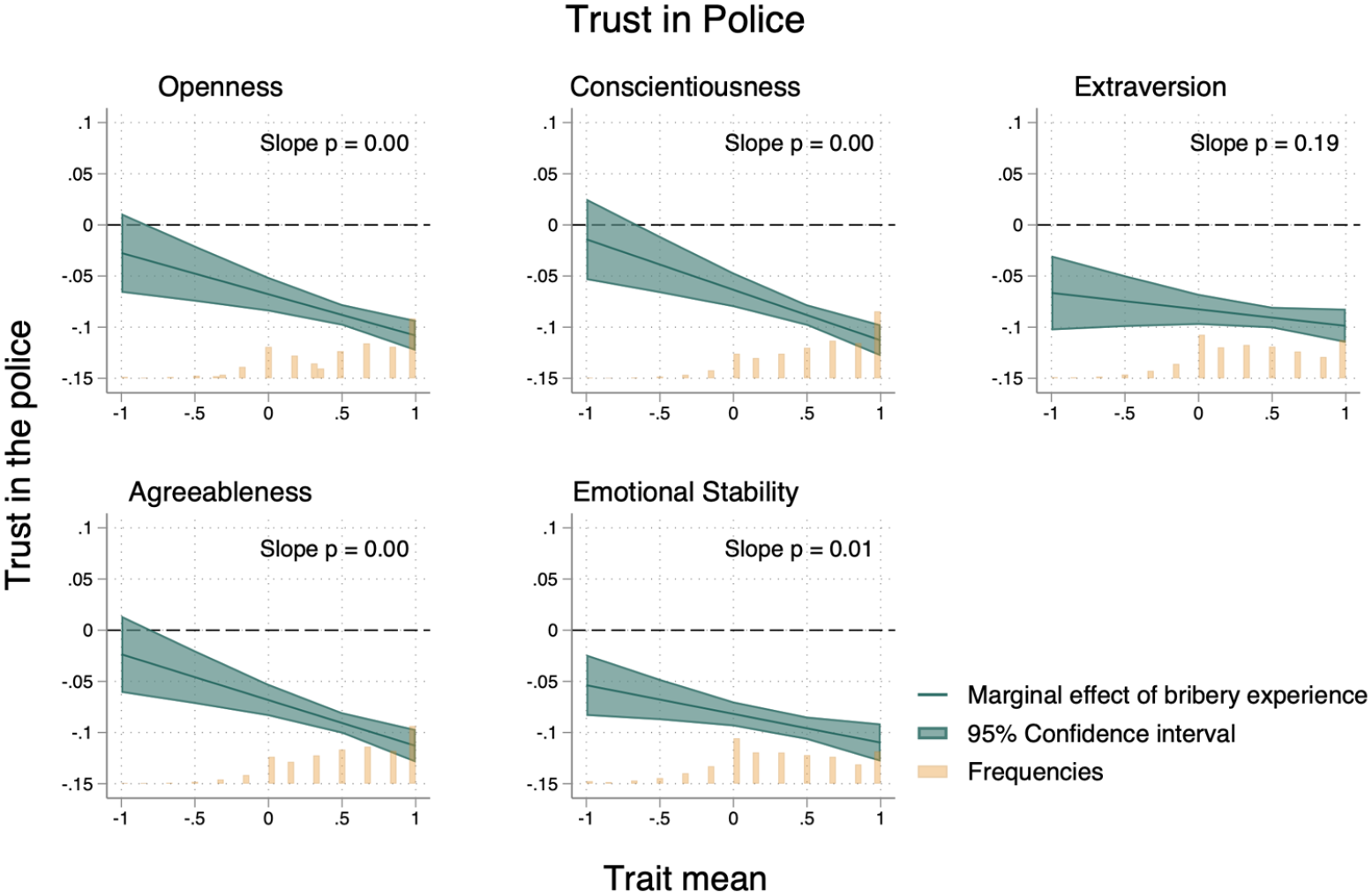
Marginal effects models show all traits, but extraversion amplifies the negative effect of bribery on trust in the police.
I find negative interaction terms for all traits but extraversion (see Figure 1). In other words, openness, conscientiousness, agreeableness and emotional stability amplify the negative effect of bribery on trust in the police. This is in line with H1a, H2a, H4a and H5a. However, extraversion does not amplify the effect of bribery experiences on trust in the police as the relationship does not reach the statistical significance level (p > .05).
Interestingly, only extraversion conditions the relationship between government bribery experience and trust in government, which supports hypothesis H3a (see Supplemental material). In this model, openness, conscientiousness, agreeableness and emotional stability do not condition the effect of bribery experience on trust in government since the results are insignificant (p > .05). Bribery experiences affect people at different levels of personality traits, similarly, meaning that hypotheses H1a, H2a, H4a and H5a may be discarded.
I therefore find support for personality traits and corrupt experiences interacting in shaping trust in one out of two institutions. One explanation could be that the government and the police ask for different bribes. For example, government bribes could entail faster expedition of licences, businesses and IDs, whereas police bribes regard traffic violations, inspections and parking. Although the analysis cannot show whether they ask for different bribes, the data suggest that personality traits affect how these experiences are translated into trust with each authority.
Testing the selection effect
In the subsequent analysis, I use probit regression to estimate the probability of people with different personality traits being asked to pay a bribe by the police or the government, with country-fixed effects. Then I test how much of the initial effect of traits can be attributed to bribery experience.
Coefficients from probit models, when all personality traits, gender, age and country-fixed effects are included, show that openness, extraversion, agreeableness and emotional stability are related to the probability of being asked to pay a bribe by a police officer or government employee (see Figure 2 here and Supplemental material). These effects are substantial; for example, open individuals are more than twice as likely to experience bribery than those scoring low on openness. Furthermore, openness and extraversion positively relate to bribery experiences, whereas agreeableness and emotional stability entail a reduced likelihood for exposure, which means I find support for H1b, H3b, H4b and H5b. However, conscientiousness is not related to government or police bribes, contrary to the expectations in H2b.
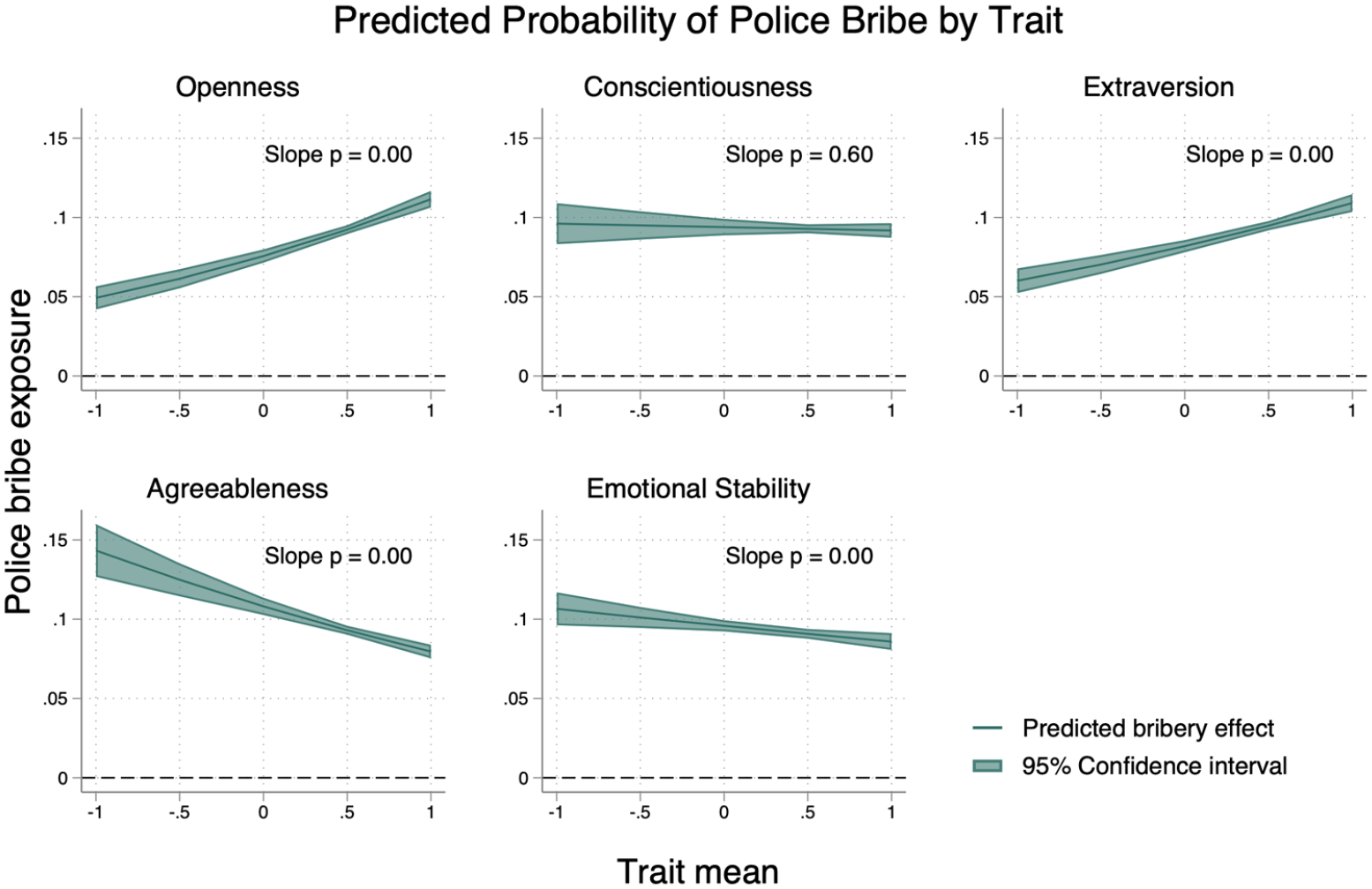
Highly open individuals are twice as likely to experience police bribery.
In essence, this section shows that even when using a conservative estimate for exposure to corruption, I find that traits are significantly related to the probability of being requested to pay a bribe. Next, I test whether corruption experience mediates the effect of personality traits on political trust. I therefore test how much of the effect of traits on political trust can be explained by bribery experience in a mediation analysis (see Supplemental material).
Notably, the direct effect of bribery on trust is small, and a partial mediation of bribery experience could only be detected for two traits: openness and extraversion on trust in the police. The lack of a reduction in trust when bribery is introduced further supports the moderating relationship between traits and corrupt experiences on political trust. Moreover, it may also entail that other experiences related to one’s personality traits may be important for political trust. It is plausible that traits affect how information about corruption or other corrupt experiences is interpreted. Lastly, a caveat for this model and all the other analyses in this article is that they are based on a survey and not an experimental design, meaning causality cannot be established.
I also tested the selection and interaction pathways using other model specifications. Results from multilevel random intercept models, and models with country-level bribery measures, show similar results for interaction and selection effects (see Supplemental material). By combining corruption experiences with a police or government employee, I find support for my hypotheses for trust in the police and the government. I also replicate Cawvey et al.’s (2018a) findings by showing that openness, extraversion and agreeableness affect bribery experiences.
Conclusion
In this article, I develop arguments and test the interplay between corruption and personality traits on political trust. My argument is twofold. First, there are reasons to expect individuals to respond differently to specific events. Personality traits may affect how individuals interpret corrupt interactions with the government and the police, affecting how they evaluate those institutions’ trustworthiness. Although previous studies have argued that corruption is a key factor affecting political trust and that personality traits can explain within-country variation in trust, no studies have considered personality traits’ conditional effect on corruption experiences and political trust.
Regarding the second pathway, previous research has shown that not all people within a country have the same experiences with public institutions. For example, age, gender and education are examples of individual-level factors that have been found to affect corruption exposure. In addition, as personality traits define how social, cynical, active or anxious people are, traits should also affect how individuals are selected into corrupt experiences.
Starting with the test of the first pathway, where I use data from the 2010 AmericasBarometer, I find that several personality traits condition the previously assumed relationship between corruption and political trust. For example, openness, conscientiousness, agreeableness and emotional stability – that is, all traits but extraversion – amplify the negative effect of police bribery on trust in the police. In contrast, only extraversion amplifies the negative effect of government bribery experience on trust in government. I therefore find support for the moderation hypotheses for one out of two institutions.
In testing the second pathway, I find that the probability of bribery exposure depends on personality traits. I show that individuals with the personality traits openness, extraversion, agreeableness and emotional stability – that is, all traits but conscientiousness – are related to the probability of encountering government or police corruption. For example, open individuals and extraverts are more likely to encounter corruption, whereas those high on agreeableness and emotional stability are less likely to be asked for bribes. Moreover, mediation analyses showed that corruption might partially mediate the effect of openness and extraversion on trust in the police. Nevertheless, I found no indication that corruption mediates the effects of the other traits on trust in the police or government. This means people rely on more experiences or information about corruption when making trust judgements.
Previous findings suggest that corruption is the most crucial factor for political trust. This study makes an essential contribution to this literature by finding that individual-level personality traits condition the effect of personal bribery experiences on political trust. Moreover, by using a very conservative estimate of corruption – namely through personal experiences of being requested to pay a bribe – this study avoids the common endogeneity problem inherent in corruption and political trust studies. I therefore avoid the common challenge to disentangle whether respondents who trust institutions say that they perceive corruption to be low from whether the perceived lack of corruption leads to higher trust.
However, some caution is warranted since the analysis comes from observational data, and more studies are needed to clarify how personality traits affect the likelihood of experiencing different types of corruption. My contribution to the research is showing that being asked to pay a bribe has a negative effect on political trust. However, from this study, it is not possible to conclude whether there is an additive effect of being asked for many bribes, whether this accrues over a lifetime or whether the type of bribe or reason for the bribe matters for trust formation, based on this study. Moreover, it is also possible that individuals do not accurately perceive officials’ signals regarding whether they want a bribe. This could entail that people trust institutions, despite officials’ wrongdoings. In conclusion, researchers have reason to re-evaluate the assumptions of a strong link between corruption and political trust.
This study makes three important contributions to the scholarship. First, by developing expectations for how personality traits magnify or constrict the effect of corruption on political trust. Second, by arguing and showing that personality affects exposure to corruption.
Third, this study exemplifies the need for research to consider the effects of personality traits and their potential moderating effects on a broader base, including, for example, perceptions of the rule of law, acceptance of corruption, and voting behaviours.
In conclusion, this is a fruitful field of study; however, many stones are left unturned before the heterogeneous effects of personality and corruption are fully understood or before we know how trust in political institutions is built.
Supplemental Material
sj-do-1-ips-10.1177_01925121231186556 – Supplemental material for Who reduces political trust after experiencing corruption? Introducing the role of personality traits
Supplemental material, sj-do-1-ips-10.1177_01925121231186556 for Who reduces political trust after experiencing corruption? Introducing the role of personality traits by Felicia Robertson in International Political Science Review
Supplemental Material
sj-do-10-ips-10.1177_01925121231186556 – Supplemental material for Who reduces political trust after experiencing corruption? Introducing the role of personality traits
Supplemental material, sj-do-10-ips-10.1177_01925121231186556 for Who reduces political trust after experiencing corruption? Introducing the role of personality traits by Felicia Robertson in International Political Science Review
Supplemental Material
sj-do-11-ips-10.1177_01925121231186556 – Supplemental material for Who reduces political trust after experiencing corruption? Introducing the role of personality traits
Supplemental material, sj-do-11-ips-10.1177_01925121231186556 for Who reduces political trust after experiencing corruption? Introducing the role of personality traits by Felicia Robertson in International Political Science Review
Supplemental Material
sj-do-12-ips-10.1177_01925121231186556 – Supplemental material for Who reduces political trust after experiencing corruption? Introducing the role of personality traits
Supplemental material, sj-do-12-ips-10.1177_01925121231186556 for Who reduces political trust after experiencing corruption? Introducing the role of personality traits by Felicia Robertson in International Political Science Review
Supplemental Material
sj-do-13-ips-10.1177_01925121231186556 – Supplemental material for Who reduces political trust after experiencing corruption? Introducing the role of personality traits
Supplemental material, sj-do-13-ips-10.1177_01925121231186556 for Who reduces political trust after experiencing corruption? Introducing the role of personality traits by Felicia Robertson in International Political Science Review
Supplemental Material
sj-do-14-ips-10.1177_01925121231186556 – Supplemental material for Who reduces political trust after experiencing corruption? Introducing the role of personality traits
Supplemental material, sj-do-14-ips-10.1177_01925121231186556 for Who reduces political trust after experiencing corruption? Introducing the role of personality traits by Felicia Robertson in International Political Science Review
Supplemental Material
sj-do-15-ips-10.1177_01925121231186556 – Supplemental material for Who reduces political trust after experiencing corruption? Introducing the role of personality traits
Supplemental material, sj-do-15-ips-10.1177_01925121231186556 for Who reduces political trust after experiencing corruption? Introducing the role of personality traits by Felicia Robertson in International Political Science Review
Supplemental Material
sj-do-16-ips-10.1177_01925121231186556 – Supplemental material for Who reduces political trust after experiencing corruption? Introducing the role of personality traits
Supplemental material, sj-do-16-ips-10.1177_01925121231186556 for Who reduces political trust after experiencing corruption? Introducing the role of personality traits by Felicia Robertson in International Political Science Review
Supplemental Material
sj-do-17-ips-10.1177_01925121231186556 – Supplemental material for Who reduces political trust after experiencing corruption? Introducing the role of personality traits
Supplemental material, sj-do-17-ips-10.1177_01925121231186556 for Who reduces political trust after experiencing corruption? Introducing the role of personality traits by Felicia Robertson in International Political Science Review
Supplemental Material
sj-do-18-ips-10.1177_01925121231186556 – Supplemental material for Who reduces political trust after experiencing corruption? Introducing the role of personality traits
Supplemental material, sj-do-18-ips-10.1177_01925121231186556 for Who reduces political trust after experiencing corruption? Introducing the role of personality traits by Felicia Robertson in International Political Science Review
Supplemental Material
sj-do-19-ips-10.1177_01925121231186556 – Supplemental material for Who reduces political trust after experiencing corruption? Introducing the role of personality traits
Supplemental material, sj-do-19-ips-10.1177_01925121231186556 for Who reduces political trust after experiencing corruption? Introducing the role of personality traits by Felicia Robertson in International Political Science Review
Supplemental Material
sj-do-2-ips-10.1177_01925121231186556 – Supplemental material for Who reduces political trust after experiencing corruption? Introducing the role of personality traits
Supplemental material, sj-do-2-ips-10.1177_01925121231186556 for Who reduces political trust after experiencing corruption? Introducing the role of personality traits by Felicia Robertson in International Political Science Review
Supplemental Material
sj-do-20-ips-10.1177_01925121231186556 – Supplemental material for Who reduces political trust after experiencing corruption? Introducing the role of personality traits
Supplemental material, sj-do-20-ips-10.1177_01925121231186556 for Who reduces political trust after experiencing corruption? Introducing the role of personality traits by Felicia Robertson in International Political Science Review
Supplemental Material
sj-do-21-ips-10.1177_01925121231186556 – Supplemental material for Who reduces political trust after experiencing corruption? Introducing the role of personality traits
Supplemental material, sj-do-21-ips-10.1177_01925121231186556 for Who reduces political trust after experiencing corruption? Introducing the role of personality traits by Felicia Robertson in International Political Science Review
Supplemental Material
sj-do-22-ips-10.1177_01925121231186556 – Supplemental material for Who reduces political trust after experiencing corruption? Introducing the role of personality traits
Supplemental material, sj-do-22-ips-10.1177_01925121231186556 for Who reduces political trust after experiencing corruption? Introducing the role of personality traits by Felicia Robertson in International Political Science Review
Supplemental Material
sj-do-23-ips-10.1177_01925121231186556 – Supplemental material for Who reduces political trust after experiencing corruption? Introducing the role of personality traits
Supplemental material, sj-do-23-ips-10.1177_01925121231186556 for Who reduces political trust after experiencing corruption? Introducing the role of personality traits by Felicia Robertson in International Political Science Review
Supplemental Material
sj-do-24-ips-10.1177_01925121231186556 – Supplemental material for Who reduces political trust after experiencing corruption? Introducing the role of personality traits
Supplemental material, sj-do-24-ips-10.1177_01925121231186556 for Who reduces political trust after experiencing corruption? Introducing the role of personality traits by Felicia Robertson in International Political Science Review
Supplemental Material
sj-do-25-ips-10.1177_01925121231186556 – Supplemental material for Who reduces political trust after experiencing corruption? Introducing the role of personality traits
Supplemental material, sj-do-25-ips-10.1177_01925121231186556 for Who reduces political trust after experiencing corruption? Introducing the role of personality traits by Felicia Robertson in International Political Science Review
Supplemental Material
sj-do-26-ips-10.1177_01925121231186556 – Supplemental material for Who reduces political trust after experiencing corruption? Introducing the role of personality traits
Supplemental material, sj-do-26-ips-10.1177_01925121231186556 for Who reduces political trust after experiencing corruption? Introducing the role of personality traits by Felicia Robertson in International Political Science Review
Supplemental Material
sj-do-27-ips-10.1177_01925121231186556 – Supplemental material for Who reduces political trust after experiencing corruption? Introducing the role of personality traits
Supplemental material, sj-do-27-ips-10.1177_01925121231186556 for Who reduces political trust after experiencing corruption? Introducing the role of personality traits by Felicia Robertson in International Political Science Review
Supplemental Material
sj-do-28-ips-10.1177_01925121231186556 – Supplemental material for Who reduces political trust after experiencing corruption? Introducing the role of personality traits
Supplemental material, sj-do-28-ips-10.1177_01925121231186556 for Who reduces political trust after experiencing corruption? Introducing the role of personality traits by Felicia Robertson in International Political Science Review
Supplemental Material
sj-do-3-ips-10.1177_01925121231186556 – Supplemental material for Who reduces political trust after experiencing corruption? Introducing the role of personality traits
Supplemental material, sj-do-3-ips-10.1177_01925121231186556 for Who reduces political trust after experiencing corruption? Introducing the role of personality traits by Felicia Robertson in International Political Science Review
Supplemental Material
sj-do-4-ips-10.1177_01925121231186556 – Supplemental material for Who reduces political trust after experiencing corruption? Introducing the role of personality traits
Supplemental material, sj-do-4-ips-10.1177_01925121231186556 for Who reduces political trust after experiencing corruption? Introducing the role of personality traits by Felicia Robertson in International Political Science Review
Supplemental Material
sj-do-5-ips-10.1177_01925121231186556 – Supplemental material for Who reduces political trust after experiencing corruption? Introducing the role of personality traits
Supplemental material, sj-do-5-ips-10.1177_01925121231186556 for Who reduces political trust after experiencing corruption? Introducing the role of personality traits by Felicia Robertson in International Political Science Review
Supplemental Material
sj-do-6-ips-10.1177_01925121231186556 – Supplemental material for Who reduces political trust after experiencing corruption? Introducing the role of personality traits
Supplemental material, sj-do-6-ips-10.1177_01925121231186556 for Who reduces political trust after experiencing corruption? Introducing the role of personality traits by Felicia Robertson in International Political Science Review
Supplemental Material
sj-do-7-ips-10.1177_01925121231186556 – Supplemental material for Who reduces political trust after experiencing corruption? Introducing the role of personality traits
Supplemental material, sj-do-7-ips-10.1177_01925121231186556 for Who reduces political trust after experiencing corruption? Introducing the role of personality traits by Felicia Robertson in International Political Science Review
Supplemental Material
sj-do-8-ips-10.1177_01925121231186556 – Supplemental material for Who reduces political trust after experiencing corruption? Introducing the role of personality traits
Supplemental material, sj-do-8-ips-10.1177_01925121231186556 for Who reduces political trust after experiencing corruption? Introducing the role of personality traits by Felicia Robertson in International Political Science Review
Supplemental Material
sj-do-9-ips-10.1177_01925121231186556 – Supplemental material for Who reduces political trust after experiencing corruption? Introducing the role of personality traits
Supplemental material, sj-do-9-ips-10.1177_01925121231186556 for Who reduces political trust after experiencing corruption? Introducing the role of personality traits by Felicia Robertson in International Political Science Review
Supplemental Material
sj-docx-29-ips-10.1177_01925121231186556 – Supplemental material for Who reduces political trust after experiencing corruption? Introducing the role of personality traits
Supplemental material, sj-docx-29-ips-10.1177_01925121231186556 for Who reduces political trust after experiencing corruption? Introducing the role of personality traits by Felicia Robertson in International Political Science Review
Footnotes
Acknowledgements
I thank Marcia Grimes, Claes Ek, Elias Markstedt, Marina Nistotskaya, Gefjon Off, Marina Povitkina, Jana Schwenk and Anna Persson for invaluable feedback. I also thank the anonymous reviewers for their helpful comments, which substantially enhanced the article. Lastly, I thank the Latin American Public Opinion (LAPOP) Lab and its major supporters (the United States Agency for International Development, the Inter-American Development Bank and Vanderbilt University) for making their data available.
Funding
The author received financial support from the University of Gothenburg for the Open Access publication of this article.

Supplemental material
Supplemental material for this article is available online.
Notes
Author biography
References
Supplementary Material
Please find the following supplemental material available below.
For Open Access articles published under a Creative Commons License, all supplemental material carries the same license as the article it is associated with.
For non-Open Access articles published, all supplemental material carries a non-exclusive license, and permission requests for re-use of supplemental material or any part of supplemental material shall be sent directly to the copyright owner as specified in the copyright notice associated with the article.
