



Abstract
To what extent are political parties responsive to voters before and after elections (that is, during the campaign and in office)? And what explains responsiveness at both of these stages: agenda-setting and decision-making? We argue that parties are more responsive at the agenda-setting stage than at the decision-making stage, and that responsiveness tends to be mediated by the type of promise (change versus status quo, and issue salience), and type of government (majority versus minority, and left- versus right-wing). This research focuses on the Portuguese case using data from party manifestos between 1995 and 2015, as well as surveys of Portuguese citizens. Findings generally support our expectations, although with some differences between parties as a whole and governments. Our results have important implications for understanding opinion–policy linkages and mandate-responsiveness, as well as more broadly for party competition.
Introduction
This article assesses how much parties are responsive to voters’ policy priorities regarding the emphasis put on policy areas in their manifestos (agenda-setting stage), and then regarding how much they fulfil pledges in the areas that voters prioritize (decision-making stage). By conceiving responsiveness as the response of parties to voters’ policy priorities at two moments, the agenda-setting and the corresponding decision-making stage, we assume that pre-electoral promises and post-electoral policy decisions should relate to voters’ preferences. As Stokes (1999a: 261–262) argues, ‘manifestos and campaigns express voters’ preferences as interpreted and aggregated by parties, so that remaining true to campaign positions is equivalent to remaining responsive to voters’ (see also Stokes, 1999b). Furthermore, we argue that responsiveness at these two stages differs across governments and pledge characteristics. This piece of research addresses two bodies of literature – on policy responsiveness (e.g. Stimson et al., 1995), and on the party pledges approach (e.g. Naurin et al., 2019) – to explore the dynamics of opinion–policy linkage before and after elections, with the objective of unravelling its causality.
By linking citizens’ preferences to public policy, party responsiveness is a core feature in conceptions of representative democracy (Lijphart, 1999). Most of the research on responsiveness has been based on the public’s policy preferences compared to government programmatic stances as measured in party manifestos and in elite or expert surveys (see e.g. Stimson et al., 1995). Another relevant body of work relies on government budgetary behaviour as an indicator of responsiveness (Kang and Powell, 2010; Wlezien and Soroka, 2012). Other sources have been explored, such as prime ministers’ or kings’/queens’ speeches in parliament (Bonafont and Palau, 2011; Hobolt and Klemmensen, 2005, 2008), and congressional hearings (Jones and Baumgartner, 2004, 2005). These studies mostly gauge responsiveness relying on a single policy venue; either on party platforms, budget behaviour or another venue. The implication is that the analysis has essentially focused on a particular moment of parties’ response to the public, which narrows the scope of our understanding of the linkage between public preferences and party decision-making. We aim to contribute to filling this gap in the literature by considering party pledges in manifestos and their corresponding fulfilment, examining the consistency in parties’ responsiveness between campaign promises and post-electoral policy; or, in other words, the predictive power of the former on the latter.
Prior studies have found that governments tend to fulfil their promises more often than not (Artés, 2011: 144–145; Costello and Thomson, 2008: 251–252; Thomson et al., 2017). Even opposition parties appear to be capable of fulfilling a large amount of electoral pledges (e.g. Artés, 2011; Serra-Silva and Belchior, 2020). This suggests that it is also worth looking at the performance of parties that are not in cabinet, while acknowledging that they are more constrained in the implementation of their programmes. For this reason, we do not limit our research exclusively to government parties, but include all parties in parliament. Furthermore, we will not be looking at the crude performance of parties (i.e. at how much they promise and how much they deliver), but at the salience they give to policies (i.e. in which policy areas they promise and deliver most). This minimizes the problem of jointly analysing parties with different status positions (in government or in opposition).
Research on responsiveness has primarily focused on the United States or Canada, and, except for the UK, much less on European cases. In addition to contributing to a better understanding of the topic in the European context, the case study of Portugal is important for two reasons. First, it has a very stable multiparty system, dominated by two mainstream parties that alternate in government – the centre-left Socialist Party (Partido Socialista; PS), and the centre-right Social Democratic Party (Partido Social Democrata; PSD). 1 Between 1995 and 2015 there were only two types of government in Portugal: socialist (a total of four) and centre-right coalition (a total of two, although only one of them was included in the analysis due to data limitations). Our sample includes both minority and majority governments (most socialist executives were minority, and the right-wing executive was majoritarian). Thus, the sample of Portuguese governments on which our analysis is based not only provides clarity in parties’ left–right positioning but also enough variance concerning government type 2 in order to explore the importance of government characteristics for responsiveness.
Second, for the study of the Portuguese case we build on extensive and unique datasets from manifesto promises and their fulfilment, between 1995 and 2015. These data exceptionally enable the analysis of responsiveness based on party pledges at the two distinct stages. By considering a time span of two decades, this study encompasses five legislatures, thus allowing a valid test of party consistency in responding to voters’ priorities in campaign promises and in their post-electoral policy.
After presenting the main contributions in the literature on the topic and supporting the hypotheses, we discuss the data sources and analysis strategies. Following this we present and discuss the findings.
Policy responsiveness: literature and hypotheses
According to the responsible party model, it is up to voters to make a conscientious, informed and rational electoral choice, and it is up to elected members of parliament (MPs) to fulfil the mandate that they have been given by voters. The electorate’s choice gives constituents indirect control over political decisions, as the party is expected to keep the promises that presumably reflect its voters’ wishes (Powell, 2004). According to this model, party responsiveness to voters is thus not only desirable but also highly likely. This argument is in line with the government party mandate doctrine (Budge and Hofferbert, 1990), although it is far from indisputable (Manin, 1997: 163–183; Stokes, 1999b).
From a less normative point of view, the model of ‘dynamic representation’ offers an important framework for the study of responsiveness. This model’s assumptions are that ‘public opinion moves meaningfully over time, that government officials sense this movement, and that – for a mixed set of motives – those officials alter their behaviour in response to the sensed movement’ (Stimson et al., 1995: 543). This research approaches the idea of dynamic representation in the sense that it is a macro-level concept focused on the dynamic of electorate preferences and parties’ responses over time (we strictly focus on two stages of electoral cycles). The model – as well as the empirical tests – suggest that among the various factors intermediating that relationship, time and the political party type play major roles. Our analysis specifically relies on and adapts these factors, among others: (a) time, measured as the agenda stage; and (b) government type. The following sections discuss each of these factors and present the corresponding hypotheses.
Agenda-setting versus decision-making stages
Few studies are based on multiple party sources to comparatively assess responsiveness (exceptions include Bevan and Jennings, 2014; Bonafont and Palau, 2011; Jones et al., 2009). Despite the importance of these studies to understand responsiveness at different moments in the policy-making process, comparisons across different stages have seldom been carried on. An exception is the Hobolt and Klemmensen (2008) study of government responsiveness operationalized as a two-stage process. They used the extent to which governments’ selective policy emphases in speeches reflected public issue preferences, which they called rhetorical responsiveness, and the correspondence between public issue preferences and budgetary priorities, called effective responsiveness. Still, this approach does not assess governments’ performance regarding different stages of the democratic process: from campaign to office. Expanding knowledge on this issue is the main purpose of our research.
Electoral manifestos are key to performing the analysis of what parties promise during campaigns and what they do afterwards relates to voters’ policy prioritization. Nevertheless, it is convincingly argued that manifestos are not good predictors of concrete policies, either due to the uncertainty of the political and economic conditions to come and the emergence of new public problems (e.g. Mortensen et al., 2011), or due to the interference of other variables, such as voters’ changing preferences (Kang and Powell, 2010). One implication is that campaign promises are potentially independent of decision-making after elections and that parties may be quite responsive to voters at one level, but not at the other. Although previous research suggests that this disconnection tends to prevail (Bara, 2005; Bonafont and Palau, 2011), the magnitude of how much parties (and, more specifically, government parties) respond to voters before and after elections is yet to be fully weighed. Systematically comparing responsiveness at both stages allows us to shed some light on this issue.
The concept of institutional friction helps to direct expectations regarding responsiveness at these two stages. This concept refers to the extent to which institutions interfere in the process of converting public demands into policy decisions, thereby slowing it down or, in extremis, immobilizing any attempts at policy change (Jones and Baumgartner, 2005). It allows us to assess the impact of institutions in responsiveness while referring to the decision costs underlying the translation of inputs into outputs regarding a specific policy venue, and the number of actors whose agreement is required for decision-making. In brief, as a policy issue moves from agenda-setting venues to decision-making, institutional friction tends to increase. The increase in friction decreases the capacity of policymakers to be responsive to the public (Bevan and Jennings, 2014; Bonafont and Palau, 2011). The level of friction associated with the different costs of promising policies, compared to that of fulfilling them, leads to the expectation that parties converge better with citizens’ policy priorities during the campaign (at the agenda-setting stage), when friction is lower, than during office (at the decision-making stage), when friction is expected to increase.
This expectation does not conflict with opposition parties lacking the parliamentary representation to pass their policies, for two main reasons. First, opposition parties manage to carry out a non-negligible part of their electoral programme. In Portugal (between 1995 and 2011) they were able to fulfil on average 30% of their pledges, while government parties accomplished about 59% (Serra-Silva and Belchior, 2020: 80; see also, for similar results on Spain, Artés, 2011). Even knowing that the promises opposition parties keep are largely dependent on the lower costs associated with compliance (Serra-Silva and Belchior, 2020), the fact that they manage to fulfil almost one-third of their mandate makes it relevant to understand whether they do it in line with voters’ priorities or not. Second, we are looking at how much voters and parties emphasize the same policy issues, and not at parties’ level of mandate accomplishment. A party may accomplish only a small part of its electoral mandate but do so in line with its voters’ preferences. Of course, government parties have a greater capacity to carry out their electoral programme than (smaller) opposition parties and, consequently, of being responsive to their electorate. However, parties may have the necessary parliamentary representation to get their proposals approved whilst prioritizing different policies from their voters. From this policy issue salience perspective, being in cabinet is not a sine qua non condition to being responsive. Thus, our first hypothesis tests whether voters’ policy prioritization is more relevant in explaining parties’ election platforms (agenda-setting) than their policy agendas (decision-making stage):
H1. Responsiveness is expected to be higher at the agenda-setting stage when compared to the decision-making stage.
The type of pledge: salience, and change versus status quo pledges
Previous research has generally found that politicians are responsive to changes in the policy preferences of the public (Bevan and Jennings, 2014; Kang and Powell, 2010; Stimson et al., 1995; Wlezien and Soroka, 2012). Responsiveness seems, nonetheless, to vary according to the complexity and the salience of the issue at stake, with less complex and more salient issues being more prone to generate higher levels of responsiveness (Bonafont and Palau, 2011).
In this vein, we claim that the issue pledged is relevant as a mediating factor in responsiveness. We anticipate that responsiveness is likely to be higher regarding more polarizing issues on the traditional left–right dimension – that is, economic issues – as there is widespread acknowledgement of their centrality in structuring that dimension (see e.g. Mair, 2007). Our argument is that more salient promises in the eyes of voters will generate higher responsiveness. With great consistency, voters tend to prioritize economic issues (Bonafont and Palau, 2011; Hobolt and Klemmensen, 2005; see, for the Portuguese case, Belchior and Freire 2013). In light of the responsible party model, we also expect parties to better respond to issues that are more important for voters. In this vein, economic issues have been identified as generating higher policy attention and being among the issues that lead to greater responsiveness (Bonafont and Palau, 2011), or at least party–voter congruence (e.g. Costello et al., 2012). Therefore, we expect parties’ responsiveness in general, and governments in particular, to be higher for economic issues. As we have neither theoretical nor empirical reasons to distinguish the effect of salience across stages of the policy process, we expect that relationship to prevail across the two stages under analysis. Our second hypothesis is thus:
H2. Responsiveness is expected to be higher regarding the most salient policy issues for voters (that is, economic issues), both at the agenda-setting and decision-making stages
Still regarding the type of pledge, we also claim that parties promise and keep more promises in a responsive way to voters’ priorities when the pledges are easier to accomplish. It is well established that pledges that maintain the status quo require less effort to be accomplished, and have higher probability of being enacted than ones that require a policy change, due to the lower costs of fulfilment (Costello and Thomson, 2008; Naurin et al., 2019). We move one step forward in the study of status quo versus change pledges by testing their moderating effect on the levels of party responsiveness to voters’ preferences. We expect that parties in general, and governments in particular, respond more to voters’ priorities regarding pledges that are easier to accomplish – that is, promising no policy change (status quo) – than to pledges promising some policy change. For the same reasons stated in the previous hypothesis, we do not foresee differences between stages of the cycle. The third hypothesis reads as:
H3. Responsiveness is expected to be higher when the pledges aim at maintaining the status quo, both at the agenda-setting and decision-making stages.
Type of government: left-wing versus right-wing and minority versus majoritarian
The two remaining hypotheses explore the mediating effects of government characteristics. Since we are now strictly looking at governments, the following hypotheses are only tested with regard to the decision-making stage.
There is modest evidence that government ideology is relevant to explaining responsiveness (e.g. Adams et al., 2009; Klüver and Spoon, 2014). Some research has even demonstrated that governments’ ideology does not have a significant impact on policy responsiveness (e.g. Hobolt and Klemmensen, 2005: 393). It is, however, reasonable to expect that executives have different incentives regarding being bound to their electorate’s issue priorities depending on their ideological placement.
In his well-known post-materialist thesis, Inglehart (e.g. Inglehart 1990) advocates that the left tends to be more focused on linking and responding to the electorate than the right; for instance, when it comes to issues on the new politics dimension. More recent research has shown that left-wing parties tend to be more in tune with their electorate with respect to economic issues than those on the right (Belchior and Freire, 2013; Dalton, 2021: 17). We extend this argument from congruence studies to governments’ responsiveness in terms of fulfilling electoral promises. We expect Portuguese left-wing governments to better respond to the issues that citizens prioritize – economic issues – when deciding which policies to implement. Apparently, there is a good chance that both tend to converge in prioritizing the most important policy issue – the economy – thus positively affecting responsiveness levels. Our fourth hypothesis is thus:
H4. Left-wing governments are expected to be more responsive when compared to right-wing governments (at the decision-making stage).
Another important characteristic in understanding governments’ responsiveness to voters is whether they have minority or majority status. Extant research following the agenda-setting approach shows that minority governments tend to be more responsive than majoritarian ones (Bonafont and Palau, 2011; Hobolt and Klemmensen, 2008). Party pledge research also finds that minority governments fulfil at least as many pledges as their majority counterparts (Artés, 2011; Moury and Fernandes, 2018; Thomson et al., 2017). Minority governments seem to have stronger incentives to perform well, as they fear for their stability and, in order to survive in office, they rely on bargaining strategies with opposition parties, so that both win in terms of execution of their respective programmes (Krauss and Thürk, 2022; Moury and Fernandes, 2018). Nevertheless, this prior research leaves out the extent to which promise fulfilment coincides with public opinion priorities. We test whether the advantage of minority government holds regarding being responsive to voters’ priorities when it comes to fulfilling promises. Our fifth hypothesis reads as follows:
H5. Minority governments are expected to be more responsive when compared to majority governments (at the decision-making stage).
Data and methods
We rely on data on pledges in party manifestos and subsequent analysis of pledge fulfilment, 3 as well as voters’ issue salience (provided by Eurobarometer and European Election Studies (EES)). In order to compare policy agendas, a coding procedure corresponding to the Comparative Agendas Project (CAP) was used for all sources (Bevan, 2019). 4 Pledges and issues were categorized according to the 21 policy categories of that project (see the distribution of pledges by category in Table A2 in the Online Appendix). Our unit of analysis is the policy area in each party manifesto, with the dataset amounting to 525 observations, each corresponding to one policy area per party per election, with 21 policy issues per election (see number of cases per party and year in Table A3 in the Online Appendix). Case selection comprises Portuguese parliamentary parties, over five election cycles and legislatures between 1995 and 2015. 5
The methodology used to identify pledges and assess their fulfilment is that conceived by Royed (see Royed et al., 2019). She identifies a ‘pledge’ as ‘the commitment to carry out some action or produce some outcome, where an objective estimation can be made as to whether or not the action was indeed taken or the outcome produced’ (Royed 1996: 79). Non-testable and vague party commitments were not included in the analysis, such as ‘To continue to support women so that they can reconcile their work and family life’. Only party commitments relating to testable actions or outcomes were included as pledges, such as: ‘To enact a new legal regime for soil policy’.
After collecting the pledges in each party manifesto, we then verified corresponding fulfilment by searching for information about their accomplishment in diverse sources, such as legislation, cabinet decisions, official websites, etc. This research is based on the CAP only as far as data encoding is concerned, strictly relying on one data source to identify the parties’ agendas: manifestos. Hence, although the sources mentioned above may also be appropriate to define parties’ agendas (e.g. Bonafont and Palau, 2011; Hobolt and Klemmensen, 2008), we consider them only to verify the fulfilment of promises. After this verification is done, pledges were classified as: (a) ‘fully fulfilled’, if evidence among the search sources demonstrated that the promise was completely accomplished; (b) ‘partially fulfilled’, if party efforts only led to a partial delivery of what was promised; and (c) ‘not fulfilled’, if there is no evidence at all indicating that the party fulfilled the pledge.
In order to ensure the reliability of the identification and codification of promises, and subsequent assessment of their fulfilment, at least two coders were simultaneously working on different manifestos and tests of cross-validation were routinely run. The tests were conducted on a random selection of a sample of manifesto pages/pledges and their identification, codification and assessment were done by a different coder. We found agreement between 80% and 90% in all cases, comparable with previous intercoder reliabilities (e.g. Thomson et al., 2017). The tests were repeated by two different coders whenever the percentage of correspondence was far from 100%, and the coding properly revised afterwards. This procedure did not imply the exclusion of cases, except those of promises considered inappropriately selected as such. These intercoder reliability tests were conducted using the procedures established for the comparative project (Royed et al., 2019).
Dependent variables
The degree of responsiveness at the agenda-setting stage is measured as the extent to which party policy attention in manifestos goes in the same direction as public policy attention. By policy attention, we mean the emphasis that is given to a policy issue, measured in terms of its recurrence (Jones and Baumgartner, 2005). In this way, a high level of responsiveness means that the party gives a similar salience to the policy area in its manifesto as the voters do. Operationally, this requires that we first compute parties’ agenda-setting in manifestos, which is one of our dependent variables. It corresponds to the following equation:

Similarly, decision-making responsiveness results from the correspondence between parties’ policy attention regarding the fulfilment of electoral promises (the policy areas parties deliver more promises) and the policy attention of the public. In order to assess responsiveness at this level we first need to assess parties’ decision-making agenda, our second dependent variable. This variable is computed as follows: 6

The option of collapsing fulfilled with partially fulfilled promises to measure parties’ decision-making stage follows the usual procedure in recent studies on mandate fulfilment (see Royed et al., 2019: 34–36). Although fulfilling a promise in full should not be considered as equivalent to its partial fulfilment, to have completed at least some action towards meeting the pledge supplies important information regarding parties’ attempts to comply with their electoral mandate. To ensure that aggregating both categories does not significantly affect the results, we have re-run the analysis only considering the fully fulfilled pledges as the dependent variable in the party decision-making equation. The results are very similar across both operationalizations of the dependent variable (see Table C1 in the Online Appendix).
Independent variables
To assess voters’ policy priorities, our core independent variable, we rely on the commonly used open-ended question asking respondents to identify the country’s most important issue (MII) for all years in our sample except for 1999, for which only the question on the most important problem (MIP) is available. On the one hand, although widely used, including the MII or the MIP in research on the comparison between elites and citizens’ policy priorities, raises a number of issues (Jones and Baumgartner, 2004: 3–4). The most relevant is related to its substantive meaning: the most important problem’s responses may be driven by problem status and not necessarily by importance or salience (see Wlezien, 2005). Despite the issues its use raises in measuring public opinion, this is a frequently used source as the ‘potential gains far outweigh the pitfalls’ (Jones and Baumgartner, 2004: 4). On the other hand, albeit not being perfect substitutes, Jennings and Wlezien (2011) concluded that asking about the most important issue or the most important problem mainly offers the same pattern of responses, with respondents’ answers practically overlapping between the two. This evidence, as well as the tests we have run to ensure that the use of the MIP in 1999 does not affect the results, 7 allows validation of the joint use of the MII and MIP in measuring voters’ policy priorities.
After coding the answers according to the CAP scheme, we computed the relative weighting given to each category as a proportion of the overall frequency of policy issues. Voters’ priorities for each policy area in a given legislature are calculated by the proportion of voters who considered a specific policy area as the most important issue/problem facing the country (vis-à-vis all areas). Although we ideally aspire to rely on voters’ data from a year before the election, the unavailability of such data prevented us from following this rule. For this reason, we used the last available public opinion survey fielded before the production of party manifestos for each general election. This option ensures that there is a time lag (although not regular) between the expression of policy priorities by voters and an eventual response by parties to those priorities (varying between a one-year time lag and only one month). 8
Government type is measured using two variables. One assesses the government’s left–right position based on the Manifesto Project. 9 We used a weight for the coalition government reflecting the number of ministers of each of the parties in the coalition (see Table A1 in the Online Appendix). This variable was rescaled so that 0 corresponds to a right-wing government (a PSD coalition with the Portuguese conservatives, the Partido Popular; CDS-PP), and 10 to a left-wing (socialist) government. The second variable measures whether a government is majoritarian, coded as 0, or a minority, coded as 1. 10
Furthermore, as is usually done, the type of pledge records whether it encompasses a policy change, or if it is a status quo commitment (Costello and Thomson, 2008; Naurin et al., 2019). As our unit of analysis is the policy area, we used the relative number of status quo pledges within each of the policy areas, in each manifesto (that is, the number of status quo pledges vis-à-vis all the pledges in the policy area, in each manifesto). We also include in our models the policy area to which the promises relate.
Among the 21 categories in which policy issues were classified, we selected the six considered as most important for citizens: macroeconomics, employment, health, justice, welfare and education. All of the selected policy areas have 4.5% or more of respondents considering the area as the most important, and altogether they comprise 94.6% of voters’ policy priority. By including in the analysis all areas with relevance in the eyes of individuals, we aim to test if responsiveness is higher when salience is higher. Each of these areas was included in the analysis as a dummy, with the policy issue coded as 1 and the remaining areas coded as 0. 11
The policy priorities of Portuguese citizens and parties’ responsiveness
As Figure 1 shows, the evolution of voters’ issue prioritization over a period of 20 years has mainly been focused on economic and employment issues. 12 Overall, there has been a tendency since the early 2000s for increased salience of economic and employment issues among the Portuguese public; a tendency that seems to have been further fuelled by the emergence of the European debt crisis in 2010. Whereas in the late 1990s issues like health and education competed for citizens’ prioritization vis-à-vis the economy, the last decade covered by our analysis has rendered these once prominent issues completely marginal.
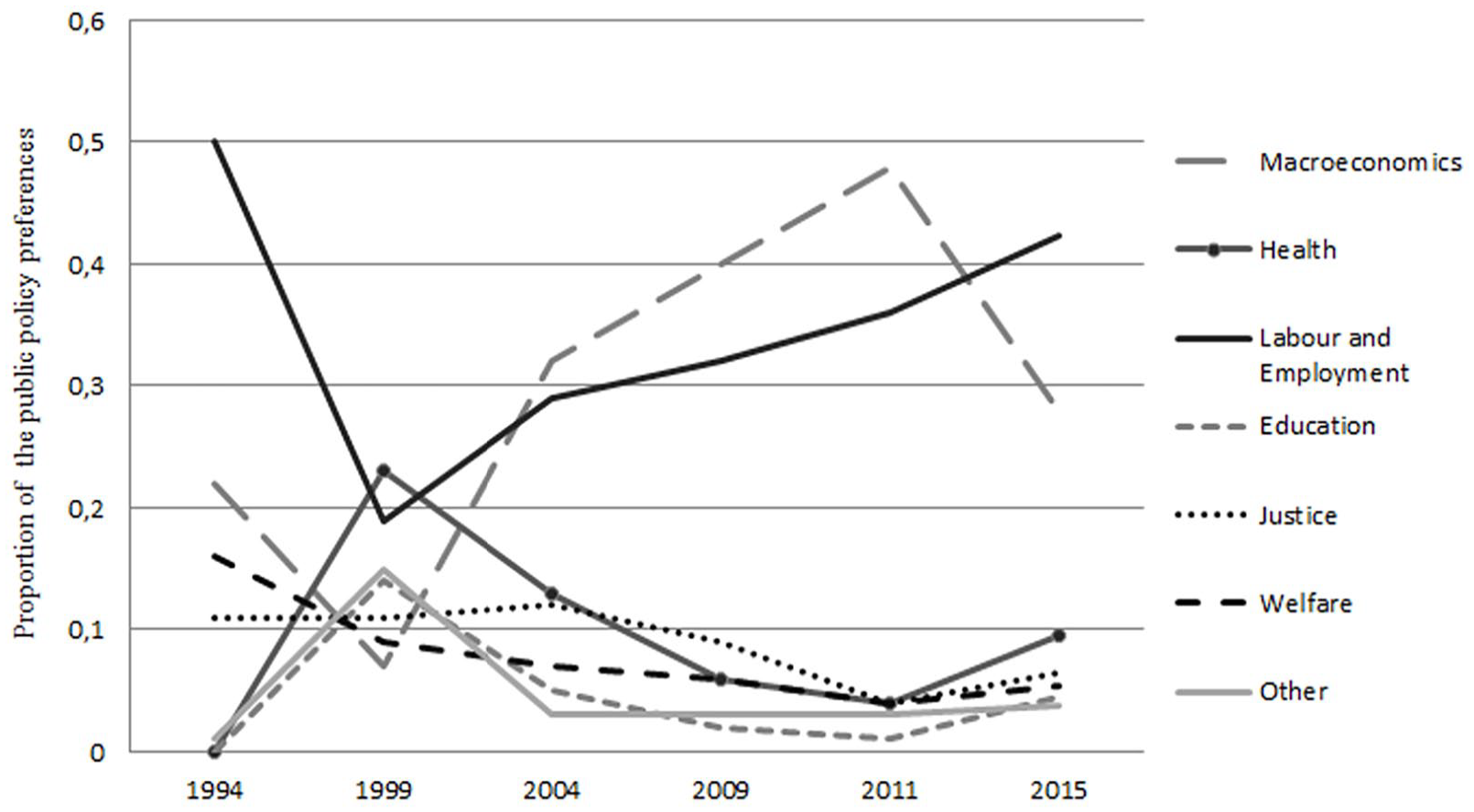
Voters’ policy priorities, 1994–2015.
Figures 2 and 3 plot parties’ position vis-à-vis voters’ policy priorities regarding pledges in manifestos (agenda-setting stage) and pledges’ fulfilment (decision-making stage) (measured, respectively, as the proportion of pledges in party manifestos and the proportion of pledge fulfilment, within the policy areas prioritized by voters). It is evident that it is easier for political parties to reflect the public’s priorities in the agenda-setting stage when compared to the decision-making stage. This evidence holds even if employment and macroeconomics are withdrawn from the analysis: the positive relationship is strengthened for responsiveness in manifestos (R2 increases to 25.3%) and weakens (becomes less negative) for responsiveness in pledge fulfilment (R2 = 1.5%). It is also relevant to point out that parties focus a very large part of their manifestos on issues that voters do not prioritize, like transportation, public administration and natural resources. This may be related to the fact that party agendas are much more diversified than those of voters (Jones and Baumgartner 2004).
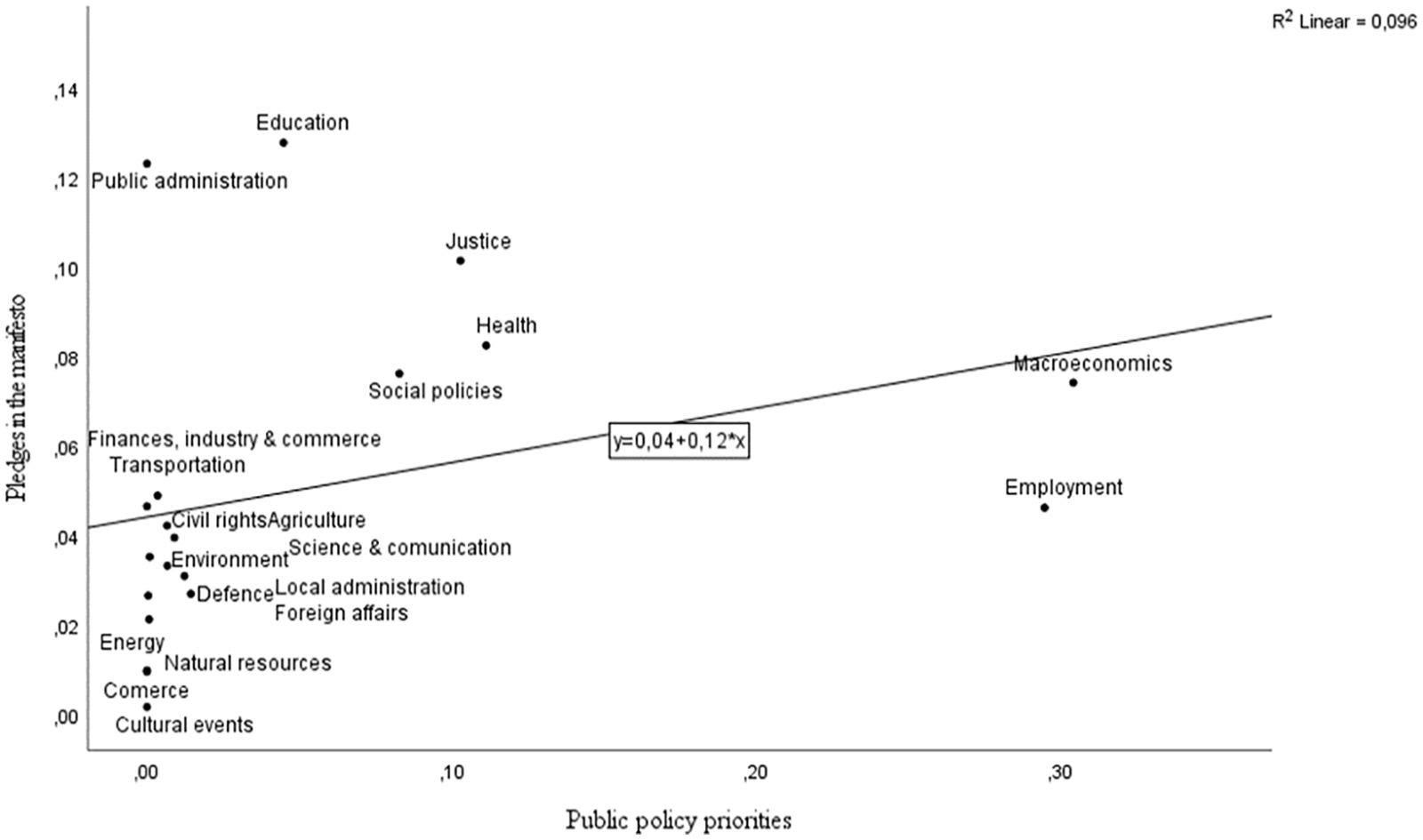
Voters’ policy priorities and pledges in party manifestos (mean proportions).
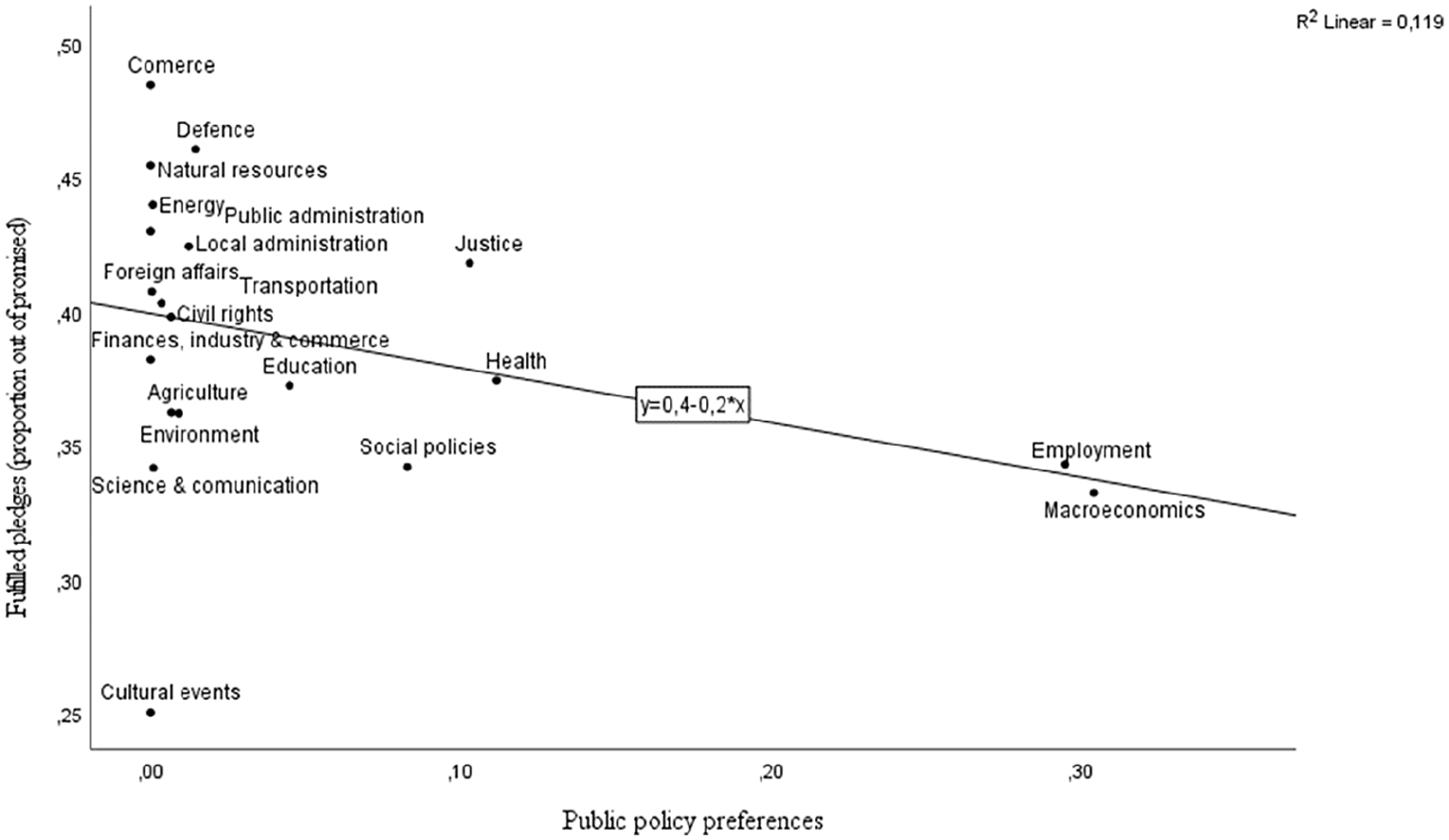
Voters’ policy priorities and fulfilled pledges (mean proportions).
Despite the tendency for parties to fulfil a large portion of their manifestos (e.g. Thomson et al., 2017), Figure 3 reveals that they fail in areas that the public prioritizes. In fact, there is an inverse relationship between public priorities and fulfilment of promises. This is highly problematic for parties for two reasons: on the one hand, if voters do not consider an issue important the political gains from fulfilling pledges are very marginal; on the other hand, and more importantly, if voters believe that parties do not fulfil promises, then the odds are that they will feel less represented and will tend to trust parties less. So, although objectively political parties are able to fulfil high percentages of their pledges, subjectively citizens will tend to believe that they do not, since they fail on the policy areas about which the citizens care most (Belchior, 2019).
Party policy responsiveness: modelling and findings
Parties are responsive to their voters’ priorities when the policy salience in manifestos (Mt) and pledge fulfilment (Ft) is correlated with voters’ priorities (V). Therefore, the model for responsiveness at the agenda-setting level is:

And the model for responsiveness at the decision-making level is:

Where β measures the degree to which parties’ policy pledges are correlated with voters’ issue salience, Z represents the other determinants of policy responsiveness (government and pledge characteristics, and control variables), α is the intercept term and ε the error term.
To test our hypotheses, we ran seemingly unrelated regressions (SUR). Given that pledge fulfilment at the decision-making stage may be related to pledge formulation at the agenda-setting stage, and that both regression lines may not be independent, SUR is an appropriate technique to use, allowing the examination of the interrelation between both agendas. 13 The two-level SUR estimators are obtained via a generalized structural equation model, with clustered standard errors by party*election year given the nested structure of the data (Heck et al., 2014: 5). The covariances between the error terms of the two dependent variables are non-significant in most cases, showing that the decision-making stage remains largely independent of the agenda-setting stage.
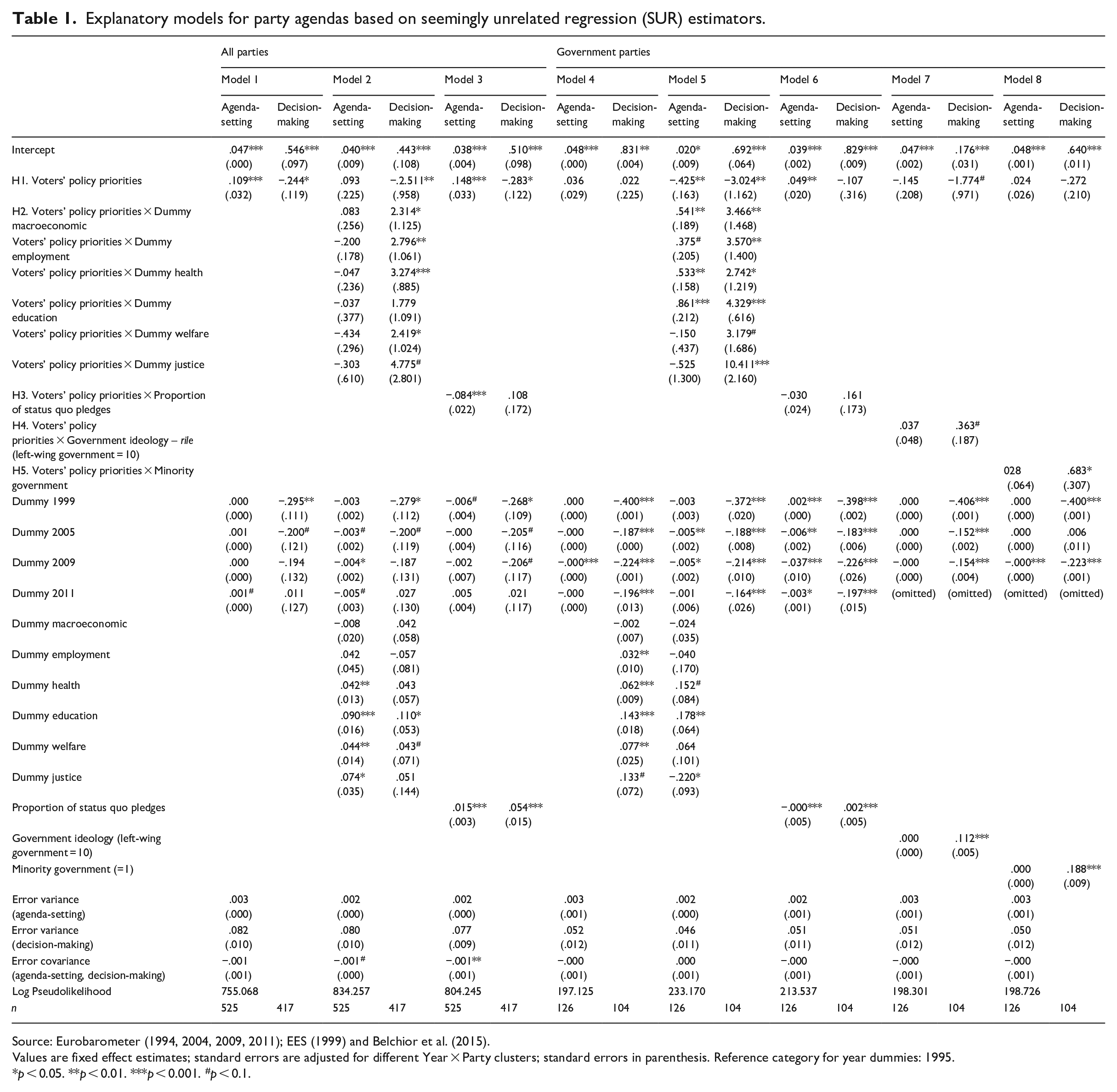
The SUR models in Table 1 test the effect of voters’ policy issue priorities (lagged) on parties’ policy attention in manifestos (agenda-setting) and pledge fulfilment (decision-making), mediated by the type of pledge (the proportion of status quo pledges) and the type of government (right-wing = 0, left-wing = 10, and majority = 0, minority = 1).
Explanatory models for party agendas based on seemingly unrelated regression (SUR) estimators.
Source: Eurobarometer (1994, 2004, 2009, 2011); EES (1999) and Belchior et al. (2015).
Values are fixed effect estimates; standard errors are adjusted for different Year × Party clusters; standard errors in parenthesis. Reference category for year dummies: 1995.
p < 0.05. **p < 0.01. ***p < 0.001. #p < 0.1.
First, for parties in general, voters’ issue prioritization is more relevant in explaining party agenda-setting than decision-making, thus partially supporting H1 (coefficients are non-significant for governing parties). Model 1 shows that voters’ priorities are related to the increase in issue attention in party manifestos, but not in pledge fulfilment. The coefficients are positive for the agenda-setting stage and negative for the decision-making stage. From this we can infer that – at least to some extent – parties take their voters’ priorities into account when constructing their electoral platforms. When it comes to policy attention at the decision-making stage, as seen before in Figure 3, voters’ policy priorities have a negative effect on the parties’ decision. That is, the fulfilment of promises is carried out in the opposite direction to the preferences of voters, with parties fulfilling more promises in policy areas different from those to which voters attach more importance. Consistent with prior work, government parties do not seem to listen to voters’ policy priorities (Klüver and Spoon, 2014), given that there is no significant effect on any of the agendas.
Therefore, if responsiveness to voters’ preferences in manifesto formulation is achieved for parties in general; when it comes to pledge fulfilment the opposite occurs. This finding is consistent with the idea of increasing institutional friction decreasing the capacity of policymakers to be responsive to the public (Bevan and Jennings, 2014; Bonafont and Palau, 2011). The negative effect of voters’ priorities on parties’ decision making (Model 1) suggests that such friction is more impactful when opposition parties are included, as no effect was found when we strictly look at government parties (Model 4). As expected, opposition parties seem to be the ones who face the greatest institutional barriers to fulfilling their mandate in accordance with voters’ priorities.
Of course, our choice regarding the measure of responsiveness may play a role in this mismatch. When using the MII and MIP we are focusing on voters’ prioritization of policy issues or problems, and not really on preferences, while party pledges are more directly related to the organization’s policy preferences. MII and MIP are proxies of voters’ preferences, simply assessing what they consider to be the highest priority policy areas at a specific time. In short, the measurements for voters and parties are not fully compatible, and the party logic of drafting a manifesto may be more in line with voters’ priorities than that of its implementation, thus affecting responsiveness. This kind of measurement problem cuts across many studies on the topic. It also affects the interpretation of our findings but does not diminish the importance of our conclusions.
Models 2 and 5 address H2, partially confirming it. Taken globally, parties do not tend to give more attention to economic issues (measured using macroeconomics and employment issues) on their electoral platforms when such issues are emphasized by their voters. However, this is not the case for government parties: coefficients are significant and positive for both issues, meaning that they tend to be responsive to voters regarding these issues in their manifestos. However, the coefficients are not more robust for economic issues than for other issues, which also represent policy areas that the public prioritizes. Note that we consider coefficients whose p value is equal to or less than 0 as statistically significant, which is justified by the small size of the samples on which the analysis is based. These coefficients must thus be interpreted with some caution.
Paradoxically, since fulfilling pledges is costlier than just promising, parties (and governments) appear to better respond to their voters’ economic priorities at the decision-making level. They fulfil more pledges in the area of macroeconomics and employment when voters prioritize such issues. For example, a 10% increase in the share of the electorate that prioritizes macroeconomics or employment will produce on average, respectively, a 35 and 36 percentage points increase in the responsiveness of government parties in that area, or a 23 and 28 percentage points increase in all parties’ response (Model 5). One likely explanation for this better performance at the decision-making level is that parties try to satisfy a broader array of constituencies in the pre-electoral period, whereas their focus narrows post-election to issues that have been traditionally tied to the evaluation of government performance, and, consequently, that voters prioritize. The coefficients for the governing parties, as well as for parties in general, are similarly high for the other dummy issues, suggesting that parties also tend to respond to voters’ priorities other than economic ones. Figures B1 and B2 in the Online Appendix depict the effect of the interactions for each policy issue, for both agendas and for opposition parties and governing parties, visually corroborating these conclusions.
When pledges are easier to accomplish, as is the case with status quo pledges, parties globally are not more responsive to voters’ priorities, as would be expected; thus H3 is rejected. Both at the agenda-setting and decision-making stages, our results suggest that when the fulfilment costs of promises are lowered, parties in general and government parties do not tend to better respond to voters’ priorities than when the pledges imply a policy change. Therefore, although being easier to accomplish, status quo pledges do not help explain parties’ responsiveness (see Figure B3 in the Online Appendix for interaction representations). 14
The remaining hypotheses and models focus on government characteristics. Government left-wing placement contributes towards explaining responsiveness in pledge fulfilment, thus confirming H4. That is, when governments are left-wing, compared to right-wing, voters have a higher chance of seeing their preferred policy priorities enacted (Model 7). 15 This is probably related to the fact that leftist governments are more directly aligned with the preferences of the electorates in terms of economic policy – a matter to which voters give priority (e.g. Belchior and Freire 2013; Bonafont and Palau, 2011). This finding contrasts with previous research that found no, or limited, evidence that the ideology of parties is relevant in explaining parties’ responsiveness or the level of pledge fulfilment (e.g. Hobolt and Klemmensen, 2005: 393). It should be noted, however, that in our sample we only had a right-wing government, which requires us to interpret the results with caution.
Finally, minority governments tend towards higher levels of responsiveness in pledge fulfilment, as the interaction with voters’ priorities is significant and positive at the decision-making stage (Model 8), thus converging with H5 (although the p value is above the conventionally established limit of 0.05). Besides performing better regarding mandate fulfilment, as previous research has largely demonstrated (e.g. Moury and Fernandes, 2018; Thomson et al., 2017), our findings add that minority governments accomplish their mandates more in line with voters’ priorities than majority ones (a factor that probably explains why the minority control variable is not significant is the small sample size). These results give strength to previous research using other operationalizations (Bonafont and Palau, 2011; Hobolt and Klemmensen, 2008), arguing that minority governments invest in responsiveness to public preferences as a way of coping with the vulnerability underlying their minority condition, in this way seeking to maximize their electoral advantage. Also noteworthy is that ideology could be affecting these results, given that all minority governments in our sample are leftist, although majority governments are not all right-wing.
Conclusions
By using an approach based on two phases of the electoral cycle – the agenda-setting (pledges in manifestos) and the decision-making (fulfilment of manifestos’ pledges) stages – we were able to demonstrate the independence in parties’ response to voters between campaign pledges and post-electoral policies. Knowing a party’s performance at one of these moments says little about the party’s performance at the other stage (as found by Bara, 2005; Bonafont and Palau, 2011). The exception to this trend concerns government parties’ responsiveness to the policy issues that voters prioritize the most. When compared to other issues, government parties are consistently more responsive to voters’ most important issues throughout the electoral cycle. Generally, the evidence supports our expectations.
First, if we consider parties globally, responsiveness becomes evident only at the agenda-setting stage, as a negative effect is observed at the decision-making stage, indicating that parties act in the opposite direction to voters’ priorities. Since governments tend to respond to the public’s issue salience at both stages, this suggests that the decreasing capacity of parties to be responsive to the public in pledge fulfilment is a consequence of increasing institutional friction (Bevan and Jennings, 2014; Bonafont and Palau, 2011), which especially affects opposition parties. This is in line with the fact that these parties face higher costs in fulfilling their promises (Serra-Silva and Belchior, 2020). Apart from the institutional friction explanation, this might also be related to what Adler and Wilkerson (2013) call problem solving. A substantial part of the legislative agenda seems to be less impelled by electoral manifestos, and more by events in society and established law-making routines, moving parties away from their initial priorities.
Second, voters’ priority issues – macroeconomics and employment, but also non-economic issues – tend to be better accommodated by parties at the decision-making stage than in campaign manifestos. This is the case for parties as a whole, and also for government parties, suggesting that alignment with voters’ demands in pledge fulfilment is not strictly due to party control of the executive power.
Third, although being a left- or right-wing government does not seem to make a difference regarding the policy issues to which government parties give more emphasis, being a left-wing government enhances responsiveness, since such governments tend to fulfil more electoral pledges in the policy areas prioritized by the public. Note, however, that in our sample we have four socialist governments and only one right-wing coalition which advises us to take this result with caution.
Fourth, consistent with prior research (Bonafont and Palau, 2011; Hobolt and Klemmensen, 2008), minority governments tend to be more responsive to voters’ issue priorities than majority governments when it comes to pledge fulfilment. The higher responsiveness of minority governments might be related to the government’s sense of insecurity and the need to make compromises and strike bargains with opposition parties to pass legislation, leading to pledge fulfilment for a wider array of constituencies. Despite the constraints in the variance of our sample of governments, the evidence we gathered allows us to conclude that the type of government, in terms of both its ideology and its constitution, seems to mediate party responsiveness, at least as measured by policy issue attention. It remains to be seen whether the policies decided by governments are likewise convergent with the preferences of individuals, or whether convergence in attention has underlying divergence in terms of the public policies that are adopted, as prior research suggested (Klüver and Spoon, 2014).
Our findings have relevant implications for the understanding of the opinion–policy linkage and mandate-responsiveness, and also have important consequences related to party competition. Besides reiterating that parties tend to be responsive to voters’ issue priorities, we were able to demonstrate that there are significant differences across agenda stages and governments with respect to the level of responsiveness that a given policy issue generates. Although generalization of our conclusions is not possible, it is nevertheless reasonable to suppose that similar results may be reached in relatively stable party systems such as the one in Portugal, where two ideologically opposed mainstream parties alternate in power. The prevalence of minority executives may also underlie the reach of similar results, given the importance they seem to have in terms of responsiveness. More work is needed, especially following a comparative approach, to examine whether our results may actually be exported to other contexts.
Supplemental Material
sj-docx-1-ips-10.1177_01925121231155140 – Supplemental material for Party policy responsiveness at the agenda-setting and decision-making stages: The mediating effect of the types of government and promise
Supplemental material, sj-docx-1-ips-10.1177_01925121231155140 for Party policy responsiveness at the agenda-setting and decision-making stages: The mediating effect of the types of government and promise by Ana Maria Belchior, Hugo Ferrinho Lopes, Luís Cabrita and Emmanouil Tsatsanis in International Political Science Review
Footnotes
Acknowledgements
The authors would like to thank the four anonymous reviewers for their insightful comments and suggestions. Earlier drafts of this article were presented at the European Consortium for Political Research (ECPR) Standing Group on Analytical Politics and Public Choice’s conference ‘Analyzing Strategic Interactions in Political Decision-Making’ and at the 24th International Political Science Association (IPSA) World Congress. We thank the participants for their valuable feedback.
Funding
The authors disclosed receipt of the following financial support for the research, authorship and/or publication of this article: The research reported in the article has benefited from funding from the Portuguese Foundation for Science and Technology (FCT, Grant no. PTDC/IVC-CPO/3921/2012).

Supplemental material
Supplemental material for this article is available online.
Notes
Author biographies
References
Supplementary Material
Please find the following supplemental material available below.
For Open Access articles published under a Creative Commons License, all supplemental material carries the same license as the article it is associated with.
For non-Open Access articles published, all supplemental material carries a non-exclusive license, and permission requests for re-use of supplemental material or any part of supplemental material shall be sent directly to the copyright owner as specified in the copyright notice associated with the article.
