



Abstract
Mass movements that are able to overthrow a dictator do not always lead to democracy. Transition periods present narrow windows of opportunity in which activists face difficult decisions to build democracy and prevent authoritarian relapse. Existing scholarship offers limited guidance for pro-democracy forces because it focuses on unchangeable structural factors and cases with a known outcome. We propose an innovative approach for finding informative comparisons for ongoing transitions after authoritarian breakdowns. We quantify the similarity between all breakdowns caused by mass uprisings since 1945 based on their structural preconditions. We then apply our approach to Sudan’s ongoing transition and draw lessons from two similar cases: the Philippines in 1986 (successful democratization); and Burma/Myanmar in 1988 (failed democratization). Our analysis shows that structural factors are weak predictors of transition outcomes and that Sudan shares characteristics with cases of both failed and successful democratization. Therefore, democratic transition appears possible in Sudan.
Introduction
Mass uprisings against autocratic rule are rare events that raise hopes of democratization. Yet overthrowing a dictator is only the first step. Daunting tasks lie ahead for pro-democracy forces, as most authoritarian breakdowns lead to the rise of new authoritarian regimes. 1 Such forces face myriad decisions after an autocrat’s ouster: whether to engage in formal politics or stay in the streets, prosecute, or compromise with former regime elites, unite behind one leader or encourage political pluralism. These dilemmas give rise to heated debates, often without much guidance from empirical research.
What can political actors do in the wake of authoritarian regime breakdown to facilitate democratic transitions? Building on the literature on controlled case comparison (Lijphart, 1971; Przeworski and Teune, 1970; Slater and Ziblatt, 2013) and new advances in matching methods (Nielsen, 2016), we propose a framework for selecting comparative cases in studies of democratic transitions after authoritarian regime breakdowns. We identify 28 structural factors, including regime characteristics, democratic history and level of development, that extant political science scholarship relates to a country’s chances of democratization during a transition period (e.g., Rød et al., 2020).
Using machine learning algorithms for classification, we then show that preexisting structural factors perform poorly at distinguishing successful from unsuccessful democratization episodes after authoritarian breakdown. We suggest that this heterogeneity in outcomes amid similar structural conditions may suggest a greater role of agency in shaping the outcome of democratic transitions than is often recognized. 2 For our matching procedure, we keep these structural factors constant to find comparative cases that hold lessons for pro-democracy forces during transitions.
As a proof of concept, we apply our method to the ongoing transition in Sudan. The method points to comparative cases beyond Africa and the Middle East and yet can shed light on the uprising that ousted Sudanese dictator Omar al-Bashir in 2019. These cases are the Philippines in 1986 and Burma/Myanmar in 1988. Whereas the Philippines successfully transitioned to democracy after its dictator was toppled, Burma/Myanmar did not. Although democracy faces major challenges in Sudan, the outcome of the transition may not be predetermined by adverse structural conditions.
Our approach makes several contributions to existing research on democratic transitions. First, instead of comparing countries that are geographically or culturally proximate, we use a theoretically motivated list of structural factors that previous research has deemed important for democratization. This procedure allows us to find potentially informative comparative cases that may not be obvious at first sight. Second, existing scholarship focuses largely on structural factors such as economic development or natural resource endowment that actors cannot change. These theories offer little guidance to pro-democracy forces who wish to prevent an authoritarian relapse. Our findings point to a possible role for actors’ agency in shaping transition outcomes in line with the ‘democracy by mistake’ thesis (see Treisman, 2020). Finally, we depart from existing scholarship by comparing a transition with a yet unknown outcome to completed cases. We argue that these theoretically founded comparisons are especially valuable for transitions that are still ongoing because this is the phase where comparative evidence is most needed.
Structure and agency in democratic transitions
If overthrowing an authoritarian regime is hard, building democratic institutions after the autocrat’s ouster is even harder. Even in the case that the incumbent dictator loses the ‘endgame’ (Croissant et al., 2018), the breakdown of an authoritarian regime very often leads not to democracy but to another authoritarian regime. What should pro-democracy forces do after successfully ousting an autocrat?
Extant literature on democratization offers only partial guidance. On the one hand, structuralist approaches see democratization as the result of economic, social and political processes that are outside the actors’ control (Lipset, 1959; Ross, 2001). On the other hand, actor-centric approaches hold that actors’ decisions matter for democratization (c.f. O’Donnell and Schmitter, 1986; Rustow, 1970; Di Palma, 1990). For instance, O’Donnell and Schmitter (1986) famously argue that civil society actors should strive for moderation and seek to make a pact with former regime elites; otherwise, democracy is unlikely to take hold. 3 Yet this theory of pacted transitions was later criticized by scholars who argued that it poorly explains the trajectories of post-communist countries (McFaul, 2002). Thus, although actor-centric approaches are better suited for providing policy guidance than structuralist approaches, the lessons they provide may be context-specific and difficult to implement in practice. What ‘worked’ in one case of democratic transition may not work in a different one.
In this article, we address these issues by building on the scholarship on small-N empirical research, which advocates the careful selection of a few cases for dealing with causal heterogeneity (Gerring, 2011: 270). Building on recent advances in matching methods, we design an empirical approach to hold structural factors constant and select comparative cases for qualitative research.
Learning from ‘most similar’ transitions
A large literature is devoted to designing methods for the optimal selection of cases for improving inference (Brady and Collier, 2004; King et al., 1994; Lijphart, 1971; Przeworski and Teune, 1970). In both quantitative and qualitative research traditions, the goal is to select cases that are most similar on some set of covariates and only differ on one independent variable of interest (Ho et al., 2007; Iacus et al., 2012). Such ‘most similar’ case selection, which John Stuart Mill called the Method of Difference, is challenging in practice because a large number of factors could theoretically be relevant, and it is unclear which ones to choose (the problem of ‘many variables, small number of cases’ [Lijphart, 1971: 685]).
Given these difficulties, scholars often select cases that are geographically proximate and share a common culture or history to account for multiple and potentially unobserved structural differences that could confound the results (Anckar, 2008). Although valid (see e.g., Morency-Laflamme, 2018), this approach limits the number of comparable cases from which one can learn. This is an issue, in particular when studying rare events such as authoritarian regimes’ breakdowns caused by mass uprisings. Thus, in many studies, cases from other world regions could be more suitable for systematic comparison. As a recent study by Bogaards (2019) reveals, many case studies in democratization research only apply systematic rules to case selection implicitly, if at all, which limits our ability to learn from country comparisons.
Moreover, scholarly research mainly focuses on completed, past transitions offering little guidance for pro-democracy activists when they need it most, namely while a transition is ongoing. Although this approach is perfectly in line with the scientific method, it neglects that important lessons from other cases can be drawn without knowing the outcome of the main case of interest.
We propose an innovative approach for finding useful comparisons for ongoing transitions after authoritarian breakdowns focusing on what actors can do to increase the chances of a successful transition. As a first step, we compile data on various structural background factors that should affect whether a country is more or less likely to democratize for all cases of authoritarian breakdowns caused by mass uprisings since 1945. Second, we quantify the similarity between them by first applying dimension reduction (principal component analysis (PCA)) and then using the Mahalanobis distance (Ho et al., 2007), a metric for measuring similarity between observations in quantitative and qualitative research (Nielsen, 2016). The method allows us to identify most similar cases among the universe of cases. Third, we apply our method to Sudan as a case of an ongoing transition and identify cases with similar structural preconditions for a small-n case study. While a full comparative study is beyond the scope of this paper, we highlight some lessons from the Philippines 1986 and Burma/Myanmar 1988 to identify takeaways for pro-democracy forces in Sudan.
Identifying and quantifying structural conditions
Our universe of cases consists of all authoritarian regime breakdowns prompted by mass uprisings since 1945. The list is based on the Authoritarian Regimes Dataset by Geddes, Wright and Frantz (GWF) (Geddes et al., 2014), which covers the period 1945–2010. For the post-2010 years, we relied on the expanded GWF data, as provided by Derpanopoulos et al. (2016) and the Rulers, Elections, and Irregular Governance (REIGN) dataset (Bell et al., 2021) to identify regime changes from autocracy to democracy or another authoritarian regime. 4 Based on our assessment of these data, we identified 47 cases in total since 1945. We treat those cases as successful that were democratic five years after the breakdown. 5 By these standards, 19 countries had successfully transitioned to democracy and 25 had failed – including Sudan in 1985. In three cases – Armenia (2018), Algeria (2019) and Sudan (2019) – the outcome of the transition is still unknown.
To derive a measure of similarity regarding structural conditions between cases of regime breakdown, we proceed in two steps. First, we conduct a review of existing scholarship on democratic transitions and distill a list of variables believed to influence democratization. 6 We then complement our list by adding variables that Rød et al. (2020: 103) classified as ‘highly robust determinants for all democracy measures’ in their comprehensive sensitivity analysis of 67 potential determinants of democracy. 7 Our final list of selected variables comprises 28 factors and covers five major areas: economic development; civil society; political regime; (in)stability; and demographic factors. A full list of variables can be found in Table 1.
Structural variables included in the principal component analysis and matching procedure.
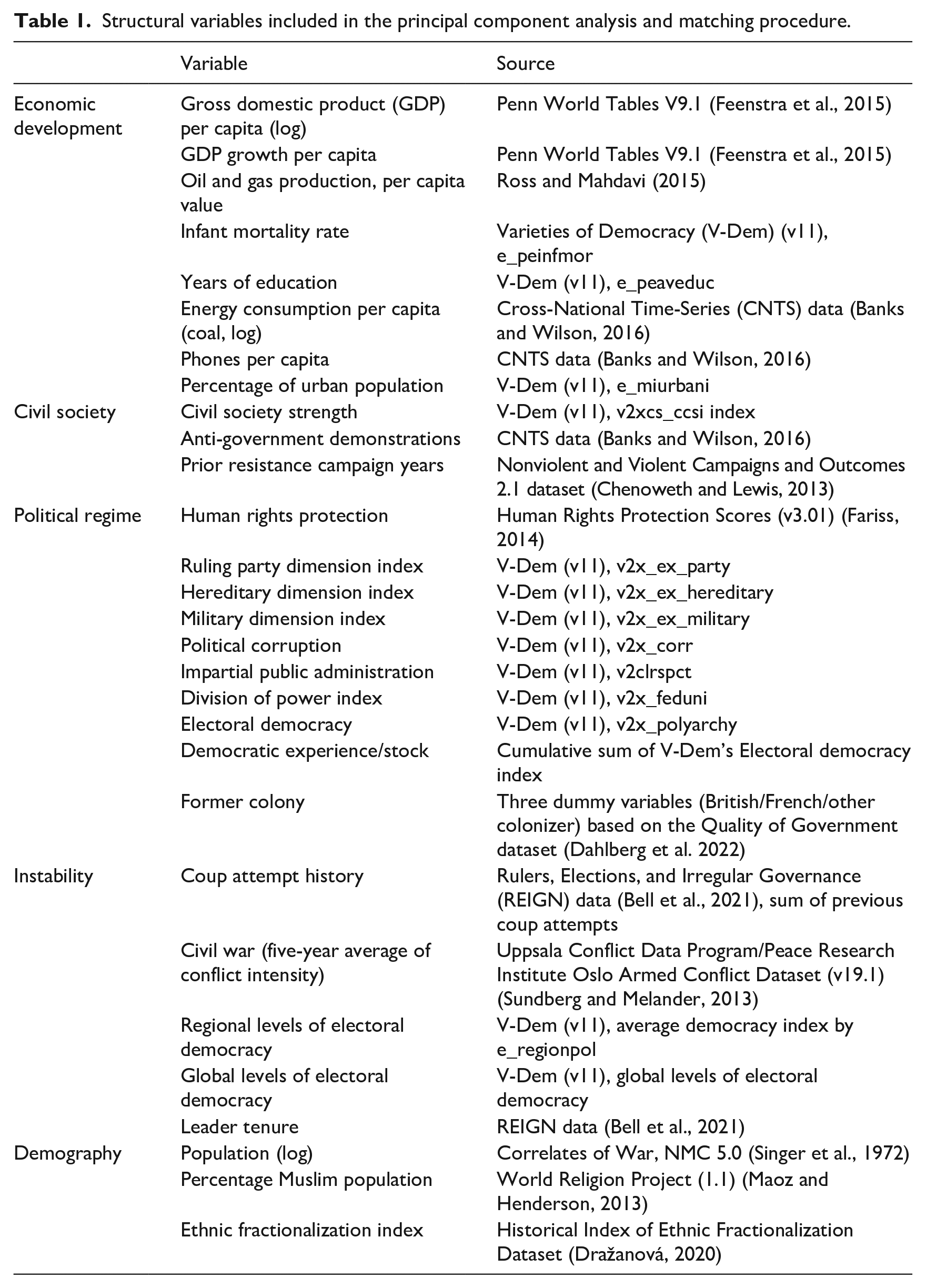
First, we include variables that capture countries’ different levels of economic development. Economic factors may matter for democratization in multiple ways (Haggard and Kaufman, 2018). According to modernization theory (Inglehart and Welzel, 2009), economic development empowers pro-democracy forces by increasing citizens’ economic and social resources. Economic crises are, in some cases, a direct cause of autocratic breakdown and weigh heavily on the transition process (Przeworski, 1995). In addition, economic development is associated with capital mobility, which is why elites in well-developed countries might be more open to democracy as they can evade taxes (Boix, 2003). Similarly, existing research points to education as an important determinant of democratization (Barro, 1999). In the matching analysis, we, therefore, include total gross domestic product (GDP) per capita, GDP growth per capita (Feenstra et al., 2015), years of education and infant mortality as indicators for development (Coppedge et al., 2021, based on gapminder.org and Clio Infra). Existing research also emphasizes the importance of natural resources for authoritarian persistence and democratization, which is why we add data on oil and gas production per capita (Ross, 2001; Ross and Mahdavi, 2015). Another important aspect for democratization is industrialization and the rise of the middle classes and working classes. Our data include information on urbanization rates to capture the democratizing effect of industrialization. Finally, we include energy consumption per capita and the diffusion of phones as the sensitivity analysis by Rød et al. (2020) shows that both factors are robust predictors of democratization.
Second, we include measures of civil society strength and mass mobilization. A strong civil society is argued to be a crucial prerequisite for successful democratization (Bernhard and Karakoc, 2007). The degree of organization of civil society affects the dynamics of mass-based mobilization and has an impact on whether or not opposition forces can organize and negotiate the transition outcome with former regime elites and the military. The Varieties of Democracy (V-Dem) core civil society index provides an aggregated measurement of government control over and repression of civil society (Coppedge et al., 2021; Pemstein et al., 2020) and thus takes these important differences between regimes prior to regime breakdown into account. Moreover, we include information on a country’s history of mass mobilization by including the number of past anti-government protests (Banks and Wilson, 2016) and resistance campaign years as recorded in the Nonviolent and Violent Campaigns and Outcomes (NAVCO 2.1) Data Project (Chenoweth and Lewis, 2013). 8
Third, we consider differences in the outgoing political regime and potential legacies as prospects for democratization may look different after the breakdown of military or single-party regimes. Militaries with a history of being in power are determined to maintain their prerogatives at the end of the transition (Brownlee et al., 2015), and they are likely to intervene and end democratic experiments (Bratton and Van de Walle, 1997). Therefore, we include recently developed measures of the executive’s power base. Teorell and Lindberg (2019) provide a continuous measurement of the political importance of the military, as well as indicators of party dominance and hereditary rule. Moreover, we add a measure for the protection of human rights under the old regime (Fariss, 2014), the level of electoral democracy (from V-Dem), and the democratic experience a country has accumulated up to the point of regime breakdown. This helps us to identify cases with similar democratic legacies, similar ruling structures, and levels of state repression. Furthermore, we include information on public administration impartiality, political corruption, the institutional division of power within a country, and a country’s colonial past. All factors are associated with democratization and democratic stability, according to Rød et al. (2020).
Fourth, a country’s history of (in)stability affects prospects for future stability. Coups d’état are a prime challenge for democracy and past coups are, together with other factors, a good predictor for future coups (Belkin and Schofer, 2003). For that reason, our matching approach uses information on the length of tenure of the previous authoritarian leader and the number of previous coup attempts. These data are taken from the REIGN dataset (Bell et al., 2021). Similarly, we include information on the level of intra-state conflict during the last five years before regime breakdown using data from the Uppsala Conflict Data Program (Sundberg and Melander, 2013). Intra-state conflicts such as civil war or territorial conflicts make it more challenging to achieve consensus on the future path of the country and produce grievances that can cast a shadow on the transition process. Similarly, research suggests that neighbourhood effects matter. Democratic transitions should be easier to achieve when a country is surrounded by democratic neighbours, which are less likely to spoil democratization than autocratic neighbours. We, therefore, include global and regional democracy scores based on V-Dem’s Electoral Democracy Index. 9
Finally, we include important demographic factors. For instance, country size has been argued to affect a state’s capacity to respond to its citizens’ needs (Dahl and Tufte, 1973). We use data on population size from the Correlates of War project (Singer et al., 1972). Moreover, some have argued that Islam makes democratization less likely (Fish, 2002). Our dataset includes information on the Muslim population of all countries, as provided by the World Religion Project (Maoz and Henderson, 2013). For similar reasons, we look at ethnic fractionalization using data by Dražanová (2020), as it has been argued that ethnically diverse countries are less likely to democratize compared to more homogeneous countries (Rabushka and Shepsle, 1972).
Table 1 presents all variables and data sources. All variables are measured one year before the year of regime breakdown (or the latest available year when data are missing). 10
Reducing dimensionality by PCA
Given the high number of variables in the dataset, we first reduce dimensionality by using PCA. PCA creates new variables that are linear combinations from all input variables and capture as much variation as possible. Since many of the variables included in the data are related, we seek to avoid giving disproportionate weight to variables that measure the same underlying concepts. All variables are centred and standardized. The scree plots reveal that approximately 50% of the variation in the data can be explained using the three first principal components (see Figure A.1 in the Online Appendix), which is why we consider the first three components in the matching analysis. In addition, using three principal components reduces the risk of overfitting, which is important given the small sample size (n = 47). As we explain below, three principal components are optimal for minimizing sampling variability and are thus preferred here.
To illustrate the results from the PCA, we plot the variables that contribute most to the first two major components in Figure 1. The first dimension, which accounts for about 24% of the variation in the dataset, comprises variables related to a country’s level of development such as the availability of smartphones, infant mortality, education, and energy consumption. The second dimension (15% of total variation) represents variables concerning political order and includes civil wars, coup attempts, demonstrations, and repression. Dimension three consists of factors associated with democratic resources such as a strong civil society, prior levels of electoral democracy and democratic stock (see Figure A.2 in the Online Appendix).
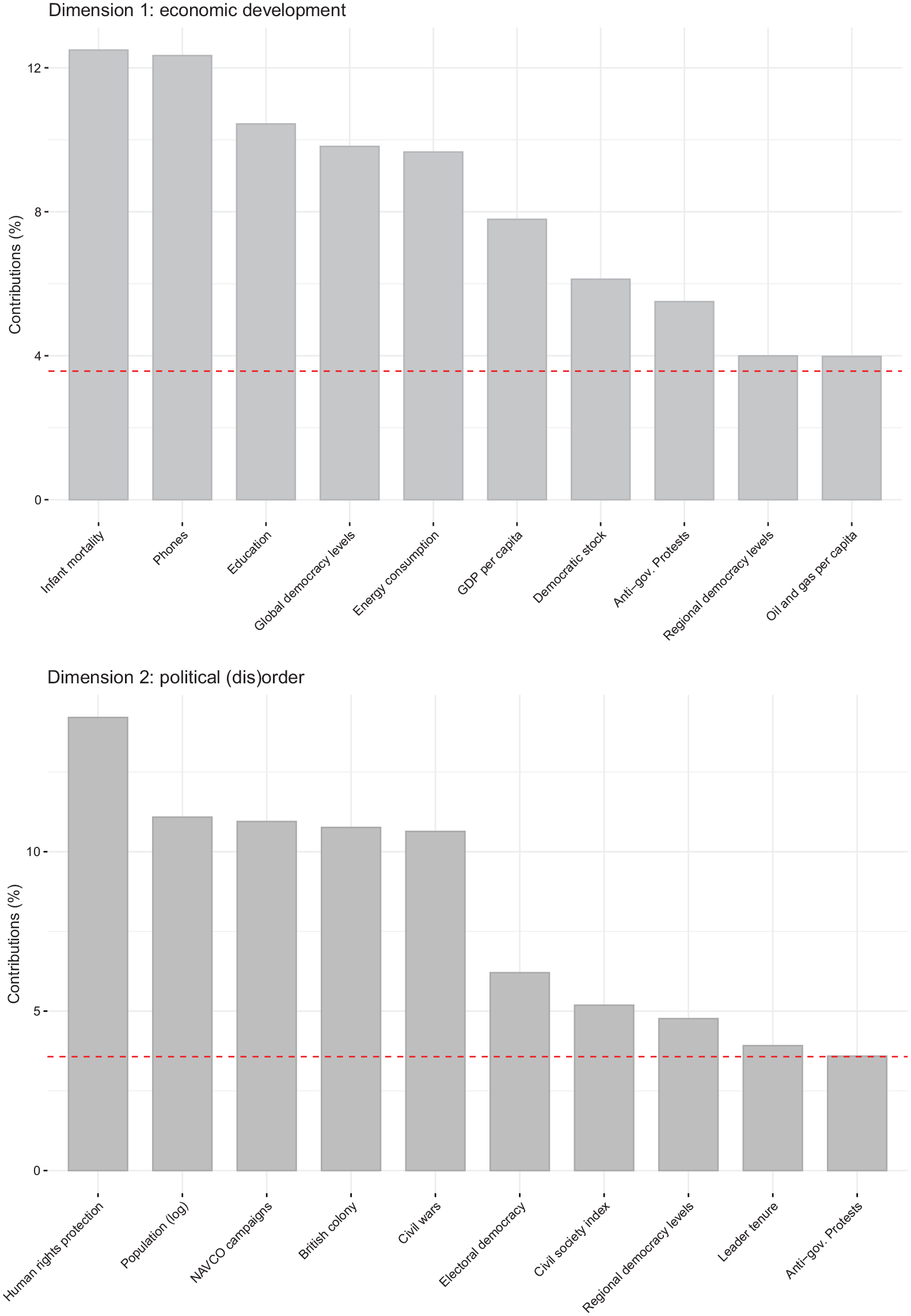
Principal component analysis: contribution plots.
Before proceeding with our matching analysis, we evaluate the predictive power of the structural factors. In Figure 2, we plot all cases of authoritarian breakdowns induced by mass mobilization and the outcome of the transition process on the two main dimensions as given by the PCA (development and political order). 11 Figure 2 shows little to no clustering of transition outcomes, suggesting that the first two principal components cannot explain well why a particular country democratized or failed to do so. We substantiate this finding by applying the support vector machine (SVM) algorithm to predict transition outcomes from the 28 structural factors themselves. If structural factors strongly determine transition outcomes, we should expect the SVM classifier to perform well at predicting successful democratization. However, we find that the predictive accuracy is only around 60%. 12 The outcome of democratization after an authoritarian regime breakdown caused by a mass uprising does not appear to be strongly determined by preexisting structural factors. Although not definitive, these results are nevertheless consistent with our claim that agency, meaning people’s choices, appear to matter for democratization. The next question is: Which strategies and choices facilitate democratization? We present a matching procedure aimed at addressing this question in the following section.
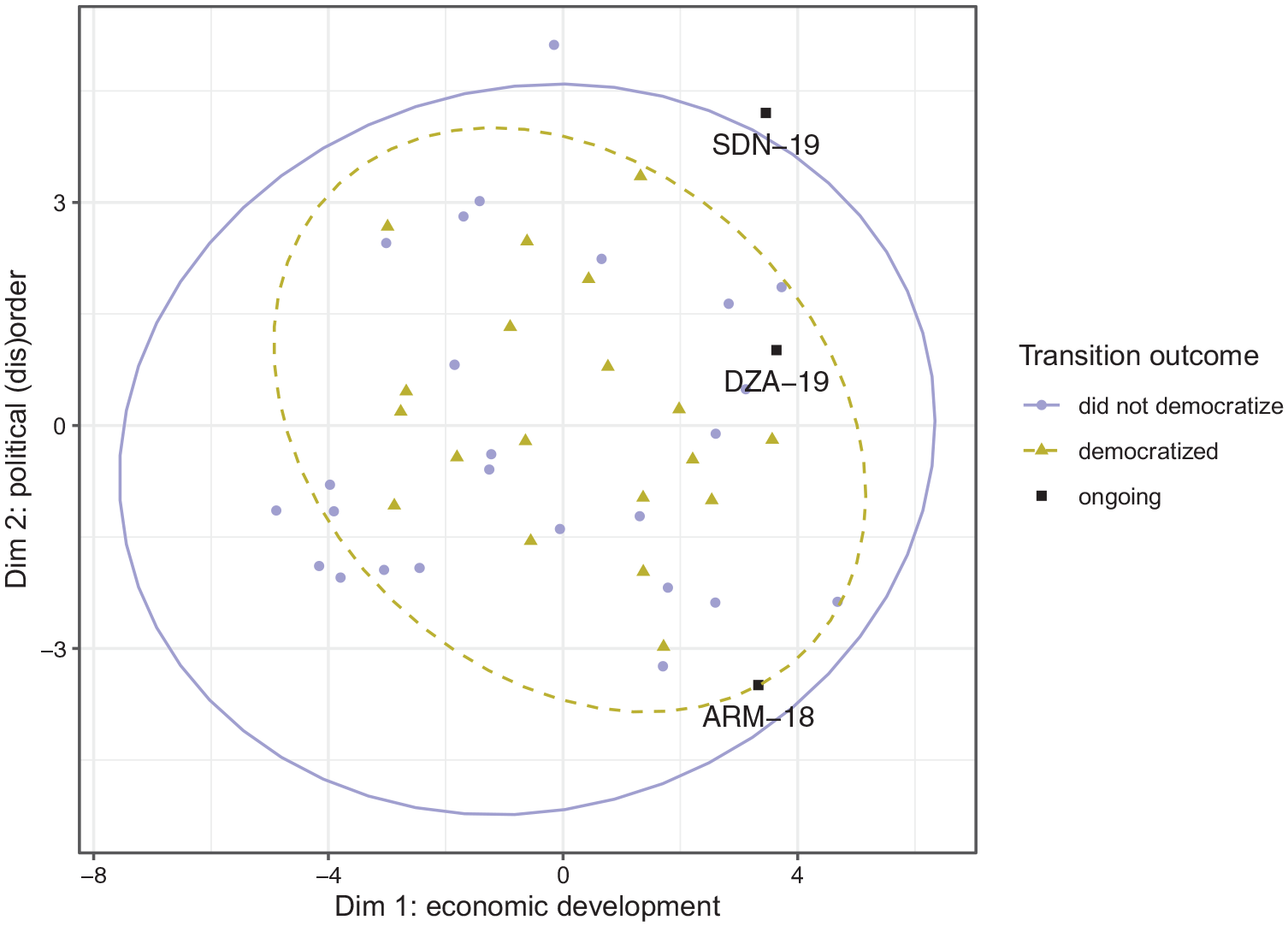
Transition outcomes by main principal components.
Measuring similarity between cases
Based on the output from the PCA, we calculated the pairwise Mahalanobis distances between all cases using the caseMatch R package provided by Nielsen (2016). We choose the Mahalanobis distance for the following reasons. First, it is a continuous measure that offers more flexibility in choosing the number of matched cases than discrete matching procedures (such as exact matching or coarsened exact matching, e.g., Iacus et al., 2012). Second, it is more appropriate than the propensity score for selecting cases for qualitative research, as the latter gives matches that are ‘often far apart in the covariate space’ (Nielsen, 2016: 578). Given our small sample (n = 47), we estimate the uncertainty in pairwise distances using the bootstrap method. We create 300 new datasets of 47 regime breakdowns by sampling from the original dataset with replacement; 13 and we compute 95% confidence intervals using the adjusted bootstrap percentile method in R (Canty and Ripley, 2021). Our resampling analysis supports the choice of three principal components for the matching procedure. Online Appendix Figure A.4 shows that three principal components reduce variability in matches across bootstrap samples, as shown by the large Chi-square statistic, which measures the amount of agreement in matches across bootstrap samples.
Figure 3 summarizes the matching results. It presents a heatmap of all pairwise distances between cases in the dataset. ‘Good’ comparative cases, that is, cases characterized by a small Mahalanobis distance, are coloured in dark purple (matching on three principal components). ‘Bad’ comparative cases, that is, cases characterized by a large Mahalanobis distance, are represented by a lighter yellow colour. In other words, the darkest square in each horizontal line marks the most similar transition regarding structural background factors. 14
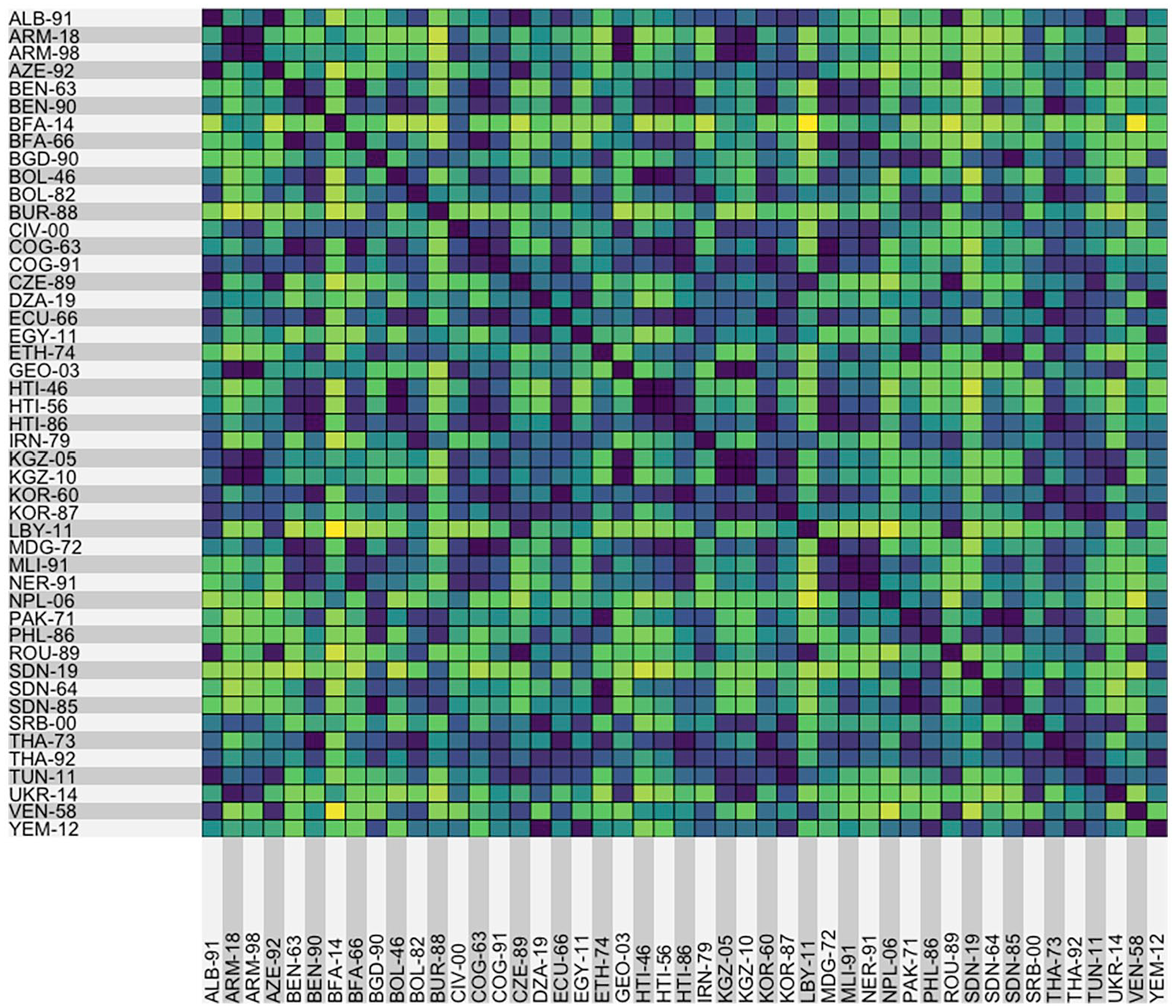
Heat map of pairwise distances (Malahanobis).
Case study: Sudan in 2019
Next, we focus on a specific case of authoritarian breakdown, Sudan in 2019, to demonstrate how the method can be used to learn lessons from comparative cases. Figure 4 presents the evolution of democracy in Sudan based on V-Dem’s Electoral Democracy Index (credible intervals shown in grey). Whereas Sudan has been authoritarian since its independence, it experienced two periods of partial liberalization. The first period began with the so-called ‘October Revolution’ of 1964 that toppled President Ibrahim Abbud. The uprising ushered in a period of civilian rule and partial liberalization that ended with a military coup in 1969. Coup leader Jaafar Nimeiri would lose power later in the 1985 popular uprising, marking the beginning of a second liberalization period, which also failed. The transition ended in 1989 with the coup of Omar al-Bashir, who remained in power until 2019.
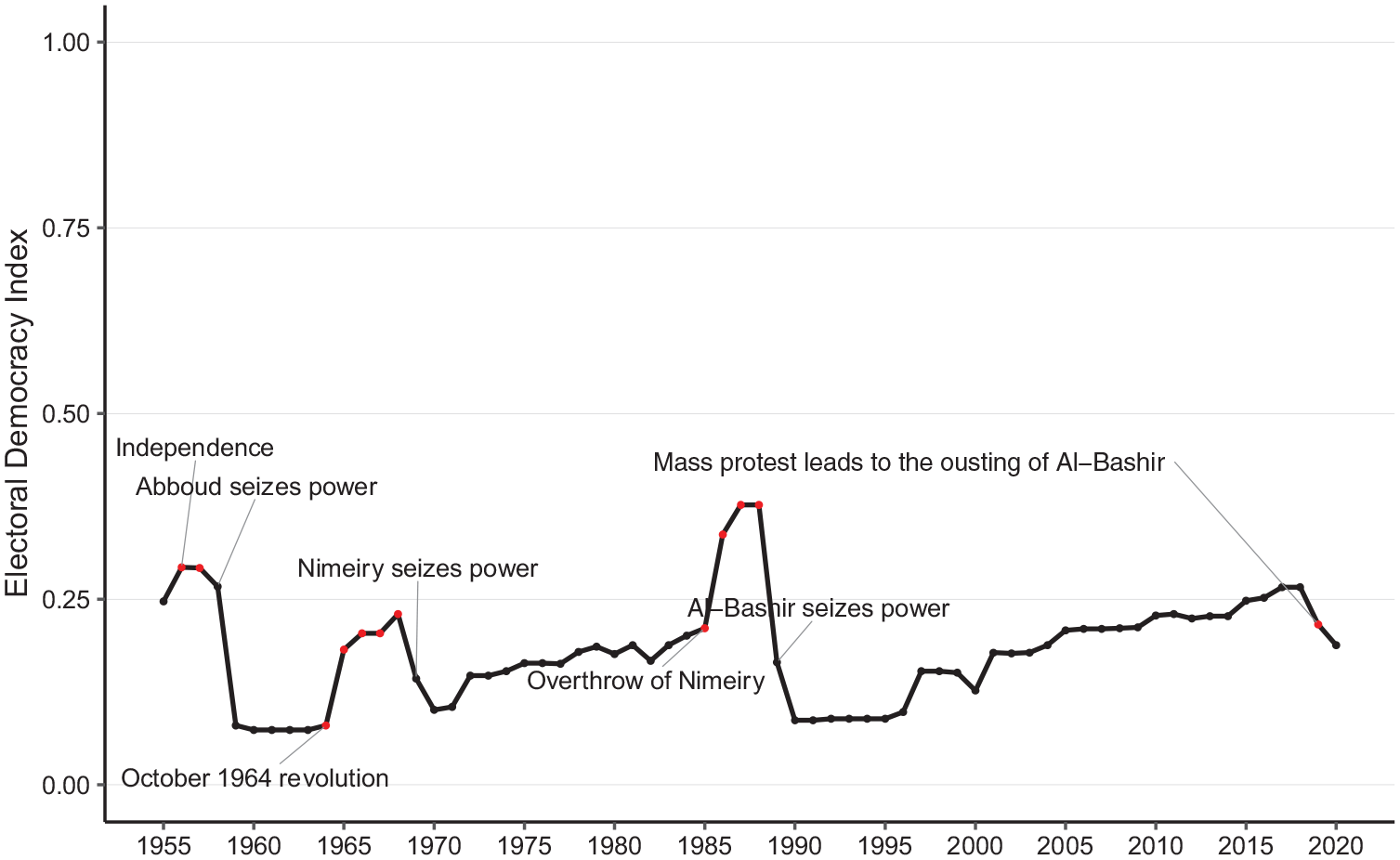
Democracy in Sudan (1955–2020).
Al-Bashir was ousted in 2019 amid mass protests against his rule (Hassan and Kodouda, 2019). After his fall, a power-sharing agreement between the military and an alliance of civilian groups was struck, and the transition government agreed to hand al-Bashir over to the International Criminal Court. While these developments were initially encouraging, the situation has worsened since this article’s first draft was written (in late 2019), particularly since a military coup in October 2021 appears to have put power back in the hands of the military. Yet the final outcome of the transition remains unknown at the time of writing (early 2022). 15
Sudan’s past experiences with regime breakdowns might offer important lessons for the current situation (Dwamena, 2019). However, we propose that additional insights can be gained from looking at cases beyond Sudan. Whereas other cases of transition may appear very different at first sight, they resemble Sudan on several relevant dimensions. Figure 5 shows the pairwise distances between Sudan and all other cases of authoritarian breakdown in decreasing order of similarity alongside 95% confidence intervals. The five most similar cases to Sudan in 2019 are the Philippines in 1986, Yemen in 2012, Burma/Myanmar in 1988, Algeria in 2019, and Egypt in 2011.
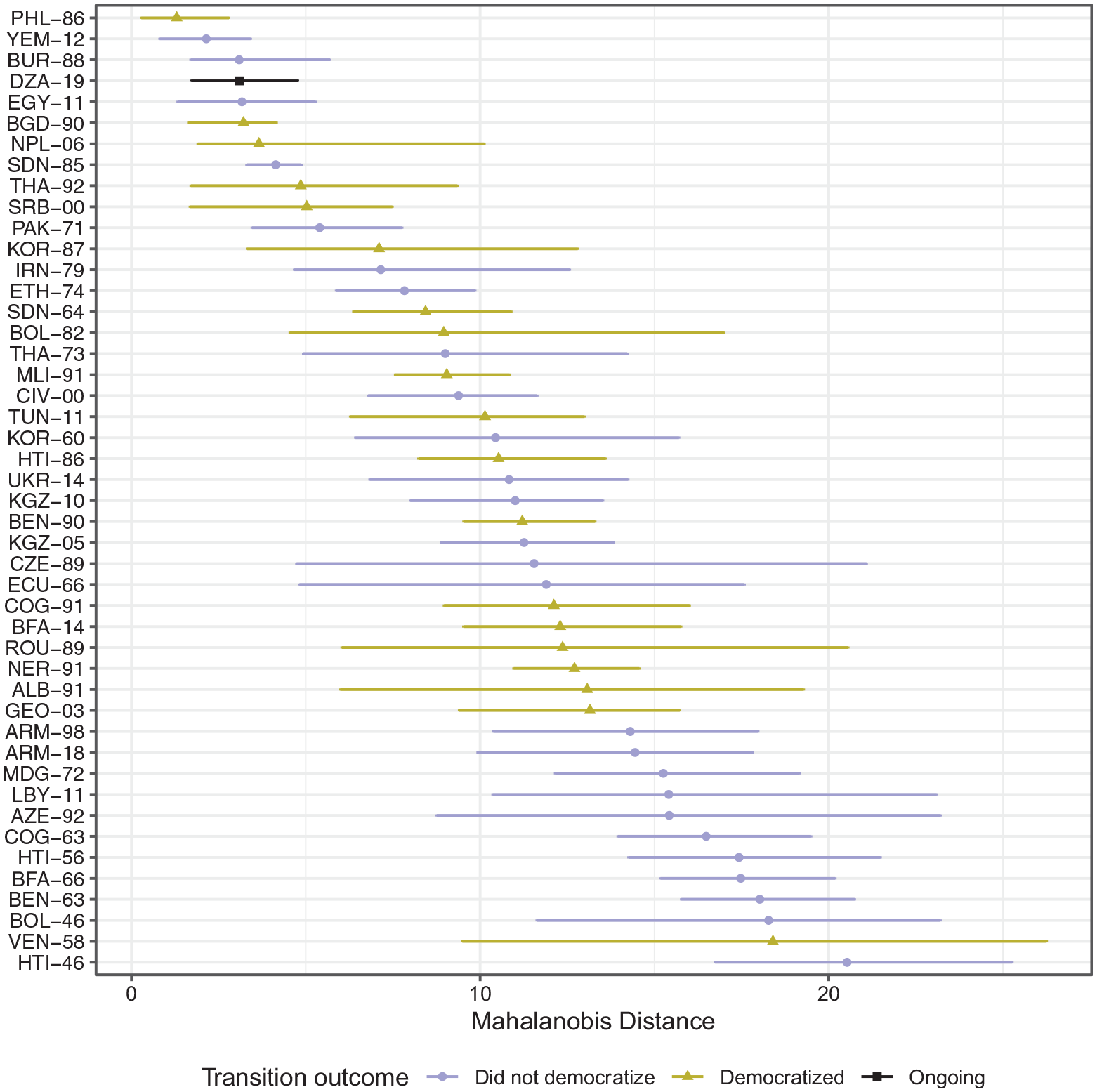
Most similar cases to Sudan 2019 from a matching analysis.
These results are interesting for two reasons. First, they show that Sudan’s transition in 2019 shares structural characteristics with cases beyond Africa and the Middle East, suggesting that additional lessons can be learned from countries on other continents. Second, they show that Sudan in 2019 does not belong to a cluster of failed nor successful transitions. Among the cases of regime breakdowns caused by mass protests that are most similar to Sudan, we find instances of both successful (the Philippines) and failed democratization (Burman/Myanmar). These results are tentatively encouraging. Although Sudan faces structural obstacles to democratization, it does not appear ‘destined to fail’.
To ensure that our findings are not overly sensitive to the choice of variables included in the analysis, we assessed the robustness of our results to removing variables from the matching model. We reran the analysis using all combinations of 24 or more of our 28 variables (24,157 combinations in total). For each case of authoritarian breakdown, we calculated the proportion of analyses for which a given case was ranked among the five cases closest to Sudan in 2019. Figure 6 presents these proportions across all cases. It shows that the Philippines in 1986, Yemen in 2012, Algeria in 2019, and Burma/Myanmar in 1988 are ranked in the top four comparisons across most analyses – the same list of top four countries that also came out of the full model reported in Figure 5. These results increase confidence that the distances we computed are not overly sensitive to the choice of variables.
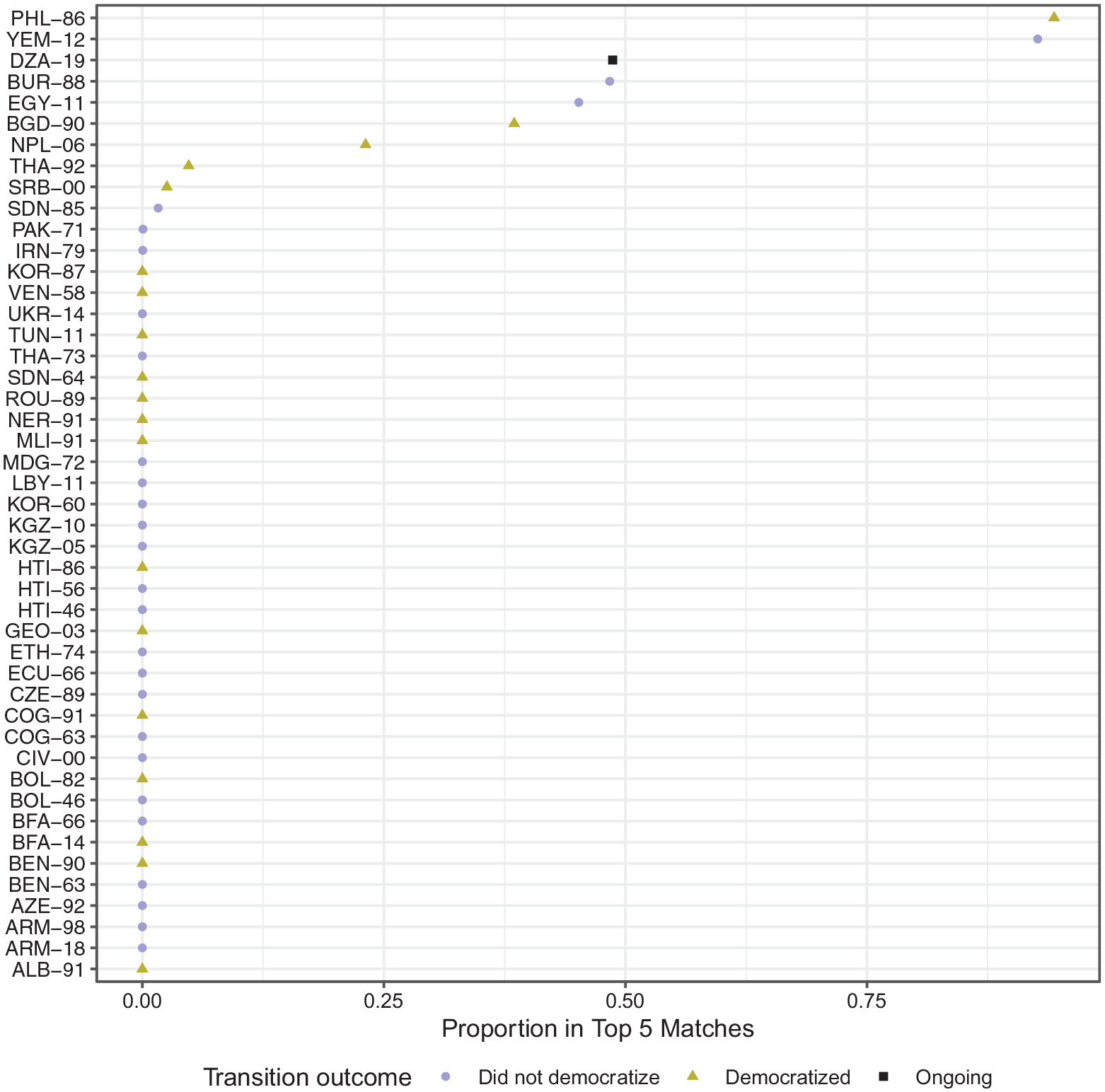
Sensitivity tests: proportion of analyses with case ranked closest (top 5) to Sudan 2019 across 24,157 combinations of variables.
Case descriptions
In order to demonstrate the value of our approach, we take a closer look at two cases that were selected by the matching procedure. Our goal is to show how the method can generate insights from comparative cases that may not be obvious at first. We provide exploratory case descriptions in which we highlight actors’ strategic choices after the authoritarian regime breakdown that previous work views as conducive (or not) to democratization. These case descriptions illustrate how our method can help reflect upon ongoing cases of transitions and highlight aspects that scholars and activists may not initially consider.
Among the four most similar cases identified by the matching procedure, we focus on the Philippines in 1986 and Burma/Myanmar in 1988 as these cases offer the starkest variation in the outcome (democratization versus non-democratization) and are less obvious comparisons than regional neighbors (Algeria and Yemen). 16
The Philippines 1986 – successful democratization
In 1986, large-scale protests against election fraud forced long-time dictator Ferdinand Marcos out of power, ushering in a successful transition to democracy in the Philippines. The new government, led by Corazon Aquino, faced several obstacles, including a highly politicized military and a history of armed insurgencies. Forces loyal to Marcos worked to sabotage the transition (Timberman, 1991: 169; Thompson, 2004: 27–28). Yet despite these obstacles, the Philippines succeeded in its transition to democracy. Figure A.5 in the Online Appendix summarizes the development of democracy in the Philippines.
Existing literature on the Philippines points to several decisions that appear to have helped democracy take hold during the transition period. One such choice was the Aquino government’s pragmatism and its ability to cultivate the support of military factions that favoured civilian rule. Shortly after gaining power, the new administration nearly lost officers’ support when it sought reconciliation with communist insurgents, appointed left-leaning officials, and signaled a willingness to investigate corruption within the armed forces (Timberman, 1991: 252). These decisions were highly unpopular amid military ranks. Ultimately the government rescinded these decisions and secured these military factions’ support by maintaining a hardline against insurgents, sacking the most controversial figures in the government and abandoning prosecution (Timberman, 1991: 225).
Second, the Aquino government adopted a cautious approach to reform and avoided alienating powerful political forces, including business elites and large landowners (Thompson, 1996: 189–190). For instance, the presidency exercised caution when dealing with the controversial issue of agrarian reform. Sustained pressure from progressive forces and landholders led Aquino to decree a reform plan that reflected a compromise between the two camps and left many of the most sensitive issues to be decided by congress (Putzel, 1992: 235–236; Thompson, 1996: 190). Moreover, observers tend to agree that the composition of the constitutional commission appointed by Aquino reflected a diversity of actors and interests (Abinales and Amoroso, 2005: 233–234; Timberman, 1991: 178). Caution was also reflected in the government’s restraint in using the powers at its disposal. For instance, the government refrained from declaring martial law after a coup attempt in August 1987 (Timberman, 1991: 192, 200).
Third, pro-democracy forces were able to secure support from powerful international actors. Specifically, the United States supported the transition despite its previous backing of the Marcos regime. The United States condemned coup attempts against the transitional government and even intervened to help thwart the December 1989 putsch. The military bases that the United States maintained in the Philippines were unpopular and Aquino even pledged their removal in the runoff to the presidential election in 1986. Yet she later changed her position and cultivated United States support (Thompson, 1996: 190–191).
Even though the transition in the Philippines serves as a case of successful democratization, there have also been some shortcomings that could inform cases such as Sudan. These include the failure of the civilian administration to institutionalize the people power movement. The Aquino government refrained from building a party organization that could have served as an independent power base. These deficiencies meant that the government had no other option than to rely on the support of moderate parts of the military and traditional political elites, narrowing the leeway for political reform (Timberman, 1991: 238–239).
Burma/Myanmar 1988 – failed democratization
The wave of protests that led to the 1988 popular uprising in Burma/Myanmar began in September 1987 when the government ‘nullif[ied] between 60 and 80 percent of the currency in circulation’ and impoverished large segments of the population (Thompson, 1999: 34). Protestors forced the chairman of the ruling Burma Socialist Programme Party (BSPP), General Ne Win, to resign on 23 July 1988. He appointed General Sein Lwin – notorious for atrocities – as his successor, sparking more protests. On 8 August 1988, the unrest culminated in a nationwide general strike (the ‘8-8-88 uprising’), and thousands protested in the capital and were met with violent repression (Burma Watcher, 1989: 176–177).
On 12 August 1988, General Sein Lwin resigned. He was replaced by a civilian, Dr Maung Maung, on 19 August, and repression halted briefly (Fink, 2001: 57). The political opening led to the emergence of new pro-democracy figures. These included Aung San Suu Kyi, the daughter of independence leader Aung San, who on August 26 spoke before large crowds about the need for non-violent resistance (Fink, 2001: 60; Fong, 2008: 150).
Amid political paralysis, the military staged a coup on 18 September 1988 (Fink, 2001: 61–62). The new military government, which dubbed itself the State Law and Order Restoration Council (SLORC), violently cracked down on protests. Yet it allowed political parties to form and promised multiparty elections (Tonkin, 2007: 34). In May 1990, it held elections, which the main opposition party, the National League for Democracy, won unexpectedly by a large margin, whereas the National Unity Party, favoured by the military, performed poorly. Still, the SLORC refused to convene a legislative assembly after the elections and transfer power. Instead, it expanded its control over the country and forestalled democratization. Figure A.6 in the Online Appendix gives an overview of the timeline of the (failed) transition.
Why did democratization fail in Burma/Myanmar? And could pro-democracy activists have done anything differently to achieve a better outcome? The clearest political opening was from August to September 1988, under the presidency of Dr Maung Maung (Fink, 2001: 61). He had offered to ‘organize multiparty elections within three months’ (Tonkin, 2007: 37). Yet his offer was rejected by opposition leaders who were doubtful of the election commission’s impartiality (Tonkin, 2007: 37). Instead, they called for the creation of a new interim government composed of non-BSPP figures to supervise elections (Fong, 2008: 150; Tonkin, 2007: 37).
Tonkin (2007: 37) argues that it ‘is possible that if the emerging political leaders [. . .] had agreed to this [the BSPP’s proposal] and had been willing to accept the nominated Election Commission to supervise the elections, the 18 September 1988 coup might never have happened’. That said, the opposition in Burma/Myanmar may have had valid reasons to worry about the BSPP’s proposal to hold rapid elections in the absence of institutional safeguards. Thus, it is not obvious that Burma/Myanmar would have democratized had the protesters agreed to elections without institutional safeguards.
Furthermore, after the 18 September coup, many students did not pursue peaceful protests; instead, they ‘decided that their best hope against the SLORC was armed struggle and subsequently fled to the jungle’ (Thompson, 1999: 36). They put their hopes in receiving support from foreign countries and cooperating with ethnic insurgents – hopes that were never fulfilled (Thompson, 1999: 36).
Lessons for Sudan
The discussion above illustrates how our method may shed light on comparative cases for in-depth study. Previous work has proposed a diverse set of explanations for the democratization, and lack thereof, of the Philippines and Burma/Myanmar and the case descriptions suggest several important relevant lines of inquiry. We focus on two points in particular: unity and pragmatism of pro-democracy forces during Philippines’ transition; and the lessons these offer for the ongoing transition in Sudan.
Since the first version of this article was drafted (late 2019), there have been important new developments in Sudan. On 25 October 2021, Sudanese general Abdel Fattah al-Burhan dissolved the civilian-led government and imposed a state of emergency. The coup appeared aimed at protecting the officers from investigations into corruption and prosecution for past human rights abuse; and it seemed to spell the end of Sudan’s democratic transition (Sayigh, 2021). However, widespread protests and international condemnation forced the generals’ hand. Amid these pressures, the military reinstated Abdalla Hamdock as Prime Minister. Hamdock later resigned in January 2022 amid protests, leaving the transition in the hands of the military at the time of writing (BBC News, 2022).
The challenges currently facing Sudan are reminiscent of those that pro-democracy forces in the Philippines faced after the fall of Marcos. As in Sudan, the new government in the Philippines faced military insubordination; it suffered no less than seven coup attempts between July 1986 and December 1989 (Thompson, 1995: 163). Scholars have highlighted two factors that helped civilian forces prevail in the Philippines. The first factor is constant civilian pressure on the military. Civilian forces remained united and consistently opposed military intervention. A particular dramatic illustration of this unity was the popular reaction to the December 1989 coup attempt, when 100,000 anti-coup protesters mobilized ‘against those who would “destroy our democracy”’ (Thompson, 1995: 172).
Yet this pressure was combined with pragmatism in dealing with the military. Although achieving civilian control was the priority, there was a willingness to forge alliances with powerful military figures. Civilians avoided antagonizing powerful officers, who would later help thwart military threats. For instance, President Aquino was able to secure crucial support of Chief of Staff Fidel V. Ramos, who would play a central role in supporting a transition, even thwarting a coup attempt in November 1986 (Thompson, 1995: 173). In Sudan, it has been argued that the coup of 25 October was a reaction to investigations into past wrongdoings. Scholars argue that providing officers with a guarantee that their interests will be protected could make them more willing to accept civilian rule (Sayigh, 2021). However, as the 2021 coup in Burma/Myanmar showed, convincing officers to relinquish power is a daunting task. That said, pro-democracy forces in Sudan enjoy opportunities that their Burma/Myanmar counterparts lacked. The Sudanese security apparatus is divided and may be less capable of coordinating against pushes for civilian control (Grewal, 2021; Hassan and Kodouda, 2019).
Conclusion
This study proposes an innovative strategy for identifying cases for comparative studies on successful and failed transition processes. Comparing all 47 successful and failed transitions to democracy after mass uprisings since 1945 based on 28 key structural factors and matching techniques allows us to identify similar cases for comparison using a transparent and reproducible quantitative strategy. This analysis suggests that the outcome of transition periods may not be pre-determined by structural conditions and that there is room for agency by pro-democracy movements.
In an empirical illustration of this method, we draw lessons that can be helpful for understanding the current transition in Sudan. Over two years after the overthrow of long-time dictator Omar Al-Bashir, the democratization process is still ongoing, and its outcome is uncertain. After a coup attempt in September 2021, a successful coup in October 2021 and the resignation of Prime Minister Abdalla Hamdok, who was in charge of leading Sudan’s transition, we may see the end of liberalization in Sudan. At the same time, mass mobilization for democracy remains high. Overall, our article reports reasons for cautious optimism for Sudan. 17 The historical case that is most similar to Sudan in 2019, the Philippines in 1986, democratized despite many coup attempts during the transition. The case descriptions highlight the importance of unity in pushing for civilian rule, and compromise with select military factions that can support civilian rule. That said, the Philippines’ recent democratic decline may raise questions about the long-turn sustainability of the post-Marcos transition.
The recent overthrow of dictators in Sudan and Algeria and Armenia will not be the last. There will be more revolutions in the future. We hope that our method will prove useful to pro-democracy activists and practitioners to draw lessons for upcoming democratic transitions.
Supplemental Material
sj-docx-1-ips-10.1177_01925121221138408 – Supplemental material for Pathways to democracy after authoritarian breakdown: Comparative case selection and lessons from the past
Supplemental material, sj-docx-1-ips-10.1177_01925121221138408 for Pathways to democracy after authoritarian breakdown: Comparative case selection and lessons from the past by Jean Lachapelle and Sebastian Hellmeier in International Political Science Review
Footnotes
Acknowledgements
The authors are indebted to Anna Lührmann, who was instrumental in initiating this project and who contributed greatly to earlier versions of this paper. We also thank Lukas Bernhard, Julian Voß, Shreeya Pillai, Emilie Segura, Nikolina Klatt, Lukas Warode and Christopher John Chanco for their skillful research assistance and participants in seminars at the University of Gothenburg (February 2020) and the University of Khartoum (February 2020) for their input.
Funding
The authors disclosed receipt of the following financial support for the research, authorship, and/or publication of this article: This research was supported by Vetenskapsrådet (grant number 2018-016114), PI: Anna Lührmann and European Research Council, Grant 724191, PI: Staffan I. Lindberg, Varieties of Democracy (V-Dem) Institute, University of Gothenburg, Sweden, as well as by internal grants from the Vice-Chancellors office, the Dean of the College of Social Sciences, and the Department of Political Science at the University of Gothenburg. Parts of this research were conducted while both authors were postdocs at the V-Dem Institute.
Supplemental Material
The Supplemental Appendix for this article is available online at journals.sagepub.com/home/ips. An interactive Online Appendix is available at 
Notes
Author biographies
References
Supplementary Material
Please find the following supplemental material available below.
For Open Access articles published under a Creative Commons License, all supplemental material carries the same license as the article it is associated with.
For non-Open Access articles published, all supplemental material carries a non-exclusive license, and permission requests for re-use of supplemental material or any part of supplemental material shall be sent directly to the copyright owner as specified in the copyright notice associated with the article.
