



Abstract
Studies of public support for war among non-Western and non-major powers (NWNM) states are distinctive from United States foreign military operations. First, these wars often intrude on subjects’ direct livelihood. Second, great powers’ intervention can drastically alter the outcome of these wars. These factors have not been examined extensively in the war support literature. We fill this gap by spearheading several hypotheses of war support unique to NWNM countries. Through an original and representative survey experiment on a hypothetical military conflict between China and Taiwan, our analysis yields that the information about the United States coming to Taiwan’s defense in an armed conflict with China drives up war support by around 7% among the citizenry, although such information does not make the Taiwanese population more tolerant of combat casualties. In addition, perception of military training increases public support for war significantly. The findings suggest that the study of NWNM states could contribute to the war support literature from different perspectives.
Keywords
Introduction
Studies of public support for the use of force are critical to both scholars and policymakers. Decades of research since the end of World War II has benefited us with indicators that shape public opinion and war, including, but not limited to, the principal policy objective of the mission (Jentleson, 1992; Jentleson and Britton, 1998), human and financial costs of war (Flores-Macías and Kreps, 2008; Mueller, 1971), support from allies and international organizations (Appleby et al., 2010; Holsti, 1996; Page and Bouton, 2008), and partisan cues (Bernisky, 2007).
Aside from its findings, this line of research line has its limitation—the cases and findings are primarily drawn from Western democracies (for notable exceptions, see Tago, 2005; Tanaka et al., 2017; Yeh and Wu, 2021). The dearth of cases from non-Western and non-major powers (NWNM) is problematic, as most armed conflicts have happened between these states since World War II. The lack of research that focuses exclusively on these states limits the diversity and generalizability of existing findings and the policy recommendations that could offer.
There are reasons to expect that citizens in NWNM states approach war support differently. First, war support is largely a foreign policy issue for the Western publics. When the US public forms their opinions about an armed conflict overseas, they operate with an assumption that the conflict will not hit home. The reverse tends to be the norm for citizens in NWNM states. Wars often directly intrude into their living space, if not originate from their neighborhood, and they or their family members must face the challenge head-on. In this regard, war support for NWNM is a matter of life and death, not choice (Yeh and Wu, 2021). Relatedly, since wars are close to home, citizens in NWNM states could perceive military training differently from their counterparts in Western democracies; they tend to withdraw war support when a conscription system is put in place (Horowitz and Levendusky, 2011; Moskos, 1970; Vasquez, 2005). For publics in NWNM states, being prepared for war increases one’s chances of survival on the battlefield. Last, compared to other major powers that are more capable of conducting military operations, many NWNM states often need to rely on involvement from external great powers during armed conflicts due to their inherent weaknesses. Thus, assistance from major powers should influence how citizens in NWNM states view the prospects for a conflict.
In this paper, we formulate hypotheses around the specific characteristics of NWNM states to examine their influence on war support. Due to the proximity to the battlefield, we argue that citizens who perceive their military training to be useful will increase their willingness to fight. We also contend that assistance from great powers could influence citizens’ war attitudes. However, we have reasons to believe that the effects could go either way. Such information could provide the much-needed support NWNM states crave, but many citizens could oppose or become worried about the corresponding entanglement in other ongoing rivalries of that great power. We also argue that great power assistance will influence how citizens in NWNM states process battle deaths. For the latter two theoretical conjectures, we see our role as referees in assessing both possibilities without taking a stance.
We selected the potential armed conflict between Taiwan and China as our case. Experts on cross-Strait relations have cautioned that as tensions continue to rise, an armed conflict between both sides could take place in the near future. The case is emblematic of the larger NWNM cases in many ways. Taiwan is only around 100 miles away from China, so a war would directly intrude into citizens’ living space. The majority of the citizens in Taiwan were required to serve in the military until recently. Furthermore, the United States has been involved in cross-Strait conflicts numerous times in history and has been the island’s security partner for decades. These factors help us to examine our theoretical conjectures.
Examining war support in Taiwan, Yeh and Wu (2021) have found that existing correlates of war support in Western cases could be helpful for understanding public opinion on war in Taiwan. But its correlational design weakens the ability to make causal claims, as many key variables such as military experience and battle deaths were not included in their analysis. Their work also could not tell us how citizens in Taiwan would behave under different conditions. In this paper, we improve upon these weaknesses by relying on the experimental method to study how information about great power assistance, military training, and the number of casualties could influence war support in Taiwan.
Through an original and representative survey experiment of citizens in Taiwan, we find that citizens who perceive their military training to be useful are more supportive of fighting against China. We also find that learning about the United States coming to help Taiwan militarily results in a dramatic increase of war support among citizens in Taiwan—the effect could be as large as seven percentage points, though such information does not make citizens more tolerant of battle deaths.
Despite the contributions, there are clear limitations to our work. Most notably, it is difficult to extrapolate the findings to other NWNM states with only one case. We envision our findings to be most applicable to NWNM states when a potential armed conflict will likely occur in the country and is seen as a matter of survival and necessity rather than simply one of foreign policy preference. Additionally, citizens responding to the war have a widely shared military experience, and the conflict is likely to be involved with a major power. 1 That being said, we have demonstrated that war support research could benefit from this new line of inquiry on NWNM states. Our study also provides policy recommendations to policymakers. In an era where the United States is confronting the rise of China in the Asia-Pacific region, understanding public opinion on war in Taiwan could reduce the uncertainties surrounding this potential conflict.
Public support for war in NWNM states
Drawing mostly from the United States and other Western states such as Italy (Herrmann et al., 2009), Germany (Schoen, 2007), Britain (Tomz and Weeks, 2013), and Australia (Lis, 2018), research on public support for the use of force has shed lights on the factors that could sway public opinion and war. For instance, these factors include battle deaths (Mueller, 1971), principal policy objectives (Jentleson, 1992; Jentleson and Britton, 1998), endorsements from allies and international organizations (Grieco et al., 2011; Kull, 1995; Rielly, 1995; Sobel, 1997), conscription and fiscal policies (Flores-Macías and Kreps, 2017; Horowitz and Levendusky, 2011), elite cues (Baum and Groeling, 2010; Berinsky, 2007), demographic factors such as gender (Conover and Sapiro, 1993), education levels (Baum, 2004; Brewer and Steenbergen, 2002; Conover and Sapiro, 1993; Nincic, 1997), and one’s perception of success and the righteousness of the operations (Gelpi et al., 2006).
Despite the contributions from this literature, our knowledge about public support for war in NWNM remain meager, with a few exceptions (Midford, 2011; Tanaka et al., 2017; Yeh and Wu, 2021) in recent years. The dearth of studies focusing on NWNM states limits our ability to discuss conflicts in these countries, which is problematic, as most wars nowadays fall largely within them. All major wars since 1945 have often involved countries from the less developed parts of the world (e.g., the United States–Vietnam conflict, 1954–1973, the first and second United States–Iraq conflicts of 1991 and 2003, and the Iran–Iraq War, 1980–1988). The exclusion of this group of states leads war support scholars unequipped to address war support in these countries. The work by Yeh and Wu (2021) alleviates some concerns of generalizability as they find that some indicators of war support (e.g., principal policy objectives, multilateralism, ethnicity, partisanship, and education) could influence citizens of Taiwan in a war with China. But as we will elucidate below, applying indicators to a different context is not sufficient for improving an understanding of war support in NWNM states, which, for a variety of reasons, is a different question from the war support in Western states.
Why is war support for NWNM states different?
War often hits home
There are reasons to believe that war support is different for NWNM states. First, for citizens in this group of countries, conflicts often occur at home, not overseas. Unlike powerful states and their citizens that have the luxury of choosing the locus of military operations, citizens in weaker states must fight foreign aggression at home. Put differently, when the US public weighs in with opinions on an ongoing military conflict, the idea that such a war will hit home is unlikely to cross their mind. But for the public in NWNM states, war support is not a matter of choice but of necessity (Yeh and Wu, 2021). Survival is at stake.
Research has shown that proximity to danger could influence one’s attitude toward conflict, either psychically or mentally. For instance, Althaus et al. (2012) have concluded that when a person or an acquaintance from their neighborhood is harmed in an armed conflict, their support for an ongoing conflict will decrease. If just hearing that someone we know suffers from war could influence war support, it is logical to assume that the public will certainly be influenced when they are embroiled in war.
The actions or preparations citizens take are crucial for understanding their war support. Here, the mentality toward military training is also different between citizens in Western democracies and those in NWNM states. Horowitz and Levendusky (2011) maintain that conscription often weakens war support among Americans. When more have served in the military, they often become more aware of the sacrifices and costs that might incur, making war less appealing to them. Realizing that their children or they themselves could be put in harm’s way decreases appetite for the use of force (Gartner, 2008; Moskos, 1970; Vasquez, 2005).
Citizens in NWNM states could regard military training very differently. They should be more likely to regard it as a survival tool, without which their chance of exiting a battlefield safely is greatly diminished. This mindset is especially critical when the result of a war in their living environment will decide if they could keep their freedom and way of life (Machiavelli, 1985). To this day, many NWNM states such as Taiwan, South Korea, and Israel still require their citizens to go through mandatory military training. In short, the relationship between the perception of military training and war support is an important factor in understanding war support in NWNM states.
Support from major powers
Another reason that war support for NWNM states is different has to do with great power involvement. Unlike many Western powers that are militarily capable of conducting military operations on their own, many NWNM states often have to rely on great powers for protection or assistance in conflicts. Great power assistance is vital for them to fend off military threats (Labs, 1992; Waltz, 1979) and could often embolden their state resolve to act more aggressively. As Labs (1992) puts it, ‘. . .a Great Power ally will strengthen the weak state’s tendency to balance’ (p. 384). Such information also signals to the citizens in NWNM that a great power is willing to share the burden of military expenses (Labs, 1992). These rationales should drive up war support. Being an ally with a great power also increases the opportunity to develop other alliances and receive political support and military assistance from other major partners (Schou and Brundtland, 1971). In short, whereas support from allies can boost support among Americans, intervention by a great power can be a game-changer for NWNM states facing a conflict. These reasons suggest that information about great power assistance should drive up support for war among citizens in NWNM states, despite that the literature has yet been able to supply supportive evidence.
Historically, the United States has played a critical military role in Asia. For instance, United States security pledges to Japan and South Korea shape public opinion when tensions with China over territorial disputes arise as citizens believe that the US nuclear umbrella can deter China’s hostile actions toward them (Komiya et al., 2018). The United States also diffused numerous confrontations between South Korea and Japan over their own territorial and historical disputes. The United States has also been the arbiter of cross-Strait relations, and its diplomatic and military involvements successfully prevented both sides from escalating armed conflicts during the Korean War and all the three crises of the Taiwan Strait.
On the other hand, great power assistance can also draw pushback from the public. Citizens could consider having the potential of a great power intervening harmful to their security, as it could entangle their country in said great power’s military adventures overseas (Tago, 2009, 2014) or become an enemy of the great power’s adversary. Citizens might also disapprove of the social unrest that an alliance with a great power could bring to their own society. For instance, citizens in Okinawa, Japan, often accuse the United States of endangering their personal safety and the natural environment (Chanlett-Avery and Konishi, 2009). At times, the ‘Okinawa Effect’ derails cooperation and trust in the United States–Japan alliance (Envall and Ng, 2015). United States involvement in South Korea also draws discord from local citizens—rapes by United States soldiers fuel anti-Americanism and the call for the withdrawal of United States troops (Kim, 2004). Even in Taiwan, where the United States does not have an active military presence, 2 there are still voices arguing that purchasing weapons from the United States is wasting taxpayers’ money (Chase, 2008). Taken together, it remains an open inquiry as to whether great power assistance could increase public support for defense among citizens in NWNM states.
Influence of great power assistance on casualty sensitivity
In the public support for war literature, the human cost of war has been established as a key factor in influencing public opinion. Examining polls during World War II and the Vietnam War led Mueller to establish a negative correlation between battle deaths and war support (Mueller, 1971). Later work suggests more nuances that could moderate, or in some cases, nullify the effect of battle death on war support (e.g., Brody, 1991; Gartner and Segura, 1998).
The literature has yet to provide reasoning for how citizens in NWNM states view casualties. Essentially, there could be two competing schools of thought. The first argues that they should be casualty phobic. For example, surveying citizens in Israel, Hamanaka (2018) finds that simply mentioning the term ‘many casualties’ dramatically decreased their support for an ongoing conflict with Hamas. Similarly, mentioning casualties to citizens in Japan led to an increase in support for withdrawing the Self-Defense Forces (Komiya 2019). Like citizens in Western countries, the public in NWMN states could become war-shy when learning of battle deaths.
There are counterarguments. Several issues with the above studies lead us to challenge their findings. First, the Israeli study does not specify an exact number of casualties in the survey experiment, and such information and the way it is presented can significantly influence public opinion. For example, Gartner (2008) demonstrates that mentioning 100 casualties in an increasing fashion (from 5, 10, to 100) or a decreasing trend (from 100, 10, to 5) has divergent effects on war support. Thus, simply mentioning ‘many casualties’ is an imprecise way to gauge public opinion. The issue with Komiya’s study (2019) is that it does not include variables that could alter war support, such as international backing. In that experiment, the subjects only received information about Japan sending troops to South Sudan for a peacekeeping operation. The prompt did not contain information about assistance from other allies or international organizations, which could significantly influence the perception about numbers of casualties.
There are certain conditions under which citizens in NWNM states could become insensitive to casualties. In psychological research, researchers have developed a concept called ‘identity fusion’ to describe the phenomenon when citizens develop closeness or ‘a visceral sense of oneness’ with a group (Swann et al., 2014). Seeing others in their group as family would propel them to make unthinkable sacrifices compared to situations where those bonds are nonexistent. These sacrifices range from physically fighting, dying to defend their country (Gómez et al., 2011; Swann et al., 2009), to committing suicides to save the lives of members of their country (Gómez et al., 2011; Swann, Gómez, Dovidio, Hart, & Jetten, 2010).
One of the ways that identity fusion could manifest is when citizens in one country start to develop a unique identity. For instance, public opinion polls in Taiwan have shown that citizens have gradually developed an independent identity from China. Since 1992, National Chengchi University (NCCU) in Taiwan has surveyed citizens’ identity in Taiwan. The respondents that identify themselves as ‘Taiwanese only’ nearly quadrupled from 17.6% in 1992 to 64.3% in 2020, whereas identification with a sole Chinese identity shrank to only 2.7% in 2021. Seeing themselves as Taiwanese and Taiwanese only helps construct an environment where identity fusion can take place.
Public perception of combat casualties becomes murkier when we put great power assistance into consideration. Great power assistance could push their support in either direction. On the one hand, knowing a major power would share the burden of the conflict on a battlefield might boost the public’s tolerance of battle deaths. The public could see the deaths as worthwhile costs to prevail in a conflict, especially when the great power itself has also sustained casualties. On the other hand, it is certainly possible that such information strengthens the propensity for the NWNM publics to be sensitive to casualties. They might fear that great power assistance might also mean that they would also need to shoulder and become involved in other conflicts that the great power is waging, potentially resulting in more casualties among them. Clearly, how citizens in NWNM states react to battle deaths in light of great power assistance is an open inquiry.
Research design
We select a Taiwan–China war as our case for several reasons. For starters, Taiwan is an NWNM state about 100 miles away from China, and China has not abandoned its intentions of using forces to ‘liberate’ the island. Second, the possibility of a cross-Strait conflict has increased dramatically in the past two years (at least since 2019), as China has frequently used its fighter jets to intrude in Taiwan’s Air Defense Identification Zone hundreds of times, prompting the Taiwan side to scramble their F-16s for a response. The geographic proximity suggests that an armed conflict with China will almost inevitably intrude into the public’s living space in Taiwan. To prepare for the contingency of China’s invasion, male citizens in Taiwan are required to serve in the military for a period from several months to two/three years. 3 Third, this case involves two great powers, China and the United States, where the former has been claiming to ‘reunite’ China by taking over Taiwan, and the latter has been Taiwan’s long-time security partner and has offered an implicit promise to come to the island’s assistance if China attacks Taiwan. 4 As a result, a conflict between the Strait will surely involve the United States to a certain degree.
In the past two years, polls on public willingness for self-defense in Taiwan have started to draw more attention as China escalated its threats toward Taiwan. However, these polls overall suffer from two major weaknesses. First, since different agencies adopted relatively distinct question wordings and how the subjects answered the questions was inconsistent, the result varies greatly. For instance, in 2018, the Taiwan Foundation for Democracy (TFD) asked: ‘[W]ould you fight for Taiwan if Taiwan formally announces independence and causes mainland China to use force against Taiwan?’ where more than half of the respondents (57%) said, ‘Yes’ on a ‘Yes–No’ dichotomized response option. In contrast, the 2019 Taiwan National Security Survey (TNSS) asked: ‘what action would you take if the war breaks out between China and Taiwan?’ where only a quarter of the respondents (25%) said they would ‘serve in the military’ or ‘defend the country’ in response to this open-ended question. Second, as shown in the TFD and TNSS surveys, these polls did not include key influential variables such as United States assistance or were not consistent on the condition of the war (Taiwan declares independence), making it difficult to provide accurate policy implications and suggestions.
To remedy these weaknesses, we utilize an experimental survey design, commonly used in war support studies, to carve out specific scenarios to gauge public support for fighting a war with China. By including other demographic variables such as military experience and tolerance of battle deaths, we strengthen the internal validity of our results to avoid potential spurious effects that many polls on this topic suffer from. We focus on the following three case-specific hypotheses derived from our arguments:
(H1) Taiwanese citizens who consider their military training useful will be more supportive of the use of force: (H2) information about United States military assistance should influence war support among the public in Taiwan: and (H3) information about United States military assistance will also influence how citizens in Taiwan react to casualties.
In the following, we detail our empirical strategy.
In-depth interview and pre-registration
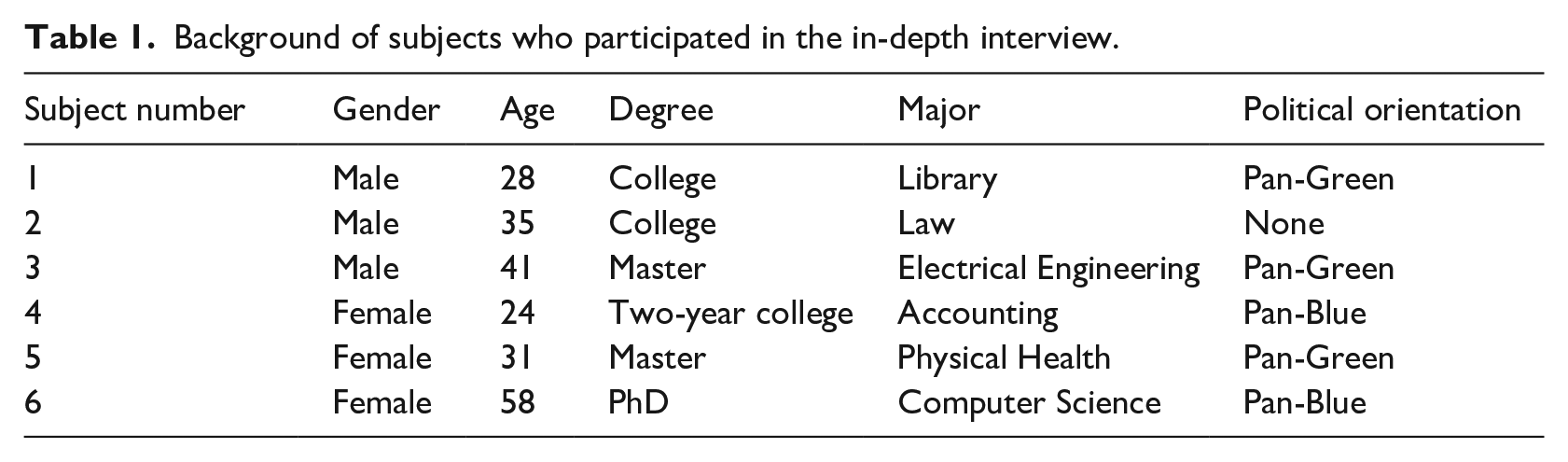
Before fielding our survey experiment, we conducted in-depth interviews to examine whether ordinary citizens in Taiwan could comprehend the questionnaire. This step helps us get rid of inappropriate and ineffective questions. From June 10–17, 2018, six Taiwanese citizens from various backgrounds were recruited through an online post. None of them studied political science, and all male subjects had served in the military. Table 1 provides basic information about the six subjects. 5
Background of subjects who participated in the in-depth interview.
After the in-depth interviews, the survey was pre-registered on the Evidence in Governance and Politics website (EGAP; the project’s registration link is available upon reasonable request) and Open Science Foundation (OSF; the project’s registration link is available upon reasonable request). The pre-registration, completed before June 28, 2018, included the survey, survey implementation procedure, the number of subjects, and an analysis plan.
Data collection and experimental design
During July 6–9, 2018, 1003 subjects were recruited through the PollcracyLab, an online questionnaire platform housed at NCCU in Taiwan. PollcracyLab’s subject frame relies on invitations to the representative telephone and face-to-face academic surveys conducted by the NCCU. Since NCCU has access to the Taiwanese government’s household registration records, all Taiwanese citizens have a non-zero probability of being invited to the survey, enhancing the sampling procedure’s representativeness. In short, compared to other self opted-in online platforms such as Amazon’s MTurk or Survey Sampling International, the PollcracyLab has the advantage of recruiting from diverse and representative backgrounds. For our survey, subjects were invited by an email from the PollcracyLab to participate in a survey titled ‘A Survey of Public Opinion and Political Participation.’ They were informed that they could skip any question, and their responses would be anonymous. Researchers only receive de-identified data from PollcracyLab. In this experiment, subjects first answered a battery of questions on news consumption, political interest, and partisanship before being randomly assigned to one of the four experimental groups. 6
We design the background of the experiment based on some of the most common conflict scenarios in cross-Strait relations, that is, if an attack from China is the result of Taiwan declaring independence or maintaining the current status quo. China has proclaimed that Taiwan announcing independence will surely trigger a Chinese People’s Liberation Army attack. As tensions continue to rise across the Strait, keeping the status quo is no guarantee for peace as China might launch a surprise attack. The inclusion of both scenarios helps ensure that different onsets of war would not drive our results. We use United States responses to cross-Strait conflict as our treatment for great power assistance. We choose the narratives of ‘the United States will help defend Taiwan’ and ‘the United States will not help defend Taiwan’ as they both are the most salient scenarios among the public in Taiwan.
After their treatment, subjects rated their level of willingness to fight China (from 0 to 10). Besides, they answered: ‘Is there a casualty threshold beyond which you will consider the conflict (with China) is not worth the trouble?’ Modeled after Gelpi, Feaver, and Reifler (2006)’s work, subjects selected from six options: (1) 0 deaths; (2) 1–50 deaths; (3) 51–500 deaths; (4) 501–5,000 deaths; (5) 5,001–50,000 deaths; and (6) over 50,000 deaths. We also asked subjects several questions related to their military training experience. Afterward, the subjects were debriefed and compensated. The completion rate of the survey was high (99.8%).
Representativeness and randomization check
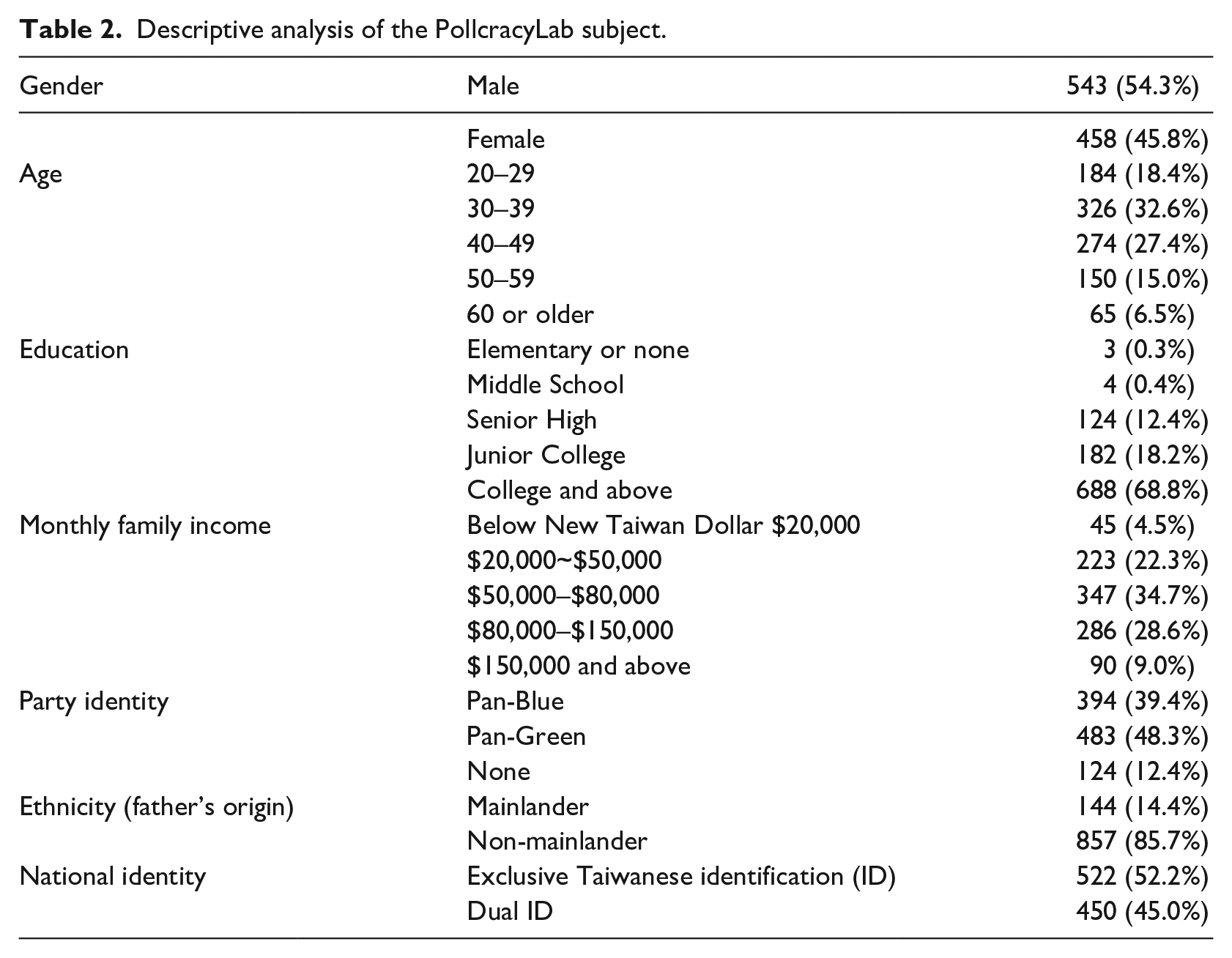
Table 2 illustrates the background information of our subjects. Compared to Taiwan’s population, our subjects were younger, more likely to be Pan-Green supporters (supporting the pro-independence parties), male, and less likely to be non-partisan. Despite this result, our subjects are nationally representative among those below 50 based on the PollcracyLab establishment’s report (Yu, 2013). Subsequent randomization checks also showed that respondents were evenly assigned to the treatment and control groups with respect to gender (p = 0.891), age (p = 0.072), level of education (p = 0.367), income (p = 0.772), partisanship (p = 0.150), and ethnicity (p = 0.620).
Descriptive analysis of the PollcracyLab subject.
Empirical results
Perception of military training on war support
To test our first hypothesis, we incorporate a series of variables related to respondents’ perception of military training. The variables included in the regression model are: learning (whether they perceived their conscription experiences to be useful, measured using a four-point scale where 4 is very useful and 1 not useful at all); boss (whether they had experienced a positive interaction with their supervisors during the conscription, measured using four-point scale where 4 is very positive and 1 indicates very negative); and four dummy variables indicating which military branch they served in, including army, marines, military police, and navy (army is the reference group). In our sample, only male respondents with military experience are included in the models: male respondents without military experience (due to personal issues) were excluded, and none of the female respondents reported their military experience. 7
We find support for the first hypothesis: when a citizen considers their military training useful, he would be more supportive of self-defense. In both models in Table 3, one unit increase in the perceived usefulness of military training will increase about 0.7 units of willingness to fight against China on the 0–10 scale. The results remain the same when other control variables are included.
War support and conscription (only those who have served in the military, n = 436).
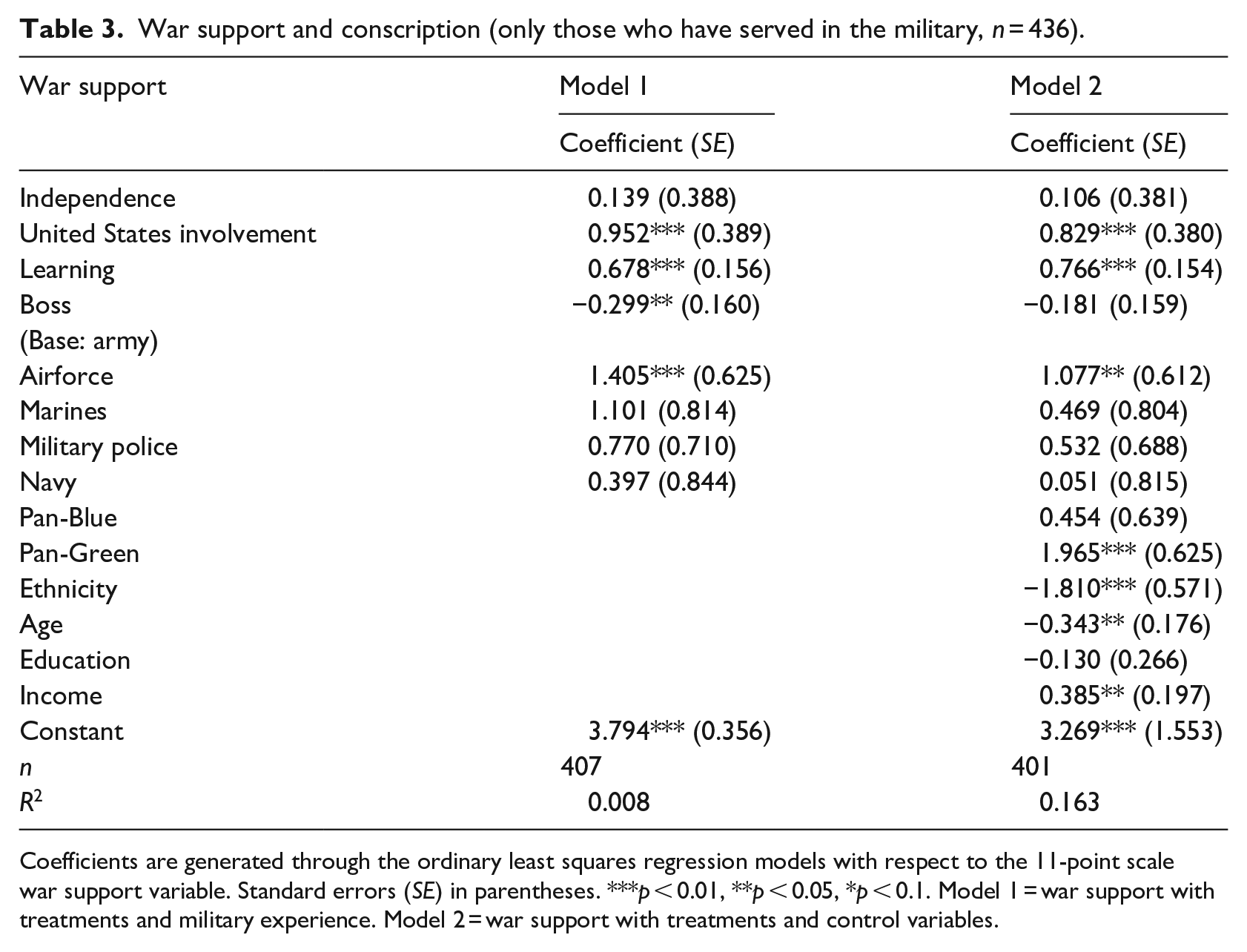
Coefficients are generated through the ordinary least squares regression models with respect to the 11-point scale war support variable. Standard errors (SE) in parentheses. ***p < 0.01, **p < 0.05, *p < 0.1. Model 1 = war support with treatments and military experience. Model 2 = war support with treatments and control variables.
Great power assistance on war support
We also find support for the second hypothesis: information about United States military assistance would influence war support among the public in Taiwan. Table 4 presents the raw average of the four experimental groups on the level of war support. Analysis of variance shows that the mean values are significantly different across the groups, and post-hoc Tukey analysis reveals that the level of support in the two groups with the information about United States military assistance is significantly higher than the two groups without (Tukey test p = 0.06). Comparatively, whether Taiwan declared independence or not has no impact on the respondents’ attitudes toward war support. It is worth noting that the measure of war support ranges from 0 to 10, and the effect of United States help for both groups is nearly one unit, indicating a sizeable effect of such a treatment.
Level of war support across experimental groups.
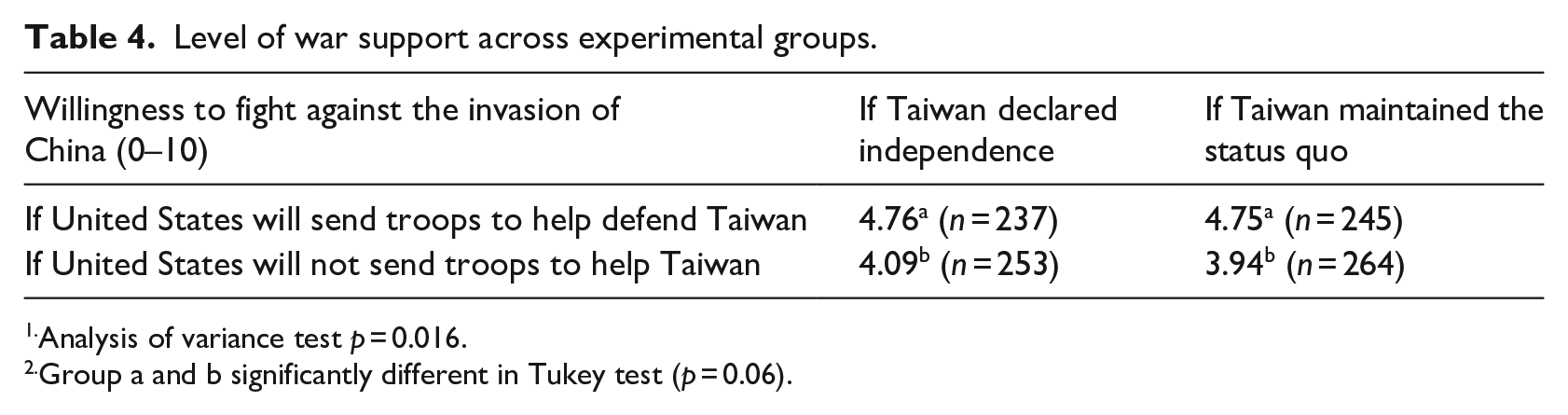
Analysis of variance test p = 0.016.
Group a and b significantly different in Tukey test (p = 0.06).
We use two ordinary least squares (OLS) regressions to include possible confounds, and the results are shown in Table 5. Model 1 includes only the treatments of the experiment, and Model 2 adds in all the controls, including two party identification dummies, Pan-Blue (respondents who support Kuomintang, the New Party, the People First Party; these parties are known for supporting unification with China) and Pan-Green (respondents who support the Democratic Progressive Party, the Taiwan Solidarity Union, and the New Power Party; these parties are known for supporting independence for Taiwan), shengi (whether one of the respondents’ parents were from China after 1945), gender (Female), age, education, and income level.
Great power assistance on war support.
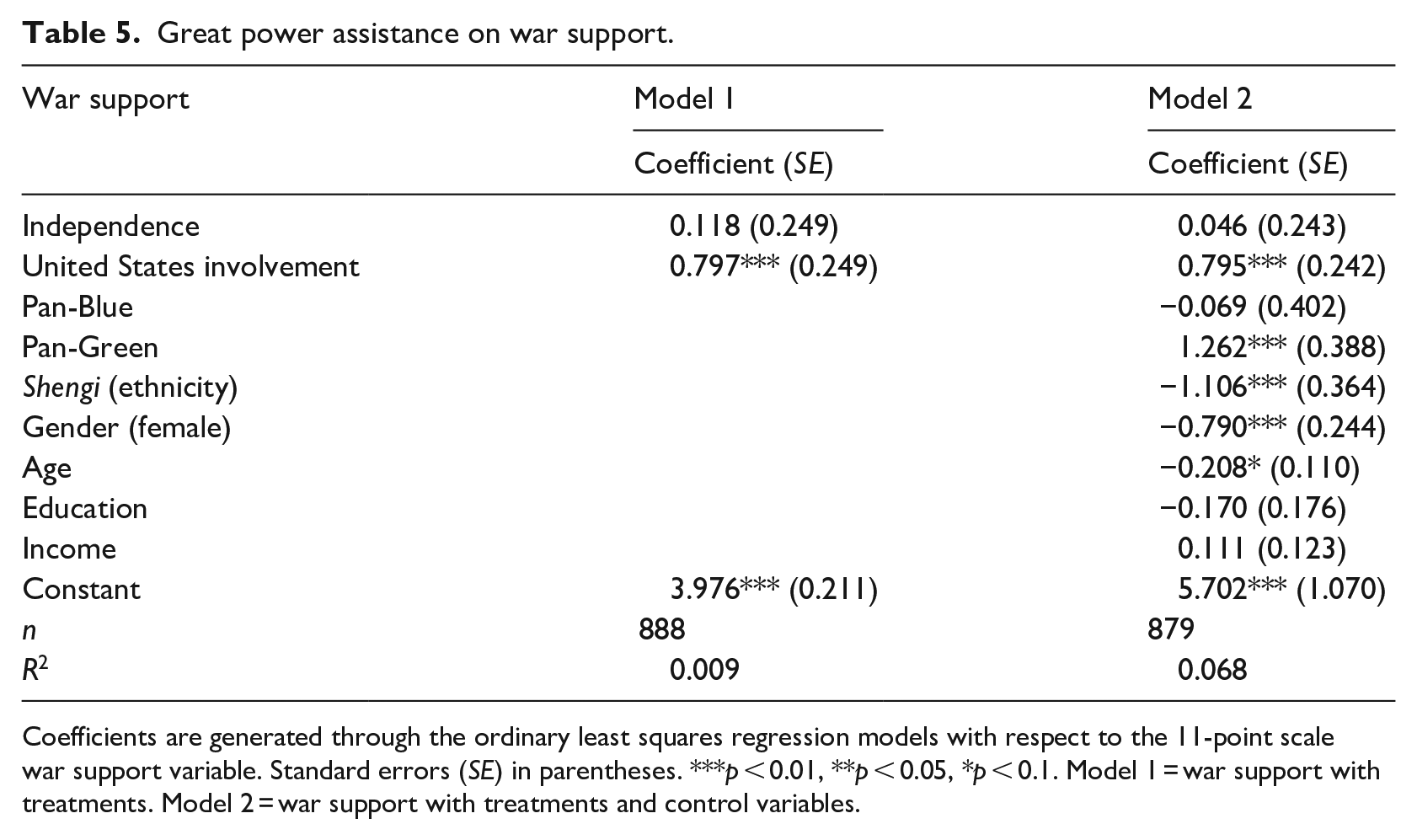
Coefficients are generated through the ordinary least squares regression models with respect to the 11-point scale war support variable. Standard errors (SE) in parentheses. ***p < 0.01, **p < 0.05, *p < 0.1. Model 1 = war support with treatments. Model 2 = war support with treatments and control variables.
The effect of the information about United States military involvement is positively significant in both Models 1 and 2. Information about United States military assistance to Taiwan could, on average, lead to a 0.77-point increase among the public’s willingness to fight China on a 0–10 scale, equivalent to a 7% increase. Meanwhile, Taiwan declaring independence is non-significant in both models, and controlling for confounds does not change our findings. 8
To illustrate the effect of the two treatments, Figure 1 shows the simulation results based on Model 2 in Table 5. The variance–covariance matrix was sampled 200 times and then was used to estimate the variance of the effects of the two treatments, controlling all other variables at the mean values. The error-bars show a 95% distribution of the simulations. Figure 1 indicates that United States assistance increases Taiwanese citizens’ willingness to fight against China’s invasion.
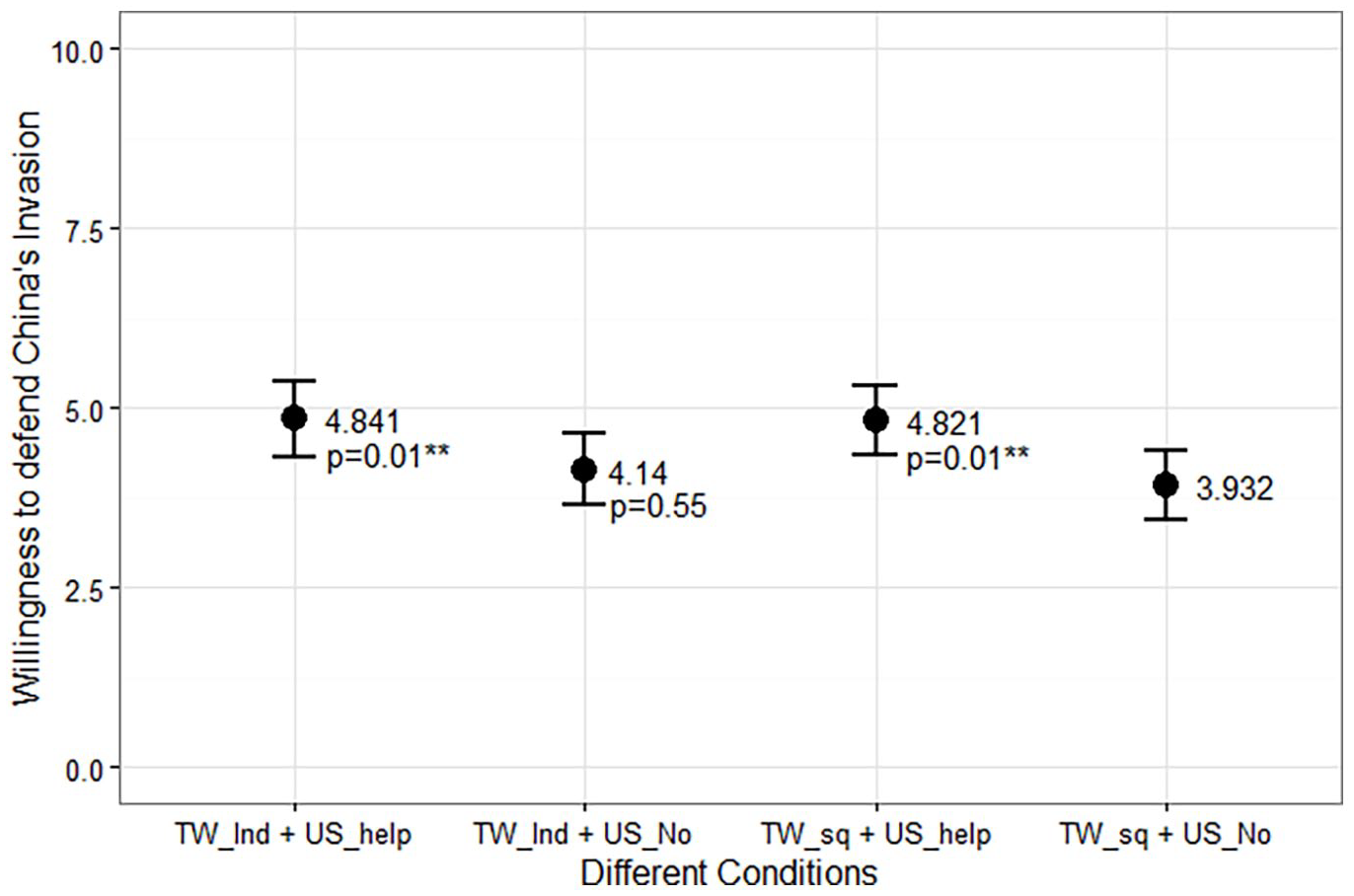
Simulation results based on Model 2 in Table 4.
Information about United States assistance on Taiwanese casualty tolerance
Table 6 presents several models examining the third hypothesis on the influence of military assistance on casualty tolerance among citizens in Taiwan. The DV, casualty tolerance, is coded from 1 (0 people) to 6 (more than 50,000 people). Models 1 and 2 treat this variable as a continuous variable and are estimated through OLS regression, while Models 3 and 4 treat it as ordinal and apply ordinal logistic models. The same set of control variables in Table 4 is included. The result shows that United States military assistance did not influence the Taiwanese public’s perception of battle deaths.
Great power assistance on casualty tolerance.
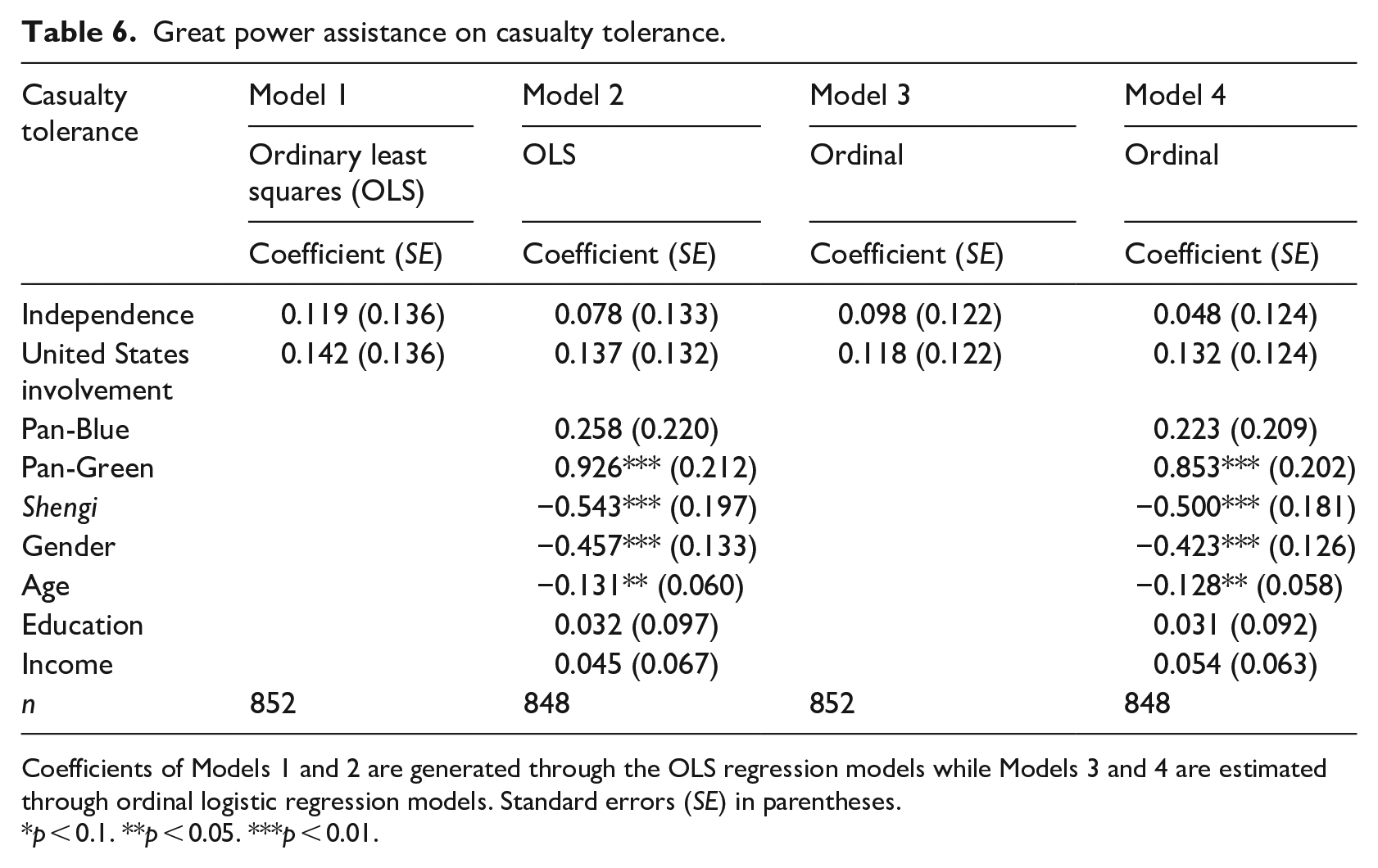
Coefficients of Models 1 and 2 are generated through the OLS regression models while Models 3 and 4 are estimated through ordinal logistic regression models. Standard errors (SE) in parentheses.
p < 0.1. **p < 0.05. ***p < 0.01.
Table 7 shows the distribution of Taiwanese casualty tolerance by four experimental groups. Although United States involvement did not influence public perception of causality tolerance in Taiwan, it creates a sizable change in higher casualties’ tolerance. For example, in the scenario where the United States will assist when Taiwan proclaims independence, the percentage of the public willing to sustain 500 and more casualties increased by 7%, compared to the same scenario without United States military assistance. Similarly, in the scenario where the United States gets involved when China breaks the status quo, the percentage of the public willing to sustain 500 and more casualties increased by 3%, compared to the same scenario without United States military assistance.
Distribution of selecting casualty categories in different groups.
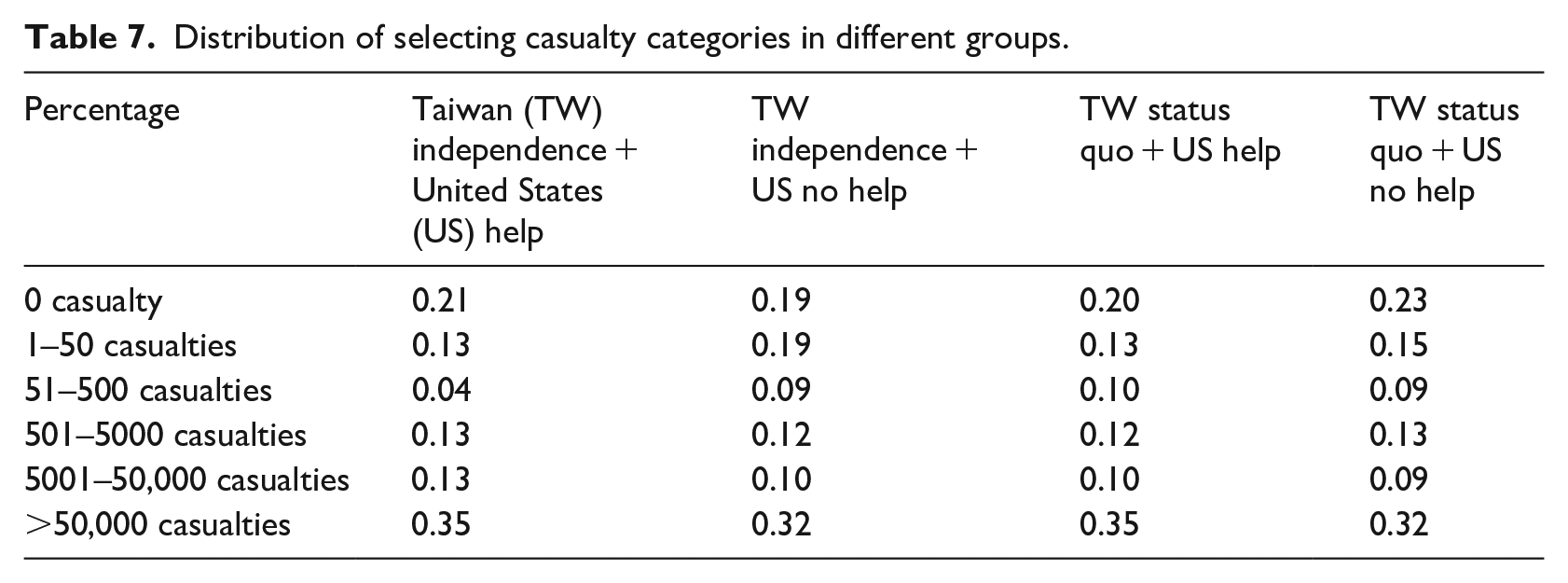
Additional post-hoc analyses shown in Table 7 help us further evaluate if the public in Taiwan is casualty phobic. The analysis shows that citizens in Taiwan do not show a clear sign of casualty phobia, as the most selected category of acceptable battle deaths is over 50,000 deaths (32.2%). In other words, the public in Taiwan is willing to sustain a high level of casualties before reducing war support. The public in Taiwan is, comparatively, less sensitive to battle deaths when compared with their US counterparts: only 11% of the public chose 50,000 when support for the Iraq War was still high in 2003 (Gelpi et al., 2006).
But there is also evidence to suggest the contrary. In Table 7, although the option of over 50,000 deaths is the most popular one (32%), another 20% of the respondents choose 0 death, meaning that a large segment of the population in Taiwan is averse to war casualties—they would not be able to tolerate any death in a war. Taken together, this finding confirms research that suggests battle deaths and war support does follow a linear relationship (Berinsky, 2007).
Discussion and conclusion
War support in NWNM states is a novel inquiry in the war support literature. Our experiment in Taiwan shows that unlike citizens in Western democracies, a positive perception of military training leads to higher war support among citizens. We also find evidence of the critical role that a great power could play in shaping war support among the public in NWNM states. In the case of Taiwan, information about the United States coming to help Taiwan in a war with China would boost war support to a great extent, although such information does not motivate the public to accept a higher level of battle deaths. Our work demonstrates that studying war support in NWNM states is a promising avenue of research as it could yield innovative findings and contribute to the diversity of the literature.
Despite the theoretical and empirical contributions, our study has clear limitations. While we maintain that the reasons that make NWNM cases from traditional war support cases—proximity to war and great power assistance—are common, our hypotheses and findings drawing from one country and one conflict scenario should be treated with skepticism when thinking about other NWNM cases. Let us be clear about our contributions. We are not providing a general framework for how citizens in NWNM cases would react in terms of war support. Instead, through the case of Taiwan, we suggest that NWNM states are worth studying, considering the different contexts and backgrounds they have to offer. Now that we have established the value of such an investigation, scholars should have more confidence in broadening the scope to include more countries and other nuances that might also play a role in the war support literature.
Our findings speak to existing war support literature in a number of ways. First, contrary to the conventional wisdom that conscription reduces war support (Gartner, 2008; Horowitz and Levendusky, 2011; Moskos, 1970; Vasquez, 2005; Wallace, 2017), we find that it is possible that some citizens in NWNM states might approach mandatory military training in a positive light when it well-prepares them for combat. Second, our findings raise a number of questions regarding casualty sensitivity. Although we have primitive evidence suggesting that citizens in Taiwan could be tolerant of high casualties, we find that a significant portion of respondents considered only zero battle death to be acceptable in our survey. Clearly, it takes further research to tease out the mechanisms and conditions for casualty sensitivity among the citizens in NWNM states.
Our findings also allow us to think about alliances differently during the onset of war. For Western cases, assistance from allies and international organizations boost war support for reasons such as increasing the legitimacy of the operations and burden-sharing the costs involved (Holsti 1996; Page and Bouton, 2008). For NWNM states, the involvement of allies, especially great powers, can be for other reasons such as offering protection, as in the case of Taiwan. Future research could design experiments to ascertain which explanation holds the most power in explaining war support in NWNM states.
Lastly, our research also generates two critical policy implications. For United States–Taiwan relations, our study agrees with the conventional wisdom that the United States promise to help defend Taiwan should increase war support among citizens in Taiwan—it is the most important factor for keeping China at bay. Our study also suggests that Taiwan could further increase its deterrence against Chinese invasion by committing to military programs that are deemed valuable and effective among citizens.
Footnotes
Acknowledgements
We thank anonymous reviewers and the editor of the International Political Science Review for their valuable comments and suggestions.
Funding
The authors disclosed receipt of the following financial support for the research, authorship, and/or publication of this article: The project is funded by the Global Taiwan Institute and the Taiwan & East Asia Studies Program at the University of St Thomas, Houston.
