



Abstract
The article draws on nationally representative telephone surveys in Tunisia, Egypt and Lebanon to unpack popular beliefs about who can best handle the social and economic consequences from the ongoing COVID-19 pandemic. It therefore offers insights into state–society relations under stress and contributes to the debate on whether or not the state should play a key role in social protection. Findings reveal intriguing differences between countries, but also among social groups within societies. Communal identities and economic status do not appear to drive differences, with roughly half of the three countries’ populations sharing trust in their respective state authorities. In turn, the article challenges findings on the gender gap in people’s expectations about the provision of public goods amid crisis. On the country-level, Egyptians exhibit significantly greater trust in their state authorities than Tunisians and Lebanese, which substantiates arguments about the perceived advantage of autocratic governance to fight health crises.
Introduction
Scholarship on risk management and social policy has long discussed which actor can best help individuals deal with micro and macro shocks. Some scholars have argued that the state alone can provide sufficiently reliable and equitable social protection to everyone in society, while others have emphasized the market to be more efficient. Yet others stress society would be better equipped to do as much as possible, relegating the state to a subsidiary role (Loewe and Schüring, 2021). Quite often, however, the discussion has neglected to consider citizens’ expectations in the capacities of governments versus societies.
The ongoing COVID-19 pandemic is one of the most serious macro shocks since decades. It has had a tremendous impact on people’s lives across the globe. The Middle East and North Africa (MENA) is no exception. Not only has the COVID-19 pandemic resulted in increased health risks and fatalities, government responses to curb this virus’s spread have also resulted in social and economic adversities for many people. This article explores people’s expectations about who would be best equipped to provide them with medical and financial support and help alleviate the consequences of the COVID-19 crisis. More directly, we wonder whether people think that assistance should better come from their governments or social networks. Looking at people’s attitudes is important for the broader research programme on the distribution of responsibilities in social contracts in the Global South (Loewe et al., 2021). First, exploring popular expectations against the backdrop of a macro crisis as severe as the COVID-19 pandemic reveals a stress test for the social contract in MENA societies. It is in such critical moments where we can most directly gauge people’s expectations about what a government can, and should, do for them, and what the family or key societal actors can do better.
To explore our question, we draw on original, nationally representative opinion polls in Egypt, Tunisia and Lebanon, conducted amid the height of the MENA region’s COVID-19 pandemic in late 2020. Studying these countries allows us to present findings from varied social and political contexts. It also establishes greater external validity compared to single-country inquiries.
We find commonalities but also intriguing differences across our cases. In a broad perspective, people appear to be divided in their perceptions, with many pointing at the government, others at society to be best equipped to deal with the COVID-19 pandemic. These findings, however, conceal important differences across our cases and social constituencies. First, women rely significantly more often on support from the family than the government. At the same time, neither economic status – that is, differences in actual and perceived income disparities – nor communal identity matter much in our findings. Third, we detect substantial differences across our cases: Egyptians have greater trust in their central government than citizens in both Tunisia and Lebanon. These findings give rise to an explanation that assertive states – represented by the authoritarian regime in Egypt – are viewed as more capable at weathering the storm of social and economic shocks than the accountability mechanisms characterizing democracies (Tunisia) and hybrid regimes (Lebanon).
The remainder of this article proceeds as follows: in the second section, we briefly discuss the theoretical literature on the political impact of natural disasters and health crises; in the third section, we then discuss the empirical context and introduce the survey data on which our findings are based; and in the fourth and fifth sections, we present the findings from our data analysis before concluding with a discussion of their impact for academic and policy debates.
Theoretical expectations
In an emerging research programme, scholars have been interested in the management of macro shocks such as natural disasters, global economic crises and pandemic diseases. Most works in this research tradition have zoomed in on two distinct perspectives. For one, scholars have focused on immediate government responses. Examples include analyses of restrictions of democratic rights (Cheibub et al., 2020), government responses to social movement demands (Abers et al., 2021), or implications for authoritarian regime coalitions (Badarin, 2020; Koehler and Schulhofer-Wohl, 2022). Others have compared the effectiveness and distributive impact of different economic and social policy reactions to economic crises (Gehrke, 2012).
A second strand in the literature aims to unpack the long-term political developments emerging from such shocks (Carlin et al., 2013; Cole et al., 2012; Crisman, 2020; Park and Wang, 2017). We find inspiration in this body of literature yet taking one step back. Rather than looking at government responses to, and long-term effects of, macro shocks, we remain interested in popular expectations in who can best deal with them: state authorities or social networks. While most scholars look at the economic and political trajectories of macro shocks, less research has been done on people’s trust in the capacities of government and society at a time where a crisis is unfolding.
An emerging body of literature has begun to study people’s trust in government action amid the COVID-19 pandemic. Scholars have been intrigued about people’s support of restrictive lockdown measures (Bol et al., 2021; De Vries et al., 2021), support for governments and incumbents more broadly (Esaiasson et al., 2021; Vlandas and Klymak, 2021), and people’s emotional underpinnings of government trust during the early COVID-19 crisis (Erhardt et al., 2021).
We believe there is value in contributing to this perspective on people’s trust in their government and their social networks because it offers a glimpse into broader expectations in the allocation of public goods and hence the nature of state–society relations and social contracts (Desai et al., 2021). We seek to offer an empirical expansion of the emerging literature on popular perceptions amid the COVID-19 pandemic by, first, juxtaposing people’s expectations in government and society and, second, exploring empirical cases beyond the Organization for Economic Co-operation and Development world. Moreover, our findings have policy implications: the level of trust (or lack of it) in government capacities to curb pandemic diseases can explain people’s compliance with measures implemented by that very government (Abers et al., 2021; Blaire et al., 2016).
We raise two interrelated questions. First, do people expect the government or their social networks to be particularly capable at alleviating the social and economic consequences of the pandemic? Second, what determines whether people have high hopes in the government – or social networks – to secure the wellbeing of their citizens? Our curiosity leads us to study institutional mechanisms as well as social constituencies. Methodologically, when generating testable hypotheses, we distinguish between country-level and group-level factors.
To begin with, we rely on the literature that juxtaposes mechanisms inherent to democratic accountability with those associated with authoritarian action. In this perspective, some scholars have pointed to the advantages of democracies in pandemic crisis management (McMann and Tisch, 2021). Their premise is that elected officials most forcefully allocate public goods across a broad range of societal actors, rather than small constituencies in support of smaller, authoritarian ruling coalitions. This holds true particularly for ‘nonexclusive goods’ (Deacon, 2009), such as alleviating the social and economic costs of an infectious disease. Popular expectations in democratic accountability as a driving force for a state’s crisis management may also be inspired by people’s awareness that they can punish or reward elected officials in the future (Cole et al., 2012; Crisman, 2020).
High expectations in democratic accountability stand in contrast with what we call the assertive state: people’s expectations could be driven by their experience with swift and decisive actions typically associated with autocratic governance, where policy-makers do not observe limitations imposed by decentralized governance, party coalitions and social dissent. In fact, scholars have shown that fatalities in the early stages of the COVID-19 pandemic were higher in democracies than in authoritarian regimes, implying an authoritarian advantage in rapid responses to such crises (Cepaluni et al., 2020). Emphasizing the ability to exercise decisive action when faced with a health crisis or natural disaster (Carlin et al., 2013; Stasavage, 2020), the People’s Republic of China’s response to the COVID-19 pandemic has been mentioned as a vivid example of this assumed authoritarian advantage (Mao, 2021). While authoritarian governments tend to misreport fatalities from the COVID-19 pandemic (Cassan and Van Steenvoort, 2021), people may still buy into the narrative of these regimes to be particularly effective crisis managers.
If people take the institutional set-up of their respective states seriously, the question emerges whether citizens across the MENA region – and possibly the Global South more broadly – believe in the assertive state of autocracies, or the accountability mechanisms of liberal democracies, to serve their interests best during crisis. Given inconsistent findings in prior research addressed above, we propose two rivalling hypotheses on people’s expectations: Hypothesis 1a: Citizens in democracies are more likely to call on the government to handle the consequences of the COVID-19 pandemic. Hypothesis 1b: Citizens in authoritarian regimes are more likely to call on the government to handle the consequences of the COVID-19 pandemic.
Apart from such country-level factors, we also need to consider factors pertaining to differences among social constituencies, namely economic status, social identity and social diversity. We propose that people with a low income may rely to a greater degree on government support than more affluent members of society. This is because the economic resources a government can allocate are more meaningful to poor people. Moreover, Egypt and Tunisia spend considerably more on public social transfers than most other middle-income countries (Lebanon less so). While public transfers in the MENA region suffer from huge errors of inclusion (wealthy people receiving transfers), they are still progressive in redistributive terms because most recipients are still poor (Silva et al., 2012). Private transfers, in contrast, have regressive effects because the relatives, friends and neighbours of low-income people tend to have below average resources as well and suffer just as much from the socioeconomic impact of macro shocks (Loewe, 2009). Hence, we submit a second hypothesis: Hypothesis 2: Poor people are more likely than rich people to call on the government to handle the consequences of the COVID-19 pandemic.
Rather than economic status, people might quite well look at themselves predominantly as members of a particular social community, such as family, neighbourhood, tribe, ethnicity, or religious community. Scholars have shown that a common social identity increases in-group cooperation for the production of a common good (Lankau et al., 2014). If this holds true for the context of a health crisis, we would assume those individuals emphasizing a communal identity – based on allegiance to tribe, ethnic group, or religious community – would be driven by in-group solidarity. This is for altruism as much as reciprocity expectations of in-group solidarity (Baldassarri, 2015): people may quite well believe in the power of networks to help each other on an iterative basis. Moreover, citizens may be aware of sectarian groups below the level of national governments to distribute goods and services, in particular in governments with limited economic resources (Brooke, 2019). Our third testable hypothesis therefore reads as follows: Hypothesis 3: People emphasizing a communal identity are more likely than people emphasizing a national identity to call on their social networks to handle the consequences of the COVID-19 pandemic.
Finally, societies are diverse beyond communal identities as evidenced, for instance, by gender differences. Scholars found that women share specific values and preferences in the delivery of government services, emphasizing social welfare provisions over security-related government spending (Lizotte, 2020). Challenged by low levels of welfare benefits, women have been found to favour public spending for social protection more often than men (Shorrocks and Grasso, 2020). The literature on the welfare state has been particularly instructive for highlighting the mechanisms held responsible for women’s greater trust in the government. Scholars have identified women’s ideological disposition – namely greater sense of solidarity (Arts and Gelissen, 2001) and egalitarianism (Blekesaune and Quadagno, 2003) – along with their self-interest as main beneficiaries of public spending (Hasenfeld and Rafferty, 1989). Taking the gender gap seriously, we submit a fourth hypothesis: Hypothesis 4: Women are more likely than men to call on the government to handle the consequences of the COVID-19 pandemic.
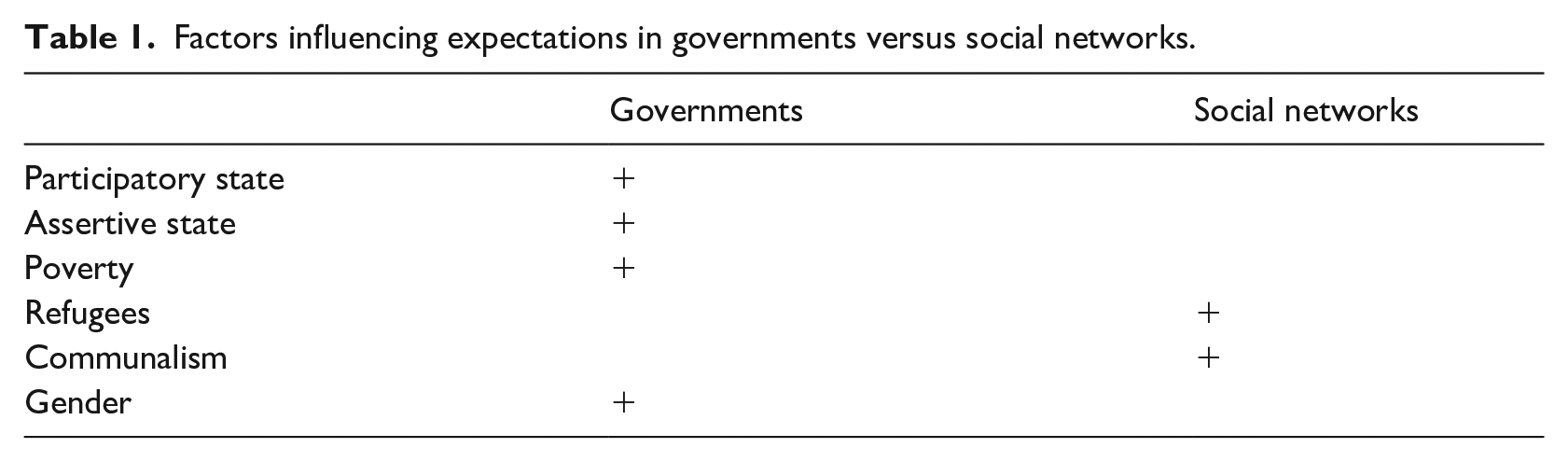
We summarize our hypotheses regarding expectations in the capacities of states vs. social networks in Table 1.
Factors influencing expectations in governments versus social networks.
Case selection and empirical data
We chose to explore Egypt, Tunisia and Lebanon for theoretical and empirical reasons. Our case selection allows us to introduce important scope conditions and, at the same time, claim a degree of external validity for our findings. Owing to the limited number of countries, we can only test our country-level hypothesis upon the logic of comparative, rather than statistical control, while the latter will be used for the individual level inquiry of Hypotheses 2–4.
We begin with a theoretical premise on people’s expectations about the broad capacities of governments and social networks to alleviate the social and economic costs from macro shocks: people have generally modest expectations in the capacities of their social networks. This is because social shocks emerging from macro crises – such as the COVID-19 pandemic – affect many individuals in social networks equally. This poses substantial limits to friends, family and members of the same communal network to easily absorb the social and economic costs of such crises. As Park and Wang suggested, ‘community members cannot provide sufficient assistance to each other when everyone has been adversely affected’ (Park and Wang, 2017: 38).
This is consequential for our case selection. In countries with substantial economic resources – such as oil-fuelled allocation states in the Gulf region or tax-based social welfare states in Scandinavia – people may not even consider their social networks for help as they would surely expect the government to step in to remedy the situation. To allow for a comparison of people’s genuine expectations in public versus private capacities, we must create a roughly level playing field and hence draw on cases where government capacities produce equally modest expectations.
Egypt, Tunisia and Lebanon serve this purpose well. Our case selection strategy allows us to study lower-middle income countries under roughly similar socio-economic conditions. Unlike least-developed countries, our cases do have established capacities at government spending. Yet, citizens in these countries are most certainly aware of the limited scope of such government capacities. According to the World Bank, Egypt and Tunisia are among lower-middle income countries with a gross national income (GNI)/capita of US$ 2,690 (Egypt) and US$ 3,360 (Tunisia) in 2019. 1 In that same year, Lebanon ranked among upper-middle income countries at a GNI/capita of US$ 7,600. Yet, over the following two years, Lebanon has suffered from a major economic crisis resulting in substantial inflation rates, economic decline and loss of income and savings (Bisat et al., 2021). In sum, we have reason to believe people in Egypt, Tunisia and Lebanon look at both their social networks and the authorities as possible, yet equally limited sources of help during crises. This allows us to reformulate our general puzzle: if both public and private capacities are limited, which social constituencies would emphasize government capacities, and which ones would trust the capacities of their social networks for help in response to macro shocks?
Second, our case selection allows us to consider variance along dimensions meaningful for our theoretical expectations. As mentioned above, we are interested in different political regime types, as there are substantial differences in the provision of participatory mechanisms in authoritarian regimes, hybrid regimes and democracies. Egypt, Lebanon and Tunisia represent these different regime types well. 2 At the time of our survey, Tunisia remained the only Arab democracy. While Tunisia’s democratic transition has been volatile and uncertain (Albrecht et al., 2021), no other country in the Arab world has established similarly robust avenues of participation. Egypt, in turn, experienced a resurgence of authoritarian rule (Bellin, 2018). At the time our survey was implemented, the country represented a particularly repressive authoritarian regime in the region. Finally, Lebanon’s political system has remained a hybrid regime. It combines both democratic and nondemocratic elements (Salamey and Payne, 2008), namely limited participatory opportunities for citizens (Paterson and MacQueen, 2021). In turn, our country selection also introduces variance regarding our third hypothesis: ethnic diversity. Lebanon, in particular, has an ethnically and religiously diverse society with substantial refugee communities from Palestine and Syria (Harb et al., 2022).
Finally, the timing of our empirical inquiry is important in that it had to be conducted when people’s sense of the health crisis was salient. We chose to conduct the surveys in October–December 2020, that is, at a time where respondents understood both the magnitude of the COVID-19 pandemic’s social and political impact as well as the initial measures from government authorities and social network members to alleviate those social and political costs. Among our three countries, Egypt was first in detecting a confirmed case of infection as early as in February 2020 (Hamzawy and Brown, 2020). And yet, our cases experienced the most serious social and economic fallout from the COVID-19 pandemic later that same year (Beschel and Yousef, 2020). This is in great part owing to government measures – including travel restrictions, curfews, lockdowns, mosque closures and stay-at-home orders – widely applied in MENA countries amid the early stages of the COVID-19 pandemic, including in our three countries (Guetat and Agrebi, 2022; Koehler and Schulhofer-Wohl, 2022). Government-mandated lockdowns have undoubtedly served to keep infection numbers within reasonable limits throughout much of 2020; but they also contributed to a growing awareness of the magnitude of the crisis, with people being adversely affected from restrictions on work and travel. By late 2020, however, the region was hit hard by a belated wave of COVID-19 infections and experienced consequences similar to those in other world regions, including a rise in fatalities, economic decline and the social consequences of protracted lock-down measures (Abbouzohour, 2021). 3
For our empirical inquiry, we draw on nationally representative telephone surveys among adult respondents in Tunisia, Egypt and Lebanon. We worked with a survey firm, One-to-One for Research and Polling, based in Tunis. 4 The survey was constructed in modern-standard Arabic and administered to a total of 3,509 respondents by enumerators speaking local dialects in the respective countries (Egypt: 1003; Tunisia: 1003; Lebanon: 1503). 5 The entire survey consisted of 43 questions, seven of which were designed to directly gauge people’s perception on the COVID-19 pandemic (see Online Appendix Part I for the questions on COVID-19 and Online Supplemental Appendix Table A1 for descriptive statistics on the survey sample). 6
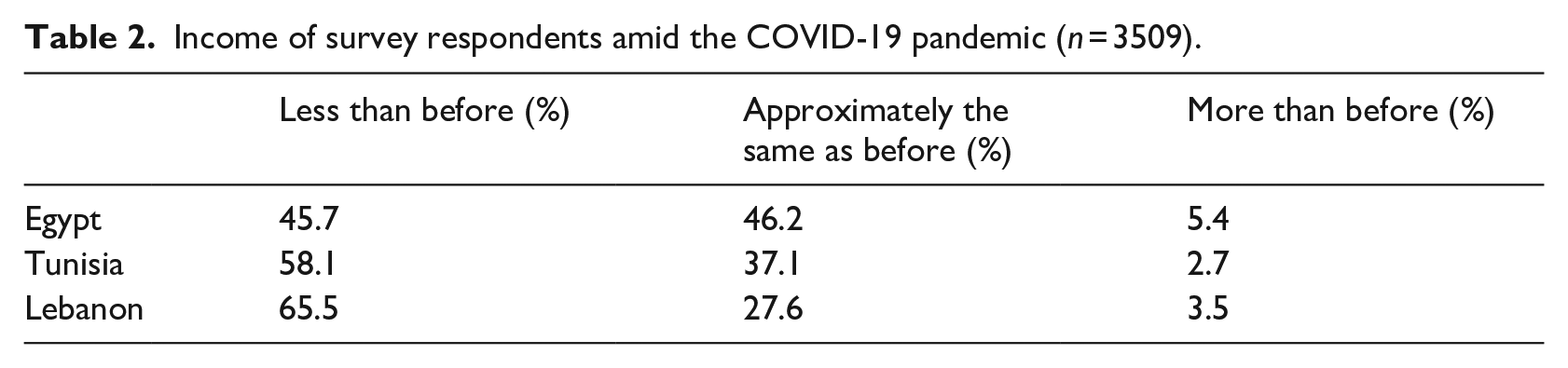
Table 2 shows a substantial number of respondents – to the tune of almost 58% across all three countries – reported income losses over the past months. By the end of 2020, people across the MENA region not only understood the COVID-19 pandemic to be a possibly existential health hazard. They also began to feel the socio-economic impact of their governments’ measures to contain the outbreak.
Income of survey respondents amid the COVID-19 pandemic (n = 3509).
Findings and discussion
To gauge people’s expectations in the sources of help to alleviate the fallout from the COVID-19 pandemic, we asked the following question: ‘who can best handle the coronavirus outbreak and protect the wellbeing of the people?’ By intention, this question is broad enough to include people’s perceptions on capacities to ameliorate the immediate consequences from the crisis – such as health risks and death – as well as the social and economic consequences from a prolonged crisis, such as unemployment or the effects from social isolation. Possible answers included: government/government authorities; local government; traditional leader; religious leader; and family. This allows us to operationalize responses for our dependent variable, with higher belief in the capabilities of the central or local government indicating trust in state authorities and higher belief in the family or religious/traditional leaders implying trust in social networks.
We estimate probit models because we treat all independent variables as binary. 7 Since we need to measure both country-level and group-level factors, we estimate two different sets of models: one set of cross-country models uses the entire dataset and includes countries as independent variables and social and economic indicators as controls (Hypothesis 1a and 1b); and a second set of models operationalizes our Hypotheses 2–4 as independent variables separately for each country.
Cross-country analysis
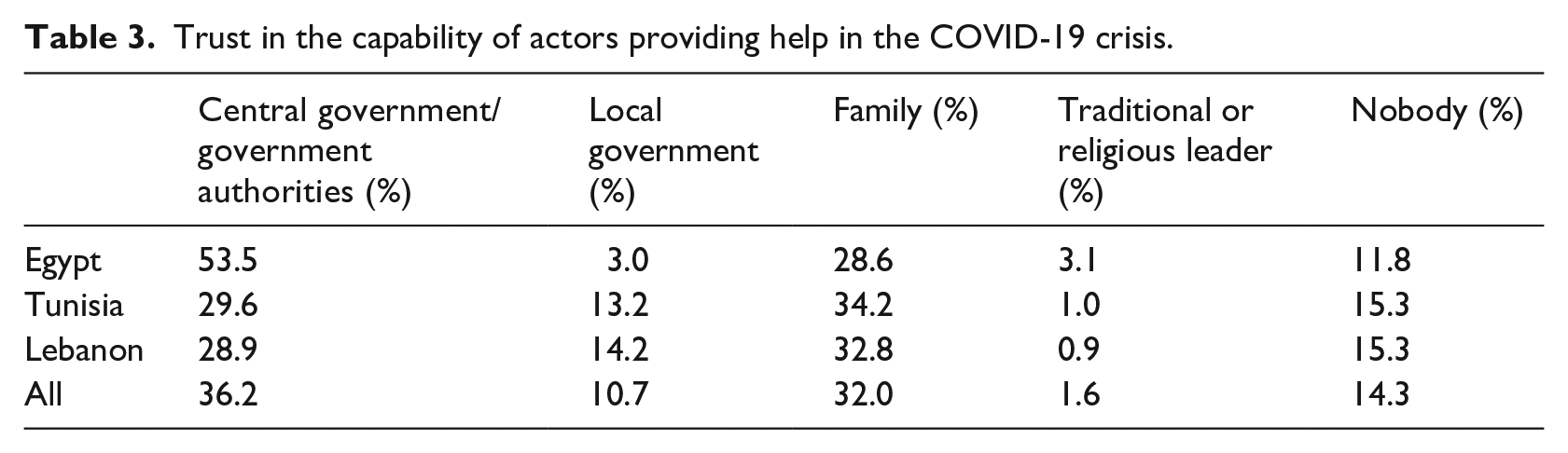
We begin our cross-country analysis with descriptive statistics. Table 3 reveals intriguing findings. For one, citizens across our three countries share a healthy dose of scepticism, with an aggregate 14.3% voicing their disbelief that anybody could be of help to combat the crisis. For another, respondents across the countries are almost evenly split between those putting their hopes into the central government (36.2%) versus others relying on their families (32%). Fewer people put their hopes into traditional and religious leaders that we collapsed into one category. And yet, those aggregate findings disguise marked differences between the three countries. Most importantly, Egyptians appear to have more confidence in their government than Tunisians and Lebanese – providing initial evidence in support of our assertive state assumption (Hypothesis 1b, and dismissing Hypothesis 1a).
Trust in the capability of actors providing help in the COVID-19 crisis.
These findings remain in need of more systematic analyses. Table 4 presents probit estimates of the determinants for people stating that the central or local government are best to handle the COVID-19 outbreak. Egypt and Lebanon are independent variables, with Tunisia serving as the baseline variable. Models 1, 4 and 7 include several socio-economic indicators as control variables: gender as a nominal variable; age and household size as cardinal variables; religion being nominal again and picking up on Christian minorities in Egypt and Lebanon; and country of origin for interviewees in Lebanon as a multivariate variable. Models 2, 5 and 8 build on somewhat different sets of control variables. Each model includes the variables that occurred with significant results in relation to the models’ respective dependent variable (see also Online Supplemental Appendix Tables A3–A5; our models 1, 2 and 3 here correspond with models 1, 8 and 9 in the Online Appendix). Models 3, 6 and 9 finally use the same variables as Models 2, 5 and 8 but control for social desirability concerns: they include only interviewees who have declared, in a separate question, that they do not trust their respective government at all. Table 4 reports robust empirical support for our Hypothesis 1b and dismisses Hypothesis 1a. However, we need to further explore the possibility that results from our surveys are characterized by response bias emanating from social desirability concerns. This is particularly relevant for findings in response to the paired Hypothesis 1 reporting variance between an authoritarian regime (Egypt) and other regimes (Tunisia and Lebanon). It is possible that Egyptians are more prone to preference falsification than people in Tunisia and Lebanon, that is, respondents’ not telling the truth in public, including in survey interviews (Kuran, 1997). This is due to fear from retribution by authoritarian governments known to prosecute citizens for voicing opinions critical of the government’s institutions and policies (Truex and Tavana, 2019). Response bias is therefore possible in answers to questions containing a sensitive item, such as the question if interviewees have trust in government capacities to provide help during the COVID-19 crisis. We suspect preference falsification could bias the results from Egypt more so than those from Tunisia and Lebanon because the latter two countries have developed participatory procedures allowing citizens to share their true opinions without government retribution.
People’s expectations in government and family acting in response to the COVID-19 outbreak
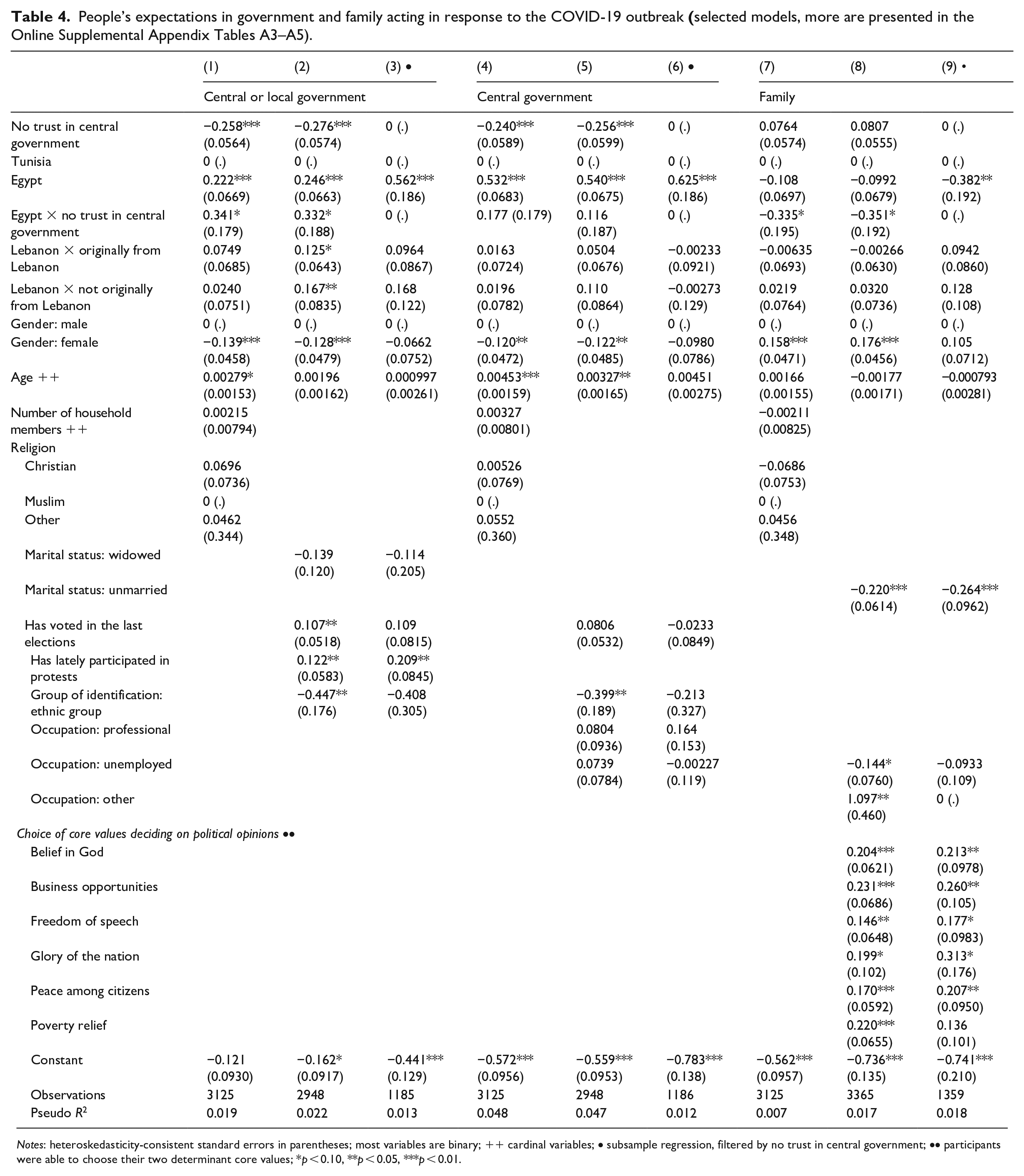
Notes: heteroskedasticity-consistent standard errors in parentheses; most variables are binary; ++ cardinal variables; • subsample regression, filtered by no trust in central government; •• participants were able to choose their two determinant core values; *p < 0.10, **p < 0.05, ***p < 0.01.
Our strategy to control for misreporting builds on the assumption that interviewees who are afraid of state penalties would lie systematically. It is quite unlikely that they lie in the answer to one sensitive question but respond truthfully to another. We find that the share of people who believe the government is better able to help them during the COVID-19 crisis is significantly higher in Egypt than in the other two countries among those who trust the government just as much as among those who do not (see Online Supplemental Appendix Table A14). We are thus not overly concerned for misreporting to bias our country-level findings.
Within-country analysis
Apart from country-level factors, we are also interested in group-level factors such as economic status, social identity, and social diversity. Table 5 presents selected probit estimates from a larger number of models that we report in the Online Supplemental Appendix (Tables A6–A13). The models explore our Hypotheses 2–4, with the combination of the central and the local government being the dependent variable; that is, Table 5 shows which factors determine an interviewee considering the government rather than private actors being best able to master the COVID-19 pandemic.
Determinants of people considering the central or local government as the most appropriate actor to handle the COVID-19 pandemic, separately by country.
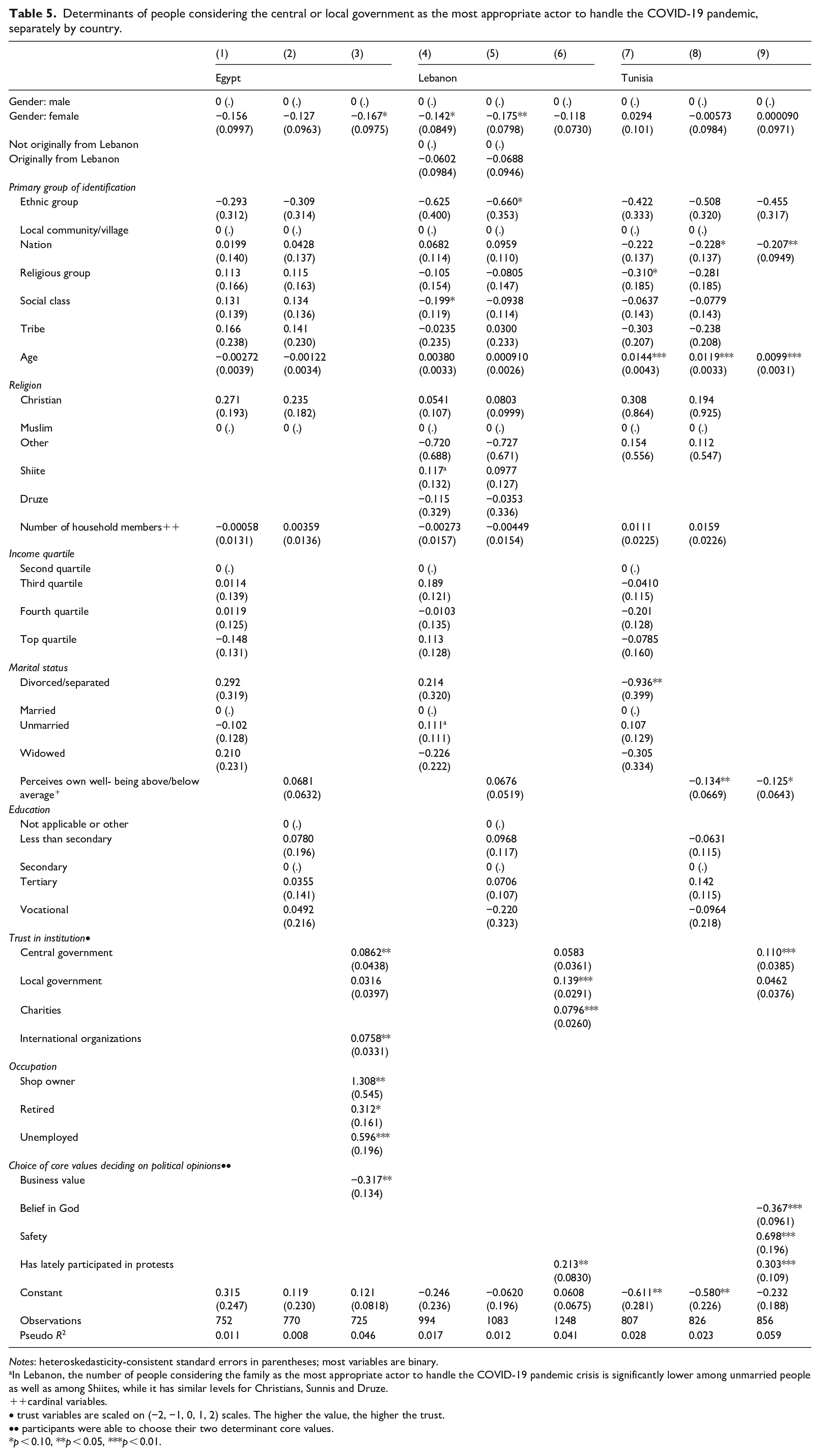
Notes: heteroskedasticity-consistent standard errors in parentheses; most variables are binary.
In Lebanon, the number of people considering the family as the most appropriate actor to handle the COVID-19 pandemic crisis is significantly lower among unmarried people as well as among Shiites, while it has similar levels for Christians, Sunnis and Druze.
cardinal variables.
• trust variables are scaled on (−2, −1, 0, 1, 2) scales. The higher the value, the higher the trust.
•• participants were able to choose their two determinant core values.
p < 0.10, **p < 0.05, ***p < 0.01.
Table 5 uses belonging to either income quartile as an objective measure for socio-economic status and the belief to fare better or worse than others in society as a subjective measure. The table shows that objective economic status is not significant, which falsifies our Hypothesis 2. 8
To further operationalize possible effects of different socio-economic status, we measure whether members of refugee communities were more likely than a country’s citizens to call on their social networks to handle the consequences of the COVID-19 pandemic. This is based on the premise that refugee communities are typically more vulnerable than citizens. We ultimately do not find support for this assumption either. None of our models finds significant differences between Lebanese citizens and residents with different origin.
With regards to Hypothesis 3, our results are less clear-cut. They differ between the three country cases. Interestingly, religion (Islam versus Christianity) does not occur anywhere as a significant factor. For Egypt, hardly any socio-cultural indicator has a significant effect on people’s attitudes. The exceptions are in people’s general trust in the central government and international organizations, both of which remain positively correlated with stronger expectations in the government. Likewise, general trust in the extended family is positively correlated with belief that the family can best handle the COVID-19 pandemic. Admittedly, these findings are neither surprising nor meaningful to draw conclusions on Hypothesis 3.
For Lebanon, we have similarly trivial but also some more remarkable findings. People’s trust in the government is positively correlated with their general trust in local government and charity organizations. In turn, Shiites more often favour the government over the family. Both findings might quite well imply there is no automatic contradiction between the government and religious communities in Lebanon. The communities (often referred to as ţawā’if) assume and fulfil many of the state’s duties with financial and intentional support by the central government.
Findings on Tunisia are also in need of explanation. For one, we find general trust in the central government once more to be positively correlated with interviewees believing that the government can help them best during the COVID-19 pandemic. Likewise, ‘safety’ is positively correlated with more trust in the government, while religiosity shows the opposite effect, that is, a higher share of people trusting the family rather than the government. Finally, tribal identity reduces the number of people sympathizing with government action against the COVID-19 crisis; yet – perhaps surprisingly – the same appears to be true in Tunisia showing identification with the nation as the primary group of reference beyond the core family. We thus conclude that socio-cultural factors matter only to some degree and only in very specific cases such as for Shiites in Lebanon.
There remains, however, one factor with very high statistical significance in Egypt and Lebanon: gender. In both countries, women are much more often sympathetic about the family providing support amid the COVID-19 pandemic than men. In turn, they expect less often help from the government. These findings are robust in almost all cross-country probit estimates (Table 4) as well as within-country estimates (Table 5). 9 This result contradicts Hypothesis 4, which stated the opposite assumption, that is, that women are more likely than men to call on the government to handle the consequences of the COVID-19 pandemic. Tunisia is the exception in this regard because women distribute similarly as men with regards to their sympathy for public and private providers of help (except widowed women). In addition, we find trust in government to rise with age in Tunisia.
Finally, particularly high shares of shop-owners and unemployed people in Egypt expect the government rather than the family to provide support during the COVID-19 crisis. This finding is probably just another expression of the fact that Egyptians rely generally more on the government. The unemployed are among the most vulnerable at any time, and shop-owners are probably among those who suffered most from the COVID-19 pandemic and the government’s reaction to it. Of course, additional parameters may also have an impact. We included household size, education, occupation, religion, voting behaviour, participation in protests and group identity in some models (all in the Online Appendix) but without robust results. Separately, we test for the impact of informal versus formal employment, also without significant results.
Conclusions and implications
Our analysis reveals intriguing results for the hypotheses formulated above. For one, a comparison of Egypt with Tunisia and Lebanon corroborates findings from previous research emphasizing popular preferences for the assertive state: the assumed ability of decisive action by an authoritarian government that does not consider dissenting public opinion, power-sharing, or decentralized decision-making germane to democracies and hybrid regimes. While prior research has largely studied the policies, consequences and long-term effects of government responses to health crises, attitudes regarding the assertive state hold at a time where the health crisis unfolds.
Given the small number of countries used for our cross-country comparison, these findings are indicative of trends highlighted in the growing literature on government responses to the COVID-19 pandemic; but they remain in need of further inquiries into the mechanisms that prompt citizens of the assertive state to place greater trust in their governments than people living in countries with greater participatory mechanisms. Further research will be necessary to determine, for instance, if these regime-level differences are owing to different institutional set-ups, political personalities and leadership styles, differences in the control over information disseminated on the health crisis, or possibly more. Moreover, as we are intrigued by social and political factors in a culturally homogeneous set of countries, we have not engaged with arguments highlighting different cultural dispositions toward expectations about states and societies’ crisis capacities.
While belief in the advantage of the authoritarian government in Egypt appears to be robust, we do not find any significant difference between Tunisia (representing a liberal, unconsolidated democracy) and Lebanon (representing a hybrid regime). Neither do we find any variance between Lebanese citizens and Syrian refugees residing in Lebanon. This is noteworthy because Syrians have been in Lebanon for a short time. As they certainly recall the assertive state – Bashar al-Asad’s authoritarian government – in their own home country, they appear to remain cognizant of what they see as limited capacities of a more liberal political environment in their host country.
Findings from our empirical measure of group-level variables are less clear, though no less intriguing. For one, we do not find any evidence within and across our countries that economic status and social identities would explain different preferences about governments or social networks to alleviate the social consequences of the COVID-19 pandemic. Focusing on the gender gap, we see significant differences across our country samples. Unlike in Tunisia, women in Egypt and Lebanon believe in the power of social networks and remain suspicious about their respective government’s capacities to handle the COVID-19 pandemic. These findings prompt us to reconsider assumptions – prominent in the literature on the welfare state – about women’s trust in the government to provide social services.
Findings from our empirical analysis give rise to some broader interpretations. For one, the MENA region appears to have a rather inconclusive track record regarding the assumed rallying effect around sitting incumbencies witnessed in many countries (Bol et al. 2021; De Vries et al., 2021). And yet, a broad picture has emerged from our data: most social groups across the MENA region – perhaps with the exception of women and older people – do not show a clear-cut social or political pattern. People appear to be rather homogeneous regarding expectations in crisis management as a pandemic unfolds. This is in line with findings from European countries (Bol et al., 2021) and remains in stark contrast to the United States where a prolonged pandemic appears to catalyse polarization and partisan divisions, hence emphasizing differences among political and social constituencies regarding expectations in crisis management (Druckman et al., 2021).
Supplemental Material
sj-do-2-ips-10.1177_01925121221109264 – Supplemental material for States or social networks? Popular attitudes amid health crises in the Middle East and North Africa
Supplemental material, sj-do-2-ips-10.1177_01925121221109264 for States or social networks? Popular attitudes amid health crises in the Middle East and North Africa by Holger Albrecht and Markus Loewe in International Political Science Review
Supplemental Material
sj-do-3-ips-10.1177_01925121221109264 – Supplemental material for States or social networks? Popular attitudes amid health crises in the Middle East and North Africa
Supplemental material, sj-do-3-ips-10.1177_01925121221109264 for States or social networks? Popular attitudes amid health crises in the Middle East and North Africa by Holger Albrecht and Markus Loewe in International Political Science Review
Supplemental Material
sj-docx-5-ips-10.1177_01925121221109264 – Supplemental material for States or social networks? Popular attitudes amid health crises in the Middle East and North Africa
Supplemental material, sj-docx-5-ips-10.1177_01925121221109264 for States or social networks? Popular attitudes amid health crises in the Middle East and North Africa by Holger Albrecht and Markus Loewe in International Political Science Review
Supplemental Material
sj-docx-6-ips-10.1177_01925121221109264 – Supplemental material for States or social networks? Popular attitudes amid health crises in the Middle East and North Africa
Supplemental material, sj-docx-6-ips-10.1177_01925121221109264 for States or social networks? Popular attitudes amid health crises in the Middle East and North Africa by Holger Albrecht and Markus Loewe in International Political Science Review
Supplemental Material
sj-docx-7-ips-10.1177_01925121221109264 – Supplemental material for States or social networks? Popular attitudes amid health crises in the Middle East and North Africa
Supplemental material, sj-docx-7-ips-10.1177_01925121221109264 for States or social networks? Popular attitudes amid health crises in the Middle East and North Africa by Holger Albrecht and Markus Loewe in International Political Science Review
Supplemental Material
sj-dta-1-ips-10.1177_01925121221109264 – Supplemental material for States or social networks? Popular attitudes amid health crises in the Middle East and North Africa
Supplemental material, sj-dta-1-ips-10.1177_01925121221109264 for States or social networks? Popular attitudes amid health crises in the Middle East and North Africa by Holger Albrecht and Markus Loewe in International Political Science Review
Supplemental Material
sj-dta-4-ips-10.1177_01925121221109264 – Supplemental material for States or social networks? Popular attitudes amid health crises in the Middle East and North Africa
Supplemental material, sj-dta-4-ips-10.1177_01925121221109264 for States or social networks? Popular attitudes amid health crises in the Middle East and North Africa by Holger Albrecht and Markus Loewe in International Political Science Review
Footnotes
Acknowledgements
A first version of the paper was presented at the Project on Middle East Political Science Virtual Workshop, 18 November 2021, and at the 2021 meeting of the Middle East Studies Association, 2 December 2021. We are grateful for insightful comments by Amira El-Haddad, Liran Harskor, Kevin Koehler, Marc Lynch, Jonah Schulhofer-Wohl, Alon Yakter and Yael Zeira. All remaining errors are ours.
Funding
The authors disclosed receipt of the following financial support for the research, authorship, and/or publication of this article: The research for this article has been supported by the German Institute of Development and Sustainability (IDOS) with funding from the German Federal Ministry for Economic Cooperation and Development.

Supplemental material
Supplemental material for this article is available online.
Notes
Author biographies
References
Supplementary Material
Please find the following supplemental material available below.
For Open Access articles published under a Creative Commons License, all supplemental material carries the same license as the article it is associated with.
For non-Open Access articles published, all supplemental material carries a non-exclusive license, and permission requests for re-use of supplemental material or any part of supplemental material shall be sent directly to the copyright owner as specified in the copyright notice associated with the article.
