




Abstract
Existing studies propose that anti-Americanism in the Arab region is fueled by American interventions, citizens’ religion, and relative deprivation. However, these three have not been addressed simultaneously or integrated into one framework. This study does so by developing and testing a context-dependent framework. Empirically, we apply multilevel regression to 32 Global Attitudes Project and 34 Arab Barometer surveys that cover more than 58,000 respondents. Contrasting dominant understandings, we find that American interventions fuel both political and societal anti-Americanism and that relatively deprived citizens are not more anti-American. Moreover, our results show (highly religious) Muslims are more politically and societally anti-American than (less religious) non-Muslims, particularly in Arab countries with fewer (highly religious) Muslims and American interventions. Altogether, anti-Americanism is context-dependent and shaped by different but interconnected mechanisms.
Introduction
Anti-Americanism is widespread in the Arab Middle East and North Africa (MENA): 60% of citizens in Lebanon, 70% in Palestine, and over 80% in Jordan view the United States unfavorably (Pew Research Center, 2015). This substantial dislike of the United States can be troublesome, for instance, for international cooperation to thrive (Tokdemir, 2017). A more general dislike of American society and its ordinary citizens can even be considered dangerous in the light of recent terrorist activities. Clearly, not all MENA citizens who dislike America(ns) will approve of violence, but animosity toward America(ns) is argued to legitimize terrorism or hinder its prevention (Berger, 2014; Moghaddam, 2005). All this highlights the importance of answering the question, “why do they hate us?”
Recent work has provided answers for anti-Americanism in the form of three explanations. These three differ widely in their central actors, theoretical mechanisms, and views of Arab citizens. First, the anti-domination theory proposes American foreign policies cause anti-Americanism because they are perceived to be harmful to the region and its citizens (e.g. Chomsky, 2002; Parker, 1988; Pitchford, 2011; Tessler, 2003). Countering this view of anti-Americanism as a rational evaluation that is ultimately caused by American actions, the other two theoretical strands emphasize Arab citizens themselves and social constructions, although one focuses more on culture and the other on structure. The former proposes that Arab citizens’ religion is used to construct and reinforce antagonistic boundaries between “the secular-Christian United States” and “the religious-Islamic Arab region” (Huntington, 1993, 1996). The latter proposes that deprived Arab citizens construct the United States antagonistically by scapegoating the US for their personal (socio-economic or political) predicament (Gurr, 1970; Tessler and Robbins, 2007).
Altogether, current understandings are rich in the sense that they include diverse views, encompassing American foreign policies, Arabs’ religiosity, and relative deprivation. At the same time, the anti-Americanism literature seems fragmented. Although all three theoretical strands have shown their merits, to our knowledge, no study exists that theoretically and empirically addresses all three explanations simultaneously, let alone one that synthesizes them into one framework. This study aims to create a more coherent and complete picture of what drives anti-Americanism in the Arab region by integrating the three theoretical strands. To do so, we apply an intra-MENA region context-dependent framework to anti-Americanism (see Glas et al., 2019; Spierings, 2019). However, by identifying what contextual factors condition public opinion on America(ns) in this region, our framework also provides insights that can be applied beyond the region, as we will return to in the conclusion.
Using data from the Global Attitudes Project (GAP) and the Arab Barometer (AB), we are able to empirically study 55,000 Arab citizens in 14 Arab countries between 2005 and 2016—a larger scale than has been done up to now. What is more, these data allow us to address multiple aspects of anti-Americanism in one study—a dislike of the political entity of the United States (“political anti-Americanism”) and unfavorable views of ordinary Americans (“societal anti-Americanism”). Although we cannot assess cultural anti-Americanism or socio-cultural anti-Americanism more broadly, this study starts to empirically address current theoretical understandings that anti-Americanism consists of multiple dimensions that may work differently (Corstange, 2015; Jamal et al., 2015; Katzenstein and Keohane, 2007; Tessler, 2003). Altogether, this study addresses to what extent American foreign policies, MENA citizens’ religiosity, and MENA citizens’ relative deprivation interconnect to cause political and societal anti-Americanism.
Theoretical Overview
As noted, studies on anti-Americanism have proposed three different explanations—based on American foreign interventions, religion, and relative deprivation. These three strands stress different (extra- or intra-regional, individual, or societal) actors and include diverse views of (more rational actor-like or more societally embedded) Arab citizens. Therefore, the three may, at first glance, appear completely disconnected, and consequently most current studies have treated them separately. However, below we argue that focusing on the context-dependency of the drivers of anti-Americanism creates an opportunity to address all three explanations simultaneously and integrally.
In what follows, we first outline each of the three existing explanations. Simultaneously, we take a few steps toward our synthesis by expanding existing explanations to focus on contexts and both political and societal anti-Americanism. Next, we outline our overarching theoretical framework and finally apply that framework, arguing how the three theoretical strands can be integrated.
American Interventionism
At its core, the widely used anti-domination thesis proposes MENA citizens evaluate the United States negatively because American foreign policies are viewed as US self-interested imperialism harming MENA citizens (e.g. Chomsky, 2002; Parker, 1988; Pitchford, 2011; Tessler, 2003). That MENA citizens evaluate current American actions negatively has been attributed to (a) the US’ history of interventions in the Middle East (e.g. Iraq, Libya, Syria, Yemen, and the US–Israel relationship), (b) the perceived economic and cultural imperialism (Abdallah, 2003; Jamal et al., 2015; Makdisi, 2002), (c) the negative portrayal of Islam and the MENA in American political discourse (Kundnani, 2014), (d) the negative portrayal of the US in MENA education and media (Blaydes and Linzer, 2012; Moghaddam, 2005), and (e) the perceived hypocrisy of American aid (Katzenstein and Keohane, 2007; Makdisi, 2002; Mostafa and Al-Hamdi, 2007; Tai et al., 1973; Tokdemir, 2017).
However, public opinion studies on the anti-domination theory across the world show mixed results. The presence of American troops does seem to increase political anti-Americanism (Chiozza, 2004; Tai et al., 1973), but military aid shows no impact (Tai et al., 1973) as well as a strong correlation with political anti-Americanism (Blaydes and Linzer, 2012). Economic investments even show positive relations next to nil and negative results (cf. Blaydes and Linzer, 2012; Chiozza, 2004; Dietrich et al., 2018; Tai et al., 1973). 1
These varying results could partly be due to the different indices used to measure American interventions. Theoretically, one could argue that investments are viewed less suspiciously than the presence of American soldiers on Arab soil because the latter can remind MENA publics of US imperialism more directly or more visibly. Even if that is the case, all three foreign policies—troops, military aid, and economic investments—can still be expected to fuel anti-Americanism, albeit to different extents. What is more, because of the particularities of the region, Arab citizens could be expected to be intuitively wary of American foreign policies (for reasons (a) through (e)), even ones that could also (be argued to) benefit their countries economically.
Therefore, we propose that the diverse results of previous studies could be explained by the importance of context, as they suggest that the country studied matters for the interpretation of American presence. Indeed, the strongest negative effects were found in studies on Muslim-majority countries (Blaydes and Linzer, 2012; Chiozza, 2004). Thus, for the Muslim-majority MENA region, a negative relationship between an American presence in a country and political anti-Americanism can be expected. However, so far this has not been studied MENA-wide. So, we test whether American military and economic interventions are positively related to political anti-Americanism (Hypothesis 1a).
In the classic anti-domination thesis, anti-Americanism is thus seen as a directed response (against US politics), which is not expected to affectively spread to holding a negative view of American culture or citizens more generally. We, however, contend that we should not a priori assume that American foreign policies do not affect societal anti-Americanism. American interventions may affect societal anti-Americanism if emotive judgments of one American entity spill over into another, which has hardly been tested using region-wide public opinion data (cf. Johnston, 2006; Katzenstein and Keohane, 2007; Nye, 2004). In sum, we test whether American foreign policies also increase societal anti-Americanism (Hypothesis 1b).
Religiosity
The second theoretical strand focuses on how religious identities can be socially constructed in a way that creates antagonistic fault lines between the Arab region and America. This strand is related to Huntington’s (1993, 1996) “Clash of Civilizations” thesis. Huntington’s thesis can be interpreted as proposing a more primordial, essentialist view of religion, which causes theoretical difficulties as religious interpretations vary between times and locales. This study, however, applies a more social constructionist interpretation of Huntington’s work that centers on context-dependency.
The contextualist Clash of Civilizations thesis argues that many (self-interest-based) conflicts will revolve or be legitimized around cultural-religious identities (Huntington, 1993, 1996). Through processes of identity building and framing, the content of a religion and the conception of “the other” are constructed in such a way that cultures or civilizations are positioned antagonistically (Huntington, 1993: 29; Spierings, 2014). Huntington (1993: 23–24) defines the US and the MENA as two (sub-)civilizations, and, indeed, leading politicians and media in both regions have depicted the other as intrinsically different and evil (Blaydes and Linzer, 2012; Kundnani, 2014). Islam is used as a crucial identity marker in these frames, and therefore this antagonistic “othering” probably resonates especially with MENA citizens who identify as Muslim, inducing greater anti-Americanism among Muslim than non-Muslim MENA citizens. Similarly, we can expect anti-Americanism to be particularly strong among highly religious Muslims as Islam is more central to their identity. In sum, we thus expect that Muslims and highly religious Muslims are more politically anti-American (Hypothesis 2a) and societally anti-American (Hypothesis 2b) than non-Muslims and less religious Muslims.
This argument fits the individual-level focus in the attitudes literature, but the contextualist Clash of Civilizations thesis more directly pertains to societies; social constructions of religious identities as boundary markers are not manifested in particular individuals as much as societal narratives. If religion is currently an important, socially constructed fault line between the MENA and the United States, especially MENA societies in which Islam is more strongly entrenched would engender anti-Americanism among their citizens, regardless of individual citizens’ own beliefs. It can thus be expected that in countries with a greater share of Muslims and highly religious Muslims, citizens are more politically anti-American (Hypothesis 3a) and societally anti-American (Hypothesis 3b) than in less religious contexts.
Deprivation
Third, relative deprivation may matter. Classic relative deprivation theory centers on economic relative deprivation: an imbalance between the resources one has and the resources one feels entitled to (Gurr, 1970). More recently, Tessler and Robbins (2007: 310) have extended this notion to a less ego-centered, more socio-tropic relative deprivation: a negative “assessment of societal or national well-being.” Both societal and economic relative deprivation are predicted to engender frustration that is directed toward an outgroup via scapegoating processes (Gurr, 1970; Tessler and Robbins, 2007; Tokdemir, 2017; cf. Jamal, 2007). As a highly visible superpower that has historically been (perceived as) an imperialist force, the US is a likely scapegoat, which predicts that economic and societal deprivation generate anti-Americanism (Tai et al., 1973).
Empirically, there is some evidence that deprived individuals are indeed more anti-American (Glazier and Miller, 2016; Tai et al., 1973; Tessler, 2006). Still, MENA-specific studies that focus on deprivation are almost completely absent, although Tessler and Robbins (2007) found that disaffection with one’s government fuels approval of terrorist acts against the US in Algeria and Jordan. Filling this gap, we formulate the expectation that more economically and societally deprived MENA citizens are more politically anti-American (Hypothesis 4a) and societally anti-American (Hypothesis 4b).
Building an Integrated Framework
Now, we aim to start bridging gaps between these three theoretical strands. To do so, we first sketch an overarching theoretical framework, which we later apply to how American foreign policies, religion, and relative deprivation interconnect to drive anti-Americanism specifically.
As noted, the three theoretical strands focus on different actors (extra-regional, intra-regional, and individual) and diverse views of Arab citizens, and consequently they have remained largely disconnected. Our framework aims to overcome these differences by acknowledging intra-regional differences and stressing context-dependency. We view Arab citizens as individuals with their own personal deliberations, who are nevertheless simultaneously embedded in particular MENA countries as well as subject to regional forces and American actions (see Coleman, 1994; Elder, 1994 in general, and Glas et al., 2019; Spierings, 2019 on the MENA region). Applied, our framework thus recognizes that anti-Americanism may flow from individual situations, characteristics of particular MENA countries, or foreign actions. Moreover, we argue that most likely these three will not fuel anti-Americanism independently but rather in interrelated ways.
To illustrate this perspective, we refer to Geertz’ (1973: 5) famous assertion in his seminal The Interpretation of Cultures that an individual is “suspended in webs of significance he himself has spun.” Applied, interpretations of America(ns) can be seen as products of socially embedded processes that shape people’s (unconscious) deliberations, judgments, and reactions (see also Coleman, 1994; Elder, 1994). For instance, American foreign policies may be interpreted as invasive rather than helpful because individuals are embedded in societies that construct the US as a neo-imperialist actor that is not to be trusted. In other words, people do not (only) make up their minds on what they think of America(ns) by sitting alone in a room and weighing the pros and cons of the country’s actions. They also dislike America(ns) because of how people around them interpret the world.
Before turning to applying this framework, one note should be made regarding anti-Americanisms. Above we mentioned societal and political anti-Americanism, and the literature generally considers these two to be completely distinct (e.g. Corstange, 2015; Jamal et al., 2015; Katzenstein and Keohane, 2007; Tessler, 2003). However, one could argue that our context-dependent perspective cannot account for a harsh differentiation between the two. Indeed, if anti-Americanism is partly a product of individuals’ social environment, then interpretations of adjacent entities can be expected to be structured in relation to each other (Geertz, 1973). This perspective thus arguably sooner proposes that political and societal anti-Americanism spill over into each other than them being completely separated. In applying this perspective below, we thus consider both political and societal anti-Americanism.
Altogether, individuals’ anti-Americanism is viewed as the function of intra- and extra-regionally embedded processes that shape both political and societal anti-Americanism. In what follows, we specify how this context-dependent perspective leads us to believe that American interventionism, religion, and relative deprivation are linked in shaping attitudes toward America(ns).
Integrating Interventions, Religion, and Deprivation
Taking seriously our assumption that larger settings are pivotal for shaping interpretations of America(ns), America(ns) should be interpreted negatively throughout certain societies. So, in certain settings, anti-Americanism is probably high, regardless of individuals’ particular characteristics. To understand in which societies such widespread anti-Americanism occurs, we can draw on the anti-domination theory and the contextualist Clash of Civilizations thesis. As discussed, the former proposes that America(ns) are viewed negatively as a response to the neo-imperialist signals of American interventions, and the latter proposes that anti-Americanism takes root due to the socially constructed antagonistic fault lines that occur in societies with more Muslims (Huntington, 1993; Nugent et al., 2018; Pitchford, 2011; Tessler, 2003). So, anti-Americanism would be more widespread in Arab contexts in which the US intervenes more and that are inhabited by more (highly religious) Muslims. Taking this importance of societal settings one step further, our perspective proposes that all citizens of these societies may be affected, given that social embeddedness is key to interpretations. (Over)simplifying, in Arab countries that face many American interventions and that are virtually only inhabited by (highly religious) Muslims, not only may anti-Americanism be relatively higher, it may also simply be high. In other words, individual differences are expected to narrow in societies with more American interventions and more (highly religious) Muslims. Both political and societal anti-Americanism are expected to be prevalent and widespread throughout these societies.
The counterfactual to this case is that in Arab societies not plagued by large-scale American interventionism and of which the vast majority is not a highly religious Muslim, there is more wiggle room for less anti-American interpretations. Indeed, these contexts lack the society-spanning constructions of the US as an imperialist force or enemy, so citizens embedded in these societies are not expected to unanimously vilify America(ns). This raises the question, who in those societies is still prompted to interpret America(ns) negatively? In societies with relatively few American interventions and (highly religious) Muslims, who is anti-American?
Further integrating the contextualist Clash of Civilizations thesis and relative deprivation theory into this frame presents us with an answer. For instance, in contexts with a lower level of US interventions, following the Clash of Civilizations logic, (highly religious) Muslims are still expected to interpret America(ns) negatively due to socially constructed Islam–US fault lines, even though America’s absence in the particular country presents no direct imperialist cues (Huntington, 1993; Nugent et al., 2018). Similarly, following the relative deprivation thesis, economically and societally deprived MENA citizens are expected to scapegoat the United States for their disadvantaged positions “even” if it is less constructed as an antagonistic force (Tai et al., 1973; Tessler and Robbins, 2007). So, (highly religious) Muslims and deprived citizens can be expected to interpret American(s) negatively “even” in less antagonistically opposed societies, while non-Muslims or non-deprived citizens have less reason for anti-American interpretations in those contexts.
Altogether, (highly religious) Muslims and relatively deprived MENA citizens are thus expected to be anti-American regardless of their surroundings, while non-Muslims and less deprived citizens only have reason to interpret America(ns) negatively in societies with wide-spanning American interventionism and vast majorities of (highly religious) Muslims. The gaps in anti-Americanism between Muslims and non-Muslims and between the deprived and non-deprived are consequently expected to be smaller in MENA countries in which the US intervenes more or that are inhabited by more (highly religious) Muslims. This means that especially non-Muslims’ and non-deprived citizens’ evaluations of America(ns) are likely to be negatively impacted by neo-imperialist signals and social constructions of the United States as the enemy (cf. Tokdemir, 2017). Altogether, in technical terms, we expect that in contexts with more American interventions (Hypothesis 5) and more (highly religious) Muslims (Hypothesis 6), relations between religiosity and deprivation and anti-Americanism are weaker.
Methods
We use two sets of cross-comparative surveys to directly test the reliability of results within this single study and provide the fullest picture of anti-Americanism across the MENA. In that sense, differences in measurement between the datasets, generally considered problematic, actually strengthen this study; if both datasets return similar results despite differences in wording and sampling, the relationship can be considered to be remarkably robust. In addition, we opted for using two datasets because each addresses the other’s limitations; one set includes few MENA countries but does contain information on both political and societal anti-Americanism, while the other only covers societal anti-Americanism but spans a larger and more diverse set of countries.
The first dataset consists of 32 surveys from the Pew Research Center’s GAP, covering Egypt, Jordan, Kuwait, Lebanon, Morocco, Palestine, and Tunisia between 2005 and 2013. 2 The GAP surveys target the entire adult population of each country and employ (stratified) random sampling and face-to-face interviews. They are mostly representative, and after listwise deletion for missing values, a dataset of 29,755 respondents remained (95%). Although the GAP data, compared to other datasets, provide the most complete set of indicators to measure our theoretical mechanism, they only cover seven countries, with a particular focus on Egypt, Jordan, and Lebanon.
We therefore also test the hypotheses on a data source that covers a more diverse set of MENA countries, but only one dimension of anti-Americanism (societal anti-Americanism): 34 surveys from the AB. 3 These surveys cover almost all MENA countries, namely, Algeria, Bahrain, Egypt, Iraq, Jordan, Kuwait, Lebanon, Libya, Morocco, Palestine, Saudi Arabia, Sudan, Tunisia, and Yemen, between 2006 and 2016. The AB surveys also target the entire adult population, employ stratified random sampling, conduct face-to-face interviews, and are largely representative. After listwise deletion of cases with missing values, 28,551 respondents (68%) remained. 4 The descriptive statistics of all variables from the AB and the GAP can be found in Table 1.
Descriptive Statistics (NGAP = 29,755; NAB = 28,551).
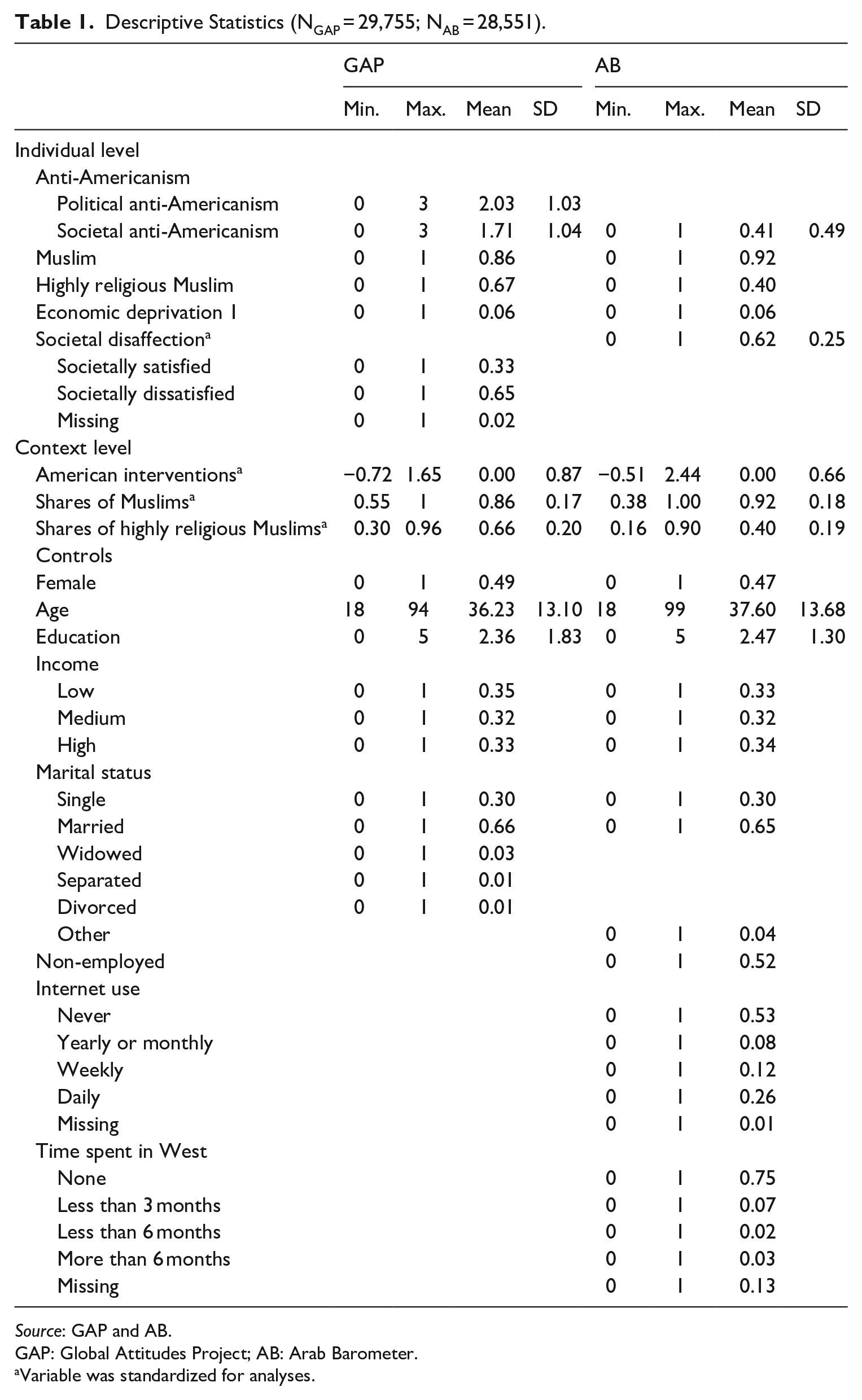
Source: GAP and AB.
GAP: Global Attitudes Project; AB: Arab Barometer.
Variable was standardized for analyses.
Anti-Americanism
Both political and societal anti-Americanism can be operationalized with the GAP data. The first item is “Please tell me if you have a very favorable, somewhat favorable, somewhat unfavorable, or very unfavorable opinion of the United States?” and the second asks the same for “Americans.” Both are recoded to 4-point scales ranging from 0 to 3, the latter being most anti-American. The item on the United States aligns best with political anti-Americanism as it is directed toward a political unit: the country or nation-state as such. The second item is less clearly connected to the state as it explicitly refers to ordinary people, Americans. Although these two measures were correlated (Pearson’s correlation = 0.57), we address them separately to empirically assess the literature’s consensus that political and societal anti-Americanism are distinct (e.g. Katzenstein and Keohane, 2007; Tessler, 2003). Moreover, while the two items are similarly phrased, they were asked directly after one another in the surveys, making their differences more distinct to respondents and reducing the likelihood that we overestimate the similarity in political and societal anti-Americanism.
More importantly, we further address this issue by also including the AB’s measure, which explicitly questions respondents’ societal anti-Americanism, phrasing it so that it is clearly set apart from respondents’ political anti-Americanism: “Do you agree or disagree with the following statement: ‘Despite negative US foreign policy, Americans are good people’?” Respondents who disagreed were scored as 0 and those who agreed were scored as 1. Together, we study three different measurements of anti-Americanism, which leads to insights in the robustness of relations between US interventions, religion, and deprivation, on the one hand, and anti-Americanism, on the other.
Individual-Level Explanatory Variables
Denomination was measured in both datasets by items on whether respondents belonged to a religious group. Across surveys we could distinguish between people who identify as “Muslim” (1) and people who do not (0). Unfortunately, further distinctions could not be made based on our data; still this dichotomy reflects our core theoretical distinction.
To measure being a highly religious Muslim, we additionally used the GAP’s question “How important is religion in your life—very important, somewhat important, not too important, or not at all important?” The AB provides a similar measure: “Generally speaking, would you describe yourself as religious, somewhat religious, or not religious?” In both the GAP and the AB, respondents who were both Muslims and had chosen the category representing greatest religious commitment were considered highly religious Muslims (1) and respondents who had chosen any other answer category concerning religious commitment and/or did not identify as Muslim were scored 0. We construct this dummy variable because the contextualist Clash of Civilizations logic poses particular expectations for the most religiously devoted Muslims, but it is unclear whether it also has suggestions for demarcations between less religious citizens.
In both data sources, respondents were considered economically deprived (1) if they belonged to their country’s 33.3% highest educated while also belonging to the 33.3% lowest income groups—although we also tested different cut-off points as discussed below (see Supplemental Appendices A1 through A6 for robustness tests). By combining the two tertiles, we identify the most economically relatively deprived respondents: those who are not just among the poorest, but who may have thought their economic future would be different—as illustrated by the instigator of the Arab Spring, the higher educated but poor Mohamed Bouazizi. Overall, about 6% of respondents were considered economically relatively deprived. Education and income were also included separately. In both data sources, education was measured as the highest level of education the respondent had completed in six categories, scored from 0 to 5. Income was measured by the reported total income of the household of the respondent and for constructing the deprivation variable recoded in per-survey tertiles. In both data sources, missing values on income were imputed per survey.
Following the approach of Tessler and Robbins (2007), societal deprivation is operationalized by items on societal dissatisfaction. The question in the GAP data that proxies this most closely is whether respondents were “satisfied or dissatisfied with the way things are going on” in their countries; respondents with missing values were included in a separate group. Still, respondents might refer to life more generally without blaming societal institutions for their general dissatisfaction, and the AB provides a thicker precise measurement of societal disaffection, using three items: “Generally speaking, how would you evaluate the performance of the government in carrying out its tasks and duties”? “How would you rate the current overall economic condition of [respondent’s country] today?” and “I would like you to tell me to which extent you trust parliament.” The three items were recoded to continuous scales running from 0 to 1, with higher scores reflecting greater disaffection, and averaged onto one scale (Cronbach’s alpha: 0.7). Respondents who answered at least two questions were included.
Individual-Level Control Variables
We control for sex (0 for men and 1 for women), age (measured in years), and marital status (GAP: “married,” “single,” “widowed,” “separated,” “divorced”; AB: “married,” “single,” “other”). The AB provides three additional control variables: respondents’ current employment status (0 for “non-employed” and 1 for “employed”), Internet usage (“never,” “yearly or monthly,” “weekly,” or “daily”), and the question “during the last 5 years, how much time, if any, have you spent in Europe, the US, or other Western countries?” for which we distinguish between: no time spent in Western countries, less than 3 months, between 3 and 6 months, and more than 6 months (and a dummy for missing values).
Contextual-Level Variables
American interventions were measured by the three dominant indicators in the literature: (a) the number of American active troops present in an Arab country, reported by the Defense Manpower Data Center (DMDC); (b) the amount of military assistance given to an Arab country in constant dollars, relative to the country’s gross domestic product (GDP) per capita (purchasing power parity (PPP)), reported by the United States Agency for International Development (USAID) Greenbook; and the total amount of US foreign direct investments (in Arab businesses) in constant dollars, relative to the country’s GDP per capita (PPP), as reported by the USAID Greenbook. 5 Each is measured per survey (country-year). We combined these three indicators into one variable. We created one index by first standardizing the scores and then taking the average of the three. In addition, we assessed whether the three indices work similarly when added separately, which they generally do (see “Results” section and Supplemental Appendix A1). The shares of Muslims and the shares of highly religious Muslims are aggregates from the individual-level data, namely, the percentage of respondents per survey who were considered Muslims and highly religious Muslims, respectively.
Analytic Strategy
As our individual-level data are embedded in country-years embedded in countries, we estimate multilevel models. The GAP’s 4-point scales on anti-Americanism are analyzed using linear multilevel models. We also ascertained that ordered logit models provide similar results (see Supplemental Appendix A6) but present the linear models in the text because these are more intuitive and due to the limitations of logit models for our type of hypotheses (Mood, 2010). We use logistic multilevel models for the AB data as its dependent variable is dichotomous. Below we first estimate the main effects in random intercept models and subsequently add cross-level interactions. We add context-level indices and cross-level interactions separately due to the relatively low number of higher level units and thus low number of degrees of freedom. We summarize findings on cross-level moderations in the main text and present full models in Supplemental Appendices A2 through A5. We also conducted multiple sensitivity checks, focused on alternative modeling procedures and operationalizations, including two alterations in the cut-offs for being considered “economically relatively deprived,” but these mostly did not alter our conclusions (see Supplemental Appendix A6); where they did, we report so in the text.
Results
The Prevalence of Anti-Americanism
Figure 1 shows the average anti-Americanism in our sample across Arab countries. For purposes of comparability, political and societal anti-Americanism in the GAP have been temporarily rescaled to range from 0 to 1 (instead of to 3). On average, MENA publics are rather politically anti-American (0.68) and are more politically than societally anti-American (0.57 in GAP and 0.42 in AB data). These findings are in line with previous studies’ assumptions that multiple aspects of anti-Americanism are distinct (e.g. Chiozza, 2004; Katzenstein and Keohane, 2007; Tessler, 2003).
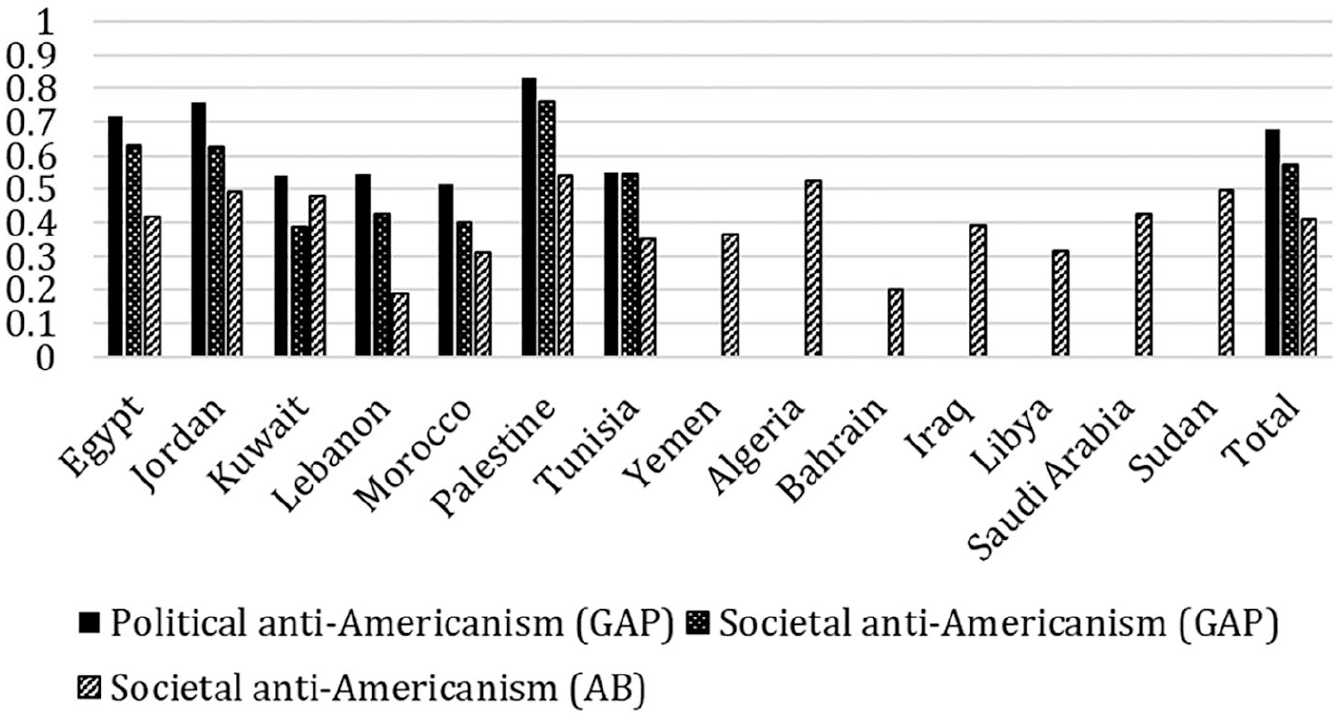
Mean Anti-Americanism per Country.
At the same time, our results also show that societal anti-Americanism is still clearly present and the gap between political and societal anti-Americanism is considerably smaller than previously suggested. In fact, the GAP data show that most respondents (50.4%) are as politically as societally anti-American (see Figure 2). These findings indicate the importance of not a priori assuming the uncommonness of societal anti-Americanism and also warrants our empirical focus on both political and societal anti-Americanism (cf. Abdallah, 2003; Zoubir and Aït-Hamadouche, 2006).
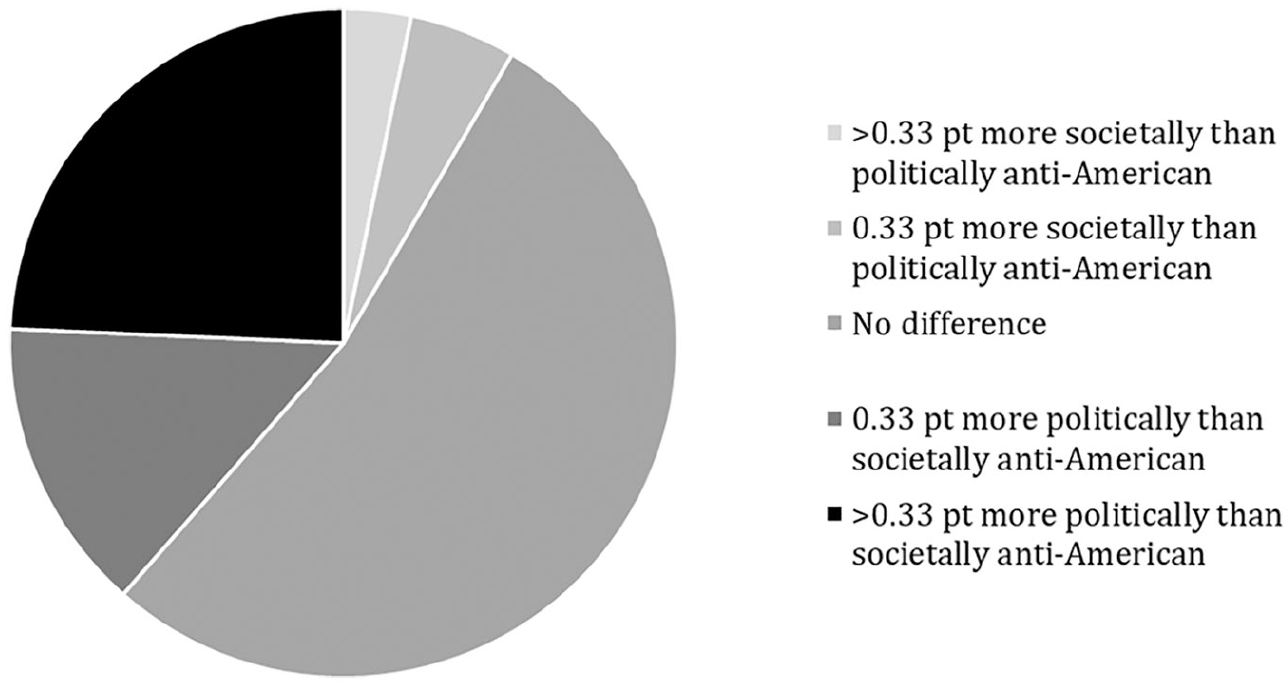
Within-Respondent Differences in Political and Societal Anti-Americanism (N = 29,755).
In addition, these results show large differences between social settings. Perhaps unsurprisingly, anti-Americanism seems particularly pronounced in Palestine, while it is markedly lower in Kuwait, Morocco, and Lebanon. For instance, on average, Palestinians are almost twice as likely to hold unfavorable views toward ordinary Americans than Moroccans are. These vast differences between countries start to point out the importance of focusing on context-dependency; it seems that context matters for anti-Americanism.
Explaining Anti-Americanism
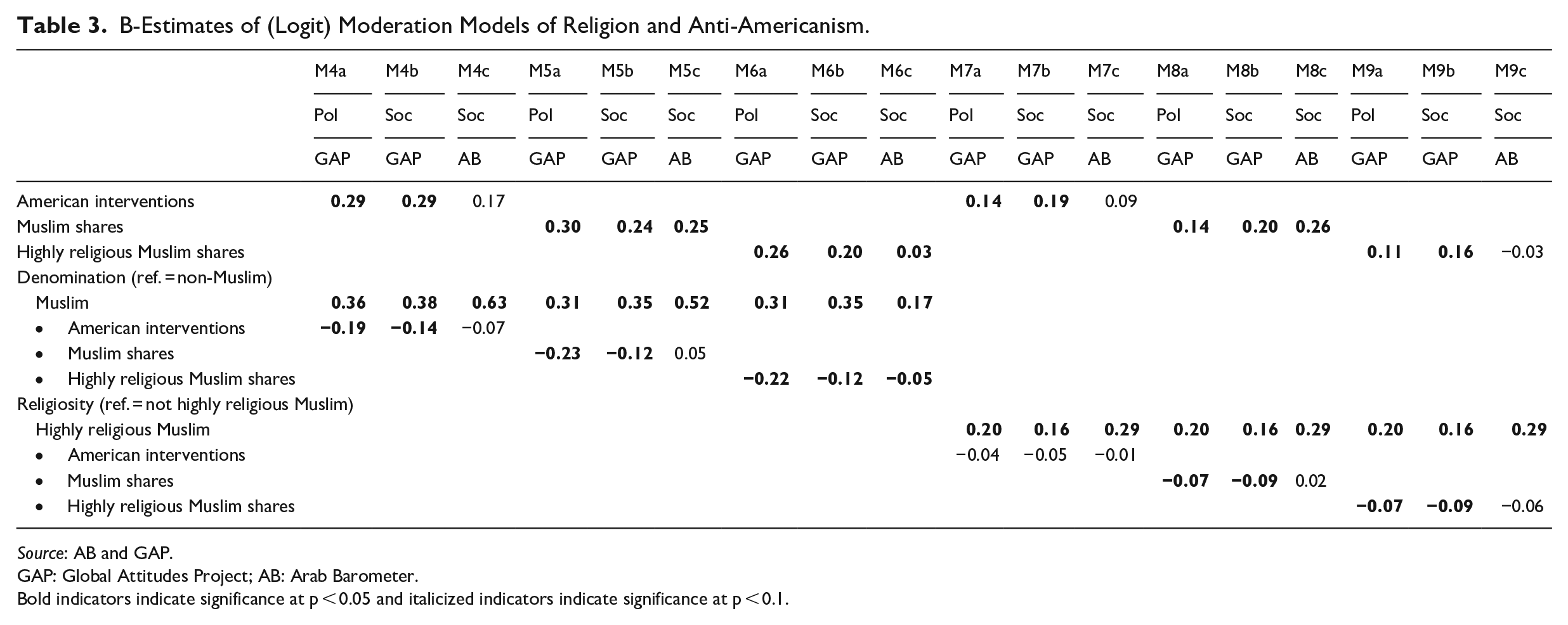
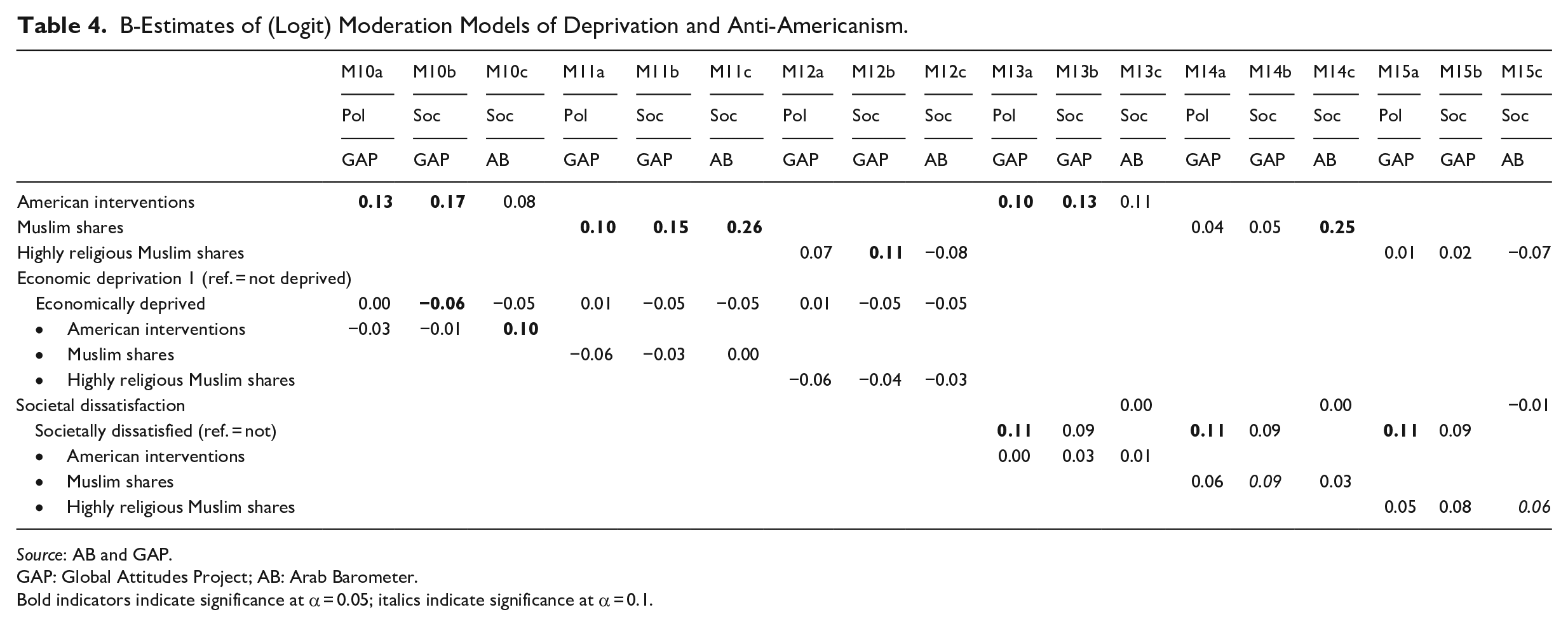
We now turn to our multilevel models to explain anti-Americanism. Table 2 includes all direct relations; Models 1, 2, and 3 all include individual religiosity (Hypothesis 2) and deprivation (Hypothesis 5). Regarding the contextual level, Model 1 includes American foreign policies (Hypothesis 1), while Models 2 and 3 include shares of (highly religious) Muslims (Hypotheses 3 and 4). The models in Tables 3 and 4 summarize the main findings regarding the moderation hypotheses. Throughout these models, the control variables mostly show expected patterns. Most notably, respondents who spent time in the United States or have higher incomes are less anti-American, and education only significantly reduces societal and not political anti-Americanism.
Multilevel (Logit) Analyses of Anti-Americanism.
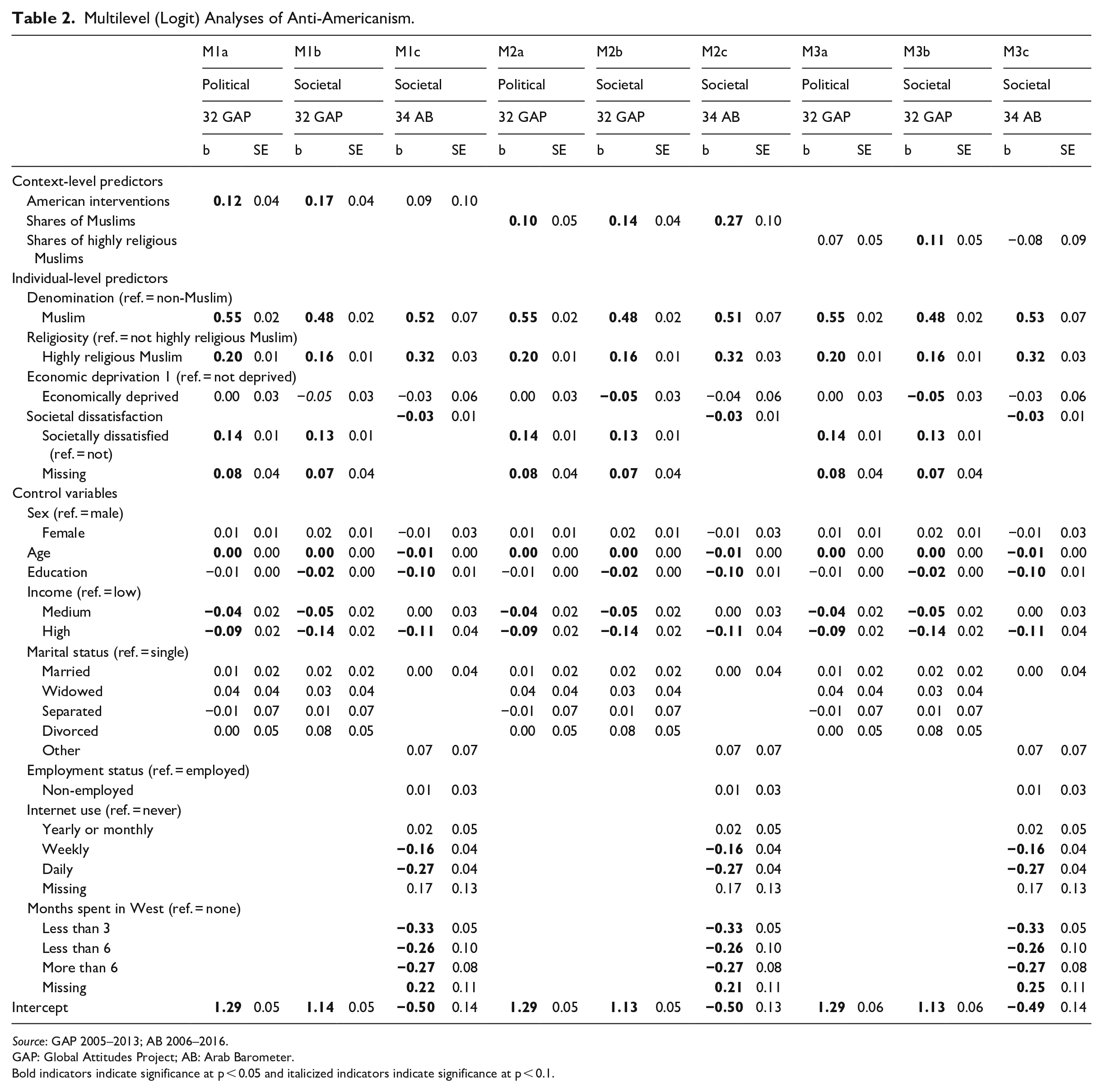
Source: GAP 2005–2013; AB 2006–2016.
GAP: Global Attitudes Project; AB: Arab Barometer.
Bold indicators indicate significance at p < 0.05 and italicized indicators indicate significance at p < 0.1.
B-Estimates of (Logit) Moderation Models of Religion and Anti-Americanism.
Source: AB and GAP.
GAP: Global Attitudes Project; AB: Arab Barometer.
Bold indicators indicate significance at p < 0.05 and italicized indicators indicate significance at p < 0.1.
B-Estimates of (Logit) Moderation Models of Deprivation and Anti-Americanism.
Source: AB and GAP.
GAP: Global Attitudes Project; AB: Arab Barometer.
Bold indicators indicate significance at α = 0.05; italics indicate significance at α = 0.1.
Moving on to the focus of this article, the results in Models 1a through 1c first show that political anti-Americanism is significantly higher in Arab countries in which the US intervenes more, as the anti-domination thesis predicts. 6 We therefore accept Hypothesis 1a. Crucially however, our models imply that societal anti-Americanism may also be affected. Indeed, the GAP data show that US interventions significantly increase societal anti-Americanism. Still, this positive relation does not reach statistical significance in the AB data when we use our compound index of US intervention. However, when we add the three measures of US interventions separately to our models, each significantly increases societal anti-Americanism in the GAP data and so do economic interventions in the AB data (see Supplemental Appendix A1). This means that societal anti-Americanism is boosted by US interventions in four out of six cases, making it likely such an impact actually exists. Therefore, we tentatively accept Hypothesis 1b. US presence thus not only drives political anti-Americanism but seems to affect societal anti-Americanism as well, in contrast to what previous studies have assumed (e.g. Jamal et al., 2015; Katzenstein and Keohane, 2007; Mostafa and Al-Hamdi, 2007).
Moving on to the role of personal religion, Models 1a through 3c robustly show that Muslims and highly religious Muslims are significantly more anti-American than non-Muslims and less religious Muslims, respectively. 7 These results are in line with the contextualist Clash of Civilizations theory and support Hypotheses 2a and 2b (Huntington, 1993, 1996). Similarly, Models 2a through 2c consistently show that anti-Americanism is significantly higher in countries with a greater share of Muslims. 8 However, we do not consistently find that anti-Americanism is higher in countries with more highly religious Muslims. Although countries’ shares of highly religious Muslims do significantly increase societal anti-Americanism in the GAP data, these results are not mirrored by political anti-Americanism and societal anti-Americanism in the AB data. So, we accept Hypotheses 3a and 3b for the shares of Muslims, but not for the shares of highly religious Muslims.
Concerning the deprivation thesis, economic relative deprivation is mostly non-significantly related to anti-Americanism. 9 Economically relatively deprived MENA citizens do not seem to directly blame America, as is sometimes assumed (e.g. Khondker, 2011). In fact, the GAP data show that economically relatively deprived citizens are significantly less societally anti-American. This may mean that Arab citizens who feel economically cheated are more attracted to the American dream, decreasing their societal anti-Americanism. However, we do not find similar patterns in the AB data, so this remains mere suggestion. Regardless, we reject Hypotheses 4a and 4b as economically deprived citizens are in any case not more anti-American.
Regarding societal deprivation, the GAP results consistently show that the societally dissatisfied are more politically and societally anti-American, while the AB data consistently find the opposite. This may seem paradoxical at first, but when we re-estimated the AB models in a subsample consisting of only countries that are also included in the GAP data, we found positive associations similar to the GAP results. This all implies that the impact of societal deprivation on anti-Americanism is highly dependent on the particular MENA context. We thus reject Hypotheses 4a and 4b for societal deprivation because the hypotheses proposed a consistent, region-wide positive impact of societal dissatisfaction. It seems that societally dissatisfied Arab citizens attach different meanings to America(ns), depending on the societal context in which they are embedded. This finding further ratifies our proposition that context-dependency is key for interpretations of America(ns).
Context-Dependent Drivers of Anti-Americanism
Overall, our moderations in Tables 3 and 4 show that the relation between Arab citizens’ religion and their anti-Americanism is context-dependent. Generally, the models show that the impact of religion is weaker in contexts with more American interventions and (highly religious) Muslims. However, the impact of relative deprivation remains largely unchanged.
Starting with denomination in Table 3, Muslims are found to be more societally and politically anti-American than non-Muslims, but this gap closes in Arab countries in which the US intervenes more and in which more Muslims and more highly religious Muslims live (see Figures 3 and 4). So, the impact of being a Muslim on anti-Americanism is stronger in Arab countries with fewer American interventions and (highly religious) Muslims. Despite the relatively few higher level observations, more than half of the interaction coefficients reach statistical significance, and all but one of the effects are in the same direction. Therefore, we accept Hypotheses 5 and 6 for denomination. More broadly, these results imply that how Muslims interpret America(ns) is clearly dependent on the society in which they are embedded, which further supports our perspective’s stress on context-dependency.
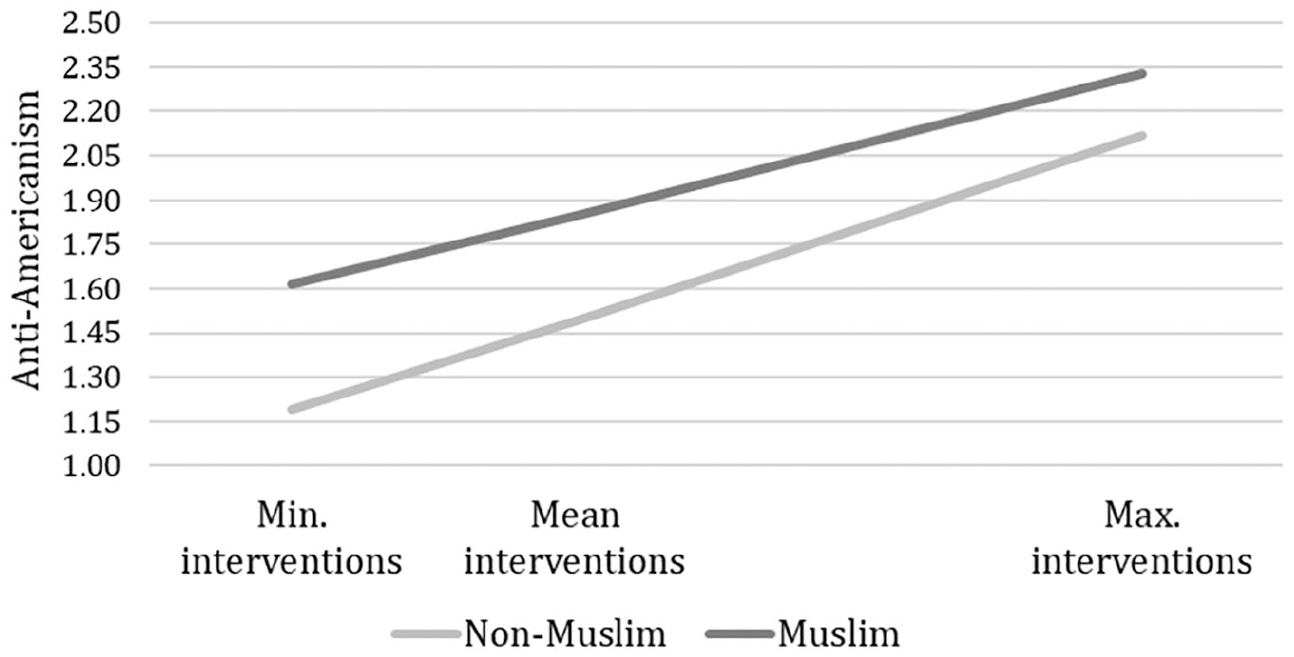
Political Anti-Americanism among Non-Muslims and Muslims by Amount of American Interventions in Arab Countries.
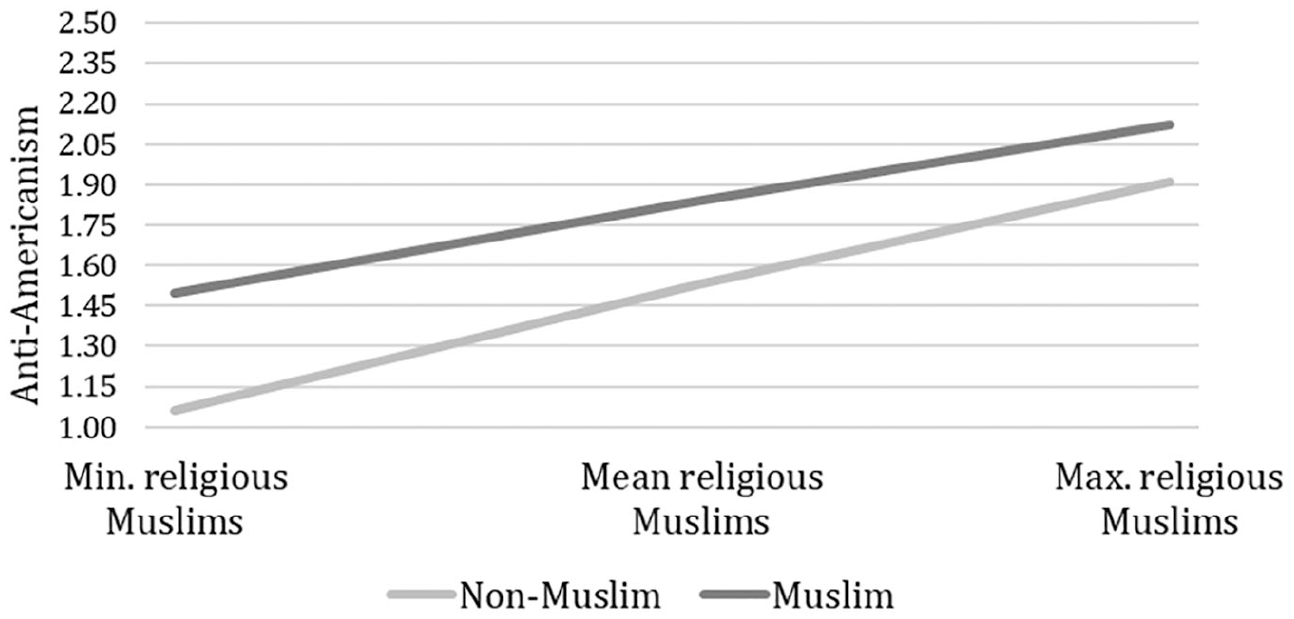
Political Anti-Americanism among Non-Muslims and Muslims by Shares of Highly Religious Muslims in Arab Countries.
We find similar results for highly religious Muslims, although less overwhelmingly so, as American interventions do not moderate its impact. So, while highly religious Muslims are more politically and societally anti-American than others, this difference is smaller in Arab countries inhabited by more Muslims or more highly religious Muslims. As we do not find the same for American interventions, we reject Hypothesis 6 but accept Hypothesis 5 for highly religious Muslims as well.
Finally, economic and societal deprivation seem less influenced by MENA contexts (see Table 4). Although a few contextual characteristics do significantly moderate deprivation’s impact, we mostly find that the effects of economic deprivation and societal dissatisfaction are not significantly moderated by American interventions or the shares of (highly religious) Muslims. Hypotheses 5 and 6 are thus rejected for economic deprivation and societal dissatisfaction.
All in all, the models in Tables 3 and 4 imply that contexts influence whether individuals attach anti-American meanings to their religion. However, our macro-level measurements do not seem to systematically influence deprived people’s scapegoating processes.
Conclusion
What drives the substantial levels of anti-Americanism in Arab Middle Eastern and North African countries? The existing literature provides three answers to this question, based on American interventionism, and Arabs’ religion and relative deprivation (e.g. Gurr, 1970; Huntington, 1993; Katzenstein and Keohane, 2007; Tessler, 2003; Tessler and Robbins, 2007). However, the anti-Americanism literature has become somewhat fragmented as most studies tackle one explanation, and, recently, most have concentrated on how American foreign policies engender a dislike of the United States (e.g. Cole, 2006; Makdisi, 2002; Mostafa and Al-Hamdi, 2007). This study aimed to create a more encompassing picture of what drives anti-Americanism in the Arab region by integrating the three theoretical strands. To do so, we applied and tested a framework centered around context-dependency. This frame views Arab citizens as individuals with their own personal deliberations who are nevertheless embedded in particular MENA countries in the world and thus subject to regional forces and American actions (see Coleman, 1994; Elder, 1994).
To test our integrated framework, we applied multilevel models to 32 GAP surveys on 7 MENA countries between 2005 and 2013 and 34 AB surveys on 14 countries between 2006 and 2016. Our results first showed that two out of the three explanations of anti-Americanism operate in the Arab region. Relative deprivation did not consistently affect anti-Americanism throughout the region. However, US foreign policies and religiosity did tie into political anti-Americanism and seems to fuel societal anti-Americanism too. That we found some evidence that US interventions fuel both types of anti-Americanism is especially noteworthy, since multiple studies have assumed that societal anti-Americanism would remain wholly unaffected (cf. Abdallah, 2003; Cole, 2006; Furia and Lucas, 2008; Mostafa and Al-Hamdi, 2007; cf. Chiozza, 2004).
More importantly, we found that the impact of individuals’ religion on anti-Americanism is context-dependent, as predicted by our framework. So, the strength with which Arab citizens’ religion positively affects their anti-Americanism is shaped by the societies in which they are embedded. For instance, gaps in anti-Americanism between more and less religious MENA citizens closed in contexts with more American interventions and more (highly religious) Muslims. This indicates that societal constructions of the United States as an antagonistic force rouse non-Muslims’ and less religious Muslims’ anti-Americanism particularly. So, even though these Arab citizens seem to have less personal reasons to view America(ns) negatively, contextual anti-American cues cause their political and societal anti-Americanism to mushroom. Overall, these results support our notion that social embeddedness is key to understanding anti-Americanism in the Arab MENA.
Our main finding of the context-dependency of anti-Americanism also has broader implications for socio-political attitudes within and beyond the Arab region. Within the region, we have shown the importance of intraregional differences for public opinion, which supports a larger recent literature that similarly stresses the diversity in the forms of governance (Glas et al., 2019; Tokdemir, 2017) and state–religion relations (Blaydes and Linzer, 2012; Spierings, 2019). More broadly, although we focused on the Arab region, it seems unlikely that anti-Americanism only operates context-dependently in that region, which raises the question how socio-political contexts impact anti-Americanism globally. For instance, our framework proposes a novel explanation for why American interventions seem to affect anti-Americanism less strongly in Latin American countries than in Arab ones (Baker and Cupery, 2013); this may also be due to Latin Americans interpreting interventions differently due to the particular context in which they are embedded. For instance, constructed religious fault lines between Latin America and the United States are weaker, if not absent, compared to religiously marked tensions between Arab countries and the US. At the same time, when we transpose our framework to the Latin American region, perhaps especially the extent to which Latin Americans are economically left-wing may be influential in how they interpret American interventions. Beyond this example, our framework implies that the comparative research agenda on attitudes toward foreign countries or foreigners in any part should consider, theorize, and test the context-dependency of explanatory processes and factors. Any absence or unexpected strength of one mechanism could be a function of another, unexplored theoretical current.
Future studies could expand on our insights particularly if more data become available. The main obstacle to studying the role of contextual forces in the Arab MENA is the current lack in diversity of MENA contexts that are surveyed, which problematizes modeling procedures. Also, data on how Arab citizens perceive the foreign policies America implements would help to address the proposed influence of American interventions more directly and to assess whether American foreign policies in and of themselves spur on anti-Americanism or whether this is more related to a general hostility toward globalization. Alternatively, measurements on American humanitarian interventions could assess how wide-spanning negative evaluations of any American foreign policy directed at the MENA countries are. In addition, panel data could shed more light on the causal directions of processes, for instance, whether politically disenfranchised MENA citizens scapegoat America or whether MENA citizens who find fault with the US also do so with their own countries. Finally, while we dealt with political and societal anti-Americanism, we did not assess a dislike of American culture, raising the question whether cultural anti-Americanism follows similar trajectories. Addressing cultural anti-Americanism would be especially interesting since one of our measures on societal anti-Americanism (provided by the GAP) was not ideal, so we cannot (cl)aim to represent what is sometimes referred to as “socio-cultural anti-Americanism” (Katzenstein and Keohane, 2007).
Notwithstanding these limitations, to our knowledge, this study is the first to integrate the three different explanations of anti-Americanism in the MENA region. Doing so, we have shown that anti-Americanism should be considered context-dependently. Only studying the actions of the United States, the state of Arab countries, or the situations of individuals may not be enough to fully understand what drives anti-Americanism in the Arab region and beyond.
Supplemental Material
Online_Appendix – Supplemental material for Connecting Contextual and Individual Drivers of Anti-Americanism in Arab Countries
Supplemental material, Online_Appendix for Connecting Contextual and Individual Drivers of Anti-Americanism in Arab Countries by Saskia Glas and Niels Spierings in Political Studies
Footnotes
Acknowledgements
We would like to thank two anonymous reviewers for their useful suggestions.
Declaration of Conflicting Interests
The author(s) declared no potential conflicts of interest with respect to the research, authorship, and/or publication of this article.
Funding
The author(s) received no financial support for the research, authorship, and/or publication of this article.

Supplementary Information
Additional supplementary information may be found with the online version of this article.
A1. Multilevel (Logit) Models of Disaggregated American Interventions on Anti-Americanism.
A2. Multilevel (Logit) Models of Anti-Americanism with Denomination Moderations.
A3. Multilevel (Logit) Models of Anti-Americanism with Religiosity Moderations.
A4. Multilevel (Logit) Models of Anti-Americanism with Economic Deprivation Moderations.
A5. Multilevel (Logit) Models of Anti-Americanism with Societal Dissatisfaction Moderations.
A6. Explanation of Robustness Tests.
Table A6. Descriptive Statistics of Robustness Variables.
Notes
Author Biographies
References
Supplementary Material
Please find the following supplemental material available below.
For Open Access articles published under a Creative Commons License, all supplemental material carries the same license as the article it is associated with.
For non-Open Access articles published, all supplemental material carries a non-exclusive license, and permission requests for re-use of supplemental material or any part of supplemental material shall be sent directly to the copyright owner as specified in the copyright notice associated with the article.
