




Abstract
This article gives an initial overview of the explanatory power of established approaches in comparative political science of various lockdown strategies in connection with the COVID-19 pandemic in 35 democracies. In a macro-comparative statistical analysis of the first wave of the pandemic, I test partisan and veto player theories. I distinguish two phases of the first wave of the COVID-19 pandemic, which show distinct patterns of political impacts. In the first phase of implementing lockdown strategies, central governments were relatively uncontested and partisan theory has strong explanatory power. In the second phase of lifting lockdowns, party differences lose relevance, but veto players have a strong influence during this time. The analysis shows that political science theories are useful for analysing political processes not only under normal conditions but also in extreme social crises. Moreover, it provides deeper insights into the democratic decision-making process of advanced democracies in exceptional situations.
Introduction
In a comparative perspective, the response to the COVID-19 pandemic differs substantially between modern, highly industrialized democracies. Some countries reacted fast and implemented strict lockdowns, other responded late and others kept restrictions to a minimum (Plümper and Neumayer, 2020). Many factors play a role in explaining these differences, including economic conditions, the healthcare system and even cultural aspects (Egger et al., 2021). So far, however, there has been a lack of studies analysing the contribution of established theories of comparative political science in explaining differences in the lockdown strategies of advanced democracies. I test the explanatory power of two established approaches in macro-comparative analysis: partisan theory and veto player theory. Both have proven to be very effective in explaining policy outcomes in many areas (Hallerberg, 2011; Jahn, 2010; Potrafke, 2017; Schmitt and Zohlnhöfer, 2017). Together they shed light on how the political process works in democracies. I use these theories to analyse the first wave of the corona crisis in 35 highly industrialized democracies.
Testing these two theories is useful for at least two reasons. First, we can better understand the first wave of the COVID-19 pandemic if we frame it in a theoretical explanation. This way of looking at the first wave helps us to tap into the uniqueness of the crisis. Second, the rapidly changing nature of the crisis enables us to test the broad generalizability of these theories even in this extreme situation.
The article shows that both theories have a lot to offer when explaining the differences in the first wave of the COVID-19 pandemic. Partisan theories show that left-wing governments introduce faster and tougher lockdowns than right-leaning governments. It also shows that constitutional checks and balances were discarded in the first phase of the crisis. The situation changed in the second phase of the first wave when the lockdowns were lifted. During this phase, veto players became more relevant and partisan differences decreased. This result shows that after extreme pressure, when the infection rate increased sharply, democratic control was suspended, but that highly industrialized democracies, after overcoming the peak of the first wave, returned to the democratic order again. This demonstrates that democracies are able to react to an extreme situation without permanently abandoning democratic processes.
This article starts out by formulating hypotheses deduced from partisan and veto player theory. I then introduce the empirical model used for this study and the operationalization of the variables. The next section presents the results. The conclusion summarizes the results and reflects on the findings in a broader context.
The corona pandemic and politics
The COVID-19 pandemic is an extreme situation where different measures were taken to prevent the spread of the coronavirus. These measures ranged from rules for keeping distance from each other to a complete lockdown, which involved closing schools, universities and workplaces, and limited travelling and international contacts. However, on which basis were these measures and the various degrees of lockdown decided? Are they a result of a stimulus-response mechanism (i.e. infection or death rates → degree of lockdown), or do different political factors make a difference? Two approaches are highly relevant in macro-comparative policy analysis and together capture the political process in modern democracies. Partisan theory analyses the effect of different party ideologies on outcomes. That is, when parties are in government, they form results according to their party ideology (Budde et al., 2018; Potrafke, 2017; Schmitt and Zohlnhöfer, 2017). This effect can also be seen in health policy, which is probably the policy area most closely related to the COVID-19 pandemic (Falkenbach et al., 2020).
While partisan theory covers the executive branch and focuses on setting the agenda, veto player theory focuses on factors that prevent a smooth implementation of the executive branch’s wishes. Veto player theory thus stands for the democratic checks and balances that take place when compromises have to be taken into account. Like partisan theory, veto player theory has been widely used in comparative political science (Ganghof, 2011, 2017; Hallerberg, 2011). Both approaches taken together reflect the political process of modern democracies: how political action is initiated and intermediated.
In the context of the COVID-19 pandemic, too, one can assume that the left–right dimension is decisive, as in many other policy areas. A strict lockdown policy has enormous economic consequences, and one could argue that right-wing governments are reluctant to implement strong lockdowns in order to protect the economy. In contrast, left-leaning governments may solve the trade-off between economic stress and public health by supporting stricter lockdown strategies. Because workers and less privileged groups are at higher risk of becoming infected, left-wing parties support tighter lockdowns. This stricter strategy was often flanked by financial support measures for such affected groups. Left parties are also more inclined to intervene in social processes and implement regulatory measures than right-wing parties which advocate for a small state and little state intervention. However, right-wing parties are likely to have various reasons for rejecting a strict lockdown. For conservative parties, the above economic argument is likely to weigh heavily. Civil liberties are essential to liberal parties and for this reason they will not support strong and long lockdowns. Religious parties, which are mostly found on the right-wing spectrum of parties, are also sceptical of state interference and see vaccination measures and other physical interventions as an encroachment on personal rights. Even if the motives against stronger lockdowns within the right-wing parties are different, all positions contribute to the assumption of a left–right conflict in the COVID-19 pandemic.
However, there are also some arguments that the left–right dimension is not relevant for explaining COVID-19 lockdowns. One of the reasons is that the coronavirus issue transcends the left–right dimension and can be better explained in other terms. For example, the protection of civil liberties transcends the left–right dimension because both liberal parties on the right and left-libertarian parties (such as green parties) on the left advocate for these rights. It has also been shown that the partisan effects of morality policy making, which may include COVID-19 lockdowns, are multidimensional (Budde et al., 2018). Moreover, left-wing ideology is production- and wage-oriented and therefore not as interested in strict lockdown strategies and is close to right-wing parties in this respect. The Swedish Social Democratic government’s strategy may be a good example. Although most arguments suggest that the left–right dimension is relevant for explaining the stringency of the COVID-19 lockdown measures, it is ultimately an empirical question.
Comparative studies on partisan effects in the pandemic are scarce. A comparison of surveys of the electorate in 15 European countries concludes that incumbent parties and above all prime ministers benefit from the crisis in that they get broad public support (Bol et al., 2021). The rally-around-the-flag effect wipes out any left–right effect in this study. This is different in studies focusing on the US where clear left–right effects are measured (Conway et al., 2021; Gadarian et al., 2021; Painter and Qiu, 2020). These studies show that the Republicans downplayed the severity of the virus and President Trump undermined health experts who warned of the effects of COVID-19. In counties with Republican governments, residents are less likely to stay home after a state order has been implemented relative to those in Democratic counties. However, the US might be an exception (Pennycook et al., 2021).
It could be that there are no partisan effects, not only because the left–right dimension is irrelevant, but also that the decision-making process is not as simple as previously thought. In a democratic environment, the executive branch cannot enforce its policies because a political system has multiple checks and balances. This is where veto player theory comes into play. Since governments have to change policies to introduce lockdowns, the greater the disagreement among veto players, the less likely that radical lockdowns will be implemented.
The argument so far is valid for normal politics. However, the fight against the COVID-19 virus is far from business as usual. In contrast, it can be said that it is politics under an extreme crisis situation. Actually, the first wave can be divided into two stages. First, the immediate reaction to the great challenge of avoiding the uncontrolled spread of the coronavirus and, second, the return to normal living conditions or to a ‘new normality’. The term ‘new normality’ describes the situation when the peak of the first wave has been overcome and the valley before the second wave is reached. In fact, both stages differ from the pre-corona times of (old) normal politics. These different stages affect how partisan and veto player theory work in the context of the pandemic.
The first reaction to COVID-19 or the initial period deviates sharply from normal politics. In normal politics the political process is characterized by lengthy policy processes of checks and balances. There are often considerable delays between a first, a second and a third reading in parliament and/or the reaction of veto players. In order to reach decisions, most political systems have established processes of consultation between different political institutions and interest groups. The Consultation Committee in the US Congress or the navette system in many countries with second chambers are cases in point.
However, in the initial period central government decisions were taken with almost no longer time delays. One could almost say it was governance by decree or fast-track decision making. Some countries even issued emergency ordinances to combat the rise in infections (Binder et al., 2020; Bjørnskov and Voigt, 2021). In relation to the theories I expect a clear partisan impact, but veto players should not interfere as their involvement would have slowed down the political process.
H1: In the first stages of the first wave of the COVID-19 pandemic, the partisan effects are strong and veto players have no significant political impact.
The second period of the first wave is the downhill period after the peak. This phase is characterized by lifting strict lockdown measures. This period also differs from the political process in normal politics. Partisan theory may also be valid in this period. Right-leaning governments favour a faster lifting of the lockdown measures because a long-lasting strict lockdown is harmful for the economy and limits civil liberties. Left-leaning governments may be more cautious and therefore more reluctant to lift strict lockdown measures in a rapid manner. An interesting question is: what role do veto players fulfil in the second period?
First, I assume that (more) normal politics resumes and that veto players are becoming significant in the policy process again. But in what direction do veto players have an impact on lifting lockdowns? Tsebelis (2002: 204) states that veto players ‘will “lock” a country to whatever policies they inherited’. Hinich and Munger (1997: 244) are more concrete and give a straightforward definition of the status quo as the ‘present government policy, whether it is the result of a conscious decision process in the past or simply historical accident’. However, this clear-cut definition of the status quo is doubtful in the case of the corona crisis. Many lockdown policies have not been created as permanent but rather as temporary and exceptional policies which can be taken back if no effort is made to keep them for longer periods. So, what is then the inherited policy?
There are two answers to this question:
1. The inherited policy is the degree of the lockdown policy at the peak of the wave or the strictest lockdown strategy in a country (Hinich and Munger definition). A lifting of the strict lockdown policy will be blocked, the greater the ideological range of the veto players. The sign of the impact of the veto players in a regression model would be positive.
2. Another way of looking at the inherited policy is to say that the status quo is the situation before the lockdowns have been installed. This position makes sense when one thinks that many measures have been implemented as temporary measures which should disappear again when the corona pandemic has been overcome. In this case, disagreeing veto players would prevent lockdown measures and the function would be that the pre-crisis status quo should be restored. In this case the sign of the coefficient in a regression would be negative.
The increasing significance of veto players in the second stage may have consequences for the impact of governments. Strong veto players or, better, substantial disagreement among the veto players may lead to a weaker impact of the executive. That means that there is an assumed trade-off between agenda setter power and veto players: ‘Many veto players are correlated with a lack of institutional agenda control by the government, and lack of agenda control means weaker governments’ (Tsebelis, 2002: 186). In light of partisan and veto player theory I predict the following hypothesis for the second stage of the corona crisis:
H2: In the second stages of the first wave of the COVID-19 pandemic, the partisan effect becomes weaker, and the veto players have a significant (a) positive or (b) negative political impact on lockdown stringencies.
However, there are also heavy weighing arguments for a null hypothesis. That means that politics does not matter and that our hypotheses do not get any support from the data. It is quite convincing to argue that the crisis caused by the sudden spread of the coronavirus functioned as a simultaneous shock for all the countries and that there has been a herd reaction in that all countries responded similarly. The only variation in the reaction is then the pressure caused by the different magnitude of the spread of the COVID-19 virus in a country. For instance, Italy, as the first democratic country heavily affected by the virus, reacted more strictly than, for instance, countries which had been affected more mildly in the beginning. That party differences do not seem to matter is supported by the fact that left governments stand for a strict lockdown in New Zealand and Spain, on the one hand, and for weak strategies in Sweden and Finland, on the other. The same is true for right governments and even populist governments when considering Italy and Slovenia versus Bulgaria and the US. These unclear political impacts lead us to the null hypothesis:
H0: Different strategies of lockdown policies are primarily a result of the degree of the spread of the COVID-19 virus in a country. Political factors only play a minor role, if any at all.
The model
The dependent variable of this article is the lockdown strategy of 35 highly advanced democracies. 1 I focus on rich democracies because they have the economic capacity to respond effectively to the spread of COVID-19 and because all of these countries must adhere to democratic rules. The country sample is highly representative for advanced industrialized democracies and avoids selection bias when comparing case studies. On the flip side of our approach, I can only use concepts for which information is systematically available for all 35 countries. However, since I do not conduct a y-centred analysis that aims to find out which factor dominates in explaining a causal relationship, but rather test certain theories (x-centred analysis), the problem of the omitted variables bias is less relevant for our study (for y- and x-centred research design, see George and Bennett (2005: 218); Gerring, 2001: 137). Nevertheless, I include some control variables to estimate the robustness of our findings.
We start our analysis on 7 January, when Japan was the first democracy to take measures against the spread of the virus by restricting international travel. Canada, New Zealand and France introduced first restrictions on 22 January and one day later Italy, Poland and Iceland followed. Each country is included in the analysis when the first lockdown measures were introduced. The peak of lockdown strategies was reached between mid-March and mid-April in most countries and it lasted until mid-May. In some countries, such as the US and Sweden, the highest level of lockdown was kept in force until mid-June. The level of lockdown strategies differed fundamentally between very strict lockdown strategies in New Zealand, Croatia, Italy, Cyprus, France and Ireland and low levels in Japan, Sweden and Iceland. From mid-May there was an incremental lifting of lockdown measures. This period lasts in some countries until November 2020 and encompasses the second stage of the first wave. I assume that both stages are built on different political strategies and conditions. I start the analysis of the second stage when the lockdown measures have been relaxed for the first time in a country. I end the analysis when the stringency of the lockdowns has increased again to face a second wave. This means that I analyse different lengths of the first and second stage in each country. Figure A1 in the Supplemental Appendix shows the duration of each period.
To measure the intensity of lockdowns, I use the stringency index of the Oxford Covid-19 Government Response Tracker (OxCGRT) (Hale et al., 2020). The index of the strictness of the lockdown strategy aggregates the following nine measures:
- Public information campaigns
- Closing of schools and universities
- Closing of workplaces
- Cancelling public events
- Limits on private gatherings
- Closing of public transport
- Orders to ‘shelter-in-place’ and otherwise confine to the home
- Restriction of international movement
- Restriction of foreign travellers
Each containment or closure policy was coded on an ordinal scale ranging from 0–2 to 0–4 (Hale et al., 2020; Philips and Tatlow, 2021). For all but ‘Restriction of International Movement’ there is a ‘flag’ when the policy is ‘targeted’. Targeted means that the policy does not apply to the whole nation but is regionally or otherwise limited. The final score (f) for the index (I) on any given day (t) is calculated in the following way.

where Nj is the maximum number of the measures (which is 9). When the measure is nationally applied, F = 1 and if it is targeted, F = 0. The recorded policy value (vt) is on an ordinal scale. Finally, ft is the recorded binary flag for that indictor. The data only contain flag values if the indicator has a non-zero value. If a government has no policy for a given indicator (vt = 0), then the corresponding flag is blank/null in the data. That means that if vt = 0, then the function Fj–fj,t is also treated as 0. The index is normalized in the way that if all 9 policies are fully implemented, the value is 100. 2 Figure 1 shows the stringency of the 2020 lockdown measures – indicating when they began, when they were lifted, and when the second wave began.
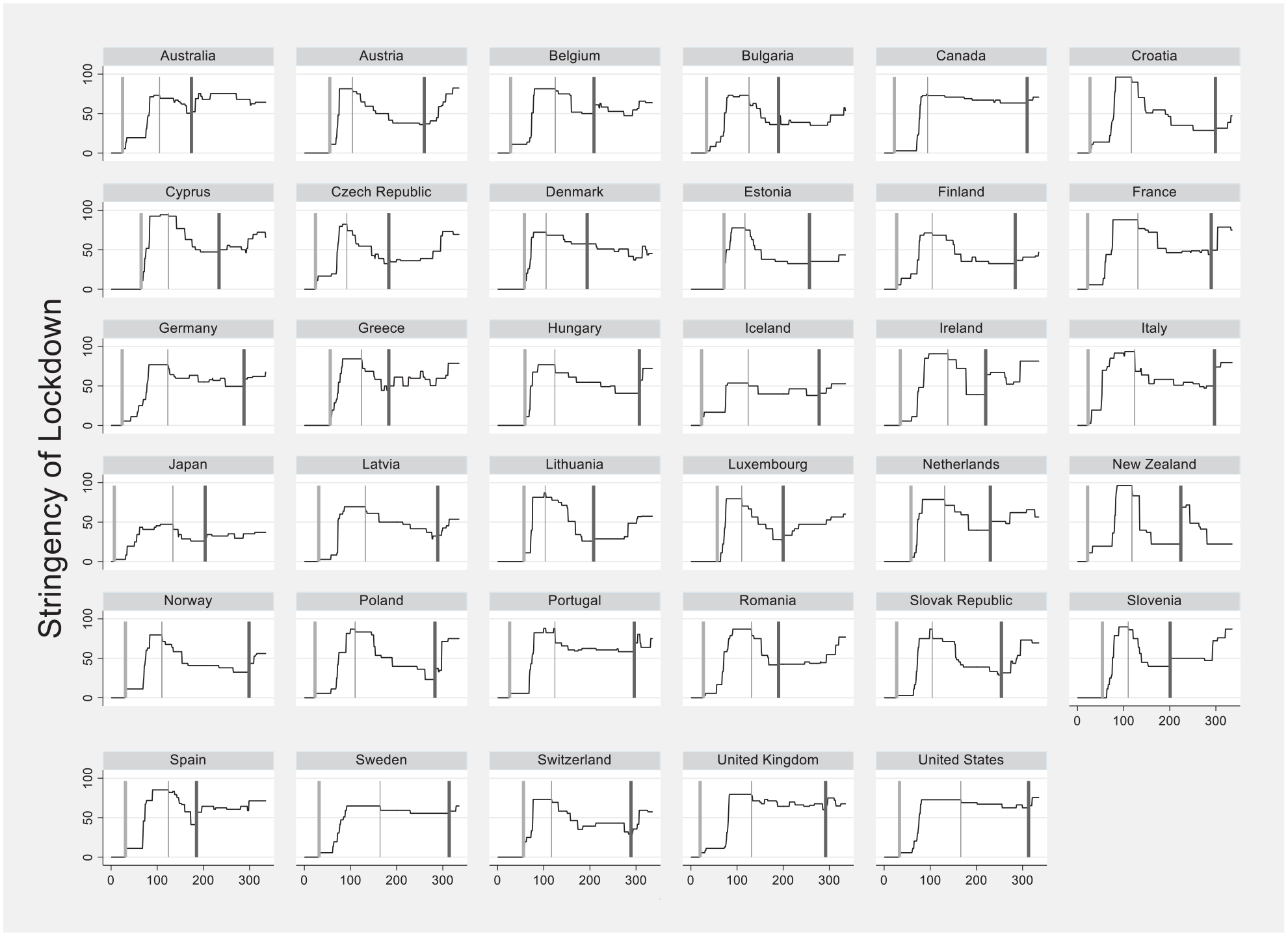
The stringency of the corona lockdowns in 35 advanced industrialized democracies in 2020.
Figure 1 shows that the stringency of lockdowns varied widely between the 35 democracies and that the intensity has little to do with whether a country introduced lockdowns sooner or later. In Croatia, France, Italy, New Zealand, Portugal and Romania, strict lockdowns were imposed early on, but they were also strict in Cyprus, Ireland and Slovenia, which began introducing lockdowns late. In Australia, Denmark, Iceland, Sweden, the US and especially Japan, the stringency of the lockdowns was rather mild. The length of the first stage also seems only vaguely related to the stringency of the lockdown. It is true that countries with low stringency remained in lockdown for a long period of time, such as Japan, Sweden, the United Kingdom and the US. However, a brief first phase is associated with strict (Slovenia and Lithuania) and less strict lockdowns (Denmark and Estonia). Most countries eased the lockdown relatively quickly, but others such as Canada, Sweden, the United Kingdom and the US remained at relatively high levels for a long time. Some countries were able to lift the lockdowns significantly before the second wave, such as Austria, Croatia, the Czech Republic, Estonia and New Zealand. Lockdowns remained longer in other countries, such as Australia, Canada, Sweden, the United Kingdom and the US. Indeed, in Australia, the second wave followed shortly after the lockdown was lifted. Overall, there are major differences between the 35 countries in terms of the duration of the 2 phases and the stringency of the lockdowns.
For government positions on a left–right scale I use the LR-index developed by Jahn (2011). This index is based on the party manifesto data (Krause et al., 2020) but, in contrast to other indices from the manifesto data, it takes country-specific differences into account. For instance, it can show that in some countries, environmental issues or the question of migration are essential aspects of left and right positions whereas in other countries left and right are mainly based on economic aspects. 3
The veto player approach I use is based on rational choice theory (Tsebelis, 2002). Tsebelis assumes that the greater the ideological distance between the key players in a political system, the less likely it is to change policies. Key actors can be individuals such as presidents or institutions such as second chambers. Tsebelis is very sparing in the selection of veto players and only considers the ideological distance between governing parties (in a coalition), second chambers 4 and the president. 5 For macro-comparative studies, he uses the ideological range between the two most extreme veto players. As a measure for the ideological range, I again rely on the left–right dimension. That means that our veto player range depends on the number of veto players but even more on their position. 6
The spread of COVID-19 and its effects are used as a control variable. I use the data on the number of people whose death is related to the virus. The data come from the Coronavirus Resource Center at John Hopkins University, as provided by the OxCGRT.
To test whether the partisan and the veto player effects are robust, I examine some factors that could be important in the context of the pandemic. First of all, prosperity and growth could be crucial. Rich countries have more leeway to introduce stricter lockdown measures. The same goes for growth. Countries that experienced a sharp economic decline during the coronavirus crisis are under greater pressure to comply with less strict lockdowns and lift them sooner than countries that are less economically affected. I use quarterly data for 2020 (for the descriptive statistics and data sources, see Supplemental Appendix).
Another factor which may reduce the stringency of lockdowns is hospital capacity. If a country can trust its capacity to take care of COVID-19 patients, it may be less strict with lockdowns. For this I use data for hospital beds from the World Bank that correlate highly with acute beds, which are more relevant for corona patients but do not exist for all countries included in my sample. 7
As mentioned above, some countries have the option to declare a state of emergency and have used this tool in the pandemic. I coded the days of a state of emergency in a country using the Center for Civil and Political Rights tracking tool, ‘State of Emergencies in Response to the Covid-19 Pandemic’. I assume that lockdowns will be stricter when such laws are implemented.
Another topic of our study is the focus on central governments and nationwide veto players. This may be appropriate in the first phase of the lockdown, but it is less likely for later episodes, at least for some countries. Federal states in particular can make decisions at the subnational level. But also in other countries like the United Kingdom, travel restrictions and the like varied in England, Wales and Scotland, whose public health policies were all under the control of different political parties. In order to capture this aspect, I use the index of regional authority, which measures to what extent the regional level can decide on relevant issues (Hooghe et al., 2016).
Egger et al. (2021) state that political trust is also important. Highly trusted countries can rely on the responsibility of their citizens and strict lockdowns are less necessary. Sweden could be a case in point. I use data from the Welcome Global Monitor, which is part of the Gallup World Poll 2018, that covers all the countries considered in this article. I use the question ‘How much do you trust medical & health advice from this country’s government?’ I used the portion of the answers that say strong and some confidence. The question ‘How much do you agree that vaccines are safe?’ is also included in the questionnaire. I assume that people who trust vaccinations are also likelier to go along with their country’s lockdown strategy and accept stricter lockdown measures.
For the models I employ panel-corrected standard error regression (xtpcse) and specify that, within panels, there is first-order autocorrelation AR(1) (Beck and Katz, 1995). This model deals with panel heteroscedasticity and autocorrelation. In all models I include day dummies and a lagged dependent variable to account for temporal effects. These effects might be quite strong because special events popped up and the debate and scientific findings shifted frequently. Furthermore, extra-parliamentary protest emerged, and political support for the lockdowns changed. For all those factors there are no comparable data available for every day and country, so a day dummy seems to be the best solution to capture those effects. However, I do not include dummy variables for countries (fixed effects (FEs)) in the models because they wipe out all the country differences we are actually interested in (Plümper and Troeger, 2019; Plümper et al., 2005). Furthermore, the independent variables rarely change, in which case the effects are underestimated in regressions with FEs. As Plümper et al. (2005: 334) conclude: ‘If a theory predicts level effects, one should not include unit dummies. In these cases, allowing for a mild bias resulting from omitted variables is less harmful than running a fixed effects specification.’
To test the period effects, I use a fully interactive regression model (Kam and Franzese, 2007: 103–111). Such a model, in which the independent variables interact with the moderator, has the advantage that the estimated coefficients are comparable, and the number of observations is retained (Kam and Franzese, 2007: 109). As a moderator for the period break, I use a country-specific dummy variable that is 0 for the period of increasing strictness of lockdowns and 1 when the suspension period begins.
The unit of analysis is country/day. The response time – that is, the time lag between the dependent and independent variables – is difficult to determine. It is clear that policies cannot be changed from one day to the other. Therefore, I tested the strongest effect for each partisan and veto player variable over a three-week period. The result is that a time lag of four days is most appropriate.
Results
Model 1 and 2 in Table 1 show the explanatory power of partisan and veto player theory when I analyse the complete first wave. Model 1 shows the isolated effect only controlled for the mortality rates and the path dependency (lagged dependent variable) and model 2 includes all control variables. In model 1, there is a highly significant partisan effect, as left-wing governments are associated with greater stringency of lockdowns. Veto players have a negative sign, but the coefficient is far from significant. However, controlling for other variables cancels out the significant partisan effect. This means that there is very little evidence that partisan and veto player theories have any bearing on the stringency of lockdowns.
The impact of left-right government positions and veto players on lockdown strategies.
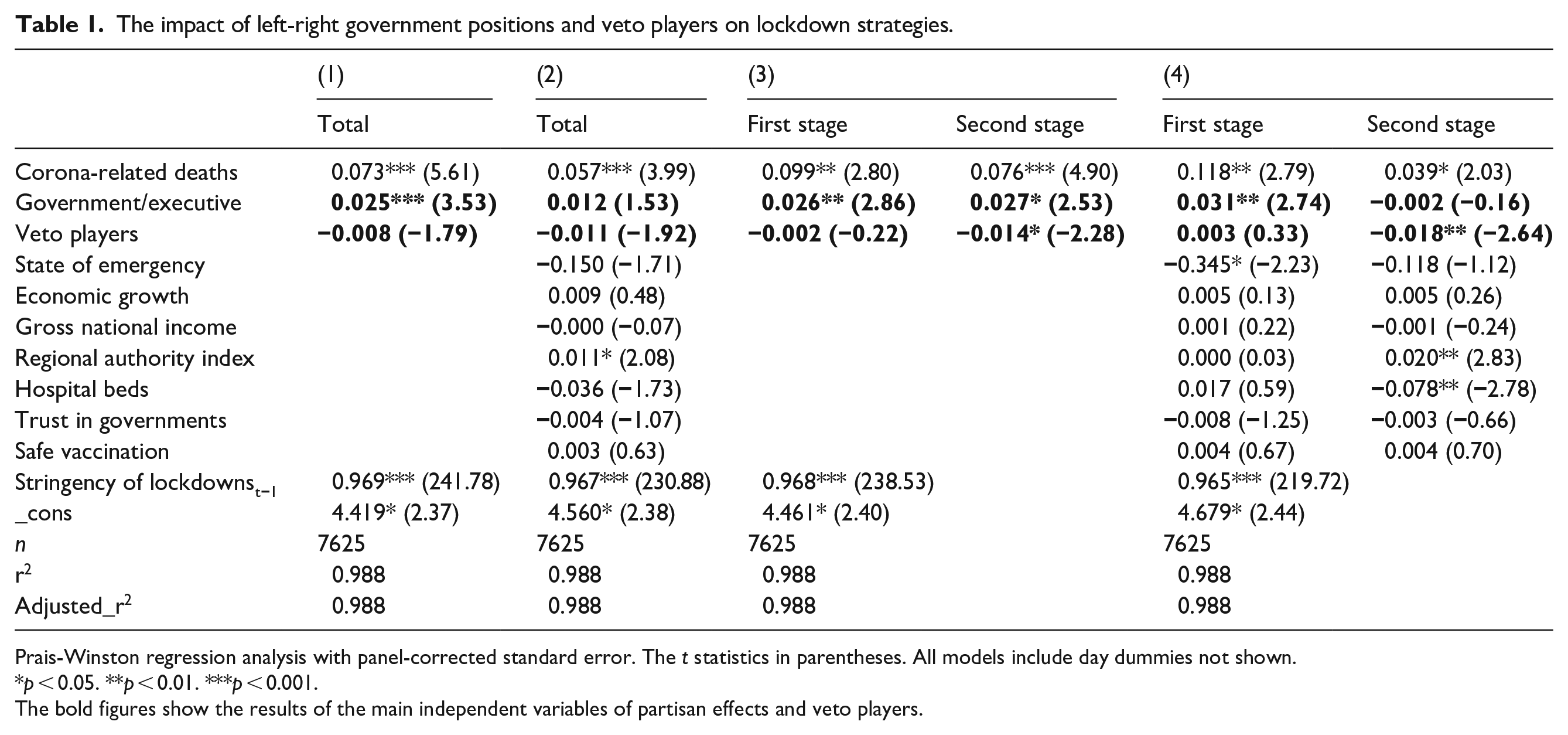
Prais-Winston regression analysis with panel-corrected standard error. The t statistics in parentheses. All models include day dummies not shown.
p < 0.05. **p < 0.01. ***p < 0.001.
The bold figures show the results of the main independent variables of partisan effects and veto players.
Model 3 again shows the isolated effect of the partisan and veto player theory, but now also with a structural break. The results show that the government’s position in the left–right dimension is significant in both periods. Veto players are significant, but only in the second period. This would confirm our hypotheses. However, the control variables change the results again.
There are two major changes when comparing model 3 and 4. On the one hand, the government effect increases to 0.31 in the first period, which means that in this model the difference between a right and a left government changes the stringency of lockdowns by 7.5%. The result that the partisan effect is confirmed and that there is no effect of veto players in the first phase of the first wave of the COVID-19 pandemic confirms hypothesis 1. In model 4, however, left–right government positions no longer have a significant effect in the second period. As in model 3, veto players show no significant effect in the first period, but they have a significant negative effect in the second period. Similar to the government position, the veto player effect is also somewhat stronger in the second period with control variables than without. The coefficient of 0.18 means a difference of 4.5% in lockdown stringency between a country with no veto players and the country with the maximum veto player range. The results for veto players also show that veto players do not want to stick to the latest stringency level (option (a) in hypothesis 2), but want to return to the pre-crisis level (option (b)). The increasing relevance of veto players in the second stage with a simultaneous decrease in the importance of governments confirms hypothesis 2 that strong veto players are associated with a lack of agenda control by governments. It also shows that the democratic checks and balances suspended in the first stage fulfil these functions again in the second stage. This means that highly developed democracies will revert to democratic principles once the height of the crisis has passed.
However, I did not assume that partisan theory would become insignificant in the second stage. The clear decline in the explanatory power of the central government can also be explained by the fact that the decision-making centre has been shifted from the central to the subnational level. This interpretation is supported by the local authority control variable. The regional authority index shows that this index is insignificant in the first period. This makes sense because the first phase was mainly organized by the central government, often bypassing the subnational level. That changed in the second stage, when subnational units began to play a role in determining the degree of severity of lockdowns. This is reflected in the fact that during this period the coefficient became significant. The results show that the greater the regional autonomy, the stricter the lockdown or the slower the removal of lockdown measures. More research is required regarding the role of subnational units and actors in order to arrive at conclusive results. The increase in the importance of regional authorities in the second phase of the first lockdown wave, however, goes hand in hand with the decline in the influence of central governments and supports my argument of the increasing power of the veto actors in the second phase. Since the veto player index in many countries includes second chambers that organize subnational units, the significant impact of this index corresponds to the increasing relevance of veto players.
Finally, I would like to briefly comment on the influence of the other control variables and their assumed relationship to the independent variables of partisan and veto player theory. Many control variables (wealth, growth, trust in government, belief in vaccinations) are not significant. Countries that use emergency orders have a significant impact in the first period. This confirms again that the executive branch dominated in the first period although, contrary to our expectations, the state of emergency correlates negatively with the stringency of lockdowns. I can only speculate about this finding. It is likely that emergency measures will allow governments to improve the implementation of lockdowns and thus make them more effective. In fact, it appears that less stringent lockouts may be sufficient if implemented efficiently (Limberg et al., 2020). However, much more research is needed to analyse the effects of emergency measures in the event of the COVID-19 pandemic (Bjørnskov and Voigt, 2021). Ultimately, healthcare infrastructure also plays an important role in the second stage: the higher the capacity of hospitals to care for corona patients, the weaker the degree of lockdown.
Conclusion
A look at partisan and veto player theories provides important insights into the political reactions in the first wave of the COVID-19 pandemic. The results impressively show that the fight against the pandemic is not just a technocratic response to a challenge, but is part of the left–right dimension of politics. They demonstrate that party politics plays an important role for the stringency of lockdown policy in the 35 highly developed democracies. Left-wing governments promote a more stringent lockdown than right-wing governments. However, the analysis also shows that the first stage of the crisis, that means the immediate reaction, circumvented democratic checks and balances. This result shows that extreme crisis situations are hardly compatible with normal democratic procedures. This becomes clear when comparing the initial period of reacting to the spread of COVID-19 and the second period of lifting lockdown restrictions. In the second period, veto players become more relevant in reducing the stringency of lockdowns.
This article is one of the first to test established theories of macro-comparative policy on the case of the corona pandemic. It shows that my approaches are relevant even under these extreme circumstances. I have formulated hypotheses that take into account that the first lockdown wave of the COVID-19 pandemic should be analysed in two periods: the establishment of lockdowns and their tightening, on the one hand, and the lifting of lockdowns until the beginning of the second wave, on the other hand. The first period was really exceptional in that it required quick decisions that hampered the normal political process. In this context I asked whether partisan theory helps explain various outcomes during this period. Indeed, the difference in government position made a difference. This difference is most evident when looking at the established left–right dimension. These results show once again that modern, highly industrialized democracies are structured according to the established left–right ideology. Even if this dimension has been criticized and many other dimensions are viewed as relevant, it is nevertheless suitable for analysing political questions of modern societies. However, the results also show that we need country-specific left–right indices in order to capture the relevance of ideological dimensions (Bakker and Hobolt, 2013; Jahn, 2011).
I offered hypotheses to understand the impact of veto players in the context of the COVID-19 pandemic and these hypotheses were confirmed as well. Because partisan and veto player theory describe the political process in democratic societies in a nutshell, the combination of both theories is helpful to understand what happened in the first wave of the corona pandemic. In that we saw that veto players did not matter in the first period but had a significant negative effect in the second period, we can conclude that democratic processes were dismissed to a large extent in the first period but resumed in the second. This finding shows that, in the face of an acute crisis, democratic countries suspended democratic rules but reverted to democratic principles as soon as the immediate threat was – more or less – under control.
My analysis shows that veto players do not prevent policies per se but that it is necessary to define the status quo theoretically. In the case of the COVID-19 pandemic that means that veto players block more restrictive lockdowns and that they wish to return to pre-corona policies. A general conclusion of my analysis is that it is much harder to define the status quo empirically than is often assumed in theory.
This study stands at the beginning of a new field of research of suddenly emerging global crises. I took a very broad perspective by analysing almost all highly industrialized democracies. The results are therefore highly representative for advanced industrialized democracies. However, with such a broad consideration, of course, some important nuances are neglected. An important issue for macro-comparative policy is that lockdown strategies in many countries have shifted from the central level of national politics to the subnational level. This means that the analysis of the second and subsequent lockdown waves must take greater account of the subnational level. This is of course a profound data problem as we mainly have data for the central tier. Further research should also analyse which lockdown regulations are most effective. In other policy fields, command-and-control policies have been shown to be superior to softer policies (Steinebach, 2019). This perspective could add to our knowledge of how to combat global challenges such as the COVID-19 pandemic in the future.
The results also have political implications. Since the fight against the corona pandemic is not a technocratic reaction to a challenge, but is located in the left–right dimension of politics, this can fuel social conflicts. This means that the pandemic is politicized. This conflict is very evident in many countries and is expressed in anti-lockdown protests. In this regard, too, further research is needed to determine whether this conflict leads to new social divisions or revitalizes established ones. It can also be assumed that the fight against climate change has similarities with the COVID-19 pandemic in that quick and decisive action is required and democratic rules may be suspended for a while. In this respect the article contributes to our understanding of policy making in times of exceptional global crisis (Schmidt, 2021). However, the fight against climate change differs in that stringent measures must be taken for a longer period of time. What this means for the democratic decision-making process is an open question at the moment, but the analysis of lockdown strategies in the COVID-19 pandemic could provide clues as to how democratic industrialized nations might respond.
Supplemental Material
sj-docx-1-ips-10.1177_01925121221078147 – Supplemental material for Politics and corona lockdown regulations in 35 highly advanced democracies: The first wave
Supplemental material, sj-docx-1-ips-10.1177_01925121221078147 for Politics and corona lockdown regulations in 35 highly advanced democracies: The first wave by Detlef Jahn in International Political Science Review
Supplemental Material
sj-do-2-ips-10.1177_01925121221078147 – Supplemental material for Politics and corona lockdown regulations in 35 highly advanced democracies: The first wave
Supplemental material, sj-do-2-ips-10.1177_01925121221078147 for Politics and corona lockdown regulations in 35 highly advanced democracies: The first wave by Detlef Jahn in International Political Science Review
Supplemental Material
sj-dta-3-ips-10.1177_01925121221078147 – Supplemental material for Politics and corona lockdown regulations in 35 highly advanced democracies: The first wave
Supplemental material, sj-dta-3-ips-10.1177_01925121221078147 for Politics and corona lockdown regulations in 35 highly advanced democracies: The first wave by Detlef Jahn in International Political Science Review
Footnotes
Acknowledgements
I would like to thank the extremely useful comments of three reviewers on a first draft of this article. During the revision of the manuscript, my team in Greifswald, as well as the participants of the weekly chair colloquium, assisted me with further comments. Above all, I would like to thank Darius Ribbe, Erik Baltz, Lisa Klagges, Maximillian Andorff-Woller, Paula Reppmann and Sophie Suda. I thank Ashley Fritsch for editing the article.
Funding
The author received no financial support for the research, authorship, and/or publication of this article.

Supplemental material
Supplemental material for this article is available online.
Notes
References
Supplementary Material
Please find the following supplemental material available below.
For Open Access articles published under a Creative Commons License, all supplemental material carries the same license as the article it is associated with.
For non-Open Access articles published, all supplemental material carries a non-exclusive license, and permission requests for re-use of supplemental material or any part of supplemental material shall be sent directly to the copyright owner as specified in the copyright notice associated with the article.
