




Abstract
This article compares how COVID-19 affected state–society relations differently in two relatively similar countries: Brazil and Argentina. Bringing together social movement theories and ideational institutionalism, we argue that variation in responses to the COVID-19 pandemic is explained by the different roles played by social movements inside and outside government and by contrasting ideational disputes. The extreme uncertainty introduced by the pandemic generated intense contestation about the meaning of the crisis and how to resolve it. In Brazil, progressive social movements not only were excluded from the government coalition, but also had to combat a powerful discourse that denied the existence of a crisis altogether. Such denialism did not flourish in the same way in Argentina, where progressive social movements were part of national government processes. The result was that in Argentina, movement–government dynamics revolved around constructing long-term policy proposals, whereas in Brazil movements focused on short-term emergency responses.
Introduction
How do social movements devise strategies for confronting problems characterized by extreme uncertainty and rapid change, such as pandemics? Although the COVID-19 pandemic that swept across the globe was caused by a single disease, it affected each country’s political system differently. It is too early to anticipate the long-term effects, but we can take advantage of this period of extreme uncertainty to study how actors respond to crises as they are taking place. While much attention during the pandemic has been given to government responses (Bárcena, 2020; Filgueira et al., 2020), we focus on social movements. Whether working against or in favour of governments, these actors are relevant because they affect the agenda-setting process, as well as the design and implementation of public health, economic and social policies. We propose that analyzing movement responses requires combining social movement theories with the study of how ideas are generated and transformed during crises. The former literature allows us to understand better actors’ ability to seize and create new opportunities for promoting their agendas, while the ideational institutionalist literature helps in analyzing why ideas emerge in contexts of intense uncertainty.
A most-similar comparative research design enables us to explore differences in movement responses to the pandemic. Brazil and Argentina face similar challenges in terms of social inequality and development, and both are presidential, federal countries, with a concentration of national power in the executive and substantial subnational autonomy. In the past decade, the two countries have undergone increasing political polarization, with high levels of right-wing and left-wing mobilization (Ferrero et al., 2019; Rossi, 2018). However, by the time the pandemic had arrived, this polarization had yielded distinctly differing electoral results in the two countries, putting a far-right government in power in Brazil and a centre-left coalition in Argentina. This produced divergent trajectories in these otherwise similar countries. Polarization increased during the pandemic, but while in Brazil this involved the introduction of a new cleavage (denialists versus those who saw the pandemic as a serious threat), in Argentina the pandemic reinforced a pre-existing ideological cleavage (neoliberals versus neo-developmentalists). In Brazil, the centrality of the struggle around denialism limited the ability of social movements to promote debates about long-term solutions. In Argentina, progressive movements were more successful in promoting debates on the best policies for tackling the pandemic and for recovering from it. The comparison of the cases of Brazil and Argentina between March and early December 2020 allows us to analyze these different social movement responses to the same event under similar institutional settings.
This article is organized in four sections and a conclusion. First, we propose a framework that connects the social movement literature on political opportunities and threats and on (contentious and collaborative) state–society interactions to the ideational institutionalist literature on ideas and uncertainty. Second, we summarize our comparative argument. The third and fourth sections provide detailed analyses of each case. We specify recent trends in social movement activism as well as the key challenges faced by collective actors and how they responded to them.
Bridging social movement studies and ideational institutionalism
Although political science traditionally focuses on government and party institutions, social movements also influence government responses to social problems, such as pandemics. Following Diani (1992), we define movements as networks of actors engaging in collective action on the bases of shared collective identities and orientations toward a conflict. Movements defend alternative policy models or cultural practices that are contentious, in that they question existing social, political and cultural conditions or efforts to change them (movements can, in this sense, be either progressive or conservative).
Much of the social movement debate on how actors respond to changing political and social conditions has revolved around the concept of political opportunities. Tarrow (1994), McAdam et al. (1996) and Tilly (2006) used the term to refer to changing characteristics of what the latter calls political regimes: openness, instability, the existence of influential movement allies, and the use of repression (Tilly, 2006: 44). The early argument was that mobilization typically occurred when political regimes became more accepting of movement demands. Later, the recognition that worsening conditions can also promote mobilization led to the introduction of the idea that movements respond not only to opportunities, but also to threats (Goldstone and Tilly, 2001).
Extensive debates have challenged some of the initial presumptions of the opportunity/threat approach, two of which are particularly relevant to our analysis. One has to do with the presumption that ‘opportunity structures’ are external to social movements (Jasper, 2012). Movements were often defined as ‘challengers’ (Tilly, 1978) engaged exclusively in noninstitutionalized politics. Yet, much recent work has demonstrated that they often combine public, contentious forms of collective action (such as street protests), with behind-the-scenes negotiations with elected officials and party leaders (Goldstone, 2003; Rossi, 2017; Rossi and von Bülow, 2015). In some cases, they actually occupy government positions in legislatures or the bureaucracy, engaging in ‘institutional activism’ (Abers, 2020; Abers and Tatagiba, 2015; Banaszack, 2010). Political opportunities thus emerge and can be created by movements themselves, not only when governments are sympathetic to movement goals, but also when movements are included in governing coalitions. When movements are in opposition to government, such possibilities are likely to be foreclosed or to require much more disruptive action.
A second debate around the political opportunity approach that contributes to our analysis refers to the tendency of the early literature to see opportunities and threats as objective determinants of social movement strategy. Instead, Goodwin and Jasper (1999) understand political opportunities and threats as interpretations inserted in cultural frames. Rossi (2017: 32–65) argues that strategies are not detached from experiences and perceptions of the past, the immediate context and the desired outcomes. Social movement strategies are developed through political interactions and embedded in disputes around the meanings of those interactions.
Although these discussions help us understand how government–movement coalitional dynamics and their interpretations of the context affect movement strategy, the social movement literature has had little to say about the difference between routine politics and moments of great uncertainty and rapid change. A different literature, ideational institutionalism, helps us conceptualize the particular challenges brought up during crises such as pandemics.
Institutionalists in general have given substantial attention to how crises affect politics. They have been variously defined as critical junctures (Collier and Collier, 1991; Mahoney, 2001), punctuations between equilibria (Baumgartner and Jones, 1993), unsettled times (Katznelson, 2003), events (Sewell, 2005), exogenous shocks (Haggard and Kaufman, 1992), and so on. The assumption tends to be that while institutions normally tend toward stability, under special circumstances the balance of power is shaken up, making change possible. Most of these approaches look at the effects of crises post hoc. Indeed, determining which moments constitute critical junctures is a major debate among scholars. Similarly, Sewell (1996, 2005: 100) defines an ‘event’ as ‘a rare subclass of happenings’ that alters routine life in dramatic terms, resulting in the significant transformation of society. A convulsive period, however, can only be duly classified as an ‘event’ once we know that major change has occurred. From this perspective, what is most important about a crisis is what we find out about it once it is over.
Perhaps because their focus is on stability, mainstream institutionalists say little about what political actors do during social or political ruptures. Ideational institutionalists such as Blyth (2002, 2013) and Hay (2008), fill this gap by arguing that crises should be understood less as ‘exogenous shocks’ than as ‘endogenous constructions’ (Widmaier et al., 2007). Crises ‘unleash short bouts of intense ideational contestation in which agents struggle to provide compelling and convincing diagnoses of the pathologies afflicting the old regime/policy paradigm and the reforms appropriate to the resolution of the crisis’ (Hay, 2008: 68). For Blyth (2010), social life is characterized by uncertainty, distinguished from risk in the sense that we simply do not know the probabilities of different possible outcomes. Ideas serve as ‘blueprints’ (Blyth, 2002) for defining problems and solutions to them, and thus they are fundamental for helping people act coherently in a world in which uncertainty makes it very hard for actors to define their own interests (McNamara, 1998: 8; 58). During crises, ongoing disputes become accentuated and new ones may arise, as actors try to adapt or reinvent their existing blueprints to conditions of uncertainty.
This kind of ideational struggle adds a layer to the interpretative process that movements face as they seek to influence policies. Understanding how social movements attempt to affect policy during a crisis requires exploring the interaction between movement efforts to identify coalitional opportunities and threats and their role in ideational disputes about the nature and consequences of the crisis itself. As we will show in the coming pages, the theoretical cross-fertilization between the social movement and ideational literatures helps us explain different responses to the pandemic in Brazil and Argentina.
COVID-19 and the strategies of social movements in Brazil and Argentina
Although the virus in each country is the same, social movement responses in Brazil and Argentina differ not only because actors are differently located in governing coalitions, but also because distinct narratives about the pandemic have become a source of dispute. As we explore in more detail below, in Brazil, debates around long-term policy proposals were virtually suppressed, as movements focused on responding to the denialist discourse expounded by the president and his followers and on launching emergency relief campaigns. In Argentina, the key players (in government and opposition) agreed that the event was an epidemiological crisis. Ideational disputes between developmentalist or neoliberal policies to tackle the effects of the pandemic took centre-stage. The result was that, in Brazil, a broad array of movements critical of denialism focused on short-term relief policies in Congress and at the subnational level, and in launching awareness campaigns and solidarity initiatives. In contrast, in Argentina, progressive movements were able to propose very ambitious short- and long-term policies from within the executive branch with the support of Congress. Table 1 summarizes this comparative argument.
Social movements and the pandemic in Brazil and Argentina (2020).
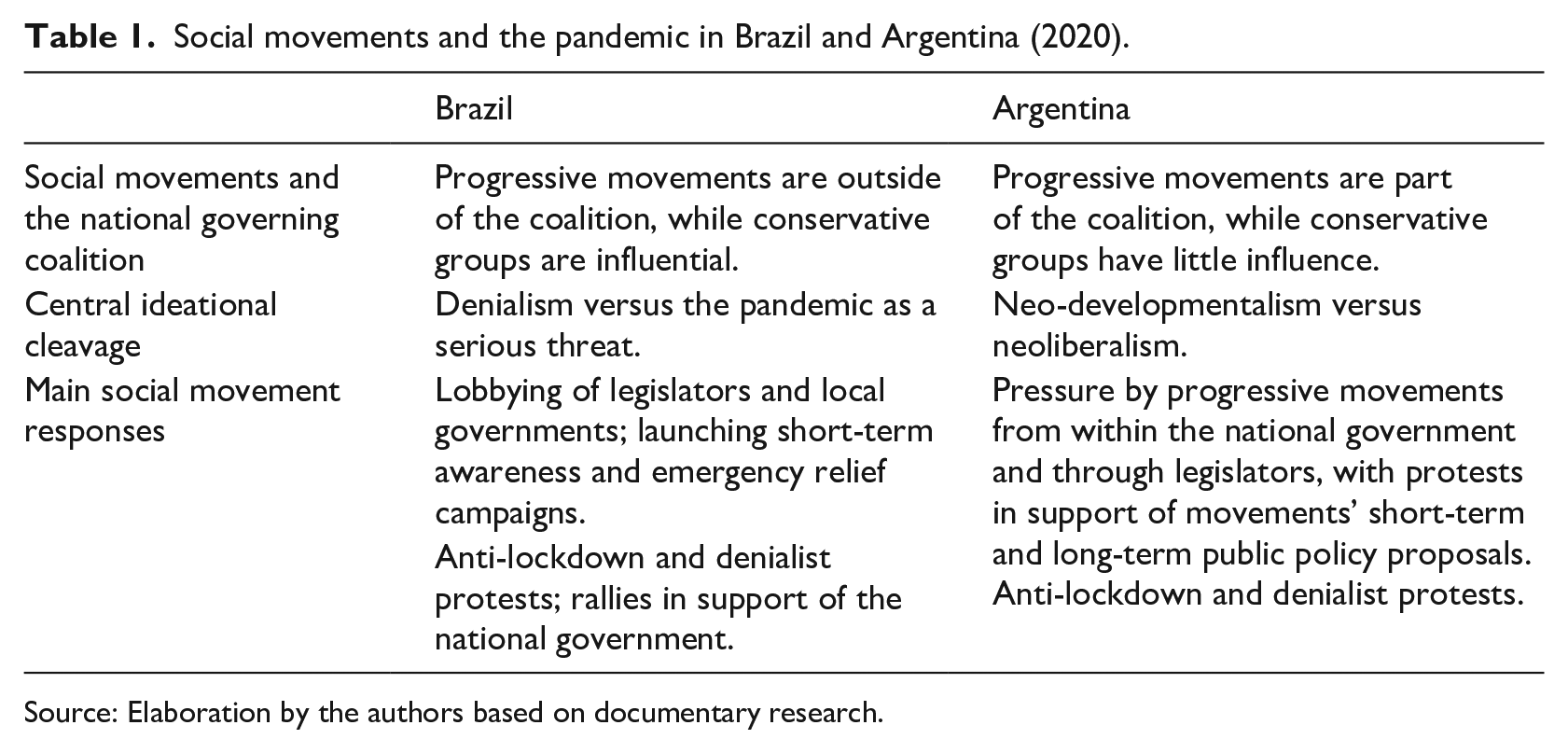
Source: Elaboration by the authors based on documentary research.
In the next two sections, we analyze in detail how these dynamics have unfolded in Brazil and in Argentina. This analysis is based on a systematic examination of documents produced by social movement organizations, legislators and government officials between March and early December of 2020. 1 Data from these documents is complemented by information published by media outlets. Also relevant were preliminary analyses published by scholars, especially work gathering data on social movement responses to the pandemic.
Brazil: Official denialism and resistance from outside government
In Brazil, the pandemic arrived after a period of dramatic instability and increasing political polarization. In 2016, President Dilma Rousseff of the centre-left Workers’ Party (Partido dos Trabalhadores) was ousted through a contentious and legally dubious impeachment process. Her impeachment found popular support in a widespread belief that her party, leftwing policies and parties, and professional politicians in general were responsible for all of Brazil’s problems. As Hunter and Power (2019: 70–71) argue, a ‘perfect storm’ brewed around political, economic and public-security crises, which led not only to a plunge in government legitimacy, but also, and more importantly, in regime legitimacy. The wave of discontent led, in 2018, to the election of right-wing extremist, Jair Bolsonaro.
When the pandemic took hold, Bolsonaro was beginning his second year in office. By then, the relationship with the legislature and the judiciary was increasingly tense, with his more radical supporters calling for the shutting down of Congress and the Supreme Court and further empowering the military (von Bülow and Llanos, 2020). The relationship with social movements was also tense. In contrast to the Argentinian case and to previous leftist administrations in Brazil, the Bolsonaro government effectively closed its doors to social movement participation within the government, with the exception of conservative movements that supported him, such as anti-abortion groups. Protests were held both by opposition groups (who denounced the dismantling of social and environmental protections) and by supporters (who protested a supposed boycott of Bolsonaro by the political establishment).
Perceptions and responses to COVID-19 exacerbated this polarized political debate. Contentious political decisions by the government introduced a new cleavage: between denialists and those who took the pandemic seriously. Bolsonaro systematically and continuously minimized the dangers of the pandemic, speaking out against shutdowns and mask-wearing requirements. When questioned, he stated that ‘people will die anyway’, blamed foreign (China) and other domestic (state governors and mayors) actors for the deaths and for the economic impacts of the pandemic and advocated the use of chloroquine. Denying the severity of the pandemic and the uncertainty surrounding it became a political statement.
It was in this context of dispute around the meaning of the pandemic itself that state and municipal authorities, including those affiliated with right-wing parties, announced social isolation policies in March. As some cities, such as Manaus (in the Amazon region), were significantly impacted by the pandemic, others managed to keep the disease under control, initially. But the inability of so many impoverished Brazilians to isolate in crowded homes or to survive without working, combined with the president’s claim that the restrictions were unnecessary, put enormous pressure on state and local governments to open up the economy. Starting in June, despite rising numbers of infections and deaths, most began to lift pandemic regulations. According to the Public Policy Adoption Index of the COVID-19 Observatory of the University of Miami, by the end of August, while Argentina led the ranking of adoption of public policies related to the pandemic, Brazil lagged below the region’s average, showing better results only when compared with two of the poorest countries in Latin America, Haiti and Nicaragua. 2
Struggles over the meaning of the pandemic: denialism versus defining the pandemic as a serious threat
In this context of polarization and official denialism, social movements responding to the pandemic had to deal with the fact that many Brazilians believed that the pandemic did not exist or could be easily resolved with the use of miracle drugs. They faced highly organized extreme right-wing movements supporting the president who echoed the official framing of the crisis on social media, disseminating false news about the disease and its treatment. False videos showing empty coffins being buried 3 and posts claiming that the virus could not survive the heat of tropical countries such as Brazil went viral in social media and on WhatsApp. In pro-government protests against isolation policies, protestors held up signs saying, ‘We don’t want the vaccine, we want chloroquine’, 4 and ‘the real virus is corruption’, in reference to the campaign that led to the prior left-wing government’s impeachment.
The acceptance of denialist arguments was clearly associated with political affiliations, but did not neatly fit into the existing divide between right and left. Based on data from a national probabilistic online panel of 2400 respondents completed on 3 May, Calvo and Ventura show that, at least among online users, the perception of risk associated with the pandemic was correlated to electoral identification. Thus, 23% of respondents who supported the opposition candidate, Haddad, considered it very likely that they would lose their jobs or become infected with COVID-19, while only 12% of Bolsonaro supporters had the same perception (Calvo and Ventura, 2020: 8). Another analysis, based on Twitter messages sent in the last 10 days of March, found that the president’s publications were a central source of misinformation disseminated by his supporters on that platform (Recuero and Soares, 2020). But other right-wing politicians did not agree with the denialist approach. Bolsonaro clashed over how to respond to the pandemic with the governors of São Paulo and Rio de Janeiro and with members of his own cabinet. In April and May, he fired two health ministers in succession for contesting his discourse on the pandemic.
The struggle by social movements critical of denialism to fight government-sponsored disinformation campaigns in Brazil was exacerbated by constant changes in scientific knowledge about the virus and how to respond to it. Although right-wing movements have dominated social media in recent years, progressive groups have sought to increase their on-line presence to promote their own views on the pandemic (Penna et al., 2020; von Bülow, 2020). The dissemination of cell phones and internet connections in poorer areas has contributed to the growth of grassroots journalism groups. During the pandemic, these organizations sought to contest denialism in poor communities, launching awareness campaigns that combined traditional methods of communication, such as radio programs, with new digital technologies. An example was the creation of a new cell phone app by the media activists of the Rio de Janeiro based Voice of the Community (Voz da Comunidade) that sought to disseminate reliable information about the pandemic within favelas.
Social movement responses to uncertainty: mutual aid initiatives and advocacy for emergency relief programs
In this context of ideational contestation, a broad-based, ideologically heterogeneous group of actors throughout Brazil unified around an interpretation of the pandemic as a grave and urgent threat, especially for the poor, and mobilized to defend emergency relief. Starting in early March 2020, they engaged in two forms of collective action. First, they launched mutual aid campaigns. Second, they lobbied political authorities at the national and local levels to implement policy responses. Over the year, uncertainty about how best to deal with the pandemic and a rapidly changing political environment produced constant challenges to these efforts.
Social movements and other civic groups quickly put together emergency campaigns by adapting existing collective action routines to the new situation. 5 Local neighbourhood groups, charities, traditional social movements, religious organizations, labour unions and businesses set up campaigns to gather and distribute food and cleaning and medical supplies. Many of these actors had previous experience distributing food and supplies during emergencies. They had to learn, however, to do this safely: sanitizing donations, socially distancing, and using personal protection equipment. They creatively combined online and offline activism to operationalize campaigns. Although digital activism is not new, the pandemic has led organizations to develop new capacities in organizing complex logistical operations online. At the same time, activists had to walk from house to house, delivering food and supplies and reliable information. Emergency relief efforts were only part of a wide array of solidarity initiatives organized from below. Other groups sought to provide psychological support for people who were dealing with the emotional difficulties of social isolation, especially when coupled with issues such as increased domestic violence or the violation of LGBTQ+ rights. Other initiatives aimed at providing better health services in much-needed neighbourhoods. Various organizations created directories of initiatives to connect potential donors to organizations on the ground. Just one of them listed, at the end of May, over 800 initiatives nationwide (Abers and von Bülow, 2020). 6
In the second place, movements initiated political campaigns in Brazil to pressure the state by both promoting policy proposals and denouncing government inaction. These campaigns often made connections to historic agendas and grievances. Progressive social actors tied the pandemic to the issue of inequality and to debates about the role of the state. Signs and chants by protesters filling the streets in June 2020 linked the fight against the virus to the struggle against police repression and racism, making discursive connections between police shootings of black children and the particular vulnerability of black people in the pandemic. Indigenous people, in turn, have linked their own vulnerability to the disease to ongoing struggles against deforestation and to invasions of their territories by clandestine miners. The strike of app (Uber, iFood and others) delivery workers, held on 1 July, provided a clear link between debates about labour rights and health risks (Abers and von Bülow, 2020). As Penna et al. (2020) note, rural social movement organizations tied their solidarity initiatives to debates about the need to change food commercialization schemes and to promote agroecology. Others focused on the need for better digital inclusion and literacy in isolated and poor communities (von Bülow, 2020).
One of the most important movement campaigns in Brazil was the struggle for a cash transfer program to help informal workers deal with the sudden loss in income. In April, a broad national coalition of NGOs, trade unions and social movements formulated and then successfully lobbied for the program in the National Congress (Orofino, 2020). Committed to austerity policies, the Bolsonaro government initially resisted calls to increase spending. In a victory for progressive movements, the 3-month Emergency Aid program approved by Congress would pay cash transfers to informal workers at three times the monthly amount proposed by the government. Other measures approved by Congress with support from NGOs, social movements and political parties from a broad ideological spectrum were vetoed by the president. Even former allies of the president criticized these vetoes, for instance in the case of the law that required masks in closed spaces such as shopping centres and churches, the veto was subsequently overturned by the National Congress. 7
A broad-based anti-Bolsonaro coalition from centre-right to left called ‘We are 70%’ (referring to the majority of the population giving the government negative ratings) flared up in late May and early June. With long delays in initiating emergency aid payments, polls registered high levels of dissatisfaction with the government. The prospects for building a national coalition of movements in favour of a stronger response to the crisis initially seemed good. Things started to shift in July, however, when the Emergency Aid began to reach beneficiaries, and ironically gave a push to Bolsonaro’s popularity (Instituto de Pesquisas Datafolha, 2020; for a contrasting response see Filsinger and Freitag, this issue). As the government thus took credit for their proposals, movements have struggled to remind the population that ‘basic income’ has long been a left-wing platform.
They also sought to create new interpretations that redefine the political situation and the pandemic in other terms. Various coalitions have attempted to connect the simultaneous struggle against the extreme-right to the fight against the pandemic. To confront the increasing sensation that Brazilians had decided that the pandemic was over, 8 some movements focused on the importance of mourning the dead. Others sought to mobilize Brazilians around the idea that things should not be the same after the pandemic. For example, one online campaign launched in September, called ‘Liberate the Future’, asked participants to film videos presenting concrete proposals ‘to postpone the end of the world, imagining possibilities for post-COVID-19-pandemic futures’. 9 As the pandemic increasingly reveals and deepens Brazil’s harshest social and economic cleavages, many actors thus suggest that there is no future at all under the radical right. Some focus on electoral struggle; others engage in exercises of utopian imagination; others continue promoting mutual aid initiatives. But for now, a broad-based coalition around an alternative vision of the future has yet to be built.
Argentina: social movements in the governing coalition
When the first COVID-19 cases arrived in Argentina, the centre-left government of Alberto Fernández was in its fourth month, and was still settling into power. The pandemic put additional pressure on a government that was initiating the renegotiation of its sovereign debt while facing 50% annual inflation rates. Political polarization between neoliberals and neo-developmentalists had been on the rise in Argentina since – at least – 2005 (Ferrero et al., 2019; Rossi, 2018). In the pendular politics that characterizes Argentina (O’Donnell, 1988), the Fernández government was in the midst of reversing changes made by the previous centre-right government, recreating the Ministries of Health, Education and Science, eliminated in 2018.
In March 2020, the government issued strict shutdown decrees in the worst-hit regions (starting in Buenos Aires city, its hinterland, and the very poor Chaco province, then expanding to the rest of the country). In radical contrast to the Brazilian president, Fernández justified the shutdown with the words: ‘You can recover from a drop in the GDP, but you can’t recover from death.’ Until November, the government maintained control of the situation and the health system kept up with the spread of COVID-19. 10
The pandemic led to a reorganization of the role of social movements in Fernández’s governing coalition. Prior to the pandemic, three groups participated in it: (a) traditional politicians (who replaced the CEOs of Mauricio Macri’s previous government); (b) scientists (as national ministers as well as part of the president’s close circle of advisors); and (c) social movements (mostly located in ministries responsible for human rights, social policies and infrastructure) (Longa and Vázquez, 2020). Strong social groups, such as the piquetero movement of informally employed and unemployed poor people and the human rights movement (for instance, the Mothers of the Plaza de Mayo (Madres de Plaza de Mayo)) had previous experience working inside government, especially in the 2002–2015 centre-left coalition. They had worked in social, housing and human rights policy-making and had elected several active national and provincial legislators (Rossi, 2017: 190–232). Early on in the Fernández administration, they had a fairly marginal place in the governing coalition. But as the crisis evolved, they gained increasing importance. The three sectors began to collaborate to guarantee that vulnerable populations would have access to health, social and emergency policies.
Social movements in Argentina gained traction in the government after a corruption scandal hit the Ministry of Social Development, leading to the expulsion of public officials involved in purchasing food at above-market prices in April, just as the pandemic began to take hold. This situation in the national government coincided with a similar case in the health department of the Buenos Aires city government, run by centre-right Horacio Rodríguez Larreta (of the Together For Change (Juntos por el Cambio) Coalition, JC), the main opposition to Fernández’s administration. These scandals became a political opportunity for social movements inside the national government, allowing them to gain influence over social and health policies for poorer segments of society. In addition, the Buenos Aires scandal forced the reluctant mayor to start working with shantytown movements, such as The Powerful (La Poderosa).
The struggle over the best policies to respond to the pandemic: neo-developmentalism versus neoliberalism
The pandemic reinforced the left/right cleavage by increasing already existing polarization in Argentina between neo-developmentalist and neoliberal approaches. On one side, progressive movements used their participation in government to expand their influence in policy-making. On the other side, centre-right parties and right-wing movements gradually intensified their critique of the government and shutdown policies. A strong denialist movement, however, never developed.
The national corruption scandal created space within the Ministry of Social Development and the Ministry of Territorial Development and Habitat for the piquetero movement, and especially for the confederation of the largest piquetero and informal economy groups, the Confederation of Popular Economy Workers (Confederación de Trabajadores de la Economía Popular (CTEP)). Their incorporation in the policy-making process led the piqueteros to leave the streets for several months. Their participation in government promoted increased internal coordination within the administration and between scientists and popular movements. 11 Interpreting the pandemic as affecting the most vulnerable segments of society disproportionately, the piqueteros on the inside of government cooperated to launch several important initiatives to support informal workers and poor people who had become unemployed because of the pandemic. In sum, by coordinating with a group of social movements, by recognizing the gravity of the situation, and by developing policy in consonance with scientific knowledge and inclusive principles, the national government of Argentina was able to mobilize support around a vigorous humanist response to the crisis during the first 9 months of shutdown.
For the opposition movements, the corruption scandal in Buenos Aires led to a double process inside the JC coalition. At the city level, the combination of the corruption crisis and the fear that the healthcare system could collapse led to a moderation of the anti-shutdown position of mayor Rodríguez Larreta’s faction in JC, at least until October. At the same time, the JC national leadership (led by Macri) increasingly radicalized its anti-shutdown position, promoting protests. 12 As in Brazil, right-wing movements and parties in Argentina were divided about how to reorient their interpretations of the changing situation.
Divisions about how to respond to the pandemic also took place within the labour movement. The conservative General Labor Confederation (Confederación General del Trabajo) negotiated a 25% salary decrease in exchange for job security during the shutdown. Meanwhile, grassroots and factory-level unions, mostly dominated by the left, engaged in pickets, strikes and occupations to request personal protection equipment, salary bonuses for essential workers and to transform defunct companies into cooperatives. Strikes by various unions – app delivery, milk production, fishing, police, and health, among many others – accounted for 54% of total protests between March and June 2020 (Natalucci et al., 2020). While police repression grew, 13 in most cases these mobilizations achieved their goals. Highly disruptive protests by police led to the creation of a special fund for that sector, and postal and health workers received tax relief. The Buenos Aires city legislature passed a law guaranteeing certain labour rights for app delivery workers.
Conservative groups interpreted increasing government regulation of the economy and of human mobility as restricting economic and civil rights. The most right-wing faction of the JC organized protests with isolated anti-Peronist and other conservative groups. They began to refer to the government as an ‘infecto-dictatorship’ (infectadura), claiming that government regulation was leading Argentina toward a communist regime. 14 These groups often questioned the seriousness of the health crisis (although at a lower intensity than in Brazil). Made up largely of white, rich and upper-middle-class people, the protests used traditional, nationalistic symbols, and combined a global conspiracy discourse with a defense of the ‘republic’, suggesting that the government was using the shutdown to concentrate power. They repeated historic conservative discourses that associated all progressive policies and governments with a threat to ‘liberty’. 15 Participants of these small protests rejected social distancing protocols, leading to criticism by more moderate sectors of the opposition JC coalition, who accused them of recklessness. 16 This evaluation turned out to be correct: several were infected by COVID-19 at the 9 July protest alone, including its organizer. Just a few days before, another anti-government protest organizer died of COVID-19. 17 At the 26 August protest, Patricia Bullrich, the national JC leader also caught the virus. 18
The JC was increasingly divided between moderates (led by Rodríguez Larreta, who criticized the protests) and radicals (commanded by Macri and Bullrich). Instructed by the Macri faction, JC deputies boycotted the online remote sessions of the National Congress, appearing massively in person in the chamber to stop the approval of laws that threatened neoliberal policies. A number of them consequently contracted COVID-19, discrediting their position and leading all the other political parties to accuse them of anti-democratic behavior. 19 Eventually, even the most right-wing factions abandoned denialist discourse as the growing number of deaths demonstrated the pandemic’s severity.
In the absence of major denialists movements, key players in Argentina agreed that COVID-19 required a coordinated health response. Ideational disputes revolved around the kind of response to be implemented and how to rebuild the country after the pandemic. These debates reinforced the existing polarization between neo-developmentalists and neoliberals. Against the neoliberal mantra of austerity, progressive movements helped build an alternative approach based on intensive government investment in the economy financed by taxes on the rich.
Social movements response to uncertainty: a post-COVID-19 reconstruction plan
Social movement activities on both sides engaged in historic protest repertoires: strikes, pickets, pot-banging, street demonstrations, factory occupations and land occupations, as well as online protests such as hashtag campaigns on Twitter, WhatsApp messages, Change.org petitions, and so forth (Tarullo, 2020). Protests from inside cars were not a new invention, but were now used more intensively by the anti-shutdown side.
In response to protests coming from the right and by people who rejected the shutdown, the government began in September to loosen restrictions on mobility and authorized the opening of most activities, while maintaining the interventionist economic agenda. To deal with residual denialism, it also invested in disseminating scientific and epidemiological information.
In response to social and labour rights mobilizations, the government announced a universal citizenship income policy, paid every month to poor, unemployed and informal workers, 20 the prohibition of dismissals and suspensions by all companies, massive investment in health infrastructure and health-related research 21 and increased regulation of the markets for medicine, food, cleaning products and public services (electricity, water, gas and telecommunications) to help handle the drop in the standard of living for the vast majority of the population. These activities were complemented by intensive community-level emergency initiatives (Tuñez, 2020). In contrast to the Brazilian case, in Argentina, short-term mutual aid programs implemented by progressive movements received financial support from the state in a nationally coordinated effort.
Like in Brazil, movements in Argentina sought to interpret the crisis in connection to their historic agendas. But their alliance with the government allowed them to participate in building more ambitious and concrete solutions, with an eye on how to rebuild the country after the pandemic. The main source of uncertainty for progressive movements in government was related to whether their ideas for a post-COVID-19 reconstruction plan would be applied, instead of restricting action to the social assistance policies proposed by the opposition. Groups like CTEP interpreted the crisis as an opportunity to modify Argentina’s development model and to implement a more progressive long-term agenda. This has led them to propose a major reconstruction and social welfare project dubbed the ‘Creole Marshall Plan’. The proposal would reactivate the economy by investing in civil construction initiatives that would urbanize 1600 shantytowns in the Buenos Aires Metropolitan Area, where most of Argentina’s poor population lives (3.5 million inhabitants). The plan would simultaneously promote job creation. 22
The US$ 3.2 billion needed to finance the Creole Marshall Plan were approved with the support of most opposition parties, except for the neoliberal JC and the Trotskyists. It will be partially funded by a tax on transactions in US dollars that provides funding for the Ministries of Social Development and of Territorial Development and Habitat. 23 The rest of the funds come from a one-time tax on Argentina’s richest (approximately 12,000 people owning more than US$ 2.5 million, 0.02% of the population) 24 . Of the revenues, 15% will go to the Creole Marshall Plan, 20% to scholarships for poor students, 20% to support small and medium-sized businesses, 20% to pay for the COVID-19 vaccine and health equipment, and 25% to finance investment in gas exploration to promote the export market. 25
To force the passage of the special tax law, social movements and allied sectors organized land occupations and a protest campaign. Posters on the streets saying ‘Neither the poor nor the middle class, let the great fortunes make the effort’ were accompanied by a Twitter campaign with the hashtag #AhoraAporteExtraordinario (#SolidarityContributionNow) and a mobilization. These campaigns were preceded by a highly contentious wave of land occupations beginning in late July 2020. The CTEP, the Classist and Combative Current (Corriente Clasista y Combativa), the Evita Movement (Movimiento Evita) and other groups that historically struggled for housing and employment interpreted the sudden increase in poverty and unemployment as a threat. This helped mobilize people around the issue of land concentration in one of the few Latin American countries that never implemented a land reform. This led to a wave of peri-urban and rural land occupations that were severely repressed by the provincial governments of Buenos Aires, Entre Ríos, Córdoba and Río Negro, among others. 26
This process reinforced polarization as both right and left groups increased mobilization. Conservative movements joined up with rural landowners and organized urban and rural protests in defense of ‘private property’. 27 They were able to force the resignation in November 2020 of the Minister of Territorial Development and Habitat and a temporary halt in land occupations. But mobilization on the left led to increasing influence by progressive movements in the governing coalition and the approval in December of the one-time tax on the rich.
In sum, like Brazil, movement interpretations of the pandemic in Argentina had a complex relationship with ongoing political polarizations. With extremist, denialist groups playing a tiny role in Argentina’s politics, however, the pandemic has reinforced the country’s classical ideological cleavage between neoliberal and neo-developmentalist approaches. Conservative groups were divided over whether or not to promote anti-shutdown positions but found unity in their protests against the government policies. Progressive movements were united in support of shutdowns and other restrictions to contain the pandemic, but, unlike Brazil, their location inside the state allowed them to propose concrete solutions in dialogue with the government’s heterodox neo-Keynesian economic approach. Although the government has been under increasing pressure from agribusiness and the IMF to apply austerity policies, unions and piqueteros have coordinated efforts to support neo-Keynesian policies. With the government behind their proposals, movements have worked to diminish the sense of uncertainty caused by the crisis, while pressing for a transformation of Argentina’s development model.
Final comments
In moments of severe political rupture, war, or pandemics, actors must devise strategies on the basis of extreme uncertainty. In the case of the COVID-19 pandemic, the result has been a sensation of accelerated time, as knowledge and understandings about how best to confront the pandemic rapidly change. The volatility of this quickly evolving context should discourage us from coming to definitive conclusions about this ongoing process. The vaccine should eventually provide an epidemiological solution to the pandemic, but there is no end in sight to the economic and political crises it has produced. As this article has shown, social movements are key actors in pandemic politics, not only because they protest, but also because they put forward new ideas and build coalitions around them.
Our analysis of social movement responses to the pandemic in Brazil and Argentina leads us to two initial conclusions about how extreme uncertainty affects movement strategy. First, the explanation for differences in the social movement responses lies not only in the different location of movements in governing coalitions in the two countries, but also in the type of ideational dispute that took place. In Brazil, where the dispute focused on whether or not the pandemic was actually a serious threat, social movements were mostly involved in a struggle to define the nature of the epidemiological problem. This limited the construction of political debates about long-term policies. In Argentina, where actors mostly agreed on the epidemiological aspect of the pandemic, progressive movements were able to push the debate past the discussion of the immediate effects of the pandemic into a struggle for the post-pandemic development model.
Second, we conclude that, although pandemics are characterized by a great deal of uncertainty, both ideational disputes and coalitional dynamics affect how different actors perceive that uncertainty. By denying the uncertainty of the crisis altogether, denialists produced a consistent and unshakable narrative. Taking the crisis seriously put other groups on more tenuous ground, as they had to reframe their understandings of how to respond as scientific knowledge evolved and as the pandemic dragged on far longer than initially imagined. Movement location in prevailing political coalitions also made a major difference in terms of how they translated uncertainty into strategy. As they gained influence in the government, Argentina’s progressive movements were able to work for a less uncertain future. With the government on their side, they could propose and approve key policy initiatives, the impacts of which will go well beyond the pandemic. Their counterparts in Brazil, differently, had to build a counter-narrative to denialism and launch emergency campaigns amidst constantly changing conditions, essentially swimming just to keep afloat.
The combination of different coalitional dynamics and of different ideational disputes in the two countries thus shows the relevance of studying the relational dynamics between governments and social movements if we wish to understand how crucial events are interpreted and disputed among political elites and the general population. The pandemic is equally tragic for Brazil and Argentina, but the responses to it could not have been more diverse. In the post-COVID-19 world, radically different transformations may result from these contrasting responses.
Footnotes
Acknowledgements
The authors thank the detailed and insightful comments of the two anonymous reviewers for the IPSR, as well as of the journal’s editor, Dr. Theresa Reidy, whose words encouraged us to advance on this article.
Authors’ Note
This article was the result of equal collaboration by all three authors. The order of authorship is alphabetic and does not reflect differences in participation in the elaboration of the text.
Funding
The author(s) disclosed receipt of the following financial support for the research, authorship, and/or publication of this article: Abers and von Bülow would like to thank the Fundação de Apoio à Pesquisa do Distrito Federal (FAP-DF), for funding for this research (Grant Number 00193.0000229/2019-14). Rossi thanks the Alexander von Humboldt Stiftung for support for this project.
