




Abstract
Direct democracy is seen as a potential cure to the malaise of representative democracy. It is increasingly used worldwide. However, research on the effects of direct democracy on important indicators like socio-economic, legal, and political equality is scarce, and mainly limited to Europe and the US. The global perspective is missing. This article starts to close this gap. It presents descriptive findings on direct democratic votes at the national level in the (partly) free countries of the Global South and Oceania between 1990 and 2015. It performs the first comparative analysis of direct democracy on these continents. Contradicting concerns that direct democracy may be a threat to equality, we found more bills aimed at increasing equality. Likewise, these votes produced more pro- than contra-equality outputs. This held for all continents as well as for all dimensions of equality.
Introduction
Direct democracy is on the rise worldwide. It promises to cure some of the malaise of representative democracy – or, in case of partly free democracies, to give people at least some influence over political decisions. Given the problematic levels of inequality in many democracies – be it regarding socio-economic, political, or legal status – the utility of introducing direct democratic votes crucially depends on whether they can mitigate inequalities. 1 Yet, research on the effects of direct democratic votes has mainly been limited to Switzerland and the US states, 2 including the important issue of their impact on equality. Crucial questions remain open: Is direct democracy a threat to political and legal equality? Does it also endanger socio-economic equality, as mainly the well-off seem to vote, thereby enlarging their privileges? Or do politically, legally or socio-economically disadvantaged groups utilize direct democracy to achieve more equality?
Political scientists have come up with ambiguous answers to these questions. Often, results are anecdotal and case-specific. Moreover, while findings are not straightforward for direct democracy in Europe or the US, research on other continents is almost non-existent. There are analyses of direct democratic votes in Latin America, but these mostly focus on presidential use, implying a negative effect on political equality. Legal or socio-economic equality dimensions are neglected. Likewise, studies mostly ignore the question of direct democratic outputs in relation to equality in Africa, Asia or Oceania.
This article takes the first step towards closing this gap. First, it asks which direct democratic bills have been voted on at the national level on these continents. Did these bills relate to socio-economic, legal, or political equality, and did they aim to increase or decrease it? Second, what were the outputs of these votes that is, which bills succeeded at the ballot? Were pro-equality bills more or less likely to win compared with contra-equality ones? And are there any differences between equality dimensions or distinct continents?
To answer these questions, we will proceed as follows: first, we define the two concepts central to this article – direct democracy and equality – and give theoretical reasons why we expected the first to influence the second. In addition, we explain why we analysed the continents separately. Afterwards, we provide an overview of the options for, and the numbers of direct democratic votes in Latin America, the Caribbean, Africa, Asia, and Oceania during our period of analysis (1990–2015). Third, we outline our dataset, our procedure for coding pro- and contra-equality bills and the methods we employed. In the subsequent section, we present descriptive results on the numbers of pro- and contra-equality bills and outputs, differentiated by equality dimension and continent. We conclude the article by summarizing our results in light of theory and the state of the art in direct democracy research, and providing ideas for future research.
We are aware that descriptive results are no substitute for in-depth analyses of the causal link between direct democracy and equality or the investigation of potentially influential contextual factors. Nevertheless, our results have already offered some interesting insights. For example, two-thirds of direct democratic bills between 1990 and 2015 were pro-equality, and this positive ratio held for all continents under investigation. The results were also positive for all three dimensions of equality. Furthermore, pro-equality bills were not less likely to succeed at the ballot than contra-equality ones, diverging from findings on European direct democratic votes (Geißel et al., 2019a, 2019b). This contradicts claims of direct democracy being a threat to equality in general.
Theoretical considerations: Direct democracy, equality, and their connection
We begin by defining direct democracy and equality. In addition, we argue theoretically why we assumed the former to influence the latter, and why regional context should be important.
First, we consider direct democracy to be popular votes on issues – excluding direct elections or recalls of politicians (e.g. Svensson, 2011). Connecting to existing research on the equality effects of direct democracy, we differentiate between two levels of analysis: the bill level and the output level (Geißel et al., 2019a). The former includes all direct democratic bills up to a vote. The latter only includes those bills that succeeded, meaning those that gained a majority of votes and passed possible quorums. However, output level only considers the specific decisions; it does not consider the eventual outcomes of such decisions, which potentially diverge from the original intention.
Second, we understand equality as closing the gap between disadvantaged and well-off groups relative to a certain benchmark, reflecting a longstanding conception in philosophy (e.g. Rawls, 1971; Westen, 2016). This means, for example, that the differences in wealth between the poorest and the richest in a society decrease. Closing a gap sometimes entails treating groups unequally: giving benefits to those who are worse off at the expense of those who are better-off (Altwicker, 2011; Sartori, 1992). Picking up on the example above, this unequal treatment could be an increase in a wealth tax that is used to finance support for the poor.
This definition of equality still contains a plurality of conceptualizations. Whereas socio-economic redistribution has been considered central to the politics of equality, these increasingly include granting groups legal and political benefits (Sniderman et al., 1996). Accordingly, research on the impact of direct democracy on equality not only focuses on socio-economic aspects, but also on the implications for different kinds of minorities, comprising issues of legal or political equality. In order to arrive at an overview that is as encompassing as possible, we included these three dimensions of equality and defined them as follows 3 :
Socio-economic equality: socio-economic status (SES) (e.g. income, education, health, or property);
Legal equality: the legal status of the inhabitants of a country;
Political equality: the scope of political influence (especially of disadvantaged minority groups).
Accordingly, we defined direct democratic bills as pro-equality if they aimed to close the gap, either by proposing equal or unequal treatment of certain groups to foster socio-economic, legal or political equality (see our Codebook in the online Supplemental material).
Third, why should direct democratic votes have an impact on equality? A common critique of direct democracy hinges on the unequal participation of citizens. Drawing on rational choice theory, critics assert that voters use direct democracy to pursue their own self-interest. The well-known socio-economic participation bias – which may be even more pronounced than in elections according to some theoretical arguments – then results in direct democratic decisions that benefit those already advantaged social groups that disproportionately participate. For instance, the outputs of votes are assumed to undermine socio-economic equality by favouring the better-off and undermining the interests of low SES groups (Merkel and Ritzi, 2017).
The median voter theorem offers a similar line of thought (Black, 1948; Downs, 1957). It states that direct democratic decisions should mirror median voter attitudes more than parliamentarian decisions. Consequently, whether direct democratic decisions are pro- or contra-equality depends on the particular distribution of attitudes in the constituency (Bochsler and Hug, 2015). For instance, in a country with a large middle class, the median voter will most probably oppose large government spending on welfare, as they feel they do not directly benefit from it and might have to pay for it with higher taxes. Thus, direct democracy should result in less socio-economic equality there. Similarly, if the median voter holds positive attitudes towards minorities, this is likely to result in pro-legal and political equality outputs. However, if the respective minority group is perceived as an out-group by the median voter, legal and political equality might be at risk (e.g. Vatter and Danaci, 2010).
Fourth, we expected similar patterns in countries with similar contexts; drawing on the median voter theorem, we suspected that differences in the populations and their attitudes that depend on particular contexts would materialize in diverging equality effects. For example, one might assume that political culture would influence whether direct democratic votes yield more or less equality. Insofar as we adopt the notion of ‘regional political culture’, this should result in differences between the continents (e.g. Blondel and Inoguchi, 2006). In addition, Altman (2011) has shown that the use of direct democracy significantly depends on the colonial past and institutional legacies of a country, which are similar for countries of the same region. There also is a spillover in this use from neighbouring countries, making it probable that countries from the same regions will show (to a certain degree) similar direct democratic patterns (Altman, 2011). Therefore, we analysed the direct democratic bills and outputs in terms of equality separately for each continent.
To provide a basic level of comparability, we limited our analysis to countries rated as free or partly free by Freedom House at the time of the vote. This guaranteed that civil rights were provided at least to some degree in the context of the votes (for direct democratic votes in authoritarian regimes, see for example Beramendi et al., 2008; Collin, 2019; Kost, 2013; Lissidini, 2017).
To sum up, it is difficult to arrive at straightforward theoretical assumptions on the impact of direct democracy on equality. Whereas socio-economic equality might be under pressure in direct democratic votes, the outputs for legal or political equality are probably more context-specific. We also assumed regional patterns to be influential and accordingly analysed direct democratic votes for each continent separately.
Direct democratic votes in the Global South and Oceania
Various countries of the Global South and Oceania 4 have a direct democratic tradition, for example Uruguay, Australia and New Zealand. New Zealand actually ranks second after Switzerland in a global comparison of the most direct democratic votes at a national level until 2011 (Kost, 2013). Despite this, these countries have been mostly neglected in the research on direct democracy. Whereas some literature deals with the use of direct democracy by Latin American presidents, there is almost no research on Africa, Asia or Oceania.
In Latin America and the Caribbean, direct democracy has been on the rise, especially since the 1990s. Options at the national level exist and are used in almost all countries of Latin America, whereas it is rarer in the Caribbean (Beramendi et al., 2008). 5 In Latin America, especially in Ecuador and Venezuela, votes have been rather acclamatory in nature (Durán-Martínez, 2012; Lissidini, 2017). In Venezuela, Hugo Chávez promised to establish comprehensive direct democratic options central to his election campaign, resulting in a new constitution with a wide range of direct democratic instruments.
In Africa, direct democratic options and their use are widespread as well, although not as common as in Latin America, and frequently happening in non-democratic systems. Votes often deal with constitutional issues. Among the countries with the most frequent use are Algeria and Madagascar – votes in the former often deal with constitutional issues and the peace process (e.g. on increasing presidential powers in an emergency or changes in language rights). The country with the most encompassing direct democratic options is Uganda, which allows votes on any issue (Beramendi et al., 2008).
In Asia, direct democratic options mostly exist in post-Soviet states and some Arab states, although many of them are considered not free by Freedom House and therefore were not part of our analysis. 6 Options and use in South Asia are rare: there are no direct democratic options in China and only very limited ones in India. The Japanese government needs popular approval if it wants to change its constitution (e.g. its military policies), but no such direct democratic vote at the national level has taken place to date (Beramendi et al., 2008; Kobori, 2014: 213–214). Russia has recently increased the opportunities for direct democratic votes, although it remains to be seen how ‘democratic’ these will be (Kost, 2013). In addition, different direct democratic options exist, for example in the Philippines, Kyrgyzstan, Taiwan and Turkey (Hill and White, 2014; Kao, 2004; Kobori, 2014). The Philippines has witnessed the highest number of direct democratic votes at the national level in Asia thus far, but mostly during the 1970s and 1980s (Beramendi et al., 2008, www.c2d.ch).
Finally, Oceania has a longstanding tradition of direct democracy (Kost, 2013). Votes often deal with decisions around gaining independence from a colonial power or amending constitutions (Morris, 2014), for example, in Australia the Queen was confirmed as head of state in 1999. While in Australia votes are limited to constitutional issues, New Zealand has a long tradition of direct democratic voting on a variety of issues (Beramendi et al., 2008; see also Morris, 2014: 224–227). 7
What were the frequency and distribution of direct democratic votes in our dataset? The regions with the most national votes between 1990 and 2015 were Latin America and the Caribbean: 203 direct democratic votes have taken place there in (partly) democratic countries. Ecuador is in top position, with 51 direct democratic bills voted on. Africa, in contrast, has the lowest number of votes: 56 took place at the national level in free or partly free countries. Botswana experienced the most with 11 votes between 1990 and 2015. Finally, people voted in 74 national direct democratic votes in the free and partly free countries of Asia and Oceania. Here, New Zealand witnessed the most votes with a total of 26. 8
State of the art: Direct democracy and equality around the world
Research on the impact of direct democratic votes on equality so far has mainly focused on the US and Switzerland, investigating only one dimension of equality, or has been limited to case studies. We first present these results, before we turn to research on the other continents. Outside of Europe and the US, analyses of the equality outputs of direct democratic votes are even rarer, clearly representing a research gap. One exception is the cross-national study of Bochsler and Hug (2015) that investigates the indirect effects of direct democracy on legal equality in Europe, the US, and Latin America. They found that direct democracy has no inherent effect on equality; rather, the preferences of the respective median voters determine whether minorities are legally protected. Most existing work on the US and Switzerland and the few comparative studies suggest that other contextual factors also play an important role in direct democracy’s effect on equality. Does the investigation of votes in Latin America, the Caribbean, Africa, Asia, and Oceania indeed yield different patterns than the analysis of American and/or European votes?
Direct democracy and equality in Europe and the US
Starting with socio-economic equality, empirical studies do not provide robust evidence supporting the pessimistic assumptions described above: some authors present only anecdotal evidence (Merkel and Ritzi, 2017), while others limit their analysis to certain direct democratic instruments (Berry, 2014). For example, several studies have found social welfare to be lower in Swiss cantons with more extended direct democratic options (e.g. Feld and Kirchgässner, 2000; Freitag and Vatter, 2006; Moser and Obinger, 2007). Yet, according to Feld et al. (2010), there is no direct effect from the amount of welfare spending on income equality. For Blume et al. (2009) and Blume and Voigt (2012), the effect of direct democratic options on welfare spending depends on the instruments that are put into practice.
Most of these studies only analyse the impact of different direct democratic options on socio-economic outcomes, and do not look at the outputs of actual individual votes. Berry (2014), for example, found education spending to be lower in US states with the option of direct democratic initiatives compared to states without. While this is an interesting finding, it does not indicate whether it is the existence of this option (and thereby a potential threat effect) that explains the different policy outcomes, or whether there have been actual direct democratic votes in these states, whose outputs increased the spending on education. In order to investigate this second possible mechanism, one has to look at the concrete individual votes that actually take place.
A second part of the literature focuses on the implications of direct democratic votes for minority interests. Again, the results are as diverse as the theoretical considerations about political and legal equality suggest. In the US, the rights of linguistic minorities and LGBTQ citizens seem to be particularly endangered in direct democratic votes, whereas the findings on other groups are mixed (e.g. Gamble, 1997; Lewis, 2013). Findings from Switzerland imply more optimistic conclusions, with minority rights sometimes even being protected by popular vote. Often, the fate of minority interests seems to depend on whether the minority is perceived as an in- or out-group by wider society, stressing the importance of the context of a vote (e.g. Christmann and Danaci, 2012; Helbling and Kriesi, 2004; Vatter and Danaci, 2010).
The only analyses taking several equality dimensions into account so far when investigating the outputs of direct democratic votes are those by Geißel et al. (2019a, 2019b). They found that more pro-equality bills were put to a direct democratic vote in European democracies than contra-equality ones, which is also mirrored by the outputs of these votes.
Direct democracy and equality in the Global South and Oceania
Compared with the literature presented above, research on direct democratic votes in the Caribbean and Latin America, Africa, Asia, and Oceania in general is scarce, and even more so when it comes to their effect on equality.
In Latin America, many of the votes have been rather plebiscitary in nature. In particular, direct democratic instruments have often been used to increase presidential powers, thereby undermining an equal distribution of political power (e.g. in Bolivia, Venezuela, Ecuador) (e.g. Altman, 2011; Beramendi et al., 2008; Durán-Martínez, 2012; Kaufmann et al., 2010). In Peru, the vote on a new constitution even sealed the transition to presidential dictatorship in 1993. Nevertheless, most of the votes took place in full democracies, and some of them paved the way from dictatorship to democracy (e.g. Chile 1988, Uruguay 1980, Panama 1983) (Lissidini, 2017). The effects of direct democratic votes in Latin America seem to depend on contextual factors like the political system, culture, or even vote-specific factors like who is involved in the campaign. According to Lissidini (2017), 48% of the national votes between 1978 and 2014 had progressive effects, strengthening the rule of law, human rights or peace processes, and thereby fostering equality on every dimension.
Uruguay stands out as having had a semi-direct system of government since 1934 inspired by the Swiss system. However, in Uruguay, the hurdles for initiating votes are much higher, making it a tool for powerful actors only. Nevertheless, several direct democratic votes have prevented the privatization of public services and resources, defending the interests of lower SES groups. Likewise, although votes are often initiated top-down in Bolivia, direct democracy is perceived to be an important tool also for the indigenous population there (Altman, 2011; Beramendi et al., 2008; Kaufmann et al., 2010). This suggests that disadvantaged groups are able to exert political influence at least in some cases through direct democratic votes in Latin America, whereas the overall picture points to a potential decrease in political equality through direct democratic votes. There is little research on the effects of direct democracy on socio-economic or legal equality in Latin America.
In Africa, many of the direct democratic votes have been used by governments seemingly to increase their power, suggesting contra-equality effects. That said, direct democracy has also been used for increasing political equality: multiple votes have limited the power of the government, for example, through the introduction of a multiparty system in Uganda in 2005, and the establishment of a term limit for the president in Mauritania in 2006. In addition, people have expressed their discontent with the current government, for example with the rejection of a constitutional draft in Kenya and with an extremely low turnout rate in an Egyptian referendum aimed at enhancing former president Mubarak’s power (Kost, 2013). 9
For Asia and Oceania, there is little research on the equality output of direct democratic votes. A notable exception is Nagel’s (1994) study on the referendum on electoral reform in New Zealand; in this case, the voters decided in favour of an electoral system that benefits more equal representation of the population in parliament.
In summary, although direct democratic options and use are increasing in the Global South and Oceania, literature on its effects on equality is scarce. While the scarce research on Latin America suggests negative effects on political equality, analyses of direct democratic equality outputs in Africa, Asia, and Oceania are almost completely missing. This article aims to close this research gap by providing a first overview of whether direct democratic bills have dealt with issues of socio-economic, political or legal equality, and whether they have produced more pro- or more contra-equality outputs in the (partly) free countries of these continents.
Data and methods
Our dataset included all direct democratic votes at the national level in free or partly free countries in Latin America, the Caribbean, Africa, Asia, and Oceania from 1990 to 2015. 10
These bills were coded based on whether they proposed measures that fostered or hampered equality in its three dimensions (see Codebook in Supplemental material). Bills were considered pro-equality if they proposed measures that would give the greatest benefit to clearly disadvantaged groups. Thereby, they potentially contribute to ‘closing the gap’ by improving the position of these groups relative to other, better-off ones. On the contrary, bills were considered to be contra-equality if they proposed measures that would primarily benefit better-off groups, thereby potentially further increasing the gap of disadvantaged groups (e.g. a tax cut for high income groups). The coding was based on multiple data sources such as the bill proposal itself, newspaper articles, legal text, and information from search engines for direct democracy (www.sudd.ch, www.c2d.ch). In order to increase intercoder reliability, multiple researchers undertook the coding independently. There was substantial agreement between the coders (Cohen’s kappa = 0.62).
The following examples illustrate how this was done: in 2006, people in Ecuador voted on a 10-year educational plan, including the provision of universal education and investments in its quality. This should primarily benefit groups that are worse off when it comes to socio-economic aspects such as income or – obviously – education. Therefore, this bill was coded as pro-equality on the socio-economic dimension. An example of a bill proposing measures that would foster political equality is the vote in Mauritania in 2006 on limiting the presidential term of office and his/her possibilities of getting re-elected. Here, the gap between a powerful political actor and groups with less political influence was narrowed by taking benefits from the first. Finally, a bill in Azerbaijan was voted on in 2002 proposing access to the Constitutional Court for everyone. This bill was coded as pro-equality on the legal dimension. In addition, some of the bills would have affected more than one dimension of equality. This was the case for the vote on the continuation of the reform process in South Africa in 1992 that asked whether the president should proceed with the abolishment of Apartheid. As the system of Apartheid discriminated against people of colour socio-economically, politically and legally, this bill was coded as pro-equality on every dimension.
Examples of bills that were coded as contra-equality include a vote on the privatization of social insurance in Ecuador in 1995 (socio-economic dimension), and a bill that included the appointment of the prime minister by the president instead of election by the National Assembly in Madagascar in 1995 (political dimension).
In total, more than 300 direct democratic votes took place at the national level between 1990 and 2015 in the democracies under research. For 121 of these votes, it was not possible to gather enough information on the contents of the bills or they were too complex to be coded – for example, 95 votes dealt with issues of independence or the establishment of an entirely new constitution. It is not possible to code such votes as pro- or contra-equality in a straightforward way. Therefore, we included 211 direct democratic bills in our analysis. Out of these, most (124) took place in Latin America or the Caribbean, followed by Asia and Oceania (59) and Africa (28). Eighty-four of the 211 votes were related to equality: 46 in Latin America and the Caribbean, 18 in Africa and 20 in Asia and Oceania.
Finally, as mentioned above, we draw a distinction between the bill level and the output level. The first includes all direct democratic bills that have been voted on (n = 211). The second only includes those direct democratic bills that succeeded, that is, gained a majority at the ballot and passed a possible quorum (n = 120). For both levels, we coded 1 if the bill was pro-equality, −1 if it was contra-equality, and 0 if it did not relate to any of our dimensions of equality.
Results
To gain a first impression of the relationship between direct democracy and equality in the Global South and Oceania, we provide the shares of pro- and contra-equality bills and outputs for each equality dimension and in total using cross tabulations. This descriptive analysis serves as a starting point for future multivariate analyses as well as more detailed case studies (for the value of descriptive methods in social sciences, see for example Gerring, 2011).
We present our results in two steps: first, we look at which bills made it to the direct democratic ballot: whether they related to equality at all and, if so, to which dimension, and if there were more pro- or more contra-equality bills. Numbers are given for all continents summed as well as for the three regions separately. Second, we look at bills that succeeded at the ballot: whether there were more pro- or contra-equality outputs of direct democracy, how well pro- and contra-equality bills fared in comparison, and whether there were differences between equality dimensions. Numbers are presented again for all continents summed as well as separately.
Which direct democratic bills made it to the ballot?
Overview: Global South and Oceania
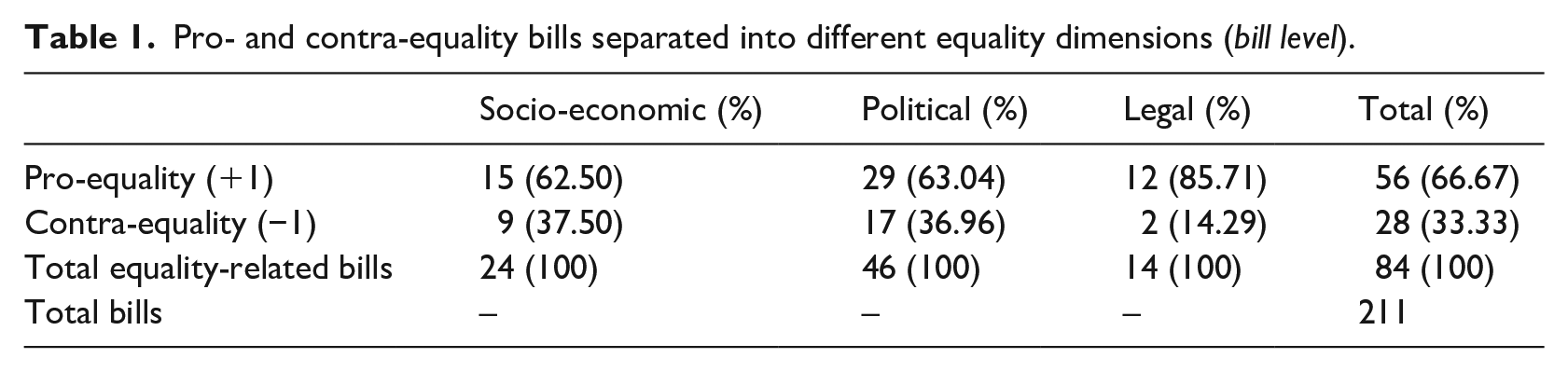
As Table 1 shows, twice as many pro-equality bills were voted on than contra-equality. The difference was especially pronounced for the legal dimension, but was also evident for socio-economic and political equality. Bills mostly dealt with the political dimension: there were almost twice as many as for socio-economic equality, with legal equality being the dimension with the lowest number of votes. Overall, roughly 40% of the 211 votes related to issues of equality, making it a ‘hot topic’ on the direct democratic agenda.
Pro- and contra-equality bills separated into different equality dimensions (bill level).
Latin America and the Caribbean
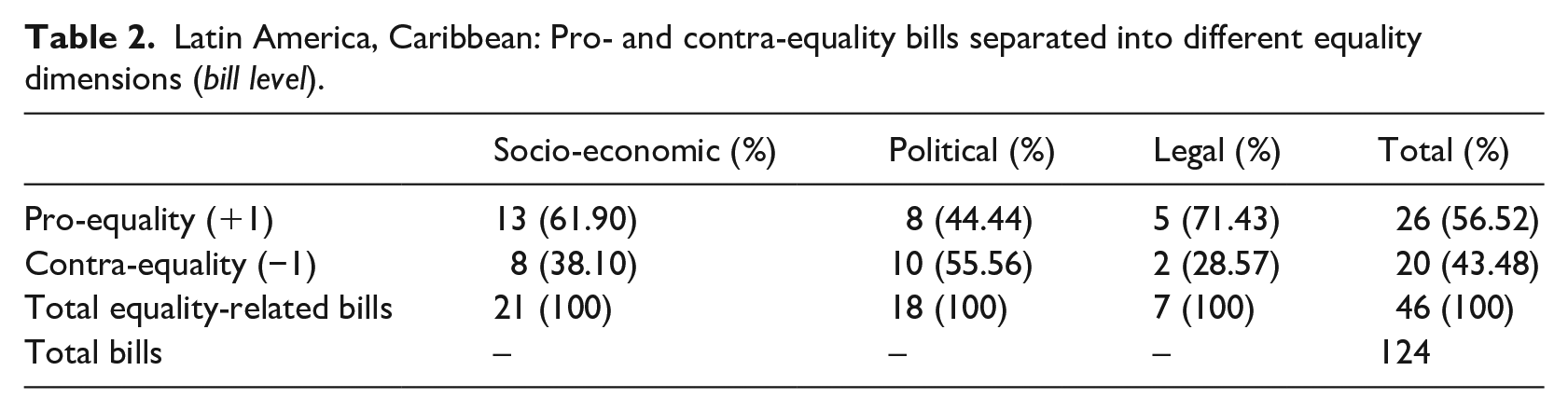
Turning to the specific continents, most of the equality-related bills made it to the ballot in Latin America and the Caribbean, reflecting the fact that most of the referendums in general took place there (Table 2). For socio-economic and legal equality, the picture was similar to the overall one: pro-equality bills outnumbered contra-equality ones. In contrast, for political equality, contra-equality bills actually outnumbered pro-equality ones. Therefore, whereas the total for these countries still tended towards pro-equality bills, the difference was not as pronounced as it was when adding the votes from Africa, Asia and Oceania.
Latin America, Caribbean: Pro- and contra-equality bills separated into different equality dimensions (bill level).
Africa, Asia, Oceania
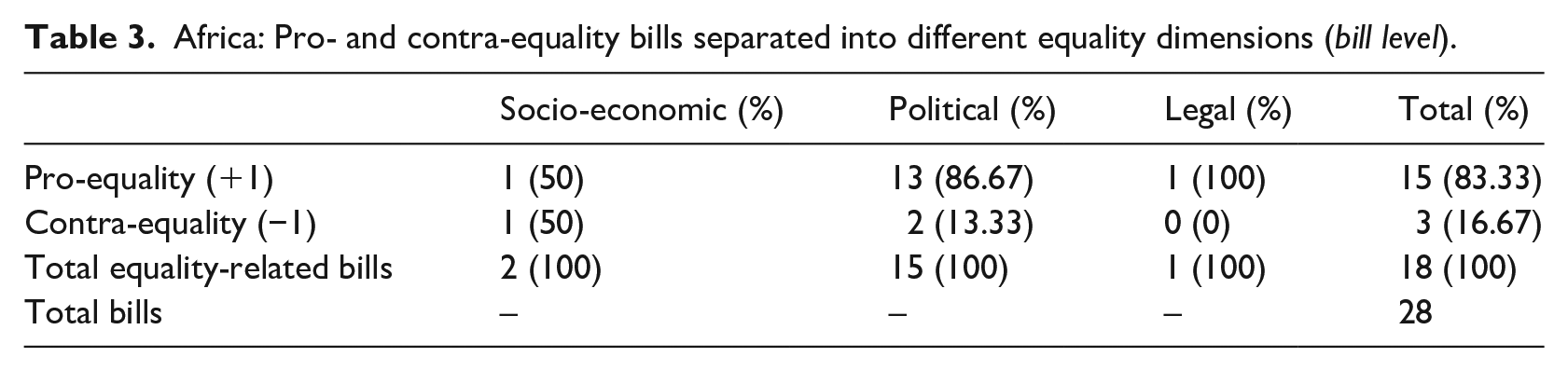
In Africa, Asia and Oceania, relatively few direct democratic votes took place (Tables 3 and 4). Therefore, inferences for these continents should be taken as preliminary. Most of the equality-related bills dealt with the political dimension of equality. A clear majority of them aimed at increasing equality, accounting for the overall positive picture on this dimension. Whereas the legal dimension only comprised pro-equality bills for Asia and Oceania, the one African vote affecting this dimension did not allow for any general conclusions. The same held for socio-economic equality: only two bills were voted on that referred to this dimension in Africa, and only one in Asia and Oceania. Nevertheless, taking all equality dimensions together, far more bills at the ballot aimed at increasing equality than at decreasing it.
Africa: Pro- and contra-equality bills separated into different equality dimensions (bill level).
Asia, Oceania: Pro- and contra-equality bills separated into different equality dimensions (bill level).
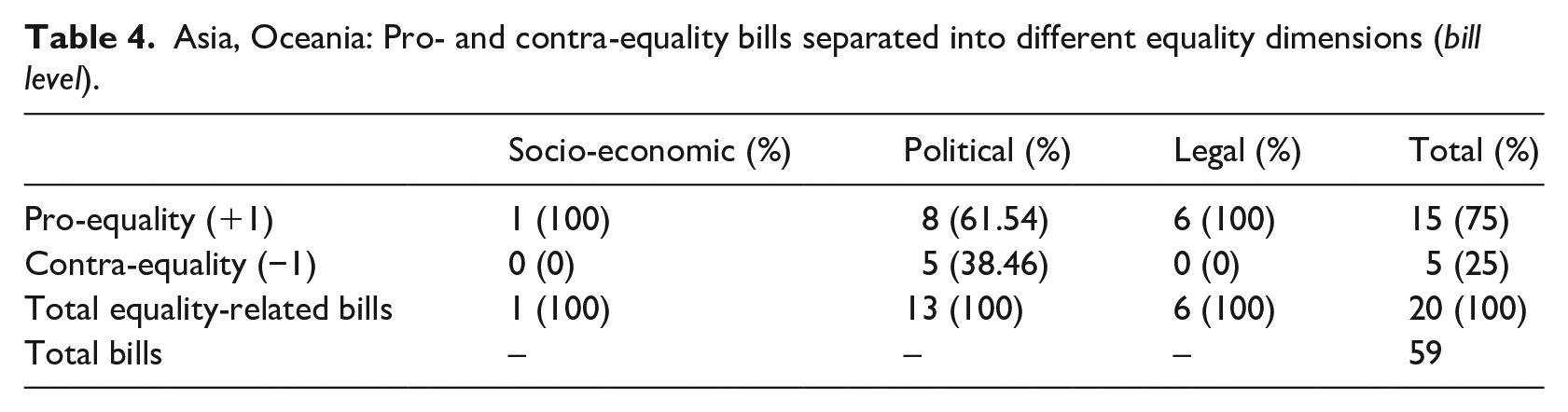
To sum up, there were more pro-equality bills voted on by far, on all continents taken together as well as individually, and across the three dimensions of equality (with one exception in the Americas).
Which bills succeeded at the ballot?
Overview: Global South and Oceania
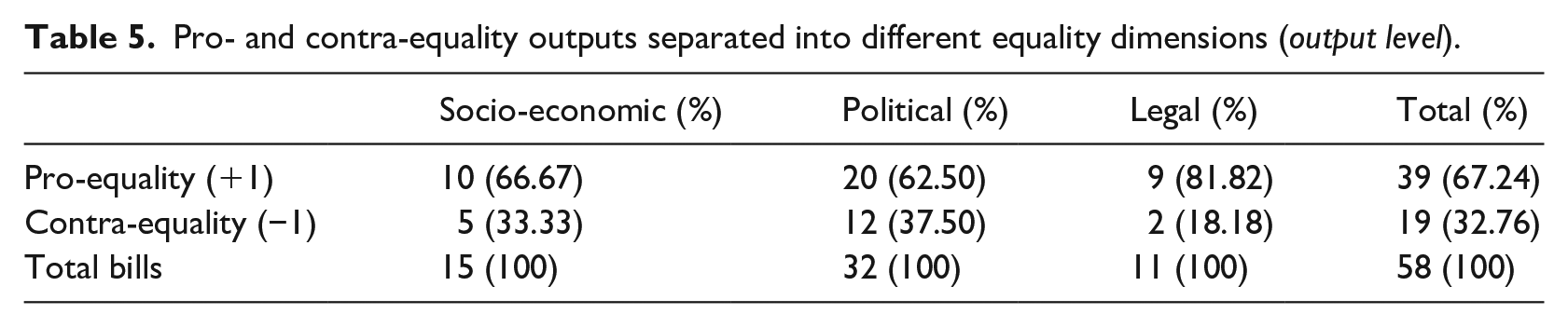
Looking at the successful bills, there were only small differences to the shares of pro- and contra-equality bills presented above. This applied to the overall picture as well as to the single dimensions of equality and the four continents – it is actually striking how similar the numbers are. Therefore, bills aiming to increase equality have not been more or less likely to gain majorities in direct democratic votes than bills that would have decreased equality. In sum, 67.24% of the equality-related outputs were pro-equality, while 32.76% were contra-equality (Table 5). It was again the legal dimension that showed the most positive record, with the socio-economic bills faring a bit better than the numbers on the bill level would have suggested. Again, political equality was the most common dimension by far.
Pro- and contra-equality outputs separated into different equality dimensions (output level).
Latin America and the Caribbean
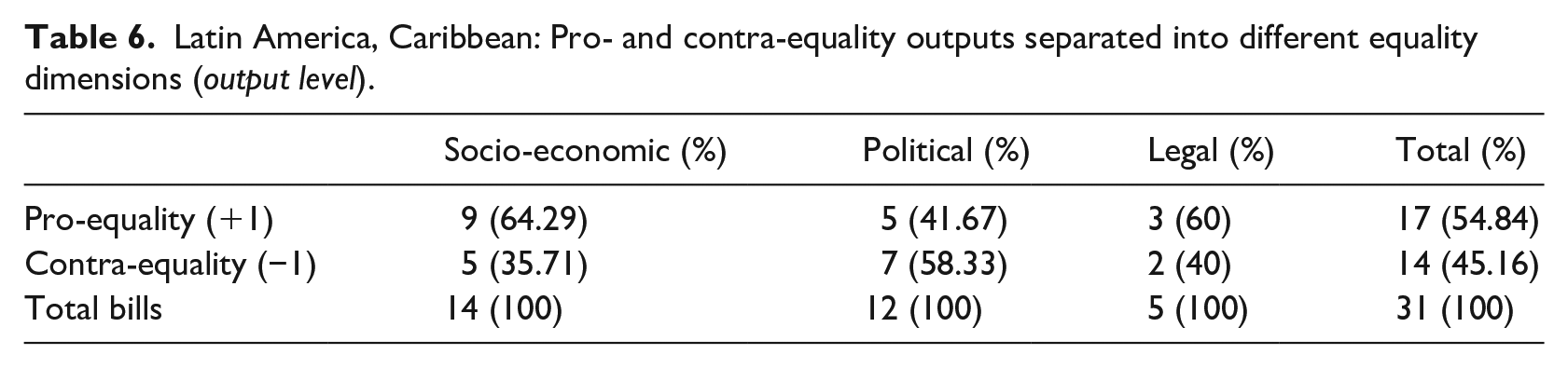
Most of the equality-related outputs stemmed from direct democratic votes in the Americas – a finding that comes as no surprise given that these countries faced the most votes in total as well as the most equality-related ones (Table 6). Whereas the shares of pro- and contra-equality outputs did not differ much from the bill level for the socio-economic and political dimensions, the success rate was smaller for bills that aimed to increase legal equality. Nevertheless, they still outnumbered those that decreased legal equality in their output.
Latin America, Caribbean: Pro- and contra-equality outputs separated into different equality dimensions (output level).
Africa
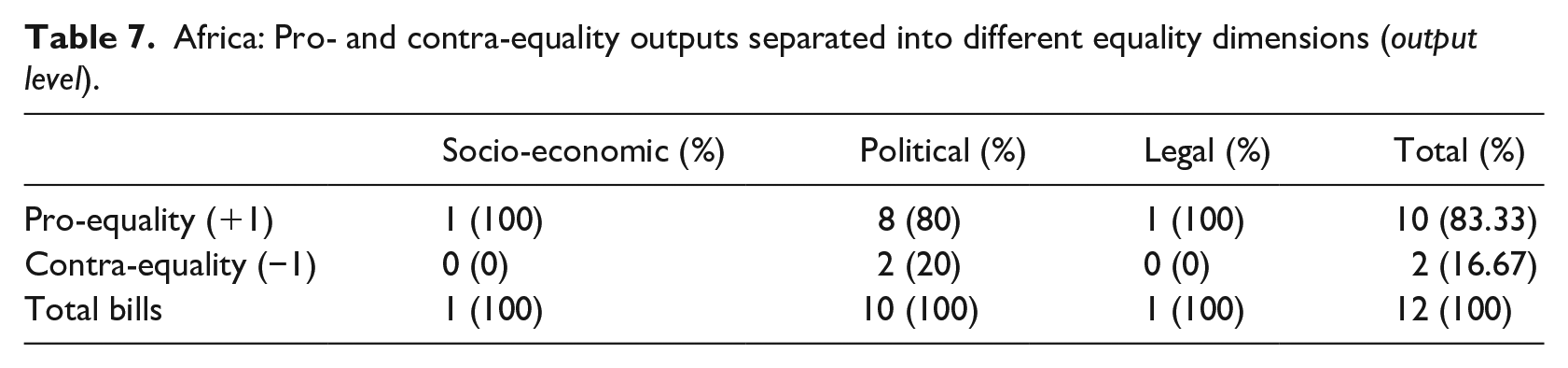
In Africa, the total proportion of pro- and contra-equality outputs exactly mirrored the total share of bills (Table 7). Most of the equality-related outputs dealt with the political dimension: 10 out of 15 bills on political equality succeeded. The share of pro-equality outputs on this dimension dropped only slightly compared with the bill level. Given the low number of cases, nothing of substance could be drawn from the outputs concerning socio-economic or legal equality in Africa.
Africa: Pro- and contra-equality outputs separated into different equality dimensions (output level).
Asia and Oceania
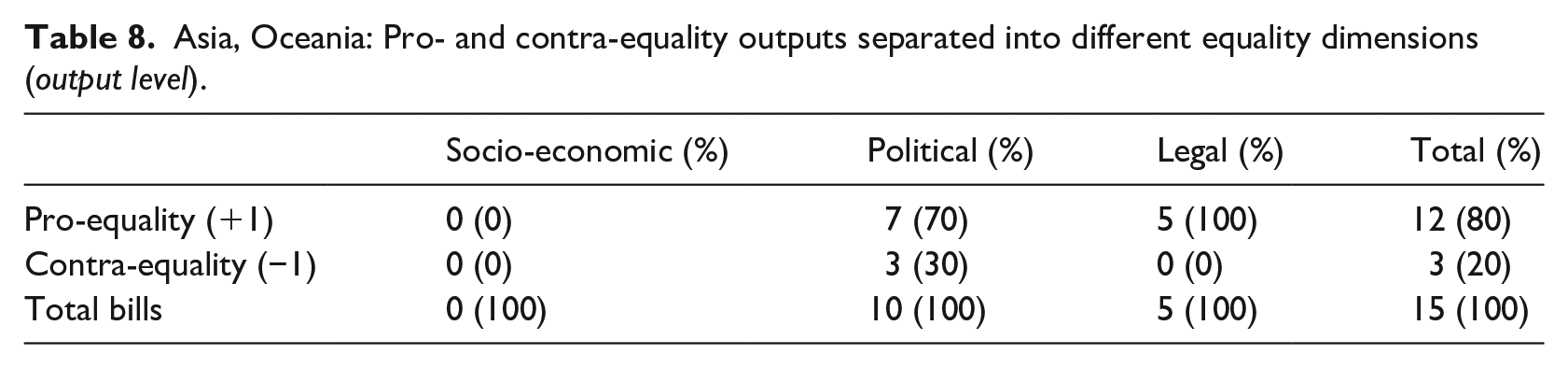
Finally, pro-equality bills turned out to be very successful in Asia and Oceania: 5 of 6 bills that aimed at increasing legal equality won (Table 8). The share of pro-equality outputs on the political dimension was even higher than it had been at the bill level (see Table 4). That is, pro-equality bills dealing with political issues were more successful at the ballot than their contra-equality counterparts.
Asia, Oceania: Pro- and contra-equality outputs separated into different equality dimensions (output level).
To sum up, pro- and contra-equality bills did not differ very much in their probability of succeeding at the ballot. As a result, roughly two-thirds of all outputs related to equality were pro-equality, while only one-third was contra-equality. This held for every dimension of equality analysed here as well as for the single regions. In total, our findings indicated that direct democracy indeed bears the potential to foster equality in the Global South and Oceania.
Conclusions
With direct democratic options and their use rising all over the world, research on direct democratic outputs concerning socio-economic, legal and political equality is surprisingly scarce. This holds especially for the Global South, where analyses of direct democratic outputs for equality were almost non-existent, although direct democracy is used frequently. This article contributes to the research on direct democracy by being the first that has analysed its patterns of equality for the countries of the Global South and Oceania.
First, our descriptive analysis of all direct democratic votes at the national level in the free or partly free countries of Latin America, the Caribbean, Africa, Asia and Oceania between 1990 and 2015 revealed that roughly 40% of all bills related to socio-economic, legal or political equality, with the last dimension being the most common one. Two-thirds of these aimed at increasing equality. Second, pro- and contra-equality bills did not differ very much in their likelihood of succeeding at the ballot box. Therefore, roughly two-thirds of the outputs of direct democratic votes concerning equality were also pro-equality.
Although our results are only descriptive in nature and limited to a specific time frame, they speak against theoretical warnings of direct democracy being a threat to equality in general. Instead, they strengthen the more positive empirical conclusions from certain studies on European and US direct democratic votes. Compared with research by Geißel et al. (2019a, 2019b) on European direct democratic votes between 1990 and 2015, results for the bill level were roughly mirrored: they found pro-equality bills outnumbered contra-equality ones as well, although the most common dimension in Europe was the socio-economic instead of the political one. 11 However, in Europe, pro-equality bills were less likely to succeed at the ballot compared with contra-equality ones. Taking these findings into account, the results presented here for the Global South and Oceania paint a brighter picture. 12
Breaking down the results revealed that pro-equality referendums were more numerous on each continent. Latin America mirrored the ratio of pro- and contra-equality bills and outputs that Geißel et al. (2019a, 2019b) reported for Europe, while Africa, Asia, and Oceania indicated an even higher share of pro-equality bills and outputs. This suggested that the positive ratio of pro-equality bills and outputs was independent of different political cultures.
Another pattern that the continental breakdown revealed concerns the distribution of votes on the different equality dimensions. The overall preponderance of votes on political equality in the data was mainly driven by Africa and Asia and Oceania. There, the bill- and output-level shares of votes on political equality were more than 80% and around 70% respectively. In Latin America, the share of votes on political equality was roughly equal to that of socio-economic equality. Potentially, political culture is a contributing factor for the observed differences.
Further research is necessary to investigate whether the respective political cultures are driving the differences between the continents or confounding factors play a greater role in the equality outputs of direct democracy – or whether observed patterns are an artefact of the low number of cases in Africa and Asia and Oceania. One particularly interesting avenue for future reseach lies in scrutinizing the median voter theorem. Taking the population’s preferences on the issues of the bills into account would put the equality outputs of direct democratic votes into perspective. Moreover, this would complement and expand Bochsler and Hug’s (2015) study on the indirect effects of direct democracy on legal equality. Combining insights into direct and indirect effects in the case of equality issues would crucially contribute to theorizing the functioning of direct democracy in the policy process (Leemann and Wasserfallen, 2016). 13 In addition, an analysis of subnational votes is necessary to reveal whether our findings hold for these levels as well, and which contextual factors might be decisive there. To conclude, it is important for research on direct democracy to broaden its scope beyond its Western centrism, as direct democratic votes in the Global South and Oceania offer important insights.
Supplemental Material
sj-pdf-1-ips-10.1177_01925121211058660 – Supplemental material for Direct democracy and equality: A global perspective
Supplemental material, sj-pdf-1-ips-10.1177_01925121211058660 for Direct democracy and equality: A global perspective by Anna Krämling, Brigitte Geißel, Jonathan R. Rinne and Lars Paulus in International Political Science Review
Footnotes
Acknowledgements
We thank the German Research Foundation (DFG) for their generous funding of the project ‘Inequality and Direct Democracy in Europe’. We also thank our student assistant Amelie Buck for her efforts in data collection. In addition, we thank the editors of the International Political Science Review and two anonymous reviewers for their very helpful comments and support during the publication process.
Funding
The authors disclosed receipt of the following financial support for the research, authorship, and/or publication of this article: This work was supported by the German Research Foundation (grant number GE 1083/23-1).

Supplemental material
Supplemental material for this article is available online.