




Abstract
A significant part of the Western literature on democracy assumes that political participation leads to citizens being more committed to democratic values. However, we do not know to what extent this is true in young democracies with an authoritarian tradition. Hence, this article aims to examine whether politically engaged Brazilians are more democratic. To do so, we analyzed whether there is any association between political participation, support for democracy, and democracy relativization through multivariate regression models. Our database comprises a representative sample of 2417 interviews with the electorate of São Paulo in 2019. The results show a statistically significant association between unconventional political participation and support for democracy. General political participation is associated with non-relativization of democracy only, showing a limited relationship between support for democracy and participation. Other variables, such as political interest, political knowledge, and interpersonal trust, are also associated with higher support for democracy.
Introduction
A significant segment of the Western literature on democracy assumes that political participation leads to citizens being more committed to democratic values (Michels and de Graaf, 2010; Quintelier and van Deth, 2014; Verba et al., 1995). The argument for civil society engagement in the political arena usually includes aspects such as: the influence of citizens on the decision-making process; their inclusion in the policy process; development of their civic skills; deliberation about public issues; and increasing the legitimacy of decisions (Gastil and Xenos, 2010; Pateman, 1992).
The benefits of political participation are frequently taken for granted, the assumption being that they impact all elements of the democratic political culture, such as increasing political interest or political knowledge. In fact, there is some evidence that citizens who participate in politics do tend to develop more civic skills than those who do not (Gimenes and Borba, 2019; Moisés and Carneiro, 2008; Quintelier and van Deth, 2014; Rennó, 2006). At the same time, not all kinds of participation aim to strengthen democracies, especially in contexts where authoritarian-populist leaders foster a direct connection with citizens, attempting to undermine the foundations of representative democracy (Mounk, 2018; Norris and Inglehart, 2019). Such leaders probably have higher chances of being successful if citizens present low appreciation for the regime. This could pose an additional concern particularly when people who participate in politics do not support democracy, which, in turn, could strengthen authoritarian movements.
This research intends to fill the gap on the relationship between political participation and the extent to which citizens express their preferences for democracy as the best political regime. Articles on this topic usually analyze the relationship between participation and civic skills, but do not address specifically the support for democracy. Manifesting democratic preferences might indicate the extent of citizens’ democratic commitment. Although citizens could acquire civic skills through participation, they might not necessarily embrace democracy. Closely analyzing the direct linkage between political participation and support for democracy prevents an assumption that individuals who participate have a stronger preference for democracy.
This article examines whether more politically engaged citizens are also more democratic. Since democratic values are essential for sustainable democracies, looking directly into how citizens declare their adherence to democracy might reveal to which degree they value it or believe other regimes could substitute it. We consider the difference between formal and strong support for democracy, which separates the so-called ‘solid democrats’ – who not only manifest strong support for democracy but also strongly reject authoritarian forms of government – from ‘lenient’ ones – who formally support democracy, but are prone to accept its relativization whenever it is convenient (Fuks et al., 2016; Inglehart and Welzel, 2009). In other words, this research contributes to unpacking the relationship between political participation and democratic preference, scrutinizing connections that are not always direct.
Another important consideration is that democracies are more robust when citizens support the regime (Dalton, 2004), and this is especially the case in places where there is no enduring democratic tradition (Chu et al., 2020; Doorenspleet, 2012). We investigate the Brazilian case, a country combining a young democracy with a tradition of authoritarian movements over its history. Such a tradition might also appear in electoral choices, the degree of respect for democratic procedures, and deficits in the adherence to a democratic political culture (Baquero, 2003; Moisés, 2008; Santos and Guarnieri, 2016). Therefore, we are able to test if the alleged relationship between participation and democratic behavior holds in a context where advanced democratic legislation coexists with a political culture that maintains several elements of authoritarianism. 1
Our database comprises a representative sample of 2417 interviews with the electorate of São Paulo (the largest Latin American city) conducted in 2019, allowing us to evaluate the quality of local democracy within the most important Brazilian metropolis. Our research is based on an original database – unique when compared with other global surveys – looking at how citizens have daily experiences with institutions and fellow citizens.
There are many experiences across countries concerning collaborative governance, citizens’ advisory committees, and participatory budgeting (Avritzer 2009; Michels and de Graaf, 2010), with many of them taking place in cities. Thus, examining the phenomenon of local democracy allows us to understand citizens’ behavior and attitudes toward the political regime.
The article is organized as follows: the next section debates the relationship between political participation and democratic values, reviewing the central arguments about the topic and presenting the research hypotheses; after that, we present the methodology and results; and finally, we discuss these findings and put forward our conclusions.
Political participation and democratic values
The role of citizens in political regimes has been an ongoing discussion in political theory. Studies to date have led to a consensus that no political regime can be a democracy without guaranteeing the formal rights of every adult citizen to participate, at least to some extent, in political decision-making (Diamond and Morlino, 2004). This does not mean, however, that participation is enough to produce citizens who adhere to democratic values or that participation is the only aspect to determine whether a given regime is a democracy (Dahl, 1997). Nonetheless, the participatory citizens’ model is indisputably a relevant feature of a sustainable democracy.
The complex context of contemporary societies makes it difficult for citizens to participate directly in every public decision. Therefore, representative democracy is the most accepted model of political regimes around the world, although there is increasing pressure on this model. Researchers disagree about the extent to which citizens should participate in political issues (Pateman, 1992; Schumpeter, 2008).
Despite arguments against citizens’ participation in politics beyond elections, there is a proliferation of opportunities for people to engage in the political process in the 20th and 21st centuries, mainly due to technological changes in the digital world. This has prompted researchers to investigate the impacts of political participation on democracy by examining who engages, why, and what are the effects of participation on civic skills. In this article, we understand political participation as an activity with the intent or effect of influencing government action, either directly, by affecting public policies, or indirectly, by influencing the selection of people who design these policies (Verba et al., 1995). We adopt a broader understanding of participation, considering not only its party–electoral manifestation (conventional participation) but also participation in public hearings or street protests, for example (unconventional participation).
Within this branch of the literature, there is evidence that political participation associates with increased civic skills. There is perhaps a mutually stimulating effect of encouraging citizens to participate, and, in turn, this might strengthen democratic attitudes in citizens (Quintelier and van Deth, 2014). In this regard, some studies have found a reciprocal relationship between participation and civic attitudes (Bowler et al., 2007; Gastil and Xenos, 2010).
In the Brazilian context, not all political activism is associated with increased civic skills among citizens (Rennó, 2006), indicating differences between developing countries and Western European countries or the United States. Recent studies have shown no relationship between participating in political parties and support for democracies, but partisan citizens with more sophisticated cognitive skills tend to be more democratic than non-partisan ones (Gimenes and Borba, 2019).
These results might indicate that other variables, such as political knowledge and interest, precede political participation and lead to support for democracy. The impact of corruption on citizens’ behavior also indicates something about the complex picture of participation and democratic values in Latin America, since individuals who have experienced corruption are more likely to participate in politics, and are also more tolerant toward those wrongdoings (Bonifácio and Fuks, 2017).
Nonetheless, we must also consider that, in Brazil, there is an age gap between generations that have lived under authoritarian regimes and those who were socialized only under democracy, with the former more clearly rejecting autocracies (Fuks et al., 2018). Evidence shows that in countries where a stronger democratic legacy exists, with freedom and no constraints on political participation, there is more support for democracy (Denemark et al., 2016). Several studies have shown that Latin American citizens support political participation, although there is a significant part of the population with a preference for more authoritarian government (Fuks et al., 2016; Gimenes and Borba, 2019). This indicates that democracy and political participation do not necessarily (or usually) go hand in hand in these developing countries.
Considering the evidence presented by the international literature and the inconclusive evidence provided by Brazilian and Latin American studies, we might test whether taking part in democratic events, such as different kinds of political participation, fosters more democratic citizens even in a context characterized by an authoritarian tradition. Our first hypothesis, then, is:
H1: Citizens who participate more tend to express more support for democracy.
However, as support for democracy is a phenomenon very likely affected by social desirability bias, we must be cautious about relying solely on a formal measurement of democratic preference. Hence, we also hypothesize that higher levels of political participation yield more rejection of democratic relativization. This means the participating citizens simultaneously support the regime and reject its relativization. We argue that citizens who engage in politics tend to behave as ‘solid democrats’ – individuals who manifest strong support for democracy while also strongly rejecting authoritarian forms of government (Inglehart and Welzel, 2009). Therefore, our second hypothesis is:
H2: Citizens who participate more tend to behave more as solid democrats.
Data and methods
Our database consists of a representative sample of 2417 interviews with the electorate of São Paulo (the largest Latin American city) in 2019. The Sivis Institute conducted a survey to assess the quality of democracy in Brazilian cities. Multistage probabilistic sampling and random walk were used to select households, with implicit stratification based on the Human Development Index’s income dimension from São Paulo’s various census sectors, and disproportionate explicit stratification based on the division of the city covering eight administrative regions. We used non-probabilistic quota sampling to select the interviewees, representing the population distribution according to four variables: sex; age group; education level; and occupational status.
We built this database to enable the calculations of the Local Democracy Index (LDI) from São Paulo. 2 The LDI aims to tackle contemporary problems of democratic erosion by emphasizing local dynamics of democracy. This index embraces the perspective that the local system might function as a school of democracy since it is the closest to the daily concerns of citizens. Therefore, the local level should stimulate participatory decision-making in a civic process of political engagement wherein communities figure out their challenges and find solutions to their collective problems.
Since São Paulo is a large city that reproduces inequalities, problems, and opportunities similar to those across the entire country, we argue it is a privileged microcosm for assessing democracy in Brazil. Also, the city has been one of the most important venues for political participation throughout Brazil’s history, as illustrated by the Constitutionalist Revolution in 1932, the March of the Family with God for Liberty in 1964, the civil unrest movement demanding direct presidential elections (Diretas Já) in 1984, and the June Journeys in 2013, just to mention a few (Lacerda and Simoni, 2021).
One of the main characteristics of the Brazilian context is an authoritarian tradition, which is pervasive nowadays, combined with a low degree of political education among citizens (Borba, 2005). Brazil was the last country in Latin America to abolish slavery, and it had two periods of dictatorship during the 20th century – from 1937 to 1945 and from 1964 to 1985 (Carvalho, 2016). The first constitution to provide all Brazilians with the right to vote, including illiterate people, was only enacted in 1988 (Bresser-Pereira, 2015), after the end of the civil-military dictatorship. Despite providing several rights, the constitution was influenced by the politicians who took part in the dictatorship and by the military forces (Moisés, 2008).
Brazil has now experienced the most extended period of democratic rule without interruption, but this has not been enough to consolidate a democratic political culture (Baquero 2003). In 32 years, two presidents were impeached. The second one, Dilma Rousseff, was ousted in 2016, and there is strong disagreement about whether it was a legislative coup (Santos and Guarnieri, 2016). Corruption scandals are frequent among Brazilian political elites (Carvalho, 2016), which have contributed to weakening traditional parties and have facilitated the election of a populist president (Rennó, 2020). For many scholars, the result of the 2018 elections might be understood as a threat to liberal democracy, suggesting that an authoritarian culture resonates with Brazilians (Lima et al., 2020). The 2020 report from the V-Dem Institute corroborates that perspective, showing that an autocratization process is affecting Brazilian democracy 3 .
At the same time, Brazilian democracy has a reliable electoral system, assuring every citizen over 16 years old the right to vote in clean elections (Moisés, 2008). Voting is mandatory for citizens over 18-years old and under 70 years old. The country is considered a free democracy by Freedom House, despite concerns about violence against minorities 4 . Therefore, this provides a singular scenario in which to test the association between engaging in democratic procedures and support for the regime in a context where democracy itself is not as stable as in most Global North countries.
The LDI database covers a broad spectrum of themes, from political knowledge and interest to interpersonal trust and support for democracy, among others. For this article, we have used the set of variables detailed in the Online Appendix Table A1. The complete database, the codebook, and the Appendix are available at: https://bit.ly/2NqrscS/.
As shown, we use the following variables: Support for Democracy; Political Participation; Political Knowledge; Political Interest; Political Education; Interpersonal Trust; and Socio-demographic characteristics. First, for the dependent variables on Support for Democracy, we adopted the statement on democracy preference from the Churchillian position 5 as an initial variable (‘Democracy Preference’). Although less sophisticated than multidimensional propositions of democratic adherence, we use this single variable because it is internationally recognized as an indicator of preference for democratic government and is widely used by researchers who seek to quantify the abstract elements of democratic legitimacy (Claassen, 2020). We also have a variable on the propensity of individuals to reject the relativization of democracy (‘Democracy Non-relativization’), which provides us with a measure of counterproof to the social desirability bias likely underlying democracy preference. Finally, following the steps outlined by Inglehart and Welzel (2009), we have created an additive index variable (‘Democracy Support Index’) based on the sum of these two variables to identify those individuals who can be characterized as ‘solid democrats’ – that is, citizens who both support democracy and reject its relativization.
Second, for the independent variables on Political Participation, we analyze five different variables: Electoral Participation; Institutional Participation; Associative Participation; Demonstrative Participation; and Digital Participation. Since we are investigating the influence of political participation on support for democracy, it is crucial to consider several kinds of political engagement (Gastil and Xenos, 2010). In Brazil, voting is mandatory, an aspect that changes the dynamics of participation. Hence, we deem the examination of political participation in its various facets (conventional and unconventional) to be particularly relevant.
We also have several control variables; these include Political Knowledge (Political Knowledge of the City Hall; Political Knowledge of the City Council; Political Knowledge of the Judiciary Power; Political Knowledge of the Public Ministry; Political Knowledge of the Court of Accounts; Political Knowledge of the Mechanisms of Popular Influence); Political Interest (Willingness to be Informed about Politics; Plurality of the Information Sources on Politics); Political Education (Willingness to be Educated on Politics); Interpersonal Trust (Trust in Family Members; Trust in Neighbors; Trust in Acquaintances; Trust in People from the Same Town; Trust in People from the Same Country; Trust in People from other Countries); and socio-demographic characteristics (Sex; Income Bracket; Age; Ideological Position; Education; and Region of Residence).
As there are too many variables of interest, we carried out data processing for dimension reduction to have a smaller number of measures and therefore straightforward analysis. More specifically, we ran a principal component analysis, which is a statistical approach used to analyze correlations among many variables and to explain them in terms of their common underlying dimensions by condensing the information in the original variables into a smaller set, also known as ‘principal components’ (Hair et al., 2014). We have obtained principal components for four sets of variables: (a) the set of independent variables on Political Participation (see Online Appendix Table A2); (b) the set of control variables on Political Knowledge (see Online Appendix Table A3); (c) the set of control variables on Political Interest (see Online Appendix Table A4); and (d) the set of control variables on Interpersonal Trust (see Online Appendix Table A5).
With this smaller set of variables, we were able to construct better-specified models to obtain inferential statistics. We ran ordered logit regressions for the dependent variables Democracy Preference and Democracy Non-relativization, which are both ordered categorical variables and hence need modeling that draws from an underlying and naturally ordered preference scale to a discrete ordered and observed outcome (Greene, 2012). For the dependent variable Democracy Support Index, we simply ran a multiple linear regression model. Following the recommendations of the current literature on political science referring to the issue of missing data bias (King et al., 2001; Lall, 2016), we applied multiple imputation techniques using Markov chain Monte Carlo procedures for the creation of five imputed data sets. In the following sections, we discuss the regression results from the multiple imputations, and in the Online Appendix Table A6 we present the regression results without the imputation as a robustness check.
Results
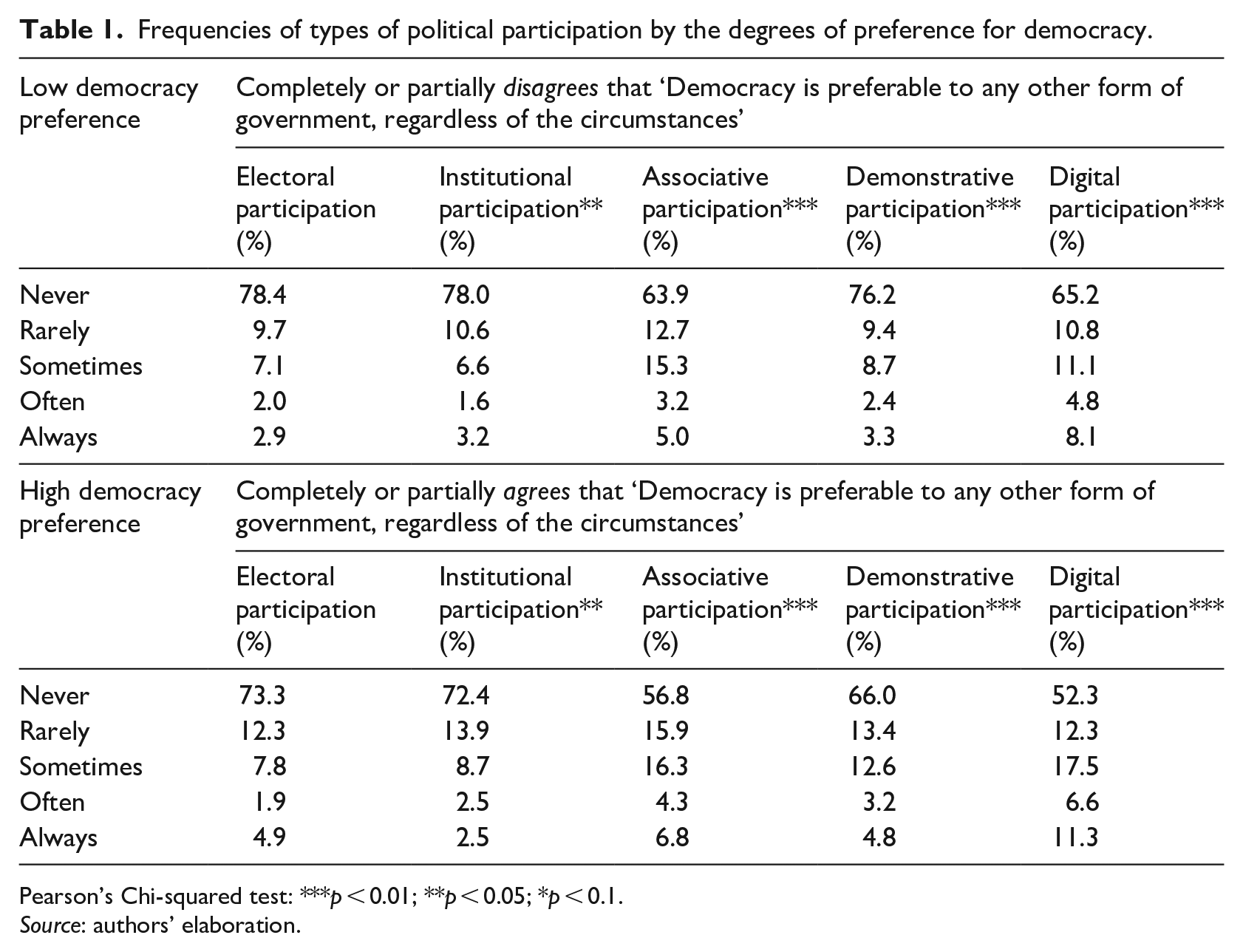
Table 1 presents frequencies of types of political participation according to the degree of preference for democracy, aggregating those who mainly disagree (completely or partially) and those who mostly agree (completely or partially) that democracy is the best political regime. As we can see, there is a somewhat higher level of political participation among those who prefer a democratic regime, especially for the unconventional forms of participation. The association between democratic preference and frequency of participation is statistically significant in most cases, except for electoral participation – which could be partially explained by the fact that voting is mandatory in Brazil.
Frequencies of types of political participation by the degrees of preference for democracy.
Pearson’s Chi-squared test: ***p < 0.01; **p < 0.05; *p < 0.1.
Source: authors’ elaboration.
Among those who mostly prefer democracy (High Democracy Preference = 3 or 4), there is a lower percentage of citizens who never participate in protests or digitally as compared with those who mostly reject democracy (Low Democracy Preference = 1 or 2). The rates of citizens who never participate in these arenas shrink from 76.2% to 66.0% on demonstrative participation and 65.2% to 52.3% on digital participation when analyzing those who mostly disfavor and those who mostly prefer democracy, respectively.
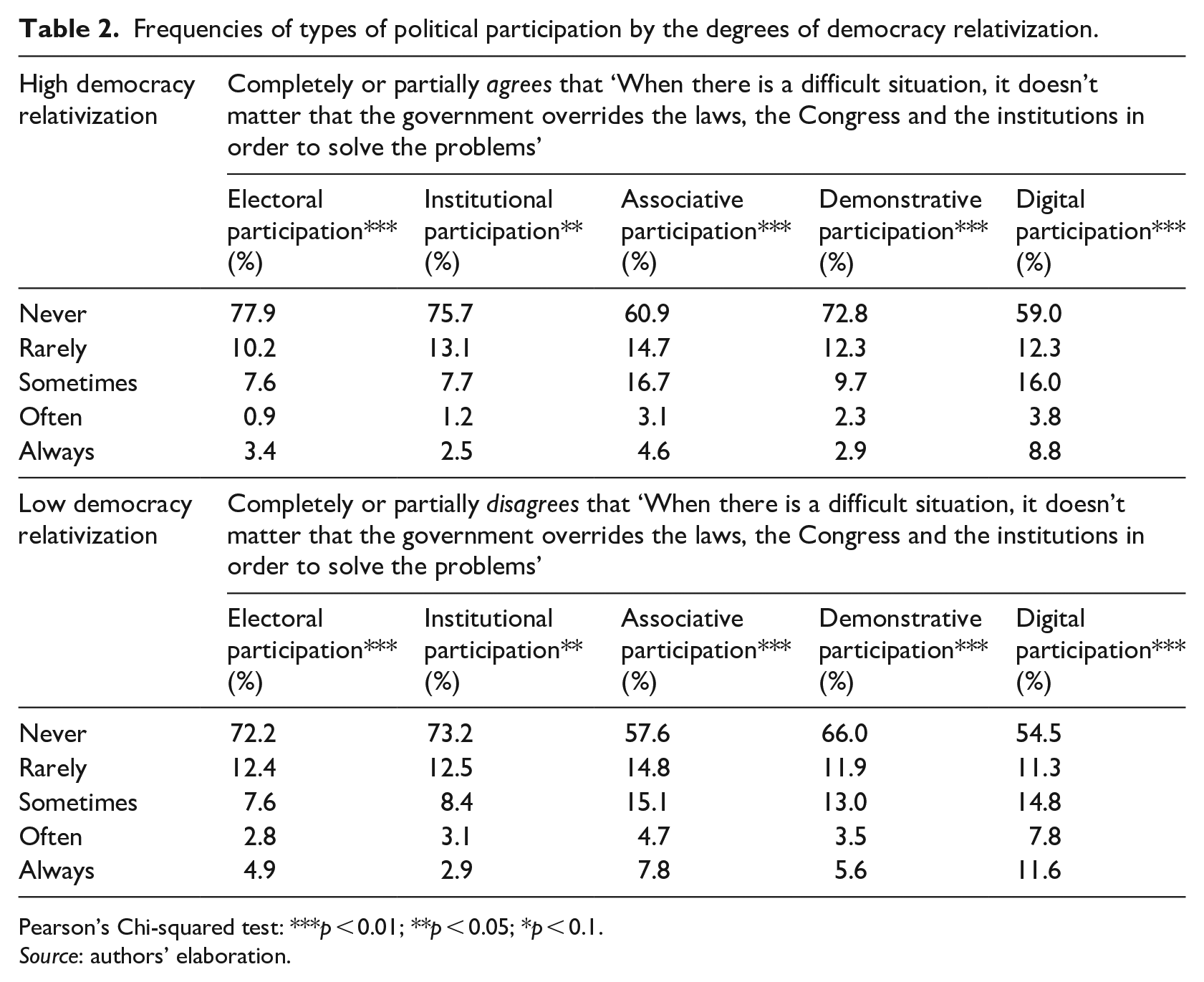
Table 2 presents similar results regarding the relationship between forms of political participation and the degree of democracy relativization. We also aggregate those who mostly agree (High Democracy Relativization) and those who mostly disagree (Low Democracy Relativization) that the government can override the laws, the Congress, and the institutions during a crisis. Again, the frequency of political participation seems to be slightly higher among those who reject the relativization of democracy, with a statistically significant association for all forms of participation. The percentages of citizens who often or always participate in electoral activities and associations, for example, jump from 4.3% to 7.7% and from 7.7% to 12.5%, respectively, when shifting the focus from those who would accept breaking the democratic rules to those who reject this possibility.
Frequencies of types of political participation by the degrees of democracy relativization.
Pearson’s Chi-squared test: ***p < 0.01; **p < 0.05; *p < 0.1.
Source: authors’ elaboration.
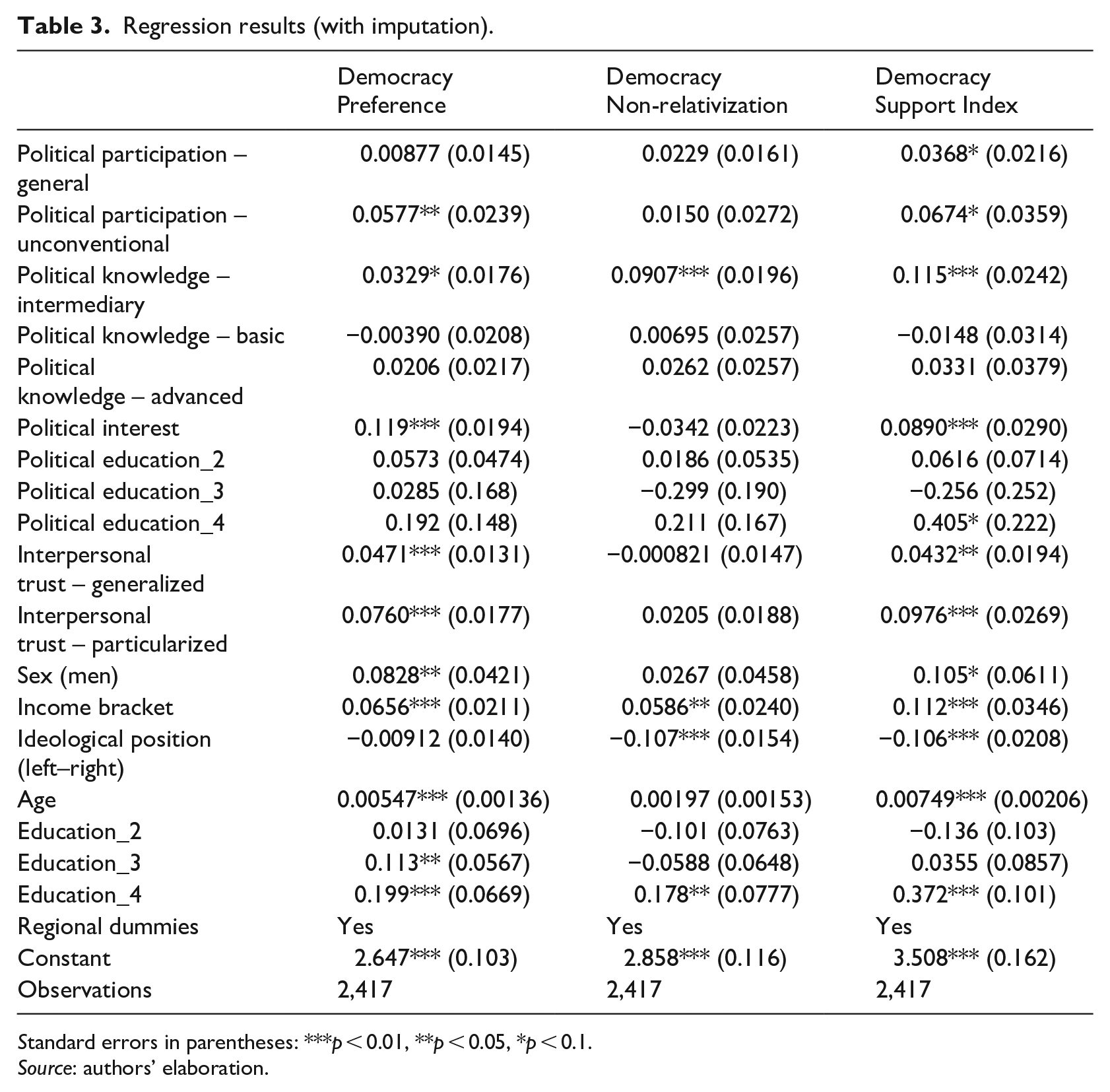
Table 3 presents the regression results for the imputed databases. All in all, the results for our key variables are pertinent, even though their substantive relevance in terms of statistical significance is relatively weak. They show that political participation, in general, has a positive (although weak) statistically significant association only with the Democracy Support Index. Considering that participation explains the index results for solid democrats’ attitudes, but not the democratic preference or non-relativization of the regime, we argue that engaging in politics seems to associate with a more sophisticated comprehension of democracy. This indicates that citizens who participate more may have a more extensive understanding of the regime, suggesting some benefits of participation. A more profound comprehension of democracy is crucial when we consider the arguments presented by Inglehart and Welzel (2003) that superficial support for the regime limits its diffusion in society.
Regression results (with imputation).
Standard errors in parentheses: ***p < 0.01, **p < 0.05, *p < 0.1.
Source: authors’ elaboration.
The second explanatory variable encompasses mostly unconventional participation forms, such as online participation and street protests. With such forms, there is no statistically significant association with rejecting democracy relativization, but the relationship is positive and statistically significant for the Democracy Preference and the Democracy Support Index. Therefore, the different kinds of participation tend to associate with support for democracy, either formal or more sophisticated support. The association between unconventional participation modes and being a solid democrat is even stronger than the relationship with participation, in general.
Looking for a more accurate explanation, we have also controlled for the influence of other political variables. Regarding political knowledge, on the one hand, results show that an intermediary degree of political knowledge has a positive and statistically significant association with all three dependent variables. On the other hand, advanced and basic levels of political knowledge did not produce any statistically significant coefficient. This may be because people with a low knowledge level do not understand how the political regime works and are not able to appreciate it. In contrast, after citizens achieve the intermediary level, there is no significant difference in their support for democracy, suggesting that it is necessary to provide only a reasonable degree of political knowledge to foster individuals who are educated about the democratic process.
This argument can be reinforced when we consider the willingness of São Paulo’s citizens to educate themselves about politics. We used a factor that places category 1 (‘Has never done any course and has no interest in doing so’) as the baseline omitted variable. The only significant association is among citizens who took a course and would like to take other courses (Political Education_4), which positively correlates with the Democracy Support Index. The other levels of willingness to learn are not linked to any kind of support for democracy, suggesting that this variable is only relevant to explain support for the regime at its highest level. The effect of a high degree of willingness to learn about politics might reflect the impact of other variables linked to it since Brazil faces several educational restrictions and inequalities that probably influence the efforts citizens want to put into learning about the political regime.
Political interest is another variable associated with Democracy Preference and the Democracy Support Index. Although there is no statistically significant relationship with Democracy Non-relativization, the positive correlation with solid democrats indicates a more complex understanding of the regime when people get information about political issues.
Other societal aspects also contribute to explain the support for democracy from São Paulo’s citizens. Both generalized and particularized interpersonal trust have statistically significant associations with the index and preference for democracy, but not with the rejection of democracy relativization. Such results might be a sign that trust is important for making people adhere to a certain level of support for democracy. Still, it is not enough to ensure they will have the most substantial appreciation for democratic rules.
In contrast, ideological position does not affect their formal support for democracy. Still, there is a significant negative association both with non-relativization and the solid democrats’ index. In effect, the more citizens present themselves with a right-wing leaning, the more they tend to accept democracy relativization and the further they are from being solid democrats. Considering there is typically a misunderstanding about what democracy means in Brazil, and that it is sometimes used as an excuse by authoritarian movements to threaten the constitutional order, it is possible that far-right citizens tend to support democracy as an idea, but do not appreciate its principles. This is similar to the formal support that populist citizens expressed for democracy in Zaslove et al.’s (2021) work, but our analysis provides more detail due to the use of additional variables.
Finally, we must also examine the influence of key socio-demographic variables on support for democracy. In general, sex shows that men tend to manifest more preference for democracy and have a higher score on the index. Income brackets, in turn, present a robust statistical association with all three dependent variables, demonstrating the significance of higher income for the support of democracy. Similarly, using a factor for education level with category 1 (‘No formal education or incomplete primary school’) as the baseline omitted variable, we observe that its highest level (Education_4) shows strong statistically significant associations with all three dependent variables. In contrast, the second-highest level (Education_3) shows a weak statistical association with democracy preference. This indicates that completing higher education or above, and to a lesser extent also completing high school or ongoing higher education, produces a significant positive relationship with support for democracy. Age also shows statistical significance, which means that older citizens tend to be more supportive of democracy. Regional dummies were included as control variables for fixed effects.
Discussion
In this section, we discuss the hypotheses outlined earlier. H1 was partially confirmed. General participation is weakly associated with the Democracy Support Index, and with a small coefficient, indicating that citizens who participate in various spheres tend to have a slightly stronger commitment to the regime. This finding seems to be complemented by that regarding unconventional participation, which shows positive associations with the Democracy Support Index and Democracy Preference. However, these associations are weak, and the coefficients are also small.
H1’s partial confirmation is aligned with political participation literature’s common finding, that it generally tends to enhance democratic values (Avritzer 2009; Michels and de Graaf, 2010; Verba and Nie, 1972; Verba et al., 1995). The results provide some evidence that São Paulo’s citizens who participate in politics tend to show more appreciation for the democratic regime, even in a context where a significant part of the population is not convinced about its benefits.
The results also indicate that there is some difference in the relationship between distinct kinds of political participation and democracy support. Citizens who engage in unconventional forms of participation seem both to prefer the regime and to be solid democrats. Although participating online and in street demonstrations is not associated with Democracy non-relativization, it appears that citizens who participate in unconventional forms are more convinced about the benefits of democracy than those who participate, in general. This might be because people who participate in non-conventional ways in Brazil tend to be already interested in politics (Ribeiro et al., 2019), which is also a significant variable for explaining democratic preference in our model.
The second hypothesis was also partially confirmed. Looking at the results for the Democracy Support Index, both kinds of participation were positively associated with solid democrats. However, the significance was weak, and the coefficients were small. As we found no statistically significant result for the Democracy Non-relativization variable, the relationship between participation and a strong commitment to democracy is not as straightforward as we would expect.
All in all, our results might indicate the educative role of political participation (Finkel, 2003). The more citizens participate, the more they tend, in general, to appreciate the democratic regime and understand the importance of its methods and rules, thus producing a virtuous cycle. However, participation does not seem to be enough, and the kind of participation matters for achieving higher levels of democratic commitment.
The results also reveal some differences when compared with other studies regarding political participation and democratic values in Brazil. Whereas Rennó (2006) found that some cases of engagement in associations or institutional spheres were not enough for Brazilians to present higher levels of political knowledge, they are associated with São Paulo’s citizens behaving as solid democrats. The problem is that there is a tiny percentage of paulistanos who often participate in politics, limiting the positive aspects of such an activity.
When we consider the influence of aspects such as political interest, political knowledge, political education, and interpersonal trust, the results align with the international literature on this topic. Studies have typically found that these four elements go hand in hand (especially the first two) in consolidated democracies, showing that democratic attitudes and values are relevant for fostering support for democracy (Booth and Seligson, 2009; Chu et al., 2020; Finkel, 2003).
The results also indicate the importance of offering citizens opportunities to participate in politics. Quintelier and van Deth (2014) demonstrate that political participation tends to strengthen civic attitudes. If those civic attitudes, such as political knowledge and interest, are predictors of support for democracy, participation might help to tackle the current democratic crisis in two different ways: by enforcing those democratic values; and by directly increasing support for democracy.
There are, however, limits for the effect of political knowledge. Our results show that it influences the support for democracy only in intermediary levels, suggesting that there is a minimal degree of required political knowledge for people to understand the characteristics of democracy. This makes sense, as citizens with a low degree of political knowledge are probably not capable of comprehending the regime more broadly. The fact that higher levels of political knowledge are not associated with more support for democracy deserves further investigation. It might be that these people tend to be more educated, or they tend to present higher levels of political interest, diminishing the effect of their political knowledge. We must also stress that most paulistanos rarely achieve even intermediary levels of political knowledge, which indicates the challenges to fostering a politically astute citizenry in São Paulo.
In a parallel study, Kołczyńska (2020) shows that a country’s level of democracy affects the degree of education and trust in citizens’ democratic values. It is possible, therefore, that shortcomings in São Paulo’s democratic environment limit the association of political knowledge and political interests with people’s support for democracy. This might reinforce the importance of a strong democratic culture and robust institutions to ensure that citizens do not accept attacks on the political regime.
The association of trust with support for democracy, in turn, is similar to that found by Torcal and Lago (2006), when looking at the impact of political disaffection on Latin American democracies. These authors reveal that it undermines participation and accountability of representatives. In our research, stronger levels of trust are connected to more support for democracy, showing that democratic values might benefit from a more cohesive society (Newton et al., 2018).
At this point, we need to consider the association of citizens’ ideological positions with their support for democracy. Results show that right-wing paulistanos tend to accept the relativization of democracy and present a lower score on the index. This is probably connected with two aspects: (a) the Brazilian political tradition, in which right-wing movements were successful in establishing authoritarian governments and undermining democracy in the past; and (b) the recent rise of far-right President Jair Bolsonaro and his supporters, who have a strong record of disregarding democratic norms and institutions. This might lead to the acceptance of relativization of the regime for right-wing citizens. Even though far-right supporters do not dominate the right-wing spectrum, the extremist discourse became increasingly normalized with Bolsonaro’s election, which brought it to a prominent place in the political debate. This also presents a challenge to strengthening a democratic right-wing movement in the country soon.
The fact that income, sex, age, and education are also relevant to explain support for democracy highlights the inequalities of São Paulo and its effects on how people evaluate the political regime. The literature has already documented the restrictions that minorities and poor/less educated people face when trying to engage in politics (Biroli and Miguel 2015; Verba et al., 1995). Our results demonstrate that such limitations are also encountered in the development of a democratic culture.
In São Paulo’s case, there seems to be an accumulation of inequalities. This is even clearer when we see the difference in support for democracy among those with a college education and those who have lower levels of formal education. The most impoverished regions in the city are also less democratic, as the results of the LDI 6 pointed out. Since Brazil presents high levels of wealth concentration, being more educated usually means being richer, yielding structural shortcomings for fostering a democratic culture in the country.
The age gap also deserves attention in a country that until recently lived under a military dictatorship. Contrary to the argument that younger generations are more supportive of democracy (Moreno and Lagos, 2016), our results show that older people tend to prefer a democratic regime. This is likely because they have experienced political and civil rights repression under authoritarian rule, creating an aversion to autocracies (Fuks et al., 2018). More than that, it is possible that exercising participation over the years has also contributed to fostering more democratic citizens.
Conclusion
This article’s goal was to investigate whether politically engaged citizens are more democratic than those who are not politically engaged. We have found that there is a small but significant association between political participation and support for democracy, although the features of such a relationship change according to the form of participation and the degree of support. We have also found that other variables, such as political knowledge, political interest, and education, significantly explain citizens’ support for democracy in São Paulo.
One important highlight is that general participation associates only with the index for a stronger democratic commitment. This might indicate that citizens who participate have a more sophisticated understanding of the political regime. It is important that citizens who participate develop such appreciation, especially in third-wave democracies that are still in a consolidation phase. The problem is that few people participate in politics frequently, undermining the positive effects for the whole population.
We should also underscore that these results for Brazilian democracy have some degree of overlap with findings from more mature democracies. Although there are limitations on consolidating democracy in the country due to its authoritarian legacy, participation could help to overcome them to some extent. At the same time, we need to be cautious about generalizing from the results, since we are examining only one city and the coefficients have a weak significance and are relatively small.
Naturally, this study is not able to account for all the results. Further research could help to explain the apparent power of higher education for democracy when compared with other education levels, whereas presenting a high degree of political knowledge has no association with being more democratic, for example. Future studies could benefit from more robust empirical settings, as one of our main limitations was relying on cross-sectional data, preventing us from addressing causality. Nevertheless, it is noteworthy that this article opens up further possibilities for investigating the values and preferences of the ‘solid’ versus ‘lenient’ democrats vis-à -vis democratic values and contexts. The current risks for the erosion of democracy worldwide seem to suggest that further research on this topic would be both helpful and timely.
Supplemental Material
sj-docx-2-ips-10.1177_01925121211056578 – Supplemental material for Are politically engaged citizens more democratic? A glimpse from Brazil
Supplemental material, sj-docx-2-ips-10.1177_01925121211056578 for Are politically engaged citizens more democratic? A glimpse from Brazil by Camila Mont’Alverne, Diego Moraes and Thaíse Kemer in International Political Science Review
Supplemental Material
sj-dta-1-ips-10.1177_01925121211056578 – Supplemental material for Are politically engaged citizens more democratic? A glimpse from Brazil
Supplemental material, sj-dta-1-ips-10.1177_01925121211056578 for Are politically engaged citizens more democratic? A glimpse from Brazil by Camila Mont’Alverne, Diego Moraes and Thaíse Kemer in International Political Science Review
Supplemental Material
sj-pdf-4-ips-10.1177_01925121211056578 – Supplemental material for Are politically engaged citizens more democratic? A glimpse from Brazil
Supplemental material, sj-pdf-4-ips-10.1177_01925121211056578 for Are politically engaged citizens more democratic? A glimpse from Brazil by Camila Mont’Alverne, Diego Moraes and Thaíse Kemer in International Political Science Review
Supplemental Material
sj-xlsx-3-ips-10.1177_01925121211056578 – Supplemental material for Are politically engaged citizens more democratic? A glimpse from Brazil
Supplemental material, sj-xlsx-3-ips-10.1177_01925121211056578 for Are politically engaged citizens more democratic? A glimpse from Brazil by Camila Mont’Alverne, Diego Moraes and Thaíse Kemer in International Political Science Review
Footnotes
Acknowledgements
The authors are grateful to the Sivis Institute, Brazil, for providing the data and the Reuters Institute for the Study of Journalism, University of Oxford, for the support to publish this article. We also thank Michiel De Vydt and the anonymous reviewers for their valuable feedback.
Funding
The authors disclosed receipt of the following financial support for the research, authorship, and/or publication of this article: This work received financial support from the Sivis Institute, Brazil and from the Reuters Institute for the Study of Journalism, University of Oxford.

Supplemental material
Supplemental material for this article is available online.
Notes
Author biographies
References
Supplementary Material
Please find the following supplemental material available below.
For Open Access articles published under a Creative Commons License, all supplemental material carries the same license as the article it is associated with.
For non-Open Access articles published, all supplemental material carries a non-exclusive license, and permission requests for re-use of supplemental material or any part of supplemental material shall be sent directly to the copyright owner as specified in the copyright notice associated with the article.
