




Abstract
Research on election violence often does not capture its psychological and gendered dimensions. Gender differences on the continuum of violence, as acknowledged in other fields, are applied here to election violence. Specifically, this article explores ways to unveil the forms of election violence that are hidden from the view of an external observer because they are either not carried out in public or not recognized as violence. Survey data and interview material was collected from men and women political candidates participating in the 2014 national elections in the Maldives. The study concludes that the continuum of violence is relevant for adequately assessing the full range of illegitimate acts used against men and women candidates to affect electoral races. Women candidates in the Maldives were more exposed than men candidates to threats and to verbal and figurative sexualized aggression.
Election violence in all its forms is harmful to individuals as well as to electoral integrity and democracy. This article investigates the gender dimensions of psychological forms of violence targeting political candidates in electoral races. By acknowledging gendered patterns that have been long established in research on violence outside of the electoral sphere, the purpose of this work is to examine whether and how such patterns can be discerned in election violence. The empirical focus is on political candidates participating in the 2014 national elections in the Maldives. This article focuses on often overlooked psychological forms of violence in order to develop a research strategy that captures the full continuum of violence employed to illegitimately affect elections.
In feminist theorizations of violence, continuum thinking has emerged as a way of connecting seemingly diverse experiences of physical and psychological violence. While physical violence inflicts bodily harm, psychological violence inflicts emotional harm, often through threats or degrading verbal assault. Victims often see these different forms of abuse as originating from the same oppression (Boyle, 2019; Kelly, 1987). The World Health Organization (WHO) defines violence as both physical and psychological because both forms have similar important negative consequences for well-being and feelings of security (Krug et al., 2002). Research on violence outside of the electoral sphere, including intimate partner violence, criminal violence, and conflict-related violence, has long indicated that the experience of violence is gendered. Men are more likely to be victims on the physical end of the continuum of violence, while the violence that women experience is more likely to be psychological (Kellermann and Mercy, 1992; Tjaden and Thoennes, 2000).
Studies of election violence, however, have not yet applied these insights about how physical and psychological forms of violence may be conceptualized as part of the same continuum of violence, nor have they incorporated the knowledge about men’s and women’s different experiences of these forms of violence. Of course, many different coercive tools are available to a perpetrator who seeks to affect an election process in an illegitimate manner. Hitherto, research on election violence has primarily captured violence recorded by journalists and news sources, police and hospital records, or election observers. This reliance on secondary sources documenting publicly observable physical incidents may have created a bias in measurements of election violence, underestimating the forms of election violence experienced by women. Few attempts have been made to systematically compare women and men’s experiences of violence in elections, or to conceptualize such forms of violence along a continuum of violence that explicitly includes psychological forms of violence. 1
The aim of this article is thus to explore the application of insights about gender differences on the continuum of violence from research outside of the political sphere to the study of election violence. More specifically, this study seeks to identify ways of unveiling psychological forms of election violence that may not be reported by outside observers—either because they are not recognized as violence or because they are not carried out in public. It asks whether men and women experience different degrees and types of psychological election violence. To address this question, this study builds on a survey and interviews with men and women political candidates in the Maldives. The study suggests that the continuum of violence is relevant for adequately assessing the full range of illegitimate and coercive tools used against candidates to affect electoral races. It also notes that, because some acts on the continuum of violence are directly observable only by the target, the collection of first-hand experiences of psychological forms of violence is crucial. This study concludes that gender shapes people’s experiences along a continuum of violence in elections, as well as in other contexts. In particular, women candidates are more exposed to threats and to verbal and figurative sexualized aggressions. The article ends by identifying challenges and ways forward for gender-sensitizing research on election-related violence.
Gender differences along the continuum of violence
Feminist research on violence uses the concept of the continuum of violence to highlight that although violent incidents appear in many shapes and forms, they may be connected to each other and understood as being aligned along a continuum (Boyle, 2019; Cockburn, 2004; Gray, 2019; Kelly, 1987). Here, the continuum of violence signals that different forms of violence may still be connected by similar motives and impacts (see also Bardall et al., 2019). The concept of the continuum was first used by Kelly to analyze women’s personal experiences of sexual violence. She noted that it was only when women were explicitly asked about ‘everyday’ abuse that they thought of mentioning non-physical harm. When reflecting on their experiences along a continuum, however, they referred to a wider range of aggressions, including psychological forms of violence (Kelly, 1987). Frequent aggressions and abuse eventually lead to a process of normalization of violence from the point of view of victims, meaning that they may not even mention it or see it as violence. At the same time, when brought into the light, the boundaries between physical and psychological violence are often blurred in practice, as they are perceived to have similar causes and consequences (Lundgren et al., 2002).
Another contribution of feminist research on violence has been to point out that the forms of violence that women face in private are likely to accompany them into the public sphere. In conflict studies, feminist scholars refer to a continuum of violence in order to contest both the mainstream dichotomous view of wartime and peacetime violence as distinct phenomena, and what ‘counts’ as violence (Cockburn, 2004; Swaine, 2015). Studies on violence in conflict zones demonstrate that women themselves see the violence they face before and during conflict as ‘interrelated oppressions located against a continuum’ that is persistent, albeit varying in form (Gray, 2019). Boyle (2019) suggests that continuum thinking is useful for maintaining all the connections between physical and psychological forms of violence, as well as between violence in the private and public spheres. Although they exist on the same continuum, these forms of violence are not the same. Seeing different forms of violence as positioned differently on a continuum of violence also makes it possible to maintain distinctions that are of conceptual, political, or legal relevance.
Most research that explicitly refers to the continuum of violence stems from feminist research and focuses on violence against women. However, in order to understand gendered aspects of violence, men and masculinities also warrant attention (Bardall et al., 2019; Cockburn, 2004). Men and women have gendered experiences as victims of violence and tend to be subjected to different forms of violence. Men are more likely than women to experience physical violence in public places, and they are more likely to be attacked by perpetrators unknown to them (Kellermann and Mercy, 1992; Tjaden and Thoennes, 2000). In armed conflict, men are largely overrepresented as fatalities on the battlefield and as civilians (Ball et al., 2007; Goldstein, 2001). Women tend to experience different forms of violence than men, in both peacetime and war. Psychological partner violence is both common and associated with similar physical and mental adverse health outcomes as physical partner violence (e.g. Coker et al., 2000). In armed conflict, women are less likely to be to be killed in battle, but more vulnerable to sexual exploitation, which is stigmatized and underreported but associated with long-term psychological ill-health for the victims (e.g. Bjarnegård et al., 2015).
The above review demonstrates that diverse fields have started to acknowledge a continuum of violence ranging from psychological to physical harm and encompassing public and private spheres. This continuum thinking has challenged conventional wisdom by unveiling that the violence that men and women face is differentially situated on the continuum of violence. In particular, it points to women’s vulnerability to the traditionally overlooked sexual and psychological forms of violence. Studies of election violence have not yet followed suit. While theoretical definitions of election violence generally include non-physical aspects such as threats of physical violence, intimidation, and coercive tactics (e.g. Fischer, 2002; Höglund, 2009), the primary concern of scholars conceptualizing election violence has not been to capture the psychological spectrum on the continuum of violence, but rather to distinguish violence that is carried out with the intent of influencing the electoral process from violence that is carried out with other motives. Studies on election violence are generally preoccupied with what is publicly observable, and thus mainly refer to physical acts of violence (see e.g. Collier, 2009; Daxecker et al., 2019; Fischer, 2002). Larger datasets on elections such as National Elections across Democracy and Autocracy (NELDA) (Hyde and Marinov, 2012) and Perceptions of Electoral Integrity (PEI) (Norris and Grömping, 2019), primarily code armed or physical forms of violence. Even when non-physical forms of electoral conflict are included, such as verbal violence in the Countries at Risk of Election Violence (CREV) (Birch and Muchlinski, 2017), or threats in the Electoral Contention and Violence (ECAV) datasets (Daxecker et al., 2019), the coding is based on secondary sources such as news wires or NGO reports, indicating that events must have been publicly recognized as newsworthy or openly debated for them to be included. Studies using these conventional measures of election violence draw conclusions based on a potentially limited estimate of election violence as physical and public. It is unknown to what extent these conclusions are distorted by this limitation and whether gendered differences along the continuum of violence also exist in election violence. Based on the gendered patterns established in other fields of research, however, it can be expected that women experience more psychological forms of election violence, and with more sexual connotations, than men do. This article investigates whether this is the case.
Capturing psychological forms of election violence
Why would we expect findings about gendered patterns along the continuum of violence to travel to electoral studies? Election violence is a collective term for the multitude of ways in which perpetrators illegitimately try to affect an election by simultaneously violating electoral and personal integrity (Bjarnegård, 2018). There are many different ways to control, frighten, or coerce an individual, and such methods seem to be increasing. The importance of information and communication technologies (ICTs) in election campaigns—as well as in politics at large—emphasizes the need to incorporate online abuse into the study of election violence. Online abuse is, by definition, psychological violence (Bardall, 2013). Political discussion on online platforms is often uncivil (Theocharis et al., 2016) or abusive (Kuperberg, 2018). Rumors and degrading messages spread more quickly and widely online and may have a significant detrimental effect on the well-being of candidates as well as a large bearing on elections (Bardall, 2013).
Political science research focusing more broadly on the experiences of women politicians also reports on frequent intimidation, harassment, threats, and sexualized language (see examples in Childs, 2001; Krook, 2017; Krook and Sanín, 2016). The gender gap in experiences of psychological forms of violence increases higher up in the political hierarchy, indicating that visibility triggers attacks against women (Håkansson, 2020). While politicians are expected to be visible and meet with voters and colleagues, research from China and Thailand shows that this behavior is frowned upon when the politician is a woman. When they become public figures, women politicians encounter allegations about sexual impropriety, adultery, and romantic affairs (Howell, 2008; Vichit-Vadakan, 2008). Perpetrators thus seem to take contextual and gendered vulnerabilities into account—whether consciously or subconsciously—when they script an attack against a political actor (Bjarnegård, 2018; Krook and Restrepo Sanín, 2019).
For perpetrators and victims alike, the many different forms of election violence—physical as well as psychological—are aligned along a continuum. While forms of violence may differ, they are connected by the same motives (seeking to affect the election), and the impacts may be similar (frightening or coercing victims into different behavior) (cf. Bardall et al., 2019). In order to incorporate the psychological end of the continuum of violence into the study of election violence, a new research strategy must be developed that moves beyond considering publicly observable physical incidents and toward capturing more private experiences of psychological violence against political candidates.
Pioneering practitioner work suggests that making use of sources with better access to private information may illuminate gender differences in election violence. The Election Violence Education and Resolution (EVER) project, launched by the International Foundation for Electoral Systems (IFES) in 2003, was a community-based monitoring of election violence in six countries, complemented with informal field interviews. It captured a greater extent of election violence against women than had previously been reported, suggesting that electoral violence against women is generally underreported. It also indicated that the experiences of men and women in elections may largely mirror their experiences of violence outside the political sphere: Women most often reported intimidation and psychological abuse while men typically reported physical violence in the public sphere (Bardall, 2011; Kammerud, 2011).
Building on this project, this article takes the strategy one step further and relies entirely on self-reported data from political candidates, in order to include forms of psychological violence that may be hidden from the public eye. For the purposes of studying candidate experiences on the psychological end of the continuum of election violence, psychological violence is first distinguished from physical forms of violence. 2 Psychological violence encompasses acts that are carried out in order to inflict emotional harm on individuals either by threatening physical violence, by manipulation, or by socially inflicting harm on a person. It often occurs in locations where there are exploitable power imbalances (Bardall, 2011; Krook, 2017). Sexual connotations may or may not be a part of psychological violence. For example, threats of sexual assault or rape, or rumor-spreading about a politician’s alleged promiscuity, would be regarded as psychological violence with sexual connotations. Psychological violence can occur in both the public and private spheres but often refers to personal characteristics in order to inflict harm.
The case of the Maldives
The Maldives is an island country and a new democracy. Political parties were legalized as late as 2005 after 30 years of authoritarian rule. The first democratic presidential election was in 2008, when President Maumoon Abdul Gayoom, who had been in power for three decades, was defeated by Mohamed Nasheed of the Maldivian Democratic Party (MDP). Three democratic parliamentary elections took place for the People’s Majlis, the unicameral legislative body of the Maldives, in 2009, 2014, and 2019. This study focuses on the 2014 elections, which occurred amidst political turmoil and strong electoral contestation.
Two years earlier, in February 2012, the first democratically elected president, Mohamed Nasheed, unwillingly resigned in what he described as a coup d’état. Opposition protests against him and his reforms had escalated, and Nasheed claimed that members of the police and army mutinied and coerced him into resigning (Nasheed, 2012). President Nasheed’s party—the MDP—was not in control of the legislature, where the former President Gayoom’s party and its allies held a majority of the seats (Golding et al., 2014). Nasheed’s political opponents argued that they acted to protect Islam and prevent further foreign influence. In the Muslim country of the Maldives, the progressive President Nasheed was controversial. The country had experienced rapid social transformation, along with the effects of globalization, economic growth, and democratization (Fulu, 2014). The forced resignation of President Nasheed and the rise of Islamic extremism and an ultra-conservative Islamist party, the Adhaalath Party, can be seen as reactions to these broader societal changes. Nasheed’s resignation led to a series of clashes between protesters and police in the years leading up to the elections (Fulu, 2014; Shiuna, 2015).
Much was thus at stake during the 2014 elections. Six political parties, in addition to independent candidates, competed for the 85 parliamentary seats. The political parties included the ousted President Nasheed’s MDP, which fielded candidates all over the country. Opposing the MDP was the so-called Progressive Coalition consisting of the Progressive Party of the Maldives (PPM) and its allies the Jumhoree Party (JP) and the Maldives Development Alliance (MDA). The Progressive Coalition divided the constituencies between its three parties in order to avoid competing with each other in the first-past-the-post electoral system (Golding et al., 2014). The Adhaalath Party and the Dhivehi Rayyithunge Party also entered the race, alongside a number of independent candidates. The total number of candidates competing in the election was 302; only 23 (7.5%) were women.
International election observers assessed that election day was run in an efficient and fair manner. The main concerns involved the interference of the supreme court in the dismissal of election commissioners preceding the election. During the campaign, there were several reports about vote-buying, but the Commonwealth observers concluded that the elections passed peacefully (Golding et al., 2014). In one reported incident, a man beat his wife upon leaving the polling station; however, psychological pressure into voting for a particular party seemed to be more widespread, according to the same report (Ritchie et al., 2014). No reports or studies have previously focused on the experiences of the political candidates themselves.
The 2014 elections led to a slim victory for the Progressive Coalition headed by the PPM. The coalition had its stronghold in the more rural atolls and received 53 out of the 85 seats, against 26 seats won by the MDP, which had more support in urban areas such as the capital Malé and the city Addu (Inter-Parliamentary Union (IPU)). Only one woman was elected in the winning coalition (for the PPM), whereas three women from the MDP won seats. In addition, the only candidate to win a seat for the Islamist Adhaalat Party was a woman. Thus, out of 85 parliamentarians elected to the Majlis, only five (5.9%) were women (Ritchie et al., 2014).
The low number of women candidates, and the subsequent low number of women elected, should be understood in relation to the broader society. Rapid social transformation in the Maldives has gone hand in hand with decreasing gender equality and increasing violence against women. The economic shift from a fishing economy to a tourism economy has left women largely outside of the financial benefits. While women were highly involved in the fishing industry, they are effectively excluded from working in tourism, which is considered an immodest occupation due to the presence of alcohol and scantily clad tourists (Fulu, 2014). The labor force participation of women dropped from 63% to 20% between 1977 and 1990 (Shaljan, 2004). Globalization has also brought about new and more patriarchal interpretations of Islam, leading to a conservative shift in views of women’s and men’s roles in the family and society (El-Horr and Pande, 2016). Another adverse impact of globalization is urbanization, which has led to a strengthening of the division between public and private, effectively constraining women’s mobility and silencing violence within the household. Women have therefore lost economic independence and seem to be increasingly vulnerable in the new Maldivian society (Fulu, 2014).
The Maldives is an interesting case for studying gender differences on the continuum of election violence. The combination of contentious elections and highly debated gender roles make these issues both possible and relevant to study.
Design and methods
This study was designed to explore ways to apply insights about gender aspects on the continuum of violence to the study of election violence. Its aim is to investigate ways in which non-publicly observable and non-physical acts of violence can be measured in order to adequately determine whether men and women experience different degrees and types of psychological election violence. The field work and data collection took place in April 2015, approximately a year after the election in the Maldives. Data collection was a collaborative endeavor between a research project and an international organization working with political parties and elections in the Maldives.
The research strategy was twofold: First, the direct experiences of political candidates were collected and systematically compared; and second, a broad definition of election violence was used that encompassed both physical and psychological forms of violence, including sexual subcategories (Bjarnegård, 2018). This study makes a methodological contribution by exploring the use of surveys and interviews to obtain information about the psychological end of the continuum of violence during elections. It was carried out with an integrated mixed-methods approach, combining a small-scale survey with subsequent voluntary non-structured interviews in which respondents were asked to reflect on and add to the theme of the questionnaire.
To ensure that the focus is on election violence, and not on violence perpetrated for any other reason, the focus of this work is on political candidates, because their role in relation to the election is indisputable. Survey questions were also explicitly formulated to ask about experiences of different forms of violence that the candidates perceived to be carried out with the intention of dissuading them from running in the election(s) or lowering their chances of winning.
To avoid selection bias, the relevant population constituted all political candidates, regardless of whether they were men or women, had experienced violence or not, or had subsequently won the election or not (Bjarnegård, 2018). In total, there were 480 3 potential candidates countrywide. Eighty-six candidates 4 filled out the questionnaire and 34 volunteered for a follow-up interview, which was usually conducted immediately after the participant had taken the survey. A survey sample was thus obtained that consisted of 18% of the candidates, with almost 40% of those responding to the survey also having been interviewed.
Even though a response rate of 18% is acceptable, the sample is on the small side for a quantitative analysis of gender differences, particularly considering that only 16 of the 86 candidates surveyed are women. This feature is to be expected, given the stark male dominance of Maldivian politics, in which just 7.5% of candidates and 5.9% of elected MPs are women. In highly patriarchal political spheres, this is a recurring problem: where gender inequality is most stark, it is most difficult to adequately measure its implications. Women respondents were specifically targeted in order to achieve acceptable variation with regard to candidate sex, but also to simply have enough material to describe the experiences of women candidates. The proportion of women participating is the study is about 20% in both the survey and interviews, and is thus considerably higher than the proportion of women candidates or MPs.
The survey questions were about personal experiences from the election campaign and the election itself. 5 The questions were detailed and explicit so as to distinguish between different ends on the continuum of violence: physical violence (including direct bodily violence and bodily violence directed at political supporters associated with the candidate’s campaign) and psychological violence (including threats, libel, and libel of a sexual nature). The survey was presented to the candidates, who then filled out the questionnaires themselves. The interviews contributed to a deeper understanding of the candidates’ perceptions and experiences of election violence, as the interviewees were able to add qualitative information and descriptions to complement the quantitative survey data. The interviews also functioned as an assessment of the survey and contributed a crucial lesson: Surveys need to strongly emphasize that even everyday experiences are of interest. This is of particular relevance in contexts where violence is normalized, such as in the Maldives. In the interviews, several respondents said that they had refrained from reporting threats and verbal or visual attacks in the survey questionnaire ‘because it happens all the time in politics.‘ This response implies that the prevalence of psychological violence estimated by this and other surveys is likely to be underestimated, even when asking explicit questions.
The analysis below presents the results based on descriptive statistics, logistic regression models assessing gender differences on the psychological end of the continuum of election violence, and qualitative interview material exploring the meaning of gender in psychological forms of election violence. The logistic regression models control for candidate age and incumbency and include party fixed effects. In the analyses of the interview material, respondents are anonymized and are therefore only referred to as men or women candidates.
Analysis
A descriptive analysis of the survey answers provides a broad overview of candidate experiences on the continuum of election violence in the Maldives 2014 election. The survey question asked: ‘Did you experience [the particular form of violence] to try to dissuade you from running in the election(s) or to lower your chances of winning?‘ This measurement of violence thus indicates exposure to violence of a particular kind, but says nothing about frequency or severity.
Figure 1 demonstrates that psychological violence is a widespread problem for political candidates in the Maldives. In all, 40% of candidates have been threatened, and a large majority (77%) have experienced libel or degrading talk. In comparison, physical violence against candidates is rarer. About 14% of the candidates reported having experienced physical violence, and 30% knew that someone associated with their campaign (i.e. a family member, campaign worker, or supporter) had been physically attacked. This finding implies that physical violence is not uncommon, which should be understood as substantiating the more common threats about physical violence.
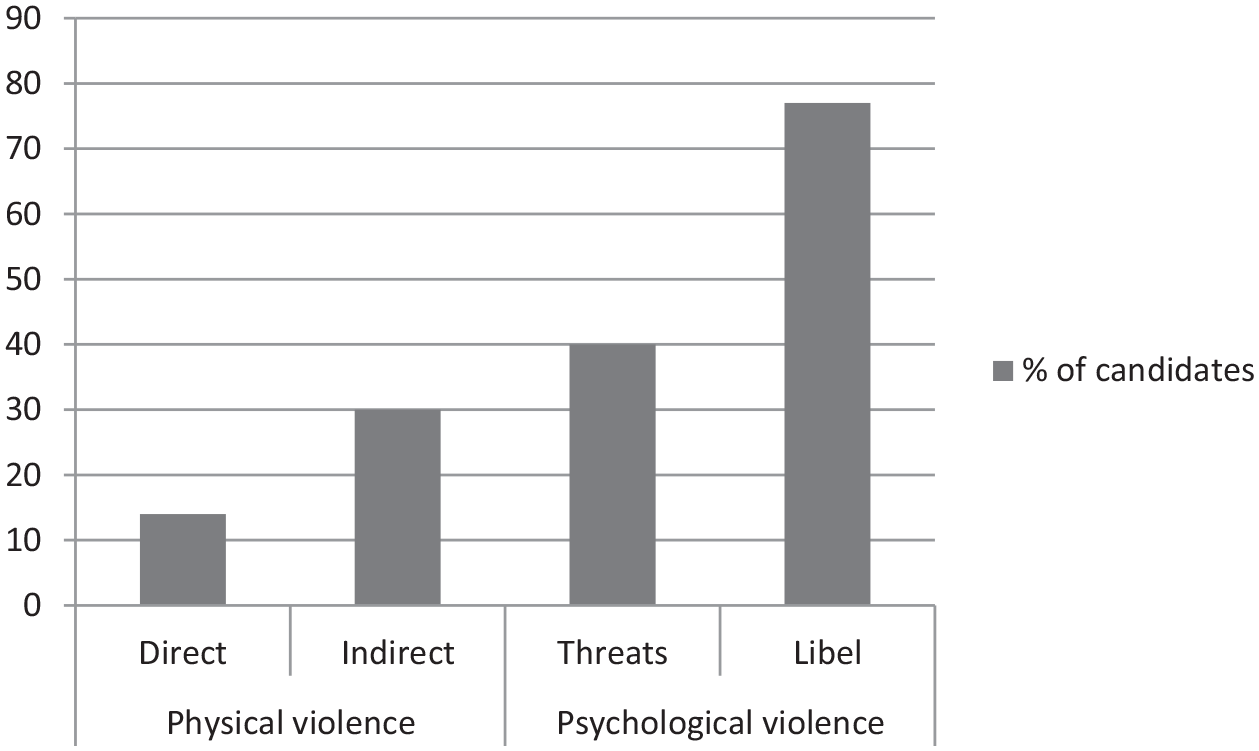
Physical and psychological violence on the continuum of violence (% of candidates).
Based on the findings mentioned above, studies of election violence that focus primarily on physical forms of violence are likely to exclude a large share of the violence that is actually taking place. Next, the analysis focuses on different forms of violence on the psychological end of the continuum. The interviews contribute an abundance of examples of psychological violence in connection to the election.
As threats had been experienced by 40% of candidates, they were clearly not uncommon in Maldives politics at that time. While some threats were made public, such as on social media, most seem to have been directed only to the candidate, in private. According to some candidates, gangs—often dealing in drugs—are increasingly involved in politics, and are paid to deliver different threats (e.g. I12). One candidate received threats on Facebook that drugs would be planted on him (I5), while another was threatened by unknown people who showed up at her house in the middle of the night and told not to run for office (I7). Big business can also be political, as one candidate experienced when he started speaking publicly about the need for minimum wages for staff working in tourist resorts. Immediately following his campaign speech, he received anonymous phone calls telling him not to jeopardize important business, or he ‘would be finished’ (I19). One woman was told, in person, that she had to leave the island on which she was campaigning if she wanted to live (I6).
According to all the interviews, and as the survey data demonstrates, libel and rumors are even more common than threats and are part of everyday life for most politicians in the Maldives. It is telling that such a large majority of the candidates reported having experienced libel and degrading talk, even though, as mentioned earlier, some respondents thought that such things were so normal that they did not even note them down. The interviews demonstrate that degrading talk can be about anything that is seen as reflecting badly on the candidate—whether political or private. Because the survey is based on candidates’ self-reported experience, it is not well-suited to determine whether the reported degrading talk is a question of disinformation (i.e. when false information is shared to cause harm in what would legally be considered libel) or misinformation (i.e. when genuine information is shared to cause harm, often by moving private information to the public realm) (Wardle and Derakhshan, 2017). However, we do have some information about the content of the libel and degrading talk. The gender disaggregated analysis will demonstrate that, while the experience of libel is shared by most candidates, the content of libel is highly gendered.
Turning to gender differences on the continuum of violence (see Figure 2), we can first see that, while more men than women have experienced direct and indirect forms of physical violence, a significantly larger proportion of women candidates have experienced threats compared with men candidates: 56% of women compared with 34% of men. In terms of general libel, the gender differences are very small, but the subset of sexual libel is significantly more common among women candidates: 38% of women have experienced degrading talk with sexual connotations, but only 10% of men. In line with our expectations, women candidates seem to be more likely targets of some types of psychological violence than men candidates.
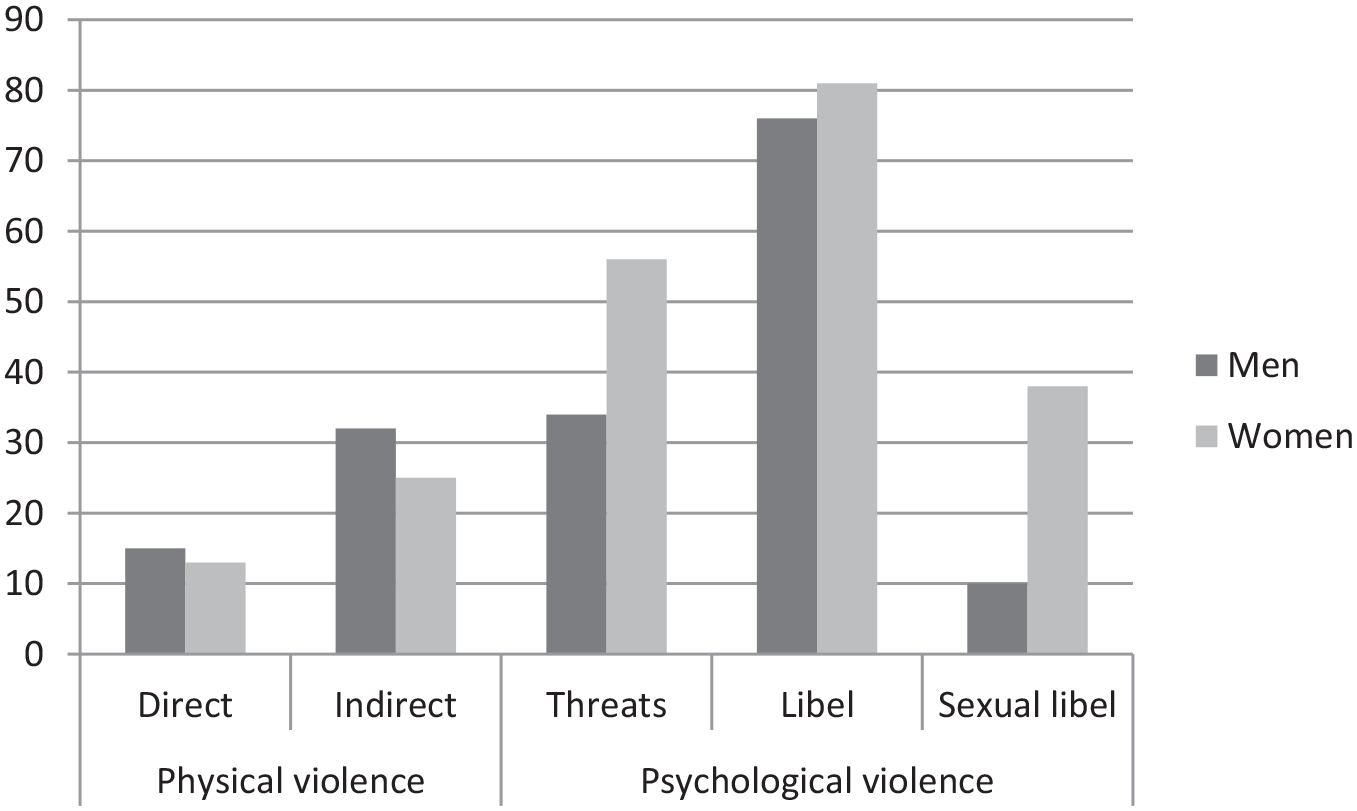
Gender differences on the continuum of violence (% of candidates).
To investigate these findings further, a logistic regression analysis is used to discern whether the relationships between candidate sex and experience of different forms of psychological violence hold, even when controlling for potentially confounding candidate characteristics.
The logistic regression reveals that psychological violence is fairly indiscriminate in that it affects candidates of all ages, including incumbents and new candidates. The candidate characteristic that stands out as significant in two of the three models is candidate sex. According to Table 1, the results in Figure 1 are largely confirmed. The control variables do not significantly influence the gendered patterns. Being a woman renders a candidate more vulnerable to receiving threats (Model 1.1) and much more likely to be the victim of libel and degrading talk of a sexual nature (Model 1.3). The relationship between candidate sex and general libel (Model 1.2) does not reach any conventional level of statistical significance.
Different forms of psychological violence and candidate sex, logistic regression.
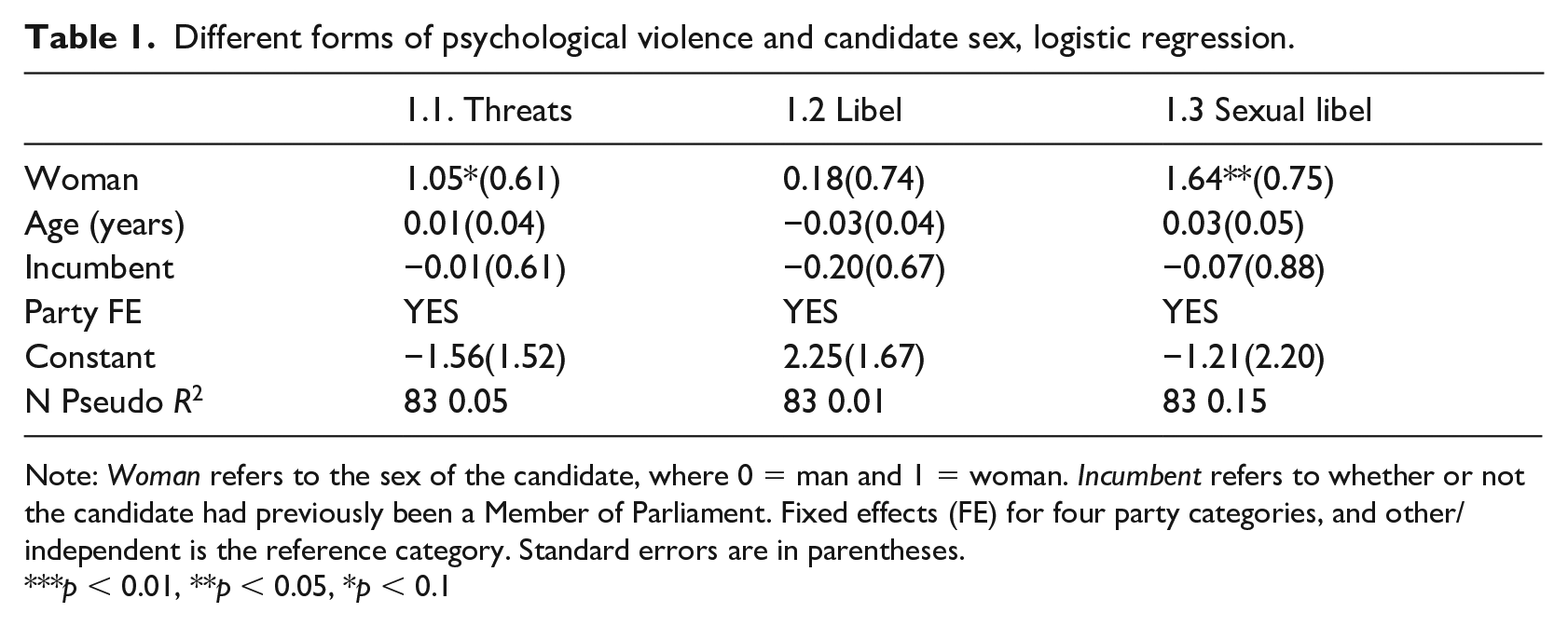
Note: Woman refers to the sex of the candidate, where 0 = man and 1 = woman. Incumbent refers to whether or not the candidate had previously been a Member of Parliament. Fixed effects (FE) for four party categories, and other/independent is the reference category. Standard errors are in parentheses.
p < 0.01, **p < 0.05, *p < 0.1
The gender aspect of threats comes through in the interviews, in that women candidates often interpret the threats as having to do with them being women. One woman says that she receives death threats ‘all the time,‘ often online, and that she has been stalked. She describes being constantly on guard: Every time she enters her house, she looks carefully to determine whether it will be safe to go into the elevator. She thinks that death threats of the kind she receives disproportionally affect women who are seen as ‘modern.‘ Being seen as a ‘modern’ woman is associated with socially unacceptable behavior in the Maldives, such as smoking, drinking alcohol, sleeping around, and not being covered up. While such behavior is also undesirable for men, it is not unacceptable and provocative to the same extent. The candidate also reflects on the fact that it is simply easier for a perpetrator to identify a ‘modern’ woman in a society where most women still wear traditional dress. The dress code for men is more uniform, making ‘modern’ men less easy to distinguish visually (I27).
Another woman who advocated for the removal of capital punishment, flogging of women, legal dress codes, and other Islamic rules says that she, too, receives daily death threats and that there are calls for a jihad against her. She also receives death threats directed at her son and her entire family. These threats have become more tangible in the streets, where gang members arrive on motorcycles screaming obscenities and death threats, sometimes following her all the way to her door. She is certain that these gang members are financed by her political opponents, and she is convinced that the kidnap threats are real. She no longer walks the streets alone and claims that it is impossible to visit her constituents. She even recounts how the threats follow women into the Majlis, if they are elected; a man parliamentarian whispered, ‘I will rape you here on the floor of the House!‘ in the ear of one of her woman colleagues (I30).
When it comes to degrading talk and rumors, there is no discernable gender difference concerning the experience itself. Politics in the Maldives is full of degrading talk and misleading information, affecting both men and women candidates. The interviews, however, reveal a highly gendered content, which is also visible in the statistical results that single out libel and rumors with sexual connotations (Model 1.3) from libel in general (Model 1.2). In the interviews, men candidates mostly talk about political rumors, such as rumors suggesting that the candidate in question secretly worked for a different party or was being disloyal to his constituents (e.g. I6). The rumors that are spread about women candidates are quite different, as they question the morality and the private lives of the women candidates, but rarely mention their political stance or activity.
The women candidates report facing rumors about love affairs from years ago—even from high school—that were spread both face to face and via Facebook (e.g. I2, I6). The interviewed women candidates all agree that women’s campaigning is frowned upon, as it necessarily involves meeting many people of the opposite sex. One woman had just married when she became a candidate, and her new husband believed the rumors that suddenly started circulating about his wife going out with other men; he thought that she was having an affair. His family also told him that his wife was spending too much time with other men, and his friends started teasing him. The couple filed for divorce on their first anniversary (I6).
In an island state such as the Maldives, social media has revolutionized communication, and Twitter and Facebook are very common sites for political discussion—and harassment. Social media blurs the lines between what is communicated in public and what is private. The rumors that are spread online demonstrate a strong trend of attacking women’s morality by suggesting that they have sexual affairs, often using techniques such as photoshopping. Disinformation in the form of manipulating visual imagery (Wardle and Derakhshan, 2017) had been used against several of the interviewed women candidates.
One woman had a picture taken when she attended a rally; she was pregnant and holding her toddler son in her arms. Soon, that picture was circulating the internet, with the former President’s face photoshopped unto that of her small son, insinuating that she had only achieved her position due to an affair with the former President. The same candidate told of numerous other instances when photoshopped images appeared on the internet—images of her breastfeeding or dressed in vulgar clothing (I26). Other women working closely with powerful men have experienced similar accusations: ‘I am seen as very close to NN. We are labeled as prostitutes who sleep with NN. This is on social media!‘ says another woman (I27). Visual disinformation of a sexual nature seems to be widespread, with photoshopped pictures of candidates in bikinis being one of the most common methods (e.g. I27, I30).
Being a political candidate in a contentious election in the Maldives implies working in an environment full of psychological violence in the form of verbal threats, degrading talk, and rumors. This violence affects both men and women, but the rumors that are spread about women are of a distinctly sexual nature. It seems as if the threats and rumors that women are exposed to are, indeed, detrimental to their ability to run their campaigns as they would prefer to.
Conclusion
This article concludes that psychological violence constitutes an important aspect of election violence, and that gender shapes experiences of psychological forms of election violence. It applied insights about how gender affects patterns of violence outside of the political sphere to the 2014 electoral campaign in the Maldives, using a small-scale survey and interviews with candidates. In particular, it explored gendered experiences along the continuum of violence, with a focus on psychological forms of violence. Women candidates were more likely than men candidates to experience election-related threats and sexualized degrading talk and rumors. In the words of Krook and Restrepo Sanín (2016), perpetrators seem to have used gendered scripts as they carried out the attacks, as men and women were targeted in very different ways. The script used for women includes personalized and sexualized disinformation and misinformation as well as direct threats. This psychological violence affects the candidates, who do not dare to move as freely as they would like, either in private or for campaigning. Thus, from an electoral integrity perspective, it seems highly likely that psychological attacks, such as online character assassinations, may be as detrimental as physical attacks.
It should be noted that women’s roles—and, more broadly, gender equality—were highly salient political topics in the Maldives in 2014, as these topics were discursively associated with issues the island state was grappling with, such as globalization and modernization. The Maldives is a strongly patriarchal society where women in politics are few and far between. While the very fact that women are rare in politics may well contribute to the highly gendered tendencies that can be discerned, their low numbers also, paradoxically, render the validation of these tendencies more difficult. Future studies of elections in highly patriarchal political spheres thus need to put an even greater effort into boosting the sample of women so that statistical analyses can be fruitfully carried out. Another important task for future research is to assess gender aspects of election violence in other political contexts, where gender roles and women’s political participation may not be as controversial and central to political mobilization and discussion as they were in the Maldives.
The results presented in this article suggest that research on election violence should do what other fields have done, and take the continuum of violence into account when moving forward. In order to adequately assess the magnitude of the problem of election violence, and to subsequently address it properly, gendered insights need to be incorporated even as they challenge conventional conceptualizations of election violence and methodological approaches to researching it. Assessing the full continuum of election violence is associated with a different set of challenges compared with estimating physical election violence. Incidents of physical violence may be relatively rare, but when carried out during a political rally or demonstration, they are often reported by the media and thus counted by outside observers. Assessing the prevalence of psychological violence, on the other hand, requires asking about individual experiences that may not always be publicly known. Threats are often directed at an individual rather than being public and overt. Disinformation may spread via the internet rather than from the podium of a political rally. Furthermore, toxic political discourse can be normalized to such an extent that the victims do not even think about recording it, but view it as the ‘cost of politics’ (National Democratic Institute (NDI), 2019). Yet, updating the working definition of election violence to ensure that it encompasses the continuum of election violence is necessary in order to attain a more gender-sensitive approach to election violence in research as well as in practice. Such an approach is sorely needed not only to protect the personal integrity of political candidates, but also to safeguard electoral integrity.
Supplemental Material
sj-pdf-1-ips-10.1177_0192512120977111 – Supplemental material for The continuum of election violence: Gendered candidate experiences in the Maldives
Supplemental material, sj-pdf-1-ips-10.1177_0192512120977111 for The continuum of election violence: Gendered candidate experiences in the Maldives by Elin Bjarnegård in International Political Science Review
Footnotes
Acknowledgements
This article has benefited from the feedback of Gabrielle Bardall, Ursula Daxecker, Beverly G. Hagerdon, Pippa Norris, Marian Sawyer, Laura Sjoberg, Pär Zetterberg, as well as from editors and anonymous reviewers. I would like to thank Ahmed Hamdhan and Ahmed Naaif Mohamed for invaluable research assistance and the Kvarsebo family for helping me find the time and space to write.
Funding
The author disclosed receipt of the following financial support for the research, authorship, and/or publication of this article: The research was supported by the Swedish Research Council project number 2015-03488.
Interview
Thirty-four interviews were conducted between April 21 and April 27, 2015, with party candidates and subsequent Members of Parliament from all parties. All interviews were conducted in the capital of the Maldives, Malé. Respondents have been anonymized and are referred to only by number.

Supplemental material
Supplemental material for this article is available online.
Notes
Author biography
References
Supplementary Material
Please find the following supplemental material available below.
For Open Access articles published under a Creative Commons License, all supplemental material carries the same license as the article it is associated with.
For non-Open Access articles published, all supplemental material carries a non-exclusive license, and permission requests for re-use of supplemental material or any part of supplemental material shall be sent directly to the copyright owner as specified in the copyright notice associated with the article.
