




Abstract
Despite the global expansion in women’s access to political leadership in recent decades, female parliamentarians remain a distinct minority in most national legislatures. Previous studies have linked variations in women’s descriptive representation to international and domestic security threats, such as interstate war and transnational terrorist campaigns. However, existing research has thus far overlooked how the turbulence, unrest, and violence often associated with the election process itself may produce gendered electoral outcomes. I argue that violent contention in the period immediately preceding elections introduces gendered distortions to the political recruitment process that determines the gender composition of legislatures. The cumulative effect of these distortions is a reduction in the proportion of legislative seats subsequently held by women. To evaluate my hypothesis, I analyze data from 620 nominally competitive legislative elections in 128 countries between 1990 and 2012. Consistent with expectations, the results suggest that higher levels of election-related violence are associated with lower rates of women's descriptive representation.
A rapidly growing literature suggest that changes in women’s descriptive representation can influence both political discourse and political processes and, in so doing, shape policy outputs. Recent studies have, for instance, found that increasing the proportion of seats held by women in the national legislature is associated with greater political engagement among female voters (Barnes and Burchard 2013), the adoption of social welfare-oriented policies (Bolzendahl and Brooks 2007; Lu and Breuning 2014), the prioritization of social welfare over defense spending (Koch and Fulton 2011; Shair-Rosenfield and Wood 2017), and a diminished risk of armed conflict (Koch and Fulton 2011; Melander 2005). Thus, for both normative and instrumental reasons, improving women’s participation in politics and increasing their access to position of political authority has become a key objective for many international organizations and represents an increasingly important component of United Nations strategies for promoting global peace, security, and stability (UN Women 2015; UNDP 2022).
The average share of seats held by women in national legislatures has risen from just over 10% in the early 1990s to more than 25% in 2023 (IPU 2023). 1 Thus, despite achieving significant gains over the previous three decades, women remain dramatically under-represented in law-making bodies around the globe and continue to face substantial constraints on their collective ability to influence policymaking. Societal gender norms, party structures, and electoral system characteristics feature prominently in existing explanations for the persistent gender imbalance observed across national parliaments (see Wängnerud 2009). However, recent scholarship has begun to consider how changes in domestic and international security environments influence public support for female leadership (e.g., Holman, Merolla, and Zechmeister 2022) and women’s descriptive representation (e.g., Kang and Kim 2020; Schroeder 2017). Such studies contribute to the existing literature by identifying security threats as significant obstacles to women’s access to political authority; yet, by focusing predominantly on large-scale threats, they have largely overlooked how the turbulence, unrest, and violence often associated with the electoral process itself might produce gendered leadership outcomes. Violent contention and social unrest are common features of the pre-election landscape in many countries and have the potential to shape the preferences and behaviors of candidates, parties, and voters. It is therefore important to consider whether variation in the prevalence of election-related violence influences women’s political recruitment, electoral success, and subsequent representation in elected political institutions.
I address this issue by linking patterns of violent political contention observed in the period immediately preceding the election with the proportion of seats held by women in national legislatures following the election. In developing my argument, I explicitly acknowledge that the gender composition of a legislature reflects the outcome of a multi-stage recruitment process that extends from the supply of candidates who aspire to candidacy, through the party-controlled selection mechanisms that determine the field of candidates, and finally to the preferences of the electorate who ultimately selects winners from the pool of candidates competing for office (Krook 2010; Norris 1997). This approach improves upon those adopted in previous studies, which have focused disproportionality on the last stage of this process and therefore obfuscated the theoretical mechanisms that connect security threats with women’s descriptive representation. Building from this sequential model of political recruitment, I contend that electoral violence introduces distortions to each stage of the process. In brief, high levels of pre-election violence may disproportionally deter women from pursuing candidacy, (further) bias party elites against nominating female candidates, and discourage voters from endorsing them at the ballot box. The cumulative effect of these distortions is a reduction in women’s descriptive representation in the national legislature.
I test my hypothesis by analyzing data on 620 nominally competitive national legislative elections—elections in which, at minimum, voters could directly select representatives from a list of candidates—held in 128 countries between 1990 and 2012. The results provide robust support for the proposition that more frequent pre-election violence is associated with a reduction in the proportion of women-held seats in the subsequent national legislature. Notably, they also indicate that non-violent contentious events occurring during the pre-election period—including protests, detentions, and harassment of party members or candidates—have little influence on women’s representation. This result implies that explicit acts of violence rather than aggressive and antagonistic campaign environments or unrest and instability more broadly suppress women’s descriptive representation.
This study makes several important contributions. First, it adds to the growing literature demonstrating how patterns of violence and the perception of threat influence women’s access to positions of political authority. It specifically highlights the gendered implications of the often-tumultuous nature of elections, and it demonstrates that in addition to traditional, high-profile security threats, more quotidian forms of political and social violence can also influence women’s representation. Furthermore, by highlighting how violence potentially impacts the discrete but inter-related stages of political recruitment, it offers a more nuanced theoretical framework for examining the relationship between various forms of security threats and descriptive representation. Finally, the empirical results imply that efforts to expand women’s representation should be linked to broader efforts to reduce violence, intimidation, and harassment during political campaigns and on the day of the election. The international community has demonstrated a keen interest in both in recent years; yet, these issues are often decoupled and treated as distinct and separate goals. These findings suggest that efforts to reduce violence during the campaign period may positively influence the women’s descriptive representation in national legislatures.
Security and Gendered Leadership
A complex, bidirectional relationship exists between conflict and violence on the one hand and sex and gender on the other. The prevalence of traditional gender norms and patriarchal social structures—and the associated exclusion of women from political authority—among societies characterized by high levels of militarization and violence and the frequently observed retreat of women from the public sphere during war strongly implies that violence and gender roles/beliefs are mutually constitutive (e.g., Sjoberg 2013). While empirical studies have not fully untangled this reciprocal relationship, their results nonetheless suggest that political leader sex and the gender composition of national political institutions influence a state’s propensity for violence and armed conflict (Koch and Fulton 2011; Shair-Rosenfield and Wood 2017). Principally, countries whose citizens hold more egalitarian gender attitudes—which in turn facilitate women’s access to political leadership—are less likely to instigate armed conflicts (Caprioli 2000) and less likely to experience large-scale internal violence (Melander 2005). Conversely, they find that armed conflict and threats of war represent powerful impediments to women’s ability to gain access to positions of political authority. For example, the proportion of seats held by women in the national legislature is lower among states that experience heightened external threat environments, such as during periods of international conflict, persistent interstate rivalry, and ongoing territorial dispute (Kang and Kim 2020; Schroeder 2017). Consistent with the assertions of feminist scholars, Kang and Kim (2020) further demonstrate that external threat negatively influences rates of female representation by promoting the militarization of society, which reinforces traditional gender roles and marginalizes women who contravene those roles (Elshtain 1985; Sjoberg 2013). Similarly, Barnes and O’Brien (2018) find fewer female defense ministers among military dictatorships and during periods of international conflict, both of which are associated with higher levels of societal militarization.
An emerging body of research has likewise investigated how historical legacies of wartime atrocities influence women’s descriptive representation. These studies often rely on fine-grained data on candidate gender and voter preferences to analyze these relationships in specific cases. Hadzic and Tavits (2021), for example, find that while the scale of war-time atrocities in a given geographic area was positively associated with the number of women competing in Bosnian local elections, female candidates were also less likely to win seats in those municipalities that had previously experienced higher levels of wartime violence compared to those that witnessed comparatively less violence. Their results suggest that exposure to violence can positively influence the supply of female candidates but simultaneously suppress demand for female leadership among voters. Glaurdić and Lesschaeve (2023) similarly find that greater exposure to wartime violence reduced Croatian voters’ support for female parliamentary candidates, particularly among right-wing voters. Somewhat at odds with these findings, experimental evidence suggests that increasing the salience of violence among Bosnian voters contributed to greater politically engagement among male respondents while reducing engagement among women (Hadzic and Tavits 2019). Lastly, Gaikwad, Lin, and Zucker (2023) find that women in the areas most exposed to Khmer Rouge atrocities during the Cambodian genocide are more likely to seek and to win political office.
Analyses of the historical legacy of mass killing and genocide notwithstanding, scholars have devoted only limited attention to the link between the severity/frequency of less severe forms of internal political or social violence and women’s descriptive representation. Among the very few exceptions, Jacobs et al. (2013) finds that state-level homicide rates are inversely related to women’s representation in state assemblies and state delegations to the US Congress. This oversight is somewhat surprising given the (fortunate) rarity of mass atrocities and genocides and the (unfortunate) frequency of other forms of internal violence (e.g., civil conflicts, terrorist campaigns, organized criminal violence, and electoral violence). And while numerous studies (e.g., Holman, Merolla, and Zechmeister 2022) discussed in more detail below demonstrate that transnational terrorist attacks influence voter attitudes towards female leaders, such studies only indirectly suggest that internal political violence affects women’s descriptive representation.
Relevance of Electoral Violence
While sharing certain similarities, electoral violence is distinct from other types of security threats. Such violence—ranging from physical threats and intimidation against specific candidates to large-scale, armed clashes between supporters of rival parties—is a perennial feature of elections in many countries (Daxecker, Amicarelli, and Jung 2019; Hafner-Burton, Hyde and Jablonski 2014). Electoral violence and unrest are particularly common in transitional democracies, electoral autocracies, and countries experiencing ongoing internal armed conflict (Birch and Muchlinski 2018; Höglund 2009). According to one analysis (Straus and Charles 2012), over a fifth of all African elections held between 1990 and 2007 were marked by violence, and significant threats and harassment were observed in nearly half. Thus, compared to the infrequency of international conflict and transnational terrorism, electoral violence is commonplace.
The goals and motivations driving electoral violence likewise differ from those of other forms of violent conflict. Hostile foreign states and transnational terrorist groups are typically external to the political and policy processes of the target state. Moreover, their political objectives usually focus primarily on changing the policies of the target state rather than shaping the political process that determines its leaders. By contrast, perpetrators of electoral violence, such as rival candidates, party members, and activists, are often central players in domestic political processes. Even where they are not directly tied to the process itself (e.g., security forces), they often seek often to influence it by intervening in elections and political campaigns (Hafner-Burton, Hyde and Jablonski 2014; Höglund 2009). Regardless of its specific tactics or targets, exclusion is the proximate objective of most electoral violence (Birch, Daxecker, and Höglund 2020). By excluding rivals (or their supporters) from the political process, the perpetrators of electoral violence intend to shape the outcome of the election.
Electoral violence also routinely exhibits a distinctly gendered character (Bjarnegård 2018). Consistent with its broader exclusionary objective, electoral violence is sometimes explicitly used to undermine, marginalize, and force women out of politics (Bardall, Bjarengård and Piscopo 2020; Krook and Sanin 2020) with the goal of preserving the prevailing (and patriarchal) socio-political order (Matfess, Kishi, and Berry 2023). Thus, while election violence is not always (or even disproportionately) directed against women, much of it nonetheless follows a gendered logic. Moreover, male and female candidates are often exposed to different forms of election-related violence (Bjarnegar, Kåkansson and Zetterberg 2022; Krook and Sanin 2020), which in turn produces gendered outcomes (see below).
The frequency of electoral violence and its potentially gendered nature highlight the importance of assessing its impact on women’s descriptive representation. In particular, these features imply the possibility that contention and conflict in the weeks and months preceding the election may exert a gendered influence on its outcome. Consequently, in the following section I outline an argument that links election-related violence to each of the stages of political recruitment that determine the gender composition of the legislature.
Electoral Violence and Descriptive Representation
Scholars seeking to explain the gender composition national legislatures often draw on the stylized sequential model of political recruitment described by Norris (1997). This model disaggregates the recruitment process into multiple discrete stages, which include: (1) the factors that shape individuals’ aspirations to run for elected office, (2) party-level decisions regarding candidate recruitment and nomination, and (3) voters’ selection of candidates during the election. 2 Subsequent scholarship further highlights how gender biases can potentially distort each stage of the process, thus penalizing female political aspirants and candidates and ultimately producing the imbalances in descriptive representation commonly observed in national legislatures (Krook 2010). As such, explanations for variation in women’s descriptive representation necessitate considering actors, attitudes, and decision-making at each stage.
With few exceptions, existing research examining the influence of violence on descriptive representation has focused principally on the final stage of political recruitment (elections) and neglected its potential impact on earlier stages of the process (e.g., Kang and Kim 2020; Schroeder 2017). 3 Numerous related studies likewise examine how threat perception, heightened insecurity, and exposure to violence increase voters’ preferences for male candidates and leaders (Falk and Kenski 2006; Holman, Merolla, and Zechmeister 2022; Kim and Kang 2022), thus implying that female candidates’ odds of electoral success should decline under these circumstance. However, elections—the key forum through which voters’ signal these preferences—represent only the final stage of the process that determines representation. Using the model described above as a starting point, I argue that electoral violence represents an important but hitherto overlooked distortion in the processes of political recruitment and representation. Each of the recruitment stages provides opportunities for election-related violence to influence the attitudes and perceptions of the relevant decisionmakers, potentially reducing the number of women aspiring to candidacy, diminishing party elites’ willingness to select (or prioritize) women as candidates, and discouraging voters from selecting female candidates. I discuss each stage in turn, beginning with the last.
Voter Attitudes and Choice
Because it represents the principal focus of previous studies, I first consider the link between violence and voter preferences for female candidates. The political arena and its associated institutions and processes are heavily gendered, reflecting and reinforcing masculine perspectives of power and leadership (Kenney 1996; Kenny and Verge 2016). The masculinization of politics is also reflected in voters’ preferences over the traits their leaders possess. Social role theory (e.g., Koenig and Eagly 2014) contends that the historical sex-based divisions of labor observed in most societies have produced deeply entrenched gender stereotypes and reinforced the gendering of personal traits and attributes. Broadly speaking, agentic traits (aggression, power, decisiveness, and competence) are associated with men while communal traits (compassion, empathy, sensitivity, and honesty) are associated with women.
With some minor variations across different societies and over time, individuals tend to associate political leadership with male-typical agentic traits (Eagly and Karau 2002; Koenig and Eagly 2014). Moreover, voters often prefer leaders that exhibit these traits over those that exhibit female-typical communal traits (Huddy and Terkildsen 1993; Schneider and Bos 2019, 186). In practice, agentic and communal traits are not neatly distributed based on candidate sex: female candidates can (and often do) exhibit agentic traits, and many male candidates possess communal traits. However, voters are more likely to penalize female candidates that deviate from societal gender stereotypes (Eagly and Karau 2002; Schneider and Bos 2019). Indeed, scholars have long noted the existence of a “double bind”—in which voters favor agentic traits in leaders but simultaneously disfavor role incongruity (especially among female candidates)—as an obstacle to the electoral success of female candidates (Jamieson 1995; Teele, Kalla, and Rosenbluth 2018).
Despite the common assumption that voters are inherently biased against women and thus choose around them when casting their votes, the empirical evidence suggests otherwise (Clayton et al. 2020; Shair-Rosenfield 2012). Nonetheless, contextual factors often influence voter attitudes in ways that benefit male candidates over female candidates. For example, the relative importance of candidate traits and their influence over voters’ preferences varies depending on the salience of different policy domains. Rising threat perception increases voters’ desire for political leaders that appear more competent on security issues and those that demonstrate agentic traits such strength, resolve, and aggression. Because these represent male-typical traits, voters tend to identify male candidates more closely with military and security issues (Huddy and Terkildsen 1993). The perception that male candidates are more qualified to tackle security challenges offers a distinct advantage during periods of uncertainty and heightened threat. Specifically, when security dominates the policy agenda, public support for female leaders declines (Holman, Merolla, and Zechmeister 2022; Kim and Kang 2022). Female candidates should therefore be less likely to win electoral competitions under these circumstances.
Voter bias represents the principal mechanism articulated in most existing studies that have sought to directly link security threats with women descriptive representation (e.g., Hadzic and Tavits 2021; Schroeder 2017). The general logic should likewise extend to the specific context of election-related violence. Pre-election landscapes characterized by hostility and aggression advantage male candidates by (re)shaping voter perceptions of the relative importance of candidate resolve, strength, and competence. Because they are more likely to possess agentic traits, voters tend to believe that male candidates are better able to successfully endure and forcefully respond to threats and intimidation than their female counterparts. Furthermore, observable election-related violence, such as attacks on campaign events or armed clashes between rival activists, increases the salience of security and encourages voters to prioritize security concerns over other issues (e.g., social welfare) and thus increases their preference for stereotypically strong (masculine) leaders. In this context, gender stereotyping, which casts female politicians as passive and conciliatory and male politicians aggressive and resolute, discourages voters from selecting female candidates.
Candidate Nomination and Placement
Despite the disproportionate focus on elections in previous studies, party-level candidate selection processes explain much of the variability in women’s under-representation in elected institutions (Krook 2010; Niven 1998). Parties are the principal gatekeepers to political office; as such, their preferences largely determine the demand for female candidates. Previous studies demonstrate how the gender biases held (and reinforced) by party elites as well as the formal and informal processes that govern candidate selection often represent significant barriers to women’s advancement in politics (Kenny and Verge 2016; Krook 2010). First, because men typically dominate the ranks of party elites, out-group effects encourage party leaders to prioritize candidates whose background and personal characteristics mirror their own (Niven 1998). Parties therefore tend to select candidates that exhibit masculine traits and those who have previously held more traditionally masculine careers (Kenny and Verge 2016; Piscopo 2016). Second, as strategic actors, party leaders choose candidates that they perceive have the highest likelihood of success. Elites’ own gender biases and the imputed biases of the electorate thus encourage party leaders to select men, whom they perceive as more competitive candidates (Krook 2010, 163; Norris and Lovenduski 1995). Even when compelled by quota rules to field female candidates, parties often place women in unwinnable candidates or lower on party lists (Piscopo 2016), reducing their likelihood of electoral success.
Similar to the mechanisms at play among the broader electorate, election-related violence may exaggerate party elites’ preexisting biases toward male candidates. Given the high concertation of (traditionally masculine) men among party elites, the salience of security issues may exert an even more profound influence on party bias against women during the nomination process than it does among voters more broadly. Recognizing voter concerns about safety and security and perceiving male candidates as more credible in these areas, party elites are likely to prioritize candidates that exhibit agentic traits such as assertiveness, strength, and authority during periods of heightened security risks. Particularly in cases where electoral violence has become routinized, the expectation of violence during the campaign period is likely to create the perception that female candidates would represent a strategic liability for the party, thereby incentivizing elites to nominate male candidates over female candidates or to ensure male candidates compete in the most winnable districts.
Political Ambition
Political ambition among the population of women legally eligible to run for office largely determines the supply of female candidates (Norris and Lovenduski 1995). A combination of socialization and rational calculus shape women’s political ambition. These factors are inter-related, as the gendered social processes and experiences she accumulates over her lifetime inform a woman’s perspective on the relative costs and benefits of running for office. Owing to deep-seated norms regarding gender-based divisions of labor within society, boys and girls are socialized from a young age to view politics and political space as male-dominated and to believe that political success favors candidates with masculine traits (Bos et al. 2022; Lawless and Fox 2005). Parties, in turn, reinforce these beliefs by actively encouraging potential male candidates to run while ignoring equally (or better) qualified women (Kenny and Verge 2016; Lawless and Fox 2005).
These gendered experiences also contribute to disparities in candidates’ estimation of their odds of electoral success and the costs they associate with running for office. Largely due to earlier patterns of socialization, female political aspirants are more likely to perceive themselves as underqualified for office and express less confidence regarding their odds of winning electoral competitions compared to men with similar socio-economic and professional backgrounds (Lawless and Fox 2005). Moreover, because women recognize the pervasiveness of the gender biases, discrimination, and constraints on opportunities within politics, they often perceive higher costs associated with candidacy (Rincker, Aslam, and Isani 2017; Shames 2017). The combined effect of these factors is that women are significantly less likely than men to actively seek elected office.
Violence may exacerbate this self-selection process by affecting women’s perception of the availability of opportunities to run for office. As noted above, the routinization of violence in electoral politics reinforces gendered beliefs about the traits required to succeed in politics. The expectation or observation of violence in the months preceding an election may therefore persuade female political aspirants that they lack the key (masculine) traits required of viable candidate, thus discouraging them from pursuing candidacy. In addition, where pre-election violence (further) encourages party elites to signal their preferences for male candidates, it may also further undermine women’s political ambition. Election-related violence also raises the perceived costs of candidacy. The majority of electoral violence is not driven by explicitly gendered motives. Nonetheless, threats, harassment, and overt acts of violence against female politicians and candidates are an increasingly common feature of elections globally (Bardall, Bjarngård and Piscopo 2020; Krook and Sanín 2020). Compared to their male counterparts, female candidates and politicians are more likely to experience threats and physical violence (Collignon and Rüdig 2021; Herrick et al. 2019; Herrick and Thomas 2022), including sexual violence and sexualized threats (Bjarnegård, Kåkansson, and Zetterberg 2022; Herrick and Thomas 2022). While women’s political ambition does not appear to be significantly more sensitive to violence than men’s (Bjarnegård, Håkansson, and Zetterberg 2022; Herrick et al. 2019), the higher burden of risk imposed upon female candidates is likely to exacerbate the gender gap in the supply of candidates. Indeed, concerns about personal security represent a substantial barrier to women’s entry into politics and encourage many women to reconsider political careers, even among those that have not directly experienced threats or violence (Håkansson 2023; Rincker, Aslam, and Isani 2017).
Lastly, regardless of its specific targets, election-related violence has gendered political implications. Overall, women’s political engagement is lower where violence is a regular feature of politics and in locations that have recently experienced high levels of violence (Bjarnegård, Håkansson and Zetterberg 2022; Hadzic and Tavitz 2020). Consequently, both gendered election violence and electoral violence more broadly raise the costs associated with political candidacy and reinforce the perspective that, like war, politics is a “man’s game.” Election-related violence may therefore reduce the number of women aspiring to political office. Where this occurs, it creates fewer opportunities for voters to elected women to parliaments and thus reduces the proportion of seats women hold therein.
Empirical Expectation
Based on this discussion, I derive a single testable hypothesis regarding the relationship between election-related violence and the proportion of legislative seats subsequently held by women.
The proportion of national legislative seats held by women is lower in countries that experience greater levels of pre-election violence than those that experience comparatively less pre-election violence.
Research Design
To test the hypothesized relationship between pre-election violence and women’s legislative representation, I analyze cross-sectional time-series data for a sample of nominally competitive national legislative elections occurring between 1990 and 2012. The sample is defined by merging the National Elections across Democracy and Autocracy (NELDA) dataset (Hyde and Marinov 2012) with election-related violence data from the Electoral Contention and Violence (ECAV) dataset (Daxecker, Amicarelli, and Jung 2019). NELDA employs a minimalist definition of competitive elections, which focuses narrowly on the ability of voters to directly elect the persons or parties appearing on the ballot. This definition implies nothing about the extent of the franchise nor the fairness of the elections. ECAV, which defines its sample based on NELDA, includes event-level information on electoral contention and election-related violence in nominally competitive national elections between 1990 and 2012. 4 ECAV excludes consolidated democratic regimes because significant electoral violence and unrest is very rare in these cases. Thus, states that were OECD members prior to 1991 (except Turkey) are excluded, but countries that joined the OECD after 1990 (Mexico, Israel, and several Eastern European countries) are included.
Because I am specifically interested in the relationship between election-related violence and the composition of the legislature following the election, I define the unit of analysis as the legislative election-year (rather than the country-year). The sample therefore includes a single observation for each (first-round) national legislative election for each country included in the sample. Because the time periods between national elections vary across panels but also within them, this structure produces an unbalanced time-series. The sample I analyze ultimately includes 620 first round elections for seats in the lower house of the national legislative assembly in 128 countries. This construction differs significantly from previous cross-national quantitative analyses of the relationship between women’s representation and violence (e.g., Kang and Kim 2020; Schroeder 2017), which typically include consecutive years within each panel regardless of whether or not an election occurred in the country in that year. By including non-election years, these studies ignore the reality that the proportion of legislative seats held by women rarely changes outside of the context of an election. Thus, while independent predictors such as terrorist attacks or international conflicts often exhibit substantial annual variation, the dependent variable remains static over multiple consecutive observations. I address this problem by excluding non-election years and constraining the analysis to those periods where there was an opportunity to observe substantial election-related changes in the rate of female representation.
The proportion of women in the national legislature following the most recent national legislative election serves as the dependent variable. Data on women’s representation is taken from the Varieties of Democracy project (V-Dem [V13)] (Coppedge et al. 2023), which compiles these data from sources such as the Inter-parliamentary Union (IPU).
5
Figure 1 illustrates the annual mean value of Women’s Legislative Representation for the sample of states included in the analysis. The proportion of legislative seats held by women in the sample countries increased overtime from approximately 9% in 1990 to roughly 19% in 2012. This positive trend largely mirrors the global increase in women’s descriptive representation noted above. However, the values observed in this sample are slightly lower than the global means because the sample excludes consolidated democracies and most single-party Communist regimes, both of which have comparatively large proportions of women in their legislatures. Annual mean women’s legislative representation within sample. Note. Annual mean proportion of seats held by women in lower houses of national legislatures for all sample countries.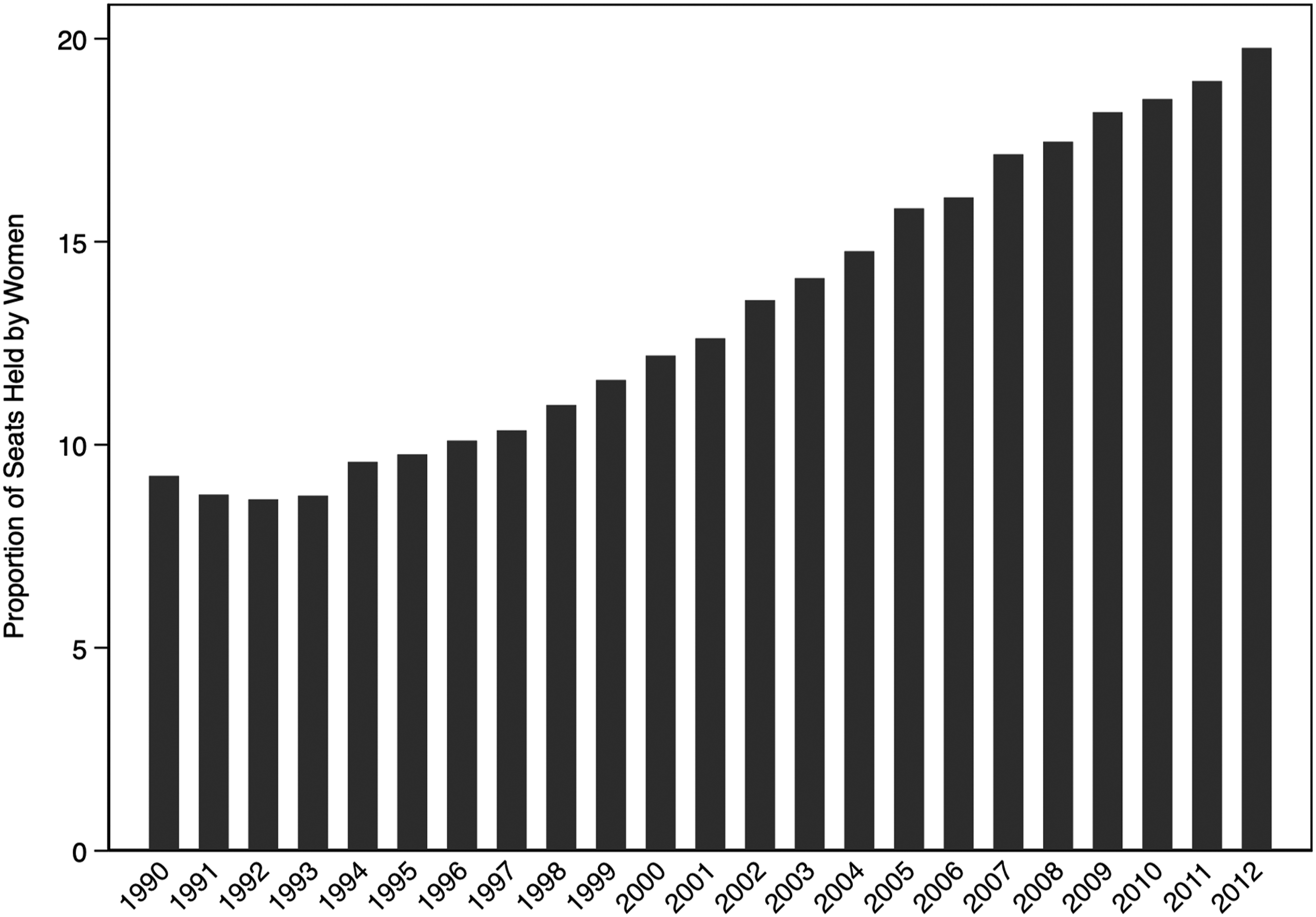
To affect the stages of recruitment as anticipated in the theory contentious events should meet two key criteria. First, they should provoke a sense of insecurity or perception of threat among the relevant audience. Events such as political assassinations, clashes between rival activists, physical attacks on candidates and their supporters, and bombings of campaign offices or polling places are the most likely to raise the salience of security in the minds of voters and party elites and likely to influence the threat perception of potential candidates. By comparison, events such as online harassment or verbal threats may be provocative and intimidating (particularly to candidates), but they are less likely to induce acute security concerns among audiences more broadly. Any influence of such events on the salience of security issues would be much weaker than the effect of overtly violent events. Second, the events must occur prior to the election. Post-election violence necessarily occurs subsequent to the decisions of the relevant actors and should therefore have little direct influence on descriptive representation.
To ensure that the dependent variable in the analyses correspond to the logic of the argument, I construct a ymeasure that captures instances of overt violence and physical threats associated with the electoral process that occurred specifically during the pre-election period. Data for the measure comes from the ECAV dataset set, which defines electoral contention as “public acts of mobilization, contestation, or coercion by state or non-state actors used to affect the electoral process or arising in the context of electoral competition” (Daxecker, Amicarelli, and Jung 2019, 716). ECAV captures all contentious events for a temporal window spanning 6 months prior to the election data and 3 months following it. The events subsumed by the broader definition of contention are further disaggregated into violent and non-violent actions. Events are parsed based on the specific character of the events as well as their type. Violent events include overt acts of physical violence (such as those described above). Non-violent events include verbal and media threats, harassment, arrests (by security forces), and peaceful protests and demonstrations. 6
Using information from ECAV, I construct the measure Pre-election Violence, which represents the sum of all observed instances of physically violent electoral contestation in each country during the 6 months prior to and including the date of the first round of national legislative elections. 7 I exclude from the measure all events occurring after the election date. I construct Non-violent Events in the same manner but instead include only non-violent contestation events. This measure allows me to distinguish between the effects of different types of electoral contestation. Specifically, it useful to know whether women’s legislative representation is affected principally by acts of explicit violence or is instead shaped by patterns of broader contention and instability. I use the natural log of both because of the skewness of the measures.
Figure 2 illustrates the annual estimated count of pre-election events (violent and non-violent) for countries that held legislative elections in the specified year as well as the global count of legislative elections (line). Bars reflect the total number of events (violent plus non-violent). The black portion represents the total number of violent events while the grey portion accounts for the number of non-violent events. As the figure illustrates, the number of events varies annually and reflects no obvious time trend. Somewhat surprisingly, instances of violence exceed instances of non-violent contestation in most years. This might be an artifact of the data gathering process, reflecting the difficulty of observing non-violent events relative violent events. Events such as intimidation and harassment are potentially under-reported. Election violence is very common among the states in the sample. However, 2005 represents a particularly violent year for elections. The very high count of events in that year is primarily driven by Iraq, which witnessed 755 instances of pre-election violence (as well as an additional 369 instances of post-election violence) in that year. This represents more than twice as many violent events as the next most violence-prone observations in the sample (Bangladesh in 1996 [297] and Kenya in 2007 [292]). Violent and non-violent pre-election events in sample. Note. Annual count of violent and non-violent pre-election events and legislative elections for countries included the sample.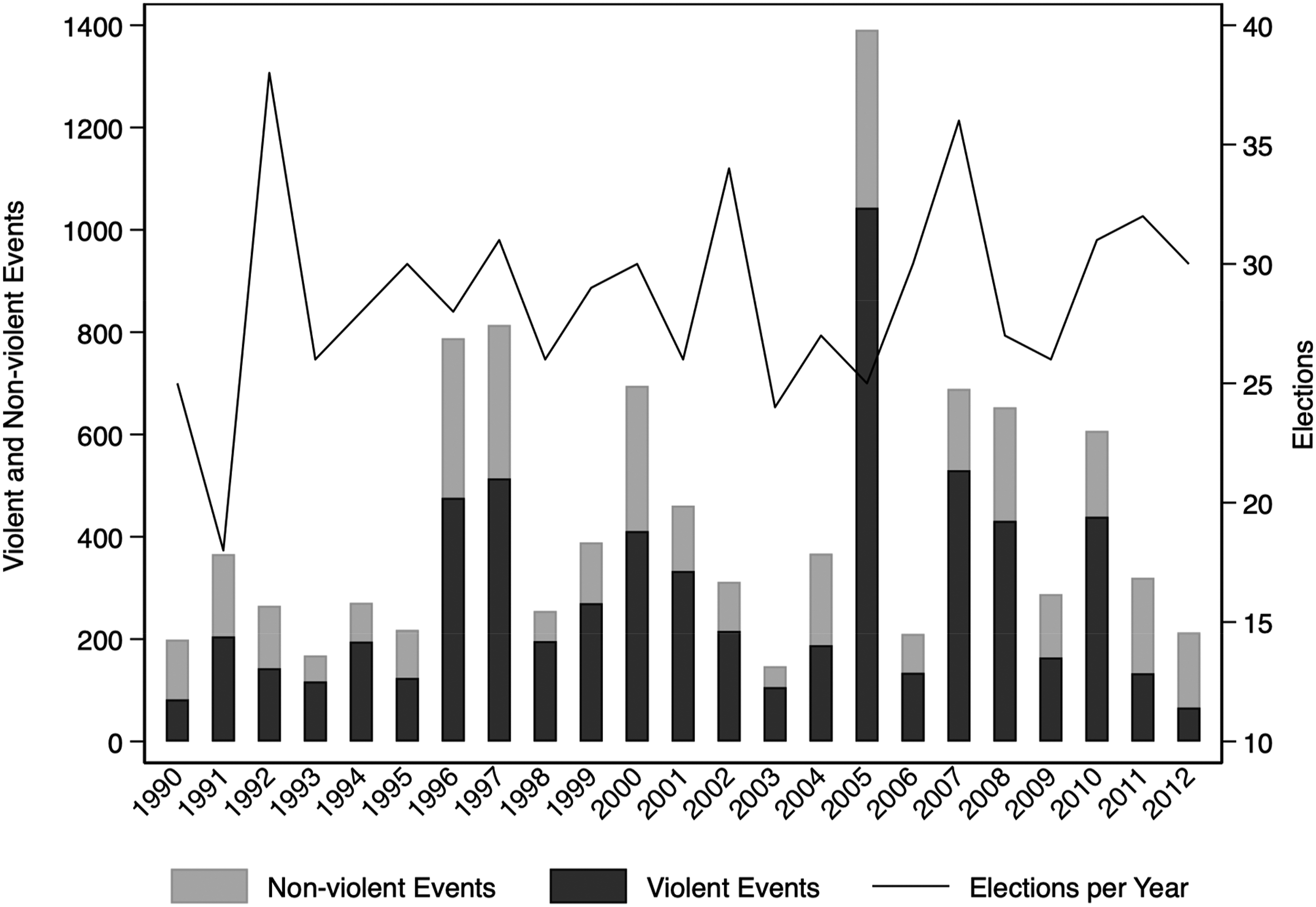
Figure 3 shows the geo-spatial distribution of Pre-election Violence and Female Representation. The blue shading depicts the average value of the proportion of women in the national legislature of a country for the years it appears sample. Black circles reflect the average prevalence of pre-legislative election violent events observed in a country during the years it appears in the sample. Larger circles indicate a greater prevalence of violence compared to smaller circles.
8
Because of the aggregation of these data, it is difficult to draw any conclusions about their relationship from the figure. Rather, it is simply intended to illustrate general patterns for each of the indicators. Female legislative representation and pre-election violence. Note. Mean proportion (for all sample years) of seats held by women in the lower house of the national legislature (shading) and the relative scale of pre-election violence per election (black circles) for states included in the sample. Countries in white are excluded from the sample.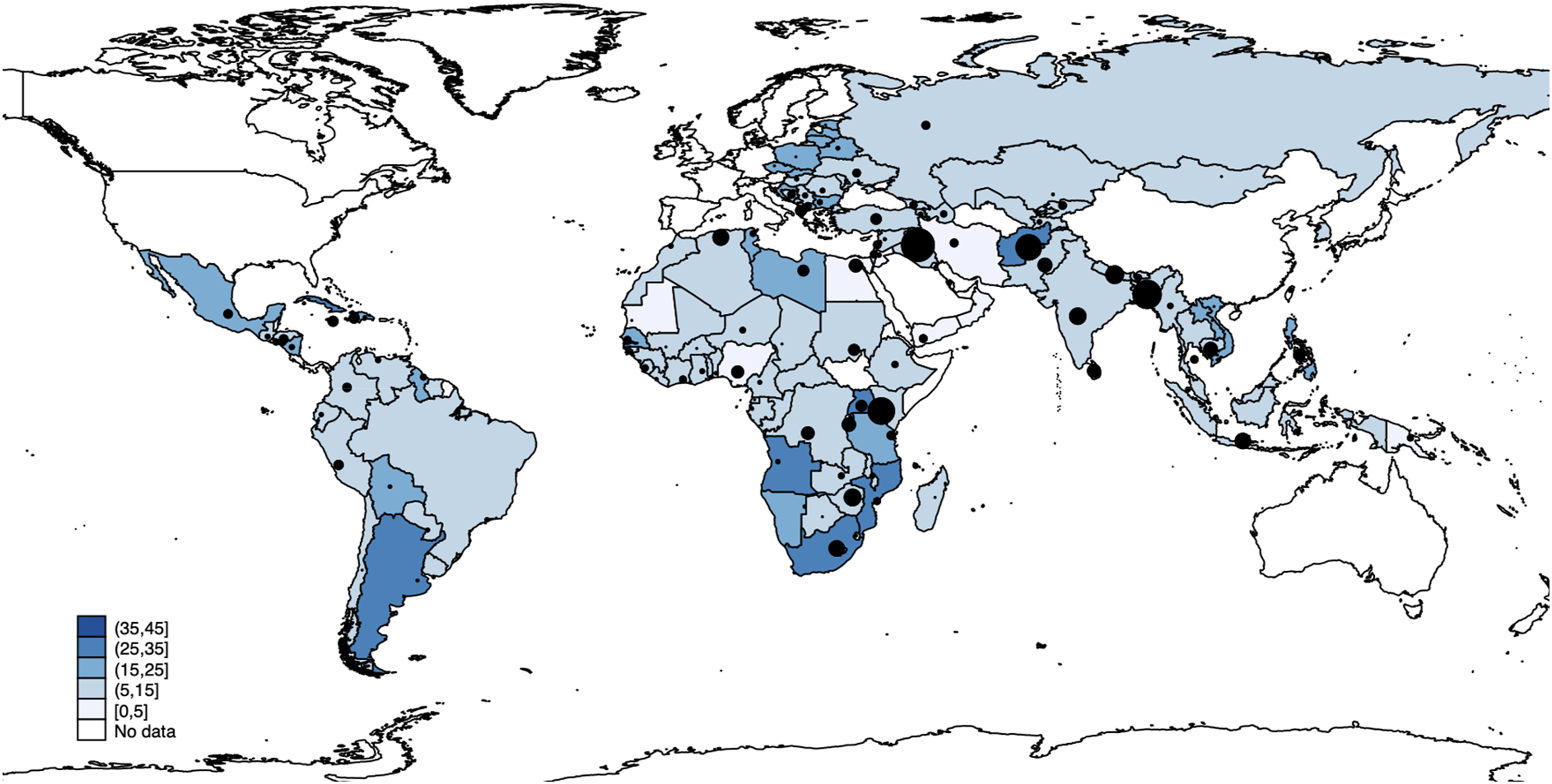
I include several important confounding variables in the empirical models. First, previous studies suggest that proportional representation systems produce greater proportions of female legislatures than other electoral systems. I therefore include the variable PR System, which is coded 1 if the electoral system uses proportional representation and 0 otherwise. Quotas mandating the number of female candidates or their placement on party lists and systems that reserve seats for women in the legislature have also been shown to increase descriptive representation. Quotas/Reserved Seats is a binary indicator reflecting whether national electoral laws specified reserved seats for women or gender quotas accompanied by at least weak sanctions for parties that violated them. This information comes from the V-Dem dataset.
I also include two measures that plausibly capture women’s status within society. Fertility Rate, which previous scholarship has routinely used as a proxy for societal gender norms, indicates the estimated average number of births per woman in the country. The proportion of women in the national legislature should also be greater in countries in which equality of participation in the political system is not only enshrined in law but at least nominally realized in practice. I therefore control for the extent to which a country embraces the principals of Egalitarian Democracy. Both measures come from the V-Dem dataset.
I also control for various characteristics of the broader security environment. International Conflict is a binary indicator coded 1 if a country experienced a militarized interstate dispute characterized by explicit “use of force” or “war” in the year of the election and 0 otherwise. Information for variable is taken from the MID5 dataset (Palmer et al. 2022). I control for the domestic security environment by including the variable Civil Conflict, which indicates whether the country was involved in an ongoing internal conflict that produced more than 25 deaths per year (Gleditsch et al. 2002; Pettersson 2023) (V23). The termination of civil wars, especially via negotiated settlements, creates new opportunities for women to enter politics and acquire political authority. I therefore include Post-peace Agreement, which indicates whether a civil conflict within the country terminated in a peace agreement in the decade prior to the election. Information for this indicator comes from Kreutz (2010) (V3). I also include the log-transformed values of the country’s GDP per capita and Population Size. Both measures are included in V-Dem.
The gender composition of legislatures is also a function of both time and previous political and bureaucratic processes. Incumbency and demonstration effects benefit female candidates (Shair-Rosenfield 2012); thus, the proportion of legislative seats held by women following the last election likely influences the proportion observed in the subsequent election. I control for temporal dependence by including a one-period lag of the dependent variable in the random effects models. Lastly, as Figure 1 illustrates, global rates of women’s representation exhibit a positive time trend. I therefore include year fixed effects in some specifications.
Results and Discussion
I present results from a series of linear regression models in Figure 4.
9
Results from models including country-level random effects are presented in the left panel while results for models including country-level fixed effects, which addresses unobserved heterogeneity across observations in the sample, are shown in the right panel. The final set of models in each panel (black circles) also include year fixed effects. Consequently, these models include “two-way” fixed effects accounting for unobserved heterogeneity across units and time points. Results are similar regardless of the estimator. The coefficients for Pre-Election Violence are negative and achieve statistical significance in most models. The model utilizing two-way fixed effects (Model 6), where the coefficient achieves only marginal significance (p = 0.08), represents a partial exception. Effects on proportion of legislative seats held by women. Note. Coefficient estimates (points) and 95% confidence intervals (horizontal bars) for predictors. Models include random or country fixed effects as noted. Models 3 and 6 (black circles) include year fixed effects (coefficients not shown).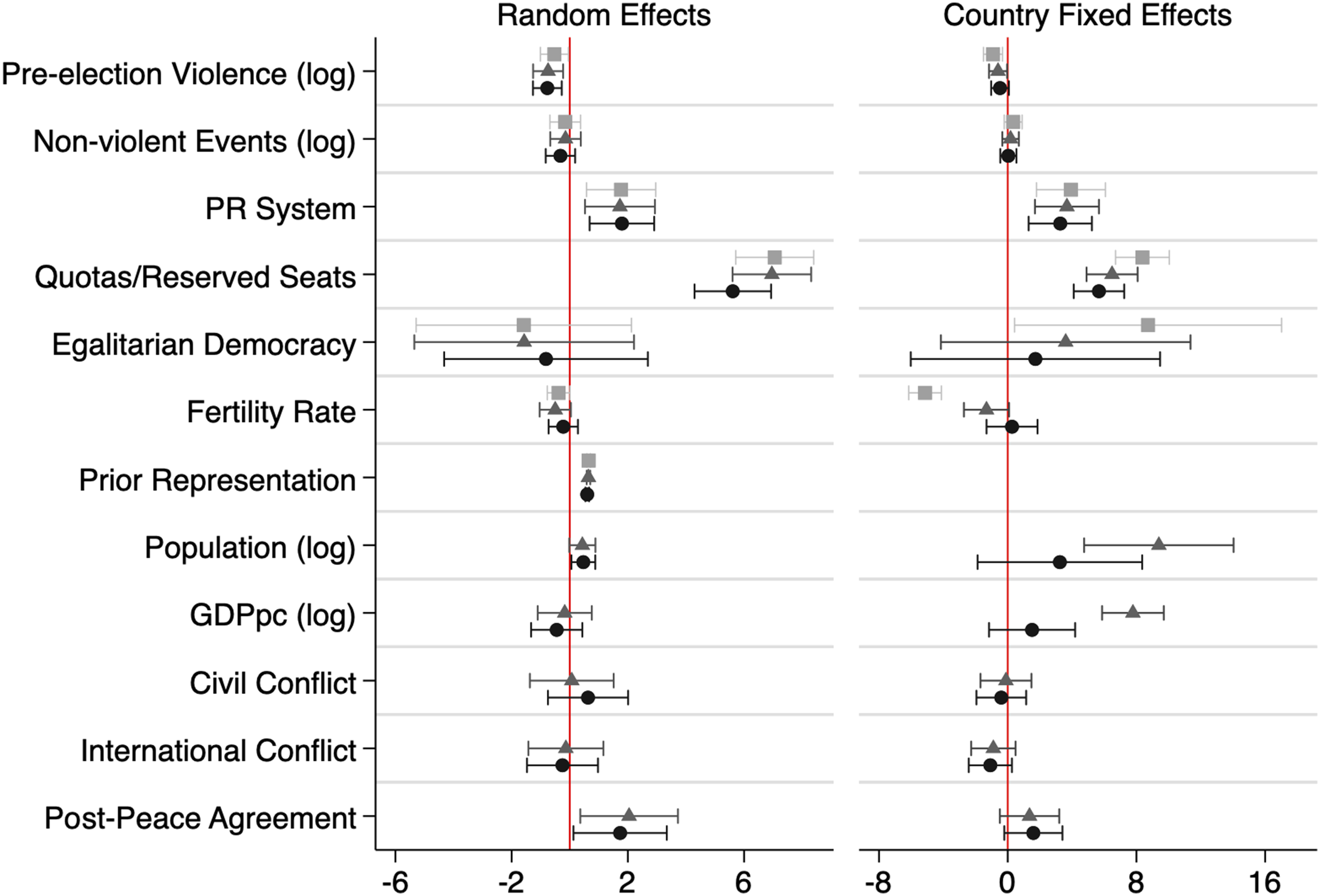
These results provide substantial empirical support for the primary hypothesis: more frequent pre-election violence is associated with a lower proportion of women-held seats in the national legislature. Conversely, non-violent contentious events are not strongly associated with the proportion of female representatives in the legislature. The coefficient for Non-violent Events is not significant in any model. While higher levels of explicitly violent events observed during the election period appear to reduce the rate of female representation, other forms of public contention do not. Given the frequency with which (non-violent) protests, harassment, and detentions are observed during elections in transitional and emerging democracies, this represents an important and arguably positive finding.
With respect to other covariates, the results confirm that the proportion of women holding seats in the legislature is substantially larger in countries with proportional representation systems than in those with other electoral systems. Consistent with previous studies, these results likewise suggest that quotas and reserved seat rules exert a substantively large and significant positive effect on the proportion of women in the legislature. Egalitarian democracy has little influence on female representation, only attaining significance in a single model. Higher fertility rates are significantly associated with lower rates of women’s representation in most of the models; however, the effect is insignificant in models including year fixed effects. This is perhaps due to a strong negative temporal trend in the measure. Nonetheless, it provides some evidence that in countries where women’s status is less closely tied to their traditional roles as mothers and caregivers, they are more likely to acquire positions of political authority.
Surprisingly, none of the variables accounting for other forms of security threats attain significance. The coefficient for international conflict is consistently negative but not significant, while the sign on coefficient for civil conflicts changes across the models. These results might obtain because unlike the measures of election-related violence, they are binary indicators and thus mask significant variation in threat levels. Notably, the coefficient on the indicator for civil conflict becomes significant and negative when the electoral violence measures is excluded (not reported), suggesting the general suppressive influence of domestic conflict on descriptive representation The variable accounting for elections held following a peace agreement is positive and significant in the random effects models and attains marginal significance in one of the fixed effects models. Thus, there is some evidence that description representation increases in the decade after a peace settlement.
Population size is positive and significant in three out of four of the models, indicating that larger populations are associated with a higher proportion of women legislators. GDP per capita is significant in only a single model, suggesting that national wealth and development are not strongly related to women’s success in achieving positions of political authority. This result is somewhat surprising given that modernization hypotheses often imply that women’s access to politics should increase as countries develop more advanced economies. Unsurprisingly, previous rates of women’s representation are a strong predictor of current representation. Finally, models including year fixed effects show strong growth in women’s descriptive representation over time. Coefficients for the year dummies (not reported) imply that more recent years are significantly associated with a larger proportion of female representative relative to the baseline year of 1990.
Figure 5 shows the predicted effect of Pre-election Violence on Female Representation based on results from the fully specified random effects model (Model 3). Holding other measures at their mean values, women are expected to hold approximately 13% of seats in the national legislature when pre-election violence is held at the mean for the sample (1.1 on the logged scale [∼3 violent events]). However, at violence levels one standard deviation above the mean (∼2.5 on the logged scale [∼12 violent events]), the proportion of seats held by women declines to roughly 11.5%. Moving from the minimum observed level of violence (0) to the maximum (6.6 on the logged scale [755 events]), the rate of female representation falls from 14% to under 9%. In absolute terms, this reflects a modest 5-point drop in women’s legislative representation. However, this translates into a striking 37% decline in the overall proportion of women-held national legislative seats. Given global interest in reducing barriers to women’s access to political authority, these predictions suggest that election-related violence exerts a substantively meaningful influence on women’s representation. Its persistence in many countries therefore represents a significant impediment to those goals. Marginal effects and distribution of pre-election violence. Note. Predicted effect (solid line) and 95% confidence intervals (shading) of Pre-election Violence (x-axis) on Female Representation (y-axis). Bars depict the frequency of given levels of Pre-election Violence observed in the sample.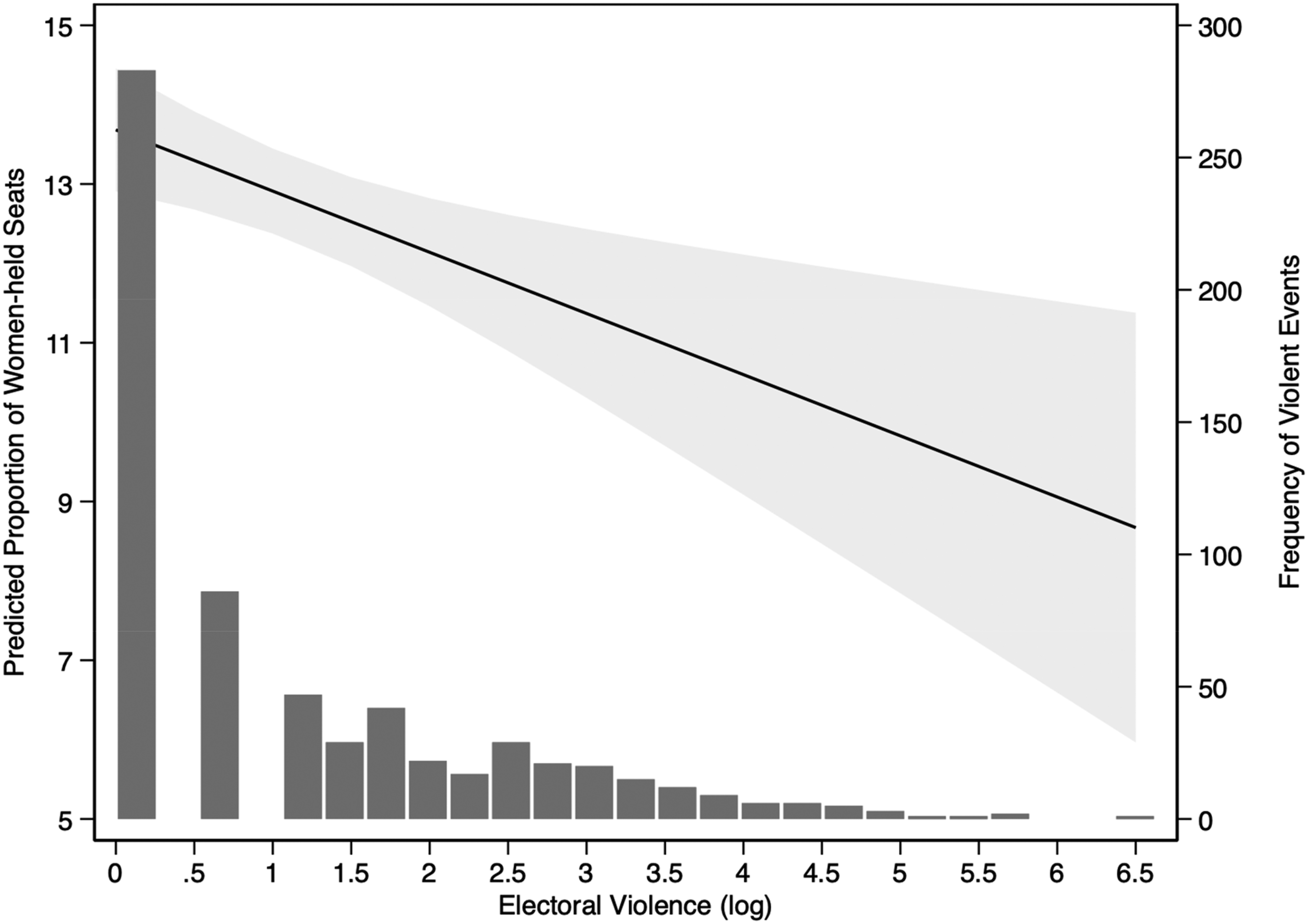
Robustness Checks and Extensions
To assess the robustness of these results, I also conducted a series of additional analyses using alternative samples, controls, and estimation techniques. Owing to NELDA’s minimalist definition of competition, the sample includes numerous cases where electoral competition among parties is severely constrained in practice. The argument, however, is partly predicated on the assumption that voters influence the outcome of elections through their preferences over candidates. The inclusion of cases where vote choice and competition are severely constrained potentially violates this assumption. I therefore re-estimate the models after excluding 72 elections (12% of the sample) that V-Dem codes as uncompetitive or significantly constrained competition. The results of these models are very similar to those presented above (Table A2), demonstrating the robustness of the results to cases where the argument is most applicable.
While measures such as fertility rates or women’s rights often serve as proxies for societal gender norms, they may inadequately account for voters’ beliefs and preferences regarding women’s leadership. This challenge is particularly relevant for this study because voter preferences, which are influenced by gender biases, represent one of the key theoretical mechanisms. I therefore evaluate additional models that include the indicator Prefer Male Leaders, which I construct from the World Values Survey data (Inglehart et al. 2014). 10 The WVS is only deployed at semi-regular intervals and does not include all countries. Thus, even after interpolating values between WVS waves, the inclusion of this indicator reduces the sample size by 70% (180 observations). Despite the diminished sample, the results are consistent with those presented above, further highlighting the robustness of the relationship between election-related violence and descriptive representation. These results, along with those including alternative proxies for societal gender norms, are in the appendix (Table A3).
Endogeneity bias represents an additional challenge to establishing the robustness of the results. If electoral violence is systematically correlated with unobservable factors that predict women’s descriptive representation, any relationship between the two variables could be spurious. To address this concern, I conduct additional analyses using an instrumental variable framework. Specifically, I use two-stage least squares regression and include a measure indicating the extent to which the previous election were deemed Free and Fair well as the natural log of the Victory Margin of the winning party in the country’s most recent elections (executive or legislative) as exogenous instruments for Pre-election violence. 11 Both indicators predict pre-electoral violence but should remain uncorrelated with the error structure of the model, thus meeting the exclusion restriction. The results of these models (Table A6) are consistent with those presented above and provide additional support for the principal hypothesis. Finally, I reiterate that by design the primary independent variable (Pre-election violence) precedes the dependent variable. There are thus few concerns regarding reverse causality because it is highly unlikely that the proportion of seats held by women following the election influences the prevalence of violence observed prior to it.
Conclusion
Despite increasing awareness by policymakers, activists, and international organizations of the gendered consequences of social and political violence, few studies have sought to empirically evaluate the effects of such violence on women’s political participation or their access to positions of political authority. Recent studies have, however, provided robust evidence that persistent external threats and heightened security concerns disadvantage female candidates and female political leaders (Hadzic and Tavitz 2021; Holman, Merolla, and Zechmeister 2022), thereby reducing descriptive representation (Kang and Kim 2020; Schroeder 2017). This study contributes to this important area of inquiry by demonstrating that this relationship is not limited to comparatively rare forms of high-profile violence such international war and transnational terrorism; rather, more routine forms of violence—such as the physical violence, threats, and intimidation that occur during elections in many countries—likewise adversely impact women’s opportunity to participate in political decision-making.
The comparatively low proportion of women in high-level political positions in most countries reflects both persistent biases and overt discrimination that disempowers women and diminishes their ability to contribute to the processes of collective decision-making that impact their lives. Promoting women’s descriptive representation is therefore important from a normative perspective as it represents a key dimension of equality that women are often denied. Moreover, mounting evidence suggests that diversity in political leadership and the inclusion of female voices in policy debates affects policy outputs, shapes perceptions of governance, and contributes to peace and stability. Recognizing these potential benefits, the international community has devoted substantial attention to reducing the barriers to women’s entry into politics and policymaking.
This study identifies an important but under-examined impediment to these efforts. Much of the contemporary effort to enhance women’s participation in political leadership focuses on encouraging women to run for office, recruiting female candidates, and encouraging parties to nominate more female candidates (e.g., Krook and Norris 2014). Yet, the results above imply that efforts to increase the supply of qualified female candidates may not necessarily translate into greater numbers of female legislators. Election-related violence, which is prevalent in many of the places where these efforts are focused, creates distinct disadvantages for female candidates and ultimately harms their ability to win seats in the legislature. Conversely, the results imply that improving domestic security during elections and reducing pre-election violence should contribute to an increase in the proportion of women holding seats in the legislature.
Previous studies have identified numerous strategies and tools that can successfully ameliorate pre-election violence and help ensuring the orderly conduct of campaigns and elections. These include international election observes, integrating election monitoring and support activities into multinational peacekeeping missions, and providing pre-election technical assistance and training to security forces and election officials (Birch and Muchlinski 2018; Smidt 2020). An implication of this study is that by reducing electoral violence, these activities also remove an important barrier to women’s access to position of political. This suggests that important synergies exist between programing and strategies designed to promote security during elections and efforts to expand women’s participation in politics and policymaking. International actors increasingly recognize the overlapping and mutually supportive nature of these strategies. Emerging evidence also suggests that such strategies can promote women’s political participation and women’s rights (Blanton, Peksen, and Blanton 2023). However, additional research is needed to examine whether such efforts translate into improvements in descriptive representation.
Despite the robustness of the results, this study nonetheless has limitations. First, the level of aggregation of the data obscures important geographic variations in both election-related violence and election outcomes. Electoral violence is often localized, distributed non-randomly within a country, and driven by local-level social and political factors. Data aggregated to the country-level is unable to account for such variations, and therefore the analysis does not link the specific locations of violence to the success of female candidates in geographically defined electoral districts. Rather, it assumes that exposure to violence is distributed evenly across the country and affects candidates and voters in a similar manner regardless of their geographic proximity.
Second, and arguably more problematic, data restrictions also prohibit quantitative tests of the causal processes elaborated above. Ideally, it would be possible to adjudicate among the different mechanisms by examining the effects of violence at each stage of the recruitment process. However, this would require significantly more nuanced data than is currently available. Unfortunately, reliable cross-national, district-level data capturing the gender of the winning candidates does not currently exist for a sufficiently large enough sample to conduct such as an analysis. Data accounting for the number of female candidates running in each election—even aggregated to the country-level—is also unavailable for most countries in the sample. Current data constraints therefore preclude more nuanced investigations of these relationships and more specific tests of the theoretical mechanism. I therefore treat these results as a starting point for investigating of these important dynamics. However, I highlight the growing need to collect more fine-grained data on various facets of women’s participation in elections and political institutions.
Supplemental Material
Supplemental Material - The Effects of Electoral Violence on Women’s Legislative Representation
Supplemental Material for The Effects of Electoral Violence on Women’s Legislative Representation by Reed M. Wood in Political Research Quarterly
Supplemental Material
Supplemental Material - The Effects of Electoral Violence on Women’s Legislative Representation
Supplemental Material for The Effects of Electoral Violence on Women’s Legislative Representation by Reed M. Wood in Political Research Quarterly
Footnotes
Acknowledgments
I wish to thank Atsushi Tago, Nelson Ruiz, and the other participants in the WE-SPICE workshop at Waseda University for their feedback on an earlier version of this paper. I also wish to thank Hyeran Jo and Sarah Shair-Rosenfield for their helpful suggestions. I offer my gratitude to Laura Sjoberg and Miki Caul Kittilson for support and guidance at the outset of this project. I thank the Leverhulme Trust for the generous support it provided for this project (RF-2023-569\7).
Declaration of Conflicting Interests
The author(s) declared no potential conflicts of interest with respect to the research, authorship, and/or publication of this article.
Funding
The author(s) disclosed receipt of the following financial support for the research, authorship, and/or publication of this article: This work was supported by the Leverhulme Trust (RF-2023-569\7).

Supplemental Material
Notes
References
Supplementary Material
Please find the following supplemental material available below.
For Open Access articles published under a Creative Commons License, all supplemental material carries the same license as the article it is associated with.
For non-Open Access articles published, all supplemental material carries a non-exclusive license, and permission requests for re-use of supplemental material or any part of supplemental material shall be sent directly to the copyright owner as specified in the copyright notice associated with the article.
