




Abstract
The contributions to this special issue examine the politics of domestic and international climate policy, concentrating on the role of institutions, interests, ideas, and networks. The outcomes of the policymaking processes are assessed with regard to their proportionality, that is, the balance between the benefits and costs of a policy. The contributions show that climate politics can lead to policy under- and overreactions. This introduction sets out the common research interest of the special issue and explains how the individual contributions relate to each other. To this end, it begins by providing the rationale for adopting the analytical perspective of comparative politics. Then it presents the conceptual framework and gives an overview of the contributions to this issue. Subsequently, it develops a research agenda that highlights avenues for future research and offers a brief conclusion that reflects on the potential of the concept of (dis)proportionality to advance the cumulative knowledge on climate politics and policies.
Introduction
Climate change entered the political agenda in 1988 with the Toronto Conference on the Changing Atmosphere and has experienced fluctuations in attention levels ever since. National governments committed themselves to addressing climate change through the adoption of the United Nations Framework Convention on Climate Change (UNFCCC) in 1992, marking a peak in political attention. The parties to the UNFCCC have met annually from 1995 onwards at the Conference of the Parties (COP) to evaluate progress in tackling climate change. Important milestones were reached, first in 1997 with the establishment of the Kyoto Protocol to limit the greenhouse gas (GHG) emissions of industrialized countries. This was followed in 2015 by the adoption at COP21 of the Paris Agreement, which relies on nationally determined contributions (NDCs), that is, efforts by each country to reduce national GHG emissions (see, e.g., Falkner, 2016; Morrison et al., 2017; Tobin, 2017; Tobin et al., 2018). All countries that have ratified the Paris Agreement are obliged to report regularly on the adoption and implementation of policy measures that reduce GHG emissions, thereby helping them reach their self-determined goals – a common mechanism in various areas of international governance (see, e.g., Sawer, 2021).
Thus, while the Paris Agreement has created a system of pledges that are voluntary only, it is noteworthy that these reporting requirements will produce information that can be reviewed and compared, which, in the best-case scenario, will lead to an upward ratcheting through ‘naming and shaming’ (Falkner, 2016: 1107). The central role of NDCs in the post-Kyoto climate regime increases the relevance of domestic politics for the study of climate change governance. Previously (and understandably), the governance of climate change was studied predominantly from the perspectives of international relations and international political economy (Bernauer, 2013). Yet some earlier studies (Harrison and Sundstrom, 2007, 2010) and many newer ones have alluded to the importance of domestic politics, as well as the interaction between the domestic and international or transnational levels for explaining international climate negotiation outcomes (see, e.g., Castro, 2020). A specific body of research takes this argument a step further by highlighting the importance of subnational actors such as regional governments and cities (Jordan et al., 2015; Morrison et al., 2017) and networking among subnational actors such as the Covenant of Mayors, launched in 2008 with the ambition to gather local governments in Europe committed to achieving and exceeding climate and energy targets as defined by the European Union (Domorenok et al., 2020).
In the end, most climate change policies are made and implemented by national entities – it is therefore crucial to understand this particular level of governance. This area of research in political science has elaborated on the role of government behavior and the institutional arrangements in place in the individual states, including the degree to which they a well-functioning democracy, as well as the role of civil society and the economy, science-policy interface, and public opinion (Bernauer, 2013: 437–438). These factors can be summarized by the following overarching explanatory variables that feature prominently in comparative public policy and comparative politics: institutions, interests, and ideas (see, e.g., Harrison and Sundstrom, 2007). Shearer et al. (2016) suggest extending this list of explanatory variables to networks, as we do here. Consequently, this special issue is interested in furthering our understanding of how institutions, interests, ideas, and networks affect climate politics and the corresponding climate policy outputs (see, in particular, Carter and Little, 2020; Leiren et al., 2020) and outcomes (see, in particular, Kalinowski, 2020; Upadhyaya et al., 2020).
The remainder of this introduction unfolds as follows. First, we provide a rationale for the adoption of a country-comparative approach, which is then followed by the presentation of our conceptual framework. Subsequently, we provide an overview of the contributions to this issue before, in a final step, we present a research agenda that highlights avenues for future research as well as a brief conclusion.
Rationale for the country-comparative approach
The analytical perspective of this issue is country-comparative and concentrates on domestic decision-making with regard to the national and international levels of climate politics. Compared with an analytical framework, which investigates the negotiation of international agreements, this perspective offers many more potential insights for comparative politics scholars. One advantage of the national-level approach is that we can examine how specific national climate policies come about and how their adoption affects international climate policies through vertical policy diffusion and ‘upscaling’ (Ostrom, 2010) as well as international climate politics (see, e.g., Harrison and Sundstrom, 2007, 2010). Likewise, studies focusing on domestic politics can assess the way in which initiatives beginning at the international level are processed and reacted to by domestic policymakers. For example, in an explicitly comparative analysis, Harrison and Sundstrom (2007) demonstrate the effects of having ratified the Kyoto Protocol on the levels of GHGs emitted by states. While ratification did not always produce lower GHG emissions, it did appear to have an effect in some cases such as Germany, the UK, and Russia. Further, this work demonstrated the importance of domestic political factors such as institutions and elections on the policy choices made, as well as the consequences of those policy choices in terms of policy outcomes.
There have been several attempts to assess the patterns of climate policies adopted by individual national governments. Among them, Dubash et al. (2013) show that national climate policies increased in number between 2007 and 2012. They also suggest the existence of regional patterns and a catch-up dynamic in Asia and Latin America. Fankhauser et al. (2015) support the finding that the adoption of climate policies has grown over time, now forming a major aspect of public policy. In this context, it is important to note that climate policy mostly consists of measures for expanding energy produced from renewable sources and efforts to use energy more efficiently (Tosun, 2018).
While we can witness growing similarities among countries concerning climate policies, important cross-country differences still exist, as illustrated by Figure 1, which presents the data for national and international climate policy performance for the G20 countries as well as the guests to the organization’s 2019 summit, for which the Climate Performance Index provides data (Bruck et al., 2018). 1 The data are based on the opinions of climate policy experts, who judged the importance of certain policies and specific measures taken by national governments, as well as the implementation statuses of these measures and their effects on the reduction of GHG emissions. The data report scores that range from 0 to 100 and differentiate between national and international climate policies. As we can see, there is a strong and positive correlation (Pearson’s correlation coefficient = 0.8) between national and international climate policies.
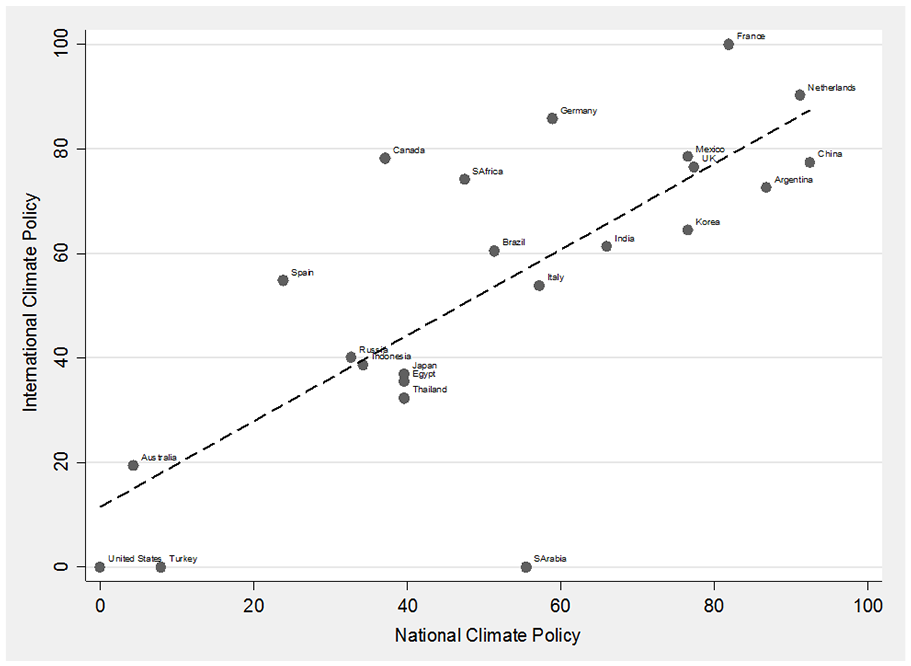
Relationship between international and national climate policy, 2019.
For example, the USA is characterized by a weak performance at both the national and the international level. The low score of the USA is the result of only the federal, and not the state level, being considered in the Climate Performance Index. Within the USA, California is the leading state in climate policy but some cities and municipalities have adopted even more ambitious climate policies at the local level (Homsy, 2018). This finding also points to the importance of electoral politics (Carter and Little, 2020), media coverage (Yagodin, 2020), and public opinion (Stadelmann-Steffen and Eder, 2020), with ‘green’ voters concentrated in some states such as California and in affluent cities, while other areas of the USA are dominated by voters less supportive of ambitious climate policies (Stokes and Warshaw, 2017).
Figure 1 also reveals cases in which there is a strong correlation between ambitious climate policies at the national and international levels. For example, China and the Netherlands are characterized by very good performance on both dimensions. For some countries, however, the relationship between national and international climate policies is weak. Figure 2 presents the residuals for the individual countries. Residuals are differences between the observed value and the mean value that the model predicts for that observation. Larger residuals indicate that the extent to which a model accounts for the variation in the observed data is limited. In other words, the covariate included in the model is not a good predictor of a given outcome variable.
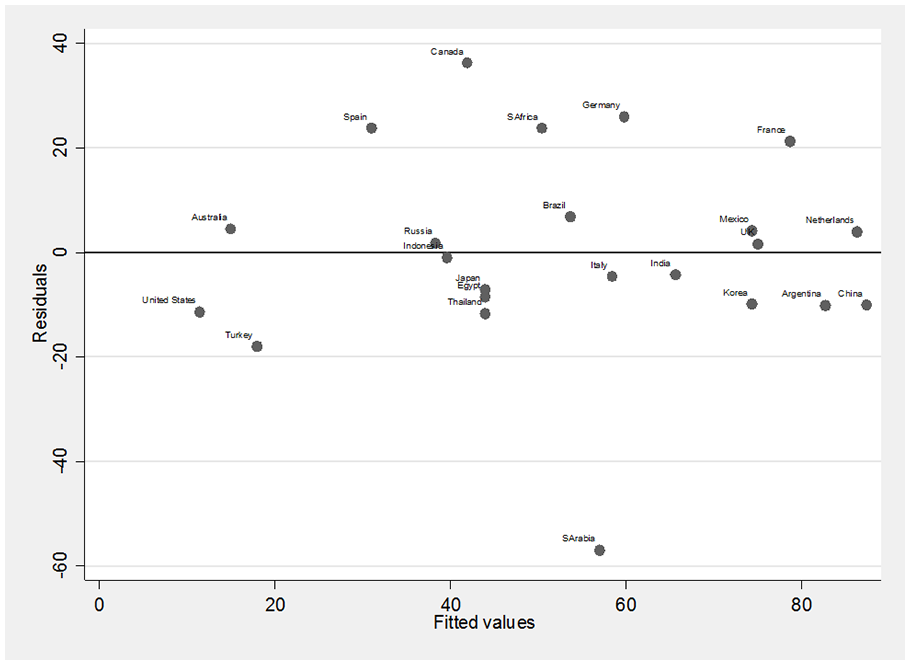
Residuals plot for the relationship international and national climate policy, 2019.
Based on this logic, the large residual for Saudi Arabia indicates that this is a case in which the relationship between national and international climate policy is particularly weak. As we can see in Figure 1, Saudi Arabia has a much higher – albeit, in comparison with other countries, low – score regarding its national climate policies relative to the international climate policies adopted, which explains the size of the residual for this particular observation in Figure 2. The opposite holds true for Canada, for instance, which demonstrates a better international than national performance in climate policy (see also, e.g., Tosun and Rinscheid, 2020). The authors of the Climate Performance Index note for Canada that there is an ‘increased gap between policy directions at federal and provincial levels, leading to a low rating for national climate policy’ (Bruck et al., 2018: 20). Thus, similar to the case of the USA, it appears worth investigating in detail climate politics in the individual Canadian provinces (see, e.g., Jones, 2014).
Overall, the data presented in Figure 1 support our choice of a country-comparative research design. Despite the existence of a single common global challenge, namely climate change, the policy responses to climate change still vary across countries and in federal polities even within countries. With the NDCs from the parties to the Paris Agreement and the corresponding shift to a bottom-up ‘pledge and review’ system (see, e.g., Falkner, 2016; Jordan et al., 2015; Morrison et al., 2017; Tobin, 2017; Tobin et al., 2018), it is likely that the cross-country variation in climate policies will persist.
We contend that the differences in climate policies depend on the respective institutions, interests, ideas, and networks in place in the individual countries. This perspective does not exclude a policy harmonizing effect at the international level such as exerted by the ratification of international climate agreements and the corresponding commitment to meet the GHG emission targets defined therein (see Harrison and Sundstrom, 2007). In contrast, it is flexible enough to accommodate both national and international factors explaining climate politics and its outcomes – a combination first discussed by Putnam (1988). Subsequent research has shown this to be superior to models that concentrate on either national or international factors (Bernauer, 2013; Fankhauser et al., 2015; Harrison and Sundstrom, 2007). What is more, our research perspective goes beyond explanations in the comparative politics literature such as studies contrasting democracies and non-democracies or parliamentary and presidential systems. As Figure 1 suggests, such factors alone can hardly explain the differences and similarities among the chosen set of countries.
Conceptual framework
The articles in this issue share two common features. First, all elucidate how institutions, interests, ideas, and networks matter for climate politics. The second common thread is that all articles reflect on the concept of disproportionate policy responses, which, in a nutshell, contends that there is no balance between the costs and benefits of a given policy (Maor, 2012, 2017a). We can differentiate between two forms of disproportionate policy responses: policy over- and underreactions. Policy overreactions are situations in which policymakers adopt a policy measure that imposes disproportionately high costs on the target groups given the policy measure’s expected benefits. Conversely, policy underreactions are policy responses that provide lower benefits than costs to the target groups (Maor et al., 2017b).
We have extended our conceptual framework to the dimension of disproportionality in order to provide a common metric for the assessment of the outcomes of climate politics. Three considerations induced us to choose this particular perspective. First, the basic differentiation between proportionate and disproportionate policy responses enables this issue to liaise with the literature on climate politics and policies that calls for the adoption of ‘sticky’ policies that cannot be easily watered down or dismantled by future generations of policymakers (Levin et al., 2012). Examples of climate policies that were repealed are abundant, such as carbon pricing in Australia (Crowley, 2017). Second, the concepts of policy overreactions and underreactions offer a different and potentially innovative perspective on politics. Most importantly, this perspective concentrates on the cost-benefit analysis of policymakers and additional behavioral aspects related to policymaking such as the overconfidence in policy expertise. Considerations about the ‘rationality’ of policymakers align with theories of decision-making in situations of uncertainty and risk, which is addressed by public choice research but less in classic comparative politics, with the exception of electoral risks, of course. Third, the concept of disproportionate policy responses, which is predominantly associated with the oeuvre of Moshe Maor (2012, 2017a), is an emerging one and the insights offered by this issue regarding its applicability to climate politics and policies can guide its future development.
One such contribution to this emerging literature is made by De Francesco and Maggetti (2018) and their proposed measure of disproportionate policy responses, which concentrates on the average policy response of countries and on the domestic-level variation in the magnitude of the stimulus that brought about the policy reaction concerned. The authors show that during the banking crisis of 2007 and 2008 there was variation in the proportionality of countries’ reactions. While we lack research that provides a systematic assessment of the different policy sectors, initial evidence supports the pattern observed by De Francesco and Maggetti (2018) that there exist both instances of proportionate and disproportionate policy responses to specific events. In this regard, Howlett and Kemmerling (2017), Gillard and Lock (2017), Maor et al. (2017b), and Peters et al. (2017) present evidence that disproportionate policy responses also exist in climate policy. In fact, considering the characteristics of climate change among which is the need for immediate action in order to prevent harm in the future (Levin et al., 2012), this particular policy issue represents an almost ideal locus for investigating the factors that lead to (dis)proportionate policy responses.
Maor et al. (2017b) consider disproportionate policy responses to climate change to be deliberate decisions taken by governments and propose a list of factors that are likely to result in such measures. The first factor introduced by the authors refers to the domestic economy and its expected wins and losses resulting from climate change (see also, e.g., Meckling and Nahm, 2018). If economic actors conceptualize climate change as an opportunity for business, they may not only support proportionate policy responses but also demand policy overreactions. Conversely, if climate policies are perceived as detrimental to economic activities, we can expect to observe underreactions. An insightful example is provided by Tobin (2017), who explains the surprisingly unambitious climate policy of Austria by its specific social partnership governance model and the influence of labor union on policymaking. The labor unions want to protect jobs and therefore oppose climate policies they consider threaten employment security.
The second factor relates to public support for climate action, which again can result in proportionate, but also disproportionate, policy responses. This relationship can affect climate politics and the corresponding policy outputs not only in the present but also in the future as Stokes (2016) shows, for example. The analysis reveals that US voters were informed about the climate policy decisions of policymakers and punished governments responsible for wind energy projects in the next elections. Consequently, politicians learning about this effect could opt for underreactions in order to avoid electoral punishment as also argued by Howlett and Kemmerling (2017).
The third potential factor refers to focusing events (e.g. floods, droughts, and other weather-related disasters), which Maor et al. (2017b) expect to result in some degree of policy overreactions. In this context, it will be important how many weather- and climate-related hazards states experience. As Dilling et al. (2017), for example, show, the more types of hazards local governments experienced, the more policy actions they are likely to take. Consequently, policy overreactions are more likely to occur when countries experienced many weather- and climate-related hazards.
Fourth, Maor et al. (2017b) acknowledge that domestic politics is affected by the international level and therefore argue that, considering the inevitability of climate change, national governments might overreact in order to establish domestic climate policies that put other countries under pressure, giving them a strategic advantage in international climate politics. For example, Germany has been known as a ‘climate leader’ that strives to upscale its ambitious policies to the European and then to the international level (Tobin, 2017), including for strategic reasons, such as the creation of an international market for clean energy technologies (see also Tosun and Rinscheid, 2020).
In this issue, we employ a modified version of the conceptual model put forward by Maor et al. (2017b). We concentrate on institutions, interests, ideas, and networks in explaining climate policy choices. Evidently, these four dimensions are not independent from each other. So for example, the degree to which interests can influence policy decisions is determined by institutions. Nonetheless, differentiating among these four dimensions is useful since it facilitates a more precise understanding of climate politics and how it brings about certain climate policies. Therefore, the contributions to this issue concentrate on one of these dimensions, but they will typically also take into account some others in order to explain the respective phenomenon of interest.
We argue that the output of policymaking is the result of various inputs and how these are processed by the actors involved. The processing in the narrow sense occurs within institutions. In this context, a state’s capacity should be critical for the climate policy outputs it produces (Meckling and Nahm, 2018). The design of government ministries and agencies, for example, should make a difference in terms of how scientific evidence on climate change is taken into account in the policy process and whether climate change is included in the political agenda (Tosun, 2018). What is more, we consider the state bureaucracy to be insulated to some degree from demands from both the public and interest groups, although it can be influenced very directly by experts, politicians, and political interests. Concerning the latter, the extent of potential influence depends on the administrative system’s level of politicization (Peters et al., 2017), with bureaucracies with numerous patronage appointments being easier to influence. Depending on the specific characteristics of the administrative system, state bureaucracies can facilitate proportionate or disproportionate responses to climate change policy needs. Further, depending upon the strengths of elements within the bureaucracy, the focus may be on climate change mitigation or adaptation.
Interests refer to the actors involved in the policy process as well as their power to shape policy decisions. We can roughly differentiate between public and private actors: the first include the government, parliaments, and political parties from which the members of the government and parliament are recruited. Research has shown that changes in the partisan composition of government and the head of government can result in far-reaching changes in climate policy (see, e.g., Crowley, 2017). How politicians perceive climate change and respond to it has been researched by Willis (2018), who explains that it depends on the politicians’ understanding of scientific evidence, their professional identity and perception as a representative of their constituencies, and their overall routines in policymaking. Private actors comprise business and civil society interests, which do not take policy decisions themselves but seek to influence them by pursuing direct access to policymakers or using indirect strategies such as drawing attention to climate issues via media coverage (Tresch and Fischer, 2015).
Ideas refer to the evidence on climate change as well as the climate-related values of individuals and organizations. In this regard, growing climate skepticism among the public in some countries has received enhanced attention. For example, in the USA, Evangelical Protestants are more skeptical about climate change than the religiously unaffiliated (Ecklund et al., 2017). Likewise, media coverage in some countries (e.g. Russia, see, e.g., Tynkkynen and Tynkkynen, 2018; Yagodin, 2020) is marked by denial of the anthropogenic causes of climate change, which is also one of the reasons for the public’s dismissal of it.
Networks refer to different collective actors forming an alliance with a view to influence climate policy. While organized business interests are already powerful in shaping climate policy responses, Wilkinson’s (2020) analysis of Australia shows that this holds even truer when they form networks with climate skeptics and politicians. But networks consisting of business interests only can also prevent proportionate responses to climate change (Meckling and Nahm, 2018). On the other hand, transnational city networks have the potential to strengthen climate policy by scaling up local-level policy experiments to the national level although they have yet to live up to this potential (Domorenok et al., 2020).
What institutions, interests, ideas, and networks produce proportionate climate policy responses? Under what conditions do they lead to disproportionate policy responses? These are the broad research questions that guide this special issue.
Overview of the contributions
This special issue comprises eight contributions. The contributions vary with regard to their respective analytical focus on institutions, interests, ideas, and networks. The contributions use different types of data and a wide range of methods for analyzing them, including single case studies, comparative case studies, content analysis, and regression analysis.
Are climate policies valence issues on which political parties of the left–right spectrum largely agree? Or are climate policies positional issues over which political parties compete and offer different positions? Neil Carter and Conor Little address this question by investigating inter-party competition over climate policy in Ireland and the UK. The authors find that the broader structures of political competition shape the patterns of party competition on climate policy. Furthermore, they allude to the importance of the relationships between political parties and interest groups and whether parties exist that ‘own’ the issue. This article offers an intriguing combination of the analytical elements that lie at the heart of this special issue (institutions, interests, ideas, and networks), whereas Merethe Dotterud Leiren, Tor Håkon Jackson Inderberg, and Tim Rayner add the perspective of disproportionate policy responses in their complementary study of British climate policy. The authors show that there existed instances of overreactions to climate change in the UK as political parties attempted to ‘out-green’ each other in response to public demand and pressure from non-governmental organizations. Despite the overall dynamics that stimulated surprisingly ambitious climate policy, when the individual policy instruments were designed, industry actors exerted considerable influence and the unambitious setting of these instruments turned out to reflect their interests.
Thomas Kalinowski’s study investigates the puzzling co-existence of policy over- and underreactions in Korean climate policy. On the one hand, the country pursues a weak climate policy in terms of carbon emission reduction goals. On the other, it has ambitious policies to promote green technologies. Kalinowski solves this puzzle by postulating that this is a result of Korea’s transformation from a developmental into a neo-developmental state that is no longer able to control the influence of business. This contribution links up nicely with the study by Leiren et al. and corroborates their finding that the dominance of business interests is more likely to lead to climate policy underreactions than overreactions. Further, it emphasizes the importance of the state’s capacity for controlling the influence of interest groups in order to adopt proportionate policy responses.
Dmitry Yagodin focuses on the relationship between climate change denial and public demand for climate policy at both the national and the subnational levels in Russia. As in Kalinowski’s case, this analysis presents an empirical puzzle: some regions in Russia respond actively to external climate-related initiatives but subvert local policy debates. According to Yagodin, this discrepancy can be explained by the media discourse on climate change: at the national level, media coverage dismisses climate science evidence as too uncertain, while at the regional level, changes in environmental conditions are not related to climate change or climate change is framed positively.
The contribution by Isabelle Stadelmann-Steffen and Christina Eder relates to the study by Yagodin to the extent that it also emphasizes the importance of public support for fighting climate change. The authors test whether the existence of renewable energy policies induces individuals to support measures for mitigating climate change. The analysis reveals that the existence of policies does not have an impact on individuals’ attitudes, at least not in the European countries included in the analysis. Instead, they observe a positive policy feedback in individuals with strong opinions on climate change or with high levels of political trust.
Paula Castro examines the coalition of Like-Minded Developing Countries, a large and heterogeneous group that brings together emerging, oil-dependent, and poor developing countries by elucidating domestic interests that provide the rationale for participation in the coalition. Owing to the heterogeneity of its coalition members, the group fails to speak with a unified voice. Castro transplants the concept of disproportionate policy responses to the international level, which has produced several policy underreactions to climate change by not producing international agreements that effectively limit carbon emissions to the optimal degree. The study shows that heterogeneous advocacy networks increase the likelihood of climate policy underreactions.
Jale Tosun and Adrian Rinscheid explore the motivation of national governments to join the Clean Energy Ministerial, which was founded in 2009 by the US Secretary of Energy, and how members performed in this organization concerning the adoption of renewable energy policies. The article shows that membership is the result of expected benefits, especially for domestic business and industry actors, and the leadership role of the USA in launching this organization, which induced many other countries to follow. Of the five countries (Australia, Brazil, Canada, China, and the United Arab Emirates) examined, the number of renewable energy policies adopted by Brazil and the United Arab Emirates vary to such a strong degree over time that the authors identify instances of disproportionate policy responses.
The article by Prabhat Upadhyaya, Manish Kumar Shrivastava, Ganesh Gorti, and Saliem Fakir examines the implementation of NDCs in India and South Africa. In order to prevent poor implementation of these voluntary pledges, the authors make a strong case for the need to increase the capacity of institutions that govern the cooperation between state and non-state actors. They contend that state actors need to be in a position where they can mediate between competing interests of non-state actors. If this is not provided, the policy outcomes produced by the NDCs are likely to correspond to underreactions.
Research agenda
Despite the insights provided by this collection, three broad avenues for future research on climate politics remain; namely the roles of political parties, state bureaucracies, and subnational governments.
Carter and Little and Leiren et al. argue compellingly in their contributions that political parties take different positions on different climate policy issues and showed that consensus among parties resulting from electoral strategic considerations does not necessarily result in more ambitious climate policies. What both articles suggest is that the networks of political parties and their affiliated interest groups need to be taken into account to explain climate policy positions and outputs. This aligns with the argument put forward recently by Wilkinson (2020).
We invite future researchers to pay enhanced attention to both political parties and their affiliated interest groups. It appears fruitful to further investigate voters’ preferences for certain climate policy instruments (and their settings) and to contrast these with the policy positions of individual parties – an analytical perspective complementary to that adopted by Stadelmann-Steffen and Eder.
Future research should also pay enhanced attention to the positions of left- and right-wing populist parties. The latter in particular have campaigned for climate policy to become less stringent since they often deny anthropogenic climate change. At the same time, some right-wing populist parties, for example, the Austrian Freedom Party, have a surprisingly ‘green’ profile. This observation for right-wing populist parties only holds true for some Western European countries. In other parts of the world, such as Brazil, right-wing populist leaders have a coherent and strongly negative stance on climate protection and related policy measures. In these countries, it would be interesting to examine how salient climate change is to the supporters of such parties and leaders by using data from the Latinobarómetro, for instance.
The article by Tosun and Rinscheid introduced the Clean Energy Ministerial, but did not look into how decision-making processes inside this organization function and how domestic bureaucracies prepare the annual meetings or form their preferences regarding the organization’s policy agenda. The same limitation applies to the study by Castro, which also could have benefitted from a more detailed analysis of the role and impact of ministries on the climate policy preferences put forward by the national representatives of individual countries. The study by Upadhyaya et al. alludes to the importance of institutional design and governance capacity, but it also pays limited attention to the role of state bureaucracies. Overall, an improved understanding of how state bureaucracies matter for climate politics appears promising to further our understanding of conditions that facilitate more proportionate policy responses to climate change (see Peters et al., 2017). In this context, it seems useful to analyze who serves in specific ministries in charge of climate policy (see Tosun, 2018) and how decisions are made within these organizations, and to what extent the competent ministries are subject to lobbying attempts by interest groups (see, e.g., Kalinowski, 2020).
The third and last avenue for future research concerns subnational governments and how they address climate change. Yagodin’s study on Russia has shown that it is analytically rewarding to extend the analytical focus from the national to the regional level. For example, in 2015, the governments of California in the USA and the German state of Baden-Württemberg founded the Under2 Coalition, which seeks to accelerate climate action. Today, the Under2 Coalition comprises more than 220 governments from 43 countries on six continents. 2 The most straightforward object of investigation would be to answer why governments choose to join this regional initiative. More generally, it would be interesting to examine the variance in climate policy positions between the governments at the national and subnational levels, as well as to explore the variance in positions between the individual subnational governments as research on Australia, Canada, and the US has suggested (Homsy, 2018; Jones, 2014).
Conclusion
What institutions, interests, ideas, and networks produce proportionate climate policy responses? Under what conditions do they lead to disproportionate policy responses? These two research questions guided this special issue on the politics of climate change, which, building on the extensive existing literature, sought to offer an improved understanding of domestic and international responses to this global challenge. The contributions to this special issue showed that the design of institutions is important for producing proportionate climate policy responses. If the state institutions lack capacity and cannot mediate between competing private interests or are even ‘captured’ by these (see Kalinowski, 2020), the likely outcome are policy underreactions (see Upadhyaya et al., 2020), which also holds true for international climate politics (see Castro, 2020).
Another important finding is that organized interests exert considerable impact on climate politics and the resulting policy outputs. Depending on the type of interests, they can produce both over- and underreactions as Leiren et al. (2020) showed. In the UK, very ambitious climate policy was adopted because of pressure exerted by non-governmental organizations, but business interests shaped the design of the concrete policy instruments adopted to put that policy into effect. In this regard, political parties as the organizations that supply members of government and parliament are in a critical position to mitigate the attempts by organized interests to influence climate policy and therefore parties’ positions on climate policy warrant enhanced attention (see Carter and Little, 2020). Since research in comparative politics has shown that political parties respond to their electorates when adopting positions on policy issues, the public and its perception of climate change is also an important determinant of the policy responses adopted (see Stadelmann-Steffen and Eder, 2020).
When speaking of party positions, these can be equated with the notion of ideas in the conceptual framework from which this special issue draws (see Yagodin, 2020). Evidently, ideas matter more in climate politics and for the policy outputs, but the contributions showed that interests are more powerful in the policy process than ideas (see Tosun and Rinscheid, 2020).
In addition to providing insights into how governments make policy in response to climate change, the authors in this special issue reveal the importance of understanding the proportionality of governmental responses. In the best of all possible worlds, governments would respond to policy problems in a measured, proportional manner. As we do not live in such a world, the contributions to this special issue show that governments often either over- or underrespond to the challenges presented by climate change. Moreover, many of the same factors that explain general differences in policy choices can also explain their proportionality. Understanding the causes and consequences of disproportionate policy responses to climate change represents a stimulating agenda for future research in comparative politics.
Supplemental Material
sj-pdf-1-ips-10.1177_0192512120975659 – Supplemental material for The politics of climate change: Domestic and international responses to a global challenge
Supplemental material, sj-pdf-1-ips-10.1177_0192512120975659 for The politics of climate change: Domestic and international responses to a global challenge by Jale Tosun, B Guy Peters, Jale Tosun and B Guy Peters in International Political Science Review
Footnotes
Acknowledgements
We thank the two anonymous reviewers and Marian Sawer for their generous comments and Laurence Crumbie for editorial assistance.
Funding
The authors disclosed receipt of the following financial support for the research, authorship, and/or publication of this article: This work was supported by the Innovations in Climate Governance (IS1309) program (European Cooperation in Science and Technology).

Notes
Author biographies
References
Supplementary Material
Please find the following supplemental material available below.
For Open Access articles published under a Creative Commons License, all supplemental material carries the same license as the article it is associated with.
For non-Open Access articles published, all supplemental material carries a non-exclusive license, and permission requests for re-use of supplemental material or any part of supplemental material shall be sent directly to the copyright owner as specified in the copyright notice associated with the article.
