




Abstract
Numerous studies suggest a relationship between women’s political representation and improved environmental outcomes. Yet, the contexts in which this holds and the mechanisms through which it comes to be remain understudied. This study proposes that women’s impact on political commitments to environmentalism and policy outcomes are moderated by states’ corruption levels. Although women tend to be more environmental, left-leaning, and risk-averse than men, environments of high-corruption restrain, tokenize, and marginalize women representatives, thereby limiting the impact they may have on environmental governance. Time-series cross-sectional analyses of 58 democracies across 15 years show women’s representation is correlated with better environmental outputs and outcomes, but only when corruption levels are low. These findings help broaden our understanding of the relationship between representation and environmental politics and suggest that the interaction of both integrity and inclusivity in governments holds a key to fighting climate change.
Introduction
A growing literature in political science’s subfield of gender and climate change has demonstrated a positive relationship between the participation of women in government and environmental outcomes, prompting some scholars to conclude that women’s increased inclusion in governance around the world will yield environmental benefit (Ergas and York, 2012; Fredriksson and Wang, 2011; Lv and Deng, 2018; McGee et al., 2020; Norgaard and York, 2005; Salahodjaev and Jarilkapova, 2020; Salamon, 2023). Yet, much of the criticism of this apparent relationship has stressed that women’s mere presence in governance does not always mean they have the necessary authority to change policies or outcomes. As Melody Valdini (2019: 72) argues in The Inclusion Calculation: Why Men Appropriate Women’s Representation, “women’s presence does not equal women’s power.” Without meaningfully engaging with the reality that “system[s] designed to privilege and maintain men’s power” (Valdini, 2019: 13) often inhibit women’s, understanding how and why women’s representation in democracies leads to better environmental outcomes has remained out of reach. Is the relationship between women’s influence in governance and environmentalism universal across democratic states? If not, why?
To address these questions, I pay special attention to the governance norms that may help or hinder women’s ability to influence environmental policy by focusing on the role of corruption as a moderator of the relationship between women’s representation and various environmental outcomes. Corruption, “the abuse of a public role for private gain” (Hough, 2013: 4), is a relatively common phenomenon around the world that erodes governance in both democracies and nondemocracies. Not only can corruption incentivize representatives to make policy decisions in line with corrupt interests, but it can disincentivize civic engagement itself (Hooghe and Quintelier, 2014). Corrupt behavior often results in detrimental environmental outcomes (Cole, 2007; Gennaioli and Tavoni, 2016; Goel et al., 2013; Koyuncu and Yilmaz, 2008; Vasylieva et al., 2019). Although existing literature investigates the impact of corruption on women’s access to parliamentary participation (Branisa and Ziegler, 2010; Esarey and Schwindt-Bayer, 2019; Goetz, 2007; Stockemer, 2011; Sundström and Wängerud, 2016; Sung, 2003; Tripp, 2001), my argument instead focuses on women parliamentarians’ ability to impact outcomes—in this case, environmental outcomes—in contexts of varying levels of corruption.
I put forth a theoretical basis for the moderating effect of corruption on the relationship between women’s representation and environmental outputs and outcomes. To test the proposed hypotheses, I estimate regression models using time series cross-sectional data from 58 democracies from 1997 to 2017. I find that where corruption is low, women’s representation is positively and significantly correlated with environmental outputs—political commitments to environmentalism—and outcomes—the resulting changes in emissions, renewable energy consumption, and deforestation (Bättig and Bernauer, 2009).
This research contributes to the growing understanding not only of how women influence political outcomes through increased inclusion in circles of power, but it also contributes to the literature on climate change policy, mitigation, and governance. It supports the idea that inclusion and integrity are key to good governance, and that such good governance is key to implementing policies that effectively combat the climate crisis.
Literature Review
In this section, I outline the relevant literature surrounding the linkages between women’s representation, corruption, and environmentalism. First, I review the existing literature regarding women’s environmental preferences and behaviors and the subsequent impacts of their increased representation on environmental outcomes. I then explore how corruption dampens women’s ability to be effective representatives. Finally, I address the antienvironmental impact of corruption.
Women’s Preferences, Representation, and Environmental Outcomes
Existing literature has extensively investigated the role of gender in shaping both policy preferences as well as political outcomes, particularly as the number of women representatives around the world has grown. This literature differentiates between descriptive representation, wherein the number of women in the electorate reflects the proportion of women voters, and substantive representation, where political outcomes reflect the political preferences of women voters (Wangnerud, 2009). Often, descriptive representation can lead to substantive representation (Clayton et al., 2019; Taylor et al., 2003; Tremblay, 1998), wherein increased inclusion of women in governance roles leads to increased reflection of women’s preferences in political outcomes. Women’s tendency to favor healthcare spending, family support programs, gender equality, etc. (Clayton et al., 2019; Dolan, 1997; Taylor-Robinson and Heath, 2003; Wittmer and Bouché, 2013, etc.) has helped put these issues on political agendas.
The mechanisms through which women make a difference in policy are debated: some evidence suggests that a critical mass of women is needed to put “women’s issues” on the agenda affectively (Childs and Krook, 2006), whereas others suggest that critical actors, or “those who act individually or collectively to bring about women-friendly policy change” (Childs and Krook, 2009: 126–127) are more effective at influencing policy. Yet, in either case, “the voice of women in the electorate is heard more loudly when a woman articulates the views on which women and men differ” (Ondercin and Bernstein, 2007: 50).
With particular regard to environmentalism, existing research shows that, as individuals and representatives, women tend to be more in favor of environmentalism than their male counterparts. Women are more knowledgeable about climate change, more worried about the consequences of climate change, more inclined to behave environmentally in light of climate change, more in favor of environmental protection measures, and more likely to perceive benefits of climate change mitigation, whereas men are more likely to perceive costs (Arnocky and Stroink, 2010; Bush and Clayton, 2023; Goldsmith et al., 2013; Hunter et al., 2004; McCright, 2010; Noblet et al., 2015; Semenza et al., 2011; Tranter, 2011). Green parties see high rates of women’s participation by marrying traditionally “women’s” issues with environmentalism (Keith and Verge, 2018; Kroeber, 2021).
Women also tend to be generally more left-leaning than men, even though “gender has never been a clear-cut cleavage determining electoral choice” (Abendschön and Stenmetz, 2014: 317) to the extent that, for example, class has been. Emmenegger and Manow (2014) show that women’s leftward tendencies are attributable to decreasing religiosity of both women and parties, coupled with women’s changing social roles; others assert that left parties have more successfully promoted issues important to women—like healthcare, childcare, welfare and social support, and economic equality—than those on the right (Keith and Verge, 2018). With women’s meaningful support of these issues, “the evidence suggests that the women’s vote translated into real impacts on policy and social welfare, even at a time [in which] women participated less in the electoral process relative to the present day” (Cascio and Shenhav, 2020: 25). Indeed, Greene and O’Brien (2016) find that women’s presence in political parties is associated with more left-leaning party manifestos while Kroeber (2021, 2022) finds that political parties headed by women and those which include more women as members increasingly support green positions.
Finally, research in psychology shows that women display more risk-averse tendencies than men. Holt and Laury (2002) show that men took more risky choices than women in lottery experiments; similar results are found by Dohmen et al. (2005), Powell and Ansic (1997), Eckel and Grossman (2008), and others (see Croson and Gneezy, 2009). Hinz et al. (1997) find that women participate in less risky investments compared to men. Croson and Gneezy (2009) argue that this could be due to emotional differences, as women report more fear and nervousness when anticipating negative outcomes relative to men (Croson and Gneezy, 2009: 452). In addition, they point to the tendency for women to be less overconfident than men in some situations (Estes and Hosseini, 1988) to explain why women may make less risky decisions. Regardless of the specific mechanisms for women’s greater risk aversion, climate change poses massive global risks to health, infrastructure, biodiversity, and survival. Since women are less prone to risk taking, they may be less likely to risk environmental health, and therefore favor environmental protection to a greater extent than their male counterparts.
The existing literature has established that women’s preferences are reflected in policy as their representation increases; this includes representation of climate-related preferences. Nations with higher proportions of women in parliament are more likely to ratify environmental treaties (Norgaard and York, 2005), create more protected land areas (Nugent and Shandra, 2009), have lower CO2 emissions (Ergas and York, 2012), experience less deforestation, and maintain more forest cover (Salahodjaev and Jarilkapova, 2020). Women legislators in the United States House of Representatives favor more stringent environmental policies (Fredriksson and Wang, 2011), and countries with higher women’s political empowerment see long-term reductions in CO2 emissions (Lv and Deng, 2018). Women members of the European Parliament were significantly more likely than their male counterparts to support environmental legislation (Ramstetter and Habersack, 2020), and although increases in GDP can often increase emissions, nations with more gender equality see a much weaker association between GDP and CO2 emissions (McGee et al., 2020). In high-income democracies, women’s representation correlates with increased renewable energy consumption over time (Salamon, 2023).
Although these findings suggest that women are both more environmental and risk-averse than their male counterparts and that their increased representation contributes to better environmental outputs and outcomes, this literature has not engaged sufficiently with the potential impacts of corruption on women’s ability to influence environmental policy. Thus, I next outline the role of corruption in women’s ability to realistically impact policy.
Women’s Representation and Corruption
The literature on women’s representation and corruption is deep and wide-ranging. Although much research has demonstrated that women’s increased presence in governing bodies decreases corruption (Brollo and Troiano, 2016; Dollar et al., 2001; Esarey and Chirillo, 2013; Rose-Ackerman, 2008; Swamy et al., 2001), that corruption is detrimental to human rights and therefore to gender equality (Sung, 2003), and that in countries with high levels of corruption, fewer women are elected to government to begin with (Dollar et al., 2001; Esarey and Chirillo, 2013; Stockemer, 2011; Sundström and Wängerud, 2016), what is most relevant to the present research are the consequences of high-corruption contexts for women parliamentarians.
First, corrupt contexts can both discourage and disallow women’s full participation in governance, hampering their potential to impact policy outputs and outcomes by helping to engrain existing power networks. Sundström and Wängerud (2016) argue that corruption causes “shadowy arrangements” which benefit the already privileged, usually men, and “pose a direct obstacle to women when male-dominated networks influence political parties’ candidate selection” (Sundström and Wängerud, 2016: 354). Similarly, Randall and Svasand (2002) show that, in corrupt governments, political seats may be filled through patriarchal clientelist networks which marginalize women candidates.
Next, corrupt governments often intentionally bolster women’s representation for the express purpose of increasing public trust. Research shows that the presence of women candidates decreases voters’ perceptions of election fraud (Barnes and Beaulieu, 2014); when women are both descriptively and substantively represented, public perceptions of corruption decrease (Watson and Moreland, 2014). Armstrong et al. (2022) find that although women’s presence as finance ministers increases with corruption: it is not simply the case that countries or leaders with an anti-corruption ethos are more likely to include women in politics, but rather that leaders who are likely to face electoral consequences for increasing corruption use women as anti-corruption symbols (Armstrong et al., 2022: 1).
Similarly, Valdini (2019: 63–64) argues that when corruption scandals take place: women’s inclusion . . . becomes a valuable strategy in this environment due to their association with honesty and democracy; without actually changing any of the factors that led to the corruption scandal, elites see an opportunity to use women’s inclusion as a means to repair the reputation of the party or government.
She finds that in the aftermath of Spain’s 1996 corruption scandals, the percentage of women candidates increased substantially in all parties, with the greatest increase in the corrupt party (Valdini, 2019). In addition, in postcorruption scandal contexts, women’s representation in legislatures increased by 9%, indicating greater voter support for women candidates (Valdini, 2019).
Corrupt governments may also instate gender quotas, or mechanisms that mandate a certain number of women to be included in government or party representation (Valdini, 2019). Similarly, quotas are often called upon in these corrupt contexts not to meaningfully include more women in governance but to benefit the already-powerful. Gender quotas can draw “good press” to parties or governments, appearing as permanent commitments to equality while actually being constructed such that they will be easily overturned by courts or made immediately ineffective; at the same time, they can disempower so-called “quota women” to the extent that the existing power of elites is actually bolstered (Valdini, 2019: 98). The “reproduction of patronage-based selection procedures means that quotas mainly provide illegitimate regimes with a solid block of supporters in parliament” (Bjarnegård et al., 2018: 108). Valdini (2019: 123) shows, with evidence from both Italy and Argentina, that “elites adopted a gender quota in each of these countries because they saw a potential political benefit from associating their governments with women in the post-[corruption] scandal context.” Thus, women elected in corrupt contexts, whether by quotas or otherwise, may have vastly different experiences as legislators relative to women in noncorrupt contexts.
Importantly, tokenized women representatives in corrupt contexts are constrained in their ability to influence policy. Clayton and Zetterberg (2021: 1) show with cross-national data from Africa that parties intentionally select women candidates with even higher party discipline than their male counterparts; once elected these women “are more constrained by expectations of party discipline than are men” because “as historical outsiders, [they] must do more to signal their commitment to the party” to maintain and sustain their political careers. In addition, women representatives elected in these contexts are constrained by “gendered expectations about proper behavior” which restrict them from taking political stances outside of their parties. Madsen (2019: 81) explores the ways in which increased inclusion of women in the Ghanaian New Patriotic Party (NPP) was used to bolster the party’s public perception; in reality, women were far from included, with one women MP recalling that “I had a member of Parliament tell me that I’m not in the kitchen so I should not be contributing to the debate in the committee.”
Conversely, where corruption is not the norm, women representatives are less likely than their male counterparts to engage in corruption. Esarey and Schwindt-Bayer (2019: 659) show that women are less likely than men to engage in corruption when “the risk of corruption being detected and punished by voters is high—in other words, when officials are held electorally accountable” because women are both more risk-averse and held to a higher standard than men at the polls. Women may also have less opportunity to engage in corruption due to exclusion from power networks (Branisa and Ziegler, 2010; Goetz, 2007; Tripp, 2001). Alexander and Bagenholm (2019: 187) find, in their analysis of Latin America and Europe, that women politicians “seem to be just as keen or even keener on fighting corruption” than men politicians. Furthermore, corruption decreases in countries in which women play larger political and economic roles (Branisa et al., 2013; Swamy et al., 2001). Thus, whether due to lack of opportunity or access, high-stakes consequences, or conscious opposition to corruption, the presence of more women in government will likely equate to less net corruption (Arriola and Johnson, 2014; Beck, 2003; Bjarnegård, 2013). In addition, women representatives’ policymaking choices may thus be less impacted by corrupt influences than men’s policymaking in uncorrupt contexts. Yet, where corruption is rampant, women representatives are just as corrupt as men (Esarey and Chirillo, 2013), and thus, any anticorruption benefits that arise from increasing women’s representation may not play out in corrupt contexts.
The Effects of Corruption on Environmentalism
Almost universally, corruption negatively impacts the environment. Because corruption often encourages politicians to accept bribes to limit the extent of environmental policies (Sundström, 2012), it is a leading source of environmental destruction (Desai, 1998). Although democracies are generally more committed to climate change mitigation and have lower CO2 emissions than nondemocracies, “the benefits of democracy for climate change mitigation are limited in the presence of widespread corruption” (Povitkina, 2018: 411). At all levels of economic development, corruption increases pollution past manageable levels (López and Mitra, 2000), weakens the authority of environmental policies and decreases pollution taxes (Damania et al., 2003), and “[reduces] the ability to respond to climatic stressors” (Rahman, 2018: 313). It diminishes the level of compliance with environmental regulations, encourages record falsification to hide harvesting of protected plant species (Wilson and Damania, 2005), and lessens compliance with fishing limits (Sundström, 2012).
Corrupt practices affect policy and implementation both immediately and long-term, as research on the impact of a corrupt legacy on environmental outcomes shows that “both the current level of corruption-control and the stock of [past corruption] matter for climate change policies and cooperation” (Fredriksson and Neumayer, 2016: 457); embeddedness of corruption “mean[s] that it will be more costly and take longer time to adapt to climate change” (Jacobson and Tropp, 2010: 85). The impact of corruption on environmental policies is “similar in magnitude to conventional explanations of environmental program strength, such as public environmentalism and state wealth [and] its impact is particularly pronounced in states with strong organized manufacturing interests” (Woods, 2008: 258).
Why Should Women’s Participation in Low-Corruption Contexts Result in Better Environmental Outcomes?
Building on this literature, I develop a theoretical framework suggesting a conditional relationship between women’s representation, corruption, and environmental outputs and outcomes. Because of the constraining effect of corruption on women’s influence in the legislative process, and the generally anti-environmental impact of corruption, I predict that the potential benefit of women’s representation for environmental outputs and outcomes suggested in the literature is conditional on corruption levels and that greater representation of women in parliament will improve environmental outputs and outcomes only in contexts of low corruption (see Figure 1). In these contexts, the increased inclusion of women’s left-leaning, environmental, and risk-averse preferences are more likely to manifest in environmentally friendly policy outputs and outcomes.

A Moderative Relationship.
Because high-corruption environments often foster election of women to expressly signal anticorruption commitment (Armstrong et al., 2022; Bjarnegård et al., 2018; Valdini, 2019), it is more likely that women be restrained, tokenized, and marginalized in these corrupt contexts. In addition, women may work in congruence with powerful elites in contexts of corruption (Esarey and Chirillo, 2013). They may also be disproportionately constrained by their party platforms to maintain their political careers (Clayton and Zetterberg, 2021) as powerful elites are incentivized to select women who are outwardly supportive of the individuals or parties in power, who are inexperienced and therefore more easily controlled, or both (Valdini, 2019: 12). Thus, environmental benefit should not arise from the inclusion of women parliamentarians in high-corruption contexts.
Because women continue to make up a minority of representatives in virtually every parliament in the world (and all those included in my sample), women’s proenvironmental preferences must survive passage through majority-male institutions to ultimately manifest in policy outputs and subsequent outcomes. Although male representatives have a lower likelihood of being in favor of environmental policy, increasing advocacy for environmental policy by women representatives could encourage more environmentalist support generally, which in turn could encourage new standards for environmental policy in parliaments. In addition, men in noncorrupt contexts are less beholden to antienvironmental corrupt interests which may allow them more freedom to vote in congruence with women and pro-environmental agendas, especially when they face accountability through functioning democratic processes (Esarey and Schwindt-Bayer, 2018).
Thus, I predict it will be unlikely to see positive environmental outputs or outcomes as a result of women’s participation in parliaments when they are hindered institutionally. In contexts of lower corruption, women are less likely to be corrupt themselves or to have gained office through elites’ tokenization methods. By extension, they are less likely to be marginalized, sidelined, and silenced by powerful elites. Therefore, women in less corrupt contexts retain more political power to put forth policy in line with their preferences. Thus, I predict that:
Because women in corrupt contexts are as likely as men to be corrupt (Esarey and Chirillo, 2013) and often chosen specifically for their commitment to a party or government status quo (Bjarnegård et al., 2018; Randall and Svasand, 2002; Valdini, 2019), it is probable that women’s influence on environmental outcomes in highly corrupt contexts will be insignificant or even negative. Gender quotas are often instated merely to “provide illegitimate regimes with a solid block of supporters in parliament” (Bjarnegård et al., 2018: 108) and can intentionally disempower so-called “quota women” to the extent that the existing power of elites is actually bolstered (Bjarnegård et al., 2018; Randall and Svasand, 2002; Valdini, 2019). Although women, even in highly corrupt contexts, may favor policies that better reflect women’s preferences more than men (Clayton et al., 2019; Taylor-Robinson and Heath, 2003, etc.), they may be inordinately restrained, tokenized, and marginalized in corrupt contexts. Thus, increases in the proportion of women representatives in corrupt contexts could signal even more active attempts to consolidate commitment to existing interests that result in environmental destruction. Thus:
Methodology, Data, and Variables
To test the relationship between climate change outcomes, women’s representation, and corruption, I analyze time series cross-sectional data from 58 democracies from 1997 to 2017. Although data for all necessary variables in this analysis are available for 89 countries, I do not consider nondemocracies in this analysis, as the theoretical framework I put forward should hold mostly, or only, in cases where democratic principles such as accountability, purposeful representation, equality, and universal suffrage are taken for granted and considered the norm. Although research shows that democracies often perform better environmentally than autocracies (Barret and Graddy, 2000; Bättig and Bernauer, 2009; Fredriksson and Neumayer, 2013), democracies’ environmental outcomes still vary (Escher and Walter-Rogg, 2020).
Due to the nature of the relationship I seek to uncover, I am interested in measuring the links between women’s representation and environmental outputs and outcomes that have been identified in the literature as particularly vulnerable to the effects of corruption. Bättig and Bernauer (2009) draw particular attention to investigating policy outputs, or political and legal commitments, and policy outcomes, the resulting changes in environmental measures such as CO2 emissions or forest area, side by side to help identify “words-deeds” gaps in governments’ approaches to policy issues and to acknowledge that policy outputs remain in control of policymakers to a greater extent than policy outcomes, which may be influenced by a host of other factors. Thus, I employ two categories of operationalizations of the dependent variable: policy outputs and policy outcomes.
Dependent Variable: Policy Outputs
Climate Change Readiness
Using the University of Notre Dame’s Global Adaptation Index’s measure of climate change readiness (Chen et al., 2015), I consider states’ level of preparedness for climate change as a policy output measure. The indicator is made up of three components. Economic readiness measures “the investment climate that facilitates mobilizing capitals from the private sector” (Chen et al., 2015: 4), governance readiness, which measures: the stability of the society and institutional arrangements that contribute to the investment risks, [as a] stable country with high governance capacity reassures investors that the invested capitals could grow under the help of responsible public service and without significant interruption,
and social readiness, which measures “social conditions that help society to make efficient and equitable use of investment and yield more benefit from the investment” (Chen et al., 2015: 4).
Corruption affects adaptation in a range of ways. As Mahmud and Prowse (2012: 933) argue, the success of adaptation initiatives in states that foster high levels of corruption “depends partly on the level of fiduciary risk (in other words, that adaptation funds are used for intended purposes).” Where funds are lost to corrupt interests, adaptation measures fall short. According to the OECD, infrastructure investment for climate change adaptation will require more than $6 billion a year through 2030, yet up to 33% could be lost to corruption (Timilsina, 2019). Similarly, Rahman (2018: 313) finds that corrupt practices in Bangladesh “significantly reduce the ability to respond to climatic stressors” and undermine adaptive capacity. Jacobson and Tropp (2010: 81) argue that corruption will increase water sanitation costs by more than $48 billion. Considering the effect of corruption on this indexed variable of climate change readiness may demonstrate whether adaptation initiatives will be more successful when a greater number of women are involved in governance in low-corruption contexts.
Dependent Variable: Policy Outcomes
Energy
To measure energy outcomes, I consider CO2 emissions per capita and renewable energy consumption as a percentage of overall energy consumption. Fredriksson et al. (2004) show that energy policy is impacted by corruption in that “greater corruptibility reduces the stringency of energy policy by shifting the government’s relative weight away from welfare towards bribes, making it cheaper to purchase government influence” (Cole, 2007: 638). Although the literature discusses in detail the existence of an environmental Kuznets curve (EKC) with regard to countries’ per capita income and pollution levels 1 (Cole, 2007; López, 1994), López and Mitra (2000) revisit this theory with specific attention to contexts in which corruption is high. The EKC assumes that policy is reflective of citizens’ preferences. Yet, if government activity is beholden to corrupt interests, the EKC model may not hold (Cole, 2007). The authors thus put forth that “corruption will increase pollution levels above the socially optimal level” (Cole, 2007: 638; López and Mitra, 2000).
Vasylieva et al. (2019) show that increased control of corruption correlates with significant decreases in greenhouse gas emissions. Goel et al. (2013: 516, 519) discuss the prevalence of under-reporting emissions in highly corrupt countries, finding that higher corruption levels decrease reported CO2 emissions by mis- or underreporting and that “corruption. . . [tends] to contribute negatively to (recorded) pollution levels.” Cole (2007) finds that corruption has a direct and positive impact on per capita emissions. 2
The literature on renewable energy consumption is, in part, conflicting, while offering some evidence that corruption acts as a negative influence. Bayer et al. (2013) find that corruption does not significantly influence innovation in the renewable energy sector. Yet, like most energy sectors which generate rents and require government oversight to operate, activity in the renewable energy sector has prompted “international organizations such as the World Bank, which have been involved in the financing of energy infrastructure in the developing world, [to recognize] the need to reduce corruption, often by trying to strengthen governance” (Gennaioli and Tavoni, 2016: 262). Corrupt and criminal association offenses increased by 6% in windier Italian provinces compared to less windy provinces during the growth of the wind power sector (Gennaioli and Tavoni, 2016). Control of corruption positively correlates with greater renewable energy consumption (Uzar, 2020).
I derive both measures—CO2 emissions in metric tons per capita and renewable energy consumption as a percent of overall energy consumption—from The World Bank (2021).
Natural Resources
To consider natural resource outcomes, I measure forest area as a percentage of total land area. Rates of deforestation have increased over time, particularly with the amplified demand for agricultural, farming, and logging resources caused by exponential population growth (Koyuncu and Yilmaz, 2008). In 2001, the UN Food and Agriculture Organization named corruption as a leading cause of deforestation (Koyuncu and Yilmaz, 2008: 216), especially due to the forest sector’s: high timber values, low visibility, low salaries of government officials, a far from standardized product, broad discretionary powers of local forestry officers to decide on a number of highly subjective matters, poor objective information, poorly-designed regulations, uneven distribution of power among players and the improbability of harsh punishment.
Corruption takes place through: the approval of illegal contracts with private enterprises by forestry offices, illegal sale of harvesting permits, under-declaring volumes cut in public forests, underpricing of wood in concessions, harvesting of protected trees by commercial corporations, smuggling of forest products across borders, allowing illegal logging, and processing forest raw materials without a license (Koyuncu and Yilmaz, 2008: 216).
Although petty corruption in the public sector is a significant predictor of forest loss, grand corruption in the executive branch also significantly reduces forest area (Sommer, 2017). For this reason, Koyuncu and Yilmaz (2013) find that privatization of forest areas decreases deforestation by reducing opportunities for corruption. Bulte et al. (2007) find that more corrupt governments pay more in subsidies to wealthy producers, at the cost of other public welfare spending, prompting more deforestation.
In this analysis, I use The World Bank’s (2021) indicator of forest area as a percent of overall land area.
Independent Variable and Controls
The main independent variables of interest are corruption and women’s participation in governance. Corruption is measured with the Worldwide Governance Indicators’ Control of Corruption estimate. This indicator measures “perceptions of corruption, conventionally defined as the exercise of public power for private gain” (Teorell et al., 2021: 541). Although an absolute measure of corruption would be ideal, the secretive nature of corruption makes it extremely difficult to measure, and thus perceived corruption is often used as a substitute (Esarey and Schwindt-Bayer, 2019). I re-code the variable such that higher values indicate higher levels of corruption. Data on the proportion of seats held by women in national parliaments comes from the Worldwide Governance Indicators of the World Bank Group, which I access from the Quality of Government Dataset (Dahlberg et al., 2020).
I include common control variables found in corruption, environmental, and women’s representation literature. A logged value of GDP per capita controls for the impact of state wealth and development on potential outcomes (Dahlberg et al., 2018); I control for a squared value of GDP per capita in models with CO2 emissions as the dependent variable because some literature finds a Kuznets curve in the relationship between gender equality and emissions (Cole, 2007; López, 1994). The level of democracy (Freedom House/Imputed Polity) measure is a scaled variable and ranges from 0, least democratic, to 10, most democratic. Because only democracies as characterized by Hadenius and Teorell (2005) are included in this analysis, this variable controls only for the level of democracy within states that already qualify broadly as democracies. The score is formulated by transforming both Freedom House and Polity’s scores to a 0-10 scale and averaging them. Combining the two measures results in a more valid and reliable measure of democracy (Dahlberg et al., 2018; Hadenius and Teorell, 2005: 77). Because representatives may be more likely to pass legislation in line with democratically popular issues like climate change mitigation when they can be adequately punished at the polls, controlling for democracy may help control for the variance attributable to accountability. I also control for the effective number of parties, as this serves as an indication of the fragmentation of the party system (Dahlberg et al., 2018). Finally, I control for natural resource rents (The World Bank, 2019), as environmental outcomes may be worse in states that see significant financial benefits from the extraction of resources.
Methods and Modeling
I conduct interaction models using the above variables. In these models, each environmental outcome indicator is regressed on the interaction of women’s parliamentary participation and corruption level. I measure these variables in country-year units of analysis.
In all time series cross-sectional models, I include both time and country fixed-effects, as the former help capture global trends over time (e.g., the global trend toward higher CO2 emissions), whereas the latter control for country-level variation that does not vary with time (e.g., one state may have access to alternative forms of low-emission energy that another state lacks). The fixed-effects model is used to avoid inconsistency of a pooling model when the individual standard error component is correlated with the regressors, which was the case with the data used here. Yet, this will not capture time-varying within-country changes that correlate with corruption. This regression equation takes the form

where country is the individual component i, t is the year, yit is the dependent variable, each xit is a time-varying independent variable,
Results
As described earlier, I predict that the proportion of women in parliaments will correlate with better environmental outputs and outcomes in contexts of low corruption. Thus, I expect that as the proportion of women increases, climate change readiness will increase. I also expect that as the level of corruption decreases, CO2 emissions will decrease, whereas renewable energy consumption and forest area will increase.
Existing literature has suggested that women’s entrance to politics may be hindered by corruption (Esarey and Chirillo, 2013). Thus, it is necessary to plot my sample’s distribution of women’s parliamentary participation across corruption levels to ensure that high levels of women’s representation are not too strongly clustered only in low-corruption contexts, as this could bias regressions measuring the relationship between women’s representation and environmental outputs and outcomes. Yet, Figure 2 demonstrates that this is not the case, as high levels of women’s representation are not clustered in only low-corruption contexts.
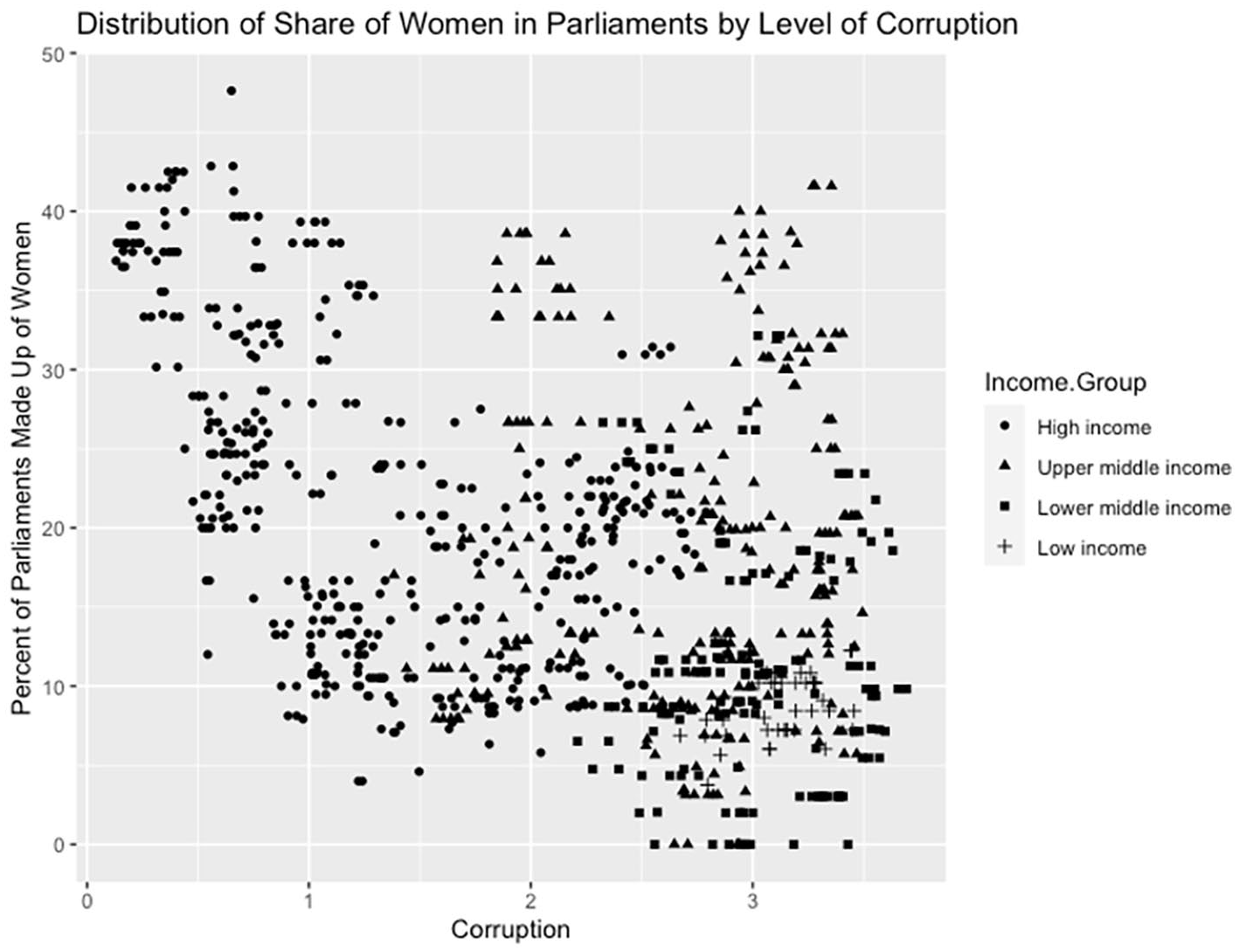
Scatterplot of the Proportion of Women in Parliament by Corruption Level.
Tables 1 and 2 contain time series cross-sectional regression results including both environmental outputs and outcomes as dependent variables. Although multicollinearity between corruption levels and GDP per capita could bias these results, Supplemental Appendix Tables 17 and 18 and Supplemental Appendix Figures 16 and 17 indicate no significant multicollinearity. Due to the nature of the interpretation of interaction models, I include the plotted marginal effects of these models in Figure 3. Significance levels should not be derived directly from the regression table—rather, where plotted estimated coefficients and their confidence intervals do not contain zero (which is demarcated with a dotted line) relationships are significant.
Regression Results of the Interaction of Women and Parliament and Corruption Levels on Policy Output.
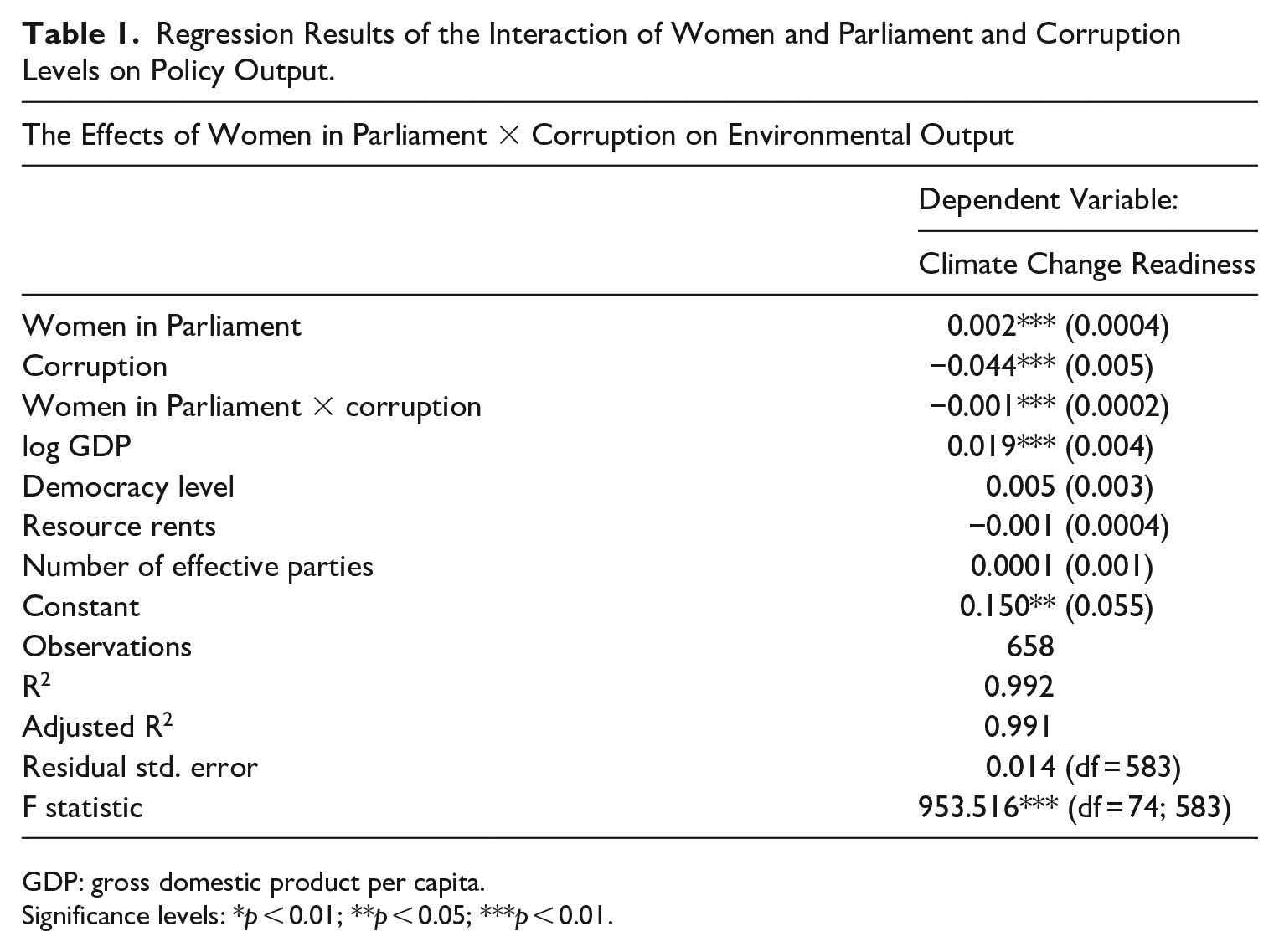
GDP: gross domestic product per capita.
Significance levels: *p < 0.01; **p < 0.05; ***p < 0.01.
Regression Results of the Interaction of Women and Parliament and Corruption Levels on Policy Outcomes.
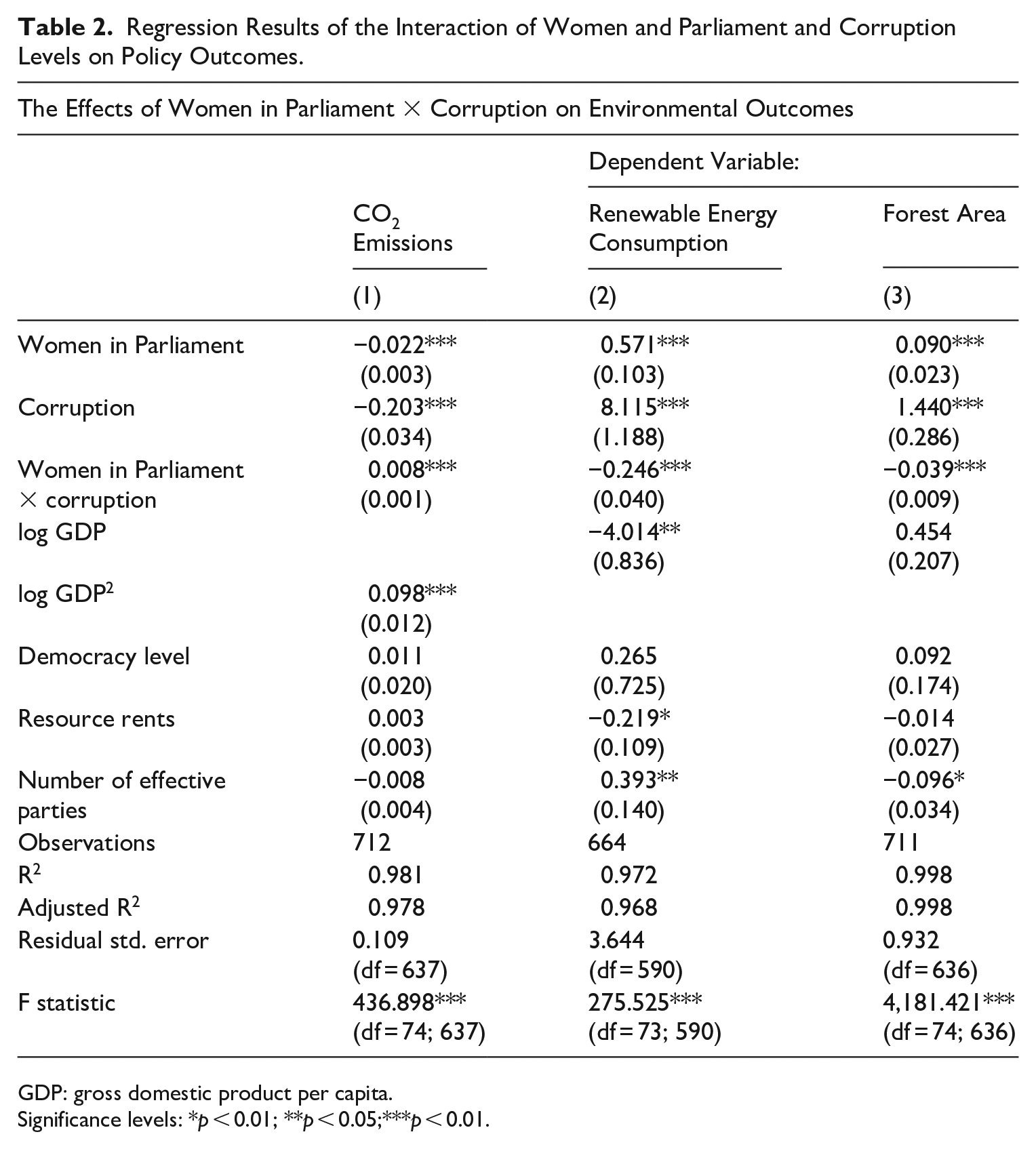
GDP: gross domestic product per capita.
Significance levels: *p < 0.01; **p < 0.05;***p < 0.01.
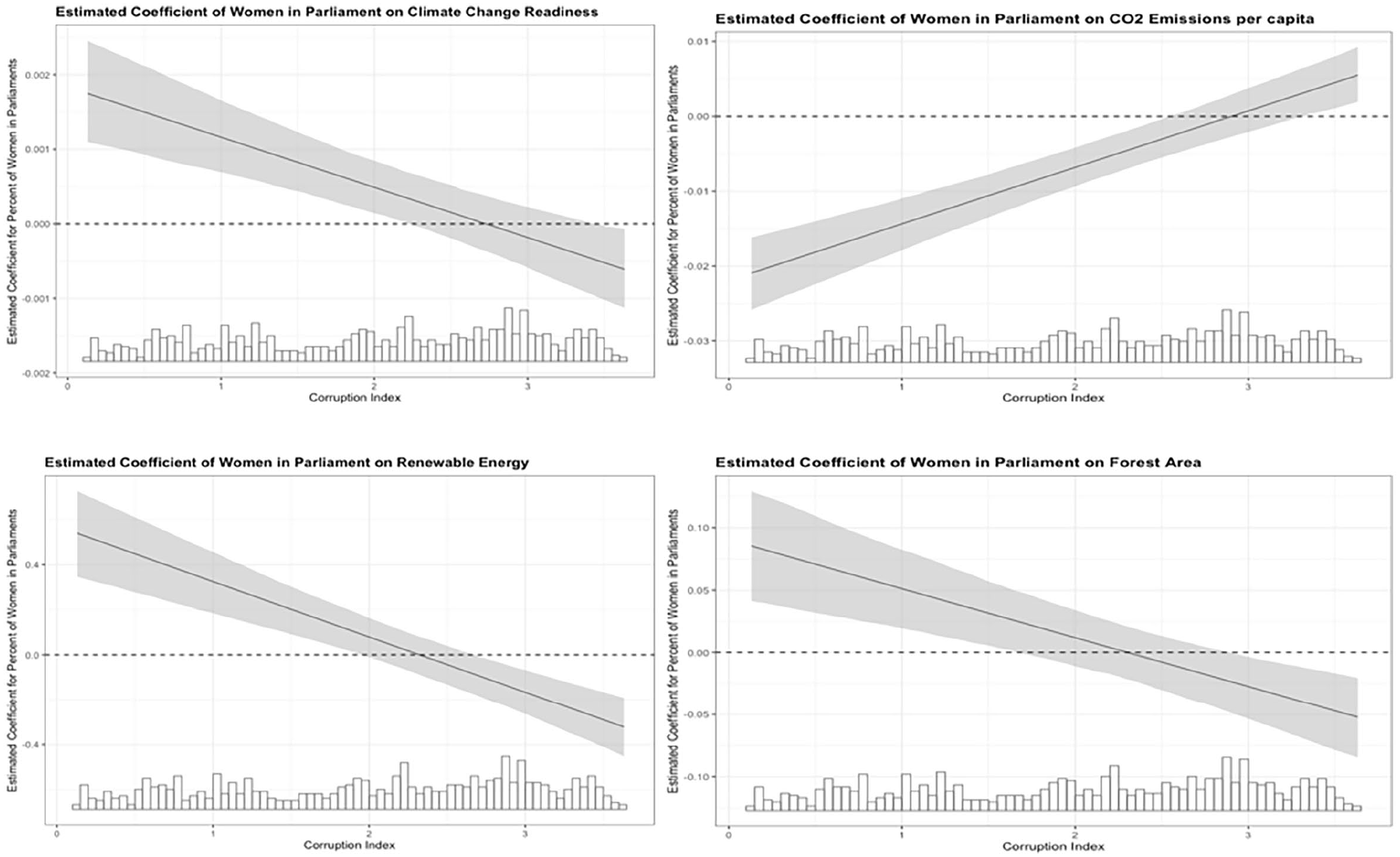
Plotted Marginal Effects of the Proportion of Women in Parliament on All Dependent Variables: CO2 Emissions, Renewable Energy Consumption, Forest Area, and Climate Change Readiness.
The results in Figure 3 demonstrate support for
The proportion of women in parliament significantly benefits climate change readiness where corruption is equal to or lower than about 2.25, which includes countries like Barbados, Botswana, Canada, the Czech Republic, Finland, and Greece. With a corruption score of about 1.5, climate change readiness, which ranges from 0.25 to 0.82, would be 0.001 units greater for each 1% increase in the proportion of women in parliaments. Thus, a state with a parliament made up of 50% women—complete gender parity—would have a climate change readiness score 0.05 higher than a country with no women in its parliament. As readiness scores in this sample range from 0.25 to 0.82, this equates to an 8.77% increase in climate change readiness. For a country like Germany, which scored 0.75 on the corruption scale in 2016, increasing women’s representation from 30.7% to 50% could increase their already high 0.72 climate change readiness score by 0.014, or 2.46%.
Similar patterns emerge with policy outcome measures. The proportion of women in parliaments leads to significant decreases in CO2 emissions where corruption is equal to or less than about 2.5. This includes a range of countries like Hungary, Japan, Luxembourg, Finland, Dominica, Chile, Canada, and Botswana. With a corruption score of 2.0, CO2 emissions per capita would be 0.05 metric tons lower with each 1% increase in the percentage of women in parliament. So, a state with 50% women in its parliament would have CO2 emission of 2.5 metric tons per capita less than a state with no women in its parliament. For a country like Chile, where CO2 emission per capita was 4.73 and corruption was 1.45 in 2016, increasing women’s representation from 15.83% to 50% could drop their CO2 emission by 1.71 metric tons per capita, or over a third.
The proportion of women in parliament correlates with significant increases in renewable energy consumption where corruption is equal to or lower than about 1.75, which includes countries such as Austria, Barbados, Costa Rica, Denmark, Germany, and Malta. With a corruption score of about 1.5, renewable energy consumption would be about 0.38% higher for each 1% increase in women in parliament. Thus, if women made up half of a state’s parliamentarians, that state would be expected to consume 19% more renewable energy than a state with no women in its parliament. A country like Israel, with a corruption score of around 1.5, would see a 13.6% increase in renewable energy consumption if women’s representation rose to 50%.
The effect of women in parliament on forest areas is significant where corruption is equal to or less than about 1.6, which encompasses countries such as Australia, Belgium, Iceland, Israel, and Japan. With a corruption score of 1.5, forest area is predicted to grow by about 0.4% for each 1% increase in women in parliament. If women made up 50% of a state’s parliament, 20% more of that state should remain forest area compared to a state with no women in its parliament. If a heavily forested country such as Brazil, which scores 3.13 in corruption in 2017, decreased their corruption by 1.63 and increased their women’s representation to 50%, forest area should increase by about 15.7%.
Additional Robustness Checks
To ensure the robustness of the models in Tables 1 and 2 and Figure 3, I conduct a large range of robustness checks in the Supplemental Appendix. This includes conducting models with lagged values of corruption to ensure the modifying variable is not affected by the treatment (Keele and Stevenson, 2021); replacing the independent variable of women in parliament with a measure of women’s substantive representation (Watson and Moreland, 2014) with data from The World Bank (2021); conducting mediation analysis which shows that measures of women in parliament and corruption are not significantly correlated in this sample, and that a mediative relationship does not exist; controlling for colonial history, gender quotas, and world region; controlling for left party seat share and women in cabinet positions; and using country-election term units of analysis rather than country-year.
Conclusion
Melody Valdini’s (2019: 72) observation that “women’s presence does not equal women’s power” embodies a valid criticism of the quantitative research which has attempted to measure the effects of parliaments’ gender makeup on political outcomes. The mere existence of women parliamentarians does not always mean that these women have the ability to change policies or outcomes, particularly where corruption is involved. Women may be included in politics for purposes expressly unrelated to increasing women’s descriptive or substantive representation, but may rather be used by political elites to symbolize political integrity and gain the trust of their constituents.
For this reason, I assert that in low-corruption contexts, women representatives are less likely to be restrained, tokenized, and marginalized by elites or have their power curtailed by corrupt interests. In these low-corruption environments, women parliamentarians are thus more likely to have real agency and power to represent the interests of their choosing. Women’s preferences—which tend to be more environmental, left-leaning, and risk-averse—will likely impact policy and outcomes more notably in these contexts. The results of my analysis support this theoretical foundation: where corruption is low, increases in women’s parliamentary participation benefit environmentalism, results which do not hold in corrupt contexts.
This analysis contributes to the literature on representation, showing how and when women’s participation in parliaments can be impacted by other governance factors. It contributes to the growing subfield of “gender and climate change” by clarifying the role of governance contexts for the women representatives who champion environmentalism. Yet most importantly, it has significant implications for climate change policy outcomes. In low-corruption democracies, the marginal effects of increases in women’s political participation on environmental outputs and outcomes are substantively large. If women representatives made up half of the legislatures—full gender parity, a distant yet desirable goal—environmental benefits would be far from negligible: renewable energy consumption could grow by nearly 20%, per capita CO2 emissions could decrease by more than 2 metric tons, forest cover could increase by 20%, and countries could be nearly 9% more ready for the effects of climate change. With many countries seeking to achieve Net Zero by 2030 and the global community aiming to meet the Paris Climate Agreements’ goal of curtailing global warming at 1.5°C (Bazilian and Gielen, 2020), this study draws attention to the incredibly important role of integrity and inclusion within governance structures. It in fact suggests that without integrity and inclusivity in governance, averting climate disaster will likely not be possible.
Although this analysis sheds light on the importance of institutional context for women’s representation, it leaves many questions unanswered. Because the data utilized here is limited to 58 democracies, additional research should seek to replicate and deepen these findings should a broader cross-section of data become available. Additional research should also question what other political arenas may be impacted by women’s “real” inclusion. If a lack of corruption allows women representatives more leeway in enacting their preferences, what other preferences, outside of environmental ones, do women put forth in policy when they have the power to do so? The theory and mechanisms here should thus be tested for their generalizability to other issue areas. Future research should also parse out just what goes on in policymaking processes that eventually lead to environmental benefit, and open the black box of how women parliamentarians act in their capacity as parliamentarians. Engagement with the potential for a mediative relationship between women’s representation, corruption, and environment should be more carefully explored, potentially taking a narrower focus than the 20 years and nearly 60 countries studied here. Using more qualitative research methods to engage directly with women parliamentarians may shed new light on this yet unexplored territory and could continue to add rich understanding to the subfield of gender and climate change mitigation.
Supplemental Material
sj-docx-1-psx-10.1177_00323217231224964 – Supplemental material for The “Women’s Representation-Corruption Link” and Environmentalism: A Cross-National Study
Supplemental material, sj-docx-1-psx-10.1177_00323217231224964 for The “Women’s Representation-Corruption Link” and Environmentalism: A Cross-National Study by Hannah Salamon in Political Studies
Footnotes
Acknowledgements
Many thanks to Dr Stefanie Reher and Prof Patrick Bayer for their constant feedback and support. Thanks as well to Dr Despina Alexiadou and Dr Amanda Clayton for their feedback.
Declaration of Conflicting Interests
The author(s) declared no potential conflicts of interest with respect to the research, authorship, and/or publication of this article.
Funding
The author(s) received no financial support for the research, authorship, and/or publication of this article.

Supplemental Material
Additional Supplementary Information may be found with the online version of this article.
Appendix Paragraph 1: The Countries Included in the Main Analysis Are Listed Below. Twenty-two of 58 Are OECD Countries and Labeled in Bold. Appendix Paragraph 2: Pearson’s Correlation Between GDP and Corruption Pearson’s Product-Moment Correlation. Appendix Table 1: Dataset Summary Statistics. Appendix Table 2: Calculated Coefficients for the Percent Women in Parliament at Various Values of Corruption, Using Data From Table 1. Appendix Table 3: Distribution of the “Corruption” Variable. Appendix Table 4: Women’s Empowerment Index x Corruption Models. Appendix Figure 1: Plotted Marginal Effects of Women’s Empowerment Index on Climate Change Outcomes by Corruption Score. Appendix Table 5: Women’s Substantive Representation x Corruption Models. Appendix Figure 2: Plotted Marginal Effects of Women’s Substantive Representation on Climate Change Outcomes by Corruption Score. Appendix Figure 3: Distribution of % Girls’ Secondary School Enrolment by Corruption Levels. Appendix Table 6: Regression Results of the Interaction of Women and Parliament and Corruption Levels on policy Outcomes With Country-Election Term Units of Analysis (Rather Than Country-Year). Appendix Figure 4: Plotted Marginal Effects of the Interaction of Women and Parliament and Corruption Levels on Policy Outcomes With Country-Election Term Units of Analysis (Rather Than Country-Year). Appendix Table 7: Regression Results of the Interaction of Women and Parliament and Corruption Levels Lagged by 1 Year on Policy Outcomes. Appendix Figure 5: Plotted Marginal Effects of Women’s Representation on Climate Change Outcomes by Corruption Score at t-1. Appendix Table 8: Regression Results of the Relationship Between Women and Parliament and Corruption. Appendix Table 9: Mediation Analysis Regressions: Women and Parliament, Corruption, and Environmental Outputs and Outcomes. Appendix Figure 6: Mediation Analysis Results: Women and Parliament, Corruption, and Environmental Outputs and Outcomes. Appendix Figure 7: Change in Corruption Over Time. Appendix Figure 8: Change in Women’s Representation Over Time. Appendix Table 10: Regression Results of the Interaction of Women and Parliament and Corruption Levels Lagged by 3 years on Policy Outcomes. Appendix Figure 9: Plotted Marginal Effects of Women’s Representation on Climate Change Outcomes by Corruption Score at t-3. Appendix Table 11: Regression Results of the Interaction of Women and Parliament and Corruption Levels Lagged by 5 years on Policy Outcomes. Appendix Figure 10: Plotted Marginal Effects of Women’s Representation on Climate Change Outcomes by Corruption Score at t-5. Appendix Table 12: Regression Results Using the Proportion of Women in Cabinets as the Main Independent Variable in Place of Women in Parliament. Appendix Figure 11: Plotted Marginal Effects of the Proportion of Women in Cabinets on Climate Change Outcomes by Corruption Score. Appendix Table 13: Regression Results Including Both Women’s Labor Force Participation and Proportion of Seats Held by Left-Socialist Parties as Controls. Appendix Figure 12: Plotted Marginal Effects of Proportion of Women in Parliament on Climate Change Outcomes by Corruption Score Including Controls of Women’s Labor Force Participation and Left Party Seat Share. Appendix Table 14: Regression Results Using Year-Colonial History Fixed Effects Rather Than Year-Country Fixed Effects. Appendix Figure 13: Plotted Marginal Effects of Proportion of Women in Parliament on Climate Change Outcomes Using Year-Colonial History Fixed Effects Rather Than Year-Country Fixed Effects. Appendix Table 15: Regression Results Using Year-World Region Fixed Effects Rather Than Year-Country Fixed Effects. Appendix Figure 14: Plotted Marginal Effects of Proportion of Women in Parliament on Climate Change Outcomes Using Year-World Region Fixed Effects Rather Than Year-Country Fixed Effects. Appendix Table 16: Regression Results Controlling for the Existence of a Gender Quota Mandated by Electoral Law. Appendix Figure 15: Plotted Marginal Effects Controlling for the Existence of a Gender Quota Mandated by Electoral Law. Appendix Table 17: Reporting VIFs of Each Main Model and Each Robustness Check Model With Standardized/Centralized Variables. Appendix Table 18: Regression Results of Robustness Checks on Main Models Wherein Variables Are Standardized to Account for Potential Multicollinearity. Figure 16: Plotted Marginal Effects of Women in Parliament on all Environmental Outputs and Outcomes With Standardized/Centralized Data. Figure 17: Plotted Marginal Effects of Women in Parliament on CO2 Emissions With Standardized/Centralized Data and Without Including a Control for Fossil Fuel Rents.
Notes
Author Biography
References
Supplementary Material
Please find the following supplemental material available below.
For Open Access articles published under a Creative Commons License, all supplemental material carries the same license as the article it is associated with.
For non-Open Access articles published, all supplemental material carries a non-exclusive license, and permission requests for re-use of supplemental material or any part of supplemental material shall be sent directly to the copyright owner as specified in the copyright notice associated with the article.
