




Abstract
This article investigates the policy implications of national and regional climate change denial in Russia. While in general Russia has lagged behind in its climate mitigation policy, its key fossil-fuel regions are actively responding to external initiatives and pressures. As the country generally lacks substantial climate policy initiatives, the focus of this study is on the symbolic policy reactions operationalized as the media coverage of climate change at the national and regional levels in Russia during 2017–2018. Following the theoretical perspective of disproportionate policy response, the analysis elaborates on one of the suggested causes of policy over and underreactions, namely, the level of public demand for policy action. The findings indicate potential for disproportionate policy response research to conceive of public demand in broader terms, distinguishing between local, national and international domains.
Keywords
Introduction
Russia has lagged behind in its climate mitigation policy. It joined the 1997 Kyoto Protocol in 2004, later than the majority of other parties. Moreover, it participated in the Protocol’s first commitment period (2008–2012) without adopting any serious mitigation measures (Korppoo and Kokorin, 2017: 2). This period coincides with Dmitry Medvedev’s four years of presidency, marked by a brief moment of increased engagement in energy efficiency and economic modernization campaigns. The country then refused to sign up to the second Kyoto period, which began in 2013, but agreed to join the next stage by signing the Paris Agreement (PA) in 2016. Again, it was one of the last to ratify the PA in September 2019. Furthermore, even though Russia joined the Clean Energy Ministerial, it leads and participates in fewer initiatives than other members.
Russia’s hesitance to engage in domestic climate politics coincides with the prevalent public perception that climate change is natural, cyclical, and not catastrophic (Tynkkynen and Tynkkynen, 2018; Wilson Rowe, 2009). Russians believe that the country is a great environmental power by default and that new commitments are excessive (Tynkkynen, 2010). Thus, while international climate cooperation is seen as useful for modernization (Andonova and Alexieva, 2012), it remains far from a priority for the Kremlin (Henry and Sundstrom, 2012; Korppoo and Kokorin, 2017). However, the energy-intensive Russian economy risks losing about half a per cent of its GDP growth rate due to climate-related policies that may be implemented outside Russia (Makarov et al., 2017). Therefore, potential post-Paris developments in global energy markets have brought about a particularly high risk for Russia’s export-oriented energy sector. As most Russian oil and gas production and exports are heavily concentrated in western Siberia, it is worth considering regional policy separately from and in comparison to national-level policies. This article focuses on one region, Yamal-Nenets Autonomous Okrug (YNAO), which, by the mid-2010s, had grown into the largest supplier of natural gas (80%) and one of the leading producers of oil (10%) in Russia. As shown below, YNAO has high relevance for climate policy. In addition, it engages in an unusually high level of external public relations, emphasizing the climate responsibility of its major industry.
Russia’s slow national policy reactions can be understood in the context of regional initiatives. To account for the lack of national climate mitigation measures and compare the national context to the particular sub-national context of YNAO, this article draws on the concept of disproportionate policy response (Maor et al., 2017; Peters et al., 2017). This approach distinguishes between policy underreaction and policy overreaction as intentional rather than erroneous approaches to policymaking. In this framework, policy underreaction means a ‘systematically slow and/or insufficient response by policymakers to increased risk or opportunity, or no response at all’ (Maor, 2014: 426). The opposite situation, policy overreaction, may be an urgent response to previous underreaction, ‘which is derived from a lack of systemic issue attention’ (ibid: 433). This article aims to contribute to knowledge at the intersection of policy research and media studies, where there is another crucial distinction, that between substantial and symbolic policy reactions (Walgrave and Van Aelst, 2006). The former results in more tangible policy changes (legislation, regulation, and similar), and the latter takes the form of public deliberation and the publicity agenda. Research has shown that Russia lacks substantial climate policy initiatives, and the focus of this study is mainly on the symbolic dimension and on one of the hypotheses for the cause of policy underreactions, namely, a lack of public demand for policy action (Maor et al., 2017). 1
The argument below stresses the role of climate change denial in maintaining low domestic interest in the issue and suggests a broad conception of the public as an international domain that represents interests and pressures of greater relevance to export-oriented national and sub-national policymaking. This approach is particularly valuable when considering disproportionate policy response, because Russia is vast, and the regional impacts of climate change and conditions for economic development are diverse, so a full alignment of national and regional policies is problematic. Thus, reasons and motivations for disproportionate policy response vary accordingly. To demonstrate these points, this article analyses the media coverage of climate change at the national and regional level in Russia during 2017–2018, when the country had already signed the PA but had not yet ratified it. The analysis highlights the role of individuals in the production of the denial that justifies policy underreactions (Peters et al., 2017: 618). The choice of YNAO as a case of high relevance for climate policy and its dependence on fossil-fuel exports expands the notion of domestic and local public space to the public demands of global energy markets. In the Russian fossil-fuel regions, such as YNAO, the state often manages social stability by delegating wellbeing provision to extracting companies and their corporate social responsibility programmes. These neo-paternalistic relationships have replaced the previous Soviet welfare system with measures of administrative pressure on large corporations (Henry et al., 2016) that blur the differences between government and business interests as well as between federal, regional and international levels.
National and regional climate policy contexts in Russia
The Intergovernmental Panel on Climate Change (IPCC) is recognized as the primary source of scientific consensus and policy recommendations regarding climate change. Russia’s official representative on the IPCC is the Federal Service for Hydrometeorology and Environmental Monitoring (Roshydromet). Roshydromet concurs with the IPCC that ‘the observed climate change is attributable primarily to the increase in greenhouse gas concentrations caused by human economic activities’ (Roshydromet, 2014: 18). Both the IPCC and Roshydromet state that climate change is most rapid and visible in the Arctic, where permafrost thawing and ice melting not only erode landscapes but also generate positive feedback loops that accelerate global warming. The Arctic region in northwest Siberia, where YNAO is located, is therefore an area experiencing extreme climate problems, which could lead to policy overreaction. Nevertheless, in a situation of ‘resource constraints and institutional inertia’ (Peters et al., 2017: 616), general public discourse in Russia often contradicts scientific consensus, which leads to a denial of the problem and, hence, halts proportionate policy measures (Tynkkynen and Tynkkynen, 2018: 13). These resource constraints and institutional inertia in Russia can be ascribed to a combination of factors: the prevalence of middle- and low-income households, the limited public understanding of climate change, Russia’s economic dependence on natural resources, and its authoritarian media and political systems (e.g. Boussalis et al., 2016). The latter is especially relevant for this study, as the government-controlled Gazprom owns many news media outlets in Russia and sets a predominant pattern of media ownership at all territorial levels.
In September 2013, President Putin signed a decree that set Russia’s national target for greenhouse gas (GHG) emissions by 2020: 75% or less of the 1990 level. However, slow economic growth and the stagnation of GHG emissions that began in 2010 made this target easy to achieve without substantial policy change. After 2014, the regime of economic sanctions and countersanctions along with a fall in oil prices slowed Russia’s emissions growth and the development of new fossil-fuel extraction projects (Belyi, 2018). In 2015, Russia extended the 75% target to 2030, which it is less likely to achieve without significant measures (Korppoo and Kokorin, 2017). The problem is that even this goal is inadequate in terms of Russia’s commitment to prevent global warming above 1.5℃ or 2℃ by 2100. Climate Action Tracker (CAT) places Russia among the countries with the lowest commitments, which, if not raised, could lead to global warming well above 4℃ (CAT, 2019). In Russia’s case, its present level of commitments means an almost complete absence of mitigation policies. As of the end of 2019, the combined international pledges indicate a pathway to a global temperature increase of 2.8℃. Therefore, Russia’s domestic climate policies are not only part of the overall international climate inertia but also stand out as exemplary policy underreaction.
In 2017, Russia’s Ministry of Natural Resources and the Environment asked regional authorities to report their local GHG emissions. The request was not obligatory, and only seven out of 85 regions replied, including YNAO, the world’s largest natural gas producing area and the mainstay of Russia’s hydrocarbon exports. Energy giants operating in the region, such as Gazprom, Rosneft and Novatek, are major contributors to the local and national economy as well as attractive assets for foreign investors. YNAO is highly ranked in the national Climate and Responsibility Contest, which evaluates self-reported regional climate policies. In different years, between 10 and 14 regions participated in the contest, but like YNAO, many of them were energy-producing areas, which may be a sign of a local greenwashing overreaction to compensate for high carbon footprints and to secure foreign investment. In 2019, the contest recognized the YNAO regional government as the second most responsible regarding climate action. This award was publicized on the government website stressing YNAO’s main achievement – the creation of a database that collects inventories of GHG emissions.
Prior to the 2018 UN climate conference (COP 24) in Katowice, Russian Minister of Natural Resources and Environment, Dmitry Kobylkin, explained why it was important for Russia to ratify the PA. He pointed to the growing number of low-carbon initiatives in major world economies. According to Kobylkin, these initiatives pose risks to Russian hydrocarbon exports unless Russia develops a strategy regulating its GHG emissions (RIA, 2018). The ratification of the PA in September 2019 presupposed the development of climate change legislation, several drafts of which had been flowing between different ministries for months. The process was slowed down by the resistance of industrial lobbyists, such as the Russian Union of Industrialists and Entrepreneurs (Gershkovich, 2019), which includes Gazprom, Rosneft and Novatek as members.
The three fossil-fuel giants have concentrated much of their production in YNAO directly or through subsidiaries. They are among the largest publicly-traded fossil-fuel companies in the world that depend on global investment trends, deploy diverse stakeholder engagement programmes (Bataeva, 2018), and report their climate impacts to the Carbon Disclosure Project (CDP). The CDP is a non-governmental organization that solicits countries, cities and companies to disclose their environmental impacts in a systematic and regular way. Participation in CDP ratings increases shareholder value for companies, especially when major climate change regulation or initiatives come into force (Kim and Lyon, 2011). In 2017, the CDP requested climate information from 61 Russian companies and received it from only 15 of them, including Gazprom, Novatek and Rosneft. The first two companies have been part of the CDP initiative since 2010. Between 2010 and 2017, Rosneft either declined to participate or did not respond to CDP requests.
Despite positive publicity in the form of national contests and presence in international ratings, actual GHG emissions in YNAO have grown significantly faster than the Russian average. Russia entered a period of slow economic growth in the 2010s, and its national emissions dropped a few per cent from 2012 to 2013 and only returned to their 2012 level in 2017 with a net increase of 0.4%. 2 During the same period (2012–2017), YNAO’s emissions increased by 25% (YNAO GHG inventory, 2019). The increase was due to the opening of new hydrocarbon mega projects in YNAO, such as the Bovanenkovo gas field (2012), the Novy Port oil field (2016), and the Yamal LNG plant (2017). Notably, of all reported YNAO emissions, almost two-thirds have been fugitive, which means that they came from industrial oil and gas activities.
Although YNAO produces 80% of all Russia’s natural gas and 10% of its oil, its regional share in the total national GHG emissions is 2%. However, Russia exports about one-third of its natural gas and half of its oil, which influences downstream emissions and raises concern for YNAO industry that investors and importers may be conscious of the climate impacts of fossil fuels. The contrast between YNAO’s relatively small, yet rapidly growing, upstream carbon footprint and the stakes it has in international energy markets distinguishes the region from the rest of Russia. However, half of the Russian budget comes from oil and gas exports, which makes YNAO central to the national economy and Russia’s great energy power reputation.
Another crucial public demand factor is the perception of climate change as a problem. How different are environmental and climate concerns in YNAO compared to Russia as a whole? In 2015, only 12% of YNAO’s population considered environmental problems important (Markin and Silin, 2016), and poverty (56%), unemployment (50%), healthcare (43%), housing (41%), and crime (28%) were ranked as more important than the environment. In a similar national survey conducted in the same year, environmental issues were at an even lower level, concerning only 6% of Russians (FOM, 2016). There is a lack of poll data regarding the public perception of climate change in YNAO, but a comparison can be made between national and larger sub-national levels. YNAO is part of the Ural Federal District (UFD), one of Russia’s eight federal districts, which are commonly used in national opinion polls. It is possible to compare what Russians think about climate change on a national scale with opinion in the eight larger geographical areas. In December 2018, fewer people in the UFD (63%) than in the total population (69%) believed that global warming was happening. Only half of those who answered the question positively believed that mitigation measures were necessary. The figure was slightly higher in the total population (53%) than in the UFD (49%).
Public opinion polls in Russia have demonstrated deepening climate change denial that contrasts with growing international climate change awareness and the public demand for low-carbon development. The share of Russians who believed that climate change was a result of human activities decreased from 59% in 2007 to 55% in 2017 (WCIOM, 2017). In addition, more people (an increase from 30% to 35%) started to believe that the causes were natural. In the same period, the number of people who believed that global warming benefited the country increased from 18% to 27%. Strong climate change denial is not unique to Russia, as the following section illustrates, but it is a particular form of denial that is combined with low public interest, advanced climate science, and a geographically spread carbon intensive economy that makes Russia an exception worth studying.
Climate change denial and policy underreaction
As Painter and Ashe (2012: 1) put it, climate change denial is a discourse that ‘challenges the views of mainstream climate scientists and environmental policy advocates, contending that parts, or all, of the scientific treatment and political interpretation of climate change are unreliable’. In the United States (US), this discourse originated from a network of influential conservative think tanks, whose organized resistance to environmental movement undermined US climate change policy and led to the rejection of the Kyoto Protocol (Dunlap and McCright, 2011). More specific policy outcomes depend on the scale of denial and what is being denied: the very fact of global warming (trend denial), the anthropogenic cause of warming (attribution denial), significant negative effects (impact denial) or the scientific climate change consensus (consensus denial) (Björnberg et al., 2017).
How does one recognize climate change denial in media discourse? Usually, it involves the use of conspiracy theories, fake experts, the cultivation of impossible expectations and misrepresentations, all of these are facilitated through a technique called cherry-picking (Washington and Cook, 2011: 51). This involves focusing on a single study, or a scientific argument, not necessarily a wrong one, but taken out of its original context and applied too generally or in a different context. In the early 2010s, the Russian denial discourse cherry-picked arguments that attributed climate change exclusively to solar activity, sometimes implying an upcoming new ice age or highlighted the positive aspects of global warming (Tynkkynen and Tynkkynen, 2018). Thus, the discourse ignored the wider picture about the causes and consequences of global warming.
The literature reports numerous cases of influential climate change denial and controversial policy debates in the United Kingdom (UK), the US and Australia. However, these cases also demonstrate relatively high levels of mass media attention to climate change in these countries (Schmidt et al., 2013), which indicates intensive domestic debate where over and underreactions depend on the contingencies of political struggle. The case of Russia is different because climate change denial there is strong but only within the context of generally low public interest in climate change. In a sample of 27 countries, Russia was ranked 26th by the level of media attention to climate change (Schmidt et al., 2013). Similarly, the volume of tweeting about climate change in Russia is one of the lowest in the world, and the tweets often deride climate change, deny it and rarely refer to the professional mass media (Kirilenko and Stepchenkova, 2014: 180).
In its low attention to climate change, Russia is an outlier among other energy-dependent countries. Thus, it fails to conform to the model of Schmidt et al. (2013), where the prominence of a fossil-fuel economy is positively associated with public attention to climate issues. Such attention is closer to denial in the psychological or socio-cultural sense of either avoiding stressful alarmism or denying the existence of the climate problem as such, which was the goal of the US conservative counter-movement in the 1990s (Dunlap and McCright, 2011). However, Russia’s domestic impact denial reverses this logic by seriously considering the positive impacts of climate change (Tynkkynen and Tynkkynen, 2018). The general lack of public demand for action against climate change therefore precludes the initiation of policy debates and results in a policy underreaction (Maor et al., 2017). Moreover, as research shows, the rare and marginal climate debates in Russia contain a high proportion of denial, which further increases the chances for underreaction. It is therefore analytically beneficial to consider climate change denial as a factor of disproportionate policy response.
To understand the role of denial in generating and maintaining low public demand, it is worth examining the historical roots of the current situation. During the Soviet time, remote regions east of the Ural mountains and northern Arctic areas such as YNAO were rapidly industrialized, populated and administratively connected to other regions by the Soviet planned economy and ideological motivations rather than by market logic (Hill and Gaddy, 2003). With the collapse of the Soviet system in the early 1990s, market forces replaced the planned economy, forcing industry and local administrations to cut infrastructural and social expenses and to rely more on shift workers than on resettlement programmes that strengthen local attachments. As a result of inherited authoritarianism, Russia’s policymaking is often riven with policy imitations of the Soviet era (Zaytsev, 2018). A short period of administrative autonomy in the regions followed the collapse of Communism, but in the 2000s the vertical political relationship with the state was restored in a unitary model of personalized relations between the Putin administration and regional authorities (Sakwa, 2016). Subsequently, one central source of the system’s stability and resilience has been ‘the extraction and redistribution of rents from the oil and gas sector’ (White, 2018: 141). In contrast to Soviet times, the fossil-fuel industry has also become a major business that draws international investors, competes for global markets and depends on international climate mitigation incentives.
What is the link between the systemic constraints that drive climate change denialism and the media agenda? Mass media studies have named ownership as a key factor that influences media content (Shoemaker and Reese, 2013). As discussed above, a large part of the Russian federal budget and subsequent regional budgets comes from hydrocarbon export revenue. Fossil-fuel companies not only pay taxes that support the government media but also own many news outlets and may influence editorial policy. News-talk radio station Ekho Moskvy (Echo of Moscow) is one of the most liberal news media outlets in Russia and belongs to Gazprom through Gazprom-Media Holding. The radio station hosts a diversity of programmes, including a weekly show Kod Dostupa (Access Code). The author of the show, Yulia Latynina, a popular journalist and an outspoken critic of the political regime has, in almost every second show, denied climate change. She has likened it to a leftist ideology and a hoax and spends hours debunking what she calls the myths of global warming. Given the low public interest in climate change and the factors that promote denialism, the specificity of Russian climate discourse in the media and its policy relevance suggest that denial plays a more important role in justifying policy underreaction in the eyes of decision-makers and media owners than in lowering public expectations.
Media content analysis
This study is based on the content analysis of mass media materials. It distinguishes between print newspapers and television broadcasts and explicitly focuses on national and sub-national or regional (YNAO) levels within the Russian media landscape. The quantitative overview of the data measures the prominence of climate change agenda in the media by analyzing materials that mentioned ‘climate change,’ ‘global warming,’ or the ‘greenhouse effect’ and their grammatical forms in the Russian language. 3
Four media sources were selected following the criteria of media diversity and relevance to the policy process: one national daily newspaper, one national television company and their regional YNAO equivalents. All four media sources are state-owned and represent official rather than more general discourse. The national newspaper is Rossiiskaia Gazeta (RG), one of the most popular dailies. The regional newspaper is Krasnii Sever (KS), headquartered in Salekhard, the administrative centre of YNAO. The newspaper sample is limited to printed versions that are accessible and searchable via the Integrum database. The television material consists of news reports and documentaries shown by a group of channels belonging to a major national broadcaster, the All-Russia State Television and Radio Broadcasting Company (VGTRK). VGTRK also operates through separate regional offices. Television material was accessed via the central vgtrk.com website and its news and information services at vesti.ru for national data and vesti-yamal.ru for regional data. This made it possible to search for stored recordings of actual televised broadcasts, separating them from other, mostly textual, content only available online. Due to the nature of online searching, it was impossible to compare television materials against the channels’ total output.
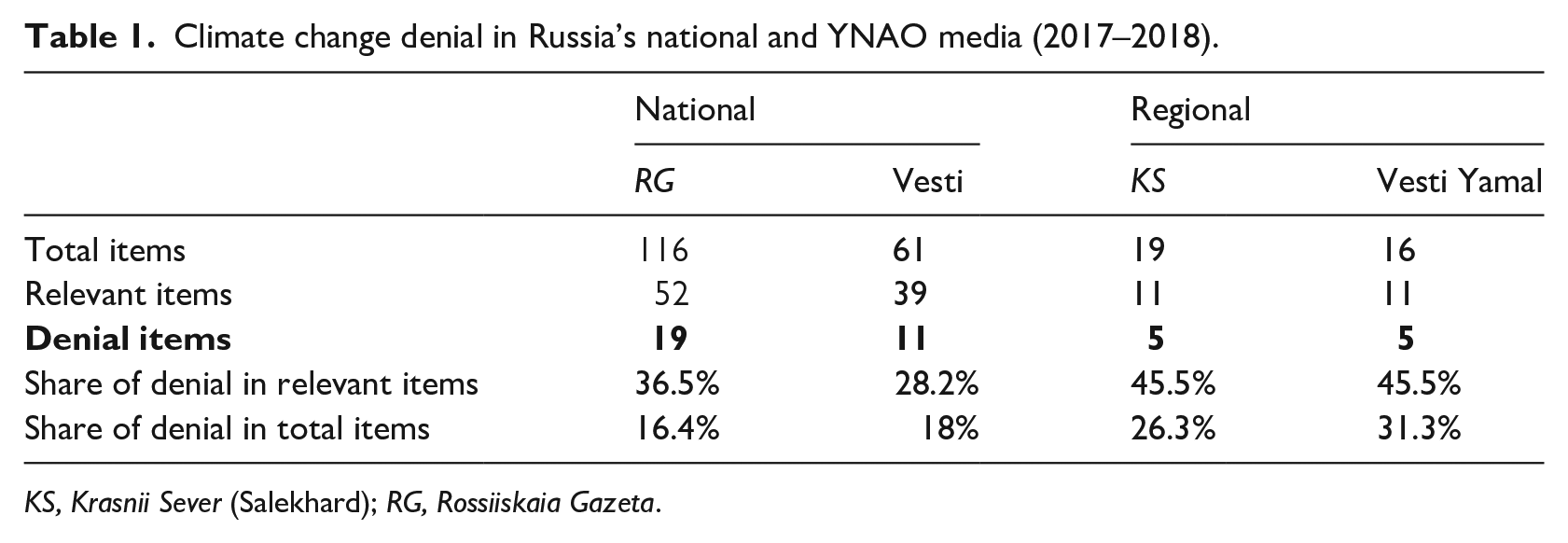
During the study period (2017–2018), 4 RG published 592 issues (5–6 times a week) averaging about 60 news items per issue, while the biweekly KS published 206 issues with an average of 26 items. The overall output difference means that RG had about 6.5 times more space to talk about climate change. In total, 212 media items from a two-year period from 2017–2018 were retrieved. Total items included all mentions of keywords. Roughly half of them were relevant items (climate as the main topic), which, in part, consisted of stories containing elements of trend, attribution, impact, or consensus denial (denial items). See Table 1 for details.
Climate change denial in Russia’s national and YNAO media (2017–2018).
KS, Krasnii Sever (Salekhard); RG, Rossiiskaia Gazeta.
Denial was widely present in the total output ranging from 16% to 31% across all media. On average, every third (35%) relevant item and every fifth (19%) item in the total sample contained climate change denial. Although all media samples were rather small, regional samples were visibly smaller. However, the national RG usually publishes at least six times more material per issue than KS, so relative issue attention was virtually the same. The regional newspaper and television programme have more material containing denial. Furthermore, regional outlets were more likely to include short mentions of the search terms without actually discussing the subject. These differences between national and regional levels, however, were not statistically significant (p > 0.05). Results indicated that YNAO’s media did not radically differ from their national counterparts in the total volume of denialist arguments or in their propensity to spread or avoid them. However, there was a significant difference in how news media outlets talked about climate change. Regional media outlets preferred talking about climate change with no references to global warming (60%), while this was true of the national media in only 40% of cases. Based on an analysis of co-occurrences, denial appears more closely associated with references to ‘global warming’ than to ‘climate change’, confirming previous assumptions about the politicized representation of the former (Tynkkynen and Tynkkynen, 2018).
National denial
The occurrence of denial was not equally distributed in the national sample. Instead, denial peaked during the summer and autumn months of 2017. The focal point was a documentary film Climategate, which Rossiia24, VGTRK’s flagship television channel, broadcast on Saturday 24 June 2017. The title, of course, alludes to the 2009 hacking scandal. The documentary employs the conspiracy theories arising from the scandal to support concerns regarding the PA. According to the Russian experts and scientists interviewed for the documentary, the PA mitigation measures would be harmful to the Russian economy and its fossil-fuel industry. Several Russian dailies reviewed the film with unusually concerted attention to what is usually a marginal topic. For instance, a story titled ‘A greenhouse defect’ in RG argued that the Russian specialists ‘clearly and convincingly explain that global warming is not certain but a probability and that human activity is just one factor in the possible climate change’ (RG, 26 June 2017).
‘Climategate’ features five experts, including one climatologist – Aleksandr Bedritsky, the then climate adviser to the Russian president, who appears briefly to state that climate science operates with probabilities and cannot promise 100% accuracy. The film and the above-mentioned RG article thus cherry-pick and misrepresent this statistical truism to question scientific evidence. However, even more important cherry-picking occurs with the excessive use of two denialists, who account for most of the expert testimony during the film. One is Konstantin Simonov, head of the National Energy Security Fund, who lobbies for industrial interests and does not even pretend to be a science-based expert. The other central figure in the film is Aleksandr Gorodnitsky, introduced as a professor at Shirshov’s Oceanology Institute of the Russian Academy of Science (RAN). Gorodnitsky unequivocally denies anthropogenic climate change and instead promotes the idea of the natural cooling of the climate in the next 15 or 20 years (Vesti, 2017).
At the time the film was made, Gorodnitsky was 84. His academic career had peaked during the Soviet era – a strong predictor of naturalistic beliefs in climate variability (Dronin and Bychkova, 2018). Gorodnitsky has been a notable public figure in climate change denialism, although he never specialized in climatology. Instead, he has admitted on many occasions that his knowledge of climate comes through his academic ties to figures of the same generation. In particular, Gorodnitsky explains that his understanding of climate has been shaped by his close friend and scientific mentor Oleg Sorokhtin, professor at Shirshov’s Oceanology Institute. This example constitutes a mechanism of denial production by cherry-picking in the form of the unjustified and dubious selection of experts and commentators, which was common throughout the analyzed data. On the national level in Russia, denial frequently relies on what the literature terms ‘fake experts’ (Washington and Cook, 2011). These are usually misplaced experts who extrapolate their (often real) expertise and talents to other fields and practices. Their crucial contribution to denial stems from a high media profile (Painter, 2011: 23).
Gorodnitsky studied geophysics in the 1950s and participated in Soviet scientific expeditions. Although he presents himself as a science popularizer, the wider public mostly know him as a prolific poet, songwriter and TV personality. From 2003 to 2012, Gorodnitsky authored a series of science documentaries, including several about climate change (TV Kultura, 2012). In his films, Gorodnitsky poses as a professor of geology and mineralogy and as a member of the Russian Academy of Natural Sciences (RAEN). RAEN must not be confused with the Russian Academy of Sciences (RAN). The two organizations are in fact unconnected rather than the former being the natural science division of the latter. RAN is the highest scientific authority in Russia, with a history dating back to the early 18th century. Membership is highly prestigious and includes a rigorous selection process. By contrast, created in 1991, RAEN has loose membership rules and selection criteria. For instance, a 2003 Nobel Prize winner, the Russian physicist Vitaly Ginsburg, once described RAEN as a ‘total fake’ because it accepts members who are unqualified for membership of RAN.
Gorodnitsky, who is curious about climatology without having professionally studied it, often mentions the topic in public and even released a music album called Global Warming in 2012. One of his early documentaries, a 2005 film called Does the new glaciation threaten us or. . .? predicted global cooling by 2010. Despite being scientifically inaccurate and outdated, this film was shown on national television again in March 2018 (TV Kultura, 2018), coinciding with the increased public attention to the ratification of the PA. A similar example is one television item from the national sample – a 2011 film shown again on 2 January 2018 (Vesti, 2018). Rebroadcasting old climate denial documentaries as well as repeating past slogans (climategate) have become commonplace in the national climate discourse. The original timing of Gorodnitsky films (2005 and 2012), the 2011 film, and their recent reruns coincide with three major climate policy decisions for Russia: joining the Kyoto Protocol (2004–2005), withdrawing from its second period in 2012, and the intensification of the PA ratification debate (2017–2018).
The low media output found in the previous section is further impoverished by the evidence of multiple use of selected materials (rebroadcasts) and their inter-media dissemination (television show reviewed by the press). This evidence of course is not sufficient to argue that the media act this way because of their dependence on the government hydrocarbon budget and direct state-control. The elements of strategic planning and content uniformity between different media organizations indicates a non-random character of climate change denial on the national level.
Regional denial
While national-level media landscape is diverse and includes some media that are formally independent from the state and the large fossil-fuel companies, there are very few media in YNAO and all of them part of the local government publicity system entrenched in the promotion of the oil and gas projects. The lack of media diversity, a relatively small population of over half a million people scattered across huge territories, and the scarcity of news sources are the key characteristics of this system. YNAO hosts no established institutions of fundamental climate science. The closest available expertise comes from environmental scientists at the Arctic Research Center in Salekhard. Opened in 2012, the centre conducts regional monitoring and applied studies of the local ecosystems and environment. It is an important hub for national and international networks, yet much of its research aligns closely with economic interests, the exploration of natural resources and infrastructural planning.
Analysis of the regional media reveals that scientists who work at the centre regularly comment on permafrost degradation, species migrations, tundra overgrazing, depletion of fish resources, weather anomalies and the spread of infectious diseases. Rarely, however, do they link these phenomena to global climate change. The change they observe is what they call the local change of ecosystems and the pollution of air and water. According to these scientists, human activities (land use, industrial waste) do influence local microclimates in this narrow sense, but these findings are not easily explained by global climate change. A telling example is the media coverage of the 2016 anthrax outbreak in YNAO, multiple references to which appeared in the 2017 data. The unprecedented heatwave apparently thawed frozen cattle graves, releasing the deadly bacteria, which killed hundreds of reindeer.
Explicit climate change denial in the YNAO media is more typical of external experts who visit the region for fieldwork or conferences. For instance, one KS report from a 2017 conference in Salekhard argues that ‘warming is unstoppable’, but one may expect to see the beginning of a natural cooling period that ‘will become clear in five to 10 years’ (KS, 3 November 2017). The article highlights the traditional wisdom of indigenous arctic communities who survived extreme weather events in the past and likens them to nature’s self-regulation or evolutionary natural selection. In another KS article, a scientist from Shirshov’s Oceanology Institute emphasizes the natural causes of climate change, to which humans need to adapt, although human-made GHG emissions have now become capable of affecting climate (KS, 25 March 2018).
In several cases, external experts referred to the state of local ecosystems in the distant past, when the climate was not ‘as harsh’ and vegetation not ‘as scarce as today’, indirectly assuming a positive view of global warming. One scientist was quoted as stating that the YNAO territory was a ‘temperature paradise’ 10,000 years ago. According to his research, the climate has changed many times, which has convinced him that humans are not the only cause of global warming (KS, 27 November 2017). This scientist represents Tyumen State University, an institution from another oil and gas region south of YNAO. The university has traditionally maintained strong ties with the fossil-fuel industry by conducting geological exploration and the development of mining areas.
Tyumen State University is also the home of one particularly influential source of climate change denial in the YNAO media: Vladimir Melnikov, a RAN academic in the field of cryology and an adviser to the YNAO government. In an interview on local television, Melnikov once stated that the current interglacial period would soon end and ‘after global warming the Earth would phase into the ionic irradiation of our galaxy and freeze’ (Vesti Yamal, 2017). Such an example of blunt trend denial is a rare contradiction of the scientific consensus from a RAN scientist, who, in the case of Melnikov, has been an influential public figure in YNAO for many years. His opinion on climate change can be summarized as follows: global warming occurred in the 1970s and had nothing to do with human activities; now the earth is moving towards a new mini ice age – a natural stage of shorter climatic circles which humanity, most famously, last experienced in 17th century Europe. For Melnikov, climate change differs starkly from the phenomenon policymakers find in the IPCC and Roshydromet reports. Moreover, the climate discourse arising from such a vision promotes public demand for enhanced weather observations rather than climate mitigation. As in the case of Gorodnitsky in the national-level debate, Melnikov’s expertise regarding climate change is questionable: he is not a climatologist. Only three of his 200 scientific publications discuss climate change or global warming, including one theoretical essay where he is the lead author and two co-authored papers. More revealing of his motivations is his long-term research collaboration with Tyumen State Oil and Gas University (changed to Industrial University of Tyumen in 2016).
To conclude, regional climate change denial in YNAO has two main features. While local scientific knowledge, based on direct observations, recognizes environmental change, it fails to attribute it to global climate change. Moreover, the already harsh conditions of the region cause scientists and policymakers to think of climate change in a positive way. Despite notable symbolic climate initiatives on national and international levels discussed earlier in this article, the internal regional discourse is strongly denialist. Regional achievements in the national Climate and Responsibility Contest, though noted by the government website, are not discussed in the regional press. This means that YNAO’s climate policies are mostly symbolic outward overreactions (and informed by external pressures) and inward underreactions. The latter is supported by low public interest and finds justification in almost all types of denial, be it attribution, impact or even trend denial.
Conclusion
This study focused on the policy implications of national and regional climate change denial in Russia. The large volumes of denial both nationally and in the region studied (YNAO) differ in quality (global warming vs climate change) and the underlying scientific expertise (popular fundamental vs applied industrial). Both discourses epitomize low public demand for mitigation measures. The study adopted climate change denial as an indicator of the lack of public demand, that would theoretically lead to policy underreaction at both national and regional levels. However, the example of YNAO demonstrates that policy agenda debates may have different manifestations locally and externally. Domestic climate politics may contradict foreign politics, and locally relevant perceptions in remote regions may differ from their extension to national and international policy regimes. Consequently, the perspective must be specified before considering what constitutes an over or underreaction.
The paradox of the regional situation in YNAO is that local discourse tends to support underreaction in local policy, while in the national and international context the region seems to be overreacting by following its strategic interests (Maor et al., 2017: 607). Based on the evidence presented, this apparent external overreaction in YNAO’s climate policy is particularly pronounced compared to other Russian regions and the general national policy response due to external pressures: the necessity to compete in international energy markets and portray energy-producing actors as environmentally responsible players (e.g. Belyi, 2015). The climate debate influencing such a policy occurs outside the region and even outside Russia; hence, it requires neither local media attention to climate issues nor local public demand for action. Moreover, because of its strategic status in the energy policy and economics of Russia, YNAO plays an important role in shaping national policy regimes regarding climate change. This is why climate policy development in this remote region matters in formulating explanatory frameworks for disproportionate policy research.
The individual policy contribution of denialists who function in the national-level media debate, mostly as science popularizers (Gorodnitsky), can be explained by their structural positioning within media institutions that favour and re-use certain climate denial arguments during sensitive periods of policymaking. Individual discursive work of this kind contributes to the production of a climate mitigation underreaction in the national-level policy debate by reducing public perceptions of climate change risks. On the other hand, the policy implications of denial by individuals with ties to industrial research and the fossil-fuel economy naturally lie not in the field of climate policy but in the adjacent fields of economic and industrial policy. The regional case of Melnikov, his counselling role in the YNAO government and regular responses to public demands for climate expertise attests to this point. His contribution to the local climate policy underreaction stems from strategic interests in other policies that enhance the role of the institutions he represents ‘in the ongoing resource battles’ (Peters et al., 2017: 619) and from the necessity of responding to public demand for the economic development of the region. Previously, little evidence has been presented of the fossil-fuel industry’s backing of denialist discourse in Russia. Therefore, denial on a regional level, exemplified by a scientist linked to Industrial University of Tyumen, is a rare example of lobbying with a direct link to the ‘usual suspect’: the hydrocarbon industry.
The evidence presented in the article suggests the potential for disproportionate policy response research to conceive the concepts of publics and public demand in broader terms distinguishing, for example, between local, national and international domains. The implication for media studies is that future analyses of symbolic policy responses should be more specific about the audiences that the media messages target.
Supplemental Material
sj-pdf-1-ips-10.1177_0192512120971149 – Supplemental material for Policy implications of climate change denial: Content analysis of Russian national and regional news media
Supplemental material, sj-pdf-1-ips-10.1177_0192512120971149 for Policy implications of climate change denial: Content analysis of Russian national and regional news media by Jale Tosun, B Guy Peters and Dmitry Yagodin in International Political Science Review
Footnotes
Acknowledgements
The author would like to thank three anonymous reviewers and Jale Tosun for their valuable feedback on earlier versions of this paper, Veli-Pekka Tynkkynen for his support and Matthew Billington for language editing.
Funding
The author received no financial support for the research, authorship, and/or publication of this article.

Notes
Author biography
References
Supplementary Material
Please find the following supplemental material available below.
For Open Access articles published under a Creative Commons License, all supplemental material carries the same license as the article it is associated with.
For non-Open Access articles published, all supplemental material carries a non-exclusive license, and permission requests for re-use of supplemental material or any part of supplemental material shall be sent directly to the copyright owner as specified in the copyright notice associated with the article.
