




Abstract
What motivated national governments to join the Clean Energy Ministerial (CEM), a climate club founded in 2010? And to what extent have the club members participated in policy initiatives developed by the CEM? Our analysis shows that combinations of (a) the expected benefits of club membership and (b) the leadership of the USA induced the governments of Australia, Brazil, Canada, China and the United Arab Emirates (UAE) to join the CEM. The importance of these two factors varied across countries. Participation levels in the CEM’s policy initiatives varied over time. While this variation happened in a ‘proportionate’ manner for Australia, Canada and China, we observed singular instances of ‘disproportionate’ changes in levels of policy effort for the UAE and Brazil. Overall, our findings suggest that climate clubs constrain the behaviour of its members by discouraging them from engaging in sustained policy under-reactions.
Keywords
Introduction
Climate change mitigation requires jurisdictions around the world to participate in solving a collective action problem by means of a swift and sustained reduction of greenhouse gas (GHG) emissions. Policy under-reactions where national governments enact insufficiently ambitious policies (Maor et al., 2017: 599) pose a serious threat to mitigating climate change. Therefore, international co-operation on climate change has sought to establish long-term incentives for facilitating more ‘proportionate’ policy responses. While the United Nations Framework Convention on Climate Change (UNFCCC) remains the major framework for international co-operation on climate change, the institutional landscape has undergone a process of differentiation in recent years. For example, we are witnessing the creation of ‘climate clubs’, which consist of a relatively small group of countries that engage in co-ordinated international climate action beyond the UNFCCC (Falkner, 2016; Hovi et al., 2016).
In this study, we concentrate on the Clean Energy Ministerial (CEM), a climate club seeking to promote a global energy transition away from carbon-intensive technologies and infrastructure and towards technologies for ‘clean energy’. At the 15th Conference of the Parties (COP) to the UNFCCC, in 2009, the US Secretary of Energy, Steven Chu, announced that he would host the first CEM in 2010, bringing together relevant ministers from a small number of countries invited to participate. In contrast to other climate clubs (e.g. the Renewables Club, which was established in 2013 but never became operational), the CEM is a ‘successful’ organization in the sense that it has developed and implemented a number of concrete policy measures (Yu, 2019). An example is the CEM’s Electric Vehicles (EV) Initiative; its decarbonization activities range from a pilot project to establish a global network of 100 EV-friendly cities to the annual publication of the Global EV Outlook, an influential compendium of EV policies and markets. 1 Another indication of the organization’s success is that its secretariat was transferred from the US Department of Energy (DoE) to the International Energy Agency (IEA) in 2016 in order to strengthen the IEA’s activities related to clean energy technologies (Sanchez and Sivaram, 2017: 125).
Since the CEM represents an additional international organization working on climate governance, we assume that membership entails costs (see Van de Graaf, 2013). Therefore, the first research question concerns the reasons that motivated the relevant national ministers to join the CEM. The second research question reflects both a specific institutional feature of the CEM as well as the thematic focus of this special issue, which is on the politics of (dis)proportionate climate policy. The CEM pursues a bottom-up and opt-in approach, whereby national ministers interested in furthering an idea on the transition of energy systems are encouraged to form a partnership with other ministers and proceed without any need for reaching common agreements (Yu, 2019: 15). In light of this institutional design, we investigate the development of members’ participation in policy initiatives over time: did countries maintain, reduce or even increase their respective policy effort over time? We consider extreme changes in the participation level as policy under-reactions or over-reactions, respectively.
Our analysis comprises five CEM member states that varied in respect of their capacities for energy transition and their contributions to GHG emissions at the time of accession: Australia, Brazil, Canada, China and the United Arab Emirates (UAE). We show that the expected benefits of membership and the leadership of the USA explain accession to the CEM. Furthermore, our analysis reveals that the members’ participation in policy initiatives varied over time yet was mostly in line with what the pertinent literature would consider ‘proportionate’ (see Maor, 2017). We observed exceptions for Brazil and the UAE, where instances of both policy under-reaction and over-reaction occurred during the observation period.
The article is structured as follows. First, we provide background information on the CEM and set out our theoretical argument. Subsequently, we explain the rationale for our case selection and clarify our methodological approach, before turning to the empirical analysis, which proceeds in two steps. We then discuss our findings and offer some concluding remarks.
The Clean Energy Ministerial: goals and design
A climate club is a group of international actors (most commonly nation states) that ‘starts with fewer members than the UNFCCC’ and ‘aims to co-operate on one or more climate change-related activities’ (Hovi et al., 2016: 2). According to this definition, the CEM can be conceptualized as a climate club. In particular, it is an institutional platform for national energy ministers and high-level representatives to exchange information on clean energy technologies and implement policies and projects co-operatively. Upon its launch in 2010, 22 countries and the European Union (EU) Commission joined the CEM. Since then, three more countries have joined, meaning the CEM currently has 26 members, including the EU Commission (see Table 1). According to the CEM’s institutional framework adopted in 2016, the organization orients its actions around the Paris Agreement and the United Nations Sustainable Development Goals (Clean Energy Ministerial, 2016).
Renewable electricity capacity and carbon emissions indicators, 2010.
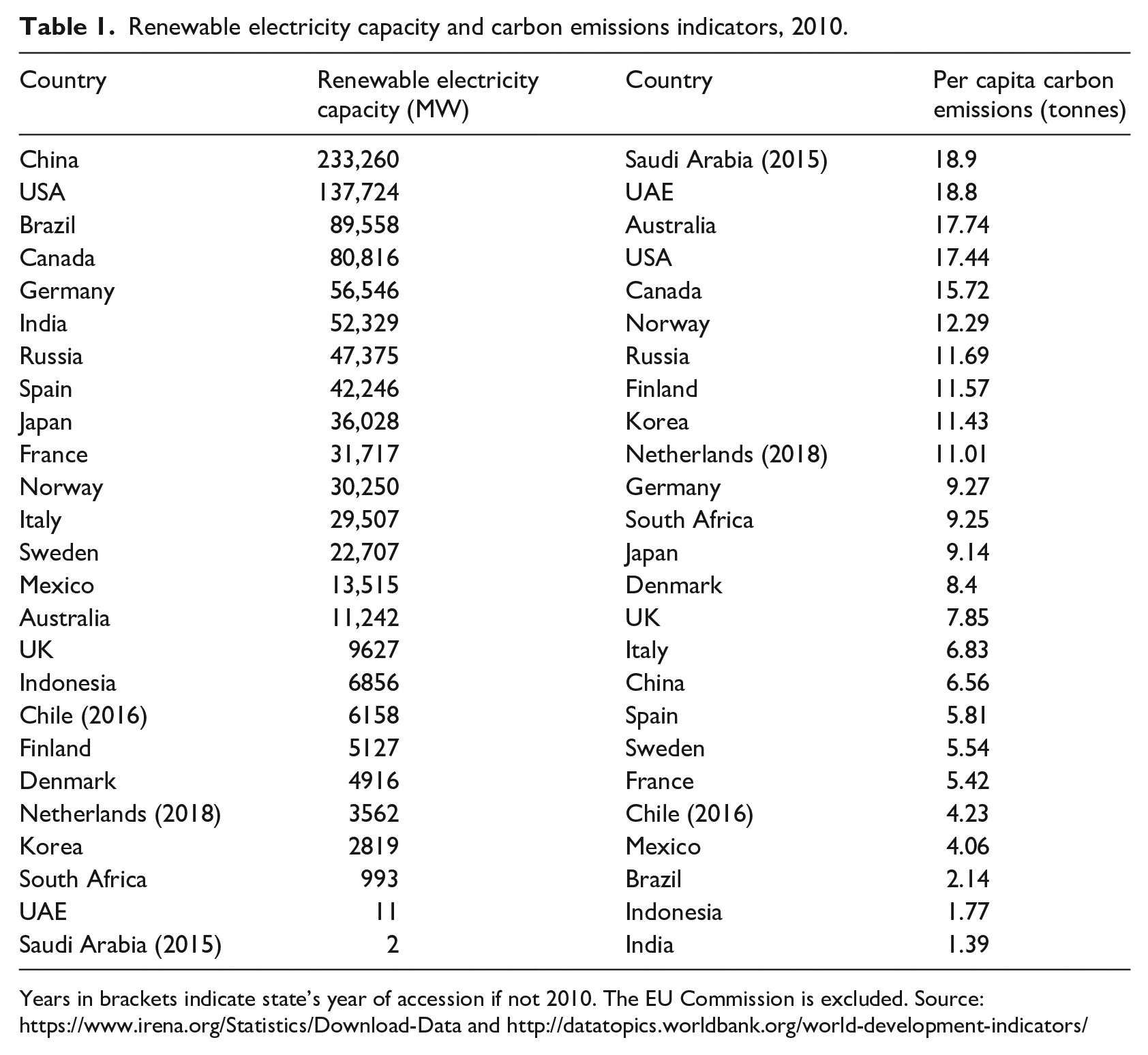
Years in brackets indicate state’s year of accession if not 2010. The EU Commission is excluded. Source: https://www.irena.org/Statistics/Download-Data and http://datatopics.worldbank.org/world-development-indicators/
The CEM is committed to three overarching goals: improving energy efficiency; enhancing the supply of clean energy; and expanding access to clean energy. To attain these goals, the organization advocates policies that expand the development and deployment of clean energy technologies (see Yu, 2019). It supports the involvement of private-sector partners (including industry and non-governmental organizations) both in the ministerial meetings and in the technical work.
The annual meetings constitute an important institutional element of the CEM, as they create a forum for ministers to meet on a regular basis and engage in mutual policy-learning and exchange of best practices (Sanchez and Sivaram, 2017: 125; Sandalow, 2016). The CEM’s work is based on a model of ‘distributed leadership‘, which means that member governments can decide themselves how deeply involved they wish to become in the development and implementation of policies (Yu, 2019: 15). Involvement includes two dimensions: first, members decide whether they want to participate in policy development and implementation; second, members decide whether they want to act as leaders or co-leaders of policies.
The main tool for attaining the organization’s goals are ‘initiatives’ – the sustained collaborative efforts of its members to advance clean energy policies and technologies, based on working plans with tangible expected outcomes. 2 Initiatives can be regarded as the organization’s policy outputs and we treat them here as such. Examples of initiatives include the EV Initiative mentioned above and the International Smart Grid Action Network, which strives to accelerate the development and deployment of smart grids (Yu, 2019: 14).
Theoretical argument
Given their involvement in the UNFCCC, why are national governments willing to join climate clubs such as the CEM? According to functionalist arguments advanced in International Relations (Keohane, 2020), governments may join such organizations because they regard them as useful in solving the collective-action problem underlying climate change. Most importantly, the failure of international negotiations under the auspices of the UNFCCC could have motivated governments that support climate action to turn to alternative forms of co-operation (see, e.g., Hermwille et al., 2017). However, membership in climate clubs also entails considerable costs. In the first place, members need to invest in constructing the new organization (Van de Graaf, 2013: 15). This begs the question of under what circumstances governments are willing to bear these costs.
The literature on climate clubs stresses the exclusive benefits that club members accrue (club goods) and which induce members to ‘contribute more to the production of the public good. . . than they would do as non-members’ (Hovi et al., 2016: 3). Following a rationalist logic, governments should join a climate club if the expected benefits they receive from enjoying club goods exceed the costs. What exactly determines the governments’ cost–benefit calculus?
To answer this question, we find the theoretical literature on EU accession helpful since the EU has also been modelled as a club. Mattli and Plümper (2002: 557) argue that EU membership is desirable for non-member states since they expect access to technical and financial assistance, economic growth and prosperity. Adapted to the more specific context of climate clubs, we can derive two motivations from this argument. The first motivation is that membership in a climate club provides access to relevant knowledge and technologies. Therefore, governments of states that have not yet started the process of transitioning to clean energy, or which strive to make more progress, should be willing to join a climate club. The second motivation refers to the opposite scenario, in which the country concerned possesses clean energy expertise and technologies and strives to venture into new markets. Thus, for the latter, CEM membership can also be motivated by the prospect of economic gains resulting from international co-operation on the transition to clean energy.
The literature on climate clubs also acknowledges leadership as an important factor for recruiting members (Hovi et al., 2016). Similar to the previous set of explanatory factors, we argue that leadership can matter in two ways. First, and in line with research on policy diffusion and institutional isomorphism (DiMaggio and Powell, 1983), governments might join an international organization because it was launched by their peers or by ‘high-status countries that are considered to know best’ (Meseguer, 2005: 73). The idea underlying this move is that uncertainty encourages imitation, which results in the behaviour of one state resembling that of other states. The second line of reasoning is advanced by regime theorists, who have argued that entrepreneurial leadership is necessary for facilitating international co-operation (Moravcsik, 1999: 267). Consequently, we expect that both the potential members’ perception of the climate club leader as a peer or a high-status country as well as the leader’s entrepreneurial activities help to explain why national governments consider joining the club. We do not consider the motivations to be mutually exclusive. Governments can decide to join because they want to benefit from (knowledge about) clean energy technologies as well as the economic benefits related to the new markets for these technologies. Similarly, the generally positive image of the USA (at that time) and the way they approach a specific government can help to explain membership. Therefore, both expected benefits and leadership can account for membership.
Joining a climate club is one thing, but actual participation in its policy activities is another – one which warrants enhanced attention, given the need to produce effective policy outputs and outcomes in order to mitigate climate change. How does governments’ participation in CEM policy initiatives change over time? Referring to the CEM specifically, Sanchez and Sivaram (2017: 125) contend that ‘there is little risk of member states abandoning their keen interest in the initiative’. We take this claim as the point of departure for our theoretical reasoning, namely that we expect the policy efforts of club members to vary to some extent over time, but not to be reduced to an extreme degree. We consider extreme changes to correspond to policy over-reactions or under-reactions, respectively.
Our definition of policy over- and under-reactions differs somewhat from other conceptualizations (see, e.g., De Francesco and Maggetti, 2018; Jones et al., 2014; Maor, 2012, 2017) as we do not concentrate on whether the policy activities are proportionate given the intensity of the underlying problem. Instead, we concentrate on how the policy effort of members changes over time and assess whether we can observe a ‘normal’ degree of oscillation or extreme shifts, which would indicate proportionality to us. In other words, we concentrate on the degree of changes in policy effort. We contend that policy under-reactions will be prevented by the risk of reputation costs (Jensen and Slapin, 2012: 784).
While the CEM cannot – and does not wish to – sanction its members (see Yu, 2019), the ministers participating in the annual meetings interact with each other often and are eager not to compromise their personal reputations or the reputations of their governments concerning their commitment to clean energy transition. In fact, reputation costs are likely to be higher in climate clubs than in more comprehensive multilateral organizations. The reason is that the smaller number of members makes it easier to observe the behaviour of the individual club members. Another reason for our expectation is that the policy outputs produced by the CEM are of a technical nature and predominantly seek to increase capacity for clean energy transition (see Yu, 2019). We do not exclude the possibility of instances of over-reactions, but we expect them to occur rarely due to the costs that investing in policies incurs (see also Peters et al., 2017).
Data and methods
Our analysis comprises two steps. The first refers to the decision of national governments to join the CEM. The second refers to the members’ participation in the CEM’s policy initiatives and how it varies over time. Since the second variable connects this analysis to the theme of this Special Issue, we have conceptualized changes in the participation in policy initiatives in terms of over- and under-reactions. A useful proposal for operationalizing disproportionate policy responses is made by De Francesco and Maggetti (2018), who contrast the policy response with the level of problem pressure. We deviate from their approach for two reasons: First, the authors examine policy responses to a very specific problem by adopting a limited-time perspective, namely the banking crisis as it unfolded in 2007/2008; second, CEM initiatives aim to build capacity and coalitions (Yu, 2019), which are not directly related to the states’ carbon emission levels. We propose a different approach and argue that policy over- and under-reactions can be assessed by examining how the data on policy effort are distributed. More specifically, we show subsequently that boxplots are a useful way for determining whether we can observe extreme changes in policy efforts.
Our analysis comprises five cases. The rationale for our case selection corresponds to the logic of ‘diverse cases’ (see Seawright and Gerring, 2008). While membership in the CEM is constant across all cases, we seek to explore which combinations of motivating factors can account for this outcome. When selecting the cases, we paid particular attention to variation in the installed capacity for the generation of electricity from renewable energy and carbon emissions per capita.
As Table 1 shows, in 2010, Brazil and China were leaders in the field of renewable-energy generation. Brazil has been a strong player with regard to hydropower and biofuels for a long time (Urpelainen and Van de Graaf, 2015: 170), while China has been the leading manufacturer of renewable-energy technology, such as solar cells (Urpelainen and Van de Graaf, 2015: 165). Brazil also had low per-capita carbon emissions, whereas the levels were higher for China. Canada had a high generation capacity for renewable energy, but it also produced very high levels of per-capita carbon emissions. Compared to Canada, Australia had even higher levels of carbon emissions per capita as well as a lower capacity for generating electricity from renewable sources. The most extreme case is the UAE, since it had the highest per-capita carbon emissions as well as the lowest capacity for generating electricity from renewable energy of all CEM members in 2010 (Saudi Arabia only joined the CEM in 2015). Given these differences, the countries selected will provide robust insights into whether our theoretical reasoning holds or needs to be adjusted.
This study is desk research as our primary sources for the first step of the analysis are statements, recorded or printed interviews, reports and (electronic) newspaper articles, which we cite directly in the text. In addition, we rely on secondary sources, such as articles published in scientific journals. Lastly, we obtained background information on the CEM and its launch from two former members of the US DoE. We do not use this background information directly but base some of our interpretations of the data on it. For the second step, we rely on overviews on the participation in CEM initiatives and campaigns, which are published annually and are available on the CEM’s website. Based on this information, we counted the number of CEM initiatives in which the members participated in a given year and divided them by the total number of CEM initiatives in that year.
Motivation for membership
In this section, we first discuss the considerations that induced the governments of Australia, Brazil, Canada, China and the UAE to join the CEM in turn. Then, we offer an integrated discussion of the various motivations for seeking membership in the CEM.
Australia
During the tenure of Prime Minister John Howard (1996–2007) and his coalition government, climate policymaking in Australia was strongly affected by the interests of the fossil fuel and mineral sectors (Crowley, 2013; Young and Coutinho, 2013) and reflected a close alliance with the administration of US President George W. Bush (Lawrence, 2009). Toward the latter period of his government, Prime Minister Howard came under pressure to address climate change due to a drought crisis. In this context, US President Bush and Prime Minister Howard initiated the Asia-Pacific Partnership on Clean Development and Climate (APP) in 2006, which also represented a climate club (Yu, 2019). The launch of the APP ‘was part of the Howard government’s strategy to demonstrate some policy movement on climate change while postponing serious action’ (Lawrence, 2009: 281).
During the run-up to the Australian federal elections in 2007, climate change became a salient issue, and the victory of Labour Leader Kevin Rudd has been attributed to his campaign promise to shift the country towards a less carbon-intensive economy (Crowley, 2013). In marked contrast to his predecessor, Prime Minister Rudd was genuinely committed to realizing a more ambitious climate policy. This is indicated by the ratification of the Kyoto Protocol, which was one of the first official acts of the newly elected government, and the appointment of a minister in charge of climate change (Lawrence, 2009: 288).
The launch of the CEM falls in a period when Prime Minister Rudd was still in power (he resigned in June 2010). While Australia had also participated in a climate club during the Howard government, the CEM represents a much more ambitious organization. The APP ‘mainly focused on building incentives and capacity among private sector actors’, whereas the CEM’s ‘key ambition is to alter the policies and regulatory systems of its member states’ (Yu, 2019: iii). Therefore, Prime Minister Rudd’s ambition to make Australia a leader in the production of renewable energy by ‘exploiting the country’s ample sunshine’ (Reuters, 2009) is an important motivation for joining the CEM. Rudd’s interest in the CEM can be explained by the anticipated benefits of access to clean energy technologies and the prospect of economic gains achieved through clean energy transition. In our theoretical framework, we introduced leadership as another important factor shaping countries’ motivation to join climate clubs. In the case of Australia, the leadership of the USA in fact played a relevant role. Rudd regarded himself as a close ally of US President Barack Obama and was willing to follow his leadership in international climate politics. In multiple instances, Rudd and Obama pledged to ‘team up on climate change’ (The Age, 2009).
Brazil
Hydropower has been the central energy source in Brazil for a long time and was complemented in the 1970s with ethanol for transportation (McCormick, 2017: 471). Business interests have provided strong motivation for Brazilian climate policy (Hochstetler and Viola, 2012). This also becomes apparent when examining the country’s accession to the CEM. Brazil’s involvement in the organization is largely motivated by the importance of its ethanol sector. From 2005 to 2007, Brazil advocated the ‘creation of a global biofuels market and tried to make an international commodity out of ethanol, exporting technology and establishing partnerships to develop ethanol markets in several countries’ (Viola and Basso, 2014: 5). The CEM represented an appropriate organization for pursuing this interest. In the context of the first CEM meeting, the Minister of Mines and Energy, Márcio Zimmermann, of the government led by Luiz Inácio Lula da Silva (2003-2011) explained that Brazil could support other developing countries in Latin America and Africa by sharing its know-how (El Periódico de México, 2010). At its inaugural meeting, the CEM launched the Multilateral Bioenergy Working Group, in which Brazil participated together with Italy and Sweden (CEM, 2010: 4). While the expected gains played an important role in Brazil’s decision to join the CEM, we found no indications that US leadership mattered.
Canada
At the time of Canada’s accession to the CEM, the country was governed by a conservative minority cabinet under Prime Minister Stephen Harper (2006–2015), which did not give priority to climate policy. At the end of the 2000s, the government was committed to making Canada an ‘energy superpower’ (Calamai, 2007) and strengthening its role as an oil exporter, which entailed attacking environmental science and downsizing environmental regulations, notably to the advantage of extractive industries (MacNeil, 2014). To understand Canada’s decision to join the CEM, one must take into consideration the country’s special political–economic relationship with the USA. The energy markets of Canada and the USA are highly integrated and interdependent (Gattinger, 2012). In order to minimize short-term costs for the energy industry and ensure the economy’s competitiveness, Canada has repeatedly emulated US positions and targets in climate policy (Gattinger, 2012), yet typically making slightly less ambitious commitments. For example, with the Kyoto Protocol, Canada stayed one percentage point below the US GHG emissions reduction target. And in the run-up to COP15 in 2009, Canada again followed the US position, pledging a 17% reduction of GHG emissions by 2020 relative to 2007 (Harrison, 2012: 62).
From 2007 to 2009, the Harper Cabinet made claims that, while it was unwilling to address climate change at the domestic level, it welcomed co-ordinated measures against climate change at the international level. Along these lines, Canadian–US collaboration on clean energy development was institutionalized in the ‘Canada–US clean energy dialogue’ in February 2009 (Government of Canada, 2016). In April 2009, the Minister of Foreign Affairs, Lawrence Cannon, emphasized Canada’s endorsement of multilateral mechanisms like the UNFCCC to highlight the government’s commitment to combatting climate change (Smith, 2010). Moreover, on 10 August 2009, the US President, the Canadian Prime Minister and the President of Mexico issued a joint declaration that signalled their commitment to joint climate action and included targets of increasing their use of clean energy sources (Geri and McNabb, 2011). Therefore, Canada’s motivation to join the CEM can be explained both by a typical pattern of emulating US policies and by its desire to benefit from a positive stimulus on its economy.
China
The years 2009 and 2010 mark a turn in China’s commitment to collaborative climate governance (Dong, 2017: 34). For many years, China had resisted pleas from the international community to reduce its GHG emissions. Chinese elites repeatedly argued that developed countries have a higher responsibility to reduce their emissions than developing countries, mainly because of their historically higher emissions. At COP15 in 2009, China announced that it would not make an emission reduction commitment but would reduce the economy’s energy intensity by 40 to 45% of the 2005 levels by 2020 and increase the use of non-fossil fuels to about 15% (Schreurs, 2016: 22). Then, after 2009, President Hu Jintao argued for reconsidering climate change as an opportunity for transforming China’s economic development model (Qi and Wu, 2013: 306). Ever since it realized that the promotion of alternative sources of energy and energy efficiency could provide economic opportunities, the Chinese Communist Party’s Central Committee and the State Council have paid high attention to climate change (Dong, 2017: 35).
In the closing remarks at CEM7 in 2016, the Chinese Minister of Science and Technology, Wan Gang, explained that China’s participation in the CEM results from the country’s role as the world’s major producer and consumer of energy (Clean Energy Ministerial, 2016). This aligns with Qi and Wu’s (2013: 301) assessment that in Chinese politics, ‘clean energy development has been proposed as a “win-win” solution to help balance economic development and climate change mitigation’. With regard to entrepreneurship, it in fact was decisive that the USA initiated the CEM. The US Secretary of Energy himself reached out to Minister Wang and invited him to participate in the CEM (Sandalow, 2016), which signalled to the Chinese government that their participation would be valued.
UAE
The UAE is a major oil and gas producer and a member of the Organization of Petroleum Exporting Countries (Van de Graaf, 2013: 14). It is largely dependent on exporting oil and natural gas for its national budget as well as for covering its own consumption needs (see Urpelainen and Van De Graaf, 2015: 166). For a long time, renewable energy represented a niche, even though natural conditions favour its use – particularly solar energy. This began to change in 2006 with the launch of a new policy for the promotion of renewable energy, known as the Masdar Initiative (Griffiths and Sovacool, 2020). The Masdar Initiative aims to attain a long-term economic diversification strategy and to help the UAE to benefit from growing global demand for clean energy solutions (Reiche, 2010: 379). In 2008, Abu Dhabi announced its candidacy to host the secretariat of the newly founded International Renewable Energy Agency (IRENA). It won the competition against Germany as a result of a diplomatic lobbying campaign (Van de Graaf, 2013: 24).
In April 2010, the US DoE and the CEO of the Masdar Initiative signed a Memorandum of Understanding to promote collaboration on clean energy technologies, concentrating on carbon capture and sequestration, water and bio-fuels, and building technology. This agreement grants small and medium companies better market access to clean energy technology as well as funding to the Masdar Initiative by the US DoE (United Arab Emirates, 2014: 131–132). The agreement was announced at a preparatory meeting for the first CEM, at which David Sandalow, an influential figure in the US DoE, was participating (United Arab Emirates, 2014: 132). Thus, participation in the CEM appears to be a direct consequence of the Masdar Initiative and the UAE’s collaboration with the USA (United Arab Emirates, 2014: 132–133). Along these lines, Sultan Ahmed Al Jaber, CEO of Masdar, explained that the UAE participates in the CEM to attest the country’s leadership in and commitment to advancing clean energy technologies (United Arab Emirates, 2014: 133).
Bottom line: motivations for club membership
To conclude, the above analysis shows that the national governments had different motivations for joining the CEM. However, our parsimonious theoretical framework focusing on economic gains (in terms of access to new knowledge and technologies or in terms of tapping into new markets) and leadership (as imitation or entrepreneurial activities) captures the various motivations quite well. The Australian Prime Minister was interested in gaining access to knowledge and technologies relevant to clean energy transition, with the twofold goal of responding to the climate change challenge and benefitting economically from climate action. US leadership along with joint entrepreneurship was another important factor for inducing the Australian government to join the CEM. In the case of Brazil, the prospect of profiting economically from opening up new markets dominated the government’s calculus. The Canadian government predominantly emulated the behaviour of the US government, though it also committed itself to the CEM in order to benefit economically from clean energy technology. Turning to China, economic considerations (both in terms of new expertise and unlocking export markets) as well as the entrepreneurial leadership of the USA mattered. In the case of the UAE, the country joined the CEM because it sought access to clean energy technology in order to transition from a carbon-based economy to one based on renewable energy. In this context, the UAE also considered potential economic gains. As with China, the entrepreneurial leadership of the USA was an important driver for their accession to the CEM.
Policy consequences of membership
We now examine whether our reasoning concerning the absence of (dis)proportionate policy responses holds true. As explained in the theory section, we expect the level of policy effort (measured by the number of CEM initiatives in which the members are involved as leaders, co-leaders or participants) to oscillate over time, but not to change to an extreme extent. To empirically explore our expectation, we inspect Figure 1, which presents box plots of the respective governments’ levels of participation in CEM initiatives from 2010 to 2019. The data described by the box plots refer to the individual countries’ participation in CEM initiatives as a share of the overall CEM initiatives existing in each of the 10 years forming the observation period. Thus, the dataset consists of 10 data points per country. In this way, we capture both the changes in the total number of CEM initiatives and the respective members’ decisions to join them or not. In this way, the proportionality of the individual members’ policy decisions is evaluated against the benchmark of the number of total CEM initiatives. Box plots include the minimum and maximum values together with the median and the 25th and the 75th percentile. On the basis of boxplots, we can tell whether some observations are outliers and what their values are. Thus, we operationalize policy over-reactions as outliers above the maximum value and policy under-reactions as outliers below the minimum value with respect to policy effort. The dots in the box plots indicate the outlier values. We observe outliers only for Brazil and the UAE. We will turn to these two cases after discussing the other ones.
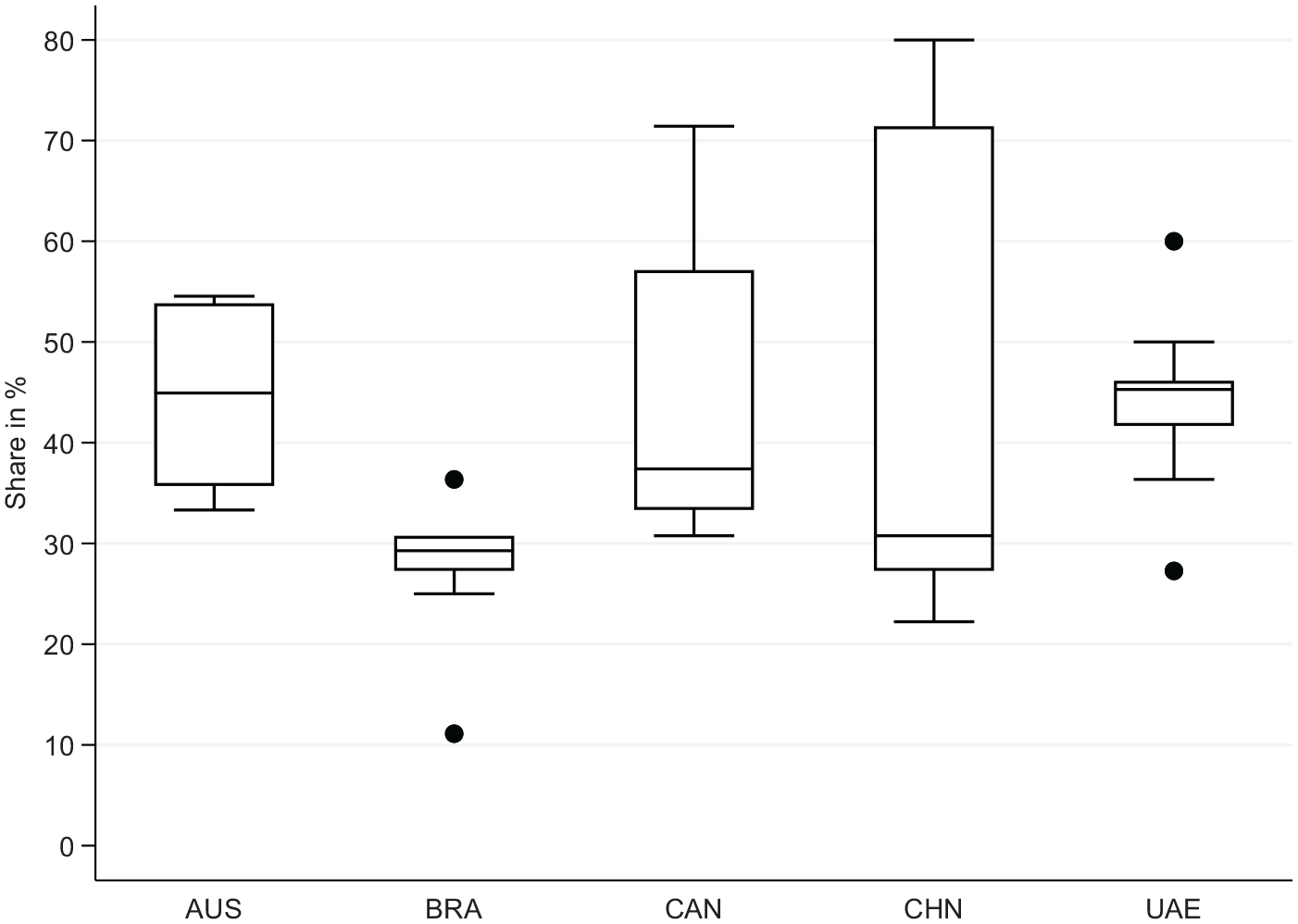
Box plots for the share of Clean Energy Ministerial (CEM) initiatives the countries participated in, 2010–2019.
When inspecting the development of policy effort by the competent Australian minister, we can see that the median (the black line) divides the body of the boxplot into two equal areas. This signals that Australia is characterized by a homogeneous oscillation in the level of policy effort. The minimum and maximum values for the shares of initiatives in which the Australian government participated are close to the body of the box plot, which provides additional support to a relatively stable pattern of forward and backward movements concerning clean energy policies.
The pattern is different for Canada and China. For these two countries, there are more observations above the median share of policy initiatives. It should be noted, though, that Australia performs better than Canada or China in respect of the median share of policy initiatives. However, the latter have increased their levels of policy effort more often than Australia.
The most interesting cases are Brazil and the UAE since they challenge our theoretical argument – at least at first glance. The dots below the minimum values of the box plots suggest that the competent ministers of these two countries supported policy under-reactions. For the UAE, we can dismiss this interpretation since the outlier refers to the year in which the country joined the CEM and participated in only a few policy initiatives. In all other years, the UAE participated in a higher number of initiatives, indicating an increasing level of policy effort rather than an under-reaction. It should be noted that of all countries examined here, the UAE has the highest median value, indicating a relatively high level of policy effort over time. By contrast, in the case of Brazil, we witness one instance of an under-reaction in 2016. Of the nine initiatives in place in 2016, Brazil participated in only one (see Figure 2). Thus, this observation challenges our theoretical argument.
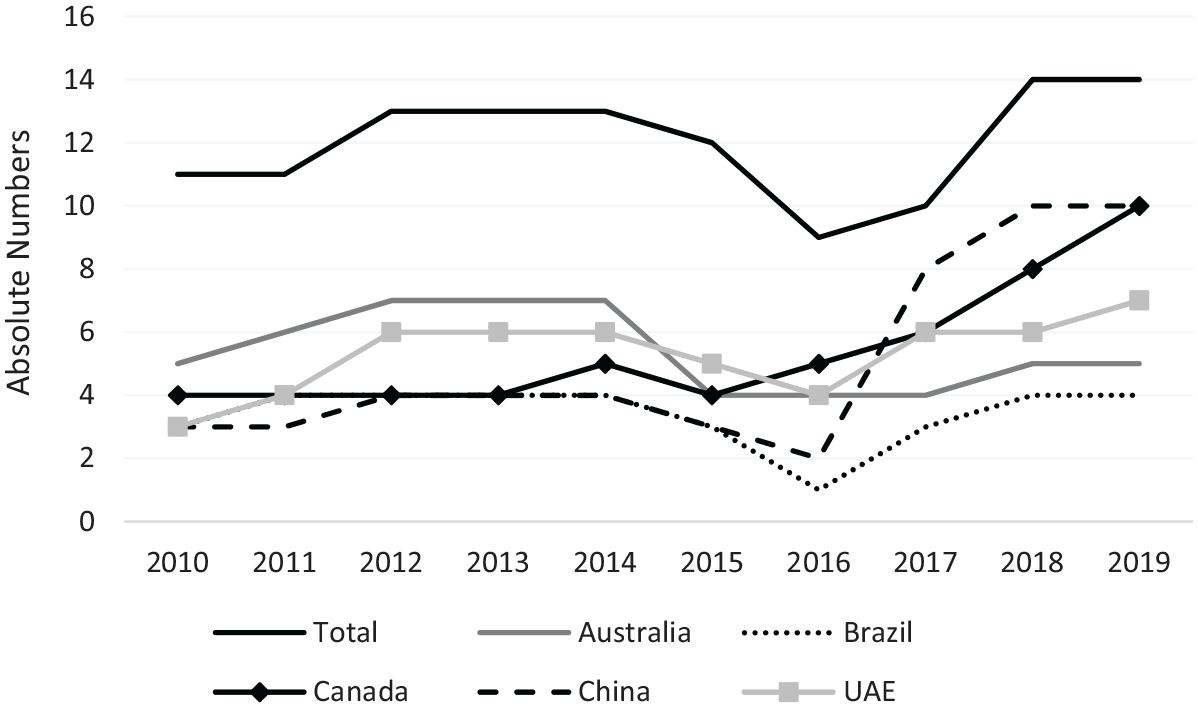
Participation in Clean Energy Ministerial (CEM) initiatives in absolute numbers, 2010–2019. “Total” refers to the total number of CEM initiatives in a given year.
Turning to policy over-reactions, Brazil demonstrates an exceptionally high level of policy effort in 2011, when it participated in four out of 11 initiatives (see Figure 2). The fourth initiative that Brazil joined in that year was the ‘Super-efficient Equipment and Appliance Deployment’ initiative. Participation in four initiatives appears exceptionally high since there have generally been very few changes in Brazil’s participation levels over time, as indicated by the short length of the interquartile range (i.e. the box). The UAE had a remarkably high value regarding its policy effort in 2017, when the country participated in six of 10 initiatives, whereas in 2016 it had participated in only four of nine initiatives (see Figure 2). The change from four to six initiatives indicate that the UAE joined the existing initiatives ‘International Smart Grid Action Network’ and ‘Clean Energy Solutions Center’. The UAE also joined the new initiative ‘Sustainable Cities and Eco-Energy Towns’, which was launched by Korea and Russia. The participation in this new initiative aligns with the UAE’s interest in fostering its prestigious eco-city project of Masdar City, which, since its inception, has repeatedly scaled back its initial ambitions (see Griffiths and Sovacool, 2020).
In summary, the empirical analysis supports our theoretical argument for three of the five cases examined. In the case of the UAE, the theoretical reasoning still appears to be valid since the supposed policy under-reaction refers to the year in which the country joined the CEM. Afterwards, the UAE increased its level of policy effort and even produced one instance of a policy over-reaction. The picture is less clear for Brazil. While the over-reaction in 2011 aligns with our theoretical argument, the under-reaction in 2016 does not. A potential explanation could be the instability of the government in Brazil in that particular year, the year in which the Senate of Brazil first suspended President Dilma Rousseff’s powers and duties and then removed her from office, which also should have affected the country’s participation in the CEM. However, while this observation needs further exploration, we also acknowledge that the policy under-reaction was swiftly overcome. This provides suggestive evidence for our argument that reputation costs may have a steering effect in climate clubs, helping to overcome policy under-reactions.
Conclusion
Since climate change has become recognized as a threat that requires international co-operation, climate clubs have been launched, which are characterized by the membership of a small number of countries (Falkner, 2016; Hovi et al., 2016; Yu, 2019). In this study we examined two questions. First, we were interested in governments’ motivations for joining the CEM, which represents a climate club. Second, we were interested in whether and how the members’ participation in CEM initiatives changed over time. We considered CEM initiatives to correspond to the organizations’ policy outputs, which facilitated the analysis of the policy consequences of membership.
Concerning the first research question, we could show that participation in the CEM was a deliberate decision made by the individual governments. For the governments of all countries examined in this study, the expected economic benefits represented the main trigger for joining the CEM. In the case of some countries (e.g. the UAE), membership in the CEM was considered beneficial since it provides access to knowledge and technologies that can facilitate clean energy transition. Other countries (e.g. China) joined the CEM since it provides a platform to liaise with the governments of export markets for clean energy technologies. While the expected economic benefits mattered for all countries, we could not find evidence suggesting that US leadership played a role in Brazil’s decision to join the CEM.
With regard to the second research question, we showed that the level of policy effort (measured by participating in CEM initiatives) oscillated to a moderate degree for three of the five countries analysed. In the case of the UAE, the level of policy effort was unusually low in the first year but increased significantly thereafter. Therefore, we do not qualify this case as an instance of policy under-reaction. For Brazil, the analysis showed that in 2016, the country participated in exceptionally fewer initiatives than at any time before or after. This instance of policy under-reaction, however, was overcome within a year and therefore did not result in a sustained under-reaction, which would have corresponded to a ‘policy bubble’ (Jones et al., 2014; Maor, 2012, 2017; Maor et al., 2017). In addition to these observations, there are instances where the two countries participated in an exceptionally high number of CEM initiatives given their previous participation level, which indicates the existence of policy over-reactions.
Our study contributes to the literature on (dis)proportionate policy responses in two ways. First, we applied the concept of policy under- and over-reactions to policymaking in international organizations, demonstrating that it might provide fruitful insights beyond analyses of domestic policymaking. In contrast to earlier attempts to operationalize policy over- and under-reactions (see De Francesco and Maggetti, 2018), we did not match the policy reactions observed with a howsoever-defined level of problem pressure. Instead, we relied on the repeated observations of the dependent variable in order to assess the degree to which the individual observations are proportionate or disproportionate.
Second, our finding that the changes in the policy efforts of the CEM members can predominantly be seen as proportionate suggests that climate clubs may help prevent national governments from scaling back their involvement in climate governance in a sustained manner. This is an important observation when considering, for example, the very low priority that the current Brazilian administration of Jair Bolsonaro gives to climate policy. Likewise, it remains to be seen whether and how the participation of Australia in the CEM will change in reaction to the devastating bush fires in December 2019, which at least to some extent have been fuelled by climate change-induced drought conditions. The bushfire crisis may result in greater political pressure to fight climate change, which might also manifest itself in how Australia participates in the CEM. In the past, Australian governments used membership in climate clubs to postpone serious action. This was, for example, the case when the Howard government initiated the APP (Lawrence, 2009). With the hazard brought about by the bush fires, such strategic manoeuvres are unlikely to happen again since there will be considerable public scrutiny directed at the adoption and implementation of domestic climate policies as well as compliance with international commitments to mitigate climate change. Despite the analytical insights provided, our analysis is affected by several limitations, which we regard as starting points for future research. First, the CEM is an exclusive club, whose membership is by invitation only. Hence, becoming a member is associated with a certain status in the international system. Therefore, it appears promising to compare the countries’ motivations for joining the CEM with their motivations for joining other climate clubs or more broadly other climate governance organizations such as IRENA (see Urpelainen and Van de Graaf, 2015; Van de Graaf, 2013). Second, our analysis was limited to five cases and therefore an obvious next step would be to increase the number of cases. An interesting approach for studying the interplay of the different explanatory factors would be to apply configurational comparative methods, such as Qualitative Comparative Analysis. Such an approach should not only expand the number of cases but also enable a more systematic identification of the configurations of conditions that lead to climate club membership. Third, in this study we did not pay attention to policy consequences of the CEM policy initiatives at the domestic level. Likewise, we could not provide detailed insights into the domestic politics resulting in the over- and under-reactions observed for Brazil and the UAE. Therefore, we strongly encourage future research that integrates an analysis of climate club policy efforts with an investigation of its interactions with both domestic policies and politics.
Supplemental Material
sj-pdf-1-ips-10.1177_0192512120942303 – Supplemental material for The Clean Energy Ministerial: Motivation for and policy consequences of membership
Supplemental material, sj-pdf-1-ips-10.1177_0192512120942303 for The Clean Energy Ministerial: Motivation for and policy consequences of membership by Jale Tosun, B Guy Peters, Jale Tosun and Adrian Rinscheid in International Political Science Review
Footnotes
Acknowledgements
We thank Jian Shao for research assistance and acknowledge helpful comments by Jörn Ege, Eduardo Grin, Sebastian Oberthür, Guy Peters, Tiina Randma-Liiv, David Sandalow and Marian Sawer as well as three anonymous reviewers. Laurence Crumbie deserves credit for language editing.
Authors’ note
Earlier versions of this paper were presented at the INOGOV workshop organized by Nicole Schmidt and Paul Tobin at the International Academic Forum at Heidelberg University in May 2017 and at the ECPR General Conference 2017 at the University of Oslo in September 2017.
Funding
The authors disclosed receipt of the following financial support for the research, authorship, and/or publication of this article: we thank the COST network INOGOV – Innovations in Climate Governance (IS1309) (European Cooperation in Science and Technology) – for funding.

Notes
Author biographies
References
Supplementary Material
Please find the following supplemental material available below.
For Open Access articles published under a Creative Commons License, all supplemental material carries the same license as the article it is associated with.
For non-Open Access articles published, all supplemental material carries a non-exclusive license, and permission requests for re-use of supplemental material or any part of supplemental material shall be sent directly to the copyright owner as specified in the copyright notice associated with the article.
