




Abstract
Despite the policy-relevant aspirations of military regimes, scholars have shown surprisingly little interest in exploring the agenda dynamics and policy processes in these regimes. We sought to close this gap by analysing the original datasets of over 13,000 legislative speeches, public budgets, and the background characteristics of 160 representatives who served in the Consultative Assembly of the military regime of Kenan Evren in Turkey (1980–1983). Empirical analyses indicate that the regime’s policy priorities did not differ significantly from those of democratic governments, and that while representatives with military backgrounds showed far more interest in the core functions of the government, the process through which they were selected (whether or not directly appointed by the National Security Council) appeared to have no explanatory power. Perhaps more importantly, there were more similarities than differences between the military regime of Kenan Evren and the coalition, minority and majority governments of the 1970s and 1980s. Our findings imply that the effect of institutions on policy agendas is overstated.
Introduction
This study raises the question of what factors shape the agenda dynamics in military regimes by analysing the policy priorities of the ruling elite in the Kenan Evren regime in Turkey (1980–1983). Specifically, we explore the extent to which the policy priorities of the military regime differed from the policy priorities of the governments that preceded and succeeded the military regime. We delve further into policy prioritization at the individual level by utilizing representatives’ background characteristics to predict their policy priorities in the assembly.
A significant amount of research has explored the institutional characteristics of democratic and authoritarian regimes and how these institutional characteristics interact with other political conditions to shape regime survival. However, much less attention has been given to the extent to which authoritarian regimes differ from democracies in policy priorities and outputs (Pepinsky, 2014; Sebők and Berki, 2018; Or, 2019). For instance, is the policymaking process in electoral authoritarian regimes more likely to have similarities with democracies than with other non-democracies such as military regimes? As Frantz and Ezrow (2013: 85) once wrote, ‘the category of dictatorship masks interesting variations in the institutional structure of these regimes’, which constitutes an additional layer of complication for the study of policy processes in authoritarian regimes. Although practical, the binary measure of democracy and dictatorship potentially conceals the various policymaking characteristics that particular types of democracies and non-democracies share in common (Remmer, 1986; Wright, 2008). Indeed, past scholarship in comparative public policy and politics has shown that while democracies differ significantly from non-democracies in their reliance on external cues when updating policies (Baumgartner et al., 2017; Chan and Zhao, 2016; Lam and Chan, 2015), non-democracies are considerably heterogenous as a group when it comes to policy outcomes and this further complicates scholarly efforts to identify qualitative differences among regime types (Frantz and Ezrow, 2013).
In this article, we aim to advance our understanding of policy change and policy priorities in a highly understudied regime type, military dictatorships, where we examine the case of Kenan Evren’s military regime in Turkey. The case of Turkey provides excellent opportunities to explore the extent to which military regimes differ from their democratic counterparts in policy priorities and processes, given that Turkey’s military regime (1980–1983) was preceded and succeeded by a series of coalition and majority-party governments. This variation allows us to delve further into the nature of policy dynamics in the Evren regime and how it diverged from the different types of democratically elected governments of the 1970s and 1980s.
In our empirical approach, we make use of different levels of data to explore both macro- and micro-level agenda dynamics in the regime. At the macro-level, we compiled and coded all the parliamentary statements made within the Grand National Assembly of Turkey before and after the military regime (the coalition governments of 1977–1980 and the majority government of 1983–1987) to allow for comparisons between the Consultative Assembly (CA) of the Evren regime and the democratically elected legislatures of the same period. In addition, we put together a dataset of budget appropriations from the period 1971–2005 to further scrutinize differences in agenda dynamics between the democratic and non-democratic periods. At the micro level, we utilized information about the political and demographic backgrounds of the ruling military elite and explored individual-level variation in the content of representatives’ speeches. Our results cast doubt on the contention that military elites pursue distinct policy priorities and agendas once in power. Our results also show that the ruling elite in the Evren regime was fairly heterogenous in their policy priorities and preferences.
Background
Extant literature has studied the relationship between democracy and other variables such as human development, economic growth, and income inequality. Since politicians in democratic regimes rely on public support to stay in power, they are motivated to improve citizen welfare. Studies also show that democracies outperform autocracies in terms of quality of government (Adserà et al., 2003; Charron and Lapuente, 2011; Ross, 2006; Rudra and Haggard, 2005), fighting corruption (Humphreys and Bates, 2005), providing transparency (Hollyer et al., 2011) and managing foreign aid to improve quality of life (Kosack, 2003). Strong scholarly evidence also shows that democracy has a positive and significant effect on various aspects of human development. For example, democratic states invest more in health and education (Haggard and Kaufman, 2008; Lake and Baum, 2001; Stasavage, 2005), which leads to decreased infant mortality (Gerring et al., 2012), better public health and educational attainment.
Although democracies and authoritarian regimes are generally thought to produce distinct policy outcomes, a growing body of research contends that the institutional differences between these two forms of governments are overstated. Specifically, the function of legislatures is quite obvious in democratic polities, yet what institutions accomplish in authoritarian countries is less clear (Gandhi and Przeworski, 2007). Although authoritarian regimes have been studied from many aspects, the influence of autocratic institutions on policy outcomes remains an understudied area. Fortunately, an increase in the number of studies exploring various aspects of authoritarian regimes has been witnessed in recent years, thanks to the new institutionalists (Schedler, 2009). Accepting that these institutions are more than ‘window dressing’, scholars in this strand of research focused on the effects of these institutions on political outcomes.
A number of studies within this area explained the establishment of legislatures as a move to solve credibility problems, which are severe in authoritarian regimes. The credibility problem has both economic and political dimensions and concerns both domestic and foreign actors. In terms of domestic politics, authoritarian leaders use legislative institutions to neutralize threats coming from within the ruling elites. Gandhi and Przeworski (2007), for example, found that legislatures help dictators broaden their support by incorporating potential opposition forces into the ruling elite, which in return, lengthens their tenure. Similarly, Boix and Svolik (2013) argue that dictators establish and maintain legislatures to solve commitment and monitoring problems within the ruling elites. More specifically, dictators are more likely to establish and maintain legislative institutions when their allies are strong enough to pose a credible threat.
As for the economic dimension, research shows that authoritarian legislatures foster economic growth. Gandhi (2008) portrays authoritarian legislatures as instruments of cooptation that facilitate cooperation between the regime and outside groups to provide better economic growth. Wright (2008) argues that dictators in authoritarian regimes that rely heavily on domestic investment to stay in power establish legislative institutions to put constraints on the regime’s confiscatory behaviour, as binding legislatures improve economic growth and domestic investments.
While there is an established literature on differences in terms of performance and policy outcomes between democratic and non-democratic regimes, much less attention has been given to the variation within non-democracies. Miller (2015a) identifies this lacuna and stresses that, despite the rich literature comparing democracies and autocracies, scant attention has been paid to how development outcomes differ among types of autocratic regimes. His analysis shows that there is indeed variation among autocracies, and contested autocratic elections promote human development by improving state accountability and capacity. More specifically, the presence of elections produces better outcomes in health, education, gender equality, and basic freedoms, compared with non-electoral autocracies. In another study, Miller (2015b) delves further into the micro-mechanisms of authoritarian institutions and policy responsiveness. A central tenet of democracy is the responsiveness of elites to the priorities of the public, hence politicians in democracies are expected to respond to public preferences. But do the elites respond to public preferences in authoritarian regimes? Miller’s findings show that autocratic elections give citizens a chance to signal their dissatisfaction with the regime, and the ruling elites use this information to calibrate policy concessions (Miller, 2015b).
Though far from ideal, autocratic elections often lead the ruling elite to reconsider its redistributive policies. Martinez-Bravo and colleagues, for example, find that Chinese local elections significantly increase public goods expenditure and lead to income redistribution within villages (Martinez-Bravo et al., 2012). Wang and Yao (2007) also reach similar conclusions and show that elections have enhanced the accountability of the village committees in rural China and weakened the state’s grip.
Recent studies also underline the variation among autocratic regimes from various other aspects. In a recent study, Wilson and Wright (2017) found that legislatures reduce expropriation risk in non-personalist regimes, but are correlated with a higher risk of nationalization in personalist regimes. Chandra and Rudra (2015) also show that autocracies with higher levels of public deliberation have higher growth rates compared with authoritarian regimes that have less public deliberation. Collectively, these studies show that qualitative differences among non-democratic regimes are not negligible and need to be given adequate attention.
All in all, a growing literature has stressed the importance of institutions, more specifically legislatures, in authoritarian regimes. Recent scholarly work underlines the variations within autocratic regimes in terms of policy outcomes such as economic performance and human development. Although this literature is quite rich and enlightening, it largely ignores, with a few notable exceptions (Bonvecchi and Simison, 2017; Desposato, 2001), the micro-mechanisms of elite behaviour in authoritarian regimes. If authoritarian institutions matter and produce distinct outcomes in various aspects, we should also expect to see variation in legislative behaviour in these regimes. In fact, Desposato’s (2001) work on authoritarian Brazilian legislatures confirmed this possibility, showing that the legislators acted strategically to balance competing demands from two principals, the constituents and the military elites. Inspired by these findings, we believe that it is of utmost importance to examine the micro-mechanisms of agenda dynamics in different types of authoritarian regimes. In what follows, we describe the case of the Evren regime in Turkey and present our theoretical expectations.
The Turkish Case
The military had always played an active role in Turkish politics until the last decade, when various reforms were undertaken by the ruling AKP (AK Parti; Justice and Development Party) to curb its influence on democratic politics. As Karabelias (1999: 130) succinctly summarized, if there is one element on which all researchers of Ottoman and Turkish history seem to agree, this is the assumption that the military institution has been the most important force behind the evolution of the social, economic and political structure of the Turkish state. Herein lies an irony: European officials have made diminishment of military influence a key reform in Turkey’s European Union accession process. This may be a noble goal, but by insisting on dismantling the military role in Turkish society without advancing a new mechanism to guarantee the constitution, well-meaning reformers may actually undercut the stability of Turkey as a democracy.
The pessimistic camp, on the other hand, contends that each military intervention originally had a goal regarding the social and political transformation of the country, which typically resulted in long-term instability due to the unintended consequences of far-reaching reforms (Özbudun, 2000). In Jeremy Salt’s (1999: 72) words, ‘in intervening in the name of safeguarding secularism, the military has undermined Turkey’s fragile democratic evolution, and the threat that the [Islamist parties were] supposed to represent must be weighed against this very significant cost’. Also, as Ergun Özbudun (2000: 117) famously argued, Turkey’s military regimes do not differ much from those of Brazil, Chile and Portugal in the sense that the departing military regimes have always dictated the conditions of their departure, making the rules of the game that continue to shape politics in democratic times. Indeed, the failed coup attempt in 2016 casts doubt on this positive framing of the military’s influence in politics, as it demonstrated that the role the Turkish military played in shaping policy and political outcomes depended largely on what factions were more dominant within the military’s leadership positions.
Few would disagree with the statement that the military intervention under the leadership of General Kenan Evren had profound consequences for Turkish politics in the following decades. Through the National Security Council (NSC) formed by Kenan Evren and the commanders of the land, air, naval and gendarmerie forces, the Turkish Armed Forces ruled the country from September 1980 to November 1983. In addition to the NSC, the CA of the military regime was established to draft the new constitution before elections were held, which is considered an equivalent of the lower chamber of a parliament. Among its 160 members, 40 of them were directly appointed by the NSC, and the rest were recommended by governors of provinces to the NSC, which then chose a representative from a small list of recommended candidates in each province. This variation in the process through which representatives were selected provides important opportunities to examine the scope of agenda congruence among individual members of the ruling elite.
Hypotheses
Based on the above discussion, we proposed two hypotheses regarding the agenda-setting dynamics in the Evren regime at the macro- and micro levels. Past scholarship has shown that ‘in single-party and military dictatorships, policy changes tend to be incremental and significant departures in policy more difficult to agree to’ (Frantz and Ezrow, 2013: 87). To the extent that this argument is correct, we expected to find only minor departures in policy in the Evren regime. To that end, we explored the extent to which the military regime’s policy priorities and preferences differed from those of the coalition governments of the 1970s and the majority government of the 1980s through an analysis of legislative speeches and budgetary changes.
Firstly, drawing on a content-analytic dataset of legislative speeches made in the CA of the regime, we analysed agenda congruence between the military regime and the democratically elected governments of the 1970s and 1980s. Specifically, we expected to find similar levels of attention to individual policy categories across the periods under investigation in this study. Similarity in the levels of legislative attention to policy topics would be indicative of policy continuity in the military regime. Secondly, we examined policy change and continuity by focusing on budgetary expenditure. Following a large body of research within the framework of punctuated equilibrium (Jones and Baumgartner, 2005), we plotted the distribution of annual changes in budgetary expenditure on the grounds that significant departures in policy should result in leptokurtic probability distribution (i.e. fat tails). Stochastic process methods have been widely used in testing policy punctuations, where scholars have relied exclusively on budgetary changes to detect major policy departures (Breunig and Jones, 2011; Breunig and Koski, 2006; Jones et al., 2009). In the context of our research, if the military regime of Kenan Evren did indeed undertake major policy changes once in power, then these changes should be reflected in budget appropriations. In statistical terms, major changes in policies should result in change distributions that deviate remarkably from normality, where the overall distribution should be characterized by leptokurtosis (i.e. high L-kurtosis values).
The first two hypotheses focused on the macro-level dynamics of policy agenda. We delved further into agenda dynamics by exploring the variation in attention among the representatives in the CA of the regime. Past scholarship has shown that military regimes, compared with personalistic dictatorships, operate with a larger numbers of veto players that restrain policy change (Frantz and Ezrow, 2013). Although we were unable to test this argument directly in the absence of a personalistic dictatorship in Turkey, we can still make inferences about the extent to which individual representatives share policy priorities in common. Specifically, we explored the possibility that the process through which representatives were elected to the assembly shaped representatives’ attention to the core functions of the government. Unlike those appointed directly by the NSC, 75 percent of the representatives (120/160) were selected by the NSC from a pool of candidates nominated by provincial governors. On the one hand, this is not a trivial difference as it helped diversify the pool of candidates. On the other, the NSC members had the final say on the appointment of all candidates, including those nominated by provincial governors; therefore, the selection procedure may have had limited impact on the legislative attention of individual representatives.
Representatives with a military background made up a good portion of the group of elites appointed directly by the NSC and the list of candidates recommended by provincial governments. This variation allows us to explore another theoretically important question about informal ties among the ruling elite in the regime. In particular, representatives with a military background may have prioritized a similar set of policies during legislative debates, given their shared experiences and perspectives. In other words, regardless of the process through which representatives were selected, those with a military background may have been socialized to care more about particular aspects of governance.
Data and methods
We utilized original content-analytic datasets of over 13,000 parliamentary speeches, budget outlays and the biographies of 160 members of the CA of the military regime to examine agenda dynamics at the macro- and micro levels. We collected and coded the parliamentary speeches made by the members of the CA based on the CAP coding scheme (the CAP codebook can be found at https://www.comparativeagendas.net/pages/master-codebook) (Baumgartner et al., 2019; Bulut and Yildirim, 2019, 2020), which codes legislative activities into 21 major topics and 220 subtopics. After creating individual variables for 21 major topics, we collapsed these speeches by representatives to merge the data with representatives’ background characteristics. The biographical information includes age, gender, past parliamentary experience, military background, the process through which the representative was selected (whether or not appointed directly by the NSC), localness (born in constituency), and educational background.
While only a tiny portion of representatives was female, there is considerable variation in other demographic and political characteristics. Seven percent of the representatives selected by provincial governments, and 10% of the representatives appointed by the NSC had previously served in the parliament. Many of the representatives were bureaucrats who worked for state-owned agencies in the provinces they were born and raised in. More than a quarter of all representatives were law graduates, and around 18% had previously served in the army professionally. The average age of the legislators was 53, ranging from 30 to 76. Descriptive statistics are reported in Table 1S.
Results
We started our empirical investigation by comparing the issue priorities of the coalition governments of the late 1970s, the military regime of Kenan Evren (1980–1983) and the majority government of Turgut Özal (1983–1987). Table 2S in the Appendix reports the statistical association between the policy priorities (measured with legislative speeches) of the coalition governments of the late 1970s and that of the military regime. As chi-squared values indicate, there were statistically significant differences between the two periods in about half of the policy categories. Notably, the amount of attention devoted to ‘the core functions of the government’, the macroeconomy, crime and law, defence, international affairs and government operations (see Jennings et al., 2011) in the military regime did not differ significantly from its predecessor’s attention to the core functions. One might expect to see important changes in public policies regarding security issues, international affairs, law and reforms, and the economy under military rule, as these policy areas are key to social and political transformation in the country. However, we found that the military regime devoted as much attention to the core functions as the democratically elected assembly it replaced in September 1980.
Figure 1 depicts legislative attention to selected issues across three periods, the coalition and minority governments of the late 1970s, the Evren regime, and the majority government of the 1980s. The figure shows that the policy priorities of the ruling elites in all three periods were strikingly similar. That is, in support of the results from Table 2S, it is clear that there is no association between regime type and legislative attention to the core functions of the government. In all three periods, issues related to the government operations occupied at least a quarter of the agenda space, followed by crime and law issues that constituted 12–15% of all legislative speeches. The increase in attention to the macroeconomy can be explained by the fact that the leader of the majority government formed in 1983, Turgut Özal, had established himself as an economic reformer who wanted to open up the economy by minimizing state interventions.
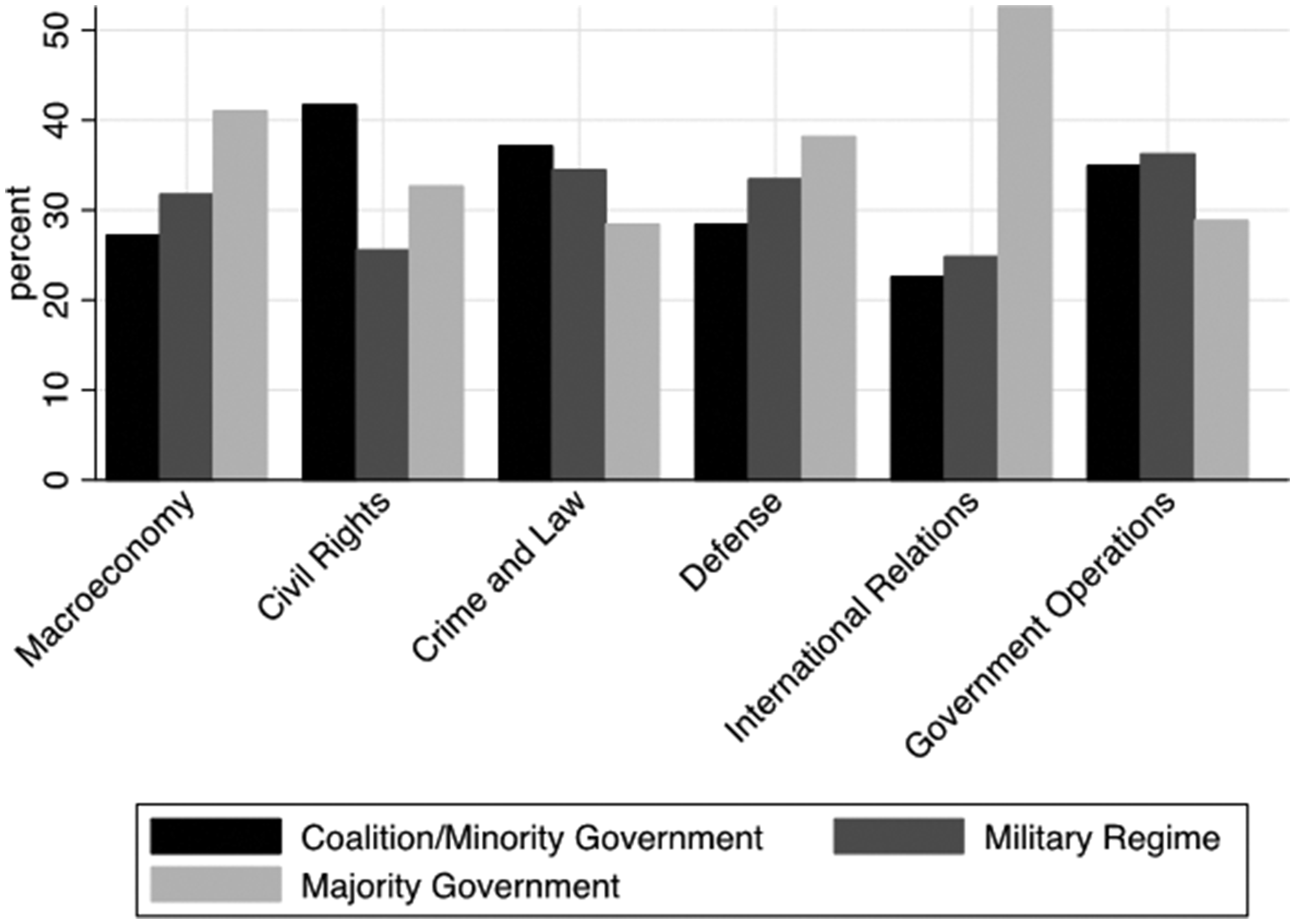
Attention to selected policy categories in three periods.
One might expect the scope of issues with which ruling elites are involved to decrease substantially in authoritarian regimes, as information streams available in non-democratic regimes are far less diverse (Baumgartner et al., 2017). We explored this possibility by calculating Shannon’s H to compare the scope of issues that entered the political agenda in each period under investigation in our study (see Boydstun et al., 2014; Or, 2019). Note that a highly concentrated political agenda would yield a very low entropy (diversity) score. Our results showed that the coalition/minority governments, the military regime and the majority government had entropy scores of 2.40, 2.37 and 2.55, respectively. While issue diversity in the military regime’s political agenda was the lowest, the issue diversity of the coalition/minority governments was not meaningfully higher than that of the military regime.
We continued our empirical investigation with an analysis of policy change. A large body of research in policy processes has examined policy change in various contexts by tracking the scope of changes in public budgets (Breunig and Jones, 2011; Breunig and Koski, 2006; Jones and Baumgartner, 2005; Jones et al., 2009; True et al., 1999). This strand of research has shown that the change distribution of budgetary changes in systems that undertake frequent and major policy changes deviates significantly from normality (L-kurtosis of 0.123). In statistical terms, the higher the L-kurtosis value, the more severe the policy punctuations (Jones and Baumgartner, 2005). We first plotted the change distribution of budget appropriations between 1978 and 1985, and then compared the L-kurtosis value obtained from this sample with different periods. Given that our primary goal here was to compare the scope of budgetary changes in the military period with the budgetary changes undertaken in the democratic governments of the 1970s and 1980s, we included in our sample two budgetary years before and after the military regime to allow for comparison. Figure 2 demonstrates that there are indeed large punctuations in budget appropriations for the period 1978–1985 and that the change distribution clearly deviates from normality (L-kurtosis = 0.603).
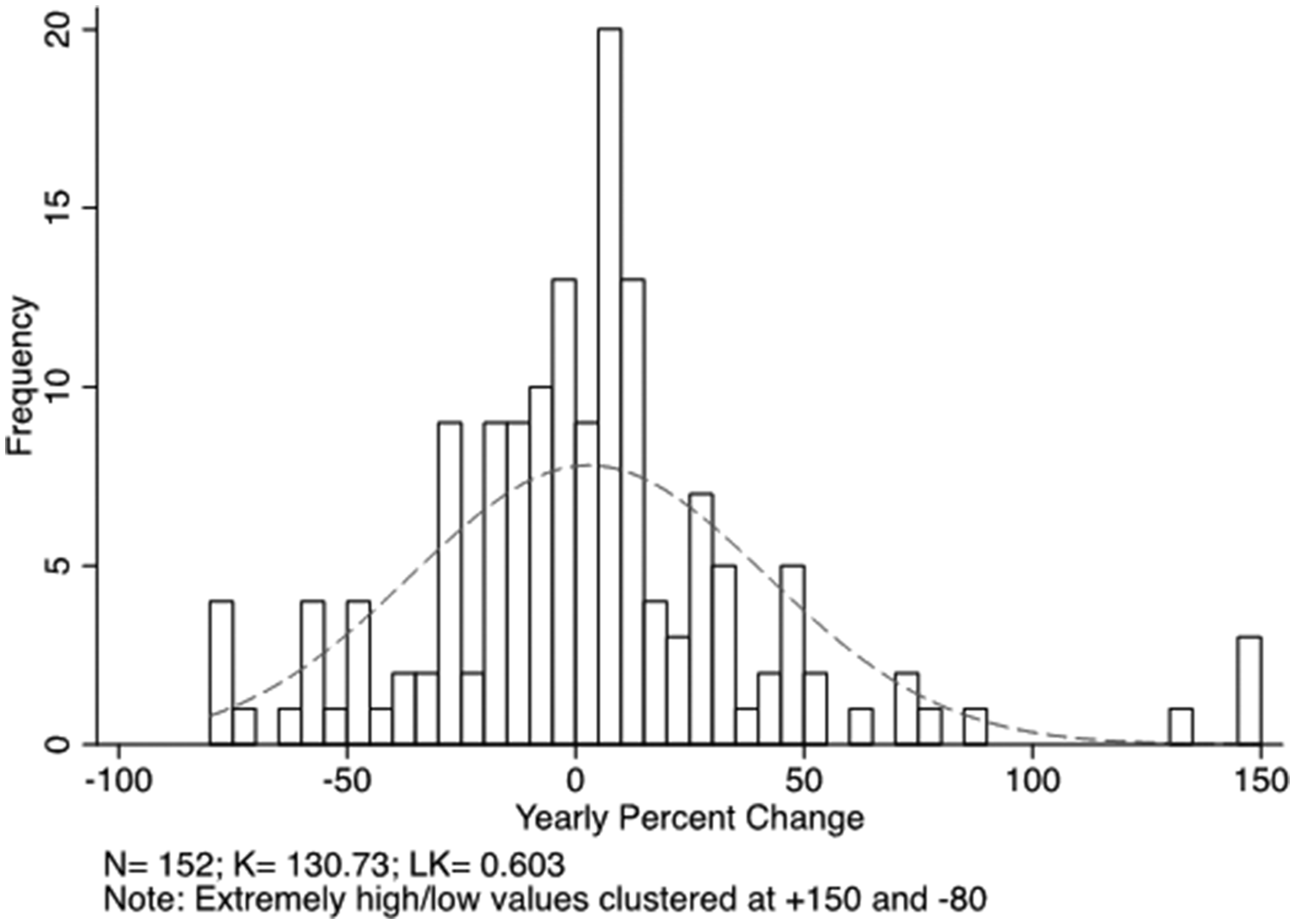
Change distribution of budget appropriations, 1978–1985.
However, it is important to put these numbers into perspective, for they would be indicative of extreme policy volatility only if change distributions of budget appropriations from other periods deviated more from normality. Therefore, we replicated the same procedure for different periods and found that policy punctuations during the coalition and minority governments of the 1970s were more severe than those in the military regime (N = 209; L-kurtosis = 0.746). In fact, except for the majority-party Özal governments in the 1980s (N = 182; L-kurtosis = 0.392), the distribution of budgetary changes yielded similar or higher levels of L-kurtosis, relative to the Evren regime. Stated differently, volatility in the policy outputs was not as severe as one might expect to find in the military regime of Evren.
We now turn to the individual-level analysis of agenda dynamics and policy priorities by exploring the variation among the members of the CA in the Evren regime. At the micro level, we capitalized on the variation in representatives’ background to explain differences in issue attention. The null hypothesis was that representatives, regardless of their past military background and of the process through which they were selected, prioritize a common set of policy problems facing the country. Specifically, our analysis sought to explain the variation among representatives in attention to the core functions of the government.
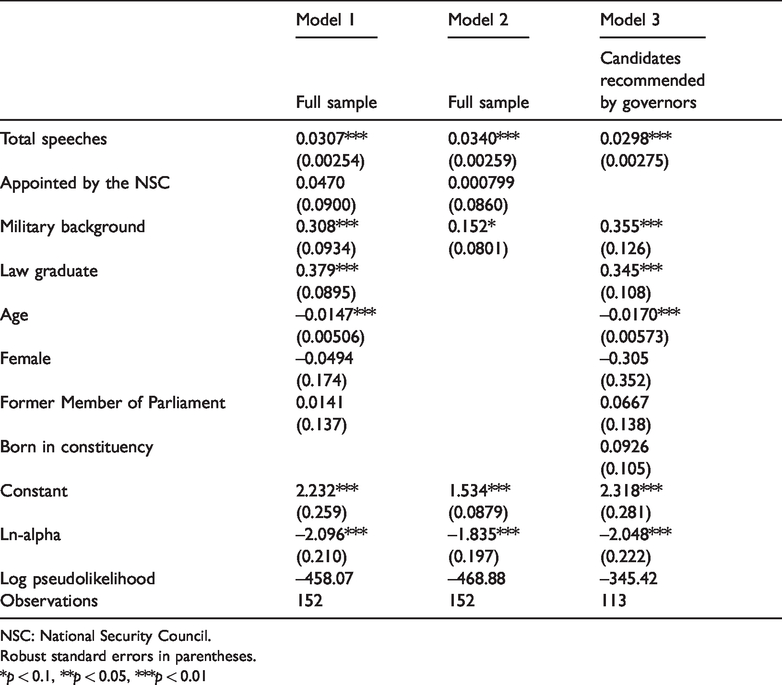
The results are reported in Table 1. Unlike the first two models, Model 3 uses a restricted sample based on representatives who were selected from the pool of candidates recommended by provincial governors. That is, Model 3 excludes the representatives directly appointed by the NSC. Two observations are immediately evident. First, representatives appointed directly by the NSC did not differ significantly from other representatives in their issue attention. Second, models 1–3 show that representatives with military backgrounds were significantly more likely than other representatives to focus on the core functions of the government. The positive and significant coefficient on the military background variable in Model 3 is of particular importance, as it shows that the military background mattered even among those who were selected from the list recommended by the governors. The interpretation of this finding required additional information about the background characteristics of the representatives, as we lacked information about whether or not those with a military background had close ties with the ruling elite and therefore relied heavily on the cues received from the NSC in shaping their policy priorities. We did know, at least, that many of the representatives selected from the governors’ lists had served previously in the parliament, and had no association with the armed forces at the time of their appointment.
Determinants of attention to the core functions of the government.
NSC: National Security Council.
Robust standard errors in parentheses.
*p < 0.1, **p < 0.05, ***p < 0.01
The results also show that senior representatives were less likely and law graduates more likely to focus on the core functions of the government. The finding that seniority was negatively associated with the core functions of the government comes as a surprise, for such issues require more expertise that tends to come with seniority. Representatives’ gender, past parliamentary experience and localness (born in constituency) appeared to have no significant effect on their attention to the core functions. All in all, these findings imply that there was considerable heterogeneity among representatives, though the process through which they were selected had no discernible impact. In fact, the explanatory power of various individual-level factors such as seniority, and educational and civil-military background implies that there was considerable room in the CA for legislators to raise issues of their own choosing.
Discussion
In this study, we made the first empirical attempt to study the degree to which a military regime outside Latin America diverged from the democratically elected governments that succeeded and preceded it. Drawing on original datasets of public budgeting and legislative speeches, we examined agenda dynamics in the military regime of Kenan Evren at both the micro- and macro levels. Our results show that major policy punctuations were not more severe in the military regime and that the military regime did not diverge significantly from the democratically elected governments of the 1970s and 1980s. In addition, we delved further into the agenda dynamics by exploring the individual-level variation in issue attention in the CA of the regime. Our empirical analyses based on legislative speeches and the biographies of the representatives revealed that the military regime of Kenan Evren did not pursue a distinct policy agenda and that the process through which representatives were selected (whether or not appointed directly by the NSC) had no effect on representatives’ attention to the core functions of the government.
These findings have important implications for the study of agenda dynamics in non-democratic regimes, as well as Turkish politics. In painting authoritarian regimes with the same brush, scholars tend to ignore the qualitative differences among non-democratic regimes that may help explain why policy outcomes vary remarkably with types of authoritarian regimes. In this regard, our study lends strong support to the idea that there are often important differences even within the same type of authoritarian regimes. In terms of policy agendas, there were more similarities than differences between the military regime of Kenan Evren and the coalition, minority and majority governments of the 1970s and 1980s. In other words, our findings cast doubt on the contention that regime type plays a key role in shaping agenda dynamics, at least in the Turkish case.
It is important to note that our results by no means imply a generalizable trend in the policy priorities of the military regimes, given that it is based on a single case. What these results do suggest, however, is that scholars of democracy and dictatorship need to proceed with caution in their attempts to generalize their findings about the agenda dynamics and policy outcomes in military regimes, as qualitative differences among authoritarian regimes tend to be understated. Future research needs to examine other cases of military regimes in an empirical manner to advance our understanding of agenda dynamics under different authoritarian conditions.
Supplemental Material
sj-pdf-1-ips-10.1177_0192512120923068 - Supplemental material for Agenda dynamics and policy priorities in military regimes
Supplemental material, sj-pdf-1-ips-10.1177_0192512120923068 for Agenda dynamics and policy priorities in military regimes by T. Murat Yildirim, Alper T. Bulut and Emel Ilter in International Political Science Review
Footnotes
Acknowledgments
The authors would like to thank Aurel Croissant, Max Grömping, Orion Lewis, Jessica Teets, Florian Weiler, as well as the editors, for comments on an earlier version of this paper.
Declaration of conflicting interests
The authors declared no potential conflicts of interest with respect to the research, authorship, and/or publication of this article.
Funding
The authors received no financial support for the research, authorship, and/or publication of this article.
Author biographies

Supplemental material
Appendices can be found at journals.sagepub.com/home/ips.
References
Supplementary Material
Please find the following supplemental material available below.
For Open Access articles published under a Creative Commons License, all supplemental material carries the same license as the article it is associated with.
For non-Open Access articles published, all supplemental material carries a non-exclusive license, and permission requests for re-use of supplemental material or any part of supplemental material shall be sent directly to the copyright owner as specified in the copyright notice associated with the article.
