




Abstract
Have the Arab uprisings influenced the desire for democracy in the Middle East and North Africa? This study presents a systematic explanation of the different impact the uprisings had on people’s desire for democracy across the region. It applies the relatively new consequence-based theory of democratic attitudes, and integrates the notion of deprivation into it. The expectations derived from this framework are tested empirically by examining data from 45 public opinion surveys in 11 Middle East and North Africa countries (2001–2014) and combining them with a systematic country-level case comparison. The study shows that the desire for democracy drops mainly in countries of major protest and initial political liberalization, but no substantial democratization (e.g. Egypt, Morocco) indeed, and that a lack of major protest or initial reform (e.g. Algeria, Yemen) ‘prevents’ disillusionment. The seemingly exceptional Lebanese and Tunisian cases also show the mechanism holds for specific groups in society: Lebanese Sunnis and the poorest Tunisians.
Introduction
From early 2011 onwards, mass protests swept the Middle East and North Africa (MENA) calling for more democracy, but not really getting it. I focus on these events to gain a better understanding of the impact of mass protest and political liberalization on the public’s desire for democracy. Doing so contributes to a better understanding of macro-level events’ impact on the development of democratic attitudes.
The current lack of attention is surprising, because a citizenry’s desire for democracy is generally seen as fundamental to stable, lasting democracies (Geddes, 2011; Hinnebusch, 2006; Welzel and Inglehart, 2009). Moreover, the literature on Arab exceptionalism and MENA authoritarian consolidation draws attention to the popular demands (see Anderson, 2006; Bellin, 2012; Hinnebusch, 2006; Posusney, 2004; Szmolka, 2017; Teti et al., 2019), but only as a cause of elite responses, overlooking that societal-level desire for democracy might also be influenced by societal-level events and their aftermath. Finally, the post-uprising MENA literature on democratic attitudes still lacks a systematic assessment of the uprisings’ impact on the desire for democracy (e.g. Hassan and Shalaby, 2018; Teti et al., 2019; cf. Mazaheri and Monroe, 2018; Robbins, 2015).
This study creates a better understanding of how certain protests and elite responses influence citizenries’ desire for democracy. Theoretically, I deduce from several recent studies (see Benstead, 2015, Ciftci and Bernick, 2015; Spierings, 2014) a new approach to explaining democratic attitudes, which is in contrast to the dominant cultural–modernization perspective. The latter focuses on long-term economic processes and religio-cultural worldviews (e.g. Inglehart, 1997; Spierings, 2014) and cannot accommodate the punctuating impact of the uprisings. The new ‘consequence-based theory’, however, acknowledges democracy as instrumental to other goals and argues that people’s desire for democracy is (partly) a function of the (perceived) consequences of having democracy (see Benstead, 2015: 1187–8; Spierings, 2014: 716).
I apply this model to the impact of the uprisings and use the concept of deprivation to theorize how protest and political reform might change people’s assessment of the consequences of democracy. In short, I argue that if mass protest in combination with initial political liberalization does not result in substantial democratization this leads to democratic disillusionment that is directed not only at the political actors, but also taints democracy as a system.
Empirically, I combine surveys from the Arab Barometer (AB) and the World Value Surveys (WVS). These data provide information on 45 country–year combinations from before and after the uprisings (11 countries; 2001–2014) and allow me to assess whether changes in the desire for democracy are part of a larger trend or specific to the events’ time window and how developments vary across 11 different MENA countries. The data will be embedded in a comparative qualitative design drawing on case knowledge.
Theoretical background
Consequence-based theory
The extensive (MENA) literature on democratic attitudes is dominated by research on how socio-economic progress increases a desire for democracy (e.g. Ciftci and Bernick, 2015; Inglehart, 1997) and particularly whether an Islam-based culture and individual religiosity have a (negative) impact on the desire for democracy (e.g. Spierings, 2014). These debates, however, shed little light on the impact of macro-level political events, because the underlying mechanism of these theories focuses on slowly changing socio-economic and demographic factors.
A newer approach in the MENA literature on democratic attitudes seems more promising in explaining the impact of macro-level political events. While different studies use different labels, for example ‘consequence-based’ (Benstead, 2015), ‘utilitarian’ (Ciftci and Bernick, 2015), ‘instrumental’ (Spierings, 2014), all present a similar core mechanism, hereinafter called ‘consequence-based’. Democracy is valued, based on individuals’ ‘assessment of the security, economic, or cultural impacts of democracy’ (Benstead, 2015: 1187), as ‘an instrument [. . .] used to gain power’ (Spierings, 2014: 711) in order ‘to achieve personal goals’ (Ciftci and Bernick, 2015: 1163). Democracy is thus not a goal in itself, but an instrument which is (consciously or unconsciously) assessed based on its impact on people’s personal well-being.
Applying a similar underlying logic, Robbins (2015) explores how some MENA citizenries’ civic attitudes changed after the uprisings and concludes that ‘people still want democracy’ because ‘citizens did not take their regime’s reforms or promises to increase democratic development seriously’ (88). 1 Moreover, for Egypt he argues reforms were taken seriously, but political Islam is blamed for the failure. Robbins’ argument includes expectations as a building block and highlights the importance of theorizing who blame is directed towards. However, the conclusion reiterated above cannot explain all empirical developments reported in Robbins’ study itself (82) or others’ (e.g. Brown, 2013: 5; Mazaheri and Monroe, 2018: 530). Similarly, Mazaheri and Monroe (2018: 425–426) zoom in on small business owners, whose assessment of democracy became more positive because newly elected Islamist leaders created room for economic entrepreneurship. Their conclusion thus goes directly against that of Robbins. And empirically, it builds on problematic analyses, 2 but again the consequences of democratization are a focal point.
In short, there seems merit in applying a consequence-based reasoning in understanding the impact of the uprisings but it needs to be specified and refined so that it can truly serve as a testable theory of (un)met aspirations resulting in changing attitudes towards democracy as political system.
Theorizing democratic disillusionment after the Arab uprisings
Unmet aspirations links to the notion of deprivation. However, I will not use deprivation as an explanans for popular mobilization, for which it has received strong criticism (see Goldstone, 2001; Skocpol, 1979); I apply the concept to theorize which tangible contextual circumstances shape people’s expectations of and experiences with democracy.
Following Gurr’s (1968, 2015) definition, deprivation refers to people’s perception of discrepancy between the expectations that have risen due to changing circumstances and their experienced achievement or reality in relationship to these expectations. If a person’s perceived reality is below their level of expectation this leads to grievance, in other words deprivation. Moreover, the person does not consider those expectations misleading or unrealistic afterwards, but holds an authority or system responsible for the perceived collective injustices.
Regarding the Arab uprisings, I argue that there are two necessary conditions for raising peoples’ expectations that a country is actually democratizing: mass protest and initial political liberalization. After discussing those two, I discuss how raised expectations can lead to democratic disillusionment – a decline in the desire for democracy.
Raised expectations: First, for raising expectations, initial political liberalization is necessary. Of course, people knew change would not come easily, given the historical context of protest and tokenistic and managed reform (see Szmolka, 2017). However, the unique precedent of democratization in Tunisia created an environment in which increments of democracy might be taken more seriously. As Weyland (2012: 917) illustrates, after Ben Ali’s fall people across the region were likely to jump ‘to the conclusion that they could successfully challenge their own autocrats’.
Still, I argue that these initial politically liberalizing reforms are not sufficient for raising expectations. As the Tunisian case illustrated, it was not just the reforms themselves but reforms in a context of mass protest that gave people hope. Therefore, I posit that citizenries are most likely to take initial political liberalization seriously if the background to these reforms includes mass protest. Again, it is unlikely that MENA citizens expect major change every time protest takes place (see Diamond, 2010). However, if the protests are unprecedented, the signal is different. Additionally, the more people participate in a protest, the more likely they themselves and others are to expect an impact (Kurzman, 1996).
In short, I expect that under the circumstances of mass protest followed by initial political liberalization more people will have raised expectations and hold the perception that democratization is taking place.
Democratic disillusionment: Ironically, raised expectations are also a core ingredient for deprivation. With the arguable exception of Tunisia, none of the MENA countries developed in the direction of a lasting democracy: the public did not get what it expected. Generally, such an outcome does not lead to adjusting one’s view on how realistic the expectations were but rather an authority or system is held responsible (e.g. Gurr, 2015; Skocpol, 1979; Tessler and Robbins, 2007). This is clearly illustrated by the popular demands during the uprisings themselves as well as the declining trust in political actors after the uprisings (Spierings, 2017). But why would these circumstances lead to blaming democracy as a system for elite behavior?
As discussed in the previous section, there are multiple indications that citizenries perceived the acts of political liberalization differently after the Arab uprisings. Ending up without democracy or continued democratization becomes all the more salient among citizenries with raised expectations. And, because the events were perceived as unprecedented, the blame resulting from the disappointment also needed to be directed at more than the typical political actors. This time people perceived having experienced the first elements of actual democracy, which is exactly the reason why this system is held responsible: people become disillusioned with democracy, because democratization did not deliver.
Summarizing, the consequence-based logic leads to the expectation that, if major protest and initial political liberalization are both present and combined with a lack of actual democratization, peoples’ desire for democracy drops.
A perception of democracy
As stressed, the logic above is based on people’s perceptions and thus their understanding of democracy (Tessler et al., 2012; Teti et al., 2019). In the eye of Arab publics, politics and economics are intertwined in defining democracy, for instance because political elites control the economic resources and live in luxury (Moghadam, 2013; Tessler et al., 2012; Teti et al., 2019). Accordingly, people demanded political and economic change during the uprisings (Bayat, 2013; Moghadam, 2013) and recent research shows that MENA publics combine political and economic equality in how they see and judge democracy (Hassan & Shalaby, 2018; Mazaheri and Monroe, 2018; Teti et al., 2019). 3 Consequently, it needs to be considered that economic equality might be part of their assessment of the reforms.
Design
The impact of the uprisings and their aftermath on public opinion is this study’s core focus, whereby the explanatory factors are found at the country level (N=11). So, while the outcome is at the individual level, the macro-level N directed me to take a mixed-method approach combining a country-level in-depth comparative assesment with statistical analyses of the individual-level survey data.
Comparative survey data
I pool representative data from two larger projects: the AB 4 and WVS 5 surveys, three rounds each (see Online Appendix A), 6 creating a data set on 11 Arab MENA countries, for some countries as far back as 2001. Longitudinally, I can distinguish shock effects from continuations of existing longer-term trends in the desire for democracy. Cross-sectionally, I can compare the different trajectories across the MENA.
Given the theoretical focus on the impact of country-level political events, the most direct approach to assessing the public opinion trajectories is to chart the changes in aggregate desires of democracy and apply t-tests (reported on in the text below), as it assesses the overall net changes. However, micro-level variables have explanatory power too and might explain differences over time, for instance rising education levels might lead to increasing desires for democracy (see Inglehart, 1997; Spierings, 2014). Therefore, I ran multilevel regression models with the individual-level desire for democracy as dependent variable, controlling for age, gender and education – which are all exogenous to the uprisings – (see Online Appendix B). The multilevel setup accounts for different starting points between the countries and for whether the trends (and shock effects) vary between countries as assumed above (Online Appendix B shows this is the case). However, including explanatory variables at the country level is not feasible given the small N; that is where the qualitative comparative analysis comes in (see below).
Thus, multilevel analyses and independent sample t-tests of the mean comparisons are used to assess whether there is a shock effect of the macro-level events (additional to population-wide changes in individual-level characteristics). The regression models are found in Online Appendix B and the aggregate means are presented in the figures below as the latter also show the actual levels of desire for democracy and real-world changes therein. 7
Measuring desire for democracy
The desire for democracy is measured directly in each survey by (slight variations on) the item ‘Democracy is a [very bad; bad; good; very good] way of governing this country’ (0–3) (94.1% valid responses). In four cases AB and WVS covered the same year and country: the scores differed only 0.03 (Tunisia, 2013), 0.02 (Algeria, 2013), 0.02 (Lebanon 2012), and 0.01 (Iraq, 2013) on a scale from 0 to 3. These differences were not statistically significant (t-test, p>0.42).
To provide additional information and test robustness, I also assess several alternative measurements, available in a subset of country-years. First, ‘Democracy may have problems but it’s better than any other form of government’ which respondents could (strongly) disagree or (strongly) agree with (0–3). Given this item’s generic nature, there might be more regional spillover effects. Still, in terms of robustness, the strongest changes should be found in the same countries. The item was available in 2001–2004 for WVS and 2012–2014 for AB, allowing a before–after comparison for Algeria, Egypt, Iraq, Jordan and Morocco. 8
Second, building on the conceptual discussion, I include an item that does not directly measure desire, but assesses the perceived economic effectiveness of democracy: ‘In a democracy, the economy runs badly.’ (WVS4, AB1); or ‘Under a democratic system, the country’s economic performance is weak.’ (AB2, AB3). Both could be answered with (strongly) agree to (strongly) disagree (0–3). This item sheds light on whether a declining desire for democracy is linked to a decline in the expected economic performance of democracy. For all but one country (i.e. Bahrain), before–after comparisons were possible. The surveys also include indicators of the political performance of democracy (‘democracies are indecisive and full of problems’, ‘democracies are not effective at maintaining order and stability’). In the case of democratic disillusionment and a decrease of economic faith in democracy, these are used to test whether the disillusionment is about politics too.
Comparing countries
Using (secondary) case information and crisp set Qualitative Comparative Analysis (csQCA), I compare the classification based on the public opinion data with a classification of the key explanatory variables (protest and reform). Below, I first develop the latter, building on existing studies and supplementary sources; next I present the public opinion data; after which I compare the classifications, providing in-depth case assessments of the causal pathways at work. The formal csQCA is presented in Online Appendix C, which also includes the assessment of the csQCA robustness (see Skaaning, 2011).
Classifying protest and reform
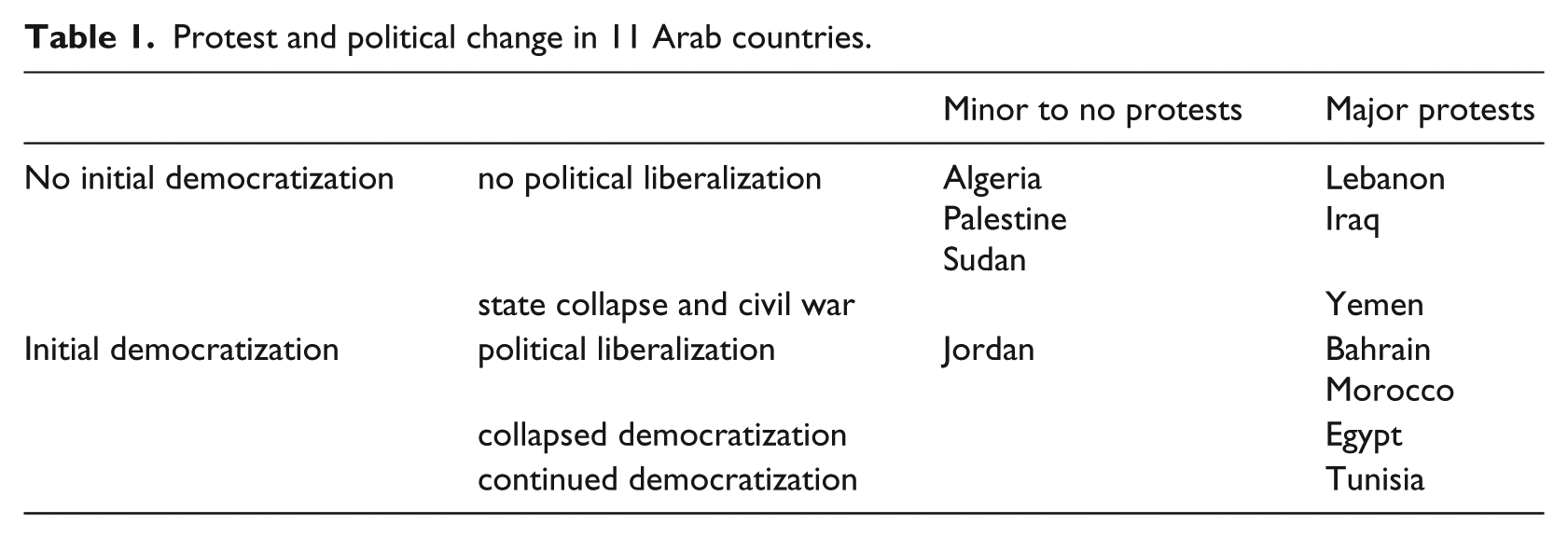
The key observable elements of the explanatory framework are (a) major protests, (b) initial political liberalization, and (c) (the lack of) substantial democratization later on. (a) is discussed first and then (b) and (c) together. Table 1 summarizes the classification.
Protest and political change in 11 Arab countries.
Protest
As Brownlee et al. (2013: 35) stress, major protest involves large demonstrations with national resonance and persistence: ‘the eruption of nonviolent mass protest over multiple days [and] the spread of that protest across multiple geographical locations’[emphasis added]. This captures whether the mass protests differ from the (limited) protests and strikes that were taking place across the region before (Moghadam, 2013; Posusney, 2004; Szmolka, 2017; Weyland, 2012) and could thus raise expectations.
Seven countries included in Brownlee et al. are also included here. For Algeria, Bahrain, Egypt, Jordan 9 , Tunisia and Yemen, I follow them and the larger literature (e.g. Gurr, 2015; Szmolka, 2017). Morocco is also classified as a protest case here: 10 protests took place across the country, with up to a million people taking to the streets in early 2011 (Gurr, 2015; Moghadam, 2013, Szmolka, 2017).
This leaves four countries. Protests in Palestine were rather minor or about supporting protesters in other MENA countries (Ma’an News Agency, 2012; YnetNews, 2011). Protests in Sudan were not multi-site/multi-day and numbered only in the low thousands out of a population of around 35 million (Gettleman, 2011; Human Rights Watch, 2011). Contrarily, in Iraq and Lebanon multiple sources report large protests over multiple days in multiple cities (Ahmed, 2016; Szmolka and Durán, 2017; The Daily Star, 2013), although those in Lebanon were less numerous and mainly driven by the Sunnis (Al Jazeera, 2011; Murdock, 2011). Still, given an overall population of roughly one million, thousands can be considered substantial.
Political liberalization
In Egypt and Tunisia long-standing dictators were ousted in a matter of weeks, new constitutions were drafted, and relatively free and fair elections were being held. Yet the countries took very different routes from then on. In Tunisia, the new institutionally democratic system took root, partly because Islamist Ennahda collaborated with secular and liberal parties. In Egypt, the newly elected Islamist leaders started to curtail the democratic system and, not long after, a military intervention (July 2013) aborted the democratization process (Robbins, 2015; Strzelecka and Angustias Parejo, 2017).
Clearly Egypt and Tunisia embarked on processes aligning with democratization initially; however, this is less clear for some of the other countries. Here I focus on the two core theoretical elements of political change: were there initial changes that could be read as serious political liberalization and did the country become democratic? The latter question is simple: only Tunisia can be considered democratic a few years after the uprisings. For the former question, I fall back on the conceptualization offered by Szmolka (2017), focusing on (initial) political change: regime transformations that affect the political rules, procedures and institutions and therewith the power relations and processes (Szmolka, 2017: 24; see also Strzelecka and Angustias Parejo, 2017: 115). Changes to the system need to be made in order to be considered substantial. This includes changes to the constitution, electoral laws and other laws governing political rights; the simple replacement of some cabinet members, for instance, does not suffice (Szmolka, 2017: 29). Moreover, changes must take the form of political liberalization – an increase of meaningful political competition and participation with less repression (ibid: 26). Crucially, political liberalization might of course result in a shift within the family of authoritarian regimes; however, in light of the theoretical model presented above, I focus on responses to the protests which were read as democratization at the time (regardless of our assessment in hindsight).
Applying the above definition to the MENA cases means that for three countries political change could be considered to be initial political liberalization: Bahrain, Jordan and Morocco (see Szmolka, 2017: 31; Szmolka and Durán, 2017; Strzelecka and Angustias Parejo, 2017). In Bahrain, protests called for the reform of the constitution and within months a ‘national dialogue’ including opposition leaders was inaugurated. Although not all recommended constitutional changes were adopted and the opposition remained critical, the eventual reforms included greater parliamentary powers to control the government and budget, including founding an Ombudsman’s Office. In Jordan, the king’s early response to the protests in 2011 included the establishment of a constitutional court and allowing more freedom of expression. In Morocco, there were ‘apparent concessions’ by the king, who transferred some of his powers to elected politicians, which was widely applauded internationally (Strzelecka and Angustias Parejo, 2017: 119). In hindsight the reforms in these countries were partly tokenistic (Diamond, 2010; Strzelecka and Angustias Parejo, 2017), 11 but at the time they could be interpreted as first institutional steps towards democracy.
In the remaining countries, the responses of the regimes were not institutional or came only years after the protest. In Iraq and Sudan a few ministers were replaced, but no changes towards a more democratic system were made early on, and the latter also holds for Algeria, Lebanon and Palestine (Strzelecka and Angustias Parejo, 2017). For instance, in Algeria a process of constitutional reform was initiated, but this only took shape in 2014. Lastly, in Yemen, after considerable pressure and violence, Ali Abdullah Saleh signed an agreement to transfer power, but by the time he signed the protests had already escalated into violent state breakdown (Alley, 2013).
Desire for democracy in the Arab MENA
Did the desire for democracy drop?
First of all, Figure 1 shows that citizens supported democracy fairly consistently from 2001 onwards at least up until 2011 (the 2007 spike in Jordan being the exception), but including the post-uprisings years suggests a negative impact over time which varies significantly between countries (Models 1 and 2 in Online Appendix B), suggesting different trajectories indeed.
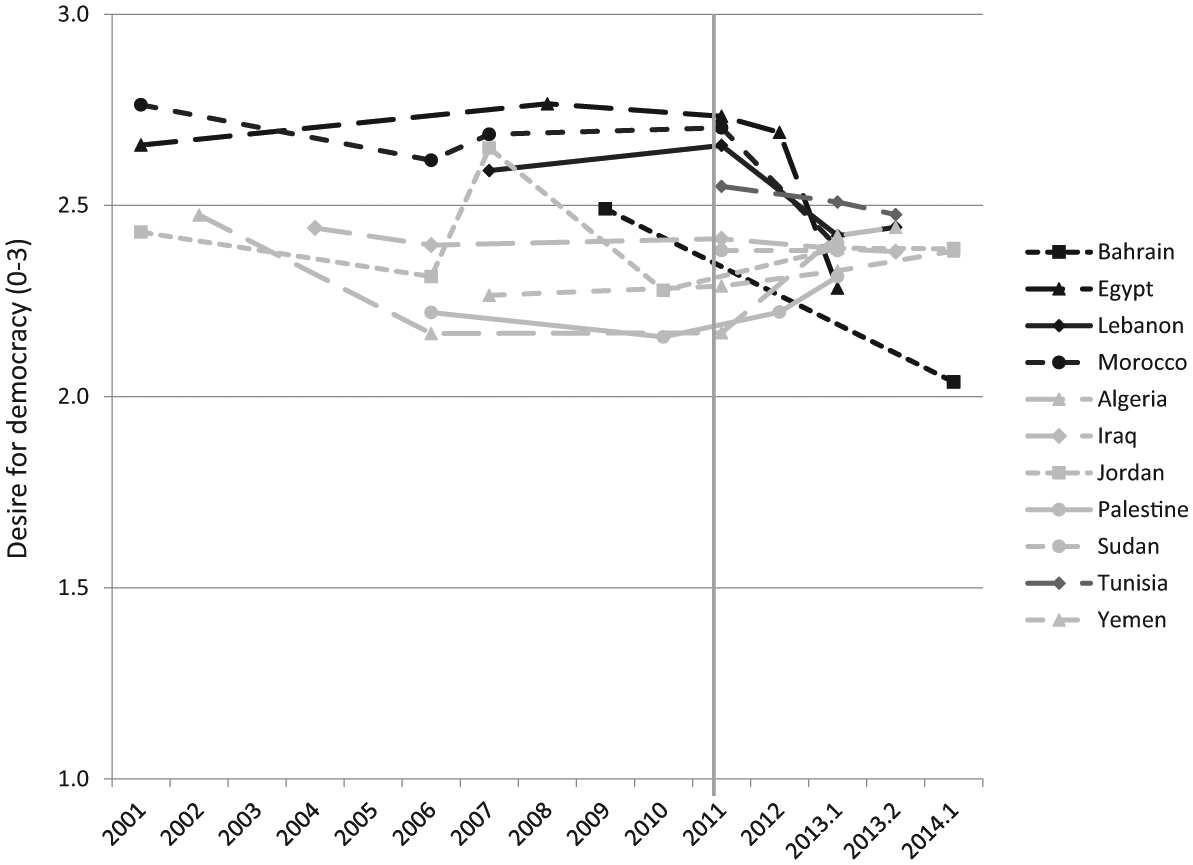
Desire for democracy across the MENA since 2001.
In Bahrain, Egypt, Lebanon and Morocco (the black lines) the desire for democracy dropped after the uprisings, from 0.24 points in Lebanon to over 0.40 in Bahrain and Egypt. To illustrate: if 70% of the people say democracy is ‘very good’ for their country and 30% ‘good’ (equaling 2.7 in the figure), a drop of 0.4 equals 40% of the people changing from ‘very good’ to ‘good’ or 20% from ‘very good’ to ‘bad’. Accordingly, the underlying data shows that particularly in these four countries, the large group of people saying democracy is very good decreased, while we saw an increase among the modest proponents and groups thinking democracy is undesirable. The multilevel models confirm this picture with an average and statistically significant drop of 0.27 (Online Appendix B, Models 3), and in terms of effect size, the role of the uprisings is about twice the size of the maximum impact of age, education or sex. Moreover, the drops are consistently found across cohorts and genders. 12
Finally, Tunisia shows a decline that is statistically significant too (t-test: p<0.05), albeit smaller than the other drops (0.074). Zooming in shows an increased dispersion for Tunisia. The moderately desiring group has decreased, whereas both the strong proponents and opponents became more numerous: polarization, with more people moving to the negative pole. For now, I consider it a drop. Later on, below, I discuss the Tunisian case in more detail.
Alternative measurements
For two decline countries (Egypt, Morocco) and three others (Algeria, Iraq, Jordan) it was possible to perform a before-and-after comparison on the more general item. This confirms the pattern discussed above. Egypt and Morocco showed drops of respectively 0.5 and 0.8 points that were statistically significant (t-test: p<0.001); for the other three countries considerably smaller differences were found. For three of these countries, AB4 (2016–2017) data are available. Including these still shows the largest decline for Morocco, the only decline country of the three.
Next, Figure 2 shows the aggregate data on the (lack of) economic faith in democracy. In four countries skepticism grew: Egypt, Jordan, Morocco and Tunisia. For each, the difference is statistically significant (t-test: p<0.001). However, the dropping desire for democracy is not completely economically motivated. Additional analyses show that the political faith in democracy has decreased in these countries as well. Moreover, for Egypt, Morocco and Tunisia the dropping desire for democracy overlaps with a decreased economic faith. Also, in five countries neither a drop in the desire for democracy nor an increase in economic skepticism was found. However, two cases deviate. In Lebanon the declining desire for democracy is not directly linked to a declining economic faith in democracy, suggesting that economic issues were not at the heart of the situation. And among the Jordanians the general economic effectiveness of democracy is doubted somewhat more after 2011, but this did not translate to a decline in the desire for democracy.
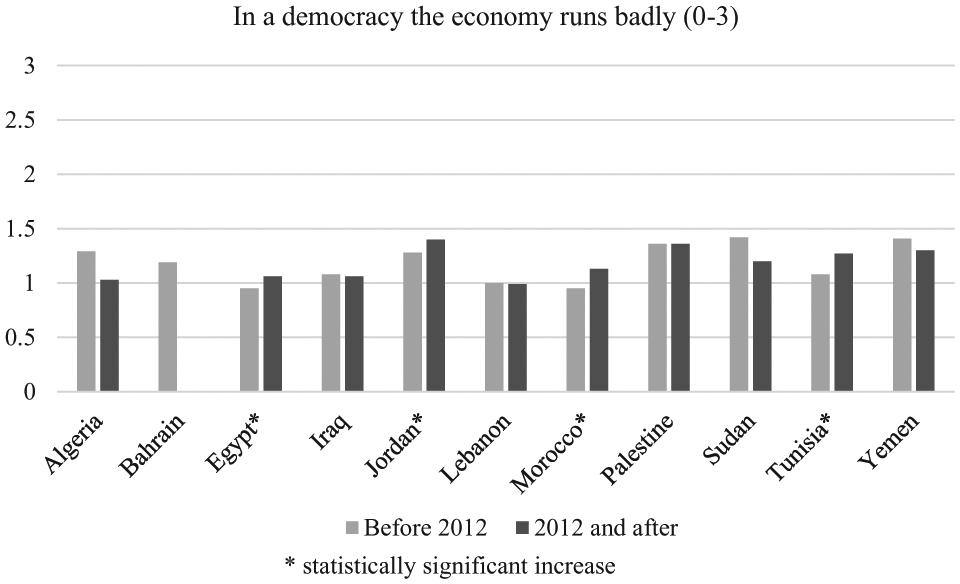
Lack of belief in economic effectiveness.
Different developments
After the Arab uprisings, democratic disillusionment set in in five countries (Table 2). In Bahrain, Egypt, Morocco and Tunisia, this was linked to a decreased economic faith, but not in Lebanon. In Algeria, Iraq, Jordan, Palestine, Sudan and Yemen, no nation-wide decreases were found (or clear increases for that matter).
MENA countries classified by the public’s changing desire for democracy.
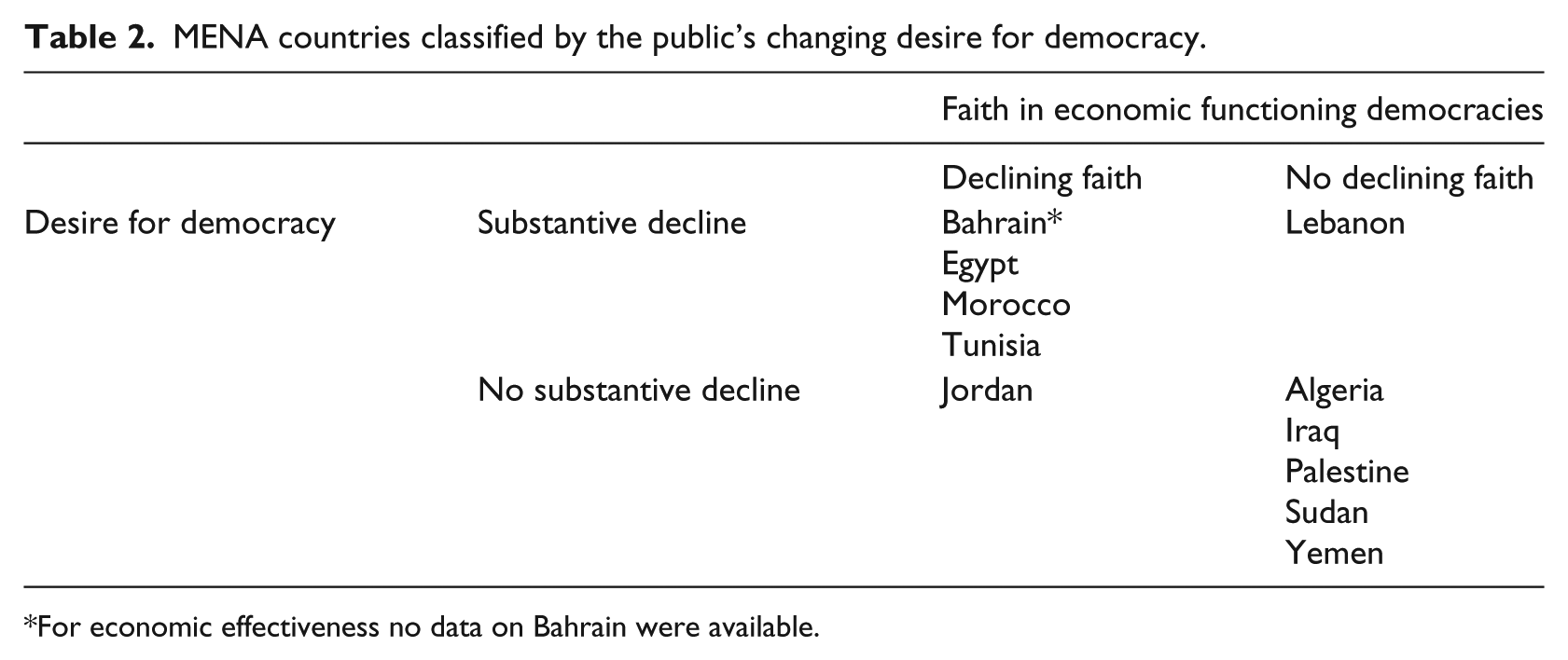
For economic effectiveness no data on Bahrain were available.
Pathways to democratic disillusionment
Below I will compare the results presented in Tables 1 and 2. The text provides more in-depth information, following the comparative logic of csQCA (see Rihoux & De Meur, 2009). The formal csQCA is presented in Online Appendix C. Substantively, I found three clusters of countries. The first two clusters (covering 9 of 11 cases) fit the theoretical expectations: (a) countries without major protest and (initial) political liberalization, and without democratic disillusionment (Algeria, Iraq, Jordan, Palestine, Sudan, Yemen) and (b) countries combining major protest and some political liberalization without lasting democratization, in which the desire for democracy declined (Bahrain, Egypt, Morocco). Two cases are apparent exceptions: (c) Lebanon and Tunisia. By zooming in on each cluster, and the two exceptions particularly, below, I will assess and refine the theory.
No protest, no political liberalization, no disillusionment
In Algeria, Iraq, Jordan, Palestine, Sudan and Yemen there were no continuous and widespread protests in combination with initial reforms (Table 1), and the support for democracy did not clearly drop (Table 2). In itself, (a) implementing minor reform without further democratization (e.g. Jordan) and (b) only major protest, but no initial political liberalization (e.g. Iraq, where Prime Minister al-Maliki responded with some economic reform, but not political liberalization [Szmolka & Durán, 2017: 418]) were not sufficient for democratic disillusionment. In Yemen there was major protest, but no political liberalization as the very late transitional agreement contained no concrete change and civil war had already broken out (Alley, 2013: 78; Szmolka, 2017).
Summarizing: the absence of major protests and/or initial political liberalization (without state breakdown) seems sufficient for the desire for democracy not to drop. Lebanon is the exception, but below it will become clear that Lebanon actually helps to define the scope conditions of the specific application of consequence-based theory here.
Protest, political liberalization, and disillusionment
Bahrain, Egypt and Morocco witnessed major protests and in each country the government responded with political liberalization that might have suggested a move towards more democracy (Table 1). The reforms, however, did not lead to lasting democratization. Congruently, the publics lost part of their desire for democracy.
Egypt, with its short-lived democratic system, is a particularly interesting case, and its political events can be mapped onto the moment at which the data were collected for each survey: for 2011 (June/July) and 2012 (March/April) the data show no drop, while, in between, Islamists won the parliamentary elections (November 2011–January 2012). After the latter survey, Morsi won the presidential elections. With Islamists holding both the presidency and parliamentary majority, they started shaping the system in their favor: secular and liberal forces were excluded from the Qandil I coalition (August 2012), Morsi tried to strip the judiciary of its right to challenge his decisions (November 2012), and parliament accepted a new constitution restricting political rights while boosting Islam’s role (December 2012). In the following survey (June 2013), a markedly lower desire for democracy showed. As the military coup took place (July 2013) months after this attitudinal drop was registered, it seems/appears that the acts of the democratically elected officials are responsible for the declining enthusiasm about democracy – something confirmed by the decreased and regionally low trust in Islamist or clerical actors (Teti at al., 2019).
Thus if major protest takes place and is followed by initial political liberalization, but strides towards actual lasting democratization fail to appear, the desire for democracy drops.
Disillusionment among some: The Lebanese and Tunisian exceptions
Two cases do not clearly fit the expected pattern: Lebanon and Tunisia. This apparent lack of fit seems mainly caused by a specific social group being disillusioned. Theoretically, the implications are twofold.
The scope of my application of consequence-based theory might be restricted to initially non-democratic countries;
People’s understanding of democracy and the state thereof is crucial.
The Lebanon case should be understood against its unique institutional–sectarian background: the country’s three top-level political posts are traditionally divided between the three main religious sects, the prime minister’s office being ‘the Sunni post’. Moreover, this system is considered (partly) democratic as elections resulted in a parliament with actual policy-making powers (Hinnebusch, 2006; Szmolka, 2017: 21), and Polity IV (2018) considers Lebanon democratic for the whole period studied.
While initially the protests were in support of protesters in other countries, the protests grew in the course of 2011 and were aimed mainly against the result of the institutional–sectarian system. After the fall of the Hariri government in March of that year, a new government was negotiated. Part of the outcome was the nomination of Mikati as prime minister. Given that Mikati is Sunni Muslim this was strictly speaking in line with sectarian arrangements, but his appointment was mainly pushed by Shi’a parties, whereas Hariri’s Future movement – the main Sunni actor – opposed Mikati’s appointment (Khashan, 2012; Murdock, 2011). Nevertheless, Mikati was appointed.
How is this reflected in public opinion? Prior to the uprising the data distinguishes between Muslims and Christians and the desire for democracy was similar among them. Data after the uprisings distinguishes between Christians, Shi’a and Sunni. The desire remained stable for Christians but dropped among Muslims overall, whereby it was equally high among Christians and Shi’a after the uprisings, but clearly lower among Sunnis. This suggests that the general drop (Figure 1) is largely due to Sunnis being disillusioned.
In terms of the theoretical framework, it seems that the unwritten rules of the sectarian (defective) democratic system, and the protests signifying that Mikati did not have Sunni support, created the expectation that Mikati’s candidacy would be withdrawn. The democratically elected parliament and presidency, however, stuck to their choice and this seems to have backfired on Sunni assessment of democracy as a system. Thus, the consequence-based logic of expectations and disillusion explains subgroup disillusionment, but this case also shows that factors other than democratic deepening (Szmolka, 2017) are needed to raise expectations in more democratic than authoritarian systems. The scope of consequence-based theory’s translation in this study is limited to initially undemocratic countries.
In Tunisia, after major protest and the ousting of the authoritarian leader, the regime changed into a functioning (arguably defective) democracy suggesting there was actually little reason for disillusionment. Still, relatively modest, but statistically significant, drop in the desire for democracy was found. Focusing on the context and different societal groups offers an explanation. The events in Tunisia sparked the region-wide uprisings after a young vendor set himself on fire. He could not make a living, partly due to the government forbidding him to sell fruit from a stall. The protests were about political and economic equality, which are considered part and parcel of democracy. And while the institutions democratized, little economic relief came for the economically worst-off, who still felt marginalized, suggesting that particularly the less well-off might have become disillusioned.
The survey data support this explanation. For instance, distinguishing between the Tunisians living in the 20% of households with the lowest income and the rest of the Tunisian population, shows that the modestly decreasing desire for democracy among Tunisian society at large is fully explained by a more substantial drop (p<0.05) among the poorest. Also, the polarization found partly overlaps with this: among the not-poorest people, the group moderately in favor of democracy decreased by 10 percentage points; among the poorest this was 20 percentage points. Relatively, many of the poor shifted towards being strong opponents: an increase from 0 to 9% (vs a 3 percentage point increase among the rest). 13
Congruent with the framework, it seems that most Tunisians saw their expectations being met. However, for the poorest a different pattern was found, which resonates with the notion of the pauperization of the Tunisian middle class due to the country’s economic downturn 14 and with the observation that poorer Tunisians displayed particular hopes for economically better times as well as disappointment (Can, 2016).
Conclusion and discussion
Even though the importance of people’s attitudes for the survival of democracy and the delegitimizing of authoritarian regimes has been acknowledged for the MENA and beyond, the impact of the Arab uprisings had yet to be systematically studied. This study does this and contributes to a better understanding of how political events shape societies’ desire for democracy (as called for by Welzel and Inglehart, 2009: 303). It also sheds light on how attitudes play a role in the dynamics of authoritarian resilience.
I applied and refined consequence-based theory on political attitudes in the MENA. This theory basically states that people base their desire for democracy on their assessment of what it delivers and I used Gurr’s concept of deprivation to specify which conditions change this assessment: major protest in combination with initial political liberalization followed by a lack of substantial democratization.
Empirically, I showed that in Bahrain, Egypt and Morocco, major protests and initial reforms did not result in substantial or lasting democratization and concurrently the public’s desire for democracy waned. Focusing on Lebanon showed that the underlying mechanisms apply in (partly) democratic contexts too, but translate differently; the concrete model’s scope thus encompasses initially undemocratic countries. The Tunisian case showed that the model also helps to explain a declining desire for democracy among (socio-economic) subgroups in society. Last, as expected, society-wide democratic disillusionment was absent in Algeria, Jordan, Palestine, Sudan and Yemen as no major protest and initial reform took place.
Overall, this application of consequence-based theory provides a parsimonious and systematic reasoning that can explain the larger patterns, seemingly exceptional cases, and unexplained developments from previous work (e.g. Robbins, 2015). However, given the limited number of cases, there is a risk of over-determination. While this issue cannot be fully resolved, some alternative explanations can be assessed. To be clear, it was not the goal to provide the fullest explanation of each case, but to identify core elements behind the larger and different developments across the MENA region. First, two alternatives stem from the literature on public opinion and the uprisings: the role of small business owners (Mazaheri and Monroe, 2018) and the rise of Islamist forces (Robbins, 2015). The former was not empirically substantiated and cannot explain drops in the desire for democracy; the latter cannot explain the Tunisian case well and is undermined when zooming in on the timing of Egypt’s democratic disillusionment. Second, the logic presented in the more general literature can be looked into. As discussed, cultural-modernization studies provide little help with their focus on more gradual changes; however, one might look at studies like Maseland and Van Hoorn’s (2011) micro-economic logic. They argue that the less democracy people have (scarcity), the more they desire it. Regarding the uprisings, this implies that the desire for democracy should wane to the degree to which countries democratized. Consequently, it should have led to the sharpest decline in Tunisia, but this finds no support in the data. Similarly, religious fractionalization and state Islamism have been shown to shape public opinion in the MENA (e.g. Spierings 2018), but mapping such variables onto the patterns found here shows no systematic overlap.
Third, we should focus on other protest-related and structural factors, such as petrol politics and authoritarian diversity. These factors are actually part of the story. As convincingly shown by others (e.g. Brownlee et al., 2013), they help determine whether protests lead to regime change. Similarly, the figures presented above suggest that the largest protests took place where the pre-uprising level of desire for democracy was extremely high. These characteristics are thus crucial in explaining whether the conditions I identified as shaping disillusionment were present to begin with. They are part of the larger causal chain, although they do not provide direct explanations of disillusionment. Overall, we can now rule out some potential explanatory characteristics, whereas others should be recognized as part of the chain of events leading to disillusionment. Still, it is impossible to fully resolve the issue of over-determination; future work might test the logic presented here on a larger set of cases, for instance including events in the larger Middle East (e.g. Iran, Turkey) and Sub-Saharan African states.
Among the more general implications of this study are that it underscores the importance of considering macro-level events as causes shaping democratic attitudes, and that it highlights the importance of how citizens understand the concept of democracy. Moreover, it has important implications for the literature on resilient authoritarianism. Anderson (2006: 210) argued that ‘if we wish to find out why the Middle East is resistant to democratization . . . we may have to search a bit more in the shadows’. So far, the role of democratic attitudes has remained largely in such a shadow. The results here show that an elite responding with minor or tokenistic reform might not only calm down or demobilize the population, but might receive an additional ‘bonus’ in the form of a decreasing desire for democracy itself. Taking this perspective when looking at Figure 1 and Table 1 draws attention to the clear overlap between the countries in which major protest took place and in which the desire for democracy was highest before the uprisings. This suggests that the population’s desire for democracy is an integral part of democratization cycles. In other words, authoritarian leaders might actually use rising expectations among their population as an exploitable mechanism to decrease the peoples’ desire for democracy and stay in power. Turned around, this implies that in democratizing regimes, expectations need to be kept in check to create a lasting support for democracy.
Some limitations of this study also point towards avenues for future work. First, even though I included different measurements of the public’s desire for democracy, the availability of similar items across surveys is limited. Consequently, as shown by recent work on AB and ArabTrans data (e.g. Teti et al., 2019), the items used in this study provide limited information on the support for liberal democracy. Moreover, and second, as the latest round of AB data does not include the standard question, long-term effects are hard to study. For one decline country (Morocco), I had later data for the alternative operationalization, and those data suggest the desire for democracy was slowly recovering but was still relatively low. Others, however, show further declines for Egypt (Hassan and Shalaby, 2018: 3). Similarly, data from before the uprisings were absent for Libya and Syria, which makes it hard to draw clear conclusions on the role of state breakdown beyond the Yemen case. If pre-uprising data on Libya and Syria were to become available outside the AB or WVS, this could provide another robustness test.
Third, the more in-depth analyses of events in Lebanon and Tunisia showed that democratic disillusionment can also set in among specific societal groups. This brings to the surface the question about integrating macro- and micro-level explanations. Such integration is needed to theorize and test how political events might make certain individual characteristics salient and create within country differences in the desire for democracy. I suggested some avenues for further research accordingly, but zooming in further was beyond this study’s scope. Also, and more generally, micro-level panel data would help to draw stronger conclusions on developments in democratic attitudes. However, for now, I conclude that protest and reform are crucial for understanding why and how the Arab uprisings harmed democracy’s reputation in some MENA countries, but not in others.
Supplemental Material
French_Spanish_abstract_867011 – Supplemental material for Democratic disillusionment? Desire for democracy after the Arab uprisings
Supplemental material, French_Spanish_abstract_867011 for Democratic disillusionment? Desire for democracy after the Arab uprisings by Niels Spierings in International Political Science Review
Supplemental Material
Spierings_supplemental_material – Supplemental material for Democratic disillusionment? Desire for democracy after the Arab uprisings
Supplemental material, Spierings_supplemental_material for Democratic disillusionment? Desire for democracy after the Arab uprisings by Niels Spierings in International Political Science Review
Footnotes
Acknowledgements
I am grateful to the anonymous reviewers and editors for their constructive comments on earlier versions of this manuscript.
Funding
The author(s) disclosed receipt of the following financial support for the research, authorship, and/or publication of this article: This research is funded by The Netherlands Organization for Scientific Research (NWO #451-15-006). I gratefully acknowledge this support.

Supplemental material
Supplemental material for this article is available online.
Notes
Author biography
References
Supplementary Material
Please find the following supplemental material available below.
For Open Access articles published under a Creative Commons License, all supplemental material carries the same license as the article it is associated with.
For non-Open Access articles published, all supplemental material carries a non-exclusive license, and permission requests for re-use of supplemental material or any part of supplemental material shall be sent directly to the copyright owner as specified in the copyright notice associated with the article.
