




Abstract
Building better elections is a central task for the study of democracy and democratisation. Despite this, there have been no cross-national studies on the staff who manage and implement elections: electoral management body (EMB) workforces. This article provides the first macroscopic worldwide picture of workforce characteristics, human resource management practices and employee outcomes, and analyses the effects they have on electoral integrity, based on original international surveys of electoral management bodies (EMBs) (n = 51) and electoral officials (n = 2029). Drawing from the human resource management literature, a framework is developed to explain how these factors might interact with EMB performance. Analysis demonstrates them to be highly related. Adding data on human resource management practices and employee outcomes improves explanatory models designed to predict the performance of EMBs. Chiefly, EMBs that enable greater opportunities for employees to be involved in decision-making processes perform better. Recruitment practices, job satisfaction and levels of stress are also important.
Keywords
Introduction
Understanding the factors that enable states to become and remain electoral democracies is a central concern of political science (Lipset, 1959). In more recent years, the determinants of electoral integrity have become an independent, but overlapping line of enquiry, given that holding regular, well-run elections is a prerequisite for democracy (Birch, 2011; Norris, 2015). Despite this, virtually nothing is known about the personnel of electoral management bodies (EMBs) – the armies of employees who are responsible for managing the electoral process.
This article therefore seeks to make a major contribution to these literatures by presenting and analysing original data on workforce sizes, characteristics and motivations within EMBs around the world. Although there have been some studies on the casual workforce employed on polling day in individual countries, this article focuses on the core staff of the EMB with the first cross-national surveys of EMB employees. The article reports on the human resource (HR) management practices that are used to motivate those working in electoral management bodies and EMB staff experiences of working within them. Moreover, drawing from ability–motivation–opportunity (AMO) theory, a school of thought based within management studies, hypotheses are derived and tested about how HR management practices and employee outcomes can improve EMB performance and deliver better-run elections.
The article begins by reviewing the existing literature on electoral management and EMB workforces. It then introduces theory on why HR management practices and employee outcomes should affect organisational performance, before developing the hypotheses. The article continues by describing the methods, presenting results and finally drawing out the conclusions. It reveals that EMB workforces are generally small, well-educated, have inbuilt gender biases, and exhibit considerable variations in their level of experience across countries. Teamworking is usually strongly encouraged, while performance-related pay is rare. Employees tend to have strong levels of belonging to their organisations, are satisfied with their job, and generally do not intend to leave in the immediate future. Inferential analysis provides evidence that employee outcomes such as stress, work overload, a propensity to quit and declining job satisfaction are closely related. There was evidence that EMB performance can be improved by providing opportunities for employees to be involved in decision making. Recruitment practices, job satisfaction and levels of stress are also important. There are therefore important lessons for policy makers and scholars concerned about the determinants of electoral integrity, democracy and democratisation.
Existing research on EMB performance and workforces
Well-run elections are essential for the democratic credentials of any state. There has been a rapid growth in research on the determinants of electoral integrity, with explanations focusing on the role of structural factors such as the economic and social structure of societies; institutional factors such as electoral systems; and actor-based factors including the strategic choices of parties and elites (see the Introduction to this special issue for a review). A focus on the organisational determinants, set out in this special issue, uniquely emphasises that elections are like other public services, such as schools and hospitals, which have differing levels of performance and efficiency. Elections involve more than just designing and passing electoral laws. They require successful management and implementation. Electoral registers need to be drawn up and maintained; polling stations found and organised; counting staff need to be recruited and the counting process run without error (also see James, forthcoming). Cross-national data based on expert opinion shows variation in the quality of electoral management around the world (Coppedge et al., 2017; Norris et al., 2018) and even within countries (Norris et al., 2016). The quality of electoral management matters immensely because it can undermine citizens’ confidence in the electoral process in established democracies (Claassen et al., 2012), threaten democratic consolidation or cause electoral violence in emerging democracies (Elklit and Reynolds, 2002), or even affect the result of elections (Wand et al., 2001). Policy makers have therefore expressed increased concern and interest in electoral management at the highest level (Global Commission on Elections, 2012) and research has begun to examine the determinants of electoral management quality (James, forthcoming; van Ham and Lindberg, 2015).
There has been relatively little focus on the people involved in delivering elections, with only a handful of within-country studies undertaken in recent years. It has been noted that some countries struggle with a short supply of poll workers if they are recruited on a voluntary or low-paid basis (Burden and Milyo, 2015). Research has begun to identify the factors that may cause workers to volunteer their time on election day (Clark and James, 2016b; Herron et al., 2017). Less is known about the core workforces involved in managing elections, however. James (forthcoming) profiles the characteristics of the UK workforce based on a survey undertaken in 2016 and shows evidence that reforms made to electoral registration processes can lead to high levels of stress, with many electoral officials considering quitting. High levels of stress were also reported in the UK immediately before the Brexit referendum, when IT problems led to the voter registration system being offline as the deadline passed (Clark and James, 2016a). Electoral management can be organisationally centralised into a single organisation or the functions can be dispersed across many organisations. Equally, although electoral management can be centralised in one organisation, that organisation can be geographically dispersed across a polity. Research has explored the effects of central organisations issuing directions to local organisations (James, 2017) or devising best practice benchmarking schemes (James, forthcoming). No cross-national studies have explored and compared the characteristics of workforces running elections, however. This is a major gap.
AMO theory and the role of human resource practices
HR management practices are initiatives designed to make improvements in individual and organisational level performance. They might include de facto procedures for recruitment, training, performance appraisal and pay (Appelbaum et al., 2000). HR management practices are thought to be important for organisational performance because they can affect the micro-level behaviour of the individual employee. This, in turn, affects organisational performance as measured by indicators such as turnover, productivity, financial returns, survival and firm value (Delery, 1998).
The subject is approached through a diverse range of disciplines, including economics, organisational behaviour, public policy and management. Strong arguments have been posited about why HR management practices might affect performance and some research has mapped the effects of HR practices onto organisational outcomes, often in the private sector, with outcomes measured by profit or shareholder value per employee (Becker and Gerhart, 1996: 794). It is generally thought that much more research is needed, however, to which this article can contribute. Gould-Williams and Mohamed noted as recently as 2010, for example, ‘there appears to be no direct international comparative studies in which the effects of HR practice on individual employee outcomes has been empirically tested’ (Gould-Williams and Mohamed, 2010: 654).
An important principle in this research, replicated in this study, is that stated organisational intentions should be separated from actual employee experience. Organisations may have great intentions to implement practices set out in formal policy documents, but they may not have the resources, opportunity or ability to do so. Wright and Nishii (2007: 10) argue that the pathway is from intended HR practices, to actual HR practices, to perceived HR practices, to employee reactions, to organisational performance.
One debate that persists is whether there is a universal set of HR management practices that universally produce better performance, or whether more bespoke practices are needed for different contexts. A ‘best practice’ school of thought suggests that there are practices that should be adopted in all organisations, in all settings to improve performance. The most common theory used to justify the causal linkage between HR management practices and organisational performance outcomes is the ability–motivation–opportunity (AMO) model (Appelbaum et al., 2000). It can be considered a ‘best practice’ toolkit in so far as it argues that the selection of HR management practices will improve performance. The logic is that HR management practices can develop the ability of individuals within organisations by ensuring high-quality recruitment processes and investing in training and skills development. Second, the HR management practices can increase the motivation of employees through good financial incentives and conditions. Intrinsic rewards such as employment security, performance reviews and work–life balance can also be important, however. Third, HR management practices can provide employees with the opportunity to be able to use these skills and motivations within the organisation. Enabling greater employee input into decision making is one way of achieving this. In combination, these produce an environment in which positive discretionary effort is higher. Employees have significant discretion in the amount of care and additional time they invest into their job. Boxall and Purcell (2003) argue that the presence of AMO practices is additive. Each antecedent will have a direct and independent effect on performance, which can be understood through the formula:
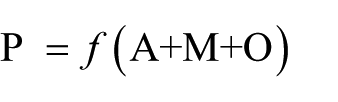
AMO will be used as the theoretical framework for this article. However, it is important to note that other de facto HR management practices are also thought to be important in mediating the effectiveness of AMO practices on performance. These include performance appraisal, communication, psychological climate, discretionary pay and teamworking. With respect to performance appraisal, for example, Poon (2004) finds that when performance appraisals are not perceived by the employee to be political, job satisfaction increases. The quality of internal communication within organisations has been found to improve performance (Gould-Williams and Mohamed, 2010). Communication has been claimed to be especially important during times of change (Elving, 2005) and for encouraging supportive workplace environments (Elving, 2005). Psychological climate is repeatedly found to be important too. Gould-Williams and Mohamed (2010: 656) state that there ‘is now growing recognition that employees’ experiences at work are affected by organisational characteristics such as support, recognition, fairness, morale, rewards equity and leader credibility’. Psychological climate therefore involves ‘an individual’s experiential abstraction of his/her routine experiences at the workplace, and the consequent sense-making of the same’ (Biswas and Varma, 2007: 666). It is measured at the individual level and is a different concept to organisational climate or organisational culture. Discretionary pay was found by a review of studies to increase performance (Hasnain and Pierskalla Henryk, 2012). Lastly, teamworking within an organisation has been found to have positive effects on performance to such an extent that Gould-Williams and Mohamed (2010: 671) claim that ‘it could be argued that teamworking should be regarded as the “kernel” of HR bundles’. However, teamworking can be undermined by discretionary pay (O’Donnell, 1998). These will therefore also be included in the study as control variables.
Employee outcomes in organisations
Understanding organisational dynamics requires us to zoom in on the experiences of employees. Employees have discretionary behaviour and varied levels of organisational citizenship in terms of their commitment to an organisation (Kinnie et al., 2005: 10). It is therefore essential to identify the experiences of employees, how HR management practices affect them, and how these relationships affect performance. This allows a further level of sophistication in the analysis: how different properties of employee outcomes, HR management practices and organisational culture interact. Those employee outcomes that are commonly thought to affect organisational performance but are also important in their own right are: stress, work overload, intention to quit, job satisfaction, affective commitment and civic duty.
Stress has been defined as ‘a harmful reaction people have due to undue pressures and demands put on them at work’ (HSE, 2013: 2). Maslach and Jackson (1981: 99) first defined the concept of burnout, which involves a ‘syndrome of emotional exhaustion and … cynical attitudes and feelings about one’s clients’. Burnout was found to be associated with poorer quality of care, higher turnover and absenteeism, and lower morale. Although burnout was initially thought to be a problem in jobs involving ‘people-work’, subsequent research found it to be present in other occupational groups (Schutte et al., 2000). Not all stress is bad, it should be noted. In certain circumstances it can have positive outcomes such as improved motivation or cognitive focus. Nonetheless, most research focuses on the negative effects. Organisational performance and productivity can decline; absenteeism and staff turnover can increase (European Agency for Safety and Health at Work, 2014: 12).
Work overload is thought to lead to burnout, an erosion of organisational commitment and job dissatisfaction, and a propensity to quit (Hakanen et al., 2008). Links have also been found to reduced civic-mindedness, demotivation and performance (Gould-Williams et al., 2014). The propensity of individuals to voluntarily quit is often thought to have a negative effect on overall performance. Resources are diverted to recruitment and training new staff, knowledge and expertise is also lost. However, a counter-argument is that benefits are accrued such as lower payroll, improvement in innovation and reductions in stagnation (Dess and Shaw, 2001). Job satisfaction, meanwhile, was defined as ‘a pleasurable or positive emotional state resulting from an appraisal of one’s job or job experiences’ (Locke, 1976). This has been found to affect the likelihood that an individual would quit but also organisational outcomes such as customer satisfaction, productivity, profit and employee turnover (Harter et al., 2002).
Other employee outcomes are thought to be important mediators in these relationships. Affective commitment is the attachment that an employee has to their organisation (Shore et al., 2006) and can mediate burnout and intention to quit (Sharma and Dhar, 2016). Civic duty or public service motivation refers to whether an individual is motivated to working ‘primarily or uniquely in public institutions or organisations’ (Perry and Wise, 1990, 368). This is thought to be an important mediator between HR management practices and employee outcomes, including whether they intend to quit, job satisfaction and their affective commitment (Gould-Williams et al., 2014).
Research questions and hypotheses
This article seeks to address two core questions. First, there is a descriptive question of what are the workforce sizes, demographic characteristics and motivations of EMB staff. Second, there is an inferential question of how HR management practices, employee outcomes and organisational performance interact.
Drawing from AMO theory and the broader literature discussed above on HR management, four core hypotheses are developed:
On the basis of the literature above, Figure 1 summarises the expected relationships, providing a model connecting HR management practices, employee outcomes and performance.
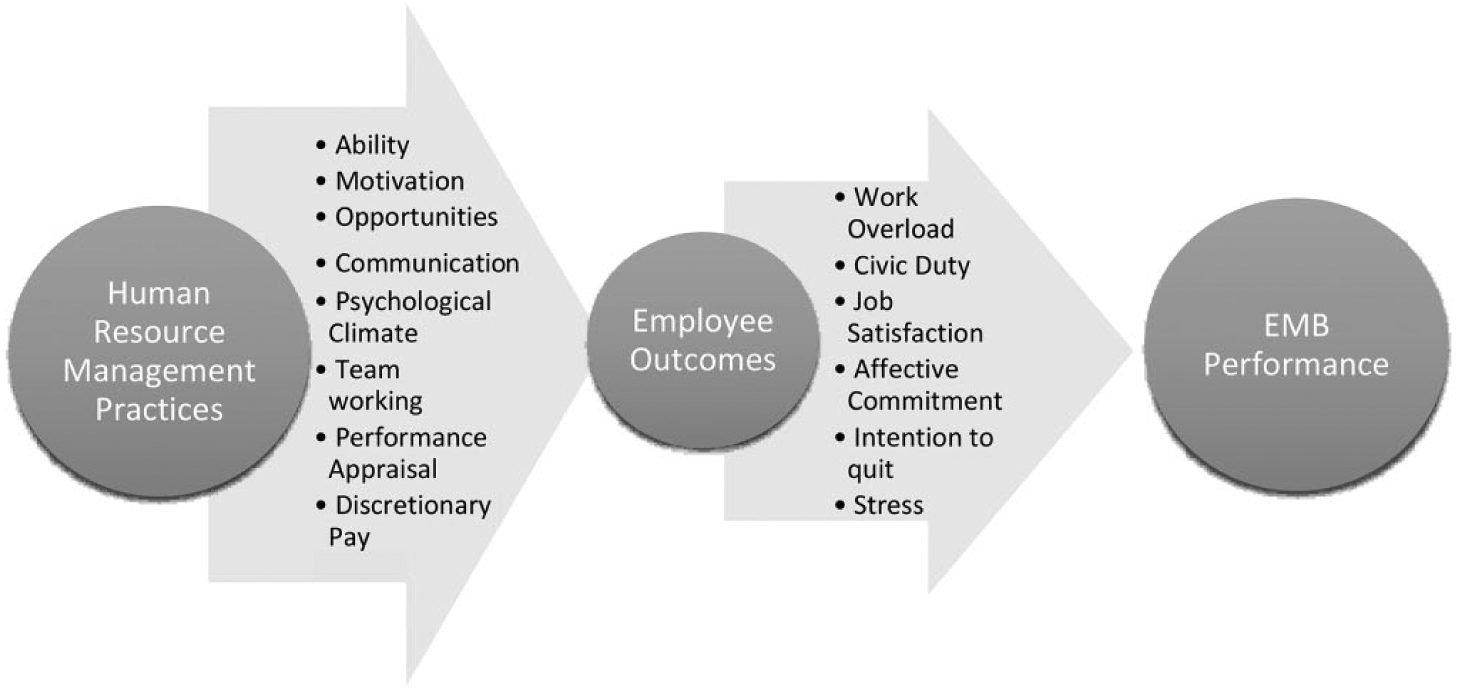
Anticipated relationships between human resource management practices, employee outcomes and EMB performance.
Data and methods
Two cross-national surveys of EMBs were undertaken, as set out in the Introduction to this special issue. These captured institutional-level data such as the budget, number of staff and institutional structure as well as individual-level employee information about the demographic and educational background, the experiences of HR management practices and employee outcomes. Surveys were translated into 33 languages.
The Electoral Management Survey (EMS) was designed and administered by the author and colleagues in Europe (James et al., 2019). The survey design captured data on HR management practices and employee outcomes, based on batteries of standard questions used by Gould-Williams and Mohamed (2010) and Gould-Williams et al. (2014). Seven-point Likert scales were used. A sister survey was administered by the Electoral Integrity Project, called ELECT, to non-European countries, which included similar or identical questions (Norris et al., 2016). The ELECT survey was based on the EMS survey, but some questions had minor changes to their wording. Non-European countries that did not respond to the ELECT survey were then followed up with the EMS. All data was collected between July 2016 and October 2017. In combination, there were 2029 responses from EMB staff in 51 countries.
In countries where electoral management is centralised in one organisation, a survey facilitator was identified to send on the survey to all employees within the organisation. When there were several decentralised organisations, usually because responsibilities are dispersed across local government units, contact email lists were requested and each unit was emailed asking for the survey to be circulated internally. The sampling methods were therefore non-probabilistic and based on organisations and individuals volunteering to take part. There is therefore a risk of a response bias in the sample, but this risk is impossible to eliminate. Other sampling methods, such as emailing every 10th employee, would have produced a much lower response rate, proved logistically impossible to implement and there would have been no guarantee that it would have been more representative. Names of countries are deliberately not given in this paper because of ethical commitments made to participants of the study. Data and analysis are therefore aggregated.
The key dependent variable in this study is EMB organisational performance. There are a number of ways in which performance can be measured and any measure is inevitably contestable (Garnett and James, 2018). The implementation of elections can be flawed in a variety of ways, but the focus here is on technical performance of electoral management. Two measures were used for robustness purposes. First, the Perception of Electoral Integrity 6.0 dataset was used (Norris et al., 2018). This is an expert-based survey that has been used in a variety of settings. The question taken as the dependent variable was ‘The election authorities performed well’, which was on a 5-point scale. The mean score for elections 2012–2017 was used. For robustness checks, this was compared to the latest electoral event before the surveys were undertaken. There were no major differences in the results. A second measure of performance used was the respondents’ evaluation of their own organisation’s performance. In the EMS survey, electoral officials were asked a battery of eight questions about how well their organisation delivered elections. 1 An additive index was generated by taking the mean of the responses. The Cronbach’s alpha score was then calculated to test the reliability of the overall measure and a high value of .878 suggested that it had a strong level of internal consistency.
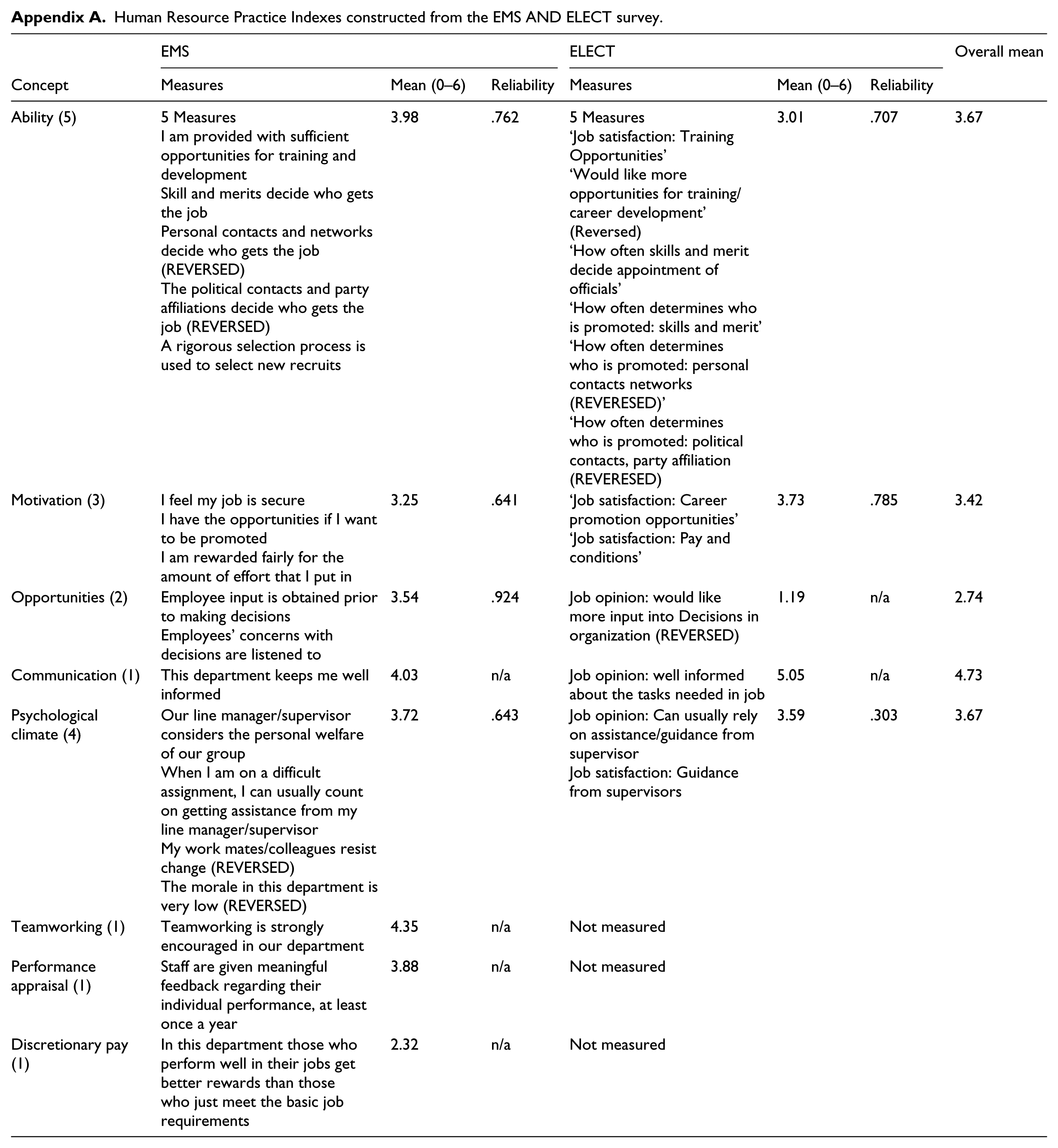
Indices were also constructed to measure the eight key HR management practices and six employee outcomes by combining data from the two surveys. Multiple question indicators were used for most measures to increase reliability. The index was created by taking the mean of the responses to generate a value of 0–6. 2 Appendices A and B summarise the questions asked, the mean and the Cronbach’s alpha score. These scores were generally over .7, suggesting that they had a very good level of internal consistency. 3 Descriptive statistics were used to identify the workforce sizes, characteristics and motivations. The interactions between HR management practices, employee outcomes and performance were then examined using correlation analysis and hierarchical OLS regressions. Many employees surveyed only contribute some of their working time to elections. Data was collected at an individual level on the proportion of the work that was dedicated to elections in an electoral year. The models were re-run to see whether this has a notable effect.
Results
Workforce sizes, characteristics and motivations
Combining data from the EMS and ELECT, it is possible to gain new insights into the overall workforce characteristics of EMBs. The workforce size within EMBs varies enormously. The largest workforces found were 15,000 in Mexico’s Instituto Nacional Electoral, followed by 4000 in Iraq’s Independent High Electoral Commission. Measuring workforce size against the eligible electoral population, Panama’s Tribunal Electoral has largest proportion of permanent employees per 100,000 members of the eligible electorate. A total of 3000 employees serve 2,338,207 eligible citizens – a ratio of one EMB employee for every 779 eligible citizens. 4 But most countries do not have a large national body running elections; rather more tend to have lightly staffed central organisations. The Swiss Federal Chancellery Political Rights Section, for example, explained that there are 10 permanent staff members on the national level, but ‘not all of them are responsible for the elections of the National Council. There are about 2–3 persons who concentrate on the elections.’ In Norway, only four members of staff were in the Ministry of Local Government and Modernisation, but the Norwegian Directorate of Elections employed another 21 staff.
Apart from population size, these small permanent teams can be explained by many factors. First, small national workforces are bolstered by large temporary teams. For example, the Indonesian Election Commission for the West Java Province only has 40 permanent employees but boosts its strategic management team size to 2732 at election time. These managers oversee a team of over 336,000 employees, including poll workers. Second, staff are often located in local communes or government. The total Swiss staff size grows to include 40–70 regional members of staff and 2300 in the local Communes. In Croatia, there are 23 permanent staff in the State Electoral Commission, but there are 576 county, city and municipality electoral commissions. These are ad hoc bodies established for each election (although some staff members remain each time). In total, 3456 staff are therefore involved in the election. Third, low permanent staff sizes can be a result of the fact that there are many organisations involved in running elections. In Malta, for example, the electoral register is effectively compiled by Identity Malta, an organisation that is not traditionally considered as an EMB (and declined to reply to the survey as a result). The staffing costs are therefore partially ‘hidden’ and shared between many organisations.
The gender balance of the workforce varies considerably around the world. Those working in elections are predominantly male in Africa (75.7%), the Asia-Pacific (67.5%) and Latin America and the Caribbean (63.5%). However, the workforce contains marginally more women in Western Europe (53.7%) and Eastern Europe (52.2%). 5 Across all continents, however, men were found to be more likely to hold senior management positions. Men were more likely than women to be supervising other colleagues (52.6 to 47.3%). The EMS survey captured more information about the seniority of each electoral official. In that survey, men occupied 69.4% of senior management positions but only 31.1% of office and administrative support jobs. In the ELECT survey, men were again occupying more of the senior management roles (77.5%) but were also occupying the office and administrative support roles (60.5%). There is therefore evidence of a gender bias within the workforces. This is not uncommon in public sectors, of course. One question also asked whether respondents were part of a minority group. Only 1.4% suggested that they were, but their distribution across post-levels was almost identical to non-minority group members.
Levels of education were found to be high, with 78.9% of staff educated to university undergraduate degree level or above. But it is not unknown for senior managers to have not attended university. Out of the 336 senior managers in the survey, nine did not have university level qualifications. The ELECT survey also reported that the majority (59.7%) had come from social science backgrounds, with the natural sciences (17.5%) as the next ranked discipline.
A job in elections seems to ensure job security, and staff commonly have considerable experience of being in post, as might be expected with a public-sector position. The mean number of years that an employee had worked for their organisation was 12.0, with one individual having worked in elections for 46 years. 6 The mean number of national elections worked was 5.74 and the average number of local elections was 5.74. 7 As one Danish respondent explained, some people have worked in elections for a very long time and have seen major changes: ‘I started helping in the 1980s and the position came to involve more and more responsibility. Today I am the main manager, but by the 2018 elections I will leave’ [sic]. There was significant variation in job tenure by country, however. For example, the mean time that someone had worked for their current organisation was over 19 years in the Netherlands and the number of national elections worked on was 10. The figures for Ecuador were 2.4 years and 2.3 national elections. Overall, workforce experience tended to be higher in older-established democracies and lower in Eastern Europe.
ELECT data suggested that in most cases (75.4%) the people running elections had applied to do so. Only 10.3% were asked to apply and 5.1% were assigned. Data from the EMS asked more detailed questions about the motivations of the employees. A desire to work in the public’s interest was the highest stated reason. Job stability was rated higher than career prospects and competitive remuneration. Most respondents self-rated themselves towards the centre of an 11-point left–right scale when asked about their political ideology, with 42.0% taking the central value. Some still took the extreme values (2.6% left, 1.4 % right). There was also significant variation by country, with a comparison of means by state showing a variation between 6.69 and 4.39. Overall, staff were slightly more left-wing in Western Europe (4.55) than in Latin America and the Caribbean (5.05). Nonetheless, the differences are small, and the overall picture is of staff identifying centrally along the political spectrum. Variation in political beliefs, of course, should not be taken to imply that officials are implementing elections according to their values.
Human resource practices and employee outcomes
Figure 2 shows the mean score for each of the HR management practices indices. At an aggregate level, teamworking is encouraged, while performance-related pay is the least widely used policy. This suggests that a collective rather than individualistic work culture is common, as we might expect of the public sector. Of the key AMO variables, EMBs are better at promoting ability within their organisations than they are at promoting opportunities to be involved in the workplace. There was significant variation in the use of AMO HR management practices at a country level, however. For instance, in one African country the mean score for Ability was 1.60 (n = 7), while in another it was 5.53 (n = 12).
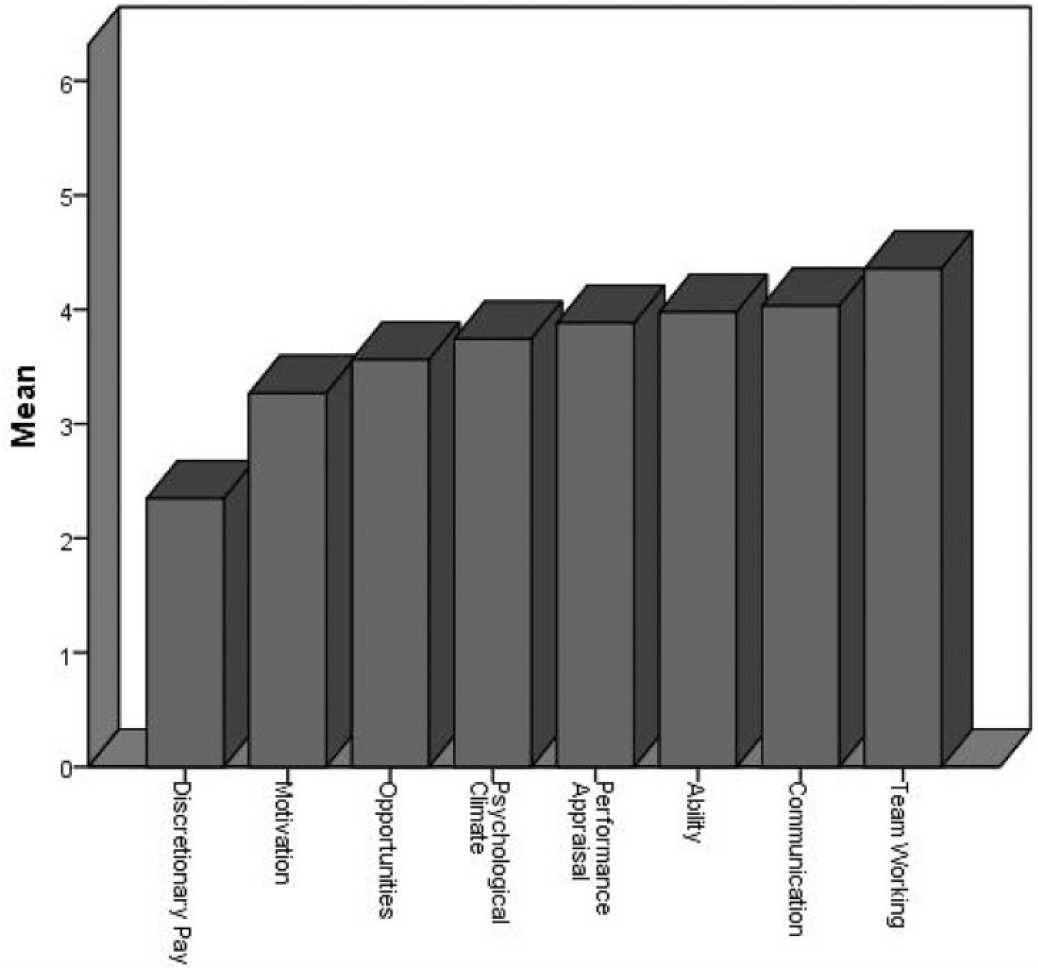
Mean HR management practices index scores. 0 = low, 6 = high.
Figure 3 shows the mean score for each of the employee outcomes indices. Employees of EMBs seem to have a strong sense of belonging to their organisation, are satisfied with their job, and generally do not intend to leave in the immediate future. There is some evidence that the workload can be high and that levels of stress can be considerable, however. Although we might expect stress and workload to be higher in countries that were holding a national election in the year that the survey was undertaken, this was not apparent in a comparison of means. Independent sample tests found that there were statistically significant differences for gender across some HR management practices and employee outcomes indices. Women were less likely to say that ability was promoted, communication was good, that their performance appraisal went well and that they received discretionary pay for performance. They had a higher propensity to quit their job but did score higher on the opportunities index.
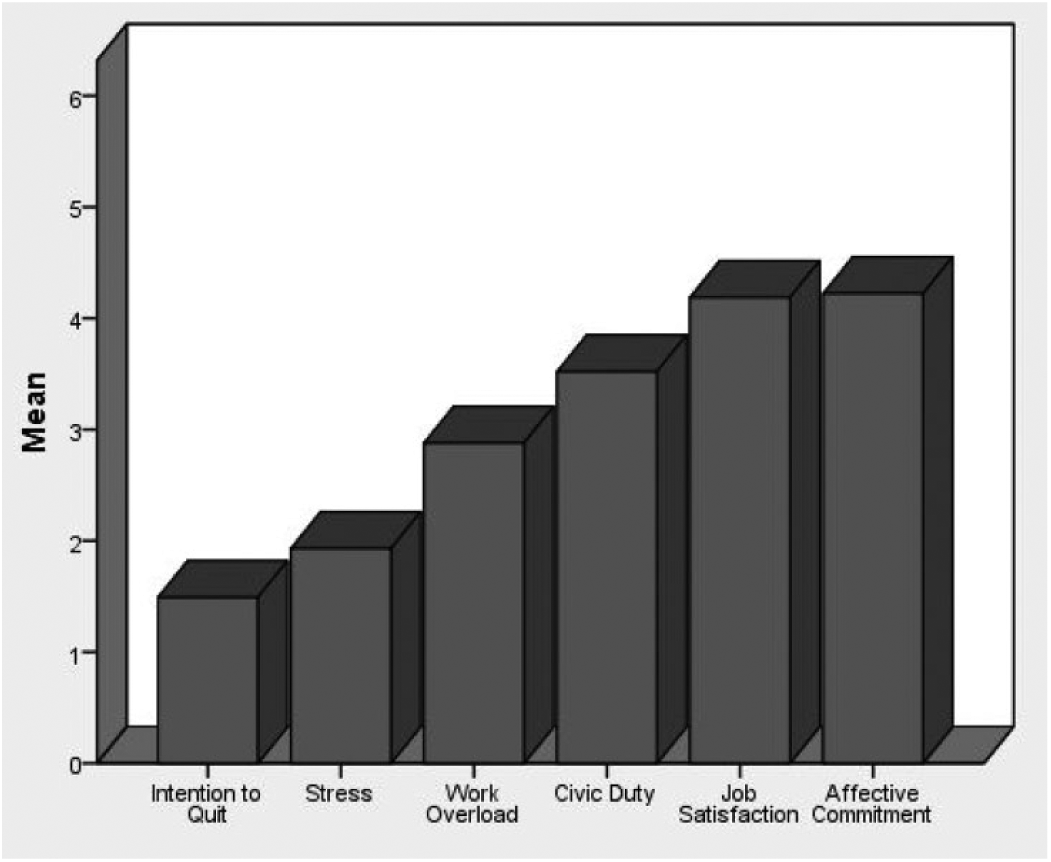
Mean employee outcome index scores. 0 = low, 6 = high.
Human resource management practices, employee outcomes and EMB performance
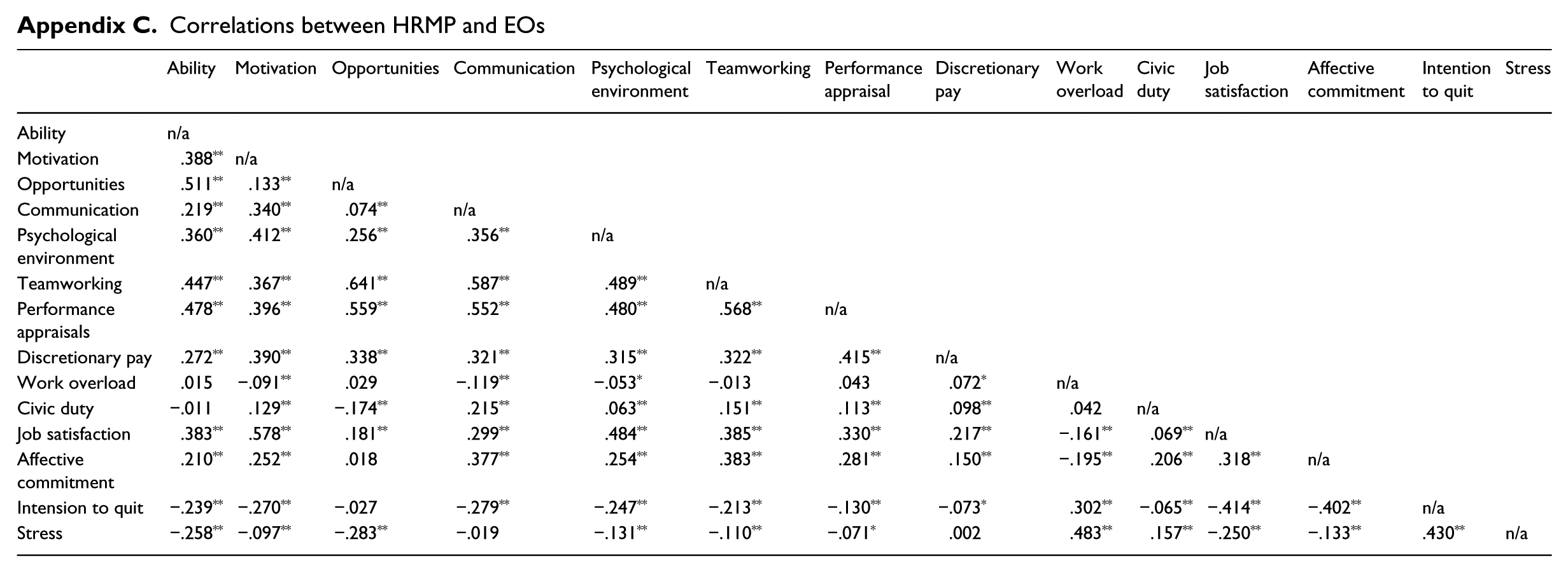
How do HR management practices, employee outcomes and organisational performance affect each other? Analysis begins with Pearson correlation coefficients between each of these indices at an individual level and measures of performance at the country level. 8 The correlations provided some evidence in support of H1, that HR management practices affected employee outcomes. Policies that promoted ability, motivation and opportunity were very strongly associated with improved employee outcomes. Job satisfaction is positively associated with all AMO practices, as is reduced stress and intention to quit. Similar positive relationships between AMO practices were also found between communication, discretionary pay, performance appraisals and teamworking with employee outcomes as well. There were other interesting relationships, such as discretionary pay having a positive effect on teamworking (β =.322**, p < 0.01), which is contrary to the existing research discussed in the literature review. Further information is set out in Appendix C.
There was also evidence that HR management practices fed through to organisational performance, providing support for H2. Table 1 maps the correlations against the two measures of EMB performance. Several measures were positively and statistically significantly correlated with performance using both measures of performance: ability, opportunities, teamworking, performance appraisals and discretionary pay. Correlations between some variables produced counter-intuitive findings. Good communication was negatively correlated with performance when expert surveys were used to measure performance, for example. But this was not found to be the case with electoral officials’ own evaluation of performance.
Correlations between HR management practices, employee outcomes and EMB performance.
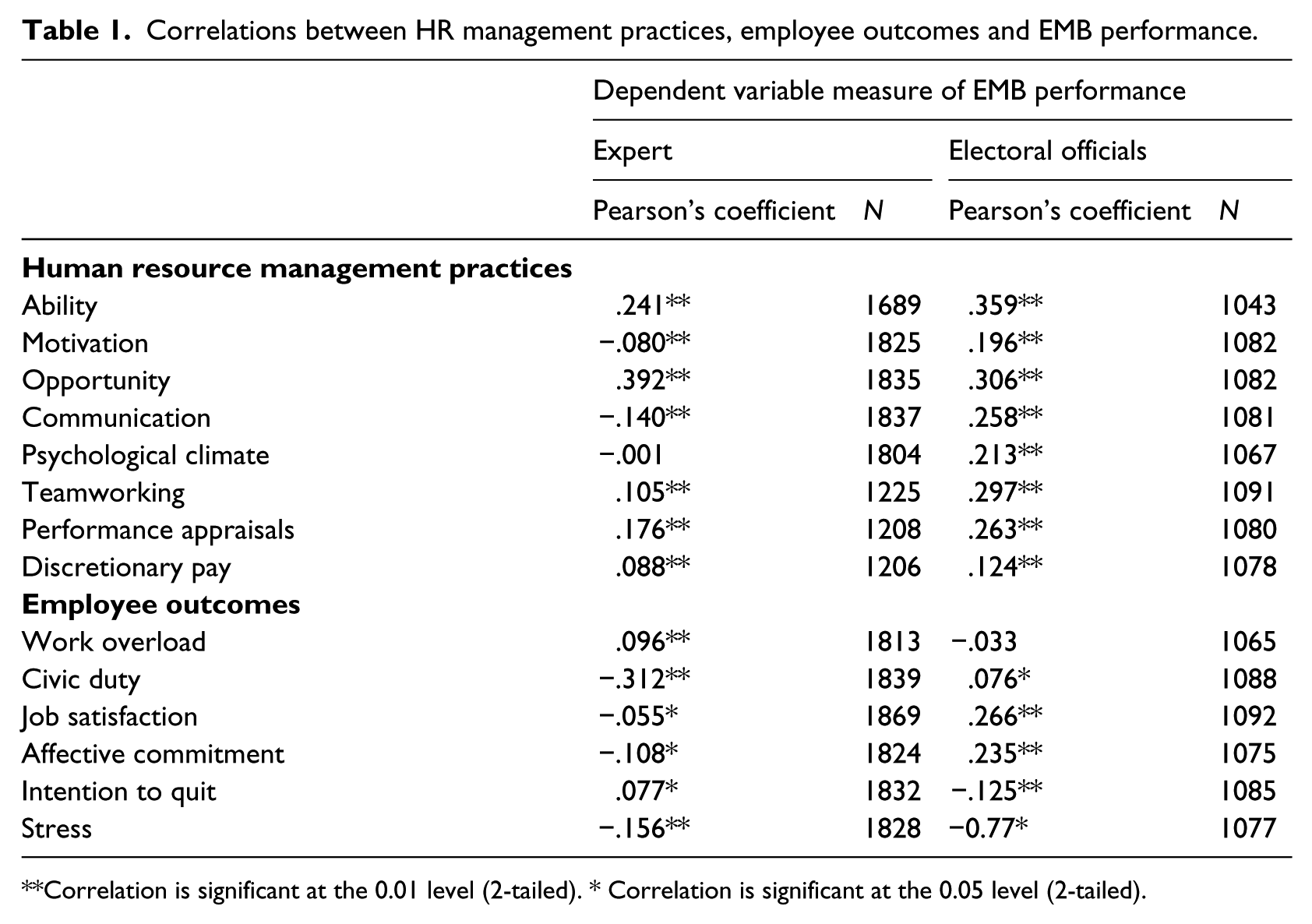
Correlation is significant at the 0.01 level (2-tailed). * Correlation is significant at the 0.05 level (2-tailed).
Employee outcomes were closely interlinked, as H3 predicted. For example, work overload was very closely linked to stress (β =.483, p < 0.01), a propensity to quit (β = .403, p < 0.01) and negatively affecting job satisfaction (β = -.250, p < 0.01). Job satisfaction improves marginally with civic duty (β = .069, p < 0.01), reduced work overload (β = -.161, p < 0.01) and lower stress (β = -.250, p < 0.01). Again, Appendix C sets out information in more detail.
Lastly, there was also evidence in support of H4, that employee outcomes affected performance. As Table 1 sets out, higher individual levels of stress were associated with reduced performance at a country level against both measures of EMB performance. Correlations between employee outcomes and performance measured through the expert surveys again produced some counter-intuitive findings such as job satisfaction, civic duty and affective commitment negatively affecting performance. These results were not found in the electoral officials’ own evaluations, where affective commitment and job satisfaction had a notable positive association with performance.
Multivariate analysis
The correlations overall suggest that HR management practices, employee outcomes and performance are closely linked (see Table 1). But what is the direction of the relationship? Are well-run EMBs more likely to have certain HR management practices and employee outcomes? Or is causality in the other direction? To further examine the effects of HR management practices and employee outcomes at the individual level on performance at a country level, and thereby test H2 and H4, linear hierarchical regression models were constructed. Missing values were replaced with the mean. This analysis can be helpful in identifying the additional explanatory value of adding variables to a model (Gelman and Hill, 2006).
An initial model was therefore built consisting of four control variables. First, we might expect EMB performance to be higher in democracies. Greater access to information, transparency, press freedom and more rigorous accountability mechanisms should increase EMB performance. The 2016 measure for the electoral democracy index was therefore used from V-DEM 7.1 (Coppedge et al., 2017). Second, we might expect EMBs with more resources to be better able to deliver elections (James and Jervier, 2017). Data is therefore also taken from V-DEM 7.1 on EMB capacity. 9 Third, it is often argued that EMBs with greater institutional autonomy will be better able to run elections (van Ham and Lindberg, 2015). Data on EMB autonomy is therefore also taken from V-DEM 7.1. 10 Lastly, a control is introduced for whether electoral management is delivered by a local or central body. 11 There are often arguments made that one type is more efficient than the other (James, 2017), so it is important to control for this. However, it is also important because some of the HR management practices and employee outcomes might have different effects on performance depending on whether the organisation is a local or national organisation.
Two sets of models were run. Models 1a–4a used expert measures of EMB performance as the dependent variable (Table 2). Models 1b–4b repeated these models, but used electoral officials’ perception of performance as the dependent variable instead (Table 3). As might be expected, all models showed that the quality of electoral democracy had a general significant effect on EMB performance. Capacity has an important effect on EMB performance when it was measured by experts’ perceptions, but not electoral officials’. The other controls did not have a notable influence.
Hierarchical linear regressions with expert perceptions of EMB performance as the dependent variable.
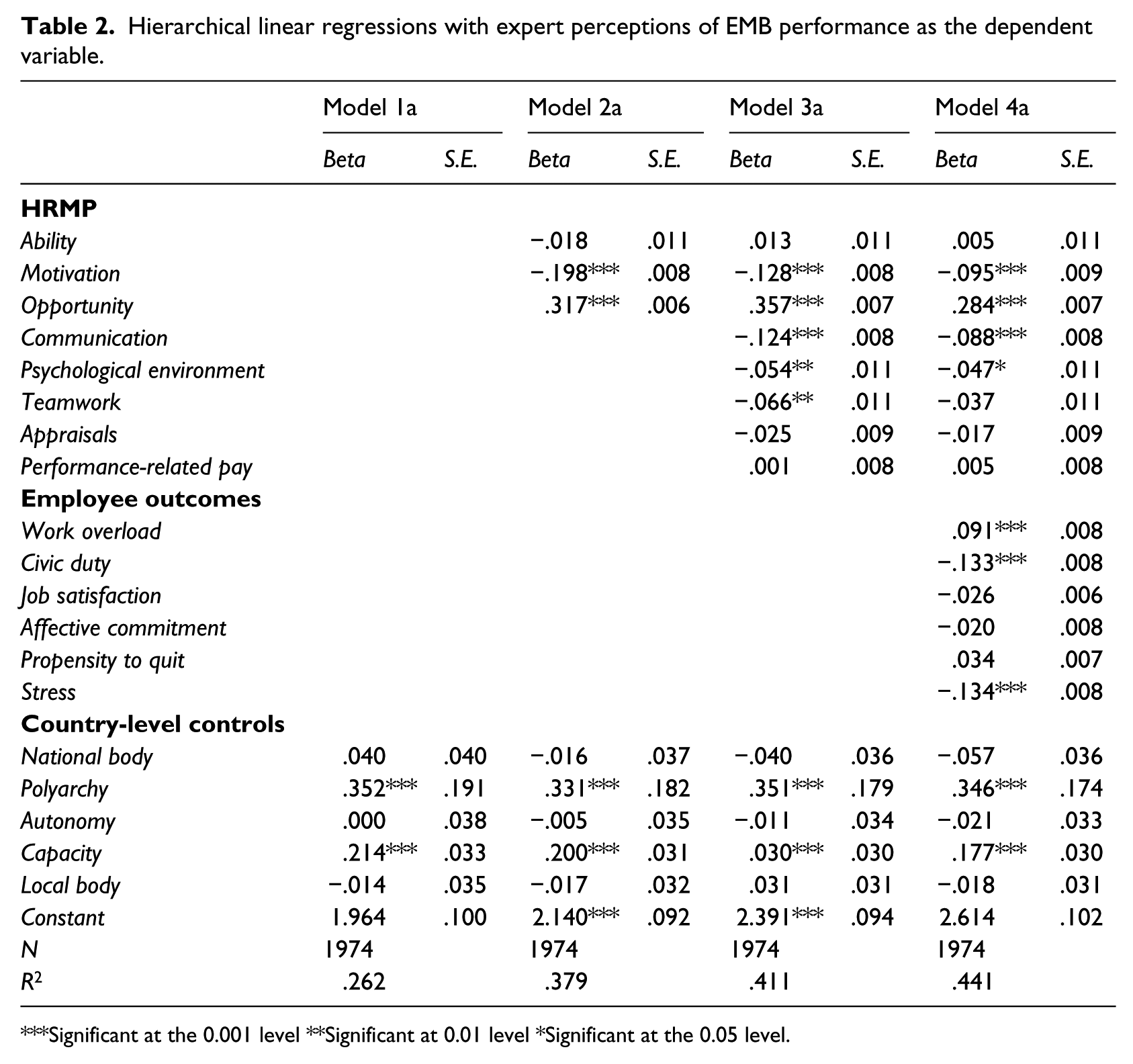
Significant at the 0.001 level **Significant at 0.01 level *Significant at the 0.05 level.
Hierarchical linear regressions with electoral officials’ evaluation of EMB performance as the dependent variable.
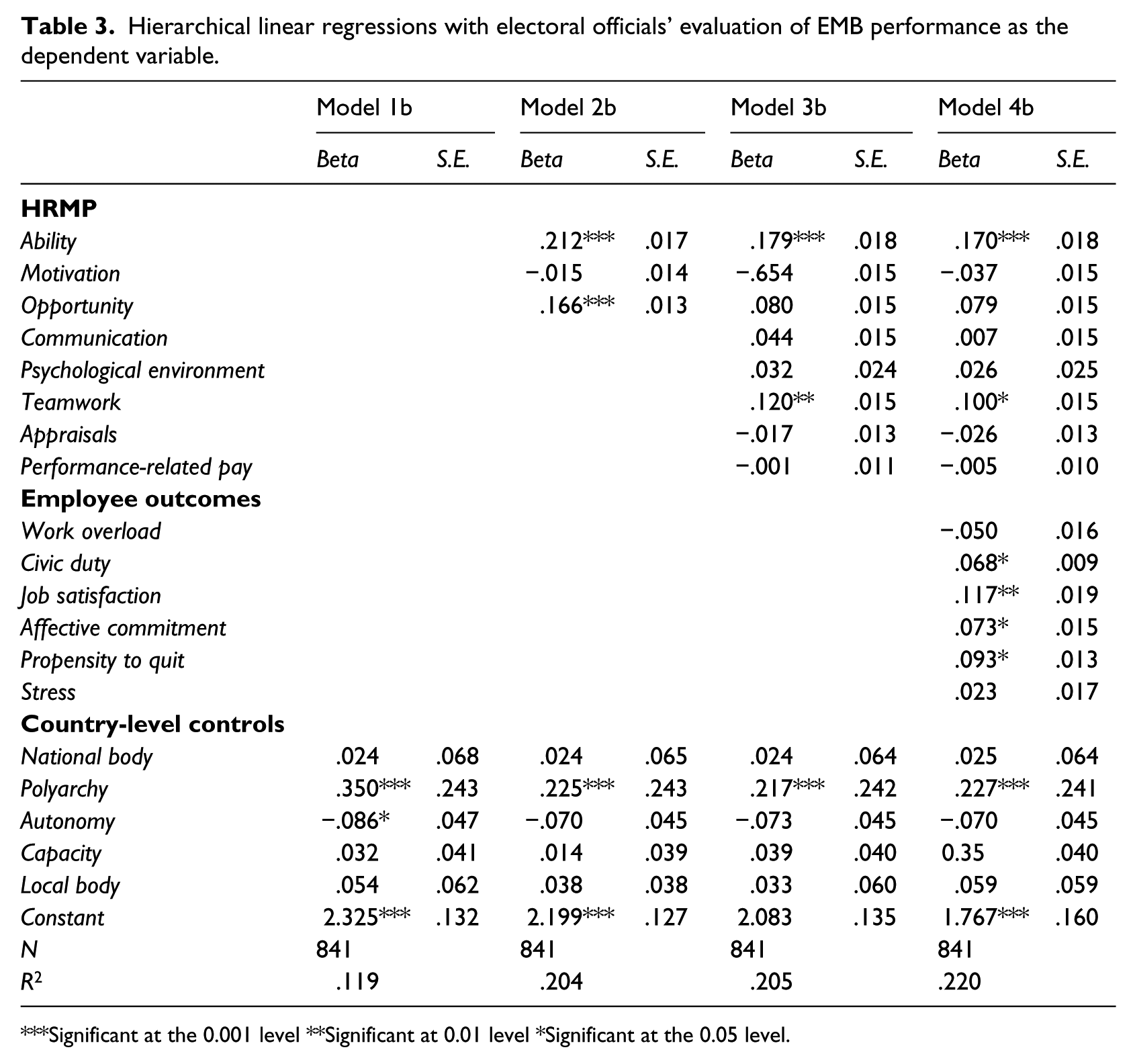
Significant at the 0.001 level **Significant at 0.01 level *Significant at the 0.05 level.
The AMO HR management practices are introduced in models 2a and 2b. Other HR management practices are then introduced in models 3a and 3b. The employee outcomes are introduced in model 4a and 4b. Importantly, the r2 value increases as the HR management practices and employee outcomes variables are introduced into both sets of models. This suggests exploring the characteristics of workforces considerably aids understanding of the drivers of EMB performance and gives strong support to H2 and H4.
Opportunity seems to have a very important effect in all models, statistically significant at the 0.01 level, even after controls are introduced. Although this effect lessens as controls are introduced in models 3b and 4b, the effect is still present. The questions that comprised the opportunities index asked individuals whether they were able or wanted to contribute towards the decision-making process in their organisation. This suggests that organisations where senior managers consult with employees deliver better-run elections. Ability and job satisfaction also have a very strong effect in the models where electoral officials’ perception of performance is used. As Table 3 illustrates, these remain significant even after all controls are introduced. As Table 2 suggests, stress has a negative effect on performance in the first set of models, even with controls.
The evidence in support of the remaining variables is weaker. In some cases, HR management practices that are commonly thought to improve performance had a negative effect. Notably, the motivations index in the first set of models had a significant negative coefficient, and seemed to have no effect in the second set of models. This index was drawn from a battery of questions asking employees about whether job security and material reward was promoted in their organisation. The results suggest that this is not so important in shaping electoral officials’ discretionary behaviour, it is the involvement in decision making that matters.
The relationships in the models were directly contradictory in a few cases. Communication and civic duty had a small negative effect in the first set of models. These effects were not found in the second set of models. Work overload also has positive effects in the first set of models, but not the second. This opens up questions about which is the most reliable measure of performance: experts or officials? It is probably wisest to draw concrete conclusions from where the models triangulate each other – or, at least, do not contradict one another. The relationships for other variables might be more complex, and worthy of further study.
Conclusion
The factors that determine whether states can become electoral democracies continue to be a central area of study. Overlapping this, the management and implementation of elections has become a pressing international policy issue which is increasingly being explored by scholars from comparative politics, law and public administration. This article has provided new data on who delivers elections around the world by reporting findings from the first-ever cross-national surveys of electoral officials. Although there are some large, permanent and centralised organisations that deliver elections, it is more common for there to be smaller national organisations with workforces being buttressed from other departments at election time, or staff being based in sub-national government. A notable finding was that there are significant gender biases. While this is commonplace in many other professions, gender bias within EMBs is an entirely unexamined political phenomenon compared to research on biases in legislatures or executives and therefore represents opportunities for further study. Workforces are overall well-educated, but there is considerable variation across countries in the levels of experience.
Hypotheses predicting causal relationships between HR management practices, employee outcomes and performance were broadly confirmed. The opportunity index was the consistent standout predictor of organisational performance across the models, suggesting that seeking employee input/consultation on decisions can produce better-run elections. Recruitment practices, job satisfaction and levels of stress are also important. Some of the other relationships such as workload, civic duty, communications and psychological environment may require further examination in future studies.
It is important to note that, overall, some effects tend to be small. This is understandable because, as the Introduction to this special issue sets out, there are many complex lines of causation that could affect performance and further research is needed to follow up these findings. Yet HR practices within EMBs are clearly an under-studied and influential determinant of electoral integrity. This article has provided a macroscopic overview of patterns and trends. There is scope for future research agenda to take this work forward with more within-country and regional analysis to help to further determine whether there are universal HR management practices and employee outcomes that shape performance.
Supplemental Material
5b-JAMES_Appendix_(1) – Supplemental material for Better workers, better elections? Electoral management body workforces and electoral integrity worldwide
Supplemental material, 5b-JAMES_Appendix_(1) for Better workers, better elections? Electoral management body workforces and electoral integrity worldwide by Toby S James, Holly Ann Garnett, Leontine Loeber, Carolien van Ham and Toby S James in International Political Science Review
Supplemental Material
IPS829516_Franch_and_Spanish_abstracts – Supplemental material for Better workers, better elections? Electoral management body workforces and electoral integrity worldwide
Supplemental material, IPS829516_Franch_and_Spanish_abstracts for Better workers, better elections? Electoral management body workforces and electoral integrity worldwide by Toby S James, Holly Ann Garnett, Leontine Loeber, Carolien van Ham and Toby S James in International Political Science Review
Footnotes
Appendix A.
Human Resource Practice Indexes constructed from the EMS AND ELECT survey.
| EMS |
ELECT |
Overall mean |
|||||
|---|---|---|---|---|---|---|---|
| Concept | Measures | Mean (0–6) | Reliability | Measures | Mean (0–6) | Reliability | |
| Ability (5) | 5 Measures I am provided with sufficient opportunities for training and development Skill and merits decide who gets the job Personal contacts and networks decide who gets the job (REVERSED) The political contacts and party affiliations decide who gets the job (REVERSED) A rigorous selection process is used to select new recruits |
3.98 | .762 | 5 Measures ‘Job satisfaction: Training Opportunities’ ‘Would like more opportunities for training/career development’ (Reversed) ‘How often skills and merit decide appointment of officials’ ‘How often determines who is promoted: skills and merit’ ‘How often determines who is promoted: personal contacts networks (REVERESED)’ ‘How often determines who is promoted: political contacts, party affiliation (REVERESED) |
3.01 | .707 | 3.67 |
| Motivation (3) | I feel my job is secure I have the opportunities if I want to be promoted I am rewarded fairly for the amount of effort that I put in |
3.25 | .641 | ‘Job satisfaction: Career promotion opportunities’ ‘Job satisfaction: Pay and conditions’ |
3.73 | .785 | 3.42 |
| Opportunities (2) | Employee input is obtained prior to making decisions Employees’ concerns with decisions are listened to |
3.54 | .924 | Job opinion: would like more input into Decisions in organization (REVERSED) | 1.19 | n/a | 2.74 |
| Communication (1) | This department keeps me well informed | 4.03 | n/a | Job opinion: well informed about the tasks needed in job | 5.05 | n/a | 4.73 |
| Psychological climate (4) | Our line manager/supervisor considers the personal welfare of our group When I am on a difficult assignment, I can usually count on getting assistance from my line manager/supervisor My work mates/colleagues resist change (REVERSED) The morale in this department is very low (REVERSED) |
3.72 | .643 | Job opinion: Can usually rely on assistance/guidance from supervisor Job satisfaction: Guidance from supervisors |
3.59 | .303 | 3.67 |
| Teamworking (1) | Teamworking is strongly encouraged in our department | 4.35 | n/a | Not measured | |||
| Performance appraisal (1) | Staff are given meaningful feedback regarding their individual performance, at least once a year | 3.88 | n/a | Not measured | |||
| Discretionary pay (1) | In this department those who perform well in their jobs get better rewards than those who just meet the basic job requirements | 2.32 | n/a | Not measured | |||
Appendix B.
Employee Outcome Indexes constructed from the EMS and ELECT survey.
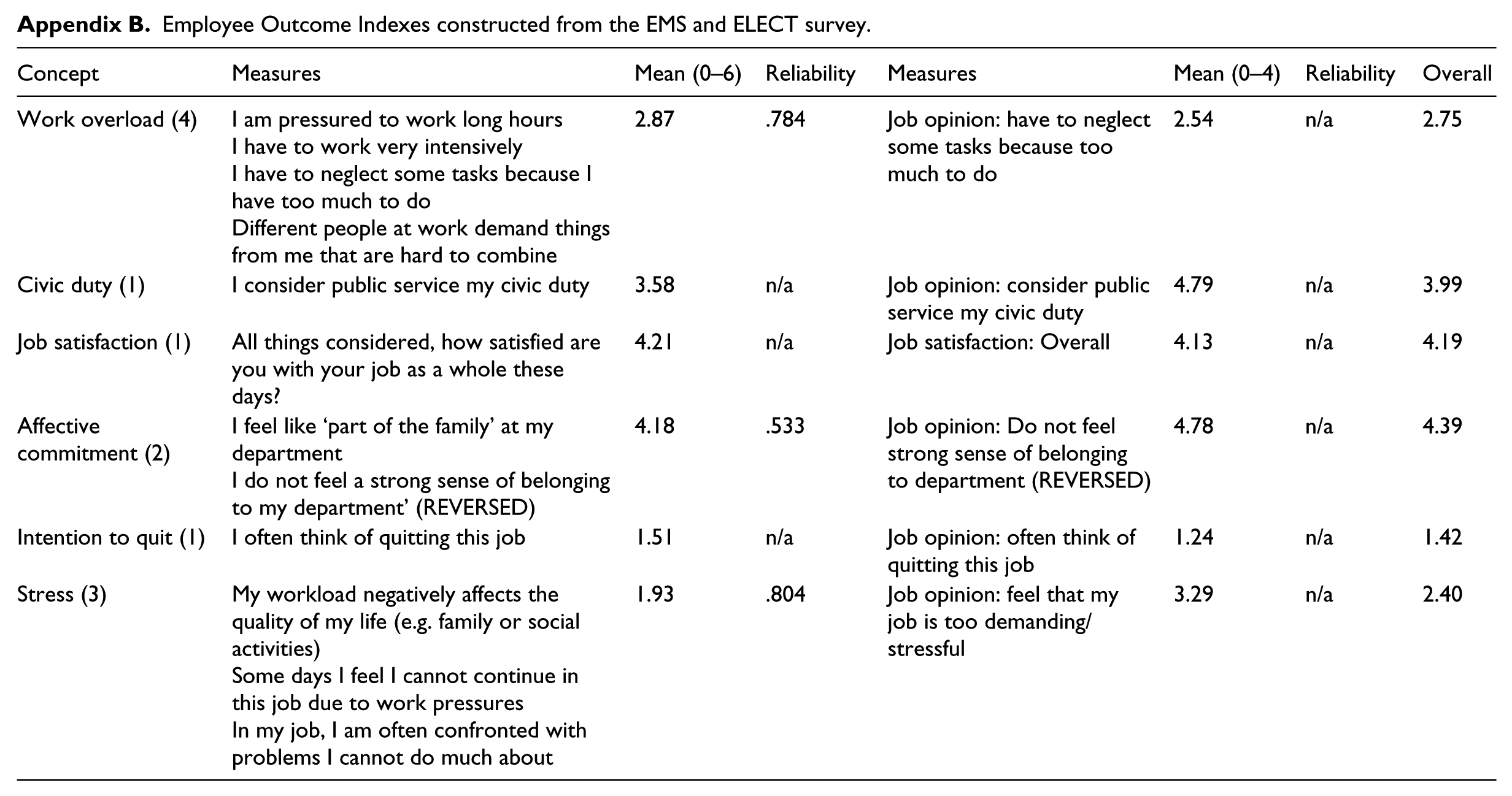
| Concept | Measures | Mean (0–6) | Reliability | Measures | Mean (0–4) | Reliability | Overall |
|---|---|---|---|---|---|---|---|
| Work overload (4) | I am pressured to work long hours I have to work very intensively I have to neglect some tasks because I have too much to do Different people at work demand things from me that are hard to combine |
2.87 | .784 | Job opinion: have to neglect some tasks because too much to do | 2.54 | n/a | 2.75 |
| Civic duty (1) | I consider public service my civic duty | 3.58 | n/a | Job opinion: consider public service my civic duty | 4.79 | n/a | 3.99 |
| Job satisfaction (1) | All things considered, how satisfied are you with your job as a whole these days? | 4.21 | n/a | Job satisfaction: Overall | 4.13 | n/a | 4.19 |
| Affective commitment (2) | I feel like ‘part of the family’ at my department I do not feel a strong sense of belonging to my department’ (REVERSED) |
4.18 | .533 | Job opinion: Do not feel strong sense of belonging to department (REVERSED) | 4.78 | n/a | 4.39 |
| Intention to quit (1) | I often think of quitting this job | 1.51 | n/a | Job opinion: often think of quitting this job | 1.24 | n/a | 1.42 |
| Stress (3) | My workload negatively affects the quality of my life (e.g. family or social activities) Some days I feel I cannot continue in this job due to work pressures In my job, I am often confronted with problems I cannot do much about |
1.93 | .804 | Job opinion: feel that my job is too demanding/stressful | 3.29 | n/a | 2.40 |
Appendix C.
Correlations between HRMP and EOs
| Ability | Motivation | Opportunities | Communication | Psychological environment | Teamworking | Performance appraisal | Discretionary pay | Work overload | Civic duty | Job satisfaction | Affective commitment | Intention to quit | Stress | |
|---|---|---|---|---|---|---|---|---|---|---|---|---|---|---|
| Ability | n/a | |||||||||||||
| Motivation | .388** | n/a | ||||||||||||
| Opportunities | .511** | .133** | n/a | |||||||||||
| Communication | .219** | .340** | .074** | n/a | ||||||||||
| Psychological environment | .360** | .412** | .256** | .356** | n/a | |||||||||
| Teamworking | .447** | .367** | .641** | .587** | .489** | n/a | ||||||||
| Performance appraisals | .478** | .396** | .559** | .552** | .480** | .568** | n/a | |||||||
| Discretionary pay | .272** | .390** | .338** | .321** | .315** | .322** | .415** | n/a | ||||||
| Work overload | .015 | −.091** | .029 | −.119** | −.053* | −.013 | .043 | .072* | n/a | |||||
| Civic duty | −.011 | .129** | −.174** | .215** | .063** | .151** | .113** | .098** | .042 | n/a | ||||
| Job satisfaction | .383** | .578** | .181** | .299** | .484** | .385** | .330** | .217** | −.161** | .069** | n/a | |||
| Affective commitment | .210** | .252** | .018 | .377** | .254** | .383** | .281** | .150** | −.195** | .206** | .318** | n/a | ||
| Intension to quit | −.239** | −.270** | −.027 | −.279** | −.247** | −.213** | −.130** | −.073* | .302** | −.065** | −.414** | −.402** | n/a | |
| Stress | −.258** | −.097** | −.283** | −.019 | −.131** | −.110** | −.071* | .002 | .483** | .157** | −.250** | −.133** | .430** | n/a |
Acknowledgements
The author is grateful to Holly Ann Garnett, Carolien van Ham, Leontine Loeber; participants at the Building Better Elections Workshop, organised by the Electoral Management Research Network at the ECPR Conference, Oslo, September 2017; colleagues at the University of East Anglia; members of the Electoral Integrity Project and the Electoral Management Network; the IPSR editors; and, anonymous reviewers for the comments on an earlier version of this article. The author alone is responsible for any errors.
Funding
This research received funding from the Electoral Integrity Project, University of East Anglia and University of New South Wales.

Notes
Author biography
References
Supplementary Material
Please find the following supplemental material available below.
For Open Access articles published under a Creative Commons License, all supplemental material carries the same license as the article it is associated with.
For non-Open Access articles published, all supplemental material carries a non-exclusive license, and permission requests for re-use of supplemental material or any part of supplemental material shall be sent directly to the copyright owner as specified in the copyright notice associated with the article.
