




Abstract
In today’s society, we can easily connect with people who share our ideas and interests. A problem with this development is that political reasoning in like-minded groups easily becomes lop-sided since there is little reason to critically examine information that everyone seems to agree with. Hence, there is a tendency for groups to become more extreme than the initial inclination of its members. We designed an experiment to test whether introducing deliberative norms in like-minded discussions can alleviate such group polarization. Based on their attitudes toward a linguistic minority, participants were divided into a positive and a negative opinion enclave. Within the two enclaves, the participants were randomly assigned to group discussions either with or without deliberative norms. Both face-to-face and online discussions were arranged. We found that free discussion without rules led to group polarization in like-minded groups, whereas polarization could be avoided in groups with deliberative norms.
Keywords
Introduction
Many Western democracies are currently affected by a negative, and even aggressive, discussion climate. According to Sunstein (2002, 2009), opinion polarization, in the sense of opinions becoming more extreme through discussion than they initially were, is a consequence of the fact that most people tend to discuss politics among like-minded individuals, nowadays often in online contexts. A fundamental problem with political discussion in groups of like-minded individuals is that the ideas and opinions that thrive within this context escape reasonable criticism based on other points of view. Hence, such groups may end up with extreme, or at least very narrow, views. On the other hand, many democratic theorists (Bohman, 1996; Gutmann and Thompson, 2004) put the meeting and exchange of ideas and arguments at the heart of a working democracy and evidence from deliberative mini-publics indicates that opinions depolarize, or at least do not polarize in the first place, as result of taking part in deliberative group discussions (e.g. Farrar et al., 2009; Himmelroos and Christensen, 2014; Luskin et al., 2002).
Free discussion in like-minded groups differs from deliberative mini-publics in two key aspects. First, a typical deliberative mini-public consists of people with diverse opinions whereas group polarization is most likely to occur in like-minded settings as a result of information biases and an adjustment to group norms (e.g. Brauer et al., 1995; Mercier and Landemore, 2012: 251; Vinokur and Burnstein, 1978: 873). Second, in deliberative mini-publics, discussion takes place under specific discussion rules and in the presence of a trained facilitator (Moore, 2012). According to Smith (2009: 169, 198), active facilitation plays a fundamental role in shaping the conditions for deliberation and is crucial for ‘ensuring that marginalized voices are heard’. Hence, it remains unclear whether group polarization is a problem for discussions where deliberative norms are in place. Our research question reads: ‘Can deliberative norms alleviate group polarization in like-minded groups?’
Findings from a previous deliberative experiment indicate that using discussion rules and facilitation to aid the implementation of deliberative norms – such as inclusion, equality of discussion, reciprocity, reasoned justifications, reflection, sincerity and respect – can indeed alleviate opinion polarization even in like-minded groups (Grönlund et al., 2015). Similar findings have also been presented by Farrar et al. (2009). On the other hand, Smets and Isernia (2014) find that predispositions can shape attitude formation even when deliberative arrangements are in place.
Thus, we designed an experiment where discussion groups consisted of participants who shared similar baseline views on the issue at hand. In this experiment, we intentionally let the setting of discussion vary: half of the participants discussed freely, and half of them discussed according to specific deliberative rules and facilitation. Moreover, given the high relevance of the online context regarding discussions among like-minded citizens (Sunstein, 2009) and in order to empirically test the importance of modality for group polarization, we implemented two discussion modes: some participants discussed face-to-face, others online.
The article is organized in the following manner. First, we review earlier research on like-minded groups, discuss how deliberative norms with facilitation may alleviate a polarization of opinions in like-minded groups, discuss the online context as an arena for deliberation and formulate hypotheses. Second, we describe the experiment in detail. Thereafter, the empirical testing is carried out. Finally, we provide conclusions based on the findings.
Group polarization in like-minded groups
Democratic theorists have emphasized the importance of giving voice to different viewpoints in democratic decision-making (Bohman, 1996; Habermas, 1996). Furthermore, deliberative democrats argue that in order to reach a decision everyone can accept, a democratic decision-making process should be based on a balanced evaluation of the arguments and viewpoints presented (Gutmann and Thompson, 2004). Ideally, a common understanding of the issue would emerge as a result of a reason-based exchange of arguments.
At the same time, a large body of research suggests that opinions are more likely to change as result of group mechanisms and pre-existing views than well-reasoned arguments. Group polarization (Sunstein, 2002) is a phenomenon where, as a result of discussion, a convening group – initially leaning toward a certain opinion –moves further in the direction they initially agree on. Group polarization occurs due to several mechanisms pertaining to affect heuristics, information bias and social comparison (Farrar et al., 2009; Isenberg, 1986; Sunstein, 2002). First, literature on motived reasoning shows that humans are goal-directed information processors who tend to evaluate information with a directional bias toward reinforcing their pre-existing views (Nyhan and Reifler, 2010; Taber and Lodge, 2006). Pre-existing views are likely to be bolstered in like-minded groups because individuals tend to value arguments supporting their own previously held position (Mercier and Landemore, 2012: 251; Wojcieszak, 2011). Second, in a group of like-minded people, individual biases in information processing and reasoning are not checked by arguments put forward by individuals supporting conflicting views. Since the group shares the same outlook, there is little or no alternative information or argument available and little reason for the group members to question the views they already agree on. Thus, polarization occurs because the discussants mostly hear information and argumentation supporting their pre-existing position (Sunstein, 2009: 22; Vinokur and Burnstein, 1978: 873). Finally, polarization also takes place, it is argued (Brauer et al., 1995; Sunstein, 2009: 23), because people usually seek social acceptance and tend to adjust their behavior according to what they perceive as the dominant position in the group. Based on this research on like-minded groups, we form the following hypothesis for our study:
Facilitated deliberation and group polarization
Most evidence on group polarization originates from studies in the field of social psychology, and while the group discussion context bears many similarities to discussion organized in deliberative forums, there are some important differences (Farrar, 2009; Grönlund et al., 2015). Most importantly, discussions in deliberative forums are designed to produce a high-quality exchange of arguments. A high-quality deliberative process should adhere to certain norms where everyone has an equal opportunity to present their claims and should state reasons for these claims (Cohen, 1989, p. 347–8). Moreover, participants in a deliberative process need to listen to others, treat them with respect and make an effort to understand them (Chambers, 1996; Young, 2000). In order to achieve a high-quality deliberative process and to mitigate the effects of groupthink and other detrimental group mechanisms, organizers of deliberative forums introduce different procedural safeguards such as trained facilitators and specific rules for discussion (Hansen and Andersen, 2004; Luskin et al., 2002; Setälä et al., 2010; Sunstein, 2009: 56).
While there may be other elements to establishing deliberative norms in a communicative setting (e.g. fair and balanced information), we focus on two essential and largely intertwined components. First, there are the conversational maxims or rules for deliberative interaction. Participants are asked to speak out, to listen to others, to behave respectfully, to learn about the issues and alternatives they are dealing with, and to try to persuade others of their points of view through spelling out reasons (Landwehr, 2014). Second, there is the moderator or facilitator who is supposed to uphold the rules of deliberation and facilitate a good deliberative process. Facilitators assist discussion among the participants and try to ensure the satisfaction of forum participants (Mansbridge et al., 2006). Both components play a crucial role in cultivating mutual respect and reciprocity among the diverse body of citizens, ensuring that citizens hear the voices of all participants during their deliberations (Smith, 2009). Conceptually, rules can be separated from facilitation, but if facilitation is supposed to bring about deliberative behavior, it needs to be combined with deliberative rules of procedure. Hence, the facilitation of deliberative discussions should be understood as having two intertwined components: discussion rules and a facilitator to uphold the said rules – what we in this article refer to as facilitated deliberation. Both of these components are seen as mechanisms whereby deliberative standards, or norms, are more likely to be achieved in actual discussions, in both the diverse groups and the like-minded groups.
There are obviously different ways to facilitate or moderate political discussions, but according to a fairly established understanding, facilitation of a deliberative process needs to be quite subtle. In short, a facilitator should act as a neutral referee who intervenes only to ensure that every participant has an opportunity to speak, that basic civility is maintained and that the group progresses toward the final decision. The task of the facilitators is to keep the discussion both open and balanced (Gerber, 2015: 114). The fact that the process is structured should not compromise its informality; on the contrary, the organizational framework is set up to stimulate the development of informal relations and to eliminate those barriers that are frequently present in non-structured interactions (Bobbio, 2010: 12). Nevertheless, as Fung (2003: 338) points out, the introduction of discussion rules and facilitators makes deliberative forums, such as mini-publics, a ‘highly artefactual’, setting. The facilitator is part of both the deliberative design and the interactive process itself, and may subsequently guide or condition the progress of the discussion, even if it is done inadvertently. Thus, skeptics have asked how facilitators actually manage the tension between necessarily initiating and eliciting discourse, and yet not directing or dominating it (Smith, 2009: 169).
The impact of discussion rules and facilitation in deliberative settings – i.e. facilitated deliberation – is, without doubt, an issue that needs further attention, even more so in the context of deliberation in like-minded groups. In a deliberative mini-public, where various opinions are present, the role of facilitation is to ensure that everyone can make their opinions heard and respected (Luskin et al., 2002; Setälä et al., 2010). This is likely to ensure that different kinds of information and varying arguments are put forth in the discussion. In like-minded groups, however, participants can voice their opinions without the risk of being criticized or dismissed (Mansbridge, 1996). In other words, when the group composition by itself does not ensure that alternative information or counterarguments are presented, the role of facilitation is augmented. More concretely, the task of facilitated deliberation in like-minded settings is to make the participants critically examine the validity of their own arguments, to reflect on the fact that there are others (not necessarily present in the discussion) who hold views different from their own and even consider as to why this is so. Here the presence of discussion rules and facilitators becomes an instrument that may help like-minded groups overcome groupthink. If there are no rules in place, members of like-minded groups have little reason to justify their opinions or consider how these reasons would be convincing to people who do not necessarily share their view.
Although the importance of facilitation is often emphasized (Landwehr, 2014; Moore, 2012), empirical research on the effects of facilitation is surprisingly scarce. Moreover, Sanders’ (2012) findings that opinion change as a result of deliberation may be bit harder to disentangle than previously thought, make it even more important to test the mechanisms of opinion change in a stringent manner. There are a number studies that discuss facilitation in deliberative forums (Mansbridge, 2006; Trénel, 2009) but few have experimentally tested the difference between facilitated group deliberation and regular group discussions. Studies that have made such comparisons (e.g. Strandberg, 2015) have not studied the impact on group polarization. Based on the literature on facilitation and deliberation, a second hypothesis emanates for our study:
Modality – the online realm as a venue for deliberation
ICTs were identified early as having a potential to increase civic participation and democratic discussion. In fact, the online environment can erode physical barriers, which have a restrictive impact on offline deliberations (Baek et al., 2012; Gastil, 2000). Furthermore, practical organization has often been seen as a significant obstacle when implementing large-scale face-to-face deliberation. Thus, the internet stands in a comparably favorable light as a venue for conveying and organizing large-scale deliberative discussions (Price 2009).
However, several scholars have raised critical questions regarding the use of the internet for deliberation. The internet has made it easier than ever before to come in contact with like-minded individuals and, in many ways, opinion polarization seems to be most prominent online (Sunstein, 2009). Perhaps as a result of this entrenchment phenomenon, online discussions also often fail to meet the qualitative standards of deliberation (Jankowski and Os, 2004; Papacharissi, 2004). Nonetheless, it has been suggested that the internet could be an appropriate venue for deliberative discussions if the forums themselves are designed with such discussions in mind (Wright and Street 2007). Thus, logic would state that online discussion venues built on principles from deliberative theory – and thus employing facilitated deliberation – would be more likely to bring about discussions with beneficial outcomes for democracy than normal everyday online discussion (e.g. Manosevitch, 2010; Smith and Wojcik, 2012). Early evidence from experiments in online deliberation (see Strandberg and Grönlund, 2014 for indepth review) indeed lends some support for this notion of beneficial effects stemming from democratic design of online discussion between citizens.
Since the internet presents deliberative democracy with both great promise and severe problems, it would be important to test the relevance of facilitated deliberation across modalities. The findings from previous research (e.g. Grönlund et al., 2009; Strandberg and Grönlund, 2012) comparing deliberation across modalities suggest that facilitated deliberation works in the same manner online as it does face-to-face. Nonetheless, experimental studies on opinion polarization in like-minded groups online have not been conducted before, especially with facilitated deliberation. In light of the knowledge concerning the online realm and deliberation, two final hypotheses are formed.
Experimental procedure and design
We designed a lab-in-the-field experiment to test whether a deliberative treatment (with facilitation and rules) differs from a non-deliberative treatment – i.e. free discussion (without facilitation or rules) – when it comes to alleviating group polarization in like-minded groups, i.e. opinion enclaves. The use of a lab-in-the-field strategy is often considered to retain the benefits of a controlled lab experiment, such as a sufficiently high internal validity, while having a higher extent of external validity than the lab-setting (Morton and Williams, 2010: 296–7; Strandberg 2015:12). Using an initial survey that was sent out to a simple random sample of citizens, people with either positive or negative attitudes toward a national language spoken by a small minority – the Swedish-speaking Finns – were first identified and then invited to the experiment. Two opinion enclaves, a ‘pro-Swedish’ and a ‘con-Swedish’ enclave, were formed and the participants within these enclaves were randomly assigned either to a deliberative treatment with facilitation and discussion rules, or to a free-discussion treatment without facilitation or rules. Everyone discussed in small-n groups. In the deliberative treatment, a trained facilitator guided the discussions and implemented discussion rules derived from deliberative norms, whereas the facilitator remained passive in the free-discussion treatment. The experiment gathered 187 persons in discussions within the two discussion modes. Two-thirds of the participants were engaged in face-to-face deliberation, whereas the remaining third discussed online. The design and treatments are presented in Table 1.
The design and treatments of the experiment.
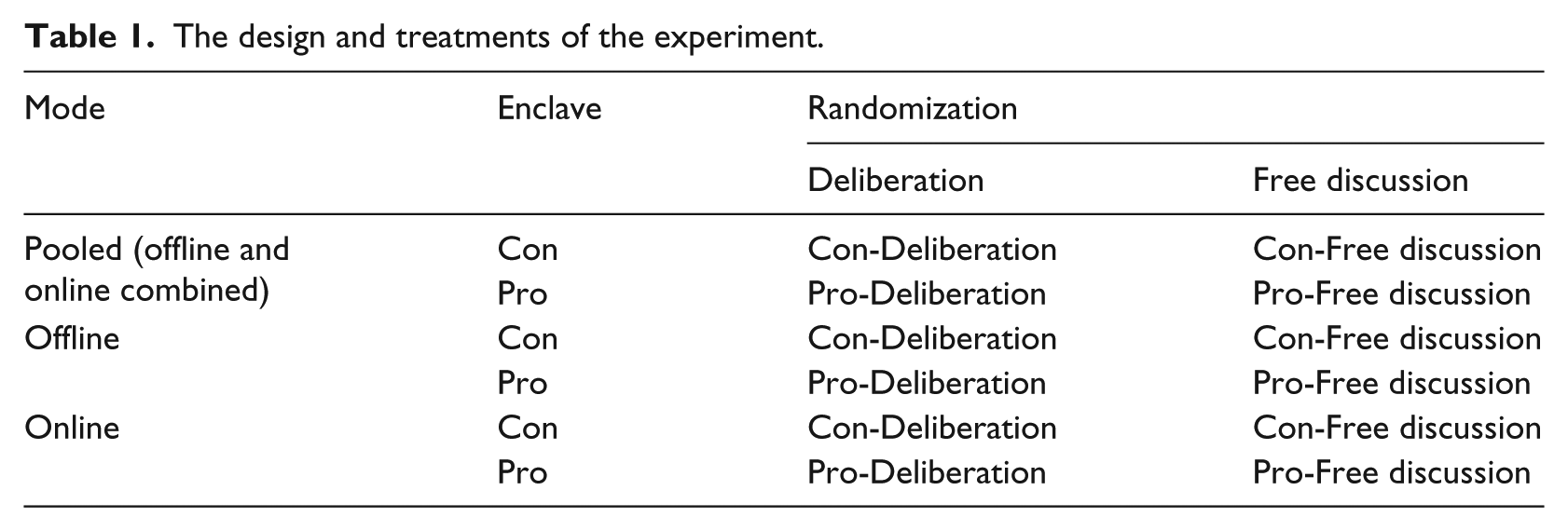
The topic of the experiment was the status of the Swedish language in Finland. The Swedish language is an official national language spoken by a small minority (approximately 5.4 percent of the population have Swedish as their first language). Due to the small size of the Swedish-speaking minority, the status of the language relies largely on the good will of the Finnish-speaking majority. Recently, the language issue has become increasing politicized due to the rise of the nationalist populist Finns party (Grönlund and Westinen 2011). Common complaints are that upholding services in the Swedish language is too costly and is of limited use for the Finnish-speaking majority (Rostila 2014). At the time of the experiment, this topic was highly salient in the societal debate and on the political agenda due to a forthcoming vote in the Parliament on a citizens’ initiative, whereby the learning of Swedish in schools would have been made voluntary. 1
Recruitment strategy and process
At the end of September 2014, an initial survey measuring opinions on the Swedish language (this survey is henceforth called T1) was mailed to a random sample of 35000 Finnish adult citizens (ages 18–80 years). 2 All in all, 7306 persons responded to the T1 survey (5797 citizens for the offline mode and 1509 citizens for the online mode). Based on the answers to the T1 survey, we constructed a sum variable ranging from 0–14, 3 whereby the more positive the opinion on the Swedish language, the higher the score on the summarized scale. The dispersion of attitudes on the summarized scale can be found in Appendix 1. Respondents with a summarized value of less than 6.01 were grouped into a con-enclave of N = 2918 (negative attitudes toward the Swedish language), and respondents with a score greater than 8.0 into a pro-enclave of N = 2821 (positive attitudes). 4 The remaining respondents (N = 1568) – i.e. those who were neither clearly in favor of nor against the Swedish language – were excluded from the experiment. 5
All respondents within the opinion enclaves who had expressed their interest in taking part in the deliberation (N = 681, of which 456 in the offline mode and 225 in the online mode) were invited to take part. All participants were at this stage promised a compensation (a gift voucher worth 90 euros) upon finishing the entire experiment. In the current study, the analyzed sample consists of 187 participants (N = 121 in the offline mode and N = 66 in the online mode).
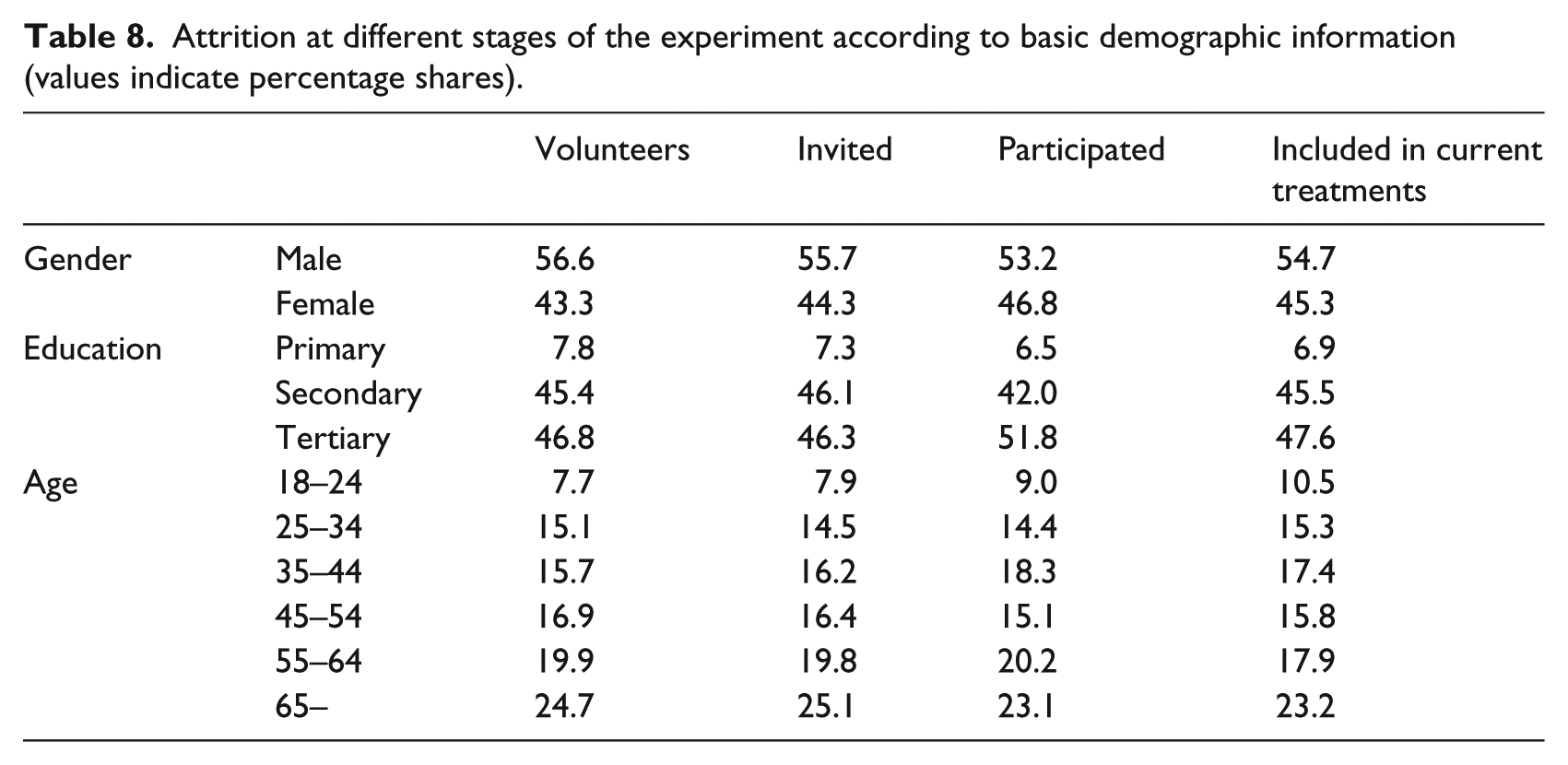
Since there were many stages in the recruitment process, we opted to compare the initial attitudes on the Swedish language for both enclaves in order to see if the final sample of participants was skewed when compared to the initial volunteers (a similar comparison concerning demographic variables can be found in Appendix 3). Table 2 shows the number of participants and their initial opinions on the Swedish language for the persons who volunteered to take part in the experiment, the persons who were invited and for the participants in the treatments analyzed in the current paper. These comparisons are done for both opinion enclaves separately and for both modes pooled (i.e. added together into one sample), as well as for each mode separately.
Comparison of attitudes at different stages of experiment.
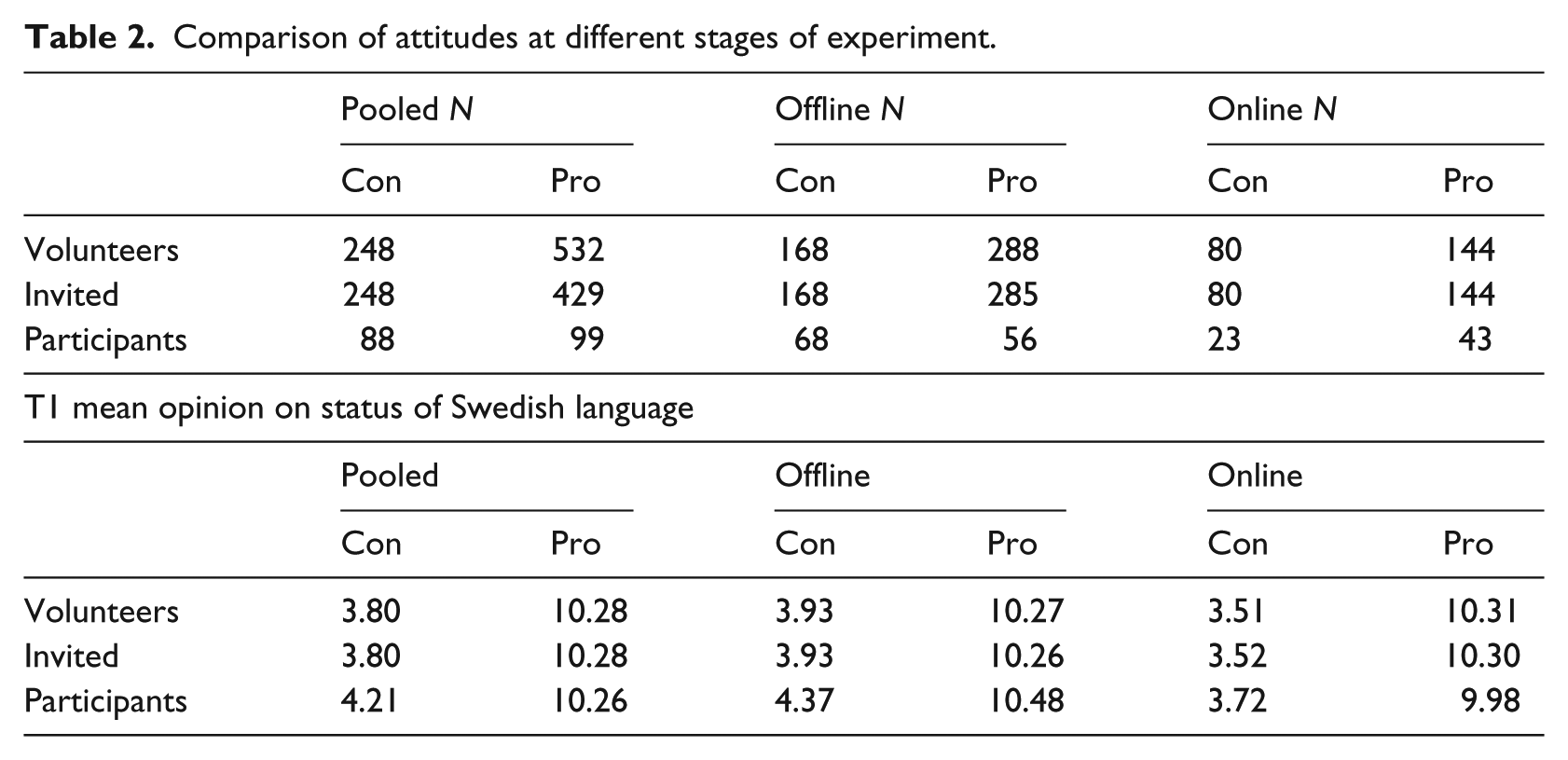
As Table 2 shows, the final participants were somewhat more positive toward the Swedish language than respondents within their own opinion enclave in the earlier stages of the recruitment process (the exception being the online pro-enclave). This tendency is most evident in the con-enclave in the offline mode.
Experimental design and set-up of the experiment
The actual deliberation used a single-factor pre-test, post-test experimental design (Morton and Williams, 2010). Participants were randomly assigned to the deliberative treatment or the free-discussion treatment. Table 3 shows the allocation of individual participants for the pooled experiment – i.e. the online and face-to-face modes added together – as well as for both modes of the experiment. 6
Allocation of participants to treatments according to modes and treatments (n = participants in each treatment).
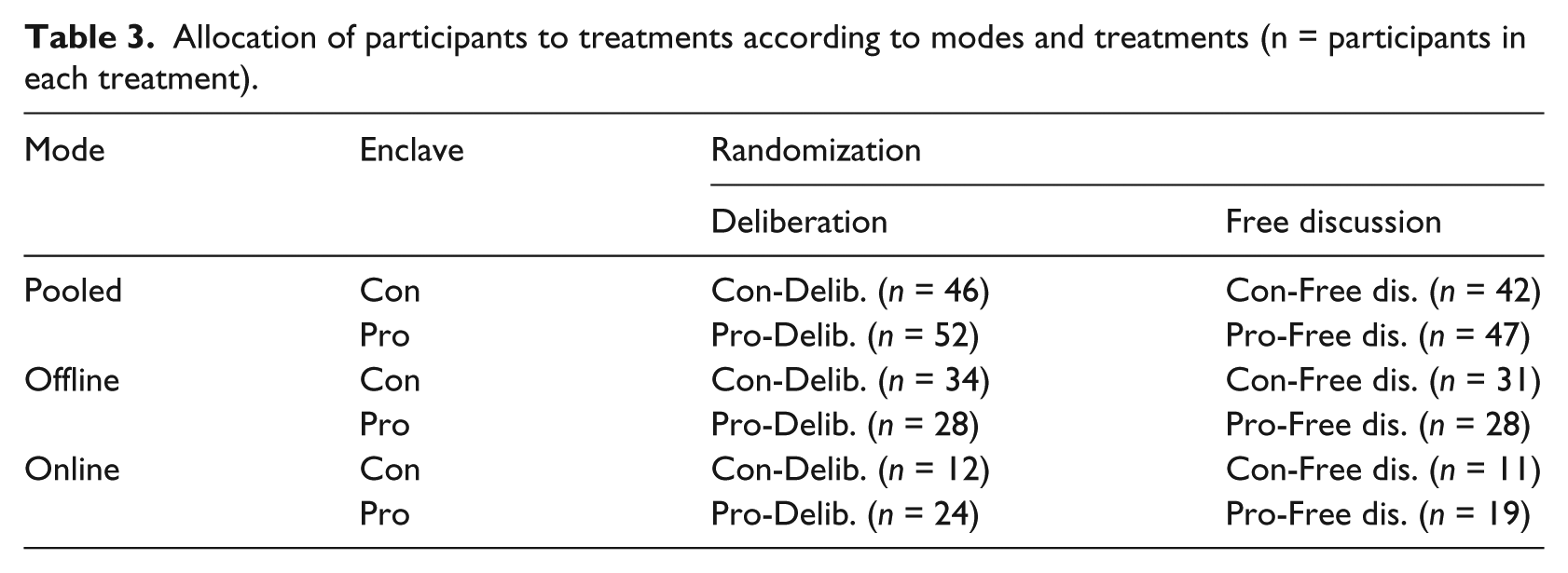
Even though we randomly assigned participants to treatments within each enclave, we opted to double-check the equivalence of the treatments post-randomization, since the number of participants in our experiment was quite low (see Gribbons and Herman, 1997 for discussion). Five background variables were checked for between-groups equivalence (chi-squares test): gender, age, education, profession and region of residence. None of these displayed any significant differences between treatments (lowest p = .21), suggesting that the randomization had worked as intended and the treatments were equivalent to each other.
The deliberations in the offline mode took place during one weekend, 22–23 November, 2014. It should be stressed that the participants were not aware of any experimental treatments before deliberating – a debriefing material was sent to them after the experiment was finished explaining what we had conducted the research on. Initially, the participants only knew we were studying discussions on the status of the Swedish language. The online deliberations took place during November 2014. In both modes, each participant only took part in one group discussion in one session. Before discussion, the participants answered a survey measuring extensive background information. Every participant in both modes also received a four-page leaflet containing information on the Swedish language in Finland. The purpose of the fact-based briefing material was also to provide a basis for discussion.
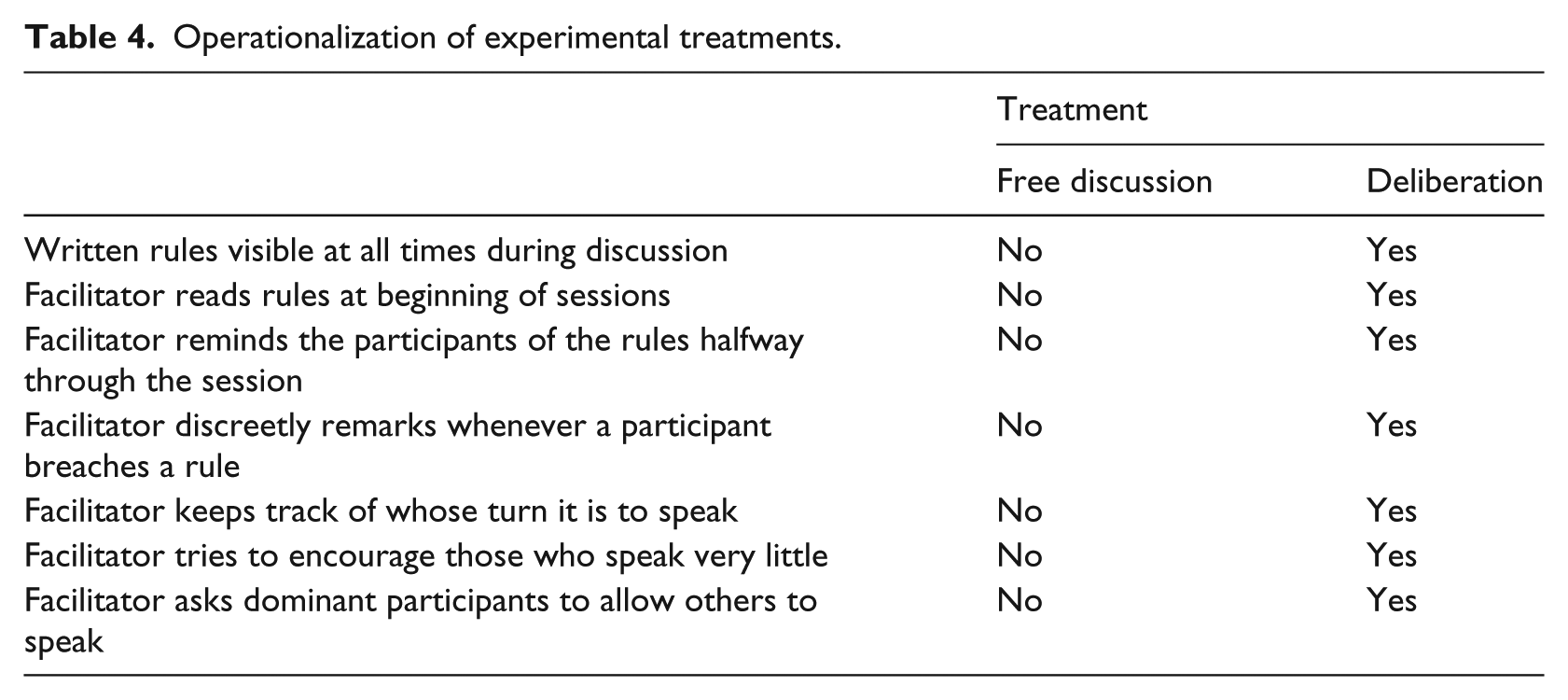
Each discussion group consisted of an average of six participants (range: 4–9 participants), discussing for two hours. There were altogether 32 discussion groups, 21 in the offline mode and 11 in the online. The offline groups using the deliberation treatment were 10: each enclave had 5. There were 11 groups in the free-discussion treatment: 6 in the con-enclave and 5 in the pro. The online discussions with deliberation were 6 in total (2 in the con-enclave and 4 in the pro). In total, five online groups had no facilitation or rules (the free-discussion treatment): two groups in the con-enclave and three in the pro-enclave. All online discussions used live webcam feeds as well as audio and text. In both treatments and modes, a person was present in the discussion room. His/her role was either to be an active facilitator or a passive observer according to the treatment (the specific rules of discussion can be found in Appendix 4). In the deliberation treatment, thus, the combination of rules and facilitation was employed to ensure that the discussions adhered to deliberative norms as much as possible. Specifically, the rules support the norms of reasoned justifications, reflection, sincerity and respect whereas the facilitation aids reciprocity, inclusion and equality of discussion. There were 14 facilitators in total – two online and the rest in the offline deliberations – who had all been trained in two sessions in order to ensure that they conducted their facilitation in similar manner. The online facilitators primarily carried out their task via audio and video, but text-based chat was used as complement if technical issues arose with the audio or video for a participant. Table 4 demonstrates these differences between the deliberation- and free-discussion treatments.
Operationalization of experimental treatments.
After the discussion had ended, the participants answered a post-test survey (T3) that contained, among other items (i.e. measures of self-perceived discussion experience), the same items on the opinions on the Swedish language that had been included in the pre-test survey (T1) as well.
Results
The hypotheses are tested in two ways. Opinion changes from T1 to T3 are tested both within treatments (paired samples t-tests) and then the difference in change values is tested between treatments (independent samples t-test). 7 We use one-tailed tests since most of our hypotheses have a directional assumption. Table 5 presents the development of opinions on the Swedish language (the 0–14 sum variable) within the two enclaves and treatments for the pooled experiment and separately for both modes.
Opinion changes between enclaves and treatments.
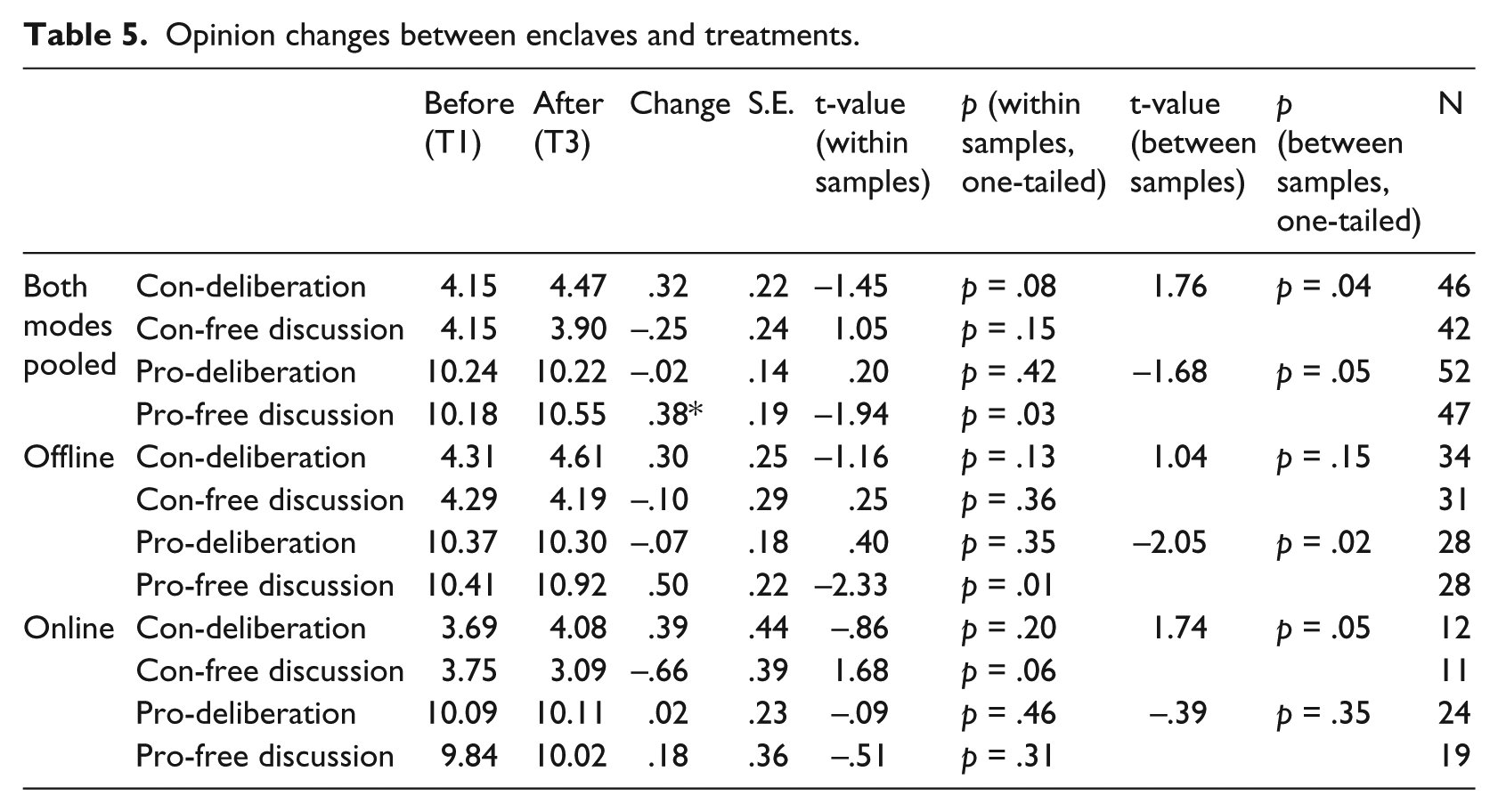
To reiterate, hypothesis H1a states that like-minded discussion leads to group polarization, whereas hypothesis H1b assumes that deliberation with rules and facilitation (i.e. the deliberation treatment) alleviates polarization in like-minded groups. What do our findings indicate regarding these two hypotheses? Starting with the test between enclaves and treatments, the results are mixed. In the free-discussion treatment, statistically significant group polarization only occurs in the pro-enclave of the pooled experiment and in both modes separated. In the deliberation treatment, we observed a significant change in the con-enclave of the pooled experiment. Moving on to the between-samples testing, the change values between the free-discussion and the deliberation treatments differ from each other (p<.10) in both enclaves in the pooled experiment and in the offline mode’s pro-enclave and the online modes’ con-enclave. Thus far, our statistically significant findings do lend support to hypotheses H1a and H1b – polarization sometimes occurred in the free-discussion treatment whereas it was sometimes alleviated in the deliberation treatment – but one should bear in mind that there were also several non-significant findings.
Nevertheless, since the Ns in the analysis by treatment and enclave are relatively small (varying between 42 and 52), we also merged the two enclaves in order to measure treatment effects with a larger N. 8 Polarization is here measured as the absolute degree of polarization that corresponds to increased anti-Swedish opinions in the con-enclave, or increased pro-Swedish opinions in the pro-enclave. Thus, positive values indicate polarization and negative values depolarization. Table 6 shows our findings regarding absolute polarization.
The degree of absolute polarization between treatments.
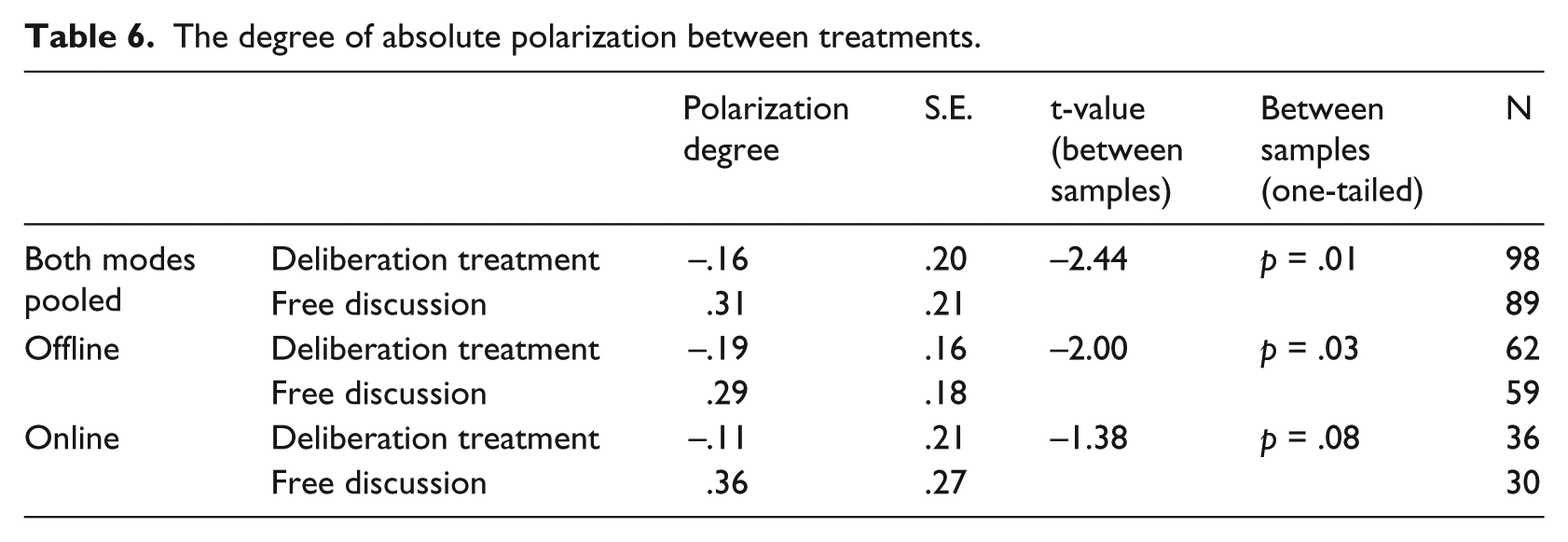
This analysis of the absolute degree of polarization (Table 6) indicates that for the pooled experiment, in the offline mode and in the online mode, participants in the deliberation treatment all moved slightly into a depolarizing direction (–0.16, –0.19 and –0.11 respectively), whereas participants in the free-discussion treatment became polarized (.31, .29 and .36 respectively). This difference is statistically significant in the pooled experiment and in both modes (p=.02, p=.03 and p=.08 respectively). Thus, both H1a and H1b gain firmer support in this analysis of absolute polarization.
However, since we use a pre-test, post-test design in the experiment, we need to draw attention to Regression to the Mean (RTM). RTM means that measuring the same sample twice – such as our measure of opinions – tends to lead to regression toward the group’s natural mean upon the second measurement, creating an illusion of an effect pre- to post-test (Torgerson and Torgerson, 2008: 10–15). Using the formula of 100 × (1 – r), where r is the correlation between the T1 and T3 measures of opinions for our population of N = 187, the expected RTM in our experiment is 7.5 percent (see Research Methods Knowledge Base 2006). 9 Regarding our experiment, though, the important thing to note is that RTM would make means move toward depolarization. Thus, the polarization in the free-discussion treatment becomes even stronger when RTM is accounted for. Taking RTM into account also means that participants in the deliberation treatment stayed more or less put: they did not depolarize but they did not polarize either. In conclusion, this supports H1a. Like-minded groups polarize when they discuss without rules or facilitation. Moreover, H1b is also supported in the way that discussion rules and facilitation seem to alleviate group polarization.
Finally, in order to address the hypotheses H2a and H2b regarding the importance of modality, Table 7 compares the absolute degree of polarization according to treatments in the offline- and online modes of the experiment.
Degree of absolute polarization by treatments and mode.
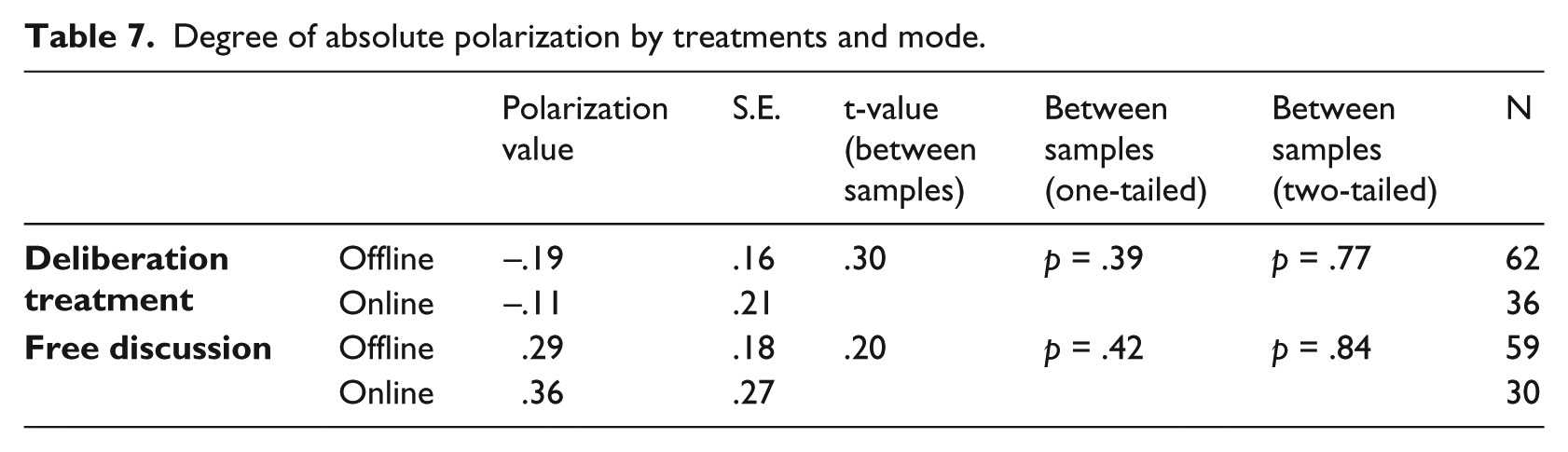
Hypothesis H2a, which states that group polarization tendencies are more evident in free discussions in the online mode, is not supported by our findings. Here, the degree of absolute polarization is almost the same in the free-discussion treatment in both modes. Our final hypothesis H2b, which states that the effects of deliberation are similar in the face-to-face and the online mode, shows that the findings presented in Table 7 support this hypothesis. Thus, the deliberation treatment within both modes experiences a similar pattern where group polarization does not occur as a result of like-minded deliberation. This means that the opinions of the participants in both modes of the experiment changed in a similar manner. In conclusion, H2a is falsified and H2b verified. Polarization occurs to an equal degree in like-minded discussion both online and offline and deliberation alleviates polarization both online and offline.
Conclusions
Does deliberation with facilitation and specific discussion rules curb group polarization? In order to answer this question, we designed a controlled population-based experiment, where people belonging to a dominant linguistic majority were invited to discuss the status of a national language spoken by less than 6 percent of the population. Without their knowledge, every participant was placed in a like-minded group based on their initial opinions on the matter. Furthermore, we enforced two treatments. Randomly, half of the participants were allocated into groups with no discussion rules, whereas the other half deliberated in groups with rules and a trained facilitator. We also organized the discussions in two modes. Two-thirds of the participants met physically and discussed face-to-face, whereas one-third discussed in virtual chat rooms where they discussed via webcams, microphones and text-chat.
The main finding of our experiment is that group polarization took place in discussions without deliberation (H1a), whereas polarization tendencies were alleviated in the deliberative treatment where rules and facilitation were in place (H1b). This difference is manifested mainly when the two opinion enclaves, one in favor of and one against the Swedish language in Finland, are merged and a comparison of the absolute values of polarization or depolarization between the two treatments is carried out. In the deliberative treatment, the absolute value of polarization was –0.16 – i.e. the participants became slightly less extreme as a result of deliberation. In the free-discussion treatment, the participants became .31 units more extreme during the course of the discussion. The difference in the two polarization values between the treatments is statistically significant (p=.01). The effects are not large, but one should bear in mind that the individuals only spent less than two hours discussing the issue (and only 75 minutes in the online mode). On this note, we need to draw attention to the limitations of our study as well. Firstly, we are not certain whether the same effects would be found in a new experiment on another topic. Future research, from other contexts and concerning different topics, could explore this further. Secondly, since we treated both discussion rules and facilitation as a whole, it is impossible to know how these two components interact to alleviate polarization. Further experiments could separate rules from facilitation in order to test this. Finally, if future experiments were able to achieve an even higher N than we did, one could generalize the findings to a larger population with greater confidence.
Even though this was an organized discussion, like-minded discussions are a common phenomenon in real life. Thus, small effects such as the ones we find here are likely to accumulate in real life and result in a greater tendency toward extreme views over time. Concerning discussion modality (H2a and H2b), we find that both discussion modes work in a similar manner. The online realm did not lead to more extreme opinions than a like-minded discussion face-to-face. This indicates that an enclaved online discussion with webcams is not really different from a face-to-face discussion. Thus, also in online discussions, group polarization can be avoided through specific discussion rules and facilitation.
Based on the results in this article and similar findings in a previous experiment (Grönlund et al., 2015), we conclude that group polarization occurs in discussions among like-minded people when there are no procedural safeguards in place (rules and facilitation) to support deliberative norms, whereas such safeguards have an impact and alleviate group polarization in like-minded contexts. The democratic concern expressed by Sunstein (2009) on an increased tendency of people discussing politics in like-minded enclaves, especially on the internet, should be taken seriously. Group polarization leads eventually to a polarized opinion climate in the whole society, evidence of which is currently abundant in many Western societies. Therefore, deliberative discussion rules and facilitation should be used if the goal is a balanced dialogue, reflection and an informed outcome. This is an important lesson, especially for policy-makers who want to engage lay citizens in different ways in the political process. Moreover, service providers hosting online communities, such as Facebook or Twitter, can use this wisdom in their moderating policy. If reminding people of how they should discuss from time to time and reprimanding them if they do not follow the rules is all that it takes to reduce polarization, it would be worth implementing.
Footnotes
Appendix 1
Appendix 2. The list of items in the sum variable
“What is your opinion on the following statements?”
Likert scale (numeric value): Strongly agree (1), agree (.66), disagree (.33), strongly disagree (0)
*= reversed coding so that a higher value will always indicate a positive attitude toward the Swedish language.
Appendix 3
Attrition at different stages of the experiment according to basic demographic information (values indicate percentage shares).
| Volunteers | Invited | Participated | Included in current treatments | ||
|---|---|---|---|---|---|
| Gender | Male | 56.6 | 55.7 | 53.2 | 54.7 |
| Female | 43.3 | 44.3 | 46.8 | 45.3 | |
| Education | Primary | 7.8 | 7.3 | 6.5 | 6.9 |
| Secondary | 45.4 | 46.1 | 42.0 | 45.5 | |
| Tertiary | 46.8 | 46.3 | 51.8 | 47.6 | |
| Age | 18–24 | 7.7 | 7.9 | 9.0 | 10.5 |
| 25–34 | 15.1 | 14.5 | 14.4 | 15.3 | |
| 35–44 | 15.7 | 16.2 | 18.3 | 17.4 | |
| 45–54 | 16.9 | 16.4 | 15.1 | 15.8 | |
| 55–64 | 19.9 | 19.8 | 20.2 | 17.9 | |
| 65– | 24.7 | 25.1 | 23.1 | 23.2 |
Appendix 4. The discussion rules used in the deliberation treatment
Acknowledgements
We would like to thank the anonymous referees as well as participants at several research seminars; particularly at the APSA Annual Meeting in San Francisco 2015 and the MPSA Annual Conference in Chicago 2016 for their valuable comments and suggestions that served to improve the article.
Funding
The research was kindly funded by Åbo Akademi University Foundation (Democracy: A Citizen Perspective Centre of Excellence) and the Academy of Finland (project number 28200170 ‘Involving Citizens through Deliberative Processes?’ Strandberg, project number 28200124K1 ‘Democracy and Reason’ Himmelroos and project number 27430 ‘Democratic Reasoning’, Maija Setälä).