




Abstract
Epistemic questions have become an important area of debate within democratic theory. Epistemic democrats have revived epistemic justification of democracy, while social scientific research has speared a significant debate on voter knowledge. An area which has received less attention, however, is the epistemic case for markets. Market advocates have developed a number of epistemic critiques of democracy which suggest that most goods are better provided by markets than democratic institutions. Despite representing important challenges to democracy, these critiques have gone without reply as democratic theorists have tended to exclude markets from consideration. This article responds to these critiques and argues that there are good epistemic grounds for granting a much greater role to democracy than its market critics have claimed. It argues that there is a broad range of goods, including important ethical goods, which are better provided by democracy than markets due to the particular epistemic burdens they create.
Epistemic questions have become an important area of debate within the theory and practice of democracy. Democratic theory, which often focuses on the intrinsic or procedural value of democracy, has seen a revival of epistemic justification which focuses on the ways that democratic procedures, such as vote aggregation and deliberation, communicate and aggregate knowledge. Epistemic democrats, for instance, have placed such issues at the centre of democracies’ legitimacy and have developed innovative new arguments for the epistemic abilities of democracy (Anderson, 2006; Estlund, 2008; Landemore, 2013). Social scientific research on voter ignorance has also speared a significant debate on the extent to which citizens can make effective decisions when voting. Some within this debate take these studies to be damaging enough to require restriction of voting rights to the more knowledgeable, while others defend the ability of voters to overcome their limited knowledge through the use of various shortcuts or heuristics (Brennan, 2016; Caplan, 2007).
An epistemic area which has received much less attention from democratic theory is the epistemic case for markets. Market advocates have put forward a number of epistemic critiques of democracy which suggest that most goods are better provided by the market than any democratic institution. Hayekians, for instance, have argued that democratic institutions, such as assemblies and parliaments, require knowledge to be centralised to a democratic forum and will, therefore, fail to utilise knowledge which is local, dispersed and fragmented (Pennington, 2003, 2011). Samuel DeCanio (2014) has further argued that the singular nature of democratic decisions forces decision-makers to make accurate policy predictions which require large amounts of knowledge. In contrast, markets coordinate individuals and goods through price signals, while allowing multiple firms to implement alternatives simultaneously so consumers can compare their outcomes without predictive knowledge. Markets, therefore, reduce the epistemic burden facing decision-makers relative to democracy. Wherever markets are possible, it is argued that there are good epistemic grounds to prefer them to democratic institutions. This epistemic case for markets over democracy has received particular attention in environmental debates (Benson, 2018; Cordato, 2004; Greenwood, 2012, 2015; O’Neill, 2012; Pennington, 2001, 2005, 2011; Sagoff, 2008; Shahar, 2017). Much of environmental politics is highly sceptical of markets and instead tends to favour democratic institutions for the achievement of environmental values. Environmental democracy, however, has been argued to face significant epistemic challenges in attempting to gather and utilise the knowledge required to manage and coordinate environmental goods. Alternatively, a system of property rights and price signals can coordinate individuals as they act on their own local knowledge, without the need to centralise information to some democratic authority.
This epistemic challenge to democracy has yet to be addressed as many democratic theorists concerned with epistemic questions have tended to exclude markets from consideration. This article engages with these critiques and argues that there are good epistemic grounds for giving a much greater role to democratic institutions than their pro-market critics have claimed. It will develop the concept of low feedback goods, and argue that they represent a broad range of goods which cannot be accounted for by the pro-market arguments. These goods are disconnected from the individuals who pursue them and do not, therefore, provide market actors with the feedback information they require. As a result, individuals will face significant burdens for explicit knowledge which markets are unable to deal with. Low feedback goods include many environmental goods but also others, such as health, human rights resource distributions and fair labour practices. It will then be argued that democratic institutions, conceived in deliberative terms, have a number of important epistemic advantages which make them better place to deal with these goods than markets.
The Market Critique of Democracy
This section will lay out two epistemic critiques of democracy made by market advocates and will use the example of environmental goods to demonstrate their significance. Democratic decision-making can take a number of different forms, but the focus here will be on democratic decisions as found in democratic forums, such as representative parliaments and citizens assemblies. Although some of the arguments considered also affect electoral decisions taken by voters, this will not be the focus. A significant number of democratic decisions are taken within forums, and they play a central role in much democratic theory, particularly deliberative democracy (Smith, 2009). Such forums will also be critical to the reply to market critiques developed later.
The first epistemic critique draws on Friedrich Hayek’s analysis of the division of knowledge in society. This argument is based on a distinction Hayek (1948, 2011) made between two forms of knowledge. The first form is general knowledge, which is defined as abstract or formal knowledge, such as scientific knowledge. The second is local knowledge about the particular circumstances of time and place. The important thing in this distinction is that while general scientific knowledge can be known to some group of relevant experts, local knowledge does not exist in any coherent whole but is rather spread throughout society. It includes such things as knowledge of the conditions of resources, as well as preferences for and uses of different goods. Such knowledge is not known to any group of experts but is rather dispersed in the minds of those on-the-spot individuals who have direct experiences of local conditions.
Contemporary Hayekians, notably Mark Pennington (2003, 2011), have argued that this division of knowledge creates important epistemic problems for democratic forms of decision-making. Democratic institutions, such as representative parliaments or citizens’ assemblies, take decisions within forums. They, therefore, require that all relevant knowledge, necessary for making effective decisions, be centralised in those forums so that it can contribute to democratic decisions. The division of knowledge, however, is argued to frustrate this task. The information relevant to addressing social problems includes a large body of local knowledge, which does not exist in any coherent whole ready to be utilised by democratic decision-makers. Instead, such knowledge is only known to particular individuals spread throughout society and is, therefore, fragmented and dispersed. Democratic institutions, however, require that dispersed knowledge be centralised in a democratic forum. Even if democratic institutions take place at the local level, as opposed to the state or national level, knowledge which is only known to on-the-spot individuals must still be transmitted to its decision procedures. Decentralising democratic institutions can help to reduce the problem of the division of knowledge, by reducing the amount of local knowledge and bringing decisions closer to individuals. However, it does not solve it as dispersed information must still be communicated to a forum.
For Hayekians, the division of knowledge is not solved by ‘first communicating all this knowledge to a central board’ but rather through a greater ‘form of decentralization’ (Hayek, 1948: 84). Markets decentralise decision-making to the level of the individual. This allows individual market actors to make decisions on their own local knowledge without the need to centralise knowledge. Their individual actions are then coordinated through the price mechanism which spreads their information throughout the economy. Through acts of buying and selling, individuals influence the formation of market prices which then allows others to adjust their actions. If, for instance, the actions of many individuals change the demand or supply of tin, then this will be reflected in its price (Hayek, 1948). This price change then communicates to market actors that they should consume more or less of the good. Prices do not communicate the reasons behind any changes but rather allow individuals to adjust their use of goods as if they possessed such information. The market, therefore, allows individuals to act on their own local knowledge and be coordinated by the communicative capacity of the price mechanism. People’s uses and preferences for goods are therefore coordinated without any need to first communicate all knowledge to any decision procedure, such as a democratic forum.
DeCanio (2014) has added to this case for markets over democracy with a second epistemic argument. 1 In order to compare alternative policies or plans in a democratic forum, decision-makers are required to make predictions about their relative outcomes. Due to the singular and exclusive nature of such democratic decisions, only one option can be chosen and implemented at any one time. Predictions are, therefore, needed to choose between alternatives. Predictions, however, require a large amount of knowledge about the causal relationships between rival policies and the relevant outcomes. For example, if a democratic institution aims to provide a more fuel-efficient or comfortable car, it will need to make predictions about how alternative car designs will impact on this criterion. This will require a large amount of information about the causal mechanisms. For instance, about whether making a car out of lighter materials contributes more or less to fuel efficiency than changing the engine design.
Markets, however, reduce the need for predictive knowledge. In markets, multiple firms can implement alternative plans simultaneously so that individual consumers are able to make comparisons of outcomes without the need for predictions. In the case of car designs, for example, multiple firms produce a number of different designs simultaneously. Consumers can then make side-by-side comparisons of their relative comfort or fuel efficiency without needing to be aware of the reason for their different performance. They do not need to be aware how causal relationships produce different outcomes as they have access to the outcomes themselves. Again decentralisation can help democratic institutions but cannot solve the problem completely. Having multiple local forums increases the number of policies which can be implemented at one time. However, the singular and exclusive nature of these local forums still means multiple plans cannot be implemented in the same area or jurisdiction, while the number of decision points, and therefore the number of plans, is still reduced compared to markets. 2
Together, these arguments make a strong epistemic case for markets over democracy. Their significance can be seen by considering environmental goods where the epistemic case for markets has received much attention (Benson, 2018; Cordato, 2004; Greenwood, 2012, 2015; O’Neill, 2012; Pennington, 2001, 2005, 2011; Sagoff, 2008; Shahar, 2017). Environmental goods can be broadly defined as those natural or ecosystem goods and services, which people value through experience, use or consumption (Díaz et al., 2015). This definition is broad as it does not restrict a good’s value to its contributions to human welfare and it includes any goods or services which are produced by natural systems. These include forests, wetlands, mountains, air, biodiversity and the primary resources which can be exploited from ecosystems. Much political theory and economy is highly sceptical of markets when it comes to environmental goods (Barry, 1999; Benson, 2018; Greenwood, 2007; O’Neill, 2017; Zografos and Howarth, 2010). Markets are associated not only with pervasive externality problems but also with a preoccupation with economic and instrumental values. Environmental goods are seen to involve a diversity of values which include not just contributions to human welfare but also relational and intrinsic values (Díaz et al., 2015; O’Neill, 2017; Pascual et al., 2017). They do not include merely personal goods which contribute to an individual’s own welfare but also ethical goods which are the subject of people’s wider ethical, moral and justice-based values. Democratic institutions, rather than markets, are seen to be necessary for expressing and achieving these diverse and possibly incommensurable environmental values. This can be seen in the emergence of deliberative and participatory approaches to environmental decision-making (Meadowcroft, 2004). Although not the only form of environmental democracy, deliberative forums such as citizens’ assemblies and juries, mini-publics, roundtables and deliberative forms of valuation have received significant support in both the theory and practice of environmental politics. These democratic forums are seen to be best placed to express environmental values while bringing individuals into contact with new forms of knowledge, both scientific and local (Díaz et al., 2015; Fazey et al., 2005).
The epistemic arguments considered here, however, suggest a much greater role for markets in the provision of environmental goods (Pennington, 2001, 2005, 2011). From a Hayekian perspective, the knowledge required to make decisions about environmental goods is dispersed throughout society. Knowledge of the conditions of particular environmental goods, local management regimes and individual preferences and values for environmental goods is only known to certain on-the-spot individuals who have direct experience of local conditions. The democratic forums favoured by environmental politics would, therefore, have to gather all this dispersed knowledge to its decision procedure in order to make effective decisions. Its requirements for knowledge will be further exacerbated by the need for policy predictions. Making predictions about the outcomes of alternative environmental policies or management practices requires being aware of the causal relationships between a chosen policy and the environment. The relationships between human actions and the natural world, however, are highly complex and require a large amount of both scientific and local knowledge in order to be properly understood.
Alternatively, markets have been argued to overcome these challenges through the communicative capacity of price signals and the possibility of comparisons of outcomes. If this is the case, then it ‘follows that the most appropriate way to communicate environmental information would be to allow the development of markets in environmental goods’ (Pennington, 2001: 183). By establishing property rights and markets in environmental goods, individuals can pursue their diverse environmental values and preferences without the need to centralise information, as price signals will coordinate their varied ends (Hayek, 2013). Consider a conflict between the recreational value of ski resorts and the environmental value of unspoiled mountain ranges within which they are built. In a system of free-markets, prices will respond to changes in demand for the two goods. The development of ski resorts will, therefore, be shifted away from those more environmentally valued and therefore more expensive sites, to those less environmental valued and therefore less expensive sites (Pennington, 2005). The different environmental values and preferences of individuals are therefore coordinated through price signals and reflected in the emergent outcomes of market interaction. By not reserving the management of environmental goods to the exclusive control of a democratic institution, markets also allow alternative approaches to be implemented simultaneously. The need for large amounts of predictive knowledge is therefore decreased as individual market actors are able to observe the outcomes produced by alternative providers of environmental goods.
Advocates of environmental markets recognise problems, such as climate change, where property rights and markets cannot be established, and alternatives are required. However, where markets and property rights are possible, they argue that there are significant epistemic benefits to environmental markets over democratic institutions. This example of environmental goods, therefore, helps demonstrate the implications of the epistemic case for markers over democracy, even in an area where markets are often met with considerable scepticism.
One place we might start to look for a reply to these arguments is in the work of epistemic democrats, who have argued for the superior problem-solving abilities of democratic decision-making. Epistemic democrats, however, have tended to remove markets from their analysis. Hélène Landemore (2013: 86), for instance, states that ‘the market is not a political decision procedure’ and therefore ‘does not offer an alternative’ to democracy. She then restricts her arguments to other forms of decision-making such as autocracy and aristocracy. Similarly, Elizabeth Anderson (2006: 9) constrains her analysis to problems of ‘public interest’ which are said to exclude consideration of markets which are confined to private matters. Despite epistemic democrats’ tendencies to exclude markets, the market critiques directly challenge democracy on epistemic grounds. For example, Landemore argues that democratic deliberation can draw on the benefits of cognitive diversity in order to more effectively solve social problems than less exclusive processes, such as aristocracy. Even if deliberation has this ability, however, the arguments of market advocates suggest that it will be unable to gather the dispersed knowledge relevant to addressing social problems and will require decision-makers to make information intensive predictions. So although democratic deliberation may outperform other collective forms of decision-making, it will be less effective than a decentralised market which can utilise dispersed knowledge and allow for comparisons of outcomes. New epistemic arguments are, therefore, required in order to address the pro-market critiques.
The rest of this article will argue that there are good epistemic grounds for giving a much greater role to democratic institutions than their market critics have suggested. First, however, a caveat is required about the scope of the article. Although the critiques discussed have been aimed at democratic institutions, they do not attack their intrinsically democratic features. They focus not on their inclusive nature but rather on their collective and singular characteristics. As a result, an assembly or board of technocrats or administrators would suffer from the same problems. This article, however, will focus on democracy and markets, and will not consider other alternatives. It will aim to defend democracy against the arguments of market advocates without directly engaging with other institutional designs which may or may not face similar challenges. These alternatives have, however, been discussed elsewhere by other democratic theorists in epistemic terms (see Anderson, 2006; Estlund, 2008; Landemore, 2013). The rest of the article will therefore remain internal to the debate between democracy and the market.
The Epistemic Limits of Markets
In the previous section, we saw two epistemic critiques of democracy which argued that, wherever they are possible, markets should be preferred to democratic institutions. Democratic control should be reserved only for areas where markets and property rights cannot be established. An immediate objection to these claims is that inequalities in markets create inequalities in the ability to communicate through acts of buying and selling. Not all individuals have the capacity to communicate their knowledge in markets, and their knowledge will likely be lost (O’Neill, 1998). This will not, however, be the argument pursued in this article. The reason for this is not to dismiss the importance of inequalities, but rather to identify a deeper problem with market mechanisms and the epistemic arguments for them. This problem is deeper in the sense that it exists even if there was complete equality between market actors. 3
What is central to the pro-market arguments is that markets reduce the need for explicit knowledge. Explicit knowledge is knowledge which needs to be consciously known to decision-makers. It is general or local knowledge which decision-makers must be explicitly aware of in order to make decisions. Markets are argued to reduce the need for explicit knowledge by allowing individuals to pursue their preferences and values for goods without centralising large amounts of knowledge, and by allowing comparisons of outcomes. This and the following section will argue that there is a class of goods, where the pro-market arguments fail. It will develop the concept of low feedback goods and argue that individual market actors will face large burdens for explicit knowledge when it comes to these good, burdens which cannot be met by market communication.
First, we need to see how the epistemic case for markets requires the presence of feedback signals to provide market actors with certain basic information. Consider the outcome comparisons highlighted by DeCanio. An individual can only make such comparisons if they receive feedback information about the outcomes of different alternatives. By testing different cars, a consumer will receive clear feedback allowing them to determine which is the most comfortable. It is this feedback about their relative comfort which reduces the consumers’ need for explicit knowledge. Similarly, market actors can only act on their preferences and values for goods, if they know the extent to which their decisions achieve these goods and, therefore, satisfy these preferences and values. An individual with a preference for spicy food, for instance, can buy different food products and receive clear feedback about the extent to which they satisfy this preference.
As should be clear from these examples, feedback information will be available for many goods. There is, however, a class of goods which will not involve the clear feedback information required by markets. We can call these goods low feedback goods. Their defining feature is that they are in some way separated or disconnected from individuals who value them. They may, for instance, be separated in terms of time or space. The result of this disconnection is that individuals will not be provided with direct feedback information about the effect of their decisions and the extent to which they achieve the good they pursue. Take, for instance, individuals pursuing the good of personal health. Often, although by no means always, individuals will not receive feedback information about how their market decisions affect their health. Take the decision of which supplier of water to choose. Many of the health effects which may result from pollutants or chemicals in different supplies of water will not be easily recognisable by consumers. They may, for instance, take long periods of time to take effect or may only increase an individual risk of contracting a health problem. 4 These factors create a disconnection between the individual and good they pursue. It will, therefore, be very difficult for individuals to tell what, if any, affect a certain supply of water has on their health. In the absence of this feedback information, market actors will require explicit knowledge in order to make decisions. They will, for instance, need to be aware of all the pollutants and chemical contents of different supplies of water, and of the different health effects these substances can have, and in what quantities. This is a large epistemic burden which further increases when we consider that individual will require knowledge relating to all their other market decisions which could impact their health in similar ways.
At this point, it may be thought that low feedback goods are only a small category of goods. That there are only rare examples, such as health, where individuals do not receive direct feedback signals. However, the greater significance of this problem can be seen when we consider ethical goods. Ethical goods are defined as goods which relate not to an individual’s own welfare, such as the personal good of health, but to such things as the welfare of others or the relations between them. They are not the subject of self-interested preferences but rather an individual’s wider ethical, moral, or justice-based values. The fact that ethical goods do not relate directly to an individual’s own welfare means they will necessarily be separated from individuals and, therefore, likely to be low feedback goods. This is not to say that all ethical goods are low feedback goods. If I care about the welfare of individuals very close to me, then I may receive feedback about the effect of my actions on their well-being. In a large society, however, there will be many ethical goods which people value from which they are greatly separated. 5
The example of environmental goods, which are often valued on ethical grounds, can help to illustrate the problem facing markets. Consider market actors who value the Amazon rainforest as an ethical good. They may, for instance, believe that it is complex and unique biodiversity to be of particular value. Now those who live or work within the Amazon may receive feedback information about their impact on it. They may receive signals about the way this ecosystem is changing. However, those who value the Amazon as an ethical good are not confined to these individuals but include many people who are significantly disconnected from it. You do not need to be in close proximity to the Amazon to value its biodiversity or to have an impact on its condition. You could, for example, be in another country entirely. There is, therefore, no set or given list of low feedback goods as they are in a particular respect agent-relative. Something can be a low feedback good to some people but not to others depending on their position. The Amazon may not be a low feedback good to those who live and work within it while being a low feedback good to others who are more distant. Through the products these distant individuals buy and sell, they can still have significant effects on the Amazon but receive no feedback information about their effects due to this separation. Market actors may be provided with information about good such as the comfortableness of cars or the taste of food, as these goods are closely connected to the individual who values them. For an ethical good, such as the Amazon, however, there can be significant separation between the good and many individuals who value it, resulting in a lack of feedback signals. In order to pursue the good they value, market actors will, therefore, require large amounts of explicit knowledge. They will need to be consciously aware of the relationship between their market decision and the ethical good they value. This relationship, however, can be highly complex and involve a large amount of general and local knowledge. It includes knowledge of the production and consumption of all the different products they buy and sell, the kinds of waste they produce and the different effects this can have on environmental goods.
Low feedback goods then produce large burdens for explicit knowledge and will be particularly prevalent when it comes to ethical goods. It is important to see that this problem is distinct from the externalities problem. Even if the whole of the Amazon rainforest was privately owned and all of its owners were consenting to its exploitation and pollution, others who value it as an ethical good will want to make market transactions which do not contribute to this. They will want to decrease their consumption of goods which damage its valuable biodiversity even if its current owners are allowing it to be damaged. However, the lack of clear feedback signals means these individuals will require large amounts of explicit knowledge to do this. This problem is also distinct from issues surrounding the international/global nature of certain goods and problems. Although many who value the Amazon as an ethical good will live in other countries, this is not necessary for there to be a lack of feedback information. There may be many environmental goods in the same country as you, which you never the less receive very little feedback from. The problem of low feedback goods is, therefore, a distinct problem for markets. 6
Alone, however, the example of the Amazon underestimates the problem of low feedback goods. Individuals will value many low feedback goods rather than just one. Environmentally minded individuals, for instance, will normally value many ethical environmental goods. In large complex societies, the market decisions of individuals will affect many environmental goods which they are greatly separated from but which they still value. Individuals with environmental values will, therefore, require large amounts of explicit knowledge about the relationship between the production and consumption of the different products they buy and a host of environmental goods from which they will not receive feedback signals. Again this does not mean that there are no market actors who do receive feedback information about environmental goods. Those who live or work with an environmental good may receive feedback information, and if only their values were at stake, then markets could account for them. The problem, however, is that many people who value these goods will not receive such feedback and will require large amounts of explicit knowledge. Managing low feedback goods through the market leaves most, although not all, unable to act on their values without being aware of a large amount of explicit knowledge.
The significance of the low feedback problem is again increased when we move to consider other ethical goods. Consider, for instance, individuals who value the good of fair labour practices, such as working conditions or wage levels. These actors will aim to buy products which are produced by certain labour standards and not with others. However, in large societies, market actors are often greatly separated from the production of the good they consume and will, therefore, not be given feedback information about the effect of their decisions. As a result, they will require a large amount of explicit knowledge about the production of all the different products they buy and the resources which go into them. Again, there will be examples where market actors will receive feedback information about ethical goods, and some goods can be low feedback for certain individuals and not others. However, given the size of modern societies, people will often be very disconnected from many ethical goods they value. Goods such as fair labour practices, fair trade practices, human rights, animal welfare, wealth/resource distributions and environmental goods will often be greatly disconnected from the individuals who value them. They will, therefore, face large and significant burdens for explicit knowledge when attempting to pursue such goods.
Markets and Explicit Knowledge
Importantly, the burden of explicit knowledge which low feedback goods create necessarily cannot be dealt with by price signals. For Hayekians, price signals are the key communicative mechanism in markets. However, they provide only an implicit form of communication and do not communicate knowledge so that others become explicitly aware of that information. Instead, they allow people to adjust their actions without the need for such knowledge. If there are changes in the price of tin, market actors do not learn the reason behind those changes but instead adjust their consumption of tin without such information (Hayek, 1948). For this reason, Steven Horwitz (2004: 314) refers to the price mechanism as a ‘knowledge surrogate’ rather than a mechanism for full communication. Prices do not allow people to ‘know what other people know’ but rather allow people ‘to act as if we knew what others knew’. This means that price signals differ from explicit forms of communication, such as speech, which allow people to become explicitly aware of knowledge. The price mechanism is an implicit, rather than explicit, form of communication and therefore cannot deal with burdens of explicit knowledge.
Market advocates may, however, argue that an alternative form of market communication can deal with these burdens. Markets present firms with clear incentives to provide explicit knowledge to consumers. If, for instance, a firm produces a product which is environmentally friendly, they will have the incentive to signal this, through such things as labelling, advertising or branding, in order to gain the custom of those with environmental values. The same incentive will be present for firms producing products with positive health effects or with high labour standards. Although price signals cannot communicate explicit knowledge, firms have the incentive to provide this information to individual consumers.
There are significant limitations to communication through such things as product labelling which will be considered later. For now, however, this reply can be seen to face a more immediate problem. Although firms may have incentives to provide positive information about their products, they also face significant incentives to withhold negative information. If their products have negative environmental or health effects, for instance, they will have every incentive to conceal information about such effects from consumers who may take this as a reason not to buy them. The incentives facing firms can, in fact, lead to the concealment of important information from individuals pursuing low feedback goods. Naomi Oreskes and Erik Conway (2010), for instance, have documented how tobacco companies and those linked to the production of acid rain and cardoon emissions attempted to conceal damaging scientific information from their consumers and even actively aimed to spread doubt and misinformation. Even considering only positive information, firms will still face incentives to present this information in certain ways. They will, for instance, have an incentive to adopt a permissive definition of terms such as ‘environmentally sustainable’ or ‘good labour practices’ in order to present a most positive image of their products. There can be significant communication problems produced by the different definitions firms and consumers attach to certain terms, particularly when firms have incentives to adopt some definitions over others. What a consumer takes the term ‘fair trade’ or ‘free range’ to mean may, therefore, differ greatly from the producer.
Problems of concealment or misinformation also cannot be effectively checked by consumers when it comes to low feedback goods. If a company conceals the fact that their car is uncomfortable, then the consumer can quickly find this out through feedback signals. If, however, the good in question is a low feedback good, then consumers will often not be provided with the information they need to check firms’ claims.
Knowledge in Deliberative Democracy
We have seen that market actors will face significant burdens for explicit knowledge when it comes to low feedback goods, and that market communication cannot deal with these burdens. There is, therefore, a broad class of goods, including important ethical goods, which the epistemic case for markets cannot deal with. Market advocates may still respond that markets do not face any greater problems in relation to these goods than democratic institutions. 7 The rest of this article will, therefore, aim to show that democratic institutions, conceived in deliberative terms, are better able to deal with burdens for explicit knowledge and low feedback goods. Importantly, it does not need to show that democracy can deal with all low feedback goods or get hold of all explicit knowledge. Rather it needs to be established that democracy is better able to do this relative to markets.
Deliberative democracy at first seems well placed to deal with explicit knowledge. Such a conception of democracy bases decision-making on a free and open discussion among participants. It is a ‘talk centric’ account of democracy which focuses on the giving of rational arguments in a forum, such as a parliament or assembly (Chamber, 2003). Deliberative democracy, therefore, is based on the explicit communication of speech which can, unlike price signals, communicate explicit knowledge. Such an approach, however, faces an immediate problem. As Hayekians have argued, the knowledge relevant to addressing social problems includes local knowledge which is fragmented and dispersed throughout society. So although deliberative forums are based on explicit communication, this does not establish how such forums can obtain dispersed knowledge, to begin with. As we have seen, decentralising democratic forums can reduce this problem but cannot solve it. Deliberative democracy must, therefore, be able to overcome the division of knowledge in society.
Although deliberative theorists have not addressed this Hayekian problem directly, steps towards overcoming it can be found in recent deliberative theory and particularly in its systemic turn (Dryzek, 2016; Mansbridge et al., 2012; Parkinson, 2006). The systemic approach has expanded deliberative democracy away from deliberation within the forum to deliberation within a wider system and has been influential in areas such as environmental democracy (Dryzek and Stevenson, 2011; Stevenson and Dryzek, 2014). Through this systemic approach, we can start to see how the division of knowledge may be addressed by deliberative democracy.
A deliberative system ‘encompasses a talk-based approach to political conflict and problem-solving’ (Mansbridge et al., 2012: 4–5). It is, therefore, based on the explicit communication of speech. The fact that it is a ‘system’, however, means that speech is not confined to empowered decision-making forums and also takes place in a number of ‘differentiated yet linked components’ in ‘public space’ (Stevenson and Dryzek, 2014: 27). These components include universities, trade unions, think tanks, social movements, businesses, voluntary associations, newspapers, television, non-governmental organisations (NGOs) and charities. Although differentiated, discussion and talk within each of these components are connected and integrated into the wider system so each can ‘consider reasons and proposals generated in other parts’ (Mansbridge et al., 2012: 23). Importantly, there are ‘transmissions’ between deliberation within ‘public space’ and deliberation within the ‘empowered spaces’ of more formal decision-making institutions (Stevenson and Dryzek, 2014: 27–29). Through campaigns and lobbying, for instance, discussions in NGOs or think tanks can come to influence the final decisions of parliaments.
Part of the reason for the systemic turn is the epistemic benefits which can be discovered by considering the wider system (Christiano, 2012; Mansbridge et al., 2012). Important to the system model developed here, is that the different components within public space can gather and aggregate different forms of dispersed knowledge, which can then be communicated to empowered democratic forums. Consider, for instance, the connection between the scientific deliberations of the Intergovernmental Panel on Climate Change and international negotiations on emission reductions. The former providing detailed scientific knowledge which is utilised by the later empowered space. Alternatively, campaign groups and social movements can be seen to gather knowledge on the local effects of social problems which can then influence decision within empowered spaces. Hayekians have focused on the problem of centralising dispersed knowledge in the forum. However, on a systems approach, democratic forums are not isolated islands of decision-making but are rather connected to many components within a wider system. These components, such as scientific bodies, campaign groups and academic groups, gather and aggregate different forms of knowledge which are dispersed throughout the system and then aim to communicate this information to democratic forums. As we have already seen, decentralisation can help to reduce the problems highlighted by market advocates, so we can also imagine that the empowered space of an effective deliberative system will involve a number of decision-making forums. This epistemic model of a democratic deliberative system is illustrated in Figure 1, which shows the movement of knowledge through the system. This model helps us to see how deliberative democracy can start to overcome the problem of the division of knowledge.
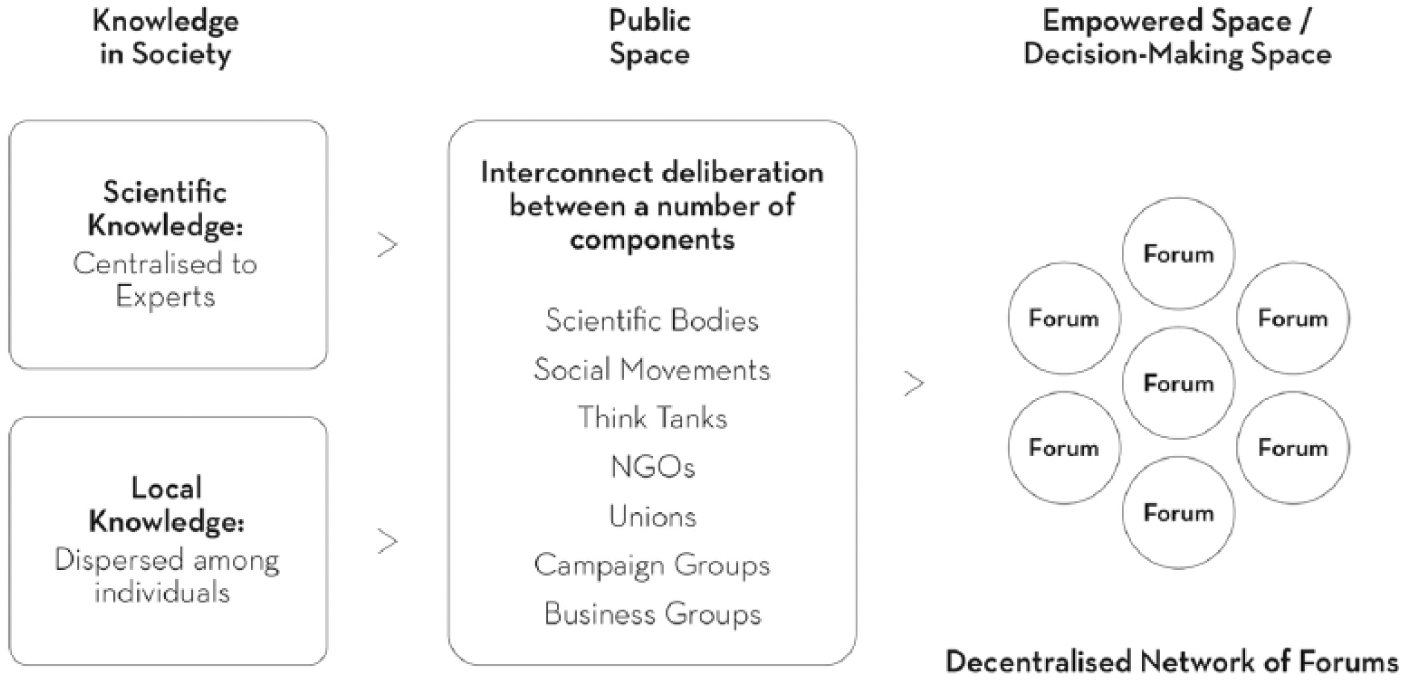
Deliberative Democratic System.
As it currently stands, however, deliberative systems run up against a significant problem in relation to the market. What needs to be shown is that a democratic deliberative system is better able to gather explicit knowledge than markets. However, the different knowledge gathering components of a deliberative system can communicate explicit knowledge to individual market actors as well as democratic forums. As Mansbridge et al. (2012: 7–8) point out, there can be deliberative systems which are not democratic. We can, therefore, conceive of a market-based deliberative system where final decisions are not taken by democratic forums, as in a democratic deliberative system, but by individual market actors (Figure 2). Within such a system, institutions within public space would aim to communicate their explicit knowledge to market actors rather than democratic forums. For instance, many environmental groups make information campaigns aimed directly at consumers, attempting to provide them with information about the effect of their market transactions on valued environmental goods. Similarly, many health charities attempt to communicate the conclusions of scientific research to market actors, in order that they can make more informed consumer choices. 8
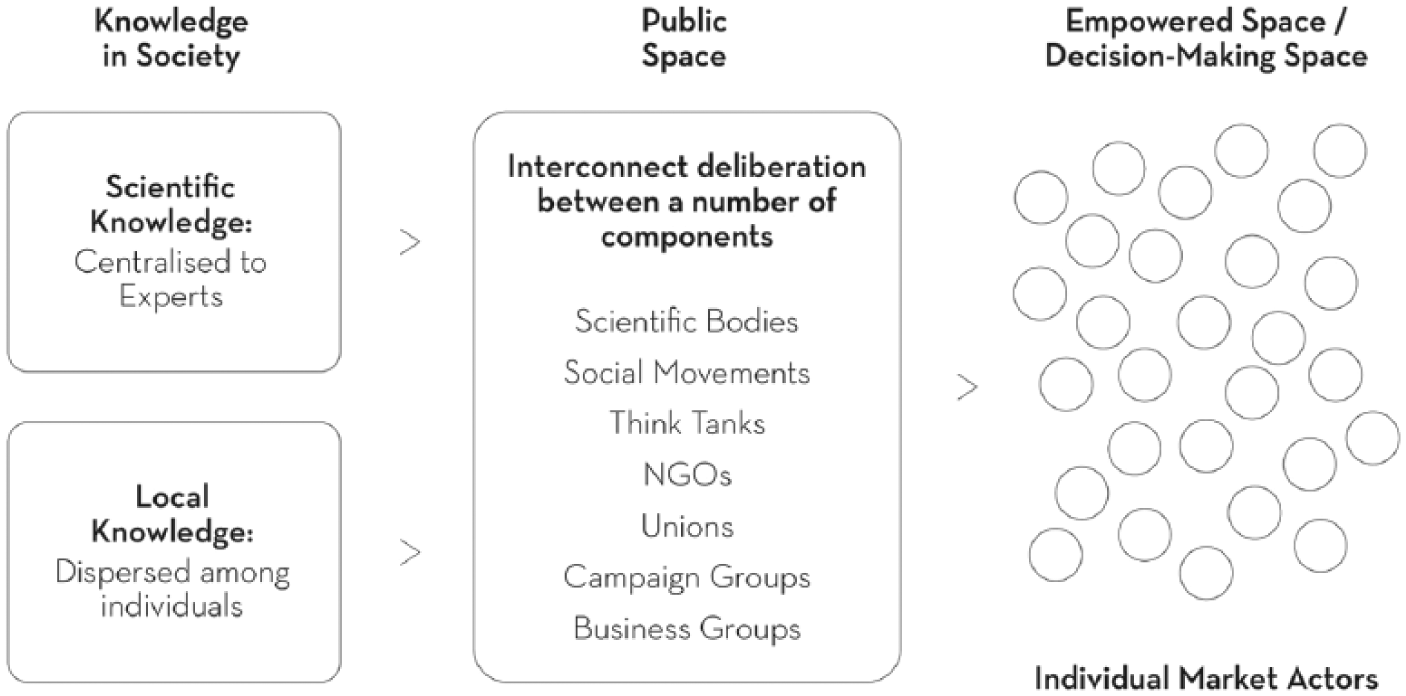
Market Deliberative System.
We can imagine then two alternative deliberative systems which we can call a democratic system and a market system. Both deliberative systems involve interconnected deliberations within public space which gather and aggregate different forms of knowledge. However, in a democratic system, final decisions are taken in a number of democratic forums, while in a market system, final decisions are taken by a much greater number of individual market actors. As it stands then, deliberative systems can be used to support either democracy or markets. In the next section, these alternative deliberative systems will be compared, and it will be argued that a democratic system has a number of significant advantages when it comes to communicating and utilising the explicit knowledge required for low feedback goods.
Democratic Systems Versus Market Systems
The first advantage of a democratic system is that it reduces the number and distribution of decision-makers to whom explicit knowledge needs to be communicated. In a market system, decision-making is decentralised to the level of the individual, while in a democratic system, decision-making takes place in a smaller number of democratic forums. In a market system then, relevant explicit knowledge needs to be communicated to a very large number of highly dispersed market actors, while in a democratic system, it needs to be communicated to far fewer decision-makers contained within a smaller number of forums. The challenges involved in communicating explicit knowledge are, therefore, dramatically increased in a market system.
These challenges will differ depending on the form of knowledge. Consider general scientific knowledge. Many low feedback goods will require scientific knowledge. Knowledge concerning environmental goods and human health, for instance, involves a significant scientific component. Scientific knowledge is general knowledge that is often available only to those with significant training. It is then, unlike local knowledge, centralised in the scientific community or academy. As O’Neill (2012) has argued, this means that communication of scientific knowledge in markets will face the opposite epistemic problems to those identified by Hayekians in centralising local knowledge to a democratic institution. Instead of centralising dispersed knowledge, a market system will have to communicate centralised general knowledge to a large number of highly dispersed individuals. The greater the number of decision-makers, the greater the difficulty there will be in communicating centralised scientific knowledge to all relevant parties. A democratic system, therefore, reduces these problems as knowledge needs to be communicated to a smaller number of democratic forums. A democratic system reduces the number and distribution of decision-makers relative to a market system, which decreases the challenges of explicitly communicating scientific knowledge.
Burdens for explicit knowledge also include local forms of knowledge. The ways in which a production process affects particular people or ecosystems, for instance, may only be known to certain on-the-spot individuals who have experience of these effects. A market system would, therefore, need to explicitly communicate a large amount of local knowledge dispersed through society to an equally large number of individuals dispersed throughout the market. Local knowledge must be communicated to a vast number of decision-making nodes spread throughout the economy. Alternatively, a democratic system will again greatly reduce the problem of communicating knowledge, as it significantly reduces both the number and distribution of decision-makers relative to a market system. In a democratic system, local knowledge needs to be communicated to a much smaller number of decision-making forums. A democratic system, therefore, reduces the challenges of explicit communication relative to markets, for both scientific and local knowledge.
The second advantage of a democratic system is that it reduces the epistemic and cognitive burden placed on decision-makers. Individual market actors will engage in a very large number of market decisions which will affect the low feedback goods they value. They will, therefore, require explicit knowledge relevant to each of these decisions. Consider, for instance, individuals who value low feedback environmental goods. These individuals will need to be aware of the environmental impact of all the products they buy. This simply places an unreasonable epistemic and cognitive burden on individuals, as almost every market transaction will confront them with a sizeable requirement for both local and scientific knowledge. It also helps us to see why market advocates cannot claim that individuals can merely seek out the information they need. Such a reply fails to recognise the size of the epistemic burden facing individuals. An environmentally minded consumer, for instance, would have to search out information about nearly all their market transactions to determine their effect on low feedback environmental goods. The reverse of Oscar Wild’s quip that socialism would take up too many evenings with meetings is that free-markets would take up too many evenings with research.
Alternatively, a democratic system does not require that individuals possess such large amounts of information as there is a division of epistemic labour. The transmission of knowledge to democratic forums can be undertaken by different components within public space which each focuses on particular kinds of knowledge. This knowledge can then be communicated to more specialist democratic forums. Unlike market actors who will make decisions in relation to a large number of low feedback goods, a democratic forum may be tasked with providing a particular good or range of goods. They do not, therefore, place such large epistemic and cognitive burdens on individual decision-makers. Forums may still require information about how the good they aim to provide affects others. Too analytic an approach can miss important ways in which the resolution of one problem can affect another. However, the burden is significantly reduced relative to a market system which leaves decision-making to individuals.
The third advantage of a democratic system is that it can increase the quality of explicit communication. The vast number of decision-makers in markets means that information must be greatly simplified in order that it can reach large numbers of people. The information which is relevant to low feedback goods is often highly technical, such as scientific information, and difficult to understand. It can often also involve uncertainties, say about the effects of substances on health, which are not easily quantifiable and can be difficult to apply (Slovic, 2000). This means that the simplification of such information can be highly problematic and lead to large reductions in its quality. Consider, for instance, product labelling as a method to spread health or environmental information to consumers. Communicating information in this way necessarily requires significant simplification: first, so that it can fit on a single label, and second so it can be easily and quickly understood by consumers. Now compare this to the communication of knowledge within a democratic forum. Knowledge can be explained and communicated at length to decision-makers and in a way which recognises its complexity. Take deliberative institutions such as citizens’ assemblies. These approaches allow citizens to come into direct contact with experts through structured events such as expert panels and workshops. A deliberative project on kidney donation, for instance, held a ‘specialist fair’ where participants were able to approach any specialist they wished in order to ask further questions and have information further explained (Burgess et al., 2007). These features of democratic forums can allow for a greater quality of explicit communication compared to a market system. Of course, when it comes to very specialist knowledge, some simplification is inevitable for those without particular training. However, the need for simplification in a market system is significantly greater than in a democratic system which can allow for a more detailed and complex understanding of explicit knowledge.
A democratic system has a number of important advantages over a market system which increases its ability to overcome the burdens of explicit knowledge produced by low feedback goods. It reduces the challenges of communicating explicit knowledge to decision-makers, reduces the cognitive and epistemic burden placed on decision-makers and increases the quality of explicit communication. 9 A democratic system is, therefore, better placed, relative to markets, to provide low feedback goods.
Conclusion
This article has argued that there are good epistemic grounds for granting a greater role to democratic institutions than their pro-market critics have suggested. Low feedback goods represent a broad range of goods, including important ethical goods, which are better dealt with by democratic institutions, whether this is through market regulation or direct democratic provision. A democratic system, where decisions are taken in forums, is much better placed to deal with the burdens of explicit knowledge than a market system, which leaves decision-making to individual market actors. There may, of course, be some very large burdens for explicit knowledge which even a democratic system may fail to satisfy. However, this does not dispute that democratic institutions are generally better placed to deal with such burdens relative to markets.
This problem of low feedback goods may, in fact, go further and suggest an epistemic priority of democracy over markets. Before we can know if a particular good can be provided by markets, we need first to determine whether such a good is valued by individuals who are disconnected from it and, therefore, whether it is a low feedback good. In other words, we need to determine how a good is valued before we can establish whether a market can provide it. A prior process, such as democratic deliberation, is therefore required in order to discover the public values which exist for certain goods before any kind of market can be advocated. Although there is no space to explore this claim here, the argument of this article at least suggests that priority needs to be given to democracy over the market. A full defence of such a claim, however, is a subject for another paper.
Footnotes
Acknowledgements
I would very much like to thank Miriam Ronzoni, John O’Neill, Billy Christmas and Paul Gunn for their feedback on previous versions of this article. I would also like to thank two anonymous referees and the journal editors for their very helpful comments and suggestions.
Funding
The author(s) disclosed receipt of the following financial support for the research, authorship, and/or publication of this article: This work was supported by the Economic and Social Sciences Research Council (grant number ES/J500094/1)
