




Abstract
What is cultural ‘appropriation’? What is cultural ‘appreciation’? Whatever the complex answer to this question, cultural appropriation is commonly defined as ‘the taking of something produced by members of one culture by members of another’ (Young 2005: 136), whilst appreciation is typically understood as mere ‘exploration’: ‘Appreciation explores whatever is there’. (Gracyk 2007: 112). These provisional definitions suggest that there is an in-principle distinction between the two concepts that presupposes the following: what is appreciated is already available; what is appropriated was, prior to its being taken, not already there or available. Moreover, perhaps appreciation, when contrasted to appropriation, is unproblematic precisely due to this basic difference.
In this paper, we argue that the exclusive disjunction – appropriation or appreciation – rests on a false distinction between the two. We also show that this distinction presupposes a false normative principle that to the extent that x is appreciation rather than appropriation, then x is not – relevant to this issue – a wrong. Against these presuppositions, we defend the view that appropriation is already built into appreciation. This does not mean that we cannot ask questions of appreciation, but that questions of appreciation do not preclude the problematics of appropriation.
The question of ‘appropriation or appreciation?’ is clearly vexed. To an extent, this difficulty arises due to the heterogeneity of candidate cases. In the case of Led Zeppelin, is their music an appropriation of the blues, or an appreciation of it? Is Bill Evans’ incorporation of European art music sensibilities into his jazz an index of the appropriating influence of European culture on African-American music, or a reverence for it? Is having dreadlocks, listening to dub, and affecting patois whilst being white to appreciate Rastafari culture, or to appropriate it? Are the Polynesian techniques involved in tatau available for use in European and American tattoo parlours? Is Alan Watts’ proselytising of Buddhist teaching reverential and authentic in some relevant sense, or just another case of appropriation? The list could go on. It appears that the question of ‘appropriation or appreciation?’ must be methodologically sensitive to complex differences between candidate cases, whilst still asking some kind of coherent question of all of them. Indeed, the theoretical challenges appear diverse: the apparent plagiarising of musical motifs and material; the encroachment of a dominant, older tradition on an-‘other’; donning the accoutrements and symbols of an-‘other culture’; using and profiting from the expressive techniques developed by ‘other’ cultures; enjoying how ‘other’ art traditions signify in the context of one’s own; being a ‘mouthpiece’ for ‘an-other’ culture. All of these questions of appropriation sit alongside straightforward colonial theft.
That said, perhaps one thinks this complexity is merely superficial. After all, in each of the above cases one might say that the difference is easy: these are cases of appropriation. If one uses or takes ‘other’ cultural material, this is to ‘appropriate’ it. If, on the other hand, one does not use it but merely acts as an audience, as it were, then this is appreciation. So, if a white European starts a dub band, they ‘appropriate’ dub culture. If, on the other hand they merely listen to King Tubby, they ‘appreciate’ dub culture. Indeed, cultural appropriation is commonly defined as ‘the taking of something produced by members of one culture by members of another’ (Young 2005, 136; Italics added); ‘the taking – from a culture that is not one’s own – of intellectual property, cultural expressions or artifacts, history and ways of knowledge’ (Ziff and Rao 1997, 1; Italics added). Yet as seemingly straightforward as these analytic approaches to ‘appropriation’ appear, as Ziff and Rao note, what ‘use’ and ‘taking’ consists in, is by no means obvious (ibid. 1–2).
Let us grant that ‘appropriation’ may be considered complex in the details, but is essentially straightforward: it is an act of ‘taking’. What about ‘appreciation’? Despite the commonness of the question, ‘appreciation’ is rarely analysed in the context of ‘appropriation’. Extended discussion has tended to take place within the ambit of aesthetics more generally. For example, Gracyk analyses ‘appreciation’ as a kind of registering of an object’s artistic properties without necessarily evaluating them: ‘Appreciation explores whatever is there’. (2007, 112). 1 This idea is immediately applicable in the context of the appropriation debate, and may help us make sense of the prima facie distinction between the two concepts. When anyone appreciates King Tubby, they merely explore the manifest aesthetic properties of the music; they do not thereby take anything.
As with appropriation, however, nothing is so simple. The notion of ‘appreciation’ is also contested. For Iseminger, ‘appreciation’ means ‘valuing for its own sake the experiencing of that state of affairs’. (2005, 99; Italics added); for Levinson, intrinsic appreciation involves a ‘finding-value’ (2016, 37; Italics added); Budd writes that ‘appreciation of a work is not a matter of knowing what its aesthetic properties are, but of perceiving them as realised in the work’ (2008, 58; Italics added); Davies suggests that ‘the pleasure that may come from appreciating a musical work for itself can be characterised only through a description of features apprehended and appreciated in the musical work, where that description acknowledges the musical work as an individual’ (1987, 316; Italics added). Yet whatever the disagreements between aestheticians, they all seem to agree that appreciation involves something that is, as Gracyk puts it, already there. This commitment is italicised in its various forms in all the above quotations. In each of these glosses, what is ‘appreciated’ is already manifest apart from the subject. Moreover nothing about any of these analyses of appreciation depends on taking or using the object of appreciation.
So, whatever the complexities of ‘appropriation’ and ‘appreciation’ individually, there appears to be an essential distinction between them: appropriation necessarily involves taking; appreciation does not. On that basis alone, one may think that no matter how complex the analyses of particular cases of ‘appropriation’, there is a grounding theoretical distinction between ‘appropriation’ and ‘appreciation’. More to the point, we can read off this distinction that just appreciating is not a de facto wrong. After all, there is nothing wrong with just recognising and enjoying something’s aesthetic properties. Of course, one may have taken something in order to appreciate it; but then that person, culture, or nation is not merely ‘appreciating’, they are also ‘appropriating’. The point here is obvious: just appreciating is blameless precisely because it is not appropriating. 2 The intelligibility of the appropriation versus appreciation debate has rested, even if only implicitly, on this distinction.
In this paper, we reject this distinction – at least in the context of cultural appropriation and cultural appreciation – and much of the debate that has come to depend on it. We defend the view that ‘cultural appropriation’ is already built into ‘cultural appreciation’. That does not mean that we cannot ask questions concerning ‘appreciation’, or questions concerning ‘appropriation’. However, if one thinks that these questions are fundamentally separable in the context of culture, we argue that this is a profound mistake. ‘Appreciation’ and ‘appropriation’ must be considered according to socio-cultural and historical particularities. More to the point, as can be seen in each opening example, particularities reveal and revolve around power imbalances. 3 A more appropriate formulation of our position is that the ‘appreciation’ of the hegemonic subject takes the subaltern object as an object for itself and is therefore appropriative. 4 In order to make good on this claim, we provide a critical ontology of hegemonic, cultural appreciation. Against the idea that cultural appreciation fundamentally involves what is already there, we argue that what is ‘culturally appreciated’ is manifested in advance by the appreciating subject. This ‘manifestation in advance’ is already an act of cultural appropriation.
In each of the opening examples, we think that there is already a problem in the set-up of the question: does x ‘appropriate or appreciate’ y? In each case, whatever the hegemonic subject, x, is taken to be, it is taken to be relevantly distinct from the y to which it is related either by appropriation or appreciation. More to the point, the object is considered ontically distinct from the subject. This is a bad model on two counts. Firstly, as has been amply demonstrated by postcolonial theorists from Said (1987) through Spivak (1988), representation of ‘the (oriental) other’, or the subaltern, in hegemonic discourse – such as in philosophical questions about appropriation and appreciation – has always been the work of hegemony and hegemonic subjects. There is no given object of the ‘other’ that exists outside of hegemonic discourse which can then be brought into philosophical analysis; the ‘object’ is already a function of that discourse.
Building on the work of these theorists, we want to explore the relationship between subjects and objects of appreciation on formal, aesthetic grounds. Our argument is that formal structures of Western aesthetic experience, especially space, time and objecthood – formal features that underwrite the possibility of an ‘already there’ object – are already appropriative. In this, we draw on critical theories of property and dispossession, as well as critical race and postcolonial aesthetics. We are particularly inspired by Al-Saji’s (2019) recent article, in which she develops a Fanonian phenomenology (1967) of experiencing colonial artworks as a racialised subject. Her point is that the racialised viewer experiences Western artworks through a distinctive temporality of ‘lateness’: the sense that one is always already too late to intervene in the meaningfulness of racialised representations (2019, 477). A representation of oneself (as racialised other) is always on the horizon, on its way, and the meaning of that representation when it arrives is already exhausted. As such, not only is intervention in the meaningfulness of the representation not possible; the exhaustion of meaning itself is experienced as ‘sticky’ or ‘gluey’. It is the feeling of being caught up in the morass of congealed racialisation which situates, constitutes and fixes its racialised subjects, ready to make them feel powerless in advance.
However, whilst Al-Saji focuses on the representation and meaningfulness of Orientalist imagery and its temporal effects, we want to reflect on the formal aesthetic structures of hegemonic cultural appreciation. That is, on the features of representation that codify and constitute the ontologies of colonising/colonised subjects/objects as they are configured in the formal structures of aesthetic representation. We will develop our view through a critical analysis of recent debates on literature and cultural appropriation, as well as through an in-depth study of Gauguin’s Bathers In Tahiti (1897). We have chosen these examples not to prove a general principle, but in order to reflect on the myriad ways that cultural appreciation is entangled with hegemonic appropriation: how appropriation is codified within ‘appreciative’ representational content; how formal, spatio-temporal features of appreciation are constitutively appropriating; and how the structural relationship between the ‘appreciating’ hegemonic subject and the subaltern object is appropriative.
Art and/as entitlement
In 2016, prize-winning author Lionel Shriver declared that the twin fads of ‘political correctness’ and ‘cultural appropriation’ might mean the end of fiction as we know it. Her keynote speech at the Brisbane Writers Festival, entitled ‘Fiction and Identity Politics’, revolved around the central claim that writing (good) fiction requires the permissibility of cultural appropriation: ‘Because the ultimate endpoint of keeping out [sic] mitts off experience that doesn’t belong to us is that there is no fiction’ (Shriver, 2016, n.p.). In other words, fiction writers must be allowed, at least in principle, to construct fictional characters with lifeworlds that have no, or very little overlap, with the writer’s own. After all, Shriver said, fiction writing is a ‘disrespectful vocation by its nature – prying, voyeuristic, kleptomaniacal, and presumptuous. And that is fiction writing at its best’ (n.p., Italics Added).
Freely obfuscating the difference between fictional and non-fictional realms, Shriver’s rhetoric is something like the literary equivalent of familiar claims that the rise of ‘political correctness’ threatens to put an end to coveted liberal ideas of ‘freedom of speech’. She has joined the ranks of English comedian John Cleese, who has likewise predicted the decline of art and creativity at large, if ‘political correctness’ were to be let loose on artists like himself (Schulman 2020). The heightened levels of awareness around issues of ‘cultural appropriation’, as we discuss them in this article, pose, in their view, a significant threat to the free play of the creative and literary imagination. On Shriver’s formulation, this is because imagining fictional people and events, as the fiction writer must do, is necessarily an act of appropriation, of taking ownership over those fictional people and events. Of course, the fiction writer exploits her characters: ‘How could [she] not? They are [her] characters, to be manipulated at [her] whim, to fulfil whatever purpose [she] cares to put them too’ (2016, n.p.).
At first glance, Shriver’s speech seems to coincide with the argument that we advance in this paper: like us, she seems to be suggesting that literary appreciation and imagination necessarily involve a prior structure of (cultural) appropriation. However, Shriver’s version of the claim that cultural appreciation is always already appropriation denies the political significance of cultural appropriation altogether. She wants to recast all her cultural entitlements as a literary/artistic entitlement that emerges from the simple – and thus politically innocent – fact of her being a writer of fiction, rather than being, as we argue, an entitlement that is constitutive of the hegemonic (white European) subject, with all the histories of colonial violence, exploitation and dispossession that this entails.
In what follows, we examine in more detail what it means for the hegemonic subject to insist on its entitlement to cultural appropriation. We show that this entitlement already constitutes the ground upon which any subsequent enquiry into whether or not something is ‘appreciation’ or ‘appropriation’ takes place – the hegemonic subject is, in short, an appropriating subject. As Shriver’s speech illustrates, its entitlement to the world is conceived as an abstract entitlement: abstract in the sense that ‘other’ cultures must be available to the hegemonic subject even if no actual cultural appropriation takes place. Crucially, the normative force of this ‘must’ is not external, but already grounded in the structure of the hegemonic subject. Thus, rather than debating the rights and wrongs of cultural appropriation – whether a ‘benign’ gesture of cultural appreciation might, in fact, turn out to be a more pernicious act of cultural appropriation (see e.g. Coleman 2004, Heyd 2003, Young 2005) – we are principally concerned with the politics of cultural appropriation in this abstract sense: not as a particular and empirically observable relationship to a cultural object that can be deemed either right or wrong, but as the abstract ‘right’ to enter into such a relationship at the discretion of the hegemonic subject. What is at stake in our argument is thus not whether and how cultural appropriation is wrong, ethically speaking (see e.g. Young and Brunk 2009), but how cultural appropriation constructs marginalised cultures and identities as always already available for appropriation by the hegemonic subject, even as actual ownership or possession of these cultures and identities might never occur. 5
Making this argument requires a shift in how we standardly conceptualise the relationship between cultural appropriation and ‘property’. As discussed above, Young defines cultural appropriation as ‘the taking of something produced by members of one culture by members of another’ (2005, 136). Examining this definition through a materialist lens, the wrong of cultural appropriation emerges as a function of the material inequalities on which it rests and which it in turn reproduces: the person who is ‘taking’ is different from the person who is ‘producing’ the object or good in question. Just as the worker is alienated from the fruits of their labour and therefore exploited by the capitalist, the community that is at the receiving end of cultural appropriation is alienated from their own cultural productions and hence exploited by the appropriators. 6 Their rightful ownership over what has been produced is violated through the wrongful taking of the good or goods in question. This is appropriation in the sense of ‘dispossession’: the wrongful taking of property. 7
However, Young’s definition of appropriation misses out key aspects of what is politically significant about structures of dispossession in the first place. What remains hidden from Young’s definition is that the ‘taking of’ someone else’s property might actually entail the prior rendering of something as property that was not considered as property before: what Nichols calls dispossession as ‘property-generating theft’ (2018, 22). Drawing on Nichols’ insight, we can expand Young’s original definition in significant ways: cultural appropriation, as we want to understand it, consists not merely in the taking of something, but in the rendering of something as an object that can – in principle, even if never in actuality – be taken by the hegemonic subject. Thus, rather than merely expressing the view that individual acts of cultural appropriation are permissible, the hegemonic subject’s insistence on their ‘right’ to cultural appropriation is in fact a larger claim about the kind of subject position that they want to inhabit in the world: a ‘possessive, proprietary orientation’ (Myers 2019, 7) in which other cultures might be viewed through the lens of property, regardless of whether or not they actually become objects of cultural appropriation as defined by Young.
This notion of appropriation as an abstract orientation, rather than as a discrete act that is amenable to questions of individual ethical responsibility, is helpfully captured in von Redecker’s notion of ‘phantom possession’. ‘Phantom possession’, as she defines it, shifts the focus in the debate around appropriation and dispossession from an exclusively materialist domain, to also consider those symbolic benefits that accrue to dominant subjects not just in virtue of their wrongful taking of other people’s land and livelihoods, but from being able to relate to objects and people in the world through the lens of property in the first place: ‘[The] retraction of dominion into its subjects, the potential to partake in dominion, is what I call phantom possession. The term allows us to link the subjective side of embodied entitlement to dominion to the objective side of propertization’ (2020, 49). 8
We can illustrate von Redecker’s point about the ‘retraction of dominion into its subjects’ by way of Shriver’s speech. Being faced with substantial criticism for her crude depictions of racialized characters in her books, Shriver’s defence strategy is, crucially, not to defend the particular creative choices she has made in imagining these characters (Shriver 2016). Instead, her strategy of justification operates at the level of abstract claims about the nature of fiction writing itself. By claiming that the fiction writer must be able to appropriate identities that are not her own, Shriver frames the ability to appropriate marginalised identities as a constitutive feature of the fiction writer, who is thereby endowed with what von Redecker calls a ‘dispositio[n] to appropriate’ (2020, 49). Cultural appropriation is ‘retracted’ into the dominant subject to the extent that this appropriation can be upheld in symbolic terms: as a subjective entitlement to marginalised identities that may – or crucially, may not – overlap with objective conditions of ownership.
Indeed, it is quite telling that Shriver has chosen to deal with criticisms of her literary choices in this way. Consider, for example, how she describes the black woman character in her novel The Mandibles: In The Mandibles, I have one secondary character, Luella, who’s black. She’s married to a more central character, Douglas, the Mandible family’s 97-year-old patriarch…in the end the joke is on Douglas, because Luella suffers from early onset dementia, while his ex-wife, staunchly of sound mind, ends up running a charity for dementia research. As the novel reaches its climax and the family is reduced to the street, they’re obliged to put the addled, disoriented Luella on a leash, to keep her from wandering off. (Shriver 2016, n.p.)
Shriver’s characterisation of Luella is an apt example of the ‘possessive, proprietary orientation’ (Myers 2019, 7) that, for Du Bois (2007), characterises white people’s attitudes towards people of colour. Myers elaborates this point by drawing our attention to the passages in Du Bois’ The Souls of White Folk where he renders ‘whiteness as the ownership of the earth, forever and ever’ (2007, 15). 9 As Myers puts it, ‘[t]his declaration captures Du Bois’ distinctive analysis of whiteness as a possessive stance, a mode of relationality that regards the world – and crucially, its non-white inhabitants and the places they live – as property, or potentially so’ (2019, 9). 10 We want to draw attention to the ‘potentially so’ in Myers’ formulation, because it underlines the point that ‘whiteness as phantom possession does not require actual, personal ownership of Black people’ (von Redecker 2020, 51). The ‘afterlife of slavery’, in Hartmann’s formulation, creates the conditions in which black people ‘remai[n] burdened with the mark of the object status’ (1997, 119) long after formal abolition, thus labelling them as ‘potential’ property.
According to von Redecker, ‘phantom possession’ allows dominant subjects to defend their entitlements to and over marginalised subjects in a way that is abstracted from the ‘lived relation’ with these subjects (2020, 49). Crucially, the pressure on the white European subject to abstract from its lived relations with marginalised people becomes more acute the more marginalised people successfully advocate for their own emancipation. As von Redecker puts it: ‘[p]hantom possession intensifies in the face of resistance and emancipation. Phantom possession in whiteness and masculinity is the excess accumulation of entitlement brought up against the horizon of the possible freedom of oppressed others’ (2020, 35). In the case of cultural appropriation, this horizon is the increasingly visible resistance of marginalised communities to cultural appropriation; a horizon of resistance that critics aim to mock and neutralise by labelling it as ‘political correctness’ (see Cattien, 2023). Building on von Redecker’s point about the abstract entitlements that constitute the hegemonic subject, the following section explores how the appropriating disposition of the hegemonic subject is codified in formal structures of aesthetic appreciation as they are represented both by and within artworks. How, in other words, do hegemonic subjects represent to themselves a world that is, in principle, if not materially, always already available for taking?
Gauguin’s moment
In the remainder of this paper, we argue that the ‘appreciating’ hegemonic subject is a subject which cannot help but appropriate. Specifically, we show that this ‘appreciating’ subject is constituted by an appropriating gaze found within Gauguin’s Bather’s in Tahiti. Furthermore, this gaze formally replicates the appropriating ‘appreciation’ of Gauguin and the viewer alike. Through a critical analysis of this painting we can excavate a model of how hegemonic subjects configure the world as always already available as objects-for-property, thereby showing that their aesthetic appreciation is predicated on this abstract, constituting structure of appropriation. The aim here is not point a finger at Gauguin, but to use his painting to further exemplify the depth to which aesthetic appreciation is compromised by the structural relationships between hegemonic subjects and (their) objects of attention, even in cases where cultural appropriation as ‘taking’ in the Youngian sense might never occur.
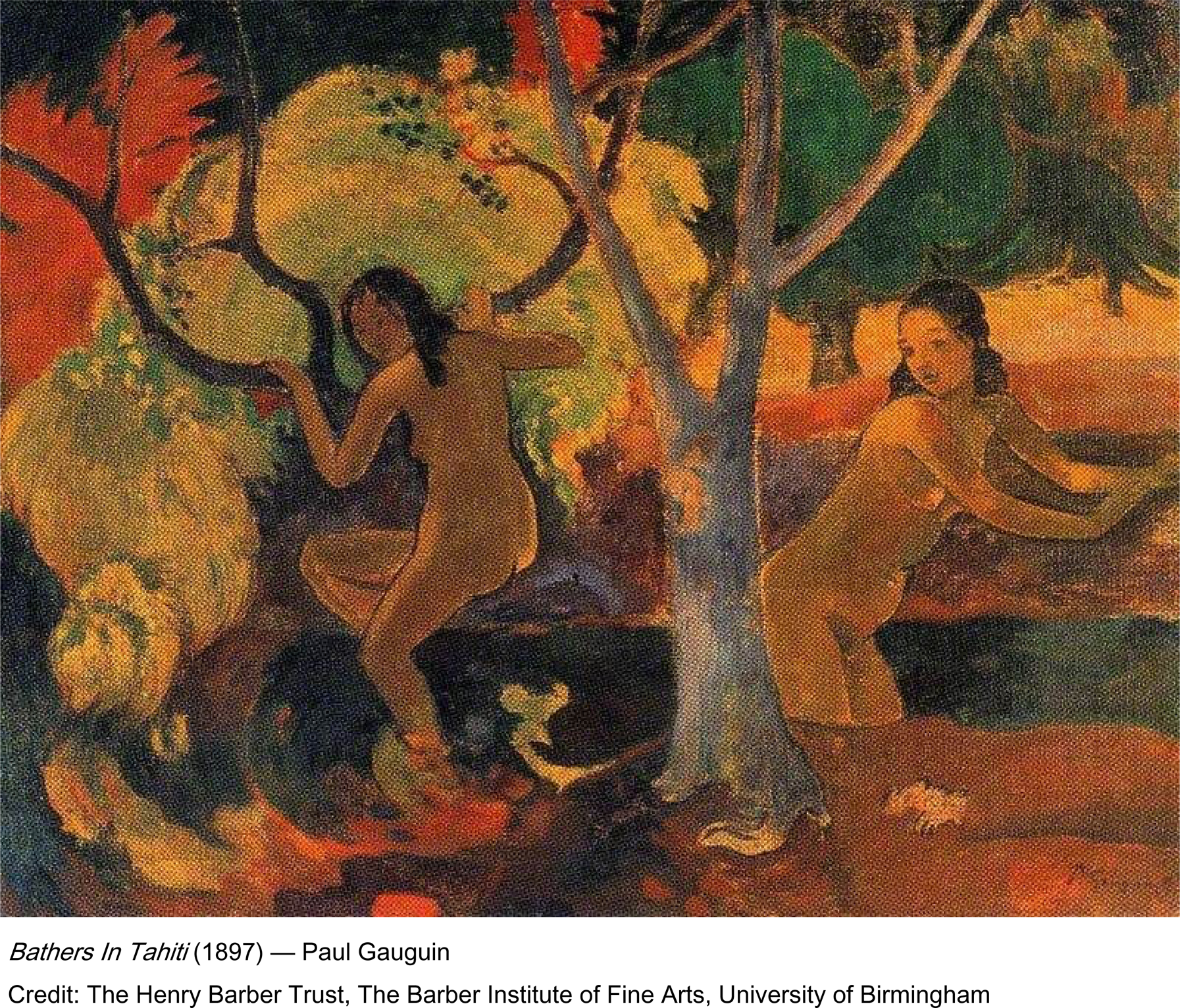
The problematics of Gauguin’s Tahiti paintings – products of his travels in the multiply-colonised Tahiti – have been well explored in the context of racism, sexism and colonialism. 11 The aim here is not to revisit those points exactly. There is the ‘appropriation or appreciation’ question over Gauguin’s use/incorporation of African and Japanese aesthetics and techniques in the flattened, graphic rendering of perspective and colour. 12 To the extent that this question causes us to reflect upon a specific instance of colonialism, this is no bad question. But then such critical inquiry is perhaps best conducted without the distraction of handwringing about whether some particular case is ‘appropriation’ or ‘appreciation’.
We believe there is a much more acute analysis to be had which reveals the ‘appreciating’ colonial gaze, and a kind of appropriating subjectivity that underwrites this gaze. On the one hand, we find a colonising gaze that is operative within the painting: it is the gaze of the implied – yet unmarked/unrepresented – subject who views the bathers from within the scene. On the other hand, the gaze of this implied subject is a codification of Gauguin’s own gaze, and the gaze of the Western audience viewing the painting. This is an ‘appreciating’ gaze configured according to the subjectivity sketched in the previous section: a subject characterised by its ‘disposition to appropriate’ (von Redecker 2020, 49). So, by revealing the appreciation within the painting, we reveal the structures of appreciation of the painting and its subject matter; from that we decode what kinds of subjects appreciate in those ways. We can mobilise appreciation in the familiar modality of objectification, of which there are two related forms. One is a mode of the male gaze, mediated by Orientalist exoticism. 13 The women are framed, ‘natural’ ‘beauties’ available to the spectator for fetishised contemplation. We want to put this somewhat familiar modality to the side. 14 There is another much less obvious aspect of objectification: appropriative appreciation codified in structures of gazing that configure the formal relationship between the viewing/painting subject and its ‘objects’.
The temporality of the scene suggests a raw, lived, in-the-moment spontaneity. Whilst very much posed, the positions of the women’s bodies, their turning heads, suggest that they were in the middle of bathing when the painter ‘turned up’ as it were. Distracted, they turn from what they are doing to face him. This is already a touch insincere: the women are clearly posed for sexual innuendo; the painterly intention is that the eroticism of the moment is accidental. Nevertheless, we are supposed to feel as though this is a moment in time unfolding. The spontaneity is emphasised by the wash of movement coming up through the reflection of the bushes in the water in the left corner, and then into the bushes themselves. This surge of movement sweeps back behind the trees, framing the woman on the left, and flows out through the arms of the woman on the right. Movement is again emphasised by the reds behind the bushes, which also follow the direction of this sweep, and peters out in the gentle swirl of the trees in the distance, in the far right. The framing of the scene as posed is further disrupted by the tree in the foreground. Its dual role is to give the impression that this scene has been stumbled upon – the painter did not have the time to find a better vantage point, and captured the scene just as it was with the tree already in the way. Again, this suggestion is insincere as the tree in fact acts as a prop to excite the gaze. It invites the viewer to their own desire, to want to peer around the tree to see the naked woman behind. The tree also gives the viewer a sense of protection from the gaze of the women: whilst they are in a clearing, we are amongst the trees. Finally, the postimpressionist, proto-fauvist, daubs of colour are deployed to capture the sense of the moment over a mimetic representation of it.
In the painting, there are a complex, interrelated set of spatio-temporalities which structure the representation, and which in turn help us decode the relative configurations of subjects and objects. We then explore the ways that these spatio-temporalities are functions of a subject disposed to appropriation. By critically exposing these spatio-temporalities, we reveal crucial configurations in hegemonic subjectivity – configurations which result in appropriative models of aesthetic appreciation. What then are these spatio-temporalities? There is the spatio-temporal structure of the moment within the painting; the political contradictions between this spatio-temporality and the material conditions under which the painting is produced; and finally, how these problematics are anticipated by subject-object relations under the universal scope of colonial space and time.
The painting itself is of a moment that has long since passed – if indeed there was any such moment. As discussed, the form, content and techniques of the painting suggest that the moment captured in the painting is captured just as the painter arrives upon the scene. The effect of the painter happening upon the scene treats its contents as something discovered and discoverable. The notion of discovery, and the spatio-temporality of discovery, is crucial to the effect of the painting: excitement at discovery. One way of situating the temporality of this moment and its effects is in the idea that all along, before Gauguin’s appearance, there are two women bathing, somewhere in a pool of lush forest. For how long we do not know. Prior to the moment of the painting, there was nothing yet for us to see. All we have is the promise of seeing something exciting, a promise which we are entitled to retroactively by way of the discovery depicted in the painting. In other words, insofar as we made this discovery, of these two women bathing just now, we are entitled to believe that there are other discoveries to be had. Hence this moment is indicative, reaching back into the past and forward into the future as an ever-present promise of discovery. 15
Yet, this moment is a lie; it is contradictory. The moment of Gauguin’s appearance spatio-temporally frames the moment of the painting, almost as if just his gaze is enough to instantaneously bring into being the entire scene, painting and all. The actual temporality required to render the moment – the time spent when Gauguin set out to make his discovery, and then sat down to paint the bathers – is erased by the temporality of the painting. This is not a mere accident of the time taken to make art; the erasure is crucial to the painting. What Gauguin wants to capture is ‘the find’, not the spatio-temporal conditions required to make possible the appearance of the find. Indeed, these must be erased precisely in order to maintain the integrity of the effect of the finding: that real discovery of ‘something wonderful’ is possible without any labour. That it is already there waiting for us, and all we have to do is find it, and that the reward of that find is instant. But this is a material falsehood: all of this, the painting, the contents, the bathers, the aesthetic effects, are Gauguin’s work, and work takes time. 16
So far, we have considered the ways Gauguin generates the moment of discovery and its effects. We could consider these ways as ‘technologies’. 17 From the technologies involved in ‘travel’ that brought Gauguin to Tahiti, to the technologies/techniques of post-impressionism which can be mobilised to render time and space in particular ways. 18 The aesthetic effects of the latter evaporate the spatio-temporality of the former, generating the conditions of a seemingly unmediated aesthetic pleasure, a pleasure untainted by the extra-aesthetic tethers of business and labour. Crucially, this singular moment, this finding, can then be relived, over and over, by its (Western) audience – an audience who are relieved by the semblance of spontaneity from having to engage with the material conditions of colonisation and conquest required for such a moment. This point is not new. 19 Instead, we are offering a critical, hermeneutic approach to the painting whereby appreciation-as-appropriation is codified into the formal aesthetics of the painting. This codification is itself an index of the way that objects are rendered relative to the painter/viewing subjects. In turn, this indicates a deeper dimension to ‘technology’: the subject itself as a technology for producing objects.
This last idea sits at the heart of our argument. The distinctive materiality of the bathers’ bodies is ambiguous relative to the materiality of their environment. The consistency of colour and texture between the bathers and the environment is such that the women are represented as materially part of the ‘natural’ environment; they are distinguishable not in material terms but under the conditions of salience under ‘our’ gaze. On the one hand, we are told that the women are bathing. Yet, their material ambiguity can just as easily make it appear that they are literally emerging out of the landscape, as much as they are bathing. It is as if Gauguin’s moment conjures them out of nature and into distinct, objective being. The semiotic effect of this representational ambiguity is that the women maintain the trace of their indistinctness from the spatio-temporal plenum of ‘natural’ materiality. ‘Gauguin’s moment’ hovers between the women’s being part of ’nature’ still – that is, not yet an object (for us) – whilst also capturing their determination as object, which happens instantaneously at the moment of being found. Hence, perhaps what is most exciting about the painting is that it captures the sense for the painter and viewer alike of bringing these two women into the being of objecthood, as distinguishable from their environment.
When discussing the notion of ‘the find’ above we suggested that the women represent a promise of something already ready to be found in the forest. This idea is now finessed further: it is not that the women were already there; we are not merely appreciating objects and their aesthetic properties as we find them. Rather, the world is a potentiality that is functionally realised by the appreciating powers of the hegemonic subject. Appreciation may generally require, as Gracyk says, something to be already there. However, cultural appreciation actively conjures the form and being of its aesthetic material; hence, the object’s ‘already being’ apart from, and prior to, the subject turns out to be an illusion of the hegemonic subject’s own making. What Gauguin captures in this moment is the same kind of property-generating subjectivity that emerged from Shriver’s speech on cultural appropriation: a universal subject that engages with the world through the lens of property/entitlement and, in so doing, brings it into the kind of material existence that matters for itself. Represented in Gauguin’s painting, as it is rendered for both himself and his Western audience, is a sense that what it is like to ‘see’ as a hegemonic subject is to bring the non-Western world into being.
The point about the universalising instincts of Enlightenment culture has been amply explored in postcolonial scholarship. What is so telling in this case is not merely that the women are appropriated for the purposes of Gauguin’s own projects, or for ‘our’ viewing pleasure, or even that the painting represents the universalising creep of Western culture; it is that hegemonic entitlements to universal representation are codified in the aesthetic structures of the representation itself. What Gauguin captures in this moment is a kind of subjectivity indexed to a form of representation and appearance which is itself universal in a distinctively appropriating way. Linking kinds of (aesthetic) representation and experience to kinds of subjects is crucial for our argument and has a pedigree in critical theory and phenomenology. One well-known example of such a link appears in Merleau-Ponty’s paper on Cézanne (1964). He mobilises Cézanne’s use of post-impressionist techniques to explore the phenomenology of perception as it is afforded through the lived body. Roughly, his point is that Cézanne reveals the falsifying idealisations of perfect memesis in painting, opting for a technique that instead captures appearances as they are functional of a lived body, a body that moves in time and space with its environment. The ‘picture-perfect’ clarity of the world in mimetic painting, as found in Renaissance paintings, is nothing like how the world appears to us. Perceptual phenomenology is fuzzy, variegated in texture, focus and alignment, all rendered as a function of embodied motion (1964: 14). As we will see, crucial in this idea is a transcendental move that can be traced back to Kant: that the spatio-temporal form of appearances are functional of the subject itself. 20
Kant holds that there is a way the world is in-itself, but this is not the object of knowledge (1996: §§A248-9). It is the foundation of knowledge but only mediated by appearances; we know the world only as it appears to us (§§A246-7). This places the world in-itself and the world as it is for-us, under the transcendental conditions of sensible appearance, in an interesting situation. The world as it is in-itself stands as the unknowable exterior of knowledge which limns and delineates an epistemic interior. 21 This interior is the world of appearance in which the unknowable, unsayable, unrepresentable exterior is always already rendered as familiar, discrete, and object(ive) (A370-80). As rendered in appearance, the object world is as amenable to conceptual determination, economic exchange, political management, as it is to aesthetic appreciation (Adorno 2004b, 178). Of course, all of this is done formally in Kant’s first and third critiques, a transcendental formalism that only touches the historical contingency of subjectivity in order to sublimate that very contingency as a source of objective (Stopford 2013) necessity (Adorno 2001, 137). 22
I have discussed this idea in detail elsewhere 23 For our purposes here, what this idea amounts to is a way of reparsing the noumenal and phenomenal world along a critical, postcolonial hermeneutics. Materially speaking, the world-in-itself, the noumenal realm, was always an abstract realm of infinite promise for the bourgeois subject as we find it in Kant: an as-yet spatio-temporally undivided ‘space’. In the domain of empirical experience – that is, the experience of the already explored, familiar world of the Western subject – the work of the noumenal is formal: to underwrite and ground subjective experience, the necessity of which is indexed to those grounds. But what of the unexplored world? The prospect of the unexplored world flips the dialectical values of contingency and necessity of experience, and thereby also the critical relationships of the noumenal and phenomenological realms. The Western subject takes transcendental solace in the necessary forms of their empirical experience as it is underwritten by noumena. Yet, the empirical world that is yet to appear, that is literally unexplored, becomes an unlimited plenipotentiary of experience for the subject, again guaranteed by the necessity of the noumenal realm. Indeed, between both the noumenal and phenomenal realms, the subject finds its actual experience guaranteed, and also all possible future experiences. Kant thinks that we are entitled to infer a priori the transcendental necessity of both our own forms of cognition, and of a world beyond appearance just from the form of actual, immediate empirical experiences. As such, just from actual experience (of the explored world as it appears to us) the subject is good for cognition of all the unexplored world too, and that unexplored world is guaranteed in advance to be amenable to the subject’s experiential demands.
It is in this sense that the hegemonic white European subject is entitled to what it explores because it is built into how it sees itself, the world and the relationship between the two. Gauguin’s painting renders this phenomenologically; the ambiguity of his gaze is a pointing back towards the noumenal origins, as it were, of the women and the environment as an undifferentiated plenum ready to license the reality-carving of Gauguin’s gaze, and it points forward towards a point in time in which the women and nature are present as fully alienated objects, spatio-temporally speaking – objects that can then be managed in the economy of subject/object relations of colonial power. Materially speaking, Gauguin captures the historical priority of the colonial gaze as he looks from the interiority of his position into a newly realised portion of exteriority. The subject position (the painter or Western viewer alike) is marked by the interiority of the universal hegemonic space, unmarked, prior to, and before the painting. And the exterior – the deadened present of these ‘Tahitian bathers’, forever-fixed at the moment of their ontological emergence under the colonial gaze – is the rendered, congealed space of objects. Whatever transcendental subjectivity is supposed to accrue to these women, the moment for their own realisation of it is already long lost. 24
Is Gauguin merely appreciating these women? Does the viewer appreciate Gauguin? Do they share Gauguin’s appreciation? Are Gauguin’s aesthetics merely an appreciation of ‘Oriental’ aesthetics? As opposed, in each case, to some form of appropriation? In this paper, we have argued that these questions have already ceded the very ground where enquiry is meaningful. The irony being that even if one grants Gauguin or the Western viewer that they are appreciating not appropriating in this case, whatever this really means, we have argued that appropriation is already built into the aesthetic structures of representation in front of them. Of course, cultural appreciation as already appropriation is not always so starkly rendered as in the examples we have chosen. But the point is not about Gauguin, or Shriver, but about white European entitlement to a world that is always available precisely because it is in principle, even if not in actuality, already taken.
Are we saying by all this that hegemonic subjects cannot produce good art because ‘everything is appropriation’? No, not exactly. Our point is that cultural appropriation is an irreducible feature of Western understandings of aesthetic appreciation, not a domain that one can carve out neatly to produce general normative principles: that one ought or ought not be able to write about or paint x, for example; or, that one ought not participate in any form of ‘cultural appreciation’. What is important is that people – artists and consumers of art alike – take a critical attitude to themselves and their particular socio-historical and cultural relationships to particular artworks. It may be that in light of such critical reflections, one decides not to write, or paint about x; maybe not.
