



Abstract
Framing is a commonly recommended strategy for building consensus on issues such as climate change and the pandemic response. These recommendations stem from research identifying potent messages across audiences and domains. Framing research, dominated by survey experiments, often overlooks crucial social context, however, limiting direct applicability of findings. This disconnect motivates our central question: How effective are framing strategies in socially embedded informal communication networks? We develop an agent-based model incorporating three contextual elements known to moderate strategic framing: (1) the identities of interacting parties, (2) the competitive nature of political communication, and (3) the structure of communication networks. Simulation results demonstrate that framing's effect on aggregate opinion is strongly diminished when modest levels of partisan homophily or potential for cross-partisan backlash are introduced. Under conditions of homophily, strategic framing by one group can actually widen partisan cleavages by creating echo chambers of highly persuasive individuals. Alternative interventions, such as increasing cross-partisan interaction or depoliticizing existing interactions, may be even more effective than framing efforts in informal networks. When framing campaigns appear effective, as many professional campaigns do, their success may stem less from the frame's persuasive power itself and more from how communication professionals strategically navigate the social constraints we identify.
Framing is one of the most influential concepts to have emerged from academic social science research in the last several decades. The central idea behind strategic framing is that how we present information, what is emphasized or de-emphasized, influences opinions (Druckman 2022). In short: to change minds, find the “right” message. Clear evidence of the influence of framing is the idea's prominence in the applied practice of strategic communication. It is now common in public discourse to attribute the failure of political campaigns to poor framing (e.g., Lakoff 2014). Taking stock more broadly: hundreds of published academic studies have sought to identify the frames that help build consensus around climate change, and many more examine framing strategies on issues ranging from immigration to the COVID-19 pandemic response (Green et al. 2023; James et al. 2021; Kustov and Landgrave 2025). These wide-ranging framing studies constitute a significant body of research examining the causal effects of strategic framing on opinion change.
Conclusions about the importance of framing, however, are based primarily on survey experiments that abstract communication from its social context. Although this methodological choice is valuable for establishing causation at the individual level, it obscures how population-level outcomes—raising awareness or acceptance, building consensus, or mobilizing publics—actually emerge. These aggregate outcomes sit at a logical remove. Whether framing efforts shift aggregate opinion depends not only on message effectiveness but also on often neglected factors: whether the framed message reaches its intended targets, how the targets relate to the source of the framed message, and the presence of competing frames and social influences (Cacciatore, Scheufele, and Iyengar 2016; Druckman 2022).
In response to these concerns, this study examines how framing operates within informal communication networks: the naturally occurring social ties of kinship, friendship, acquaintanceship, and workplace relationships that constitute everyday political discourse. These interpersonal networks represent a fundamental channel for political communication yet operate distinctly from formal messaging structures—advertising campaigns and mass media broadcasts. Isolating framing effects within these informal networks, absent formal channels, allows us to examine how peer-to-peer influence shapes opinion dynamics. Although this scope excludes an important class of professional campaigns that combine interpersonal and mass media strategies, such isolation is essential for theory building and for understanding how framing shapes system-level opinion dynamics.
This examination of informal networks builds from recognizing a disjuncture between the practice of empirical framing research and theoretical treatments of framing and opinion change generally. Theoretical accounts identify a role for framing but also consider how social context conditions and constrains framing effects. We highlight three elements of social context in particular: (1) the identities of the communicating parties, which influence how messages are received and processed; (2) the competitive nature of communication, which reflects the reality that messages do not exist in a vacuum but rather compete in an ongoing, dynamic process where multiple, often conflicting messages vie for attention over time; and (3) the structure of the communication network, which shapes the flow and reception of messages within and across social groups. These three dimensions—identity, competition, and network structure—are consistently identified in framing theory and empirical research as fundamental constraints shaping how information flows and influences opinion in social systems (e.g., Chong and Druckman 2007; Druckman 2001, 2022). They represent critical pathways through which social context mediates strategic persuasion attempts. Our review of recently published framing studies, however, reveals that this social context largely lies out of the research scope.
To examine how key elements of social embeddedness shape the aggregate consequences of framing in informal communication networks, we then develop a parsimonious agent-based model (ABM), aimed at theory development (Bruch and Atwell 2015; Macy and Willer 2002). We focus our attention on the dynamics of interpersonal influence within social networks, which has been shown to be an important context for the emergence of political polarization and is also seen as a key target for effective intervention (Bail et al. 2018; Broockman and Kalla 2016; Cowan and Baldassarri 2018; DellaPosta, Shi, and Macy 2015). Our study thus speaks directly to contexts where framing is deployed in informal interactions. We do not incorporate effects of mass media, which may have additional effects on opinion change (Siegel 2013).
This scope condition of our model constitutes a limitation for generalizing to important types of communication campaigns, but the model is nonetheless informative and an important initial step. Interpersonal networks are an essential communication channel that has an independent effect on opinion change (Centola 2018; DellaPosta et al. 2015; Dippong, Kalkhoff, and Johnsen 2017) and has been shown to mediate mass media effects as well (Siegel 2013). We use our model to explore influence dynamics and the relative contribution of strategic framing across a range of network topologies, representing alternative interpersonal communication structures (Siegel 2009), including structures with highly skewed degree distribution that resemble increasingly important social media contexts (Goldberg and Stein 2018). Thus, we accept a priori that strategic framing is effective and then use ABM simulations to examine the conditions under which such framing effectively bridges partisan divides. Specifically, we explore conditions imposed by three essential features of social embeddedness: identity, competition, and network structure.
Our simulation results show that effective framing strongly shifts aggregate opinion only when (a) discussion networks are not significantly structured by political identities and (b) cross-partisan persuasion attempts rarely result in backlash. The effect of framing on aggregate opinion wanes rapidly when even moderate levels of homophily or potential for backlash are introduced. Our findings also complicate the common recommendation to use strategic framing to reduce partisan polarization (e.g., Feinberg and Willer 2015). Simulations of our model suggest that in scenarios characterized by homophily, greater use of strategic framing amplifies polarization, entrenching individuals within persuasive echo chambers and propelling their group's opinions to greater extremes. Finally, within our modeling framework, alternative strategies targeting network structure or the salience of political identities yield effects on aggregate opinion comparable or sometimes greater than expanding framing efforts.
Importantly, the findings do not diminish the potential effectiveness of framing when deployed through professional communication campaigns. Such campaigns can circumvent the homophily constraints of interpersonal networks by delivering messages through mass media while simultaneously avoiding identity-based backlash by utilizing spokespeople who share the target audience's political identity. Professional communication strategies that combine strategic framing with the structural advantages of mass communication and/or targeted communication could prove highly effective at changing system-level opinion.
Our primary contribution is thus to formally model whether and how the documented efficacy of framing scales up under theoretically crucial yet often empirically neglected conditions of social embeddedness within interpersonal networks. By exploring these dynamics computationally, we offer specific theoretical expectations about the limits of strategies centered on message content optimization. The results do not diminish the established importance of effective framing; rather, they strongly suggest that influencing aggregate opinion in such environments requires complementary attention to the social architecture of communication, including the structure of interactions and the (de)politicization of communication settings.
Framing Theory And Research Practice
Framing occurs when a communicator emphasizes certain aspects of an issue while downplaying others to impact how an audience interprets and evaluates that issue (Chong and Druckman 2007; Druckman 2001). The basic insight of framing as a communication strategy is that some frames are more compelling than others. Choosing an effective frame for the intended audience provides a powerful way to shape public opinion, especially in the context of political polarization (Druckman 2022). The roots of framing theory are traced to foundational research on public opinion (Chong and Druckman 2007). The importance of framing follows logically from core findings, including that the mass public lacks strong ideological constraints (Converse 1964) and that aggregate opinion is shaped by opinion leaders, including political elites (Katz and Lazarsfeld 1955).
Building on these initial insights, framing theorists have elaborated a sophisticated research paradigm (Chong and Druckman 2007). Framing scholarship distinguishes alternative types of framing strategies, elaborates the psychological underpinnings of framing effects, identifies the social conditions within which frames are produced (Druckman 2022), considers competition between alternative frames (Chong and Druckman 2010), and theorizes the influence of social context on frame effectiveness (Druckman 2001). We observe a disjuncture, however, between this sophisticated theoretical apparatus and the cumulative empirical record of framing studies. We first review the theory and then the practice of framing research to describe this disjuncture and motivate the need for a shift in focus to “the limits of framing” (Druckman 2001).
The Essential Social Context of Framing Effects
In a narrow sense, a framing effect is a psychological phenomenon. It occurs in the mind when an individual constructing an opinion privileges information that was emphasized during a specific communication. This information processing does not happen in a vacuum, however. The social context within which communication unfolds shapes information processing, especially the potential for specific frames to drive change in aggregate public opinion. The essential role that social context plays is clearly articulated in theoretical treatments of framing (Druckman 2001, 2022) and related work on opinion change (Baldassarri and Bearman 2007; DellaPosta et al. 2015). The essential role of social context is clear in foundational work (Baldassarri and Bearman 2007; Druckman 2001), but important theoretical and empirical advances pinpoint three core, interconnected elements as particularly crucial: identity-based processing, competitive messaging environments, and structured communication networks (e.g., Chong and Druckman 2007; Druckman 2001).
Our focus on this triad is deliberate; these dimensions are consistently identified as fundamental constraints shaping how frames resonate (or do not) with audiences’ values and group loyalties, how they fare against rival interpretations in contested information spaces, and how they diffuse (or stall) within the social architecture of interpersonal connections (Chong and Druckman 2007; Cowan and Baldassarri 2018). Together, the three elements form a coherent framework capturing the prime movers of framing outcomes in socially embedded settings, often conditioning or encompassing the effects of other variables, such as emotional appeals or individual cognitive abilities (Taber and Lodge 2006).
First, the identities of message source and of recipient influence how individuals process political messages. The effectiveness of a message varies with the characteristics of the messenger. Druckman (2001) showed that the credibility of the source imposes an important constraint on framing effectiveness. In the context of partisan polarization, the moderating effects of identity are especially salient. Individuals evaluate information based on perceived identity clues, with prior beliefs and political predispositions conditioning their receptivity to frames (Merkley and Stecula 2021). Critically, the identities of both parties to the communication impact framing effectiveness. When source and receiver identities align, messages gain credibility and trustworthiness. Identity misalignment, on the other hand, can trigger backlash, causing opposing groups to diverge further in their views (Bail et al. 2018; Merkley and Stecula 2021).
Second, because individuals possess finite attention and cognitive resources (Dunbar 2018), framing effects decay with time and are moderated by the prevailing conditions of the discursive environment, including the presence of competing frames. Framing affects attitudes by emphasizing particular elements of an issue that shape interpretation and judgment. These effects require reinforcement through repeated exposure to persist (Chong and Druckman 2010). Even robust framing effects do not persist indefinitely. In many political contexts, especially in the context of strong political polarization, individuals are rarely exposed to a single frame; rather, they are confronted with multiple competing frames (Druckman 2022). Competition shapes message reception in multiple ways: in group discussions, the mere presence of others influences how individuals interpret frames, and social comparison processes allow peers to sway and redefine perspectives (Centola 2018). Counter-framing becomes more likely in politicized contexts where beliefs are entrenched (Chong and Druckman 2007; Kalla and Broockman 2023). The inevitable outcome of competition is that framing effects decay or become neutralized over time (Chong and Druckman 2007; Kalla and Broockman 2023).
Finally, the structure of communication networks determines individuals’ exposure to specific frames and competition among frames. Discussion networks tend to exhibit homophily because individuals connect with similar others (McPherson, Smith-Lovin, and Cook 2001). Even within heterogeneous networks, individuals tend to disclose political opinions selectively to those least likely to disagree (Cowan and Baldassarri 2018). Crucially, we acknowledge that fears of ubiquitous, hermetically sealed “echo chambers” may be overstated for the average citizen because many individuals maintain diverse media diets and some cross-cutting social ties (Guess 2021; Levendusky 2023). The fundamental principles of homophily—that similarity breeds connection—and identity-driven sorting remain, however, powerful forces structuring communication environments (Bakshy, Messing and Adamic 2015; McPherson, Smith-Lovin, and Cook 2001). Despite evidence that incidental exposure online provides cross-partisan information (Guess 2021), the rise of online communication has intensified sorting processes (Bakshy et al. 2015). The gravitational pull of like-minded networks shapes exposure and reinforcement patterns.
Furthermore, mere exposure to diverse views does not guarantee influence; identity-based motivated reasoning often leads individuals to discount or counterargue discordant information, sometimes even strengthening prior convictions (Bail et al. 2018; Taber and Lodge 2006). Consequently, although we reject the popular image of partisan echo chambers, we maintain that structured communication networks—capturing the realities of homophilous clustering, selective trust, and differential reinforcement—remain an essential parameter alongside identity and competition for modeling how frames propagate and impact opinions within social systems. It is through these network pathways, shaped by identity and message competition, that the aggregate consequences of framing effects ultimately unfold.
Taken together, the three elements, identity-based processing, competitive messaging environments, and structured communication networks, constitute a socially embedded model of opinion change within which framing unfolds. The schematic diagram in Figure 1 summarizes the embedded model. Figure 1 depicts how communication unfolds among six individuals, each with one of two possible political identities (indicated by orange and blue [light and dark, respectively, when printed in grayscale]). The highlighted dyad in the middle (dashed outline) helps us illustrate the importance of social embeddedness. Consider how the blue node in this dyad deploys strategic framing in an effort to shift the orange node's opinion on an issue. The embedded perspective reminds us that blue's influence on orange may be limited or even reversed if the cross-partisan interaction is perceived as politicized or antagonistic. Zooming out beyond the dyad, the framing effort is embedded in a communication network that may promulgate alternative competing frames that neutralize the initial framing effect. Finally, the structured patterns of interaction unfold over time (indicated in Figure 1 with the time index, t = 1), reflecting a dynamic process of opinion change over many rounds of interaction.
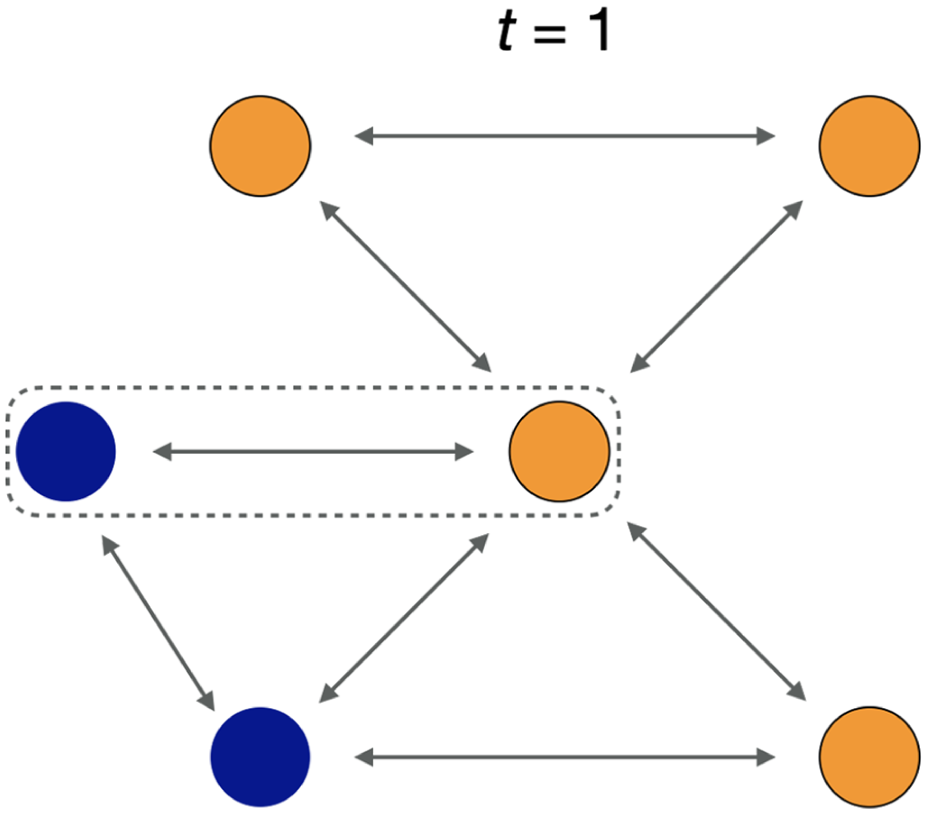
Illustration of an Embedded Perspective on Framing
Framing Surveys and the Problem of Embeddedness
Although theoretical accounts of framing highlight the importance of the limits imposed by social context (Druckman 2022; Chong and Druckman 2007), the empirical literature on framing has often failed to integrate these theoretical insights. We believe that this gap in the empirical record is related to the emergence of the survey experiment as the dominant methodology in framing research (Thomas 2024). Indeed, the growing prominence of framing research in recent years parallels the ascendance of survey experiments in social science research: one study found that publications mentioning “survey experiments” never exceeded 100 annually until 2010 yet saw an exponential increase from 2011 onward, reaching 1,826 mentions by 2021 (Thomas 2024), and another found that survey experiments grew to reach approximately 15 percent to 20 percent of articles published in two top political science journals, American Journal of Political Science and Journal of Politics, by 2023 (Briggs et al. 2025). The increase may be due to the important advantages survey experiments offer: they permit model-independent causal inference, can generalize to wider populations more readily than lab-based experiments, and are increasingly cost-effective to implement (Briggs et al. 2025; Mutz 2011; Thomas 2024).
Researchers have used evidence from survey experiments to make strong claims about the ability of framing strategies to effect opinion change, rarely explicitly distinguishing outcomes at the individual-level (which survey experiments measure) and collective outcomes (e.g., building consensus or mobilizing publics). To be clear, in a statistical sense, survey experiments make valid causal inferences about framing effects on individual attitudes when measured immediately after treatment (Mutz 2011). The claims emerge from experimental designs that abstract communication from the social environment, however, and do not examine how effects might decay with time.
To substantiate this claim, we conducted a systematic review of recent framing studies published in the Journal of Experimental Political Science (JEPS). 1 Of the 60 survey experimental studies published in JEPS between 2020 and 2024, 83.3 percent employed the simplest, context-free design. Just 3.3 percent of the studies manipulated the characteristics of the message source, and only ten percent considered competition among frames in some way. How might conclusions from such studies change if they had considered identity-based processing, competitive messaging environments, and structured communication networks?
The few studies that do use more context-sensitive designs suggest that framing effects attenuate or become highly contingent when identity dynamics, message competition, and network structure are introduced. A meta-analysis finds that message competition halves attitude effects and negates behavioral impact (Amsalem and Zoizner 2022). Real-world conditions further curb influence: a recent large-scale study showed minimal persuasion from typical campaigns and context-dependent ad effects (Hewitt et al. 2024). Thus, although context-sensitive designs reveal framing can have measurable effects, they also underscore that these effects are often smaller, shorter-lived, and more contingent than simpler experiments might imply.
As these studies suggest, critical factors intervene between the estimate of a framing effect in a typical experiment and its resulting influence on aggregate public opinion. Standard experimental designs reflect what Granovetter (1985) termed an “undersocialized perspective”—treating individuals as atomized decision-makers abstracted from their social environments. This abstraction obscures how frames operate through identity-based processing in communication dyads, how messages compete for attention within wider information flows, and how structured networks systematically pattern exposure to and interpretation of frames.
Summary
When Druckman (2001:1042), a leading framing scholar, introduced the notion of the “limits of framing,” he emphasized that identifying such limits “is not to suggest that framing effects are insignificant or irrelevant; indeed, it is because they are so important that understanding their limits can provide critical insight into public opinion formation.” It is in this same spirit that we focus on the essential social context of framing. To understand when strategic framing efforts will prove most consequential for shaping aggregate public opinion, it is essential to bring social context back in. Some survey experiments have sought to do just that, adding one element of context at a time and typically finding attenuating effects of framing. We take a different approach here. Focusing on all three elements of embeddedness that we identified earlier—identity-based processing, competitive messaging environments, and structured communication networks—we use simulations of a formal model of opinion change to develop theoretical expectations about framing impact on aggregate opinion under alternative combinations of conditions.
Modeling Framework
Our goal is to formalize the essential elements of an embedded, dynamic model of opinion change and use it to evaluate the plausible bounds of the effect of strategic framing on aggregate opinion. For this task, we adopt an agent-based model (ABM) framework. ABMs are useful for exploring the collective outcomes of dynamic and interactive processes (Macy and Willer 2002), making them well suited for our focus on how dyadic influence aggregates. There are different paradigms of ABM use in research, ranging from low to high realism (Bruch and Atwell 2015). High-realism ABMs aim to generate accurate predictions of well-understood processes based on a large amount of relevant data. By contrast, low-realism ABMs are more useful for theory development (Bruch and Atwell 2015; Macy and Willer 2002). The simplicity and parsimony of the model is a virtue if the goal is to draw out the implications of key theoretical assumptions rather than make accurate predictions about the future. This is precisely the goal of the present study.
We build on previous research on social influence and opinion dynamics to specify a parsimonious model of opinion change in the context of political polarization. We endow a subset of agents with the ability to frame an issue effectively, that is, to be especially persuasive in a dyadic setting. We then systematically vary key components of social context within empirically plausible ranges, enabling us to evaluate the relative importance of framing strategies for aggregate opinion change when it is embedded in well-understood local processes. We start with a previously studied model of opinion change, proposed by Baldassarri and Bearman (2007; henceforth, B&B), but strip away some complexities to focus attention on the proposed components of framing and opinion change.
Specifically, we start with a population of N agents, each of whom has a categorical political identity (orange or blue) and holds an opinion on some issue i. We follow B&B in specifying opinion as a continuous variable, ranging from −100 to 100. In the context of our research goals, this choice has two advantages compared to models that specify opinions as categorical (e.g., Siegel 2013). First, the continuous specification enables us to model gradual changes in attitudes, corresponding to the way opinion change is conceived in framing studies. Second, this specification allows us to separate two key components of attitude for our study, valence and strength, where valence corresponds to the sign (+ or –) and strength corresponds to distance from zero.
B&B model individual opinion as emergent from ongoing social interactions. This framework is consistent with a competitive political context—individuals are embedded in ongoing discussions, changing their own opinion based on the encountered arguments and counterarguments while also effecting change in the opinions of their discussion partners (Chong and Druckman 2007). Discussion of an issue thus leads to opinion change, but three specific types of change are possible: (1) reinforcement, when both individuals strengthen their prior opinions; (2) compromise, when individuals move toward each other's respective positions; and (3) conflict, when individuals’ opinions move further apart (Baldassarri and Bearman 2007). Table 1, borrowed from B&B, summarizes the directionality of opinion change that may result from different initial opinion configurations of discussants a and b. According to B&B’s model, discussants who share the same view (both positive or both negative) always reinforce each other's opinion. 2 Discussions by agents with opposite views lead to either compromise or conflict. The choice between these two options depends on the discussion partners’ political identities and is elaborated in the following.
Directionality of Opinion Change
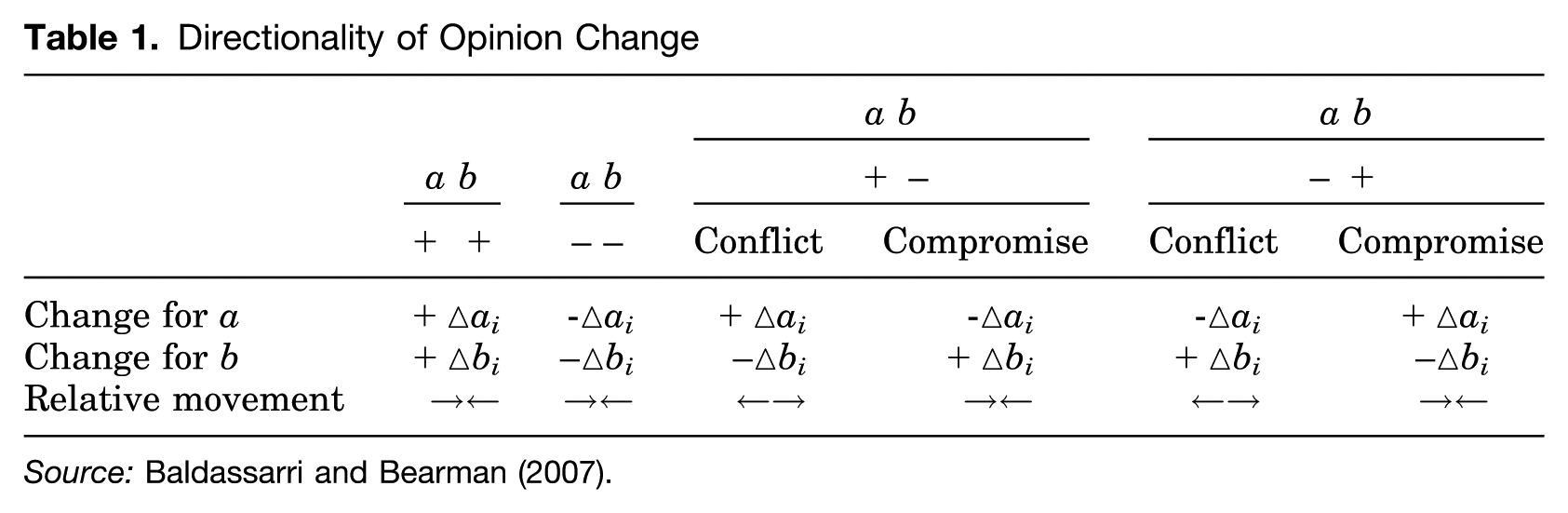
Source: Baldassarri and Bearman (2007).
As Table 1 suggests, interpersonal influence is bidirectional in B&B’s model. Following the interaction, each discussion partner incrementally shifts their opinion in a particular direction. Individuals who hold strong views on an issue are less susceptible to influence than agents who have weaker views. Thus, magnitude of opinion change is inversely proportional to an actor's opinion strength. Formally,

where
This general framework thus enables us to simulate a population of interacting agents whose opinions on an issue evolve based on the interaction they have with others. From our review of framing, we separate three mechanisms that may influence discussion dynamics in a politically polarized context: (1) the frame and its persuasiveness, (2) political identities and how they impact message receptivity, and (3) the structure of the communication network. We discuss and formalize each of these in turn.
As a baseline, social interaction leads to opinion change, but a key contribution of the framing literature is to show that not all messages are equally effective. An individual who frames their message strategically will be more persuasive and have a greater effect on the co-discussant’s opinion. First, we model this by increasing the persuasiveness of agents who use a framing strategy, scaling the baseline opinion change of their co-discussants by
Second, we integrate the identity of the discussants into our dynamic model. Recent research documents that exposure to cross-partisan sources of information, especially in settings where political identities are salient, may lead to backlash, resulting in entrenchment of opposing opinions (Bail et al. 2018; Guilbeault, Becker, and Centola 2018). We formalize this possibility by introducing a parameter (PolProb), which specifies a probability with which cross-partisan interactions lead to conflict (polarization) rather than compromise. Conservatively, PolProb only applies in cases where agents initially hold the opposite views (i.e., interactions of agents who hold the same view always result in reinforcement, regardless of political identities). Varying the parameter PolProb from 0 to .5 allows us to test how aggregate opinion dynamics respond to the potential for partisan backlash.
Third, political discussions are more likely among co-partisans than cross-partisans. We measure the level of homophily in a network using modularity (Q), which captures the extent to which co-partisans are connected to each other (Newman 2006). 3 Modularity is commonly used to measure the extent to which members of a group favor connections to fellow group members (e.g., co-partisans) above what would be expected by random chance based on the observed degree distribution (e.g., DellaPosta 2020). In our case, a Q value of 0 indicates that connections between co-partisans occur at the rate expected by chance (no homophily), whereas Q values approach 1 as individuals prefer co-partisan connections exclusively (maximal homophily). 4 We vary homophily of agents’ discussion networks to examine how the tendency to discuss political issues with ingroup members influences aggregate opinion dynamics in the presence of framing. We thus do not assume either strong or weak ingroup preferences for the selection of discussion partners but, rather, examine the full range of possible network configurations.
Additionally, we test two types of network structures. First, we assume that agents have an approximately equal number of discussion partners. This network graph is generated using a stochastic block model, which also allows us to tune the level of homophily. Second, we examine the possibility that some agents have many more connections than others, a pattern that has been found in many social media settings (Arnaboldi et al. 2017). We generate these graphs using the Barabási-Albert homophily model (Lee et al. 2019), developed to enable the specification of homophilous structures in scale-free networks.
In summary, we borrowed key features of Baldassarri and Bearman's (2007; B&B) algorithm but reduced its complexity to foreground our interest in the effect of framing on aggregate opinion dynamics. Specifically, whereas B&B track opinions of four attitudes, we focus on just one: agents in B&B’s model choose discussion partners as a function of opinion similarity and interest in politics, but we prespecify a stable discussion network and tune homophily based on political identities. Finally, perceived ideological distance serves as the basis for conflict in B&B’s model, whereas we specify agents with prespecified, stable political identities.
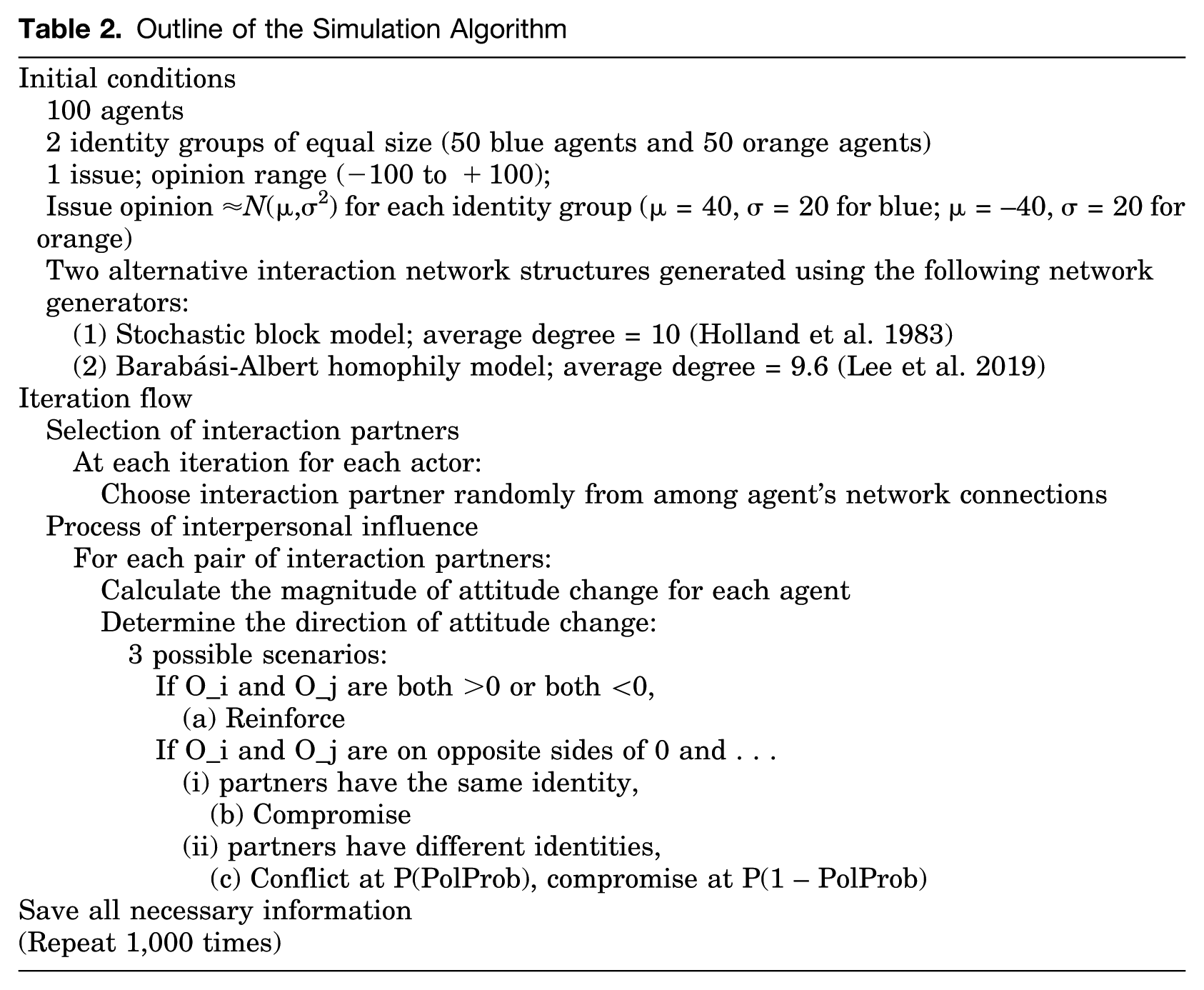
Our goal is to understand the dynamics of opinion change in the context of an issue that is already polarized along partisan lines. Therefore, we initiate the simulation with a bimodal distribution of opinions. Opinions of agents with a blue political identity are drawn randomly from a normal distribution with mean of 40 and standard deviation of 20, and opinions of agents with an orange political identity are drawn from a normal distribution with mean of −40 and standard deviation of 20. Table 2 summarizes the simulation algorithm, including the initial conditions and the steps in each iteration.
Outline of the Simulation Algorithm
We first examine model behavior under the baseline condition where network connections are random and political identities do not affect interaction outcomes. Framing should have its strongest effect on aggregate opinion under these conditions. We then introduce network homophily, structuring discussion networks based on increasing levels of in-party preference, varying Q from 0 to .5. Next, we introduce the possibility of backfire effects, increasing the rate at which cross-partisan discussions lead to conflict (PolProb). We produce results for every combination of Q and PolProb within their respective test ranges and repeat the analysis with the two different network generators: (1) the stochastic block model and (2) the Barabási-Albert homophily model (Lee et al. 2019). As additional checks on robustness, we test models that concentrate framing among agents with the highest network degree and the highest initial opinion. 5
Outcome Measures
We are interested in placing the effect of framing in context of other variables. Our first measure is simply the mean opinion at the end of the simulation averaged over multiple runs of the simulation. As we show, the expected mean opinion is 0 when no framing is specified. Thus, we can define the aggregate framing effect as the absolute value of the mean opinion in the direction of the party deploying strategic framing, averaged over multiple runs. Second, we define mean group distance as the difference between the opinion means of orange and blue agents. The simulation is initiated with a mean group distance of 80 (μ_blue = 40; orange = −40); therefore, values less than 80 imply growing consensus, and values greater than 80 imply growing polarization. We present results in two stages. First, we present several virtual case studies (Baldassarri and Bearman 2007). These case studies showcase typical dynamics in strategically selected conditions. Second, we present results from simulations across the full parameter space.
Results
Case Studies
We begin by presenting an example of the baseline case, which specifies no homophily or backfire effects. Influence operates as discussed previously. Figure 2 reports results from a simulation where no agents are endowed with strategic framing (FrameShareblue = 0, FrameShareorange = 0). Figure 2 includes (a) histograms of opinion at t = 0, t = 200, t = 500, and t = 1,000; (b) the network structure among the agents; and (c) a time-series graph reporting individual agents’ opinion trajectories (in blue or orange) and the overall opinion trajectory (in black, with 95 percent confidence interval in gray). In this illustrative case, we show that aggregate opinion changes little over 1,000 iterations of the simulation.
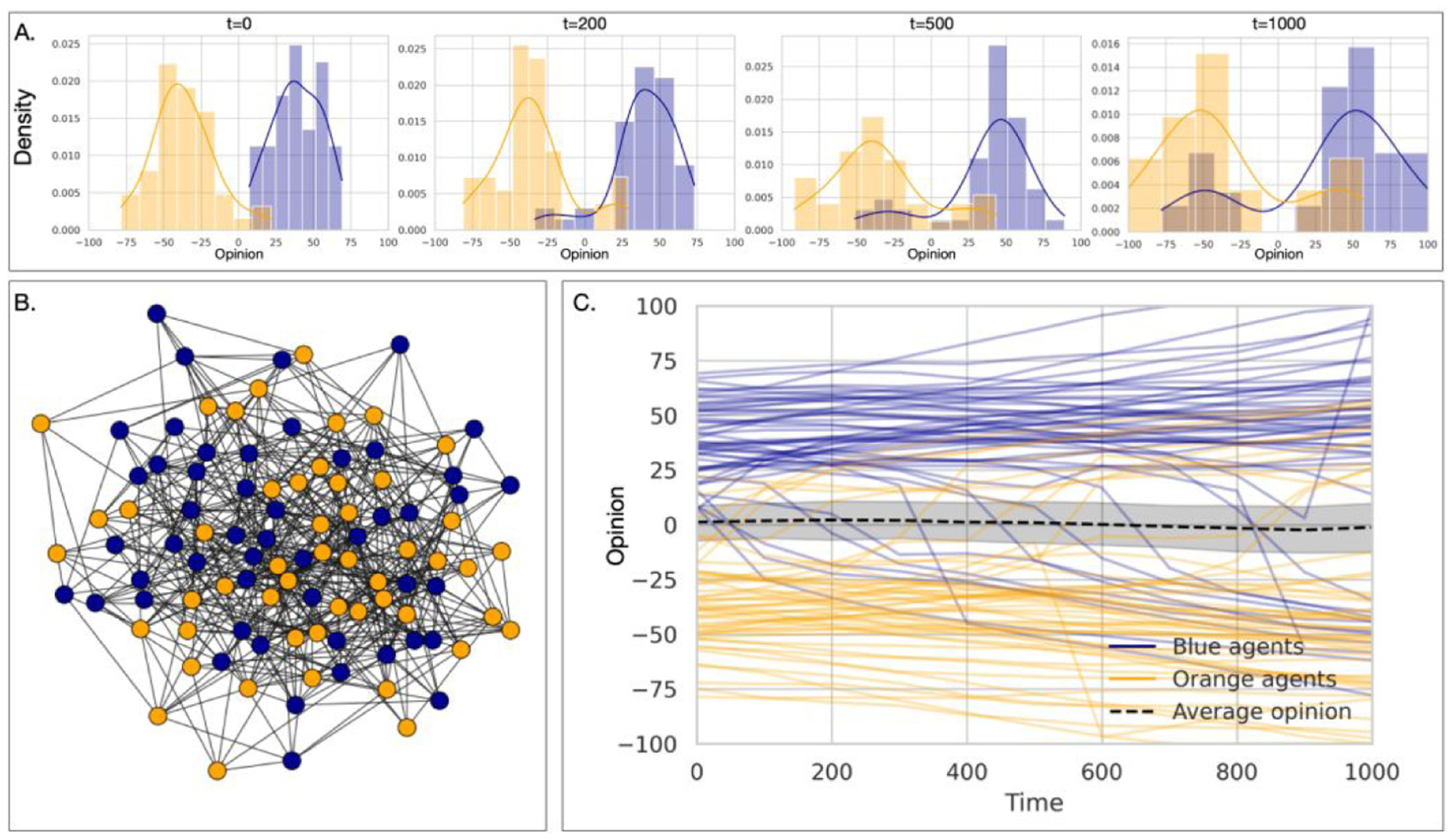
Results from Case Study 1, the Baseline Case, Specifying No Framing Effects, a Random Communication Network (Q = 0), and No Backfire Effects (PolProb = 0)
The mean opinion of blue and orange agents remains around 40 and −40, respectively, and there are little overall average opinion changes. Small shares of orange and blue agents noticeably shift their opinions over time in either direction. This is due to the specific realization of the network graph and initial conditions. As the model dynamics play out, agents that are connected disproportionately to orange and blue alters, or to alters with either strongly positive or negative opinions, shift from their initial conditions more so than agents that happen to start with more balanced networks. A subset of simulations in this condition do display some movement of aggregate opinion (again, due to random initialization conditions). In general, however, there is no systematic shift in one direction; aggregate change is always modest or zero, and the opinion distribution at t = 1,000 always remains bimodal.
The second case study, presented in Figure 3, introduces framing into the baseline case, endowing all blue agents with strategic framing (i.e., under reinforcement and compromise scenarios, blue agents induce opinion shifts in their discussion partner that are 50 percent larger than otherwise expected). Besides this change, the setup is identical to the baseline case, with ties formed at random and no possibility for backlash (Q = 0, PolProb = 0). This case most closely corresponds to framing studies that do not consider the embeddedness of persuasion efforts. The framing is effective, and we allow all agents of one group to use it in their communication, but no consideration is given to preexisting network structure or to how political identities may influence the outcome of interactions.
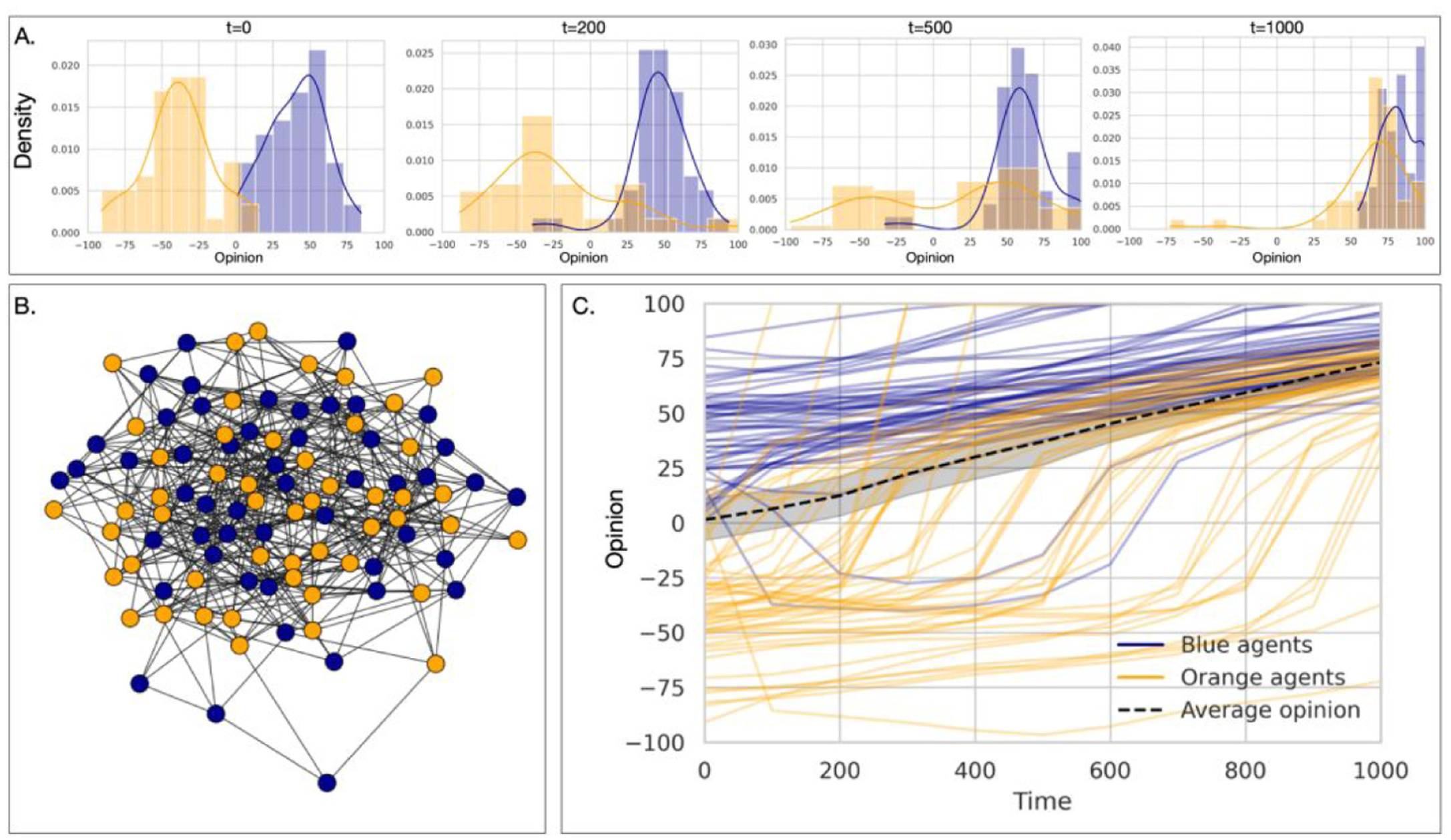
Results From Case Study 2, Which Endows 100 Percent of Blue Agents with Effective Strategic Framing (FrameShareblue = 1.0, FrameShareorange = 0, and Feffect = 1.5) and Specifies a Random Communication Network (Q = 0) and No Backfire Effects (PolProb = 0)
Figure 3 illustrates a typical example of a simulation under these conditions. With the discussion network permitting ample opportunity for cross-partisan discussion, the starting, bimodal distribution of opinion quickly shifts to the right as blue agents use effective framing to persuade orange agents to their position. A few orange agents hold out for a while, but by t = 1,000, nearly all holdouts are persuaded, and an emergent consensus on the issue is evidenced by the unimodal distribution centered near the top of the opinion range.
Empirical discussion networks are not formed at random, however, as in the specification of Case Study 2. Although we expect opportunity for cross-partisan discussions of political issues, a greater share of political discussions happens among co-partisans (Cowan and Baldassarri 2018). Therefore, in the next case study, we increase the level of partisan homophily in agents’ discussion networks. Figure 4 illustrates a case study of a simulation where modularity (Q) is approximately .2. As shown in Figure 4b, there is greater clustering of orange and blue agents in this graph compared to the random network realizations shown previously, but the level of homophily is still rather modest. Case Study 3 also endows 100 percent of blue agents with effective strategic framing and highlights the effect of modestly increasing homophily on the effectiveness of framing. Figures 4a and 4c suggest that homophily limits the opportunity for the more persuasive blue agents to engage orange agents and bring them to their side, leading to a much diminished aggregate framing effect. Although aggregate opinion shifts toward the blue position, the overall shift is modest compared to the shift observed under random mixing, and most orange agents maintain a negatively valent opinion at the end of the simulation. But the increased homophily facilitates an echo chamber effect among the highly persuasive blue agents, which is evident by the steady shift toward a near consensus among blue agents at the positive extreme by t = 1,000.
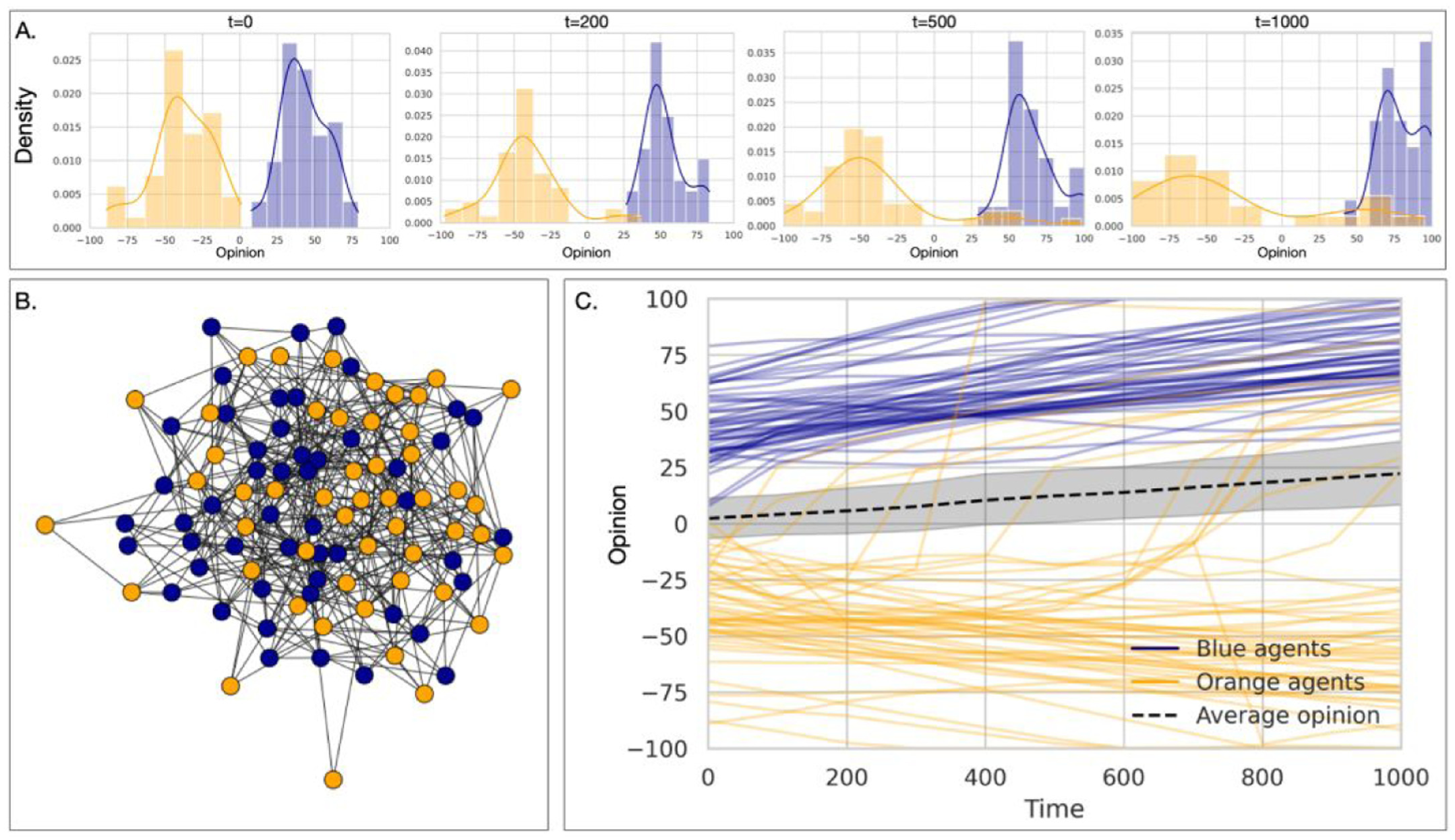
Results from Case Study 3, Which Endows 100 Percent of Blue Agents with Effective Strategic Framing (FrameShareblue = 1.0, FrameShareorange = 0, and Feffect = 1.5) and Specifies a Communication Network with a Modest Level of Homophily (Q = .2) and no Backfire Effects (PolProb = 0)
Finally, we illustrate a case with a partisan backlash in Figure 5. For this case study, we retain a modest amount of homophily (Q = .2) and increase the probability of backlash, PolProb, to a high level of .5. In this case, despite the blue agents’ enhanced powers of persuasion, the aggregate opinion remains largely unchanged over the course of the simulation. The aggregate opinion's near steady state at 0, however, masks significant polarization of the two camps. Introducing the possibility that cross-partisan discussions result in conflict rather than compromise dramatically reduces the blue agents’ ability to bring the opinion of orange agents to their side. At t = 1,000, the group distance (i.e., the difference in mean opinions between orange and blue agents) is 163, more than twice as large as the initial group distance of 80.
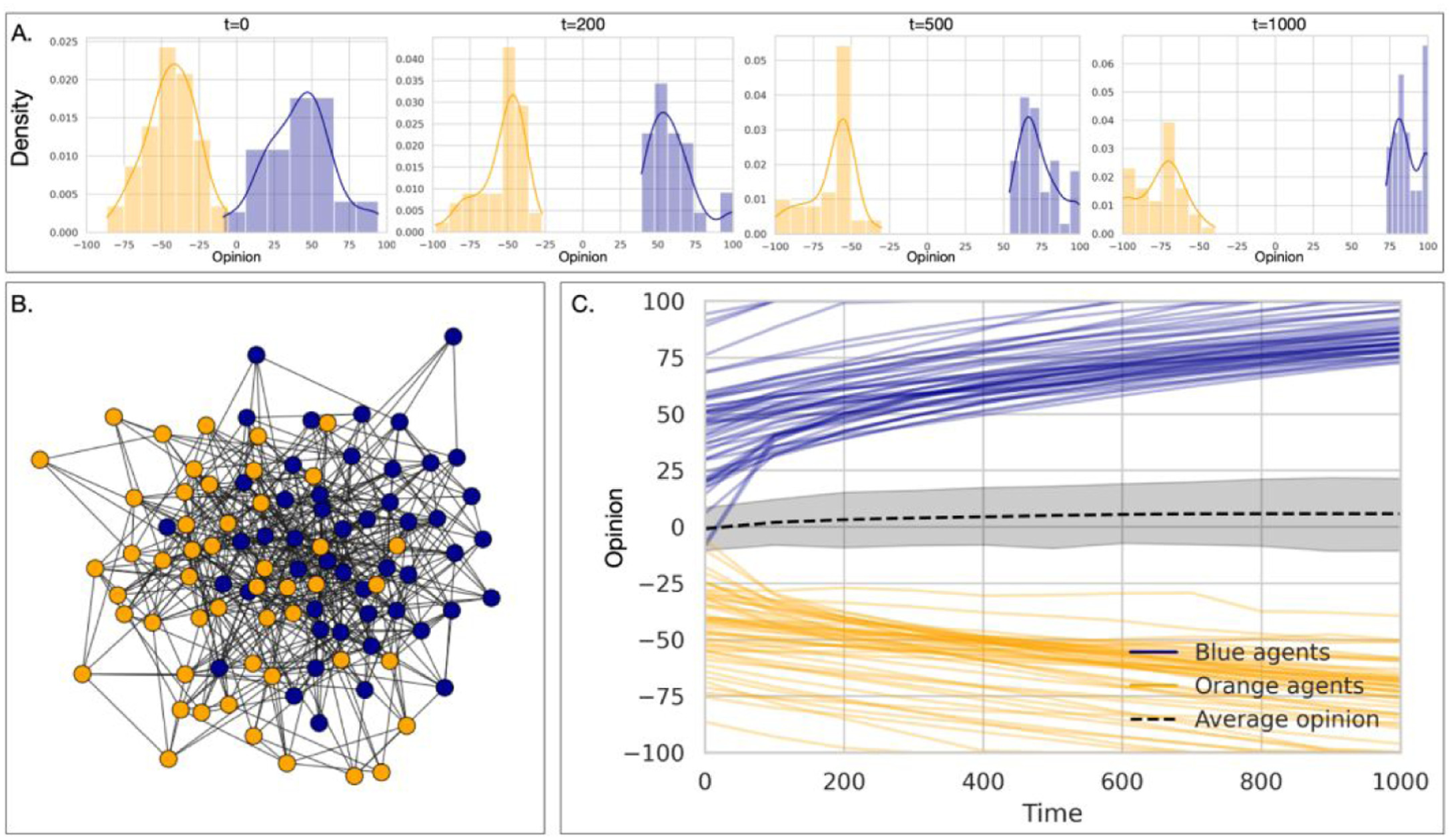
Results from Case Study 4, Which Endows 100 Percent of Blue Agents with Effective Strategic Framing (FrameShareblue = 1.0, FrameShareorange = 0, and Feffect = 1.5) and Specifies a Communication Network with a Modest Level of Homophily (Q = .2) and 50 Percent Probability of Backfire Effects (PolProb = .5)
Analyses of the Full Parameter Space
The case studies provide insight into the model's general dynamics and tendencies. It is important to note that 100 percent of blue agents were endowed with effective strategic framing across the three framing condition case studies (i.e., Case Studies 2–4). Thus, the results correspond to the upper limit of the aggregate framing effect. Next, we present full results from simulations across the parameter space. We vary the fraction of blue agents who use strategic framing (FrameShareblue ranging from 0 to 1), the level of homophily in the discussion networks (Q ranging from 0 to .45), and the probability of conflict in cross-partisan discussion (PolProb ranging from 0 to .5). With FrameShare taking on five possible values and Q and PolProb each taking on six possible values, we present results from 180 combinations of conditions, with each simulation repeated 50 times over 1,000 iterations. For each outcome measure, we report the mean value across simulation runs and the 10th and 90th percentiles.
Figure 6 reports the aggregate framing effect (i.e., average opinion at t = 1,000) for each condition. Each point with an error bar corresponds to the mean, along with the 10th and 90th percentiles, from the 50 simulation runs conducted under each unique condition. Each plot also includes a dashed orange line at 0 indicating the expected mean opinion at t = 0. Departures from this expected value indicate the presence of an aggregate framing effect. The x-axis in each plot is the share of blue agents using strategic framing (FrameShareblue). Modularity (Q) increases across plots from left to right, with the left-most column of plots showing simulations with no ingroup homophily (Q = 0) and the right-most column showing results from simulation with maximal ingroup homophily (Q = .45). The probability of backlash in cross-partisan interactions (PolProb) increases from top to bottom, with the plots in the top row having no chance of conflict as a result of cross-partisan discussion and the plots in the bottom row increasing the rate of conflict from cross-partisan discussions to a high of 50 percent (again, conditional on having opinions on opposite sides of 0). Figure 7 has the identical presentation setup but reports the group distance (i.e., difference between the mean opinion of orange and blue agents at t = 1,000). The horizontal dashed orange line at 80 in Figure 7 reports the group distance at t = 0; thus, outcomes below the orange line mean that groups grew closer in opinion over time, and outcomes above the orange line indicate growing opinion polarization.
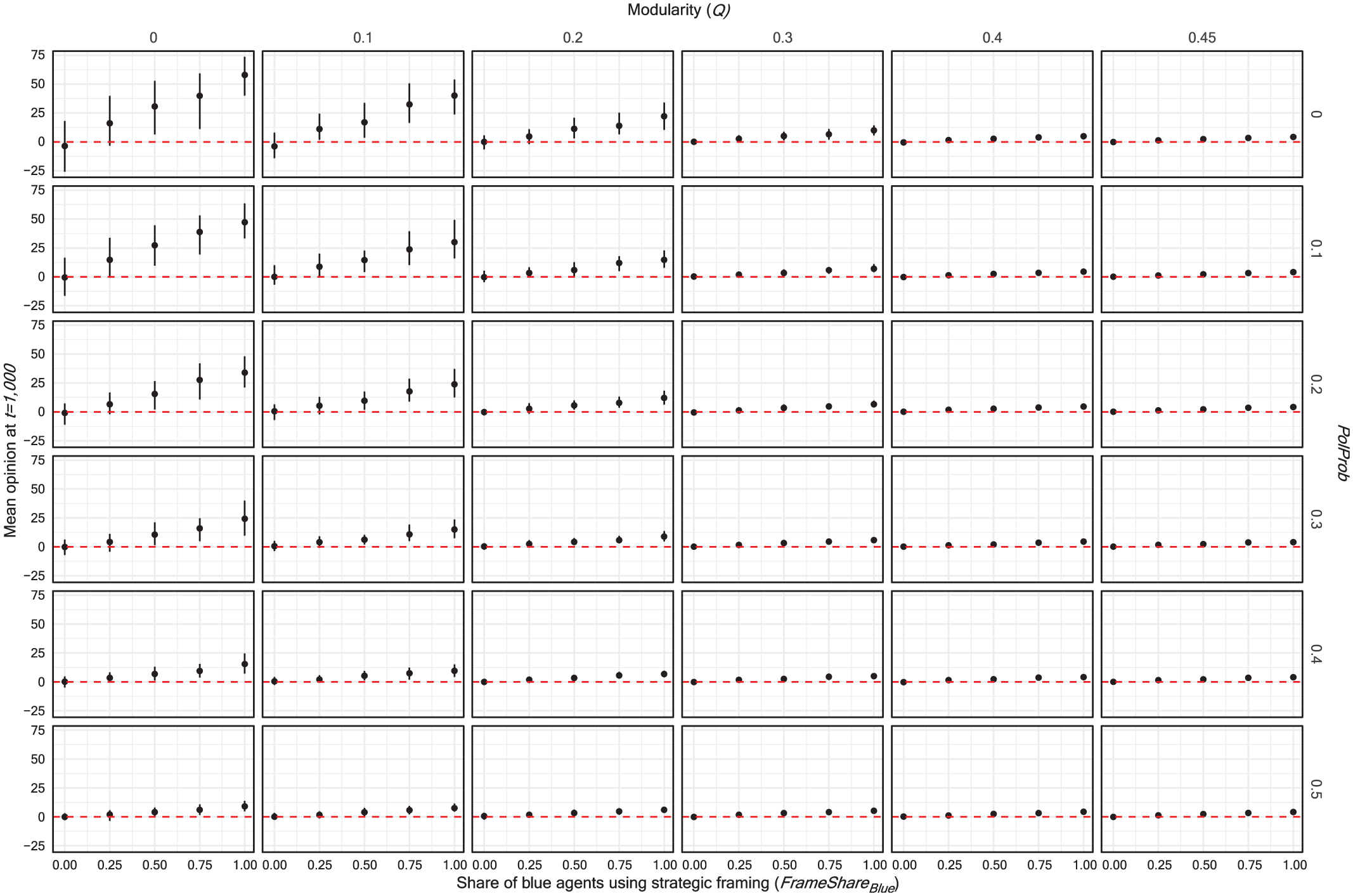
Mean Opinion at t = 1,000 from Simulations under Different Conditions
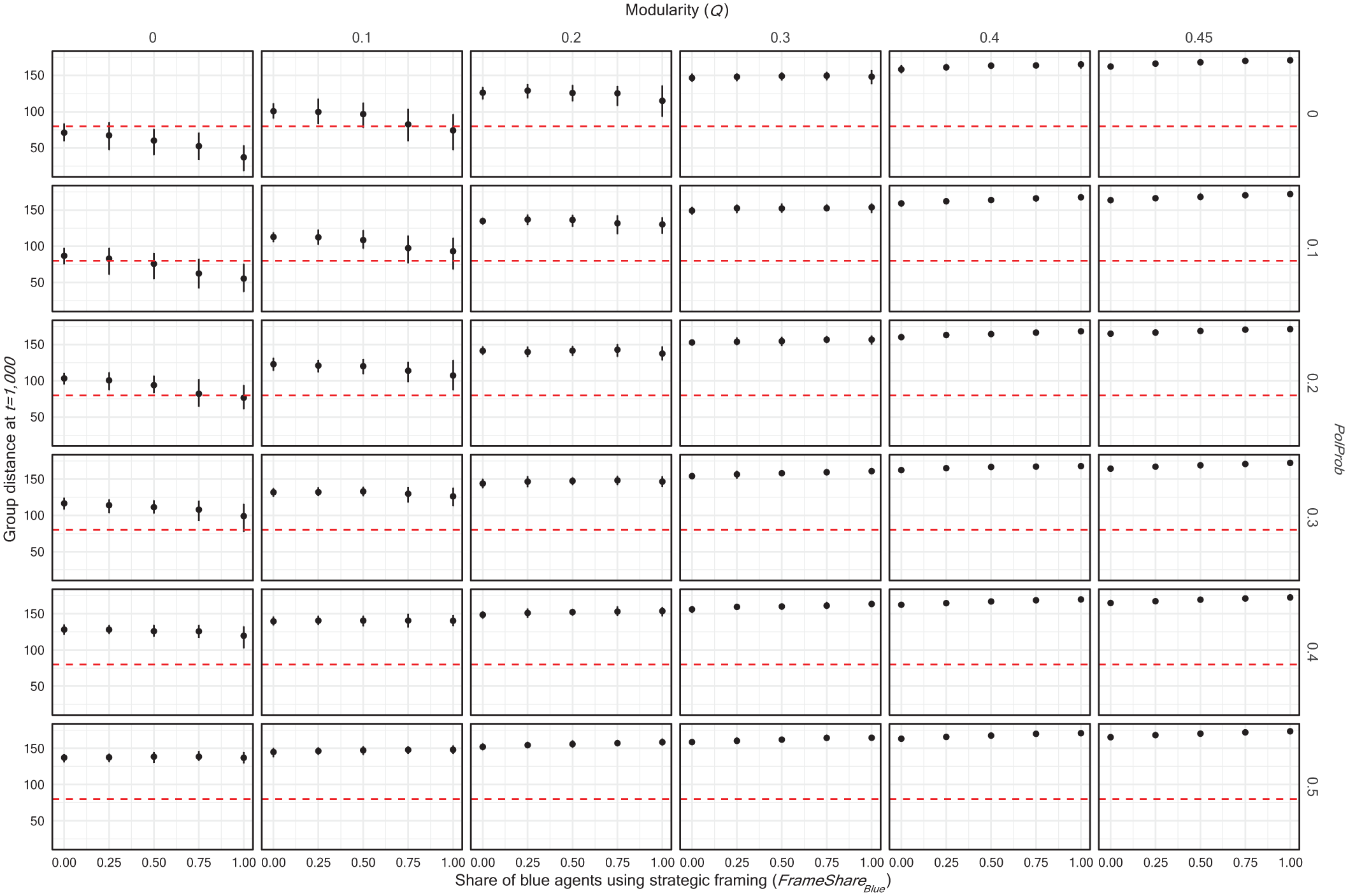
Mean Group Distance at t = 1,000 from Simulations under Different Conditions
We emphasize several key results. First, the share of agents engaged in strategic framing imposes a constraint on the aggregate framing effect. When 100 percent of blue agents are engaged in strategic framing and the conditions are otherwise most favorable (Q = 0 and PolProb = 0), the mean aggregate framing effect is 58. In contrast, keeping Q and PolProb at the same values but limiting FrameShareblue to 25 percent reduces the aggregate framing effect to just 16. As expected, the average opinion remains at 0 if no strategic framing is introduced. Irrespective of the FrameShareblue value, the simulations behave similarly across increasing values of modularity (Q) and PolProb. Increasing homophily has a strictly negative effect on the aggregate framing effect. At Q values of .4 and higher, the aggregate framing effect is below five even when all blue agents deploy strategic framing (FrameShareblue = 1) and the possibility of backlash is absent (PolProb = 0). Finally, the aggregate framing effect also decreases rapidly when we allow the possibility of backlash in cross-partisan discussions. For example, if half of the cross-partisan discussion of initially disagreeing agents result in conflict, then the framing effect of otherwise most favorable condition (Q = 0 and FrameShareBlue = 1) is limited to just nine points.
Examining the measure of group distance in Figure 7 provides additional insight. Very few conditions resulted in a reduction of group distance (below the dashed orange line in Figure 7). The reductions concentrate in the high-framing conditions in the top left corner of Figure 7. Significantly, high levels of cross-partisan interaction (low Q) and a near absence of the possibility of backlash are both prerequisites for reducing group distance. Another notable result is that group distance increases significantly even in many cases where Figure 6 reports a positive aggregate framing effect. For example, the average aggregate framing effect of simulations with FrameShareblue = 1, Q = 0, and PolProb = .4 was 15 points. Group distance increased considerably, however, from 80 to 120, indicating a pattern of polarization among the two groups. A closer examination of several examples of this simulation condition revealed that strategic framing allowed blue agents to persuade a small handful of orange agents to their position, but most of the aggregate framing effect is attributable to a rapid movement of blue agents to a more radical position while orange agents’ opinions remain largely entrenched on the opposite side of 0. In fact, in terms of opinion polarization, strategic framing appears to have the opposite of its intended effect under conditions of sufficient homophily and/or backlash. Rather than decreasing polarization, higher levels of FrameShareblue are actually associated with increased group distance, indicated by the positive association between FrameShareblue and group distance estimates in most of the plots with at least moderate levels of homophily and some possibility of backlash.
Although varying in magnitude, there is a positive effect of greater framing use on aggregate opinion and a negative effect on opinion polarization (at least in cases where there is sufficient cross-partisan interaction and backlash is limited). For the most part, therefore, framing matters for aggregate opinion. To get a handle on how much framing matters, it is important to measure these effects relative to other possible interventions. In Figure 8, we present results from linear regression models that compare the effect of FrameShareblue on aggregate opinion to the effects of increasing the opportunity for cross-partisan interaction and decreasing the chances of backlash. To improve comparison, we standardize each variable to reflect a one percent change. In other words, the magnitude of the framing coefficient corresponds to the effect of increasing the share of framing among blue agents by one percent, the rewiring coefficient corresponds to the effect of changing one percent of network ties from ingroup to outgroup, and the political backlash coefficient corresponds to decreasing the probability of backlash by one percent. Thus, all coefficients represent a possible intervention on one percent of individuals in the population.
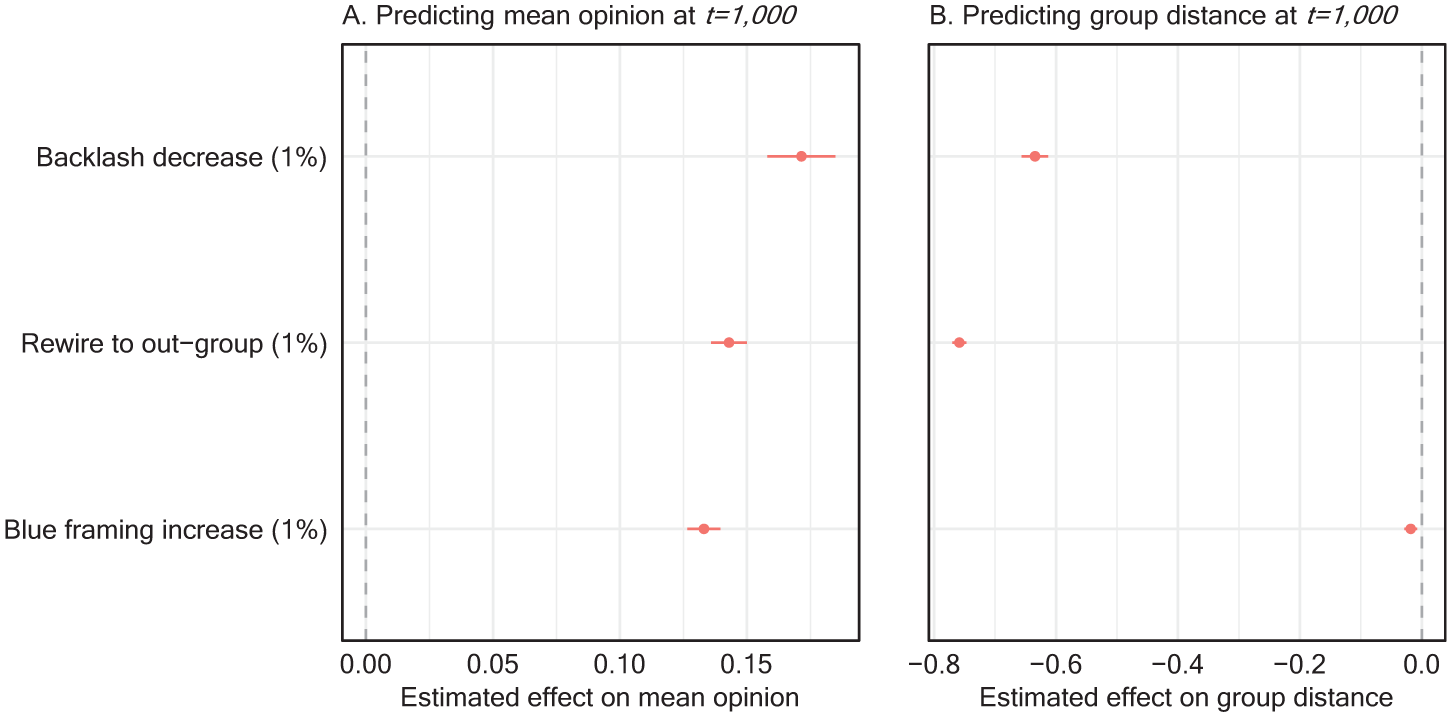
Estimates of Effects of Alternative Interventions on (a) Mean Opinion at t = 1,000 and (b) Group Distance at t = 1,000
Figure 8a presents the coefficient estimates from a model predicting average opinion at t = 1,000. A one percent increase in framing among the blue agents is associated with an increase in the average opinion of .13. The effect magnitude is similar for rewiring one percent of network ties from ingroup to outgroup (.14). Decreasing the probability of backlash by 1 percent is most consequential at the .17 point increase in average opinion for a 1 percent decrease in backlash probability. Figure 8b presents results for models predicting group distance. Here, framing is least important. Increasing the blue framing share by one percent is associated with a decrease in group distance of just .002, on average. In contrast, rewiring 1 percent of network ties and decreasing the backlash by one percent are both associated with over a half point decrease in group distance each—.76 and .63, respectively.
Alternative Networks and Communication Strategies
All the models analyzed so far assumed a discussion network where all communicating parties had approximately equal numbers of ties. In many communication settings, however, degree distributions are highly skewed. For instance, empirical networks on social media tend to be dominated by a small number of individuals with many followers, and the majority of the population have few connections (Arnaboldi et al. 2017). We replicate the simulations with networks that have scale-free properties. 6 The results from simulations on scale-free networks are nearly identical to those with more uniform degree distributions. Aggregate opinion shifts strongly only when partisan homophily is very low and the probability of backlash is minimal.
Who is endowed with strategic framing within a population is another important factor that may shape a strategic communication effort. Up to now, when FrameShareblue was less than 1.0, strategic framing was distributed randomly across the blue population. We might expect, however, that some segments of the population will be more likely to engage in strategic framing than others or, indeed, that communication professionals would design campaigns that strategically recruit specific types of individuals to use effective frames. We thus test two possible distributions of effective framing strategies: (a) agents with the highest number of connections are engaged in strategic framing, and (b) agents with the strongest initial opinions engage in strategic framing. We used the scale-free network to conduct both tests and repeated the procedure, generating 50 simulations per condition. The pattern of opinion change, including as measured by aggregate framing effect and mean group distance, were remarkably robust to these alternative communication strategies. Neither had a substantive effect on the simulation results, suggesting that the broader system dynamics—including network structure, repeated interaction, and identity effects—overwhelm tweaks in the patterning of who among the blue agents deploys framing strategies. 7 We present full results for these two conditions in the Online Appendix (Appendix Figures 3 to 6).
Discussion And Conclusions
Framing is a powerful idea. Small differences in how information is presented can evoke different responses from an audience, which can be leveraged as a communication strategy. During our review of recent empirical studies, we encountered notable results about effective frames for vaccine hesitancy and the COVID-19 response, immigration policy, welfare policy, and climate change (Green et al. 2023; James et al., 2021; Kustov and Landgrave 2025). Our study does not challenge these results addressing polarized issues. But our review also revealed the narrowness of focus in the empirical study of framing. The message takes center stage, but the source and receiver identities, the competitive environment, and other aspects of social context are largely left out of the research scope.
What happens when we take these framing effects as constant but bring in important elements of social context? Through simulations of our agent-based model, we systematically explored this question by varying key conditions of social embeddedness. In our model, framing strategies that are effective in informal communication settings do not add up to powerful persuasion at the aggregate level. This is not to diminish the documented power of framing in specific interactions but to highlight how its aggregate effect, when relying primarily on interpersonal diffusion as simulated here, appears highly contingent on the social structures and identity dynamics through which it operates. The extent to which effective framing strategies drive consensus in a polarized population depended on the opportunities for cross-partisan interaction and on neutralizing the probability of backlash. In populations characterized by higher levels of partisan homophily, effective framing strategies actually increased polarization within the model, due primarily to the emergence of highly persuasive echo chambers among the framing group pushing them to extremes while cross-partisan persuasion remained limited.
From the perspective of the practice of political communication, framing is not a cost-free intervention. Communication professionals must identify the right message for the right audience and then disseminate that message or equip influential individuals to adopt the communication strategy. Our simulation results suggest that within the proposed framework, interventions targeting the contextual parameters may be as or more effective for shifting aggregate opinion than simply increasing the share of individuals using effective frames. Specifically, interventions modeled as increasing cross-partisan interactions and decreasing backlash by one percent showed comparable or larger effects on mean opinion and significantly larger effects on reducing polarization compared to increasing the framing share by one percent. What might these alternative strategies look like in practice? Increasing cross-partisan interaction might mean deploying canvassing campaigns that facilitate interactions that would otherwise not happen (Broockman and Kalla 2016). Decreasing the probability of backlash implies lowering the salience of political identities (Guilbeault et al. 2018).
It is crucial to emphasize that our findings about the limitations of framing in informal networks should not be interpreted as evidence against the effectiveness of framing in real-world settings where professional communication campaigns are deployed. The combination of strategic framing with mass media campaigns, targeted advertising, and sophisticated messaging that transcends network boundaries and utilizes identity-matched spokespeople may prove highly effective at changing system-level opinion. Such professional campaigns can circumvent the homophily constraints and identity-based backlash that limit framing effects in purely interpersonal networks. Our study isolates a part of the communication ecosystem to understand its dynamics, but the full power of framing likely emerges when informal and formal channels work in concert.
We see our effort as supporting recent calls among framing researchers to bring greater coherence to the study of political persuasion (Druckman 2022). We agree with Druckman (2022) that the field would become more cumulative if researchers reflected on the elements of persuasion that their studies hold constant or assume away. In the increasingly prevalent survey experiment, actor identities and competition are largely absent from research on framing. This practice does not undermine the ability of experiments to identify framing effects, but it fails to contextualize the results and fit them within the broader framework of political persuasion. To address these blind spots, framing researchers should integrate a more embedded perspective in their research designs. This means: (1) a greater focus on the heterogeneity of framing effects by message source and by recipient identity; (2) studies that consider competition among multiple frames; (3) small-group studies that observe natural interaction, framing, and counter-framing among multiple individuals; and (4) empirical studies to understand relevant network structures.
Importantly, there are already great examples of research that incorporates such designs. For instance, using a field experiment, Broockman and Kalla (2016) illustrate the effectiveness of engaging people in two-way conversations and encouraging them to take the perspective of others for reducing transphobic attitudes. Other studies creatively induce cross-partisan interactions to identify conditions that lead to either lessening or heightening polarization (Bail et al. 2018; Guilbeault et al. 2018). These studies suggest, in line with our findings, that constructive political discussions and effective strategic communication campaigns are shaped by local, relational context.
There is advantage to parsimony in using agent-based modeling for theory development (Bruch and Atwell 2015; Macy and Willer 2002). Nonetheless, we want to highlight several reductive assumptions in our model that should be relaxed in future research. First, the assumption of two stable and categorical political identities is simplistic. Even in highly polarized and politicized settings, political identities are not binary and not held with equal strength. Second, we assume a stable political discussion network, but this assumption could be relaxed to allow individuals to select discussion partners dynamically based, for example, on similarity in opinion or background demographic characteristics. Third, we draw on insights from Baldassarri and Bearman's (2007) model to define how opinions shift through interpersonal interactions, but researchers have used other functions of opinion change that have also found empirical support (e.g., Dippong et al. 2017). Fourth, and centrally important given our focus, our model deliberately focuses on interpersonal dynamics and does not specifically incorporate the influence of mass media, elite messaging campaigns, or other formal communication structures that could amplify framing effects, which are known to be critical factors in real-world opinion formation and persuasion campaigns. Although the limitations of our own model are important to recognize, we emphasize that the goal of our study was not to create a fully realistic model of opinion change but, rather, to show how effective messaging, which is documented in framing studies, aggregates in a minimally plausible system of social interaction. Improving the realism of the model further would not necessarily advance this goal, but it would still advance our understanding of processes of opinion change. Ultimately, formal modeling is not a substitute for empirical research, but the models are valuable insofar as they generate theoretical expectations that can then better guide future data collection efforts. One benefit of agent-based models is that specifying them forces a researcher to formally define key elements of a dynamic system (Bruch and Atwell 2015). By situating framing effects within a formal model of opinion change, important and neglected avenues for framing research become apparent. We urge framing researchers and others interested in opinion dynamics to contribute to this important work.
Supplemental Material
sj-docx-1-spq-10.1177_01902725261418323 – Supplemental material for Framing Effects in Informal Communication Networks and the Problem of Embeddedness
Supplemental material, sj-docx-1-spq-10.1177_01902725261418323 for Framing Effects in Informal Communication Networks and the Problem of Embeddedness by Fedor A. Dokshin and Sébastien Parker in Social Psychology Quarterly
Footnotes
Supplemental Material
Supplemental material for this article is available online.
2
Baldassarri and Bearman (2007) base this mechanism on theories of social comparison, which have been shown to contribute to group polarization ( ). To ensure that the inclusion of this specific mechanism does not hardwire polarization into our model and singularly drive our results, we reran the analyses without this assumption, allowing individuals with similar views to compromise instead of reinforce each other's opinions. The results across the two models are unchanged. We thank a reviewer for pushing us to explore this possibility.
3
Formally, Q is defined as follows:
4
Note that Q can never equal 1 in a network that is at least minimally connected, which we require for all simulations.
6
In consideration of space constraints, we present results from these simulations in the Online Appendix ().
7
We present full results for these two conditions in the Online Appendix ().
Bios
References
Supplementary Material
Please find the following supplemental material available below.
For Open Access articles published under a Creative Commons License, all supplemental material carries the same license as the article it is associated with.
For non-Open Access articles published, all supplemental material carries a non-exclusive license, and permission requests for re-use of supplemental material or any part of supplemental material shall be sent directly to the copyright owner as specified in the copyright notice associated with the article.
