




Abstract
Views on equality of opportunity influence perceptions of fairness and redistributive attitudes, and yet the sources associated with these views remain underexplored. This study investigates how individual experiences, socialization with friends and family, and media consumption are related to perceptions of equality of opportunity across three welfare state regimes in Europe: Germany, Sweden, and the United Kingdom. Using original cross-national survey data, we analyze responses to a statement on current levels of equality of opportunity, employing—among other methods—an inverse probability weighting approach. Findings reveal moderate cross-country variation, with higher optimism about equality of opportunity in the United Kingdom than in Germany and Sweden. Personal experiences are the most influential factor: upward mobility tends to be associated with beliefs in equality, whereas downward mobility is linked to perceptions of inequality. Socialization with family and friends links to perceptions to a more limited extent. Media consumption also plays a role; individuals who watch reality TV shows are more likely to perceive greater equality of opportunity. As shown by previous research, however, this optimism may have counterintuitive effects; by fostering the belief that opportunity is already widespread, it can dampen public support for redistributive measures, potentially reinforcing existing inequalities.
Equality of opportunity, defined as equal chances to get ahead in life regardless of circumstances outside of individual control, is often perceived as a cornerstone of a fair and functional society. Countries with higher levels of intergenerational social mobility tend to foster greater trust, cooperation, and well-being among their citizens (Chetty et al. 2014; Gugushvili and Kaiser 2020; Wilkinson and Pickett 2018). Paradoxically, however, overly strong beliefs in equality of opportunity and meritocracy can legitimize growing social inequality and strengthen divides between those who move up the societal ladder and those who stay behind (Sandel 2020). When individuals believe that everyone has similar opportunities and that differences in outcomes are merely due to differences in ability and effort, they can approve social differences and contest the need for redistribution (Alesina and La Ferrara 2005; García-Castro et al. 2022; Kluegel and Smith 1986).
The incapability of individuals to accurately estimate levels of inequality in their society might in part explain this mismatch between actual and perceived levels of equality of opportunity (Cruces, Perez-Truglia, and Tetaz 2013; Engelhardt and Wagener 2018; Gimpelson and Treisman 2018; Gugushvili, Reeves, and Jarosz 2020). Yet this raises the question of what can then explain how people form their perceptions about equality of opportunity, if not actual levels of inequality. Or phrased differently, which sources or channels are most important to citizens in forming their perceptions of the level of equality in opportunity? The goal of the current study is to provide an answer to this question by analyzing the role of personal experiences, socialization with family and peers, and media narratives as potential channels of information and learning processes. The perception of equality of opportunity is an essential part of debates on inequality, which can have real consequences for the willingness to assist others. This study is an important endeavor to better understand the urgency of these perceptions and how they arise.
Despite its relevance, the majority of the literature focusing on perceptions of equality turns its gaze toward the outcome or output side of equality rather than to opportunities as the input side of disparities (Jachimowicz et al. 2023; Reynolds and Xian 2014). The studies that do analyze perceptions of equality of opportunity or meritocracy usually tend to focus on two explanatory frameworks, socioeconomic status and ideology (Bavetta, Li Donni, and Marino 2019; Brunori 2017; Reynolds and Xian 2014; Solt et al. 2016). These studies find that those in more socioeconomically vulnerable positions and who are ideologically progressive are less likely to perceive equality of opportunity. Although this strand of research has been useful and offers important insights into divides in perceptions in various segments of the population, these do not entirely capture the most important sources of information that people use to form their perceptions, and hence, it is still relatively unclear how people learn about or determine levels of equality of opportunity.
Building on this literature, the current study innovates in three important ways. First, we assess the most important self-reported channels of information people use to learn and form their perceptions of equality of opportunity. Second, our analysis examines the relative importance of individual experiences of socioeconomic success, socialization through friends and family, and various types of media consumption to understand better which factors are most significant for individuals. Last, because both perceptions themselves and the basis of these estimations might vary across contexts with different institutional and political landscapes, we analyze this in three different contexts. Specifically, our primary data stem from three distinct welfare state contexts: Germany (conservative), Sweden (social-democratic), and the United Kingdom (liberal). Among other approaches, we use an inverse probability weighting estimator to explore how various channels of information are linked to perceptions of equality of opportunity.
Theoretical Framework
Perceptions of Equality of Opportunity
Generally, there is a distinction between equality in outcomes and in opportunity, which constitute two interconnected but distinct dimensions of equality. Equality of outcome pertains to the results or the output side of distributions, emphasizing “levels of living.” In contrast, equality of opportunity relates to the input or procedural side of attainment, focusing on options, chances, and possibilities in achievement processes (Flora and Heidenheimer 1981; Jachimowicz et al. 2023; Roller 1995). The latter is not necessarily irreconcilable with inequalities in outcomes if everyone is given the same chances to get ahead in life. Most public opinion research nevertheless focuses more on the output or outcome side of distribution despite growing attention to the importance of opportunities as well.
An adjacent concept involves beliefs in meritocracy, which comprises a social system that governs success through a combination of effort and ability (Mijs 2021; Young 1958). Whereas meritocracy supposes that success reflects ability and effort, equality of opportunity merely requires that everyone has the same chance of success (García-Sánchez et al. 2020). In this sense, meritocracy allows for unequal starting positions when they are governed by ability or endowments, whereas equality of opportunity requires more egalitarian points of departure to truly guarantee similar chances to succeed (Mijs 2016). Despite some differences, however, both are close to each other in theory and presume a sense of individual control over outcomes, which is hence connected to a legitimization of social inequalities (Alesina and La Ferrara 2005; García-Sánchez et al. 2020; Mijs 2016). Given more limited empirical research into perceptions of equality of opportunity, the current study builds on literature delving into perceptions of meritocracy as well.
Yet even within views on the equality of opportunity, there is an important demarcation between perceptions and beliefs on equality of opportunity, also known as the differences between “what is” and “what ought to be” (Kluegel and Smith 1986). Perceptions refer to “subjective estimates of existing inequality,” whereas beliefs encompass “normative ideas about just inequality” (Janmaat 2013). Although the two are interrelated, they form clearly distinct dimensions of public opinion that relate differently to various individual- and country-level variables (Castillo et al. 2023; Duru-Bellat and Tenret 2012). The current study investigates perceptions about the current state of equality of opportunity rather than normative beliefs about desired levels.
Sources of Perceptions of Equality of Opportunity
Research looking into perceptions of inequality or meritocracy usually focuses on one's own social and economic position or broader ideological beliefs as explanatory frameworks (Bavetta et al. 2019; Brunori, 2017; Gugushvili, 2015; Kang 2020; Reynolds and Xian 2014; Solt et al. 2016). Whereas the first framework finds that individuals with a more disadvantaged status perceive larger barriers to attainment and hence lower equality of opportunity (Bavetta et al. 2019; Brunori 2017; Kang 2020), the second framework highlights that progressive or left-leaning individuals are less likely to perceive equality of opportunity (Bavetta et al. 2019; Kang 2020).
Because both are important explanations of equality perceptions, they are included in the empirical models of this study as well. They do not provide much more insight, however, into which sources people use to learn about and, hence, formulate their perceptions of equality of opportunity. Because these perceptions still influence support for redistribution and acceptance of inequality (García-Sánchez et al. 2020; Kluegel and Smith 1986), it is important to understand how citizens report their own perceptions when forming conclusions about current equality levels. As a result, we dive into three potential sources of perception formation and their relative weight: personal experiences, socialization with peers, and media consumption (Gugushvili and Reeves 2021).
One important way people develop perceptions of equality of opportunity is through personal experiences. Specifically, we examine an individual's own objective and subjective social mobility as a key formative experience. Two mechanisms could connect these experiences of mobility to perceptions of equality of opportunity, namely, motivated reasoning and experiential inference (Mijs et al. 2022). Motivated reasoning or a self-serving bias implies that those who experienced upward mobility as so-called “winners” will be more likely to attribute this to talent in order not to challenge their own obtained position (Brunori 2017; Gugushvili 2016; Olivos 2021).
The experiential inference perspective suggests that individuals develop perceptions through learning processes rooted in direct experiences and interactions (Gugushvili 2019; Margalit 2013; Mijs et al. 2022). These lived experiences, whether upward or downward social mobility, can lead individuals to update their views on fairness and meritocracy. Accordingly, we expect that individuals will state that personal experiences are an important channel for their formation of perceptions about equality of opportunity. At the same time, experiential inference extends beyond individual trajectories: prior work has shown that individuals also respond to indirect environmental cues, using their sociopolitical and economic surroundings as reference points for judgment. For instance, regional socioeconomic conditions, such as local income inequality and demographic composition, have been found to shape perceptions of injustice and influence political attitudes and preferences (Hastings 2019; Lindner and Houle 2021).
The second channel for perception formation is socialization with close peers, such as family, friends, and neighbors. Because people especially use their close and homogeneous environment as a reference group and as a source to learn about inequality (Bottero 2019; Hing et al. 2019; Schulz, Mayerhoffer, and Gebhard 2022), there is a strong possibility that close peers inform perceptions of equality of opportunity as well. On the one hand, this could occur through direct comparisons with people in spatial or social proximity, whereby individuals compare their status to close others to infer the state of equality in opportunity (Andersen, Lue Kessing, and Østergaard 2021). On the other hand, people could also base their conclusions about equality on everyday interactions with others and the social status of those around them (García-Castro et al. 2022). In sum, through their family and peers, citizens could learn about opportunities and, hence, alter their perceptions.
Last, beyond direct experiences and socialization with relatives or peers, broader information might also be an important source (Mijs and Hoy 2022). A central broker of information is the media, which can provide citizens with descriptions of the state of equality that are not necessarily always realistic (Gugushvili et al. 2020). By providing information or priming specific topics, the media can activate belief systems and frames of reference through which society is perceived and, hence, also make people view the world in egalitarian or meritocratic terms (McCoy and Major 2007). There is an important distinction, however, between traditional news media, for instance, and entertainment programs or social media. Whereas traditional news media in democratic societies often focus on inequality and downward mobility, which decreases perceived social justice and heightens economic concerns, entertainment (e.g., talent or game shows) or social media might portray a strong message of meritocracy. Entertainment shows have, for instance, been shown to heighten beliefs in the American Dream and internal control over socioeconomic attainment (Diermeier et al. 2017; Kim 2023). As a result, we expect different sources of media to work as important channels for perception formation on equality of opportunity.
Based on theory and previous findings, we hence expect each of these three sources to be important channels through which perceptions of equality of opportunity are forged. Yet in which way they will sway perceptions to more egalitarian or inegalitarian sides remains an open question and depends on the nature of the experiences, socialization, and media frames. In the first step of our analysis, individuals report themselves the channels they find most important, which is relevant to understand their self-attributed information channels better. In a second step, external measures on personal experiences and media consumption are also linked to perceptions of equality of opportunity. Formulating precise expectations about these links is challenging, however, so we adopt an inductive approach.
Variation across Welfare Regimes
Because perceptions of equality are likely to vary across contexts, in this study, they are analyzed in three different settings: Germany, Sweden, and the United Kingdom. These countries clearly demarcate distinct institutional contexts according to the welfare regime typology, namely, conservative, social-democratic, and liberal regimes, respectively (Esping-Andersen 1990). According to the moral economy and policy feedback frameworks (Kumlin and Stadelmann-Steffen 2014; Mau 2003; Sachweh 2012), these institutional contexts portray different norms about equality and welfare distributions, which can be internalized by citizens in return. Although some find limited evidence for an important link between these welfare regimes and attitudes toward redistribution (Van Hootegem 2022), others find clearer links between the two (Andreß and Heien 2001).
Although most of the available research examines how these contexts relate to normative beliefs rather than perceptions, we would similarly expect that perceptions of equality of opportunity vary across these countries. According to the logic of moral economy, the different institutional contexts establish different norms about to what extent government action is desirable and how to organize redistribution. So when a government emphasizes the importance of universality and redistribution, people will, in turn, see a stronger need for redistribution and government intervention (Andreß and Heien 2001), which goes hand in hand with lower perceptions of equality of opportunity (García-Sánchez et al. 2020; Kluegel and Smith 1986). In other words, institutions highlight a lack of equality of opportunity by emphasizing that redistribution is necessary to equalize life chances and outcomes. This paradox of higher redistribution coupled with lower perceptions of equality was also raised by Mijs (2021), who demonstrates that higher inequality relates to a stronger belief in meritocracy. Based on this, perceptions of equality of opportunity might be highest in the United Kingdom, followed by Germany and then Sweden.
Yet beyond being part of different welfare clusters, these countries have distinct occupational structures, economies, and political spheres and portray clearly distinct levels of social mobility and income inequality (Bukodi, Paskov, and Nolan 2020; Corak 2013). Because all of these characteristics could influence perceptions, we refrain from making strong predictions about the structure and channels of equality of opportunity in these three contexts. Instead, we use them empirically to assess potential variation across socioeconomic, political, and institutional contexts.
Research Design
We collected data for this study through Bilendi and Respondi, a public opinion research organization with a well-established survey infrastructure across European societies (Gugushvili and Präg 2024; Hajek, Kretzler, and König 2023; Mehlkop, Neumann, and von Hermanni 2023; Sainz Villalba and Konrad 2024). Bilendi and Respondi adheres to the ethical and privacy standards outlined by the European Society for Opinion and Market Research during the data collection process. Data collection took place in February and March 2023. Recruitment of respondents occurred through online panels in Germany, Sweden, and the United Kingdom, with approximately 1,600 participants from each country. The samples are representative of these countries’ populations in terms of age (25–64 years, cohorts born between 1959 and 1998), gender, and regional belonging (using the European NUTS-2 classification). Recruitment followed a nonprobability, quota-based sampling strategy, implemented through a proprietary sample management system that ensures demographic quotas are met while accounting for prior participation and predicted response rates. All participants received compensation for their time in accordance with standard practices for online survey research. For most variables used in the study, item-level missingness was negligible, and multivariate analyses relied on a listwise deletion approach. Notably, there was no indication that item nonresponse was not at random. 1 The Institutional Review Board of Institut Louis Bachelier in Paris, France, approved this study ethically.
Questions about Equality of Opportunity and Channels of Information
The survey collected information about equality of opportunity by asking individuals how they felt about the following statement: “In [Germany/Sweden/the United Kingdom] everybody, regardless of their social origins, has a chance to make it and be socially and economically successful.” The Likert scale answer option varied from strongly disagree = 1 to strongly agree = 5. The follow-up question explored respondents’ perspectives on what shaped their views regarding equality of opportunity. Participants were asked to choose the answer from a list of channels that most strongly affected their perceptions. These included (a) personal experiences of social or economic success, (b) observations within their own families, (c) discussions with friends or neighbors, (d) information gathered from traditional media (sources like television, printed press, and news websites), (e) social media platforms, and (f) the separate category for all other channels. This measurement strategy relied on previous uses of a similar survey item (Gugushvili et al. 2020; Gugushvili and Reeves 2021), which supports its validity.
Personal Mobility Experiences
In addition to the main question about which sources individuals state as being important for forming perceptions, we additionally consider the role of different types of personal mobility experiences in shaping perceptions. Specifically, in relation to individuals’ and their families’ experiences, the survey included two questions designed to assess family income both during individuals’ upbringing and in their current household situation. The first question asked respondents to reflect on their family's financial standing when they were growing up. They were prompted to evaluate their family's income relative to others at that time, choosing from categories such as “(far) below average,”“average,” and “(far) above average.” The second question shifted focus to the present, asking participants to compare their current household income with that of other families. The response categories mirrored those of the first question, allowing for a consistent comparison of perceived income positions across time. Using responses from these two questions, we constructed an income mobility variable. This variable cross-classifies in nine trajectories respondents’ perceived income positions during childhood and their current household income positions. This approach enables an analysis of income mobility patterns, identifying whether individuals experienced upward or downward mobility or immobility across generations based on their reported income.
Another survey question explicitly probed respondents’ perceptions of their socioeconomic progress compared to their parents. Participants were asked to indicate their level of agreement with the statement, “I have done worse in life than my parents when they were of my age.” Responses were captured on a Likert scale ranging from strongly disagree = 1 to strongly agree = 5. Using the responses, we constructed a variable to measure subjective socioeconomic mobility. This variable reflects individuals’ self-assessed intergenerational mobility, either in an upward or downward direction, relative to the socioeconomic position of their parents.
Media Exposure
Similarly to personal experiences, we also conduct a more thorough test for the role of the media. In particular, we collected data on individuals’ media consumption habits by asking how much time they typically spend engaging with different types of content daily. Respondents were prompted to estimate their daily consumption in hours and minutes. The first type of content focused on news related to politics and current affairs, capturing how much time individuals dedicate to staying informed about economic, political, and societal developments. The second type of content encompasses entertainment programming, such as reality shows and game shows, including popular examples, such as Das Supertalent in Germany, Talang in Sweden, and Britain’s Got Talent in the United Kingdom. By gathering these data, we aimed to understand the balance between respondents’ consumption of informational and entertainment media, providing insights into their daily media preferences and habits.
Covariates of Equality of Opportunity Perceptions
In our statistical estimates, we accounted for individuals’ key sociodemographic characteristics that might be associated with equality of opportunity perceptions (Brunori 2017; Steele 2015). Gender is included, with respondents specifying their identity as woman or man (the nonbinary category was included in the survey but yielded too few responses for a meaningful analysis). Age is determined through a direct question about the respondents’ year of birth. Educational attainment is captured by asking respondents to indicate their highest level of completed education, ranging from primary education to doctoral degrees. Marital status is assessed with married versus other categories. Employment status is also factored in with a dummy variable taking the value of 1 if participants reported being in paid work over the past seven days. Finally, the survey measures political ideology on a scale from 0 (representing the far left) to 10 (representing the far right), allowing respondents to place themselves on this ideological scale. 2
Statistical Analyses
In this study, we employ several statistical techniques to present and examine the role of various channels of perceptions of equality of opportunity across three countries. First, we present descriptive results for inequality perceptions, information channels, and cross-country differences, followed by the aggregation and dichotomization of perceptions of equality of opportunity.
Next, to evaluate the impact of the channels through which individuals develop their perceptions of equality of opportunity, we calculate the average treatment effect (ATE) using an inverse probability weighting (IPW) modeling strategy (Seaman and White 2013). This method adjusts for missing data arising from the fact that each individual is observed in only one of the potential outcomes—perceiving equality of opportunity. More specifically, the IPW approach follows a two-step process. First, it computes inverse probability weights using the sociodemographic variables as described earlier. Second, it applies these weights to calculate weighted averages of the outcome variable for each channel of perceptions about equality of opportunity. The differences between these weighted averages are used to derive the ATEs. A key advantage of the IPW approach is that it addresses the issue of missing potential outcomes by rebalancing the sample to account for the unobserved counterfactuals (Austin and Stuart 2015). The IPW estimations are performed using Stata 18’s “teffects” function, with the “ipw” specification applied. The results are presented as potential outcome means (POMs) for perceptions of equality of opportunity along with corresponding 95 percent confidence intervals (CIs).
IPW is a powerful tool for approximating causal inference in observational data, but its validity rests on key assumptions, including the exogeneity of the variable of interest and the absence of unmeasured confounding. In our study, the “treatments” correspond to respondents’ self-attributed sources of influence, subjective reflections on what most shaped their views of equality of opportunity. These reports may be affected by cognitive biases, identity alignment, or post hoc rationalization in addition to actual exposure histories. Therefore, we interpret our analysis as uncovering adjusted associations rather than establishing causal effects. Despite these limitations, the use of IPW improves covariate balance across self-attributed groups, allowing for more structured and informative comparisons. Unmeasured confounding remains a possibility, but we mitigate this risk by including a comprehensive set of covariates in our models.
Beyond the descriptive overview and IPW modeling strategy, we analyze the links between different types of mobility experiences and media consumption patterns. Although it would be interesting to do this for socialization with friends and family as well, this comprises such a diverse group and broad network that it would be difficult to capture, and hence, data constraints do not enable us to do so. Therefore, a second analytical approach involves the use of linear probability models (LPMs), which are well suited for dichotomous dependent variables (Angrist and Pischke 2009). These models allow us to estimate the association between mobility experiences and media consumption and the likelihood of respondents perceiving either equality or inequality of opportunity.
Results
Equality of Opportunity Perceptions and Their Sources
Figure 1a presents perceptions of equality of opportunity across Germany, Sweden, and the United Kingdom. Although opinions vary, a general optimism emerges. In the United Kingdom, 38 percent agree and 14 percent strongly agree that everyone has a chance to succeed, resulting in just over half expressing a positive view. In Germany and Sweden, 33 percent agree and 13 percent strongly agree, yielding around 45 percent with an optimistic outlook in each. At the same time, a substantial minority remains skeptical: 32 percent in Germany, 29 percent in Sweden, and 27 percent in the United Kingdom disagree with the statement, suggesting that concern about unequal opportunities is present in all three societies.
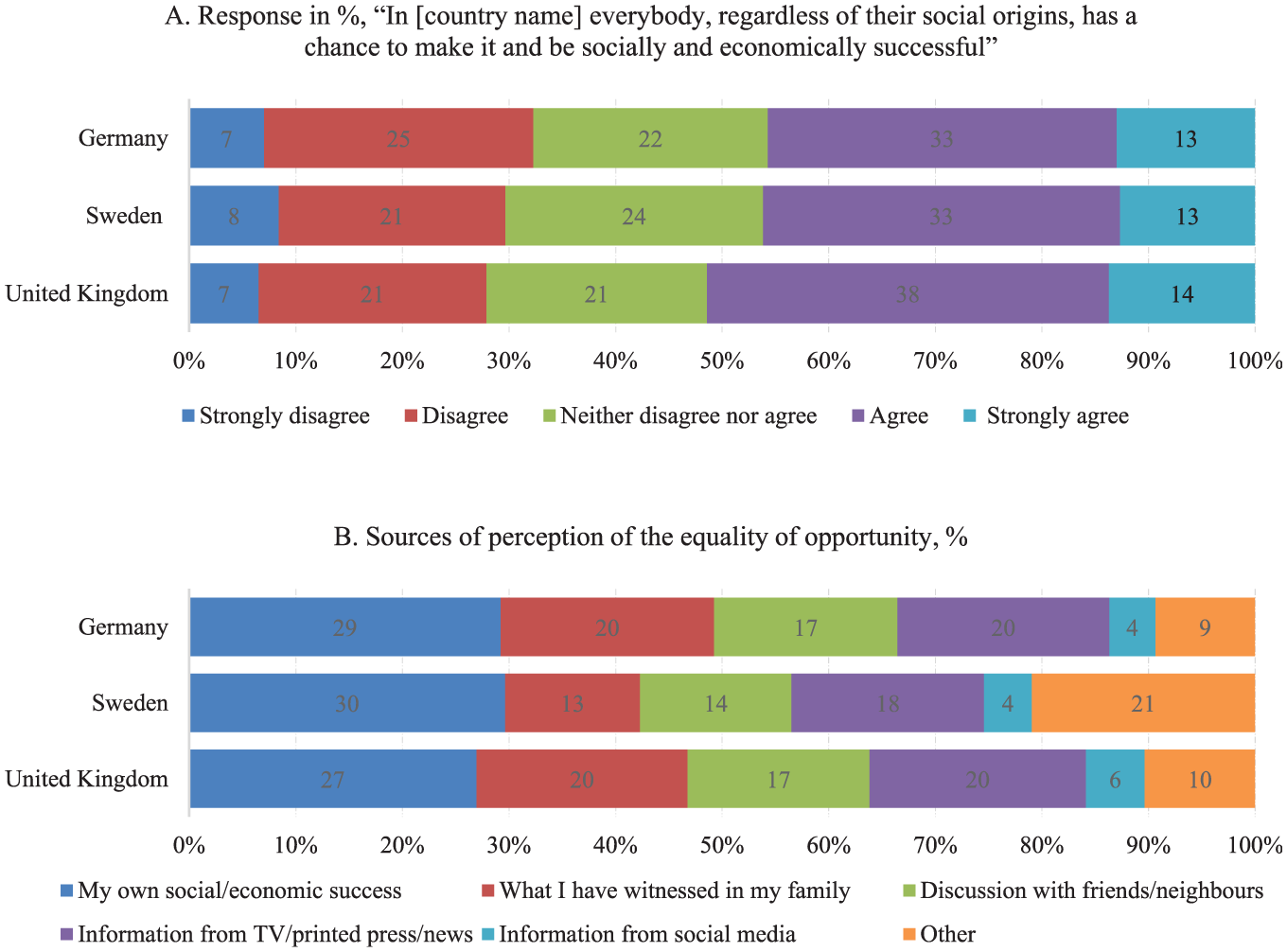
Prevalence of Equality of Opportunity Perceptions and Channels of Information
Figure 1b displays the sources people draw on when forming these views. Personal experience is the most frequently mentioned across all countries, with 27.0 percent in the United Kingdom, 29.2 percent in Germany, and 29.7 percent in Sweden citing their own social or economic success. Family is the next most common influence in the United Kingdom and Germany, where around one in five refer to familial experiences. In Sweden, however, only 12.7 percent mention family, suggesting a weaker role for familial socialization. Discussions with friends or neighbors are cited by 17 percent in both the United Kingdom and Germany and 14 percent in Sweden, pointing to the moderate influence of peer interactions.
Traditional media, such as TV, newspapers, and online news, is a relevant source in all three countries given that about 20 percent of respondents declare it to be the most important source of information. Social media, by contrast, seems to have a limited impact, with only 4 percent to 5 percent naming it as a key source. Finally, the “other” category stands out in Sweden, where 20.9 percent chose it, compared to 10.4 percent in the United Kingdom and 9.3 percent in Germany, suggesting that Swedes may rely more on alternative or unlisted sources of information.
Equality of Opportunity Perceptions by the Source of Information
Figure 2 illustrates how different sources of information are associated with perceptions of equality of opportunity across Germany, Sweden, and the United Kingdom. We distinguish three categories of respondents: those who perceive inequality, those who are neutral, and those who perceive equality. The salience of each source, personal experience, family, friends, traditional media, social media, and others varies across countries, offering insights into how individuals form beliefs about the fairness and accessibility of opportunity in their societies.
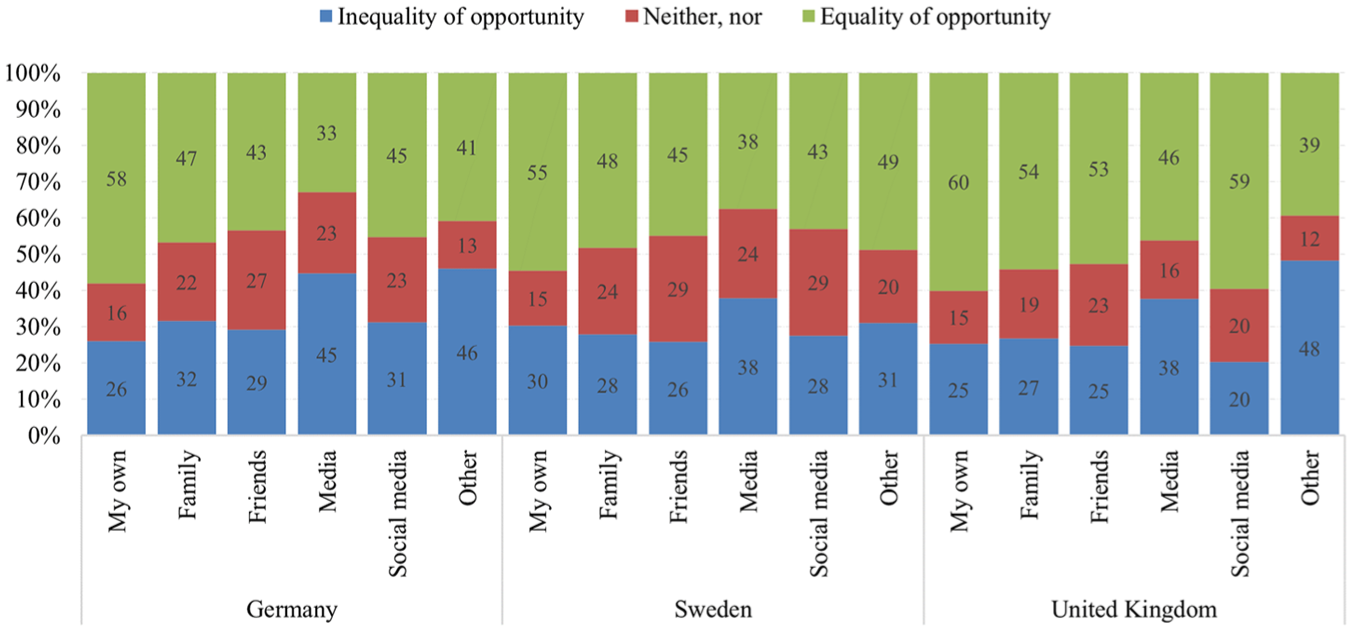
Perceiving Equality of Intergenerational Opportunity by Channels of Information about Inequality of Opportunity
Personal experience emerges as the most consistent and influential source shaping beliefs in equality of opportunity. A clear majority of respondents who rely on their own social or economic experiences perceive opportunity to be relatively equal: 60 percent in the United Kingdom, 58 percent in Germany, and 55 percent in Sweden. This suggests that those who view themselves as having achieved upward mobility are more likely to generalize their success. At the same time, a notable minority, ranging from 25 percent in the United Kingdom to 30 percent in Sweden, report perceptions of inequality, indicating that experiences of stagnation or downward mobility can lead to very different conclusions. These divergences are explored further in the multivariate analyses.
Family and friends, although slightly less influential, still play an important and often ambivalent role. Among those citing family, 54 percent in the United Kingdom, 47 percent in Germany, and 45 percent in Sweden believe in equality of opportunity. Observing a family member overcome obstacles may reinforce meritocratic beliefs, whereas persistent disadvantage may foster skepticism about societal fairness. Friends follow similar patterns: 43 percent in Germany, 45 percent in Sweden, and 50 percent in the United Kingdom express belief in equality, and about one-quarter in each country perceive inequality. Although friends and family serve as important reference groups, their role appears more diffuse and context-dependent than direct personal experience.
Traditional media, such as television and newspapers, tend to be associated with greater awareness of inequality. In Germany, 45 percent of media users report perceptions of inequality, compared to 33 percent who perceive equality. Sweden shows a balanced distribution (38 percent for both), and the United Kingdom is somewhat more optimistic, with 46 percent perceiving equality and 36 percent perceiving inequality. These patterns suggest that traditional media may highlight structural barriers, economic disparity, and social injustice, shaping public awareness of unequal opportunity.
Social media shows a more uneven and country-specific association. In the United Kingdom, 59 percent of respondents citing social media believe in equality of opportunity, with only 20 percent perceiving inequality. In Germany and Sweden, however, views are more evenly divided. This variation may reflect differences in platform use, content exposure, or the perceived reliability of these channels for informing views about societal fairness.
Lastly, the “other” category, likely including community organizations, cultural narratives, or institutional sources, shows the strongest association with perceived inequality in Germany (46 percent) and the United Kingdom (48 percent), whereas in Sweden, this figure is lower (31 percent). These alternative sources may amplify attention to structural divisions, localized injustices, or nonmainstream discourses that challenge dominant narratives of equal opportunity.
Inverse Probability Weighting Estimates
Figure 3 presents POM estimates from the IPW approach, assessing perceptions of equality of intergenerational opportunity through various channels across Germany, Sweden, and the United Kingdom. 3 The results suggest that our weighting strategy balanced the covariates used in the estimations. The primary analyses, in turn, confirm the diverse links between personal experiences, family and friends, and media, on the one hand, and equality of opportunity perceptions, on the other hand.
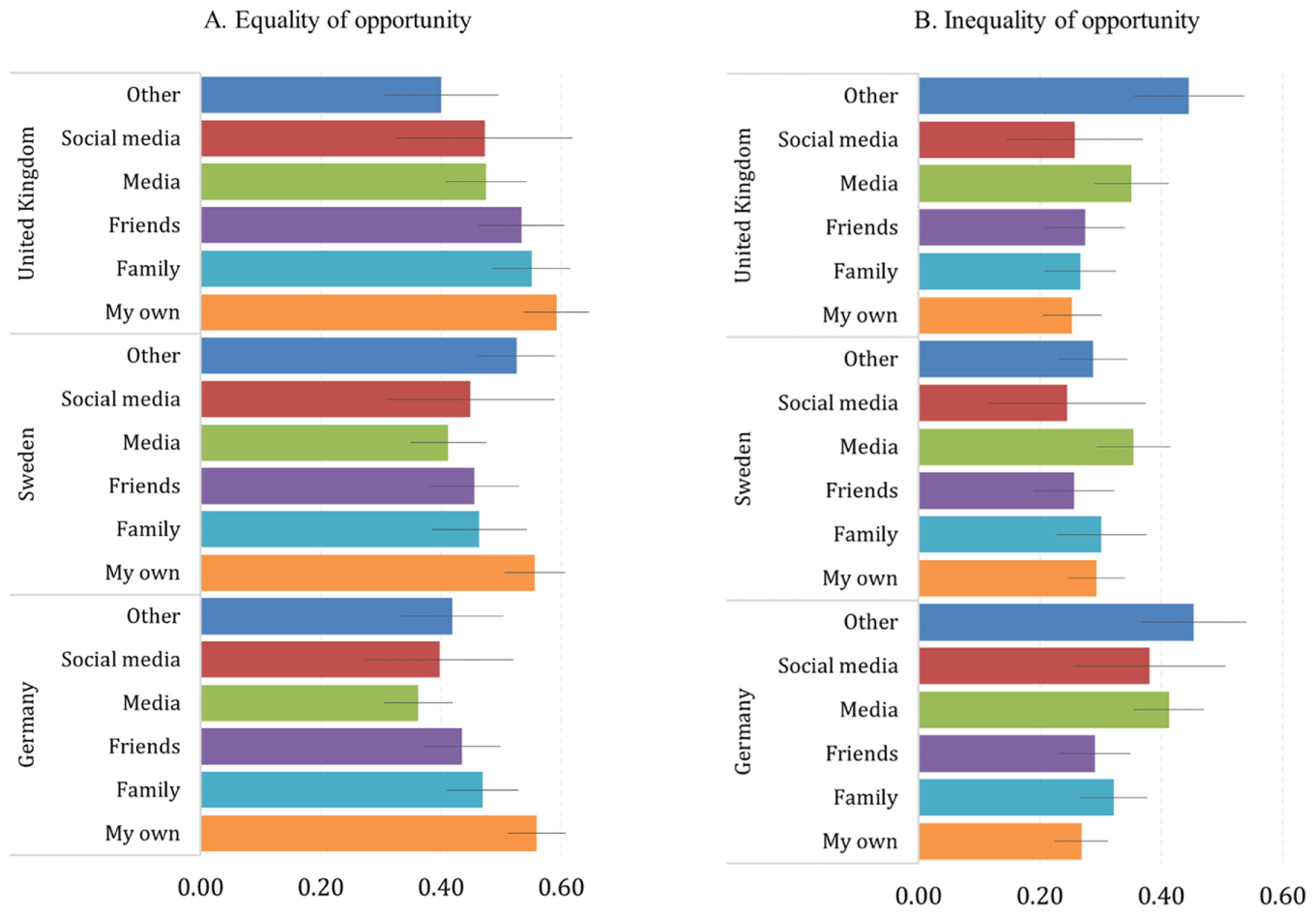
Potential Outcome Means from the Inverse Probability Weighting Approach Model of Perceiving Equality of Intergenerational Opportunity by Channels of Information about Inequality of Opportunity
Along with the descriptive results from the previous section, personal experiences again emerge as the most significant source of information about equality of opportunity, with some variation across countries. In the United Kingdom, personal experiences showed the strongest influence, with a POM of .59 (95 percent CI [.54, .65]), whereas Germany and Sweden reported slightly lower values of .56 (95 percent CI [.51, .61]). This suggests that personal experiences are salient across different contexts in different countries. Family as a source of information comes close to own experiences, with POMs of .55 (95 percent CI [.49, .62]) in the United Kingdom, .47 (95 percent CI [.41, .53]) in Germany, and .46 (95 percent CI [.38, .54]) in Sweden. This indicates that family backgrounds might play a substantial role in shaping equality of opportunity perceptions, especially in contexts like the United Kingdom, where familial experiences may carry more weight in forming these perceptions. Friends and neighbors exert a slightly lower but noticeable influence across the three countries. This might reflect the role of social networks in shaping shared narratives about equality of opportunity.
Regarding inequality of opportunity perceptions, traditional media emerges as one of the most important information channels, particularly in Germany, where its POM is .41 (95% CI [.35, .47]). In Sweden and the United Kingdom, POM is .35 (95% CI [.29, .41]). These findings suggest that traditional media might play an important role in the formation of perceptions, likely by framing public debates about social and economic inequalities. Lastly, the separate category for other sources appears to be important, particularly in Germany and the United Kingdom, where the POM is .45 (with, respectively, 95% CI [.37, .54] and [.35, .54]). In Sweden, the POM for other sources regarding inequality of opportunity perceptions is significantly lower at .29 (95% CI [.23, .34]). This category may capture diverse influences, including institutional or cultural narratives not explicitly mentioned in our survey answer options.
Exploring Personal Experiences in More Depth
As mentioned, various variables enable us to dive deeper into both personal experiences and media narratives, allowing for a thorough evaluation of the importance of different types of experiences and narratives. First, results from LPMs in Table 1 demonstrate the associations between upward and downward income mobility and equality of opportunity perceptions. For income mobility, remaining in a low-income group is associated with a lower likelihood of perceiving equality of opportunity, and this association is particularly evident in Sweden, where the negative coefficient is notably significant (β = −.20, p < .001). This association suggests that individuals who are consistently disadvantaged are more likely to perceive lower equality, possibly viewing their lack of advancement as indicative of broader barriers to income mobility. Similarly, downward mobility from higher income groups is associated with inequality of opportunity perception, especially among respondents in Germany and Sweden. In contrast, there is a positive association between stable high income and perception of equality of opportunity across all countries, particularly in Germany (β = .18, p < .001) and the United Kingdom (β = .09, p < .05). Individuals who have maintained a high-income position appear more likely to see the system as equitable, possibly interpreting their stability as evidence of accessible opportunities.
The Role of Personal Experiences in Perceptions of Equality of Opportunity, Point Estimates from Linear Probability Models
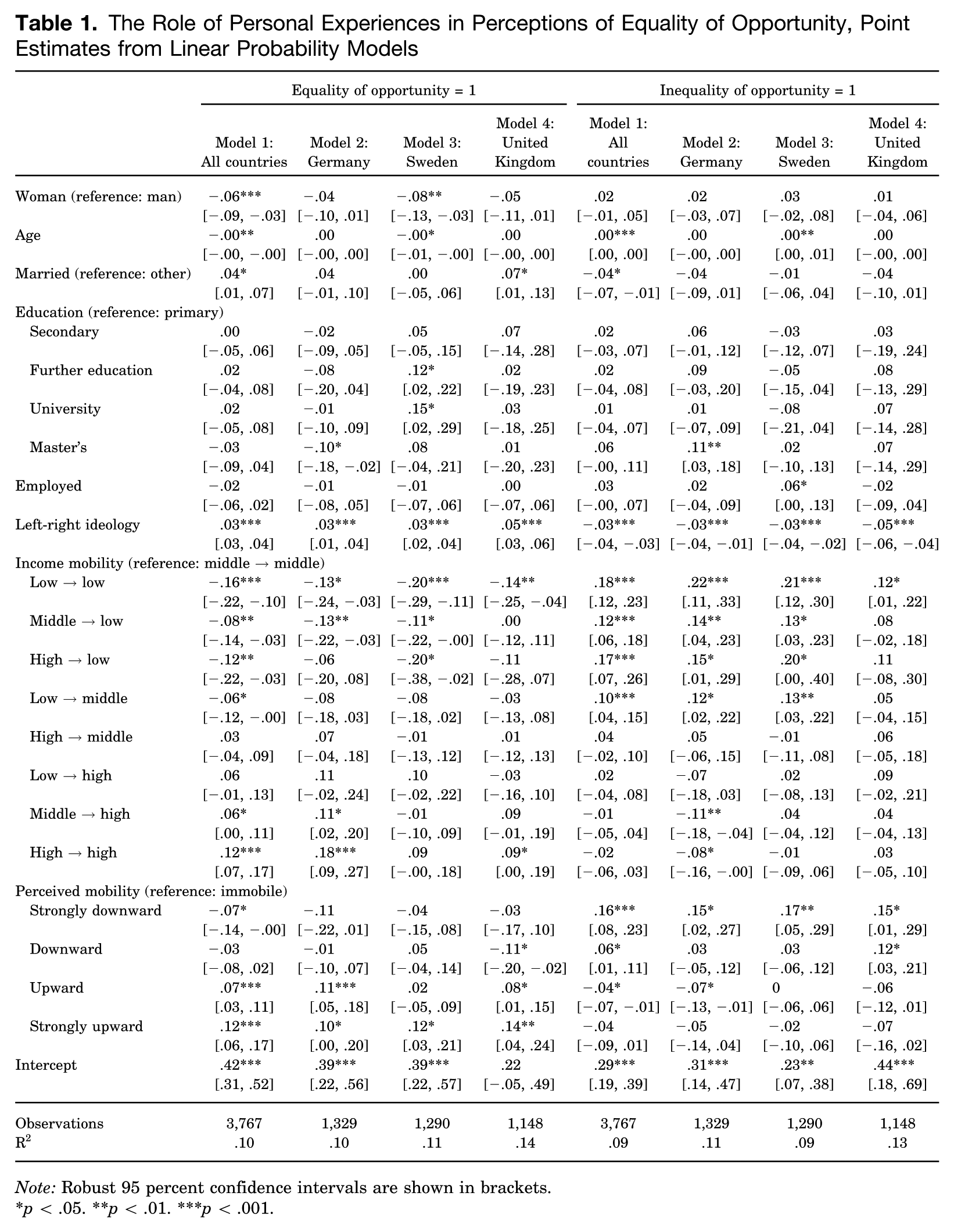
Note: Robust 95 percent confidence intervals are shown in brackets.
p < .05. **p < .01. ***p < .001.
Subjective mobility also shows significant associations with equality of opportunity perceptions. Those who perceive themselves as being strongly downwardly mobile are more likely to agree that there is an inequality of opportunity in their respective countries. On the other hand, those who perceive themselves as upwardly mobile exhibit a pronounced positive association with the statement that everybody, regardless of their social origins, has a chance to make it and be socially and economically successful in their respective countries. This pattern suggests that individuals who perceive significant upward movement in their socioeconomic position are more likely to believe in equality of opportunity, viewing their own progress as reflective of a fair system that allows social mobility. To account for region-specific effects of perceived mobility, such as socialization in eastern Germany, residing in Scotland that voted against Brexit, and living in more rural and less developed northern Sweden, we interacted these regional dummies with perceived mobility but found no statistically significant interactions. 4
Further Exploring the Role of Media
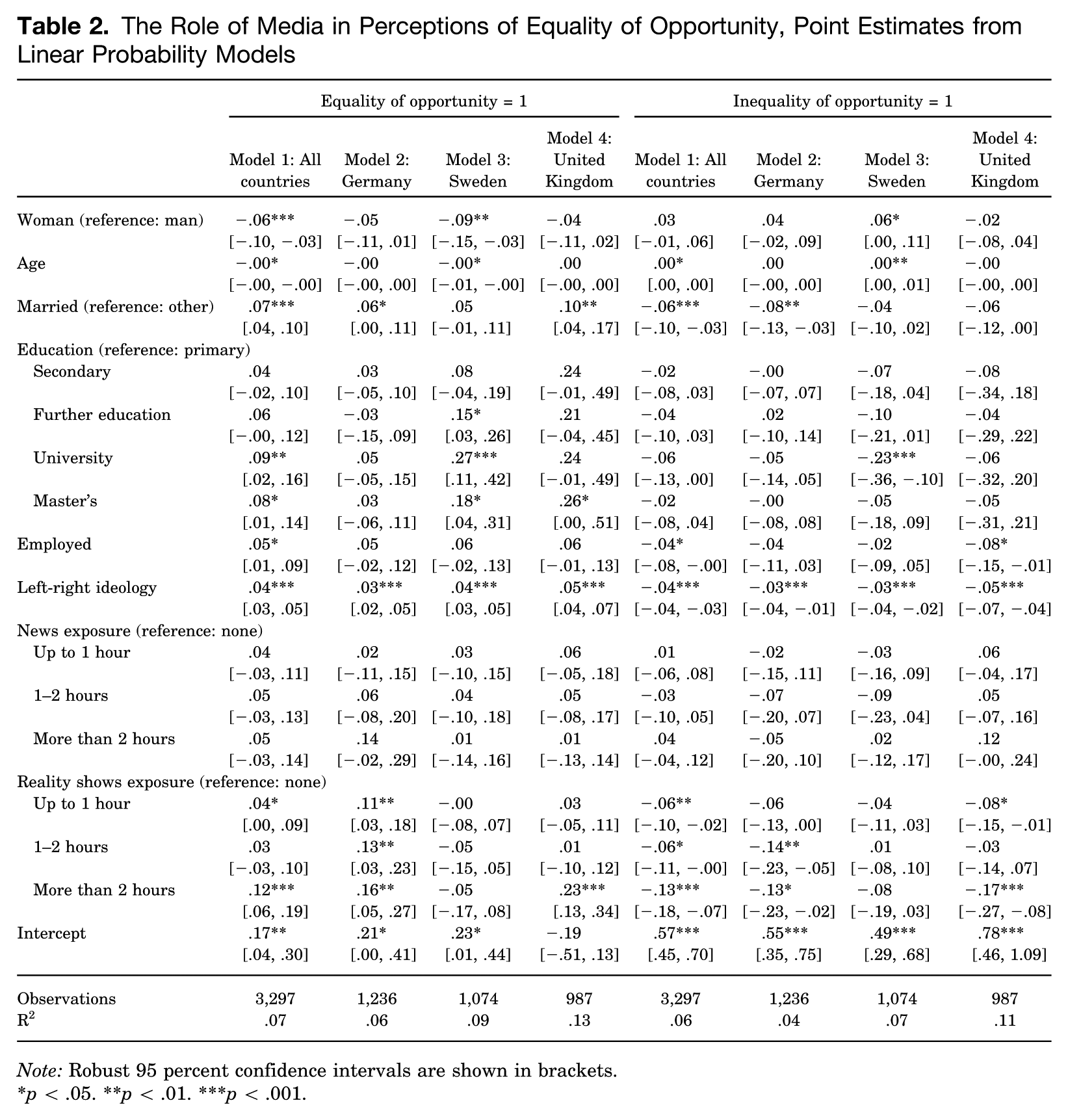
Table 2 presents the results of LPMs exploring how exposure to news/current affairs and reality shows is associated with beliefs in equality and equality of opportunity across the considered countries. First, we see that news exposure shows no significant associations with beliefs in equality or inequality of opportunity across all models. Regardless of duration, news consumption does not appear to play a substantial role in shaping perceptions of equality of opportunity. This is not in line with the main analysis because it suggests that news content, which may cover a broad range of topics without a consistent emphasis on personal success or social mobility, does not strongly influence individuals’ beliefs about structural fairness in opportunity.
The Role of Media in Perceptions of Equality of Opportunity, Point Estimates from Linear Probability Models
Note: Robust 95 percent confidence intervals are shown in brackets.
p < .05. **p < .01. ***p < .001.
On the other hand, exposure to reality shows exhibits notable associations with equality of opportunity perceptions. In the all-country Model, watching reality shows for up to one hour is positively associated with equality of opportunity perceptions (β = .04, p < .05), suggesting that limited exposure to reality shows may foster perceptions of equality. This association is particularly strong in the United Kingdom and Germany, where watching reality shows for more than two hours has a positive and statistically significant association with equality beliefs (β = .23, p < .001 and β = .16, p < .001, respectively). The common aspirational narratives in reality shows may encourage viewers to believe that success is attainable, reinforcing beliefs in equal opportunities. Exposure to reality shows (one to two hours) is also positively associated with perceptions of inequality of opportunity in Germany (−β = .13, p < .05) and the United Kingdom (β = −.17, p < .001). This pattern indicates that reality shows, particularly when watched in moderation, may strengthen beliefs in equality of opportunity by highlighting themes of personal achievement and upward mobility. Results for personal experiences and media exposure using multinomial logistic models are largely in line with the findings described in the main analysis. 5
Conclusion
With this study, we contribute to the growing literature on perceptions of equality of opportunity by exploring the interconnected roles of personal experiences, social interactions, and informational channels in shaping these perceptions across three European welfare state contexts: Germany, Sweden, and the United Kingdom. We demonstrate that perceptions of equality are unlikely to be merely reflections of objective socioeconomic realities but are shaped through socially mediated processes involving personal experiences, interpersonal interactions, and media narratives. By analyzing the salience of diverse informational channels and situating the findings within distinct institutional contexts, we advance understanding of the mechanisms through which perceptions about opportunity structures are likely formed, contested, and sustained.
The findings emphasize the paramount role of personal experiences in shaping perceptions of equality of opportunity. Across all three countries, personal experiences emerged as the most influential source of information, with respondents reporting strong associations between upward mobility or personal success and perceptions of equitable opportunity structures. This pattern highlights the extent to which personal trajectories can serve as lenses for interpreting broader societal dynamics, reinforcing narratives of meritocracy where success is seen as evidence of a fair system. At the same time, a notable minority reported perceiving equality based on their experiences, indicating that personal barriers or setbacks can challenge dominant narratives and contribute to perceptions of systemic unfairness. These dual findings highlight the dynamic relationship between personal agency and structural factors, showing how mobility experiences, whether upward or downward, can relate to different beliefs about societal opportunities (Mijs et al. 2022).
Social interactions through family and peers provide additional, albeit more nuanced, insights into perceptions of equality of opportunity. Family experiences emerged as a significant but context-dependent source of influence. In the United Kingdom, more than half of respondents who drew on family experiences perceived equality of opportunity, with this figure slightly lower in Germany and Sweden. Similarly, peer interactions—although somewhat less important than family—are linked to beliefs through social comparisons and shared narratives. These findings align with theories of social capital, which emphasize the role of localized and relational contexts in shaping individual perceptions (Duncan and Raudenbush 1999; Schulz et al. 2022). The influence of family and peers, however, appears to be contingent on the specific socioeconomic experiences of these networks, illustrating that close social relationships can either reinforce or challenge broader societal narratives.
Media, particularly traditional forms, such as television and newspapers, play a distinct role in shaping perceptions of equality, particularly in contexts where public discourse emphasizes structural barriers. Although evidence for the role of traditional media was mixed, it may still amplify awareness of systemic disparities by framing public debates around issues such as social injustice and economic inequality (Entman 1993; Gugushvili and Reeves 2021). By contrast, entertainment media, such as reality shows, fostered equality of opportunity perceptions, particularly in the United Kingdom and Germany. These findings highlight the aspirational narratives often presented in entertainment media, where individual success is depicted as attainable through effort and talent, reinforcing meritocratic ideals (Diermeier et al. 2017; Kim 2023). Social media, in contrast, exerted relatively limited influence across all three countries, potentially reflecting its fragmented nature and lower perceived credibility (Park et al. 2020). Nevertheless, the varied roles of media channels underline their power in framing public understandings of opportunity structures, highlighting the need to consider the broader informational environment when examining perceptions of equality.
Many of the key patterns are observable in all three contexts, but the cross-national differences that do exist reveal the interaction of institutional arrangements, cultural narratives, and informational dynamics. In the United Kingdom, where meritocracy is a dominant cultural ideal, both personal experiences and entertainment media reinforced beliefs in equality of opportunity despite the country's documented structural inequalities (Mijs 2021; Reay 2021). In contrast, Germany and Sweden, with their more advanced welfare systems and a stronger emphasis on redistribution, exhibited greater awareness of inequality of opportunity. These differences align with policy feedback and moral economy theories, which suggest that institutional contexts shape public perceptions by signaling the nature of societal problems and appropriate responses (Kumlin and Stadelmann-Steffen 2014; Mau 2003). The heightened role of traditional media in Germany and Sweden may furthermore reflect the salience of structural inequality in public discourse, illustrating how institutional and cultural factors mediate the influence of informational channels. Differences across these contexts could be attributable to many different aspects, however, including socioeconomic, political, and institutional characteristics. As a result, future research should dig deeper into which contextual variables are most important in explaining these differences.
In reviewing country-specific differences, furthermore, Sweden stands out for exhibiting stronger variation in perceptions of equality of opportunity by sociodemographic variables. The gender gap is more pronounced in this country, where women are significantly less likely than men to perceive equal opportunity, an effect not observed in Germany or the United Kingdom. Educational differences are also more marked in Sweden, with respondents in the lowest education category substantially more likely to view their society as unequal. These findings may reflect a sharper awareness of fairness norms among different social groups in Sweden. The patterns observed suggest that national context shapes how sociodemographic characteristics translate into perceptions about opportunity, offering an important avenue for future research.
Despite its contributions, this study is not without limitations. In the presented analyses, we drew on relatively rich data for media and personal experiences, allowing us to explore patterns of consumption and perceived mobility, but were more limited in the measurement of other key influences, particularly social interactions with family and friends. The survey captured only a single, self-attributed source of influence, which likely oversimplifies how individuals integrate multiple informational inputs in everyday life. This design also introduces potential concerns about measurement validity because self-reports may reflect post hoc rationalizations, identity alignment, or cognitive biases in addition to actual exposure histories. These limitations are particularly relevant for the IPW strategy employed in the analyses. Although IPW helps adjust for observed confounding and improves covariate balance, it cannot account for unmeasured variables that may influence both independent and dependent variables. Thus, the findings should be interpreted as adjusted associations rather than causal effects in a strict sense.
Moreover, the cross-sectional design restricts the ability to capture the temporal dynamics of perception formation. Perceptions of equality of opportunity likely evolve in response to personal experiences, policy shifts, or broader societal changes, processes that cannot be assessed using a single time point survey. Longitudinal or panel data would allow future studies to trace how such perceptions develop and shift over time. Although the analysis controls for key sociodemographic characteristics, it does not fully address intersectional dynamics or within-country regional variation. These dimensions, including differences between East and West Germany or cohort-specific political experiences, such as Brexit in the United Kingdom, may shape opportunity beliefs in important ways and deserve closer scrutiny.
Our study also opens several additional avenues for future investigation. To move beyond mono-causal self-attribution, future studies could employ multi-item batteries measuring not only the presence but also the frequency, intensity, and trust associated with various sources of information. This would allow for a more thorough understanding of how individuals synthesize multiple inputs when forming beliefs about equality of opportunity. In addition, incorporating objective indicators, such as media usage logs or social network structures, would help assess the correspondence between perceived and actual sources of influence. Finally, expanding comparative research beyond Western European contexts to include postsocialist and non-western societies could illuminate alternative narratives and institutional foundations of opportunity perceptions.
In conclusion, this study offers a novel contribution to the literature by demonstrating how personal, social, and informational channels can influence perceptions of equality of opportunity. By revealing the specific and context-dependent roles of personal experiences, family and peer networks, and media exposure, the findings highlight the importance of addressing both structural inequalities and the narratives that sustain them. For policymakers, these results emphasize the importance of considering the role of informational environments in shaping public perceptions, especially regarding how media narratives and institutional contexts influence perceptions of fairness. Understanding how perceptions about opportunity are formed and reproduced is important for addressing the challenges of inequality and fostering social cohesion in an increasingly dynamic and polarized world.
Supplemental Material
sj-docx-1-spq-10.1177_01902725251396778 – Supplemental material for What Are the Channels of Equality of Opportunity Perceptions in Germany, Sweden, and the United Kingdom?
Supplemental material, sj-docx-1-spq-10.1177_01902725251396778 for What Are the Channels of Equality of Opportunity Perceptions in Germany, Sweden, and the United Kingdom? by Alexi Gugushvili and Arno Van Hootegem in Social Psychology Quarterly
Footnotes
Funding
The authors disclosed receipt of the following financial support for the research, authorship, and/or publication of this article: This work was supported by the Research Council of Norway (Grant No. 334208). The sponsor did not play any role in the study design, in the analysis and interpretation of data, in the writing of the report, or in the decision to submit the article for publication.

Supplemental Material
Supplemental material for this article is available online.
2
3
Bios
References
Supplementary Material
Please find the following supplemental material available below.
For Open Access articles published under a Creative Commons License, all supplemental material carries the same license as the article it is associated with.
For non-Open Access articles published, all supplemental material carries a non-exclusive license, and permission requests for re-use of supplemental material or any part of supplemental material shall be sent directly to the copyright owner as specified in the copyright notice associated with the article.
