



Abstract
I develop and test a theory to address instances of “visibly unpopular” norms—norms that are widely seen as neither collectively optimal nor enjoyable to conform with. Based on 76 interviews with Korean professionals engaging with a norm pertaining to excessive drinking at after-hours business gatherings (hoesik)—widely recognized as undesirable and disapproved of by both individuals and groups—I find that conformity serves as an effective signal of commitment to exchange partners not despite of but precisely because of the conformist’s visible aversion. Insofar as typical conformity with visibly unpopular norms appears “insincere” as such, conformity may continue. Vignette experiments further validate such insincere conformity’s signaling value. The implication is that despite the prevailing notion that norms persist because they promote collectively optimal solutions or are perceived as such, norms widely acknowledged as individually and collectively suboptimal may still endure.
As a set of behaviors that individuals in a society think they are expected to follow, norms are a major driver of social action and order, often eliciting individually costly but collectively necessary actions, such as cooperation (Coleman 1990; Hechter and Opp 2001; Homans 1950). However, some norms become “unpopular,” such that people neither endorse the norms as efficient rules for the collective nor enjoy conforming with them themselves (Bicchieri and Fukui 1999). Such situations seem ripe for norm change. For example, consider the norm that women should not work outside the home. Although this norm is still prevalent in some societies, most people in other societies no longer endorse it because they believe it leads to unproductive outcomes and lower collective welfare (Becker 1971; Siegel, Pyun, and Cheon 2019). Also, the norm may violate their ideal of gender egalitarianism (cf. Knight and Brinton 2017). Logically, research suggests that two social triggers can sufficiently elicit norm change. First, various social forces, such as social movements and ideological change, can precipitate disapproval of the existing norm. Yet even if most people disapprove of the norm, they may be trapped in “pluralistic ignorance” where they misperceive the norm as popular among others and conform to it (Centola, Willer, and Macy 2005; Kuran 1997; Noelle-Neumann 1974; Prentice and Miller 1993; Willer, Kuwabara, and Macy 2009). Thus, the necessary and sufficient second trigger for eliminating the norm seems to be events that broadcast the norm’s unpopularity so everyone recognizes it as unpopular among most others and stops conforming (Miller and Prentice 2016; Munsch, Ridgeway, and Williams 2014; e.g., Bursztyn, González, and Yanagizawa-Drott 2020).
However, some norms seem to persist in the presence of these two triggers, that is, even when widespread community disapproval toward them as well as their collective suboptimality are widely recognized (cf. Nyborg et al. 2016). Why might such “visibly unpopular” norms persist? Examples of such norms may not be uncommon (Elster 1996), including:
some “ideal-worker norms” in organizations (Acker 1990; Turco 2010; Williams 1999; Williams, Berdahl, and Vandello 2016), such as working overtime, where both employees and supervisors see the norms as inefficient (Bailyn 2006; Kunda 2009; Lawler 1986) and recognize their unpopularity (Blair-Loy 2003; Kossek and Ozeki 1998);
norms among men of North Indian Hindu families and women of American families who see their respective family structures as inefficient and unpopular among themselves and others but still uphold them (Derné 1992);
female footbinding in China and female genital mutilation in Africa that were not only visibly unpopular among subjected women but also family members reinforcing the convention (Mackie 1996);
norms in religious rituals that are widely recognized as undesirable by the practicing community (e.g., “firewalking,” long travel to visit a temple; cf. Henrich 2009; Power 2017; Rappaport 1999);
norms of hazing in fraternities that members themselves recognize as undesirable (Nuwer 2001; cf. Martin and Hummer 1989; Trice and Beyer 1984); and
norms under authoritarian rules that were recognized as highly unpopular among most citizens (e.g., praising the dictator as the “father,” “gallant knight,” or even “premier pharmacist”; see Wedeen 1999; cf., Kuran 1997).
In this article, I provide an account for this puzzle. In doing so, I reveal the paradox that the very visibility of a norm’s unpopularity can make it distinctively useful for signaling commitment to exchange partners in social interactions. As conformity with such a visibly unpopular norm provides a credible “costly signal” of the conformist’s commitment (Akerlof 1976; Spence 1973), conformity derives rewards—not despite their (presumed) aversion but precisely because of it. Consequently, insofar as such signals of commitment are deemed necessary, conformity with visibly unpopular norms may continue.
Empirically, I examine the South Korean workplace norm prescribing excessive drinking in after-hours business gatherings (hoesik)—which is officially recognized by the Korean Court as a workplace hazard (Alexander 2022). Its visible unpopularity is shown in nationally representative polls, yet those same polls also show widespread conformity. At the same time, there is situational variation in the prevalence of conformity. Thus, I draw on both in-depth interviews and vignette experiments to identify conditions under which (and, thus, reasons why) conformity persists. The qualitative data come from 76 in-depth interviews with people working or having worked in Korea, across various industries, roles, and ranks. A vignette experiment was conducted on a different set of Korean professionals to further test ideas derived from the interviews. Another vignette experiment tested this dynamic among U.S.-based participants using a fictitious norm in the context of a U.S. startup.
These findings illustrate that the conformist to the visibly unpopular norm effectively appears as a more committed exchange partner, but only when the conformity is perceived to be “insincere” (i.e., it appears to go against the conformist’s underlying values and preferences). This contrasts with implications from existing research that norms persist only when people see them as efficient rules for the collective and/or appear to enjoy conforming themselves (cf. Hewlin 2003; Miller and Prentice 2016; Munsch et al. 2014; Rappaport 1999). Neither is the case here. Instead, my findings show that in such exceptional cases of “sincere conformity” with visibly unpopular norms (where the conformist appears to enjoy conforming), conformity does not reap benefits because it does not signal the willingness to sacrifice for exchange partners. Ultimately, this research reveals when and why individuals and collectives may converge on a suboptimal point that they themselves see as suboptimal (cf. David 1985).
Puzzling Persistence of Visibly Unpopular Norms
To sustain societies, humans need to overcome collective action problems so that individuals’ self-interested behaviors do not lead to collectively suboptimal outcomes (Ostrom 1999). To this end, social scientists have long pointed to social norms as a solution—specifically, behaviors people think they are expected to conform with (Arrow 1970; Coleman 1990; Homans 1950). For example, consider the system of voting. Even though it seems irrational for each individual—if their goal is to change the outcome of the election—to incur individual cost and vote in an election where their single vote is unlikely to change the outcome, people may still vote partly because they think they are expected by others to cast their ballots (Gerber and Rogers 2009). This logic—that social norms sustain collective actions that are costly for individuals but beneficial for the collective—has been applied widely to diverse situations of collective actions and cooperation (also see Hechter and Opp 2001; Nyborg et al. 2016; Ostrom 2000).
Yet a question remains about why people forgo their private interests for collectively beneficial behaviors by conforming to the norm, and research identifies specific private utility (or “selective incentives”) that individuals gain as the driver of conformity (Olson 1971; Simpson and Willer 2015; Sunstein 1996; Willer 2009). In particular, individual conformity seems to be rewarded by the collective because conformity ostensibly represents values that the community cherishes and that conformists seem to embody. A good example is the norm of working overtime in many contemporary organizations (Turco 2010; Williams et al. 2016). The conformist seems devoted enough to stay at work longer than technically required, ostensibly out of genuine commitment to work over personal life—which, in turn, is rewarded by organizations (Blagoev and Schreyögg 2019; Cristea and Leonardi 2019). The key assumption thus is that to derive benefits, conformity must appear to reflect the conformist’s underlying character because only such “sincere” conformity—where the conformist appears to enjoy conforming and endorse values underlying the norm—can communicate the conformist’s authentic commitment. Similar examples come from conformity with religious norms (Henrich 2009; Power 2017; Rappaport 1999) and norms around coercive behaviors toward women by men in fraternities (Martin and Hummer 1989), both of which represent situations where conformists appear devoted to religious ideals or hyper-masculine cultures, respectively, as values that they genuinely cherish. Therefore, this reward structure creates pressures for individuals—and especially those whose commitment is in question—to not only conform with the norm but also appear as if they enjoy conforming with the norm (cf. Kim and Zuckerman Sivan 2017), which has poignantly been labeled as an effort to erect “façades of conformity” (Hewlin 2003).
This explanation—that the conformist is rewarded for alleged sincerity behind her conformity—can even account for the persistence of some “unpopular norms” (i.e., norms that neither individuals nor collectives see as optimal or enjoy conforming with). Consider situations where employers and employees no longer perceive overtime work as beneficial for their organizations because instead of signaling a high work ethic or devotion to one’s work, it reflects the organization’s inefficiency and individual’s poor family values or inability to get their work done on time (e.g., Bailyn 2006; Blair-Loy 2003; Kossek and Ozeki 1998; Weeks 2004). At a glance, such norms seem fragile because others would see the seemingly sincere conformist as a poor worker who does little to improve the organization. But research suggests that conformity that appears sincere in that situation may still be rewarded if there is “pluralistic ignorance” (Prentice and Miller 1993), that is, if most people erroneously believe that the majority endorse and enjoy conforming with those norms (Bicchieri and Fukui 1999; Centola et al. 2005; Willer et al. 2009). After all, people can only observe each other’s public conformity but do not always know about each other’s private disapproval of and aversion toward the norm. Accordingly, research has documented that insofar as people misperceive others as endorsing the norm, people not only conform but also feign sincerity in their conformity (Bernheim 1994; Cialdini and Trost 1998; Kuran 1997; Noelle-Neumann 1974). Consequently, insofar as most people misperceive the norm to be widely endorsed (i.e., in conditions of pluralistic ignorance), conformity with the norm may still persist despite people’s (private) disapproval.
Logically, a key implication of this research is that the persistence of unpopular norms hinges on the “visibility” of the unpopularity (i.e., whether people recognize the majority’s disapproval of and aversion toward conforming with the norm). Put simply, when the majority are widely known to disapprove of the norm, those who conform should appear to embody or endorse values known to be condemned by fellow peers. This implication—that nonconformity with visibly unpopular norms will be more accepted or even rewarded—is put explicitly by scholars of pluralistic ignorance, such as Miller and Prentice (2016:340): “[P]roviding people with [accurate] information [about people’s approval of the norm] has the potential to alter their understanding of group norms. . . . This altered understanding may, in turn, lead them to act differently.” A similar prediction is made by Munsch et al. (2014:57): “[Misplaced] stigma [from not conforming to unpopular norms] may be attenuated by publicizing that many people only disapprove of [nonconformity] because they, inaccurately, believe others do.” This prediction is in fact made across different fields in social sciences, including political science (Kuran 1997), economics (Bursztyn et al. 2020), and management (Hewlin 2003; Li and Van den Steen 2021), thereby attesting to this underlying idea’s widespread purchase.
However, despite the important contributions of this body of research to our understanding of norm change, it cannot account for persistent rewards to conformity with numerous aforementioned norms that are not only unpopular but whose unpopularity is also highly visible. Consequently, the outstanding question is: When and why might such visibly unpopular norms persist?
Analytic Approach
To address this puzzle, I take a mixed-methods approach. I first focus my analysis on South Korean professionals who conform with a visibly unpopular norm—excessive drinking in after-hours business gatherings (hoesik). I specifically draw on interviews with 76 professionals in Korea and experimental data concerning the driver of the Korean professionals’ conformity. Understanding the driver behind the conformity in this particular context advances our understanding of the on-the-ground reality of conformity to visibly unpopular norms. Afterward, I experimentally test hypotheses derived from these interviews in the same Korean context. Lastly, I test the same hypotheses using U.S.-based respondents.
The Case: Excessive Drinking in Korean After-Hours Gatherings
The norm pertaining to excessive drinking at after-hours gatherings in Korean professional settings is a suitable case for examining puzzling norm persistence for three primary reasons. First, the norm is clearly unpopular among the majority of Korean professionals. In a study conducted by the Korean Ministry of Employment and Labor using a representative national sample of the working population in September 2013 (n = 3,302), 69.1 percent said they would like to avoid excessive drinking the most in after-hours gatherings (Han 2013). Because the question asked only what they would like to avoid “the most,” it is possible that even more would want to avoid the activity. Another nationally representative survey in 2017 shows that 90.5 percent of respondents said that “after-hours gatherings that involve drinking” are the most undesirable category of after-hours gatherings (Huh 2017). Interview data and public campaigns shown in the following further confirm this unpopularity not only among individual professionals but also among collectives (e.g., organizations, professional communities). 1
Second, despite the norm’s visible unpopularity, conformity persists widely. In the same nationally representative survey from 2013, 67.3 percent of the sample reported that they participate in “after-hours gatherings for which drinking is the most central activity” (Han 2013). Again, the question asked what was “most central” in their after-hours gatherings, so it is possible that drinking occurs also in after-hours gatherings of respondents who did not choose this response. Other media accounts confirm such patterns (Cha 2015; Huh 2017), and interview data I describe in the following confirm the widespread persistence of conformity.
But third, there are still situations in which conformity does not occur, and I exploit those situations to identify why conformity does occur where it does. After all, if my explanation identifies the driver of conformity, the absence of that driver may also imply less or no conformity. Such situations also help me identify scope conditions of the inductive theory. Practically, those situations give opportunities to discover how we can eliminate visibly unpopular norms and elicit norm change as long as they are harmful to the collective and to individuals.
Qualitative Study
Data, Methods, and Analysis
From 2017 to 2019, I conducted semistructured interviews with 76 individuals who were working in Korea at the time of the interviews or had worked there previously. Participants were first recruited via personal contacts and then via a purposive snowball strategy, where the number of contacts from each informant was limited to three so the sample would comprise those with diverse backgrounds (Small 2009; Trost 1986). All interviews were conducted and transcribed verbatim in Korean and are translated here by the author. Participants were 42 years old on average, and 21 individuals were women. More details about the sample are in Table 1.
Interview Sample Characteristics
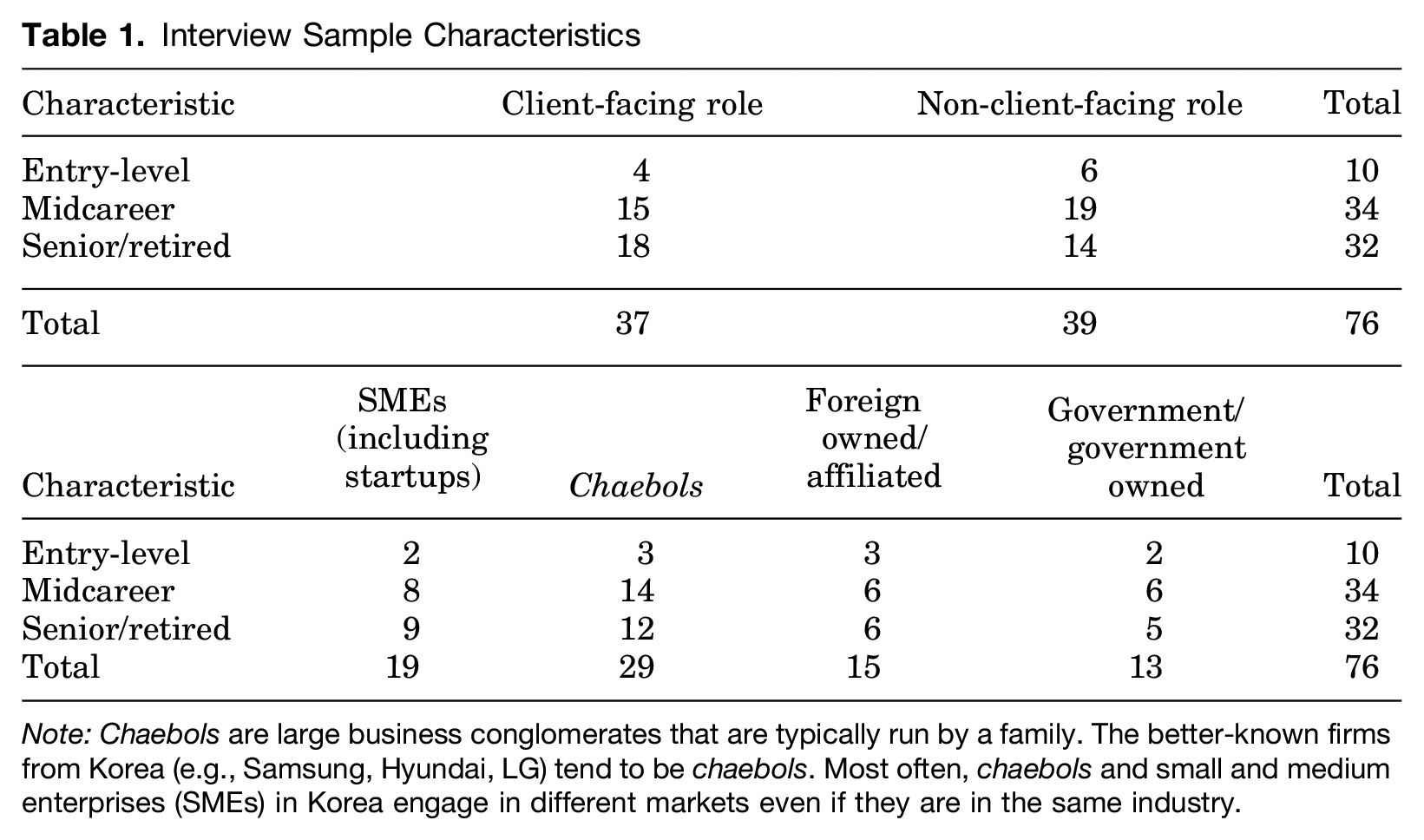
Note: Chaebols are large business conglomerates that are typically run by a family. The better-known firms from Korea (e.g., Samsung, Hyundai, LG) tend to be chaebols. Most often, chaebols and small and medium enterprises (SMEs) in Korea engage in different markets even if they are in the same industry.
Formal analysis took place concurrently with the interviews and after they were finished. The analytic approach follows the model of naturalistic inquiry, as laid out in Pratt, Kaplan, and Whittington (2020), where questions are asked around credibility, transferability, dependability, and confirmability. Initially, to ensure that I did not overlook any major dynamics that occurred during people’s preservation of the excessive drinking norm as a norm, I began the first set of interviews (n = 47) by inductively coding and identifying meanings expressed by participants within organizational contexts and other business relationships (Tavory and Swidler 2009). I then recoded the transcripts to see whether the meanings and interpretations of the participants’ conformity with the excessive drinking norm varied by their perceptions of whether and how much they enjoy conforming. During this step, I made sure that any variation reflected different constructions of reality found throughout the interviews (credibility). Also, the analysis during this step involved processing which characteristics associated with the excessive drinking norm might transfer to other contexts (transferability).
This step helped uncover some counterfactual conditions where conformity is not rewarded and conformity stops. Thus, as a third step, I explicitly coded for counterfactuals, specifically targeting situations in which participants did not interpret any positive traits based on others’ conformity with the excessive drinking norm so I could identify conditions under which conformity with the norm did not provide social rewards. These second and third steps of uncovering counterfactuals and thus scope conditions became key to the analysis and informed hypotheses for the experiments that help adjudicate alternative predictions. These steps also ensure that I am not taking the most intuitive or plausible case at face value, thereby increasing dependability.
Last, I reinterviewed some of the same participants to learn what they thought about the emergent interpretive theory (Chatman and Flynn 2005; Glaser and Strauss 1967), gathered additional data from the second set of interviews (n = 29), and returned to my data a fourth time to consider how alternative mechanisms accounted for counterfactual conditions that were uncovered in the second and third steps of analysis. This step ensures a higher level of confirmability. After completing these analyses and to increase confirmability, an experienced undergraduate research assistant listened to all the interviews and independently coded the transcribed interviews in the summer and fall of 2021. This research assistant is fluent in Korean, had worked in Korea, and did not conduct any interviews. After we separately performed the entire analysis again, any discrepancies between the research assistant and the author’s analyses were discussed until we reached agreement. 2
Visible Unpopularity
The first finding is the norm’s visible unpopularity among the collectives and individuals in Korea. In particular, interviewees were not hesitant to express that they not only (a) dislike drinking excessively but also (b) highly disapprove of the values underlying the norm as a norm for their collectives (e.g., organizations, professional communities) and (c) recognize this unpopularity around the excessive drinking norm. This finding is notable in and of itself because research suggests that norms should not persist in such a case. For instance, a junior-level accountant complained: I hear all the time how people in the West socialize with their coworkers doing cool things, like going out camping or hanging out with each other’s families. Why can’t we do that? That seems much more fun and just better. I bet that my colleagues would enjoy that much more as well.
After debriefs at the end of each interview, about a quarter of participants (n = 20) also asked the interviewer for solutions, without being prompted. An ex-entrepreneur said: “You must do academic research in order to change the world, right? Please come up with ways to get rid of this drinking problem in after-hours gatherings!”
The most frequently evoked reason for disapproving of the norm was the excessive amounts of alcohol associated with drinking in after-hours gatherings, which interviewees see as negatively affecting their personal health and collective performance. This was prevalent across all interviews. For instance, a junior-level software engineer in a large electronics company said that drinking “may help productivity [if it is at] a modest amount, but it really hurts our productivity [when it is] this excessive.” In other words, participants saw excessive drinking as not only distasteful but also harmful to the collective. More starkly, a junior-level engineer in a small electronics company said: I think [drinking in after-hours gatherings] is a very bad norm . . . everyone will die if everyone keeps doing this! It’s not good for our health either. Every person is human capital for the company. It doesn’t matter how smart they are, they won’t be productive if they drank a lot the night before at the after-hours gathering and are sick from it. It really is a bad norm.
This unpopularity was expressed by not only lower-level individuals but also leaders of organizations. Recognizing the norm’s suboptimality for the collectives, a CEO of a smartphone application startup said, “I want to stop drinking [this much] myself, and I want my employees to stop drinking in our after-hours gatherings, too. So, I have gone as far as threatening to cut their salaries if they drink excessively in after-hours gatherings.” Later, he followed up by saying how it did not work: “[The threat] worked in the first week or so, and then everyone started ignoring it. . . . I can’t fire everyone.”
Another reason for their disapproval of the norm was the additional hours they have to stay at work or the additional burden they have to bear due to excessive drinking at after-hours gatherings. Work hours in Korea consistently rank among the highest among developed countries, totaling 2,113 hours per year in 2013 (OECD Statistics 2017). In particular, about half of the interviewees explicitly brought up work-family balance as being negatively affected by the norm. A senior-level employee in an IT firm also said “I just want to go home. My wife understands that drinking this much is part of work, but my son avoids me when I go home late smelling like alcohol. . . . He does not get that this is part of work.” But younger interviewees often objected to the presence of the excessive drinking norm in and of itself, even if it did not contribute to longer hours. A junior employee in a large manufacturing firm said: “I did not sign up for this,” adding that he did not “work so hard in college just to get drunk in after-hours gatherings and catch a cab for a drunk client.”
Perhaps unsurprisingly, widespread aversion toward excessive drinking as a workplace norm was also widely recognized. Organizational campaigns may most straightforwardly have contributed to the visibility around the norm’s unpopularity at the collective level: Various organizations and governmental agencies launched campaigns to deter excessive drinking in after-hours gatherings (Lee and May 2018), as described in Figure 1. For instance, since the 2000s, Samsung—arguably the highest status organization in Korea—adopted a policy called “119” (the Korean equivalent of the United States’s emergency phone number, 911), which encourages its employees to have only one type of drink, go to only one venue, and go home by 9 o’clock. That is, neither the collectives nor individuals seem to see the norm as helpful for their collective efficiency.
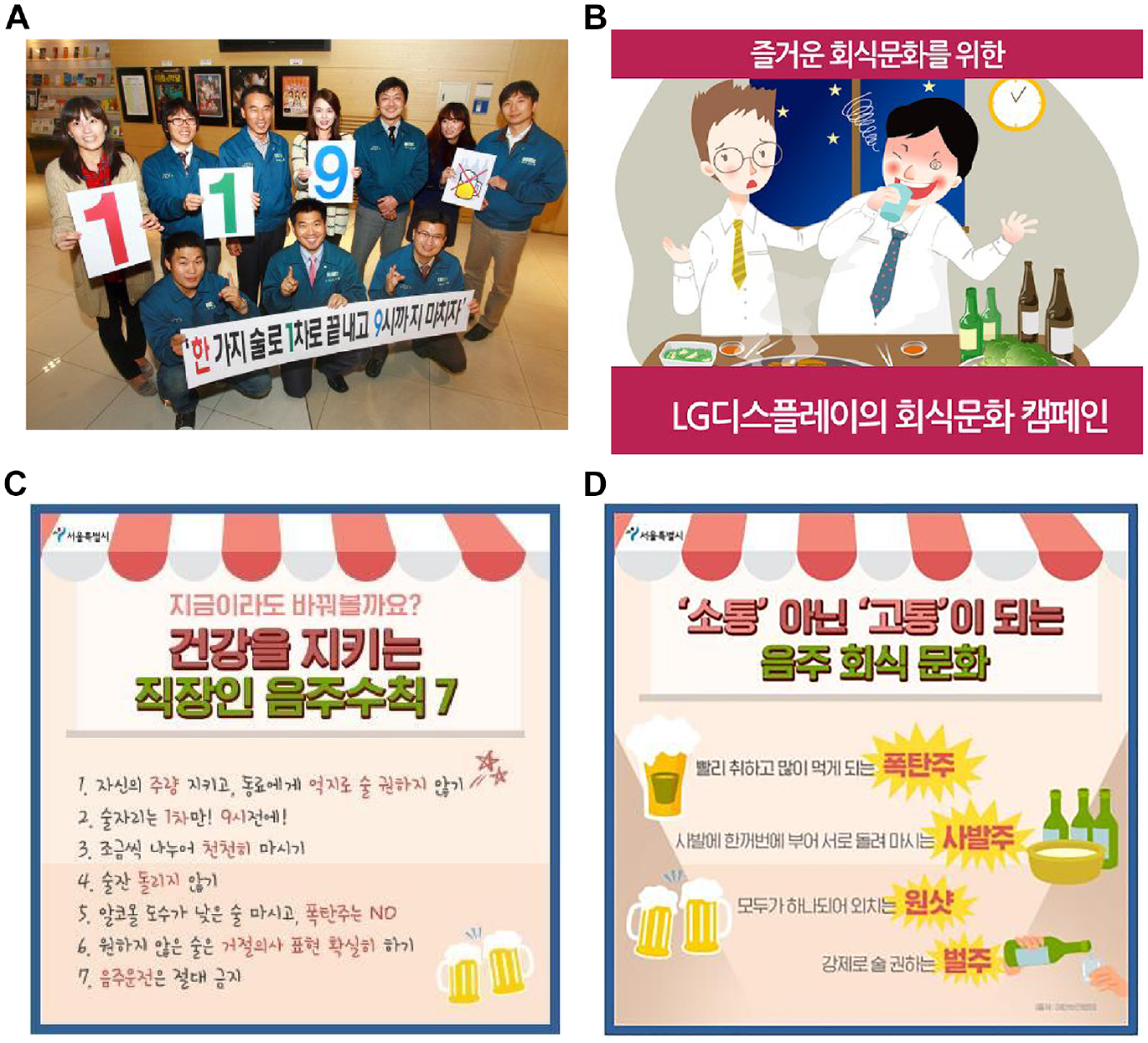
Examples of Corporate Campaigns against the Norm Pertaining to Excessive Drinking (Choi 2017; Lee 2010; Lee 2017; Shim 2014)
To be sure, this does not imply that no one enjoys drinking. A junior-level employee in a startup said: “Why not drink when you can? I’m young . . . and it’s corporate-paid food and drinks.” Yet they are likely exceptions: Only 3 out of 76 interviewees from this nonrepresentative sample said that they enjoy drinking excessively in after-hours gatherings, and as aforementioned, data more representative of the population show the norm’s general unpopularity (Han 2013; Huh 2017). Furthermore, even the three people who expressly enjoy drinking in after-hours gatherings said that they do not see it as collectively productive for their firms. For instance, a senior-level employee in a construction firm said: I really like [drinking] in after-hours gatherings but I don’t know how that’s really productive for our firm. I’m the one who can hold most liquor, but even I take a productivity hit the next day. It’s like we have a license not to be productive the next day.
Furthermore, interviewees indicated that they dislike drinking in after-hours gatherings specifically and not necessarily that they do not enjoy drinking at all. That is because when people drink in their own time, they can drink however much they want, whereas they often have to drink more than they want in after-hours gatherings. A midlevel manager in a manufacturing firm said: “I don’t mind drinking in and of itself. It’s that I have to drink over and over and over when the client is sitting right there.” A senior-level employee in an IT firm said: “I would rather sip on wine at home rather than drinking all these soju bombs at work.”
In sum, these interview data imply that people often see excessive drinking as a norm and conform with it despite (a) their own aversion toward the norm, (b) the norm’s suboptimality for their collectives (e.g., organizations), and (c) their recognition that most others disapprove of the norm. This evidence is striking vis-à-vis existing research predicting norm fragility in such situations.
Insincere Conformity as a Signal of Commitment
Yet despite the widespread recognition of people’s aversion to and disapproval of the norm, all interviewees said—unprompted—that once they arrive at after-hours gatherings (most often at a restaurant for dinner), they feel like they are expected to drink. Most straightforwardly, a junior-level software engineer said: “After-hours gatherings equal drinking in Korea. It is essentially assumed that you’ll be drinking. The only thing that varies is how much you drink and not whether you drink.” The unanimity of these responses is likely not surprising to those familiar with the Korean business context (Cha 2015; Huh 2017).
The reason all interviewees said they think they are expected to drink is to signal commitment to their exchange partners, using words such as “loyal,” “devoted,” or “committed.” Therefore, this section of the article illustrates this logic, beginning with response from a junior-level consultant: Interviewer: [In after-hours gatherings,] what do you do when you don’t want to [drink]? Respondent: As I mentioned before, there are times when one doesn’t want to drink because one is sick or something. Even then, people drink so that they can show their loyalty. It’s like “I’m sick, but I respect you, so I drink despite feeling bad.”
Similarly, a midlevel employee in a governmental financial agency said: No one says, “don’t drink,” even though they might say “drink only a little today.” So, you pretty much need to drink even if you don’t feel well. I think that you have to drink despite feeling bad, and only then people would think, “Ah, this person is really genuine in how he thinks of me.”
Further findings show that this rationale is especially salient for those in client-facing roles, where exchange partners may not be as familiar. A midlevel manager who worked with consultants said that her department “brought only the best drinkers to after-hours gatherings in order to make sure that everyone [from her department] could drink intensely.” But at the same time, by the same logic, conformity seems to persist even within intraorganizational relationships insofar as employees do not know one another well yet need to verify their commitment. A senior-level employee in a construction company said: When I first went into the field, the blue-collar workers [in the interviewee’s firm] tested me. They were thinking, you have lots of education under your belt, but what can you really do? One test was going out to see how much I would drink. Another was going up onto the construction crane and walking back and forth.
Furthermore, interviewees expressed their awareness of the strategic motives behind conformity but did not see that as problematic. One middle manager at a major automaker said: It’s all just a charade we play. They know what I’m trying to say is that I’m loyal and committed to them by drinking a lot, I know what they are trying to say is that they are loyal and committed to me by drinking a lot. But we do it anyway.
A senior-level manager at the same automaker put it more bluntly: I know that they are trying to suck up to me and look like loyal partners by drinking their guts out. But that’s exactly the point. I’m trying to find someone who is willing to suck up to me because that’s how I can tell who will be loyal to me.
Conversely, conformity seems to be futile if conformists seem to enjoy drinking. A former midlevel employee at an IT company expressed frustration that she exceptionally enjoys drinking much: “When I first interned . . . I revealed that I enjoyed drinking. Afterward, I couldn’t look like a loyal employee regardless of whether I drink my guts out.” Another midlevel employee in the same firm said: “I’m known as a ‘whale’ [i.e., someone who likes drinking and can take a large quantity of liquor] . . . so people don’t really buy it when I drink so much. People already know that I drink a lot.” Most notably, a senior-level employee in a major electronics firm said: People around me already know that I enjoy drinking a lot in after-hours gatherings. . . . Even with new clients, they can really tell with the first sip of soju-bomb that I enjoy drinking. When everyone turns red, I’m the only one pouring drinks in everyone’s cup . . . I wish I could pretend like I don’t like drinking.
It is certainly reasonable to think that insofar as people know of the conformity’s value, they also would try to “fake” their aversion toward the norm. In such a case, any conformity may lose its credibility as a signal and merely appear as “cheap talk” (Crawford and Sobel 1982; also see Gambetta 2011). However, such mimicry seems difficult in this context, as interviews illustrate the difficulty associated with deceiving others about their underlying preference for drinking. The most straightforward reason is physiological reactions: People who cannot take more alcohol may turn red and/or even vomit after drinking excessively. Another is through word of mouth: One’s ability to hold drinks and one’s preference for drinking are often information discussed in workplace gossip, equivalent to one’s dietary restrictions and educational background. A midlevel manager simply said: “You can’t fake whether you like drinking or not. People can tell.” Another midlevel manager said: “Who is going to think that you like drinking when you are vomiting your guts out?” These quotes illustrate that mimicry is not deemed possible in this context, as also documented in other norm conformity situations (cf. Gambetta 2011). This “unfakeable” preference toward the norm thus allows most conformity to the excessive drinking norm to appear credibly insincere, barring some additional information.
Scope Conditions
Naturally, the foregoing logic implies two relatively specific scope conditions outside where conformity should not derive rewards. One is when an exchange partner does not recognize the norm pertaining to excessive drinking as a performative device for signaling commitment (cf. Goffman 1959). Such cases most often involved “foreigners.” A midlevel employee in a finance firm said: “[Westerners] probably don’t know that you’re supposed to drink. They probably don’t know that I’m watching their drinking.” Thus, foreign businesspeople seem to have some plausible deniability for not engaging in conformity. To be sure, this forgiveness of ignorance may not last long, as a non-Korean participant—a former administrative assistant in Korea—said: “[P]leading ignorance goes out the window pretty quickly.” He added that such ignorance is both “a blessing and a curse,” where others “might not expect you to drink, but might also think of someone else for that job since [they] can’t [tell] what kind of person I am.” Consequently, coordination around the norm as a commonly recognized signaling device seems necessary; otherwise, the inference on what the conformity signals becomes unclear to exchange partners. 3
Another scope condition outside which conformity should not be rewarded is when a signal of commitment is not required (anymore). One straightforward reason for such situations is that people already trust their exchange partners or know them well enough. Indeed, accounts from my interviewees suggest that conformity is less rewarded and might even be punished in such situations. A junior-level consultant responds to when he does not have to drink as much: If you are a new hire, or if there is not enough data to know who you are, then if you say that you can’t drink, then people would think “What? A new hire says that he can’t drink?” But . . . let’s say that you turned out to be a dependable co-worker. Then there are few negative consequences associated with not drinking, and you don’t have to drink.
Similarly, a midlevel accountant in a major accounting firm said: “Once you become [clients’] friends, you don’t drink [that much]. You will look like a fool for drinking as much as you did when you first met.” A senior-level manager in a major electronics firm also said: “I’d pick someone who gulps in our first meeting [as a business partner], but I would look down upon someone who drinks that much in our tenth meeting.” He followed up by saying “What’s the point? We already know what each other is like.” These accounts imply that when the exchange partner’s commitment has already been confirmed, conformity should not take place, or the conformist at least should not reap as much benefit.
Ultimately, these scope conditions help identify specific conditions in which conformity with a visibly unpopular norm is rewarded. I therefore use these conditions in experimental settings to explicitly test the theoretical logic and address them more broadly in the “Discussion” section.
Hypotheses Based on The Inductive Theory
This inductively developed theoretical logic suggests that people’s visible aversion toward the norm (i.e., “insincerity”) allows conformity to be used as a commitment-signaling device. This then presents two immediate hypotheses regarding conformity with visibly unpopular norms. The first and straightforward implication is:
Hypothesis 1: Insincere conformity is rewarded over nonconformity.
Also, the logic more specifically implies such rewards for conformity based on people’s visible aversion and not just any conformity. After all, only such “insincere conformity” is inferred to reflect that conformists are willing to incur cost to show commitment to exchange partners. By contrast, the inference on “sincere conformity” may be that conformists conform simply because they enjoy conforming with a norm. Therefore, the second implication is that conformity based on visible aversion should specifically be rewarded over sincere conformity. This prediction directly contrasts with the argument from existing research (e.g., Henrich 2009; Power 2017; Rappaport 1999), which suggests that conformists to any types of norms must appear as enjoying their conformity to appear committed; otherwise, they will appear as hypocrites (cf. Jordan et al. 2017). My theory instead is that conformists must be perceived to dislike conformity—which is by definition assumed for “typical” conformists with visibly unpopular norms—and such appearances will be more effective at sending a costly and thus more credible signal of commitment:
Hypothesis 2: Insincere conformity is rewarded over sincere conformity.
However, the scope conditions also suggest that even insincere conformity with visibly unpopular norms should not be rewarded when signals of commitment are not necessary. Testing whether the rewards are intact only when commitment is required but not directly shown therefore serves as a test of internal validity—that it is about commitment signaling. But more broadly, it identifies when norms prevent optimal coordination for the collective: Existing research highlights norms’ ability to elicit optimal social coordination (Coleman 1990; Hechter and Opp 2001; Homans 1950), but visibly unpopular norms often persist despite their collective suboptimality. This implication therefore draws a specific scope condition as to when this type of suboptimal (i.e., visibly unpopular) norm may persist:
Hypothesis 3: Insincere conformity is rewarded only when signals of commitment are deemed necessary by exchange partners.
Note that in addition to testing the inductive theory using a more causal method, these hypotheses also highlight the signaling mechanism over other potential alternative explanations. Most notably, excessive drinking may persist as a norm because people become better acquainted and socialized over drinking and thus expect one another to drink (e.g., Evans 2024). This in vino veritas explanation should imply that any conformity with the drinking norm should be rewarded. By contrast, my predictions specifically identify insincere conformity as deriving social rewards.
Experiment 1
Design and Procedure
Four-hundred ninety-nine Korea-based subjects with work experience there were recruited via an online platform. Each subject was randomly assigned to one of nine conditions. In each condition, subjects evaluate two “candidates” to choose one business partner. In all nine conditions, subjects first see the “typical conformist,” whose preference is not explicitly known but is likely assumed to be against excessive drinking (which I confirm later) and who conforms with the excessive drinking norm in an after-hour gathering. Then, in all nine conditions, subjects compare this typical conformist with another protagonist. The comparison is set up this way because evaluations for choosing a business partner are often made in comparison between different candidates and such a typical conformist is by definition the most common type of a candidate. Figure 2 visualizes this setup.
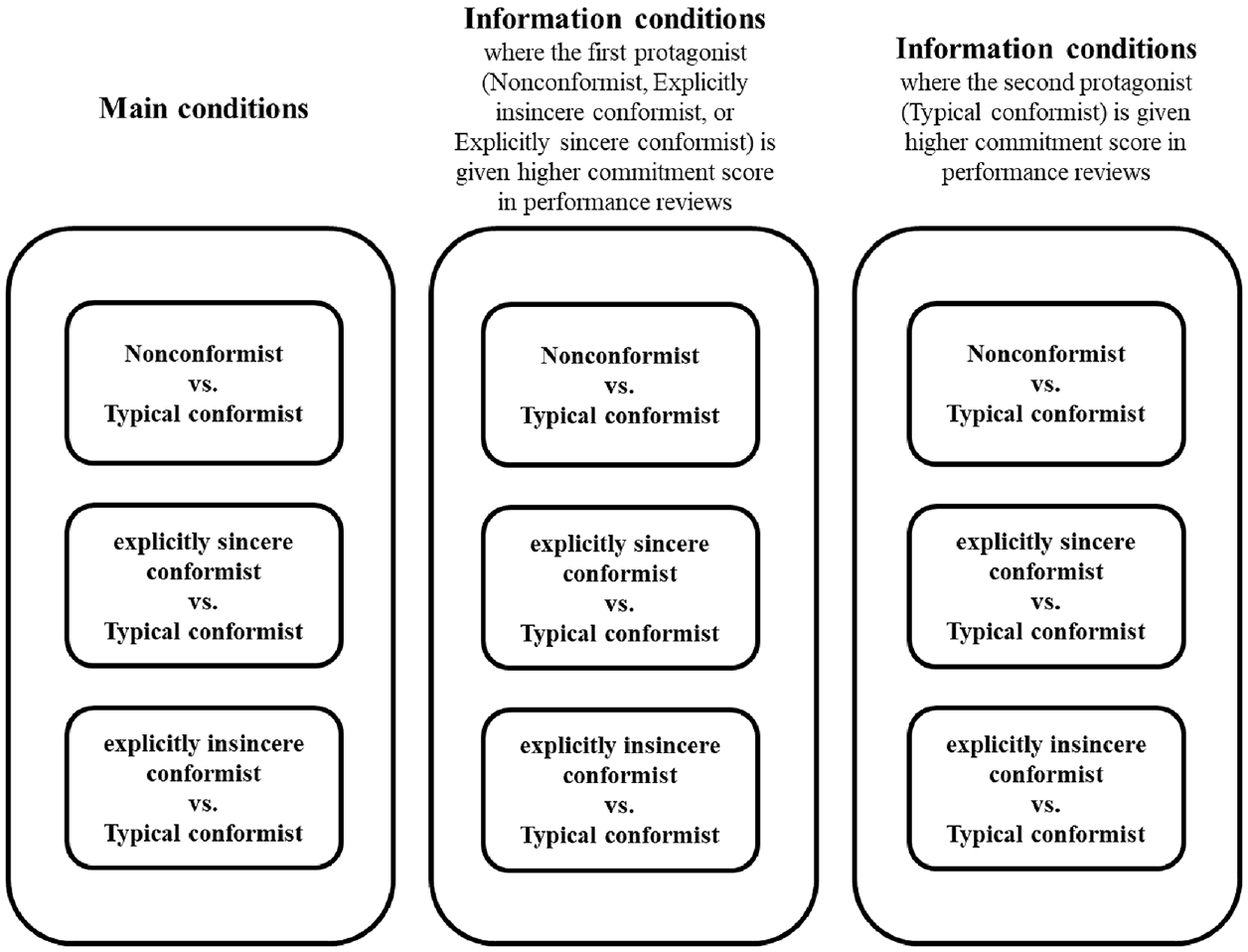
Experiment 1 Setup for the Nine Conditions
Given this setup, there are three “main conditions.” In the first main condition, subjects compare the typical conformist with the “nonconformist” (i.e., protagonist who explicitly does not like drinking and does not conform). In the second main condition, subjects compare the typical conformist with the “explicitly sincere conformist” (i.e., protagonist who explicitly likes drinking and conforms). These two conditions constitute the conditions for testing Hypotheses 1 and 2, respectively. In the third main condition, which serves as a robustness check, subjects compare the typical conformist with the “explicitly insincere conformist” (i.e., protagonist who explicitly dislikes drinking and conforms).
The six other conditions are parallel to the main conditions, but there is a more direct commitment signal so that insincere conformity as a (less direct) signal of commitment is no longer needed. For that direct commitment signal, I use the exact wording from performance reviews given in one of Korea’s major firms. I call these six conditions “information conditions.” In three of these information conditions, the nonconformist, explicitly sincere conformist, or explicitly insincere conformist receives higher ratings on commitment in his performance review than the typical conformist. Based on Hypothesis 3, preferences for the typical conformist in the first and second main conditions (as predicted by Hypotheses 1 and 2) should disappear in these conditions. In the other three information conditions, the typical conformist receives higher ratings on commitment than the counterparts. 4
Results
Results from t tests first confirm the underlying assumption that these subjects see the typical conformist as disliking conformity with the norm pertaining to excessive drinking. To the question “How much do you think [the protagonist] enjoys drinking?” (1 = not at all, 10 = very much), subjects from all conditions perceived the typical conformist as enjoying drinking (M = 1.60, SD = 1.10) significantly less than the explicitly sincere conformist (M = 6.91, SD = 0.29, t = 33.71, p < .001) but not significantly more or less than the explicitly insincere conformist (M = 1.39, SD = .91; t = 1.09, p = 0.28). Nonparametric tests using Mann-Whitney tests show substantively the same results.
Results from the main conditions further confirm Hypotheses 1 and 2. First, t tests show that subjects prefer the typical conformist (M = 6.50, SD = 1.88) over the nonconformist (M = 5.21, SD = 1.99, t = 3.52, p < .001) as a business partner (Hypothesis 1). Second, t tests show that subjects also prefer the typical conformist (M = 6.49, SD = 1.92) over the explicitly sincere conformist (M = 5.54, SD = 1.68, t = 2.45, p < .05; Hypothesis 2). This latter finding thus shows that not all conformity derives the same social rewards. But note that there is no evidence that subjects prefer the typical conformist (M = 5.89, SD = 1.72) over the explicitly insincere conformist (M = 5.83, SD = 1.98, t = .16, p = .88). The last finding shows that it is not something about how one’s aversion toward drinking is advertised that drives the higher preference. These results are visually illustrated in Figure 3a. 5
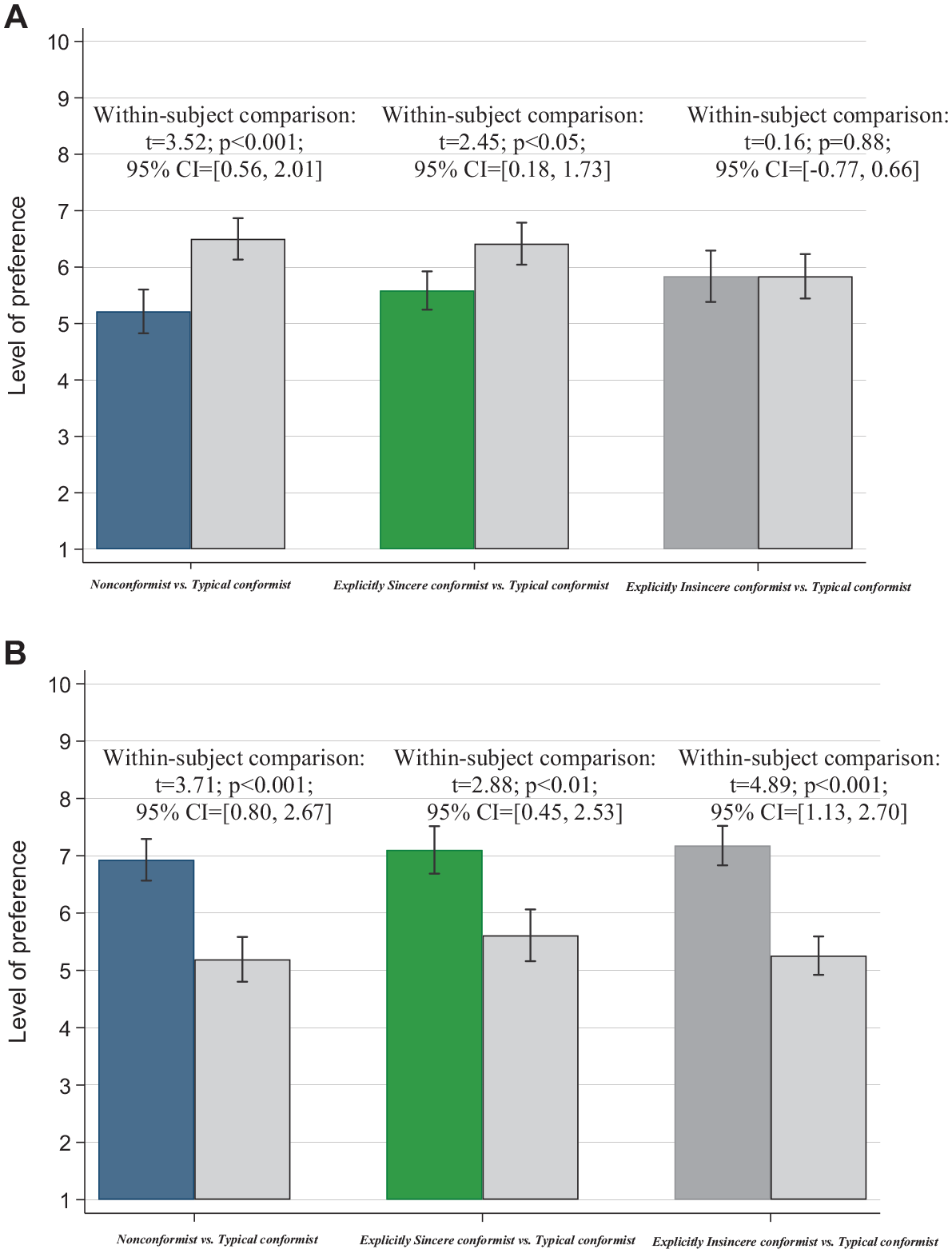
Experiment 1 Results on the Level of Preference as an Exchange Partner: (a) Main Conditions and (b) Information Conditions Where the Commitment Score in the Peer Evaluation Is Higher for the First Protagonist (“Nonconformist,” “Explicitly Sincere Conformist,” or “Explicitly Insincere Conformist”)
Results from information conditions—where the protagonists’ commitment has been shown via performance review—also validate the scope conditions. Specifically, the nonconformist, explicitly insincere conformist, or explicitly sincere conformist is preferred over the typical conformist when commitment for the former protagonist is more directly shown to be higher. These results are visually illustrated in Figure 3b. Counterbalanced information conditions (i.e., where subjects are given information that the commitment of the typical conformist is higher) show substantively the same pattern but reversed. 7
Experiment 2
Design and Procedure
A potential concern from Experiment 1 is that even though it manipulates each protagonist’s seeming preference for conformity, it also partly relies on Korean subjects’ knowledge around the drinking norm’s visible unpopularity. To see if results hold even when subjects have no preconceptions and to probe generalizability of the underlying logic, I conducted another experiment using U.S.-based subjects and a norm directly manipulated to be visibly unpopular (or popular).
Seven-hundred forty-three U.S.-based adults were recruited via Prolific in October 2021. Subjects were told of a (fictitious) norm in a startup. Specifically: [The startup newsletter article described] “the Beat,” which is a well-known element about the startup. “The Beat” entailed everyone joining a big circle and clapping along the beat, and each person was expected to take turns to dance, beat box, rap, and sing. “The Beat” was famous for the fact that founders . . . played the game, and most of current employees of the startup played it when they joined the startup as well.
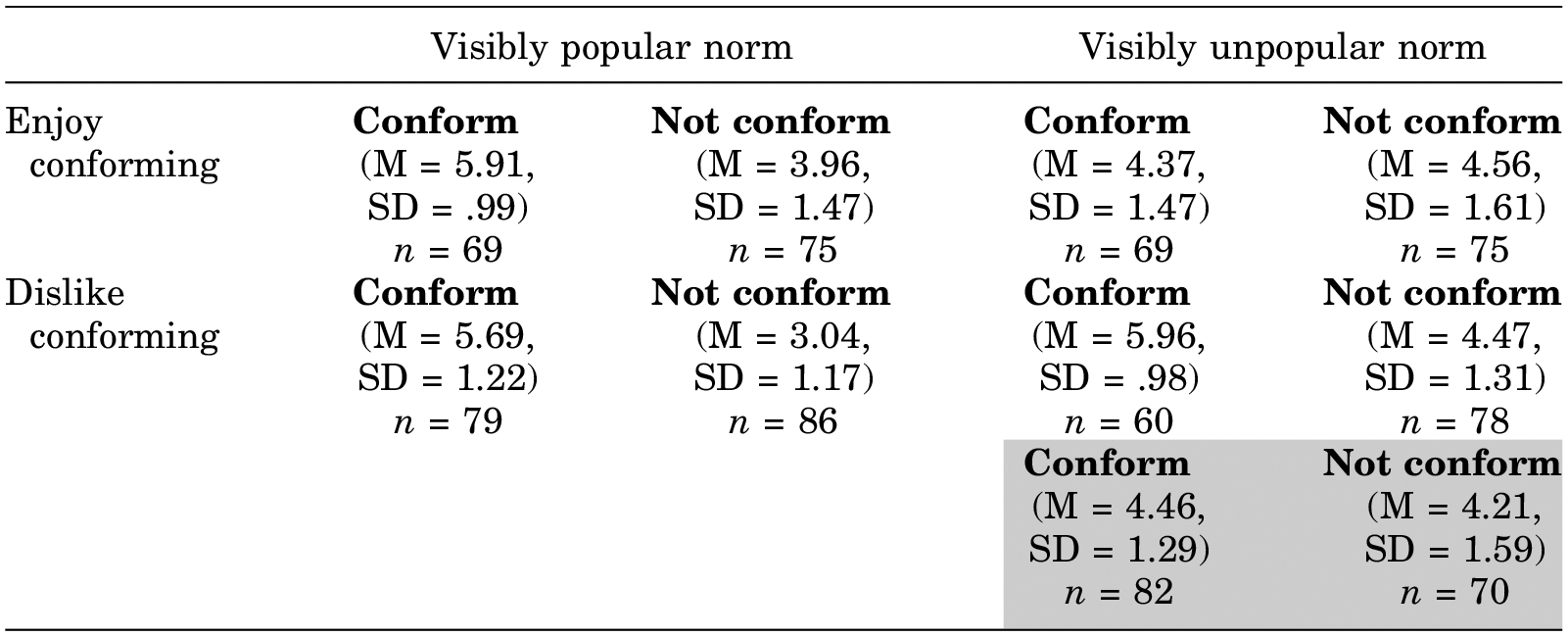
Subjects were then randomly assigned to one of eight (2 × 2 × 2) main conditions, as described in Table 2: most employees enjoy conforming to a norm and approve of it versus most employees dislike conforming and disapprove of it, the protagonist enjoys versus dislikes conforming (which was communicated to subjects via overheard conversations), and the protagonist conforms versus does not conform. Two conditions (where independence and creativity are important vs. commitment is important) are added to conditions where the norm is visibly unpopular and the protagonist dislikes conforming so that I can test whether insincere conformity with the visibly unpopular norm is valued only in situations where signals of commitment are necessary. Subjects were then asked to evaluate the protagonist in each condition as a potential new member of the startup. These design choices and predictions were preregistered.8,9 and the full instrument and questions are reported in the Appendix.
Experiment 2 Conditions and Summary Statistics
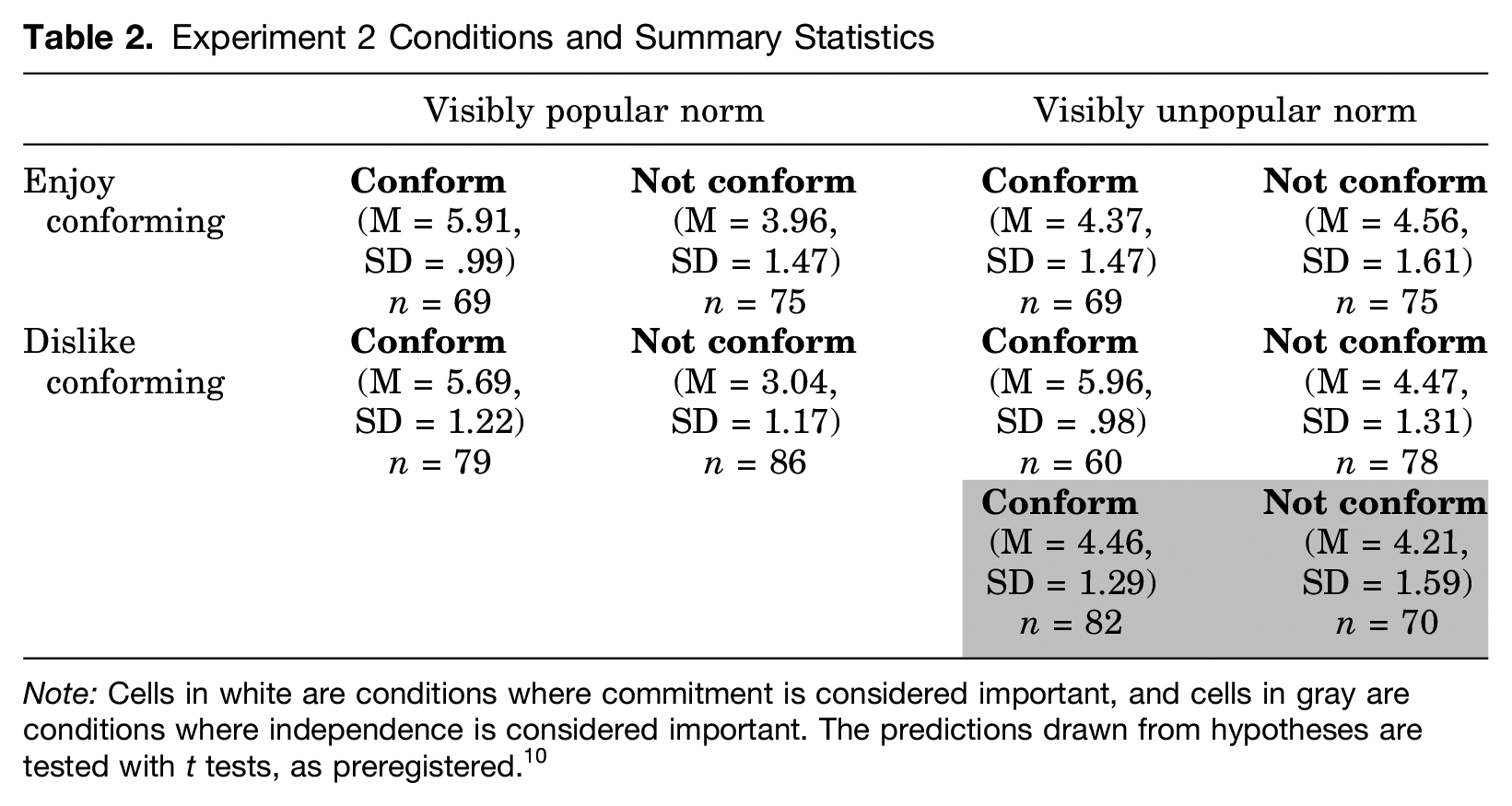
Note: Cells in white are conditions where commitment is considered important, and cells in gray are conditions where independence is considered important. The predictions drawn from hypotheses are tested with t tests, as preregistered. 10
Results
Consistent with Hypothesis 1, results from t tests show that the protagonist who dislikes conforming but conforms to the visibly unpopular norm (M = 5.96, SD = .98) is preferred over the protagonist who also dislikes conforming and does not conform (M = 4.47, SD = 1.31, t = 7.65, p < .001). But the preference for the conformist seems specific to the insincere conformist and not all conformists. In other words, results from t tests show that the protagonist in the unpopular-dislike-conform condition (M = 5.96, SD = .98) is favored over the protagonist in the unpopular-enjoy-conform condition (M = 4.37, SD = 1.47, t = 7.32, p < .001). Analysis of variance tests further show a significant visibly Unpopular × Dislike × Conform level three-way interaction, F(1, 583) = 5.10, p < .05. These results support Hypothesis 2.
Results further support Hypothesis 3 by showing that the insincere conformist to the visibly unpopular norm is preferred only when commitment is deemed necessary. Subject preference for the conformist is greater in the unpopular-dislike-conform condition, where commitment is deemed important (M = 5.96, SD = .98), over the equivalent conformist in the same unpopular-dislike-conform condition, but where independence is instead deemed important (M = 4.46, SD = 1.29, t = 7.90, p < .001). There also is no longer evidence from t tests that in the conditions where independence is deemed more important, the conformist (M = 4.46, SD = 1.29) is favored over the nonconformist (M = 4.21, SD = 1.59, t = 1.05, p = .29).
Conclusions and Discussion
The persistence of suboptimal norms presents a problem in human societies. Using interview data on the excessive drinking norm in Korean after-hours gatherings, this article develops a theory on when and why norms might be sustained despite widespread recognition of their suboptimality and unpopularity for the collectives and individuals. The core idea is that when the norm is visibly unpopular, typical conformity appears insincere (i.e., the conformist appears aversive to conforming) and signals the conformist’s willingness to sacrifice personal interests for exchange partners. After I use the interview data to uncover this logic, I test it directly in the experiments. In particular, the experiments confirm that specifically insincere conformity—and not just any conformity—drives the higher preference for the conformist with visibly unpopular norms.
Based on this idea that conformity with the visibly unpopular norm can be rewarded, a potentially remaining question is: Is the norm unpopular among individuals if people derive extrinsic utility from it? The answer in short is: extrinsic utility is not tantamount to popularity. After all, if people saw the norm as optimal or enjoyed conforming to the norm in the first place, extrinsic utility would not be present. But because of such extrinsic utility for individuals, the norm persists despite its widely recognized collective suboptimality. Communications of such “insincerity” behind conformity may vary depending on the contexts. In some contexts, physical aversions toward conformity may be obvious, as in the case of female footbinding in China (Mackie 1996); in others, dislikes and disapprovals may be more subtle and communicated through public narratives, as in the case of working overtime (Bailyn 2006; Blair-Loy 2003; Weeks 2004). Alternatively, such communications may only be made through private conversations that inform people of others’ dislikes and disapprovals (Wedeen 1999; cf. Adut 2005).
Yet despite the examples of visibly unpopular norm persistence from different cultures and contexts, several features of the excessive drinking norm in my context (and those of the fictitious norm in Experiment 2) should be considered for scope conditions. In particular, although experiments confirm that insincere conformity with a visibly unpopular norm is rewarded only when signals of commitment are deemed necessary by exchange partners, a more fundamental question may be why such signals of commitment are deemed necessary in the first place. One possible reason is broad distrust toward first-time exchange partners (i.e., strangers), which seems prevalent in East Asian countries, including Korea. In particular, consider the “emancipatory theory of trust,” developed by Yamagishi, Cook, and Watabe (1998) and Yamagishi and Yamagishi (1994). Their argument is that strong bonds among family and friends in those countries operate as “assurance systems” inside where people are assured of one another’s commitment; but because of such assurance, people do not interact or develop trust with those outside such systems (Baldassarri 2020; Macy and Sato 2002). By contrast, people in countries such as the United States do not have strong assurance systems, but they also develop trust outside such systems to compensate for lack of assured support (Kuwabara et al. 2007). The distrust toward strangers, consequently, might constitute a situation where signals of commitment are especially needed between unfamiliar exchange partners.
Nevertheless, this also implies that such distrust may not be an inherent feature of societies like Korea but a situational and structural feature that may also exist in contexts like the United States. Poignantly, Yamagishi et al. (1998) show that if Americans instead have their own assurance systems, neither do they develop trust toward strangers outside such systems (see also Ermisch et al. 2023; Ermisch and Gambetta 2010). Field studies also show that the demand for commitment signals—and conformity with visibly unpopular norms as such signals—is also present in some Western contexts (e.g., Azoulay, Repenning, and Zuckerman 2010; Podolny and Baron 1997). In fact, similar norms around “after-hour drinks” and breakfast meetings seem to persist based on the similar dynamic in the West, as described in a New Yorker article (e.g., Collins 2016).
This scope condition naturally leads to a possible solution to the problem of visibly unpopular norms: if communities wish to remove such suboptimal norms, a necessary step may be to remove the need for signaling commitment. For instance, Bursztyn et al. (2020) suggest that young married men in Saudi Arabia privately reject norms prohibiting women from working outside the home but incorrectly perceive those norms to be popular. In their field experiment, correcting such misperceptions increased women’s labor market participation. In this case, however, the norm was not recognized as a signaling device. Neither did the men need to signal their commitment to anyone. Hence, spreading awareness of its unpopularity was sufficient to remove the norm. My experiments focus on idiosyncratic contextual cues that remove the need to communicate commitment (e.g., a more direct commitment signal in Experiment 1; independence as the more important characteristic in Experiment 2). Future research may further investigate specific contextual tools with which distrust or the need for signaling commitment can be muted.
Lastly, it is worth noting that this article speaks specifically to the persistence of visibly unpopular norms and not necessarily their emergence. Although the norm pertaining to excessive drinking is visibly unpopular in contemporary Korea, it may have been popular previously and/or emerged as a norm for different reasons than reasons it currently persists. In fact, my conjecture is that the dynamics I describe in this article—where people use the visibly unpopular norm to signal commitment—is perhaps necessary but not sufficient to create a new visibly unpopular norm given that another scope condition in my theory is widespread recognition that a norm serves as a device around which to coordinate and with which to signal commitment (cf. Bursztyn et al. 2020). But a new norm may not easily win that recognition, as described in the qualitative accounts in the online Appendix on the attempts to shift the norm (cf. David 1985). Nevertheless, I see the emergence of visibly unpopular norms as a productive avenue for future research, building on existing work that speaks to the emergence of social conventions around which people coordinate their behaviors (e.g., Centola and Baronchelli 2015).
In sum, even though research suggests that suboptimal norms would persist only when their suboptimality and people’s disapproval are not widely recognized (cf. Nyborg et al. 2016), I identify a reason why some suboptimal norms persist even when everyone is wise to the norms’ suboptimality. Rather, this conclusion implies that coordination around suboptimal norms might persist precisely because of—and not despite of—people’s disapproval of the norms, thereby raising questions to the often-assumed functional efficiency of social norms in human societies.
Supplemental Material
sj-docx-1-spq-10.1177_01902725241239953 – Supplemental material for Signaling Commitment via Insincere Conformity: A New Take on the Persistence of Unpopular Norms
Supplemental material, sj-docx-1-spq-10.1177_01902725241239953 for Signaling Commitment via Insincere Conformity: A New Take on the Persistence of Unpopular Norms by Minjae Kim in Social Psychology Quarterly
Supplemental Material
sj-pptx-2-spq-10.1177_01902725241239953 – Supplemental material for Signaling Commitment via Insincere Conformity: A New Take on the Persistence of Unpopular Norms
Supplemental material, sj-pptx-2-spq-10.1177_01902725241239953 for Signaling Commitment via Insincere Conformity: A New Take on the Persistence of Unpopular Norms by Minjae Kim in Social Psychology Quarterly
Footnotes
Acknowledgements
I am indebted to Ezra Zuckerman Sivan for his patient and generous advice on this article. I also thank Vanessa Conzon, Daniel DellaPosta, Erik Duhaime, Roberto Fernandez, Rebecca Grunberg, Jaekyung Ha, Oliver Hahl, Kate Kellogg, Erin Kelly, Minkyung Kim, Ko Kuwabara, Byungkyu Lee, Freda Lynn, Kinga Makovi, Kimberly Rogers, Gabriel Rossman, Scott Sonenshein, and seminar and workshop audiences at the Better Writing Group, Dartmouth College, Harvard University, McGill University, MIT, University of Iowa, University of Michigan, University of Pittsburgh, American Sociological Association Annual Meeting, Academy of Management Annual Meeting, Association of Korean Sociologists in America, East Coast Doctoral Conference, Economic Sociology Conference, and Wharton People and Organizations Conference for their feedback on the article at various stages. My gratitude also goes to Amy Lee for excellent research assistance, to my informants for taking time to talk to me about their experiences, to the editors and reviewers for their comments, and to MIT and Rice University for generous research support. Any errors are mine alone.

Supplemental Material
Supplemental material for this article is available online.
1
One may suggest that such polls reflect collective misperceptions of disapproval when in fact there is an approval. Although this possibility seems unlikely based on interviews, such pluralistic ignorance should still present a puzzle where people continue conforming with a norm that they recognize as widely unpopular among themselves and others.
2
3
10
Bio
References
Supplementary Material
Please find the following supplemental material available below.
For Open Access articles published under a Creative Commons License, all supplemental material carries the same license as the article it is associated with.
For non-Open Access articles published, all supplemental material carries a non-exclusive license, and permission requests for re-use of supplemental material or any part of supplemental material shall be sent directly to the copyright owner as specified in the copyright notice associated with the article.
