




Abstract
This article examines how penalizing men who “do gender” in nonstereotypical ways ultimately maintains the gender system. Leveraging data from an online survey experiment conducted with hiring decision-makers, I develop and test a theory of a help-seeking paradox whereby managers are less likely to interview and hire fathers who used career reentry assistance (CRA) relative to fathers who did not. However, this penalty does not emerge for mothers. A second online survey experiment reveals that two years of full-time employment after reentry diminishes the negative effects of CRA for fathers. Nonetheless, lingering stigma from having previously left paid work for childcare continues to disadvantage fathers relative to mothers, with perceptions of competence and commitment mediating long-term effects. These studies demonstrate how the reinforcement of cultural gender rules punishes both mothers and fathers seeking more equitable career coordination while providing novel insight into the boundaries of penalties for men who violate gender stereotypes.
Widely shared cultural beliefs about gender, or gender beliefs, are a core component of a gender system that justifies men’s higher status relative to women (Ridgeway and Correll 2004). Scholars have focused on how the gender system provides unchecked privileges for men in ways that constrain women’s abilities to fully participate in the workforce (Ridgeway 2011; Ridgeway and Smith-Lovin 1999). This status imbalance is exacerbated by motherhood (Ridgeway and Correll 2004). Mothers experience a “motherhood penalty” compared to nonmothers and men because of stereotypes about mothers lacking in competence and commitment to work (Correll, Benard, and Paik 2007). For men, combining labor market success and parenthood is culturally viewed as normative (Coltrane et al. 2013). As a result, fathers often receive a “bonus” due to their breadwinner status (Hodges and Budig 2010).
Yet the negative consequences of parenthood can also extend to men. Fathers who take off work for childcare for an amount of time beyond what is considered normative not only violate ideal worker norms—the expectation that employees be highly committed to their jobs (Kelly et al. 2010)—but also gendered expectations that men should be breadwinners (Townsend 2002). Compared with women, men who ask for family leave or use flexible work arrangements for childcare often experience larger penalties, such as lower performance ratings and reward recommendations (Butler and Skattebo 2004; Rudman and Mescher 2013; for a rare exception, see Munsch 2016). Fathers who leave the workforce entirely for childcare can face even greater obstacles to career reentry than mothers who do so (Weisshaar 2018).
Over the past decade, parents who leave paid work for childcare have increasingly used career reentry assistance (CRA) to circumvent penalties levied against “opt out” workers. 1 CRA programs are a “growth industry” (Stone and Lovejoy 2019:176) and have proliferated throughout the COVID-19 pandemic (Aspan and Hinchliffe 2021). A majority of CRA programs are professional return-to-work internships, commonly referred to as “returnships,” and are largely used by women.
In this study, I ask: Does CRA reduce or increase the penalties men face when they attempt to reenter the workforce? Such participation could be viewed as either a signal of increased commitment to paid work or as an additional normative violation above and beyond leaving paid work given that seeking help violates gendered expectations that men be independent (Rudman et al. 2012). Furthermore, can a recommitment to full-time work help men regain their status in the eyes of potential employers? By examining these questions, this research seeks to understand how penalties for men who “do gender” (West and Zimmerman 1987) in nonstereotypical ways ultimately reinforce the gender system. As many scholars have noted (e.g., Ridgeway 2011), men’s greater involvement in caregiving is necessary if we are to achieve gender equality. Yet if men face additional barriers to career reentry, they will continue to be reluctant to become primary caregivers (Pedulla and Thébaud 2015), thus maintaining the normative expectation that childcare is a “woman’s job.”
Although CRA is intended to combat negative perceptions of skill degradation and lack of career commitment, I argue that fathers will be penalized for using CRA because employers perceive men who seek help as lower status than men who do not use this assistance. I call this within-gender status penalty the help-seeking paradox. When fathers use CRA, they are paradoxically at a greater disadvantage because they are perceived as needing help to get a job. To test this argument, I conducted a series of online experiments by deploying a manipulated survey instrument to a diverse sample of hiring managers (N = 2,993). Testing for contrasts, my results not only confirm the existence of a help-seeking paradox for fathers but also, importantly, illuminate the conditions under which this penalty abates over time. Additionally, findings show how fathers have more difficulty realigning with the prototypical (male) ideal worker than mothers with a (female) ideal worker, producing an even wider long-term gap in perceived quality between former stay-at-home mother and father applicants.
This work provides novel theoretical contributions to our understanding of the durability of gender inequality. First, this article demonstrates how conceptions of masculinity produce constraints on men who do gender in nonstereotypical ways. Moreover, I show to what extent men’s proactive attempts to get beyond these penalties as they reenter work are effective or damaging. Practically, findings have implications for gender equality: If fathers incur long-lasting penalties for leaving paid work for childcare andare discouraged from seeking help for career reentry, beliefs about the appropriate roles of men (as breadwinners) and women (as caregivers) remain unchanged. These constraints ultimately uphold a gender system in which women are confined to roles that prevent their full labor force participation.
Theory
Gender Stereotypes, Normative Discrimination, and Help-Seeking
Gender stereotypes consist of two categories: (1) descriptive and (2) prescriptive or proscriptive. Descriptive stereotypes are widely held beliefs about the characteristics or abilities held by men and women (Burgess and Borgida 1999). While descriptive stereotypes are based on widely shared beliefs about what men and women can do, prescriptive and proscriptive stereotypes stem from normative beliefs about what men and women should or should not do (Burgess and Borgida 1999). For instance, men (as high-status actors) should be independent and strong (not dependent or weak); women (as low-status actors) should be giving and modest (not selfish or arrogant). Because prescriptive gender stereotypes are norms, both men and women can experience “backlash” (Rudman 1998; Rudman et al. 2012) in the form of social and economic penalties, or normative discrimination, when they enact normatively inappropriate status roles (Benard and Correll 2010). Men who violate gendered norms face greater risk of losing status and respect (Heilman and Wallen 2010). The higher status of manhood must be continually earned and is easily lost; womanhood, on the other hand, is largely viewed as resulting from biological development and once obtained, remains secure (Vandello and Bosson 2013). These risks are amplified for men in the workplace because their gender status is more closely linked with work than a woman’s (Coltrane et al. 2013).
Because masculinity norms dictate that men exude high levels of self-reliance (Moss-Racusin, Phelan, and Rudman 2010), help-seeking can result in status trade-offs for men. Seeking help can show weakness and an inability to resolve problems independently (Bamberger 2009). A male help-seeker may be perceived as incompetent or overly dependent on others (Lee 1997). Additionally, asking for help may be viewed as a form of failure (Bamberger 2009) or even as an act of femininity (Wahto and Swift 2016). It is therefore not surprising that popular stereotypes portray men as not wanting to ask for directions when they get lost, not requesting support when they are struggling emotionally, and not seeking medical assistance when they sustain injuries (Addis and Mahalik 2003). For women, humility is a prescribed trait. Weakness and insecurity are not proscribed (as they are for men; Rudman and Mescher 2013). Therefore, a woman would not be expected to experience status trade-offs relative to other women when asking for help.
Empirical research has shown men are negatively viewed for seeking help (Addis and Mahalik 2003; Johnson et al. 2012). Rudman (1998) found that self-effacing behavior resulted in competence trade-offs among men but not among women. Rosette et al. (2015) showed that male leaders who sought help from subordinates were perceived as less competent than men who did not seek help, but this within-gender penalty did not apply among women. Thus, I argue that fathers who use CRA will be viewed as lower status (i.e., less competent, less respectable) than otherwise equally qualified fathers, resulting in worse employment outcomes and decreased financial rewards. I do not expect that mothers who use CRA will be penalized relative to their non-help-seeking female peers.
Skeptics might argue: Aren’t men who seek help inherently less qualified? This counterargument is based on statistical discrimination theory, traditionally viewed as informational bias rather than cognitive bias (see Correll and Benard 2006). The idea is that risk-averse employers with imperfect information rely on group statistics to hire individuals they expect will be the most productive (see England 1994). However, labor market discrimination is frequently justified based on statistical discrimination, which “can lead people to view social stereotyping as useful and acceptable and thus help rationalize and justify discriminatory decisions” (Tilcsik 2021:1). If taking time off for childcare or using CRA are indications that a worker is less productive, statistical discrimination theory would predict no differences based on gender when the quality and source of information about an applicant are otherwise held constant. Given the lack of statistics on the productivity of mothers and fathers who previously left paid work for childcare or use CRA, any increased discrimination against fathers should not be driven by statistical discrimination. Rather, such bias should be due to a violation of gendered expectations (i.e., normative discrimination) since both leaving paid work and help-seeking behaviors are so strongly counternormative for men.
The Gendered Nature of Leaving Paid Work and the Consequences for Career Reentry
Women continue to be more likely than men to leave the workforce for caregiving (Livingston and Parker 2019). However, the number of at-home fathers has doubled from one million to two million over the past three decades, with 24 percent of these at-home fathers reporting that they stay at home to care for their families and not for other reasons (e.g., unable to find work). In contrast, only 5 percent of at-home fathers reported staying home primarily for childcare purposes in 1989—about a fivefold increase (Livingston 2014). Although women have been disproportionately pushed out of the workforce in the wake of COVID-19 (Heggeness 2020), men with school-age children also left paid work at historically unprecedented rates throughout the pandemic (Feintzeig 2020).
Leaving paid work for caregiving is generally viewed as low status. Therefore, regardless of gender, parents face obstacles relaunching their careers (Stone and Lovejoy 2019; Weisshaar 2018). However, because breadwinning is perceived as integral to manhood (Townsend 2002), men can face harsher penalties than women when they violate these normative expectations. Weisshaar (2018) found that in competitive labor markets, employers penalized fathers more than mothers when attempting to reenter paid work after an 18-month gap. Consistent with these empirical findings, I expect that career reentry should present fathers with increased penalties (i.e., less likely to be interviewed or hired,more likely to receive lower compensation) compared with equally qualified mothers irrespective of whether they used CRA.
Hypothesis 1: Hiring managers will penalize fathers relative to mothers at the point of reentry.
The Paradox of Seeking Help for Career Reentry
Men who seek help violate normative expectations (Moss-Racusin et al. 2010) because they risk being seen as less competent and less respectable men (Heilman and Wallen 2010; Rudman 1998). Therefore, I predict employers will further penalize fathers who took advantage of CRA due to employers’ beliefs that such fathers are less competent and less respectable than fathers who did not receive such help.
Hypothesis 2a: At the point of reentry, hiring managers will penalize fathers who used CRA relative to fathers who did not.
Hypothesis 2b: The increased penalties faced by fathers who used CRA relative to fathers who did not will be explained by perceptions of competence and respectability.
I do not expect mothers will be penalized for using CRA on the basis of help-seeking. Although mothers typically face normative discrimination when attempting to prove their competence and commitment to work (Benard and Correll 2010), mothers who use CRA are prioritizing their careers in a gender- consistent manner (i.e., humbling, nondominant). Therefore, mothers may either avoid the within-gender penalties that fathers face, or they may be advantaged over mothers who have not received help. Thus, I make no a priori hypotheses regarding the effect of CRA on the reentry outcomes of mothers.
The Diminishment of Stigma for Help-Seeking
What are the conditions under which penalties diminish for men who violate normative expectations? Social psychological research shows that men who engage in nonstereotypical behavior may attempt to counteract backlash through compensatory recovery strategies, such as reconforming to gender norms (Cheryan et al. 2015; Rudman and Fairchild 2004). However, this literature primarily focuses on the micro-level (individual) processes that precipitate these strategies rather than the meso-level (interactional) processes that determine the effectiveness of these strategies. In other words, rather than asking “How does a man choose to alter his behavior to deter backlash for a gender norm violation?” the question becomes “How do others choose to treat a norm-violating man who has since reconformed to the norm?” With respect to the current study, would the predicted penalties for using CRA persist long term for fathers, even after demonstrating they no longer need help? I expect that returning to and continuing to work full-time, referred to herein as a “successful career relaunch,” will allow fathers to demonstrate their competence and realignment with masculinity norms, reducing the penalties for having used CRA.
Hypothesis 3: In the long term, evidence of a successful career relaunch will mitigate the workplace penalties faced by fathers who used CRA relative to fathers who did not.
The Lingering Stigma for Leaving Paid Work
Once fathers regain their breadwinner status, will employers view them according to the traditional framework as more competent and committed than their reemployed female counterparts? I argue that leaving paid work for full-time caregiving is a greater norm violation for men than using CRA, and thus fathers will continue to face long-term consequences relative to mothers even after a successful career relaunch. I predict that employers will retain greater long-term uncertainty about a father’s ability to realign with (male) ideal worker norms. Specifically, the stigma from having previously left paid work should continue to result in long-term penalties due to employers’ beliefs that a man who ever “opted out” for full-time caregiving is less competent and less committed to work than an equally qualified mother.
Hypothesis 4a: In the long term, hiring managers will continue to penalize fathers relative to mothers following reentry.
Hypothesis 4b: The increased penalties faced by fathers relative to mothers will be explained by differences in perceived competence and commitment.
The Case of Software Engineering Returnships
I use the hiring of “opt-out” workers into full-time software engineering roles to test for the help-seeking paradox and the lingering stigma of leaving paid work faced by fathers. Software engineering offers a realistic and important case to test my hypotheses. Science, technology, engineering, and mathematics (STEM) fields are numerically and culturally male-dominated, placing a strong emphasis on ideal worker norms and pressuring workers to avoid behaviors culturally coded as feminine (Cech and Blair-Loy 2019). Thus, failure to abide by these norms should result in greater status loss for men compared to women, given that manhood is even more precarious in male-typed work cultures (Vandello and Bosson 2013). Because STEM positions comprise around one-third of all returnships and the vast majority of returnships are offered in male-dominated fields struggling to retain women (Mercer 2018), the findings from the current case should be compelling. While caution must be used in generalizing results to non-STEM jobs, research shows that gender norm violations (e.g., full-time caretaking and help-seeking) result in backlash for men in other white-collar professions (e.g., accounting, business, consulting) and even in female-dominated industries (Reid, O’Neill, and Blair-Loy 2018; Rosette et al. 2015; Weisshaar 2018).
Returnships provide returning professionals with a “foot in the door,” allowing companies to assess them on a paid trial basis (Stone and Lovejoy 2019). Applicants no longer have to obfuscate their résumé gaps (ranging from two years to more than two decades). As a skills ramp-up, returnships are meant to alleviate doubts around being current (Agovino 2019). Most participants are women, but cohorts typically include a few men. Generally, at least 50 percent of participants convert into employees (Gurchiek 2018). However, failure to convert might further stigmatize a returner among future prospective employers. While ageism and/or persistent concerns around skill degradation and commitment could account for employers’ negative reactions to returnship participants, I argue that if CRA were a gender-neutral process, the consequences of seeking help would not differ for mothers and fathers.
Overview of Studies
To test the gendered implications of CRA, I conducted two online experiments that deployed a manipulated survey instrument to hiring decision-makers. I employ the design used by Galperin et al. (2019) and originally described by (Parigi et al. 2017:1) to “capture theoretically relevant environmental conditions while maximizing the researcher’s control over the treatment(s) of interest.” This methodology simulates the study’s environment of interest while using the key practitioner audience in the context of the study (here, hiring managers engaging in online hiring decision-making). Online experiments are advantageous because they (1) better simulate the hiring environment than traditional lab-based experiments, (2) are less prone to measurement error than audit studies, and (3) permit direct measurement of cognitive mechanisms underlying applicant selection (Galperin et al. 2019; Parigi et al. 2017). I conducted both experiments between March and April 2019 and recruited all participants through Lucid, an established online sampling platform I describe below.
Study 1 forms the basis of my theoretical argument that CRA in the form of a returnship will have a paradoxical effect on the reentry outcomes of fathers. In Study 1, I ask participants to evaluate the LinkedIn profile of a parent applicant applying for a software engineering position. I manipulate only gender and returnship participation status to demonstrate the effects of a returnship on the reentry outcomes of mothers and fathers. Study 2 continues to manipulate only gender and returnship status but shifts the timeline across all conditions so that the applicant has two years of continuous work experience following reentry. This study tests whether the effects of gender and a returnship persist even after an applicant has demonstrated a successful career relaunch.
Study 1: Effects of Gender and A Returnship on Short-Term Reentry Outcomes
Methods
Study 1 consisted of a 2 × 2 between-subjects design that simulated the hiring evaluation process. Participants with hiring experience reviewed the LinkedIn profile of a parent applicant whose profile varied only by gender (mother or father) and returnship status (returnship or nonreturnship), creating a total of four conditions. Participants then made interview, hiring, starting salary, and bonus recommendations. Afterward, participants rated the applicant on a series of traits and finished by answering demographic questions. Throughout the studies, I describe the applicants as being either “returnship mothers/fathers” or “nonreturnship mothers/fathers.”
Sample
I recruited participants through Lucid to obtain a diverse sample of hiring decision-makers. Lucid is the largest U.S. marketplace for large online convenience samples. It allows researchers to construct demographically targeted participant groups using a combination of screening questions and quota sampling. Lucid is a good source for empirical data, producing samples that (1) are demographically, politically, and psychologically similar to U.S. national benchmarks based on the American National Election Studies; (2) successfully replicate numerous social science survey experiments conducted using nationally representative samples; and (3) can be curated to include large numbers of participants who are relatively rare in the population (Coppock and McClellan 2019).
I restricted the sample to U.S. residents ages 18 and older with college degrees and employed full-time. I implemented quotas to achieve a sample of eligible participants that roughly mirrored national estimates of hiring decision-makers and included two screening items to ensure that participants (1) regularly made hiring decisions and (2) were either an executive, a senior or midlevel manager (in a business, HR, or IT function), or staff-level employee (in a business or HR function; see Pedulla 2016). Because participants were not drawn from a random probability sample of hiring managers, the data are limited in generalizability to a larger population. However, I can use the results to generate internally valid, causal estimates of the effects of parent gender and a returnship on hiring decisions (Quadlin 2018). For both studies, I paid Lucid $1.25 per participant. A total of 1,549 participants completed Study 1. I excluded 17 participants from the analysis for providing incomplete data for the dependent measures and mediating constructs (listed in the next section), producing a final analytic sample of 1,532 participants. 2
LinkedIn profiles
I developed applicant profiles by drawing on actual LinkedIn pages of technical workers who publicly listed participating in a returnship. 3 I made it clear that all applicants were parents who had previously left paid work by including the statement “left to take care of my children full-time” below their most recent full-time position (adapted from Weisshaar 2018). Across all conditions, every applicant was attempting to reenter the workforce. Varying application materials by returnship status and parent gender produced four experimental conditions in which participants evaluated one mother or one father who had previously left paid work for childcare and who had either recently participated or had not participated in a 16-week returnship.
To manipulate returnship status, I included an additional profile entry for a software engineering returnship at Walmart Labs, which operates one of the largest returnships in the United States (O’Donnell 2019). On the profile, I described the returnship as a “16-week internship designed for caregiving professionals looking to return to full-time work.” I made the gender of the applicant salient by using a common White female (Allison Larson) or White male (Matthew Larson) name (see Correll et al. 2007). Each LinkedIn profile included a photo of a one-dimensional White male or female avatar that was devoid of facial features and consisted of a basic color scheme so that applicants clearly differed only by gender (see Harkness 2016). I pretested profile photos to ensure that participants accurately perceived the gender of each avatar. Participants were informed that profile images had been replaced with avatars and that last names were changed to protect applicant identities. Across all conditions, applicants were parents living in the San Francisco Bay Area with an eight-year employment gap for childcare. 4 All applicants earned a bachelor of science and a master’s degree in computer science consecutively from the University of California, Berkeley, and then subsequently worked for one company for 10 years, leaving paid work at the level of engineering manager. All applicants listed knowledge of C++, Java, and JavaScript—three common programming languages. Because all applicants are presented as well qualified with prestigious credentials, solid work experience, and skills, this design results in a conservative test of the hypotheses because applicants represent the “best case” scenarios in terms of applicant qualifications.
Procedure
Participants were first invited to participate in a study on “crowdsourced hiring,” a practice in which outsideevaluators help companies evaluate and hire talent.
5
Next, participants were instructed: You will be tasked with helping an artificial intelligence (AI) company developing autonomous vehicles (i.e., self-driving cars) hire a senior software engineer. We will provide you with a job description and the LinkedIn profile of a job applicant randomly selected from a pool of applicants. After thoroughly reviewing the job description and the applicant’s LinkedIn profile, continue on to the next screen to evaluate the applicant by providing your immediate and uncensored opinion.
Participants next read a job description for a senior software engineer position at a Silicon Valley–based AI company. To develop the description, I conducted a nonrandom content analysis of relevant job postings in the San Francisco Bay Area. The job description emphasized a need for candidates who are “up-to-date on programming fundamentals and leading-edge technologies, highly technical, and able to work well under pressure and handle multiple competing deadlines.” The position also required either a BS or MS in computer science and “evidence of exceptional ability” and “knowledge of at least one programming language.”
I presented participants with the applicant’s LinkedIn and asked them to correctly complete a multiitem factual manipulation check (FMC) question (Kane and Barabas 2019) to improve data quality by ensuring participants (1) were paying attention and (2) acknowledged multiple facts about the applicant’s profile that included key experimental manipulations (i.e., parent gender and returnship status). 6 Participants who accurately completed this item moved on to the actual study task, in which they reviewed the applicant’s profile and made interview, hiring, and compensation recommendations. Afterward, participants proceeded to rate the applicant on a series of traits.
Around 60 percent of eligible participants accurately completed the FMC question, on average, across both studies. An investigation into the distribution of manipulation check failure revealed that Black applicants (compared with all other racial/ethnic groups), men (compared with women), and individuals presented with the profile of a returnship mother or father (compared to a nonreturnship mother or father) were less likely to pass the FMC. 7 To ensure that differential manipulation check failure did not bias study results, I estimated a separate set of models that include inverse probability weights. 8 These models account for differences in manipulation check failure across conditions and demographic traits. I find that the results remain strongly robust to the inclusion of controls for differential manipulation check failure.
Dependent measures
The primary dependent variables across both studies include interview likelihood, hire likelihood, and recommended starting salary and bonus, which I use as measures of workplace reentry outcomes. Table 1 summarizes how I constructed these evaluation items. Based on established research methods (see Pedulla 2016; Quadlin 2018), I transformed the interview and hire likelihood items into binary variables, with the “very likely” category equal to 1 and allother categories equal to 0. 9 Coding these variables in this way makes sense theoretically because only applicants whoattained the “very likely” category on these measures would realistically receive a callback or a job offer from an employer in an actual organizational setting (Quadlin 2018). I also aggregated recommended starting salary and bonus to create a measure of total recommended compensation.
Items Used by Participants to Evaluate Applicants (Studies 1 and 2)
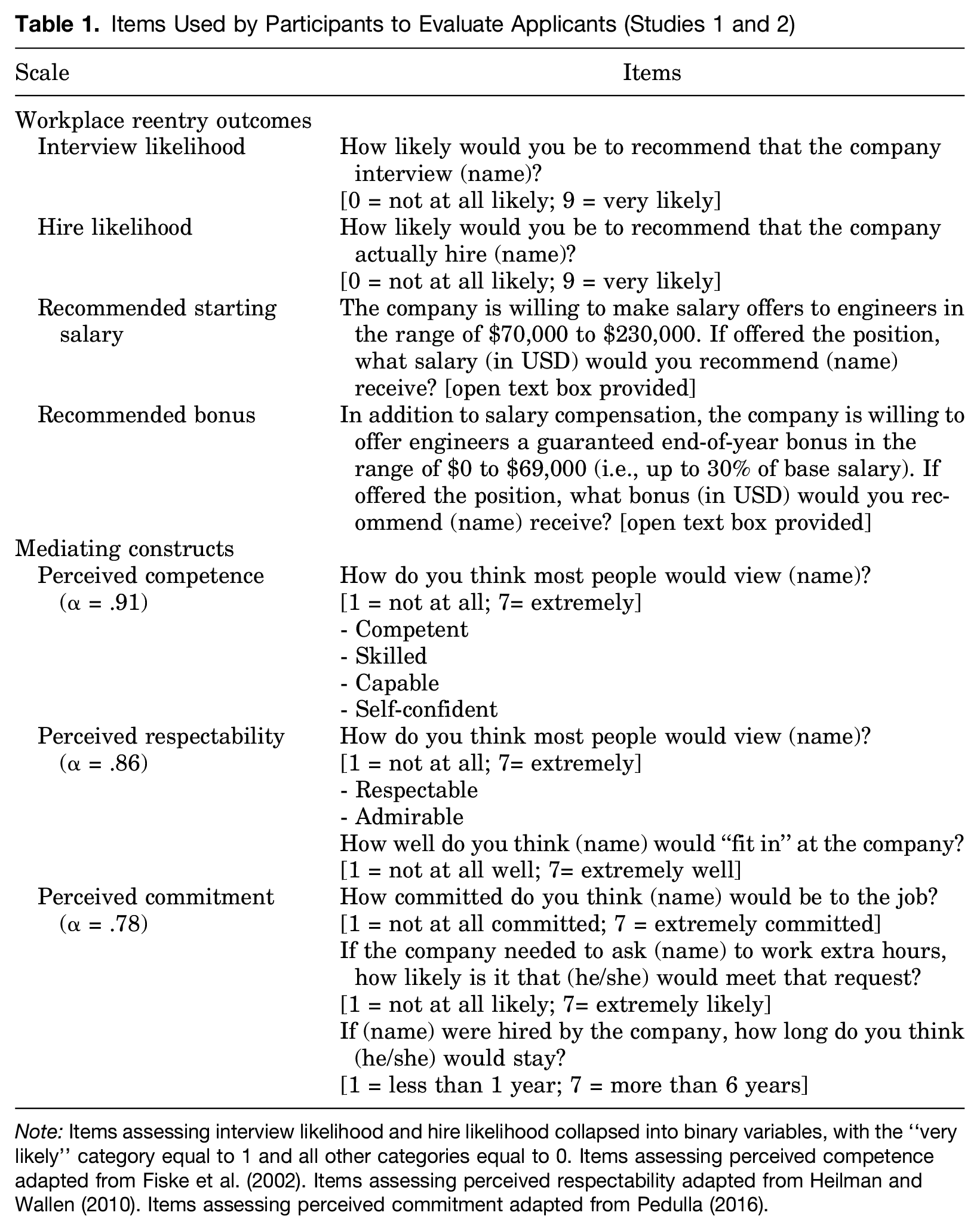
Note: Items assessing interview likelihood and hire likelihood collapsed into binary variables, with the “very likely” category equal to 1 and all other categories equal to 0. Items assessing perceived competence adapted from Fiske et al. (2002). Items assessing perceived respectability adapted from Heilman and Wallen (2010). Items assessing perceived commitment adapted from Pedulla (2016).
Mediating constructs
After providing interview, hiring, and compensation recommendations, participants scored their impressions of the applicant along multiple personal traits. Table 1 summarizes the construction of these mediating measures used across the studies, including perceived competence, perceived respectability, and perceived commitment.
Analytic strategy
I use logistic and linear regression models with robust standard errors to estimate the effect of parent gender on an applicant’s likelihood of being interviewed and hired; their recommended starting salary, bonus, and total compensation; and their perceived competence and respectability. Rather than testing conventional interaction effects, I test for the contrasts of interest by conducting split sample logistic and linear regression models with robust standard errors. All statistical tests are two-tailed with significance assessed at the p < .05 level (unless otherwise noted). I also find empirical results do not vary by participant gender, parental status, or experience of work disruptions. Moreover, while models are presented without control variables given random assignment to condition (see Mutz 2011), regression results are robust to the inclusion of controls for participant gender, age, income, and parental status.
Results
Table 2 presents descriptive statistics by experimental condition, along with paired t tests of means to show comparisons between particular applicants. Table 3 (Panel A) shows logistic and linear regression results for the effect of parent gender on the evaluations of applicants. Table 3 (Panel B) shows logistic and linear regression results for the significance of the contrast between applicants who did and did not use a returnship, split by parent gender. Although I am theoretically focused on testing for contrasts, across both experiments I find that the interaction term between father and returnship status is negative but not significant at the .05 level for all models (see Panel C for Tables 3 and 5). While the estimates of the interaction models are of substantial magnitude, the standard errors are large, which could be due to lack of power or unobserved heterogeneity.
Descriptive Statistics for Short-Term Reentry Evaluation Items by Experimental Condition, N = 1,532 (Study 1)
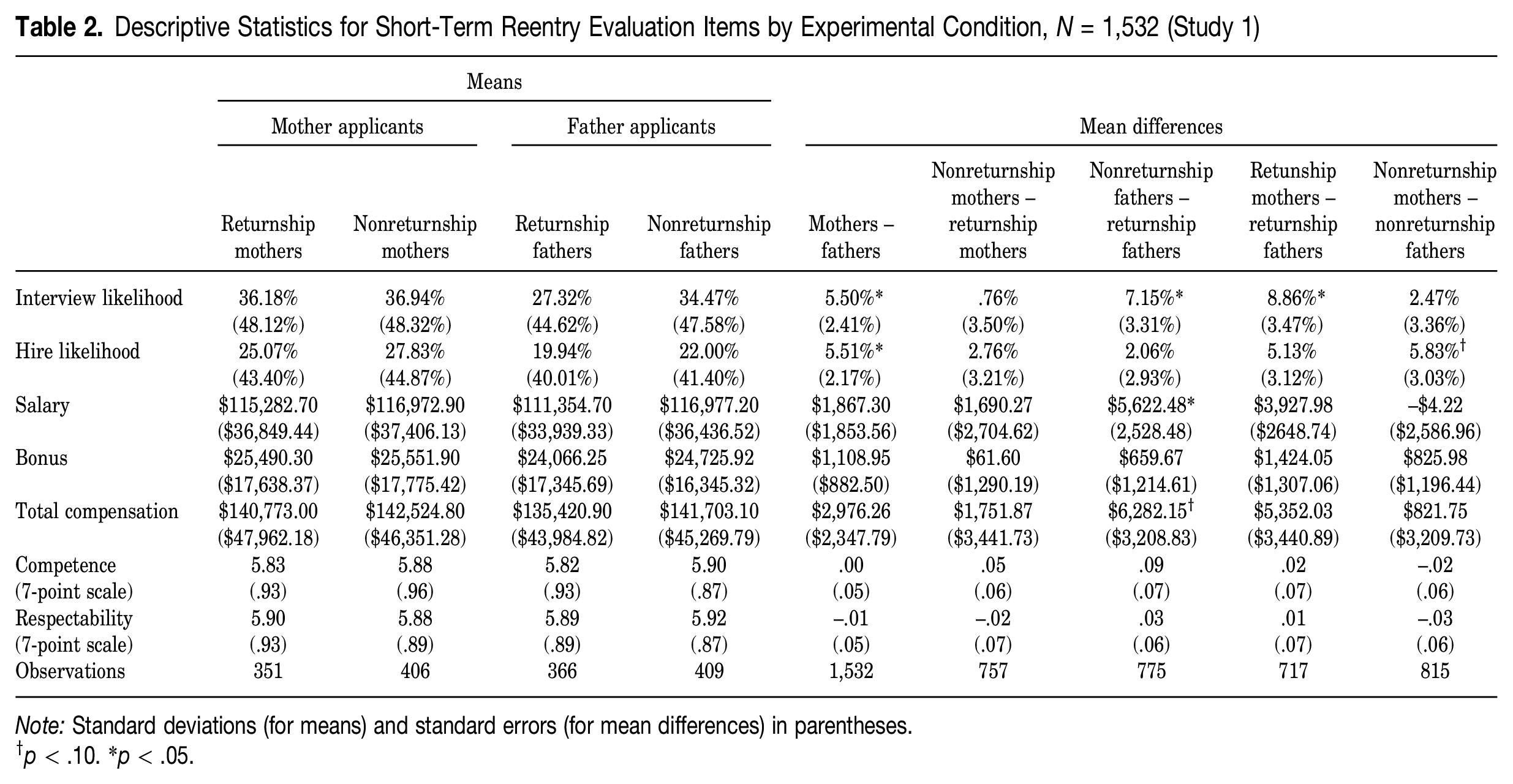
Note: Standard deviations (for means) and standard errors (for mean differences) in parentheses.
p < .10. *p < .05.
Estimated Regression Coefficients for the Effect of Parent Gender (Panel A), the Effect of Returnship Status Split by Parent Gender (Panel B), and the Interaction of Returnship Status and Parent Gender (Panel C) on Short-Term Reentry Evaluation Variables, N = 1,532 (Study 1)
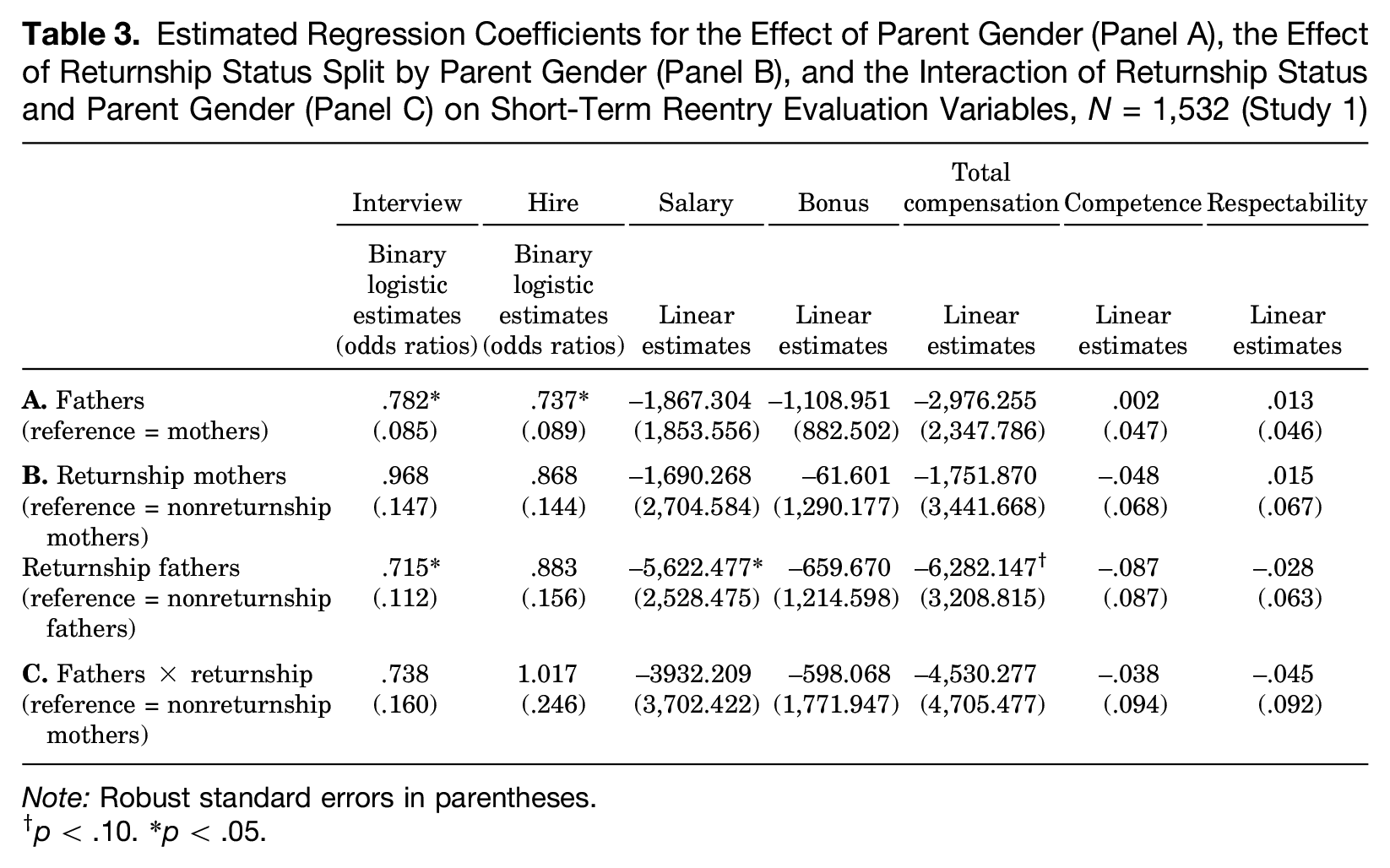
Note: Robust standard errors in parentheses.
p < .10. *p < .05.
Are fathers penalized relative to mothers at the point of reentry? (Hypothesis 1)
Table 3 (Panel A) indicates that fathers have approximately 22 percent lower odds of being very likely to be recommended for an interview (eβ = .782) and approximately 26 percent lower odds of being very likely to be recommended for hire (eβ = .737) compared to mothers. Interestingly, I do not observe a significant gender effect in terms of compensation recommendations. These findings suggest that in the short term, fathers are significantly penalized relative to mothers in terms of their likelihood of being interviewed and hired—but not in terms of pay—thus lending support for Hypothesis 1.
Who gets penalized for using a returnship? (Hypothesis 2a)
A split sample regression by parent gender (Table 3, Panel B) shows that returnship fathers have approximately 29 percent lower odds of being interviewed relative to nonreturnship fathers (eβ = .715). However, I find no statistically significant difference in the likelihood of being hired among fathers based on returnship status. For recommended starting salary, the coefficient is negative and significant, indicating that having used a returnship is associated with a $5,622 average decrease in recommended starting salary for returnship fathers compared to nonreturnship fathers (p < .05). I find no significant differences in terms of recommended bonus between returnship fathers and nonreturnship fathers. The coefficient for total compensation is negative and marginally significant (p = .051). In stark contrast, I find no significant differences between returnship mothers and nonreturnship mothers for any of the dependent variables. 10 Results thus provide strong support for my main prediction that fathers who used a returnship will be penalized relative to fathers who did not at the point of reentry.
Do competence and respectability ratings mediate the increased penalties incurred by returnship fathers? (Hypothesis 2b)
Table 3 (Panel B) shows that while the sign of the coefficients for perceived competence and respectability is consistent with my theoretical argument (i.e., that fathers who use CRA are viewed as lower status than fathers who do not), the estimated differences are not statistically significant. Additionally, including perceived competence (but not perceived respectability) into the models as a statistical control reduces the salary coefficient to marginal significance (Baron and Kenny 1986). Therefore, these status-related ratings do not appear to fully explain the increased penalties incurred by returnship fathers relative to nonreturnship fathers at the point of reentry. 11
Discussion
Results show fathers were penalized relative to mothers when attempting to reenter the labor market in terms of their likelihood of being interviewed and hired but not in terms of compensation. While men usually receive higher compensation than similarly qualified women (Blau and Kahn 2017), this pay advantage was attenuated for fathers who left employment. In the short-term reentry process, using a returnship produced different consequences among fathers than it did among mothers, offering evidence of a predicted help-seeking paradox for men. Testing for contrasts, I found that interview, hiring, and compensation recommendations did not significantly differ for returnship mothers relative to nonreturnship mothers. Conversely, returnship fathers were significantly penalized compared to nonreturnship fathers in terms of their likelihood of being interviewed and recommended compensation. Perceptions of applicants’ competence and respectability did not appear to fully explain the increased penalties faced by returnship fathers relative to nonreturnship fathers.
Study 2: Effects of Gender And a Returnship on Long-Term Reentry Outcomes
Methods
Study 2 investigates whether a successful career relaunch (operationalized as two years of continuous full-time work) mitigates the negative effects of a returnship for fathers. Study 2 also examines whether employers continue to penalize fathers relative to mothers long term, even after a successful career relaunch.
Procedure
Study 2 mirrored the design of Study 1. However, I altered the work timelines of each profile so that all applicants had approximately two years of continuous work experience after reentry. The LinkedIn profiles of returnship parents indicated that Walmart Labs hired them as standard employee software engineers following a 16-week software engineering returnship. For nonreturnship parents, they too reentered the workforce at the same time to work for Walmart Labs—the only difference being that their first 16 weeks on the job were as standard employees rather than as returnship participants. I randomly assigned 1,461 participants to evaluate one of four profiles that belonged to a mother or father who had left full-time work for caregiving and returned after eight years and who either did or did not participate in a returnship two years prior (note: I dropped six participants from the full sample for item nonresponse). After reviewing the profile, participants rated applicants using the same evaluation items from Study 1.
Results
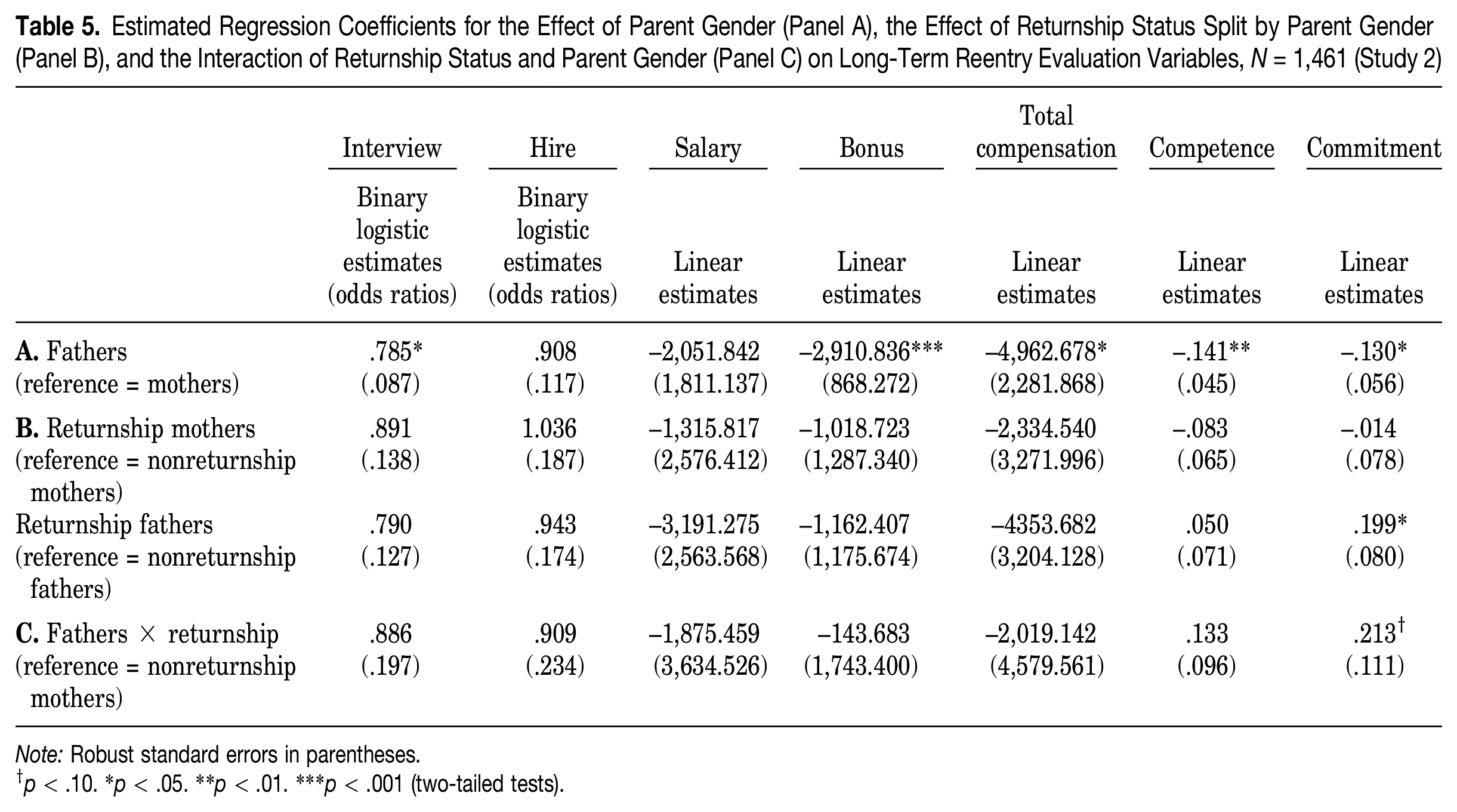
Table 4 presents descriptive statistics by experimental condition, including paired t tests of means. Table 5 (Panel A) shows logistic and linear regression results for the effect of parent gender on the long-term evaluations of applicants. Table 5 (Panel B) shows logistic and linear regression results for the significance of the contrast between applicants who did and did not use a returnship two years prior, split by parent gender.
Descriptive Statistics for Long-Term Reentry Evaluation Items by Experimental Condition, N = 1,461 (Study 2)
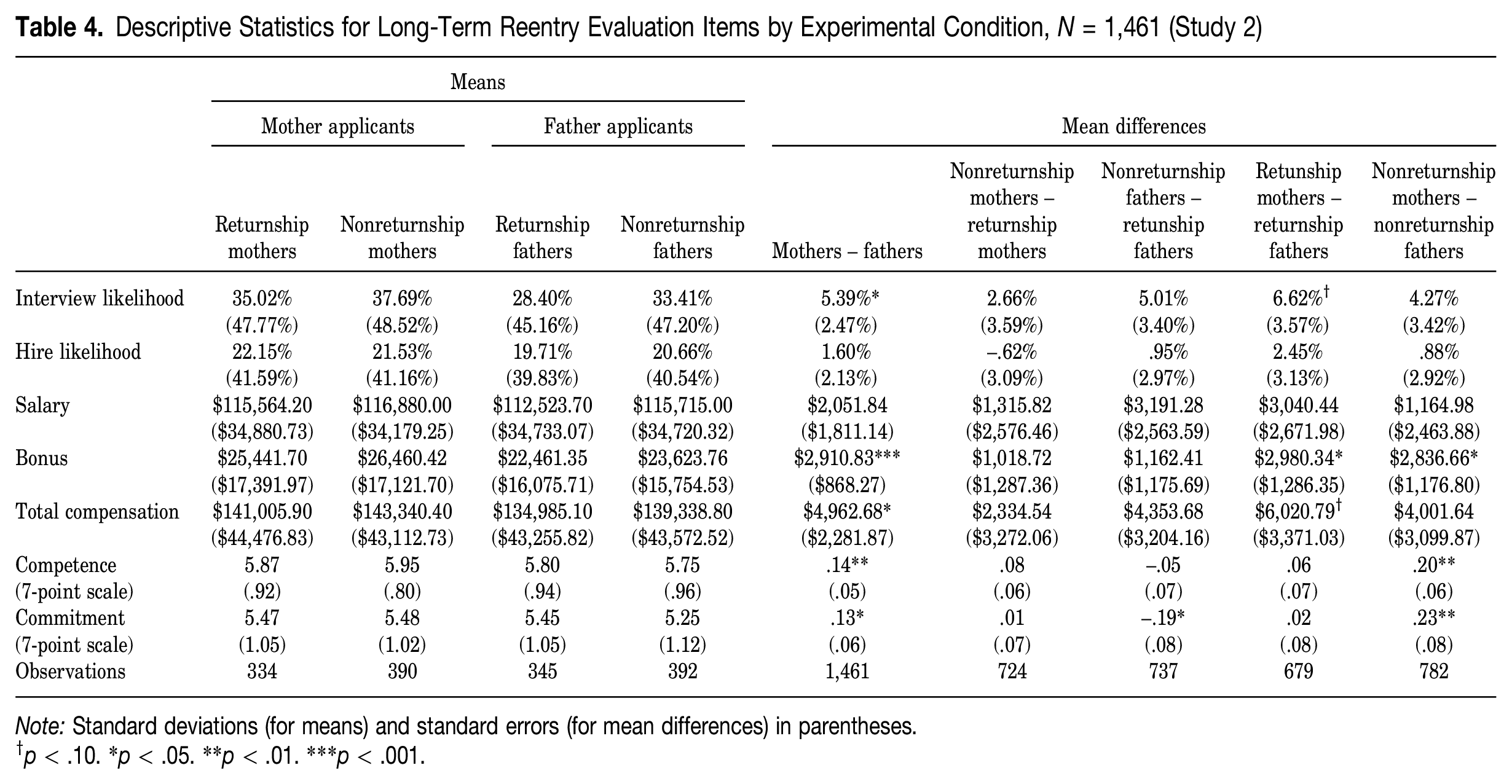
Note: Standard deviations (for means) and standard errors (for mean differences) in parentheses.
p < .10. *p < .05. **p < .01. ***p < .001.
Estimated Regression Coefficients for the Effect of Parent Gender (Panel A), the Effect of Returnship Status Split by Parent Gender (Panel B), and the Interaction of Returnship Status and Parent Gender (Panel C) on Long-Term Reentry Evaluation Variables, N = 1,461 (Study 2)
Note: Robust standard errors in parentheses.
p < .10. *p < .05. **p < .01. ***p < .001 (two-tailed tests).
Does a successful career relaunch reduce the negative effects of a returnship? (Hypothesis 3)
After reentry, does continuous full-time employment mitigate the penalties faced by returnship fathers relative to nonreturnship fathers? Results from Table 5 (Panel B) provide support for Hypothesis 3. A split regression analysis by parent gender confirms that returnship fathers are no longer significantly penalized relative to nonreturnship fathers on any workplace outcome measures. 12
Consistent with Study 1, after two years of full-time employment, the evaluations of mothers (returnship mothers compared to nonreturnship mothers) still do not significantly differ based on returnship status. Two years after reentry, mothers continue to not experience any negative consequences for having used a returnship.
Do fathers continue to be penalized relative to mothers after a career relaunch in the long term? (Hypothesis 4a)
Table 5 (Panel A) indicates that fathers still have approximately 21 percent lower odds of being very likely to be recommended for an interview compared to mothers (eβ = .785; p < .05). However, I no longer find a significant difference between fathers’ and mothers’ odds of being very likely to be hired. Additionally, being a father is still not associated with any significant starting salary differences relative to mothers. However, after two years of employment, being a father is now associated with a $2,911 average decrease in recommended bonus compared to mothers (p < .001). Fathers also now earn around $4,963 less in total recommended compensation compared to mothers (p < .05). In support of Hypothesis 4a, mothers are not only viewed as more deserving of an interview, but they are now also compensated more than fathers two years after reentry.
Do competence and commitment ratings mediate long-term penalties for fathers? (Hypothesis 4b)
Table 5 (Panel A) confirms that fathers are viewed as being significantly less competent (p < .01) and less committed (p < .05) than mothers. When I include these variables into the models, the coefficients drop in magnitude as expected and are no longer significant. I next use the average causal mediation effect (ACME) framework put forth by Imai, Keele, and Tingley (2010). 13 For differences in interview likelihood between mothers and fathers, perceived competence and perceived commitment fully mediate the negative effect for father applicants. For differences in recommended bonus, perceived competence and perceived commitment drive more than one-third of the negative effect, with the ACME resulting in a penalty of around $636 for perceptions of competence and $494 for perceptions of commitment. For differences in total compensation, perceptions of competence and commitment account for more than half of the negative effect. In this case, the ACME is a penalty of around $1,882 for perceptions of competence and $1,182 for perceptions of commitment. In support of Hypothesis 4b, both perceptions of competence and commitment are important mechanisms underlying the long-term disadvantages faced by fathers relative to mothers in the career reentry process.
General Discussion
Results across two experiments confirm that at the point of reentry, hiring managers penalized fathers who used returnships relative to fathers who did not. Yet this help-seeking paradox did not emerge for mothers. The penalties faced by fathers for using returnships were no longer significant after a successful career relaunch (operationalized as two consecutive years of full-time work). However, regardless of returnship status, fathers continued to be penalized relative to mothers long term due to differences in perceived competence and commitment.
This article makes two primary contributions to research within the sociology and social psychology literature. First, this work provides new evidence into a basic process that maintains the gender system. When men engage in nonstereotypical behavior by taking extended time off for full-time childcare, they face not only penalties for seeking help to reenter paid work but also long-lasting doubts about their competence and commitment. These challenges contribute to a gender system in which beliefs about the appropriate roles of men and women are reinforced and women’s full labor force participation remains constrained.
Second, results offer new insights into the boundaries of penalties for men’s norm violations. While it is known that men can face penalties for violating gendered norms in the workplace (Butler and Skattebo 2004; Coltrane et al. 2013; Heilman and Wallen 2010; Rudman and Mescher 2013; Weisshaar 2018), undetermined is whether and how these men can reestablish the norm once they have violated it. Fathers who experienced a successful career relaunch demonstrated that they no longer needed help and therefore ceased to experience significant within-gender penalties for help-seeking. However, the long-term scarring effects of having ever violated breadwinning norms continued to produce between-gender penalties for fathers relative to mothers. These findings suggest that the stickiness of penalties for men’s gender norm violations are not equivalent for all infractions.
From a practical standpoint, results suggest that workplace gender inequality will persist if employers punish fathers more harshly than mothers not only for becoming full-time caretakers but also for receiving help to go back to work. Findings also imply that certain masculinity violations are more “forgivable” than others. For men, using a returnship does not carry the same long-term penalties as leaving full-time paid work for extended periods. Moreover, while a former stay-at-home father could eventually remove a returnship from his résumé, hiding or explaining a long-term employment gap is more difficult.
Limitations and Future Directions
While the current research provides new theoretical insights into how the gender system is maintained, it is not without limits. First, the results cannot confirm the causal contribution of perceived competence and respectability toward fathers’ short-term negative career outcomes. While some of the variation in employment outcomes associated with a returnship for fathers is channeled through competence and respectability, the pattern lacks statistical confidence. Other low-status traits (proscribed for men) linked with competence and respectability may be the primary mediators. Research tangentially related to help-seeking in workplace settings might explain the observed help-seeking paradox. For example, experimental work by Gibson, Harari, and Marr (2018) found self-disclosing a weakness at work was perceived as an act of vulnerability (i.e., needing support, having low self-esteem), resulting in status trade-offs for high-status (but not low-status) actors. Future studies could examine whether employers perceive fathers as lacking confidence and requiring excessive support when they have and have not used CRA to further disentangle the underlying mechanisms of the observed help-seeking paradox for men.
Second, I did not include a continuously working mother or father reference group to determine the absolute delta in penalties from baseline for fathers who use CRA or to assess whether former at-home mothers experience penalties following reentry when compared to continuously working applicants. However, comparing an applicant with an eight-year gap to a continuously working applicant would compromise equivalency in either age or job quality between experimental conditions (i.e., a younger applicant in a senior position or an older applicant in a more junior position). The current design is more realistic because CRA programs typically require gaps of at least two years, and many participants have gaps spanning much longer.
Third, this research does not measure the benefits of CRA, including formal and informal networking, which offer alternative pathways to employment (Obukhova and Kleinbaum 2022; Sterling and Merluzzi 2021). These advantages could outweigh the negative consequences of not converting into a full-time employee.
There are multiple directions for future research. First, a returnship at Walmart Labs might be perceived as less prestigious than one, for example, at Google. However, most returnships are not offered by sought-after employers but by companies with either a significant talent and/or gender diversity shortage (Sterling and Merluzzi 2021). Future studies could test how effects might differ depending on the prestige of the host company.
Second, future research could investigate the generalizability of the help-seeking paradox for men in other contexts. For instance, the negative effects of CRA might be attenuated or disappear for fathers in less male-dominated or in highly feminized occupations. However, prior work has shown that men face penalties for seeking help even in female-dominated industries (e.g., Rosette et al. 2015). Additionally, employers may be less likely to penalize male veterans who use CRA because military service (i.e., a hypermasculine activity) overrides any gender status violations for seeking help. To what extent the gender-typing of an occupation or the reason for using CRA affects penalties for fathers who leave paid work is an empirical question for future study.
Finally, future work might find greater acceptance of CRA among employers, given the unprecedented exodus of parents from the workforce during the COVID-19 pandemic and the expected increase in returnship usage among men (Fishman Cohen and Amspacher 2021).
Conclusion
This study furthers our understanding of the social psychological processes driving gender inequality and barriers parents face to equitably coordinate the competing demands of work and family. Although millennial fathers increasingly desire extended parental leave and workplace flexibility (Pedulla and Thébaud 2015), the observed penalties and conditions under which they persist or abate for men who do not conform to the “rules” of the gender system (Ridgeway and Correll 2004:511) provide insight into why so few men leave paid work for caregiving. If fathers are unfairly penalized for becoming primary caregivers and using CRA, mothers will continue to shoulder a disproportionate share of childcare responsibilities. As a result, gender equality in the workplace will remain stalled.
Supplemental Material
sj-docx-1-spq-10.1177_01902725231180804 – Supplemental material for The Help-Seeking Paradox: Gender and the Consequences of Using Career Reentry Assistance
Supplemental material, sj-docx-1-spq-10.1177_01902725231180804 for The Help-Seeking Paradox: Gender and the Consequences of Using Career Reentry Assistance by Julia L. Melin in Social Psychology Quarterly
Supplemental Material
sj-pptx-2-spq-10.1177_01902725231180804 – Supplemental material for The Help-Seeking Paradox: Gender and the Consequences of Using Career Reentry Assistance
Supplemental material, sj-pptx-2-spq-10.1177_01902725231180804 for The Help-Seeking Paradox: Gender and the Consequences of Using Career Reentry Assistance by Julia L. Melin in Social Psychology Quarterly
Footnotes
Acknowledgements
The author gratefully acknowledges the guidance and support of Shelley Correll, David Pedulla, Adina Sterling, Kathleen Gerson, Sofoklis Goulas, Susan Fisk, Jennifer Merluzzi, Brandy Aven, and Pamela Stone. The author would like to thank the participants of the Stanford Economic and Organizational Theory Workshop, the Gender and Social Psychology Workshop, the Stanford Equity by Design Lab, and the editors of SPQ and three anonymous reviewers for helpful comments and discussion.
Funding
This research received generous support from Stanford University’s Lab for Social Research, the Lab for the Study of American Values, the Center for American Democracy at the Institute for Research in the Social Sciences, and the VMware Women’s Leadership Innovation Lab. Stanford University approved this IRB protocol (47359). An earlier version of this article was virtually presented at the Academy of Management Meeting in August 2020 and EGOS 2020. Data available on request.
Supplemental Material
Supplemental material for this article is available online.
1
2
See online Appendix A for sample demographic characteristics.
3
See online Appendix B for profiles used.
4
Gap lengths generally range from 2 to 20 years (Anderson 2011), with one notable program’s average being about 6 years ( ).
).
5
See online Appendix D for more details.
6
Lucid rates the quality of its providers rather than sourced individual participants. To ensure greater participant reliability and higher data quality, I used an FMC screening question, an established approach shown to not distort treatment effects (for more details, see Hauser and Schwarz 2015; Kane and Barabas 2019; ; online Appendix D). Additionally, a pilot study that included a manipulation check following the collection of the dependent variables produced similar gender effects.
7
See online Appendix D for details on FMC pass rates by demographics and condition assignment.
8
Results available in online Appendix D.
9
See online Appendix D for underlying distribution patterns of full interview and hire likelihood scales.
10
See online Appendix E for a figure of the significant contrasts of interest.
11
I also find no statistically significant differences in terms of perceived commitment between returnship and nonreturnship fathers.
12
Although no longer a formal prediction, I investigate and find in Study 2 that participants now rate returnship fathers as more respectable than nonreturnship fathers (p < .05) despite no significant differences in workplace outcomes between the two groups.
13
Full results available in online Appendix F.
Bio
References
Supplementary Material
Please find the following supplemental material available below.
For Open Access articles published under a Creative Commons License, all supplemental material carries the same license as the article it is associated with.
For non-Open Access articles published, all supplemental material carries a non-exclusive license, and permission requests for re-use of supplemental material or any part of supplemental material shall be sent directly to the copyright owner as specified in the copyright notice associated with the article.
