




Abstract
Previous research suggests that beliefs about inequality are often biased in ways that serve people’s own interests. By contrast, people might uphold system-justifying beliefs, such as meritocratic beliefs. We test these assumptions against real-life experience of highly selective university admission. Using panel data on German medical school applicants allows us to measure belief changes through experiences of success or failure in admission. We find support that self-serving bias in beliefs outweighs the motivation for system justification: success strengthens the belief that admission depends on effort, while failure reinforces the belief that admission depends on luck. These patterns partly manifest themselves in beliefs about societal inequality. Additionally, we argue that previous experiences (long-term experiences of social upbringing and short-term experiences in university admissions) provide a frame for new experiences, examine respective effect heterogeneity, and discuss implications of our findings of diverging paths in inequality beliefs of winners and losers for the persistence of inequality.
Keywords
Research suggests that beliefs about the factors driving social inequality can legitimize or delegitimize inequalities (Mijs 2016; Solga 2015). One reason for the persistence and growth of income disparities in Western societies could be that most people interpret those inequalities as the result of individual differences in merit. These meritocratic beliefs lead to negative attitudes toward the poor and the perception of different outcomes as just and thereby a reduction in support for redistributive policies (García-Sánchez et al. 2020; Hoyt et al. 2021; Lübker 2007). Examination of the reasons behind people’s beliefs about inequality (hereafter, inequality beliefs) would help improve the understanding of the persistence of social stratification in advanced societies.
Research shows that education and income are positively related to support of meritocracy as a just system for redistribution and to perceptions of existing inequalities as fair (Kunovich and Slomczynski 2007; Wodtke 2012). Although redistributive preferences might be partly driven by self-interest (Naumann, Buss, and Bähr 2016), the relationship between such preferences and social status might also be mediated by changes in inequality beliefs if winners in society develop strong meritocratic beliefs that lead them to perceive inequalities as fair and redistributive policies as unnecessary (Lübker 2007; Solga 2015).
Self-serving beliefs theory suggests that people’s experience of success and failure shapes whether they see their position as justified and deserved based on merit or as undeserved and based on bad luck or structural barriers (Bénabou and Tirole 2016). System justification theory, however, posits that the experience of failure might not necessarily weaken meritocratic beliefs. Despite evidence of structural barriers, individuals, including those who belong to disadvantaged groups, tend to support the existing system by believing in a meritocratic society due to the palliative function of these beliefs and the need to reduce ideological dissonance (Jost et al. 2003; Jost and Banaji 1994; Ledgerwood et al. 2011).
Existing research has focused mainly on changes in inequality beliefs among the successful group (e.g., Warikoo 2016) or described the relation between social status (of winners or losers) and inequality beliefs, though without consideration of social origin (e.g., Kluegel and Smith 1986; Kreidl 2000), which could confound the association of interest by influencing both a person’s social status and their inequality beliefs. Hence, these studies are unable to identify the underlying causal mechanism. By contrast, experimental studies could solve this problem and show that winners are more likely to attribute their success to talent and effort whereas losers, rather, attribute their losses to external factors (e.g., Molina, Bucca, and Macy 2019; Fehr and Vollmann 2020). However, these game studies often lack the relevance of a real-life experience; external validity remains unclear.
Taking real-life experiences of admission to medical schools, the most selective and prestigious university programs in Germany, as an example, we contribute to closing these research gaps by examining longitudinally how such experience changes inequality beliefs. More specifically, we ask whether and how experiences of success and failure influence beliefs about the factors behind an individual’s own outcome in a specific domain. Because those experiences have consequences for the justification of broader social inequalities, we also ask whether the effects extend to general beliefs about social inequality.
We further contribute to existing knowledge on the evolution of inequality beliefs by exploring whether and how the effects of experiencing success and failure vary with applicants’ social origin and their previous experiences in similar situations. To this end, we argue that the examination of the effect that a single experience has on inequality beliefs is too short-sighted. Previous experiences provide a frame for perceptions and judgments of new experiences of success and failure (e.g., Mijs et al. 2022; Schafer, Ferraro,and Mustillo 2011). On the one hand, these previous experiences might relate to long-term conditions of social upbringing (and thus span different lifespheres in which individuals experience and cumulate advantages or disadvantages). On the other hand, they might relate to short-term domain-specific experiences. We enrich the theoretical debate by discussing how these previous experiences—long-term and short-term ones—might moderate the effect of a new experience of success or failure on inequality beliefs and how new experiences might amplify winners’ and losers’ diverging paths in inequality beliefs.
To answer our research questions, we use panel data on applicants to medical schools in Germany, allowing us to measure changes in inequality beliefs through a real-life experience of success or failure at achieving a desired social outcome: admission to the most selective and prestigious university programs in Germany, which will likely have long-term consequences for applicants’ social positioning.
Theories of Biased Inequality Beliefs
In the following, we establish our theoretical foundation and derive hypotheses. We first discuss concepts of inequality beliefs. Second, we draw on the opposing theories of self-serving beliefs and system justification to argue how experiences of success and failure might influence these beliefs. Last, we turn to the role of previous experiences and discuss how they might moderate the effect of new experiences of success or failure.
What Are Inequality Beliefs?
People attribute success and failure to different meritocratic and nonmeritocratic factors—explanations that shape their justice perceptions (Hoyt et al. 2021; Mijs 2016; Solga 2015). Meri-tocratic beliefs entail all beliefs that attributesuccess or failure to individual differences in merit: effort and talent are the main predictors for success (Mijs 2016; Shane and Heckhausen 2013). Effort and talent can both be seen as meritocratic factors (Mijs 2016; Young 1958) and are summarized into one index in some studies (e.g., Shane and Heckhausen 2013, 2017). However, attributional theory suggests that effort and talent differ in their perceived controllability as people might perceive talent and intelligence as not alterable (Skinner et al. 1998; Weiner 1985). According to a luck-egalitarianism ethic, the only just differences are those based on choices that individuals can control, hence those based on effort (Gil-Hernández 2020; Swift 2005).
Nonmeritocratic beliefs include structural or fatalistic beliefs. Structural beliefs acknowledge inequality of chances based on group membership (i.e., belonging to an advantaged or disadvantaged group). Following this explanatory pattern, possible factors influencing success are ascriptive characteristics, like gender or ethnicity, but also differences in social and cultural capital due to parents’ socioeconomic status (SES; Mijs 2016). Last, fatalistic beliefs refer to the perception that success is based on luck and coincidences (Shane and Heckhausen 2013).
Meritocratic, structural, and fatalistic beliefs are not mutually exclusive; indeed, most people think that an interplay of factors determines success (Kreidl 2000). However, there are individual differencesin how strongly social inequalities are based on meritocratic and nonmeritocratic patterns—differences shaped by people’s experiences (Mijs 2016).
Inequality beliefs might refer to different points of reference and might thus be more or less strongly linked to individual experiences. Shane and Heckhausen (2017) distinguish between beliefs about one’s own and other people’s success insociety. Beyond this differentiation, inequality beliefs might also differ in whether they refer to the allocation outcome in a specific domain or to social stratification in general. Some studies have examined inequality beliefs about specific outcomes, such as students’ attribution of academic success to meritocratic or nonmeritocratic factors (Lohbeck, Grube, and Moschner 2017) and students’ beliefs in meritocratic admission (Warikoo 2016). Other studies have looked at general inequality beliefs about society (Kluegel and Smith 1986; Kreidl 2000; Mijs 2018), but few have combined the two concepts of domain-specific and general-societal inequality beliefs (e.g., Wiederkehr et al. 2015). In this article, we combine both and examine meritocratic and nonmeritocratic beliefs about inequality in a specific domain (university admission) and society at large.
Belief Change after Experiencing Success or Failure: Self-Serving or System-Justifying?
Our experiences shape how we see the world. Self-serving beliefs theory (Bénabou and Tirole 2016) suggests that experiences of success and failure bias inequality beliefs in a way that protects the self-image, whereas system justification theory (Jost and Banaji 1994) proposes that in certain situations, everyone, including those who fail or are in a disadvantaged position, might endorse meritocratic beliefs in order to justify the system they live in.
According to the theory of self-serving beliefs (Bénabou and Tirole 2016), people are motivated to defend their own and their group’s self-perceptions by attributing success to meritocratic factors, like effort, and failure to external factors, such as luck. Success is perceived as legitimated and deserved, and failure is not attributed to a lack of one’s own capability. The attribution bias justifies success and the rewards connected to high social positions (Mijs 2016; Warikoo 2016), and it reduces the negative effects of failure, like decline in self-esteem (Jost and Hunyady 2002).
According to this perspective, from which economic position and self-interest are important factors in opinion formation (Newman, Johnston, and Lown 2014), inequality beliefs differ by how successful people are. Research indeed shows that high-income earners believe more strongly in meritocratic explanations of inequality than low-income earners do, who believe more strongly in structural and fatalistic explanations of unequal outcomes (Kluegel and Smith 1986; Kreidl 2000). However, that observation does not sufficiently prove that high-income earners’ success increased their meritocratic beliefs. Meritocratic beliefs have a motivational function, which helps people achieve their goals (Heckhausen, Wrosch, and Schulz 2010; Shane and Heckhausen 2013) suggesting the possibility of reverse causality.
Education research has also shown that elementary school children (Lohbeck et al. 2017) and university students (Mkumbo and Amani 2012) tend to ascribe their success to effort and ability and their failure to external factors, like task difficulty or poor learning conditions. Moreover, high academic performance in school seems to bolster parents’ beliefs that good grades depend on skills and hard work, showing the legitimizing role of self-serving inequality beliefs (Olivos 2021).
These studies do not differentiate between social groups. However, inequality beliefs are shaped by the social environment, and through socialization and experiences, children from advantaged groups tend to have stronger meritocratic and weaker structural beliefs than those from disadvantaged backgrounds (Mijs 2018; Sampson and Bartusch 1998). Due to intergenerational status transmission, those advantaged groups have greater chances of succeeding in the educational and work setting (Bourdieu and Passeron 1977). Perhaps the association between success and meritocratic beliefs is due merely to different social upbringings.
To some extent, experimental studies could resolve issues of unclear causality and confounding variables, but the question of effect heterogeneity between different social groups remains. Participants in those game studies had unequal and more or less merit-based chances to win. In all conditions, winners were more likely than losers to attribute their success to talent and effort, and losers were more likely to attribute their losses to external factors, like bad luck (Fehr and Vollmann 2020; Molina et al. 2019). Molina et al. (2019:1) conclude, “It’s not just how the game is played, it’s whether you win or lose.” In other words, experimental studies suggest a direct effect of experiencing success or failure on inequality beliefs: a self-serving bias in explanations of social outcomes that transcends the individual’s initial advantages or disadvantages.
Contrary to self-serving beliefs theory, system justification theory (Jost and Banaji 1994) claims that in certain situations, people tend to uphold beliefs that justify and legitimate the existing system and differences in status, even if these beliefs contradict self- or group interest. Trying to justify the social order, people develop negative stereotypes about disadvantaged groups, like the working class or ethnic minorities, to explain their lower likelihood of success in society, notions that persist among majority-group members as well as among the discriminated groups themselves (Hoyt et al. 2021; Jost and Banaji 1994).
System justification theory embraces the idea within just-world theory (Lerner 1980) that people are motivated to believe in a legitimate system. While just-world theory argues this motivation stems from a universal human need to believe in a just world where people can control their own destiny, system justification theory rather argues for a justification process that “lead[s] people to rationalize the way things are” (Jost and Hunyady 2002:116), for example, through meritocratic ideology (Jost et al. 2003). Reasons for this mechanism are diverse and include socialization, the need to reduce ideological dissonance, and the palliative function of these beliefs, which helps in accepting one’s own position in the social hierarchy (Jost et al. 2003).
However, losers of the system do not always support the existing order. Instead, system justification motivation competes with, for instance, self-serving motivations. System justification is more likely to occur in a context where meritocratic explanations of outcomes are pervasive (Jost et al. 2003). It might furthermore be the dominant pattern in situations in which it is hardly possible to “escape” the system.
In our empirical case of admissions to highly selective medical schools, we expect self-serving belief bias to outweigh system justification in explaining the admission outcome. First, recurring public debates about the legitimacy of admission procedures to medical schools in Germany expressed serious doubts about their fairness and questioned their meritocratic foundation. Thus, meritocratic explanations of admission outcomes—while still widespread—are not unchallenged. 1 Second, applicants to medical schools should not have a very pronounced motivation to justify the admission system since they are not locked in this system: as they belong to a rather positively selective group of high school graduates, similarly prestigious, alternative career paths are available to them.
With these considerations in mind, we expect self-serving bias to outweigh system-justifying mechanisms in domain-specific beliefs about admission to medical school:
Hypothesis 1a: Individuals’ experiences of success strengthen domain-specific meritocratic beliefs about admission and weaken nonmeritocratic beliefs, whereas experiences of failure weaken meritocratic beliefs and strengthen nonmeritocratic beliefs.
Can we expect to find the same pattern regarding general-societal inequality beliefs? Selective admission to medical schools in Germany is a crucial event for adolescents with this particular career goal that will likely have long-term consequences for their social positioning. At this transition stage—after graduating high school—adolescents’ inequality beliefs are likely not yet consolidated. Hence, we expect, in line with findings of Rivera (2011) and Warikoo (2016), that the experience of university admission shapes inequality beliefs beyond the specific case:
Hypothesis 1b: Individuals’ experiences of success strengthen societal meritocratic beliefs and weaken nonmeritocratic beliefs, whereas experiences of failure weaken meritocratic beliefs and strengthen nonmeritocratic beliefs.
However, the self-serving bias might be weaker for societal beliefs than for domain-specific beliefs. This might, first, stem from the fact that certain life experiences are linked more strongly to beliefs about this specific domain than societal inequality in general. Second, while alternative career paths are open to unsuccessful applicants, they can less easily “escape” their society’s system of stratification, which might lead them to uphold system-justifying beliefs on a general level. In line with this reasoning, Shane and Heckhausen (2017) show that adverse labor market experiences decrease U.S. graduates’ meritocratic beliefs about their own success but do not substantially affect general beliefs in a meritocratic society. Drawing on qualitative interviews, Aronson (2017) confirmed that experiences during the great recession did not prompt adolescents to abandon the American dream: they still saw merit-based education as the key to societal success.
Thus, while we expect to find self-serving bias for both domain-specific and societal inequality beliefs among medical school applicants, the latter are likely more stable even after experiencing failure.
The Role of Previous Experiences for Belief Changes after Success and Failure
So far, we have focused on the effect that a single experience of success or failure has on inequality beliefs. This focus might, however, be too short-sighted. Previous experiences provide a frame for perceptions and judgments of new experiences of success and failure (e.g., Mijs et al. 2022; Schafer et al. 2011) and might thus moderate the effect that these new experiences have on inequality beliefs.
We include two dimensions: an individual’s social origin, which refers to experiences related to long-term conditions of social upbringing, and short-term experiences in a specific domain (in our case, the outcomes of previous applications). In the following, we first discuss whyboth dimensions contribute to potential “baseline” differences in inequality beliefs (i.e., differences in beliefs that manifest themselves before the new experience of success and failure—the one that we study—happens). Second, we discuss why the effect of a new experience of success and failure on inequality beliefs might differ by social origin and previous domain-specific experiences.
Social Origin and Belief Changes
“Baseline” differences in beliefs
Why does social origin shape inequality beliefs? Individuals form “cognitive landscapes” based on their experiences and observations (Sampson and Bartusch 1998). Children from advantaged groups tend to grow up surrounded by people with similar living conditions and might underestimate the structural barriers confronting less advantaged groups, a misjudgment that contributes to their strong meritocratic beliefs (Mijs 2018).
Furthermore, due to intergenerational status transmission, people from advantaged family backgrounds are more likely to experience success in different life domains, while people from disadvantaged backgrounds are more likely to experience failure (Bourdieu and Passeron 1977), such that advantages and disadvantages accumulate over the life course (DiPrete and Eirich 2006). Following self-serving beliefs theory, this contributes to stronger meritocratic and weaker nonmeritocratic beliefs among individuals from advantaged social backgrounds than among those from disadvantaged ones, a finding that is well established (Mijs 2018).
Experiences of success
Following suggestions of cumulative-inequality theory, success is less likely to occur for people from disadvantaged backgrounds as inequality accumulates over the life course (DiPrete and Eirich 2006). However, success against the odds is not impossible, and for members of disadvantaged groups, experiencing success might lead to an even greater increase in meritocratic beliefs than for members of advantaged groups: they managed to overcome structural barriers and might think that other disadvantaged people could achieve the same with enough effort (Cech and Blair-Loy 2010; Jost and Banaji 1994).
Warikoo’s (2016) qualitative interviews with undergraduates attending elite universities showed that, especially, first-generation students perceived admission outcomes as meritocratic and their experience of upward mobility as proof of it (Warikoo 2016). This observation is in line with research by Mijs et al. (2022). They find that subjective social upward mobility is associated with strong meritocratic beliefs, suggesting that people’s beliefs are shaped by their perception that success against the odds is possible.
Another study suggested that women in top-level positions tended to believe that unequal outcomes for men and women were driven mostly by differences in human capital and motivation, overlooking the glass ceiling they themselves had to break through (Cech and Blair-Loy 2010). Experiences of success seem to lead members of disadvantaged groups to forget about structural barriers they had to face, reinforcing the positive effect that success has on meritocratic beliefs held within this group.
Whereas Warikoo (2016) and Cech and Blair-Loy (2010) focus on domain-specific inequality beliefs, we assume that the effect of experiencing success on societal inequality beliefs might also differ by social origin; after all, achieving a desired social position is a crucial step for upward mobility. This reasoning is consistent with Wiederkehr et al.’s (2015) findings, which suggested that the correlation between school-related and general meritocraticbeliefs was especially pronounced for disadvantaged groups (i.e., low-SES students) and could be explained by the key part that educational success plays in social mobility. For both domain-specific and general inequality beliefs, we thus propose the following:
Hypothesis 2a: Experiences of success strengthen meritocratic beliefs and weaken nonmeritocratic beliefs more strongly for socially disadvantaged than for advantaged groups.
Experiences of failure
Adolescents from disadvantaged family backgrounds might be motivated to believe in meritocracy and education as their main pathway to upward mobility (Wiederkehr et al. 2015). Previous research, however, suggests that structural disadvantage and related experiences accumulate over the life course and contribute to growing inequalities (DiPrete and Eirich 2006), which increases affected adolescents’ awareness of structural barriers (Mijs 2018). Due to this higher awareness, a single negative experience might be interpreted as yet another sign of structural barriers by individuals who belong to disadvantaged groups (Mijs 2018).
In line with this theoretical argument, Schafer et al. (2011) found out that a single negative experience might be even more consequential for life evaluations if it follows other negative experiences, which are more likely to occur among adolescents from disadvantaged family backgrounds, as proposed by cumulative-inequality theory (DiPrete and Eirich 2006). We assume that long-term experiences of social upbringing moderate the effect of new experiences of failure not only on life evaluations but also on inequality beliefs:
Hypothesis 2b: Experiences of failure weaken meritocratic beliefs and strengthen nonmeritocratic beliefs more strongly for disadvantaged than for advantaged groups.
Considering “baseline” differences in inequality beliefs by social origin, our hypotheses suggest that experiencing success might outweigh prior group differences while experiencing failure might reinforce them. Following accounts of cumulative-inequality theory (DiPrete and Eirich 2006), the latter should, however, be prevalent, driving aggregate inequality beliefs of the two groups further apart.
It should be noted, however, that our study focuses on a rather positively selected group of young people. Considering their above-average school grades, our socially disadvantaged applicants are rather “the advantaged among the disadvantaged.” Social-background differences regarding both baseline beliefs and the effect of a recent experience of success and failure are probably less pronounced as they would be when considering a more heterogenous group.
Previous Domain-Specific Experiences and Belief Changes
We expect not only long-term experiences of social upbringing to set the frame for the interpretation of new experiences of success or failure but also domain-specific experiences that have more recently been made. In our case, previously unsuccessful applications to medical schools might moderate the effect of current admission or rejection on inequality beliefs, potentially even more strongly than long-term experiences of social upbringing, as these domain-specific experiences are more closely related to the new experience of admission or rejection. As admission is highly selective, it is important to note that while rejection correlates with social background, it is a common event across all social-origin groups.
“Baseline” differences
We expect experiences of success and failure to shape adolescents’ inequality beliefs in a self-serving way (Bénabou and Tirole 2016), with experiences of failure decreasing meritocratic beliefs and increasing nonmeritocratic beliefs. There is reason to believe that this argument should hold true not only for the most recent experience but also for previous experiences of failed attempts to receive an admission: previous rejections should have influenced inequality beliefs (especially domain-specific ones) in a self-serving way, leading to baseline differences in beliefs of those who apply for the first time (hereafter, first-time applicants) and those who previously experienced failure in admission (hereafter, repeat applicants).
Experiences of success
Yet, eventual success might outweigh previous setbacks: if people kept trying and were rewarded in the end, this could likely be interpreted as success through persistency, a meritocratic factor. Furthermore, prior doubts about meritocratic admission due to self-serving mechanisms (Bénabou and Tirole 2016) could be overcome, leading to a stronger belief change for previously unsuccessful candidates:
Hypothesis 3a: Experiences of success strengthen meritocratic beliefs and weaken nonmeritocratic beliefs more strongly for persons who have experienced failure in similar domain-specific situations than for those who have not.
Experiences of failure
A single negative experience might be even more consequential for life evaluations if it follows other negative experiences (e.g., Schafer et al. 2011). This assumption can be applied not only to long-term experiences of social upbringing but also to short-term domain-specific experiences. Self-serving bias in beliefs about factors behind a successful admission, and eventually success in society, might amplify with every failed attempt, while the motivation to justify the admission procedure might decrease (possibly along with the intention to reapply). Hence, we propose the following:
Hypothesis 3b: Experiences of failure weaken meritocratic beliefs and strengthen nonmeritocratic beliefs more strongly for persons who have had similar domain-specific experiences of failure in the past than for those who have not.
Considering prior differences in inequality beliefs between applicants who have been previously unsuccessful or not (i.e., repeat vs. first-time applicants), our hypotheses suggest that experiencing success might outweigh prior group differences, while experiencing failure might amplify them.
Institutional Context: Application and Admission to Medical Schools in Germany
Because of the highly stratified German school system, only 51 percent of all secondary school students in 2018 passed their Abitur (the higher education entrance examination). Only around 75 percent of these eligible students actually enter higher education (Autorengruppe Bildungsberichterstattung, 2020:143, 184). Both passing the Abitur and transitioning to higher education are very socially selective (Mayer, Müller, and Pollak 2007).
German universities are rather alike in their institutional prestige and quality (Mayer et al. 2007). However, prestige differences between fields of study are pronounced, with medical programs providing exceptionally high income and occupational prestige (Finger et al. 2020). Medical programs are also the most selective ones, with rates of admission averaging around 25 percent. Unsurprisingly, medical programs are among the most socially selective fields of study in Germany (Reimer and Pollak 2010).
Students seeking admission to medical programs at one of the 39 public universities must apply through a central clearinghouse, the Stiftung für Hochschulzulassung (SfH). Until 2019 (see footnote 1), places were allocated via three quotas: (1) 20 percent by grade point average (GPA), (b) 20 percent by waiting period, and (c) 60 percent by university-specific criteria. To be admitted by virtue of the first two quotas, applicants need a top GPA or must wait for approximately seven years. For the third quota, the applicant’s GPA is the mandatory selection criterion with the highest weight, but universities can use additional criteria (e.g., test scores or work experience) to select applicants. 2 The GPA and the university-specific quotas can thus be regarded as merit based, whereas admission through the waiting-period quota relies on nonmeritocratic factors.
The special role of medical programs as the most prestigious and selective field of study in Germany contributes to the fact that those who aspire to, apply to, and eventually enroll in such programs are likely to belong to a positively selected group in terms of grades, skills, and motivation, especially when applicants come from socially disadvantaged families. However, that special role of medical programs makes the experience of admission or rejection an instructive example of how inequality beliefs might be shaped by experiences of success and failure at achieving desired social positions.
Research Design
Data
To test our hypotheses, we drew on panel data of the 2018 cohort of applicants to medical programs at German public universities (Finger, Wetter, and Solga 2023). 3 Each wave (August and November 2018) included items on inequality beliefs. Between the two waves, the applicants were either admitted (= success) or rejected (= failure). Successful applicants were informed through which quota they got admitted. These outcomes allowed us to examine the effect that this experience had on each applicant’s belief change.
In cooperation with the central clearinghouse, we invited all medical school applicants for the winter semester of 2018 to participate in the first online survey via email. The first survey was completed by 7,349 applicants (response rate: 17 percent); 4,619 respondents participated in the second wave (63 percent of wave 1 respondents). 4
A common problem of survey-based research is that initial participation and panel attrition are not random. However, because of the rich information included in the application register data provided by the SfH (such as applicants’ GPA, gender, age, and admission status), we constructed a sampling weight to reduce bias due to selective survey participation and attrition. For more information on our weighting strategy, see Online Supplementary Section 2.
Operationalization of Inequality Beliefs
We distinguish between domain-specific inequality beliefs and societal inequality beliefs. Whereas the former measure the importance that respondents attribute to different meritocratic and nonmeritocratic factors of being successful in the admission process, the latter measure how important these factors are generally for being successful in society. Figure 1 displays the concrete questionnaire items that we based on Shane and Heckhausen’s (2013, 2017) scale of causal attributions for SES attainment.
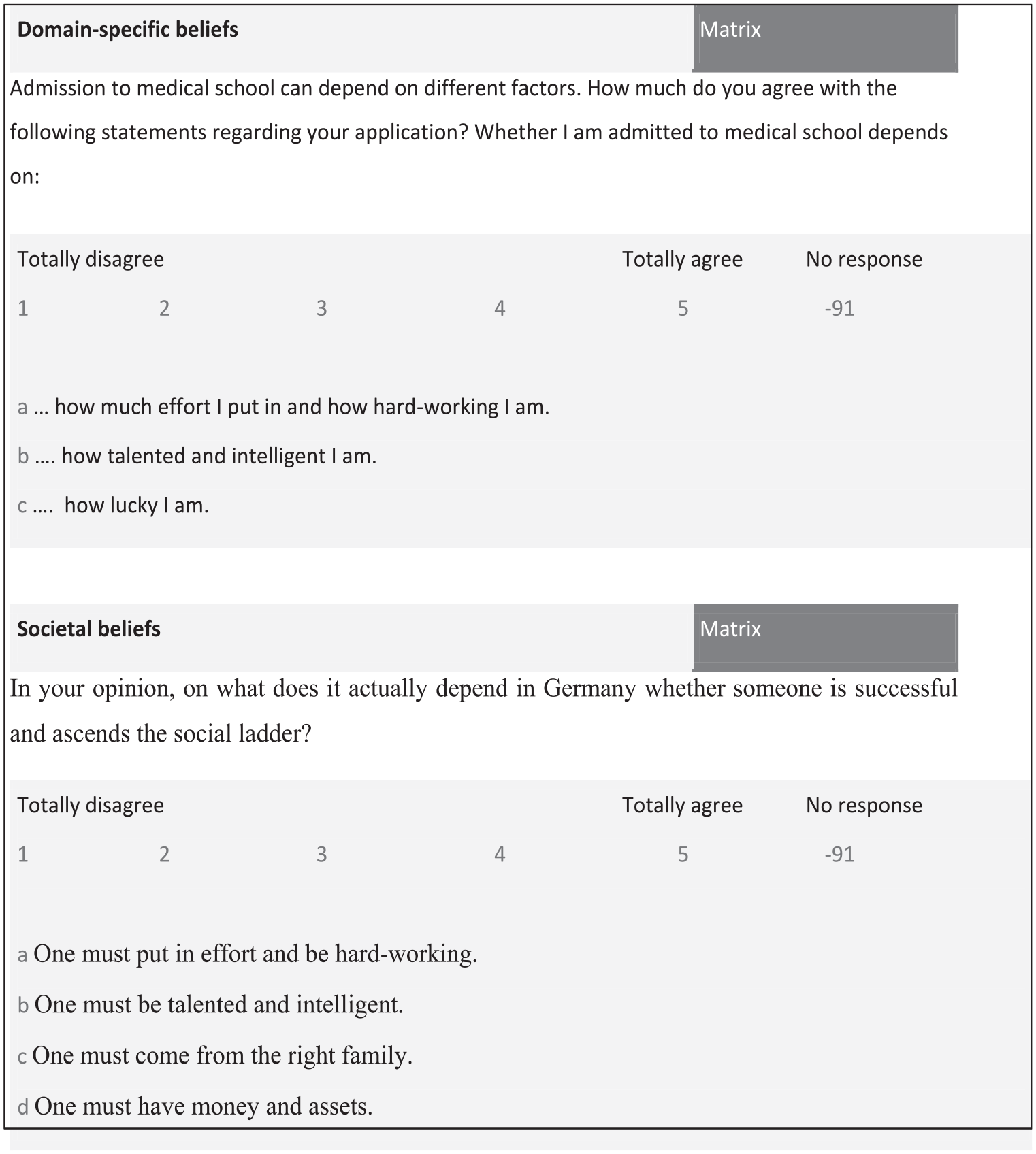
Inequality Beliefs Scale (Translated from Original Questionnaire in German)
The factors representing meritocratic beliefs are the belief in success through effort and that through talent (or intelligence). We decided not to summarize them into one index. This decision is based on attributional theory (Weiner 1985), which suggests that effort and talent are distinct dimensions of meritocratic beliefs (with effort being interpreted as alterable and talent as stable).
Factors representing nonmeritocratic beliefs are the fatalistic belief in success through luck for university admission and structural beliefs in success through family background and economic resources for social positioning. We included different nonmeritocratic factors for admission and societal success because admission to medical school is a strongly standardized and performance-related process that is only indirectly affected by structural factors. Hence, the general role of luck, including that of coming from an advantaged background, is more suitable for assessing domain-specific beliefs about admission. For general success in society, we regarded a differentiation of nonmeritocratic factors as feasible.
Correlations between the different dimensions of inequality beliefs are mostly weak to moderate, confirming that meritocratic and nonmeritocratic beliefs are not mutually exclusive and that beliefs in talent and effort are distinct dimensions of meritocratic beliefs (for more information, see Online Supplementary Section 4).
Further Variables and Sample Statistics
We used the information on whether applicants were admitted or rejected, which was included in wave 2 of the survey. We distinguished between applicants with no, one, or two college parents (i.e., parents holding a university degree) and between first-time applicants and repeat applicants (i.e., applicants who had previously applied unsuccessfully).
Admission to medical school is not a random event; it depends on applicants’ qualifications. Hence, applicants who were admitted and applicants who were rejected differ in certain characteristics (see Table 1); most pronounced is the difference in high school GPA. As school grades are influenced by social origin (Bourdieu and Passeron 1977), it is not surprising that among applicants who got admitted, and on average had a better GPA, the share of applicants with two college parents is higher than among those who got rejected.
Descriptive Statistics of Admitted and Rejected University Applicants
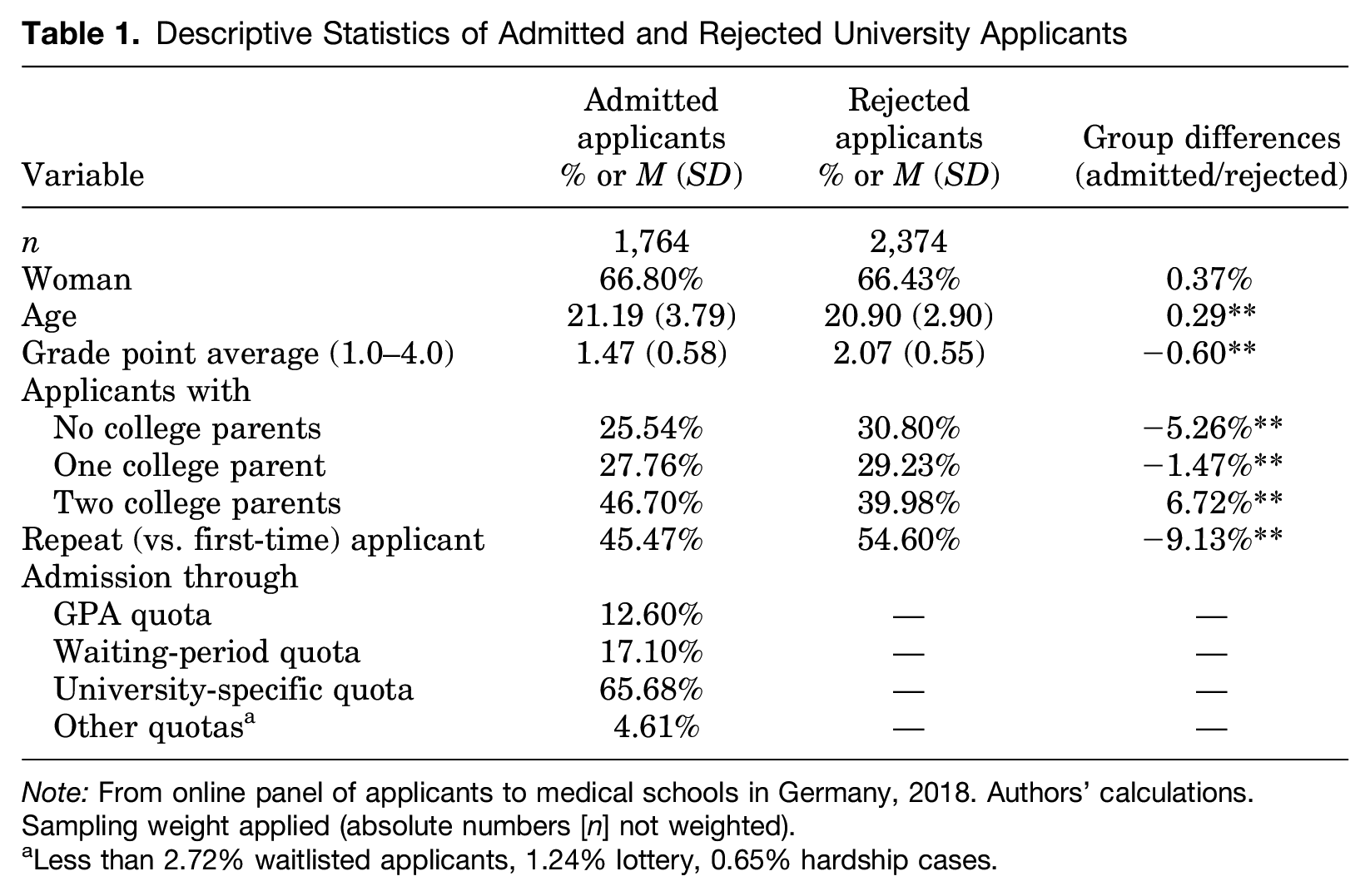
Note: From online panel of applicants to medical schools in Germany, 2018. Authors’ calculations. Sampling weight applied (absolute numbers [n] not weighted).
Less than 2.72% waitlisted applicants, 1.24% lottery, 0.65% hardship cases.
Already before the admission decision, the groups of to-be-admitted and to-be-rejected applicants likely differ in their prior (partly socialization-based) experiences in high school, which is reflected in the group differences in GPA. We assume that these differences in prior experiences shaped their inequality beliefs (e.g., Mijs 2018), leading to belief differences between to-be-admitted and to-be-rejected applicants, which might be amplified by the admission decision.
Estimation Strategy
As a first descriptive step, we compared the average inequality beliefs before and after the admission decision, separately for admitted and rejected applicants. Using Bonferroni post hoc tests, we tested whether the mean belief changes were statistically significant. We display results as bar graphs.
As a second step, to approximate the causal effect of being admitted in comparison to being rejected, we conducted individual linear fixed-effect models, which allowed us to control for differences in prior inequality beliefs between individuals and for all time-constant unobserved heterogeneity between them. We added interaction terms between admission/rejection and social background as well as repeated application to test whether differences in effects across groups were statistically significant (see Online Supplementary Section 1).
We treated our ordinal dependent variables(inequality beliefs) as continuous in order to facilitate interpretation of our results. However, we are aware of recommendations that this approach be used only if the dependent variables are normally distributed and have at least seven values (Bauer and Sterba 2011). We ran ordered logit fixed-effect models as a robustness check (see Online Supplementary Section 3).
Findings
As our theoretical assumptions and findings span multiple dimensions of inequality beliefs and are thus rather complex, we summarize our hypotheses and respective results in a systematic table in Online Supplement Section 8.
Do Experiences of Success and Failure Affect Inequality Beliefs?
Figure 2 suggests that average inequality beliefs differ already prior to the admission decision between the groups of admitted and rejected applicants and amplify through the admission decision: to-be-admitted applicants show stronger meritocratic beliefs and weaker nonmeritocratic beliefs than to-be-rejected applicants. Especially, group differences in beliefs about own admission were pronounced already before the admission took place, whereas group differences in societal beliefs were smaller.
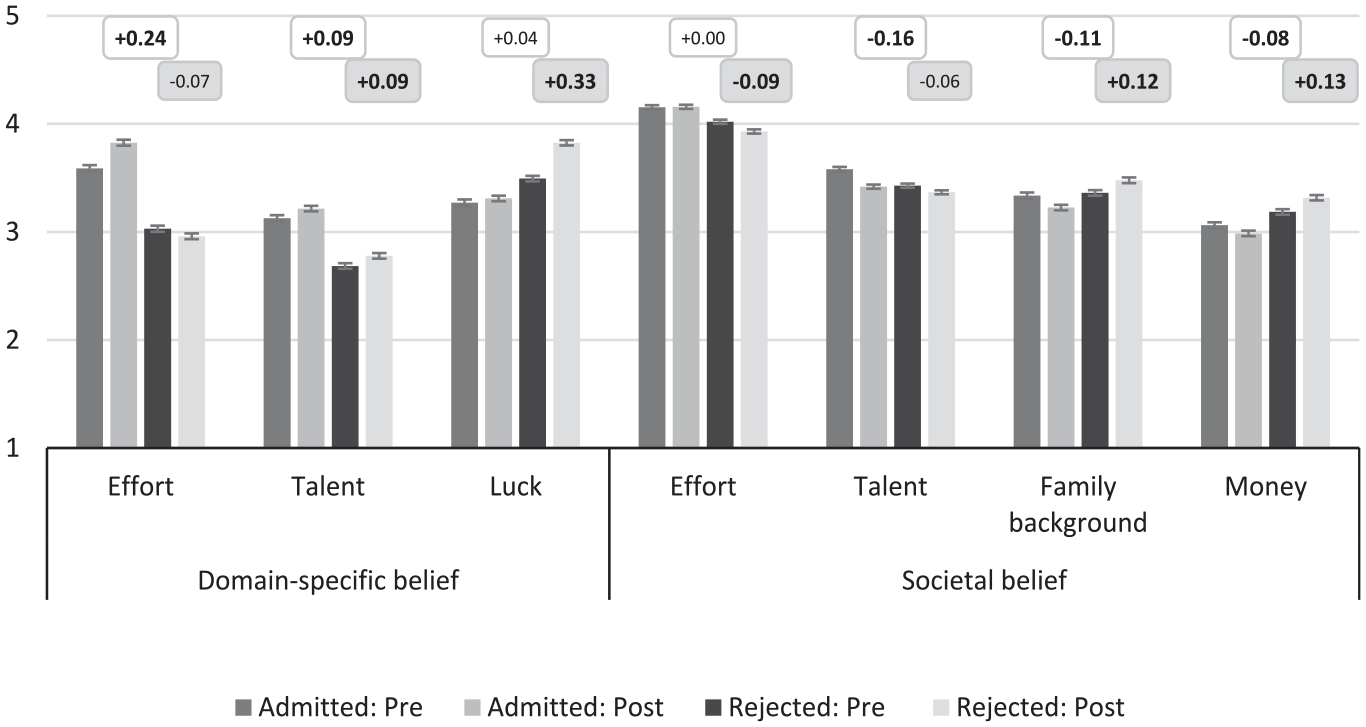
Average Inequality Beliefs Pre- and Post–Admission Decision and Belief Changes
Furthermore, our analysis suggests that individual experiences do indeed change prior to inequality beliefs. We expected, in the case of application to medical schools, self-serving belief bias to be dominant: experiences of success would strengthen meritocratic beliefs and weaken nonmeritocratic beliefs, while the opposite would be the case for experiences of failure.
Regarding domain-specific beliefs (Hypothesis 1a), being successful strengthened the meritocratic belief in how important one’s own effort is for admission by 0.24 points on the 5-point Likert scale. The nonmeritocratic luck-based belief was strengthened by experiencing failure (0.33) but was not affected by experiencing success. However, there was only a slight decrease of effort-based beliefs after failure (−0.07) and even a very slight increase in luck-based beliefs (0.04) after success. Last, the belief in the importance of talent for university admission increased similarly after admission and rejection (0.09).
To test whether the effects of admission and rejection differed significantly from each other, we conducted individual fixed-effect models with interaction terms (Belief Change × Admission/Rejection). The first column of Table 2 replicates the belief change for rejected applicants displayed in Figure 2. For instance, domain-specific effort belief slightly decreases by 0.07 points for rejected candidates. The second row shows the difference in this change for admitted versus rejected applicants. We see that the change in effort belief following admission (0.24; see Figure 2) significantly differs by 0.31 points from the change following rejection. Furthermore, the increase in luck belief following rejection (0.33) is statistically different (−0.29, p < .01) from its stability following admission (0.04; Figure 2).
Linear Fixed-Effect Models with Interaction Term (Belief Change × Admission)
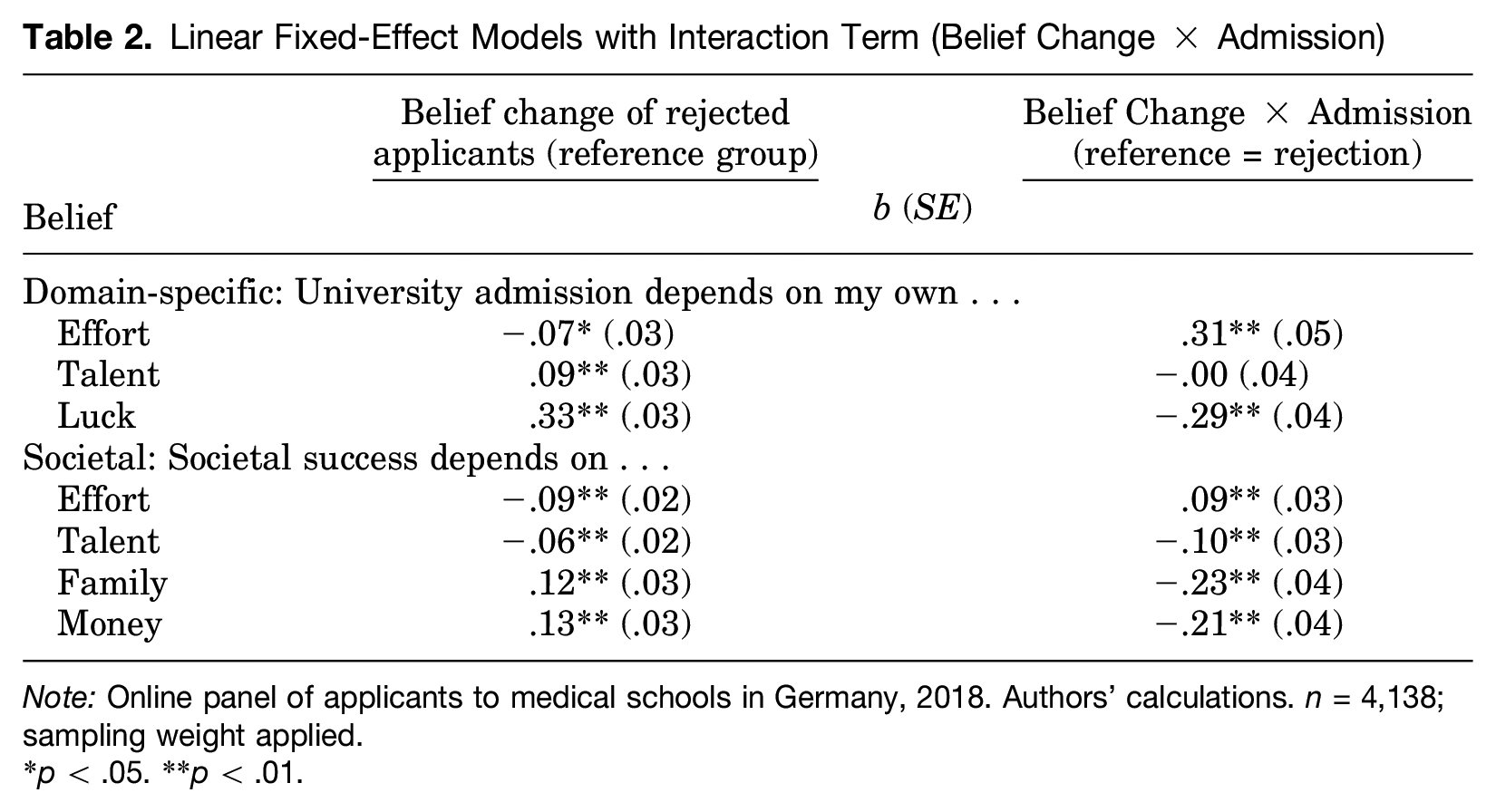
Note: Online panel of applicants to medical schools in Germany, 2018. Authors’ calculations. n = 4,138; sampling weight applied.
p < .05. **p < .01.
Overall, Hypothesis 1a, on changes in domain-specific beliefs, is partly supported by our findings, with effort-based beliefs after success and luck-based beliefs after failure changing in the expected, self-serving way. The results for talent beliefs did not support our hypothesis, however.
With respect to changes in societal inequality beliefs (Hypothesis 1b), individual experiences affected the belief in nonmeritocratic factors as expected, with success slightly weakening their perceived importance (−0.11 and −0.08, respectively) and failure strengthening it (0.12 and 0.13, respectively). The pattern looked less clear regarding meritocratic factors. Whereas failure weakened effort beliefs as expected (−0.09), success was not related to it. One explanation for admittance’s null effect on effort beliefs might be their fairly high baseline level, which could lead to a ceiling effect. Lastly, the belief in how important talent is for societal success decreased after admission (−0.16) as well as after rejection (−0.06), suggesting again that this belief might be affected differently than predicted by self-serving beliefs theory. We further discuss the diverging findings for talent beliefs in the concluding section. Fixed-effect models (Table 2) show that the effects of admission and rejection were statistically different from each other for all societal beliefs.
Overall, Hypothesis 1b was partly supported. Success decreased nonmeritocratic societal beliefs, and failure both decreased meritocratic (effort-based) and increased nonmeritocratic beliefs. Unexpectedly, however, success did increase the domain-specific effort belief but did not extend to societal effort beliefs. As expected, changes in societal inequality beliefs were weaker than that for domain-specific beliefs.
Besides supporting self-serving beliefs theory, these findings suggest diverging paths for the successful and the unsuccessful groups. Differences that were already observable prior to admission, namely, stronger meritocratic beliefs of the (to-be) admitted applicants and stronger nonmeritocratic beliefs of the (to-be) rejected applicants amplify after the admissions decision was received.
Social Origin and Belief Changes
“Baseline” differences
In line with our theoretical arguments, Figure 3 (Panel A) shows that before the admission decision, admitted applicants with two college parents believed more strongly in the importance of effort and talent for their own admission than did applicants with no college parents. Among rejected applicants, most differences by social origin were markedly smaller. The members of this group might have had more negative experiences (e.g., related to grading in school) than did applicants who were eventually admitted, overshadowing differences in beliefs by social origin.
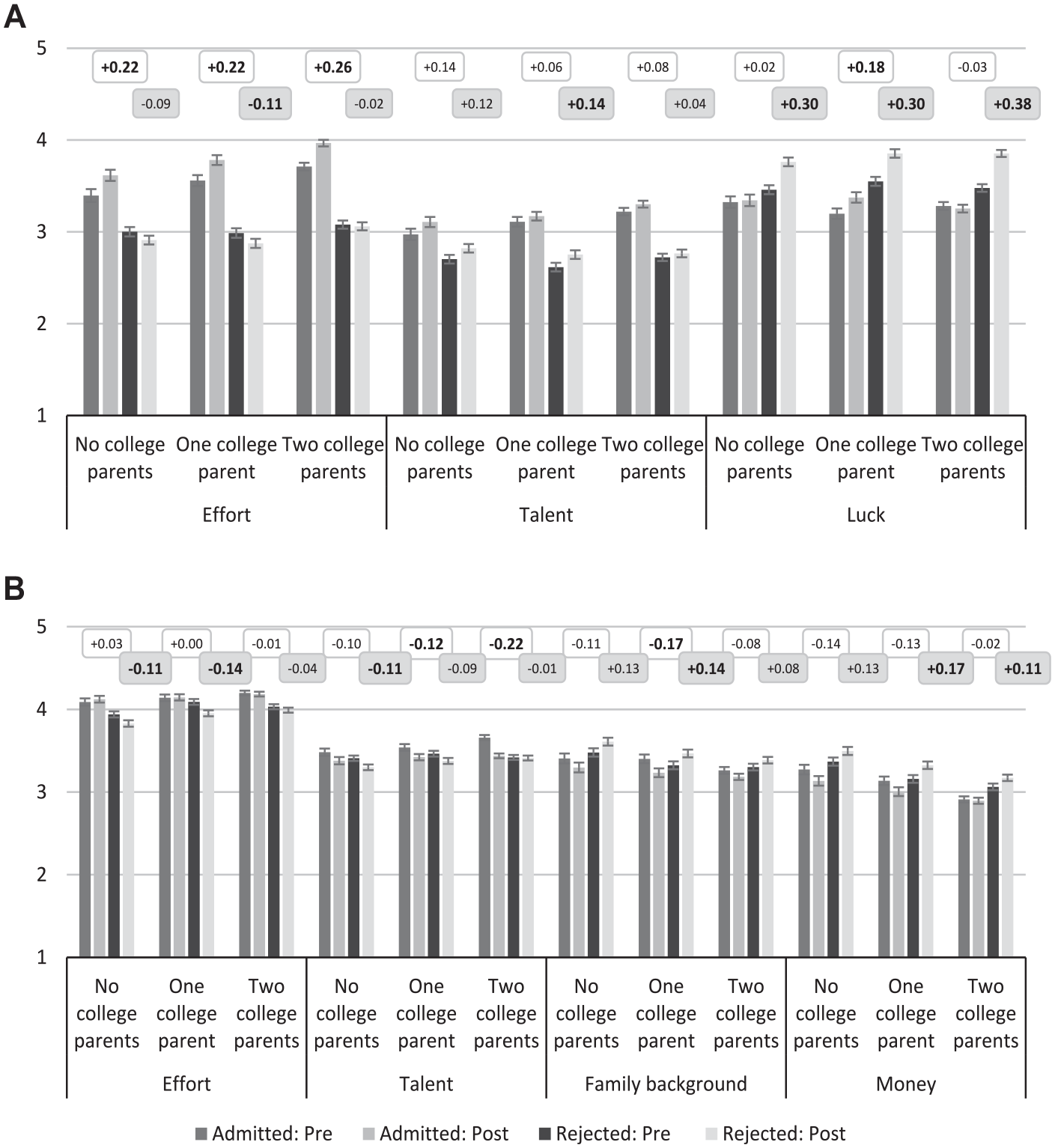
Average Inequality Beliefs Pre- and Post–Admission Decision and Belief Changes by Social Origin: (A) Domain-Specific Beliefs and (B) Societal Beliefs
Furthermore, admitted as well as rejected applicants with two college parents believed less strongly in the importance of economic resources (and to a lesser extent in the importance of family background) for success in society than first-generation applicants (Panel B). These stronger structural beliefs of disadvantaged groups are in line with our theoretical expectations: applicants with no college parents appeared to be more aware of structural barriers than their more privileged peers.
Belief changes after success and failure
Against our expectation of heterogenous belief changes across social groups, the self-serving belief changes in inequality beliefs were rather homogenous for the three observed groups (see Online Supplementary Section 1 for fixed-effects models). Overall, Hypothesis 2a, namely, that success increases meritocratic beliefs and decreases nonmeritocratic beliefs more strongly for disadvantaged than for advantaged groups, cannot be supported by our findings as group differences in belief changes after admission do not seem to follow a specific pattern.
Regarding the effect of failure, the findings potentially suggest a pattern with effort beliefs seeming to be most resistant to failure among applicants with two college parents (both for domain-specific and societal beliefs: −0.02, −0.04), the most advantaged group. Furthermore, the increase in structural beliefs is the weakest among this group (0.08, 0.11). This is generally in line with the idea that failure weakens meritocratic beliefs and strengthens nonmeritocratic beliefs more strongly for disadvantaged than for advantaged groups. However, group differences are small and do not reach statistical significance (see Online Supplementary Section 1), leading us to reject Hypothesis 2b.
Previous Domain-Specific Experiences and Belief Changes
“Baseline” differences
In line with our expectations of previous self-serving belief mechanisms, Figure 4 (Panel A) shows that prior to admission, those who had previously experienced a rejection of their application (i.e., repeat applicants) had substantially weaker beliefs in meritocratic admission than those who had not (i.e., first-time applicants). Prior differences in societal beliefs (Panel B) were less pronounced, suggesting, in line with our main findings, that prior self-serving belief biases following previous rejection to medical school were stronger for domain-specific beliefs than for societal beliefs. However, regarding nonmeritocratic beliefs, structural societal beliefs of repeat applicants were slightly stronger than those of first-time applicants, and we do not observe baseline differences in terms of domain-specific luck belief.
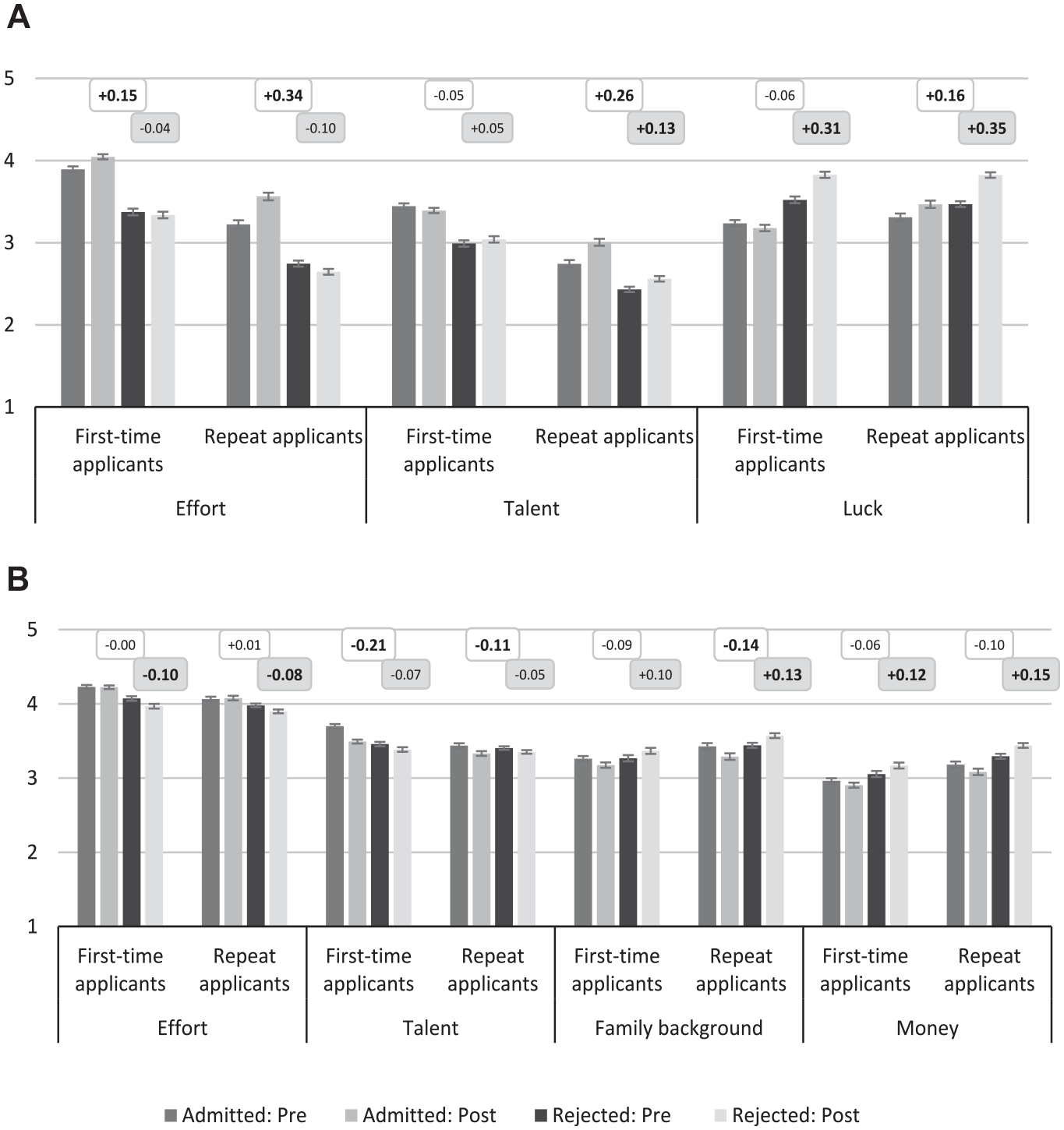
Average Inequality Beliefs Pre- and Post–Admission Decision and Belief Changes for First-Time and Repeat Applicants: (A) Domain-Specific Beliefs and (B) Societal Beliefs
Belief changes after success and failure
Hypothesis 3a, suggesting a stronger increase in meritocratic beliefs and a stronger decrease in nonmeritocratic beliefs following success for repeat applicants, could partly be supported: success strengthened meritocratic beliefs in effort- and talent-based admission more strongly for repeat applicants (Panel A: 0.34, 0.26) than for first-time applicants (0.15, −0.05). The potential decrease inmeritocratic beliefs about admission through past experiences, as expressed in lower baseline values, was at least partly outweighed by the experience of success. For societal beliefs, however, we do not see the same pattern (Panel B).
Regarding belief change in nonmeritocratic beliefs, for repeat applicants the belief in the importance of luck for admission increased after admission (0.16), different than for first-time applicants (−0.06), driving both groups further apart with regard to nonmeritocratic beliefs. Those who were finally successful after several attempts seemed to have consolidated their belief that admission to highly prestigious university programs is also a lottery and they were among the lucky ones. At the same time, they seemed to have reconsidered prior doubts about meritocratic procedures and to have recognized merit as a necessary condition for success.
Regarding societal beliefs, the decrease in structural beliefs after admission is slightly stronger for repeat applicants (family background: −0.14; money: −0.10) than for first-time applicants (−0.09, −0.06). However, the differences in belief changes are not significant (see Online Supplementary Section 1).
Hypothesis 3b, suggesting a stronger decrease in meritocratic beliefs and a stronger increase in nonmeritocratic beliefs following failure for those who already experienced failure previously, could not be supported as group differences were rather small and statistically insignificant (see Online Supplementary Section 1 for fixed-effect models including interaction terms).
In relative terms, however, the negative effect that a rejection had on the belief in the importance of effort for university admission was twice as large for repeat applicants (−0.10) as for first-time applicants (−0.04), a finding in line with Hypothesis 3b that assumes that the decrease in meritocratic beliefs due to failure are stronger for repeat applicants. This finding is particularly interesting when considering the group differences prior to the new admission decision. Experiencing failure repeatedly seemed to weaken the belief in meritocratic admissions procedures even further. Furthermore, the increase in fatalistic beliefs about admission after experiencing failure seemed to be slightly stronger for repeat applicants (0.13) than for first-time applicants (0.05).
Robustness Checks and Sensitivity Analyses
We conducted the following robustness checks and sensitivity analyses (see the online supplement for details). First, we tested different weighting strategies (Online Supplementary Section 2) and conducted ordered logit fixed-effect models to consider the 5-point Likert scale of our dependent variables and could show that this does not substantially change our results (Online Supplementary Section 3).
Furthermore, we conducted sensitivity analyses to explore whether our results differed for certain subgroups. First, we tested whether effects of admission on beliefs vary by admission quota as admission through the non-merit-based waiting quota could have different effects on beliefs (Online Supplementary Section 5). Second, we ran models that include only applicants who did not simultaneously apply to other study programs to avoid possible bias due to other admission experiences taking place between wave 1 and wave 2 (Online Supplementary Section 6). Last, following the logic of a regression discontinuity design, we ran our analysis only for applicants with a GPA close to the fuzzy admission cutoff point (1.3–1.4) to confirm our assumption that the admission decision shapes inequality beliefs beyond the diverging belief paths of winners and losers (Online Supplementary Section 7).
All these analyses provide further insights while supporting our main results.
Conclusion: Winners and Losers’ Diverging Paths in Inequality Beliefs
In this study of selective admission to medical schools in Germany, we have examined the effect of experiences of success and failure in achieving a desired outcome on meritocratic and nonmeritocratic beliefs. Furthermore, we explored how previous experiences—accumulated experiences related to social upbringing as well as recent domain-specific experiences—moderate the effect that new experiences of success and failure have on inequality beliefs.
Previous research has examined the relationship between social position and inequality beliefs cross-sectionally (e.g., Kluegel and Smith 1986; Kreidl 2000), inquired into the effect of experiences in a laboratory setting (e.g., Fehr and Vollmann 2020; Molina et al. 2019), and focused on changes in inequality beliefs exclusively within the successful group (e.g., Warikoo 2016). We contribute to this research by investigating how experiences of success or failure affect inequality beliefs. To this end, we estimated the changes in beliefs following the crucial real-life event of admission or rejection to medical school in Germany, thereby approximating its causal effect. We examined the effect on beliefs about meritocratic admission (domain-specific beliefs) and on general beliefs about a meritocratic society (societal beliefs).
We find that individual experiences of success or failure influenced inequality beliefs in a mostly self-serving way. Admission to highly selective medical schools in Germany increased the applicants’ belief in how important one’s own effort is for the admission outcome and decreased the belief in how important family background and economic resources are for societal success. Rejection decreased beliefs in effort and increased beliefs in nonmeritocratic (structural and fatalistic) factors behind selective college admissions and social positioning. The changes we observed in inequality beliefs were more pronounced for domain-specific beliefs than for societal beliefs, an observation that supports previous findings on rather stable general inequality beliefs (e.g., Shane and Heckhausen 2017).
Moreover, our findings clearly show group differences in inequality beliefs between to-be-admitted applicants and to-be-rejected applicants already, before they learned about their admission outcome. This suggests diverging paths in inequality beliefs for “winners” and “losers”: on average, those who will be admitted have better school grades than those who will be rejected; it is likely that the first group accumulated more positive experiences in high school than their peers, increasing their meritocratic beliefs and decreasing their nonmeritocratic beliefs through continuous self-serving belief mechanisms. New experiences of success or failure, like the admission outcome (an outcome that is crucially influenced by merit, measured in school grades), amplify these differences in inequality beliefs.
Furthermore, our findings tentatively suggest a widening belief gap between groups differing in their previous long-term experiences of social upbringing aswell as short-term domain-specific beliefs. Disadvantaged groups, in our case, first-generation applicants, showed weaker meritocratic beliefs and stronger structural beliefs prior to the admission decision, suggesting that they were more aware of structural barriers than their more privileged peers.
One reason for the stronger meritocratic and weaker nonmeritocratic baseline beliefs of applicants with two college parents might be due to positive experiences in school, which, due to the mechanism of intergenerational status transmission, they likely accumulated to a higher degree than their less advantaged peers and which translated into higher grades. This, in turn, makes advantaged students more likely to accumulate further experiences of success, like admission to highly selective university programs: applicants with two college parents were more than 6 percentage points more likely to get admitted than first-generation applicants.
Furthermore, we tentatively find that meritocratic effort beliefs seemed to be most stable and resistant to failure among members of the most advantaged group. Even if they happen to get rejected, this single experience of failure does not seem to reduce their effort beliefs: they internalized beliefs that effort led to their previous success and stick to this belief. However, group differences in belief changes are small and statistically insignificant, suggesting that effect moderation through social background does not play a major role for the widening of the belief gap among winners and losers, at least not among the highly selective group of applicants to medical school. In this case, social background seems to effect inequality beliefs rather indirectly, via varying admission probabilities across social groups and their consequences for inequality beliefs.
Regarding domain-specific experiences, we find that repeat applicants (those who already experienced failure in college admissions) had weaker meritocratic baseline beliefs and mostly stronger nonmeritocratic baseline beliefs than first-time applicants, a finding consistent with the idea that previous experiences shaped the beliefs of repeat applicants in a self-serving way. Additionally, experiences of failure in previous admission rounds indeed moderate the effect of the new experience of success. For repeat applicants, eventual success has a greater positive effect on the belief in the importance of effort in college admissions than it does for first-time applicants, partly outweighing differences in baseline beliefs. Diverging paths in inequality beliefs of winners and losers can be redirected if eventual success occurs for those who had previously experienced failure, strengthening the argument that such experiences directly affect inequality beliefs on top of (and sometimes against the direction of) winners’ and losers’ diverging paths in inequality beliefs.
However, eventual success of the previously unsuccessful is not the most likely event, which might contribute to a downward spiral in meritocratic beliefs of a non-negligible number of applicants. In the case of failure, we expected a stronger negative impact on meritocratic beliefs for those applicants who were repeatedly rejected. While we could not find strong evidence for this, since differences in belief changes after getting rejected do not significantly differ between first-time and repeat applicants, the difference in the belief change in effort-based admission points in the expected direction. New experiences of failure seem to reduce meritocratic beliefs even further, driving beliefs of winners and losers further apart.
Our analyses also revealed some notable patterns regarding the concept and measurement of inequality beliefs, findings in line with attribution theory’s claim that meritocratic beliefs in effort and talent, as well as nonmeritocratic fatalistic and structural beliefs, are distinct concepts (Weiner 1985).
While changes in beliefs about the importance of effort confirmed our theoretical assumptions based on self-serving beliefs theory, the belief in the importance of talent partly pointed in opposite directions. For instance, the belief that admission depends on talent increased among rejected applicants. One reason for this unexpected finding might be individual differences in the belief that intelligence is either a stable or an unstable characteristic as proposed by Dweck’s (2006) mindset theory. If applicants believe that intelligence, and thus talent, is a given, unalterable trait, getting rejected might strengthen the idea that especially innate ability (i.e., talent and intelligence), instead of effort, is important, and one might simply not have enough of it.
Based on these considerations, we argue that experiences might have a self-serving influence only on beliefs about the role of merit-based factors that lie within the individual’s control, not on beliefs about factors like talent and intelligence, which could be considered a “stable and uncontrollable cause” (Skinner et al. 1998:68) of success. Our findings suggest that belief about effort and belief about talent should be examined separately rather than summarized in an index as hitherto typically done in research (e.g., Hu et al. 2020; Shane and Heckhausen 2013).
Unlike cross-sectional and experimental studies on inequality beliefs, our study explored changes in these beliefs after a real-life event with high relevance for educational and labor market positioning. However, in studying applicants to medical programs—the most selective university programs in Germany—we focused on a rather specific, positively selected group in terms of academic performance and motivation. Even those who get rejected would typically not be considered disadvantaged in our society; they are, rather, the “losers among the winners.”
While we cannot unhesitatingly transfer our findings to other groups (e.g., applicants for all university programs or job positions) or experiences (e.g., admissions decisions pertaining to less competitive fields of study or hiring decisions), we would argue that our findings potentially underestimate the self-serving effect that experiences of failure have on inequality beliefs and group differences herein. In a less positively selected group of adolescents, disadvantaged groups are likely to have accumulated more experiences of failure, which should widen the gap in inequality beliefs between winners and losers and potentially amplify the decrease in meritocratic beliefs following yet another experience of failure. To test these expectations, studying less selective groups and situations for the effects that individual experiences have on inequality beliefs seems crucial.
Our findings of winners’ and losers’ diverging paths in inequality beliefs help improve the understanding of persistence and legitimation of inequality. The observed self-serving bias in beliefs might make success feel more deserved, and failure might be perceived not as self-imposed but rather as dependent on external factors. Whereas this mechanism might temporarily benefit the individual’s self-perception and well-being, it can contribute to cumulative disadvantage over the life course. Previous research suggests that inequality beliefs influence goal pursuit (e.g., Shane and Heckhausen 2013; Weiner 1985) and the view of others (e.g., Lübker 2007; Solga 2015).
Skinner et al. (1998:v) claim that there is a “beliefs-performance cycle” by which meritocratic effort beliefs increase goal engagement, which enhances academic performance and likelihood of success, and success further consolidates meritocratic beliefs. The opposite cycle is likely to exist for nonmeritocratic beliefs and experiences of failure. Individuals who have experienced failure might come to regard success partly as beyond their control and might eventually give up on pursuing their desired goal. Combining this idea with accounts of cumulative inequality, our findings of winners’ and losers’ diverging paths in inequality beliefs have crucial implications for the reproduction of inequality.
Winners’ meritocratic beliefs might also contribute to the persistence of inequality not only through their motivational effects but also through their implications for the view of others. Our findings show that eventual experience of success instilled belief in meritocracy even in individuals whose past encounters with failure seemed to have made them doubt that success through effort is possible. Successful people seem to forget their past difficulties to perceive social outcomes as merit based. When those who gain positions of power, even those who previously experienced failure or possibly even structural barriers, interpret processes of status attainment as merit based and legitimate, they might be less inclined to change them and to address structural barriers that hinder access to desired social positions.
With these considerations in mind, it seems important to think about ways to counteract changes in belief that exacerbate inequality. How can winners remain aware of structural barriers to success in society? How can losers continue to believe enough in effort-based upward mobility to stay motivated? Research suggests that awareness of structural barriers can grow through information on inequality (Mijs and Hoy 2022) as well as through diversity of the social environment and exchange with people from different social classes and ethnicities (Mijs 2018). Skepticism about the possibility of effort-based upward mobility, especially among disadvantaged young people, should be counteracted because it could be inimical to motivation. We agree with policy proposals (e.g., in Destin 2020) that institutions should aim at helping young people develop balanced beliefs that structural factors and merit alike shape success in society.
Supplemental Material
sj-pdf-1-spq-10.1177_01902725231165031 – Supplemental material for Do Experiences of Success and Failure Influence Beliefs about Inequality? Evidence from Selective University Admission
Supplemental material, sj-pdf-1-spq-10.1177_01902725231165031 for Do Experiences of Success and Failure Influence Beliefs about Inequality? Evidence from Selective University Admission by Rebecca Wetter and Claudia Finger in Social Psychology Quarterly
Supplemental Material
sj-pptx-2-spq-10.1177_01902725231165031 – Supplemental material for Do Experiences of Success and Failure Influence Beliefs about Inequality? Evidence from Selective University Admission
Supplemental material, sj-pptx-2-spq-10.1177_01902725231165031 for Do Experiences of Success and Failure Influence Beliefs about Inequality? Evidence from Selective University Admission by Rebecca Wetter and Claudia Finger in Social Psychology Quarterly
Footnotes
Acknowledgements
We thank our student assistants (Julia Bersch, Birte Freer, Anna Hetz, Patrick Hölzgen, Victioria Hünewaldt, Johanne Klindworth, and Carlotta Rieble) and Jan Paul Heisig, Heike Solga, Christian König, Sascha Dos Santos for their valuable support and feedback, respectively. We are also grateful to the Stiftung für Hochschulzulassung for granting us access to the field.
Funding
This research was supported by a grant from the German Science Foundation (Grant Number SO 430/13-1) and by internal seed funding of the Berlin Social Science Center (WZB) for the project “Meritocratic Beliefs, Motivated Reasoning, and Goal Dis-/Engagement: University Admissions as a Natural Experiment” (MERI).

Supplemental Material
Supplemental material for this article is available online.
1
Recently, a debate emerged on the meritocratic foundation of admission to public medical schools in Germany, mainly criticizing admission through the waiting-period quota and the comparability of grade point averages across German federal states. A 2017 ruling by the Federal Constitutional Court required changes in the usage and weighting of the criteria for admission as of 2020. The data used in this study relate to applicants from the year 2018, who are unaffected by these formal changes (but might have followed the preceding debate).
2
Applicants may rank up to six universities in each admission category (“quota”). An applicant is admitted to only one program, if any. Allocation begins with the first university listed in the GPA quota and closes with the last one listed in the university admission quota.
4
This first survey number is comparable to the response rate of a representative large-scale online survey among German university students (Becker, Baillet, and Weber 2019:20).
Bios
References
Supplementary Material
Please find the following supplemental material available below.
For Open Access articles published under a Creative Commons License, all supplemental material carries the same license as the article it is associated with.
For non-Open Access articles published, all supplemental material carries a non-exclusive license, and permission requests for re-use of supplemental material or any part of supplemental material shall be sent directly to the copyright owner as specified in the copyright notice associated with the article.
