




Abstract
We provide a conceptual replication of an experimental study that uncovered a robust correlation between the strength of individuals’ family ties and their distrust of strangers, striving to establish whether the link is causal. Using a different subjects pool and an online setting, we repeat the binary trust-game experiment from Ermisch and Gambetta and enrich it by manipulating the payoffs to create a low-trust and high-trust environment. The key finding is corroborated, but as expected, only in the high-trust environment. The two environments further allow us to impose a diff-and-diff design on the data, which rules out selection of low-trusting individuals into strong-tied families and gives us indirect evidence of causation, namely, that having strong family ties stunts the development of trust in strangers. Our findings support the emancipatory theory of trust proposed by Toshio Yamagishi and could be interpreted as uncovering the micro foundations of classic ethnographic studies, such as that by Edward Banfield, which described how subcultures fostering tight bonds within families or small groups make cooperation harder to be achieved.
The idea that having strong family ties is correlated with having low trust in strangers can be traced back to Edward Banfield’s (1958) ethnographic study of a southern Italian village. In his book, The Moral Basis of a Backward Society, Banfield describes how people trapped in a subculture in which they perceive their interests as limited to the nuclear family—which he dubbed “amoral familism”—are unable to cooperate and thus cannot improve their abysmal social and economic conditions. Their inability to cooperate is not only toward strangers, but even neighbors. Gans’s (1962) study of an Italian American neighborhood in Boston, The Urban Villagers: Group and Class in the Life of Italian-Americans, yielded comparable findings; in contrast to another Boston working-class community, the all-encompassing bonds in this community, although not limited to the nuclear family as in Banfield's, are still narrow and selective enough to prevent it from organizing collective resistance against an unpopular redevelopment project that ultimately destroys their community. Gans's study plays an important part in Granovetter’s (1973) renowned article on the strength of weak ties; it inspires a theory developed by Coser (1975), namely, that “weaker” communities rely on a greater “segmentation of roles,” allowing people to both better understand the impact of and form bonds with outside forces.
Our main theoretical reference is the work of Toshio Yamagishi and his colleagues, who developed the emancipatory theory of trust (Yamagishi 2011; Yamagishi, Cook, and Watabe 1998; Yamagishi and Yamagishi 1994). The theory points to two main causal mechanisms underpinning the link between strength of family ties and trust in strangers that can explain heterogeneity of trust at the individual level independently of the community culture to which individuals belong. One maintains that the less absorbing family ties are, the more people have an incentive to look for strangers on whom they can rely: those with weak ties would pursue more opportunities to interact with strangers and be more motivated to learn from the interaction how to discern those who are trustworthy from those who are not. Not as able to afford a defensive position as those who enjoy strong family ties, they will be more inclined to risk putting their trust in strangers. They will vigorously seek and benefit from “outward exposure.” The other mechanism claims that those who strongly rely on family ties are likely to attribute an individual's trustworthy behavior to the monitoring and sanctioning of family members rather than to an individual social or ethical disposition to be trustworthy. This attribution implicitly denies that there is such a thing as “trustworthiness,” and as a result, it prevents learning how to assess its existence at an individual level, thereby crippling the development of trust in strangers. One of the authors of the original article that we are replicating used this very argument to explain why trust in strangers fails to develop in mafia environments: the mafia acts as a strict assurance system (Gambetta 1993), and people's “honesty” and pact compliance are attributed to the effectiveness of mafiosi enforcement rather than the character of the persons. Yamagishi too mentions the Yakuza, the Japanese counterpart to the mafia, as an example of such an assurance system (Yamagishi 2011).
The family itself can be described as an “assurance system,” and for an individual to have strong family ties represents a measure of how much the individual both contributes and relies on that system. Families, however, are not just any instance of an assurance system, but arguably the thickest and the only near-universal there is. Unlike other assurance systems, such as contracts, sects, clubs, fraternities, or business networks, one does not freely enter but is born or marries into it (see also Burt 2021). The family has a grip on individuals that makes it much harder both to join and to escape.
To understand the effects that the socially pervasive bonds that tie us to family have on trust is therefore of momentous importance. Strong family ties can foster cooperation that may work well in many instances, but they impose severe limitations for social and economic development. People's willingness to migrate for professional reasons, intermarry, or establish business partnerships with outgroup members can be stunted if people rely only on those within their family system. We know, for instance, that those with strong family ties are less likely to move longer distances, which may close off job opportunities (Ermisch and Mulder 2019). Social and welfare policies are often aimed at supporting the family, and policy makers should be aware of these potential detrimental and unintended effects.
The link between trust in strangers and strength of family ties has received empirical support from various studies, which rely on different designs and measures of both trust and family ties intensity: Ermisch and Gambetta (2010) used a trust-game experiment with a random sample of British citizens drawn from the British Household Panel Survey; Alesina and Giuliano (2011, 2014) used the World Value Survey to construct a measure of family ties and found that it correlates negatively with the standard trust question employed in surveys, which measures the so-called “generalized trust” (see Banerjee, Galizzi, and Hortala-Vallve 2021); and Herreros (2015) also used the World Value Survey and a measure of the intensity of family ties and found similar results. Further evidence has extended the link beyond the family to a network of business leaders linked with one another by varying degrees of strength: combining network data with an experiment, Burt, Opper, and Holm (2022:495) find that “the closure that facilitates trust and cooperation within a network simultaneously erodes the probability of cooperation beyond the network.” Although the authors propose a different mechanism that could bring about their finding, the evidence of this study seems compatible with the emancipatory theory of trust—Yamagishi and his colleagues had in mind tightly knit groups and not necessarily blood-related groups.
Our contribution in this article is twofold. Mindful that replications are essential to demonstrate the validity and reliability of hypotheses (Willer and Emanuelson 2021), we provide a conceptual replication (Crandall and Sherman 2016) of the earlier study by Ermisch and Gambetta (2010). We test the same fundamental idea behind the original study and use the same experimental measures of trust and of family ties, but other relevant aspects differ: the experiment takes place online rather than in person; it happens 10 years after its predecessor; while in the previous study the subjects were a representative sample of the British population, in this study, the subjects are taken from the Amazon Turk pool in the United States; and we include an alternative operationalization of family ties to test the robustness of prior findings. Furthermore, we innovate by manipulating the payoffs in the experiment to create two trust environments, one encouraging trust and trustworthiness and one discouraging them. Exploiting the difference between the two environments, we provide an indirect test of the causal link between family ties and trust to further establish the relationship in the literature. The hypothesis of the original study is therefore tested under such diverse conditions that finding corroboration would reinforce the theoretical framework presented in Ermisch and Gambetta (2010).
Theory and Hypotheses
First, we replicate the test of the original hypothesis that people with weak family ties are more trusting of strangers than people with strong family ties. We do so with an important qualification. If weak family ties enhance the motivation and opportunities to learn about the trustworthiness of strangers, there needs to be a sufficiently large number of strangers who are trustworthy to produce a positive effect on trust. In a world in which trustworthy strangers are scarce, people can only learn not to trust regardless of the strength of their family ties. In such a world, the difference between those with strong and weak family ties should not emerge. Trust should be low among both those with strong ties and those with weak ties.
In this spirit, we modified the original experimental design by manipulating the payoffs for trust and trustworthiness to create two sharply different environments: one conducive to “low trust” and the other to “high trust.” We distribute subjects randomly between these two environments and ask them to play a trust game. Only in the high-trust environment should the original hypothesis emerge. In an environment where people are incentivized to be trustworthy and to trust, those with weak family ties should be better able to learn to trust strangers than people with strong family ties. The original hypothesis is therefore modified as follows:
Hypothesis 1a: People with weak family ties are more trusting of strangers than people with strong family ties in high-trust environments.
Second, we address the issue of causality. The theory assumes a causal mechanism whereby strong, absorbing family ties generate a sense of security within such relations but inhibit trust beyond these relations (Yamagishi et al. 1998). However, none of the prior studies can thoroughly establish whether the relation is causal or its direction (an ethically insurmountable hurdle is, of course, that family ties cannot be manipulated). The causal nexus could in fact be reversed, and the correlation could be measuring selection rather than causation: people with weak family ties could be more trusting of strangers to begin with. Here we manage to make progress in testing the causal link posited by the emancipatory theory of trust by taking an indirect route and investigating the question through an implication of the theory.
If those with weak family ties are inherently more trusting than people with strong family ties, then they should continue to trust strangers more than those with strong ties even in the low-trust environment. On the other hand, if family ties do affect trust, then people's experience in trusting strangers should lead those with weak ties to grasp better than people with strong family ties the incentives both to (1) be trustworthy in the high-trust environment and (2) be untrustworthy in the low-trust environment. Following this line of thought, if the emancipatory theory of trust correctly posits that weak family ties causally affect trust, the individuals with weak family ties should “learn” more readily how to respond to their environment than subjects with strong family ties. We therefore expect that people with weak family ties should rise higher in trust in the high-trust environment and drop as low as or lower than those with strong ties in the low-trust one. In other words, the difference in trusting behavior in the experiment between the two environments should be larger for those with weak family ties than for those with strong ones. This can be stated as the following hypothesis:
Hypothesis 1b: The differential in trusting behavior between people with weak and strong ties is larger in the high-trust environment than in the low-trust environment.
That is, we expect that the negative effect of family tie strength on trust in strangers will be stronger in the high-trust (vs. low-trust) environments. If trusting is higher for weak family ties than for strong family ties in the high-trust environment only, then it should follow that the gap is higher in high trust than low trust.
Design
We derive the behavioral measures of trust and trustworthiness from a real-time interactive experiment conducted between July and August 2018. Both measures are close to those used by Ermisch and Gambetta (2010), although the new study draws from a markedly different subject pool. In Ermisch and Gambetta (2010), the participants were drawn from a sample of the British population who participated in the British Household Panel Survey and were interviewed in person. In this study, the participants are from the United States and were recruited through Amazon Mechanical Turk, forming a sample of 141 subjects. Each interactive session was designed to involve six participants. 1
The experiment has two stages. First, people are invited to an online session where they play 20 rounds of a binary trust game (Ermisch et al. 2009). They are told that they will also play a second game, which they eventually learn is a one-shot binary public goods game. In light of our goals to conceptually replicate and extend the analysis of the family ties and trust nexus, this study focuses on the trust game. However, we also report how public goods game contributions in different trusting environments are moderated by family ties. 2
In our trust game, each participant is randomly assigned to play as either a truster or a trustee. Once assigned, roles do not change. At the beginning of each round, the trusters are given an endowment of 20 experimental points and asked to decide whether to send or keep the whole endowment. If the trusters send their experimental points to the trustees, the amount sent by trusters is multiplied by a fixed ratio by the researchers. Afterward, trustees can choose whether to keep all experimental points sent or return part of it. At the end of each round, players visualize the result of the interaction with their partner for that round (e.g., whether the experimental points were returned or not), how much they earned, and the overall proportions of people who send or return experimental points in the session (i.e., participants are shown the percentage of players who trusted or reciprocated). In such a way, participants had a sense of how collaborative others are both at the individual (via direct experience) and group levels (via the general report), meaning they always have the opportunity to learn about others’ cooperative or uncooperative behaviors. Trusters’ sending is defined as a trusting behavior, while trustees’ returning is considered trustworthy behavior. Throughout the game, subjects have no knowledge of their partner's identity and are unaware of group size but are informed that their partner in the game will randomly change at each round. Thus, even though each session is planned to have six subjects, participants do not know whether they are playing with a different subject or with a subject with whom they played before. This is equivalent to stranger matching. Furthermore, no identifying information on individual behaviors is shared with players to prevent retaliation and direct reciprocity. Only average behaviors in the community are displayed. Finally, the number of rounds is not shown to minimize the “end of the game” effect (Andreoni 1988).
Each session is randomly assigned to one of the following conditions: low-trust environment, in which the payoffs in the binary trust game are set to reduce the likelihood of trusting and trustworthy behaviors, or high-trust environment, in which the payoffs in the binary trust game are set to increase the likelihood of trusting and trustworthy behaviors. To create different incentive structures in the treatments, the manipulation of payoffs alters the structure of the trust game but not its essential features.
Subjects are not told that there is another condition in which the incentives for trust and trustworthiness differ from those in their condition. They are not told the exchange rate between experimental points and dollars before the start of the experiment. They are informed of the exchange rate only at the end of the trust game. Note that we manipulated the exchange rate of experimental points into dollars at the end of the iterated trust game so that the distribution of earnings was similar in low trust and high trust. The structure of the trust game is given in Figure 1, and Table 1 shows the payoffs we use.
The Structure of Payoffs in Treatments
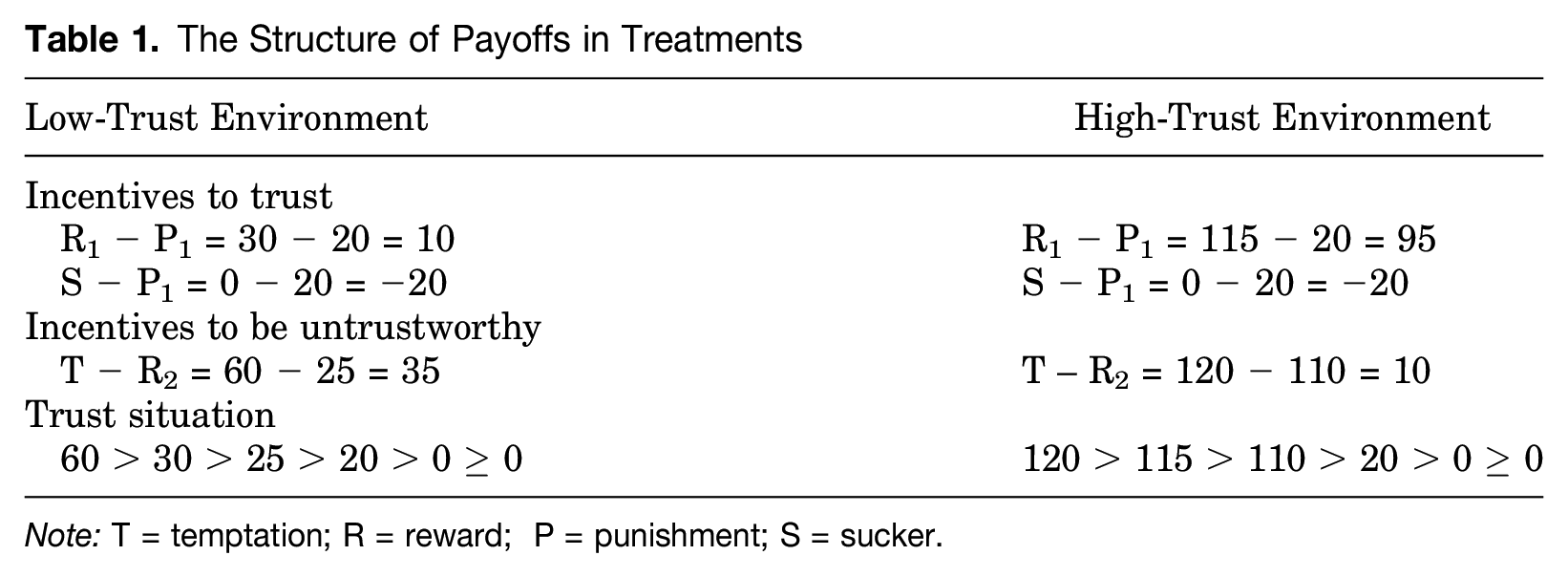
Note: T = temptation; R = reward; P = punishment; S = sucker.
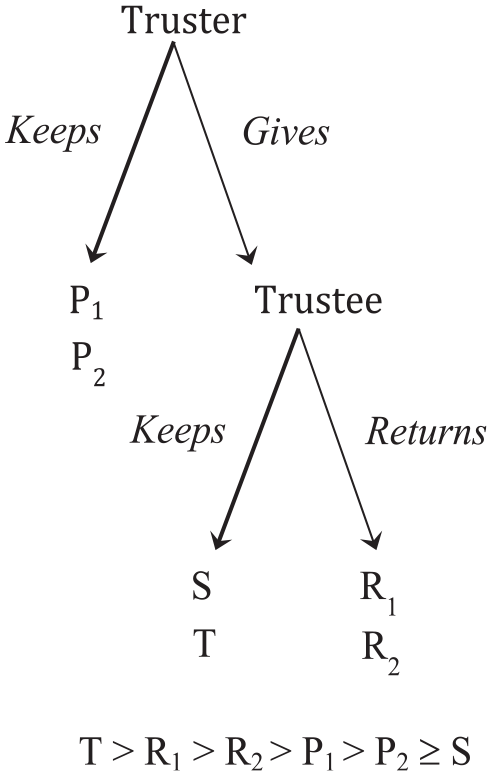
The Structure of the Binary Trust Game
The structure of the payoffs differs from that used by Ermisch and Gambetta (2010) and from most applications of the trust game (Berg, Dickhaut, and McCabe 1995; Buskens, Raub, and van der Veer 2010; Ermisch et al. 2009; Fehr et al. 2003; Glaeser et al. 2000; Lo Iacono 2018; Sapienza, Toldra-Simats, and Zingales 2013), in which only action by truster creates a surplus and trustee decides its distribution. In the present structure, actions by trustee also affect the surplus. In the low-trust environment, a trustworthy action by trustee reduces the surplus (by 5 experimental points), while in the high-trust environment, a trustworthy action increases the surplus (by 105 experimental points). The purpose of this structure is to produce dramatic differences between low trust and high trust in the incentives to be untrustworthy and the expected returns to trust. Taken together, the incentives to trust are 9.5 times higher in high trust than low trust (95 / 10 = 9.5), while the incentives to be untrustworthy are 3.5 times lower in high trust than low trust (35 / 10 = 3.5). Yet the incentive structure in both low trust and high trust respects the main pillarof a trust situation in which T >R1 > R2 > P1 > P2 ≥ S (T: Temptation; R: Reward; P: Punishment; S: Sucker; Buskens et al. 2010).
The different incentive structures are meant to mimic environments in which people “learn” to be trusting or distrusting from their community during the iterated trust game regardless of their baseline. By changing the payoff structure of the game, we aimed to create two environments that strongly differ in terms of trusting and trustworthy behaviors (Lo Iacono and Sonmez 2021).
Measures of Family Ties and Statistical Model
After the experiment, participants were asked to complete a survey. The questionnaire included information on family ties and demographics.
The intensity of family ties is measured by the frequency of contact with mother, father, or adult children—a “close relative” for short. In line with Ermisch and Gambetta (2010), physical family contact takes a value of 1 if respondent reports that he/she sees a close relative at least weekly and 0 otherwise. In addition, we also define a categorical variable that measures strength of family connection. It takes the following values: 0 if “Respondent sees close relative less than weekly and lives less than 30 minutes away,” 1 if “Respondent sees close relative less than weekly and lives more than 30 minutes away,” 2 if “Respondent sees close relative at least weekly and lives less than 30 minutes away,” and 3 if “Respondent sees close relative at least weekly and lives more than 30 minutes away.” For simplicity in displaying the results, we treat it as a categorical variable.
To test our hypotheses, we estimate a linear probability model of the following form:

where
Unless
The Impact of Family Ties on Trusting Behavior by the Environment
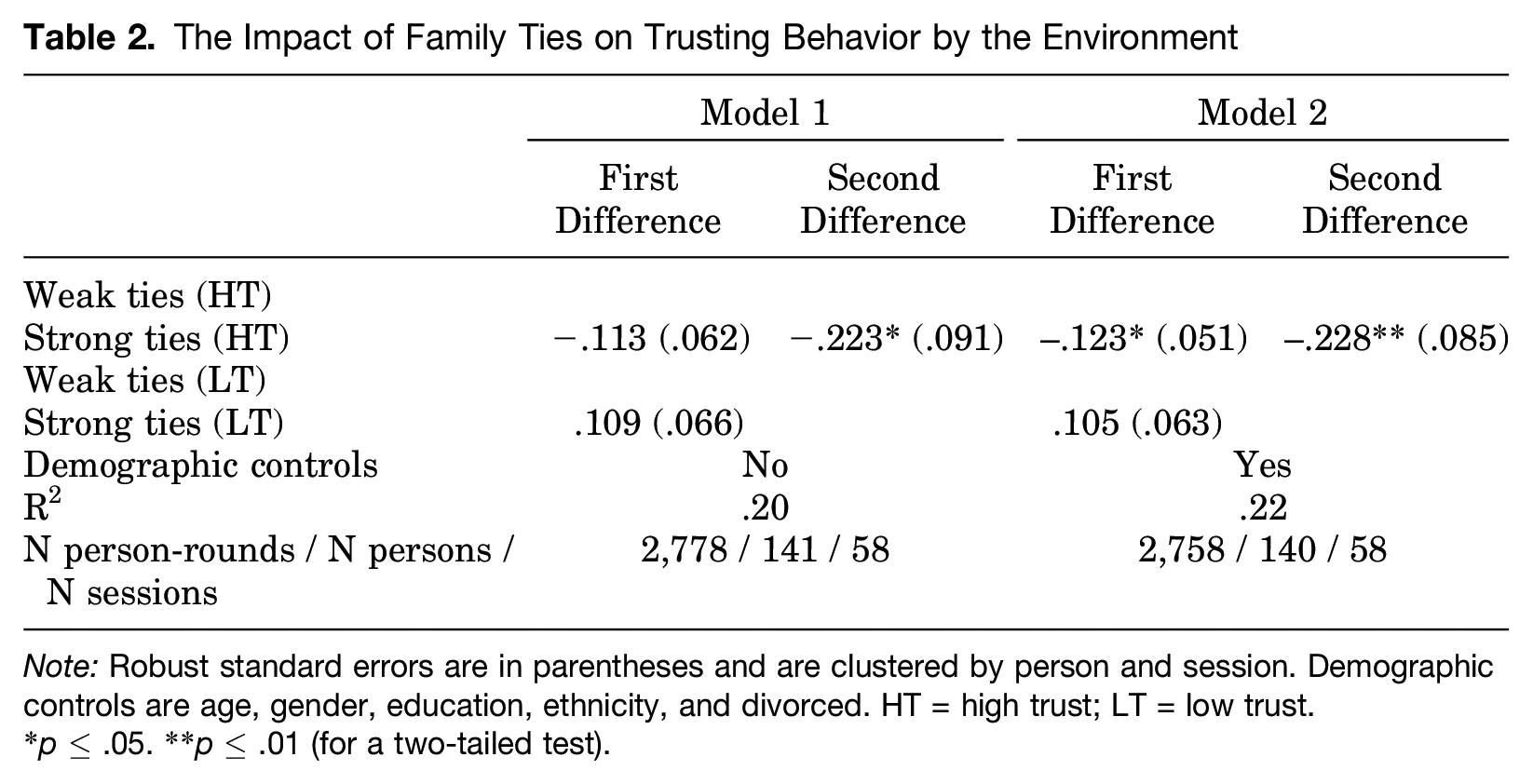
Note: Robust standard errors are in parentheses and are clustered by person and session. Demographic controls are age, gender, education, ethnicity, and divorced. HT = high trust; LT = low trust.
p ≤ .05. **p ≤ .01 (for a two-tailed test).
The Impact of Strength of Family Connection on Trusting Behavior by the Environment
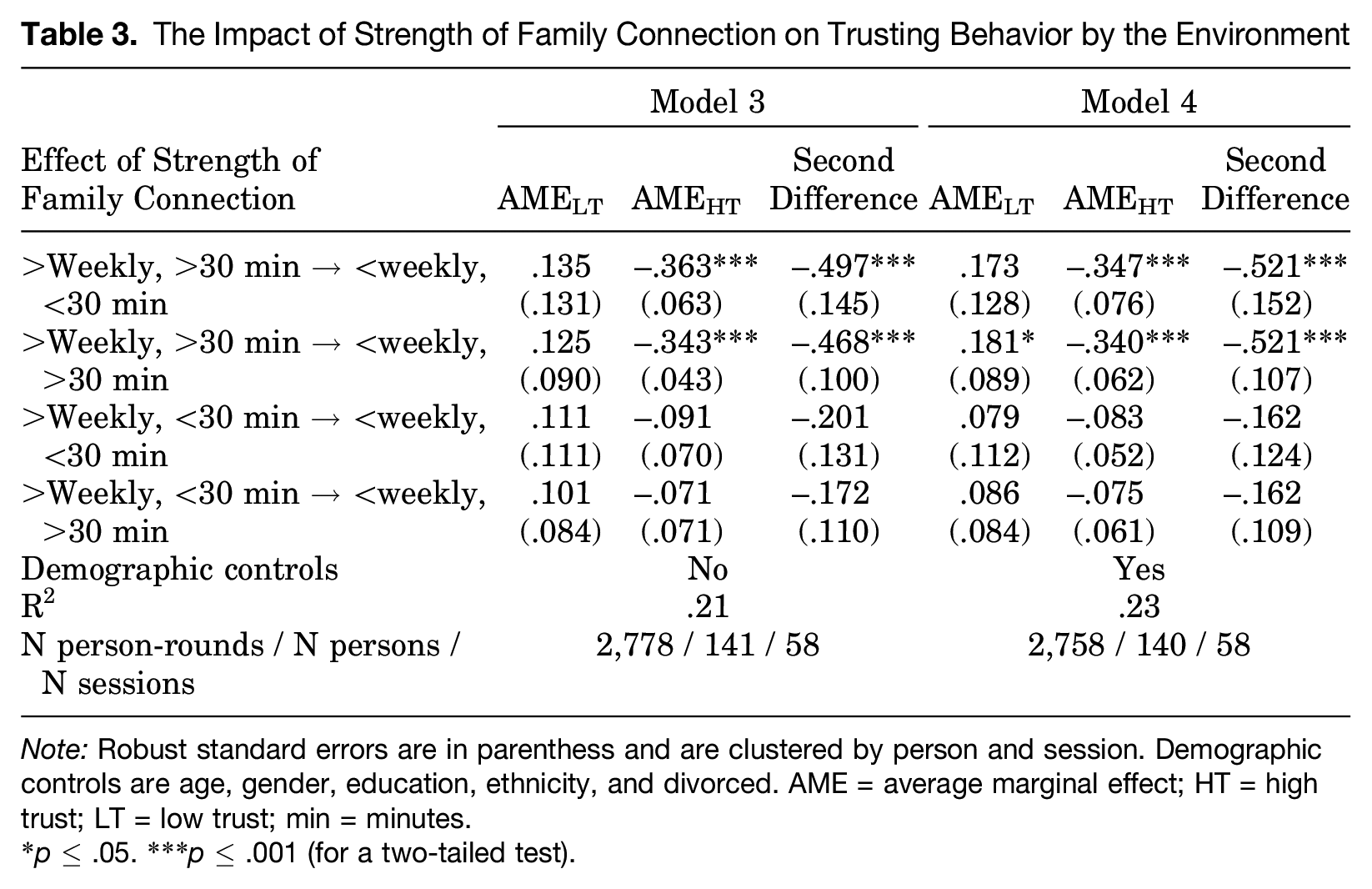
Note: Robust standard errors are in parenthess and are clustered by person and session. Demographic controls are age, gender, education, ethnicity, and divorced. AME = average marginal effect; HT = high trust; LT = low trust; min = minutes.
p ≤ .05. ***p ≤ .001 (for a two-tailed test).
Results
Averaging over all 20 rounds, we find that subjects chose to trust 64 percent of the times. If we break down this choice by environment, we find that trusting choices were 86 percent in the high-trust (HT) condition compared with 45 percent in the low-trust (LT) condition (TrustHT = .86, SE = .03; TrustLT = .45, SE = .04), t(139) = −8.38, p < .001. In high trust, trustworthiness was higher, too: 77 percent returned the money, compared with 50 percent in low trust (TrustworthinessHT = .77, SE = .05; TrustworthinessLT = .50, SE = .05), t(108) = −3.73, p < .001. Thus, these results show that the trust environments work as expected: trusting and trustworthy behaviors are substantially encouraged in the high-trust and discouraged in the low-trust condition. This is valid also for trusting attitudes toward other participants. 3
Let us examine the results of the linear probability model. Figure 2 shows the predicted trusting behavior across trust environments and across family ties using the dichotomous measure of the strength of family ties—see Model 1, Table 2. First, results suggest that people with weak family ties are more trusting than people with strong family ties in the high-trust environment (compare bars 3 and 4 in Figure 2) but not in the low trust environment (bars 1 and 2).
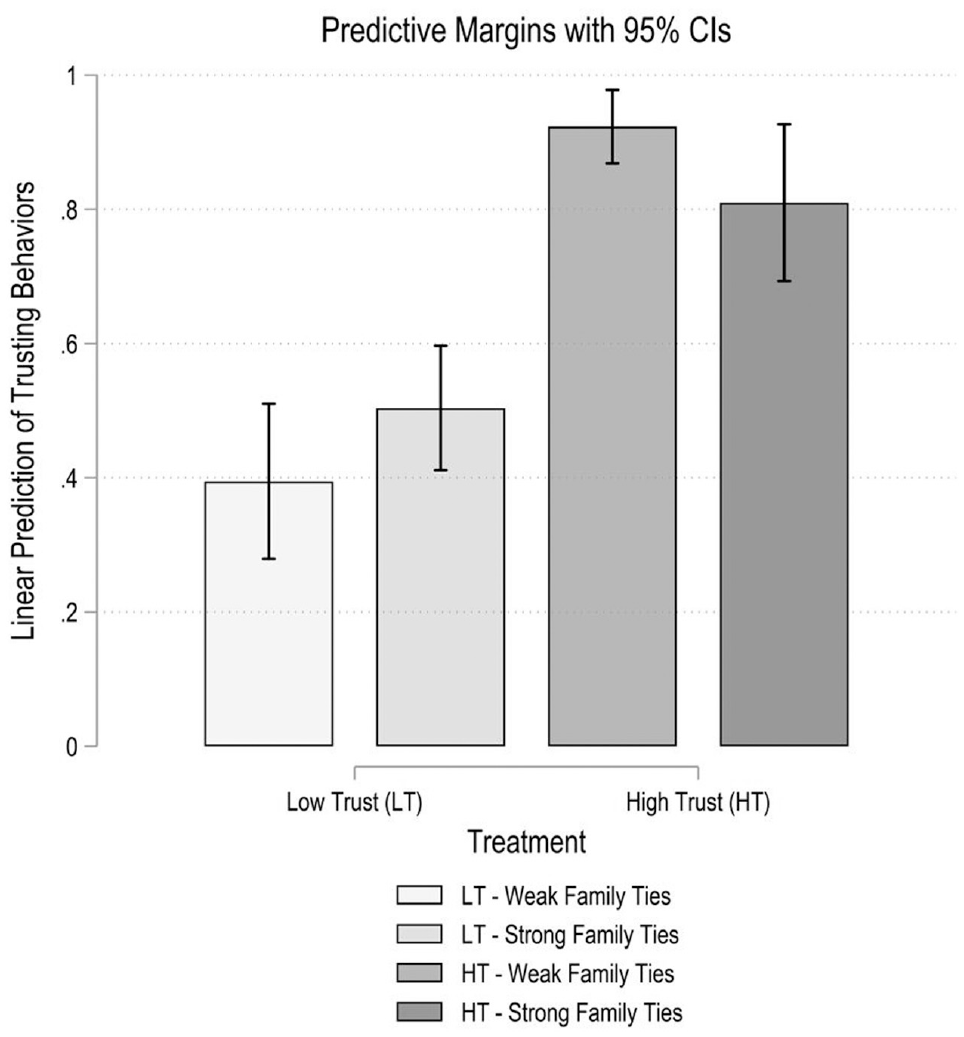
Linear Prediction of Trusting Behaviors by Family Ties and Treatment
Second, the gap in trusting behaviors between people with weak and strong ties is larger in the high-trust environment than in the low-trust environment (the difference between bars 3 and 4 and the difference between bars 1 and 2 in Figure 2—i.e., Table 2, Model 1: second difference = −.223; p = .017), as expected by the Hypothesis 1b.
These results are confirmed by using the categorical measure of strength of family connections shown in Figure 3 (see Model 3 in Table 3): in the high-trust environment, trusting behavior declines almost monotonically as the strength of family connections becomes stronger. In contrast, in the low-trust environment, an increase in the strength of family connections has virtually no impact on subjects’ trusting behavior.
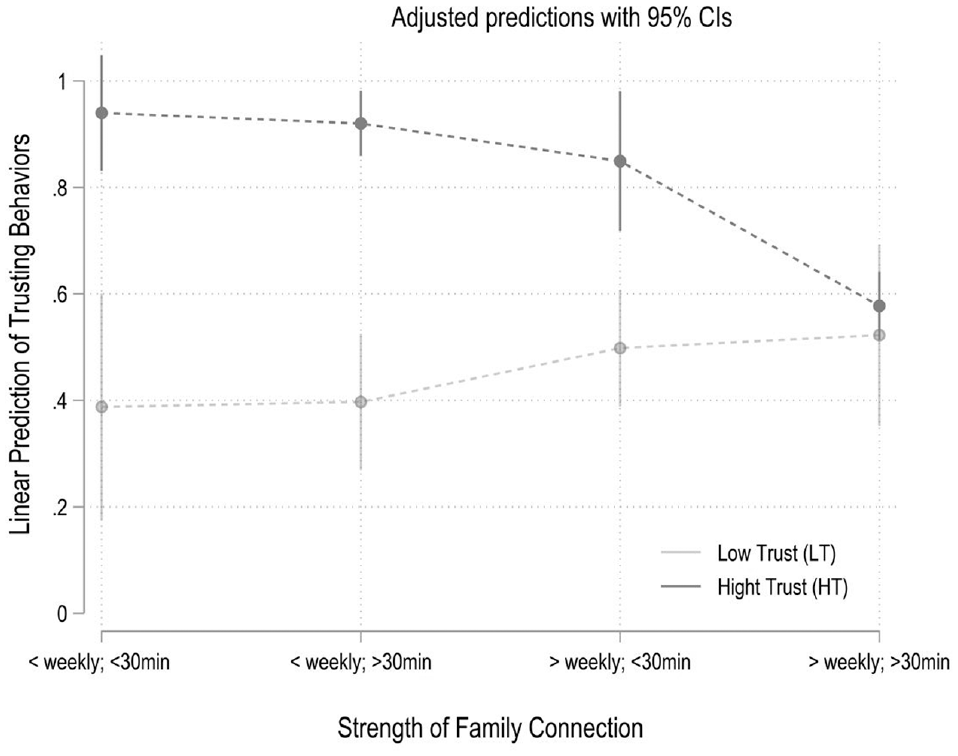
Linear Prediction of Trusting Behaviors by Strength of Family Connection and Treatment Group
Even though we manipulate trusting environments, the fact that we cannot randomize family ties may still lead to bias due to the omission of confounders in our analysis. Therefore, we add relevant control variables 4 (i.e., age, gender, education, ethnicity, divorced; Linden, Mathur, and VanderWeele 2020; VanderWeele and Ding 2017). The results showing the first differences (marginal effects) and the difference in difference (second difference) in trust between strong and weak family ties are reported in Table 2. It is noticeable that there is a statistically significant difference in trusting behavior between weak and strongly family ties in the high-trust environment (first difference = −.123, p = .019; Model 2), supporting Hypothesis 1a. More precisely, people with weak family ties trust strangers more than people with strong family ties in the high-trust environment. Also, Model 2 suggests that this trusting behavior gap is larger in the high-trust environment in comparison to the low-trust environment (second difference: = −.228, p = .009). This is in line with our Hypothesis 1b that the differential in trust between people with weak and strong ties is larger in the high-trust environment.
Repeating the analysis with the categorical measure of strength of family connections provides us with a more fine-grained understanding of the mechanism at hand. Table 3 supports the Hypotheses 1a and 1b, showing that the trusting behavior gap becomes indeed larger when the spectrum of family ties between weaker and stronger references is wider (e.g., >weekly, >30 minutes and <weekly, <30 minutes) in the high-trust environment but not in the low-trust environment. In particular, the results suggest that the less effort respondents are making to see their family frequently, the more they trust strangers in the high-trust environment. These results are consistent with Ermisch and Gambetta (2010). In assessing the robustness of our findings to other analytic strategies, we found that logistic regressions yield similar results. 5
Discussion
Our evidence upholds the previous finding that strong family ties are associated with lower trust in strangers. This evidence carries a particular force since it replicates prior findings in Ermisch and Gambetta (2010) with a radically different and rather idiosyncratic sample formed by individuals residing in the United States and recruited through Amazon Mechanical Turk a decade after the first experiment. It seems plausible to assume that the nature of MTurkers makes it more challenging to find the different effects of family ties among them—because of their very activity, MTurkers often interact with anonymous others in cooperative games. Even MTurkers with strong family ties, who may be disinclined to interact with strangers, do so regularly because of their “job.” This should make detecting the effects of family ties through the present sample harder compared to the British Household Panel Survey sample.
This renewed finding comes with two novel qualifications: first, the relationship between trusting strangers and weak family ties becomes apparent only in a high-trust environment, while the difference disappears in the low-trust environment, in which the trusting behavior of subjects with weak family ties converges downward with that of subjects with strong family ties.
This could have an interesting implication: social transformations that, intentionally or unintentionally, weaken family ties in very low-trust environments may have little appreciable positive effect on trust in strangers. Insofar as economic development relies on cooperation between strangers, the enfeeblement of family ties could have no constructive impact.
Second, we found an indirect way to overcome the fact that manipulating the intensity of family ties is not feasible, given the ethical constraints, using a difference in differences strategy by randomizing the trust environment. As we hypothesized, the differential in trust between people with weak and strong ties is much larger in the high-trust environment, although the precision of the estimates of the difference in difference in individual categories is relatively poor. Subjects with weak family ties seem faster to understand that the environment is low in trustworthiness and respond by becoming less trusting. Relative to people with strong family ties, their plausibly more extensive real-life experience in trusting strangers would lead them both to avoid trusting when the environment looks unpromising and be quicker to appreciate the expected returns to trust when in a high-trust environment.
Our findings rely on the manipulation of the payoff structure of the binary trust game. Future studies might pursue the replication in other ways by introducing subtler measures of family ties or alternative measures of trust, creating trusting environments with alternative approaches (e.g., randomly assigning people who are very trusting in everyday life to an environment filled with others who do not tend to be very trusting), or testing the hypotheses in a cross-cultural study.
Overall, these findings are evidence that it is not only heterogeneity in the propensity to trust that drives the correlation between the two, but that there is some independent causal impact of family ties on trust.
Supplemental Material
sj-docx-1-spq-10.1177_01902725231162074 – Supplemental material for Trust and Strength of Family Ties: New Experimental Evidence
Supplemental material, sj-docx-1-spq-10.1177_01902725231162074 for Trust and Strength of Family Ties: New Experimental Evidence by John Ermisch, Diego Gambetta, Sergio Lo Iacono and Burak Sonmez in Social Psychology Quarterly
Footnotes
Funding
The work was funded by a Leverhulme Trust Grant for the Leverhulme Centre for Demographic Science.
Supplemental Material
Supplemental material for this article is available online.
BIOS
 ). He has held visiting positions at the University of Chicago, Columbia University, EHT Zurich, Science Po and Collège de France in Paris, and Stanford University.
References
Supplementary Material
Please find the following supplemental material available below.
For Open Access articles published under a Creative Commons License, all supplemental material carries the same license as the article it is associated with.
For non-Open Access articles published, all supplemental material carries a non-exclusive license, and permission requests for re-use of supplemental material or any part of supplemental material shall be sent directly to the copyright owner as specified in the copyright notice associated with the article.
