



Abstract
This article presents results from an experimental study of workers tasked with evaluating professionals with identical workplace performances who differed with respect to hours worked and gender, isolating two mechanisms through which overwork leads to workplace inequality. Evaluators allocated greater organizational rewards to overworkers and perceived overworkers more favorably compared to full-time workers who performed similarly in less time, a practice that disproportionately rewards men over equivalently performing, more efficient women. Additionally, the magnitude of the overwork premium is greater for men than for women. We then use path analyses to explore the processes by which evaluators make assumptions about worker characteristics. We find overwork leads to greater organizational rewards primarily because employees who overwork are perceived as more committed—and, to a lesser extent, more competent—than full-time workers, although women’s overwork does not signal commitment or competence to the same extent as men’s overwork.
Americans work longer hours than workers in virtually every other high-income country (Alesina, Glaeser, and Scaerdote 2005; McDaniel 2011), and over the past half-century, the average number of paid work hours per year has markedly increased, particularly in professional and managerial jobs (Wilson and Jones 2018). Work hours are of particular interest to gender scholars given the role they play in maintaining inequality. For example, women are more likely than men to work part-time (Bureau of Labor Statistics 2019a), and among full-time workers, they work fewer hours than men (Bureau of Labor Statistics 2019b), differences that explain a substantial portion of the gender wage gap (Blau and Kahn 2017; Cha and Weeden 2014). Workers who put in long hours are more likely to be promoted and are promoted more quickly (Frederiksen, Kato, and Smith 2018; Perlow 1997; Williams 2000), resulting in a shortage of women at the top of professional ladders (Javdani and McGee 2019). In addition, women are less likely than men to pursue jobs that require extremely long hours (Epstein et al. 1999; Hochschild and Machung 1989; Williams 2000) and are less likely to remain in such jobs long term (Cha 2013; Stone 2007), factors that contribute to vertical occupational segregation by gender.
At the macro-level, these relationships are well documented. By comparison, however, the micro-level mechanisms that underlie the relationship between long hours and gender inequality are undertheorized. We contribute to this literature by experimentally examining the effects of overwork, defined as working 50 or more hours per week in the paid labor market, and gender on assessments of professional workers to detail two pathways through which long work hours advantage men over women. By experimentally controlling for workplace performance, we document an overwork premium such that evaluators allocate greater organizational rewards to overworkers and perceive overworkers more favorably than full-time, 40-hour/week workers (hereafter, “full-time workers”) who complete the same amount and quality of work in less time. This practice undermines organizational goals of profit and efficiency and, because men are more likely to overwork than women (Cha and Weeden 2014), disparately impacts workers on the basis of gender. Additionally, we document a significant gender bias such that the magnitude of the overwork premium differs by gender. Although both men and women are rewarded for overwork, men reap a significantly larger premium than women.
To advance theoretical knowledge of the causal processes driving these biases, we then employ path analysis to examine evaluators’ underlying assumptions about several work-relevant attributes and their role in the relationship between work hours, gender, and the allocation of organizational rewards. Prevailing explanations for the emergence of gender hierarchies in the context of professional work emphasize the role of perceived competence (Correll, Benard, and Paik 2007; Ridgeway 2011), commitment (Blair-Loy 2003), and likeability (Benard and Correll 2010; Heilman et al. 2004), suggesting overwork may influence evaluators’ perceptions of these attributes, and these attributes may uniquely explain the allocation of organizational rewards and professional gender gaps. Our results point to commitment and, to a lesser extent, competence as the primary drivers of the overwork premium. Additionally, we find that women do not reap the same benefits of overwork as men because women’s overwork does not signal commitment or competence to the same extent as men’s overwork.
Theoretical Framework
Overwork Premiums
Overworkers reap sizable wage returns relative to full-time workers, a premium that has risen steadily—particularly in professional and managerial occupations—over the past 40 years (Cha and Weeden 2014; Cortés and Pan 2019; Kuhn and Lozano 2008). For example, in the mid-1990s, hourly wages for overworkers and full-time workers were comparable. Yet by 2009, overworkers earned approximately 6 percent more than full-time workers (Cha and Weeden 2014). Similarly, overwork is associated with other workplace benefits like formal and informal accolades, occupational advancement, and monetary bonuses (Frederiksen et al. 2018; Kato, Ogawa, and Owan 2016; Perlow 1997; Williams 2000).
The most widely accepted explanation for these returns concerns performance, an association tightly interwoven into the American cultural fabric. One of the most celebrated authors of the nineteenth century, Horatio Alger, penned hundreds of stories about underprivileged boys whose long days and late nights lead to great accomplishments, and stories linking overwork to performance continue to abound. For example, historical accounts venerate Jonas Salk, reputed to work 16 hours a day, seven days a week to develop the polio vaccine, and some of the most celebrated characters of modern television and film are accomplished overworkers (e.g., Miranda Priestly in The Devil Wears Prada, Olivia Pope on Scandal, Jack Bauer on 24). Of course, long work hours are not unilaterally celebrated. For example, the term workaholic suggests long hours stem from individual pathology. Yet unlike most other forms of addiction, the compulsive desire to work is also revered. Indeed, long work hours have become a status symbol, particularly among the upper-middle class (Williams 2010; Williams, Blair-Loy, and Berdahl 2013), and people regularly boast about how busy they are and how little time they have for leisure, behaviors that favorably shape others’ impressions (Bellezza, Paharia, and Keinan 2017; Keinan, Bellezza, and Paharia 2019).
In occupations with objective output measures (e.g., sales, billable hours, units produced), the thesis that long hours and performance are correlated is easily testable. In most occupations, however, output is not easily quantifiable. For example, performance is notoriously difficult to measure in professional and managerial work, the very occupations that have seen the largest growth in wage returns to overwork. These workers often have multiple responsibilities and contribute to multiple projects, products, and services; they typically work in teams, so their performance depends on the skill and expediency of others; and they often deal with emergent matters. Thus, their contributions vary from day to day. Consequently, in the absence of concrete information regarding performance, employers may use work hours as an approximate measure (Cha and Weeden 2014; Reid 2015; Sharone 2004). By this logic, rewarding overwork is justified because workers who put in extra hours are more valuable to organizations than workers who do not.
Yet work hours are a poor indicator of output. Although research directly measuring the relationship between work hours and performance is rare, some employees waste time, sluggishly complete their work, do busy work to appear more valuable, or put out fictitious fires, particularly in work environments that reward facetime (Blair-Loy 2003; Epstein et al. 1999; Perlow 1997; Sharone 2004). Rather, factors like intensity, energy, alertness, and resourcefulness are more predictive of performance (Newport 2016). As finite resources, however, these practices are unsustainable. Consequently, shorter hours are associated with higher rates of output per hour (Holman, Joyeux, and Kask 2008; Schwarz and Hasson 2011), and longer hours are associated with diminished output per hour (Golden 2012; Holman et al. 2008). And this is true even in occupations with objective output measures (e.g., call centers, manufacturing; Collewet and Sauermann 2017; Shepard and Clifton 2000). Thus, another explanation for the favorable workplace outcomes of overworkers involves biased assessment. Given the extent to which long hours are celebrated, managers may discriminately favor overworkers over full-time workers even when both workers contribute equally to organizational goals.
As Correll et al. (2007) explain, one way to distinguish between performance-based and bias- or discrimination-based explanations for workplace premiums would be to compare workplace outcomes for people who exhibit comparable levels of performance but who differ on the characteristic in question—in this case, work hours. This is not possible, however, given the aforementioned difficulty in measuring performance in most white-collar jobs and the possibility that any remaining group disparities may reflect unmeasured performance differences as opposed to bias. A carefully designed experiment, however, allows researchers to hold performance constant and test for the presence of discrimination. Accordingly, we assess perceptions of experimentally analogous employees with commensurate performances who differ with respect to the number of hours worked. This design ensures any differences between the ratings of overworkers and full-time workers cannot be attributed to underlying performance differences. Thus, we hypothesize:
Hypothesis 1: Holding performance constant, evaluators will allocate greater organizational rewards to overworkers than full-time workers.
Of course, performance- and discrimination-based explanations are not mutually exclusive. Accordingly, we cannot rule out the possibility that performance differences account for some differences in workplace outcomes between overworkers and full-time workers. Nevertheless, our objective is to test for and isolate discrimination as a causal mechanism underlying the relationship between overwork and gender inequality.
Commitment, Competence, and Likeability
Our first hypothesis concerns discrimination, or adverse treatment. Yet discrimination stems from preconceptions about workers’ character traits. In particular, the literature suggests that work hours may influence evaluators’ perceptions of three work-relevant traits: commitment, competence, and likeability, each of which may, to various extents, undergird the disparate allocation of organizational rewards to overworkers.
Commitment
The “ideal worker norm” (Williams 2000) and “work devotion schema” (Blair-Loy 2003) are dominant workplace ideologies that call for the prioritization of work above all else. Indeed, workers whose performances align with these ideals reap financial rewards and are more likely to move up the organizational hierarchy (Blair-Loy 2003; Perlow 1997; Williams 2000). Moreover, one of the clearest demonstrations of occupational and organizational workplace commitment is clocking long hours (Perlow 1997). And prior research finds that work practices that involve scaling back on hours—for example, by taking leave (Kmec, Huffman, and Penner 2014), requesting a flexible work arrangement (Munsch 2016; Munsch, Ridgeway, and Williams 2014), or working “anything but full time” (Epstein et al. 1999; Kmec, O’Connor, and Schieman 2014)—are associated with stigma and workplace penalties. Conversely, evaluators may view overworkers as more committed than full-time workers; and to the extent that evaluators value commitment, they may reward overworkers because they perceive them as especially committed—even when workplace performance is comparable.
Competence
Although we hold objective performance constant, it is also possible that evaluators will perceive overworkers as more competent in an idealized capacity than full-time workers. For example, if evaluators assume workers can theoretically complete a particular task in a specified, minimal amount of time, then they may conclude that overworkers hold more promise than full-time workers for moving the organization forward. Thus, regardless of past performance, evaluators may find overworkers more deserving of organizational rewards. Research substantiates the claim that beliefs about specific and general competences underlie the formation of status hierarchies (e.g., Berger, Cohen, and Zelditch 1972; Ridgeway 2001, 2009). For example, Bellezza et al. (2017) find that the relationship between long hours and status is mediated through beliefs about workers’ human capital. People who work long hours are inferred to have more status, and status inferences are driven by the belief that busy people are more competent and ambitious.
Likeability
Additionally, there may be something about overwork that triggers partiality or aversion on the part of evaluators. Like virtually all arenas of social interaction, work behaviors are performative, and people construct their performances to idealize their intentions and reflect ideal cultural standards (Goffman 1959). For example, in Reid’s (2015) study of consultants, workers often lied about how much time they spent working to simultaneously spend more time with their families while appearing as “ideal workers” singularly devoted to their craft. Similarly, Perlow (1997:38) found that engineers would “resort to tricks, leaving a coat in the office, say, or a car in the parking lot” to give the appearance of being present. Because idealization is predictable and people are attracted to those they find predictable (Berger and Calabrese 1975; Touhey 1973), evaluators may find overworkers more likeable than full-time workers who simply work their 40 hours without such performances. Thus, through likeability, overwork may positively affect the allocation of organizational rewards.
Hypothesis 2: Holding performance constant, evaluators will favor overworkers over full-time workers with respect to perceptions of commitment, competence, and likeability.
Hypothesis 3: Perceptions of commitment, competence, and likeability will mediate the relationship between overwork and organizational rewards.
Gender and Overwork
Thus far, we have discussed overwork as gendered because men are more likely to overwork than women. This implies that if men and women were equally likely to work long hours, overwork would no longer contribute to gender inequality. But men are more likely to overwork than women because of gendered cultural scripts about work and family. Thus, these scripts may also lead people to interpret and reward overwork differently depending on worker gender.
Beginning in the late 1700s, the “traditional” breadwinner-homemaker family model emerged in U.S. culture linking men and masculinity to the public sphere of paid labor and women and femininity to the private sphere of unpaid domestic work (Davies and Frink 2014). Over the past half-century, however, norms pertaining to the public sphere have changed more quickly than norms pertaining to the private sphere (Scarborough, Sin, and Risman 2019). Dual-earner couples are the norm, most women work, and among employed women, most work full-time (Bureau of Labor Statistics 2021). And both men and women prefer working outside the home as opposed to staying home to take care of the house and family (Brenan 2019). Consequently, work-family scripts may have shifted such that both men and women are expected to participate in paid labor, but the norms and expectations outside of traditional business hours (i.e., Monday through Friday, 9 a.m. to 5 p.m.) remain differentiated by gender. For example, women may be expected to spend time after work doing unpaid domestic labor and care work, whereas men may be expected to further pursue their professional goals. Indeed, an abundance of scholarship documents large gender differences in domestic labor among employed men and women, a phenomenon Hochschild and Machung (1989) labeled the “second shift” (Blair-Loy 2003; Clarkberg and Moen 2001; Jacobs and Gerson 2004). Moreover, scholars have begun to document overwork—as opposed to simply working full-time—as a defining feature of contemporary masculinity (Berdahl et al. 2018; Munsch et al. 2018). For example, Cooper’s (2000) study of Silicon Valley tech workers serves as an exemplar of the ways in which this plays out in a particular industry. According to one respondent: Guys constantly try to out-macho each other, but in engineering it’s really perverted because out-machoing someone means being more of a nerd than the other person. . . . It’s not like being a brave firefighter and going up one more flight than your friend. There’s a lot of “see how many hours I can work” whether or not you have a kid. That’s part of the thing, how many hours you work. He’s a real man, he works ninety-hour weeks; he’s a slacker, he works fifty hours a week. (Cooper 2000:382)
Other scholars have documented similar trends in firefighting, consulting, and upper business management (Reid, O’Neill, and Blair-Loy 2018).
Given the cultural value placed on overwork outlined here, we hypothesize both men and women will reap overwork premiums. But because of these contemporary scripts, we theorize that the magnitude of these premiums will differ by gender.
Hypothesis 4: Holding performance constant, men will reap greater organizational rewards for overwork than women.
If confirmed, this finding will shed light on a second mechanism—gender bias in the overwork premium—through which overwork contributes to gender inequality.
As earlier, we draw on existing literature to explore the relationship between gender and perceptions of commitment, competence, and likeability and the role of each in motivating the disparate allocation of organizational rewards to overworking men and women. For example, gendered beliefs about femininity and domesticity—which make it difficult for women to work long hours (Acker 1990; Stone 2007; Williams 2000)—may lead people to assume overworking women, but not overworking men, have divided loyalties. Widely shared cultural beliefs about gender assume men are generally more competent than women (Eagly and Mladinic 1994; Ridgeway 2011; Ridgeway and Correll 2004). Consequently, people may infer overworking women are less competent than overworking men and thus put in long hours out of necessity. And women who violate gendered expectations at work face normative discrimination (Alonso 2018; Benard and Correll 2010; Rudman et al. 2012). Thus, respondents may simply like men who overwork more than women who overwork. In turn, perceived commitment, competence, and likeability may underlie the differential allocation of organizational rewards by gender.
Hypothesis 5: Holding performance constant, men will receive greater boosts in perceived commitment, competence, and likeability for overwork than women.
For clarity’s sake, we underscore the importance of gender salience. For a status characteristic—in this case, gender—to be predictive, it must be activated or relevant to the situation at hand (Ridgeway 2001; Ridgeway and Bourg 2004). As noted earlier, norms pertaining to the public sphere have changed such that full-time employment itself is not gendered. Rather, overwork is gendered and concomitant with masculinity, not femininity. Thus, Hypothesis 5 specifically relates to the interaction of gender and overwork, and we do not predict gender differences in perceived commitment, competence, or likeability for full-time workers.
Methods
Participants
To test these hypotheses, we conducted an online experiment on a nationwide sample of 306 employed persons in the United States who received $2.00 for participation via Amazon’s Mechanical Turk (MTurk). 1 MTurk is a crowdsourcing marketplace that matches “workers” with “requesters” who post jobs for workers to complete. MTurk respondents are more representative than in-person convenience samples and only modestly less representative than subjects in national probability samples (Berinsky, Huber, and Lenz 2012). Nevertheless, we employed rigorous exclusion methods to ensure data quality. Namely, participants needed to correctly answer all manipulation and comprehension check questions and have no missing data. 2 Of the original 306 participants, we excluded 66 who failed one or more of the manipulation or comprehension checks (21.6 percent of completions) and 10 who had missing data on one or more variables (3.3 percent of completions), resulting in a sample of 230 participants (58 percent men, 42 percent women). These methods have been shown to boost statistical power without introducing bias and to produce comparable exclusion rates (Thomas and Clifford 2017). Approximately 75 percent of the sample identified as White (n = 173), 66 percent (n = 152) indicated they were partnered, and 41 percent were parents (n = 95). The average age of participants was 36.8 years (SD = 10.2). 3
Procedures
After providing consent, participants read a cover story about the role of technology in changing the way companies operate, including when and where employees work and how managers make decisions. They then learned of a large (fictitious) company interested in studying these changes. Accordingly, the company developed a time-tracking application used by volunteers from their workforce. Participants were then asked to review time-tracking and performance evaluation data for two employees. Specifically, each participant saw a pair of equally performing, same gender (men or women) employees. This decision was based on recommendations by Auspurg and Hinz (2015), who discourage within-subject variation of politically charged and/or protected demographic groups. For example, if participants were asked to evaluate differently gendered employees, they may have guessed the study was about gender and provided socially desirable answers suppressing our ability to detect discrimination. The employees differed, however, in the proportion of time they spent working over the course of a calendar week. Consequently, participants were randomly assigned to one of two experimental conditions: one where participants rated two men, an overworker (who worked 60 hours) and a full-time worker (who worked 40 hours), or one where participants rated two women, an overworker and a full-time worker. 4 Overwork status was counterbalanced across the two employees so that half of the participants viewed the overworker first and the other half viewed the full-time worker first. 5 Performance was held constant by pairing one of two fictitious performance evaluations with each employee. Prior to data collection, the evaluations were pretested and found to have no statistically significant differences on our dependent measures; however, we also counterbalanced these pairings across the two employees.6,7
After viewing the first profile, participants answered questions related to their perceptions of worker commitment, competence, and likeability. Participants then rated the likelihood that the employee would receive a series of independently rated organizational rewards. Next, participants viewed the second employee profile and answered the same questions. Finally, to imitate real-world management decisions in which employers distribute fixed resources among marginally distinct employees, participants were asked to choose one worker over the other to receive several workplace rewards. We refer to these items as “zero-sum organizational rewards.”
To mirror the order in which we test our hypotheses, we first describe the zero-sum and independently rated organizational rewards. We then detail our commitment, competence, and likeability items, adapted from Correll et al. (2007) and Cuddy, Fiske, and Glick (2004). Table 1 provides descriptive statistics for the variables in our analyses.
Means and Standard Deviations for Variables Used in Analyses (N = 460 Observations, 230 Participants)
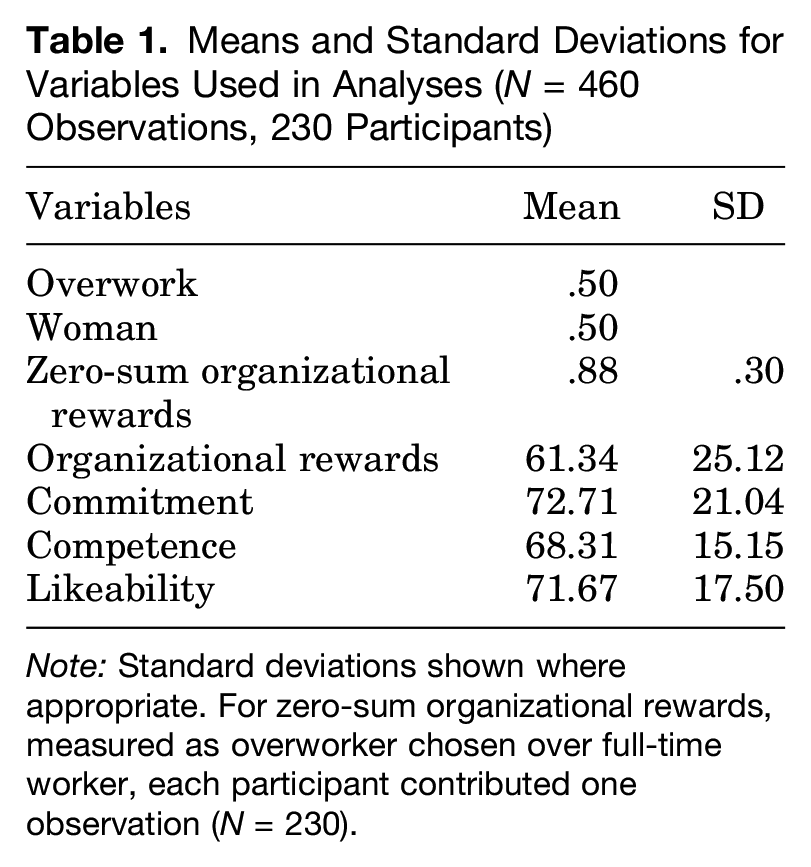
Note: Standard deviations shown where appropriate. For zero-sum organizational rewards, measured as overworker chosen over full-time worker, each participant contributed one observation (N = 230).
Measures
Zero-sum organizational rewards
Participants were asked to choose which of the two employees should be recommended for a management training course for employees with strong advancement potential, which would be considered for a promotion in the next year, and who would be most successful at the company. To create a composite variable, we counted the number of times each participant chose the overworker and divided this count by 3 (the total number of times the participant could have chosen the overworker). This created an index ranging from 0 (i.e., the overworker was never selected) to 1 (i.e., the overworker was always selected; α = .92). The mean for this variable was .878, meaning 87.8 percent of the time, participants preferred the overworker over the full-time worker when choosing whom to reward (Table 1).
Independently rated organizational rewards
We also assessed the allocation of organizational rewards for each employee separately so that we could have continuous, independent ratings for each employee to use in regression and path analysis. Specifically, we asked participants to indicate the likelihood that each employee would be recommended for a management training course designed for those with strong advancement potential, considered for promotion next year, and tracked into a senior leadership position. 8 These items were assessed on a 7-point scale (1 = not at all likely, 7 = extremely likely), averaged, and converted to a 100-point scale for interpretive ease (α = .93). Worker ratings were nested within participants because each participant gave two sets of ratings: one for the overworker and one for the full-time worker.
Worker attributes
Additionally, participants rated each worker on a 7-point scale (1 = not at all, 7 = extremely) on a series of items that combined to form indices of perceived commitment, competence, and likability. Again, these were converted to 100-point scales. The commitment index includes ratings of the employees’ career importance, dependability, commitment, dedication, and likelihood of putting work ahead of personal life (α = .90). The competence index includes ratings of employees’ capability, efficiency, skill, intelligence, independence, self-confidence, aggression, and organization (α = .85; Correll et al. 2007; Cuddy et al. 2004). The likability index includes trait ratings of the employees’ admirability, respectability, and likability (α = .83). Low values are indicative of low perceptions, and high values are indicative of high perceptions.
Analytic Strategy
To examine the main effect of overwork, we first compare respondents’ allocation of zero-sum organizational rewards to the overworker compared to the full-time worker. Then, we use linear mixed models to assess the effect of overwork on the allocation of independently rated organizational rewards and on participants’ assessments of workers’ commitment, competence, and likeability. Next, we examine how employee gender interacts with overwork to magnify or reduce these effects. Finally, we use structural equation modeling to create a path model in which overwork and gender influence the allocation of independently rated organizational rewards through perceived commitment and competence. Given that some analyses concern the effect of overwork interacted with gender, some numbers referenced in the text have been derived from information in our tables. In these instances, we include the math used to derive these values.
Results
Main Effect of Overwork
Hypothesis 1 predicted evaluators would allocate greater organizational rewards to overworkers than full-time workers. With respect to zero-sum rewards, overworkers were more than 7 times more likely to be chosen than full-time workers. Participants chose the overworker 87.8 percent of the time compared to choosing the full-time worker the remaining 12.2 percent of the time (Table 1). Testing for the equality of proportions, this significantly differs from 50 percent, a value that would indicate no difference between overworkers and full-time workers (z = 11.47, p < .001). Similarly, overwork has a large positive effect on the allocation of independently rated organizational rewards. The estimated value for overworkers is 76.0 (46.6 + 29.4 = 76.0) (Table 2, Model A), 63 percent higher (p < .001) than the estimated value for full-time workers of 46.6 (Table 2, Model A). These findings support for our first hypothesis.
Linear Mixed Models Examining the Effect of Overwork, Gender, and Overwork × Gender Interaction on Organizational Rewards and Worker Attributions (N = 460 Observations, 230 Participants)
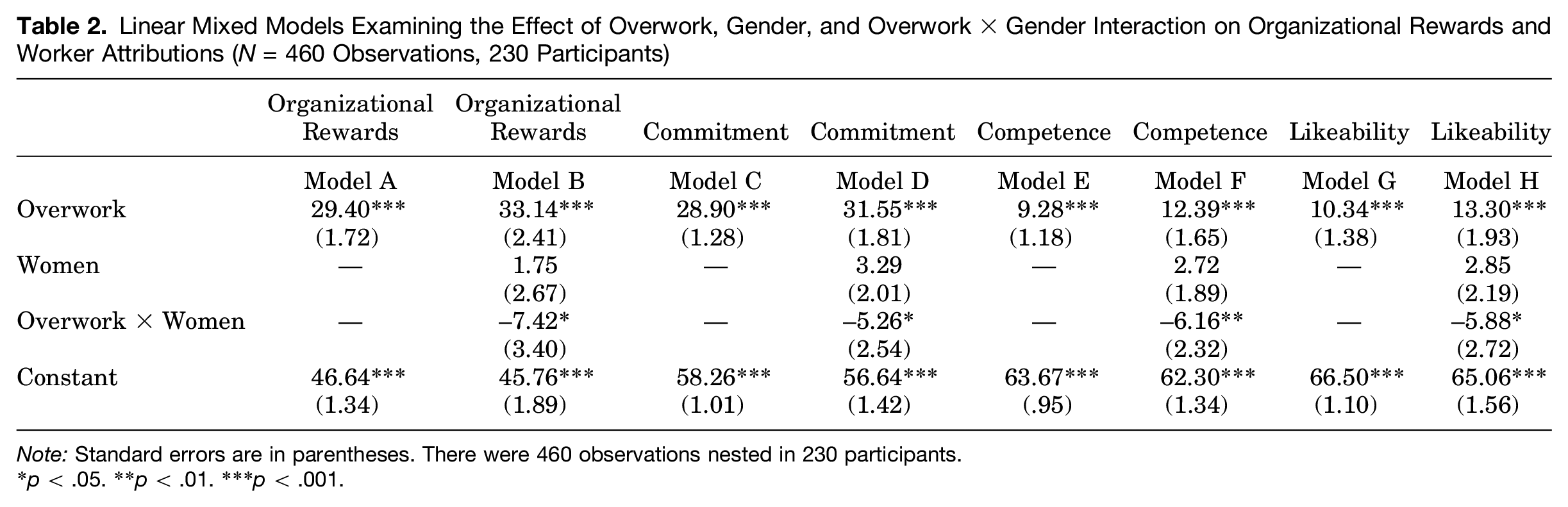
Note: Standard errors are in parentheses. There were 460 observations nested in 230 participants.
p < .05. **p < .01. ***p < .001.
Hypothesis 2 stated evaluators would favor overworkers more than full-time workers with respect to perceptions of commitment, competence, and likeability. Indeed, we find overwork is associated with enhanced perceptions of all three attributes, and overwork has a particularly large impact on perceptions of commitment. Overwork increases perceptions of commitment by 49.6 percent (full-time mean = 58.3; overwork mean = 87.2 [58.3 + 28.9 = 87.2], p < .001; Table 2, Model C), perceptions of competence by 14.6 percent (full-time mean = 63.7; overwork mean = 73.0 [63.7 + 9.3 = 73.0], p < .001; Table 2, Model E), and perceptions of likability by 15.5 percent (full-time mean = 66.5; overwork mean = 76.8 [66.5 + 10.3 = 76.8], p < .001; Table 2, Model G). 9
Effect of Gender on Overwork
Next, we assess Hypothesis 4, which predicted men would reap greater organizational rewards for overwork than women. There are two ways to assess this hypothesis. First, we ask if overwork gives men a larger increase in rewards than women. Second, we ask if outcomes are better for overworking men compared to overworking women. We find evidence for both.
In terms of zero-sum rewards, overworking men were chosen over full-time men 91.8 percent of the time (Figure 1). Yet overworking women were chosen over full-time women only 83.9 percent of the time (Figure 1). This difference of 7.9 percentage points (91.8 – 83.9 = 7.9) is marginally statistically significant (test for equality of proportions, z =1.83, p =.07, n = 230, Figure 1). This provides evidence for Hypothesis 4, which stated overwork would give men a larger increase in zero-sum rewards than women and implied that zero-sum outcomes would be better for overworking men compared to overworking women.
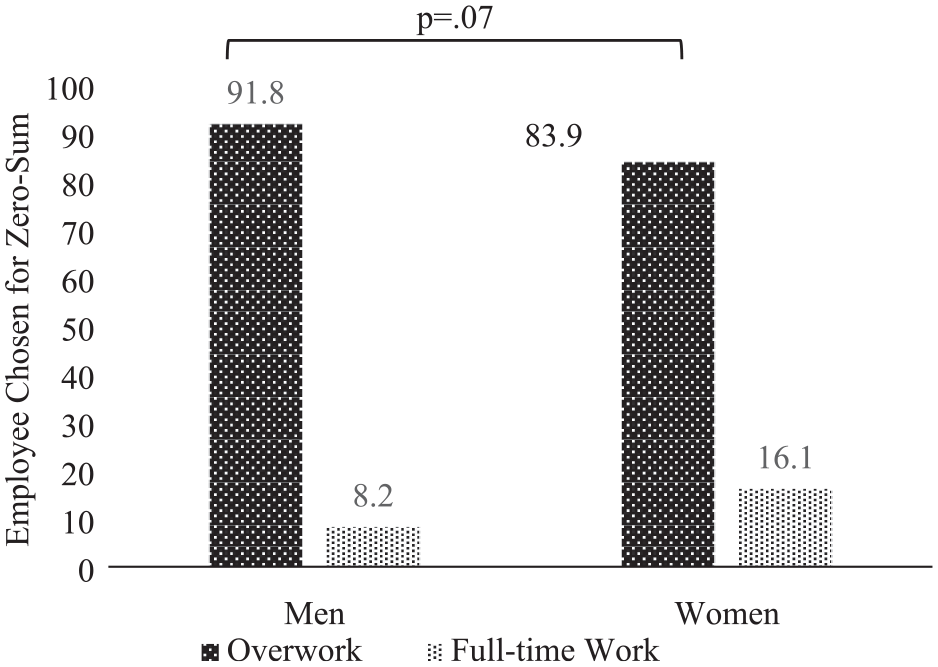
Effect of Gender and Overwork on Zero-Sum Organizational Rewards (N = 230 Observations)
With respect to independently rated organizational rewards, the interaction between overwork and gender is statistically significant and negative at 7.4 points (p < .05; Table 2, Model B). Men received a 33.1-point increase for overwork compared to a 25.7-point increase for women (33.1 – 7.4 = 25.7; p < .05; Table 2, Model B).
Next, to determine whether overworking men receive greater organizational rewards than overworking women, we estimated the predicted values of organizational rewards for overworking men and women using the margins command in Stata. The predicted value for men is 78.9, and for women, it is 73.3 (p < .05). Thus, while overwork greatly increases organizational rewards relative to full-time work for both men and women, men receive an overwork premium that is approximately 5 more organizational reward points (about 8 percent more) than overworking women.
Similarly, we find partial support for Hypothesis 5, which stated men would receive greater boosts in perceived competence, commitment, and likeability for overwork than women. The increase men receive for overwork is 5.3 points more for commitment (p = .05; Table 2, Model D), 6.2 points more for competence (p < .01; Table 2, Model F), and 5.9 points more for likability (p < .05; Table 2, Model H) than the increases received by women who overwork. We then use the margins command to determine whether overworking men are perceived more positively than overworking women. In terms of predicted values, respondents found overworking men and women equally committed (men = 88.2, women = 86.2; p = .31) and likable (men = 78.4, women = 75.4; p = .18). However, overworking men (74.7) were thought to be more competent than overworking women (71.3; p = .07).
In sum, overwork consistently gives men a larger boost than women for both organizational rewards and worker attributions. In addition, overworking men receive higher organizational rewards than overworking women. However, worker attributions are not always higher for overworking men than overworking women. This is because full-time men are rated slightly lower (albeit nonsignificantly) on worker attributions than full-time women, so the men’s slope from full-time to overwork is steeper than the women’s slope. Consequently, the only marginally statistically significant difference between overworking men and women is with respect to competence.
Path Analysis
Finally, to shed light on the causal mechanisms underpinning the overwork premium and gender bias in the overwork premium, we ask how perceptions of employees’ attributions based on work hours and gender influence the distribution of organizational rewards. Specifically, we use path analysis to model the process by which overwork and gender influence attributions of commitment, competence, and likability and their role in determining the allocation of organizational rewards. We first constructed an unrefined model in which overwork, gender, and their interaction predicted all three worker attributes (i.e., competence, commitment, and likability) and organizational rewards. Worker attributes also predicted workplace outcomes in this model. 10 Given this was a poorly fitting model (χ2 = 742.063, p < .001; root mean square error of approximation [RMSEA] = .733; comparative fit index [CFI] = .527; standardized root mean squared residual [SRMR] = .200), we respecified the model following the steps of standard model construction (Kline 2011). 11 This resulted in dropping likability from the model, because it did not have a statistically significant impact on organizational rewards, and allowing commitment and competence to covary. We also dropped the direct paths to workplace outcomes from gender and Overwork × Gender because they also did not have a statistically significant impact on organizational rewards, resulting in a well-fitting refined model (χ2 = 2.849, p = .241; RMSEA = .030; CFI = .999; SRMR = .011; see Figure 2).
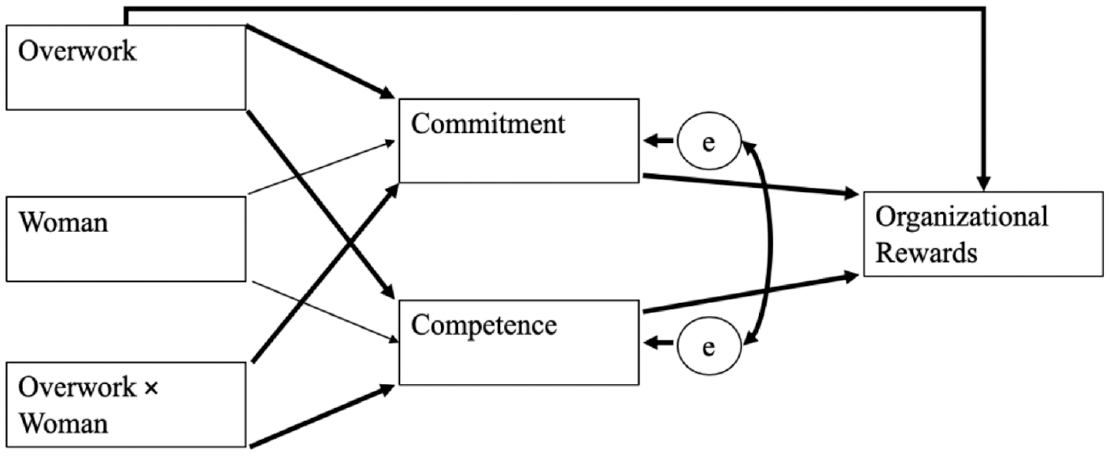
Refined Path Model Depicting the Effect of Gender, Overwork, and Overwork × Gender on Worker Attributes and Organizational Rewards (N = 460 Observations, 230 Participants)
In the refined model, we see that the impact of overwork and its interaction with gender on organizational rewards is partially mediated through perceptions of commitment and competence (see Figure 2 and Table 3.) Commitment explains 78.6 percent of the indirect effect of overwork on organizational rewards (p < .001), whereas competence explains just 21.5 percent of the effect (p < .001; Table 4). This is not surprising given that overwork has a larger impact on perceptions of commitment than on perceptions of competence and that perceived commitment is more important than perceived competence for predicting organizational rewards (Tables 3 and 4). Specifically, overwork increases perceptions of commitment by 31.6 points (p < .001; Table 3), and it increases perceptions of competence by 12.4 points (p < .001; Table 3). And every 1-point increase in perceived commitment equates to a .56-point increase in organizational rewards (p < .001; Table 3), whereas every 1-point increase in perceived competence equates to a .39-point increase in organizational rewards (p < .001; Table 3). However, even after accounting for perceived commitment and competence, overwork still has a significant direct effect on organizational rewards. Namely, overwork increases organizational rewards by 9.6 points (p < .001; Table 3) via mechanisms other than commitment and competence. But because the combined indirect effects of overwork through commitment and competence are 22.5 (p < .001; Table 4)—more than twice the direct effect of overwork on organizational rewards—we conclude that overwork leads to greater organizational rewards because employees who overwork are perceived as more committed and, to a lesser extent, more competent than full-time workers.
Refined Path Model Coefficients Predicting Worker Attributes and Organizational Rewards (N = 460 Observations, 230 Participants)
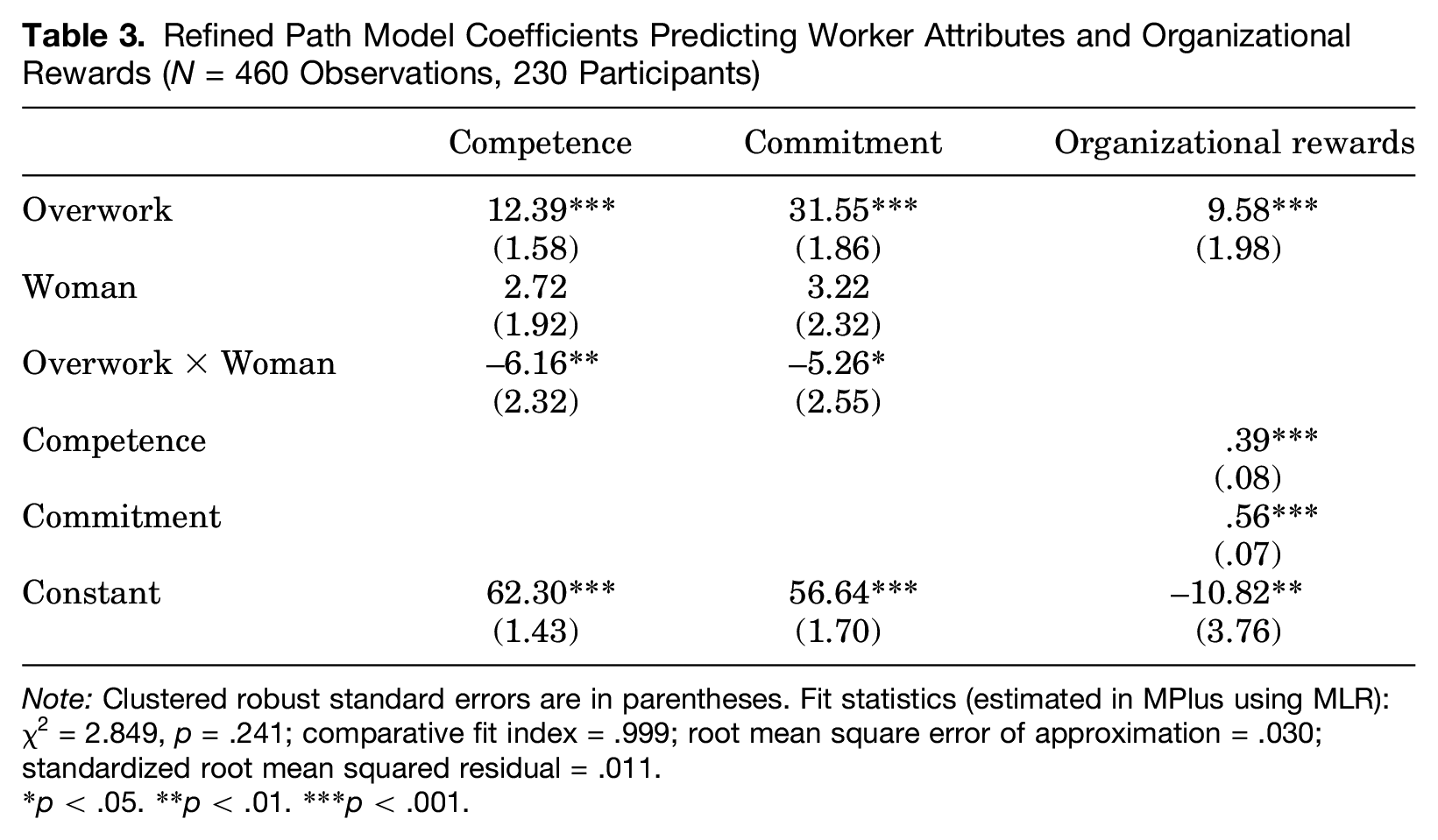
Note: Clustered robust standard errors are in parentheses. Fit statistics (estimated in MPlus using MLR): χ2 = 2.849, p = .241; comparative fit index = .999; root mean square error of approximation = .030; standardized root mean squared residual = .011.
p < .05. **p < .01. ***p < .001.
Indirect Effects of Overwork, Gender, and Overwork × Gender on Organizational Rewards (N = 460 Observations, 230 Participants)
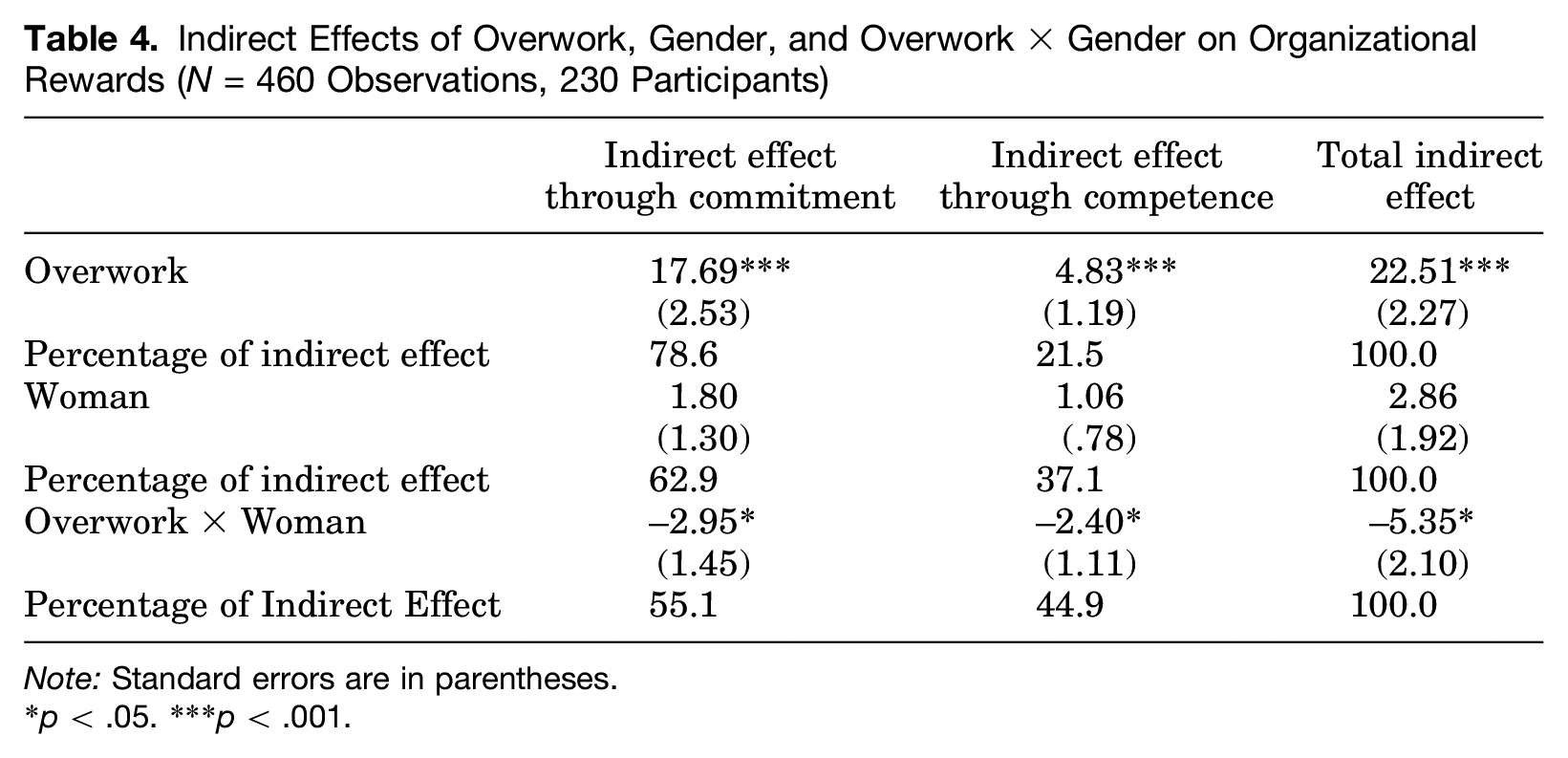
Note: Standard errors are in parentheses.
p < .05. ***p < .001.
The path model also allows us to ascertain why overwork leads to a smaller premium in organizational rewards for women compared to men. In Table 4, we see that the total indirect effect of the interaction between Overwork × Woman is –5.4 points (p < .05). This means that the total indirect effect of overwork is an additional 22.5 points in organizational rewards for men but that the total indirect effect of overwork is only an additional 17.1 points in organizational rewards for women (22.5 – 5.4 = 17.1 points; Table 4). Of this difference of 5.4 points (p < .05), 3.0 points (or 55 percent of the difference) are due to the indirect effect of Gender × Overwork on commitment (p = .05), and 2.4 points (or 45 percent of the difference) are due to the indirect effect Of Gender × Overwork on competence (p < .01; Table 4). This implies gender stereotypes influence how overwork is understood by observers such that overworking women do not receive the same boosts in perceived commitment or competence as overworking men, leading to gender differences in the allocation of organizational rewards. In other words, overwork appears to trigger larger cultural beliefs about gender, which causes observers to interpret men’s and women’s long hours differently. Women’s long hours may be perceived as less indicative of commitment than men’s long hours, perhaps because evaluators are more suspicious that women’s long hours stem from lack of competence (i.e., an inability to complete work in a timely manner).
Conclusion
The relationship between overwork and organizational rewards is well documented (Cha and Weeden 2014; Cortés and Pan 2019; Frederiksen et al. 2018; Kuhn and Lozano 2008; Williams 2000). And the consequences of gender differences in who “opts” in and out of overwork for both occupational segregation and slowing convergence of the gender wage gap are well known (Cha 2013; Cha and Weeden 2014; Javdani and McGee 2019). Yet the micro-level mechanisms that underlie the relationship between overwork, organizational rewards, and gender inequality remain elusive. Performance-based explanations of the rewards attached to overwork hold that long hours translate into greater output, directly or indirectly increasing revenue and profit. Thus, the role of overwork in creating and maintaining inequality is a by-product of capitalistic rationality. Conversely, discrimination-based explanations suggest that masculine cultural norms glorify long hours, resulting in biased assessments of workers and the discriminatory allocation of workplace rewards. By this logic, the rewards associated with overwork are both irrational and disparately impact women workers.
To shed light on this debate, we experimentally examined the relationship between gender, work hours, and the allocation of organizational rewards, controlling for worker performance. Consistent with the discrimination hypothesis, respondents overwhelmingly preferred to allocate rewards to overworkers over equally performing—and, by definition, more efficient—full-time workers and found overworkers more committed, competent, and likeable. Additionally, we examined the possibility of gender bias with respect to overwork premiums, finding that evaluators rewarded overworking men more handsomely than overworking women. Our final set of analyses examined the role of perceived commitment, competence, and likeability in accounting for the disparate allocation of organizational rewards by work hours and gender. Our findings revealed that overwork increases rewards primarily because it enhances perceptions of commitment and, to a lesser extent, competence. Yet overwork does not increase perceptions of women’s commitment and competence as much as it increases perceptions of men’s commitment and competence. Rather, reduced perceptions of women’s competence and commitment undergird gender differences in the overwork premium. In other words, given widely held cultural beliefs that women are both less committed to paid labor and less competent than men (Ridgeway 2001, 2009; Wood and Karten 1986), women’s overwork does not signal commitment and competence to the same extent as it does for men. We suspect evaluators draw on these stereotypes when interpreting overwork, causing them to harbor more doubts about women’s commitment because they can easily attribute their long hours to something else—a lack of competence. In other words, they believe women work long hours in part because they are less efficacious and need more time to complete their work.
This research yields several important insights. First, it highlights two distinct pathways—one indirect and one direct—through which overwork contributes to workplace gender inequality. Because men engage in overwork more frequently than women (Cha and Weeden 2014), the seemingly gender-neutral practice of rewarding long hours indirectly advantages men more than women, and because the advantages associated with overwork depend on employee gender, men directly benefit from overwork more than observably similar women.
Second, our path analysis suggests that to the extent that cultural beliefs about competence or commitment are tied to other social categories like gender, race, and class, the interpretation of overwork—and thus the premiums attached to it—will vary. For example, due to race and class biases about competence and commitment to work, Black, Latinx, and Native American workers; poor workers; and/or less educated workers may reap fewer rewards for overwork compared to White, middle- and upper-class, or highly educated workers. Future research should examine these possibilities as well as variation in the overwork premium by relevant organizational statuses (e.g., new hires, tenured or partnered employees).
Third, our findings suggest that it is difficult—if not impossible—for individuals to engage in strategies that mitigate the rewards attached to overwork because both commitment and overwork are, in and of themselves, so highly valued. This has serious negative consequences for inequality and well-being. We find that overwork increases organizational rewards because overworkers are perceived as more committed to work, even controlling for perceived competence. We also find that perceptions of commitment have a larger impact on organizational rewards than perceptions of competence. And lastly, we find that overwork has a large direct impact on organizational rewards even after controlling for commitment and competence. In sum, this implies that improving efficiency—for example, by limiting distractions or streamlining processes to produce work on par with colleagues who work longer hours—or increasing the quality of work produced is likely not enough to overcome the rewards attached to overwork. This is disadvantaging not only to women but also to all people who are unable to work long hours (e.g., people with disabilities and/or health issues, people with significant personal responsibilities, people with fewer resources to outsource necessary domestic work). The durability of the rewards to overwork is also damning for society because overwork has well-documented deleterious consequences for individual workers and their families. For example, overwork has been linked with an increase in occupational injuries and serious health problems like strokes and heart disease (Dembe et al. 2005; Kivimäki et al. 2015; O'Reilly and Rosato 2013). And the Japanese term karoshi—translated quite literally as “death from overwork”—demonstrates the potentially deadly consequences of extremely long work hours. In addition, people who work long hours spend less time with their spouses and report more strained relationships with partners and children (Crouter et al. 2004).
To counter these effects, we need societal change that no longer glorifies the ideal worker, extreme work devotion, and other masculinized understandings of professional work and that breaks the links between women, femininity, domestic responsibility, and competence. It is important to note, however, placing emphasis on the need for societal change has the tendency to excuse organizations from pursuing structural change while ignoring the fact that cultural expectations take shape in real time in interactional and organizational contexts (Wynn 2020). Thus, societal change is not possible without organizational action. In this vein, some possibilities at the institutional and managerial levels include limiting the number of hours employees can work, banning after-hours work emails and phone calls, and requiring employees to take vacation time. Although unconventional, existing research suggests these practices may reduce inequality, benefit organizations, and contribute to employee well-being (Becker, Belkin and Tuskey 2018; Perlow 1997; Perlow and Porter 2009). Additionally, organizations should make every effort to decouple work hours and other biasing factors (e.g., gender, race) from their evaluation and promotion procedures or consider eliminating facetime expectations altogether. Of course, doing so will necessitate managers clearly define their expectations and goals for each member of their team. As noted already, this can be difficult, particularly in professional occupations; yet, as evidenced by Support-Transform-Achieve-Results (STAR) and Results Only Work Environments (ROWE), it is not impossible. A growing number of organizations have adopted these initiatives, which redefine work in terms of output and give employees control over when and where they work, with positive results for both employees and employers (Kelly et al. 2014; Kelly, Moen, and Tranby 2011; Moen et al. 2016).
Several limitations of our study are worth noting. First, given that we utilized a convenience sample of American workers, our findings are not statistically generalizable. Although MTurk respondents are more diverse than in-person convenience samples and only modestly less representative than national probability samples (Buhrmester, Kwang, and Gosling 2011; Paolacci, Chandler, and Ipeirotis 2010), future research should examine the effects of overwork and gender with a more representative sample of working professionals and persons who make managerial decisions. Second, some readers may take issue with the way in which we operationalized worker output, which was held constant across all conditions. Indeed, this information was relayed via relatively short evaluative narratives, and all workers received an overall rating of “meets expectations.” Thus, some respondents may have found these assessments ambiguous and nevertheless assumed overworkers were more productive than regular full-time workers. Relatedly, it is unclear how often individuals in the real world receive similar performance evaluations when they work significantly different hours. Although valid, we do not find these critiques concerning. Rather, the research was designed to represent real-world professional scenarios in which employers distribute resources among marginally distinct workers for whom output is difficult to measure. Moreover, it is precisely this ambiguity that facilitates bias, “fueling subjectivity and giving free reign to cognitive distortion in information processing” (Heilman 2012:118; see also Correll 2017; Heilman and Haynes 2006). Thus, we suspect that the use of more objective performance measures will decrease both overwork and gender biases. Third, we examined the effect of overwork only in the context of professional work, yet the extent to which work hours have increased varies along important sociodemographic lines. For example, the increase has been larger among salaried, high-wage, highly educated, older, White workers (Bernstein and Kornbluh 2005; Jacobs and Gerson 2004; Kuhn and Lozano 2008) while a significant number of Americans simultaneously report being underemployed. For this reason, some people refer to the current trend in work hours as a period of polarization or a time divide between the overworked and the underemployed (Jacobs and Gerson 2004). Although we focus on perceptions of overworkers in the context of a white-collar occupation, future work should examine the effects of overwork in other occupational contexts and the effects of underemployment and gender. Fourth, we examined the effect of only two gender categories, reifying the problematic gender binary in the United States, and we did not examine how these gender categories intersect with other important demographic factors. For example, previous research finds a significant pay gap between mothers and child-free women (Budig and England 2001), and mothers are seen as less competent and committed than childless women (Correll et al. 2007). Thus, motherhood may be an important determinant of the disparate treatment of overworkers.
Despite these limitations, this research contributes to a growing body of literature that explains workplace inequality in terms of gendered cultural scripts and their influence on the structural organization of work (e.g., Munsch 2016; Williams 2000; Williams, Muller, and Kilanski 2012). Moreover, the primary advantage of our research lies in its design, which allowed for a comparison of workers who differed only with respect to our experimental manipulations, an impossibility in natural settings. Consequently, our findings provide strong empirical evidence of the discriminatory evaluation and treatment of professional workers based on work hours and gender and the detrimental impact that overwork will continue to have on women’s careers in the absence of concerted cultural and organizational change.
Supplemental Material
sj-do-2-spq-10.1177_01902725221141059 – Supplemental material for Gender and the Disparate Payoffs of Overwork
Supplemental material, sj-do-2-spq-10.1177_01902725221141059 for Gender and the Disparate Payoffs of Overwork by Christin L. Munsch, Lindsey T. O'Connor and Susan R. Fisk in Social Psychology Quarterly
Supplemental Material
sj-docx-3-spq-10.1177_01902725221141059 – Supplemental material for Gender and the Disparate Payoffs of Overwork
Supplemental material, sj-docx-3-spq-10.1177_01902725221141059 for Gender and the Disparate Payoffs of Overwork by Christin L. Munsch, Lindsey T. O'Connor and Susan R. Fisk in Social Psychology Quarterly
Supplemental Material
sj-dta-1-spq-10.1177_01902725221141059 – Supplemental material for Gender and the Disparate Payoffs of Overwork
Supplemental material, sj-dta-1-spq-10.1177_01902725221141059 for Gender and the Disparate Payoffs of Overwork by Christin L. Munsch, Lindsey T. O'Connor and Susan R. Fisk in Social Psychology Quarterly
Supplemental Material
sj-pptx-4-spq-10.1177_01902725221141059 – Supplemental material for Gender and the Disparate Payoffs of Overwork
Supplemental material, sj-pptx-4-spq-10.1177_01902725221141059 for Gender and the Disparate Payoffs of Overwork by Christin L. Munsch, Lindsey T. O'Connor and Susan R. Fisk in Social Psychology Quarterly
Footnotes
Acknowledgements
The authors thank Shelley Correll, Daisy Reyes, and Catherine Taylor for their comments and suggestions. This research would not have been possible without the assistance of Erika Del Villar, Tanya Rao, and Jon Overton and financial support from the University of Connecticut.
1
To be eligible for participation, respondents needed to reside in the United States and work for an organization or company other than MTurk and could not be self-employed.
2
Manipulation check questions asked participants how many hours each employee worked, whether the employee worked on nights and weekends, and to recall each employee’s name, which allowed us to be sure respondents implicitly registered employee gender. Comprehension check questions asked participants to recall each employee’s job title and what feedback she or he received on her or his last performance evaluation.
3
Fifty-eight percent of excluded respondents were White, compared to 75 percent in the analytic sample (p < .01); 61 percent were parents, compared to 41 percent in the analytic sample (p < .01); and the average age of excluded respondents was 32.4, compared to 36.8 in the analytic sample (p < .01).
4
Eighty percent of respondents assigned the women pairing passed the manipulation and comprehension checks compared to 76 percent who were assigned the men pairing, a statistically nonsignificant difference.
5
Seventy-five percent of respondents who saw the overworker first passed the manipulation and comprehension checks compared to 81 percent who saw the full-time worker first, a statistically nonsignificant difference.
6
Designing experimental research requires balancing manipulation salience and priming concerns. To ensure the independent variable has been successfully manipulated, participants must take note of key information. To avoid unintended response to the stimuli, however, participants must also remain unaware of the research hypotheses. Our research design effectively threads this needle by varying some but not all pieces of information presented to participants. Of the eight pieces of information provided about each worker, five varied within participants—employee name, employee ID number, date of review, performance evaluation text, and hours worked. Thus, although it is true that hours worked was the only substantive difference, it was not the only difference between the two workers, mitigating priming concerns.
8
The question regarding tracking into a senior leadership position served as a tangible correlate to the zero-sum success described earlier.
9
In light of a reviewer comment, we examined the possibility that the effects of overwork were related to the within-subjects design. Because we randomized whether respondents evaluated the regular or overworker first, we reran our analyses using only participants’ responses about the first employee using the non-zero-sum outcomes. This approach essentially transforms our data into between-subjects data, albeit with half the number of observations. (Because we are using only the first assessment from each respondent, we estimated ordinary least squares rather than mixed models.) Across all outcome variables in  , the positive, statistically significant effect of overwork remains. Thus, we are confident that the documented effects of overwork are unrelated to our research design.
10
See Figure B1 in .
11
Fit statistics for the unrefined model were estimated in Stata without nesting within respondent.
Supplemental Material
Supplemental material for this article is available online.
Bios
References
Supplementary Material
Please find the following supplemental material available below.
For Open Access articles published under a Creative Commons License, all supplemental material carries the same license as the article it is associated with.
For non-Open Access articles published, all supplemental material carries a non-exclusive license, and permission requests for re-use of supplemental material or any part of supplemental material shall be sent directly to the copyright owner as specified in the copyright notice associated with the article.
