




Abstract
Racialized names carry both penalties and premiums in social life. Prior research on implicit associations shows that racialized names tend to activate feelings of racial bias, such that people are more positively inclined toward White-sounding names than they are toward Black- and Hispanic-sounding names. But to what extent do racialized names continue to matter when they do not belong to people? In this article, we use an original data set collected over six months at a high-volume shelter where dogs are frequently given racialized names (N = 1,636). We also conducted a survey with a crowdsourced sample to gauge the racial perceptions of each dog’s name. We combine these data sets to examine how racial perceptions of names are associated with time to adoption, a meaningful outcome that captures people’s willingness to welcome a dog into their family. We find that as dogs’ names are increasingly perceived as White, people adopt them faster. Conversely, as dogs’ names are increasingly perceived as nonhuman (e.g., Fluffy), people adopt them slower. Perceptions of Black names are likewise tied to slower times to adoption, with this effect being concentrated among pit bulls, a breed that is stereotyped as dangerous and racialized as Black. These findings demonstrate the remarkable durability of racialized names. These names shape people’s behavior and their impressions of others even when they are attached to animals—not just humans.
Keywords
Research has pointed to consistent results when it comes to the effects of racialized names. Whether the outcome is in the realm of hiring, housing, or a range of other areas that affect well-being and daily life, those with White-sounding names have an advantage over those with non-White-sounding names—including, but not limited to, those with Black- and Hispanic-sounding names (Bertrand and Mullainathan 2004; Deming et al. 2016; Quillian et al. 2017). 1 These studies, many of which use audit methods or other experiments to examine the effects of racialized names, are considered strong evidence of the extent and prevalence of racial discrimination in the United States (Pager and Shepherd 2008; Quillian 2006; Small and Pager 2020).
While we know that racialized names affect humans’ outcomes, what happens when these racialized names are not tied to humans? Do the premiums that are typically associated with White names, and the penalties that are typically associated with Black and Hispanic names, continue to persist despite the names being attached to nonhuman entities? This study tests the effects of racialized names in a novel context: dog adoptions. Dogs, by definition, exist outside the human racial hierarchy—the unequal distribution of social resources and treatment that advantages Whites and disadvantages populations of color, particularly Blacks, darker-skinned Hispanics and Asians, and Native populations (Bonilla-Silva 2004). In short, dogs are not humans, so it follows that racialized names may not influence the adoption process. But at the same time, pet adoption is a deeply intimate social exchange, and adopters may rely on subtle cues, including implicit biases that have been shown to affect people’s behavior elsewhere in social life. Research also shows that dogs are racialized, such that some breeds are stereotyped as “dangerous” and therefore “Black,” whereas others are perceived as “cute” and therefore “White” (Mayorga-Gallo 2018; Tesler 2020), making race even more salient to dog adoption.
We test these possibilities using data from a high-volume dog shelter that routinely assigns racialized names to dogs. Many of these names are commonly perceived as White (e.g., Maggie), Black (e.g., Leroy), or Hispanic (e.g., Santiago), and some are nonhuman names that are common for pets (e.g., Fluffy). To assess whether these racialized names affect adopters’ behavior, we collected longitudinal data on 1,636 dogs that were adopted over a six-month period. These data included their name, sex, breed, weight, personality, and other characteristics. We then conducted a survey with a crowdsourced sample to gauge the racial perceptions of each dog’s name. We combined these data to determine how racial perceptions (from the survey) are related to time to adoption, or the amount of time the dog spent at the shelter before being adopted (from the shelter data).
Time to adoption is a meaningful outcome because it represents the extent to which adopters were willing to welcome a dog into their home (or their “chosen family,” to borrow a term from the sociology of family; Weston 1991). In the United States, and in many countries worldwide, dogs are commonly considered family (Laurent-Simpson 2017; Owens and Grauerholz 2019; Powell et al. 2010; Risley-Curtiss et al. 2006). Recent estimates indicate that nearly half of all U.S. households have a dog (ASPCA 2021a), and dog adoption rates increased substantially during the COVID-19 pandemic, as many people faced prolonged social isolation (Morgan et al. 2020). Dog adoption thus is a deeply social process that reflects people’s preferences for their chosen family. When a dog has a shorter time to adoption, this means that people readily considered them “family.” When a dog has a longer time to adoption, however, this means that many people passed over them before they were chosen to become part of a family. We assess the extent to which racialized names factor into this equation, while also controlling for a range of dog characteristics that reasonably predict time to adoption, including behavioral assessments.
Background
The Power of Racialized Names
Much research in the social sciences has examined the premiums and penalties associated with racialized names. These studies demonstrate that those with Black- and Hispanic-sounding names are penalized, relative to those with White-sounding names, when applying for jobs (Bertrand and Mullainathan 2004; Deming et al. 2016; Kang et al. 2016) and searching for housing (Hanson and Hawley 2011; Hogan and Berry 2011), among many other contexts. Scholars typically rely on status-based theories of discrimination to build arguments about racialized names in these studies. In the case of hiring, for example, when a hiring decision maker encounters an applicant with a Black-sounding name, that gatekeeper may recall widely held cultural beliefs about Black workers lacking competence, commitment, likeability, or other traits that have been shown to affect hiring decisions (Moss and Tilly 2001; Pager and Karafin 2009). This ultimately boils down to an assessment that Black workers are considered less “worthy” than White workers, all else equal, given that status-based theories of discrimination hinge on assessments of worthiness (Ridgeway 2014). These beliefs may be explicit or implicit, but regardless of the level at which they operate, research demonstrates that this process results in racialized names having outsized consequences in social life.
But what if these racialized names are not tied to people? In the case of dog adoption, status-based arguments about the effects of racialized names are far less relevant. We could not reasonably conclude, for example, that adopters make judgments about a dog’s competence or likeability based on their racialized name. 2 Rather, we rely on research on implicit associations, as well as the effects of racialized names on decision-making, to build an argument about how racialized names may affect dog adoption. At the same time, there are compelling reasons to believe that racialized names would not affect dog adoption, and we discuss this competing prediction as well.
Implicit associations, racialized names, and dog adoption
Research across the social sciences has pointed to race/ethnicity as a characteristic that is uniquely likely to elicit implicit bias. Many Americans take a color-blind stance toward race/ethnicity, such that they claim not to “see” race or treat others differently according to their race, even if they (knowingly or unknowingly) behave in ways that reinforce racial privileges and penalties (Bonilla-Silva 2006, 2012; Carr 1997; Feagin 2014). Claims of color-blindness pose a challenge to the study of racial prejudice because researchers must be skeptical of what people say and place more weight on what people do, which is not always possible in standard surveys or interviews. Implicit association tests (IATs) were designed to overcome these sources of social desirability bias by capturing people’s automatic categorization of race and their evaluation of those categories (Greenwald, McGhee, and Schwartz 1998). In this way, IATs “are thought to capture implicit cognition, or cognitive processes outside of conscious awareness” (Melamed et al. 2019:1018). Classical research using IATs shows that most White participants are quick to pair photos of White faces with positive words and photos of Black faces with negative words, but that the reverse—pairing White faces with negative words and Black faces with positive words—takes longer and is more mentally challenging. Scholars have interpreted these results as evidence of implicit bias in favor of Whites and against Blacks (Nosek, Banaji, and Greenwald 2002).
Although much research has used pictures of faces to gauge implicit associations, racialized names also have been shown to elicit latent racial prejudices. Ottaway, Hayden, and Oakes (2001), for example, used common White, Black, and Hispanic names to demonstrate that Whites show implicit preferences for those with White names over those with Black or Hispanic names (also see Greenwald et al. 1998). These patterns hold even after controlling for participants’ greater familiarity with White names, which is an important consideration because White participants are typically much more familiar with White-sounding names than they are with Black- or Hispanic-sounding names (something that we consider in our study as well; Ottaway et al. 2001). A recent study using a sample of college instructors similarly found that participants showed a weak implicit bias against those with Hispanic-sounding names and a stronger implicit bias against those with Black-sounding names (Conaway and Bethune 2015). Thus, it is not just visual cues but also racialized names that have been shown to elicit unconscious racial prejudice.
In light of this research showing the power of racialized names to affect decision-making, we posit that potential dog adopters may have unconscious preferences for or against dogs depending on their name. Because pet adoption is an intimate social process, and many people equate pet adoption with choosing a new family member, it follows that adopters may be especially likely to pick up on racialized names and to instinctively associate White-sounding names with positive feelings and Black- and Hispanic-sounding names with more negative feelings. We also suspect that the atmosphere of the shelter is something that demands implicit processing, as the paradox of choice and unfamiliarity with the setting and animals creates a cognitive overload that depletes decision-making resources, although this is ultimately an empirical question. In summary, we expect the following:
Hypothesis 1: Dogs with White-sounding names will have shorter times to adoption, compared to dogs with names that are not perceived as White. Dogs with Black- and Hispanic-sounding names will have longer times to adoption, compared to dogs with names that are not perceived as Black or Hispanic.
The potential for null effects of racialized names
At the same time, there are several compelling reasons we might expect these names to not matter among shelter dogs (i.e., we would fail to reject the null hypothesis for Hypothesis 1): First, these are dogs—not people. Although research on implicit associations shows that racialized names matter among humans, adopters might evade these patterns because they know they are dealing with dogs rather than people. This would suggest a null effect of racialized names on dog adoption.
Second, characteristics other than names should matter much more, potentially drowning out the effect of racialized names. It would be reasonable to choose a dog based on their breed, size, or activity level, to list a few examples, all of which may render the effect of racialized names nonimportant. Some adopters are also limited in the types of dogs they can have, highlighting the primacy of these characteristics for dog adoption. For example, landlords may have breed or weight restrictions, which have been shown to be concentrated in Black neighborhoods (Rose, McMillian, and Carter 2020) and to exacerbate racial segregation in housing (Linder 2018). This would suggest that some adopters are constrained in the types of dog they can have, making racialized names unimportant by comparison.
Third, and most plainly, shelter-assigned names can be changed easily. Anecdotally, based on the first author’s experience as a volunteer at this shelter, many people change their dog’s name immediately after adoption. Some people might even start looking for a dog after they have already chosen a name. Thus, we might expect names to bear little relation to adoption behavior because the names themselves are disposable.
Racialized Names and the Potential Salience of Breed
Although we have argued that dogs, by definition, exist outside the human racial hierarchy, it would be inaccurate to claim that dogs are not racialized. Many dog breeds are stereotypically associated with racial groups, and assumptions about these dogs’ behavior are further racialized. Mayorga-Gallo (2018:514) summarizes this point well when she writes, “The construction of certain dogs, such as Rottweilers, Dobermans, and pit bulls, as dangerous is directly connected to American ideologies of race, gender, and class” (also see Weaver 2013). We focus in particular on pit bulls because they are highly prevalent in our data set (40 percent of the sample; see Table 1) and because pit bulls are perhaps the most likely breed to be singled out as dangerous, as evidenced by numerous laws in the United States and abroad that restrict the ownership and/or breeding of pit bulls (ASPCA 2021b). In reality, pit bulls are not inherently more dangerous than any other breed of dog, but they are overbred and frequently abused, trained for protection, and used in dogfighting (PETA n.d.). As a result of their mistreatment, pit bulls are disproportionately involved in violence and consequently have been constructed as Black.
Descriptive Statistics for Shelter Dogs (N = 1,636)
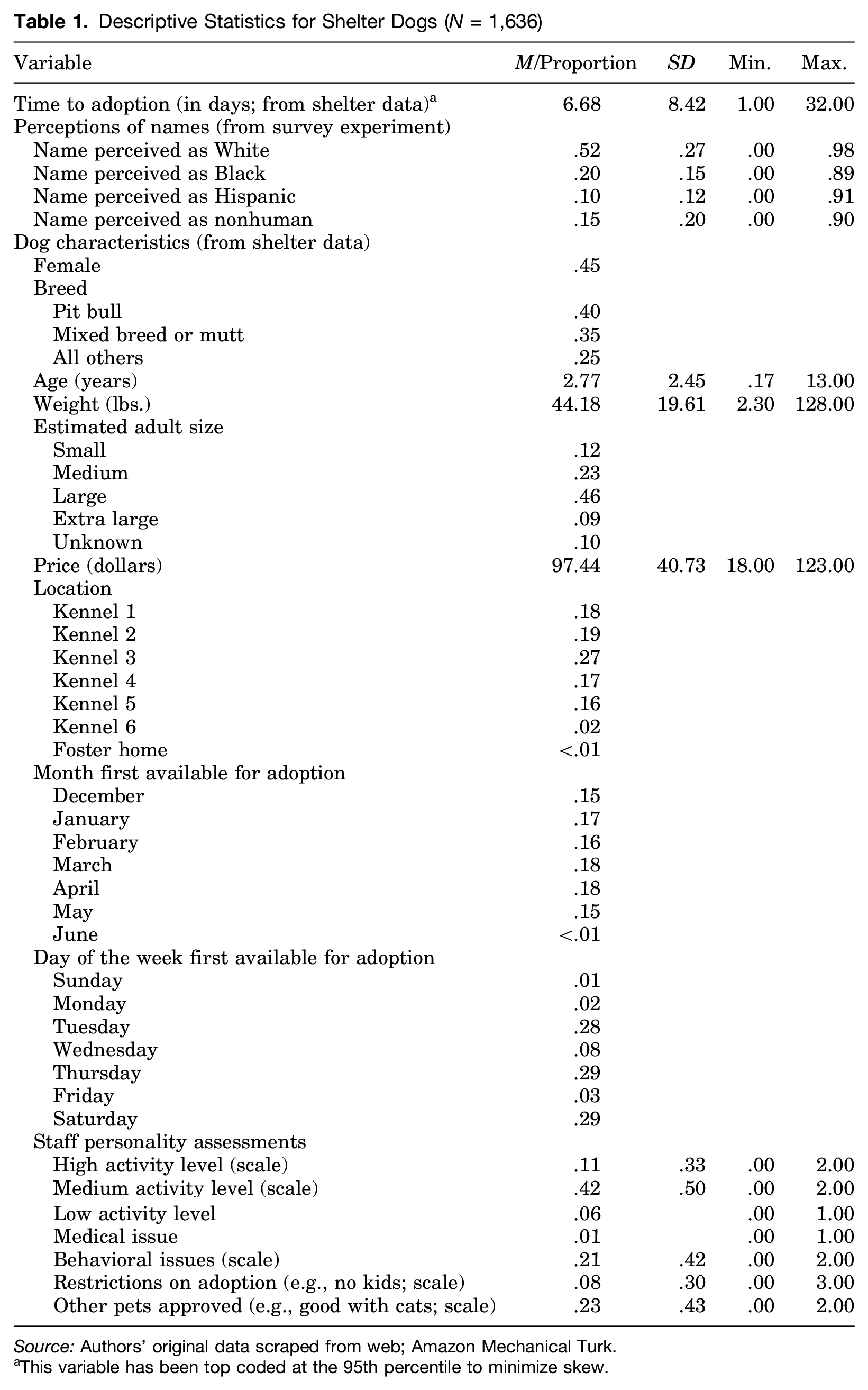
Source: Authors’ original data scraped from web; Amazon Mechanical Turk.
This variable has been top coded at the 95th percentile to minimize skew.
We expect racialized names—particularly, Black and White names—to have the largest effects among pit bulls because race is highly salient for this breed. When adopters encounter a pit bull with a Black-sounding name, we expect racial prejudices to be heightened, such that these dogs are frequently passed over. But when adopters encounter a pit bull with a White-sounding name, these racial prejudices may be assuaged, thus encouraging adoption. We expect the following:
Hypothesis 2: The effects of racialized names will be stronger among pit bulls than among other breeds. Pit bulls with White-sounding names will have shorter times to adoption, compared to pit bulls with names that are not perceived as White. Pit bulls with Black- and Hispanic-sounding names will have longer times to adoption, compared to pit bulls with names that are not perceived as Black or Hispanic.
Nonhuman Names: Premium or Penalty?
As a final piece of the puzzle, we consider whether nonhuman names (e.g., Fluffy) are tied to premiums or penalties in the adoption process. In other words, we consider whether people tend to adopt these dogs faster or slower, relative to their counterparts with more typical human names. On the one hand, we might expect people to adopt dogs with nonhuman names relatively quickly. Nonhuman names are often “cute,” and people might perceive these names as particularly dog-like, whereas human names could be perceived as out of place at a dog shelter. Thus, it is reasonable to predict the following:
Hypothesis 3a: Nonhuman names will be associated with shorter times to adoption, compared to dogs with names that are perceived as human.
But on the other hand, it is also reasonable to suspect that people would adopt dogs with nonhuman names relatively slowly, thus pointing to a penalizing effect of nonhuman names. During the highly charged and emotional process of adopting a dog, it could be that a nonhuman name dehumanizes a dog in the mind of a potential adopter, to the point that they feel less motivated to adopt that dog. When they see one dog named Robert and another named Patches, they might choose Robert (all else equal) because they feel more empathy toward him. This would suggest the following competing hypothesis:
Hypothesis 3b: Nonhuman names will be associated with longer times to adoption, compared to dogs with names that are perceived as human.
We assess these predictions using original data collected through a two-part research design, as discussed in the next section.
Data and Method
We began by using web-scraping techniques to collect names and demographic data for every dog that was available for adoption at the target shelter over a six-month period, from December 2018 through June 2019 (N = 1,636). With these data, we are able to determine the dog’s characteristics and their time to adoption, which is our outcome of interest. Then, in the second stage of data collection, we conducted an online survey with a crowdsourced sample to gauge the racial perceptions of each dog’s name. We use the racial perceptions of dog names (from stage 2) as the main independent variable, as well as other dog characteristics (from stage 1) as controls, to predict time to adoption (from stage 1).
Stage 1: Web Scraping of Dog Names and Characteristics
The shelter
We started by collecting publicly available data on every dog that was available for adoption at the target shelter over a six-month period. The shelter is based in Columbus, the state capital and most populous city in Ohio. Columbus and the shelter itself are well suited to this research for three main reasons. First, the shelter is high volume. On most days we collected data, the shelter had over 100 dogs available for adoption, which is needed to accumulate a large-enough sample for data analysis.
Second, Columbus is relatively diverse with respect to race and income. In the 2010 census, the Columbus metropolitan statistical area (MSA) was 59 percent White, 28 percent Black, 6 percent Hispanic, and 4 percent Asian. Although it is not possible to know whether the shelter clients are representative of adults in the MSA, over the three-year period when the first author volunteered at this shelter, clients were highly diverse in terms of race/ethnicity, social class, gender, age, and family structure. This generally gives us confidence that the results from this study would replicate in areas outside Columbus. That said, the MSA and presumably the clients themselves are majority White. We therefore interpret our results as stemming from mostly White clients, which is an important detail that we will return to throughout this article.
Third, many of the names the shelter assigns to dogs are racialized—that is, commonly perceived as White, Black, Hispanic, or another racial/ethnic group. This is highly unusual and, based on our review of other shelter websites, is not commonly practiced elsewhere. The names typically are either assigned by shelter staff or held over from the previous owner (in cases where a previous owner is identifiable and they request that the name is retained, which is relatively rare, although we discuss this process further in the Discussion because some clients might assume that it happens more frequently than it does). Thus, the naming process is nonrandom, but we confirmed that racialized names during the study period were not significantly related to any of the dogs’ characteristics, such as breed or personality. Thus, racialized names were not disproportionately assigned to any particular “type” of dog, which is important for isolating the effects of racialized names. 3
Web scraping process and resulting data
We collected these data by scraping the shelter’s website every day for six months. Web scraping is a common technique for extracting data from websites and converting it into a format that can be used in data analysis. Conveniently for our purposes, the shelter’s website is updated in real time. When a dog is added to the adoption floor, their profile is added to the website; when a dog is adopted, their profile is removed. Dogs also are added to the adoption floor overnight rather than at random times throughout the day, making it easy to determine when a dog was first available for adoption. Thus, we constructed each dog’s adoption history by scraping the website every day at opening. The first time a dog appeared is “day 1.” 4 We continued to track that dog until they no longer appeared on the website, and that last day would have been their “adoption day.” 5 We constructed a time-to-adoption measure for each dog by subtracting the date of their day 1 from the date of their adoption day.
Descriptive statistics for time to adoption and other variables of interest are shown in Table 1. We top-coded time to adoption at the 95th percentile to minimize skew; after top-coding, the average time to adoption was about seven days. 6 In addition to each dog’s name and time to adoption, we collected other data that we use as controls. These characteristics are listed on the shelter’s website and prominently displayed on the dogs’ cages, so clients received the same information whether they browsed online or came into the shelter in person.
Sex is male or female (all were spayed or neutered). Breed includes three broad categories: pit bull, mixed breed or mutt, and other. About three-quarters of the dogs were either pit bulls or mixed breeds. The remaining one-quarter were other breeds; within this group, small breeds and more “desirable” breeds (e.g., retrievers, labs, doodles) were rare and adopted quickly. Age ranged from two months to 13 years. Weight is measured in pounds. Estimated adult size is especially relevant for puppies, who may weigh only a few pounds in their kennel but can grow to become various sizes. A dog’s price is typically around $100 but may be cheaper if the shelter expects the dog to be more difficult to adopt (e.g., due to medical issues or old age). The kennel location is potentially relevant because some kennels have more foot traffic than others, and some dogs were being housed off-site in foster homes. We include fixed effects for the month and day of the week the dog was first available. Finally, we control for a series of staff assessments that provide insight into the dog’s personality and other issues. These include the dog’s activity level, whether the dog had medical or behavioral issues, whether restrictions had been placed on the dog’s adoption (e.g., no kids), and whether other pets had been tested and approved for this dog (e.g., good with cats). Using this scraping procedure, we collected data on time to adoption and demographic characteristics for 1,636 dogs.
One important attribute we do not have in our data set is physical appearance. We were not able to account for physical appearance because the shelter only uploads pictures of dogs of dogs who remain at the shelter for more than a day or two, which tends not to be the case for puppies and in-demand breeds. We are less concerned about this limitation because so many dogs were either pit bulls or pit bull mixes, which provides some amount of equalization in terms of physical appearance, yet this is an important consideration that we return to in the Discussion.
Stage 2: Survey to Determine Racial Perceptions of Dog Names
After finalizing the data from stage 1, we conducted an online survey to gauge perceptions of each dog’s name. We considered using another method to assess racial perceptions of names, such as U.S. birth records, but we decided that a survey was optimal for three main reasons. First, existing databases often do not include Hispanic birth records because the census categorizes Hispanic as an ethnicity, and the records disaggregate only by race. As a result, many existing databases would not have the coverage we needed. Second, these databases do not include the vast majority of nonhuman names (e.g., Fluffy). We knew that we would encounter many names that are animal names rather than human names, and an original survey was the only way to incorporate perceptions of these names. Third, on a theoretical level, we consider racialized perceptions of names to be more important than actual statistics on the racial composition of names. For example, if a name is most popular among Whites, but most people perceive the name as Black, then it is important that we categorize the name as “Black” because this is the racial group people are thinking of when they see the name (Barlow and Lahey 2018).
We conducted the survey using respondents (N = 1,205) from Amazon Mechanical Turk (MTurk), an online task marketplace that allows researchers to “hire” people to complete tasks. Selection into MTurk is not random, in the sense that anyone can opt in to join the platform and take a survey. We restricted the sample to U.S. respondents to ensure some amount of familiarity with American names and conceptions of race/ethnicity. Descriptive statistics for the sample are shown in Table 2. Notably, our sample is comprised of mostly White respondents, which is in line with our observation earlier that the shelter clients also are presumably mostly White—an important point that we will continue to revisit.
Descriptive Statistics for Survey Respondents (N = 1,205)
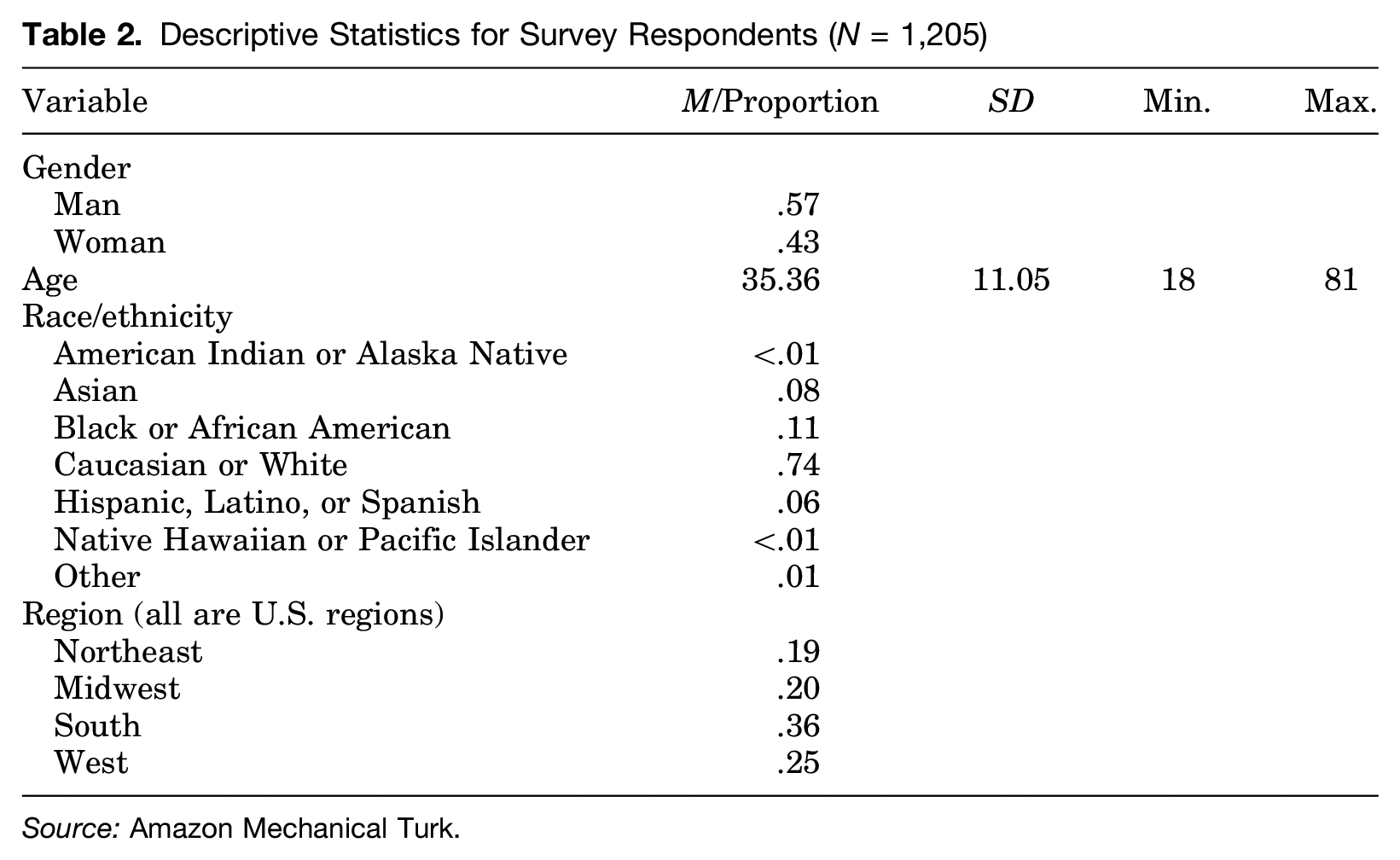
Source: Amazon Mechanical Turk.
After agreeing to participate, we gave respondents the following instruction: Starting on the next screen, we are going to show you a series of names and ask for your impressions of those names. Please answer the questions with your first impressions. Although the questions may feel vague, or like you do not have enough information, we are interested in your uncensored impressions. You will be asked whether you would expect someone with that name to be:
Caucasian or White
Black or African American
Hispanic, Latino, or Spanish
Asian
A person in another racial category (please specify your response)
OR IF:
This name is not typically used for humans
We showed each respondent 50 names, corresponding to an average of about 50 observations per dog’s name. Very few names were consistently classified as Asian or other, so we omitted these categories, leaving us with four main categories: White, Black, Hispanic, and nonhuman. 7
From these survey data, we constructed a measure that captures the perceptions of each dog’s name: the percentage of people who rated each name as White, Black, Hispanic, and nonhuman. Such measures have been used in prior research to assess racial perceptions of names (Gaddis 2017) and are particularly useful for this study because they reflect how “sure” the public is that a name would fall into a given category. The top 10 names with the highest percentages in each category are shown in Table 3.
Racial and Nonhuman Perceptions of Names: Top 10 Names with the Strongest Consensus in Each Category
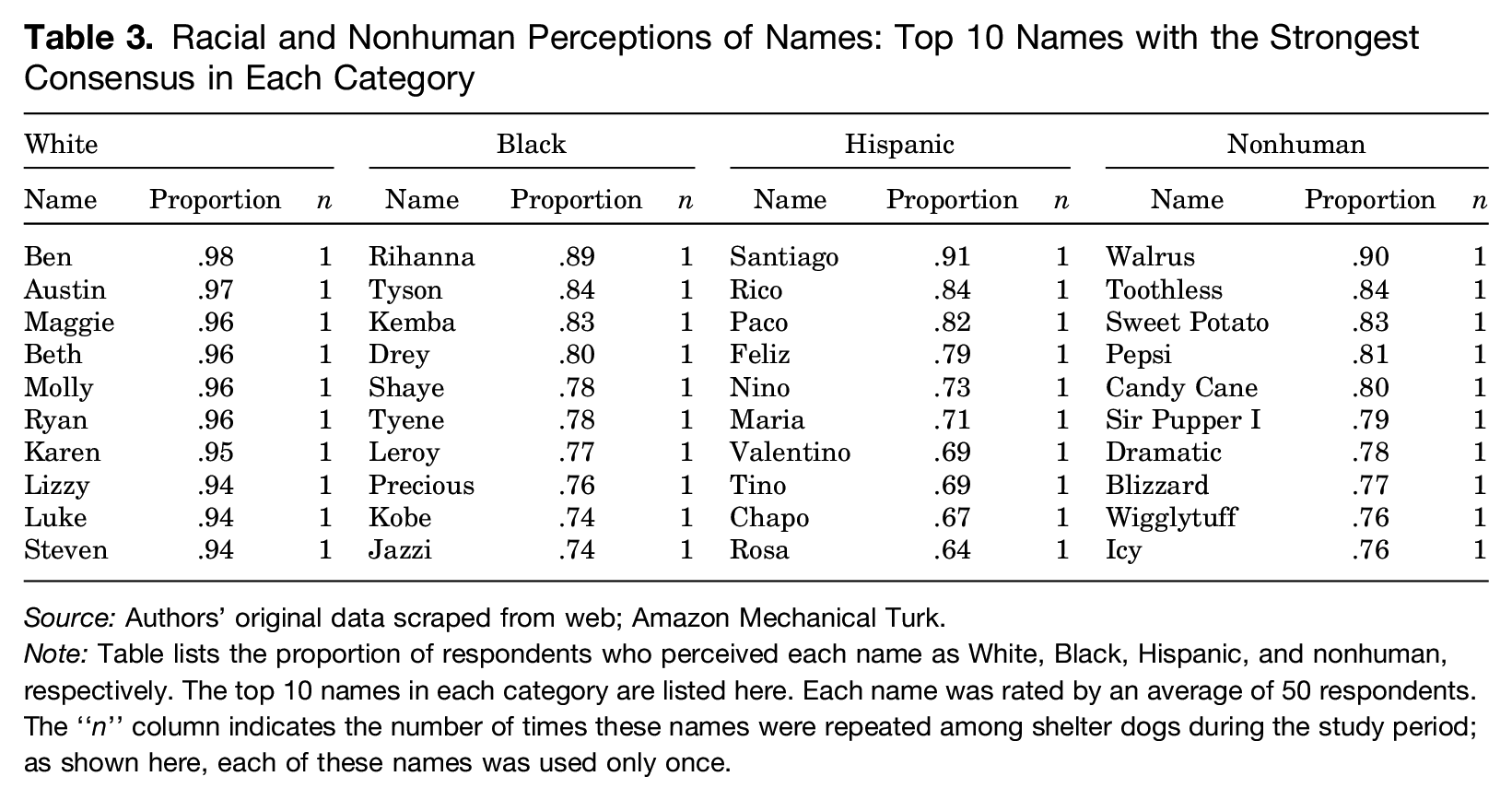
Source: Authors’ original data scraped from web; Amazon Mechanical Turk.
Note: Table lists the proportion of respondents who perceived each name as White, Black, Hispanic, and nonhuman, respectively. The top 10 names in each category are listed here. Each name was rated by an average of 50 respondents. The “n” column indicates the number of times these names were repeated among shelter dogs during the study period; as shown here, each of these names was used only once.
Two main conclusions are immediately apparent from this table. First, these data have high face validity, in the sense that one can easily understand why these names were perceived as White, Black, Hispanic, or nonhuman. This gave us confidence in the quality of the MTurk data. Second, we see rather steep drop-offs in terms of the consensus surrounding some of these categories. As an illustration, consider the names listed in the 10th position in each of the four groups. In the “White” column, we see that 94 percent of respondents perceived Steven, the 10th-Whitest name, as White. In contrast, 74 percent perceived Jazzi as Black, 64 percent perceived Rosa as Hispanic, and 76 percent perceived Icy as nonhuman. Although most respondents perceive Jazzi as Black, Rosa as Hispanic, and Icy as nonhuman, the consensus is much stronger among those who perceive Steven as White. Thus, many names were consensually perceived as White—a pattern that is consistent with research showing that White is often the “default” (Bonilla-Silva 2006; McDermott and Samson 2005; Ray 2019)—but fewer names were consistently sorted into other categories. This is especially perplexing for names that are clearly nonhuman (such as Pepsi) because a nontrivial number of respondents sorted these names into human racial categories. We discuss these sorting processes toward the end of the Results because they have potential implications for our conclusions. 8
Analytic Strategy
The results are reported in three parts. We begin by combining our two data sources to answer the main research question: How are perceptions of racialized names associated with time to adoption? We use the perceptions of names collected in the survey, along with dog characteristics from the shelter website, to predict time to adoption using ordinary least squares regression. 9 We then examine the effects of racialized names within breed groups to understand the extent to which the effects of racialized names are concentrated among pit bulls. Finally, we discuss some notable response patterns from the survey to provide additional insight into the main results, especially with regard to the consensus (or lack thereof) of racial perceptions.
Results
Racialized Names, Nonhuman Names, and Time to Adoption
Figure 1 summarizes the main results. Here we show how time to adoption is associated with increasingly consensual perceptions of dogs’ names. As an illustration, consider the first panel, which shows how a dog’s time to adoption is expected to change as its name is increasingly perceived as White. When 0 percent of the public perceives a dog’s name as White, that dog is expected to spend about 7.6 days in the shelter. Across the range of perceived Whiteness, however, time to adoption declines substantially. When 90 percent of the public perceives a dog’s name as White, that dog is expected to spend only about 6 days in the shelter (p < .05). Overall, then, perceptions of Whiteness emerge as a factor that encourages adoption among shelter dogs. When a dog’s name is perceived as White, adopters choose that dog more quickly than when a dog’s name is not perceived as White. This pattern emerges net of breed, personality, and other characteristics, suggesting that Whiteness is a salient (if unconscious) factor in dog adoption.
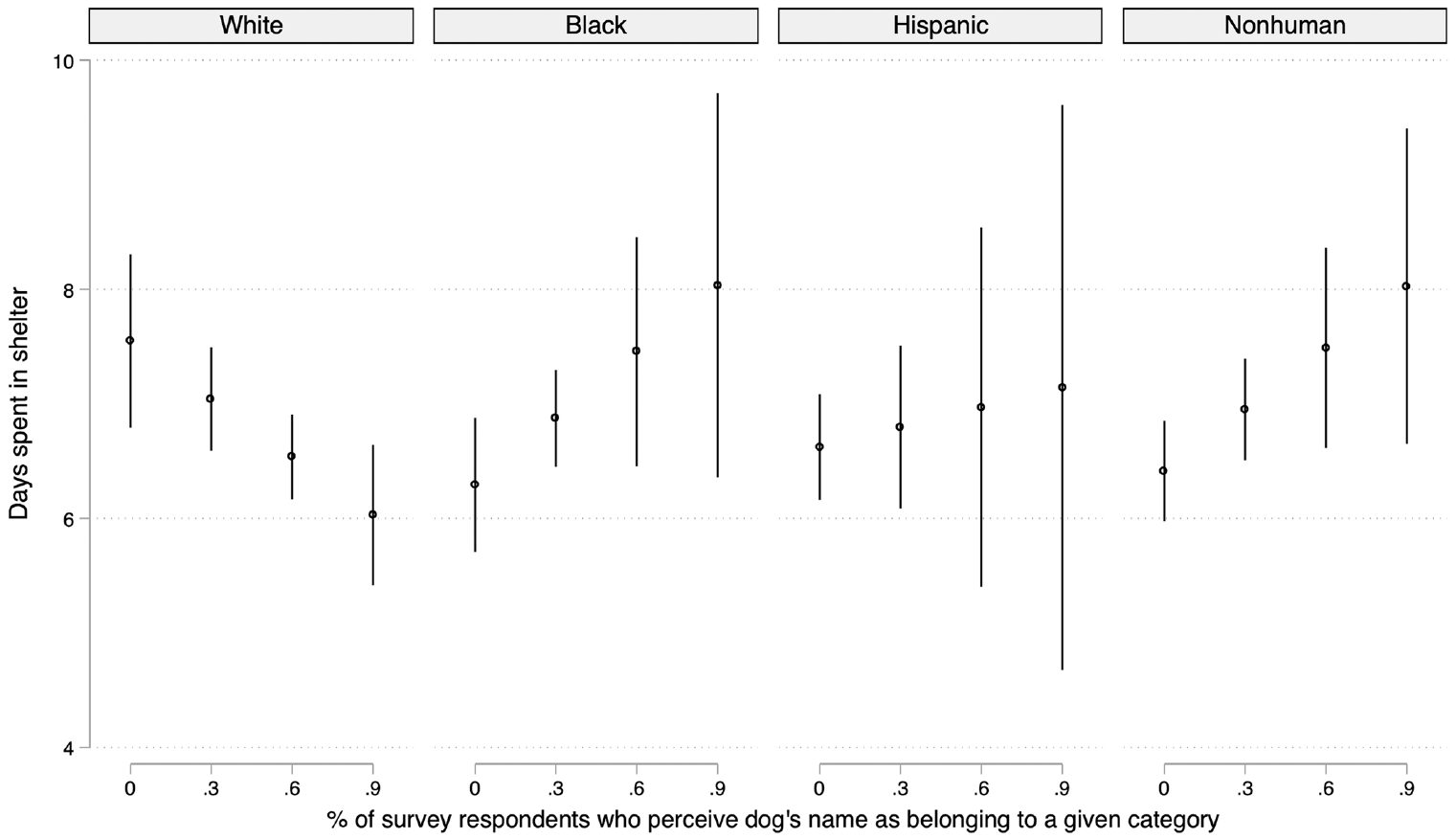
Effects of Racial Perceptions of Names on Time to Adoption (N = 1,636)
The next two panels show results for Black and Hispanic names. Notably, the point estimates for Black names are even larger than that for White names. When 0 percent of the public perceives a dog’s name as Black, that dog is expected to spend about 6.3 days in the shelter. Conversely, when 90 percent of the public perceives a dog’s name as Black, that dog is expected to remain in the shelter for 8.1 days—a difference of about 2 days. Despite this point differential, the confidence interval at the upper end of this panel is quite large, reflecting the small number of dogs’ names that were consensually categorized as Black. As a result, this effect is only marginally significant (p = .09). Note, however, that this is an overall pattern for the full sample, and we suggested in the Background section that perceptions of Black names may be particularly salient among breeds that are stereotyped as dangerous and, therefore, Black. For this reason, in the next section, we consider the extent to which the effects of Black-sounding names are concentrated among pit bulls.
The patterns for Hispanic names, in the third panel, are muted by comparison. We observe only about a half-day difference in time to adoption between the least-Hispanic names and the most-Hispanic names, again with very large confidence intervals at the upper end of the panel. Thus, although few of the names in our survey were consensually perceived as Hispanic, this does not look to have adversely affected the results, as the point differential across the range of Hispanic names was small.
The last panel shows the effects of names that are perceived as nonhuman. Here we see that dogs tend to spend more time at the shelter as their names are increasingly perceived as nonhuman. When 0 percent of the public perceives a dog’s name as nonhuman, that dog is expected to spend 6.4 days at the shelter. In contrast, when 90 percent of the public perceives a dog’s name as nonhuman, that dog is expected to spend about 8 days at the shelter—a difference of slightly more than 1.5 days (p < .05).
Taken together, the results in Figure 1 demonstrate that names matter when it comes to the adoption of shelter dogs. Only White names carry a premium, in the sense that people adopt dogs with consensually White names significantly faster than their counterparts with less-White names. All other names, including Black names, Hispanic names, and especially nonhuman names, have either null or negative effects on dogs’ adoption outcomes. These patterns provide support for Hypotheses 1 and 3b (and support against Hypothesis 3a).
These results are reiterated in Table 4, which shows the underlying regressions for Figure 1. 10 We include this table in the main text to provide some discussion of the effects of the control variables. Consistent with what we might expect, pit bulls and mutts generally are adopted slower than other breeds. Older dogs and heavier dogs also spend more time in the shelter, as do dogs whose adult size is large (relative to those whose adult size is small). In addition, we find that high-activity dogs tend to be adopted slower, low-activity dogs tend to be adopted faster (both controlling for age), and dogs who are approved to live with other pets are adopted faster, presumably because many adopters already have other pets. Notably, we do not find a statistically significant difference between male and female dogs in terms of time to adoption, although supplementary analyses reveal a potentially meaningful interaction between sex and weight (not shown). We find that adopters penalize female dogs more so than male dogs for heaviness. We highlight this pattern because it is consistent with research showing that obese women face prejudice in the workplace and in society more broadly (Saguy 2012), although the mechanisms that give rise to the undesirability of heavy female dogs and heavy women are of course distinct.
Effects of Racial Perceptions and Dog Characteristics on Time to Adoption (N = 1,636)
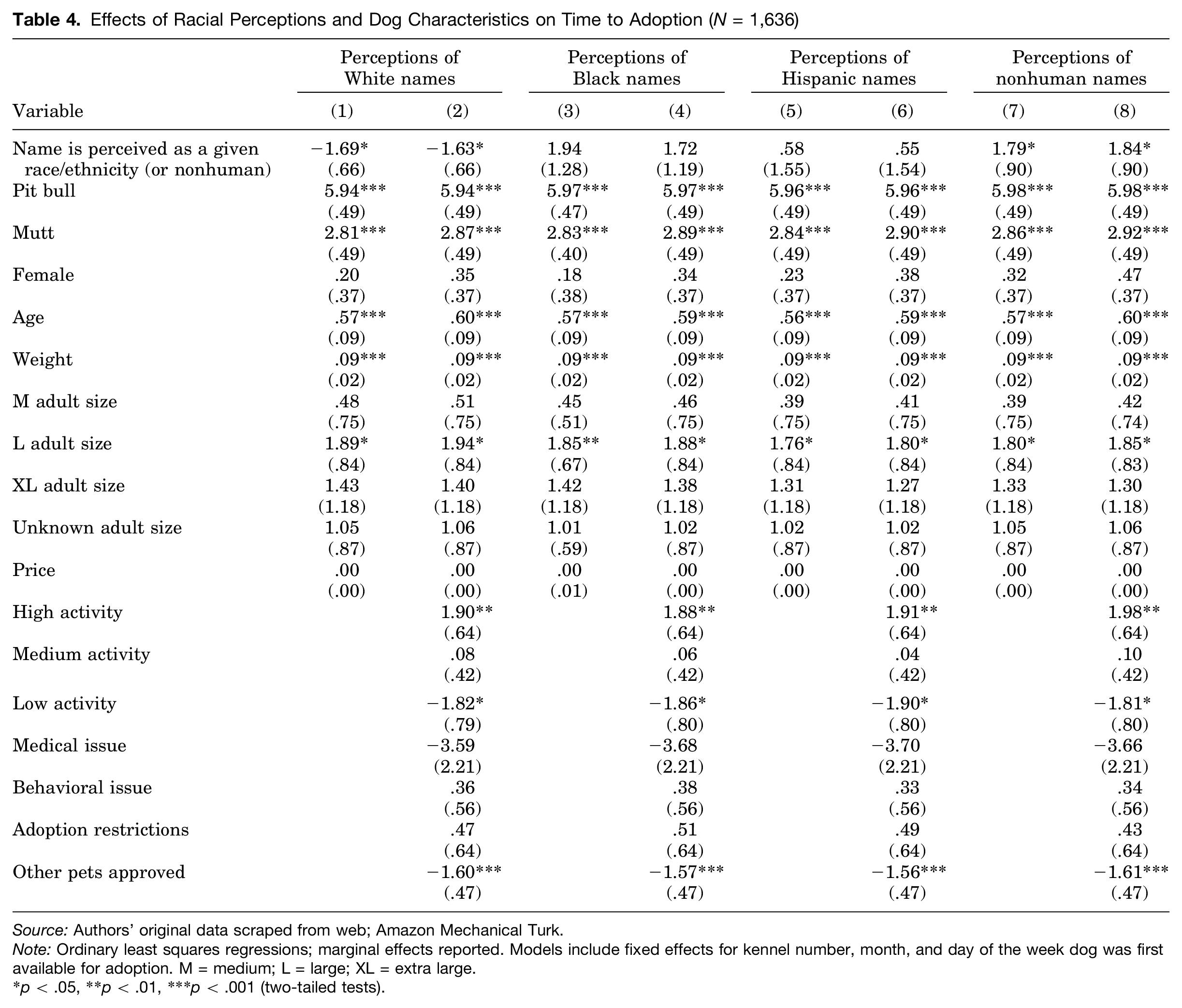
Source: Authors’ original data scraped from web; Amazon Mechanical Turk.
Note: Ordinary least squares regressions; marginal effects reported. Models include fixed effects for kennel number, month, and day of the week dog was first available for adoption. M = medium; L = large; XL = extra large.
p < .05, **p < .01, ***p < .001 (two-tailed tests).
Breed-Specific Effects of Racialized Names
These pooled results tell us much about the extent to which adopters were influenced by racialized names, but it is also important to consider whether these names have unique power among certain breeds—especially those that make race particularly salient. Conveniently for our purposes, 40 percent of the sample is comprised of pit bulls, a breed that is consistently perceived as dangerous and racialized as Black (Mayorga-Gallo 2018). Figure 2 shows results from models with interactions between racial perceptions and breed, which allow us to test whether the effects of racialized names are unique within breeds. The underlying regressions for this figure are shown in Table 5. Additionally, models with separate samples by breed are shown in the online supplement; these models help to reiterate the uniqueness of the pattern we find among pit bulls.
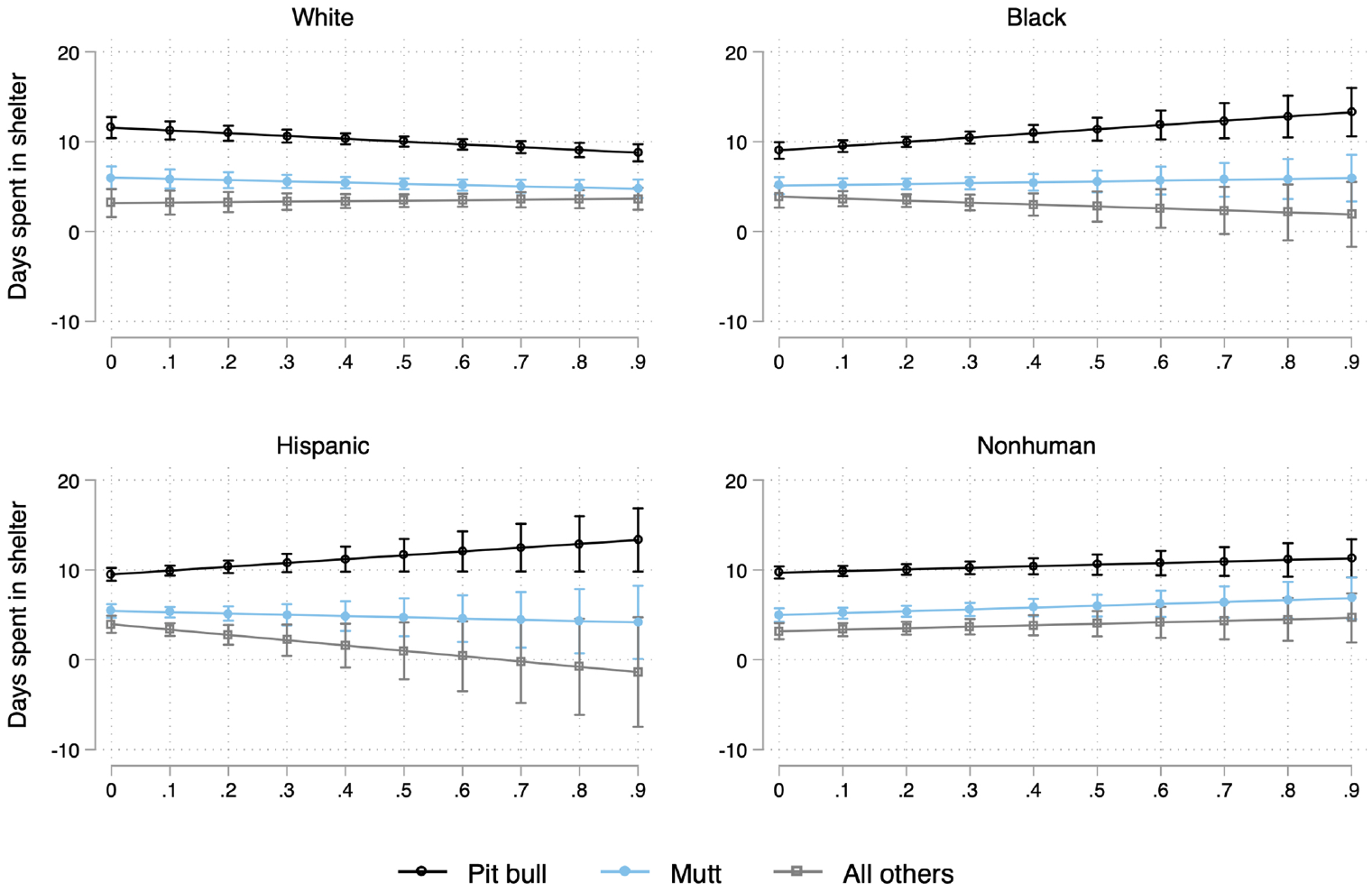
Effects of Racial Perceptions of Names on Time to Adoption, by Breed (N = 1,636)
Main Results with Interactions between Breeds and Racial Perceptions of Names (N = 1,636)
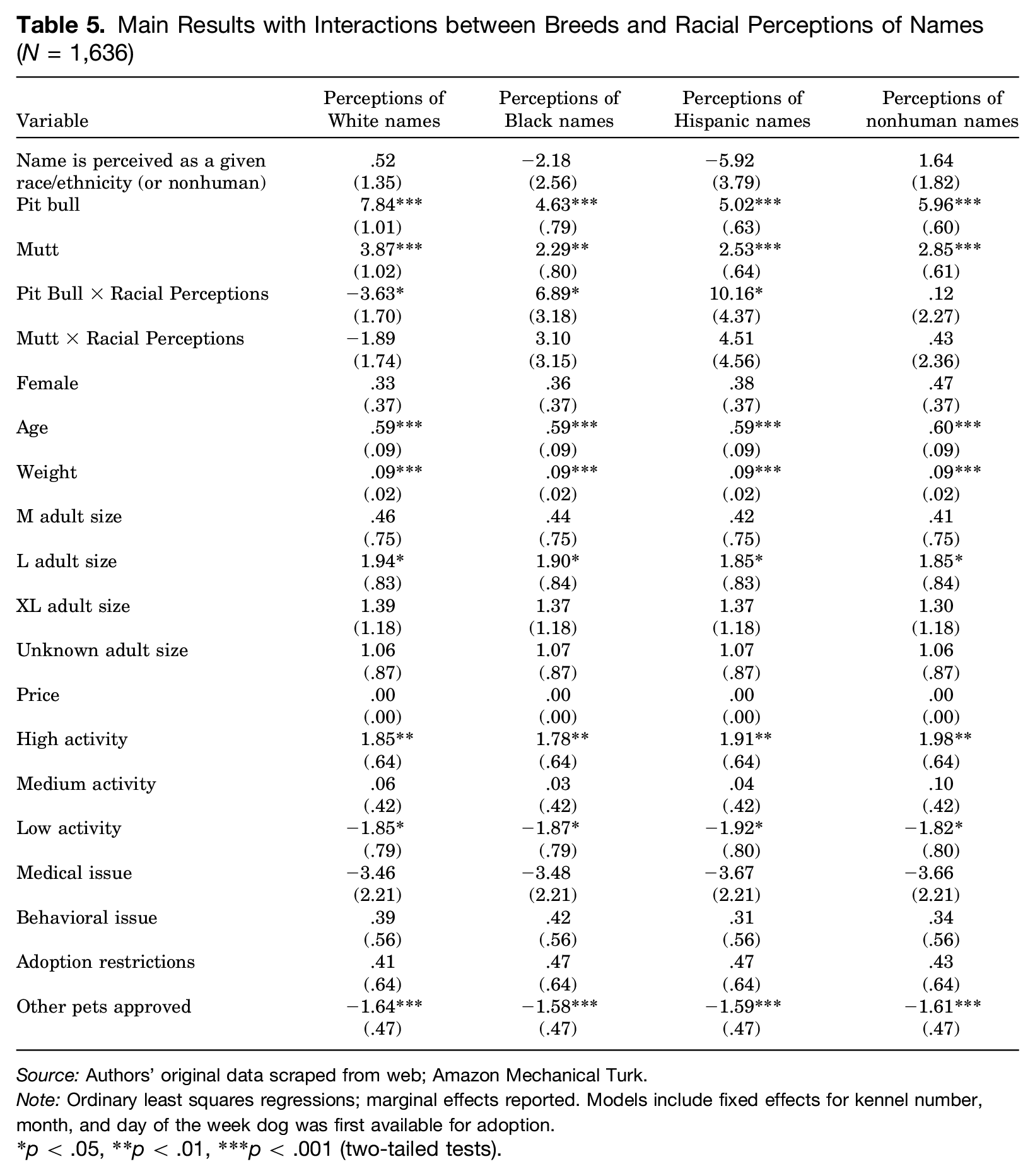
Source: Authors’ original data scraped from web; Amazon Mechanical Turk.
Note: Ordinary least squares regressions; marginal effects reported. Models include fixed effects for kennel number, month, and day of the week dog was first available for adoption.
p < .05, **p < .01, ***p < .001 (two-tailed tests).
Figure 2 makes one point in particular very clear: Adopters were more willing to choose pit bulls with White-sounding names, and more hesitant to choose pit bulls with Black- and (to a lesser extent) Hispanic-sounding names, consistent with Hypothesis 2. Beginning with the results for White names, we see that the effects of White-sounding names are unique among pit bulls. As pit bulls’ names were increasingly perceived as White, they were adopted significantly faster (b for interaction term = −3.63, p < .05), whereas this effect was more muted among other breeds. This pattern is perhaps even more telling for Black-sounding names. Pit bulls with increasingly Black-sounding names were adopted significantly slower (b for interaction term = 6.89, p < .05), suggesting that adopters were resistant to dogs with Black-sounding names but only when their breed made race particularly salient. When 0 percent of the public perceives a pit bull’s name as Black, that dog is expected to be adopted in about 9 days, but when 90 percent of the public perceives a pit bull’s name as Black, the expected adoption time is nearly 13.5 days—a difference of 4.5 days.
We also find a significant interaction for Hispanic-sounding names, such that pit bulls with Hispanic-sounding names were adopted slower (b for interaction term = 10.16, p < .05). We do not want to overemphasize this finding, however, because the contrast between pit bulls with the most- and least-Hispanic names is not significant, in part because of the large confidence intervals at the upper end of the panel. Finally, we find that the effects of nonhuman names are generally consistent across breed groups. The intercept for pit bulls in this panel is, of course, uniquely high (because pit bulls are adopted slower overall), but perceptions of nonhuman names do not have breed-specific effects on the slopes.
In summary, stereotypes about pit bulls are clearly borne out in these data. Adopters were more willing to choose pit bulls with consensually White names, and less willing to choose pit bulls with consensually Black names, thus demonstrating the power of racialized names to either assuage or heighten racialized concerns about specific breeds.
Considering Patterns in Perceptions of Racialized Names
The results so far have revealed several key patterns in the effects of names among shelter dogs. Dogs with consensually White names have relatively shorter times to adoption (compared with dogs with nonwhite names), thus demonstrating the power of White names to shape people’s impressions even when those names are not tied to humans. At the same time, dogs with consensually nonhuman names have relatively longer times to adoption (compared with dogs with human names). Although we find a clear effect of Black-sounding names among pit bulls specifically, the effects of Black- and Hispanic-sounding names in the overall sample are less clear-cut. Because relatively few names in our data set were consensually perceived as Black and Hispanic, the confidence intervals surrounding these names are large, which is potentially suppressing the effects of these names.
Why are so few names perceived as consensually Black and Hispanic? We surmise that two main dynamics are potentially at play. First, because White is considered the “default” in the United States (Bonilla-Silva 2006; McDermott and Samson 2005; Ray 2019), most people would have envisioned a White person when presented with many of the names we showed in the survey. Aside from some names that are inextricably linked with Black public figures, such as Rihanna and Kobe, White would have been the default in many cases. As we described in the Method section, White respondents comprised nearly three-quarters of the sample in our racial perceptions survey, so we would expect this sample to think of White as the default. Second, we suspect that the use of first names without last names may have made race less salient for some respondents. In audit studies and other experiments, last names are a key tool for signaling race (Crabtree and Chykina 2018). Because we focused on racial perceptions of first names only, we suspect that respondents were especially likely to perceive names as White. Taken together, we suspect that when respondents were in doubt, they chose White rather than Black or Hispanic (Dasgupta et al. 2000; Ottaway et al. 2001).
A similar process may have emerged for nonhuman names. As we noted earlier, although many of these names were clearly nonhuman, a nontrivial number of respondents sorted them into human racial categories. As an illustration, Table 6 shows the top 20 nonhuman names, with the percentage of respondents who perceived each of these names as nonhuman, then White, Black, and Hispanic. For example, although Walrus is typically not a human name, and 90 percent of respondents perceived this name as nonhuman, 3 percent perceived it as White and 3 percent perceived it as Black. In the next row, 84 percent of respondents perceived Toothless as nonhuman, but 11 percent said White, 4 percent said Black, and 2 percent said Hispanic. We observe similar patterns throughout this table.
Perceptions of the Top 20 Nonhuman Names (Along with Their Perceptions of Other Human Racial Categories)
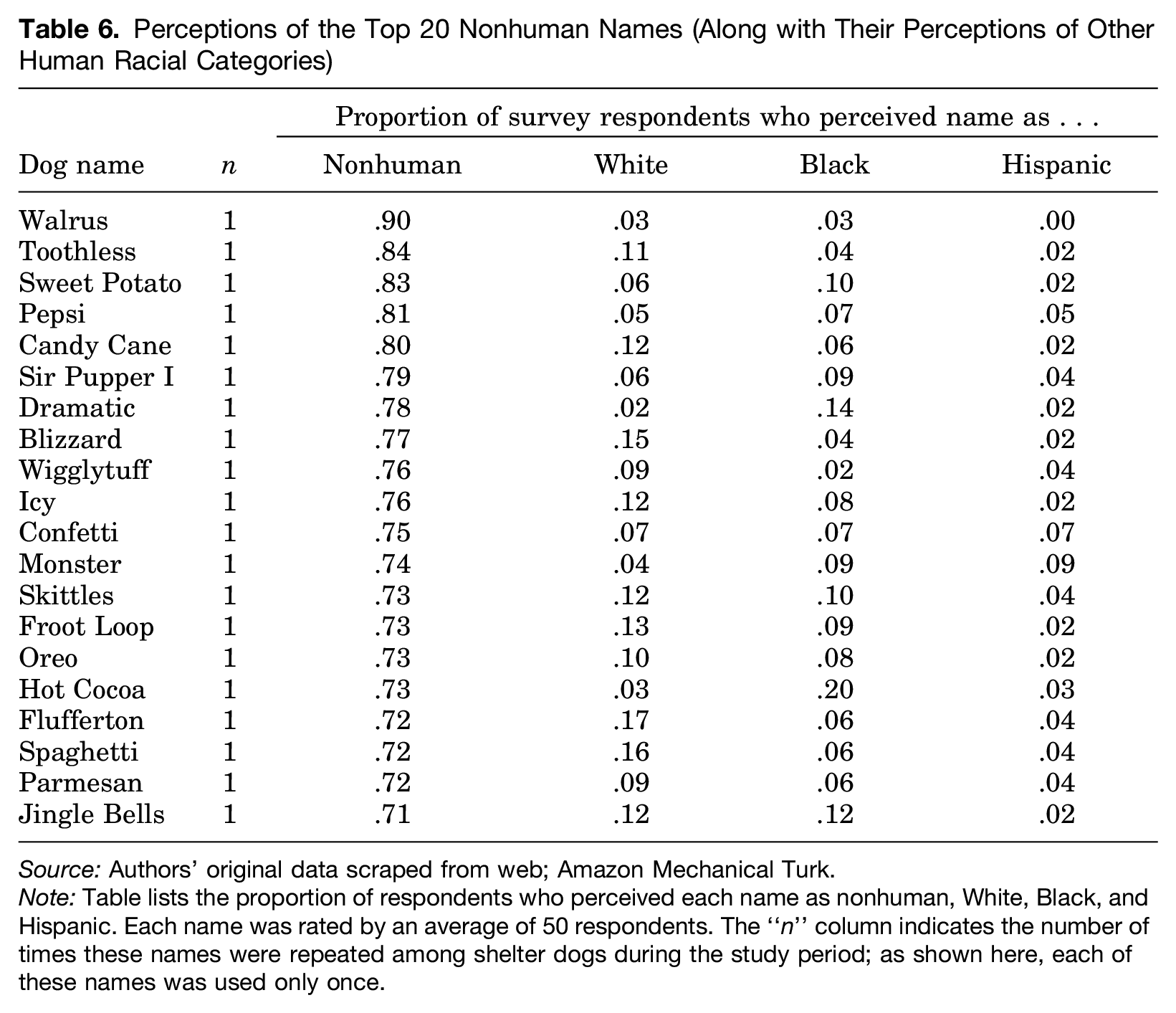
Source: Authors’ original data scraped from web; Amazon Mechanical Turk.
Note: Table lists the proportion of respondents who perceived each name as nonhuman, White, Black, and Hispanic. Each name was rated by an average of 50 respondents. The “n” column indicates the number of times these names were repeated among shelter dogs during the study period; as shown here, each of these names was used only once.
On the one hand, this is a surprising finding, considering that none of these names are common names for humans. But at the same time, some amount of noise in these estimates seems reasonable, given that we were asking respondents to complete an admittedly unconventional task. Because most of the names in the survey were common human names, some respondents may have stretched their conceptions of what a human name could be. They might have seen a name like Walrus or Toothless and thought it was odd but chose a human racial category anyway, thinking that it was an uncommon name or a person’s nickname. Perhaps these names were reminiscent of prison nicknames for some respondents; prison nicknames tend to be appearance based and colorful (Black, Wilcox, and Platt 2014), like many of the nonhuman names on our list. We could not reveal the true purpose of the task at the beginning of the survey because if people were told that they were being asked to rate dogs’ names, they might have perceived every name as nonhuman, and they would have been far less likely to sort the traditionally human names into human racial categories. It also is not lost on us that some of these racial classifications look to be based on racial stereotypes and/or prejudice. This helps account for the fact that 11 percent of respondents rated Toothless as White, 10 percent perceived Sweet Potato as Black, 14 percent perceived Dramatic as Black, 9 percent perceived Monster as Black and another 9 percent perceived it as Hispanic, and others. Another plausible explanation is that respondents lost attention during the survey, which we cannot assess directly because we did not include attention checks. We think this is unlikely because the survey was relatively brisk, lasting about four minutes on average, but this is nonetheless a possibility worth raising.
Overall, we suspect that perceptions of Black, Hispanic, and nonhuman names were lower consensus than they could have been in our survey, partly because White is viewed as the default in the United States (especially among our majority-White respondents) and partly because the mixing of human and nonhuman names is unconventional for studies of this type. This is one of the key reasons we use degree of consensus as the main predictor variables in our models, because we are interested in gauging dogs’ time to adoption as the racial connotations of their names become increasingly clear. But even in spite of these limitations, we find that racial and nonhuman names are closely tied to time to adoption outcomes among shelter dogs.
Discussion
In this article, we assessed the extent to which names affect time-to-adoption outcomes at a high-volume dog shelter. Much prior research has found consistent effects of racialized names in studies of hiring, housing, and other areas of social life. These studies make a compelling case for the salience of racialized names among humans and provide strong empirical evidence of racial discrimination. But to what extent do racialized names matter when they are not attached to humans? The dog shelter setting allows us to test the extent to which racial perceptions, and their corresponding penalties and premiums, spill over into areas that are decidedly nonhuman matters and whether the implicit associations tied to racialized names continue to affect people’s behavior in this context.
We find that dogs with White names are preferred relative to dogs with nonwhite names, presumably as a product of implicit racialized penalties and premiums. When a potential adopter observes that a dog has a consensually White-sounding name (e.g., Ben), their feelings toward that dog may be decidedly warmer than when they encounter a dog with a name that is less consistently perceived as White. These microlevel interactions may compound over time and across adopters, thus leading to the results we see here, such that dogs with consensually White-sounding names are adopted faster than other dogs. We further find that the effects of racialized names are concentrated among pit bulls—a breed that, according to prior research, is especially prone to racial fears. Among pit bulls, White-sounding names appear to assuage these racialized concerns, whereas Black- and (to a lesser extent) Hispanic-sounding names may stoke these biases. In addition, we find that dogs with consensually nonhuman names (e.g., Walrus) have relatively long times to adoption, perhaps because adopters feel less empathy toward dogs who do not have traditional human names.
Taken together, these findings illustrate the durability of racialized names and their power to shape people’s behavior even when they are not tied to humans. Biases in favor of Whiteness and White people are so pervasive that they bleed into unrelated decision-making, ultimately affecting the way people interact with and evaluate pets as potential family members. One could potentially argue: What’s the big deal? Dogs with Black, Hispanic, and nonhuman names are adopted eventually, so what is the practical significance of these dogs being adopted slower than their counterparts with consensually White names? Although it might be tempting to make this argument, the fact that people use racialized names to make any distinctions among shelter dogs powerfully reinforces the patterns of racial discrimination and prejudice that continue to privilege Whites ahead of other groups in American society. Given the volume of research on racial discrimination in this country, including research into forms of discrimination that matter profoundly for Black lives (e.g., patterns related to policing, mass incarceration), it is perhaps not surprising that people carry these prejudices with them when they visit a dog shelter. What is more surprising, however, is the way these prejudices manifest to affect their interactions with animals—similar to Rosnow’s (1972:53) description of prejudice as “any unreasonable attitude that is unusually resistant to rational influence.” 11 Bias on the basis of racialized names is part of an unreasonable attitude structure regardless of whether it emerges in the context of hiring discrimination or a dog shelter. But when we see evidence of racial prejudices in unlikely settings, the pervasiveness of racism is laid particularly bare.
Although these data provide evidence of the capacity of racialized names to spill over into nonhuman domains, we should also consider alternative explanations and limitations that have implications for our findings. One possibility that we mentioned earlier is the idea that adopters could be making assumptions about previous owners based on dogs’ names. Adopters’ preferences for dogs with White-sounding names, for example, could emerge because they assume that these dogs previously belonged to White people. We mentioned that names are rarely “held over” because the shelter typically does not have contact with dogs’ prior owners, and even then, only a subset of these prior owners request that their dogs’ names be retained on the adoption floor. Yet, the actual prevalence of this pattern is not really important—what matters is that adopters might assume that this is something that happens habitually, and thus it is worth considering as a factor that may be influencing adoption behavior.
From a theoretical perspective, this is an important possibility because it may be signaling something of a status-based assessment of shelter dogs. If, for example, people decline to adopt dogs with Black-sounding names because they assume that they previously belonged to Black people, then this could indicate much more than just implicit bias against animals with Black-sounding names. Instead, this could signal broader prejudices toward dogs that were previously owned by Black people, such as assumptions that they are poorly behaved, poorly trained, or perhaps aggressive or prone to fighting. This would indicate that people are inherently making judgments about the dog’s competence and worthiness on the basis of their racialized name, which would have broad implications for the social psychology of human–animal interaction. We are unable to conclude whether people are making this kind of calculation because we did not talk to adopters; and even if we were to talk with them, they might be hesitant to describe this thought process due to social desirability concerns. Thus, more research is needed to understand whether adopters make these types of calculations, and this research should take social desirability into account.
Another consideration that we mentioned earlier is the issue of adopter characteristics, especially race/ethnicity. We have taken care in this study to account for many characteristics other than names that help contribute to time to adoption, including breed, sex, weight, and broad measures of behavior, but one of the biggest remaining questions is the identities of the adopters themselves. We cannot know for sure, for example, whether the effects of racialized names are most pronounced among certain groups of adopters. We suspect that the clients at this shelter are majority White based on the racial composition of the MSA (~60 percent White) and because recent national estimates indicate that White households are the most likely across all racial/ethnic groups to own dogs (AVMA 2018). The racial perceptions data also are drawn from mostly White respondents (see Table 2). We therefore surmise that our ratings and results are being drawn from majority-White samples. Yet, we might also expect these patterns to replicate in populations that are less White because research often shows that people behave in ways that reflect social consensus despite their own personal beliefs or identities (e.g., both Whites and nonwhites may show a preference for dogs with White-sounding names in response to third-order beliefs; Ridgeway and Nakagawa 2017; Walker, Rogers, and Zelditch 1988). Future research should assess this claim directly by considering data on the adopters themselves.
As a final thought, we consider a question that many shelter personnel might have as a result of this study. If White-sounding names have the potential to accelerate adoption (especially among pit bulls), should we just give all the dogs White-sounding names? Given our results, this might seem like a “quick fix” that allows shelters to guard against any latent prejudices that clients bring with them onto the adoption floor. But in the long run, this would do nothing to combat the beliefs that allow these inequalities to persist, both in the context of the dog shelter and in the wider world. We therefore advise against this practice because this would be akin to leaning into bias. We cannot alter our behavior as a society to accommodate those with racist inclinations, even when those inclinations manifest in unlikely places.
Supplemental Material
sj-pdf-1-spq-10.1177_01902725221090900 – Supplemental material for When a Name Gives You Pause: Racialized Names and Time to Adoption in a County Dog Shelter
Supplemental material, sj-pdf-1-spq-10.1177_01902725221090900 for When a Name Gives You Pause: Racialized Names and Time to Adoption in a County Dog Shelter by Natasha Quadlin and Bradley Montgomery in Social Psychology Quarterly
Footnotes
Acknowledgements
We are grateful to Jordan Conwell, Brian Powell, Vinnie Roscigno, and Sean Quadlin for their encouragement and insights that helped develop this work starting with the initial idea. We also thank Jessica Collett, Michael Gaddis, and Yasmiyn Irizarry for conversations that further improved the article. Special thanks to Asparagus Quadlin and Meeko Wright for their companionship during the pandemic, when we wrote this article. Previous versions of this article were presented to the Dartmouth College Program in Quantitative Social Science and The Ohio State University Power, Inequality, and the Economy working group. We thank audience members for their feedback, in particular, Jason Houle, Kim Rogers, Sunmin Kim, and Davon Norris.

Supplemental Material
Supplemental material for this article is available online.
Notes
Bios
References
Supplementary Material
Please find the following supplemental material available below.
For Open Access articles published under a Creative Commons License, all supplemental material carries the same license as the article it is associated with.
For non-Open Access articles published, all supplemental material carries a non-exclusive license, and permission requests for re-use of supplemental material or any part of supplemental material shall be sent directly to the copyright owner as specified in the copyright notice associated with the article.
