



Abstract
Considerable work has shown that optimistic future orientations can be a resource for resilience across individuals’ lives. At the same time, research has shown little downside to “shooting for the stars” and failing. Here, we bring these competing insights to the study of lawyers’ careers, investigating the relationship between mental health and failure in achieving desired career advancement. To do this, we differentiate between expectations and aspirations for the future, a conceptual distinction that has been much theorized but little tested. Using longitudinal data, we show that dashed expectations of making partner are associated with depreciated mental health outcomes, whereas a similar relationship does not exist for unfulfilled aspirations. We conclude that inasmuch as expectations are more deeply rooted in an individual’s realistic sense of their future self, failing to achieve what is expected is more psychologically damaging than failing to achieve what is simply aspired. Our findings contrast with studies of younger people that demonstrate fewer consequences for unfulfilled future orientations, and so we highlight the importance of specifying how particular future-oriented beliefs fit into distinct career and life course trajectories, for better or for worse. In the process, we contribute to the academic literatures on future orientations, work, and mental health.
Optimism about the future is a powerful resource across individuals’ lives. Early sociological work argued that future aspirations have an imortant effect on achievement (Parsons 1953; Sewell, Haller, and Portes 1969). This line of research has reemerged in the past decade, showing that orientations to the future can shape decision-making and action (Frye 2012; Hitlin and Elder 2007; Hitlin and Johnson 2015; Schafer, Ferraro, and Mustillo 2011; Vaisey 2010). Indeed, agency itself has been influentially defined as a temporal, future-oriented process (Emirbayer and Mische 1998).
What, then, are the consequences of unrealized optimism? Americans tend to be optimistic about their probability of success (Mortimer, Mont’Alvao, and Aronson 2020; Reynolds, May, and Xian 2019), so what happens when this success is not achieved? In a compelling account, Michèle Lamont (2019) links widespread failures in achieving upward mobility to discontent and populism because the American Dream no longer functions well as a collective myth of American society. Similarly, work on mental health, especially self-discrepancy theory and social stress theory, predicts that individuals struggle when they do not achieve what they had predicted would happen (DeAngelis 2018; Mossakowski 2011; Wheaton 1994).
On the other hand, sociological research on unfulfilled future orientations has detailed individuals’ considerable resilience in dealing with such failures. 1 Smith-Greenaway and Yeatman (2020) have recently shown that young Malawian women use role transitions as buffers against the mental health effects of unrealized educational expectations. Reynolds and Baird (2010), meanwhile, have influentially argued that there is no downside to “shooting for the stars” (see also Frye 2019). They thus elaborate a theory of “adaptive resilience” to account for the null finding of a relationship between unrealized educational expectations and mental health (Reynolds and Baird 2010).
In this article, we take up the matter of unrealized optimism about the future by looking to American lawyers, tracking their future orientations as they navigate their careers, as well as the mental health effects of failing to achieve what they desire, namely making partner. We therefore expand the typical empirical domain of future orientations research from youth to professionals. Focusing on career rather than educational goals provides insights into how individuals navigate workplace transitions and especially the links between mental health and failure in the workplace.
Importantly, we differentiate between lawyers’ expectations and aspirations. This is a key distinction found in previous literature: definitions conceptualize future expectations as rooted in a more realistic calculus of likelihood of achieving what is desired, whereas aspirations are akin to hopes for the future, more loosely tied to an individual’s lived reality (Baird, Burge, and Reynolds 2008; Vaisey 2010). However, research to date has yet to empirically distinguish between the effects of dashed expectations and unfulfilled aspirations. We hypothesize that dashed expectations—inasmuch as they are more deeply rooted in an individual’s realistic sense of his or her future self—will be more psychologically damaging than unfulfilled aspirations. 2
Our analysis thus works to track the effects of future orientations and achievement on individuals’ well-being, and to more finely differentiate among aspirations and expectations as two divergent types of future orientations. Past research has shown that discrepancies between aspirations and expectations are consequential for well-being (Boxer et al. 2011; Greenaway, Frye, and Cruwys 2015), but the two types of future orientations are themselves differentially associated with individuals’ mental health. Failing to achieve what is expected is more psychologically damaging than failing to achieve what is simply aspired.
Future Orientations, Dashed
Work on the effects of future orientations has a long history in sociology (e.g., Parsons 1953; Sewell et al. 1969), although this focus fell from prominence with the discipline’s cultural turn (Swidler 1986; see especially Swidler’s critique of Parsons’s focus on ambitions). The past decade, however, has seen a resurgence of work on future orientations (Frye 2012; Hitlin and Johnson 2015; Vaisey 2010). In the sociology of culture, future orientations were reintegrated into models of culture, with Vaisey (2010) showing that future expectations and aspirations do indeed shape achievement in class-specific ways (see also Alexander, Entwisle, and Bedinger 1994). Concurrently, life course research seeking to develop more accurate operationalizations of agency began modeling the effects of future orientations on a host of outcomes throughout individuals’ lives (Hitlin and Johnson 2015; Schafer et al. 2011; see also Hitlin and Elder 2007). Indeed, Hitlin and Johnson (2015) show that future life evaluations are similar to current mastery beliefs in their effects on educational attainment and on physical and mental health.
This resurgent wave of interest also flipped the analytical lens. Rather than looking to the beneficial effects of future orientations, this work instead sought to detail what happens when individuals do not achieve what they had hoped for. Surprisingly, these studies show few downsides to shooting for the stars. Smith-Greenaway and Yeatman (2020) argue that role transitions such as motherhood can buffer against the stresses associated with unfulfilled future orientations. Meanwhile, in a landmark study, Reynolds and Baird (2010) argue that unrealized expectations do not have an effect on mental health. Focusing on educational expectations, they show that American youth are resilient in the face of unrealized ambitions. They argue that it is lower attainment that explains depreciated mental health outcomes, rather than the gap between achievement and ambitions.
This goes against the grain, however, of influential models of mental health, whether self-discrepancy theory (Higgins 1989) or social stress theory (Pearlin et al. 1981), both of which would predict that unmet future orientations lead to negative mental health outcomes. Self-discrepancy theory posits that individuals can face severe psychological distress due to discrepancies between actual and possible selves (Higgins 1989). More specifically, the larger the gap between how people perceive themselves to be (actual self) relative to who they wish to be (ideal self) or believe they should be (ought self), the greater the risk of negative emotional states (see also Marcussen 2006). And this is an idea that also finds echoes in relative deprivation theory, which predicts substantial negative effects associated with the deprivation of a reward or status to which one feels entitled (Walker and Pettigrew 1984). Meanwhile, social stress theory would posit unrealized future orientations as a nonevent stressor, which, like traumatic events or chronic strains, require a psychological adjustment (Wheaton 1994). Wheaton (1994:89) thus describes stressful nonevents as, for example, “an anticipated promotion that does not occur, or not being married by age 35 when you want to be.”
None of these mental health perspectives, however, have a fine-grained understanding of future orientations. Self-discrepancy theory implies the precedence of aspirations—grounded in personal desire or in a sense of obligation—but does not clearly emphasize the likelihood of possible selves in its vision of future orientations. The theory of nonevent stressors, as expressed in Wheaton’s (1994) example of foregone promotions and weddings, likewise blurs the distinction between anticipated events and hoped-for transitions. Social psychological elaborations of the stress process model partially address this by suggesting that the effect of a stressor on mental health varies depending on the meaning a person affords to the stressor (McLeod 2012), a mental state shaped, in large part, by how strongly a person values a desired goal. Introducing value implies that aspirations are crucial when assessing failed goals. Estimations of goal likelihood, however, are not directly specified in this meanings and values formulation.
Reynolds and Baird (2010), meanwhile, in elaborating the null relationship between future orientations and mental distress, focus only on future expectations. Indeed, in other work, they argue that expectations—rather than aspirations—are a clearer indicator of ambition and optimism (Baird et al. 2008). As they eloquently put it, “[i]t would be difficult to categorize as ambitious someone who ideally hopes to be a dentist but realistically expects to be a bus driver” (Baird et al. 2008:946).
Our goal, then, is to adjudicate among these divergent perspectives by differentiating between the effects of unfulfilled aspirations and dashed expectations. Although seldom a target of explicit analytic attention, the distinction between aspirations and expectations has been noted in much of the sociological literature on the matter (e.g., Baird et al. 2008). Aspirations are typically defined as idealized hopes for the future. Expectations, meanwhile, are more probabilistic assessments of what is likely to come to fruition. Aspirations are therefore conceptualized as not taking into account the likelihood of achievement, whereas expectations do, and so are more strongly anchored in individuals’ lived reality. Vaisey (2010:83) illustrates the distinction as follows: “[i]f we went around a hospital asking patients, ‘As things now stand, how long do you think you will live?’ we would not want to use their responses to indicate how long they ‘aspire’ to live.”
It is these distinctions we take on in the present study. In particular, inasmuch as expectations are tied to a presumed likelihood of achievement, we would hypothesize that failure to achieve what one expects could be more psychologically damaging than failing to achieve what one aspires. Following through on Baird et al.’s (2008) example of expecting to be a bus driver and aspiring to be a dentist, we theorize that failing to become a bus driver (the realistic expectation) would be more distressing than not becoming a dentist (the pie-in-the-sky aspiration).
Indeed, rather than being purely conceptual, research has shown that the distinctions between expectations and aspirations in fact have consequences for individuals’ well-being. Greenaway et al. (2015) develop the concept of quixotic hope to describe a person holding higher aspirations than expectations. Without looking at whether aspirations and expectations were achieved, they find that when educational aspirations exceed expectations, depression increases (Greenaway et al. 2015). Work in psychology further shows that this quixotic gap between aspirations and expectations can lead to lower levels of school bonding, greater test anxiety, and more behavioral and emotional difficulties among high school students (Boxer et al. 2011).
Based on this body of work, we therefore propose a series of three study hypotheses. We start with a baseline hypothesis:
Hypothesis 1: Failing to make partner will be associated with higher depression.
Further distinguishing the proposed mental health consequences of unmet aspirations and expectations, we hypothesize the following:
Hypothesis 2: High aspirations will exacerbate the relationship between failing to make partner and higher depression.
Hypothesis 3: High expectations will exacerbate the relationship between failing to make partner and higher depression, and this association will be stronger than that which exists for unfulfilled aspirations.
Having proposed these hypotheses, we differentiate between aspirations and expectations in tracking career achievement among the American lawyers from which our sample is derived.
Aspirations and Expectations among American Lawyers
Law is a competitive profession, and partnership, particularly in a large law firm, “has almost universally been held out as the singular mark of success for those with a law degree” (Dinovitzer and Garth 2020:339). Indeed, partnership conveys not only prestige but also high pay (Garth 2017). During the so-called golden age of large, corporate law firms, making partner was the pinnacle of the profession (Galanter and Palay 1991). Those who entered law firms and eventually made partner came from elite schools and were predominantly wealthy male WASPs with wives at home (Heinz and Laumann 1982; Nelson 1988; Swaine 2007). The up-or-out model of the time, moreover, meant that even though making partner was unlikely, those who did not were considered failures and pushed out of the law firm, often to in-house counsel positions considered to be of lower status (Gordon 2009; Rosen 1989).
The legal field then went through some crucial changes. First, the growth of higher education after World War II combined with the civil rights and feminist movements expanded the pool of law school graduates (Abel 1988). Second, the need for legal services mushroomed in the 1970s and 1980s, with both government and business becoming more litigious (Burk and McGowan 2011; Galanter and Henderson 2008) and U.S. legal services also expanding transnationally (Faulconbridge et al. 2008). As a result, law firms grew exponentially, and this substantially changed the partner track (Dinovitzer and Garth 2020; Galanter and Henderson 2008).
In particular, many lawyers assumed positions other than associate or equity partner, whether working as nonequity partners or moving to other sectors, such as business, government, or public interest (Galanter and Henderson 2008; Noonan and Corcoran 2004). This was the result of more competitors for the partner track and the higher difficulty in making partner. In particular, the new tournament model increased the hours and availability expected of someone on the partner track, and lengthened the time generally needed to make partner (Galanter and Henderson 2008).
But these changes also meant that not making partner was no longer considered an individual failure, with opportunities for nonequity partner positions expanding or individuals leaving firms for positions considered equally prestigious (Dinovitzer and Garth 2020). Thus, although many continued to start working at law firms—especially large ones—out of law school, they entered no longer committed to the partner track (Garth and Sterling 2009). Experience at a law firm became, instead, just that: useful career experience. As Dinovitzer and Garth (2020:344) note, “[t]he contrast with the golden age . . . is that lawyers who do not make partner are no longer conceived of as failures. They do not hide the experience but rather make it a leading feature of their resumes.” Law firm experience thus came to be used as a building block for interorganizational, lateral mobility (Bidwell and Briscoe 2010) in lawyers’ careers.
However, it is women, minorities, and nonelites who generally engage in this lateral mobility. Just as in the golden age, partnership is the almost sole province of the WASP male graduates of elite law schools (NALP 2018). Therefore, these male lawyers from elite schools can certainly expect to make partner, whereas for their peers—especially nonelite law school graduates—making partner is more of a far-fetched aspiration.
Against this backdrop of the changing structure of lawyer’s careers, we assess the mental health effects of failing to make partner. Past studies have shown fairly high levels of stress and depression among practicing lawyers (e.g., Hagan and Kay 2007; Koltai, Schieman, and Dinovitzer 2018). By looking to aspirations and expectations for making partner, we can compare those whose future orientations suggest they see themselves on the partner track with those who have effectively opted out and so would accrue few sanctions for not making partner. Because not making partner is no longer considered a personal failure, we can therefore focus in on the effects of unfulfilled aspirations or dashed expectations for those on the partner track. Reynolds and Baird (2010:168) argue that for young adults, “the only way to guarantee [negative] mental health outcomes is not trying.” Here, we look to the mental health outcomes of trying to achieve career advancement but failing.
Data and Methods
The data we analyze come from a nationally representative panel study of lawyers, the After the JD Study (AJD; Dinovitzer et al. 2004). The study began with a random sample of U.S. lawyers who were admitted to the bar in 2000. Wave 1 (AJD1) was launched in 2002. A total of 4,538 sample members responded, which is 71 percent of those located by the research team and who met criteria for inclusion. Wave 2 (AJD2) was launched in 2007 and sought to locate and survey the entire original sample, even if a sample member had not been located or surveyed in the first wave. The respondents included 70.4 percent of the respondents to the first wave of the study and 26.9 percent of those who did not respond at AJD1. The overall response rate for the second wave was 50.6 percent of eligible sample members. We began our study by focusing on Wave 2 because Wave 1 did not include several of our focal measures. AJD2 yielded 3,705 respondents meeting eligibility criteria. This included 70.4 percent of first-wave respondents and 26.9 percent of those who did not respond in Wave 1.
Wave 3 (AJD3) was collected in 2012–2013. Now 12 years since being called to the bar, the contours of these lawyers’ careers are more clearly shaped, and many of these lawyers would have reached the time for important transitions such as promotion to partnership. The third wave of the AJD sought to locate and survey only individuals who had previously responded to either AJD1 or AJD2. In total, AJD3 is comprised of surveys from 2,862 respondents, for a response rate of 53 percent of individuals who previously responded to either AJD1 or AJD2.
An analysis of attrition shows that some demographic variables predicted nonresponse at subsequent waves of the AJD; in particular, men were less likely to remain in the sample between AJD1 and AJD3. However, only 4.7 percent of the variance in response rates could be explained by demographic factors. Notably, those who experienced depression scores above the sample average at AJD2 were not less likely to complete the AJD3 survey. Thus, it appears that remaining in the sample over the entire study period was either due to random chance or explained by factors not accounted for in the survey.
Given our goal of assessing the role of future expectations and aspirations on the mental health consequences of achieving/not achieving partnership, we restricted our analytic sample to individuals who could answer questions about aspirations and expectations of making partner, namely those working in the private sector. These individuals had to be working in a law firm where equity partnership was attainable and were not already an equity partner at their law firm at AJD2. Of the 3,075 lawyers sampled at AJD2, such restrictions yielded a final sample of 1,407 lawyers after missing data techniques were applied.
Dependent Variable: Depressive Symptoms
Our dependent variable in this study is depressive symptoms, measures of which were first introduced at AJD2 and also measured at AJD3. At both waves, depressive symptoms were measured with a seven-item version of the Center for Epidemiological Studies Depression Scale (Radloff 1977). Respondents were asked, “How many days during the past week (0–7) have you”: (1) “felt you just couldn’t get going,” (2) “felt sad,” (3) “had trouble getting to sleep or staying asleep,” (4) “felt that everything was an effort,” (5) “felt lonely,” (6) “felt you couldn’t shake the blues,” and (7) “had trouble keeping your mind on what you were doing?” We averaged the responses, whereby higher scores indicated more depression (AJD2, α = .86; AJD3, α = .88).
Focal Independent Variables: Future Orientations and Achievement
Compared to prior studies assessing the role of future orientation in predicting, for instance, health behaviors (Clarke et al. 2013) or crime and delinquency (Cundiff 2017) among nationally representative samples, our study is unique in that it allows us to assess the future expectations and aspirations of a relatively homogeneous group of individuals, in the sense that our sample members share high levels of education and occupy a high rung on the socioeconomic ladder. Indeed, our sample gives us the opportunity to assess how the failure to live up to expectations and aspirations may influence the mental health of lawyers, which essentially partials out differences on the basis of social status that may otherwise be a strong precursor to people’s conceptions of the future (see Johnson and Hitlin 2017).
Future expectations
To gauge future expectations of making equity partner, respondents were asked at AJD2, “How would you rate your chances, as a percentage ranging from 0 to 100, of attaining equity partner?” We treat this as a linear variable from 0 to 100 in our analyses.
Future aspirations were also measured at the second wave of AJD through the following question: “How strongly do you aspire to be an equity partner?” Responses were coded from 1 to 10, with higher scores representing stronger aspirations.
Making partner
As an indicator of whether the lawyers in our sample met their expectations and aspirations, we created a dummy variable for whether the respondent was promoted to equity partner within their firm between ADJ2 and AJD3 (0 = no, 1 = yes).
Covariates
Firm size
Because firm size could influence how lawyers assess their chance and timing of achieving equity partner (Dinovitzer and Garth 2020), we contrast those working in firms with 251 or more lawyers (1) with all other firm sizes (0). This controls for the experience of working in so-called megafirms, settings that differ from smaller firms in multiple key respects, including prospects of promotion (Dinovitzer and Garth 2007). Results were also consistent using the full ordinal measure of firm size (2–20 lawyers, 21–100 lawyers, 101–250 lawyers, and >251 lawyers).
Hours worked
We include the number of billable hours logged at Wave 2 because hours worked could affect whether a lawyer achieves partnership status within their firm over the study period.
Physical health
Health problems may be an impediment to working the long hours necessary to achieve partnership and could also lead to depression. We therefore adjust for a measure of physical health at AJD2. This was operationalized through the following one-item question of age-comparative self-rated health: “Compared to most people your age, how would you rate your health? Would you say your overall health is: 1 = Much worse than most people your own age, [reference group], 2 = Somewhat worse, 3 = About the same as most people your own age, 4 = Somewhat better, and 5 = Much better than people your own age.” Following Koltai et al. (2018), we dichotomized physical health into a binary variable, where we contrast those reporting that their health was somewhat better and much better than people of their own age (48% of the sample) with all other categories.
Individual background characteristics
Analyses also feature an adjustment for several demographic characteristics that are known from previous research to influence mental health and one’s perceptions of the future (e.g., Brown et al. 2013; Hitlin and Johnson 2015; Johnson and Hitlin 2017; Muntaner et al. 2013; Rosenfield and Mouzon 2013). Gender is coded as 1 for women and 0 for men. For respondents’ race and ethnicity, we contrast white, coded 1, with minority, coded 0.
We also adjusted for a series of life events that were available at both waves of the AJD to ensure that other time-varying developments and potential stressors that may coincide with not achieving one’s future orientations were not driving increases in depression. We created a four-category variable to capture transitions in relationship status, comprising consistently unpartnered (reference group), consistently partnered/married, became partnered/married between waves, and became unpartnered/divorced. We note that there were fewer than 40 respondents who got remarried between AJD2 and AJD3, making it too small a category to consider on its own. These individuals were included in the “became married” category. We also entered a variable for transitions in parental status, that is, whether the respondent became a parent or had an additional child between the survey waves (compared to those with no children). Lastly, we included whether the respondent had experienced discrimination at work using a six-item index (e.g., demeaning comments, request for another attorney; see Nelson et al. 2019). We compared (a) those with consistently high levels of discrimination (i.e., higher than the sample mean at both AJD2 and AJD3) and (b) those with increasing levels of discrimination across waves to lawyers with (c) no or decreasing levels of discrimination over time. Descriptive statistics for all study variables can be found in Table 1.
Descriptive Statistics, AJD Study (N = 1,407)
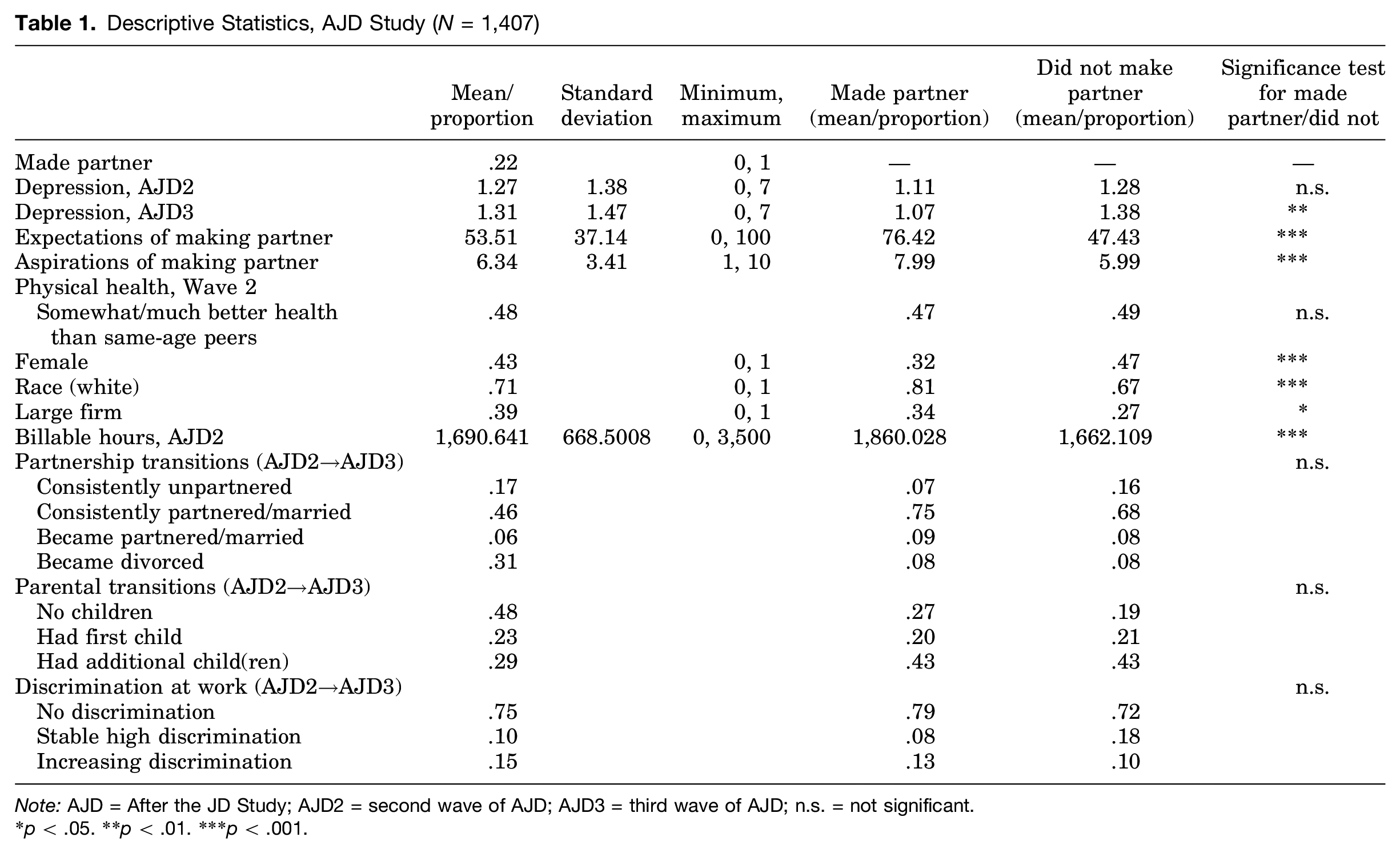
Note: AJD = After the JD Study; AJD2 = second wave of AJD; AJD3 = third wave of AJD; n.s. = not significant.
p < .05. **p < .01. ***p < .001.
Analytic Plan
All models were fit using structural equation modeling (SEM). Clustered robust standard errors were used to adjust for the nonindependence of error terms within AJD respondents over the two waves of study. Compared with standard ordinary least squares regression techniques or fixed-effects estimation, the SEM framework is advantageous because it allows us to model our dependent variable, a seven-item index of depressive symptoms, as a latent variable to adjust for measurement error. Because we adjust for baseline levels of depression, we can assess whether thwarted aspirations/expectations are associated with changes in depression.
Estimates for our SEM analyses were obtained through full-information maximum likelihood (FIML; Williams, Allison, and Moral-Benito 2016). The use of FIML assumes that data are missing at random (MAR), but even when data are not MAR, methods that assume MAR often present results that are better than those produced using more conventional estimation techniques (Allison 2003). This yielded an analytic sample of 1,407 individuals across all analyses because individuals who provided valid data at Wave 2 could be included in the sample using the FIML technique. On the whole, missing data on study variables ranged from 0 percent of cases on some variables to a maximum of nearly 40 percent missing cases. 3
As a robustness check on our decision to use FIML techniques to address missing data, we also conducted all analyses using multiple imputation with chained equations (see Royston 2005). Following common protocol to exclude those cases missing on the dependent variable (depression, AJD3; von Hippel 2007) and using a procedure that created 20 imputed data sets (N = 884), we found that our main findings using FIML do indeed replicate. Our main results were also identical when using the listwise deletion method for handling missing data. We present results with the FIML method to preserve statistical power and to allow us to incorporate all available information across the two waves of data that we utilized.
Results
Respondents reported a mean of 1.27 depressive symptoms at AJD2 and 1.31 depressive symptoms at AJD3 on a 7-point scale. This corresponds to a relatively low level of depression among lawyers in this AJD subsample (i.e., focusing only on lawyers in private practice). However, these numbers are roughly comparable to those reported by Krill, Johnson, and Albert (2016) in their comprehensive study of 13,000 practicing lawyers across all types of law practice in the United States. These authors reported a mean depression score of 3.51 on a 21-point scale, and less than a quarter of their sample met criteria for clinical levels of depression. The levels of depression reported by lawyers are also slightly higher than those reported by a national sample of American workers in the Work, Stress, and Health Study, collected at the same time as AJD2 in 2007 (for study details, see Glavin, Schieman, and Reid 2011) on an identical depression scale (N = 1,042; M = 1.13). A t test for difference of means in our sample reveals a nonsignificant change in depression between waves and provides confidence that any association found with regard to our focal variables is not a mere artifact of the sample of lawyers becoming more depressed over time.
In terms of how respondents thought of their futures with regard to achieving partnership, the mean aspiration score on a 10-point scale was 6.34 (SD = 3.41). Figure 1 shows the distribution of aspiration scores in our sample. As shown there, around 46 percent of the sample scored an 8 or higher on this scale, with 37 percent scoring 9 or higher. Over 60 percent of the sample had aspirations higher than the scale midpoint of 5. Moving to expectations, the mean expectation of making equity partner was 53.51 percent (SD = 37.14). The histogram of expectations (depicting a continuous variable where lawyers gave themselves between a 0 percent and 100 percent chance of making partner) displayed in Figure 2 shows that approximately 35 percent of the sample gave themselves a greater than 75 percent chance of making equity partner, and about 20 percent of our sample gave themselves an over 90 percent chance of making partner. Relatively speaking, it appears that lawyers report slightly higher aspirations than expectations, but the means fall above the midpoints of both scales. This pattern also fits with our conceptualization of expectations as more realistic than aspirations: a smaller proportion of the group realistically expect to make partner compared to the larger cohort that would aspire to do so.
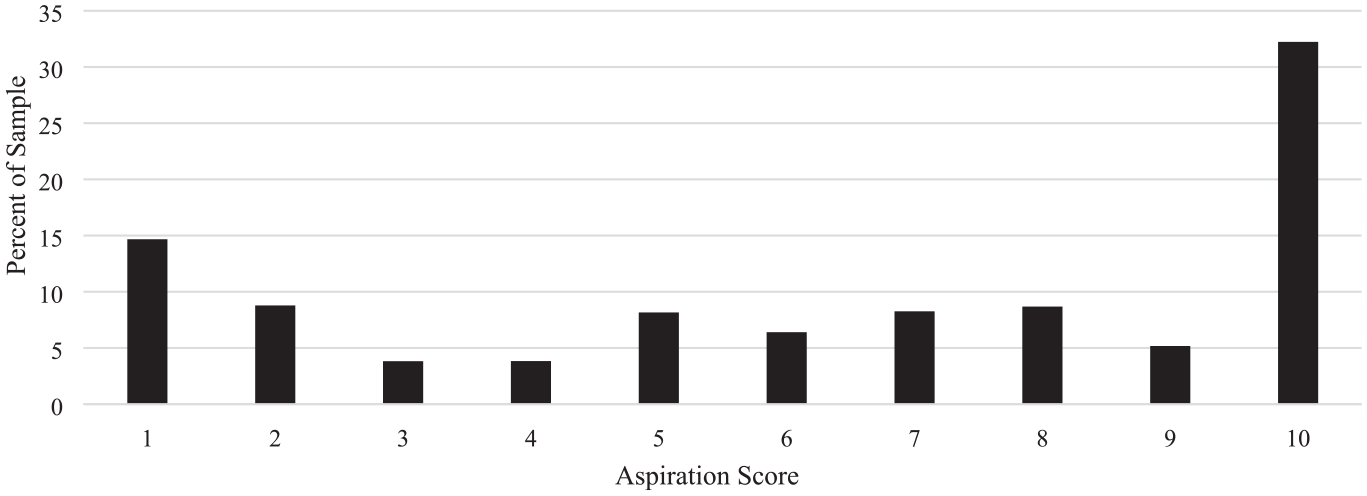
Aspirations of Making Partner, After the JD Study (N = 1,407)
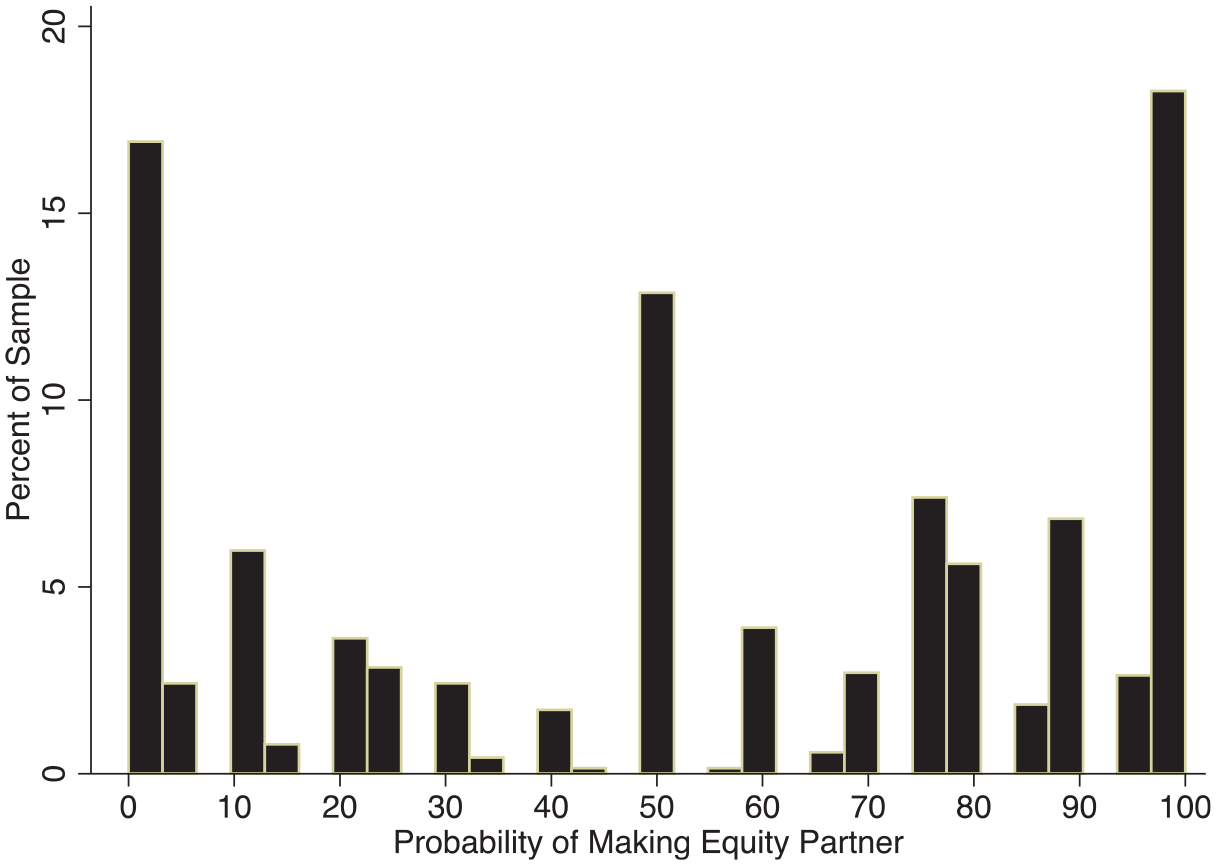
Histogram of Expectations of Making Partner (N = 1,407)
Finally, of those individuals in our analytic sample at AJD2 who remained in the study at AJD3 (N = 884), 197 of them (22%) were promoted to equity partner by the third wave. Individuals promoted to partner differed from those who failed to make partner on several key variables. Consistent with the expectation that achieving partner is a highly desirable life event, these lawyers had significantly lower depression scores at AJD3 (but not AJD2). They also had higher aspirations (7.99 out of 10 vs. 5.99) and expectations (76.42 out of 100 vs. 47.43) of making partner than those who failed to make partner. Lawyers who made partner were also more likely to be male and white, to work at a large law firm, and to work longer hours than those who failed to make partner.
We note that aspirations and expectations of making partner were fairly highly correlated in our sample (r = .63). 4 This correlation is similar to that reported in previous research looking at the relationship between educational aspirations and expectations among youth (e.g., Beal and Crockett [2010] found r = .60). Figure 3 depicts a jittered scatterplot illustrating how aspirations and expectations of making partner relate to one another. As we observe from the line of best fit, individuals who have higher expectations of making partner (x-axis) tend to have greater aspiration scores. The unadjusted equation for the regression line between these two variables is Y = 3.19+.06x, suggesting a modest increase in aspirations for those holding higher expectation scores. Altogether, it appears that aspirations and expectations are empirically related, but not in a deterministic fashion that would suggest they are tapping into the same underlying construct. 5
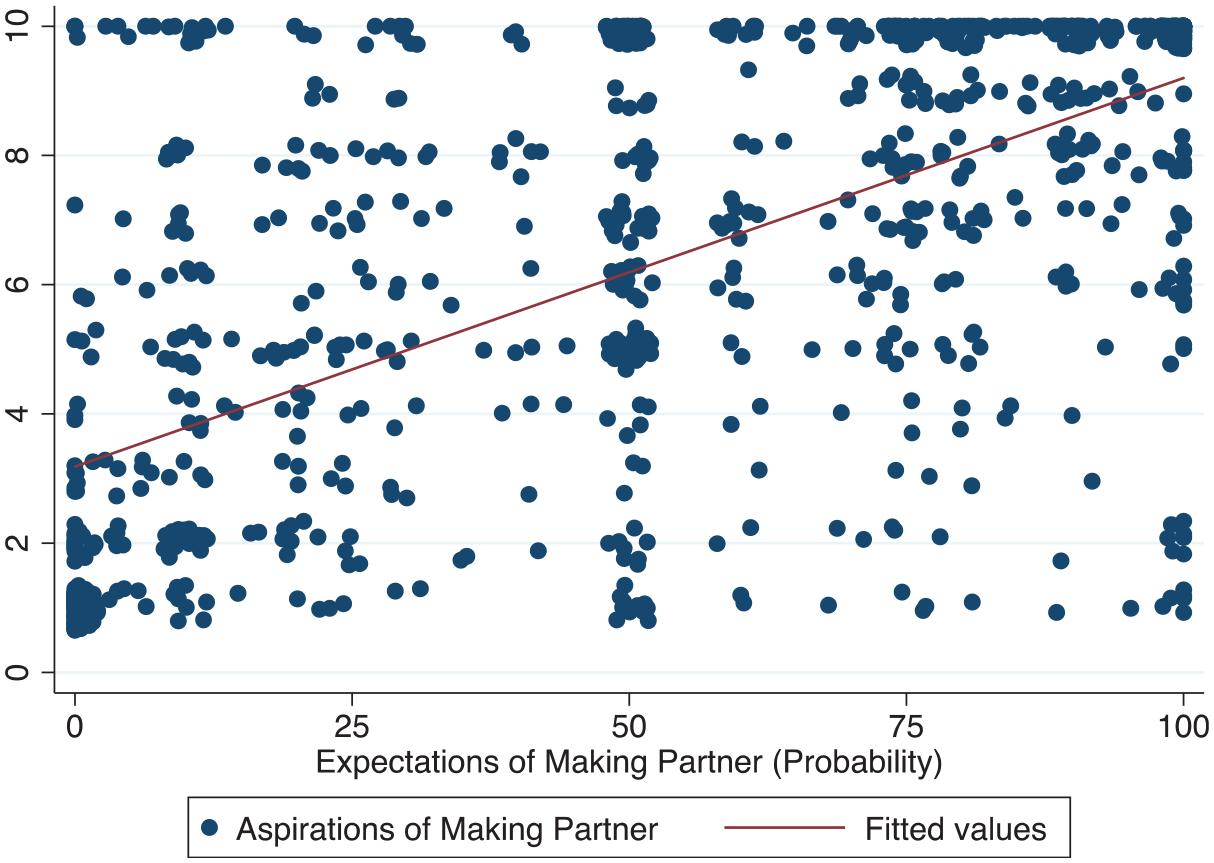
Jittered Scatterplot of the Relationship between Expectations and Aspirations of Making Partner, After the JD Study (N = 1,407)
Unmet Aspirations and Expectations of Making Partner: Consequences for Mental Health?
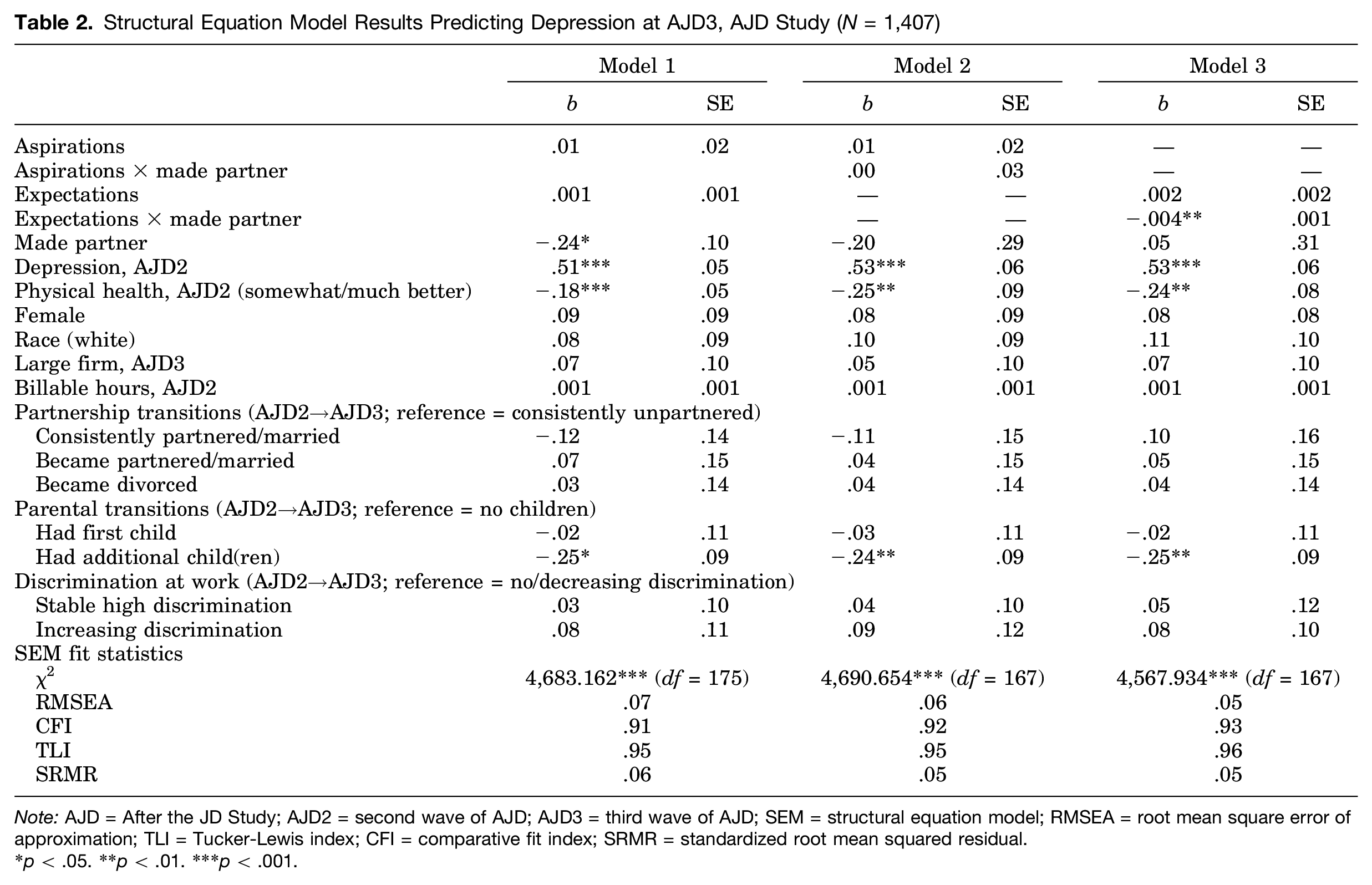
We consider unmet expectations and aspirations of making partner and their associations with depression. Table 2 shows the results from three SEMs. The models specified consist of observed variables, except for depression at AJD2 and AJD3, which were both modeled as latent variables to adjust for measurement error on the depression scale. SEM goodness-of-fit statistics are also shown in Table 2, where we present the χ2 statistic, root mean square error of approximation, Tucker-Lewis index, comparative fit index, and standardized root mean squared residual. Fit statistics for all three models fall within conventionally accepted standards (Berkout, Gross, and Young 2014), with the best model fit achieved in Model 3, where we test an interaction term between whether the respondents made equity partner and their expectations of making partner.
Structural Equation Model Results Predicting Depression at AJD3, AJD Study (N = 1,407)
Note: AJD = After the JD Study; AJD2 = second wave of AJD; AJD3 = third wave of AJD; SEM = structural equation model; RMSEA = root mean square error of approximation; TLI = Tucker-Lewis index; CFI = comparative fit index; SRMR = standardized root mean squared residual.
p < .05. **p < .01. ***p < .001.
As a starting point, Model 1 considered whether individuals who made partner reported lower depression scores than those who did not, regardless of their individual expectations or aspirations. Adjusting for our full set of study covariates, results demonstrate that making partner between AJD2 and AJD3 is associated with fewer depressive symptoms (b = −.24, p < .05). This result is consistent with Hypothesis 1, which predicted that failing to make partner would be associated with greater depression. Importantly, this association holds net of one’s aspirations and expectations of making partner. Also noteworthy from Model 1 is that expectations and aspirations of making partner were not on their own significantly associated with depression.
Having first established that individuals who do not make partner report higher depression scores, we ask whether unmet aspirations and expectations intensify the distress of not making partner. Interaction terms between whether or not the individual actually achieved partnership status and aspirations or expectations, respectively (both continuous), were entered as multiplicative terms into the SEM equation.
Model 2 of Table 2 tests an interaction term between aspirations and whether a respondent made equity partner between AJD2 and AJD3, serving as a test of Hypothesis 2. We see that this interaction term failed to reach statistical significance. In fact, of all the covariates considered in Model 1, only the autoregressive path between depression at Wave 2 significantly predicted Wave 3 depression (b = .53, p < .001). Unsurprisingly, those with higher depression scores at Wave 2 were more likely to have higher depression scores at Wave 3. Thus, results from this model do not support Hypothesis 2, that failing to live up to one’s aspirations intensifies the distress of not making equity partner.
Model 3 of Table 2 presents a similar interaction term, this time between lawyers’ expectations of making equity partner and whether or not they made partner over the study period, offering a test of Hypothesis 3. As in Model 2, the autoregressive path between depression at Wave 2 and depression at Wave 3 is statistically significant and positive (b = .53, p < .001) such that that those with higher depression scores at Wave 2 were more likely to have higher depression scores at Wave 3. But unlike Model 2, here we do observe the presence of a significant, negative interaction term between expectations of making partner and whether partnership was achieved (b = −.004, p < .01). This result offers support for Hypothesis 3, which predicted that the relationship between not making partner and depression would be exacerbated by the presence of high expectations.
For ease of interpretability given the continuous nature of expectations for making partner (0 percent to 100 percent), we undertook additional analyses to display this finding. Figure 4 shows marginal predicted depression scores with 95 percent confidence intervals across five expected probabilities of making partner (0 percent, 25 percent, 50 percent, 75 percent, and 100 percent), computed separately for individuals who made and failed to make partner.
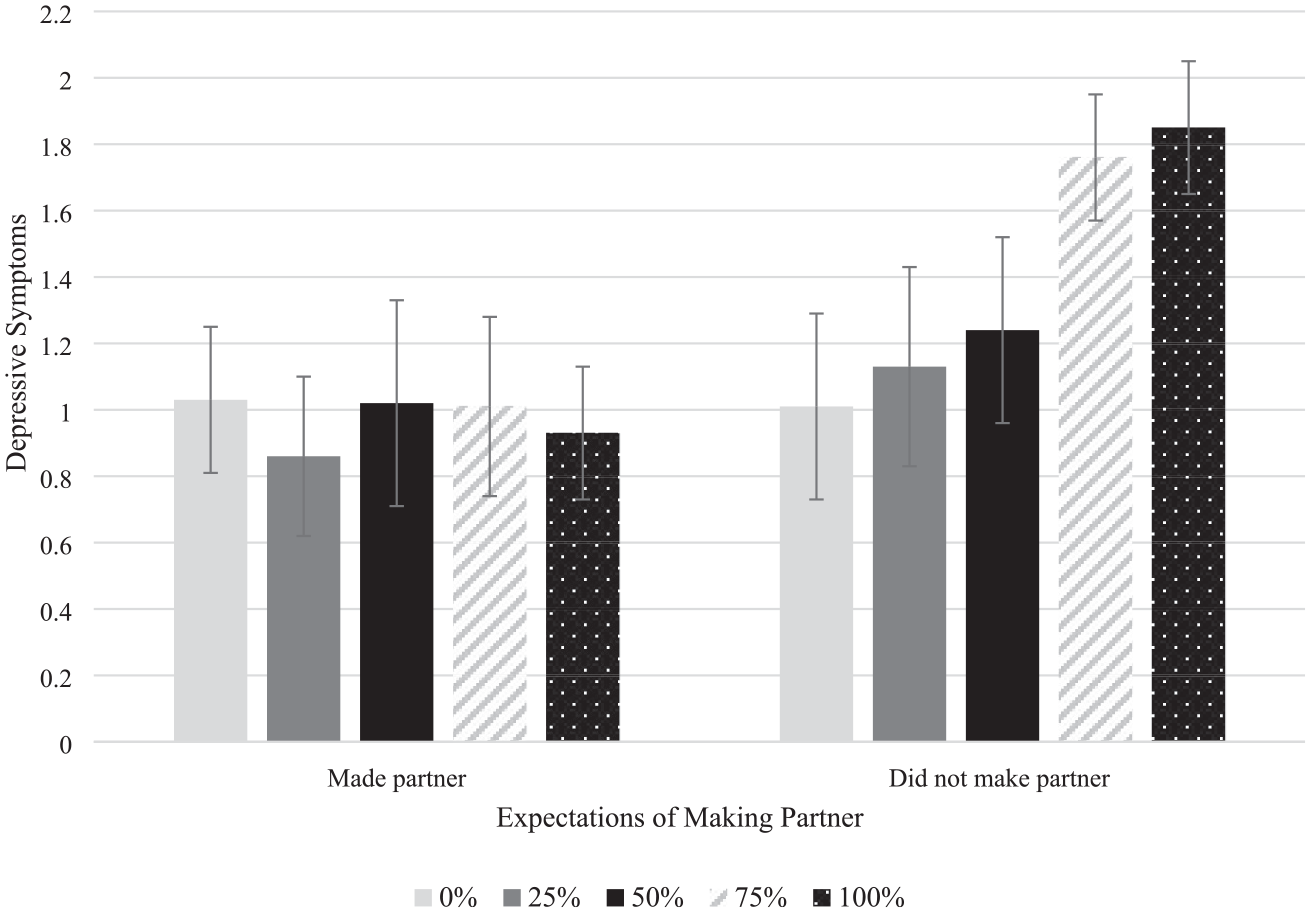
Predicted Depressive Symptoms across Expectations of Making Partner, After the JD Study (N = 1,407)
Starting with the data series on the left of Figure 4 (the first five bars), we see that there are no significant differences in depression scores among individuals who made partner across expectation probabilities. This is illustrated through the overlap of the 95 percent confidence intervals for all five expected probabilities of making partner. Thus, making partner, regardless of one’s initial expectations, seems to be equally beneficial for mental health.
Moving to the second data series in Figure 4, we see a much different story emerge for individuals who failed to make partner. At relatively low expectations (0 percent, 25 percent, and 50 percent), failing to make partner does not seem to be associated with higher depressive symptoms. In fact, these individuals have depression scores that are statistically indistinguishable from each other and from individuals who actually made partner, regardless of their initial expectations. However, as we move along to those who had high expectations of making partner (75 percent and 100 percent expected probabilities, shown in the last two bars of Figure 4, shaded gray and dotted black), we see that these individuals report higher depression scores (predicted depression scores = 1.76 and 1.85, respectively) than individuals who made partner or individuals who did not make partner yet held lower expectations of doing so (<50 percent).
Because our analyses thus far suggest that those with 75 percent or greater expectations who fell short are prone to suffer worse depression, we highlight several notable comparisons and effect sizes for this group. First, those who gave themselves a 75 percent chance of making partner and failed reported a .75 higher depression score than those with identical expectations who made partner, and reported almost a full depressive symptom (.90) more than those who only gave themselves a 25 percent chance of making partner and accomplished their goal. Second, those who expected for certain to make partner at a 100 percent likelihood reported nearly a full depressive symptom (.99) more than those who only gave themselves a 25 percent chance of making partner and did so.
Finally, the depression scores of those who gave themselves a 75 percent chance and a 100 percent chance of making partner but failed to do so were not statistically different from each other. Thus, it appears there is a threshold effect at the upper end of the partnership expectation probability spectrum (75 percent), where the differences in depressive symptoms between these two groups falls to nonsignificance when expectations go unmet.
Finally, although we found a significant interaction term only for failing to make partner and expectations, we used seemingly unrelated regression (using the suest command in Stata) to formally test the second part of Hypothesis 3, whether the coefficients derived from the interaction between making partner and aspirations (Model 2) differed from making partner and expectations (Model 3). This analysis revealed that failing to make partner*expectations had a stronger multiplicative effect on depressive symptoms than failing to make partner*aspirations (p < .05), consistent with Hypothesis 3.
Supplemental Analyses
We conducted a series of analyses to inspect the robustness of our results and to extend a selection of our main findings. First, past research has shown that particular combinations of expectations and aspirations hold consequences for mental health (Greenaway et al. 2015). Thus, we tested a series of three-way interaction terms that explore the combination of aspirations, expectations, and whether or not the individual achieved partnership status. First, we used 5 on the aspirations scale to distinguish high versus low aspirations and a 50 percent chance on the expectations scale as the cutoff distinguishing high and low expectations. Dichotomizing aspirations and expectations using these cutoffs helps to simplify their bivariate distributions and to portray the combination of aspirations/expectations. 6 On the whole, most individuals (63 percent) of the sample had matched aspirations and expectations.
To further understand the interplay between aspirations and expectations, we conducted supplemental structural equation models using the continuous variables of expectations and aspirations as shown in Table 2. We estimated a three-way interaction term between aspirations, expectations, and whether the respondent made partner. This interaction failed to reach statistical significance.
Recognizing that depression among lawyers is structured by race and gender (Hagan and Kay 2007; Reardon and Buchanan 2018), we also further disaggregated our cross-tabulations by gender and race. 7 Briefly, χ2 analyses showed that women and nonwhites were less likely to fall into the high aspirations, high expectations category relative to men and whites (p < .001). Women were also less likely to make partner than men (16 percent compared to 27 percent of men), as were nonwhites compared to whites (15 percent vs. 25 percent). At the same time, nonsignificant three-way interaction terms between gender or race, dashed expectations, and depression suggest that the relationship between dashed expectations and depression is no stronger for gender or racial minorities.
Discussion
Using the case of private sector lawyers, we consider two distinct future orientations regarding the transition to equity partnership. We hypothesized that dashed expectations—failing to achieve an anticipated professional transition—would be a distressing outcome for the ambitious individuals in this highly competitive occupation. Results supported this proposition and provide new insights for scholarship on future orientations, mental health, and the sociology of work.
Indeed, the central contribution of this study is to identify dashed expectations—but not unfulfilled aspirations—as a threat to mental health. Failing to make partner is linked to more depressive symptoms, but interaction analyses reveal that this association manifests only among those who expected to achieve that coveted rank. In other words, pessimistic lawyers whose partnership never materialized came through essentially unscathed; lawyers wrongly assuming partnership to be a foregone conclusion suffered most. Seeing one’s aspirations go unrealized, however, had no discernible impact on depressive symptoms.
This finding, contradicting self-discrepancy theory and its emphasis on unifying ideal and aspired-to selves, suggests that “standards of attainment that individuals would choose to achieve under ideal conditions” (Greenaway et al. 2015:2) do not exacerbate the distress of failing to make partner. That is, among the many possible selves lawyers envisage, falling short of the “probable” future self is more distressing than failing to become the “like-to-be” future self (Markus and Nurius 1986:966). Reasons and rationalizations can contextualize unmet aspirations, but dashed expectations undermine a whole set of planned-for future circumstances and destabilize a sense of mastery and control.
The existence and stressfulness of nonevents also seem premised on this distinction. What is merely a missing milestone for private firm lawyers in the sense of an ideal type becomes a gap in personal biography—a stress-inducing nonevent (Wheaton 1994)—only when there are expectant hopes. Our findings therefore substantiate the importance of disentangling different forms of future orientations. Past research has often conflated expectations and aspirations, but their role in mental health can evidently differ.
Our findings also offer a point of contrast with some existing research. Studies of younger people have implied that there is little downside to setting unrealistic expectations (Reynolds and Baird 2010; Smith-Greenaway and Yeatman 2020) because young adults who fall short of their educational hopes display remarkable resilience in the face of such failures. Shooting for the stars—and failing—might be less distressing for younger people with diverse alternative life pathways and whose unmet goal (e.g., graduating college) does not convey the experience of a singular and definitive foreclosed possibility. Adults committed to a career track and who have wrapped their identity and sense of meaning around a specific occupational position have much more to lose (McLeod 2012). This highlights the importance of specifying how particular future-oriented beliefs fit into distinct career and life course trajectories, for better or for worse. In the case of lawyers, high expectations can be a motivational catalyst as people commence their careers, yet also come with a cost. Similar to the biological concept of antagonistic pleiotropy—where genes promoting survival during an organism’s early life later become a liability—the impulse to succeed may also lead many lawyers to overshoot estimations and to suffer a range of harmful consequences. To advance research on future orientations and mental health, we call for research to investigate the way that ambition and anticipation can have potentially countervailing effects over the life course across diverse life domains.
The current findings also have implications for research on work. The mental health consequences of dashed expectations among lawyers suggest that updating one’s prospects is an important process in managing potential career milestones. Straightforward appraisals may help inform the probability judgments of these individuals, but it would also be helpful to know how—and under what conditions—people are receptive to such feedback from their professional peers. For instance, mentors are critical for informing lawyers as they seek to stay on the professional track, but access to and returns on mentorship in the legal profession are unequally distributed (Kay and Wallace 2009). Future research could help demonstrate if, when, and how mentors help dispel unrealistic expectations and whether certain lawyers are disproportionately at risk of inaccurate or withheld information from those in mentoring roles. Although our analysis prompts such considerations for those in the legal profession, many of these questions have applicability for other workers.
The focus on lawyers brings up one major limitation of this study. Our analyses focus on a relatively privileged group of individuals who have already achieved much in their lives. Indeed, the difficulties involved in becoming a lawyer likely weeded out many lower achieving individuals before we could capture them in our sample. Yet despite the valid concerns about generalizability, there are some clear advantages of our research design. Examining only private sector lawyers means that we are essentially holding constant educational attainment, career stage, and occupation, plus many “intangible” factors such as intelligence and motivation. Accounting for this range of variables would be very challenging in a study of the general population, and so our inferences about mental health are less prone to selection effects than if we used a more conventional social survey design.
A second limitation of this study is the fact that with two waves of data, we are unable to account for complex feedbacks between mental health, aspirations, and expectations. For instance, mental health may influence people’s future orientations. Although we adjust for a lagged (Wave 2) measure of depressive symptoms to assess change by the AJD third wave, the unavailability of such measures at Wave 1 means that we could not fully investigate how depressive symptoms may be both a consequence and a cause of career outlook and eventual success. The AJD data also did not contain measures of coping mechanisms that we could account for which may suppress the relationship between dashed expectations and depression, such as alcohol or other forms of substance abuse, which are known to exceed population averages in the legal profession (Krill et al. 2016). A related concern is that our analysis assumes stability in future orientations. Because measurement of aspirations and expectations exists only at AJD Wave 2, we do not know whether these orientations are prone to ebbs and flows. Future research with more frequent observations could shed light on trajectories of aspirations and expectations, investigating if and how they diverge and what demographic or legal field factors shape their form over time.
Although this article offers fresh directions for research of any era, it also provides a helpful lens for assessing the current moment. The global COVID-19 pandemic has been many things—including the largest aggregate of dashed expectations in contemporary history. People are currently revisiting and revising a whole range of future orientations across multiple life domains, including occupational futures, but also family, finances, health, and community. A succession of setbacks seems the only certain expectation for the short-term future, and sociologists of mental health will no doubt be active in cataloguing this fallout. But on a hopeful note, processes of recovery and resilience also distinguish the human experience. Although our findings show negative mental health consequences of lawyer’s dashed expectations, these effects only pertain to the short term. We urge researchers to also focus on how people overcome disappointment in the context of failed professional promotions, and also in the varied ways plans will have gone unfulfilled in the pandemic’s aftermath.
Supplemental Material
sj-docx-1-spq-10.1177_01902725211045024 – Supplemental material for The Divergent Mental Health Effects of Dashed Expectations and Unfulfilled Aspirations: Evidence from American Lawyers’ Careers
Supplemental material, sj-docx-1-spq-10.1177_01902725211045024 for The Divergent Mental Health Effects of Dashed Expectations and Unfulfilled Aspirations: Evidence from American Lawyers’ Careers by Ioana Sendroiu, Laura Upenieks and Markus Schafer in Social Psychology Quarterly
Footnotes

1
We use future orientations as an umbrella term, incorporating both expectations and aspirations. This is particularly useful when describing past research that does not differentiate between the two.
2
4
It is also noteworthy that this correlation between aspirations and expectations was fairly similar among key subgroups in the sample. For instance, it was r = .64 for women and r = .62 for men. Likewise, it was r = .64 for whites and r = .60 for nonwhites.
5
Bios
References
Supplementary Material
Please find the following supplemental material available below.
For Open Access articles published under a Creative Commons License, all supplemental material carries the same license as the article it is associated with.
For non-Open Access articles published, all supplemental material carries a non-exclusive license, and permission requests for re-use of supplemental material or any part of supplemental material shall be sent directly to the copyright owner as specified in the copyright notice associated with the article.
