




Abstract
Muslim religiosity is often portrayed as a barrier to integration into secular societies, especially in Europe. Scholars suggest that religiously segregated networks reinforce Muslims’ religiosity and religious identification, but solid evidence is scarce. Based on longitudinal German data, we examined whether friendship networks influence Muslim youths’ religiosity. Using stochastic actor-oriented models, we also assessed whether religiosity in turn relates to friendship choices. We found that higher shares of Muslim friends neither increase Muslim youths’ religious identification nor their frequency of prayer, but they are associated with more frequent mosque attendance. Furthermore, Muslim youths assimilated their Muslim friends’ mosque attendance and frequency of prayer. Friends’ actual religious practices, rather than shared group membership, thus seems to shape individual religiosity. Finally, religiosity does not hamper interreligious friendships; it was unrelated to friendship choices. Results are similar for Christian youths, suggesting that these patterns are not unique to Muslims.
With Islam forming the largest minority religion in Europe, Muslims are at the forefront of current debates about the integration of ethno-religious minorities in European societies. In 2010, Muslims made up about 5.9 percent of the European population, and this proportion is expected to double within the next decades (Pew Research Center 2015). For European adolescents, religion no longer constitutes a major source of social identity, but it continues to matter to European Muslims, including to younger ones who were born and raised in secular European societies (Foner and Alba 2008; Jacob and Kalter 2013; Voas and Fleischmann 2012).
In many European countries, highly secular historically Christian populations thus coexist with a growing religious minority group that continues to identify strongly in religious terms. In this context, the distinction between Muslims and non-Muslims has become both a symbolic and social divide (Drouhot and Nee 2019). This especially applies to highly religious Muslims, who tend to be more conservative than the broader European public regarding issues such as gender equality or homosexuality (Kretschmer 2018; Soehl 2017) and who identify less strongly with the country they live in (Fleischmann and Phalet 2018; Leszczensky, Maxwell, and Bleich 2020). At the same time, a considerable share of non-Muslim Europeans holds negative attitudes toward Muslims (Strabac and Listhaug 2008) and especially toward pious ones (Helbling and Traunmüller 2018). As noted by Foner and Alba (2008), religion in Europe is thus a barrier rather than a bridge to inclusion. Against this backdrop, the religious identity of young Muslims constitutes “a salient marker of difference in social interactions with friends” (Phalet, Fleischmann, and Hillekens 2018:36). There is a tendency toward religious clustering in social relationships, with friendships among Muslims and non-Muslims being less likely than relationships among coreligionists (Leszczensky and Pink 2017; Windzio and Wingens 2014).
Given that European Muslim youths are much more religious than their non-Muslim peers and that religiosity amplifies real and perceived differences between them, it is crucial to improve our understanding of the mechanisms that maintain high levels of religiosity and religious identification among Muslim youths. Research on collective identities stresses that network partners such as friends are crucial for identity processes (Deaux and Martin 2003; McFarland and Pals 2005; Walker and Lynn 2013). Accordingly, scholars have suggested that social influence from religious ingroup members is a key mechanism for upholding Muslim religiosity and religious identification (Maliepaard and Phalet 2012; Maliepaard and Schacht 2018). Specifically, they have argued that close contact with coreligionists enhances Muslim religiosity, whereas contact with non-Muslims reduces it. Summarizing this reasoning, in a recent review of identity development among Muslim Europeans, Phalet et al. (2018:39) concluded that the religious identity of European Muslims is “reinforced by religious peer groups.”
Although the conclusion that social integration affects European Muslims’ religiosity is based on both theoretical arguments and prior studies, it is premature for two reasons. First, prior studies have distinguished between the degree of contact with majority and minority group members (i.e., Muslims and non-Muslims), but they have not considered how religious these potential influencers are. Most studies have assessed social integration by distinguishing between majority and minority group contact along ethnic lines (Maliepaard and Phalet 2012; Maliepaard and Schacht 2018). This reasoning is valid for Dutch or Germans from families without a migration history, indeed very few of which are Muslim. Yet whereas “ethnicity and religion almost fully overlap” for Muslims in many European countries (Maliepaard and Phalet 2012:132), lumping all of them together under the umbrella term Muslim fails to account for heterogeneity among them. Although most European Muslims identify very strongly with their religious ingroup (Verkuyten 2007:343), they differ in terms of religious practices such as praying or mosque attendance (Simsek, Fleischmann, and van Tubergen 2019; Voas and Fleischmann 2012). From a theoretical perspective, a dense network of coreligionists who are highly religious, as expressed by praying frequently and attending mosque regularly, would lead to different expectations than a dense network of coreligious friends who are less pious. Because prior studies did not include measures of friends’ religiosity, or even religion, it is an open question whether Muslim religiosity is reinforced by Muslim friends per se, or whether such influence is restricted to friends who engage in religious practices and behaviors.
Second, in addition to the theoretical case for social integration influencing European Muslims’ religiosity, the reverse path of religiosity affecting social integration is equally plausible because people tend to befriend others who share their religious affiliation (McPherson, Smith-Lovin, and Cook 2001) or hold similar religious beliefs or practices (Cheadle and Schwadel 2012). In fact, earlier studies on the association of Muslim religiosity and their social contacts either mention reverse causality as a limitation or try to address it by additional analyses. For example, analyzing cross-sectional data of Dutch Muslims, Maliepaard and Phalet (2012) estimated two competing structural equation models with the causal arrow running from contact to religiosity in one of them and from religiosity to contact in the other one. Because both models were compatible with the data, they concluded that the “association between contact and religious identity expression is most likely a bidirectional process” (143). Acknowledging the limitation of cross-sectional data, however, they also stressed being unable to draw strong causal conclusions and called for future longitudinal research to “separate out selection from social influence” (145). Similarly, in a more recent longitudinal study, Maliepaard and Schacht (2018:876) stressed that with two waves of data, they “must be careful about drawing conclusions as to the direction of effects.” Because the nontrivial methodological task of disentangling influence of friends on religiosity from religious friendship formation has not adequately been met by past research, the conclusion that Muslim friends reinforce Muslim religiosity is tentative.
In addition to both shortcomings, prior studies have lacked a non-Muslim group of comparison. This is not generally a problem for addressing influence on Muslim youths. Still, comparing the patterns between different religious groups is substantively important because it otherwise remains open whether results are unique to Muslims or part of general processes, which research on the relationship between networks and identity would suggest (e.g., Deaux and Martin 2003; McFarland and Pals 2005).
In this study, we address the aforementioned shortcomings with a longitudinal social network approach. Analyzing three waves of network panel data of adolescents in Germany, we consider not only the religious affiliation of friends but also their self-reported religiosity as captured by their frequency of prayer, service (i.e., mosque or church) attendance, and strength of religious identification. Using stochastic actor-oriented models (SAOM) for the coevolution of networks and behavior (Steglich, Snijders, and Pearson 2010; Snijders, van de Bunt, and Steglich 2010), we examine if and how friends shape these three different aspects of Muslim youths’ religiosity in Germany. A key advantage of SAOM is that by allowing to simultaneously model the religiously driven selection of friends, they can account for the possibility that religiosity may also shape friendship choices (Cheadle and Schwadel 2012). Therefore, we also test whether religious youths in Germany are more likely to befriend or stay friends with peers of the same religious group and whether they tend to befriend or stay friends with peers of the same religious group who are similarly religious as they themselves are. To put the results for Muslim youths into proper perspective, we also conduct comparative analyses for Christian youths.
Our results extend earlier findings in several ways. First, although more religious Muslim youths had higher shares of Muslim friends than less religious ones, neither their religious identification nor frequency of prayer was affected by the share of religious ingroup friends. Muslim youths with more religious ingroup friends, however, were more likely to attend mosque. Second, Muslim youths tended to adjust their own frequency of prayer and mosque attendance, but not their religious identification, toward that of their religious ingroup friends. Third, regarding religiously driven friendship choices, Muslim youths tended to befriend fellow Muslims, but this general preference (i.e., religious homophily) was not more pronounced among highly religious ones, and there was no added effect of Muslim youths befriending Muslim peers with similar levels of religiosity. Finally, similar patterns were found for Christians, indicating that the underlying processes are general rather than specific to Muslim youths.
Background
Religious Identification and Religious Practice of European Muslims
A key distinction can be made between the strength of religious identification and following religious practices, such as praying or attending religious services (Maliepaard and Phalet 2012). We discuss the meaning of religious identification and religious practice to youths before discussing how and why friends might influence them, paying attention to the particular context of Muslims in Europe.
Starting with religious identification, religion is an important source of social identity. According to social identity theory (Tajfel and Turner 1986), people desire positive social identities, which are generated by favorable comparisons with relevant outgroups. Unlike for Christians, who still are the dominant religious group in most European countries, this poses a challenge to European Muslims, whose religious identification is devalued both by negative portrayals of Muslims in public discourse and by anti-Muslim sentiments of non-Muslim Europeans (Foner and Alba 2008; Voas and Fleischmann 2012). Considering such an unsatisfactory social identity, social identity theory suggests that individuals will strive either to leave their existing group or to make it more positively distinct. Most Muslims in Europe, however, identify so strongly with their religion that their religious identification has been described as “total group identification,” indicating that “the orientation and commitment to the in-group is normative and total, rather than optional and differing in strength” (Verkuyten 2007:343; also see Verkuyten and Yildiz 2007). Changing group membership is hardly feasible or even desirable for European Muslims because of both the strong ingroup orientation and the pronounced symbolic and social boundary between Muslims and non-Muslims that makes it harder for them to be accepted by non-Muslims. European Muslims’ pronounced religious identification thus can be understood as a coping strategy against discrimination (Foner and Alba 2008; Voas and Fleischmann 2012).
Importantly, however, the high level of European Muslims’ religious identification is not necessarily accompanied by pronounced religious practice (Simsek et al. 2019; Voas and Fleischmann 2012). This especially applies to European-born Muslim adolescents, who tend to less frequently follow religious practices than their parents but still identify strongly in religious terms. Young British Muslims, for instance, identify strongly with Islam but engage less often in religious practice than their elders, which suggests that their “strong identification with Islam does not entail strict observance but carries ethical, cultural or emotional connotations” (Kashyap and Lewis 2013:2134). Although Muslim identity for most European Muslims “does not seem to be optional or a matter of strength of identification” (Verkuyten and Yildiz 2007:1460), this pronounced identification therefore is not necessarily accompanied by religious behavior such as praying or mosque attendance. In short, although strong ingroup identification is central to being a Muslim in Europe, religious practice is not.
Theory
Why Friends Might Influence Individual Religiosity
When forming social identities in adolescence, individuals seek the social approval of their friends, who may either support or reject identifications, thereby either reinforcing and strengthening or devaluing and weakening an individual’s group identification (Deaux and Martin 2003; McFarland and Pals 2005; Walker and Lynn 2013). The strength of an individual’s identification with a given social group thus partly depends on how much others value that identity (Schulz and Leszczensky 2016). Similar arguments pertain to religious practices (Cheadle and Schwadel 2012). Especially, but not exclusively, in adolescence, peers are important reference points and exert influence on a broad range of attitudes and behavior. It is not surprising, then, that it has long been argued that religiosity is shaped by close social interaction with coreligionists. Through monitoring, social punishments and rewards, religious communities uphold and enforce religious norms of behavior, such as praying or attendance of religious services (Sherkat and Ellison 1999). In addition, religious friends may affect individual religious practice by reinforcing religious commitment and behavior because they may set an example or encourage joint engagement in religious behavior. Specifically, Regnerus, Smith, and Smith (2004) found that adolescents’ religious service attendance is higher if their friends also reported more frequent service attendance.
Based on these arguments, it has been suggested that Muslim friends reinforce European Muslims’ religiosity, whereas non-Muslim friends are not likely to reinforce Islamic beliefs or practices (Phalet et al. 2018). As noted earlier, these hypotheses have been tested for coethnics rather than coreligionists. For example, it has been shown that Turkish and Moroccan Muslims in the Netherlands tend to be religiously more active if they have more contact with coethnics, who presumably are Muslims too (Maliepaard and Phalet 2012). Similarly, a study of recent Turkish migrants in Germany and the Netherlands as well as recent Pakistani migrants in the United Kingdom found that increasing contact with coethnics was related to increased frequency of prayer and mosque attendance (Maliepaard and Schacht 2018). Conversely, Turkish and Moroccan Dutch Muslims with more native Dutch majority-group friends attended mosque less frequently (Maliepaard and Lubbers 2013).
None of these prior studies, however, included measurements of friends’ religiosity or religious affiliation. Instead, they relied on the assumptions that coethnic friends of Muslims are also Muslim and that Muslim friends have strong religious identities and/or frequently engage in religious practices. As discussed previously, the latter assumption is questionable given that religious practices vary considerably among European Muslims. Whether or not Muslim friends reinforce religious practices, therefore, may crucially depend on how religiously active these friends are. But again, this information is lacking in earlier studies (Maliepaard and Schacht 2018:877).
In sum, European Muslims identify strongly with their religious group, and having many Muslim friends may contribute to upholding this strong ingroup identification. With European Muslims differing much more in terms of religious practices, however, their religious behavior such as praying or mosque attendance may be influenced by how religiously active their Muslim friends are rather than by having Muslim friends.
Why Religion and Religiosity May Affect the Selection of Friends
Although social interaction with peers is considered to affect individual religiosity, scholars also have acknowledged for a long time that religion is also an important determinant of friendship. Religious segregation is found in all religiously diverse societies (McPherson et al. 2001). Individuals who belong to religious groups are more likely to encounter coreligionists, for example during religious services or at activities that are related to religious communities (Foner and Alba 2008:362). People also prefer to associate with similar others (McPherson et al. 2001). Religion contains a specific worldview that includes manifold norms and values, so two coreligionists are, on average, more likely to share attitudes, norms, and values than are two individuals who belong to different religious groups (Cheadle and Schwadel 2012; Windzio and Wingens 2014). In line with this argument, research in Europe has found support for homophilous youth friendships: Muslim youths tend to be friends with fellow Muslim peers, and Christian and nonreligious youths are more likely to have Christian or nonreligious friends than Muslim friends (Leszczensky and Pink 2017; Windzio and Wingens 2014).
Again, however, belonging to a religious group does not necessarily mean that one feels strongly about it. According to social identity theory (Tajfel and Turner 1986), strong group identification should increase favor for ingroups over outgroups (Brown 2000). Consistent with this reasoning, individuals with strong religious identification hold more positive feelings towards coreligionists (Verkuyten 2007). Applied to youths’ friendship choices, however, highly religious Muslim youths do not seem to be more (or less) likely to befriend fellow Muslims than their less religious peers (Leszczensky and Pink 2017).
In sum, young European Muslims tend to cluster in religiously segregated friendship networks. Theoretically, highly religious Muslims can be expected to show higher levels of religious segregation because they are more likely to meet coreligionists (e.g., during religious service) and may have stronger preferences for having coreligious friends. With little empirical evidence on the link between religiosity and friendship choices, this leaves the possibility that the association of Muslim religiosity and social contacts is a consequence of religiously driven friendship choices rather than friends influencing individual religiosity.
The Current Study
Our main aim was to assess whether individual religiosity of Muslim youths is a function of their friendship networks. We examined two ways in which Muslim youths’ friendship networks might influence their religiosity as well as two analogous ways in which individual religiosity may affect the friendship making of Muslim youths, as described in the following hypotheses:
Influence Hypothesis 1: Higher shares of Muslim friends increase Muslim youths’ religiosity, whereas having higher shares of non-Muslim friends decrease it.
Selection Hypothesis 1: Highly religious Muslim youths are more likely to befriend Muslim rather than non-Muslim peers.
Influence Hypothesis 2: Muslim youths adjust their own religiosity to that of their Muslim friends.
Selection Hypothesis 2: Muslim youths tend to befriend Muslim peers who are similarly religious as they themselves are.
We tested all hypotheses for three different dimensions of individual religiosity: religious identification, frequency of prayer, and service attendance. For comparison, we also assessed all influence and selection effects for Christian youths.
Methods
Participants
We relied on three waves of data from the project Friendship and Identity in School, a longitudinal study of diverse grade-level friendship networks of more than 2,000 students in Germany (Leszczensky, Pink, and Kalter 2015). Data were collected for fifth, sixth, and seventh graders from nine schools in nine towns in North Rhine-Westphalia, the most populous federal state in Germany. Schools with higher shares of students with a migration background were sampled, focusing on lower secondary, intermediate secondary, and comprehensive schools. The participating nine schools were randomly chosen from predefined strata regarding different shares of non-German students. School response rate was about 10 percent, but the results in the following mirror common findings of comparable network studies with higher school response rates and larger samples.
In total, 26 grades were surveyed, most of which consisted of three to four classrooms. The sample was ethnically diverse, with almost two-thirds of the participating students having a non-German background. Almost a third of all students reported as Muslim. In the first wave, on average, students were about 13 years old (M = 12.8, SD = 1.1).
Procedure and Analytic Sample
Students’ participation in the study was voluntary but required written parental approval. All waves were collected in class, with students filling out paper-and-pencil questionnaires while being supervised by researchers. The first wave was collected in May 2013, the second wave in February 2014, and the third wave in November 2014.
In the first wave, 76.5 percent of the students enrolled in the participating schools took part in the survey. This share increased in the second and third wave, to 83 and 86 percent, respectively. For the analysis, we excluded grades in which less than 75 percent of the students participated in any of the waves. This threshold is a trade-off between conventionally accepted shares of unit nonresponse in social network analysis and the amount of information available to conduct meaningful statistical analyses (Huisman and Steglich 2008). This procedure resulted in 13 grade-level networks, with a total of 1,349 students.
Measures
Religion
Students self-reported their religious affiliation, being able to choose from a list of religious groups (e.g., Catholic, Protestant, or Muslim) and to write down religious groups that were not listed. We distinguish between Muslim and Christian youths, who make up of the lion’s share of the sample (31.2 and 53.5 percent, respectively). All other students are collapsed in a joint category; two-thirds of them reported not belonging to any religious group, and the remaining ones were members of religious communities that were too small in size to be considered separately in the analysis.
Religiosity
We assessed three different aspects of religiosity, all of which were measured in each of the three waves. Religious identification was captured by a mean index of four items (“My religion is an important part of myself,”“It bothers me if somebody speaks ill about my religion,”“My religion is dear to me,” and “I feel like I am part of my religion”). All items were answered on a five-point scale with higher values indicating stronger identification. The resulting scale is highly reliable (α = .95). Students also self-reported their frequency of prayer on a six-point scale, with the possible answer categories never, a few times over the year, at least once a month, at least once a week, one to four times a day, and five times a day or more. Finally, service attendance was measured by the question how often students attended a place of religious worship such as mosque or church. Answer categories were never, a few times over the year, at least once a month, at least once a week, and daily. We treated all three religiosity measures as ordinal scales, with higher values indicating higher religiosity. 1
Friendship networks
In each wave, students could nominate up to ten of their best friends from an alphabetically sorted roster of all their schoolmates from their own grade. Friendship, therefore, was captured by directed ties. On average, students nominated 6.4 (SD = .67) friends. Muslim students had larger friendship circles than Christians (7.0, SD = 2.7 vs. 6.1, SD = 2.8; p < .001), and boys reported more friends than girls (6.6, SD = 2.9 vs. 6.2, SD = 2.8; p < .001). 2
Analytical Strategy
We use stochastic actor-oriented models (SAOM) for the coevolution of networks and behavior (Snijders et al. 2010; Steglich et al. 2010). SAOM consist of two submodels that can be estimated simultaneously in order to separate effects of network partners on individual behavior from effects of individual behavior on network partners. Accordingly, the behavior submodel allowed us to test our two influence hypotheses by assessing how friendship relations affect individual religiosity; the network submodel allowed us to test the competing selection hypotheses by assessing whether and how individual religiosity in turn affects the formation and change of friendship relations. In the network submodel, students repeatedly decided whom to befriend, which is assumed to depend on, among other things, their religiosity. The behavior submodel, by contrast, assessed whether students changed their individual religiosity and whether this change was driven by, among other things, the religion and/or religiosity of their friends. In concert, these multiple individual decisions shaped both the network structure and the religiosity distribution.
We estimated two models for each of the three dimensions of religiosity, thus six models in total. Model 1 tested our first influence (and the corresponding selection) hypothesis, namely, whether higher shares of Muslim friends increased Muslim youths’ religiosity (and/or whether highly religious Muslim youths were more likely to befriend Muslim rather than non-Muslim peers). Model 2 tested our second influence (and the corresponding selection) hypothesis, namely, whether Muslim youths adjusted their own religiosity to that of their Muslim friends (and/or whether Muslim youths tended to befriend Muslim peers who were similarly religious as they themselves were). Both models also included the respective selection and influence effects for Christian youths, as described in the following. We first describe the unique parts of both models; then we describe effects that are included in both models.
Model 1: the effect of Muslim friends on Muslim religiosity
Influence Hypothesis 1 states that having higher shares of Muslim friends increases Muslim youths’ religiosity. In the behavior submodel, we thus added the main effect of being Muslim, the effect share of religious ingroup friends, and the interaction term of both effects. 3 We also added the main effect of being Christian as well as the interaction term between this main effect and share of religious ingroup friends. We then compared a Muslim student with zero Muslim friends and a Muslim student with only Muslim friends by calculating the linear combination of the effects share of religious ingroup friends and its interaction effect with being Muslim. A positive sum of these effects would support Influence Hypothesis 1 because it would indicate that Muslim youths with a higher share of Muslim friends were more religious than those with lower shares of Muslim friends. For comparison, we repeated this calculation for Christian students.
To test Selection Hypothesis 1 and to account for reverse causality in the network submodel, we assessed whether highly religious Muslim youths were more likely to befriend religious ingroup rather than religious outgroup members. This tendency is captured by an interaction effect of a student’s (ego’s) religiosity, ego being a Muslim, and alter being a Muslim. This three-way interaction captured whether a Muslim youth (ego) was more likely to befriend another Muslim youth (alter) if the Muslim youth (ego) were more religious. All constitutive terms of this interaction terms were also included, as were the same series of effects for Christian youths. 4 Like the test of Influence Hypothesis 1, we also computed a linear combination to test Selection Hypothesis 1. Specifically, we compared the tendency of a highly religious Muslim youth (i.e., with the maximum value on the religiosity scale) to befriend a Muslim rather than a non-Muslim peer to the preference of a nonreligious Muslim youth (i.e., with the minimal value on the religiosity scale) to befriend a Muslim rather than a non-Muslim peer.
Model 2: the effect of Muslim friends’ religiosity on Muslim religiosity
Influence Hypothesis 2 states that Muslim youths adjust their own religiosity to that of their Muslim friends. We tested this by adding the Muslim youths’ (average) similarity with their Muslim friends effect to the behavior submodel. This effect estimated the tendency of a Muslim student to change his or her religiosity toward the religiosity level of all of his or her Muslim friends (or to remain similar to this value). A positive effect would indicate a preference of Muslim youths to be similarly religious as their Muslim friends, thus supporting Influence Hypothesis 2. The model also included the average similarity main effect and the main effects of being Muslim and being Christian as well as the average similarity effect of Christians with their Christian friends.
Selection Hypothesis 2 expects Muslim youths to befriend Muslim peers with similar levels of religiosity. We tested this with an interaction effect of the similarity of two students’ religiosity, ego being a Muslim, and alter being a Muslim. The religiosity similarity effect captured whether youths tended to befriend peers with similar levels of religiosity, and by interacting this tendency with both students being Muslim, we assessed whether Muslim youths had an increased tendency of befriending other Muslim youths if alters were similarly religious as they themselves were. To obtain the correct contrast of interest for testing Selection Hypothesis 2, we further included all constitutive interaction terms of the three-way interaction effect. Statistically, we tested Selection Hypothesis 2 by using a linear combination that compared the tendency of a highly religious Muslim student (i.e., who has the highest value on the religiosity scale) to befriend a Muslim peer who is just as religious as he or she is compared to a Muslim peer who is not religious at all (i.e., who has the lowest value on the religiosity scale). As before, the respective effects for Christians were also included in the model, and the linear combinations were calculated in the same manner.
Further controls included in both models
In the behavior submodel, we accounted for potential gender differences in religiosity by including a main effect of being female.
In the network submodel, in addition to religion and religiosity, we accounted for more general tendencies of friendship selection. We included the three dyadic covariates same classroom, same neighborhood, and same elementary school to control for proximity and previous ties (coded 1 if two students attended the same classroom or elementary school or lived in the same city district and 0 otherwise). We also accounted for students’ gender and ethnicity, both of which are common sources of segregation in adolescents’ friendship networks. Thus, we included ego, alter, and same sex effects as well as a same ethnicity effect. Ethnicity was coded based on the country of origin of the students’ family; students who were born abroad or who had at least one parent or grandparent born abroad were asked to write this down. Most students had a German (31.2 percent) or Turkish background (25.3 percent), followed by Polish (6.8 percent) and Russian (5 percent).
Finally, we included several effects that capture structural processes that are important in friendship networks (Ripley et al. 2020; Snijders et al. 2010). Outdegree reflects how many friends students nominate on average. Reciprocity captures the tendency of friendship nominations to be reciprocated. The GWESP (geometrically weighted edgewise shared partners) effect reflects the tendency of friends of friends to become friends as well. An interaction of reciprocity and GWESP captures differences in reciprocity in closed and open structures. The indegree popularity effect captures tendencies of actors with high indegrees to attract extra incoming ties. The outdegree activity effect reflects tendencies for actors with high outdegrees to send extra outgoing ties. The indegree activity effect reflects tendencies for actors with high indegrees to send out extra outgoing ties.
Modeling approach
Our analysis consisted of two steps, both of which we applied to both model specifications for all three dimensions of religiosity. In the first step, we employed stochastic actor-oriented models (SAOM) to analyze all grade-level networks separately. In a second step, we combined these results by means of a fixed-effects multivariate meta-analysis (An 2015). We used a fixed-effects meta-analysis because the separate estimates were obtained from networks that were both small in number and for which the survey process was identical in the sense that the same questionnaire was used and the same researchers carried out the survey (Borenstein et al. 2009).
The computation of each SAOM was carried out using RSiena 1.2-23 (Ripley et al. 2020) . All individual covariates except the Muslim and Christian effects are centered. Missing values for individual attributes were treated as noninformative in the estimation process (Huisman and Steglich 2008). To account for students who joined or left between waves, we employed the method of joiners and leavers suggested by Huisman and Snijders (2003). For frequency of prayer and service attendance, almost all individual models reached convergence for Model 2 and about half for Model 1 (i.e., had overall maximum convergence ratios that were smaller than 0.25; Ripley et al. 2020). 5 For religious identification, because of a highly skewed distribution (see next section), about half of the SAOM converged for Model 2 and about a third for Model 1. Goodness-of-fit statistics were satisfying for the behavior part of all converged SAOMs. 6
Results
Religious Identification and Religious Practices
The first column of Table 1 shows how religious the Muslim youths in the sample were (all information is averaged across the three time points). Muslim youths’ religious identification was close to the maximum value of the five-point scale (M = 4.77, SE = .02), with most of them identifying very strongly with their religious group (83 percent). This pattern is in line with earlier research on European Muslim youths (Jacob and Kalter 2013) indicating that their “orientation and commitment to the in-group is normative and total, rather than optional and differing in strength” (Verkuyten 2007:343). This pattern is much different among Christian youths, about half of which reported medium or low religious identification. 7
Muslim Youths’ Religiosity, Friendship Networks, and Grade-Level Composition
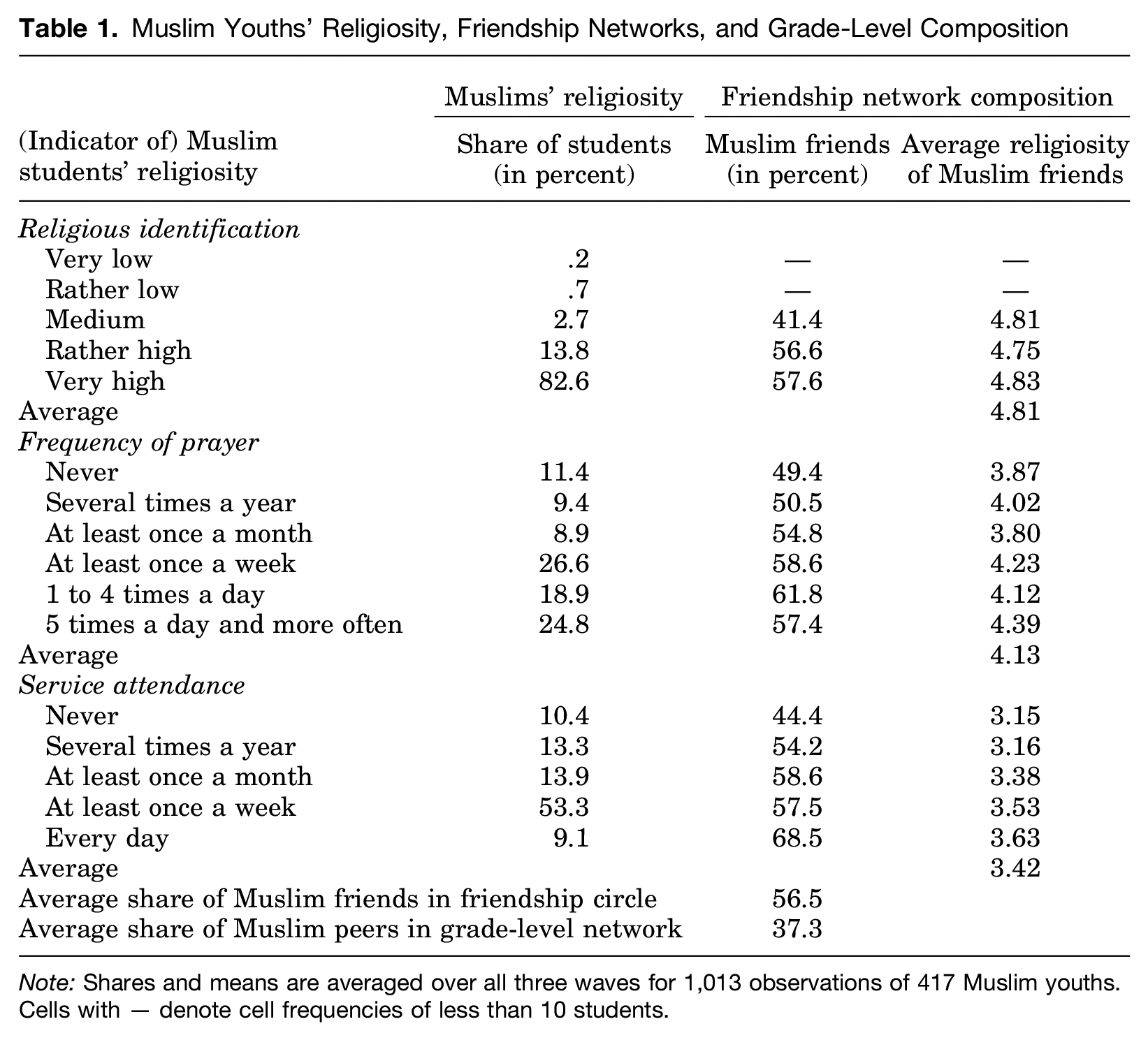
Note: Shares and means are averaged over all three waves for 1,013 observations of 417 Muslim youths. Cells with — denote cell frequencies of less than 10 students.
There is more variation in Muslim youths’ frequency of prayer. Following the Second Pillar of Islam, about one-quarter of the Muslim youths reported praying at least five times a day. Similarly high shares of Muslim youths, however, reported praying one to four times (19 percent) or at least once a week (25 percent), and smaller but still considerable shares prayed even less often. Mosque attendance shows a similar pattern of heterogeneity among Muslim youths. Although few of them reported daily mosque attendance (9 percent), more than half attended mosque at least once a week (53 percent). But again, more than a third of Muslim youths attended mosque only monthly or even less. In sum, although most of the Muslim youths in the sample identified very strongly with their religious ingroup, they differed regarding how often they prayed and attended mosque. The degree to which Christian youths engaged in religious practices also varies considerably, although at an overall lower level, with most of them praying and attending church several times a year or less. 8
The Association of Religiosity and Friendship Networks
Muslim students’ friendship networks tended to be segregated by religious affiliation. As the second column in Table 1 shows, more than half (56.5 percent) of their friends were also Muslims. This share of religious ingroup friends considerably exceeds the share of 37.3 percent that would result if friendships were formed by chance (i.e., irrespective of religious affiliation; note that this share is slightly higher than the share of Muslims in the sample because Muslim youths were not equally distributed across the grade-level networks). Christian students reported 63.1 percent Christian friends against a baseline expectation of 54.4 percent.
The share of religious ingroup friends further varied by individual religiosity, as also shown in Table 1. Consistent across the three measures, more religious Muslim youths had higher shares of Muslim friends than their less religious coreligionists. For example, 58 percent of the friends of Muslim youths with the strongest religious identification were Muslims, whereas this applied to only 41 percent of the friends of Muslim youths with medium religious identification (difference = 16.14, SE = 5.34, p < .01). Likewise, Muslim youths who prayed five times a day or more had almost 10 percent more Muslim friends than Muslim youths who never prayed (difference = 7.97, SE = 3.24, p < .05). Lastly, Muslim youths who attended mosque every day had almost 70 percent Muslim friends, whereas Muslim youths who never attended mosque had less than 45 percent Muslim friends (difference = 24.12, SE = 4.13, p < .001). The individual religiosity of Christian youths, by contrast, was much less consistently associated with the share of their Christian friends. Christian youths with different levels of religiosity had roughly equal numbers of Christian friends. 9
Finally, the third column of Table 1 distinguishes how religious Muslim youths’ Muslim friends were. Reflecting little variation in Muslim youths’ religious identification, no pattern is visible. By contrast, Muslim youths who prayed more often and who attended mosque more frequently also had Muslim friends who, on average, reported praying more often and attended mosque more frequently. Unlike for the share of religious ingroup friends, these patterns also applied to Christian youths, the more religious of them also having Christian friends who were more religious.
Taken together, the reported associations indicate that the religiosity of Muslim (and Christian) youths may partly be a function of their friendship networks or that they might befriend peers based on religion and religiosity. Answering this question, however, requires estimating multivariate statistical models that separate influence from selection mechanisms and that account for competing mechanisms of friendship network evolution that may result in Muslim youths being similar to their friends.
Do Higher Shares of Muslim Friends Increase Muslim Youths’ Religiosity?
Table 2 summarizes the findings of the SAOM meta-analyses for all three measures of religiosity. 10 As outlined previously, the statistical tests for the influence and selection hypotheses rest on linear combinations of coefficients from the estimated models. 11
Assessing Influence from Muslim Friends on Muslim Youths’ Religiosity and Selection of Muslim Friends Based on Religiosity
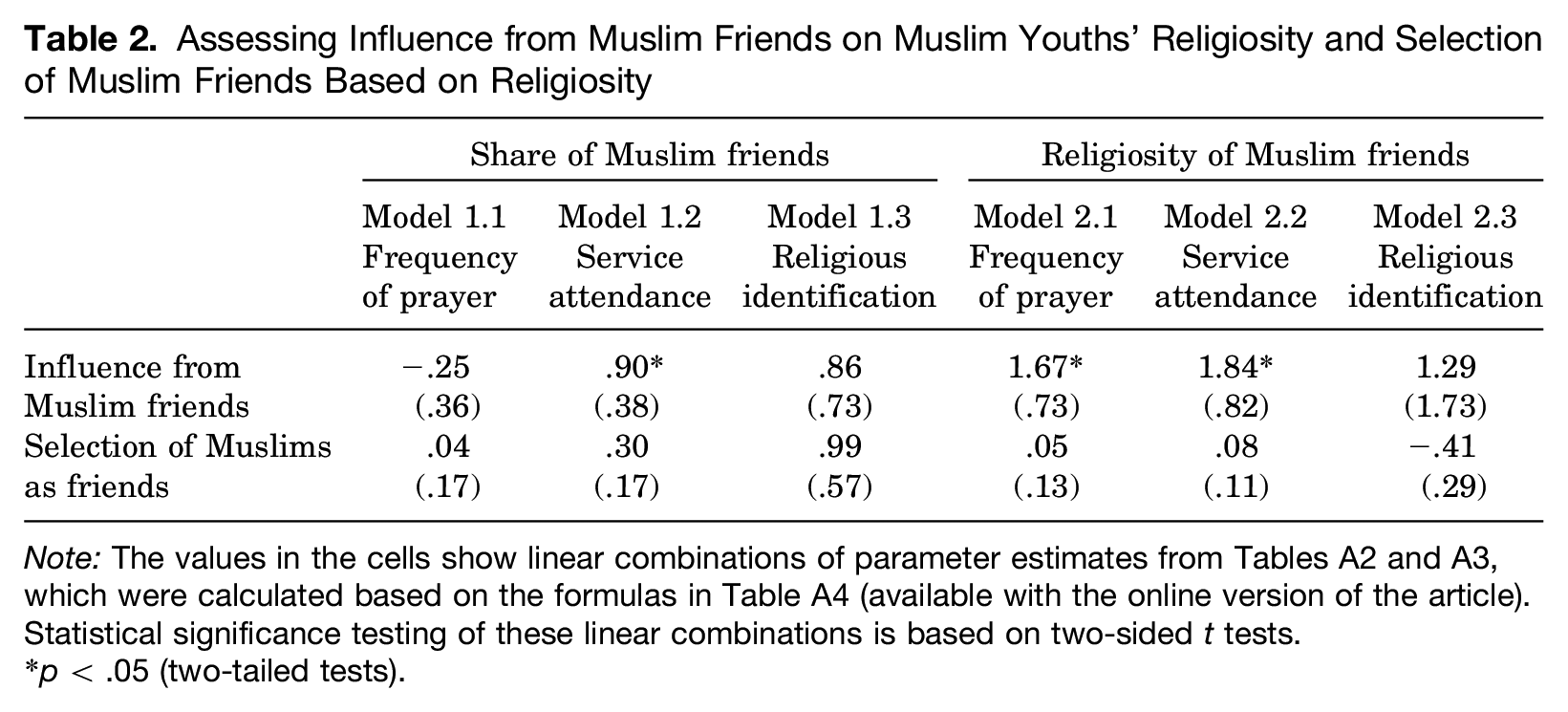
Note: The values in the cells show linear combinations of parameter estimates from Tables A2 and A3, which were calculated based on the formulas in Table A4 (available with the online version of the article). Statistical significance testing of these linear combinations is based on two-sided t tests.
p < .05 (two-tailed tests).
Starting with Influence Hypothesis 1, only service attendance (Model 1.2) of Muslim youths, though neither frequency of prayer (Model 1.1) nor religious identification (Model 1.3), was affected by the share of Muslim friends. 12 Muslim youths with only Muslim friends did attend mosque more often (b = .90, SE = .38, p < .05) than Muslim youths with no Muslim friends, but they did not pray more often (b = –.25, SE = .36, p = .48) or identify more strongly with their religious ingroup (b = .86, SE = .73, p = .24). Influence Hypothesis 1, therefore, was supported for service attendance and rejected for both frequency of prayer and religious identification. To grasp the magnitude of friends’ influence on mosque attendance, we may, using odds ratios, say that compared to a Muslim student with no Muslim friends, a Muslim student who has only Muslim friends has a 2.46 times (i.e., exp(.90)) higher likelihood of increasing frequency of mosque attendance or upholding already high levels.
Turning to Selection Hypothesis 1, the patterns are straightforward: for none of the three dimensions of religiosity, highly religious Muslim youths were more likely to befriend Muslim youths than less religious Muslims were. Importantly, however, the lack of an association of Muslim students’ religiosity and their friendship choices does not mean that they did not prefer befriending Muslim rather than non-Muslim peers in general. In fact, there is evidence of overall religious homophily in the sample. 13 Yet, this preference is not related to how religious Muslim students are, which contradicts Selection Hypothesis 1.
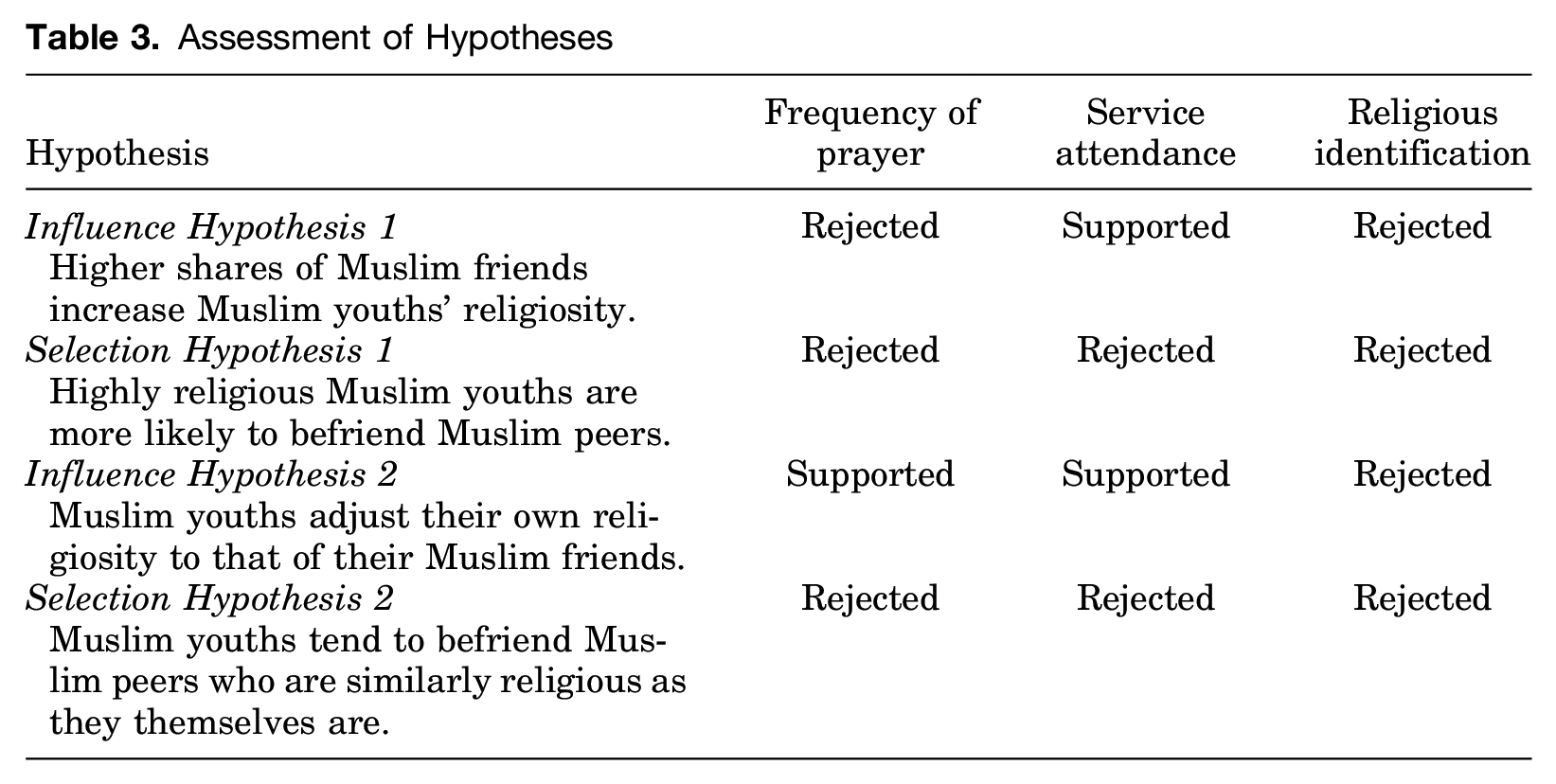
Table 3 summarizes the findings regarding Influence Hypothesis 1 and Selection Hypothesis 1 for all three dimensions of religiosity. 14 That is, just as their Muslim peers, Christian youths with higher shares of Christian friends did not pray more often and did not identify more strongly with their religious ingroup, but unlike their Muslim peers, they neither attended church more often. Moreover, their religiosity was likewise unrelated to their religious friendship choices, with the curious exception of Christian students who visited church more often being more likely to befriend Christian peers who attended church less often.
Assessment of Hypotheses
Do Muslim Youths Adjust Their Own Religiosity to That of Their Muslim Friends?
Continuing with Influence Hypothesis 2, as Table 2 shows, Muslim youths assimilated the frequency of prayer (b = 1.67, SE = .73, p < .05) and the service attendance (b = 1.84, SE = .82, p < .05) of their Muslim friends. By contrast, they did not adjust their religious identification to that of their friends (b = 1.29, SE = 1.73, p = .46). Influence Hypothesis 2, therefore, is supported for religious practice but not for religious identification. Although the magnitude of these effects in general is difficult to assess, we may state that a Muslim student whose Muslim friends’ average frequency of prayer differed by 1 unit from his or her own (i.e., lower or higher) was 1.40 times (i.e., exp(1.67 × 1 / (6 – 1))) more likely to increase or decrease frequency of prayer by 1 unit in that direction than to remain at his or her current value (Cheadle and Schwadel 2012; Ripley et al. 2020). For service attendance, this likelihood amounts to 1.85 (i.e., exp(1.84 × 1 / (4 – 1))).
Finally, Selection Hypothesis 2 is rejected because none of the three measures of religiosity was related to Muslim youths’ friendship choices. When choosing between Muslim peers as friends, Muslim youths accordingly were not more likely to befriend Muslims with similar levels of religiosity.
Table 3 summarizes the findings regarding Influence Hypothesis 2 and Selection Hypothesis 2. The influence effects on religious practice also hold for Christian youths, and these effects again did not statistically differ from those obtained for Muslim youths (p = .43 for frequency of prayer and p = .14 for service attendance). 15 Unlike their Muslim peers, however, Christian youths were also influenced in terms of their religious identification. The (lack of) selection effects also apply to Christian youths.
Discussion
European Muslims are at the center of current debates concerning the integration of ethno-religious minorities in Europe. With persistent high levels of Muslim religiosity and religious friendship segregation, scholars have suggested that social influence in religiously segregated networks is a key mechanism that upholds Muslim religiosity (Maliepaard and Phalet 2012; Phalet et al. 2018). Although this assertion is consistent with more general research stressing the role of networks for identity processes (Deaux and Martin 2003; McFarland and Pals 2005), earlier studies did not consider friends’ actual religiosity, thus providing rather indirect tests of the underlying argument of religious networks shaping individual religiosity. The direction of causality further has not yet been established because prior studies could not adequately account for the possibility that Muslim religiosity in turn shapes their friendship choices. Finally, the lack of a non-Muslim comparison group raises the question of whether identified patterns are unique to Muslims or whether they are part of more general processes.
Are Birds of a Feather Praying Together? Assessing Friends’ Influence on Muslim Youths’ Religiosity
Using a longitudinal network approach, we improve on earlier studies by considering friends’ religiosity, disentangling influence from selection mechanisms, and providing a Christian comparison group. Based on three waves of German friendship network data in religiously diverse schools, our first key finding is that having more friends of the same religious group does not per se make Muslims more religious. Neither how frequently young Muslims prayed nor how strongly they identified with their religious ingroup was affected by the share of their Muslim friends; only their mosque attendance was. Because the share of religious ingroup members also was not related to the strength of individual religiosity of Christian youths, we conclude that merely having higher shares of religious ingroup friends does not generally make youths more religious, at least not in the private realm of religious faith, as reflected by praying and religious identification.
How do these insights compare to prior studies? On the one hand, our result that having more Muslim friends is related to more frequent mosque attendance among Muslims is consistent both with the cross-sectional findings by Maliepaard and Phalet (2012) and with the more recent longitudinal ones by Maliepaard and Schacht (2018). On the other hand, in contrast to our results, these studies also found associations between friends and religious identification (Maliepaard and Phalet 2012) and frequency of prayer (Maliepaard and Schacht 2018). A direct comparison of these diverging findings is difficult, however, because of different target populations, with us studying Muslim youths in Germany, Maliepaard and Phalet (2012) studying adults in the Netherlands, and Maliepaard and Schacht (2018) studying recent adult Muslim immigrants in Germany, the Netherlands, and the United Kingdom.
A second key finding of our study is that Muslim friends’ actual religiosity influenced how frequently young Muslim youths engaged in religious practices. Specifically, Muslim youths tended to assimilate both their friends’ frequency of prayer and mosque attendance. No such influence effect was found for religious identification, however, which possibly reflects the fact that the vast majority of Muslim youths identified very strongly with their religion in the first place. This interpretation is supported by the fact that Christian youths, for whom there was more variation, adjusted toward their Christian friends’ religiosity on all three dimensions. Our findings concerning the role of Muslim friends’ actual religiosity go beyond the past studies of Maliepaard and Phalet (2012) and Maliepaard and Schacht (2018), neither of which included measures of friends’ religiosity. Our results, therefore, suggest that both Muslim and Christian youths are affected by their friends’ actual religious practices rather than by their mere membership in the same religious group.
Do Religion and Religiosity Drive Muslim Youths’ Friendship Formation?
Our findings regarding religiously driven friendship choices are straightforward. Whereas Muslim youths generally tended to befriend Muslim rather than non-Muslim peers, this religious homophily was not more pronounced among more religious ones. With the exception of church attendance, the same holds true for Christian youths. The finding that individual religiosity is not related to increased religious homophily is consistent with previous research on the same data that, however, did not separate the effects of the three different dimensions of religiosity and that also did not account for influence (Leszczensky and Pink 2017). It is also consistent with the study of Maliepaard and Schacht (2018:873), who found “little evidence that the degree of religiosity limits the social integration of Muslim migrants into majority populations.”
We further showed that Muslim youths also did not tend to befriend Muslim peers with similar levels of religiosity. This finding further strengthens the conclusion that religion rather than religiosity affects youths’ friendship choices. In addition, it questions the conclusion by Maliepaard and Phalet (2012:143), who could not separate selection from influence but suspected that “the association between contact and religious identity expression is most likely a bidirectional process.” Although we again must stress that the results of the different studies cannot easily be compared due to different target populations, our findings suggest a unidirectional process, with friends influencing religiosity but religiosity not in turn affecting friendship selection.
General Implications for Research on Networks and Identity
Going beyond research on the integration of ethno-religious minorities, our findings also have more general implications for research on networks and identity. The integrative model of identity proposed by Deaux and Martin (2003:109) suggests that group membership often leads to homogenous networks that then “will strongly support their members, who in turn will develop a strong subjective identification with the group.” A key insight of our study is, however, that friends’ actual engagement with the ingroup rather than their mere membership in the same social category affects youths’ own engagement with the ingroup. This is consistent with the more general study by Walker and Lynn (2013), who also did not find an association between identity and the proportion of ties to members of the same social category. Thus, there is growing evidence that homogeneous networks alone, as defined by shared group membership, are not necessarily consequential for individual identification.
Similarly, our finding that youths’ own religiosity was not related to their friendship choices is consistent with the more general study by McFarland and Pals (2005:290), who found that “network relations play a major role in adolescent identity development, but identity dynamics play only a minor role in adolescent network change.” In combination with the findings described previously, this suggests not only that an individual’s group membership rather than identification affects network relations but that an individual’s network partners’ identification rather than their group membership in turn affects individual identification.
The conclusion, however, that religion rather than religiosity shapes youths’ friendship choices contrasts with findings from studies in the United States that found evidence of friendship selection on religiosity (Adams, Schaefer, and Ettekal 2020; Cheadle and Schwadel 2012; Cook, Schwadel, and Cheadle 2017). Because these studies examined youths that were older than those in our sample, developmental differences are one possible explanation for diverging findings because younger youths may be less able than older ones to accurately observe their peers’ religiosity. Another potential reason is differences in national context and religious composition. Whereas we examined Muslims in highly diverse schools in Germany, studies in the United States examined schools in which most students were Christian, and often these schools were ethnically homogenous too. Unlike Muslims in Europe, Christians in the United States do not face a bright boundary (Foner and Alba 2008). Religious affiliation, therefore, may shape friendship choices in contexts in which religious group membership is salient, as for Muslims in Europe, whereas one’s actual religiosity may be more consequential in contexts in which religious affiliation is less salient, as for different Christian denominations in the United States.
Limitations and Future Directions
Our finding that Muslim youths assimilate to their friends’ mosque attendance is consistent with the possibility that Muslims join their friends when attending mosque. Yet although mosques promote religious practices among Muslims, they also are a place where social activities are organized that are not necessarily directly related to individual religiosity (Voas and Fleischmann 2012). Considering the share of Muslim friends not influencing frequency of prayer and religious identification, the association between the share of Muslim friends and mosque attendance may thus in part reflect that youths want to meet their friends in their free time or participate in social events. Moreover, more so than frequency of prayer and religious identification, mosque attendance requires opportunities; the identified patterns thus might at least partly reflect the availability of a local mosque. Future research might shed light on the underlying processes by more specifically focusing on mosques and mosque attendance, possibly using qualitative methods.
We examined Muslim youths in German schools with comparably high shares of ethnic and religious minority youths. Further research should test whether our findings are generalizable to less diverse schools as well as to other countries where both the average levels of religiosity and the cultural backgrounds of Muslims and Christians might be different from our sample. Concerning the more general question of how religion and religiosity relate to friendship choices and the contrasting findings in the United States discussed previously, future research should test the possibility that religion rather than religiosity might be more important for friendship choices of American youths in religiously diverse schools.
Our sample further consisted of adolescents, whereas earlier studies on the association between European Muslims’ religiosity and their social relationships focused on adult populations. Unfortunately, it is more difficult to apply a longitudinal network approach to adult samples because their networks are less dominated by a single social context (e.g., school). Still, future studies may examine whether friends’ influence varies with age or at different stages of the life course. Another source of heterogeneity that could be studied is gender, given that especially mosque attendance tends to be gendered among European Muslims, with males attending more frequently than females. Finally, building on the work of Walker and Lynn (2013), future research might focus on structural features of friendship networks, such as the embeddedness of friends sharing a particular identification. Although considering friends’ religiosity, our study did not address relationships among friends. The pressure, however, to conform toward the religiosity of one’s friends might be stronger if one belongs to a dense clique of religious ingroup friends than if one’s religious ingroup friends are less connected to each other.
Conclusion
We provide longitudinal evidence for how friends influence the religiosity of young Muslims in Germany. We found only for mosque attendance but not for frequency of prayer and religious identification that having more friends that are Muslim was associated with higher individual religiosity. Additionally, considering the religiosity of friends, we further showed that young Muslims adjusted both their own frequency of prayer and mosque attendance to that of their Muslim friends. Finally, Muslim youths generally tended to befriend fellow Muslim peers, but this overall religious homophily was not related to individual religiosity. Taken together, our results suggest that religious friendship networks influence some but not all dimensions of Muslim youths’ religiosity but are not in turn affected by prior levels of religiosity.
Supplemental Material
Appendix – Supplemental material for Are Birds of a Feather Praying Together? Assessing Friends’ Influence on Muslim Youths’ Religiosity in Germany
Supplemental material, Appendix for Are Birds of a Feather Praying Together? Assessing Friends’ Influence on Muslim Youths’ Religiosity in Germany by Lars Leszczensky and Sebastian Pink in Social Psychology Quarterly
Footnotes
Acknowledgements
We thank the editors and three anonymous reviewers for helpful comments and suggestions. Part of this work was performed on the computational resource bwUniCluster funded by the Ministry of Science, Research and the Arts Baden-Württemberg and the Universities of the State of Baden-Württemberg, Germany, within the framework program bwHPC.
Funding
The author(s) disclosed receipt of the following financial support for the research, authorship, and/or publication of this article: This research was supported by grants from the German Research Foundation (DFG/KA 1602/6-1 and 6-2).
Supplemental Material
Supplemental material for this article is available online.
1
Because religiosity was not assessed for students who did not belong to a religious group, we assigned these students the lowest possible value on each of the three religiosity dimensions. It was necessary do so because a social network analysis cannot be carried out for a subset of students who belonged to a religion since the structure of the entire network is subject to the analysis. Our assumption seems defensible, given that research on European youths’ religiosity has shown that youths who do not belong to a religious group state a very low importance of religion ( ). That said, nonreligious students received special treatment in our statistical model, as explained in Note 3.
2
Table A1 in the provides further details about each friendship network.
3
4
The Muslim and Christian effects are not centered.
5
To achieve a higher number of converged stochastic actor-oriented models (SAOMs) and probe the robustness of our findings, we also estimated all models including effects for only Muslim and Christian students, respectively. The convergence rate of these less complex models indeed was higher, and the results replicate the main findings reported in the following.
7
Shown in Table A2 of the .
10
The full models are found in Tables A3 and A4 in the .
11
Table A5 in the provides the formulas for each hypothesis as well as one exemplary calculation.
12
For service attendance, SAOMs (Models M1.2 and M2.2) were estimated based on a four-point scale that collapsed the highest two values of at least once a week and every day. The reason was a poor fit for the five-point scale that resulted from the unconventional distribution of service attendance with around 50 percent of the Muslim students attending at least once a week (see Table 1) and daily church visiting being almost nonexistent among Christian students (see ).
13
Although calculating the linear combinations for overall religious homophily based on Models 1 and 2 is unnecessarily complex (because religiosity must be calculated out of the equation), we reestimated Model 1 without religiosity effects (see ; 13 converged SAOMs). Based on this, the estimate for Muslims’ religious homophily is .49 (SE = .07, p < .001) and is .40 (SE = .07, p < .001) for Christian students. For example, the linear combination used to calculate the estimate for Muslims was the average of the preferences to befriend Muslim over Christian peers and to befriend Muslim over non- or other-religious peers (i.e., Muslim Alter × 1 + Christian Alter × (–.5) + Muslim Ego × Muslim Alter × 1).
14
Table A6 in the further shows that the findings for Muslim youths are similar to those for their Christian peers.
15
As can be seen in Table A6 in the .
Bios
References
Supplementary Material
Please find the following supplemental material available below.
For Open Access articles published under a Creative Commons License, all supplemental material carries the same license as the article it is associated with.
For non-Open Access articles published, all supplemental material carries a non-exclusive license, and permission requests for re-use of supplemental material or any part of supplemental material shall be sent directly to the copyright owner as specified in the copyright notice associated with the article.
