




Abstract
Contemporary puppetry reveals complex layers of meaning in Shakespeare's plays by exploring the interactions between dramaturgy, puppets and objects, and mental images. This study examines this complexity, focusing on (1) how object theatre repurposes objects to represent characters, exploiting the meta-theatrical dimension of Shakespeare's work; (2) how object theatre reconstructs dramatic action from a character's point of view, enriching their subjectivity; (3) how puppeteers resurrect the past with ghostly presences; and (4) how tensions between artificial and live actors create hybrid works where text, stage design, and music are equally important. Both metamorphic and oxymoronic, puppetry mirrors Shakespearean writing.
Faced with works as ‘glorious’ 1 and ‘magnificent’ as Shakespeare's, French puppeteer Michel Laubu of Turak theatre company confessed that all he felt he could do with his puppets and cobbled-together objects was to ‘sift through the text to keep only the large stones and let the sand of the language slip through’. 2 This statement by a puppeteer who directed two shows that borrowed from Shakespeare's plays 3 raises issues about the status and treatment of the text. Does the adaptation of a Shakespeare play to the puppet stage necessarily mean saying goodbye to large sections of the text? What, for example, are those ‘big stones’ that persist no matter how the puppeteers treat the play? How do puppets take on the expressive power of characters and situations? Are they able to use their own qualities to compensate for the loss of the ‘sand of language’, and therefore of the poetic dimension of the work? In this brief allegory of ‘large stones’ and ‘sand’ to describe the relationship between puppeteers and Shakespeare's plays, can we see the affirmation of an image-based way of thinking and the imaginative power of the material?
Indeed, in contemporary practice, the puppet does not pre-exist the performance: it is always, as American puppeteer Roman Paska points out, ‘a thing to be made, an object to be sculpted, assembled or found’, 4 an artefact that the artists need to invent in order to write their show and meet the requirements of their staging. The dual nature of the puppet – both a physical object and a character – means that the performance must be conceived with equal regard for the materiality of the objects, their expressive capacities and the source text. But this materiality is also the bearer of poetic qualities, in other words, of a plurality of possible meanings.
‘Puppet theatre is to theatre in general what poetry is to literature. Its conscience and soul’, Paska reminds us. 5 If this proposition proves to be true, perhaps the journey through the different artistic experiences examined here will enable us, as happens in The Winter's Tale, to rediscover, through the power of the puppet, what we thought was lost: this plurality of possible meanings, that is to say, poetic richness and dramatic complexity.
Since the second half of the twentieth century, puppet theatres have changed in a number of ways, affecting the way they perform, their aesthetic choices, the dramaturgy of their shows, and the way they deal with texts. 6 Puppeteers left their puppet booths to perform in full view of the audience where, often on large theatre stages, they explored all the possible relationships between actors and puppets. Everyday objects also started to replace the puppets. What is more, puppetry has become increasingly hybridised, influenced by trends in experimental theatre such as the distortion of the human figure, the incorporation of dance movements, prominent soundtracks, writing techniques inspired by cinema or video, and postmodern play on references to academic culture. 7 Within this evolving landscape, adaptations of Shakespeare's plays for puppets have mostly taken the form of ‘devised and mixed media productions’ in which ‘puppetry is only one discipline among many’. But, as Penny Francis points out, when ‘puppets are involved, the theme of the performance will [be] examined for its potential for metaphor, symbol, metonymy, metamorphosis and logistics of the staging’. 8
An analysis of the contemporary use of puppetry brings to light the different ways in which Shakespeare's theatrical writing and the objects used onstage interact, as well as the way the mental images evoked by the text interact with the physical images produced onstage. These interactions reveal an often complex stratification of meaning, depending on the nature of the items used (from everyday objects to the most sophisticated puppets) and the role assigned to them in the dramaturgy of the performance. To give an overview of this complexity, this study will be divided into four parts, each organised around an example. The first is focused on the re-purposing of objects to represent characters – a practice specific to object theatre that involves a paring down of the plot but nonetheless allows for an exploration of the meta-theatrical dimension of Shakespeare's work. Second, it will be shown that object play can be used to reconstruct the dramatic action from a character's point of view and enrich the rendering of his/her subjectivity. But the puppeteer, through the relationships he maintains with inert matter, can also resurrect the past and fill the Shakespearean stage with ghostly presences, as if consumed by death and madness: this will be the focus of part three. One last example will show how the tension built up between the respective presences of the artificial actor and the live actor can create hybrid works in which the text, the stage design, and the music all hold equal importance.
Shakespeare, objects and toys
Object theatre, which began in the late 1970s, uses ordinary, often mass-produced objects instead of puppets. These everyday objects, sometimes slightly altered, are used as ‘performing objects’ to engage the audience's imagination in various ways, including standing in for characters or translating action through metaphor and metonymy. 9 The operator remains visible to the audience and takes on a variety of roles, in turn, storyteller, actor playing a character, puppeteer delegating the representation of a character to an object, or demiurge engendering the dramatic action.
When adapting Shakespeare's plays for object theatre, the simplification of the dramatic action can be drastic, typically focusing on key scenes or famous lines to create short performances of usually less than an hour.
Tac Tac, a young French object theatre company, has embarked on a ‘Shakespeare cycle’, aimed at teenagers: Nos fantômes (based on Hamlet, 2019), Hamlet et nous (based on Hamlet, 2021), Tempête dans un verre d’eau (based on The Tempest, 2023) and Lady Macbeth (based on Macbeth, 2025).
One of the distinctive features of Tac Tac is that its shows are built around an actor-puppeteer (Clément Montagnier, alone onstage or with a partner – such as Thomas Michel or Marie Carrignon – who also acts as technical director) and three narrative layers linked to three different timeframes. The first of these is more or less the present time (which extends from the moment the show is conceived and written to the moment it is performed in front of the audience). The second is an auto-fictional timeframe, as Montagnier organises his narrative around memories of his adolescence and intense family drama: his difficult relationship with his own mother, remarried to a stepfather he resented after the death of his own father in Nos fantômes; his complex relationship with his brother, a mixture of closeness and rivalry, in Hamlet et nous and Tempête dans un verre d’eau. Finally, the third is the timeframe of the Shakespeare play Tac Tac has rewritten: the story of Hamlet, haunted by the ghost of his father and opposing his mother's remarriage, or the story of Prospero, betrayed by his brother and ultimately seeking not so much revenge as reconciliation with him. In the Shakespeare cycle as a whole, these three layers intersect and overlap in the playtext at very precise tipping points, despite the apparent awkwardness and fake improvisation. Each of these shows delicately articulates the intimacy with the spectacular, tragedy (or marvellous comedy) with object theatre, and transposes the metatheatrical dimension of Shakespearean theatre into a crazy debate over the form the performance should take.
In each of its productions, Tac Tac uses objects rather than actors to embody the characters wherever possible. Some of the manufactured objects used to represent the characters were chosen for their iconic and generational value. Nos fantômes [Our Ghosts] is the story of a teenager, Clément (Montagnier), who is under the spell of Steven Spielberg's Jurassic Park (1991) and who also identifies with Hamlet because of his family situation. At the start of the show, Clément is carefully digging in a small pile of soil on a table in the attic, trying to unearth a T-Rex. His friend Thomas is filming the scene, which is being projected live on a screen behind them. This is a direct reference to one of the film's opening scenes, in which palaeontologist Alan Grant makes an extraordinary discovery: the well-preserved skeleton of an extremely ferocious dinosaur. In the show, the exhumation scene takes on a metaphorical value, with the tragedy of the Prince of Denmark emerging from the ground to become the matrix of the show's imaginary world. And it is not without humour: in one of the scenes, Clément the actor runs on the spot ‘pursued by the tragedy of Hamlet’ with the same frenzy as the characters in the film trying to escape the dinosaurs intent on devouring them. ‘To grow up or not to grow up, that is the question’, he declared a moment before.
Standing mostly alone onstage, Montagnier voices all of the characters, from Shakespearean tragedy to his own family history: ‘Clément/Hamlet is played by a small plastic stag, while his mother/Gertrude is a white mare’. However, when Hamlet goes to his mother's room and kills Polonius in a fit of rage (3.4), the T-Rex takes the place of the stag, terrorising Gertrude with its uncontrollable violence. Less a character than a manifestation of Hamlet's vengeful fury, the T-Rex enriches the expressive possibilities of the actor-puppeteer, whose facial expressions, postures, and vocal outbursts convey the animal's bestiality in a highly convincing manner.
Carrignon, who also serves as Tac Tac Co-Artistic Director, explains the rationale behind the use of objects to represent the characters in this scene: This violence is defused by the parallel scene in which Clément confronts his mother as a harmless little tyrannosaurus: this time it's the mother who is transformed into a T-Rex, painted white, responding to her son. The reconciliation between Clément and his mother is illustrated by the return of the characters to their original state, as deer and mare. The show comes to a close with the dinosaur reburied under the same pile of earth as at the beginning. We bury the tragedy of adolescence at the same time as we bury the T-Rex.
10
The T-Rex appears again as a key figure in the next opus, Hamlet et nous. Carrignon justifies this choice as follows: Like many of our generation, we were swept up in the dinosaur-mania that erupted after the release of Jurassic Park in 1993. The T-Rex in the film frightened us and amazed us in equal measure and is a founding cultural figure in our relationship with images and narrative. Our plastic Schleich™ T-Rex has a highly evocative and metaphorical potential for us: a dizzying leap in time, a vanishing world, ferocity…
11
Bringing light into the darkness of Macbeth
Following the route of using objects to bring a character back to life to recount his or her story is a path also taken by English puppeteer Colette Garrigan in her show Lady Macbeth, the Scottish Queen (2015), but from a radically different perspective. Alone onstage, dressed simply in black, like a modern-day grande bourgeoise, the artist embodies the ghost of this evil queen. Shakespeare's tragedy is thus re-examined from the point of view of her character. The show opens with an address to the audience: We are in Scotland, in a room in Dunsinane castle. I have just taken my own life. It is the moment of Act 5, Scene 5 in the famous Shakespearian tragedy commonly known as ‘The Scottish play’. My husband's fate will be sealed in seven and a half pages, that is how the Bard wrote it! And that is the time I have to tell you how we got into such a pickle!
Beautiful crystal chandeliers conjure up images of a grand castle hall. A small table, set for two with luxurious, sparkling china, stands before Lady Macbeth. On a large white screen behind the actress are projected the huge shadows of candlesticks, which, in the audience's imagination, might become spears, swords, or battalions armed for war, or evoke the slender tree trunks of a stretch of forest. These are all ominous images that menace the woman, reinforcing the dreamlike nature of the show.
Garrigan's staging begins in Macbeth 5.1, when Lady Macbeth makes her first appearance and the point where the character tips over into evil. Three chairs represent the Weird Sisters, and two carved and sculpted antique crystal decanters – one very rounded, the other narrower – represent the royal couple. In the scenes that follow, as the murders progress, the water in the decanters becomes tinged with a blood-red liquid – the king's becoming increasingly opaque.
Such methods of representation, commonplace in object theatre, are transcended here by the interplay of light and shadow and imbue the performance with a sumptuous beauty that is a far cry from the ‘aesthetics of poverty’ usually found in this branch of performing arts, according to Jean-Luc Matteoli 14 : the cutlery becomes increasingly shiny, the crystal of the carafes and glasses diffracts the light to the point of incandescence, while the darkness closes in around the actress.
The physical properties of all the objects used in the show allow them to evade ordinariness and ‘reveal the invisible’, according to Garrigan. 15 The use of sound and voice also contributes to this effect. Garrigan voices all of the characters, sometimes distorted technically or echoing around the space, thanks to the HF microphone concealed on her body. She gives voice to Shakespeare's lines in English but repeats key elements of the story in French (the show premiered at the Théâtre Mouffetard in Paris). The puppeteer creates a dramaturgy of sound through the use of the water she pours again and again into the crystal glasses, or by running her finger along the rim of the glasses. This lament of objects and water, captured and amplified by the microphone, makes audible the private obsession of this queen tormented by guilt. ‘Water is the depth of the unconscious into which a ray of conscious light has penetrated’, writes Carl Jung. 16 It seems that Garrigan's play translates exactly this idea through a re-reading of the Scottish play centred on the psyche of Lady Macbeth.
Brunella Eruli defines object theatre as ‘a theatrical form in which the traditional roles of subject and object are reversed […] [I]t is the starting point for the question, “Who is speaking and what are they speaking about?”’ 17 Ultimately, the objects in Garrigan's show speak not so much Shakespeare's language but a secret, sensitive language of sound, shadow and light that conveys what lies behind the original text: the deep subjectivity of a woman struggling in the darkness.
Obsession, possession, and necromancy
Retrospective narration, as used by Garrigan, is a fairly convenient method for puppeteers in that it provides a framework for their adaptation of Shakespeare without requiring them to retain all of the scenes or characters and even fewer of the words from the source work. This is exactly how the German company Figurentheater Wilde und Vogel proceeds in its two Shakespearean productions, Exit. Ein Hamletfantasie (1997) and Lear (2008). Here, I shall examine only the second, which has been less frequently discussed. 18 In Lear (based on Shakespeare and Samuel Beckett, performed in German and directed by Hendrik Mannes), 19 the action onstage begins after the death of almost all the characters in particularly atrocious conditions. It is clearly influenced by Jan Kott's Beckettian reinterpretation of King Lear. 20
Much like the Hamm and Clov duo in Beckett's Endgame, Lear (played by Franck Schneider) and his Fool (puppeteer Michael Vogel) find themselves the only survivors after the final catastrophic event. In contemporary dress, they are like prisoners in a space between two worlds, empty except for a few objects such as a folding chair in lieu of a throne, a bucket of water, old clothes, and crumpled papers scattered on the ground. Lear seems doomed to recall, with the help of his Fool, the main episodes of the tragedy he himself brought about.
The Fool-puppeteer brings back to life certain characters from the past, using puppets of different sizes and shapes and a variety of manipulation techniques. Lear, meanwhile, either responds to them or is a passive spectator of their actions. On rare occasions, he plays a more active role in the performance orchestrated by his Fool.
At the beginning of the play, just as in Shakespeare's tragedy, Lear questions his daughters about their love for him (1.1). However, the king, barefoot and wearing a large golden crown, is seated on a simple wooden chair where, crucially, he delivers all the lines that make up the deceitful responses of Goneril and Regan in the original text. One marionette brings together the two treacherous daughters in a single figure. Operated from above, the string puppet is traditionally the puppeteer's most noble instrument, both because of the technical virtuosity it requires, and because of the venues in which it appears (the major theatres of the court or big-city theatres) and the repertoires it performs (opera, drama, Shakespearean works, etc.) or even the metaphysical dimension that it readily embodies, a graceful figure at the mercy of the creator/operator who towers over it. Here, however, Goneril/Regan is merely a corpse brought back to life by the necromantic puppeteer: dishevelled, dressed in a dirty white dress stained with blood around the chest, this slender figure with fine features has the greyish skin of a decaying corpse. 21 Her extremely thin arms, disproportionately long in relation to the rest of her body, end in outsized white hands. These same arms raised to the sky accompany the bombast of Lear's daughters’ false declaration of love. The puppeteer himself, spreading his arms to give the marionette a greater range of movement, uses it to create a strong theatrical image, firing the imagination of the audience, who may see in the strings the snares of a trap set for the king or recognise in them the theatrum mundi motif in miniature, with the strings of fate and manipulation.
The rest of the scene evokes another motif from Shakespeare's canon: that of the spectre. Cordelia, or at least what remains of her, is represented by the hairless head of a strikingly beautiful woman. She emerges from what appears to be a dingy old blanket, crumpled up on the ground. Her head, whose operator is hidden by the fabric, slowly rises vertically and the coarse material to which it is attached immediately becomes the puppet's body and its costume. Pulled up to its full height, the puppet becomes an almost human-sized silhouette that conceals the kneeling puppeteer. When King Lear asks her about her love for him (1.1), Cordelia, instead of answering, slowly tilts her body backwards to the horizontal in a choreographed movement, then straightens up again with the same languid slowness. Walking tall, she gets to within touching distance of Lear, looking him straight in the eye as he speaks, before turning her back on him and slowly plunging headfirst to the ground, to become a shapeless heap of fabric once again. The otherworldly movements of the mute Cordelia are accompanied by a succession of long shrill sounds: the very disharmonious and incomprehensible language of a spectral apparition.
A little later in the performance, a fresh Shakespearean motif, metamorphosis, is showcased by a marionette. Through its visual appearance and Vogel's voice, the marionette draws extensively on the web of images in the source text (especially the bestiary) to radically reinvent Edgar's image. This string puppet makes a particularly spectacular entrance. What appears to be vulture circles in the air, then lands to sing John Dowland's ballad ‘Come again, sweet love’ (1597) in a hoarse voice, facing Lear. Once on the ground, what looked like its wings are now just the tattered remains of a faded pink garment. With its red tongue sticking out, a tuft of hair, a little rouge on its cheeks, and its legs ending in long, disturbing fingers, the bird of prey still seems to retain some human features. Through its ambiguities (human/animal, skeleton/living body), the puppet's very appearance crystallises these different identities, while giving them a sepulchral quality.
Lear then questions the creature, asking if his daughters have made him this way. In a rambling speech, the strange bird alternately portrays himself as a beast hunted down and tortured by an evil power, or as a bloodthirsty predator (‘fox in / stealth, wolf in greediness, dog in madness, lion in / prey’, 3.4.99–101) just as base as his sources of food (‘But mice and rats and such small deer / Have been Tom's food for seven long years’, 3.4.146–7).
22
Audiences familiar with Shakespeare's work will immediately recognise extracts from a speech made by Edgar, here transformed into Tom o’ Bedlam. Vogel, who also makes his own puppets, takes the most evocative visually and materially violent images from the tragedy. He then transfigures them using the materials and mechanisms amassed in his workshop to generate new forms. The image of the vulture does not appear in the vast bestiary mentioned by Edgar/Tom, but earlier, in a line from Lear who likens Goneril to a vulture devouring his heart (2.4.151). However, it is the first image that comes to the audience's mind upon seeing the marionette, until other mental images are superimposed on the first. The puppet, born of a material and poetic assemblage by its maker, demonstrates its ability to lend itself to the projections of the audience's imagination, a quality that Didier Plassard calls its ‘metamorphic’ value: The theatre of animated forms, as we have long observed, is naturally metamorphic: its stage language is that of the ‘becoming-animal’ or the ‘becoming-thing’ that we carry within us – of the ‘becoming-inhuman’ of the human being, one might say – as much as that of the ‘becoming-human’ of animals and objects. The threads of our destiny, but also those of our identity, are knotted and unravelled within it.
23
Perhaps Lear can be summarised as thus: the exploration of human nature as becoming-inhuman, becoming-animal
24
and becoming-object when confronted with absolute suffering. With his head held high and his face masked by the corpse-like features of an aged man with closed eyelids, the deposed king becomes Gloucester, screaming in pain as he faces what he takes to be the White Cliffs of Dover (4.6), while Vogel/Edgar, perched on a chair, pours a bucket of water over the old man. Devoid of any psychological depth and despite the cuts made to Shakespeare's text, the theatrical image takes shape before the audience's eyes through the juxtaposition of ordinary objects and the reduction of the human form to a monstrous combination of a face frozen in pain and a tottering body. In this scene, the actor playing Lear is himself playing Gloucester through a mask-puppet, which becomes the puppet of an Edgar played by the Fool-puppeteer. The mise en abyme created by the interweaving of the two plots is like an overlay of photographs, heightening the motifs of distress and madness. As Kenneth Gross reminds us in Puppet: An Essay on Uncanny Life, the art of puppetry is in a perpetual dialogue with madness: There is something in the puppet that ties its dramatic life more to the shapes of dreams and fantasy, the poetry of the unconsciousness, than to any realistic drama of human life. That is part of its uncanniness, that its motion and shapes have the look of things we often turn away from or put off to bury. It picks out our madness, or what we fear in our madness.
25
The dream of the artificial actor and its transfigurations
Other theatrical productions based on Shakespeare's plays have for decades combined puppets and live actors onstage. Arguably more striking, however, are the shows in which, for example, the puppet adheres to the actor's body like a prosthesis or a graft, or when the actor finds himself transformed into a puppet, a dummy, an automaton, or even a statue. It is not a new process: it has its roots in the history of experimental theatre in Europe and was particularly prevalent in the period from 1910 to 1930, when poets and painters sought to replace the living actor with his ‘effigy’, to coin a term used by Plassard. It was then that the dream of an artificial actor or dancer (first mooted by the German writer Heinrich von Kleist, 26 taken up by the French writer Alfred Jarry, the Belgian author Maurice Maeterlinck, and the English theatre director Edward Gordon Craig) took shape in avant-garde movements such as Constructivism, Dadaism, and Italian Futurism, and also in the Bauhaus theatre workshop directed by German scenographer and choreographer Oskar Schlemmer. 27 At the turn of the twenty-first century, these utopias resurfaced in other forms, in the context of what Penny Francis calls ‘divided and mixed media productions based on experimental explorations’: their encounter with Shakespearean texts gave rise to fascinating and composite works, in which the strangeness of the stage design resonated with the poetry of the words.
This section will focus on Romeo e Giulietta [Romeo and Juliet], an iconic show by the Teatro del Carretto, 28 a company founded in 1983 in Lucca, Tuscany, by Maria Grazia Cipriani, playwright and director, and Graziano Gregori, set and costume designer. Their first production based on a Shakespeare text, created in 1983 and then revived in 1997 for an international tour, is characterised by its staging of the ‘actor as an effigy’ and by the equal status accorded to the text, the stage design and the music, particularly opera.
The core of the company's approach, according to Cipriani, is located ‘where the paths of the artificial actor, who gives the illusion of subjective motions, and the human performer, striving for the impossible objectivity of artistic artifice, intersect’ [‘dove se intersecano le strade dell’attore artificiale, che dona l’illusione di moti soggetivi, e l’interprete umano, teso verso l’impossibile oggettività dell’artificio artistico’]. 29 The performances therefore rely on a dual dynamic: on the one hand, that of the artificial actor (puppet, sculpture, and object), whose perfectly executed animation must create the illusion of life; and on the other hand, that of the living actor, who uses the extraordinary perfection of the artificial figure as a model in an attempt to surpass it. The resulting tension inevitably makes the audience feel unsettled, as if between the living and the dead, the real and the fake.
These ideas are directly applied in Romeo e Giulietta, where Cipriani chooses to use puppets to play the lovers and dehumanised actors to play the other characters (the ‘adults’): ‘actors have motionless masks and unnatural movements as if they were puppets, and the puppets emerge from the darkness with the naturalness of small human figures’ [‘attori hanno maschere immobili e movenze innaturali come fossero pupazzi e i pupazzi emergono dal buio con la naturalezza di piccole figure umane’]. 30 The line between the human and the non-human is blurred here, as is the distinction between the real and the fake. Only rarely does one catch a glimpse of the flesh of the actors playing the parents, like a distant memory of a long-forgotten humanity. The adults in the play, locked behind their masks, have built a frozen and grotesque world around them, which is both ‘hypocritical’ and ‘war-mongering’, according to Cipriani. 31 In contrast, Romeo and Giulietta are two very delicate papier-mâché figures, the size of 10- to 12-year-olds, constructed according to the principle of burattini a bastone (puppets manipulated from below using a central stick and various mechanisms), but in a highly sophisticated version to produce movements that are both fluid and precise. As the puppeteers are hidden under the stage, there is the illusion of the lovers as two automatons forming a fascinating little mechanical theatre (Figure 1).
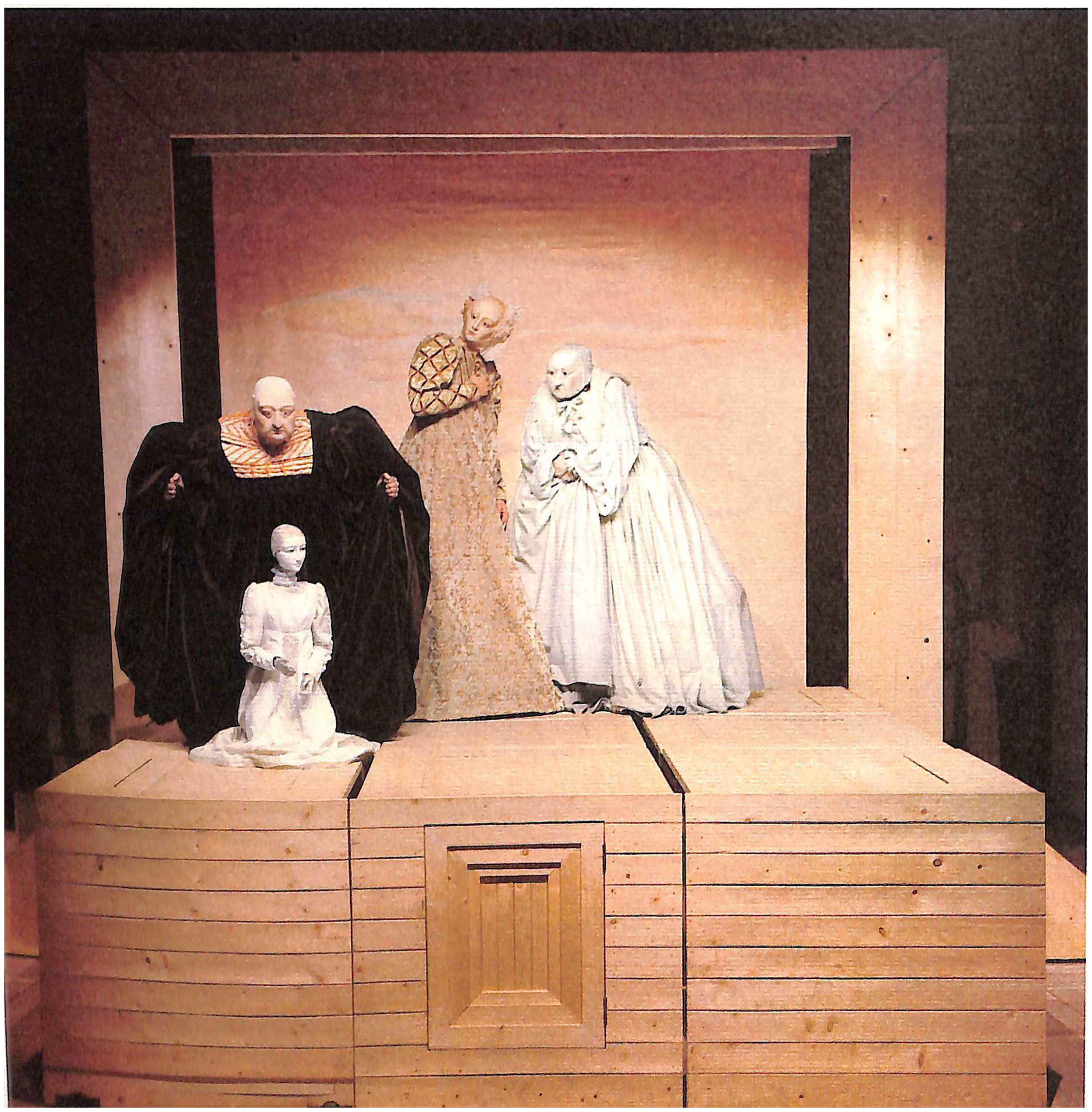
Foreground: Giulietta. Background, from left to right: her father, her mother, and the nanny. Romeo e Giulietta. Courtesy of Maria Grazia Cipriani/Teatro del Carretto. 41
A third category of characters invented by Carretto are burlesque figures that the director jokingly calls ‘balls of fat’: 32 the masked actors, probably crouching or kneeling, slip their arms into a padded servant's costume as wide as it is tall, which transforms them into puppets. This ‘chorus of minor characters, jesters, awkward and out-of-proportion actors take the place of the witty exchanges – often untranslatable. The din and the doltishness of their jokes visually underline the comic traits of the plot’. 33
The stage design is made up of cubes and modular platforms and includes a changing backdrop. Its design references three main types of stage space: the small wooden theatre reminiscent of both puppet theatres and music boxes; the ‘Elizabethan parallelepiped’ (as coined by Cipriani) 34 ; and the bare stage of the Commedia dell’arte. This set-up, ‘with its trap doors, tables and illusionistic backdrops’, 35 also allows for a multitude of surprise effects. In perpetual evolution, Graziani Gregori's stage design sometimes casts the audience as the privileged viewer of a miniature theatrum mundi (even though the show is performed on a large stage), while at other times it hearkens back to the empty space of the Elizabethan theatre (or Commedia) to showcase the actor's art, and at yet other times, it evokes a sense of grandeur. In each case, however, this stage design sublimates the myth of Romeo and Juliet. Yet, in the final scene – the show's climax – the stage design is deployed to better shatter the illusion at the end of the play. The lovers’ suicide takes us from the Elizabethan parallelepiped to the Capulets’ crypt by means of large wooden pedestals and six columns of fabric that descend from the theatre's rigging. The moment the lovers die, two live actors without masks take the place of the puppets. The platforms then move away towards the back of the stage, while the set's more majestic elements descend to the ground to the rhythm of Bellini's music. ‘The actors are dead. The poetry of this love, however, will live on forever’, says the director. 36
At the Teatro del Carretto, poetry is expressed less through words than through music. Cipriani has therefore chosen to superimpose Bellini's opera I Capuleti e i Montecchi (1831) on Shakespeare's play, while also referring to the Italian origins of the myth, such as the story of Romeo and Juliet written by Matteo Bandello, from which Shakespeare drew his inspiration. 37 But synchronising Bellini's opera, the acting and puppetry, and Shakespeare's play meant making sacrifices. First, because the libretto written by Felice Romani is not based on Bard's play, and second, because the story begins when Romeo and Juliet are already secretly in love and is tightly centred on a group of characters revolving essentially around Juliet. 38 Consequently, the Carretto show retains the essence of the scenes in Shakespeare's play, but the spoken dialogue is minimised in favour of song. The audience is thus treated to a total theatre experience in which the spellbinding power of the stage design is enhanced by bel canto: the myth of Romeo and Juliet is thus revisited via a synthesis of the arts, with actors’ theatre, puppetry, and opera striving to surpass their own evocative powers.
‘Confronting the world of Object Theatre with Shakespearean tragedy is at the heart of this project’, writes Clément Montagnier in presenting Nos fantômes: Our objects are everyday, thankless objects with no aesthetic value, but they hide within them a memory and a fatality that are close to the characters in the tragedy. […] They will end up on the junk yard in the disgrace and shame of the unused object. The characters in tragedy are not so different. They suffer a fate to which we are sensitive.
39
The confrontation between the world of Shakespeare and contemporary puppetry also highlights the expressive capacities specific to this form of art and, in particular, its ease in giving shape to what Montaigne called the ‘branloire pérenne’ 40 [perpetual swing] of the world: changing appearance, passing from the dead object to the living being, from the ignoble to the noble, from the status of object to that of character…. Both metamorphic and oxymoronic, playing on ruptures and contrasts, the arts of puppetry, one may be tempted to say, put into images the very movement of Shakespeare's writing.
Footnotes
Acknowledgements
The author wishes to thank Laura Haydon, who translated this article from French into English.
Declaration of conflicting interests
The author declared no potential conflicts of interest with respect to the research, authorship, and/or publication of this article.
Funding
The author disclosed receipt of the following financial support for the publication of this article: This article is one of the outputs of the European Research Commission PuppetPlays project (Horizon 2020 – ERC – G.A. 835193), which also paid for this publication's open access.
