




Abstract
Corporate sustainability rankings have become integral to global governance but their growing influence contrasts sharply with limited progress on urgent societal challenges. This raises critical questions about the value of rankings and the conditions under which rankings may drive substantive adoption of corporate social practices. In the context of the Corporate Human Rights Benchmark (CHRB), we find that (non)reactivity to rankings emerges under different combinations of commitment alignment, pressure and capacity for organizational transparency. Specifically, we find that societal pressure amplifies commensuration, capacity enables self-disciplining, while rankings can be ignored or avoided when commitment or pressure are absent. Furthermore, we find that lacking capacity leads to superficial or symbolic compliance depending on the pressure faced by ranked organizations. Our study advances research on rankings by reframing reactivity through a configurational lens, demonstrates how external–internal alignment fosters substantive implementation of social practices, and identifies the conditions under which rankings contribute to pluralistic governance in business and human rights.
Introduction
In recent decades, rankings have become part and parcel of the global landscape governing corporate sustainability. Rankings measure and compare corporate sustainability practices and policies and make the results publicly available for scrutiny by stakeholders. They rely on the disclosure of qualitative information about corporate practices and policies, and a measurement system that transforms this information into a quantified score or rank (Espeland & Sauder, 2007; Hansen & Flyverbom, 2015). Rankings are increasingly used by non-profit organizations to expose a lack of transparency on corporate social practices such as the implementation of the corporate duty to respect human rights (Bexell, 2022). Given the increasing reliance on rankings on the one hand, and a general lack of progress on pressing societal challenges on the other hand, it is imperative to study how effective rankings are in driving the substantive adoption of corporate social practices.
The extant literature on rankings has highlighted their reactive nature, where reactivity refers to the idea that ‘people change their behavior in reaction to being evaluated, observed or measured’ (Espeland & Sauder, 2007, p. 1). While previous research has established the main mechanisms by which rankings engender reactivity, it has encountered challenges in adequately accounting for causal complexity. Yet the external pressures exerted on ranked organizations combine with internal factors such as organizational capacity and commitment in causally complex ways (Sharkey et al., 2023). Recent studies have adopted a contingency approach to study reactivity to rankings (Lee, 2024; Lewis & Carlos, 2022), but these studies still focus on linear net effects of individual organizational or contextual factors. Building on configurational theorizing, we argue that reactivity is configurational, i.e. depending on different combinations of factors.
Furthermore, the significance of the reliance of rankings on organizational transparency has received little explicit attention in ranking research, yet organizational disclosure is often incomplete, symbolic or decoupled from practices (Heimstädt & Dobusch, 2020). This leaves an important gap in understanding under what conditions transparency-based measurement tools like rankings can generate substantive, rather than symbolic, changes in corporate practices – an insight that is crucial for designing more effective accountability mechanisms in global sustainability governance. Therefore, this research asks: Under which combinations of internal and external conditions will rankings lead to the substantive adoption of corporate social practices?
Building on the literature regarding reactivity to rankings and organizational transparency, we create a configurational model that includes commitment alignment, transparency pressure and organizational capacity for transparency. This allows us to examine causal conjunction, where it is the combination of these conditions, rather than their individual effects, that leads to the outcome of reactivity. We can also study equifinality, where different combinations of conditions lead to the same outcome, allowing us to more closely observe the different ways in which reactivity is triggered. Finally, acknowledging the critical perspective on organizational transparency, we examine which combinations of conditions do not lead to meaningful organizational responses.
We apply our configurational model to the Corporate Human Rights Benchmark (CHRB), a ranking of the corporate human rights policies and practices of more than 200 global corporations. We find that (non)reactivity to the ranking occurs under different combinations of commitment alignment, pressure and capacity for organizational transparency. Specifically, we find that societal pressure strengthens the commensuration mechanism for reactivity, whereas capacity enables self-disciplining. We also find that the ranking is ignored or avoided in the absence of commitment or pressure, while the absence of capacity leads to either a superficial or a symbolic approach, depending on the pressure faced by ranked corporations.
Our research generates several contributions. First, we contribute to the literature on rankings by developing a configurational perspective on reactivity, allowing us to better account for causal complexity. Such an explanation shifts the focus of research from the underlying mechanisms of reactivity to the conditions under which these are likely to be seen. Specifically, we offer a systematic approach to study the increasingly complex context in which rankings operate (Sharkey et al., 2023). Second, we contribute to the debate on the merits of organizational transparency for the adoption of sustainability practices (Haack et al., 2021), by showing various pathways to (un)intended consequences of transparency. Our insights mean that substantive implementation is more likely when the right combination of conditions can be fostered. Third, we contribute to the literature on corporate human rights by showing how rankings, in conjunction with social and regulatory pressure, can enable or hinder improvements in corporate human rights, providing unique empirical evidence for the call for pluralistic governance in this domain (Choudhury, 2023; Deva, 2023). Lastly, we draw practical implications for ranked corporations and issuers of rankings.
Reactivity and Transparency
Reactivity to rankings is generally explained in the literature by two mechanisms: commensuration and self-discipline (Espeland & Sauder, 2007; Sauder & Espeland, 2009). Commensuration refers to the process by which rankings quantify qualitative information to arrive at a scoring that can be compared across ranked organizations (Espeland & Stevens, 1998). It enables the comparison of performance across ranked organizations and leads to intense attention to ranking indicators, since minor differences may have substantial consequences for ranking order and scores (Espeland & Sauder, 2007). Ranked organizations, in turn, may self-discipline their behaviour through internalization of the ranking indicators to improve their future performance in the ranking (Sauder & Espeland, 2009). The effects of commensuration and self-discipline are especially strong when rankings obtain legitimacy with external stakeholders as a valid measure of organizational performance (Sharkey et al., 2023). Research has shown that rankings may lead to strategic changes, where ranked organizations adapt existing practices or adopt new practices in line with the ranking indicators, and also to gaming, where information is selectively or even falsely reported for the benefit of increased scores (Ody-Brasier & Sharkey, 2019; Sauder & Espeland, 2009).
Most sustainability rankings rely on organizational transparency, by ranking corporations based on their public disclosure. Despite the commonly accepted view of rankings as information intermediaries (Rindova et al., 2018; Sharkey et al., 2023), there has been relatively little attention for the consequences of this reliance on the organizational transparency of ranked corporations. Organizational transparency can be defined as the implementation of systematic programmes for information disclosure that meet the information needs of external stakeholders (Heimstädt & Dobusch, 2018, p. 727). Most research on rankings implicitly takes a causal perspective on transparency (Heimstädt & Dobusch, 2020), which equates transparency with accountability. Rankings are considered to facilitate accountability to external stakeholders by providing objective, comparable information on a large set of organizations. However, the causal perspective on transparency has been criticized by scholars who argue that organizational transparency may also lead to concealment and secrecy (Heimstädt & Dobusch, 2020; Ringel, 2019). Since organizational transparency is often incomplete or decoupled from organizational practices (Haack et al., 2021), the relationship between organizational transparency and accountability is more complex than frequently assumed in the extant rankings literature (Hansen & Flyverbom, 2015).
Tensions between organizational transparency and accountability are particularly prominent in the context of human rights due diligence (HRDD). HRDD is one element of the United Nations Guiding Principles for Businesses and Human Rights, which were adopted in 2011 (Wolfsteller & Li, 2022). HRDD requires corporations to ‘know and show’ (Ruggie & Sherman, 2017) what the adverse human rights impacts of their operations are, and to account for the measures taken to prevent or remedy these. Four key steps should be taken on an ongoing basis: (1) assessing actual and potential human rights impacts; (2) integrating and acting upon the findings; (3) tracking responses; and (4) communicating to stakeholders how impacts are addressed (Ruggie, 2011). While transparency is a key component in HRDD, the process may nevertheless be used by corporations as a ‘tick-box’ exercise that does not lead to accountability to rightsholders (Deva, 2021). Business and human rights scholars critically argue for better legislation to remedy these issues (Deva, 2023; Hess, 2019), while less attention has been paid to the use of rankings by non-state actors to incentivize the substantive adoption of HRDD (Bexell, 2022).
A Configurational Model of Reactivity
Research has shown that reactivity to rankings unfolds differently across settings but has struggled to examine contextual differences systematically (Sharkey et al., 2023). Recent studies adopt a contingency approach to study how reactivity is influenced by external factors such as the presence of multiple rankings or other types of information intermediaries, and internal, organizational factors such as the position and status sensitivity of the ranked organization (Lee, 2024; Lewis & Carlos, 2022). While such an approach moves a step closer to a systematic examination of the conditions under which reactivity occurs, we argue that a configurational perspective is needed to truly capture the causal complexity of reactivity to rankings. A configurational perspective moves beyond the analysis of linear, net effects of external or internal factors. Instead, it enables the study of the combination of conditions that are needed for reactivity to occur. Furthermore, a configurational perspective adds a much-needed comparative dimension, as it captures how differences in external and internal conditions interact. Many rankings focus on corporations in different international settings, which are subject to different stakeholder and institutional pressures. A configurational perspective systematically captures the way these external conditions, in combination with internal organizational conditions, affect reactivity. Such a perspective can deepen insights into the contingent effects of rankings, by identifying which combinations of conditions are linked to the outcome (Furnari et al., 2021).
We build on the literature on rankings and transparency to scope three sets of factors that encourage reactivity to rankings: commitment alignment, pressure for transparency and organizational capacity for transparency. Commitment alignment and organizational capacity capture the willingness and ability to respond to stakeholder demands that are theorized as internal drivers in the literature (e.g. Bundy et al., 2013; Durand et al., 2019). Pressure for transparency captures the external pressures that are exerted on organizations by various stakeholders – additionally theorized by Zald et al. (2005) to influence organizational responses, and particularly relevant to study reactivity to rankings (Sharkey et al., 2023). Below we argue how the presence or absence of these factors is linked to the outcome of reactivity to rankings and specify the conditions that capture these factors in our context.
Commitment alignment
Commitment refers to the degree of support that exists within the organization for stakeholder demands (Zald et al., 2005). If commitment to an issue is present within the organization, willingness to address stakeholder demands regarding the issue will be more likely (Durand et al., 2019; Zald et al., 2005), especially if these demands align with the organization’s identity or strategic priorities (Bundy et al., 2013). In the context of rankings, commitment to the topic of the ranking ensures that the ranked organization’s norms and values align with the underlying logic of the ranking. Commitment alignment is present when ranked organizations care about their performance in the ranking (Lewis & Carlos, 2022) and ensures they will pay close attention to their scores. Commitment alignment is absent when ranked organizations sense that the underlying norms and values of the ranking are not widely shared among their stakeholders (Lewis & Carlos, 2022) or conversely, when organizations perceive their own commitment as more extensive than that of the ranking (Schifeling & Soderstrom, 2022). This may explain why poorly rated organizations react to rankings by improving their performance (Chatterji & Toffel, 2010), while highly rated organizations may not draw attention to their inclusion in sustainability benchmarks (Carlos & Lewis, 2018).
We distinguish two conditions which capture commitment alignment in our context: initial commitment to core human rights principles and engagement in dialogue about the ranking. First, research shows that many corporations have outlined commitments to respect core human rights in their organizational policies (Favotto & Kollman, 2022). Such initial commitment in policies suggests alignment with the core ideas represented in the CHRB, which was designed to measure the quality of corporate human rights policies and practices (Corporate Human Rights Benchmark [CHRB], 2016). Second, corporate participation in dialogue about measurement can be seen as a sign of commitment alignment (Ferraro & Beunza, 2018). Such dialogue, which is usually invisible to the wider public, serves to exchange additional information between the ranking and ranked corporations, to improve measurement accuracy, and to check interpretations of performance against the standard of measurement (Slager et al., 2021), thereby fostering the alignment of commitment.
Pressure for transparency
Rankings do not exist in a vacuum, but function in a complex network of stakeholder demands for transparency that varies in density (Sharkey et al., 2023). These differences in external pressure affect the role of rankings as information intermediaries in causally complex ways. In a context where organizations face high pressure for transparency, and commitment alignment is present, the ranking is more likely to be seen as a useful information intermediary that can legitimize organizational disclosure through objective measurement (Clementino & Perkins, 2021). However, if commitment alignment is absent, high transparency pressure may hinder the organizational learning required for substantive implementation of sustainability practices (Haack et al., 2021). Two main sources of pressure for organizational transparency are government regulation and civil society (Knudsen & Moon, 2017; Marano et al., 2024). Previous studies have shown that corporations are more likely to react to rankings when they are subject to a more regulated environment (Chatterji & Toffel, 2010; Sharkey & Bromley, 2015) and that organizational transparency increases under high civil society pressure (Marquis et al., 2016).
Again, we distinguish two conditions that capture pressure for transparency in our context: government regulation on the disclosure of corporate human rights practices and societal pressure for transparency. Corporations have increasingly adopted human rights policies in recent years (Schrempf-Stirling & Wettstein, 2017), but selective disclosure of human rights impacts is still commonplace (Favotto & Kollman, 2022). This has led to the development of mandatory disclosure requirements in several countries (Chambers & Vastardis, 2021; Muchlinski, 2021) and therefore national and regional differences in pressure faced by ranked corporations across the world. Furthermore, scrutiny by the media and watchdog organizations of human rights violations by well-known corporations have led to increased pressure to account for human rights impacts (Wettstein, 2021). Institutional investors, such as pension funds, increasingly pressure corporations to undertake human rights impact assessments and improve their transparency about impacts on human rights (Goodman & Arenas, 2015), adding to societal pressure for transparency.
Organizational capacity for transparency
Even when ranked organizations are committed and face high pressure for transparency, they may not react to rankings when they have limited capacity to do so (Durand et al., 2019). Lack of capacity for transparency may stem from resource constraints (Durand et al., 2019) and/or organizational complexity (Kim & Davis, 2016). Organizational transparency requires the development of formal structures and systems for disclosure as well as corresponding roles and responsibilities (Heimstädt & Dobusch, 2018; Ringel, 2019), which can be resource intensive. Extant ranking research typically assumes that ranked organizations can provide disclosure straightforwardly. However, the critical perspective on organizational transparency points to the negotiations that are required to develop information systems that meet the demands of the organization as well as external stakeholders (Heimstädt & Dobusch, 2018; Hansen & Flyverbom, 2015). Furthermore, the increasing complexity of globally operating corporations hampers their capacity to provide transparency effectively (Marano et al., 2024). International diversification is a key source of complexity, as it increases the volume and diversity of stakeholder demands for transparency (Kim & Davis, 2016) and therefore requires greater investment of resources into the development of effective disclosure systems (Narula, 2019).
The final two conditions in our context are senior management responsibilities and international diversification. The first condition captures the common idea that responsibility for organizational transparency on social issues should be assigned to specific functions. The guidance on HRDD provided by the OECD for example suggests that corporations should establish senior management oversight and assign responsibilities to key departments (Organisation for Economic Co-operation and Development [OECD], 2018). Hess (2021) further argues that while HRDD can be integrated into existing compliance functions, the process needs to be overseen by a chief sustainability officer (CSO) and sustainability board committees. The presence of a CSO has been shown to aid adoption of social sustainability practices as this executive has the capacity to direct organizational resources towards social actions (Korendijk & Drogendijk, 2025). Equally, the presence of sustainability board committees helps direct attention and resources towards social practices (Fu et al., 2020; Korendijk & Drogendijk, 2025). Furthermore, senior management oversight acts as a reference point for external information seekers and can ensure a coherent approach to disclosure that meets the needs of external stakeholders (Heimstädt & Dobusch, 2018). The second condition captures the idea that international diversification creates organizational complexity, which hampers the ability of organizations to provide transparency (Kim & Davis, 2016). Internationally diversified corporations require greater resource investment to provide transparency on sustainability practices in globally dispersed subsidiaries and supply chains (Kim & Davis, 2016; Narula, 2019). At the same time, a greater geographical scope of operations also increases the likelihood of operations in countries or regions with weak governance and high risk of human rights violations (Narula, 2019; Wang et al., 2024).
Capacity for transparency interacts with pressure for transparency and commitment alignment in causally complex ways. For instance, Durand et al. (2019) theorize that capacity in the presence of commitment alignment may lead to a substantive response to stakeholder pressure, but when capacity is lacking, organizations will opt for symbolic responses such as selective disclosure. Haack et al. (2021) argue that enduring pressure for transparency regarding corporate sustainability practices may lead to a decoupling of disclosure from practices, since it hampers opportunities for organizations to learn and experiment with new sustainability practices. Our configurational model can examine how the different conditions related to commitment alignment, pressure for transparency and organizational capacity combine. In the next section, we describe the configurational method we employ to unravel the causally complex way these conditions interact with each other, and to examine which configurations are associated with the presence or absence of reactivity to rankings.
Methods
We focus our analysis on CHRB, which is one of the main benchmarks of corporate human rights practices. Although there are other sustainability rankings that cover the issue of human rights, the CHRB is the only benchmark organization that has consistently ranked corporations from multiple sectors since 2017 on corporate human rights practices specifically. The ranking was developed by a coalition of civil society organizations and institutional investors
1
to encourage corporate transparency on human rights. The coalition wanted to create a ‘positive competitive environment’ for rated corporations, and equip investors, civil society and regulators with better information (CHRB, 2016, p. 15). Our choice is also guided by the transparency of CHRB itself, which makes all information related to the benchmark, including its methodology and its scoring, publicly available. The measurement criteria of CHRB focus on corporate commitments in human rights policies, due diligence processes, grievance mechanisms and responses to serious allegations.
2
CHRB has repeatedly stressed that the benchmark enables a comparison of human rights performance across and within sectors, but acknowledges that the benchmark remains a proxy for actual human rights performance:
We know that human rights are fundamentally qualitative and hard to measure, which makes it difficult for any assessment to do justice to the complexity of the issues involved. Because of this, it will only ever provide a proxy rather than an absolute measure of human rights performance. (CHRB, 2019: 4)
Although this disclaimer has been criticized (Bexell, 2022; Maher, 2020), the benchmark has also been praised for its robust methodology and its potential to push corporations to substantially implement human rights practices (Hess, 2019).
Data and calibration
We employ fuzzy-set qualitative comparative analysis (fsQCA) as this method is particularly suited to examine causal complexity, including conjunctural causation, equifinality and causal asymmetry (where a condition can be associated with the outcome but also the absence of the outcome) (Misangyi et al., 2017). Our analysis is based on several data sources, including corporate-level data from the CHRB and other databases, and secondary data consisting of reports published by CHRB and rated corporations. While our QCA approach is predominantly focused on examining patterns in conditions (Thomann & Maggetti, 2020), we further complement our analysis with semi-structured interviews (n = 11) with representatives from CHRB, industry experts and rated corporations, to substantiate our theorization of the configurational mechanisms (see Table 1 for an overview of data sources and their use in the analysis).
Data sources.
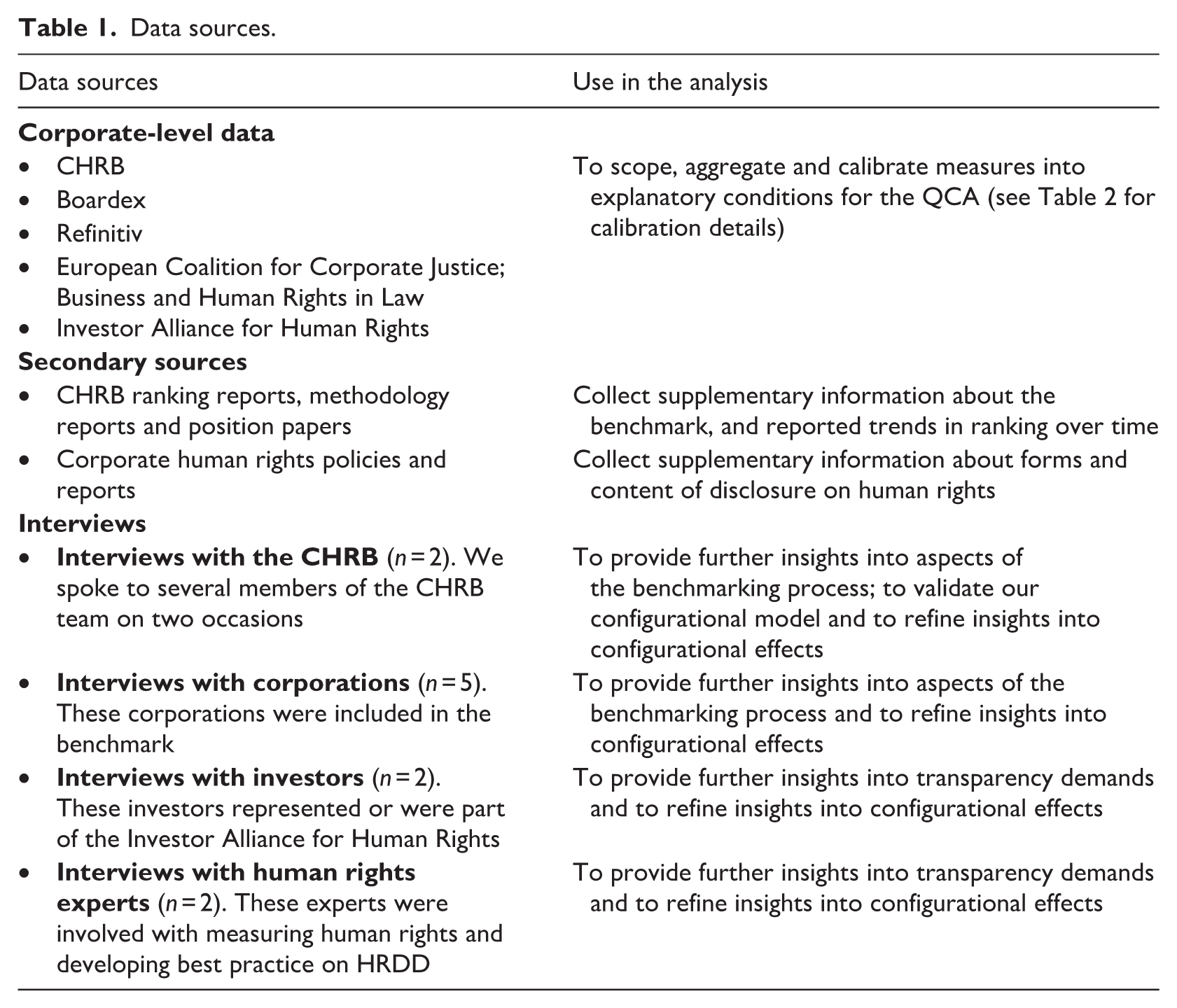
Our sample consists of corporations benchmarked by CHRB between 2017 and 2023, and totals 209 corporations for which we have complete data. CHRB focuses on the apparel, food, automotive, electronics and extractives sectors, but does not benchmark all sectors in each iteration. Our sample consists of corporations that have been included for at least three years, which are headquartered globally (see online appendix A for an overview of the sample).
The first step in the analysis consists of calibrating the data into sets, which can be crisp (0/1) or fuzzy (ranging between 0 and 1). We mix crisp and fuzzy sets and use theoretical and empirical knowledge to assign set membership (Ragin, 2008). Table 2 provides an overview of the calibration anchors, which we will discuss below.
Calibration table.
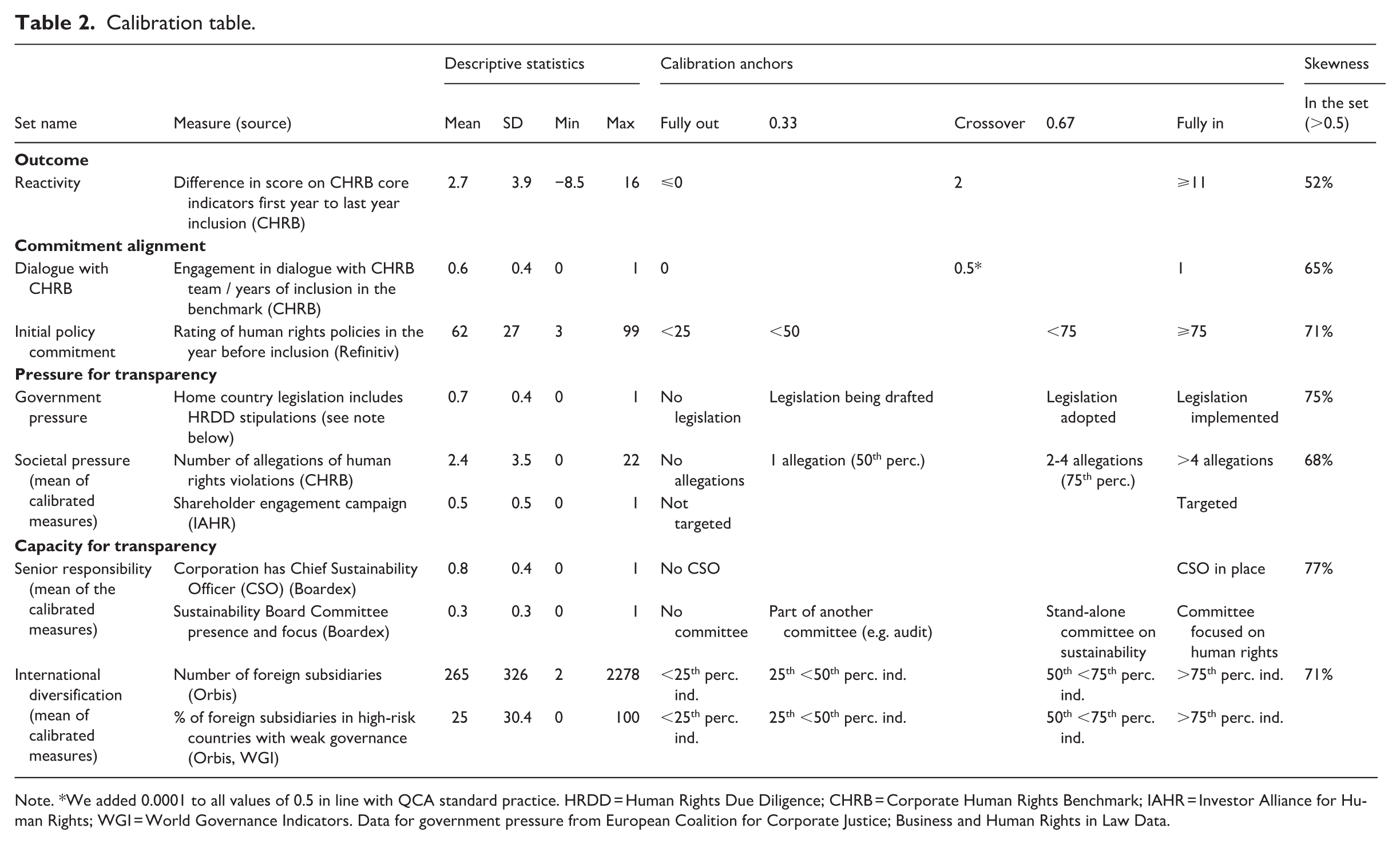
Note. *We added 0.0001 to all values of 0.5 in line with QCA standard practice. HRDD = Human Rights Due Diligence; CHRB = Corporate Human Rights Benchmark; IAHR = Investor Alliance for Human Rights; WGI = World Governance Indicators. Data for government pressure from European Coalition for Corporate Justice; Business and Human Rights in Law Data.
Outcome: Reactivity
Our outcome of interest captures reactivity to the CHRB as evidenced in score improvements over time. Over the years, CHRB has amended its ranking methodology, making it difficult to consistently compare results across years. However, a sub-set of indicators has remained stable over the period of 2017-2023, making them suitable for our analysis. These ‘core indicators’ (CHRB, 2021) capture the four steps of HRDD, as well as corporate commitment to respect human rights, and remedy and grievance mechanisms (see online Appendix B for a detailed description of indicators). These indicators form a sub-set of the overall benchmark that is closely aligned with best practice guidelines (CHRB, 2021). Almost all corporations received a low score on this subset of indicators when first benchmarked. We calculate the difference between the total score for the core indicators for the first and final year a corporation is rated. We calibrate the outcome into a fuzzy set, where full membership accounts for a 50% (11 points) increase in scores; non-membership means a decrease or no change in scores (⩽0 points), and the cross-over point is set at a 10% (2 points) increase in scores. In the early iterations of the benchmark, nearly half of the benchmarked corporations scored zero on the indicators related to human right due diligence (CHRB, 2019) and our results show that roughly the same proportion does not meaningfully increase their score over time. Table 2 shows that 52% of corporations in our sample are in the set of corporations that improved their score with 10% or more over time.
Commitment alignment
We include two conditions that capture alignment of commitment between rated corporations and the CHRB. The first condition captures whether the corporation has engaged in dialogue with CHRB regarding its score, as such dialogue provides an opportunity for commitment alignment (Slager et al., 2021). All corporations are invited by CHRB to discuss their assessment each time they are benchmarked. We collect data on engagement from CHRB and measure the number of times a corporation engaged in dialogue when benchmarked. We create the fuzzy set dialogue with CHRB to capture corporations that engaged the majority of times they were being assessed. Second, to capture a corporation’s initial commitment to human rights, we used the Refinitiv human rights score from the year before the corporation was first benchmarked. This score measures whether corporate policies refer to core human rights treaties. Such references are translated into a relative score between 0 and 100, based on comparison to industry peers. We calibrated these scores into the fuzzy-set initial policy commitment based on the standard Refinitiv classification of poor (<25), satisfactory (25–49), good (50–74) and excellent performance (>75) (Refinitiv, 2020).
Pressure for transparency
We include two conditions that capture different pressures for transparency on human rights faced by corporations: government regulation and societal pressure. Government regulation captures whether the government in the home country of the corporation has in place or is planning to implement legislation that requires disclosure of human rights policies and practices. We include legislation requiring reporting on human rights, HRDD and/or sustainability practices, or legislation containing provisions on ensuring corporate respect for human rights. We collect this data from the European Coalition for Corporate Justice and the Business and Human Rights in Law databases. For countries not covered by these databases, we conduct manual web searches for evidence of (planned) legislation. Acknowledging that corporations may increase their transparency in anticipation of government regulation (Hess, 2019), we calibrate the set government pressure based on whether the relevant legislation was in force (1), adopted (0.67), being planned (0.33) or absent (0) during the period under study.
The societal pressure condition is made up of two measures. The first measure represents public allegations of human rights violations, which we include to capture the level of civil society scrutiny. Corporations are expected to respond to such allegations, and we assume this increases pressure for transparency. The data on allegations is collected by CHRB from various sources, including RepRisk, a data analytics provider, and the Business and Human Rights Resource Centre, which gathers media reports. The data is verified by CHRB and evaluated separately from the core indicators we use for the outcome of our analysis. We use the total number of unique allegations faced by corporations in the period 2016–2022. As we were unable to identify a meaningful theoretical threshold for calibration, we calibrate this measure into a four-value fuzzy set based on sample percentiles (see Table 2). The second measure represents a crisp measure of targeted pressure exerted by shareholders. We collect data on shareholder activism from the Investor Alliance for Human Rights (the Alliance), a group of more than 200 investors representing US$12 trillion in assets under management, which has engaged in dialogue with corporations scoring zero points for HRDD in the benchmark (Investor Alliance for Human Rights [IAHR], 2023). Although there are likely more shareholders that pressure corporations for transparency, the Alliance explicitly targets corporations based on their CHRB rating and pressures them to be more transparent:
That is what we want: transparency. [When] companies disclose more, investors can make better choices. Consumers can make better choices. They make better choices with more information. [Let’s] leave aside all the questions and complications of actually accessing the data, analyzing the data, understanding the data, the comparability of the data. I mean, we all know the shortcomings that are there. But that’s the idea, [that] by shining that light, that’s going to really ensure the ‘know and show’, that the conduct is actually reflective of what companies say they’re doing or not. (Alliance representative)
We create the fuzzy set of corporations with societal pressure by taking the average of the two calibrated measures. This means corporations are in the set when they receive two or more allegations and/or have been targeted directly by investors from the Alliance.
Capacity for transparency
We include two aggregate conditions for organizational capacity that capture responsibility allocation and organizational complexity respectively. The first condition consists of two measures for the senior roles and governance channels that have been identified in the literature. The first measure captures the presence of a CSO, as this function is seen as key for substantive implementation of human rights practices (Hess, 2021). We obtain data from Boardex to create a crisp set indicating CSO presence (see Table 2). Additionally, research shows that CSOs can substitute as well as complement the influence of sustainability committees (Fu et al., 2020; Korendijk & Drogendijk, 2025). Therefore, the second measure captures the presence of a sustainability-related board committee. Such committees can fulfil management oversight of human rights impacts (Hess, 2021) but may be heterogeneous in their focus (Burke et al., 2019). We obtain data from Boardex to create a four-value fuzzy set based on the focus of the board committee (see Table 2). To create the fuzzy set of senior responsibility, we take the average of the two calibrated measures, so that it captures corporations that have at least one of these corporate governance channels in place.
The second condition captures organizational complexity due to international diversification, which hampers organizational capacity to provide transparency since it exposes corporations to a larger and more diverse set of environmental factors (Kim & Davis, 2016). These corporations also have greater exposure to reputation risk resulting from misbehaviour of subsidiaries (Li & Cuervo-Cazurra, 2024), particularly if these are located in countries where governance is weak (Wang et al., 2024). We measure international diversification based on the number of foreign subsidiaries and the percentage of foreign subsidiaries situated in countries with weak governance. We categorize a host country to have weak governance if it has a negative score in the World Governance Indicators (WGI) (Kaufmann & Kraay, 2024). The data for both measures are obtained from Orbis and the World Bank. As we were unable to identify a meaningful theoretical threshold for calibration, we calibrate both measures into a four-value fuzzy set based on sample percentiles per sector. To create the fuzzy set of international diversification, we take the average of the calibrated measures to capture corporations with an above average number of subsidiaries abroad and/or an above average number of subsidiaries in countries with weak governance (compared to their sector).
Analysis
We employ the QCA and SetMethods applications in R (Duşa, 2019; Oana & Schneider, 2018) to analyse the calibrated data. We first check if any of the conditions are necessary, i.e. always present when the outcome occurs. We set the threshold for necessity at 0.90, in line with best practice (Greckhamer et al., 2018) and find no necessary conditions. We proceed to analyse the sufficiency of the conditions, by deriving a truth table containing all logically possible combinations of conditions, and examining which combinations are found in the data and linked to the outcome (see online Appendix C). In line with best practice, we set the consistency threshold (the extent to which the combinations can be reliably linked to the outcome) at 0.8, and the proportional reduction in consistency (PRI, which accounts for the possibility that a combination can be linked to the presence and absence of the outcome) at 0.65 (Greckhamer, 2016). We set the frequency threshold (the number of cases that are empirically linked to a combination) at one. We tested the robustness of our results against more conservative thresholds and alternative calibrations, and our results remained stable (see online Appendix D).
The truth table is simplified into three types of solutions (complex, intermediate and parsimonious) that differ in their treatment of possible combinations that are not found in the data (so-called logical remainders). In line with the standard analysis protocol, we use the intermediate solution, which incorporates simplifying assumptions to deal with logical remainders (Greckhamer et al., 2018). We assume that the presence of all conditions contributes to the presence of the outcome, except for the condition international diversification, which we expect to contribute to the absence of the outcome. The intermediate solution allows us to distinguish core conditions – conditions with stronger causal links consistently present across all types of solutions – from peripheral conditions, which exhibit weaker causal links and are excluded from the parsimonious solution (Fiss, 2011).
In the next step, we used interview data for theoretical triangulation (Cornelissen, 2025), complementing our configurational grammar with qualitative evidence to contextualize the configurational effects of the conditions. We could not interview corporations that were assigned to the configurations in the QCA directly, as is standard practice for small N, case-oriented QCA approaches (Thomann & Maggetti, 2020). Instead, we asked highly rated corporations, external experts and members of the CHRB team regarding perceived barriers and drivers for transparency in the human rights domain and the influence of rankings. All interviews were recorded, transcribed and coded using Nvivo analysis software. Our first-order codes captured descriptions of benchmarking routines as well as evidence of reactivity and barriers for transparency. For instance, we noticed frequent mentions of performance comparison, close attention to the details of the ranking, and descriptions of decoupling behaviours of peers. We aggregated these first-order codes into second-order themes that were more theoretically informed. For example, we linked attention to ranking details and performance comparisons to the commensuration mechanism underlying reactivity. In a final step, we linked the qualitative evidence regarding the mechanisms to the configurations (see online appendix E for an overview of additional qualitative evidence). In the section below, we present the configuration results and draw on the interview data to complement our insights.
Findings
Table 3 presents the configuration results. We find three configurations of causal conditions where reactivity to rankings is present, and three configurations where it is absent. The consistency of the individual configurations and the model are near or above the 0.8 threshold. The coverage scores for the absence of the outcome are notably higher than the scores for the presence of the outcome.
Configuration results.
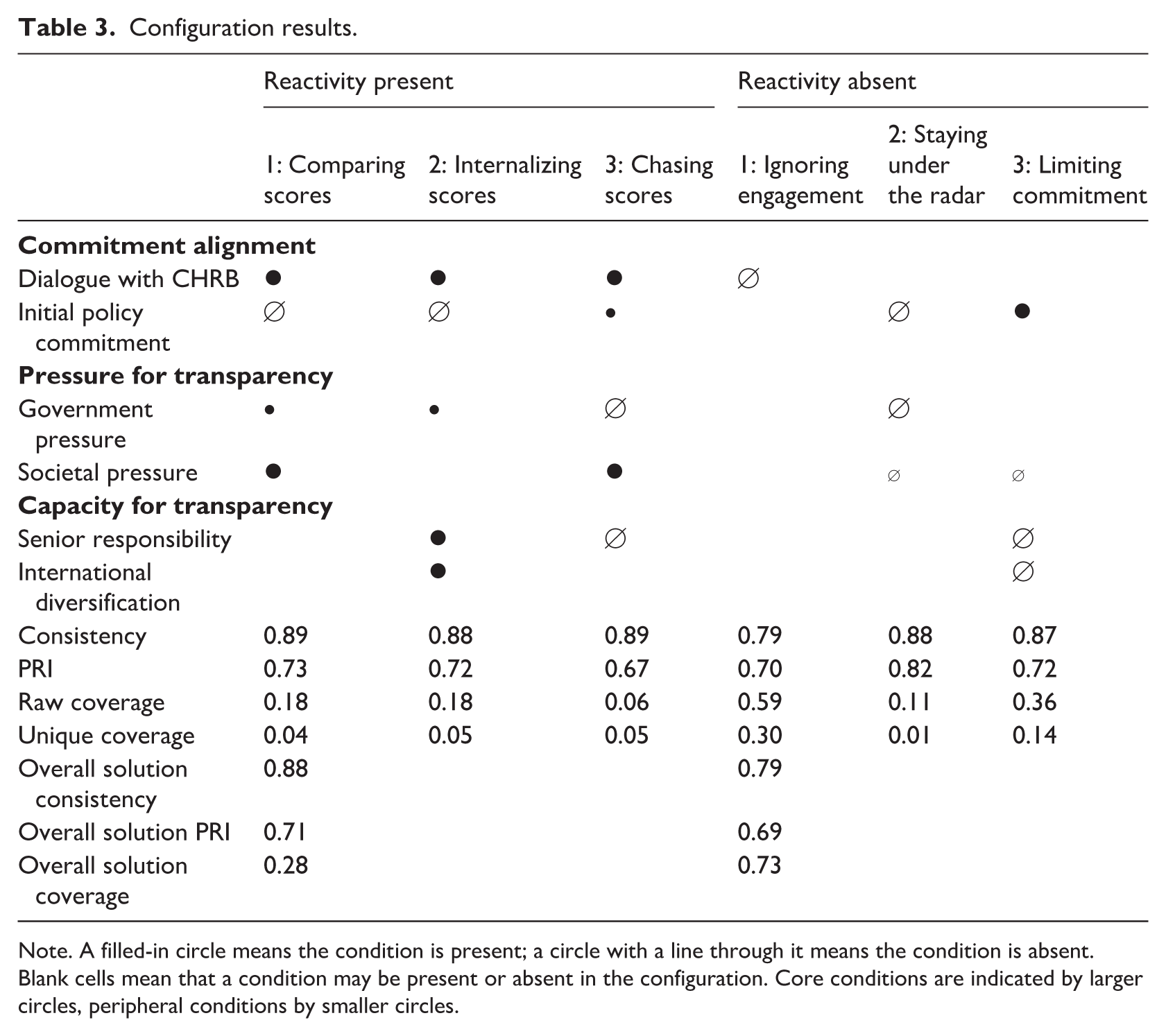
Note. A filled-in circle means the condition is present; a circle with a line through it means the condition is absent. Blank cells mean that a condition may be present or absent in the configuration. Core conditions are indicated by larger circles, peripheral conditions by smaller circles.
Overall, the causal symmetry in the dialogue condition is noticeable: all configurations for the presence of the outcome feature dialogue with the CHRB team, whereas the absence of dialogue features as the core and only condition in the first configuration for the absence of reactivity. This suggests that while dialogue with the CHRB team alone is not enough to increase scores, in the absence of such dialogue many corporations do not improve their scores. However, the condition capturing initial commitments made by corporations in human rights policies is causally asymmetric: the presence of such commitments can be associated with the presence as well as the absence of reactivity, depending on the combination with other conditions. Below, we first present our interpretation of the configurations exhibiting reactivity to the ranking, followed by our interpretation of the configurations that do not display this outcome.
Configurations for the presence of reactivity
The first configuration is labelled Comparing scores, and features societal pressure as a core condition and government pressure as peripheral. Furthermore, the two conditions capturing commitment to human rights are core, but mixed: the configuration captures corporations that engage in dialogue with the CHRB team but lacked policy commitments to human rights before being ranked. Our evidence shows that corporations pay close attention to the indicators that are used for benchmarking, triggering a process of comparison between company practices and benchmark indicators (see the additional evidence table in online Appendix E). Since quantitative scores are easy to compare, benchmarking also facilitates the comparison of corporations within and across sectors, and this comparison has been a key feature of the CHRB from the beginning. CHRB acknowledges that it does not have to be a perfect measure of corporate human rights practices to trigger reactivity, since the benchmark enables comparison:
We encourage civil society observers to recognize that improved scores may not necessarily equate to improvements on the ground or better implementation of human rights managements systems, but that increased disclosure is a necessary first step to levelling the playing field and enabling accurate comparisons of performance. (CHRB, 2018)
Our evidence suggests that within-industry comparisons have created a competitive drive among ranked corporations to increase their scores. Ranked corporations frequently report on their standing within their sector and pay close attention to their relative performance. Societal pressure enhances the comparison engendered by benchmarking, since it pressures corporations to maintain their relative performance in the benchmark. Publication of the annual CHRB results receives considerable media attention, and attracts the attention of policy-makers and investors, who see it as a robust template for measuring corporate human rights performance. For example, the Investor Alliance for Human Rights has encouraged low-scoring corporations to engage with the benchmark. Such societal pressure, which features constant comparison to other ranked corporations, has enhanced the intensity by which corporations scrutinized the criteria, and the attention they pay to the details of measurement:
So in the beginning where they could say ‘Oh, it’s just a ranking, we don’t care about that actually’, because of the fact that investors and policy-makers are taking it more seriously and starting to act on it and to put pressure on the companies, they now also have to take it more seriously themselves. (CHRB representative) So we’ve definitely found engaging and actually digging into the details of what they’re sending you is something you have to do. Just to make sure everything is consistent across the board of, okay, if we’re saying this in our policy and your assessment is saying that doesn’t count, but then you’re awarding it to these four other companies, well, are we taking points away [from them] or are we giving points to us? (American food manufacturer)
The second configuration is labelled Internalizing scores, and features (mixed) commitment and capacity as core conditions, whereas government regulation is peripheral. Like configuration 1, the core commitment conditions are mixed, but this configuration also features the presence of senior management responsibilities and international diversification. Our evidence suggests that this configuration exemplifies corporations who increase their scores by internalizing the embedded norms and practices promoted by the benchmark methodology. One interviewee for example recounted how their company had initially been rated as one of the worst performing corporations in their sector, and how they used CHRB’s methodology and discussions with the CHRB team to develop more extensive public reporting on their human rights practices (European extractives company). The benchmark is also used by corporations in a proactive manner for further improvement of their performance (see online Appendix E).
The presence of senior responsibility and international diversification as core conditions shows the enabling effect of capacity in this configuration. Our interviewees highlighted that executing human rights due diligence in global operations is very resource intensive. At the same time – and contrary to our expectations – their global presence enables them to allocate resources and senior management responsibilities for human rights, which creates the ability to react to the benchmark:
So as you can imagine, it’s made us incredibly unpopular because we’ve now taken what was a 24-hour process and turned it into a three-week process. But looking ahead at the regulations and the requirements, we simply can’t afford to do it any other way. So we have to overcompensate on that. [..] So it’s also time consuming. Quite resource intense. And I actually had to take this to our supervisory board last week because it’s a fundamental change in the way of working. (European food manufacturer)
In addition, the allocation of senior management responsibilities supports the use of the benchmark as internal leverage to increase transparency. Since HRDD reporting requires input from different functional departments within corporations, the benchmark is used to convince colleagues of the necessity to gather information for analysis and public reporting:
Internally we have a kind of leverage to explain to other functions that standards are evolving, the scrutiny is rising. It’s expected that we become more transparent and also that other companies eventually will follow. So it’s always a bit the risk of being the first mover in the industry, being so transparent. But I think in those terms it can be really helpful to use it also as a bit of leverage when you have to explain, okay, why do we need it? Because then you really have a recognized third party tool that really explains that this transparency is needed or some additional commitments or implementations are needed. (European construction company)
The third configuration is labelled Chasing scores. This configuration features commitment alignment and mixed pressure as core conditions. In contrast to configuration 2, configuration 3 features the absence of senior management responsibility as a core condition. This feature, in combination with strong societal pressure and an absence of government pressure, suggests that corporations associated with this configuration may actively seek score improvements by increasing transparency selectively. Such gaming was observed at other ranked corporations, with one interviewee indicating their choice not to engage in behaviour described as ‘improving scores, not actions’:
We did a mapping of our score last year and with very simple changes to our policy, one word here, one word there, we could easily increase our score and move up to the next category. We chose not to do that because I didn’t feel that it would really make a material impact. It wouldn’t change behaviours, ways of working or have anything meaningful operationally on the ground. But if you’re chasing the scores and you’re chasing the numbers, it’s quite easy to do that. You just have to say the right things, have the right policies. (European food manufacturer)
Our results suggest that chasing scores is a form of reactivity that may occur when societal pressure is high, but government pressure is lacking. Under these circumstances, corporations’ initial commitment to human rights is not reinforced by government regulation, nor internalized into senior management responsibilities. This means corporations may be looking for the ‘low hanging fruit’ by adding specific words or details in their policy and disclosure documents, to increase their scores on specific indicators. While corporations may be driven to such behaviour to ease societal pressure, the usefulness of transparency in these circumstances is increasingly questioned by stakeholders that rely on human rights disclosure, such as investors:
I’m not sure if enough people have thought through what good disclosure is and whether that translates into practice. So my fear around the world is that we’re going to end up with lots of companies providing information that might not necessarily be that worthwhile ultimately. (investor representative)
Configurations for the absence of reactivity
The first configuration for the absence of reactivity is labeled Ignoring engagement, since the absence of dialogue with the CHRB team is the single core condition. This configuration captures corporations that are ignoring dialogue with the CHRB team. After corporations are ranked, the CHRB team provides them with the opportunity to review their scores, before the ranking results are published. Corporations may provide information on policies or practices that may have been missed in the ranking process, as long as the information is publicly available. The dialogue also enables the team to further explain the ranking methodology and provide examples of good practices. Ranked corporations that do not engage in dialogue will still be included in the ranking:
CHRB does not give points for engagement and the methodology and assessment criteria are fully transparent and publicly available so there is no requirement to engage. We do however observe that companies actively engaged with CHRB score three times as much as non-engaged companies and that, on average, engaged companies’ scores improve at triple the rate of non-engaged companies. (CHRB, 2019)
Our evidence suggests that there are two distinct reasons for non-engagement. The first reason relates to the multitude of rankings, which makes it easier for ranked corporations to ignore a specific ranking, or pick and choose which ranking to engage with or to spend resources on:
In a world where there are limited resources and within the first two quarters of this year, we need to get out the Modern Slavery Statement, we need to respond to Know the Chain, we need to respond to the Corporate Human Rights Benchmark. Those are all very worthwhile disclosures and helpful things. But those in and of themselves are not moving the needle on addressing specific risks in a place for us. They may help raise internal awareness of types of issues or types of actions we may need to take in the future. But [..] that’s X amount of days or hours that our team isn’t focused on addressing an issue for people right now. And that’s the really delicate balance, sometimes you really do have to pick and choose what things you’re going to deeply engage in. (American food manufacturer)
The second reason relates more specifically to a fear of providing disclosure regarding human rights issues. Our evidence suggests however that some corporations still hesitate to provide transparency regarding negative human rights impacts. For example, one sector representative discusses how transparency about grievance mechanisms may attract more complaints, which is considered valuable from a due diligence perspective, as it shows that grievance mechanisms are being used. Ranked corporations may fear however that transparency about human rights grievances will bring down their scores in the benchmark (see also the additional evidence table in online Appendix E):
Perhaps other sectors like the apparel sector have gone a long way further on that transparency road than others. And so we still need to build that narrative and to build the conditions for companies to feel more comfortable about communicating more and being more transparent about human rights challenges in general. (food industry expert)
The second configuration for the absence of reactivity is labeled Staying under the radar, as it features a lack of initial human rights commitments and a lack of government pressure as core conditions. This configuration shows that in the absence of scrutiny, corporations that lack initial commitment to human rights in their policies avoid the benchmark and do not improve their scores:
While it appears that major listed corporations can and will take action in response to external pressures such as benchmarks and engagement based on the results, this effect appears mostly limited to those companies under scrutiny. (CHRB, 2019)
CHRB has acknowledged that scrutiny is an important driver for reactivity to the benchmark, and has called for stricter government regulation, supporting for example the proposals under development for due diligence regulation in the EU:
Voluntary measures, advocacy efforts and investor pressure have got us so far, but much more is still to be achieved beyond the basics. A smart mix of voluntary and mandatory measures are needed to accelerate the pace of implementation. Mandatory legislation is particularly necessary where progress resulting from voluntary measures has been slow, especially in key areas such as HRDD. Legislative efforts such as the EU Corporate Sustainability Due Diligence Directive are crucial to create a level playing field for all companies. (CHRB, 2022)
The last configuration for the absence of reactivity is labelled Limiting commitment. This configuration captures less internationally diversified corporations with initial policy commitments while senior responsibility roles are absent. It also features the absence of societal pressure as a peripheral condition. Our qualitative evidence suggests that the initial commitment to human rights may not lead to substantive human rights practices in this configuration of conditions. Here, ranked corporations do not react to the CHRB, which creates accountability tensions:
And then you get companies [..] saying ‘Well, we are doing it. Why do we have to write it down and tell you about it?’ [..] It’s a tricky one because of course writing something down doesn’t necessarily mean that you’re doing it properly, but on the other hand, not writing anything down, it can’t be assumed that you’re doing anything. (CHRB team member)
In this configuration, the absence of capacity appears to hamper reactivity to the benchmark, since lower international diversification may mean that fewer resources are available to produce extensive disclosure. For example, several interviewees that worked in larger multinationals emphasized the resources required to implement human rights due diligence and to maintain disclosure in line with recommended best practices, and acknowledged that these resources may not be present in smaller corporations:
It also takes resources to engage. And I think that’s where sometimes, depending on the very balance of different factors, some companies may not have the time or the resources to do it, especially to a point where they have a person, they go through every single line of the CHRB, evaluate how we’re scored, go evaluate our top seven peers on how they’re scored, see if there are any inconsistencies, raise those inconsistencies. There’s a lot that can go into really engaging in these things. (American food manufacturer)
Discussion
By building a configurational model of reactivity to rankings, our study finds multiple pathways to the presence or absence of reactivity based on different combinations of external and internal conditions. We show that rankings engender a process of competitive comparison in ranked corporations that is heightened by external societal pressure, whereas capacity – in the form of resources and responsibilities – enables ranked corporations to internalize the ranking indicators. However, the absence of senior management responsibilities may lead to a superficial approach consisting of chasing higher ranking scores when combined with external societal pressure. Furthermore, ranked corporations do not react when commitment alignment remains symbolically limited to corporate policies, and capacity for transparency is absent. We also find that the absence of external pressure or commitment alignment results in corporations avoiding or ignoring the ranking. Our findings contribute new insights to the research on rankings, organizational transparency and governance of corporate human rights.
We contribute to the literature on rankings (Sharkey et al., 2023) by developing a configurational perspective on reactivity. Extant research on reactivity to rankings has largely relied on linear models, which are not well suited to capture causal complexity. Using configurational methods, we extend theoretical insights into the mechanisms that trigger reactivity (Espeland & Sauder, 2007; Sauder & Espeland, 2009). For instance, the mechanism of commensuration engenders reactivity to rankings through quantifying qualitative corporate practices into a common metric (Espeland & Sauder, 2007; Espeland & Stevens, 1998). Our model shows that this mechanism is activated when ranked corporations face strong external pressure, as this enhances the attention to comparative performance created by benchmarking. The mechanism of self-discipline explains how the internalization of ranking indicators triggers reactivity in a proactive manner (Espeland & Sauder, 2007). Our configurational model shows that this mechanism is activated through the presence of internal capacity in the form of allocation of resources and responsibilities. Chasing scores, a form of reactivity that leads to superficial changes (Ody-Brasier & Sharkey, 2019; Sauder & Espeland, 2009), is likely to take place when external societal pressure is present, while senior responsibility is lacking, and the likelihood of regulatory sanctions is low.
Similar configurations of conditions are likely to be found in other domains, for example regarding metrics for carbon reporting used by investors and corporations (Rekker et al., 2021). As rankings continue to dominate organizational life and the number of information intermediaries increases, the untangling of external and internal factors that drive reactivity becomes more complex (Sharkey et al., 2023). Future research can build on our configurational model to study reactivity to rankings in other domains as well as the joint effects of various rankings on the adoption of organizational practices and market dynamics (Geiger & Bourgeron, 2023; Sharkey et al., 2023).
Our second contribution relates to the debate on the merits of organizational transparency for substantive improvements in corporate sustainability practices (Haack et al., 2021). The literature on organizational transparency has long been divided into two seemingly opposing perspectives: the causal perspective which equates transparency with accountability to external stakeholders, and the critical perspective which focuses on the unintended consequences of transparency for organizations (Albu & Flyverbom, 2019; Heimstädt & Dobusch, 2020). In turn, various scholars have argued for an integrated approach that draws on the strengths of both perspectives to study when transparency helps or hinders corporate performance (Albu & Flyverbom, 2019; Haack et al., 2021; Heimstädt & Dobusch, 2020). Our configurational approach advances this integrated framework by comparing how corporations subject to the same ranking do (not) adopt sustainability practices. This allows us to account for the unintended consequences of organizational transparency such as avoidance, gaming and decoupling behaviours (Hansen & Flyverbom, 2015; Sauder & Espeland, 2009). While previous research has highlighted that such a reaction to rankings may be driven by a fear of backlash from external stakeholders (Carlos & Lewis, 2018), our findings show that these reactions stem from a misalignment of organizational commitment, capacity and external pressure. Conversely, we show that transparency aids the adoption of sustainability practices when multiple external and internal conditions are aligned. Rather than focusing on changes in individual conditions (e.g. Haack et al., 2021), this implies that future research needs to study how alignment between external and internal conditions can be created and fostered.
Our configurational model opens several research directions for scholars who work at the intersection of organizational transparency and sustainability practices. For instance, drawing on research on open management (Dobusch et al., 2019), scholars may study how transparency practices can be developed or repurposed (Brandtner et al., 2024) to create better alignment between capacity and commitment to sustainability practices. The role of CSOs (Fu et al., 2020; Korendijk & Drogendijk, 2025) and other sustainability champions (Risi & Wickert, 2017) in fostering positive alignment between internal conditions and external pressure also deserves further attention. As we show that not all conditions need to be present for performance improvements to occur, scholars may also study how external stakeholders can exert pressure efficiently by ‘pulling the right lever’. For instance, studies of social shareholder activism (Michelon et al., 2020) can examine in a more fine-grained manner which corporations are more likely to respond to shareholder pressure, and how activists may adapt their communication and demands to fit the configuration of conditions at target corporations (Chuah et al., 2024).
Lastly, our insights contribute to the field of business and human rights by extending insights into the role of transparency regulation (Deva, 2021, 2023) and rankings (Bexell, 2022). The effectiveness of HRDD as a governance tool depends on transparency, yet achieving complete transparency in today’s complex supply chains remains difficult (Kim & Davis, 2016; Wang et al., 2024). In response, human rights scholars have mainly focused on mandatory regulation, with limited attention to the influence of rankings (Bexell, 2022). Our findings suggest that although government regulation plays a peripheral role in reactivity to rankings, the absence of regulation means that organizations can remain under the radar. This shows the limits of rankings and government regulation as stand-alone governance tools and highlights the need for more pluralistic approaches to governance in this domain (Choudhury, 2023; Deva, 2023). Contrary to our expectations, our findings also suggest that more diversified organizations are equipped with greater resources to develop comprehensive HRDD procedures. Further research could focus on the development of organizational capacity for transparency in complex value chains, for example through the use of digital technologies (Wang et al., 2024).
Practical implications
Our study has practical implications for ranked corporations and issuers of rankings. Our findings suggest that corporations can develop capacity for transparency by investing resources and clearly assigning responsibilities through their upper echelons. Even though global regulatory pressure for sustainability has recently weakened, a review of existing procedures and responsibilities for HRDD may be pertinent for corporations that still fall under the European Union Corporate Sustainability Due Diligence directive (Hess, 2025). Such a review should include a systematic stocktaking and prioritization of transparency demands from external stakeholders, to deal with the multiplicity of rankings. Ultimate responsibility should be clearly assigned to senior management functions to enable oversight and act as a reference point for external stakeholders. Furthermore, our findings imply that ranked corporations should engage in dialogue with ranking issuers where possible, since this provides a safe space to learn about effective ways to develop and disclose social practices, particularly when they face extensive external stakeholder demands. For issuers of rankings our findings imply that opportunities for dialogue with ranked corporations are most meaningful if these provide scope for learning and reflection. This may include a discussion of the ramifications of enhanced transparency, to reduce transparency tensions and to enable internal alignment between organizational capacity and commitment in ranked corporations. Furthermore, our configurational approach suggests that ranking issuers aiming to incentivize improved sustainability practices should adopt a tailored communication strategy with ranked corporations, for instance, by offering expertise specifically to corporations that lack capacity, or by seeking ways to increase external pressure only on ranked corporations that ignore or avoid their demands. Such a tailored approach will ensure that the ranking is used in meaningful ways while helping to prevent unintended consequences such as decoupling and gaming.
Limitations
Our study faces several limitations. First, our dataset is limited to the group of corporations ranked by CHRB, yet many of these corporations are also covered in other rankings and sustainability metrics, which may lead to divergence in ranking scores (Serafeim & Yoon, 2023). Further research may replicate our configurational model to study reactivity to rankings in other settings, as well as examining what the presence of ranking divergence means for the substantive adoption of sustainability practices. Second, QCA provides insights into associations based on set relationships. While we used interview data for theoretical triangulation (Cornelissen, 2025), we could not trace the configurational effects within exemplar cases. Further research could deepen the evidence of our theoretical mechanisms through in-depth case analysis to study how transparency practices may foster alignment between internal and external conditions, or through ethnographies to explore the role of key personnel in this process. Lastly, the number of explanatory conditions that can be meaningfully included in QCA is restricted (Greckhamer et al., 2018). Further research may explore other factors that can influence reactivity and the adoption of sustainability practices, such as the degree of complexity in organizational supply chains (Marano et al., 2024), or the intrinsic motivation of the CEO to engage in sustainability (Melloni et al., 2023).
Conclusion
Given today’s major environmental and social challenges, organizations are likely to continue to face demands for transparency regarding sustainability practices from external stakeholders. Although rankings can incentivize enhanced transparency, organizational reactions to rankings are neither uniform nor automatic. We offer a configurational approach to identify if and under which conditions ranked corporations react to rankings. We find that reactivity to rankings can be enabled or hampered by the presence or absence of different combinations of external pressure, internal capacity and commitment alignment. A configurational perspective on reactivity to rankings can therefore better capture the causal complexity stemming from the increasingly dense network of stakeholder demands for organizational transparency. Our approach contributes to the scholarly debate on reactivity to rankings, organizational transparency and the effectiveness of rankings in the realm of business and human rights, while providing ranked corporations and ranking issuers with the means to use rankings for sustainability improvements.
Supplemental Material
sj-docx-1-oss-10.1177_01708406261432802 – Supplemental material for Reactivity to Benchmarking Corporate Human Rights: A configurational perspective
Supplemental material, sj-docx-1-oss-10.1177_01708406261432802 for Reactivity to Benchmarking Corporate Human Rights: A configurational perspective by Rieneke Slager, Marloes Korendijk and Lottie Lane in Organization Studies
Footnotes
Acknowledgements
We thank guest editor Frank Wijen for his support and guidance throughout the review process, and the four anonymous reviewers for their insightful comments and support in further developing the manuscript. We are deeply grateful to all our expert informants for generously taking the time to share their perspectives during the research and acknowledge the critical role of feedback provided by the CHRB team.

Funding
The authors disclosed receipt of the following financial support for the research, authorship, and/or publication of this article: The authors received a Sustainable Society Small Grant in 2022 from the University of Groningen to support the research.
Declaration of conflicting interests
The authors declared no potential conflicts of interest with respect to the research, authorship, and/or publication of this article.
Supplemental material
Supplemental material for this article is available online.
Notes
Author biographies
References
Supplementary Material
Please find the following supplemental material available below.
For Open Access articles published under a Creative Commons License, all supplemental material carries the same license as the article it is associated with.
For non-Open Access articles published, all supplemental material carries a non-exclusive license, and permission requests for re-use of supplemental material or any part of supplemental material shall be sent directly to the copyright owner as specified in the copyright notice associated with the article.
