



Abstract
Paradoxical goals, such as demands in industrial R&D for exploratory learning and short-term business performance, may foster synergistic possibilities, but also surface tensions that can paralyse actors. Defensive responses can trigger vicious cycles, where over-focusing on one goal provides actors with temporary comfort, but intensifies the pull from the neglected goal. Paradox studies identify typical initiators of vicious cycles and have started to unpack managerial interventions to reverse into virtuous dynamics. Yet, we still know little about how dysfunctional dynamics drive persisting vicious cycles. Our in-depth longitudinal qualitative case study of an ICT corporate research lab reveals multifaceted and nested dysfunctional dynamics at the heart of persisting vicious cycles. Our study makes three interconnected contributions to the paradox literature. First, while extant studies suggest that managerial interventions can enable organizations to reverse vicious into virtuous cycles, our findings show that interventions may backfire and instead re-fuel dysfunctional dynamics. Particularly when paradoxical goals are almost impossible to attain in practice, managerial interventions that treat the symptoms of over-focusing on one goal instead of addressing the impossibility of the task, can feed dysfunctional dynamics. Second, our process model shows how defensive responses are continually ‘becoming’. Unpacking the shifting nature of defensive responses introduces granularity into current conceptualizations of paradox dynamics but also enriches our understanding of how the management of paradoxes may sometimes feature as an impossible task. Third, our model shows how dysfunctional dynamics are nested across organizational levels. Extending current insights on paradox nestedness, we show that persisting vicious cycles are fuelled by the interlocking effects of senior management interventions to restore dynamic equilibrium and counter-balancing defensive responses at lower organizational levels. We stress the key role of middle managers in contextualizing paradoxical demands into concrete everyday activities that employees can comprehend, while attending to employees’ concerns.
Keywords
Introduction
Paradoxes – ‘persistent contradictions between interdependent elements’, that ‘while seemingly distinct and oppositional’, ‘inform and define one another, tied in a web of eternal mutuality’ (Schad et al., 2016, p. 6) – are abundant in organizational life and nested across organizational levels (Andriopoulos & Lewis, 2009). An example can be found in contradictions stemming from interwoven yet competing goals for exploratory learning and industrial performance in industrial R&D (Alexander & van Knippenberg, 2014); what March (1991) described as ‘the exploration/exploitation trade-off’ and Christensen (1997) as the ‘innovator’s dilemma’. This duality spurs enduring tensions (Piao & Zajac, 2016; Zhou et al., 2023). When the exploration/exploitation trade-off can be approached as an optimization problem, the choice of one over the other may offer viable organizational solutions (Berti & Cunha, 2023). When an optimum choice cannot be provided, paradox dynamics may feature nested proactive or defensive responses to the pursuit of competing goals, and even shifts from one to the other (Berti & Cunha, 2023; Jarzabkowski & Lê, 2017). Proactive responses embrace paradoxical demands, fostering comfort with tensions and fuelling virtuous cycles with self-corrective patterns (Lewis, 2000). They help organizations leverage the energizing potential of paradox as a source of competitive advantage (Smith & Lewis, 2011). On the other hand, defensive responses drag actors to favour one goal over the other (Schad et al., 2016). Neglecting the opposing goal can fuel its pull, triggering further defensive responses in a vicious cycle (Pradies et al., 2021). Progressively, vicious cycles prohibit organizations from tapping into the energizing potential of paradox and instead tend to feed negative organizational outcomes (Smith & Lewis, 2011). In industrial R&D, for instance, defensive responses may drive over-focus on exploratory learning at the expense of performance, hurting efficiency and hampering productization (Levinthal & March, 1993). Alternatively, over-focusing on performance at the expense of exploratory learning may block the pursuit of radical ideas (Levinthal & March, 1993).
Current understandings of dysfunctional paradox dynamics identify typical initiators of vicious cycles, and have started to empirically unpack managerial interventions that reverse them into virtuous cycles (Pradies et al., 2021; Smith & Lewis, 2011; Sundaramurthy & Lewis, 2003). For example, studies note that emotional anxiety, cognitive forces for consistency and organizational forces for inertia may drive actors to approach paradoxical goals with defensive responses (Lewis, 2000). Managerial interventions in the form of goal revisions and feedback mechanisms including sanctions and praising, along with social-symbolic work, can encourage actors to shift their approach, embracing the synergistic possibilities of paradoxical goals and mobilizing dynamic balancing (Ortlieb & Sieben, 2019; Pradies et al., 2021). Yet, external events or even internal decisions, actions and interactions across organizational levels may lead to unexpected resurfacing of paradoxical tensions in new manifestations, pulling the organization out of balance (Weiser & Laamanen, 2022). Indeed, vicious cycles are often hard to escape (Lalaounis & Nayak, 2022; Masuch, 1985). Scarce studies, however, explore the dysfunctional dynamics that may drive the persistence of vicious cycles (Lalaounis & Nayak, 2022). Unpacking them is important for enhancing our understanding of why it can be so hard for organizations to exit vicious cycles and, as such, may guide necessary strategies to escape them (Schad et al., 2016; Tsoukas & Cunha, 2017). We, therefore, ask: How do dysfunctional dynamics persist when organizations deal with paradoxical goals?
To address this research question, we draw on an in-depth longitudinal qualitative case study of a corporate research lab that was set up by a large American multinational ICT firm. For more than three decades after it was established, the lab was caught in dysfunctional dynamics, over-focusing either on exploratory learning or on performance, instead of embracing both paradoxical goals. Despite interventions by the parent firm, the lab’s over-focus on one goal at the expense of the other over time impeded their mission to feed the firm with radical innovations (Arora et al., 2020; O’Connor & Ayers, 2005). Our findings unpack a complex web of multifaceted and nested dysfunctional dynamics at the heart of vicious cycle persistence.
Our study makes three interconnected contributions to the paradox literature. First, while paradox studies typically depict managerial interventions as key to reversing vicious to virtuous cycles, our process model unpacks a ‘dark side’ (Pamphile, 2022; Pradies et al., 2021; Smith & Lewis, 2011). We illustrate that senior management interventions aiming to switch focus at lower organizational levels on the neglected goal can backfire, re-fuelling dysfunctional dynamics (Berti & Cunha, 2023). Particularly when paradoxical goals are almost impossible to attain in practice, interventions that treat the symptoms of the over-focus on one goal instead of addressing the impossibility of the task can feed dysfunctional dynamics (Gilbert et al., 2018). Second, extending insights on the persistence and insolubility of paradox (Cunha & Clegg, 2018; Lempiälä et al., 2023; Lewis, 2000; Smith & Lewis, 2011), our process model offers a more nuanced view on how defensive responses are continually ‘becoming’; they change over time vis-a-vis managerial interventions (Cloutier & Langley, 2020). Unpacking the shifting nature of defensive responses not only introduces granularity into current conceptualizations of dysfunctional paradox dynamics, but also enriches our understanding of how the management of paradoxes may sometimes feature as an impossible task (Berti & Cunha, 2023; Gaim et al., 2021). The shifting nature of defensive responses, with the past informing the present and shaping the future, can make it extremely hard for managers to identify the evolving causes of vicious cycles (Cloutier & Langley, 2020; Masuch, 1985). As a result, managerial interventions often focus on addressing their consequences rather than their causes (Es-Sajjade et al., 2021; Lalaounis & Nayak, 2022). Managers need to be mindful that dysfunctional paradox dynamics are ongoing, shifting and persisting. Third, our model unpacks the nested, multi-level nature of dysfunctional dynamics that drive persisting vicious cycles. Extending current insights on paradox nestedness (Andriopoulos & Lewis, 2009; Jarzabkowski et al., 2013; Pradies, 2023; Schad et al., 2016; Weiser & Laamanen, 2022), we show that persisting dysfunctional dynamics are fuelled by the interlocking effects of senior management interventions to restore dynamic equilibrium and counter-balancing defensive responses at lower organizational levels.
Paradox Dynamics
Organizations are fraught with tensions stemming from competing yet interwoven demands (Smith & Lewis, 2011). For instance, managing innovation involves exploration and exploitation, goals that are interrelated yet oppositional (March, 1991; van Neerijnen et al., 2022). On the one hand, exploration requires mastery-oriented, adaptive learning to enable radical innovation (Alexander & van Knippenberg, 2014). On the other hand, exploitation requires a focus on productivity, delivering results, and short-term organizational profitability to drive incremental innovation (Andriopoulos & Lewis, 2009). This duality has energizing potential for organizations (Piao & Zajac, 2016; Zhou et al., 2023). Yet it also breeds inescapable enduring tensions that surface in the presence of resource scarcity, interest polarization and change (Berti & Cunha, 2023; Piao & Zajac, 2016; Smith & Lewis, 2011).
When tensions are rendered salient, they spur responses (Berti & Cunha, 2023; Smith & Lewis, 2011). When trade-offs can be approached as complex but decidable optimization problems actors may employ either/or responses, reflecting strategic choices, for instance, for the optimal balance of exploration and exploitation (Berti & Cunha, 2023). Yet, when a rational account of an optimum choice cannot be provided, paradox dynamics may feature nested proactive or defensive responses to the pursuit of competing demands, and shifts from one to the other, as paradoxical tensions may re-surface in new ways (Berti & Cunha, 2023; Jarzabkowski & Lê, 2017; Pradies et al., 2021). Proactive responses accept and embrace the cognitive and behavioural complexity of paradox, igniting creativity and learning (Schad et al., 2016). Over time, they can fuel self-reinforcing, virtuous cycles, endorsing innovation and long-term performance (Berti & Cunha, 2023; Berti & Simpson, 2021; Pradies et al., 2021). However, paradoxical tensions can also spur anxiety and cognitive and behavioural forces for consistency, setting in motion defensive responses across organizational levels (Lewis, 2000). Defensive responses may include: splitting (e.g. separating paradoxical goals temporally or spatially), projection (e.g. transferring paradoxical tensions to a scapegoat in order to look competent), repression (e.g. unconsciously denying the paradox and the underlying tensions), suppression (e.g. consciously suppressing one goal), regression (e.g. returning to past understandings or actions instead of keeping the paradox open), reaction formation (e.g. focusing on one goal excessively and opposing the other) and ambivalence (e.g. making quick but marginal compromises) (Lewis, 2000). While defensive responses may offer actors short-term relief from paradoxical tensions, suppressing one goal eventually intensifies pressure from the other, mobilizing dysfunctional dynamics that produce vicious cycles (Lewis, 2000; Pradies et al., 2023). Defensive responses may thus increasingly lock an organization on one goal and progressively produce negative outcomes (Sundaramurthy & Lewis, 2003).
Destabilizing forces can surface paradoxical tensions in new manifestations at any time, spurring new responses (Smith & Lewis, 2011). External chance events and internal decisions, actions and interactions across organizational levels may, for instance, cause actors to drift towards defensive responses (Pradies et al., 2021; Weiser & Laamanen, 2022). Moreover, responding to one set of tensions may activate other knotted and intertwined paradoxes nested across different organizational levels (Lempiälä et al., 2023; Sheep et al., 2017). Maintaining equilibrium thus requires dynamic balancing (Smith & Lewis, 2011; Weiser & Laamanen, 2022).
Managerial interventions to reverse dysfunctional dynamics
Once caught in a vicious cycle, organizations are likely to continue on a path that leads further and further away from a dynamic equilibrium, unless managers make appropriate interventions (Es-Sajjade et al., 2021; Huq et al., 2017; Masuch, 1985; Smith & Lewis, 2011). Goal revisions switching emphasis on the neglected goal (Pradies et al., 2021) can be further mobilized by negative feedback and sanctions against over-focus, and/or positive feedback and incentives that reward attention to the neglected goal (Goold & Quinn, 1990). Reflexivity and paradoxical thinking enable senior managers to cognitively differentiate and integrate paradoxes (Van Neerijnen et al., 2022), make them salient to their subordinates (Knight & Paroutis, 2017), shape response frames throughout the organization (Berti & Cunha, 2023) and find novel solutions that reframe the context (Berti & Cunha, 2023). Social-symbolic work by managers, as well as by outsiders such as consultants and peers, can also play a role in supporting actors across organizational levels to embrace paradoxical tensions as opportunities rather than threats, and reverse vicious to virtuous cycles (Fairhurst, 2019; Pamphile, 2022; Pradies et al., 2021). Yet, paradox scholars increasingly stress that dysfunctional dynamics may be quite complex and hard to break, calling for research to unpack further how they drive persisting vicious cycles (Lalaounis & Nayak, 2022; Pradies et al., 2021).
Drivers of persistent vicious cycles
While scholars increasingly agree that reversing vicious into virtuous cycles is not an easy act, very few studies have attempted to unpack empirically how defensive responses persist over time and may perpetuate vicious cycles, despite managerial interventions (Es-Sajjade et al., 2021; Lalaounis & Nayak, 2022; Pradies et al., 2021). A review of the scarce theoretical and empirical studies on vicious cycles ever since Masuch’s (1985) seminal call to understand their dysfunctional dynamics, highlights two key factors that may fuel their persistence.
First, managerial interventions in the form of feedback and incentives or sanctions, or even social events, may not address but instead contribute to the persistence of vicious cycles by spurring counter-balancing defensive responses at lower organizational levels (Cunha & Putnam, 2019; Es-Sajjade et al., 2021; Ortlieb & Sieben, 2019; Sundaramurthy & Lewis, 2003). Indeed, solutions may become part of the problem (Berti & Cunha, 2023). For instance, positive feedback and incentives may, over time, mobilize over-focus on one goal and produce defensive routines within units, spurring ‘success traps’ (Blagoev & Schreyögg, 2019; Cunha & Putnam, 2019). Alternatively, negative feedback and sanctions may feed persisting defensive responses (Levinthal & March, 1993; March, 1991; Sundaramurthy & Lewis, 2003). Actors may ascribe poor performance of their over-focus to others, or factors beyond their control, or respond with quick fixes, locking the organization into reinforcing paralysing ‘failure traps’ (Hambrick & D’Aveni, 1988; Levinthal & March, 1993). Defensive responses can be persistent and may outlive those who created them (Perlow & Repenning, 2009).
Second, managerial interventions may be addressing the consequences of vicious cycles rather than their causes (Es-Sajjade et al., 2021; Lalaounis & Nayak, 2022; Masuch, 1985; Pradies et al., 2021; Sundaramurthy & Lewis, 2003; Weiser & Laamanen, 2022). Cognitive biases, emotional anxiety, misplaced confidence, divergent interests, power dynamics and defensive routines can limit managers’ ability to identify the dysfunctional causes of vicious cycles, feeding inappropriate interventions (Berti & Cunha, 2023; Sundaramurthy & Lewis, 2003). Indeed, the more complex the causes of vicious cycles are, the more difficult it may be for managers to make appropriate interventions (Masuch, 1985). Managers may, therefore, treat the symptoms of dysfunctional dynamics via simple solutions that approach contradictions dualistically, but not address the underlying causes (Masuch, 1985; Smith & Lewis, 2011). Instead of shifting vicious into virtuous cycles, such managerial interventions may institutionalize defensive responses and worsen the situation, even though they intend to improve it (Lalaounis & Nayak, 2022). For example, poorly performing organizations may respond with rule-bound interventions, which in turn may further fuel poor performance (Masuch, 1985). Growing investment in one goal progressively depletes the other, thus sustaining imbalance (Tsoukas & Cunha, 2017).
Beyond these limited insights on potential perpetuators of vicious cycles, we still know very little about how dysfunctional dynamics persist when organizations juggle paradoxical goals (Lalaounis & Nayak, 2022). Understanding these dynamics is important to enable organizations to turn vicious into virtuous cycles (Pradies et al., 2021). To shed further light, we focus on the persistence of vicious cycles when organizations deal with paradoxical goals for exploratory learning and short-term business performance, and ask: How do dysfunctional dynamics persist when organizations deal with paradoxical goals?
Methods
We employed an in-depth longitudinal qualitative case study, which is well suited for exploring processual dysfunctional paradox dynamics (Cloutier & Langley, 2020; Pradies et al., 2021). Longitudinal case studies are appropriate for investigating situations with complex dynamics and context-specific meaning, allowing the necessary distance to explore how dysfunctional paradox dynamics unfold over time (Kieser, 1994). We sought to delve deep on a single case because our intention was to develop theory, rather than provide an empirical test of it (Eisenhardt & Graebner, 2007). We employed various analytic methods, including developing a comprehensive case narrative, temporal bracketing and grounded theory to describe the complex dysfunctional dynamics driving persisting vicious cycles when organizations deal with paradoxical goals (Langley, 1999).
Empirical setting
The research setting for this study is the corporate research lab (TechLab, a pseudonym) of a large American multinational information and communications technology (ICT) firm (Tech, a pseudonym). We decided to focus on a corporate research lab for two reasons. First, while corporate research labs are tasked by their parent firms to be at the cutting edge of breakthroughs and to foster short-term performance for the firm (Rosenberg, 2010), they are typically portrayed as ‘black holes’ for money. Corporate research labs often over-focus on learning at the expense of performance, often spilling technologies all over the market, and inadequately feeding their organizations with radical innovations (Chesbrough, 2002). Not surprisingly, over the years, many corporate research labs have ceased to exist or have been downsized, while others have spun off as independent entities or have had to shift their research focus onto commercial applications (Arora et al., 2020). Corporate research labs are, therefore, an ideal setting to unpack dysfunctional dynamics when juggling paradoxical learning and performance goals. Second, corporate research labs are an ideal setting to study how the context – events, activities and choices within the lab, but also by the senior management team within the parent organization – drives the evolution and persistence of dysfunctional paradox dynamics (Langley, 1999; Lim, 2004).
We selected TechLab, one of the leading corporate research labs in ICT in the world, for two reasons. First, TechLab was a research context in which persisting dysfunctional dynamics were transparently observable and, thus, an excellent typical context for addressing our research question (Eisenhardt, 1989). TechLab was founded in 1970 as the corporate research arm of Tech, to become their dominant force in developing information-intensive products. TechLab hired experts in software engineering, computer system architecture, physics, mathematics and materials science, as well as anthropologists, psychologists and linguists. Two thirds of these individuals had PhD degrees, and this composition remained the same throughout the period of our investigation. TechLab’s over-emphasis on learning at the expense of performance goals impeded its mission to feed Tech with radical innovations. Despite interventions by Tech, dysfunctional paradox dynamics persisted over time in TechLab (Arora et al., 2020). In 2002, Tech thus made the decision to spin off TechLab into an independent company, that would instead focus on informing and accelerating radical innovation for federal and commercial clients. Second, there was a significant amount of archival data available for TechLab for the period from 1970 to 2002, to enable a rich, longitudinal case study on the persisting dysfunctional dynamics that interventions by Tech failed to address, leading to the spin-off of TechLab (Yin, 2008).
Data collection
The primary data source consulted for this longitudinal qualitative case study was the private archives of the chief technologist of TechLab, covering the period between 1970 (marking the inception of the lab) to 1998 (marking the year prior to the death of the chief technologist), which are held at the special archives collection of a west coast university library. Archives have been employed widely in organizational research since they are considered viable sources for empirical analysis (e.g. Cattani et al., 2017). We started our exploration by going through the catalogue that detailed the contents of the 185 boxes of the chief technologist’s private archive and identified materials in 60 boxes that were relevant to our research question. Materials were screened against three criteria: relevance (e.g. paradoxical goals, responses, managerial interventions, dysfunctional mechanisms), reliability (e.g. comes from a trustworthy source) and uniqueness (e.g. provides new information) (Yin, 2008). Going through the archives was overwhelming at first, but our review revealed 311 documents that were relevant, adding to a total of 1555 pages of text reviewed. Our data sources included correspondence, project files, presentations, strategy reports and other documents from key actors. In TechLab, key actors in the data comprised TechLab’s senior management team (SMT), including the chief technologist who was managing the lab and team leaders of different project areas, as well as researchers working in the project teams. In Tech, key actors in the data comprised the senior management team (SMT), including the chairman, CEO, vice president, COO and CFO who set the strategy and implemented key interventions in TechLab, as well as product division managers. Contrary to corporate archives, the chief technologist’s private archives captured voices and interactions from actors ‘on the ground’ in Techlab and Tech (Andriopoulos & Lewis, 2009; Popp & Fellman, 2019). This enabled us to produce a coherent account of events and contextualize their meaning in the tapestry of TechLab’s life.
We supplemented the data from the chief technologist’s private archives with archival data from books, news articles and journal articles about TechLab, covering the period from its inception in 1970 until 2002 when it was spun off as an independent company. We used the database EBSCO Source Premier to generate an initial pool of archival data (Turner et al., 2013), which used TechLab in the title, abstract or keywords. Our initial search generated 200 results. We then excluded sources that focused on technology issues rather than on strategy, organization or innovation issues, and ended up with a list of 78 relevant data sources.
The combination of a large quantity of archival data from a variety of sources enabled us to triangulate our data and develop our process model (Langley, 1999). A detailed description of our data sources can be found in Table 1.
Data Sources.
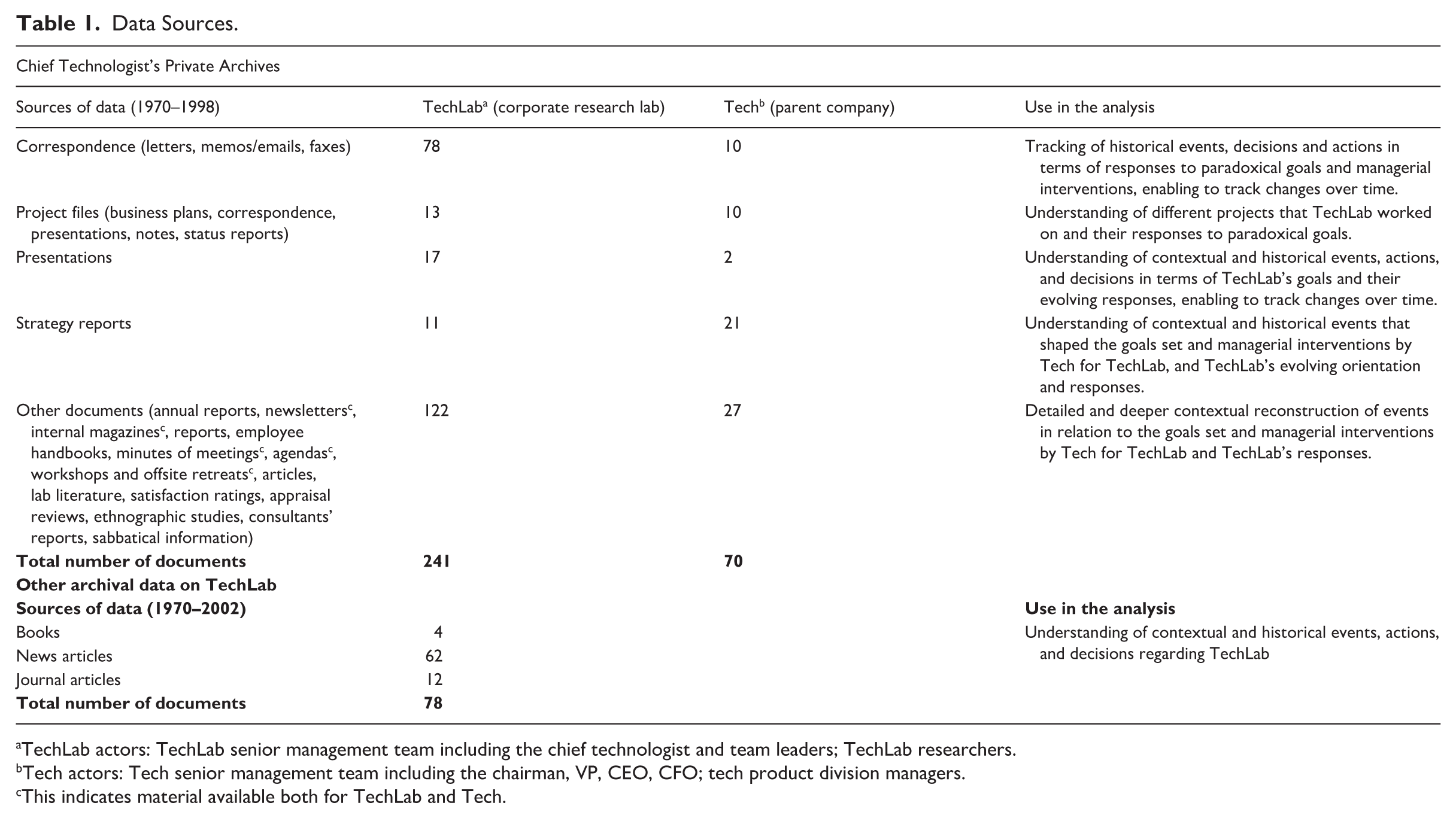
TechLab actors: TechLab senior management team including the chief technologist and team leaders; TechLab researchers.
Tech actors: Tech senior management team including the chairman, VP, CEO, CFO; tech product division managers.
This indicates material available both for TechLab and Tech.
Data analysis
We adopted prescribed analytical techniques for longitudinal case studies to move between the longitudinal data, our emerging analysis and existing literature, paying attention to temporality and change (Cloutier & Langley, 2020; Langley, 1999; Yin, 2008). We now explain our key analytical steps.
Step 1: Developing a comprehensive case narrative
We started by developing a rich case narrative (Langley, 1999). We spent over twelve months reading all the archival material, combining accounts of different actors in TechLab and Tech and different data sources, and sequencing them to produce a chronology of what happened and who did what and when (Langley, 1999). Our narrative focused on reconstructing the events in TechLab between 1970 and 2002, covering the evolution of paradoxical goals set by Tech for TechLab since its inception, and the persisting dysfunctional responses by TechLab despite interventions by Tech, which eventually led Tech to spin off TechLab into an independent company in 2002.
Step 2: Temporal bracketing
Using our comprehensive case narrative, we applied temporal bracketing to make sense of the data into successive adjacent phases, focusing on the continuity of activities within each phase and the discontinuities at its frontier (Langley, 1999). We divided our empirical data into three phases (Cloutier & Langley, 2020). Phase 1 (1970–1987) covers a period featuring dysfunctional dynamics: defensive responses in TechLab to paradoxical learning and performance goals and interventions by Tech fuelled a growing over-focus on exploratory learning in the lab at the expense of short-term business performance. Phase 2 (1988–1991) covers a period featuring a switch in the dysfunctional dynamics following interventions by Tech to address TechLab’s over-focus on exploratory learning and restore equilibrium. Instead of reversing into a virtuous cycle, defensive responses in the lab switched toward an over-focus on attaining performance goals at the expense of exploratory learning. The more the lab sought to avoid performance failure similar to phase 1, the more the dysfunctional dynamics pulled TechLab to an over-focus on performance goals. Phase 3 (1992–2002) features a period of persisting dysfunctional dynamics, despite Tech’s further interventions to switch the lab’s attention toward exploratory learning within clearly defined areas and reverse into a virtuous circle. The better TechLab became at meeting performance goals in this third phase, the more their over-focus on performance at the expense of exploratory learning persisted. Unable to tackle TechLab’s dysfunctional dynamics and fuel radical innovation for the firm, Tech decided to spin off TechLab as an independent company in 2002.
Once we had the rich description of events, we followed the coding procedure of grounded theory (Strauss & Corbin, 1998) as shown below.
Step 3: Creating first-order concepts
Our analysis began with open coding, using in vivo codes (e.g. the actual terms used in the data to identify key emerging concepts) whenever possible (Strauss & Corbin, 1998). For example, ‘inventing the office of the future’, ‘improving efficiency’, ‘exploring in specific themes’, ‘acting like a research organization’, ‘projecting performance failure to divisions’, ‘obsessing for every project to become a home run’, ‘obsessing about being always relevant to the firm’, ‘being unpunished’, ‘cutting budgets until productization is enhanced’, ‘praising for improved efficiency’, ‘free-wheeling with project schedule slip’ and ‘over-focusing on productization’ are some of the open codes that emerged at this stage. We came up with thirty-three first-order codes (as per Gioia et al., 2013) (see data structure in Figure 1 below). We extensively discussed any discrepancies in our interpretations and shifted back to data coding when necessary.
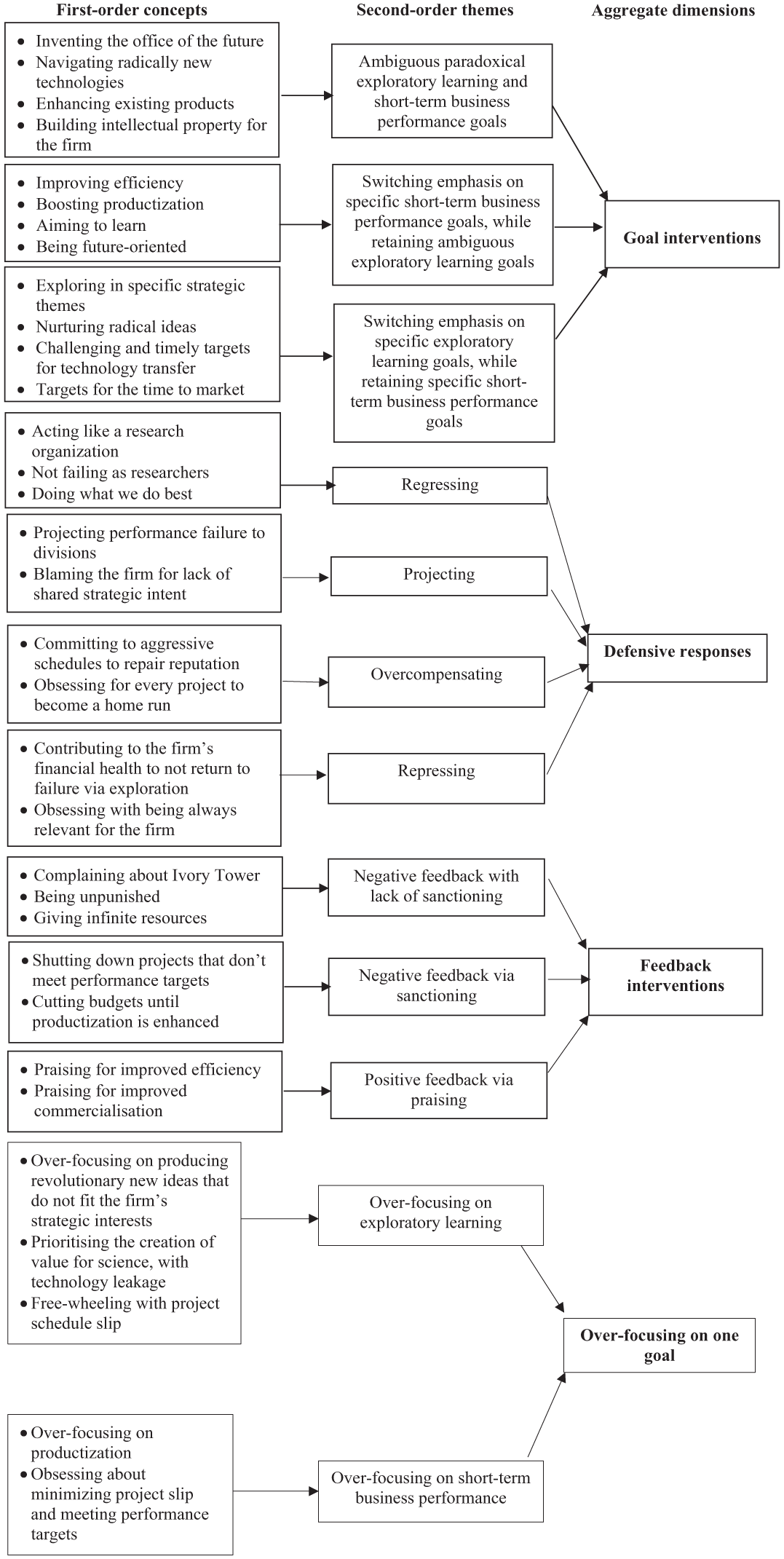
Data structure.
Step 4: Progressing toward second-order themes and aggregate dimensions
The purpose of this step was to seek links among the thirty-three first-order codes to facilitate grouping them together into second-order categories and higher-level aggregate dimensions (Gioia et al., 2013). Drawing on paradox literature, we first examined how our open codes fitted together to suggest more abstract, second-order themes. For example, drawing on the defensive responses to paradox described by Lewis (2000), the open codes ‘projecting performance failure to divisions’ and ‘blaming the firm for lack of shared strategic intent’ were bundled into the second-order theme ‘projecting’. Similarly, drawing on Alexander and van Knippenberg’s (2014) work on the role that the specificity of paradoxical exploratory learning and performance goals plays for radical innovation, we bundled ‘inventing the office of the future’, ‘navigating radically new technologies’, ‘enhancing existing products’ and ‘building intellectual property for the firm’ into the second-order theme ‘ambiguous paradoxical exploratory learning and short-term business performance goals’. Overall, twelve second-order themes emerged from our analysis. Then, reflecting on our research question and drawing further on paradox literature, we sought to bundle the second-order themes into aggregate dimensions. For instance, drawing on Sundaramurthy and Lewis’s (2003) work on the impact of feedback interventions in paradox dynamics, we bundled ‘negative feedback with lack of sanctioning’, ‘negative feedback via sanctioning’ and ‘positive feedback via praising’ into the aggregate dimension ‘feedback interventions’. Altogether, four aggregate dimensions emerged from our data analysis: ‘goal interventions’, ‘defensive responses’, ‘feedback interventions’ and ‘over-focusing on one goal’.
Step 5: Building a theoretical model
Iterating between our data and paradox literature, we then sought to interpret how our second-order themes and aggregate dimensions fitted together in a theoretical process model; a more abstract, theoretical explanation of nested persisting dysfunctional dynamics. Actors across organizational levels (in our context, Tech and TechLab) fuelled the persistence of the dysfunctional dynamics (Cloutier & Langley, 2020; Langley, 1999). We identified that, over time, goal and feedback interventions by Tech seeking to recalibrate TechLab’s over-focus on learning or performance instead propelled further defensive responses in TechLab, triggering a switch in or persistence of over-focus on one goal at the expense of the other, and perpetuating the dysfunctional dynamics. Following guidelines for visualization in paradox theorizing, our model theorizes the shifting dysfunctional paradox dynamics in our study as persisting vicious cycles (Pradies et al., 2023). We introduce our theoretical process model at the beginning of the Findings section (see Figure 2).
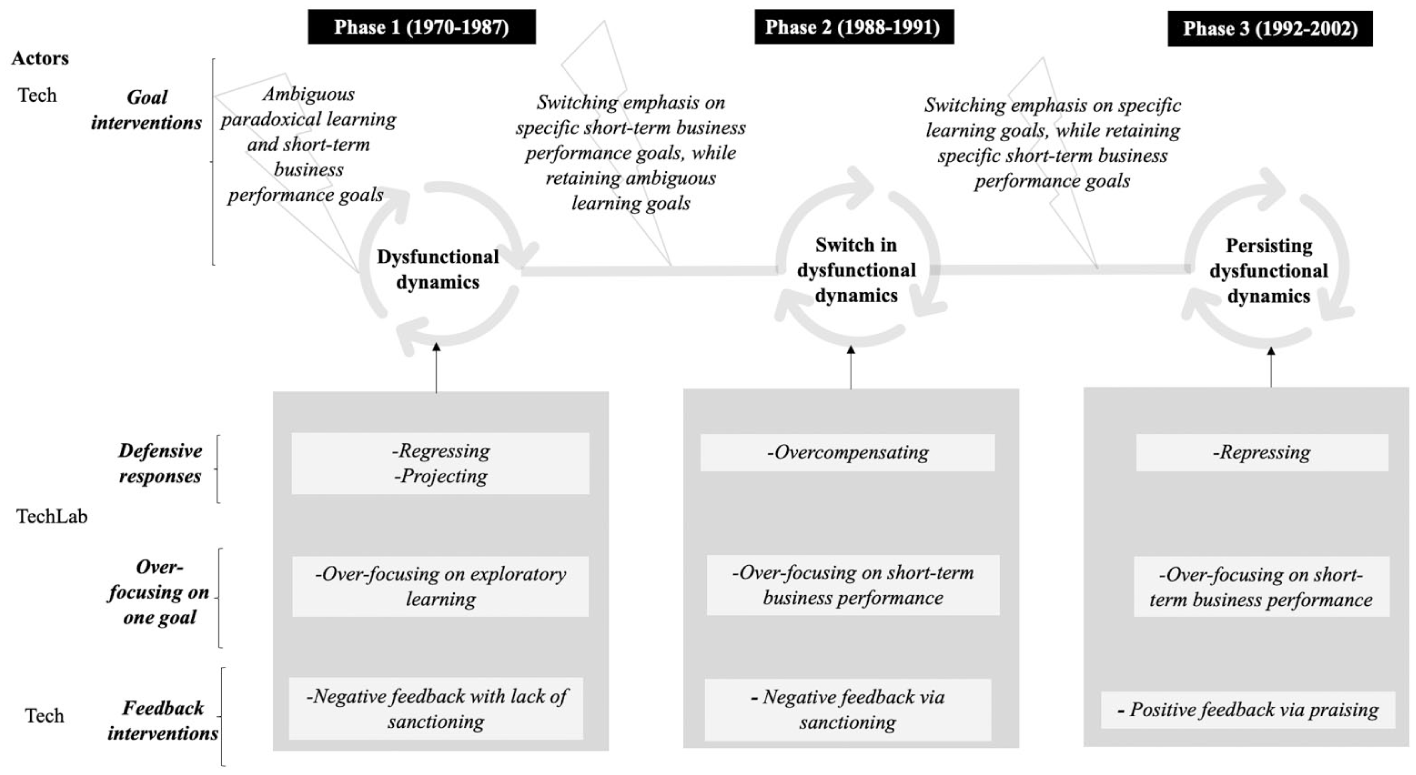
Juggling paradoxical goals: A model of persisting dysfunctional dynamics.
Trustworthiness of the data
Following Lincoln and Guba (1985), we undertook four steps to ensure the trustworthiness of our data. First, we painstakingly managed all our archival data, by keeping them in electronic folders and in chronological order. Second, we used multiple sources of data to minimize the chance of bias that might have arisen from a single perspective (Eisenhardt & Graebner, 2007). Third, throughout data analysis, we adopted an insider/outsider approach (Crosina & Pratt, 2019). The two authors who were not directly involved in the data collection (third and fourth) played a devil’s advocate role, asking critical questions, debating interpretations and probing how the data fit the proposed dimensions (Crosina & Pratt, 2019). Finally, we used peer debriefing, by engaging other researchers not involved in the study to discuss our emerging patterns, as further validity checks for our evolving interpretations. These processes helped us confirm the chronology of events and inform the development of our theoretical model.
Findings
Our longitudinal data revealed dysfunctional dynamics nested across organizational levels that drive persisting vicious cycles when actors juggle paradoxical learning and performance goals (see Figure 2). In each phase, we explain how (1) goal interventions by Tech, (2) triggered different defensive responses in TechLab, (3) switching or sustaining over-focus on one goal at the expense of the other, which, combined with (4) feedback interventions by Tech (5) sustained persisting vicious cycles. We now detail our results.
Phase 1 (1970–1987): Dysfunctional dynamics
Goal interventions
TechLab was set up by Tech in 1970, a time when Tech was posting record revenues and profits. ‘TechLab, sprang from the recognition that Tech was maturing into an information-handling and communications company. . . The Chairman asked Techlab to become the architect of information processing systems and materials for the storage and manipulation of information for Tech’ (TechLab chief technologist presentation, 1982). Tech set ambiguous paradoxical goals for TechLab to motivate exploratory learning that boosts short-term business performance. TechLab’s chief technologist summarized the paradoxical goals set by Tech’s SMT for the lab: ‘The goal is to identify and expand the technological options for the future (instead of solving the same old problems) and make a difference to Tech.’ TechLab was tasked with ambiguous learning goals to ‘invent the “office of the future”’ (presentation by Tech SMT to TechLab, 1972) by ‘navigating the uncharted waters of radically new technologies’ (presentation by Tech SMT to TechLab, 1972). At the same time, TechLab was also set ambiguous short-term business performance goals: ‘to impact products or build intellectual property relevant for Tech’ (presentation by Tech SMT to TechLab, 1972). Within this ambiguous scope, short-term performance goals were largely unspecified and untimely. Research at TechLab was ‘undirected and bottom-up driven, with no explicit timeframes’ (TechLab team leaders presentation, 1973).
Defensive responses
An interoffice memo between team leaders (13/6/1978) in TechLab illustrated how the lab responded to these ambiguous paradoxical goals: Because we are presumably working in areas largely unexplored, the cost to us of doing experiments is substantial and may lead nowhere. As a research organization I think we have a particular need to choose our projects to maximise what we learn about the technology, but sometimes this is not in-line with development, or a market probe organization. Anxious of failing to invent radically new technologies, researchers in TechLab regressed to extant frames of reference as scientific researchers, approaching the paradoxical goals as a trade-off. ‘In order to produce revolutionary new ideas, the imaginations of talented scientists and engineers need to be given free rein. Thinking about “over the horizon technology” cannot be done within bureaucratic constraints. Otherwise, we’ll fail as researchers’ (team leader, notes from TechLab retreat, 1974). As a team leader noted, ‘exploration is what we do best’ (email, TechLab team leader, 24 June 1983).
The more TechLab regressed to a familiar ‘ivory tower’, the more Tech ‘product divisions’ disappointment about TechLab’s failure to productize or build intellectual property’ for Tech mounted (memo from a product division manager to TechLab chief technologist, October 1987). Yet, TechLab were defensive against this negative feedback. Indeed, they projected blame to Tech for their failure to deliver radical product concepts relevant for Tech: ‘The business units are to blame for this (the lack of productization). They are consistently exhibiting a low attitude to risk’ (email from TechLab chief technologist to Tech SMT, 17 June 1983). ‘There is an absence of a shared strategic intent to drive radical innovations’ (email from TechLab team leader to TechLab chief technologist, 24 June 1983).
Over-focusing on exploratory learning
TechLab, therefore, consistently over-focused on exploratory learning at the expense of short-term business performance: Many people have decided to act as academics, just studying rather than building things. . . People here appear to continue to view themselves as “ivory tower” researchers from the old school, creating value for everybody in the field. A lot of great creative ideas that come out of TechLab are things Tech could not ever take into a product, because they are just too far from what Tech is interested in pursuing. Of course, the teams will tell you that this is the nature of research. Research has a life of its own and goes in many directions. (notes from TechLab SMT offsite, 29/1/1982) TechLab’s over-focus on exploratory learning birthed radical technological inventions that gave them a reputation in the scientific community as ‘a cradle for invention’ (Techlab survey, spring 1978). The sentiment in TechLab was that they were ‘the best of our kind in producing revolutionary new ideas’ (TechLab SMT presentation, 2/4/1976). Yet, the lab’s over-focus on exploratory learning also fed negative outcomes. Technology leakage was prevalent. In TechLab’s efforts to foster exploratory learning there had been ‘repeated public disclosures, which have given others ideas and which have not been appropriately controlled’ (report from Tech SMT to TechLab chief technologist, 8/3/1984). As a result, ‘the majority of inventions were commercialized by competitors or leaders in other industries’ (TechLab employee handbook, 1987). Moreover, TechLab’s ‘free-wheeling’ (with projects spanning foci from physics to anthropology and philosophy) and their abstract timelines meant that ‘interest in projects sparks, but then often they get stuck or die away’ (memo from TechLab team leader, 10 May 1983). ‘Project schedule slip was ubiquitous’ (TechLab report, September 1985). As noted in an internal report, ‘in the lab, there was a lack of urgency. There was a prescription that the best is got out of researchers if they are left to their own devices’ (report on TechLab life, early days, 1970s).
Feedback interventions
Complaints by product division managers about TechLab’s ‘ivory tower’ approach grew during this first phase: ‘My no.1 complaint to senior management over the years has been the ivory tower nature of TechLab, a more pejorative term might be Tech University’ (memo from a product division manager to TechLab chief technologist, October 1987). Yet, there was a lack of sanctions by Tech on TechLab for its performance shortfalls. Indeed, there were ‘few sanctions, few imposed deadlines on research, few constraints from the top’ (report on TechLab life, early days, 1970s). Instead, although ‘trademark and design patent protections have already been compromised . . . this has apparently gone unpunished’ (report from Tech SMT to chief technologist, 8/3/1984). Over the years, negative feedback with a lack of sanctioning reinforced ‘a tendency at TechLab to think Tech pays them to sit around and be smart. Most researchers are in their own world. They are not pushed to create artifacts that have a “path to the sea”’ (notes from the TechLab SMT offsite with Tech, 29/1/1982).
Vicious cycle
The more TechLab regressed into a ‘world-leading learning organization’ (TechLab intern program brochure, 1986) producing radical inventions and projected blame to Tech for their lack of productization, the more they over-focused on exploratory learning at the expense of short-term business performance. Despite increasing negative feedback by product divisions, the lack of sanctioning by Tech’s SMT over time deepened TechLab’s regressing into a learning over-focus, fuelling a persisting vicious cycle. This was highlighted in a TechLab report in September 1985: ‘The culture of the lab emphasises the relatively unfettered exploration of ideas, and lays far less emphasis, with one or two exceptions, on research directed at developing products for the market.’ TechLab grew more and more confident that they ‘must not make a research organization dependent on a development organization’ (TechLab team leader memo, 14/6/1978). Instead, they were ‘more interested in the character of the evolving environment, than in the final result’ (Techlab team leader memo, 2/11/1978).
Phase 2 (1988–1991): Switch in dysfunctional dynamics
Goal interventions
By the mid 1980s, Tech was reporting declining profits, amidst difficult economic conditions and increasing competition (Tech annual report, 1987). Tech’s newly appointed CEO highlighted ‘a needed company-wide emphasis on improved productivity and a drive towards improving cost effectiveness’ (Tech annual report, 1987). In 1988, Tech initiated a diagnostic investigation in TechLab, with an aim to understand why breakthrough technological inventions that had been discovered at TechLab in the past failed to translate into profits for Tech. Key findings were presented to Tech’s SMT (23/10/1988): TechLab has not demonstrated a consistent capacity to create profit for Tech by the numerous technologies it has created or pioneered . . . a lack of coupling of technological knowledge with market vision, which resulted in disastrous decisions. . . Also, high project slip, failing processes and operating circles and a lack of an advanced development mentality in research, which is a barrier to technology transfer and productization. In terms of schedule slip, causes are numerous, complex and often interactive. . . The top ten route causes include: Lack of technology readiness, too aggressive, use too much new technology, lack of commitment to plan, inadequate detail of the plan, inadequate risk management, lack of leadership, lack of design assessments. (Tech SMT report, 25 October 1988)
Tech’s SMT, thus, established that ‘there are serious problems with technology transfer and productization when it comes to TechLab’ (Tech SMT Workshop, 23–25 October 1988). Placing emphasis on ‘solving these problems and boosting the productization of breakthrough technological inventions’ (Tech SMT report, 11 June 1990), Tech proceeded in goal intervention to switch the over-focus on exploratory learning in TechLab by bringing specific short-term business performance goals onto the agenda. Ambiguous exploratory learning goals were kept in place: ‘We must still aim to learn, to be holistic, future-oriented, challenged, inspiring and idealistic’ (vision meeting by Tech SMT, 31/7/1988). Yet, Tech’s SMT enhanced the specificity of short-term business performance goals to improve efficiency and boost productization at TechLab: ‘our goals must also be tangible, measurable, specific, grounded in the present, pragmatic, realistic, aiming to avoid performance shortfalls’ (vision meeting by Tech SMT, 31/7/1988). A Tech product division manager noted: ‘we know it’s going to be hard, but we must aim to avoid schedule slip and delays in technology transfer’ (Tech new business workshop, 23-25 October 1988).
Defensive responses
TechLab responded to this goal intervention by overcompensating for their past failure in phase 1. ‘The present situation (redirection, lab cutbacks), future expectations, and our past history are. . . a blow to our esteem’ (TechLab staff satisfaction survey, June 1990). TechLab committed to aggressive performance schedules to repair their reputation: The “F” factor, is present. The “F” translates to Fear – fear that if we do not focus our attention and commit to very aggressive schedules (or quality or cost targets, for that matter) the program will be lost and our reputation will be further tarnished. (schedule team leaders report, November 1989) Researchers in TechLab responded with an ‘obsession for every new product to become a home run’ (internal memo from TechLab team leader, 24/5/1991). The prevailing sentiment at TechLab was ‘to avoid at all costs the “technology push” that characterized our research efforts’ (TechLab review, September 1989).
Over-focusing on short-term business performance
TechLab’s overcompensating response fuelled a trade-off approach, this time driving an over-focus on short-term business performance. Indeed, the enhanced specificity of business performance goals, motivated a strong sentiment in TechLab that productization was more critical than ever ‘to turn around the reputation as Tech’s “black hole”’ (TechLab team leader presentation in meeting with Tech, 21/10/1988). A TechLab team leader explained: ‘Demands are currently triggering schizophrenic thinking for most people: We talk about publishing, but reward only patents. We really only value whatever Tech divisions think and can productize’ (notes from the 1990 TechLab retreat). Their concern for overcompensating reoriented TechLab toward an over-focus on minimizing project slip and meeting performance targets at the expense of exploratory learning: The effects of this changed environment are obvious to staff members who perceive, accurately, that any exploratory work done on (description of projects) is going to have a hard time impacting the Tech product stream. Thus, we are faced with a Hobson’s choice: work at the frontiers of our fields (and accept the probability of low impact on Tech) or work on high Tech impact, timely tasks which typically are of an advanced engineering, systems integration and/or specialty software character. . . Given the changes noted above, staff focus on providing a scientific and engineering foundation for the customisation and development of Tech’s products, but basically focus on productization, and are getting paranoid about minimizing project slip and meeting performance targets. (memo from a TechLab team leader to the TechLab chief technologist, 21/6/1990).
Feedback interventions
Tech’s SMT also introduced sanctions to deter TechLab from their past over-focus on exploratory learning. For instance, they shut down projects in TechLab that ‘lacked promise of harnessing learning to commercial products’ (memo from Tech SMT to TechLab leader, 16 December 1988) or ‘continued for years without research phase shift’ (Tech SMT presentation, 21/10/1988). As noted in a TechLab retreat: ‘The climate today is “show me”, not trust. A research plan must now have an impact plan’ (notes from the 1990 TechLab retreat). Moreover, ‘budget cuts started in 1988’ (TechLab staff survey, March-April 1989). Tech’s SMT made it crystal clear that ‘at least half of the blame must be placed upon TechLab for going wild on scientific research and failing to harness learning to commercial products’ (memo from Tech SMT to TechLab chief technologist, 16 December 1988) and ‘budgets will be cut until TechLab demonstrates a consistent capacity to create profit for Tech’ (TechLab chief technologist presentation, 24/10/1988).
Vicious cycle switch
Instead of recalibrating phase 1’s over-focus on exploration, Tech’s goal intervention and sanctions fuelled an overcompensating response in TechLab that switched the vicious cycle toward an over-focus on performance. Over time, the lab got ‘much better at completion’ (memo between TechLab team leaders, May 1991) and generated ‘more customer-focused product concepts with improved technology transfer’ (Tech SMT report, 11 June 1990). A team leader in TechLab explained: ‘In the past, some of the exploratory activities continued for 10 years without research phase shift. Now we develop a first product prototype using easy-to-transfer technology within six months and a second, more technically complex prototype within the next eighteen months’ (team leader memo, 18/12/1990). In addition, TechLab worked ‘more effectively to create new business opportunities through a variety of commercialization vehicles’ (TechLab chief technologist report, August 1991). A Tech SMT report (11 June 1990), for instance, noted: ‘TechLab now generates more customer-focused product concepts and has accelerated technology transfer.’ Mindful of the sanctions set by Tech to deter further performance shortfalls, the lab continued overcompensating, switching further the over-focus on performance. Increasingly, this over-focus on short-term business performance was limiting discoveries. . . That is to say, we are not providing for early non-pejorative failure which can yield the market focus and product refinements which enable truly spectacular innovations to be realized. We are feeding mainly incremental stuff at the moment – it is disheartening. (TechLab SMT workshop, 23/10/1988) In TechLab, ‘increased attention on avoiding scheduled slip diverted attention away from scientific discovery’ (TechLab report, December 1990). A TechLab team leader elaborated:
There is not enough time to operate in a reflective manner. More meetings, more and more commitments. We are forced to do a number of things that do not create value, that are a waste of time (procedures, processes, forms etc.). (internal memo from TechLab team leader, 24/5/1991). Exploratory learning, thus, increasingly suffered in TechLab: ‘We might be meeting all these (performance) targets, but I am worried. . . Where is the real learning?’ (notes from the 1990 TechLab retreat). A TechLab team leader expressed his concern in an internal memo to the chief technologist in the lab about this switch in the dysfunctional dynamics: Based on our track record what is there to inspire confidence that the specific investments made now in (name of project) are going to lead to any significant improvement? . . . There is no new powerful software or hardware product that is coming down the pike. Where is the research payoff within the next decade? This is not real research. We are losing our lustre. (memo, 7/6/1990)
Phase 3 (1992–2002): Persisting dysfunctional dynamics
Goal interventions
By the end of 1991, short-term business performance goals were increasingly met by TechLab, but there was a growing fear that TechLab was becoming a development organization: ‘There is a common fear that: TechLab will become an advanced development organization; existing Tech divisions will determine TechLab research; our budget and head count will be slowly squeezed’ (memo from TechLab chief technologist to Tech SMT, 10/11/1992). To address TechLab’s over-focus on business performance, Tech’s SMT, once again, revised TechLab’s paradoxical goals. They sharpened the specificity of TechLab’s exploratory learning goals to switch focus towards exploration: ‘specific themes, tightly linked to Tech’s strategic priorities, will now define the terrain of exploration at TechLab’ (mid-year report by Tech SMT for TechLab, 1994). A TechLab researcher discussed the value of this added specificity for their learning endeavours: ‘Themes offered a sense that the challenging research we are doing might lead somewhere, might contribute to some larger goal’ (TechLab researcher interview for a TechLab ethnographic report, 1993). Tech did not prescribe how researchers should approach these themes, aiming to retain necessary ambiguity to foster scientific discovery: ‘The themes should remain many things to many people . . . maybe in this lies an opportunity: let the themes be all things, to all people, to nurture radical ideas’ (memo from Tech SMT-organized workshop in TechLab about the new themes, 7–16 April 1993). At the same time, specific short-term business performance goals were maintained, encouraging TechLab to continue to ‘maximize the financial returns over time to Tech, from exploitation of intellectual property assets deriving from cutting edge work at TechLab, within a set process and timescale’ (business plan for TechLab prepared by Tech’s SMT, 22 September 1992). The VP of Tech called TechLab to ‘identify and exploit opportunities for creating new business value, in an environment that spurs innovation, supports learning and engenders trust’ (memo from VP of Tech to TechLab’s chief technologist, 25 March 1994). Performance goals, thus, retained ‘challenging and timely targets for the acceleration of technology transfer and time to market’ (corporate retreat presentation by Tech SMT to TechLab, 10 July 1997), along with emphasis on ‘new product revenue ratios and an R&D effectiveness index’ (Tech strategic plan, 1998).
Defensive responses
Yet, the revised emphasis on more specific exploratory learning goals was met with a lingering sentiment in TechLab to seek cover from learning strategies that led to their reputation as a ‘black hole’ for Tech money in phase 1 and to sanctions in phase 2. Seeking to avoid distressing performance failure, TechLab responded to the goal intervention by repressing exploratory learning. Instead, over-focus on contributing to Tech’s financial health persisted. A Tech team leader noted: The lab has to be seen as contributing in some way to the company’s health. In recent years, there have been efforts to improve the relationship within the company between innovative research and the need to develop products in markets – we must retain this focus so that we don’t return to failure. . . (TechLab team leader memo to TechLab chief technologist, November 1993) Researchers in TechLab were increasingly ‘obsessed with creating an image of relevance for Tech’, ‘with little emphasis on ground-breaking research’ (TechLab staff survey, March–April 1997). A researcher explained how ‘big’ research was thus repressed in TechLab: We have been asked to go deep in five integrative research themes. . . But TechLab at the moment cares too much about what Tech does and what we do for Tech, and too little about what we should do in terms of big research. . . We rarely talk about big research now. (TechLab retreat prework responses, 10/11/1994)
Over-focusing on short-term business performance
TechLab’s response to repress exploratory learning perpetuated their persisting over-focus on short-term business performance. A TechLab team leader noted: We recognise that the freedom and the independence that the lab enjoys must be more fragile than it had been previously, more need to justify the importance of our research than before. We need to be doing more product development rather than maintaining a much longer research horizon. (TechLab team leader memo to TechLab chief technologist, November 1993) In fact, there was increasing ‘reluctance to actually do things that involve making daring decisions and starting big projects’ (TechLab staff survey, March–April 1997). A TechLab team leader explained how this persisting over-focus on performance was transforming the lab: Despite the pride in TechLab’s past achievements we know now that a skunk works, blue sky effort won’t change the company. . . We’ve failed in the past and have faced the music, so TechLab can no longer be the learning community it used to be. . . It is an awkward stage, not necessarily bad, just hard to manage. (TechLab team leader memo in TechLab retreat prework responses, 10/11/1994)
Feedback interventions
Tech reinforced TechLab’s over-focus on short-term business performance in this third phase by praising their improved efficiency and commercialization. In a Tech SMT meeting, for instance, they praised TechLab for their efficiency improvements: ‘It’s been great. . . All of the projects were transferred within one year’ (presentation at Tech SMT meeting, November 1996). They were ‘increasingly praised as a place that creates lasting value for Tech (and, through Tech, for the world)’ (TechLab report, 1993). An abstract from the appraisal of TechLab’s chief technologist by Tech’s CEO also illustrates the positive feedback the lab was receiving for improved commercialization: You’ve done an excellent job. Everywhere I go in Tech I hear about it. You’ve been sensitive in how to tune research efforts toward ones that Tech can benefit from. . . TechLab used to be considered a black hole and you have been monumentally successful in reversing this perception. (performance appraisal, TechLab chief technologist, 1/1/92–31/12/92)
Persisting vicious cycle
Caught in a success trap of enhanced process efficiency and improved commercialization, the vicious cycle persisted. TechLab’s repressing of exploratory learning and over-focus on short-term performance over time ‘enhanced time to market of inventions’, ‘increased sharing of knowledge and technologies with Tech divisions’. The lab was increasingly praised by Tech for ‘greater scalability and extensibility, improved productivity (effectiveness/efficiency), and a sharper focus on customer benefits’ (Tech product division managers’ workshop, 27 March 1992). This reinforced the lab’s repressing of exploratory learning, increasingly locking TechLab into an over-focus on short-term business performance at the expense of exploratory learning. Increasingly, ‘the mentality in the lab’ was ‘becoming exceedingly conservative’ (TechLab staff survey, March–April 1997). As a result, technological inventions at TechLab predominantly fed incremental innovations, focusing on Tech’s existing products/markets: The feeling in the lab is that following this path is leading to incrementally improved products – it will not reveal the new systems, or products that revolutionise a customer’s work process. Discovering such opportunities for radical change is quite difficult now. (TechLab meeting, March 1995) TechLab’s chief technologist highlighted his concern about the persisting dysfunctional dynamics in a presentation to Tech product division managers: At the moment we are seeing benefits in terms of time to market, scalability and productivity. But concerns were expressed over possible bias toward internal technology and that the process is stifling entrepreneurship. We need to manage technology synergy between “left” (research, architecture, core technology development) and “right” (business divisions). (presentation by TechLab chief technologist to Tech product division managers workshop, 25/3/1992) TechLab researchers further illustrated this: ‘There is strong schedule pressure for the project we are doing here, we are constantly stressed. Projects are forced from a research stage to an engineering stage prematurely’ (TechLab staff survey, March–April 1997). ‘People don’t wander very far from home. People don’t climb over the various fences’ (TechLab staff survey, March–April 1997). As a result, ‘the increasing pressures on the lab to work on more immediate problems and to contribute more directly to the corporate bottom line has shifted the focus of industrial research toward creating proprietary results of nearer term impact on the firm’ (TechLab report, 2/6/1998). A TechLab team leader further illustrated the growing problem: I see so many people who don’t seem to have the passion for doing research anymore. I don’t know if they have hit so many obstacles in the past that they have just given up. . . I spend too much energy resisting cynicism and pushing against the wall of inertia rather than doing research. (TechLab staff survey, March–April 1997) Amid the persisting dysfunctional dynamics, ‘TechLab’s future looked uncertain’ (news article, 26/10/2000). Indeed, in 2000, ‘two venture-capital firms reported that Tech approached them to discuss a possible sell-off of TechLab’ (news article, 27/10/2000). At the end of 2001, Tech hadn’t found any investors. Instead, Tech decided to ‘make TechLab independent’ (12/1/2002) in January 2002, with a mission to inform and accelerate radical innovation for federal and commercial clients. Tech’s president noted that: ‘TechLab will be the nucleus of the new company, but we intend to augment it with business development and management functions’ (news article, 11/12/2001). ‘Tech said it laid off 15 percent of TechLab employees’ (news article, 12/1/2002).
Discussion
This article set out to understand how dysfunctional dynamics persist when organizations deal with paradoxical goals. Our process model reveals empirical insights on how nested dysfunctional dynamics across organizational levels drive the multifaceted and shifting nature of persisting vicious cycles. We unpack how (1) goal interventions by the firm to address dysfunctional dynamics by switching emphasis to the neglected goal (2) transform defensive responses in the lab, (3) switching or fuelling their over-focus on one goal at the expense of the other, which (4) reinforced by evolving feedback interventions by the firm, (5) over time drives the persistence of a vicious cycle. Our study makes three interconnected contributions to extant paradox literature on understanding the dysfunctional dynamics of persisting vicious cycles (Lalaounis & Nayak, 2022; Pradies et al., 2021; Smith & Lewis, 2011; Sundaramurthy & Lewis, 2003; Weiser & Laamanen, 2022).
First, our process model unpacks the ‘dark side’ of managerial interventions intended to deal with dysfunctional dynamics when juggling paradoxical goals. Our study reveals how senior management interventions that seek to address over-focus on one goal at the expense of the other can backfire, fuelling the persistence of dysfunctional dynamics (Berti & Cunha, 2023). Paradox studies suggest that interventions by leaders, peers, and even external peers focusing attention on the neglected goal can mobilize a shift to virtuous dynamics (e.g. Es-Sajjade et al., 2021; Pamphile, 2022; Pradies et al., 2021; Smith, 2014; Smith & Lewis, 2011; Sundaramurthy & Lewis, 2003). Our empirical study shows that goal and feedback interventions by senior management to switch emphasis on the neglected goal, may instead re-fuel vicious circularity. Instead of driving rebalancing, senior management interventions can drive units to switch their over-focus towards the other goal to overcompensate for their past failure, or to persist their over-focus on the same goal, if in the past it has led to some success (Cunha & Putnam, 2019; Sundaramurthy & Lewis, 2003). Over time, managerial interventions may, therefore, extend vicious cycles (Cunha & Putnam, 2019; Weiser & Laamanen, 2022). Particularly when units are called to meet paradoxical stretch goals that are almost impossible to attain, senior management interventions that, instead of focusing on understanding and addressing the impossibility of the task at lower organizational levels, seek to treat the symptoms of the over-focus on one goal, can indeed feed dysfunctional dynamics (Gilbert et al., 2018).
Second, extending insights on the persistence and insolubility of paradox (Cunha & Clegg, 2018; Lempiälä et al., 2023; Lewis, 2000; Smith & Lewis, 2011), our model shows how defensive responses to paradoxical goals may change over time against managerial interventions, making dysfunctional dynamics an ongoing, shifting process. Theoretical and empirical paradox studies have identified various defensive responses to paradoxical tensions (Jarzabkowski & Lê, 2017; Lalaounis & Nayak, 2022; Lewis, 2000; Pradies et al., 2021; Schad et al., 2016; Smith & Lewis, 2011; Sundaramurthy & Lewis, 2003). Our longitudinal data further reveal how defensive responses may transform over time, as actors respond to new manifestations of paradoxical tensions stemming from different managerial interventions. In our case, defensive responses to goal and feedback interventions transformed from regressing and projecting, to overcompensating, and then to repressing, sustaining vicious circularity. Our study, thus, shows how defensive responses to paradox are continually ‘becoming’ in an ongoing process (Cloutier & Langley, 2020; Fan, 2025). Their transformation complicates the causes of vicious cycles, with the past informing the present and shaping the future (Cloutier & Langley, 2020; Masuch, 1985). This ongoing, shifting nature of defensive responses introduces granularity into current conceptualizations of vicious cycles, enriching our understanding of how the management of paradoxes may sometimes feature as an impossible task (Berti & Cunha, 2023; Gaim et al., 2021). As such, our model also enriches our understanding of how challenging managing the ‘dilemma of learning’ identified by March (1991) is in practice, when exploration/exploitation trade-offs cannot be approached as an optimization problem.
Third, our model unpacks the nested, multi-level nature of dysfunctional dynamics that drive persisting vicious cycles. Paradox studies have described paradoxes as nested across organizational levels: senior management’s experience and responses to paradoxical tensions are nested with paradoxical tensions and responses at lower levels in the organization (Andriopoulos & Lewis, 2009; Jarzabkowski et al., 2013; Pradies, 2023; Schad et al., 2016; Weiser & Laamanen, 2022). Scholars, thus, warn that the ultimate challenge in dealing with paradox lies in working through tensions at the interface of organizational levels (Schad et al., 2016); actions and interactions across levels can tip organizations out of balance (Weiser & Laamanen, 2022). Our model extends these insights, showing that persisting vicious cycles are fuelled by the interlocking effects of senior management interventions to restore dynamic equilibrium and counter-balancing defensive responses at lower organizational levels. Interests’ polarization can reinforce these effects (Huq et al., 2017; Jarzabkowski et al., 2013).
Managerial implications
We caution managers to be mindful of persisting dysfunctional dynamics when organizations juggle paradoxical goals. Figuring out ways to prevent and escape these dysfunctional dynamics is important, as our study showed that their persistence can be long-lasting. Drawing on paradox research, we offer three suggestions.
First, paradoxical leadership can play a vital role in helping organizations avoid paralysing dysfunctional dynamics (Alexander & van Knippenberg, 2014; Smith & Lewis, 2011; Smith & Tushman, 2005). Pursuing paradoxical goals is difficult, because it often requires seemingly counterintuitive responses (Lewis, 2000). Senior leaders and managers that act at the interface of organizational levels must guide critical reflection, helping actors across levels to reframe their assumptions (Alexander & van Knippenberg, 2014). Openly and critically discussing and confronting how paradoxical tensions are experienced across organizational levels may help socially construct practice that accommodates both learning and performance goals, thereby tackling anxiety and enabling changes in understandings and behaviour (Alexander & van Knippenberg, 2014; Lewis, 2000; Pradies et al., 2021).
Second, when organizations are caught in dysfunctional dynamics, leaders must also be active in helping actors escape paralysing vicious cycles (Masuch, 1985; Pradies et al., 2021). This involves continuous effort to understand causes that block actors in different organizational levels from embracing paradoxical goals so that appropriate corrective rebalancing interventions can be set in motion (Weiser & Laamanen, 2022). Company-instigated goal revisions, sanctions and praising, even when senior leaders are aware of the true causality of vicious cycles, are necessary but often insufficient in enabling rebalancing, as they may be obstructed by counter-balancing defensive responses at lower organizational levels (Masuch, 1985; Sundaramurthy & Lewis, 2003). Managerial interventions also need to focus on reflective processes of learning, conflict resolution and change and in cultivating positive psychological capital (Luthans et al., 2015).
Third, senior leaders need to be mindful of the nested, multi-level nature of dysfunctional dynamics, and work together with middle managers to foster employee support toward accepting and embracing the cognitive and behavioural complexity of paradox (Andriopoulos & Lewis, 2009). Interventions by senior leaders to correct imbalances may leave middle managers and employees who grapple with the paradox in their day-to-day work overwhelmed by some of tensions they surface (Ungureanu et al., 2019). Middle managers may, thus, fail to inspire employees to mobilize support for the interventions (Heyden et al., 2017). Instead, managers at the interface of organizational levels can play an important role as ‘bridges’ between senior management and the workforce, contextualizing paradoxical demands into concrete everyday activities that employees can comprehend, while attending to employees’ concerns (Heyden et al., 2017; Knight & Paroutis, 2017).
Suggestions for future research
While our study offers new insights on how dysfunctional dynamics persist when organizations deal with paradoxical learning and performance goals, it also raises several interesting avenues for future research. To begin with, building theory from accounts of a single corporate research lab in ICT exposes our study to generalizability challenges that are common to inductive research. Further work can explore the generalizability of our findings in other contexts, as attending to paradoxical goals for exploratory learning and short-term business performance is not unique to corporate research labs in ICT. Future research could examine whether our findings generalize to settings with similar characteristics, such as chemical, energy and pharmaceutical corporate research labs. Juggling learning and performance goals in these contexts is not only important for firm profitability and competitive advantage, but may also be instrumental for tackling ‘grand challenges’, such as safeguarding global health and reducing environmental impact (George et al., 2016). Further research can therefore explore how the potential societal impact of radical innovation in these settings may impact the dysfunctional dynamics that we have identified in our study. University research labs (even universities at large) would also be interesting contexts to extend our understanding of persisting dysfunctional dynamics in juggling ivory tower research and impact, adding insights from ‘not for profit’ settings. We also suspect that the generalizability of our findings may depend in part on the salience of tensions triggered by paradoxical goals. In corporate research labs and other radical innovation contexts (e.g. new product design consultancies, disruptive start-ups), tensions that arise from learning and performance trade-offs are very salient. Future research could also focus on incremental innovation contexts, where tensions in juggling learning and performance may not be as prominent. Actors developing incremental innovations face less uncertainty, risk of failure and unanticipated challenges than actors pursuing radical innovation (Alexander & van Knippenberg, 2014). Dysfunctional dynamics may therefore take a different form in incremental innovation settings. Further work can also investigate how our findings apply to the juggling of other paradoxical goals, beyond learning and performance. Drawing on Smith and Lewis (2011), these could include juggling belonging and performing goals, such as meeting individual identity goals and social or occupational goals, or organizing and performing goals, such as meeting customer goals and employee goals, as proposed by Smith and Lewis (2011). Moreover, we invite scholars to further explore paradox dynamics and understand their multifaceted and nested nature. For instance, future studies could explore the role of middle managers in driving proactive employee responses to paradox, in executing interventions by senior management or in developing and implementing interventions themselves to reverse dysfunctional dynamics (Souza et al., 2025).
To conclude, we believe that this research has important implications that are both theoretical and applied. Understanding the dysfunctional dynamics that drive the persistence of vicious cycles when juggling paradoxical goals should help organizations escape them.
Footnotes
Acknowledgements
We sincerely thank Silviya Svejenova, Paolo Quattrone, Tammar Zilber and the three anonymous reviewers for their generous guidance and support in developing this manuscript. We are also grateful to Camille Pradies and Tobias Hahn for their helpful feedback.
Funding
The authors received no financial support for the research, authorship, and/or publication of this article.
Declaration of conflicting interests
The authors declared no potential conflicts of interest with respect to the research, authorship, and/or publication of this article.