



Abstract
Real utopias are visions of desirable futures that are both aspirational and achievable. As a form of projective agency, they can inspire experimental enactment, in which utopian ideas are tested in real-life contexts. Although earlier research has touched on the practical and visceral experiences associated with such experimental enactment, it has surprisingly undertheorized the role of embodiment therein. Our shared experience of the Sailing Initiative, a collective endeavour to sail to a scientific conference on an island, provided a unique opportunity to explore the role of the body in bringing a real utopia to life. In the Sailing Initiative, we experimentally enacted our shared vision of environmental sustainability and slow academia, aiming to travel to the conference in a sustainable way while using the travel time for slow-paced academic work in an unconventional setting. We extensively documented our expectations and experiences through individual and collective reflections before and after the journey, as well as through photos and videos. Based on an abductive analysis of the rich autoethnographic data, we develop a theoretical model of the role of embodiment in enacting a real utopia that is sensitive to material realities. We argue that viewing agency through the lens of embodiment is significant for three reasons. First, an embodiment perspective highlights the transformative potential of experimental enactment in unconventional settings, helping individuals and collectives overcome embodied institutional norms and create new practices. Second, the body is not merely an instrument for executing envisioned practices or enduring discomforts; rather, bodily experiences continuously shape concrete actions in the process of enacting a desired future. Third, given the importance of bodily memories in crafting shared narratives of desired futures, a real utopia should be viewed not only as visionary thinking but as a projection shaped by both past and present bodily and visceral experiences.
Introduction
The belief in utopias, that is, in the possibility of alternatives to existing institutional arrangements, is vital to institutional change and new practice creation (Arjaliès, 2021; Fernando et al., 2018; Gümüsay & Reinecke, 2022). While, in its original sense, utopias were conceived of as fantasies unbounded by material and social feasibility, Wright (2010, p. 4) coined the term ‘real utopia’ to refer to ‘utopian ideals that are grounded in the real potentials of humanity, [. . . and] utopian designs of institutions that can inform our practical tasks of navigating a world of imperfect conditions for social change’. Examples of real utopias include circular societies, where the concept of waste is eliminated, or participatory democracies, where citizens have direct involvement in political decision-making. Real utopias are performative in nature in that ‘rather than predicting a given future, their performance brings the future into being’ (Wenzel, 2022, p. 848; see also Garud & Gehman, 2016). Yet, the question of how these visions transcend into practices, that is, how humans ‘actually, rather than ideally, engage with [imaginaries of] the future’ are relatively underexplored in organization studies (Wenzel, 2022, p. 847, emphasis as original).
The nascent research stream of future-making in organization studies (Wenzel, Krämer, Koch, & Reckwitz, 2020) is rooted in Emirbayer and Mische’s (1998) influential conceptualization of agency, especially its projective, future-oriented dimension. Real utopias can be seen as shared narratives of a desired future that inspire concrete ideas on how to enact them. These concrete ideas are hypothetical resolutions to ‘moral, practical, and emotional concerns’ which guide actual implementation, ‘experimental enactment’ in Emirbayer and Mische’s (1998, p. 990) terms. In experimental enactment, the hypothetical resolutions are put to the test in innovative settings or exploratory social interactions. For instance, the real utopia of a circular society may be experimentally enacted in a regional field laboratory, or a small municipality may experiment with forms of direct democracy.
Wenzel et al. (2020, p. 1444) emphasized that the experimental enactment of desired futures involves ‘both the mind and the body’. This emphasis on the body is also reflected in related work on prefigurative organizing, defined as the co-creation of alternatives to dominant forms of organizing that embody desired futures and moral principles in the present (Monticelli, 2018; Reinecke, 2018; Schiller-Merkens, 2024). Scholars have highlighted the ‘practical’ and ‘visceral’ dimension of these forms of experimental enactment (Monticelli, 2018; Reinecke, 2018): To enact a real utopia, actors have to put their bodies in a novel material and social environment and engage with each other against the backdrop of their sensory and visceral experiences. Despite their relevance, however, these bodily aspects are largely absent from the resulting theoretical models, limiting the current understanding of how a real utopia comes to life. Hence, we aim to answer the question: What is the role of embodiment in the experimental enactment of a real utopia?
We draw on our experiences from the Sailing Initiative, a collective effort ‘under the banner’ of OS4Future, to sail from the Italian mainland to the island of Sardinia to participate in the 39th Colloquium of the European Group for Organizational Studies (EGOS 2023), hosted by the University of Cagliari. The journey covered approximately 265 NM (491 km) across open sea from the mainland to the island, totalling 530 NM (982 km) for those who also participated in the return trip. With this initiative, we aimed to contribute to a shift in the academic system (and beyond), by enacting the intertwined real utopias of environmental sustainability and ‘slow academia’ (Berg & Seeber, 2016; Jones, 2018; Shahjahan, 2015). During the sailing trip, we were struck by the intensity of our own practical and visceral experiences in this liminal situation, which offered a unique opportunity to better comprehend the underlying dynamics of attempting to enact a real utopia and served as a magnifying glass of bodily aspects therein. The subsequent deep reflection led to the qualitative autoethnographic case study presented in this paper.
Our main contribution lies in expanding the role of embodiment in bringing a real utopia to life and, more generally, of embodiment in agency. We lean on Emirbayer and Mische’s (1998, p. 964) conceptualization of agency ‘as composed of variable and changing orientations within the flow of time’ and of actors as ‘capable of formulating projects for the future and realizing them, even if only in small part, and with unforeseen outcomes, in the present’. We also take advantage of Emirbayer and Mische’s distinction of projective, iterational and practical-evaluative agency, the latter being ‘both ethical and political [. . .] for some common good’ (Klemsdal & Wittusen, 2023, p. 715). Our findings allow us to extend the role of embodiment in the concept of agency. While Emirbayer and Mische (1998, p. 975) only considered iterational agency informed by the past as ‘corporeal and affective’, entailing ‘embodied practices’, we find that, in counterintuitive ways, agency oriented toward the present and the future is also strongly shaped by the body.
Our theoretical model is attuned to the institutional context, the material realities and the diverse perspectives of the individuals involved in bringing the real utopia to life, thereby considering its ‘discursive, bodily and material dimensions’ (Wenzel et al., 2020, p. 1443). We argue that an embodiment lens can enhance the current understanding of how individuals and groups actually, rather than ideally, enact a real utopia and bring the future to life for three interrelated reasons. First, an embodiment perspective highlights the transformative potential of experimental enactment of the underlying real utopia: The lived experience of embodying as envisioned (i.e. in an unusual way) may give rise to new practices, not only for the people involved but also for the wider community. Moreover, the concrete setting as a liminal space can prevent participants from embodying as usual, that is, from re-enacting embodied institutional scripts. Instead, it may force them to embody as suitable, thereby creating disruptions in the ingrained experience of their symbolic universe (Berger & Luckmann, 1966). These fissures can spur generative reflection among otherwise embedded actors (Holm, 1995). Second, the body should not be seen as an instrument that simply enacts cognitively envisioned practices or endures potential inconveniences in experimental enactment. Instead, bodily experiences act as ongoing sensory input, shaping concrete decisions and actions. Third, our findings emphasize the role of bodily memories in projective agency, that is, when people co-create shared narratives of desired futures as well as potential resolutions. Thus, utopias should not be seen solely as products of visionary thinking, but also as projections of the future shaped by practical and visceral experiences in the past and present.
Theoretical Background
Real utopias as a form of projective agency
Real utopias, utopian ideals at the border between ‘dreams and practice’ (Wright, 2010, p. 4), can serve as politico-ethical frames for collective action (Klemsdal & Wittusen, 2023) that guide actors’ decision-making and actions, and thus are crucial for institutional and organizational change (Benford & Snow, 2000; Gümüsay & Reinecke, 2022). Utopian thinking can create fictional expectations (Beckert, 2016) and motivate societal engagement (Badaan, Jost, Fernando, & Kashima, 2020; Fernando et al., 2018). However, real utopias come to life only through future-making, that is, through human agency (Wenzel et al., 2020).
Emirbayer and Mische (1998) prominently conceptualize agency as composed of three entangled elements, which emphasize its temporal nature: (a) the projective element, comprising the generation and pursuit of possible future trajectories; (b) the iterational element, entailing the selective reactivation of past patterns; and (c) the practical-evaluative element, involving the principled choice among alternative trajectories of action in response to evolving situations. Thereby, the act of bringing real utopias to life mainly pertains to the projective dimension of agency. According to Emirbayer and Mische, this projective dimension consists of a phase where actors, based on their hopes, fears and needs – and also their past experiences and knowledge – co-create narratives of desired futures, for example, in the shape of real utopias. These narratives can lead to the development of hypothetical resolutions, that is, potential ways of bringing the real utopia to life, which address the moral, practical and emotional concerns underlying the utopian narrative. Then, these hypothetical resolutions are tested in tentative, exploratory settings through experimental enactment. Even if such experimental enactment is localized and small in scope, it may create ‘liminal experimental periods’ (Emirbayer & Mische, 1998, p. 991) that can transform larger communities.
Experimental enactment of a real utopia
While the experimental enactment of a real utopia involves a certain degree of planning, Wenzel et al. (2020) emphasize that planning practices alone do not capture the complex processes through which actors produce and realize their goals. The future is often less predictable than expected, and future-making is a process of negotiation rather than execution (see also Holt & Zundel, 2023). Yet the pluralistic ways in which real utopias are actualized are not well-researched in organization studies (Wenzel et al., 2020).
Emirbayer and Mische’s (1998) theorizing provides a starting point for understanding these processes. From their perspective, experimental enactment is intrinsically social and relational, and actors negotiate alternatives of action against the backdrop of their goals. While, for example, participants in experimental enactment of a natural food cooperative (Ashforth & Reingen, 2014), eco-village (Casey, Lichrou, & O’Malley, 2020), or energy community (Huybrechts & Haugh, 2018) may pursue a shared vision, they are usually not a homogeneous group, and internal struggles may arise (Schiller-Merkens, 2024), for instance, around leadership, power and authority (Laamanen, Bor, & Den Hond, 2019; Reedy, King, & Coupland, 2016), decision-making structures (Reinecke, 2018), or collaboration with other initiatives (Young & Schwartz, 2012).
Moreover, experimental enactment of a real utopia may lead to external struggles with endorsers of the surrounding institutional setup (Monticelli, 2018; Schiller-Merkens, 2024; Wright, 2010). This also points to the potentially political nature of experimental enactment: Acts in everyday life become politicized through ‘conscious processes of organization’ (Monticelli, 2018, p. 511) that inherently criticize and reject the current institutional norms and structures (Kokkinidis, 2015). The implicit or explicit rejection of current institutions often causes resistance and backlash.
Emirbayer and Mische (1998) further theorize on some of the micro-processes underlying experimental enactment. They suggest that when a concrete situation at hand is ambiguous or unresolved, actors try to evaluate that situation based on their past experiences, consider their future aspirations, deliberate and weigh alternatives, make decisions and execute these decisions. Idealistic projections of the future may thus compete with established habitual patterns for dealing with similar situations; moreover, these projections may be challenged by practical demands and situational characteristics of the present.
However, while Emirbayer and Mische (1998) acknowledge that concrete actions may be shaped by embodied institutional scripts, and informed by emotions and moral considerations, they portray the experimental enactment of a desired future largely as socio-cognitive processes of deliberation and decision-making. In contrast, more recent theorizing on future-making points to the interplay of ‘discursive, bodily and material dimensions of social practices’ (Wenzel et al., 2020, p. 1443), as well as the ‘practical and visceral’ dimension of experimentally enacting a real utopia (Reinecke, 2018, p. 1317; see also Monticelli, 2018; Schiller-Merkens, 2024).
The absence of the body
What is striking about current conceptualizations of experimental enactment is that, despite its explicit link with embodiment, the bodily aspect is largely absent from existing models. This includes theoretical accounts grounded in field studies that clearly report the empirical centrality of bodily elements, such as the cold, odours and dirt found in Occupy camps, as noted by Reinecke (2018), or the ‘blistering feet’ in de Rond and Hallett’s (2019, p. 144) reflection on the Civil March for Aleppo (from Berlin to Aleppo) to demonstrate solidarity with refugees. Even these studies tend to gloss over ‘the bodily’ and present largely social and relational aspects of experimental enactment. Likewise, Emirbayer and Mische (1998), while acknowledging the relevance of the corporeal in agency informed by the past (i.e. iterational agency), do not address its significance when it comes to dealing with demands and contingencies of the present (i.e. practical-evaluative agency), or creating narratives and resolutions for the future (i.e. projective agency).
This neglect of the body in the experimental enactment of desired futures is symptomatic of a broader neglect of the role of the body in organizing that was identified some two decades ago (Dale, 2001; Styhre, 2004; Wolkowitz, 2006). Since then, organizational research has begun to acknowledge that institutions are not merely abstract entities but are, in fact, inhabited by individuals who continually bring them to life through their daily actions and interactions (Haedicke & Hallett, 2016; Hallett & Ventresca, 2006). More recently, scholars have theorized that such inhabitation is not only emotional and social but also eminently embodied (Creed, Taylor, & Hudson, 2020; Fotaki & Pullen, 2019; Harding, Gilmore, & Ford, 2022), and empirical studies have begun to shed light on the role of the body in organizing (e.g. de Rond, Holeman, & Howard-Grenville, 2019; Sele, Danner-Schröder, & Mahringer, 2025; Stowell & Warren, 2018). Thus, when trying to understand how humans bring desired futures to life, the role of the body must also be considered. The Sailing Initiative offered us the opportunity to study and theorize precisely on those bodily aspects that the current literature is just starting to build upon.
Methods
Our research design of an autoethnographic qualitative case study follows recommendations on how to research inhabited institutions (Haedicke & Hallett, 2016) and answers calls for ‘get-your-hands-dirty’ approaches to study imaginaries of the future (Wenzel et al., 2020, p. 1451). Autoethnography is a highly reflexive research method where researchers use their own lived experiences and reflections of a particular phenomenon or situation as research data (Chang, 2016; Ellis, Adams, & Bochner, 2011). Concretely, we build on our individual and collective experiences and reflections from the Sailing Initiative, as documented in rich verbal and visual qualitative data, and use a qualitative abductive analysis to develop our theoretical model (Magnani & Gioia, 2023).
The Sailing Initiative
The Sailing Initiative constitutes an unusual case (Yin, 2018) as it provided a distinct opportunity for studying the role of embodiment in the experimental enactment of a real utopia. The real utopia behind the Sailing Initiative wove together two interrelated threads: environmental sustainability and slow academia. In terms of sustainability, we envisioned a way of life that cherishes resources, reduces waste and honours the existence of all living beings. By slow academia, we meant a more mindful and deliberate approach to scholarly work, prioritizing quality over speed, and well-being over productivity (Berg & Seeber, 2016). At the heart of the Sailing Initiative, launched in November 2022, was a two-week sailing trip of approximately 530 NM (982 km), from Naples (south Italy) to Cagliari (Sardinia), where the EGOS colloquium took place in July 2023, and back. Called #SailingEGOS, it was organized as an initiative of OS4Future, a scholarly movement aimed at decarbonizing academia (Delmestri et al., 2021; Schüßler et al., 2021). We committed to travelling to Naples by train and aimed at crossing the sea powered solely by wind. Additionally, we embraced a sustainable, largely plant-based diet on board. Regarding slow academia, we sought to use the travel time for new forms of academic exchange and scholarly inspiration, shielded from the rest of the world and inspired by the beauty of the sea.
The founders of the Sailing Initiative were Paolo, Stefano, and Francesco (all names are pseudonyms), three male professors, two of whom were experienced sailors. To increase the diversity in the organizing team, they invited three female academics: a PhD student and two professors. Eight additional researchers responded to a call for participation that was distributed through websites, newsletters, social media and personal networks. Four of those dropped out at later stages due to sickness or other personal circumstances (for details, see Table 1).
Overview of the Sailing Initiative and its participants (all names are pseudonyms).
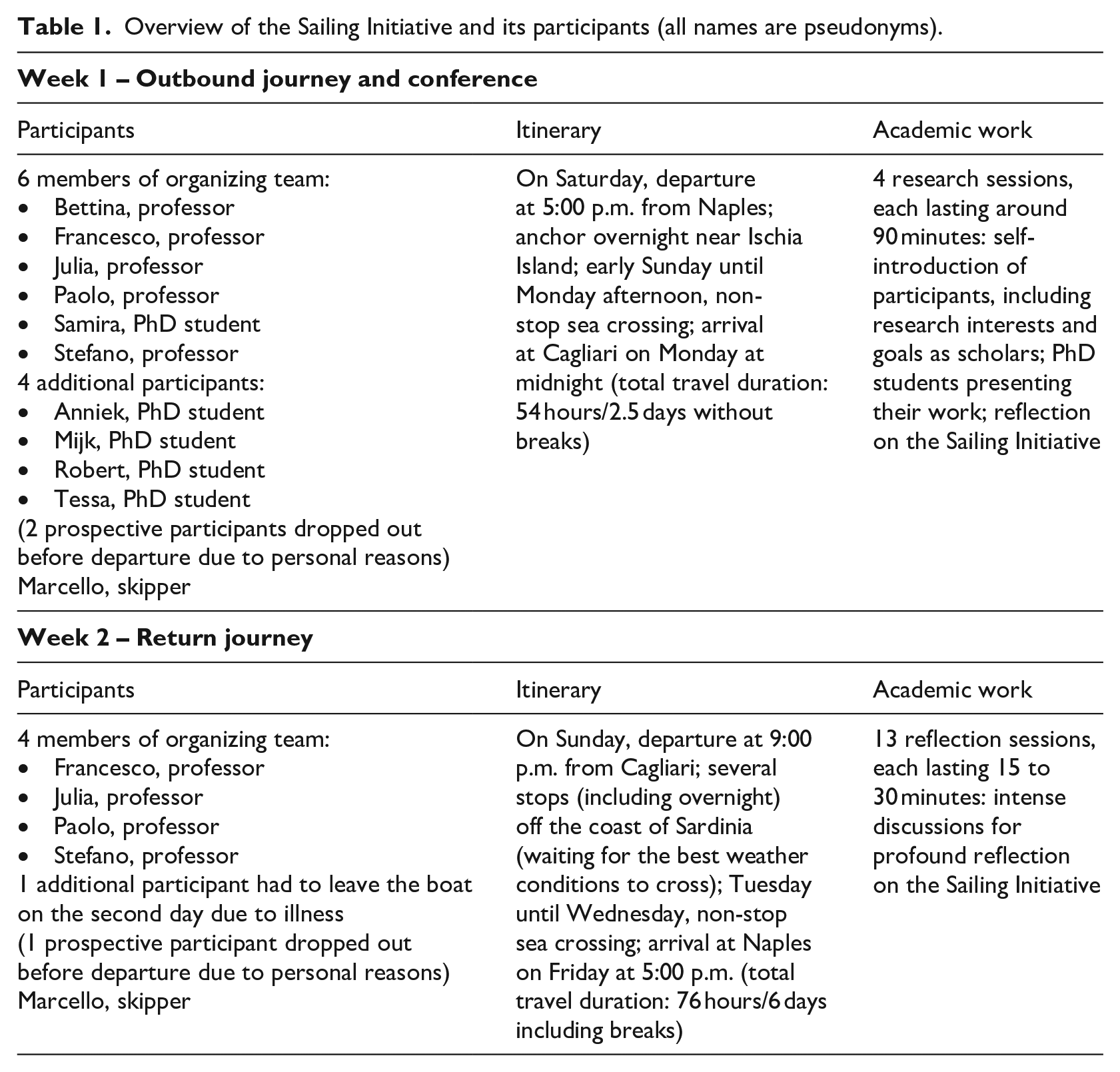
Before the trip, three online meetings were held with the entire crew between December 2022 and June 2023 to discuss topics such as the initiative’s goals, rules on board, task splitting, packing lists, and participants’ expectations and worries. The concrete sailing trip materialized in July 2023. Week 1 included the three-day outbound journey from Naples to Cagliari, where the EGOS colloquium took place, and the time during the conference in the marina of Cagliari (four days). Week 2 comprised the return journey after the conference from Cagliari to Naples, a slower-paced six-day trip with several stops (waiting for the best weather conditions to cross without the use of the engine). Participants could choose which week(s) of the trip they wanted to join. The boat was chartered from a local owner-skipper who was present during the entire journey.
Data collection
While the idea to write a scientific paper based on our experiences from the Sailing Initiative only arose during the last days on the boat, we had decided in advance to document our learnings for future initiatives. Hence, data collected between November 2022 and October 2023 include qualitative survey data of individual reflections, recorded collective reflections both on the boat and after the journey, communication records, archival data, as well as photos and videos taken during the trip.
Surveys were administered twice: once in June 2023, immediately before the trip, and again in August 2023, shortly after the trip. The pre-sailing survey, filled in by twelve of the prospective participants, comprised open-ended questions regarding participants’ motivations, hopes, fears and perceived obstacles related to the trip. The open-ended post-sailing survey, completed by all ten participants who were actually on the boat, asked about the most important experiences, deviations from expectations, and outcomes of the trip, prompting detailed descriptions, some of which were several pages long.
A second main data source were the recordings of collective reflection sessions. In week 2, while still on the boat, the remaining four participants intensively reflected on their experiences during the trip in 13 sessions, each lasting 15 to 30 minutes (one of these included the skipper’s perspective). These conversations were audio-recorded with mobile phones and later transcribed verbatim. Two additional reflection sessions, lasting 90 minutes each, were held online on 14 September 2023 (with five participants) and on 4 October 2023 (with all ten participants) to further reflect on our experiences and learnings. These video calls were recorded and conversations were transcribed.
We collected archival data, including drafts of the initiative and the final call for participation, as well as emails and text messages related to the initiative. Furthermore, participants had altogether created and shared about 500 photos and 50 short videos that document the situation on board, common experiences like sitting around the small table or eating together, as well as salient and surprising moments such as a beautiful sunrise, the sight of dolphins, or the killing of a tuna fish. In addition, one of us was in continuous contact with a close friend, a visual artist, throughout the trip and shared stories from the boat with him. In response, the visual artist created several humorous little comics of these incidents, some of which were shared with participants on the boat. The photos, videos, and sketches serve as complementary data sources regarding the physical and emotional aspects of the journey.
After the trip, the idea to write a scientific article about the experience was discussed with all the participants in week 1, and all were invited to be co-authors. This invitation to collaborate for all involved participants corresponds to the real utopian conception of academia as a place for cooperation rather than competition. While every member was positive about the idea of writing an article about our experiences and agreed for their data to be used in anonymized form, two declined co-authorship due to time constraints.
Data analysis
The analysis of our autoethnographic data followed a qualitative abductive approach (Gioia, Patvardhan, Hamilton, & Corley, 2013; Magnani & Gioia, 2023), driven by our evolving understanding of the relevance of embodiment in the experimental enactment of a real utopia.
Visual materials
First, we walked through the (audio-)visual materials (photos, videos, little comics created by the artist), which document the material conditions on board that shaped our bodily experiences, such as the level of comfort and convenience, but also the sound of the engine, as well as the shaking of the boat in high wind conditions. In addition, they capture the unusual setting of our informal and formal academic conversations, squeezed around the table in the cockpit, or lying on the windshield. Based on these data, we decided to give material features a prominent role in our subsequent data analysis.
Further, in the post-sailing survey, as well as the comics, three issues re-occurred that had spurred a lot of emotions, reflection and deliberation within the group: the use of the engine, seasickness and fishing. To convey both the bodily and material dimensions of these situations, along with the diverse individual perspectives on these issues, we invited the visual artist who had sketched comics throughout the journey to create short graphic novels depicting our initial utopian idea and our three main struggles. The artist was given access to the other visual materials and three of us worked closely with him over a period of several weeks of drafts and revisions to create appropriate visual representations of the three situations. The remaining co-authors provided feedback to fine-tune the visuals in line with their experiences. The resulting short graphic novels are presented as part of the findings.
Textual materials
The main part of our analysis was based on the textual data (i.e. individual surveys, emails and text messages, documents, and transcripts of the reflection sessions). Four of us were involved in the transcription, two of whom inductively coded the textual material (using Atlas.ti). In the first round of coding, we created first-order concepts close to the original data and clustered them into second-order themes, which we broadly organized into three temporal categories: envisioning the real utopia (to prepare for the concrete enactment), experimental enactment of the real utopia, and revising the real utopia (based on experiences from the concrete enactment). Furthermore, we identified contextual factors that are relevant across these phases. We shared these first-order concepts and second-order themes with the broader group of co-authors to validate them or suggest changes.
In a second round of coding, we used the refined second-order themes on the textual data and started to compare and contrast our emerging findings with related literature, especially on agency (Emirbayer & Mische, 1998), future-making (Wenzel et al., 2020) and prefigurative organizing (Schiller-Merkens, 2024) to identify aggregate dimensions. Three of us continuously cycled between the literature and empirical data and updated our analytical memos until a point of inductive thematic saturation (Saunders et al., 2018). Three others fine-tuned and validated the resulting data structure.
This procedure revealed eight aggregate dimensions presented in italics, and 19 second-order themes, written in brackets: institutional context (institutional norms, institutional roles), individual perspectives of participants (individual experiences, individual goals and ideals), initial utopian idea (utopian narrative, hypothetical resolution), material features (physical characteristics, material risks), bodily experiences (sensory experiences, vulnerability, convenience/pleasantness), evaluative struggles (struggles with external constituencies, internal struggles), embodying actions (embodying as envisioned, embodying as usual, embodying as suitable), and updated utopian idea (transformative embodied experiences, embodied evaluation, embodied projection). The complete data structure is shown in the Appendix.
As a last step, moving constantly between the literature, emerging themes and data, applying abductive reasoning (Magnani & Gioia, 2023) as well as scientific intuition (Kump, 2022), and reflecting on our emerging insights with those co-authors not directly involved in data collection, we developed an emerging grounded model. The resulting model of embodied experimental enactment of a real utopia affirms existing concepts, and also extends them. Concretely, we lean on Emirbayer and Mische’s (1998) chordal triad of agency as past (iterational agency), present (practical-evaluative agency) and future-oriented (projective agency), as well as their notions of narrative construction and hypothetical resolution in the context of projective agency but add an embodiment element to it. Furthermore, we integrate the idea of internal and external struggles from research into prefigurative organizing (Schiller-Merkens, 2024), as well as Wenzel et al.’s (2020) view of future-making as discursive, bodily and material, but expand extant knowledge regarding bodily experiences and related material features when enacting a desired future.
Findings
We present our case narrative in a chronological way (Pentland, 1999), from envisioning the real utopia underlying the Sailing Initiative to its experimental enactment and revision. We follow the common practice in (auto)ethnography to produce ‘aesthetic and evocative thick descriptions of personal and interpersonal experiences’ (Ellis et al., 2011, p. 277) that include interpretations of the context, meanings, intentions and underlying reasons behind our actions. In the narrative, we partly deviate from the analytical order of our data structure (Appendix), but we italicize second-order themes and aggregate dimensions throughout the text to maintain coherence between our findings and theoretical analysis. We include the short graphic novels produced during data analysis to convey the embodied aspects of our experiences, as well as the internal struggles due to varying individual perspectives (Lehtonen & Putkonen, 2023).
Envisioning the real utopia underlying the Sailing Initiative
The Sailing Initiative constitutes the experimental enactment of a broader utopian idea of combining environmental sustainability with slow academia. As the subsequent elaborations show, we developed a shared utopian narrative and a hypothetical resolution against the backdrop of the institutional context and our individual perspectives.
The utopian narrative: Sustainability and slow academia
The initial seeds for the Sailing Initiative were planted four years earlier as a vague idea to combine sailing and research. Paolo, one of the initiators, wrote in the pre-sailing survey: The primary motivation was to combine my passion for marine life and sailing with my job in academia [. . .]. There was no specific plan, just a sense that I could contribute to creating something enjoyable, and potentially scientifically intriguing.
Paolo shared these ‘embryonic ideas’ with Francesco and Stefano, both of whom had also sailed before and they were thrilled – albeit for different reasons: Stefano, an experienced sailor himself, was enthusiastic about the combination of sailing and academic work. For Francesco, who held strong sustainability values and had been practising slow travelling for many years, the prospect of combining sustainability and slow academia was particularly appealing. In a discussion among the organizers before the trip, he explained: What motivates me to do all of this is not just to make the conference more sustainable. [. . .] My utopia is that we as a profession have a broader impact. [. . .] For me, the experiment is not the boat, but [. . .] to show the world that we are walking the talk. And then also others can do it.
The initial utopian narrative was co-developed in the institutional context of academics becoming increasingly reflexive of their role in society and the incentive structure of the academic system, rewarding fast publications with theoretical contributions over societal engagement and relevance. Furthermore, it was influenced by movements like Scientists for Future, which raised awareness among scholars about the environmental impact of academic practices, including conference travel.
The Sailing Initiative as a hypothetical resolution
Over the subsequent years, the initiators pondered various options for bringing the real utopia to life. In 2023, the main conference in their discipline, the 39th EGOS Colloquium, was held on Sardinia, and travelling to the island by sailboat was considered a hypothetical resolution to the utopian narrative. At this point, the initiators involved three additional academics in the extended team of organizers. All subscribed to the utopian vision of sustainability and slow academia, which is manifested in the final call for participation, as published on the website of OS4Future: #SailingEGOS [the Sailing Initiative] seeks to minimize even further the carbon footprint of conference attendance and, at the same time, increase its ‘mindprint’. The time needed to travel [. . .] will allow academic sailors (from first-timers to experts) to engage in structured and unstructured conversations under the blue sky and night stars. What will this academic experiment bring about? With the desired combination of younger and more senior scholars, we anticipate that new research ideas will emerge and possibly new collaborations.
Eight additional researchers signed up for the Sailing Initiative, most of whom were not acquainted with the members of the organizing team. The participants’ responses in the pre-sailing survey revealed a wide range of individual goals and ideals for participation, including a commitment to sustainable travel, a desire to spend time with fellow scholars, the pursuit of adventure and novelty, making a statement regarding sustainability, and enhancing the credibility of their own sustainability-focused research.
Several choices had to be made on how to enact the shared vision against the backdrop of the institutional context of both academia and sailing. The most important task was selecting a sailboat with sufficient living and workspace, sturdy enough for the long, non-stop journey to the island. Despite two experienced sailors in the crew, we decided to hire a professional skipper, Marcello, enabling us to focus on the academic goals of the initiative. Marcello, who also owned the boat, was well-versed in leading charter trips for vacationing groups and agreed to contribute to our sustainability goals. All participants accepted the institutional norms of sailing, including shared duties (e.g. cleaning, cooking, standing watch), and recognized the need to accept the institutional role of the skipper.
All of us had varying degrees of individual experience with sailing, slow travelling and other activities in nature or in small spaces (e.g. camping), and we projected these former (bodily) experiences to the Sailing Initiative, as could be seen from the concerns expressed in the pre-sailing survey. They ranged from the necessity to share a very small bed with an unknown person, to the risk of seasickness for the less experienced sailors, to the threat of having to deal with bad weather or facing strong winds for the more experienced ones. For example, Bettina noted: ‘My three areas of uncertainty: seasickness, food and sleep.’ While being aware of these potential inconveniences, and willing to embrace them, all participants held optimistic expectations about life on board. For example, even though many of us mentioned fear of seasickness, we expected to be able to ‘work and prepare for the conference while on the boat’ (Robert).
The evening before our departure, eight of us who were already in Naples met for dinner at a restaurant, to get to know each other, discuss final practicalities (e.g. who would buy the food and bring it into the boat, how to split the costs) and talk about the days ahead on the boat. On this evening full of anticipation and excitement, Paolo showed us photos and videos of a previous sailing trip and raised our hopes of seeing dolphins and turtles. Figure 1 presents the positive, utopian view of the trip that we had co-created at this point in anticipation of our common life on board.
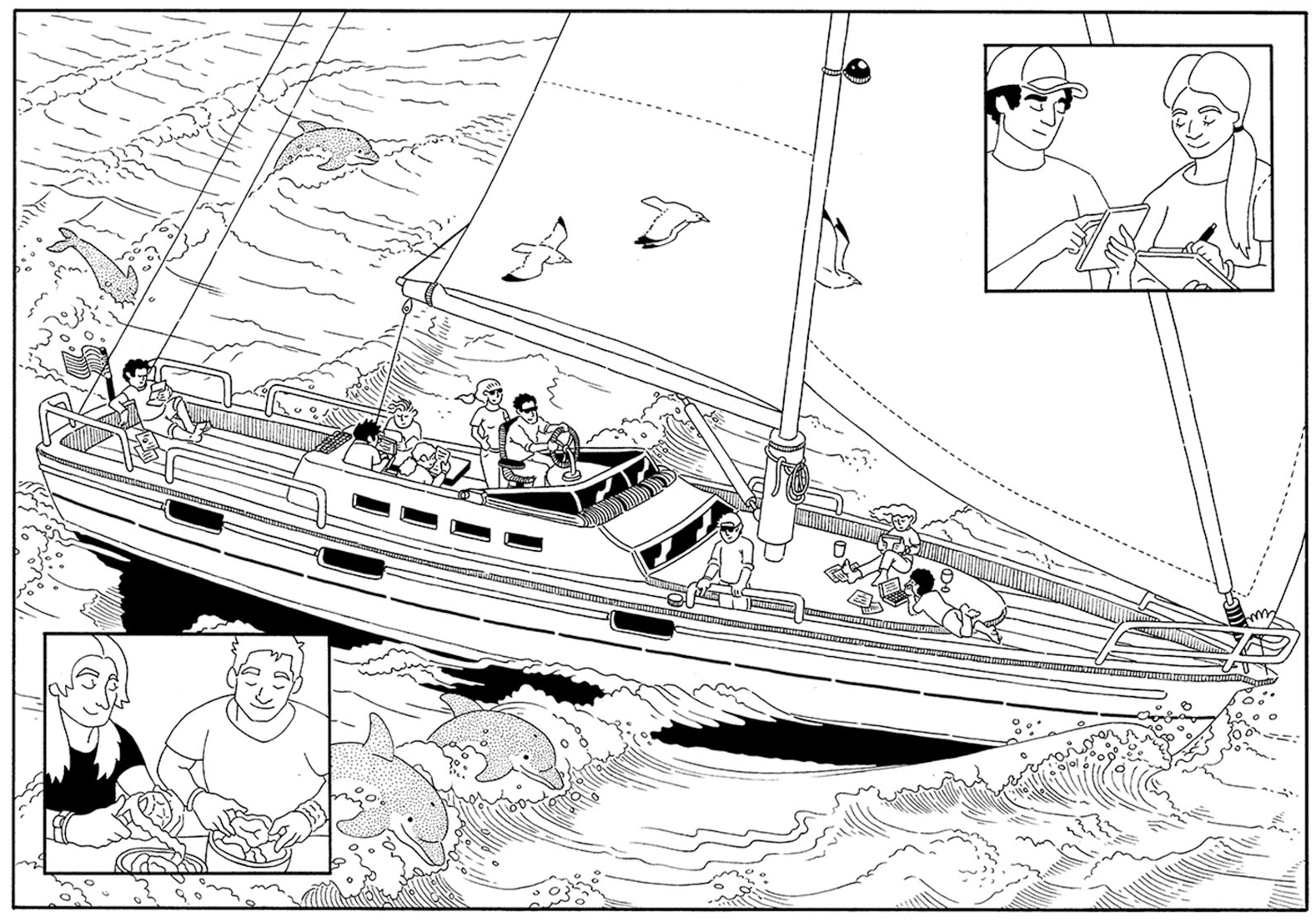
The utopian idea of sailing to a conference (artwork by Bas van der Linde).
Experimental enactment in the Sailing Initiative
Our concrete actions during the Sailing Initiative were shaped by material features (e.g. characteristics of the boat) and bodily experiences (e.g. sickness). These material and bodily aspects were embedded in the institutional contexts of the academic system and the charter logic with their respective institutional norms and roles, which caused struggles with external constituencies. For instance, although it was explicitly intended as an academic journey, all of us faced obstacles when applying for the sailing trip at our home universities. While some of them reacted more supportively than others to the unconventional means of transport, all of us had to provide detailed justifications to secure approval and gain refunds. Moreover, reactions from our colleagues and friends varied: Many found it inspirational, but some critics questioned its sustainability impact and saw it as a taxpayer-funded vacation, or as an elitist initiative only for the privileged. Furthermore, we had to deal with internal struggles among crew members (e.g. related to fishing). Hence, we could not always embody our real utopia as envisioned, but sometimes had to embody it as suitable, or fell into old patterns of embodying as usual.
In the subsequent sections, we first document our experiences of setting foot on the boat. We then report on three salient issues – using the engine, seasickness and fishing – to illustrate how bodily experiences, material features, institutional context and individual perspectives shaped our concrete actions.
Setting foot on the boat
The sailing trip started on a Saturday afternoon, three days before the beginning of the conference. At that time, all but one participant had endured multi-day train’ journeys to arrive at the marina in Naples.
Concerning the material features, the boat, a 57 ft vessel, contained five sleeping cabins (thereof one for the skipper) with tiny bathrooms and a compact kitchen below deck. On deck, there was a comfortable covered seating area (central cockpit) with a couch around a small table and several other areas where people could sit or lie. With its gleaming wooden interior, white faux leather cushioned couches and a well-equipped kitchen, the boat was more luxurious than some participants had expected. Yet, the space conditions were tight: The seating area could hold eight (rather than ten) persons comfortably; beds of approximately 1.20 m were foreseen for two, and beds of 1.40 m for three persons of the same gender and academic role. These characteristics influenced our convenience. When reflecting on what could be improved for future initiatives in the post-sailing survey, Anniek, who shared the cabin with Samira and Tessa, wrote: ‘Not more people than beds/seats’.
For some of us, like Julia or Samira, who had never sailed before, even the physical act of leaving stable ground and stepping onto the boat was daunting. Once we all were on the boat, we became acquainted with the sanitary facilities (each cabin had its own tiny sink and toilet), and the experienced sailors familiarized themselves with the emergency equipment. At this point, we learned that the level of automation of the boat was such that the skipper could navigate the boat on his own; that is, we did not have to actively help with the sailing. Most of us were surprised, as we had imagined active physical involvement in sailing.
When we cast off from the marina, the skipper uncorked a bottle of Prosecco and turned on party music to celebrate the beginning of the journey, which some of us found misaligned with the purpose of the trip. For example, in the post-sailing reflection, Bettina noted that both the surprisingly passive nature of the sailing and the unexpected music and Prosecco left her feeling somewhat uneasy, as she had expected a less luxurious and more collaborative experience.
For all of us, this moment marked the physical beginning of the experimental enactment of the real utopia, as reflected in the many photos and videos to document the departure from the marina. Mijk remembered in the post-sailing survey: When we set sail, seeing Naples slowly disappear from view, the boat getting hit by the waves, [. . .] it began to sink in that we were actually doing this thing. The sailing trip had always remained and felt a bit abstract and distanced. Something we planned for and which I sometimes thought about, but then the reality set in.
What followed were two and a half intensive days of travelling to the conference, four days of living together on the boat, and six days of travelling back from the conference (for the schedule, see Table 1). The subsequent sections narrate our most salient experiences during the Sailing Initiative related to embodiment.
The roaring engine
Due to the design of the boat (material aspect), the skipper could operate the diesel engine and steer via remote control, even while lying on the windshield. Furthermore, his electronic equipment allowed him to adjust the sails independently throughout the journey, although he still needed to move across the boat to access the diverse buttons and levers. As our goal was to sail as much as possible and to rely on the engine only if necessary, Paolo and Stefano were constantly involved in the navigation – not only to help the skipper with setting the sails but also to make sure he relied on wind power whenever possible. They continuously monitored the weather forecast and moved around to adjust the sails.
From just a few hours into the trip, we encountered significant headwind (around 15 to 20 kn). Because we had to arrive at the conference on time, we could not wait for the weather to improve; thus, we had to use the diesel engine to go against the waves. The boat shook heavily for much of the journey, making it difficult to move on board. Additionally, the engine made a loud noise, which not only impaired the physical experience of ‘sailing’ but also served as a constant reminder to several of us, for whom sustainability was the main goal of the trip, that we were producing considerable amounts of CO2.
As indicated in Figure 2, there were varying individual perspectives on this issue. While some, like Francesco, struggled heavily with the fact that our trip would likely be much less sustainable than we had hoped, others experienced fewer conflicts regarding environmental impact. For example, Tessa wrote in the post-sailing survey: ‘We sailed a bit less than I hoped we would have, due to the lack of good winds. It was unfortunate, but also reminds you of the fact that when it comes to nature, you are really the one that has to adapt.’ Marcello, who was responsible for safety on board and had strong interests in protecting his equipment, was in favour of using the engine anyway – partly because it was also less physically exhausting for him than constantly adapting sails to the changing wind, just to save a small amount of fuel. Hence, this situation led to internal struggles among crew members, as reflected by a memory of Paolo after the trip: We had a lot of negotiation, a lot of reflection about the route [. . .] based on the weather forecast. [. . .] And it was always a compromise between my view that was more wind-oriented and Marcello’s view, that was more safety-oriented for people on the boat, but also for the equipment. [. . .] For Marcello, better conditions would mean low wind [to be able to use the engine]. For me, better conditions meant moderate wind to sail.
Overall, despite our best efforts to sail as much as possible, when embodying actions, we had to discount our utopian goals and embody the utopia as suitable. Concretely, we had to rely on the engine (in support of the sails or as the only propulsion) for about 90 percent of the time during the outbound journey (week 1). As weather conditions improved and time constraints lessened during the return journey (week 2), we could embody more as envisioned, that is, sail more and reduce engine usage. Ultimately, around 95 percent of the propulsion came from sailing, resulting in average CO2 emissions per person across the entire trip that were lower than if we had taken a ferry or aeroplane.
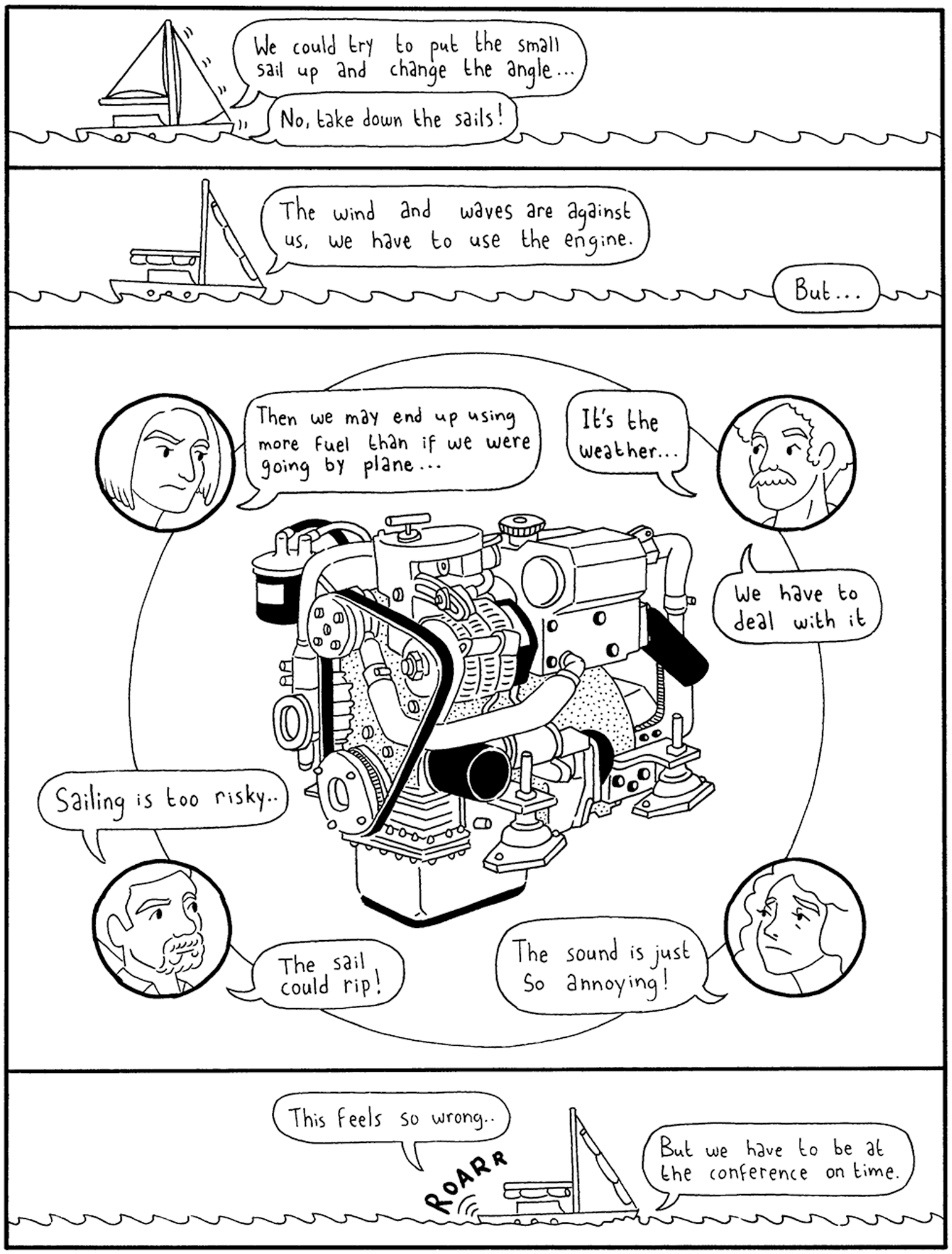
Evaluative struggles around the use of the engine (artwork by Bas van der Linde).
Another defining experience around using the engine was related to the institutional context of the charter sailing industry, which is illustrated by the following story that Francesco shared during the post-sailing reflection: It was very hot. So Marcello started the air conditioning. And I felt very bad [because of the engine]. [. . .] When the motor is running at night [. . .], you see this engine work and you hear the rrooaarrrr. And I was feeling the CO2 going out of it. So I could not sleep. I was angry. I went to sleep outside because the sound was lower. And there I met Marcello and started a discussion with him where he told me that most people during a tourist charter prefer to stay inside all the time with the air conditioning running.
For Marcello, our reluctance to use the engine was very strange and hard to understand. He was accustomed to charter sailing, where customers typically prioritize convenience over sustainability. Our individual goals and ideals were going against his established norms of how to ensure a pleasant, safe and enjoyable trip.
Seasickness
The second main issue on board was seasickness. In line with academic norms, the more experienced scholars in the organizing team had designed an academic programme – a variant of a PhD colloquium – for the trip. However, due to the rough seas at the beginning of week 1, which caused constant shaking of the boat (i.e. a material feature), we all suffered from varying degrees of nausea and headaches. Mijk, one of the more severely affected, described this situation as ‘agonizing’ in the post-sailing survey: ‘I got pretty seasick and was confined to a horizontal position for most of the trip, occasionally dozing off and distracting myself through conversation.’
Besides being unpleasant, the bad physical condition of many crew members jeopardized the academic goals of the initiative, particularly the planned work sessions on board. During these days in week 1, members of the organizing team had divergent individual perspectives on whether we should have formal academic sessions to deliver on our promise from the call for participation, leading to internal struggles, as indicated in Figure 3. Some (who felt better) thought that we should have the sessions, while others believed that we should rest because these sessions would aggravate the seasickness. Julia recalled later in week 2: ‘For me, it was really this tension of “Are we able to work? Under what circumstances? If we work, do we put ourselves in danger of becoming sick again?”’
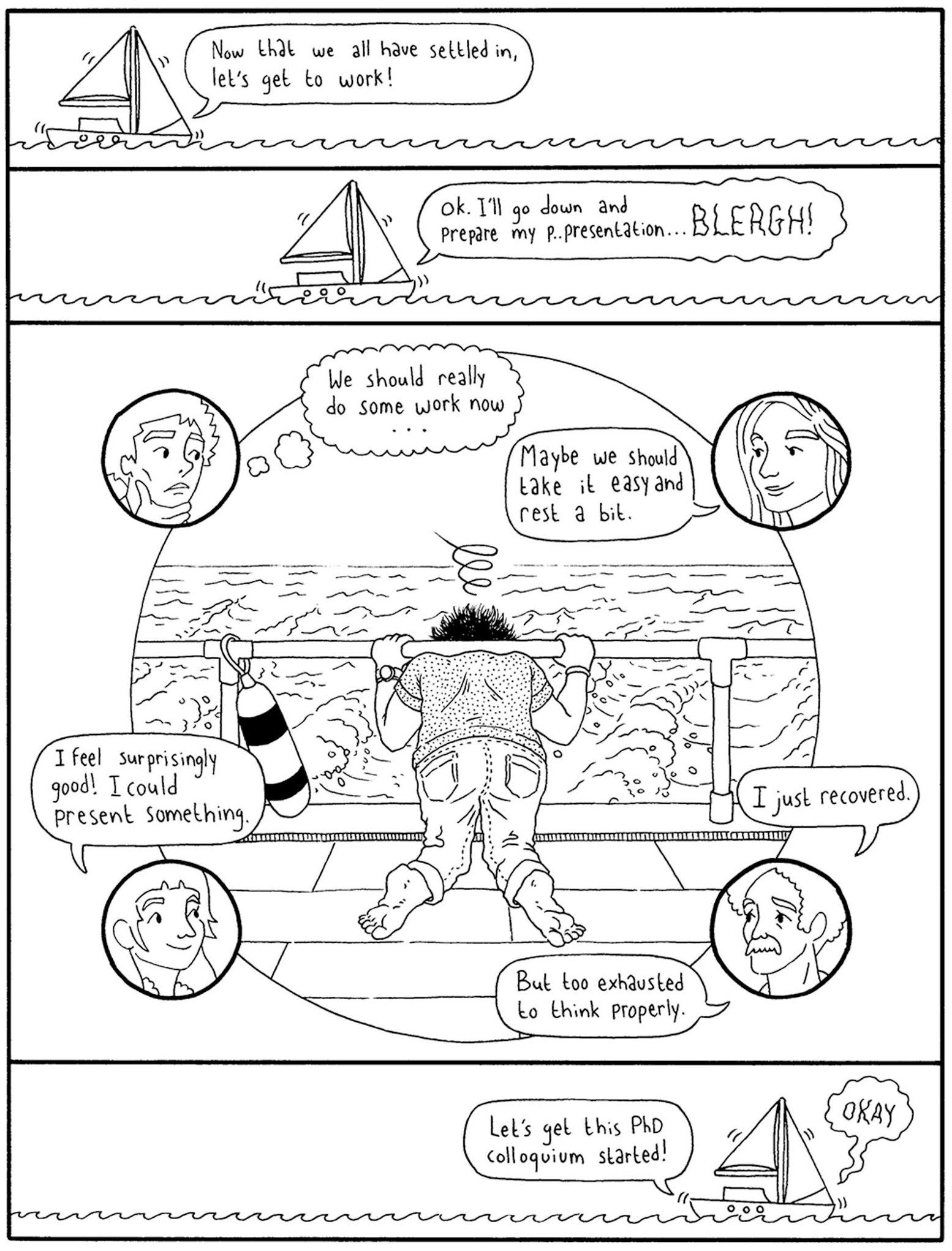
Evaluative struggles around working despite seasickness (artwork by Bas van der Linde).
The concrete embodied action was a compromise made by senior members of the organizing team. We held four academic sessions of around 90 minutes each, one to reflect on one’s role as a scholar, two where PhD students presented their research ideas and received feedback, and one session to reflect on the learnings from the Sailing Initiative. These sessions took place outdoors in the central cockpit, with participants sitting on the couch around the table and lying at its fringes or on the deck. Mijk, one of the PhD students, documented in the post-sailing survey: The moment we started with our academic sessions, I felt a bit overwhelmed, like ‘Really, are we still going to do this in the state that we are in?’ Yet, when we started off, I was really amazed at the resilience of the group and how we were able to transcend our momentary discomfort by engaging our heads for an academic discussion.
In week 2, the fact that the decision to stick to these sessions had been made by the professors, and that only PhD students had presented their work caused intensive reflection among the organizers. Depending on their individual goals and ideals regarding equality on board, some were very critical about having embodied as usual, rather than as envisioned, and reproduced academic hierarchies on the boat. Others considered it a matter of feasibility and responsibility of delivering on the promise made in the call for participation, in particular to the PhD students.
At the same time, the unusual physical characteristics on board and especially the bodily aspect of seasickness led us to step out of our conventional institutional roles and embody as envisioned: Whoever felt better than others at a certain point in time took over necessary tasks in the kitchen or below deck, irrespective of academic roles. For instance, Francesco, a professor who handled the seasickness in the first week well and thus was able to stay below deck in the kitchen without any problem, became the ‘vegan chef’ and prepared most of the dishes during the entire trip. This role change was also evident in the post-sailing survey. In the field of the survey named ‘position’, some respondents humorously noted ‘sailor’ (Stefano) and ‘cook or pirate’ (Paolo), mirroring the playful labels that were written on their onboard drinking glasses instead of their academic positions.
Fishing
The third salient experience was around fishing. Reflecting the participants’ dietary preferences, ethical stances and their shared commitment to food sustainability, an email by Stefano on behalf of the organizers before the trip documented that ‘on board, food will be vegan to suit all the requests. But we agreed that it is tolerated to fish and eat that fish during the trip.’ However, what seemed acceptable in theory proved challenging in practice.
In the first week, the skipper, with assistance from Paolo, caught, killed and gutted a fish on deck. This was a profound bodily experience for several crew members, as Mijk vividly described in the post-sailing survey: It was mesmerizing. Blue and translucent like the ocean, yet already dead once it came onto the boat, having struggled till its last and dying breath. It was a strange phenomenon to see how a line of string slowly but surely brought distanced splashing waters onto the boat in the form of a huge and beautiful creature. [. . .] The boat’s deck glittered with shiny scales, oozed with blood and gore and vehemently attacked the nostrils of any weary passenger.
Some of the vegan and vegetarian crew members were shocked and turned away, while others watched the process of killing the fish with a mix of disgust and fascination. A few of us took photos to document this raw experience or to ‘show this special food to my family back home’ (Bettina, reflection after trip). While all crew members held strong sustainability-related values, they had varying perspectives on this matter (Figure 4). For some, like Julia, catching a single fish with a rod and throwing all inedible parts into the water as food for other animals was viewed as a sustainable practice while for others, such as Francesco, it was a moral issue to take the life of a non-human animal and eat it. The incident caused physical reactions (e.g. nausea) and intense emotions (e.g. disgust, sadness), and sparked a lot of reflection and discussions among crew members on the ethical aspects of killing animals and eating meat.
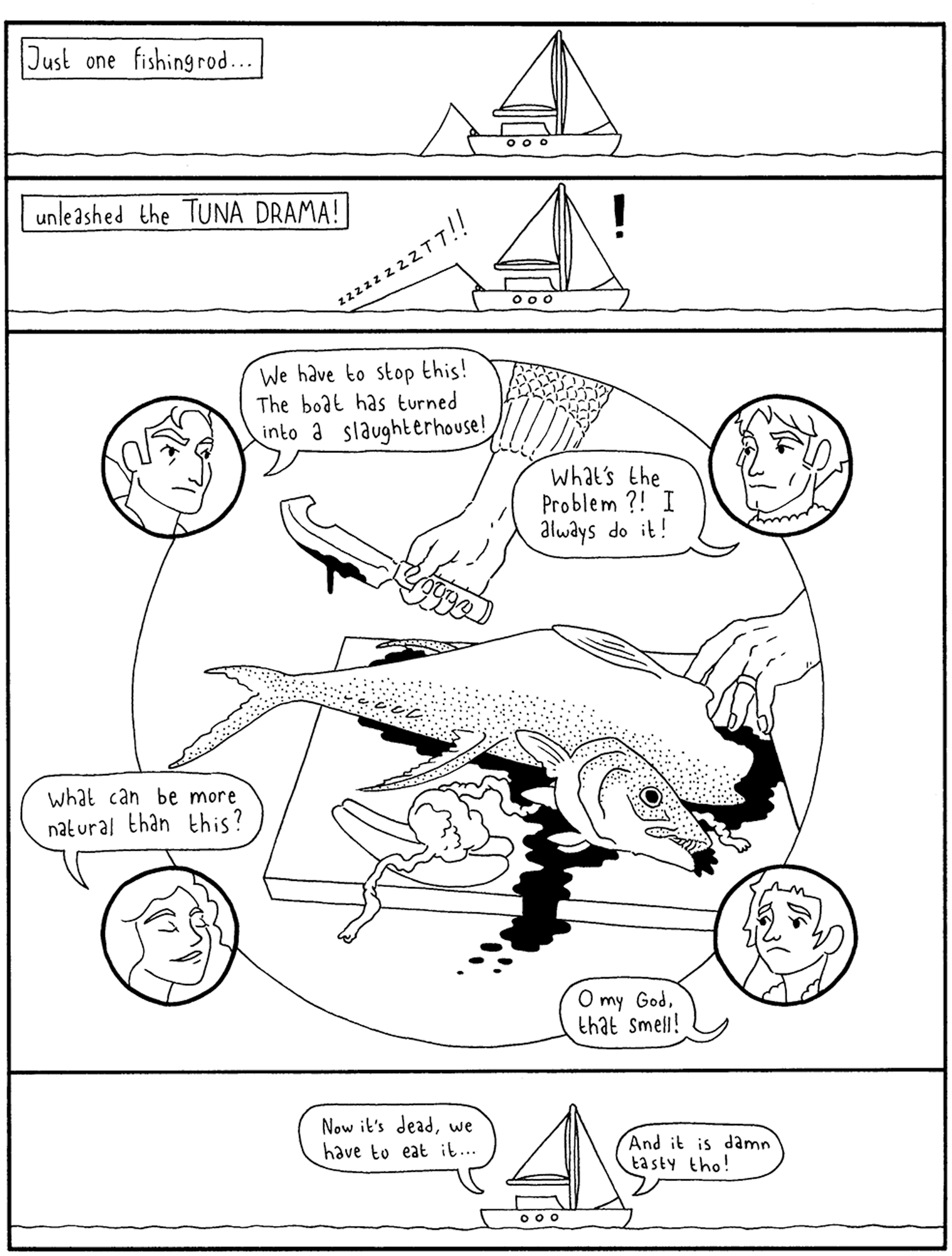
Evaluative struggles around fishing for tuna (artwork by Bas van der Linde).
An even more dramatic internal struggle occurred in week 2, which later became known as the ‘Tuna Drama’. Marcello, the skipper, had placed his fishing rod at the rear of the boat, waiting for a fish to bite. Marcello was aware that Francesco did not approve of fishing, as the two had previously discussed this topic. Suddenly, the noise of the fishing rod, the ‘zzzzzzt,’ indicated that a fish had bitten. Marcello started to struggle with the fish to kill it, and Francesco was overwhelmed by the experience: ‘The second fish was too much for me. [. . .] I went into my cabin. [. . .] I stayed there for a couple of hours because I could not deal with it emotionally’ (reflection on boat). The rest of us could see how much Francesco was suffering and realized that Marcello had to stop fishing, otherwise the situation would escalate. Surprisingly, Marcello insisted on continuing, throwing the rod back into the sea. In a lengthy and emotional conversation on the high seas, without any possibility of exiting the boat, we tried to understand Marcello’s individual perspective and find a way to convince him to stop fishing. Throughout this conversation, the fishing rod remained in the water, and there was a sense of urgency to resolve the situation.
Marcello explained that he wanted to catch a fish for his father, who had suffered a stroke, because they shared many beautiful memories of fishing. Moreover, in Marcello’s view, in line with institutional norms of the charter logic, fishing was ‘natural’. ‘I thought, “What the hell do I care? It’s something I do normally. I did nothing wrong. What’s the problem?”’ (Marcello, reflection on boat). He considered the participants’ attempt to save the fish naive, given the unsustainable institutional practices of other charter boats, and felt undermined in his role as a skipper on his own boat. Yet, through the intense conversation, Marcello came to realize that his behaviour threatened to destroy the team spirit and remorsefully removed the fishing rod. Francesco, after coming out of his cabin, learned about Marcello’s ill father and could empathize with him. This led to a resolution, and Francesco eventually hugged Marcello. The intensive experience preventing Marcello from embodying as usual changed his view of our initiative and his role on the boat: He became increasingly interested in our real utopia and even took part in some of our reflection sessions.
Revising the real utopia underlying the Sailing Initiative
Toward the end of the trip, we began to realize that the experience of sailing to a conference, as well as the encountered evaluative struggles, had led to a revision of our utopia through three mechanisms: We had gone through strong transformative embodied experiences, conducted embodied evaluations and engaged in embodied projections to future settings.
Transformative embodied experiences
After the experimental enactment in the Sailing Initiative, all of us had bodily memories of the visceral experience of being on a sailboat on the open sea, facing strong winds, or being seasick. Besides these basic bodily memories, in the post-sailing survey, many participants expressed transformative embodied experiences, for example, of being ‘a small part of this universe’ (Julia) or ‘the pure connection I felt with the sea’ (Tessa). Bettina wrote: ‘The sleeping under the stars and the sunsets and sunrises over the sea were also very overwhelming. One deeply felt the beauty of the world, the cyclical nature, and the absolute necessity to preserve the planet.’ Indeed, many of the photos and videos also show crew members gazing fascinatedly at the horizon.
Further, the shared experience of physically being ‘on the same boat’ and being dependent on each other in such a restricted environment forged strong social bonds that transcended academic hierarchies. Francesco, one of the professors, noted in the post-sailing survey, ‘with the passage of time, status and hierarchical differences between the participants almost vanished’. At the end of the first week, when the crew members coincidentally crossed paths at the conference party, they celebrated and danced together, indicating the transformation from strangers to friends in a matter of days. This sentiment was not only shared by organizers but also reflected in statements by the PhD students. For example, Robert ‘just also really appreciated how genuine everyone was in that joy when we crossed each other’s paths during [the conference]’ (post-sailing reflection).
Embodied evaluation
As expected for experimental enactment, the physical experiences during the Sailing Initiative exposed our utopian vision to a reality check. In hindsight, some of our assumptions, for example, related to seasickness, or to using the engine, felt painfully naive – something we intensively reflected on throughout week 2.
More interestingly, however, our data suggest that the body itself plays a crucial role in this evaluation. The physical experience of and bodily reaction to seeing, hearing and smelling a tuna being killed in week 1 shaped the participants’ ideals and worldviews. When the fish had been prepared for dinner, several crew members, some of whom rarely consumed meat or were even vegetarians, partook of small portions, because it was considered ‘very pure’ (Anniek, on board). Others changed their opinion after the bodily experience, like Mijk, who wrote in the post-sailing survey: Although I was at first amenable to eating a fish that would be caught by one’s own hands in discussions that we had the day before, I was a bit thrown into disarray when I was left with images of that beautiful fish being dragged in, dead from exhaustion, onto our deck.
Robert, who had been deeply affected by the experience, decided to transition towards a fully vegan diet at that moment on the ship. Overall, watching the killing of the fish sparked a lot of discussions about individuals’ varying stances toward meat consumption and broader interpretations of sustainability.
Embodied projection of experiences
While some of the experiences were rather sobering, others, such as the sheer beauty of nature and the silence on the sea, encouraged new imagination. During week 2, several of us reflected on possible ways of enacting the vision of sustainability and slow academia in the future. We observed that our bodily experiences, together with our individual goals and ideals, shaped our embodied projections of the future regarding the real utopia. Some, like Stefano, who still believed in sailing as a feasible means of transportation, were thinking of ways to modify the sailing trip, for instance by reducing the number of participants on board, choosing a different boat, or extending the travel time to the conference. Others, having experienced the severe material and bodily limitations of sailing, projected alternative sustainable travel options for experimental enactment of sustainability and slow academia, such as group walking or utilizing a big ferry for many attendees. For Francesco, who had very strong bodily and emotional memories related to the killed fish and the constant usage of the engine, sailing was not part of the hypothetical resolution anymore. He thought, however, that the trip could be seen as a symbol, if not for sustainability, then at least for ‘slow academia, for courage, tenacity, for a different way to approach destinations in a non-competitive way. [. . .] A symbol for slowing down’ (reflection on boat).
Discussion
In the subsequent sections, we first present our theoretical model of the role of embodiment in enacting a real utopia (Figure 5). Then, we discuss our contributions to the literature on embodiment in the enactment of real utopias and on agency more broadly.
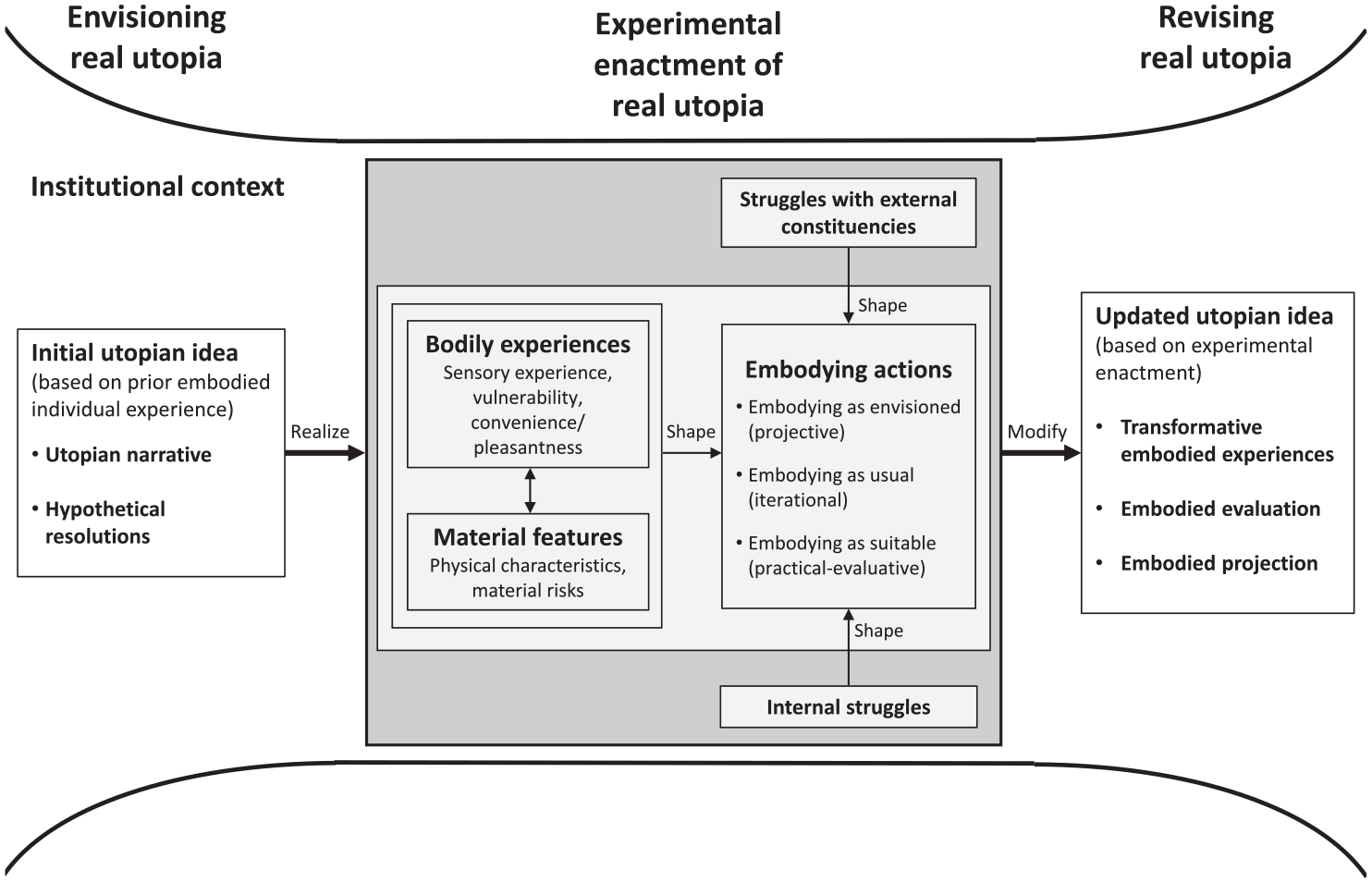
Theoretical model of the role of embodiment in enacting a real utopia.
Theoretical model
Envisioning the real utopia
As depicted in Figure 5, bringing a real utopia to life starts with actors envisioning scenarios of desirable futures. To create the utopian narrative, they individually or collectively ‘dream’ about what would be possible (e.g. sustainability, slow academia; Arjaliès, 2021). Then, they develop a specific scenario of action, a ‘hypothetical resolution’ (Emirbayer & Mische, 1998, p. 990) that adequately responds to the moral, practical and emotional aspects of the utopian narrative.
Earlier research portrayed these processes as inherently social and culturally embedded (Emirbayer & Mische, 1998). Expanding on these arguments, we propose that the co-creation of utopian narratives and decisions on hypothetical resolutions are also strongly embodied, as actors extrapolate from their past bodily experiences of what feels normal, pleasant, or feasible when developing their visions. For example, the initiators of the Sailing Initiative drew upon their lived, bodily experiences of sailing and other forms of slow travelling (e.g. by bike, by train) to co-create hypothetical resolutions. Besides considerations of budget and fuel consumption, they chose the vessel based on their experiences with varying levels of comfort and safety on a sailboat.
At this stage, actors’ hopes, wishes and aspirations are not only rooted in the (embodied) individual experiences and goals of those co-creating the utopian narrative, but they are also informed by the institutional context with its respective institutional norms (e.g. appropriate means and duration to go to a conference) and roles (e.g. academic hierarchies). The concrete choices for the experimental enactment (e.g. boat, activities on board, distribution of participants to cabins) are shaped by ‘shared sensibilities for how to experience and represent the world’ (Creed et al., 2020, p. 421).
Experimental enactment of the real utopia
In experimental enactment, hypothetical resolutions are put to the test. Here, people physically show up (e.g. on a sailboat) and participate with their bodies to bring the real utopia to life. When it comes to concrete actions, in some cases, actors may be able to embody as envisioned and act in line with their projections of the real utopia. For example, despite struggles with external constituencies and bodily inconveniences, in the Sailing Initiative we indeed arrived at the conference by sailboat and engaged in multiple ‘structured and unstructured conversations under the blue sky and night stars’, as mentioned in the call for participation. In other situations, actors may revert to their institutional norms and practices that have proven to work outside the experimental setting; they embody as usual. In the Sailing Initiative, we experienced this when we returned to our common roles as ‘professors’ and ‘PhD students’ and enacted the usual practices of a rather formal PhD colloquium (albeit in bathing clothes), where always one of the professors took the lead, sat in an exposed position (e.g. the skipper’s chair), with students presenting and professors providing feedback. Finally, there may be situations of experimental enactment where neither embodying as envisioned nor as usual works, for example, when confronted with strong wind, seasickness, or a killed tuna fish. In such situations, participants have to embody as suitable within concrete life circumstances. They have to make practical and normative judgements and choose between alternative courses of action. This not only involves cognition and discussion among group members, but is also an inherently embodied process. Sensory and visceral experiences determine, for instance, whether a situation is seen as beautiful, pleasant, or dangerous, and influence the perception of what is morally right or wrong (e.g. observing the killing of a sentient being), thus shaping concrete actions.
These bodily experiences are influenced by the physical space as a ‘prefigurative territory’ (Asara & Kallis, 2023; Reinecke, 2018) and, more specifically, by material features (Boxenbaum, Jones, Meyer, & Svejenova, 2018; Wenzel et al., 2020). Hypothetical resolutions involve material choices that shape bodily experiences, such as feelings of pleasantness or vulnerability, and affect ways of embodying actions during experimental enactment. The material may come with affordances and constraints, rendering the choice of certain concrete embodied actions more or less feasible and more or less likely. For instance, in the Sailing Initiative, the constant rocking of the boat made some people seasick, hindering us from working and thus from embodying our real utopia as envisioned, and the fact that we were on a sailboat in the middle of the sea during the ‘Tuna Drama’ prevented Francesco from aborting the experiment, being forced to embody his vision as suitable.
The concrete choice of actions may be influenced by struggles with external constituencies (Monticelli, 2018; Schiller-Merkens, 2024; Wright, 2010), such as with the academic system that does not foresee sailboats as a means of transport to scientific conferences, or the charter industry that does not understand sailing as a mode of transportation, but as a leisure activity. Further, it may be shaped by internal struggles arising from participants’ diverse goals, motives and worldviews, for instance, concerning activities such as fishing or using the engine (Laamanen et al., 2019; Reedy et al., 2016; Reinecke, 2018).
Revising the real utopia
Eventually, the experimental enactment of a real utopia leads to a revised version of the initial vision through three interrelated embodied mechanisms of retrospective engagement. The first mechanism is based on transformative embodied experiences. In the Sailing Initiative, some participants were deeply touched by the feeling of being in a small boat in the middle of the sea, as well as by their own smallness in the universe and they left the boat as ‘different persons’ than before.
The second mechanism is embodied evaluation. The experimental enactment of a real utopia serves as a reality check concerning the feasibility of a hypothetical resolution. During experimental enactment, some aspects may be bodily experienced as right or wrong, or as feasible or impossible. These embodied evaluations not only shape the immediate course of action (as discussed above) but may trigger reflection and discussions that lead to the revision of the concrete hypothetical resolution (e.g. the Sailing Initiative), or the entire utopian narrative (e.g. sustainability, slow academia).
As the third mechanism, embodied projection, the practical and visceral experience of experimental enactment can fuel new imaginations. Most basically, embodied memories – for example, of the ‘nature of sailing’ (e.g. smell, sound, speed) – shape what is considered feasible or desirable in the future. New practices, some of which may not have been envisioned before, can give rise to new goals, ideals, or dreams.
Theoretical contributions
Embodiment of real utopias
While it is widely recognized that real utopias as imaginaries of desired futures have transformative potential (e.g. Arjaliès, 2021; Fernando et al., 2018; Gümüsay & Reinecke, 2022), Wenzel et al. (2020) called for a better understanding of how actors actually bring desired futures to life. Our autoethnographical study contributes to this line of inquiry by providing a theoretical model of the role of the body in enacting a real utopia.
Our findings highlight the significance of embodiment in shaping how actors engage with and evaluate future scenarios. While earlier research has focused on the cognitive and discursive processes through which actors assess the probability, feasibility and desirability of future narratives (Blagoev, Hernes, Kunisch, & Schultz, 2024), our model underscores that these processes are deeply intertwined with bodily experiences. Specifically, the imaginaries of desired futures (i.e. utopian narratives) and the hypothetical resolutions to achieve them are not solely abstract or rational exercises; they are also influenced by actors’ prior embodied experiences. These bodily aspects thus deserve a much stronger role in theorizing on how individuals and collectives envision real utopias and decide on hypothetical resolutions.
Furthermore, while earlier research has highlighted the ‘performative nature’ of desired futures (Wenzel, 2022) and explored their role in planning and decision-making (Blagoev et al., 2024), it has largely overlooked the processes involved in their concrete enactment – specifically, what happens after a decision has been made. Our study emphasizes that bringing a desired future to life requires embodying the envisioned scenarios within a physical environment characterized by particular material conditions that may differ significantly from the actors’ usual life contexts. Earlier research on prefigurative organizing has described experimental enactment as a practical and visceral experience (Reinecke, 2018), engaging not only cognitive processes but also the sensory dimensions of what people see, feel, hear, smell and taste (Casey et al., 2020). Building on these earlier works, our findings suggest that bodily experiences significantly shape how a real utopia is brought to life. While a shared vision of a desired future can strongly drive action and motivate individuals to endure physical hardships (e.g. inconvenience, potential illness), concrete physical and visceral experiences influence whether a utopian idea can ultimately be embodied as envisioned, will be embodied as usual, or must be embodied as suitable. This shifts the focus of future-making research beyond cognitive and narrative dimensions, positioning embodiment as a critical yet underexplored element in the process of transforming utopian visions into lived realities.
The recognition that physical commitment is essential to bringing a real utopia to life highlights an important and underexplored issue. Experimentally enacting a real utopia in an overly optimistic manner can lead to outcomes that are not only unpleasant but potentially dangerous – the physical and material realities encountered during enactment may cause it to shift into a dystopia. This was evident on a small scale in our Sailing Initiative, with the collective seasickness and the ‘Tuna Drama’, and on a larger scale in incidents of assault and harassment during the Occupy London movement (Reinecke, 2018). This insight advances future-making research by emphasizing the role of embodiment in mediating the boundary between utopia and dystopia. Bodily and sensory experiences are central to determining whether utopian ideals are realized or destabilized in practice, opening new avenues for exploring how physical realities shape the outcomes of experimental future-making.
Embodiment in agency
Our findings contribute not only to a better understanding of the role of embodiment in shaping the future, but also to a better understanding of embodiment in agency in general. As we have argued, the experimental enactment of a real utopia is part of future-oriented agency: actors act to embody a desired future as envisioned. Nevertheless, in many situations, they may fall back into past-oriented, iterational agency and embody as usual. Refining Emirbayer and Mische’s (1998) argument that iterational agency has a corporeal and affective component, our model acknowledges the role of the body, in conjunction with material circumstances, in re-enacting schemas of past experiences. Actors are not only socially and emotionally embedded in institutions but also with their bodies (Stowell & Warren, 2018; see also Styhre, 2004). When they transport their bodies into new contexts, they still carry these embodied institutions with them, in their ‘flesh and blood’ (Bourdieu, 1998, p. 118, our translation). Especially in very familiar situations, such as travelling to a conference, or participating in a PhD colloquium in the Sailing Initiative, embodying alternative actions as envisioned is difficult because individuals are not only cognitively but also bodily ‘conditioned by the institutions that they wish to change’ (Martí & Fernández, 2013, p. 1196).
Earlier work referred to this as the ‘paradox of embedded agency’ (Hardy & Maguire, 2008; Holm, 1995): Instead of instigating change in experimental enactment, actors re-enact old patterns, thereby reinforcing existing institutional structures and roles. It is somewhat ironic that in our empirical context of conference travel, it is precisely the embodied aspects of participating in a conference (e.g. gazing at prominent scholars, serendipitous encounters, hugging colleagues, culinary experiences, partying) that we, as researchers, value so highly. This drives many of us, even those with strong sustainability values, to continue embodying conference travel as usual – fast and unsustainable – just to be part of it.
Nevertheless, in many cases, the change of setting during experimental enactment may prevent individuals from engaging in customary and deeply embodied patterns of action and encourage (or force) experimentation with new, unforeseen practices (Wright, 2019). Hence, the ‘relocation’ of individuals and collectives into new physical contexts during experimental enactment, coupled with their interaction with novel material artifacts, may be instrumental in preventing them from embodying as usual and thus overcoming the aforementioned paradox of embeddedness in a different way than the mainly cognitive route theorized in earlier work (Luo, Chen, & Chen, 2021).
Going further beyond Emirbayer and Mische’s (1998) arguments, we found that present- and future-oriented agency have an embodied element, too. In present-oriented, practical-evaluative agency in the context of experimental enactment, individuals embody their utopian idea as suitable within concrete life circumstances. Emirbayer and Mische (1998, p. 971) portrayed this as a rather cognitive sequence of problematization, characterization of the problematic circumstances, deliberation of alternatives, decision and execution, where individuals ‘make practical and normative judgments among alternative possible trajectories of action, in response to the emerging demands, dilemmas, and ambiguities of presently evolving situations’.
We argue that embodiment plays a crucial role in this process. Problematization may be strongly informed by bodily experiences, such as perceiving sickness or gore on a sailboat, and these experiences may shape both, the decision among alternatives and the execution of a concrete action. Actors may find themselves engaging in conversations, either with others or through introspection, contemplating the pragmatic and normative aspects of the situation (Emirbayer & Mische, 1998; Wenzel et al., 2020). In line with more recent work on inhabited institutions (Creed et al., 2020; Cunliffe & Coupland, 2012; de Rond et al., 2019), our findings emphasize the embodied nature of these deliberations and judgments. We propose that the concrete actions in experimental enactment result from complex negotiation processes grounded in sensory and visceral perceptions. Thereby, bodily experiences potentially alter normative evaluations, for example, with respect to eating fish (for related arguments, see Fotaki & Pullen, 2019; Pullen & Rhodes, 2015). In particular, physically and emotionally intense and unpleasant situations (e.g. the sight of a dead fish, the smell of blood) may trigger reflection and lead to changes in embodying as usual. Hence, we suggest that in the context of future-making (Wenzel et al., 2020), the body should not be viewed as a passive entity that ‘implements’ a desired future and ‘endures’ the potential inconveniences that come with it, such as cold or odour. Instead, bodily experiences serve as continuous input that shapes the choice of concrete actions when trying to embody as suitable under real-life circumstances.
Most counter-intuitively, we suggest that Emirbayer and Mische’s (1998) notion of future-oriented, projective agency has an embodiment component as well. In the Sailing Initiative, this surfaced when we realized that the embodied experimental enactment of our real utopia shaped our view of what is feasible and desirable. In hindsight, it became clear that both the utopian narrative and its hypothetical resolution were embodied, too. Initiators of the Sailing Initiative drew upon their embodied experiences of sailing, whereas others, who had never sailed before, projected their embodied memories from camping or, more generally, from sharing limited spaces or becoming nauseous when travelling by car. While Emirbayer and Mische (1998, p. 989) highlighted the role of memory and the ‘stock of knowledge’ in the projective dimension of agency, they confined this to cognitive memories. We argue that past and present bodily experiences are a crucial part of this stock of knowledge and affect projections of a desired future.
The discovery that embodiment plays a pivotal role in shaping the evolution of future ideas holds significant theoretical and methodological implications. Theoretically, utopias have primarily been approached as cognitive constructs arising from deliberation and contemplation of desirable futures. Our insights from the Sailing Initiative underscore that the creation and ongoing development of a utopian idea are inherently embodied: a utopia is always rooted in and moulded by lived experiences. Thus, the endeavour to experimentally enact a real utopia may give rise not only to new realities but also to new dreams. Methodologically, it is not by chance, we believe, that our discovery of the role of embodiment occurred when we put ourselves as scholars into a liminal physical and social situation. Ethnographies, autoethnographies and forms of action research have the potential to involve more directly and intensely researchers’ bodies in the field and, hence, of increasing understanding and theoretical elaboration.
Future work
Our study opens up several avenues for future research, some of which result from the specific characteristics of our research setting. First, travelling for several days to a scientific conference via sailboat represents a highly intense and physically demanding experience, especially for novice sailors, and may be seen as an extreme context where embodiment plays a particularly crucial role (Bharatan, Oborn, & Swan, 2025; Hällgren, Geiger, Rouleau, Sutcliffe, & Vaara, 2025; Sele et al., 2025). Compared to less intense forms of experimentation, such as adopting a vegan diet for a similar period, this setting likely amplified bodily experiences, acting as a magnifying glass for studying embodiment. At the same time, the Sailing Initiative was still relatively short and comfortable compared to initiatives such as the Occupy London movement (Reinecke, 2018) or the Civil March for Aleppo (de Rond & Hallett, 2019). In line with the current stream of research on the role of embodiment in extreme contexts (Hällgren et al., 2025), future research could investigate whether the role of embodiment on imaginaries of the future changes with the intensity and duration of these experiments.
Second, as participants in the Sailing Initiative, we were privileged in many ways. Among other things, our socio-economic status and social context enabled us to take part in an experiment that some criticized as elitist, and we were physically fit and healthy (before the trip). Future research could examine whether similar or additional factors come into play when experimental enactments are conducted by less privileged or more physically diverse groups, and in less elitist settings (e.g. the Argentinian movement Empresas Recuperadas, where people take over and collectively manage bankrupt or abandoned businesses to preserve jobs; Sitrin, 2006). Such studies would broaden our understanding of how embodiment interacts with the socio-economic and cultural context in shaping the feasibility and impact of real utopias.
Third, future research could explore the wider consequences of embodying a real utopia beyond the experimental enactment itself. When participants embody the principles of a real utopia in new ways, this can reshape individual perceptions of what is normal or feasible, give rise to new practices (Sele et al., 2025) and potentially have transformative effects on the institutional environment in which the experiment takes place (Emirbayer & Mische, 1998). Anecdotal evidence suggests that the Sailing Initiative attracted significant attention among conference colleagues, sparking discussions about the feasibility and scalability of sailing as a sustainable mode of conference travel. This visibility may have been amplified by the journey’s physical intensity and duration, which underscored the commitment required for such an enactment. Future work could examine how the nature of embodiment – such as the intensity, duration, or visibility of the enactment – influences its broader social and institutional effects.
Finally, our study emphasizes the critical role of bodily lived experiences in shaping and reshaping what actors consider desirable and realizable. This underscores the importance of immersive, sensory and embodied experiences in fostering societal change and highlights the need for larger-scale initiatives for experimental enactment. In the specific empirical context of sustainable conference travel and slow academia, this could mean rethinking the format of academic events to incorporate slower, more embodied practices. Examples include outdoor sessions, group walks, or sustainable travel incentives that encourage academics to engage in alternative, embodied forms of interaction. Future research might focus on the planning and execution of such experiments and study their normalization as routine choices. Thereby, researchers could gain deeper insights into how experimental enactments of real utopias might inspire systemic change and contribute to the development of more sustainable and equitable practices in academia and beyond.
Conclusion
With the Sailing Initiative, we literally embarked on a journey to attempt social change by experimentally enacting our real utopia of environmental sustainability and slow academia. Our intense experiences in this extraordinary situation gave us important insights regarding the role of embodiment in such an endeavour.
First, embodying an envisioned future in experimental enactments can give rise to new repertoires of actions, reshaping perceptions of what is normal and achievable – not just for those directly involved but for others as well. Even when actors attempt to revert to institutional scripts (embodying as usual), the liminal experience of bringing a real utopia to life in a new context can spark ethical dilemmas and evoke physically and emotionally charged moments that demand careful deliberation to embody in a way that is both practical and aligned with the moral principles of the utopian vision. This potentially creates cracks in the corporeal and affective experience of the inevitability of their actors’ symbolic universe that may short-circuit established practices and roles (Berger & Luckmann, 1966). Such bodily felt cracks can open spaces for reflection on the meaning and value of institutions, as well as individuals’ roles within them, offering a lever of change for otherwise (paradoxically) embedded actors (Holm, 1995). Second, our findings around bodily informed negotiations and decisions among alternative courses of action when embodying as suitable highlight that the body should not be seen as a passive entity that simply enacts cognitively envisioned practices or endures potential inconveniences in future-making. Instead, bodily experiences act as ongoing input that shapes the choice of concrete actions in enacting a desired future as suitable. Third, the concrete embodied experience within experimental enactment forms the very essence of the utopian idea through the imprints of embodied memories, the cognitive and emotional reflections on those experiences, and the projection of bodily sensations into the future. Thus, considering embodiment in agency ‘within the flow of time’ (Emirbayer & Mische, 1998, p. 964), we propose moving beyond the notion of utopia as the boundless creation of enlightened visionaries sketching a radiant future. Instead, utopian ideas should always be understood as ‘embodied’ as they are projections of the future shaped by past experiences and deeply anchored in present realities.
Finding new ways of environmentally friendly travelling and creating new spaces for knowledge production in academia will also depend on these very bodily processes. This is less consequential because of its direct carbon footprint (although duty ethics would oblige us to walk our talk) or because researchers are currently too unproductive (quite the opposite is true), but especially due to the role that academia plays in society as potential role model of appropriate action to a wider audience.
Footnotes
Appendix
Acknowledgements
We would like to thank our co-sailors Sylke Jellema and Philine van Overbeeke as well as Gilda Antonelli for the wonderful moments we experienced during the trip. We would also like to thank Riccardo Rossi, our skipper and the owner of the boat Rossodisera, not only for steering us safely from Naples to Cagliari and back, but also for getting involved in our experiment and helping us to achieve our ‘utopian’ goals throughout the journey. Special thanks also go to the visual artist Bas van der Linde, whose unique artwork encouraged us during the difficult times on board and helped us to convey the experience of the voyage to our readers. Finally, we would like to thank the three anonymous reviewers and the editors of this Special Issue for their invaluable feedback and support in the preparation of this manuscript.
Funding
The author(s) received no financial support for the research, authorship, and/or publication of this article.
