



Abstract
This study investigates the shale gas debates in France and Germany, providing a comparative lens on how historical context shapes the construction of field-level frames. Leveraging a structural topic modelling approach, our analysis of over 25,000 newspaper articles reveals that France and Germany’s field-level frames were influenced by unique historical contexts that reflect longstanding differences in their countries’ energy production. While France framed shale gas as inherently in conflict with their energy strategy, Germany framed it as an opportunity aligned with their energy mix. Supplementing the topic modelling results with 78 interviews, we identify three mechanisms through which France and Germany’s historical context of energy production influenced the construction of these frames: (1) historical positioning, which first situated the concept of shale gas within the country’s decades-old understanding of energy; (2) issue labelling, which then constrained actors in how they categorized and discussed the overall debate; and finally (3) bounded mobilization, which, given the positioning and labelling of the issue, limited the actors that could participate in the debates. Taken together, this study offers a rare comparative lens on how field-level frames are influenced by historical contingencies and offers a methodological roadmap for scholars interested in using structural topic modelling to conduct multilingual frame analyses.
Introduction
Framing is a powerful communication strategy that enables actors to promote specific interpretations (Entman, 1993; Goffman, 1974) and reorient issues in a way that suits their interests (Cornelissen, Durand, Fiss, Lammers, & Vaara, 2015; Pan, Li, Chen, & Chen, 2020). Successful framing efforts have led to controversial ideas gaining acceptance (Lefsrud & Vaara, 2019; Rhee & Fiss, 2014; Weber, Heinze, & DeSoucey, 2008), social movements gathering momentum (Benford, 1993; Snow, Rochford, Worden, & Benford, 1986) and institutional fields becoming restructured (Feront & Bertels, 2021; Gray, Purdy, & Ansari, 2015; Gurses & Ozcan, 2015). According to this longstanding view, frames are largely the result of agentic and strategic action, whereby actors can select readily accessible frames that best achieve their goals.
Yet where does the content of these frames come from, and why do some frames appear more accessible to some actors than others? One plausible explanation is that frames are not simply strategically selected but are ‘affected by a number of elements of the socio-cultural context in which they are embedded’ (Benford & Snow, 2000, p. 628). Building on this idea, a growing body of work has started to show that the beliefs, values, and historical contexts in which contentious issues arise influence how field-level frames are constructed in public discourse (Gamson & Meyer, 1996; Giorgi, Maoret, & Zajac, 2019; Kaplan, 2008). For instance, cultural or political conditions can affect the way frames are expressed in the media (Ansari, Wijen, & Gray, 2013; Mooney & Hunt, 1996), and a country’s history can shape how ‘people locate and find meaning [of issues in] the present’ (Schwartz, 2000, p. 301; see also Ocasio, Mauskapf, & Steele, 2016; Wadhwani, Suddaby, Mordhorst, & Popp, 2018).
This work, however, has largely investigated the influences of history on field-level frames within just a single context (e.g. Meyer & Höllerer, 2010). Indeed, it is rare to see a comparative study on how the historical contingencies across different contexts shape the construction of field-level frames in the first place (for reviews, see Benford & Snow, 2000; Cornelissen & Werner, 2014). We argue that a comparative study of this nature could be useful and reveal novel mechanisms by which historical context can influence the construction of field-level frames. At the same time, such an analysis presents several challenges. First, comparing field-level frames across two public discourses requires collecting, processing, and analysing an enormous volume of text, which the qualitative methods often used in frame analysis studies are ill-suited to handle (Cornelissen & Werner, 2014). Second, contexts with distinct histories, such as diverse countries with different national languages, make direct textual comparisons difficult.
In this study, we gain traction on these issues by deploying a natural language processing (NLP) method, structural topic modelling (STM), which enables us to directly compare the shale gas debates in France and Germany’s public discourse. Because France and Germany have radically different histories of energy production, this setting offers a unique opportunity to compare how their historical contexts might have influenced how the shale gas issue was framed in public discourse over the same period. To explore this, we collected over 25,000 newspaper articles on shale gas from news outlets in France and Germany between 2006 and 2015. Following prior work (Karell & Freedman, 2019; Lucas, Nielsen, Roberts, Stewart, Storer & Tingley, 2015), we built a monolingual corpus by translating all French and German articles into English. We then used STM to generate topics discussed in both countries (Aranda, Sele, Etchanchu, Guyt, & Vaara, 2021; Hannigan et al., 2019), examined the interrelationships among topics to generate intermediate issue frames (Nelson, 2020) and finally aggregated these issue frames into the field-level frames constructed in each country (DiMaggio, Nag, & Blei, 2013).
Our results reveal a significant difference in how these countries framed the shale gas debate at the field level. In France, a conflicting field-level frame dominated the public discourse, pitting shale gas against their existing energy strategy. In Germany, an aligning field-level frame instead portrayed shale gas as largely consistent with their energy policy. Digging deeper into this difference by the use of 78 interviews with industrialists, environmentalists, and politicians in both countries revealed three mechanisms through which historical differences in France and Germany’s energy production influenced the construction of these field-level frames: (1) historical positioning, which first situated the concept of shale gas within the country’s decades-old understanding of energy; (2) issue labelling, which then constrained actors in how they could categorize and even discuss the overall debate; and finally (3) bounded mobilization, which, given the positioning and labelling of the issue, limited the actors that could participate in the debates.
This study provides several contributions. First, by leveraging STM as a novel methodological approach, we provide a rare comparative lens that facilitates a more systematic comparison across multiple contexts. While prior work has suggested that history can shape field-level frames (Meyer & Höllerer, 2010), few studies compare the same issue being framed in public discourse simultaneously in two different contexts. By examining the shale gas debates in France and Germany, our findings suggest that a country’s unique history can be carried forward into the present day (e.g. Frake & Harmon, 2024; Ocasio et al., 2016), shaping the construction of unique field-level frames in public discourse. Furthermore, by demonstrating that history influences the way field-level frames are constructed in the first place, our findings emphasize the need to study the antecedents of prior work, which has primarily focused on the amplification and eventual outcomes of these framing contests (Benford, 1993; Bohn & Rogge, 2022; Gray et al., 2015).
Second, this study provides a methodological roadmap for using topic modelling for comparative and multilingual frame analysis. In their review of the framing literature, Cornelissen and Werner (2014) suggested that methodological advances in NLP may enhance framing research by enabling the analysis of larger datasets and the identification of new mechanisms. Our study makes a significant contribution in this direction by demonstrating the usefulness of STM in analysing over 25,000 newspaper articles. By employing a comparative, multilingual STM, we provide a robust analytical framework that overcomes language barriers and can be applied to explore frames across diverse datasets and linguistic environments. Our paper thus provides a novel example of how ‘machine translation can be used in conjunction with STM to make comparisons across countries and languages’ (Lucas et al., 2015, p. 268). In so doing, it not only enhances our understanding of the role of history in the construction of field-level frames but also offers a novel methodological approach for the systematic comparison of frames across multiple contexts.
How Historical Context Shapes the Construction of Field-Level Frames
Field-level frames, or the shared meanings expressed across multiple actors in public discourse (Furnari, 2018; Lounsbury, Ventresca, & Hirsch, 2003), emerge as orienting devices that enable actors to influence and make sense of contentious issues. These frames are ‘not merely aggregations of individual attitudes and perceptions but also the outcome of negotiating shared meaning’ (Gamson, 1992, p. 111). In this sense, field-level frames are both the outcome of framing activities (Benford & Snow, 2000) and a lens that shapes public debate (Lounsbury et al., 2003). Although prior work has argued that actors can strategically select and shape field-level frames (Gurses & Ozcan, 2015; Lefsrud & Vaara, 2019; Weber et al., 2008), a growing body of work has suggested that such efforts, as well as the construction of the field-level frames themselves, are deeply constrained by the socio-cultural context in which they are embedded.
In particular, social movement scholars have argued that political opportunity structures – or ‘dimensions of the political environment that provide incentives for people to undertake collective action’ (Tarrow, 2022, p. 85) – can influence the construction of field-level frames (Gamson & Meyer, 1996; Meyer & Minkoff, 2004). For example, McAdam (1982) showed that demographic, migration, and political economy changes created a climate or space in which collective action could be organized. Mooney and Hunt (1996), who studied agrarian efforts in the United States to collectively mobilize, similarly found that the changing political conditions enabled shifts in collective or field-level frames.
In addition to political opportunity structures, scholars have suggested that culture, broadly construed, can also influence the construction of field-level frames (Cornelissen & Werner, 2014). As Benford and Snow (2000) allude: ‘The cultural material most relevant to . . . framing processes include the extant stock of meanings, beliefs, ideologies, practices, values, myths, narratives, and the like’ (p. 629). Building on this idea, Weber et al. (2008) showed that actors drew upon existing cultural codes (e.g. organic) to frame grass-fed meat and dairy products. Similarly, Giorgi et al. (2019) found that the prevailing legal environment in which firms operate can change their ability to influence a new law.
One aspect of culture of particular interest to this study is history. While studies have shown that actors can strategically draw upon history to legitimate their ideas (Basque & Langley, 2018), several scholars have theorized that history can also play a subtler role in undergirding a society’s collective memory and present-day beliefs (Ocasio et al., 2016). For instance, the prevailing historical context has been shown to affect the unconscious construction of identities (Wadhwani et al., 2018), influence actions or decision-making processes (Marquis & Tilcsik, 2013), and shape how people make sense of the world (Benner & Tripsas, 2012; Meyer & Höllerer, 2010; Schwartz, 2000). As a result, history is one of the most deeply embedded ‘latent meaning structures that organize social and cultural experience’ (Cornelissen & Werner, 2014, p. 207).
Interestingly, although we know that past events affect the present in a rather general sense, we have a limited understanding of how historical context shapes the construction of field-level frames. One potential reason for this, we suggest, is that most studies investigate the construction of field-level frames within a single historical context rather than comparing them across contexts. Cornelissen and Werner (2014) note that this focus has produced a deeper understanding of how framing disputes and counter-framing efforts create ‘active struggles over meaning’ within a single context (e.g. Benford, 1993; Gamson, 1992; Gurses & Ozcan, 2015; Kaplan, 2008), but has limited our understanding of how different historical contexts might give rise to the construction of distinct field-level frames in the first place.
In what follows, we offer a comparative study of the shale gas debates in France and Germany and, in doing so, explore how these countries’ unique histories with respect to energy production played a role in shaping the construction of the field-level frames that emerged decades later in their public discourse.
Empirical Setting
The shale gas debate
The debate surrounding shale gas gained prominence in the late 2000s. Shale gas, a natural gas trapped within shale rock, is accessed through horizontal drilling or hydraulic fracturing (i.e. fracking), which involves injecting a mixture containing water, sand, and chemical additives into the bedrock (Uddameri, Morse, & Tindle, 2015). Though hydraulic fracturing technology has existed since the 1940s, it was the fusion of this technology with horizontal drilling that unlocked shale gas as a significant energy source. Initially viewed as a means to energy independence and economic growth, shale gas extraction raised concerns due to its intensive technique, and the industry soon faced scrutiny for its environmental impact (Speight, 2016). Concerns such as groundwater contamination, air pollution, and methane emissions became flashpoints in public and academic discourse. Moreover, reports linking hydraulic fracturing to seismic activity further fuelled concerns, making earthquakes another critical aspect of the conversation (Gold, 2014).
Europe’s involvement in the shale gas debate has been varied, making it a microcosm of global tensions surrounding the issue (Weible, Heikkila, Ingold, & Fischer, 2016). Some countries, such as the United Kingdom and Poland, initially explored shale gas to bolster energy security and reduce dependency on gas imports (Johnson & Boersma, 2013). However, the UK quickly put a moratorium on fracking, citing seismic risks (Cotton, Rattle, & Van Alstine, 2014), and Poland’s ambitions waned due to less promising geological results. Countries such as France and Germany were slower to enact blanket policies, letting a rich public discourse emerge in the news media before they ultimately took action. As such, in France and Germany, the emerging field-level frames captured in the media became powerful orienting devices for environmental, regulatory, and social decisions.
France and Germany’s historical contexts of energy production
France and Germany, both founding members of the European Union (EU), are not only the largest countries in terms of size and population, but together account for about a third of the total population in the EU and more than 40% of its GDP (Lafrance & Wehrmann, 2023). As the two most influential members of the EU, France and Germany have many economic, political and regulatory commonalities. As economic powerhouses, they influence EU monetary policy and have highly developed industries. Politically, both operate as representative democracies and have worked in tandem to drive EU initiatives, including defence and climate policies. Regulatory similarities stem from EU membership, mandating adherence to shared standards in competition, consumer protection, and environmental conservation. Thus, both countries are embedded within the same EU macro-regulatory environment and share many important present-day institutional characteristics.
Despite these commonalities, a significant difference between France and Germany is their historical approach to energy-related technologies and the means of energy production (Graf, 2018). France strategically decided to invest heavily in nuclear energy following the oil crises of the 1970s (Hecht, 1998). Decades later, nuclear power dominates France’s energy production. As of 2022, nearly 70% of its electricity came from nuclear power, whereas coal contributed less than 1%, offering France a degree of energy independence and relatively low carbon emissions (IEA, 2022a). In contrast, Germany historically has relied on coal investments, which accounted for most of its total electricity production well into the 2000s (Gross, 2023). By 2022, coal still contributed to a third of its electricity production (IEA, 2022b). Unlike France, Germany’s longer-term aim to phase out coal involves sidestepping nuclear altogether in favour of more sustainable alternatives, such as wind and solar.
In this context, we aim to answer the following research question: How did France’s and Germany’s unique unique historical energy contexts shape the construction of the field-level frames that emerged decades later to make sense of the shale gas debate?
Methods
Data collection
To investigate this question, we gathered primary and secondary data. Our primary data source is newspaper articles collected in France (from 2006 to 2015) and Germany (from 2007 to 2015) referenced in Factiva using the keywords ‘fracking’, ‘shale gas’, ‘gaz de schist’ or ‘Schiefergas’. 1 The articles were collected in their native language from all available sources within each country (see Table A1 in the Appendix). This resulted in 15,886 French articles and 13,434 German articles. We supplement these media data with 78 interviews conducted by the first author in 2013 and 2014. The interviews, which lasted 45 to 120 minutes, were conducted in German, French, or English, recorded and transcribed (see Table A2 in the Appendix).
Analytical strategy
To conduct our comparative study, we devised a two-step analytical strategy. First, we leveraged the news media data and estimated an STM to identify and compare differences in the construction of field-level frames in France and Germany during the shale gas debate. The fact that the shale gas debate simultaneously emerged in France and Germany and generated similar media coverage supports this comparative approach. Second, given that STM’s strength lies in detecting thematic structures in large textual data but is less equipped to extract more complex theoretical inferences, we then draw on our rich interview data to identify potential mechanisms that seek to explain how each country’s unique history with respect to energy production shaped the construction of different field-level frames. Table 1 provides a general overview of our research design and analytical strategy.
Research Design and Analytical Strategy. 1
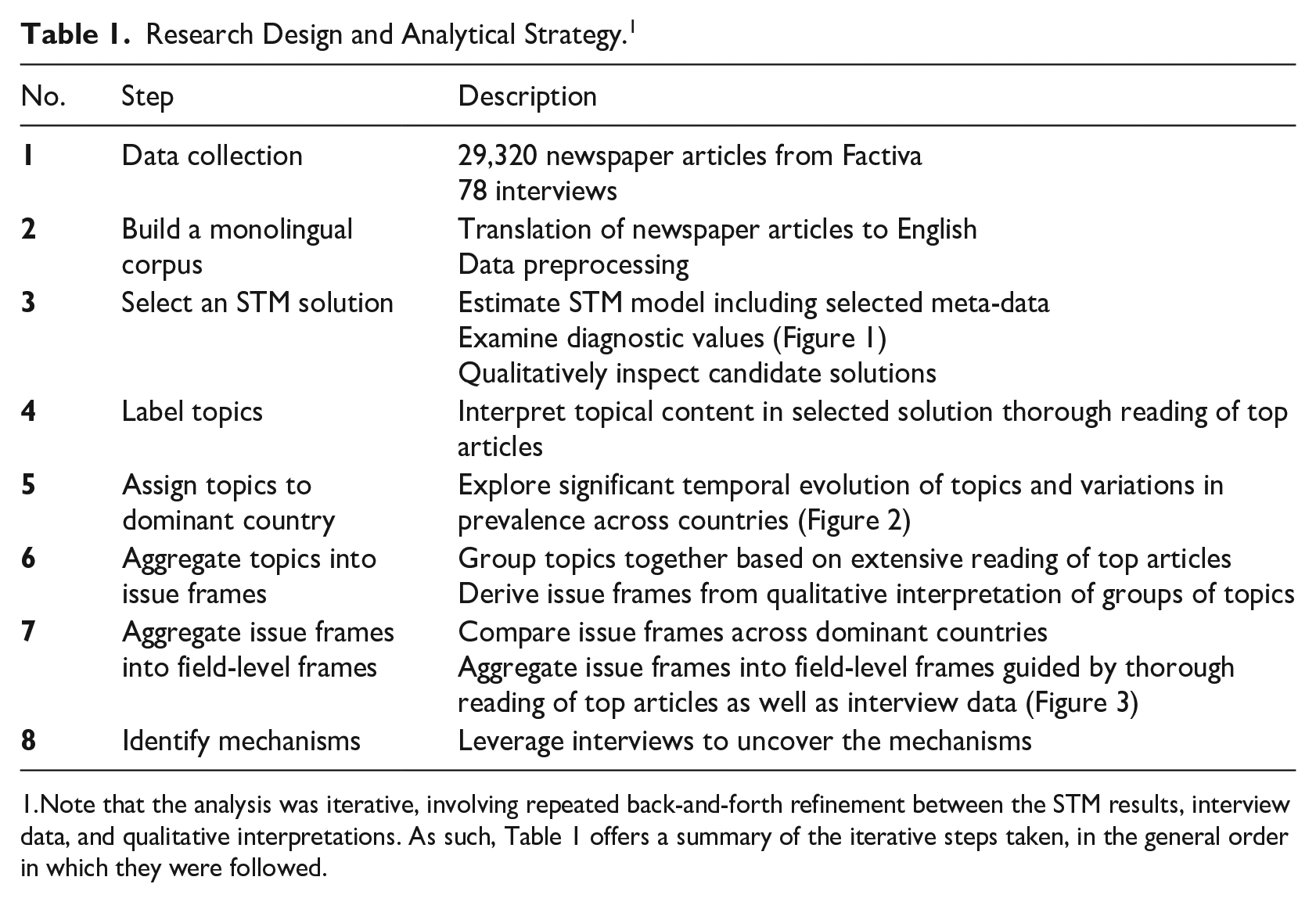
Note that the analysis was iterative, involving repeated back-and-forth refinement between the STM results, interview data, and qualitative interpretations. As such, Table 1 offers a summary of the iterative steps taken, in the general order in which they were followed.
STM Analysis
To analyse the media articles for potential differences in field-level frames, we use topic modelling, a methodological development in NLP for quantitative text analysis (Mohr & Bogdanov, 2013). Topic modelling facilitates the ‘analysis of larger corpora than human coders can master, facilitating the discovery of unanticipated frames, and distinguishing between different uses of the same term’ (DiMaggio et al., 2013, p. 593). In this study, we leverage STM rather than the basic LDA model widely used in prior work (e.g. Bohn & Gümüsay, 2023; Croidieu & Kim, 2017). STM is more flexible than LDA (Blei, Ng, & Jordan, 2003; Maier et al., 2018), as it not only allows for topics to be correlated but, importantly for our purposes, incorporates metadata in the estimation procedure (Roberts, Stewart, & Tingley, 2016). Metadata can be any relevant variable(s) to explore the relationship between external factors and the content of the texts, in our case, the country in which the article was published (i.e. France or Germany) and the year of publication (i.e. calendar year). Including these variables and their interaction term as metadata enables us to identify which topics were prevalent in each country at a given time and facilitates a comparison of the topical content between countries (Reber, 2019).
Given the comparative nature of our study and the fact that our corpus was in both French and German, our first step was to build a monolingual corpus. 2 Naturally, human translation of the documents would have been ideal, but the size of our corpus makes it infeasible. As such, we translated all texts to English using machine translation, 3 which has been found to be a desirable solution for cases like ours since ‘most approaches to automated text analysis make a bag-of-words assumption, which implies that the ordering of terms [and the distance between them] in a document does not matter. The translation software needs only to correctly translate the significant terms in the original document, as any error in word order will be discarded by the bag-of-words assumption’ (Lucas et al., 2015, p. 260). Machine translation is thus particularly well-suited for studies using STM, as the focus is on the frequency of words within the corpus rather than the grammatical structure of the text.
We translated all French and German articles into English to take advantage of the fact that machine translation systems tend to use English as a ‘pivot’ language. 4 Indeed, these ‘algorithms are expected to perform best when translating to and from English’ (de Vries, Schoonvelde, & Schumacher, 2018, p. 421). Doing so, instead of translating the French articles to German or vice versa, also ensured that all texts were translated, which ‘at least makes it more plausible that the inevitable error introduced in translation is roughly comparable between the two language groups, resulting in a type of symmetry’ (Lucas et al., 2015, p. 269). Moreover, we translated the entire corpus so that ‘words are always considered within the context that they appear. Context not only improves accuracy in most machine-translation systems but may, in some cases, be necessary for an appropriate translation’ (Lucas et al., 2015, p. 269). Hence, using full-text translation preserves the context in which words are used, such that their meaning remains unchanged (de Vries et al., 2018; Reber, 2019).
Although translating texts into a third language may alter some of the nuances of the original language, modern machine translation systems are sophisticated enough to capture the core content accurately (de Vries et al., 2018). Importantly, translating all documents to English meant we could estimate a single STM, allowing for direct quantitative comparisons of topic content and prevalence across the two countries. The alternative to this approach would be to estimate two separate STMs in two different languages (as in Bohn & Rogge, 2022), but this would only allow judgement-based comparisons across countries (Amara, Hadj Taieb, & Ben Aouicha, 2021; Heidenreich, Lind, Eberl, & Boomgaarden, 2019). 5
We then preprocessed the translated data to prepare the corpus. Following standard practice, we converted all text to lowercase, deleted duplicates, stemmed words, filtered out infrequent words and stop words, as well as removed special characters, punctuation, and numbers (Aranda et al., 2021; Hannigan et al., 2019; Schmiedel, Müller, & vom Brocke, 2018). We also dropped articles with too few (<50) or too many (>2000) words. After this preparation, our final corpus consists of 25,902 articles. Next, we estimated a STM that includes an interaction between the country and time covariates. We modelled theta using a logistic-normal generalized linear model (Roberts et al., 2016), where country and year are the covariates. This model specification incorporates two key considerations: (1) to allow topics to differ in baseline prevalence between the two countries; and (2) to allow for a different flexible evolution of each topic over time.
The next step was to identify the proper STM solution. There is no right answer to the appropriate number of topics. Still, given the size of our corpus, we followed Lindstedt’s (2019, p. 311) guidance: ‘For shorter, focused corpora (i.e., those ranging from a few hundred to a few thousand documents in size), an initial choice between five and 50 topics is best.’ We then estimated models ranging from 5 to 50 topics with increments of 5. To select a solution, we plotted the diagnostic values for all solutions and their semantic coherence-exclusivity specification (see Figure 1). As Lindstedt notes, ‘semantic coherence is a measure of the probability for a set of topic words to co-occur within the same document, [while] exclusivity is a measure of the probability for a word to fall primarily within the top rankings of a single topic’ (2019, p. 311).
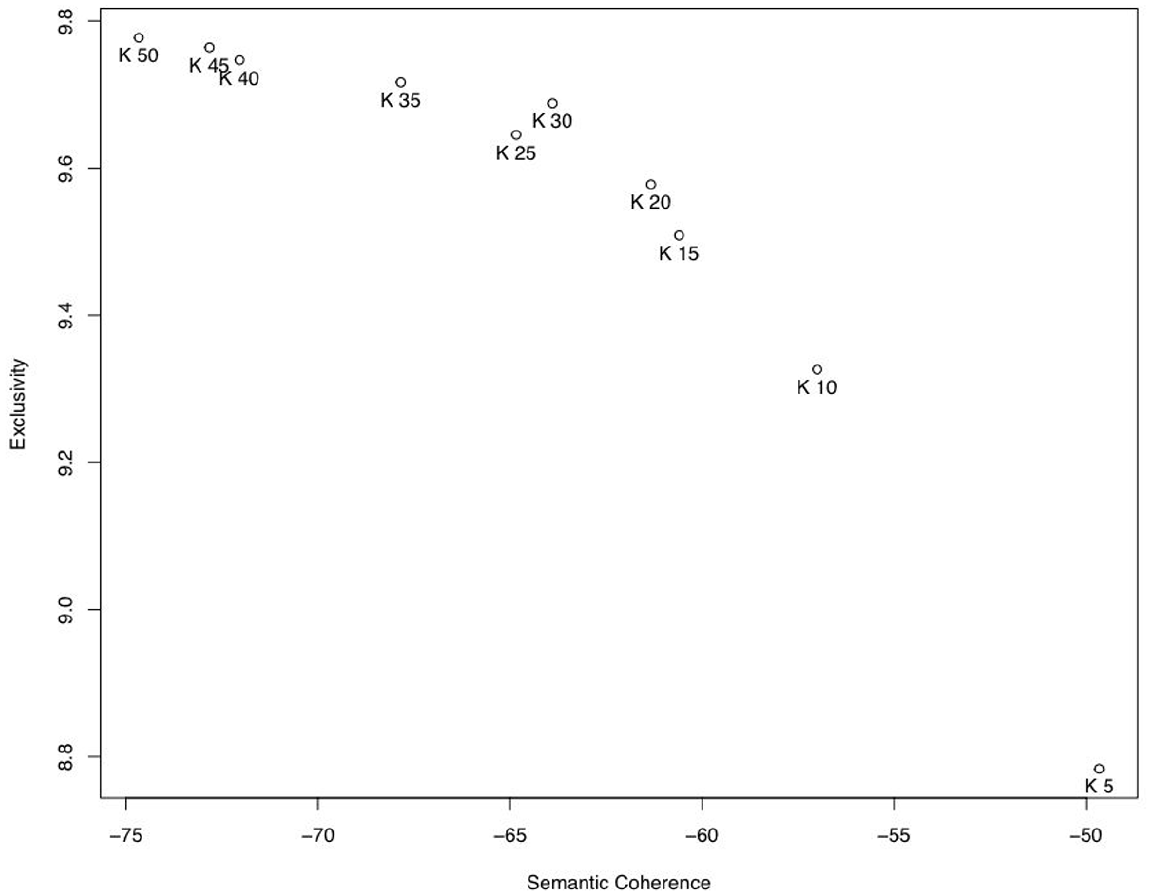
Diagnostic values.
We used these quantitative indicators and our interviews to qualitatively inspect candidate solutions in detail, aiming to find a solution that allowed us to understand the discussion in each country at a level of granularity that would allow a cross-country comparison. We assessed each of the nine estimated solutions (i.e. 10, 15, 20, . . . 50) by labelling all topics in each model. In labelling topics, we followed standard practice, and instead of imposing insights into the meaning of topics, we allowed meaning to emerge from them (Aranda et al., 2021; Hannigan et al., 2019). To do so, we read the top articles within each topic, and then compared the labels derived from different estimated solutions to ensure accuracy and interpretability. 6 In doing so, we found that the best solution was 30 topics. Labels for the 30 topics solution are listed in Table 2 (see Table A3 in the Appendix for illustrative quotes).
Topics.
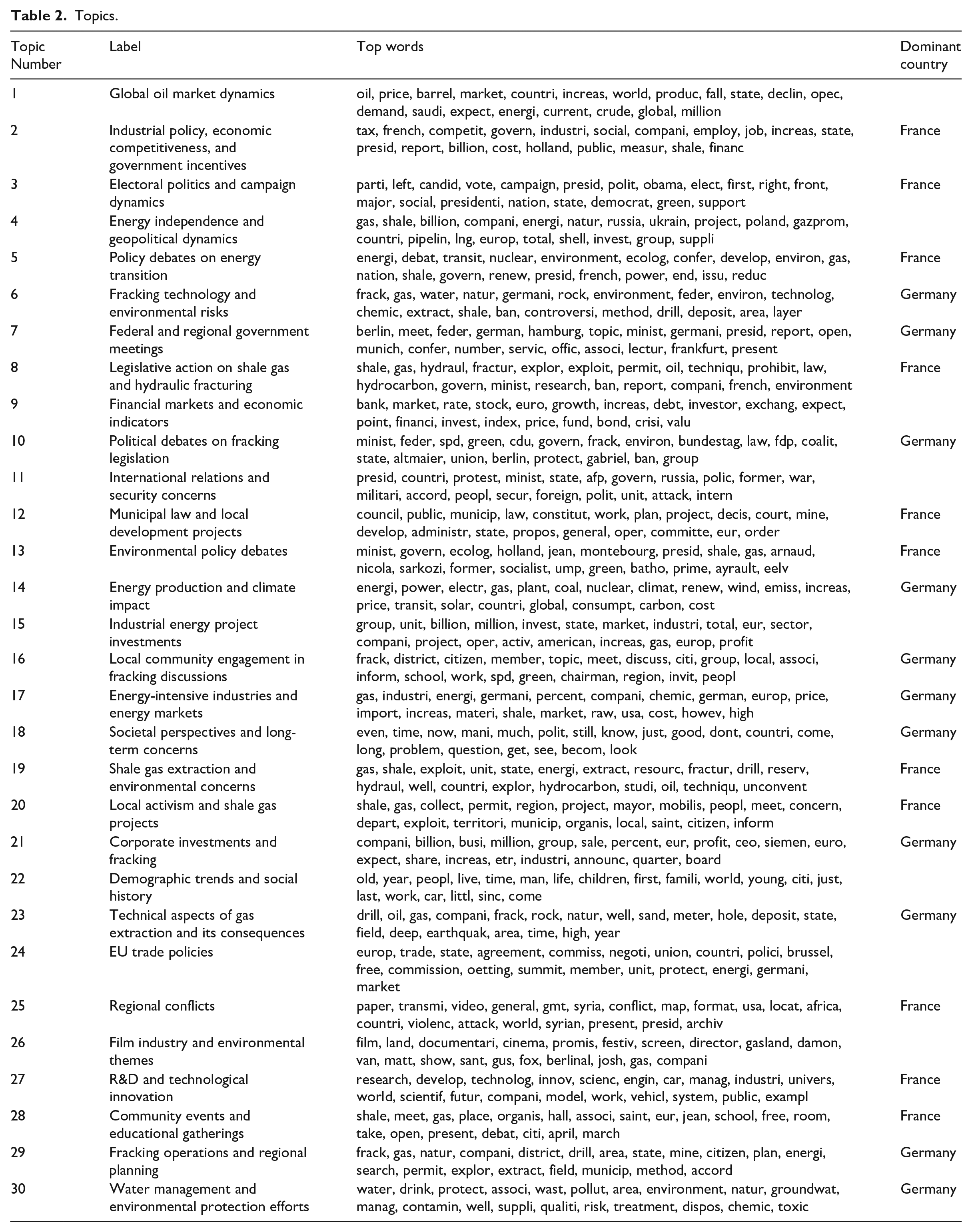
Next, leveraging the year and country of the article as metadata in the STM estimation, we plotted the prevalence of each of these 30 topics over time to show the relative dominance of each topic in France versus Germany. Figure 2 plots this comparison for two topics, illustrating statistically significant differences in the prevalence of these topics between France and Germany over the years of study. We replicated this process for all 30 topics, thereby enabling us to determine whether a topic emerged as more dominant (i.e. more prevalent) in France or Germany, or was similarly prevalent in both countries. Guided by the country metadata, this process enabled us to assign most topics to either France or Germany (see Table 2), which formed the basis for exploring similarities and differences between the countries, paving the way for identifying field-level frames.
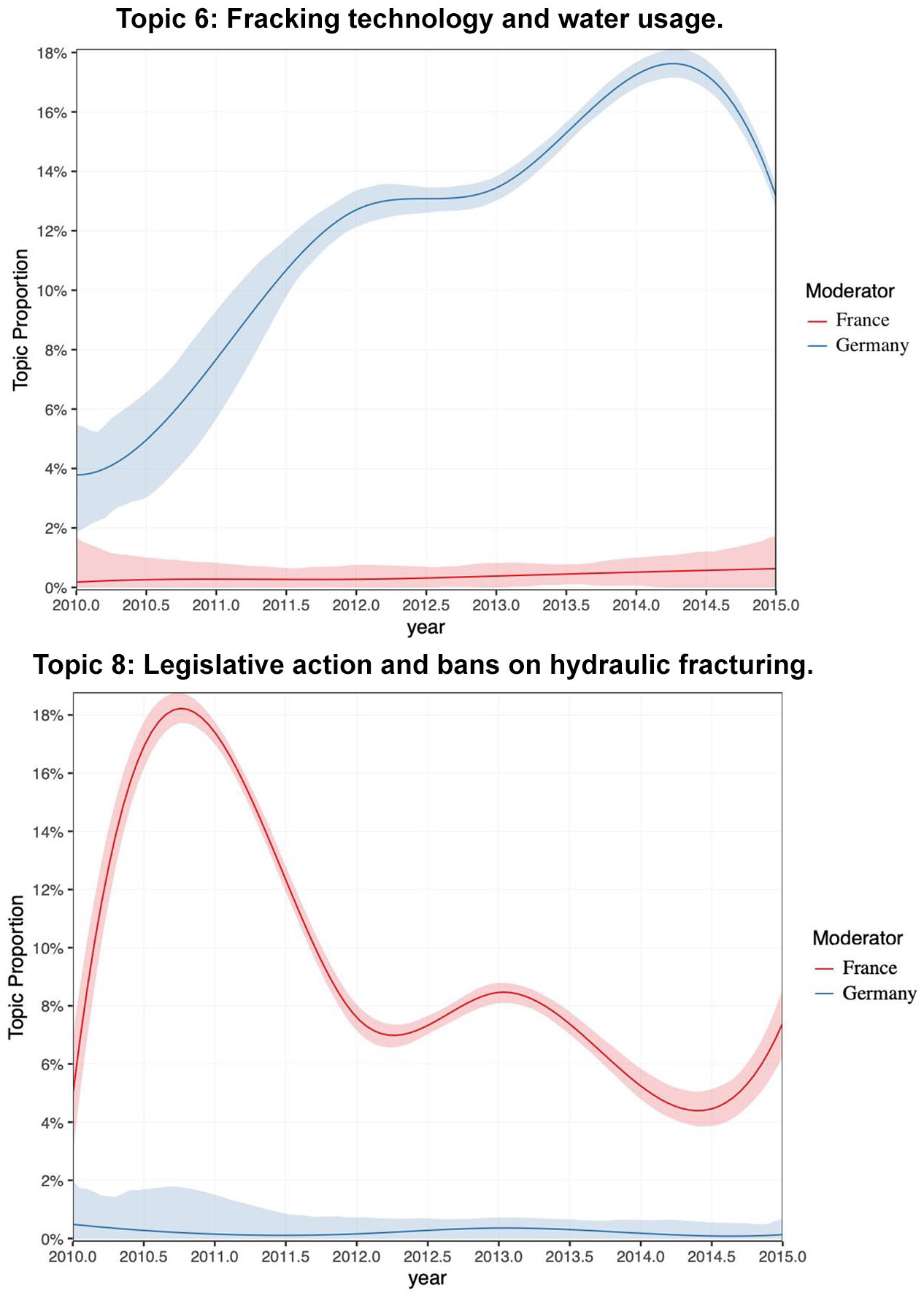
Examples of topics plotted over time in France versus Germany.
From topics to field-level frames
Our next task was to move from the topics generated by the STM to field-level frames. Using a sequential mixed methods approach (Creswell, 2009), we inductively interpreted the content of the topics in the context of our interviews to aggregate them into field-level frames (Lounsbury et al., 2003). In doing so, we followed work that has advocated topic modelling as a tool to study framing, whereby ‘many topics may be viewed as frames (semantic contexts that prime particular associations or interpretations of a phenomenon . . .) and employed accordingly’ (DiMaggio et al., 2013, p. 578). In this view, topics represent the words used to frame an issue, highlighting some of its features at the expense of others (Klebanov, Diermeier, & Beigman, 2008). Our focus lies in exploring the interrelationships among topics that generate field-level frames (DiMaggio et al., 2013; Mohr & Bogdanov, 2013) while leveraging insights from our interviews to deepen our understanding of each country’s historical context. Our process to get from topics to field-level frames comprised two steps (Bohn & Gümüsay, 2023; Nelson, 2020).
First, we moved from topics to issue frames. To do so, we read the most representative articles per topic and aggregated topics into inductively derived issue frames. 7 Each issue frame comprises topics that, based on our reading of the top articles and extensive interviews, fit together to address key issues of the shale gas debate. Table 3 lists how our 30 topics aggregate into eight issue frames: (1) energy policy debates (i.e. national and local debates in the context of energy transition and environmental policies), (2) energy security (i.e. environmental dangers vs. climate benefits of using fracking for achieving energy independence), (3) environmental and social governance (i.e. economic, social, and regulatory risks around shale gas development with an emphasis on public engagement), (4) EU policies (e.g. the role of the EU in policymaking), (5) innovation and R&D (i.e. academic debates and scientific research on shale gas), (6) market dynamics (i.e. global economic and geopolitical impact of shale gas), (7) mobilization efforts (i.e. grassroots movements or the mobilization of collective action against shale gas developments), and (8) community and social dynamics (i.e. local and artistic reflections on fracking).
Topics, Issue Frames and Field-level Frames.
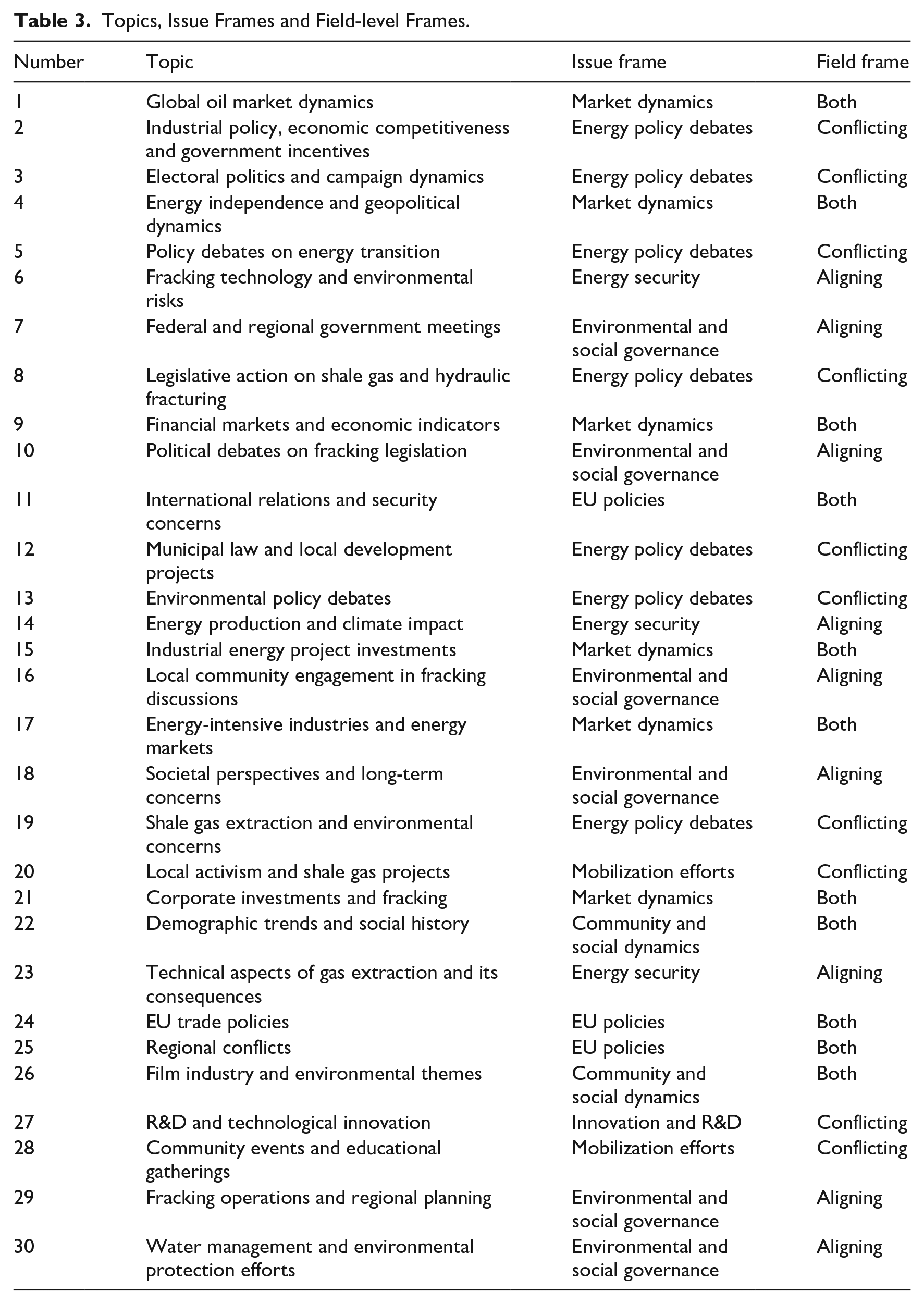
Second, we moved from issue frames to field-level frames. To do so, we once again leveraged our deep reading of the top articles and our extensive interview data to evaluate how each issue frame (and underlying clusters of topics from our STM output) portrayed the concept of shale gas in relation to a country’s historical energy strategy. This was an iterative process, where we revisited Figure 2 to closely examine the peaks and troughs of topic prevalence in each country over time, while referring back to the top articles to contextualize these trends and to the interviews to validate our interpretations. Through this process, we identified how issue frames were interconnected within each country and how they differed between countries. Guided by the interviews, we were able to further understand how issue frames relate to each country’s historical energy policy and uncover the underlying foundations shaping the debate within each country. This comprehensive analysis allowed us to group issue frames into the overarching field-level frames within each country (see Table 3). 8
Our aggregation process, from topics to field-level frames, as summarized above and depicted in Table 3, can also be seen in Figure, which plots the correlations between topics from our STM output. Topics discussed primarily in Germany are shown in blue nodes, whereas topics discussed primarily in France are shown in beige nodes. Topics discussed in both countries are shown in white nodes. Issue frames that cluster these topics are overlaid with their respective labels (blue for Germany and red for France). 9 Validating our analytical strategy and aggregation process, the graph highlights two separate clusters (left vs. right), thereby reflecting two distinct field-level frames.
Findings
Our STM analysis and analytical framework reveal distinct field-level frames in France and Germany. Given their historical focus on nuclear energy and longstanding efforts to shift away from fossil fuels, the public discourse in France portrayed shale gas as fundamentally inconsistent with the country’s historical energy mix and a direction that would jeopardize its transition towards a more sustainable future. We define this as a conflicting field-level frame. In contrast, because of their historical reliance on coal, the public discourse in Germany viewed shale as a comparatively cleaner fossil fuel and portrayed fracking as a practical extraction technology to cheaply obtain a transitional energy source. We refer to this as an aligning field-level frame.
In what follows, we first detail the content of these two field-level frames captured by our STM analysis of the news media. We then leverage our rich interview data to identify potential mechanisms that elaborate upon how France and Germany’s unique historical context shaped the construction of these field-level frames.
France: A conflicting field-level frame
France’s conflicting field-level frame consists of the following issue frames: energy policy debates (topics 2, 3, 5, 8, 12, 13 and 19), mobilization efforts (topics 20 and 28) and innovation and R&D (topic 27) (see Figure 3).
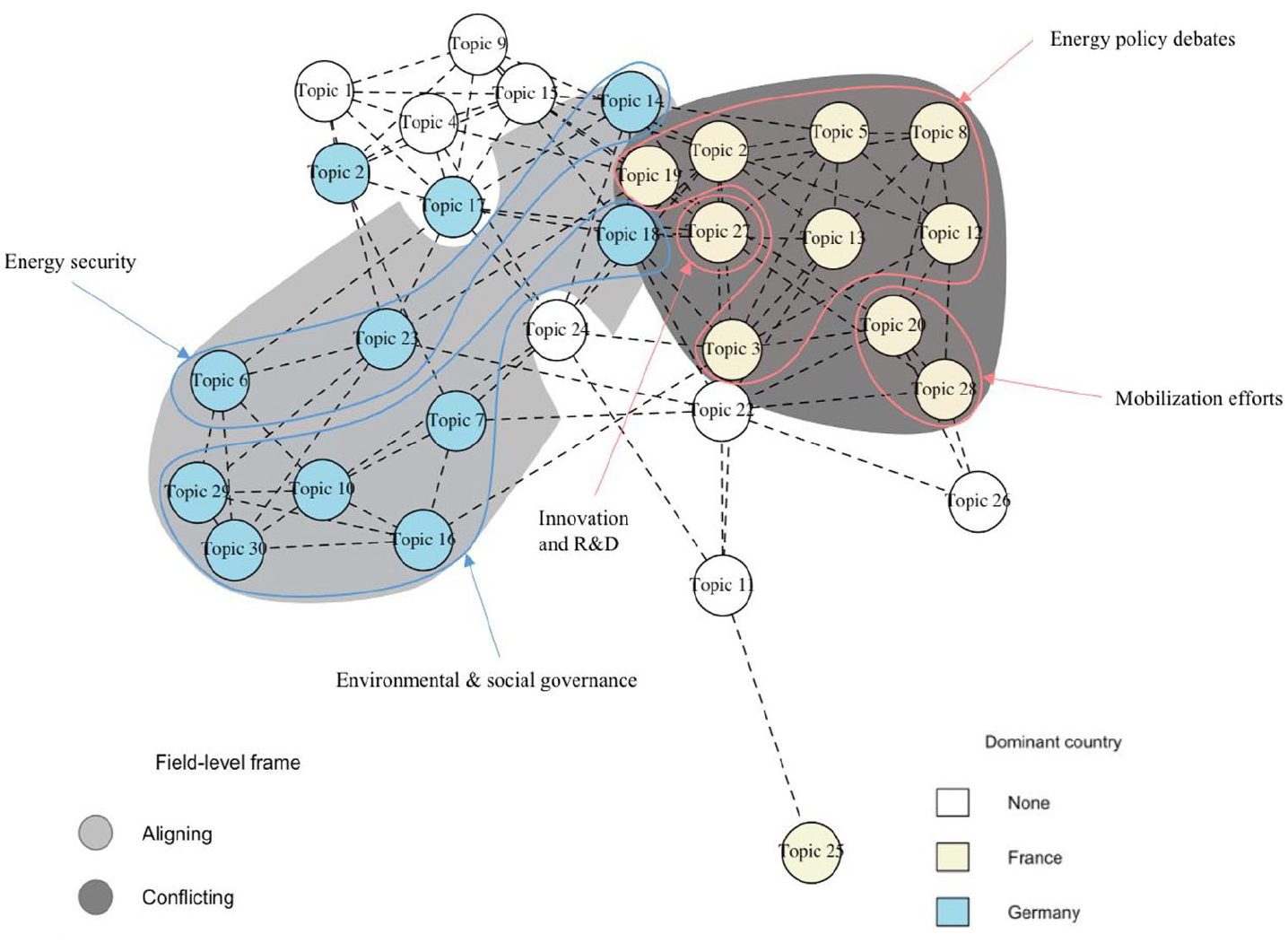
Topic correlations.
France’s conflicting field-level frame first emerged in the media with the issue of energy policy debates. Such debates captured an abstract inquiry into the nature of renewable energies and the future of the environment. Instead of exploring the more specific idea of shale gas extraction and its related technologies, French actors maintained the debate at the ideological level. As a French environmentalist stated:
This is a societal debate. We are really at the heart of the energy transition question: Should we continue to explore the possibilities of fossil fuels to a maximum or shift to a mode of energy transition where we distance ourselves as fast as possible from fossil fuels? (French environmentalist-1)
The discourse remained ideologically laden even when the discussion addressed the more specific topic of extractive fossil fuel technologies. It emphasized how these technologies pose a fundamental risk to the climate and overall environment. The following article demonstrates this point:
‘[The Federation of Regional Natural Parks of France] mobilized to express their fears about the social, economic, and environmental consequences, especially on water reserves. Indeed, the water resource is highly threatened due to an important need in the technique of hydraulic fracturing. Part of this water containing many chemical components is not recovered and resides in the basement. (. . .) Moreover, the exploitation of a fossil resource, releasing methane, runs counter to a policy of struggle combating climate change or promoting energy savings and energy development renewables.’ (330)
Similarly, when the topics of R&D efforts and innovative technologies emerged in the media, they were met with scepticism and an overall resistance to the idea of exploring ways to make shale gas extraction safer. As one article noted, even the idea of ‘conducting research on the techniques of exploitation of shale gas, [is] very controversial’ (17406). Given the presumption that shale gas extraction was damaging to the environment, little research was sought in France to even explore the degree to which shale gas extraction was truly as problematic as most assumed.
Interestingly, the conflicting field-level frame was shared between shale gas opponents and proponents alike. For example, opponents (e.g. environmentalists and opposition politicians) called for a shale gas ban. They engaged in protests and demonstrations, creating community awareness and rapidly raising widespread opposition to shale gas. Protesters ‘mobilized in Paris as part of the World Day Against Hydraulic Fracturing’ (22279), arguing that the focus should be on developing renewable energy infrastructure ‘for a more sustainable development’ (196). Similarly, proponent politicians who were open to shale gas admitted that the critical question was really about the paradigm society wanted for alternative energies. A supportive French politician noted that ‘the question of shale gas is but one small part in an overall coherent policy frame on the energy transition’ (French politician-5), and another proponent politician concluded that: ‘Even if the fracking technique was without risks, we will not exploit shale gas since it is still a fossil fuel’ (French politician-4).
Taken together, the debate in France remained entrenched in abstract ideological concerns about renewable energy and their historical energy mix, thereby ignoring the more concrete issues of extraction technologies and their potential. Even though ‘nearly one in two French people thinks it is necessary to stop nuclear energy’ (1060), the conflicting field-level frame that emerged in France’s public discourse made it clear that shale gas was not a replacement. As one environmentalist said: ‘Even if they fracked with tomato juice, I would still be against it’ (French environmentalist-3).
Germany: An aligning field-level frame
Germany’s aligning field-level frame was built around the following issues frames: environmental and social governance (topics 7, 10, 16, 18, 29 and 30) and energy security (topics 6, 14 and 23) (see Figure 3).
Germany’s aligning field-level frame first emerged in the media with the governance issue. Instead of discussing fracking at an abstract level, as the French did, when German stakeholders talked about regulation, they were focused on figuring out how to best regulate the specific technology and the best extraction modes. One article notes that the Federal Environment Agency:
‘recommends a comprehensive risk assessment of all fracking projects for gas and oil production’ (7476) and ‘urges rapid legal regulation for the risk technology fracking. ‘Close guardrails are needed to protect the environment and health,’ said President Maria Krautzberger.’ (8142)
Similarly, the Association of Municipal Enterprises and the Alliance of Public Water Management, representing public utilities and municipal enterprises, called for comprehensive regulation to protect drinking water from the dangers of fracking, encouraging the involvement of water authorities and municipalities:
The Alliance of Public Water Management, as a representative of the public water utilities and wastewater companies and the ‘Soil and Water’ Associations, calls on the Bundestag to prioritize the protection of nature, water resources, and drinking water supply when dealing with the topic of fracking. (11027)
The idea that fracking technology would ‘be possible in Germany only under strict conditions’ (7506) made clear the assumption that it was presumed to be already aligned with their existing energy mix, and that they could move on to consider its extraction techniques. This practical, as opposed to ideological, approach also emerged in the media surrounding the energy security issue. Indeed, there were calls for more research to understand the risks better:
‘The technology is not yet sufficiently researched,’ said Environment Minister Lucia Puttrich (CDU)’ (8363). ‘Although health protection is a priority, we do not want to close ourselves for all times for purely ideological reasons against new techniques or funding methods’ (7206). And Norbert Brackmann wants further research on the technology to be carried out: ‘I find it irresponsible to ban research.’ (8672)
This more concrete focus on extractive technologies also led to examining the technical differences between conventional fracking (i.e. vertical drilling) and unconventional fracking (i.e. horizontal drilling). While this distinction was initially introduced by proponents of domestic gas extraction, it was embraced and reused by opponents as well. For instance, a German environmentalist remarked, ‘There is fracking, and there is fracking. . .’ (environmentalist-2 Germany), by which they meant that some extraction techniques are better and potentially safer than others. German politicians also supported this by arguing that ‘the fracking fluids that are used to crack the rocks are an orange juice cocktail compared to what comes up with the flow back . . . If we treated the flow back, I think then we would get a higher acceptance by the people who are reasonably open to energy and technology’ (politician-3 Germany). By distinguishing different extractive technologies, German actors portrayed fracking as potentially contributing to the country’s energy security:
In principle, Germany should no longer resist the production of shale gas and explore its shale gas resources on a ‘scientific basis’. (8944) We are, therefore, very in favour of approaching shale gas on a scientifically sound basis rather than just saying, no, that’s dangerous; we don’t want that. (9795)
This more concrete focus also led proponents and opponents alike to a narrower set of what they viewed as the primary risks of fracking: earthquakes and water contamination. The discussion on earthquakes focused on communicating research findings linking fracking to seismic activity, arguing that ‘since many such disruptions are unknown, authorities, industry, and academia must work closely together when fracking expands into new regions’ (8013). The discussion on water protection mobilized various proponents and opponents calling for fracking regulations. For example, Maria Krautzberger, President of the German Federal Environment Agency, advocated for strict rules and safeguards for water protection, including a ban, but only when fracking happened in certain sensitive areas. Breweries and mineral water companies similarly orchestrated a strong mobilization in favour of water protection:
Fracking is a danger to water and, therefore, to the beer – at least in the opinion of the brewing industry, which opposes the gas production method. For the Berg Brewery, it’s all about basics: ‘Water is a basis for life and survival that cannot be dispositioned,’ says a statement in which brewery chief Ulrich Zimmermann argues against the controversial fracking. (4838)
Taken together, the overall debate in Germany focused more narrowly on the practical ways to use and regulate the safest fracking technologies available. By portraying fracking as being already aligned with their existing energy mix, proponents and opponents sidestepped the discussion of more intractable issues, such as the broader implications of fracking for climate change from entering the debate. Indeed, a German political advisor noted: ‘Gas is more environmentally friendly than other energy sources. It’s better than brown coal. It’s better than stone coal. Hence, gas is a safe bridge fuel before we can practically rely 100% on renewables’ (politician-3 Germany).
How historical context shapes the construction of field-level frames
The above findings show that the shale gas debate was framed very differently in France compared to Germany. However, while these differences seem to reflect the unique historical contexts of France and Germany’s energy policies, our STM results cannot explain how historical context might have shaped the construction of these field-level frames. This section aims to draw this connection by leveraging our rich interview data. In doing so, we identify three sequential mechanisms: historical positioning, issue labelling, and bounded mobilization, through which the country’s history appears to have constrained the construction of the field-level frames that emerged decades later.
Historical positioning
The first and most important mechanism explaining how France and Germany’s historical context influenced their field-level frames is historical positioning. This mechanism embedded the concept of shale gas within each country’s historical understanding of energy production, leading shale gas to take on entirely different meanings in these two countries.
In particular, because France has historically emphasized nuclear, shale gas was positioned as just another fossil fuel and was, by definition, a non-starter. ‘France has no oil, no gas, no coal. We have nuclear,’ GDF Suez boss Gérard Mestrallet noted (978). Given this longstanding history, stakeholders were focused not on the way shale gas could be extracted in novel and inexpensive ways (as in Germany) but instead on the fact that shale gas should not be considered in the first place. One environmentalist noted: ‘Today we fight against the use of fossil fuels. Full stop. Whether it is shale gas, oil, or uranium’ (French environmentalist-7). This is further illustrated in the following quote:
The Minister of Ecology Nathalie Kosciusko-Morizet reiterated Tuesday that it was ‘out of the question’ to use ‘extracting processes that would have a disastrous ecological impact’ to exploit shale gas. It is out of the question to have recourse in France to the means of extraction processes that would have a disastrous environmental impact,’ Kosciusko-Morizet said in a debate in the Assembly National on shale gas. ‘It would be a step backward from everything we did and wanted together,’ she continued. (1164)
In contrast, because Germany has historically relied heavily on fossil fuels (i.e. coal), shale gas was positioned as an improvement upon their existing fossil fuel energy mix. Given that ‘coal, oil, and natural gas are at the top of German consumption’ (466), fracking was positioned as a pragmatic alternative to help the country transition away from even dirtier fossil fuels. Indeed, when comparing the differences between the electricity produced from fracking and that generated from other fossil fuels, fracking was positioned as helping the country’s energy transition within, and eventually out of, the fossil fuel space: ‘The use of domestic shale gas could make the energy transition affordable’ (6311). Even the German Green Party, while opposed to fracking, prioritized it as cleaner than coal:
‘Gas is a cleaner energy source than stone coal until we can cater to our needs completely with renewables. This will probably take some more time and thus we need to make sure that our power plants run as cleanly as possible, also with regards to CO2 emissions’. (German politician-1)
The unique historical contexts of France and Germany led to the issue of shale gas being positioned, and therefore understood, entirely differently. In France, discussions emphasized the fundamental incompatibility of shale gas as a fossil fuel, whereas the debates in Germany focused on fracking technologies and how shale gas extraction is preferable to coal mining. Taken together, as one article aptly notes: ‘the choice of such energy [shale gas] or technology [fracking] is complex and remains linked to a country’s history, development, resources or culture’ (2292).
Issue labelling
The historical positioning of shale gas within France and Germany’s understanding of energy, in turn, constrained stakeholders in terms of how they could label the overall debate. Thus, issue labelling builds on the prior mechanism, recasting the way shale gas was embedded within France and Germany’s historical context to define the focus of the overall debate.
In France, the country’s positioning of shale gas, being just one of many fossil fuels, was a non-starter that led stakeholders to see the debate in an abstract and ideological manner, prompting actors to label it as the ‘shale gas issue’. Indeed, being historically unwilling to consider fossil fuels as a step forward, shale gas naturally became a non-negotiable and ‘red line’ even when better technology became available. This historical view of fossil fuels in general, and shale gas in particular, is captured when a French politician commented: ‘I consider that shale gas exploitation can only slow down the (energy) transition. It can only be a brake’ (French politician-4).
In contrast, in Germany, the country’s positioning of shale gas as an improvement upon existing extraction techniques of other fossil fuels led stakeholders to see the debate in a more concrete and pragmatic manner, consistently labelling it as the ‘fracking issue’. As a German politician noted: ‘Our main enemy is coal. As long as fracking allows us to decrease our coal consumption and replace it with gas, I’m happy with it’ (German politician-6). Labelling the debate as the ‘fracking issue’ also led German actors to focus on more specific technological risks associated with fracking, such as groundwater contamination, and the technological opportunities to manage those risks. ‘If industry treated the toxic fracking fluids that flow back to the surface, then I think this would add to the acceptance of the people who are generally open to energy and technology’ (German politician-1).
Thus, once the concept of shale gas was positioned within France and Germany’s unique historical contexts, the overall debate emerged as either an abstract and ideological fight against fossil fuels or a concrete and pragmatic exploration of technological improvements to existing extraction techniques.
Bounded mobilization
The final mechanism reflects how, given the way shale gas was historically positioned within France and Germany’s contexts, which in turn constrained how stakeholders labelled the issue, only certain actors were drawn in to participate. Indeed, abstract and ideological debates attract and require the mobilization of different stakeholders compared to debates that emphasize the more technical aspects of fracking.
France’s ideological debate surrounding the abstract ‘shale gas issue’ immediately galvanized environmental opponents, who protested ‘to express their fears about the social, economic, and environmental consequences’ (330). Governmental leaders, who had little to no appetite to return to dirtier and non-renewal fossil fuel energy options, picked up on these protests and intervened with the passage of Jacob’s Law, which banned fracking. Moreover, given the ideological and closed nature of the debate, there was no need to involve a broad range of stakeholders in discussing the risks and benefits of fracking technologies, as such considerations were simply out of scope.
In contrast, Germany’s more technically driven debate surrounding the ‘fracking issue’ called for a more diverse range of stakeholders. Industrial proponents and environmental opponents alike explicitly asked for scientific experts to participate and evaluate the risks of fracking: ‘We want citizens to learn about this method and its implications and want to mobilize the public’ (1043). The collective objective was to understand whether fracking constituted a relative improvement over coal and if it was worth the risk. Such a debate required more voices and ‘people to be engaged’ (4243) to come to a resolution.
The historical positioning and labelling of the issue within France and Germany thus led to very different actors participating in the discussion. France’s ideological positioning and abstract labelling contributed to a relatively closed-off debate, where technical questions about fracking were largely ignored, and protesters and government officials led the charge to shut down the issue. In contrast, Germany’s more practical positioning and concrete labelling contributed to a far more open debate that required the mobilization of various voices to identify the technical issues and potential benefits of these extraction technologies.
Discussion
This study investigated the debates on shale gas in France and Germany. By leveraging a novel methodological approach to analyse over 25,000 newspaper articles and 78 in-depth interviews, we revealed how field-level frames regarding energy production in France and Germany were shaped by their unique historical contexts. We offer a rare comparative lens that sheds new light on the role of history in the construction of field-level frames as well as provide a novel methodological approach to conducting systematic and comparative multilingual frame analyses using STM.
How historical context shapes the construction of field-level frames
Framing scholarship has long argued that field-level frames are the result of agentic and strategic action, whereby actors can select readily accessible frames that best achieve their goals (Benford & Snow, 2000; Cornelissen & Werner, 2014). However, studies over the last few decades have started to emphasize the role of context, from political opportunity structures (Gamson & Meyer, 1996; Mooney & Hunt, 1996) to cultural discourses (Giorgi et al., 2019; Weber et al., 2008), and its influence in shaping field-level frames and framing activities. Our study extends this conversation in several ways.
First, we offer a comparative lens that examines the same contentious issue simultaneously emerging in two countries’ public discourse, thereby allowing for a direct comparison of field-level frames. Prior work primarily investigates frames and framing activities that have emerged within a single context rather than a comparison across contexts. Cornelissen and Werner (2014) suggest that this has led to research questions focusing primarily on ‘active struggles over meaning’ within a single setting (p. 208). While exploring framing disputes, counter-framing efforts and frame change within a single context are important (e.g. Benford, 1993; Gamson, 1992; Gurses & Ozcan, 2015; Kaplan, 2008), our study’s comparative approach to the content of two countries’ field-level frames shows that two countries can construct entirely different interpretations of the same contentious issue over the same period of time.
Second, these results also offer new insights into how historical context shapes the construction of field-level frames. Although organization theorists have recognized that the past plays a vital role in shaping the present (e.g. Hannan & Freeman, 1984; Ocasio et al., 2016; Zucker, 1977), framing scholars have focused more on how political opportunity structures and culture codes influence field-level frames and less on the historical contingencies embedded within a given context. One recent exception is a paper by Bohn and Rogge (2022), who examined the media debate on electric vehicles in Germany and the UK, revealing essential differences in the field-level frames that emerged in each country’s public discourse. While these findings are an important first step, key questions arise that require investigation. For example, what aspects of a country’s historical context could have driven these differences, and how exactly do they shape the construction of its field-level frames?
We shed light on these questions. In particular, our findings identify France’s historical investment in nuclear and Germany’s historical investment in coal, both mainly dating back to the 1970s, as the critical difference in their country’s historical contexts that shaped the construction of their field-level frames surrounding shale gas. Indeed, these longstanding historical differences established the historical context – or the material practices, beliefs and values that operate as ‘latent meaning structures that organize social and cultural experience’ (Cornelissen & Werner, 2014, p. 207) – within which actors in both countries sought to interpret and make sense of the concept of shale gas when it emerged as a topic for discussion in the mid-2000s. Moreover, starting with these longstanding historical differences in how France and Germany invested in energy production, our findings also identified a set of three sequential mechanisms through which these countries’ historical contexts shaped the construction of their subsequent field-level frames.
The first mechanism was historical positioning, which depicted how the concept of shale gas became embedded within France and Germany’s historical energy context. France’s historical investment in nuclear led them to position shale gas as an outdated fossil fuel. In contrast, Germany’s historical investment in coal led them to position shale gas as an improvement to their existing energy infrastructure. This initial positioning, in turn, then constrained stakeholders in terms of their ability to label the issue. While France defined it as an ideological debate that assumed ‘shale gas’ to be a non-starter, Germany saw this ‘fracking issue’ as an opportunity to improve existing extraction techniques. Finally, the historical positioning and the labelling of the issue defined the terms and scope of the debate in each country, as well as defining a bounded mobilization by specifying which actors could mobilize. Indeed, France’s ideological approach encouraged the involvement of primarily environmental protesters and government officials, who led the charge to quickly shut down the shale gas issue, whereas Germany’s more pragmatic approach required a wider array of voices to identify the trade-offs of fracking.
We believe that these three sequential mechanisms, which help explain how a country’s historical context shapes the construction of field-level frames that emerge in public discourse, extend existing research on framing in at least two valuable ways. First, these mechanisms move beyond prior work that has sought to explain how framing disputes become more intense or amplified (Benford, 1993; Gray et al., 2015) and, instead, emphasize how the content of such field-level frames is constructed in the first place. More specifically, before considering how field-level frames get amplified or more intense within a single context, we provide some insights into where the content of these field-level frames comes from in the first place. In this regard, our findings offer initial support for Cornelissen and Werner’s (2014, p. 207) suggestion that historical practices, beliefs and values operate as ‘latent meaning structures that organize social and cultural experience’, serving as the cultural tools actors use to generate field-level frames when contentious issues arise.
Second, the sequential nature of these three mechanisms offers new insight into the temporal nature of how the prevailing context shapes the construction of field-level frames. Prior work on frame amplification, for example (Benford, 1993; Gray et al., 2015), tends to focus on specific mechanisms and how they operate alongside one another and less on how they relate to one another or how they might even be contingent upon one another. Our findings suggest that the mechanisms through which historical context shapes the construction of field-level frames unfold sequentially, constraining the meaning construction, labelling of the issue, and participation in the debate. Indeed, our findings suggest that who participates in a debate (i.e. bounded mobilization) is contingent on what issue is at stake (i.e. issue labelling) which, in turn, is contingent upon how the issue is understood within the extant meaning systems in the first place (i.e. historical positioning). While we cannot demonstrate the universality of these mechanisms, it seems plausible that the construction of field-level frames necessarily depends upon these three unfolding mechanisms. This possibility calls for more investigation into the temporal process by which context shapes the construction of field-level frames.
Methodological contributions
This study also provides an important methodological contribution by developing a roadmap for using STM to conduct systematic and comparative multilingual frame analyses. While prior work often examined frames using qualitative methods such as thematic content analysis to identify ‘the occurrence and co-occurrence of certain keywords or expressions in discourse produced by actors’ (Cornelissen & Werner, 2014, p. 218), we respond to Cornelissen and Werner’s (2014, p. 220) call for the scholarly conversation to build on ‘recent methodological advances’ to identify latent themes in large datasets. Our methodology highlights the value of incorporating metadata into the STM, enabling researchers to make systematic comparisons across multiple contexts and gain a deeper understanding of the historical context in which field-level frames are constructed, thereby filling a critical gap in the current framing literature.
Our methodology also addresses two key challenges in framing studies: managing large volumes of data and overcoming language barriers. First, large textual data in different languages presents significant challenges for researchers aiming to draw systematic field-level frame comparisons. Despite the advantages of using recent advances in NLP for the ‘inductive discovery of systematic patterns in large quantities of textual data, to date, topic modeling is primarily used to understand text corpora written and published in one language only – most commonly in English’ (Lind et al., 2022, p. 96). Our study advances this work by translating French and German articles into English to illustrate how researchers can use STM to study multilingual, non-Anglo-Saxon contexts. In doing so, our work also illustrates how to leverage the abundance of textual data in different languages, further enhancing our ability to systematically tackle comparative framing research questions.
Second, our findings illustrate how STM enables researchers to extract topics from multilingual texts and aggregate them into broader field-level frames, providing a roadmap for scholars interested in systematic comparisons across multiple contexts. Several promising avenues exist for researchers working with multilingual textual data. First, bilingual (Boyd-Graber & Blei, 2009) or multilingual LDA models (Boyd-Graber & Resnik, 2012) laid the foundation for multilingual topic modelling by introducing methods to draw inferences across texts in different languages. Second, multilingual topic models (MLTM) are designed
‘for datasets where more than one language is represented (this means that one article can be in, say German, and another article in French, but not cases where a single article exhibits more than one language). The topics that one would get from an MLTM are similar to an LDA topic except that each topic has a separate representation in the different languages that are found in the dataset.’ (Zosa & Granroth-Wilding, 2019)
The advantage of using multilingual LDA topic models is that they align topics across languages (Ni, Sun, Hu, & Chen, 2009). An extended version of the MLTM, the multilingual dynamic topic model (ML-DTM), captures the cross-lingual evolution of topics over time (Zosa & Granroth-Wilding, 2019). Third, polylingual topic models (pLDA) are a useful tool for ‘leveraging correspondences between semantically comparable documents in multiple different languages (. . .) to increase cross-cultural understanding’ (Mimno, Wallach, Naradowsky, Smith, & McCallum, 2009, p. 2). Finally, recent topic modelling techniques based on transformer-based embeddings (i.e. BERTopic and Top2Vec) have been developed to support multilingual data and facilitate cross-language analyses without requiring translation (Angelov, 2020; Grootendorst, 2022). Future work can thus benefit from the various tools that topic models provide for effectively handling multilingual textual data.
With this said, our methodological approach has limitations. First, our STM analysis predominantly relies on media representations that may only partially capture the spectrum of public opinion or the complexities of policy discussions. Future studies could benefit from incorporating a wider array of data sources, such as social media, public forums, and official policy documents, to gain a more holistic view of these processes. Another opportunity might be to incorporate more source-specific metadata, which STM allows, to explore how a newspaper’s political positioning (left/centre/right) influences its discourse and framing. Second, we acknowledge that the mechanisms that link France and Germany’s history to present-day field-level frames are theorized primarily based on interview data. Future empirical work might consider finding ways to empirically test these mechanisms. Third, we excluded topics that contain elements of both frames from our analysis. However, future research examining the relative importance of these mixed-frame topics compared to those loading on a single frame, may provide additional insights into how a given historical context affects the construction of field-level frames years or even decades later.
Finally, when considering the generalizability of this study, we acknowledge that a country’s approach to energy may be particularly prone to long-lasting path dependencies due to institutional, technological, and infrastructural ‘lock-ins’ (Fouquet, 2016). Indeed, prior studies have referred to the interlocking of these forces as ‘carbon lock-ins’ (Goldstein, Neimark, Garvey, & Phelps, 2013), which can create resistance when transitioning to cleaner energy sources and lead to a persistence of fossil fuel dependence. In this regard, scholars might consider studying other industries to further explore the mechanisms by which a country’s unique history might influence how contentious issues are interpreted and understood when they arise decades later in public discourse.
Supplemental Material
sj-docx-1-oss-10.1177_01708406251357839 – Supplemental material for How Historical Context Shapes the Construction of Field-Level Frames: A comparative study of France and Germany’s shale gas debates
Supplemental material, sj-docx-1-oss-10.1177_01708406251357839 for How Historical Context Shapes the Construction of Field-Level Frames: A comparative study of France and Germany’s shale gas debates by Helen Etchanchu, Ana M. Aranda, Derek Harmon and Shaz Ansari in Organization Studies
Footnotes
Acknowledgements
This paper is dedicated to the memory of Helen, whose passing during the revision process deeply saddened us; it is the culmination of work she began during her PhD, and we are honoured to have completed and contributed to it. We would like to acknowledge and thank Marie-Laure Djelic, Eero Vaara, Renate Meyer, Jan Lepoutre and Royston Greenwood for the generous comments received on earlier versions of this manuscript.
Funding
The author(s) disclosed receipt of the following financial support for the research, authorship, and/or publication of this article: Ana M. Aranda acknowledges the financial support of the A Sustainable Future initiative (ASF), financed by the Faculty of Economics & Business at the University of Amsterdam.

Supplemental material
Supplemental material for this article is available online.
Notes
Author biographies
References
Supplementary Material
Please find the following supplemental material available below.
For Open Access articles published under a Creative Commons License, all supplemental material carries the same license as the article it is associated with.
For non-Open Access articles published, all supplemental material carries a non-exclusive license, and permission requests for re-use of supplemental material or any part of supplemental material shall be sent directly to the copyright owner as specified in the copyright notice associated with the article.
