




Abstract
Accelerating technological change is expanding the role of corporations in public–private partnerships for responsible innovation. While existing research emphasizes the importance of deliberative processes for responsible innovation, little is known about how corporate innovation capabilities impact such processes. Through an in-depth case study of Quayside, a Canadian smart city project, we examine how established corporate innovation capabilities shape public deliberation for responsible innovation. Our findings expose intricate challenges that arise when public entities grant corporations significant authority over innovation processes intended to be deliberative. We critically assess the effectiveness of widely embraced approaches to open innovation and human-centric design, showing that, without reflexivity, these capabilities can give rise to an imbalance between two critical modes of governance for responsible innovation: anticipatory and deliberative. Corporate self-referentiality and business interests drive anticipatory governance, reinforcing corporate expertise and promoting the instrumental use of resources and capabilities to engage citizens as consumers. When corporations lack the reflexivity needed to align this approach with expectations for meaningful public participation in a democratic context, this can derail rather than inform responsible innovation processes.
Keywords
Introduction
Corporations have become essential partners for policymakers seeking to access specialized capabilities and resources necessary for the resolution of social issues and delivery of public functions (Klein, Mahoney, McGahan, & Pitelis, 2010; Voegtlin & Scherer, 2017; Voegtlin, Scherer, Stahl, & Hawn, 2022). The growing influence of corporations, particularly large tech companies (e.g. Alphabet, Facebook, Amazon), poses complex governance challenges for multi-sector responsible innovation projects (Khanal, Zhang, & Taeihagh, 2025; Voorwinden, 2021). On the one hand, responsible innovation requires societal actors to become mutually responsive to ensure ethical, sustainable and socially desirable innovation (Von Schomberg, 2011, p. 50). This suggests a need for deliberative governance to align societal values with the technological advancements of corporations, especially in democratic settings (Brand & Blok, 2019; Owen, Macnaghten, & Stilgoe, 2012; Voegtlin & Scherer, 2017; Voegtlin et al., 2022). On the other hand, anticipatory governance is required to identify, process and achieve appropriate goals (Flyverbom & Garsten, 2021). While this goal-oriented approach aligns with the strategic ways corporations conduct business, it raises concerns regarding the feasibility of democratizing corporate innovation practices (Brand & Blok, 2019). Issues of participatory design (Fung, 2006), and value creation and appropriation (Bacq & Aguilera, 2022) raise questions regarding the governance capabilities of public and increasingly private actors to achieve democratic legitimacy (Scherer, Rasche, Palazzo, & Spicer, 2016).
Despite the recognized importance of corporate involvement in responsible innovation (Bacq & Aguilera, 2022; Scherer & Voegtlin, 2020; Voegtlin et al., 2022), the literature has yet to consider how organizational capabilities for corporate innovation (Eisenhardt & Martin, 2000) function within public–private partnerships, and how they influence the governance of responsible innovation projects. While corporate approaches such as open innovation, user-centred design and entrepreneurial experimentation are lauded for their potential to enable stakeholder participation (Stilgoe, Owen, & Macnaghten, 2013; Voegtlin et al., 2022), these capabilities are fundamentally grounded in advantage-seeking rationality (Eggers & Park, 2018; Winter, 2003) and tied to the shaping of competitive market opportunities (Pandza & Ellwood, 2013; Rindova & Courtney, 2020). Little is known about their application in pluralistic settings, where corporate mechanisms may conflict with norms of public deliberation and democratic governance. This raises the guiding research question: How do corporate innovation capabilities shape public deliberation in responsible innovation projects?
To answer this question, we draw on a case study of Quayside, a smart city project initiated by a public–private partnership between a governmental development agency, Waterfront Toronto, and a subsidiary of Alphabet, Sidewalk Labs. Complementing previous research focused on global-level governance arrangements (Scherer & Voegtlin, 2020; Voegtlin & Scherer, 2017; Voegtlin et al., 2022), we use this case to explore responsible innovation processes at the local level (Goodman & Mäkinen, 2022) by investigating how corporate innovation capabilities and related stakeholder engagement practices shaped public deliberation around the Quayside project.
Our research offers two contributions to the responsible innovation literature. First, it deepens our understanding of the governance requirements for responsible innovation in public–private partnerships by highlighting a need to achieve a balance between anticipatory governance (to support goal attainment) with deliberative governance (to support goal definition, especially in democratic settings). We show how such balance depends on expectations for public deliberation, the governance structure of the partnership, and the partners’ ability to adopt a reflexive stance toward the innovation process.
Second, we contribute to an emerging literature on organizational capabilities for responsible innovation. We show how corporate innovation capabilities may require reflexive adaptation to enable the democratic embedding of a responsible innovation project. Specifically, we highlight the challenges of using mainstream corporate innovation capabilities to organize public consultation. While these capabilities can sustain competitiveness, their instrumental use can undermine public deliberation. When opportunities for meaningful participation are lacking, an ‘innovation spectacle’ can arise – the instrumental use of corporate innovation capabilities to shape stakeholders’ perceptions and understandings (Boje, Rosile, Durant, & Luhman, 2004; Flyverbom & Reinecke, 2017).
Theoretical Background
Governance of responsible innovation
Responsible innovation involves managing complex, uncertain and value-laden challenges (Scherer & Voegtlin, 2020; Voegtlin & Scherer, 2017; Voegtlin et al., 2022), with frameworks emphasizing anticipation, deliberation, inclusion and reflexivity (Conley & York, 2020; Stilgoe et al., 2013). These elements can be examined through two distinct but complementary governance modes: anticipatory governance and deliberative governance.
The notion of anticipatory governance emerged from futures scholarship (Bezold, 1978; Toffler, 1970) describing how tools and practices for envisioning alternative futures can be combined with public participation to enhance the capacity of democratic institutions to anticipate the long-term effects of innovation (Toffler, 1970). While traditionally this research has focused on governmental capacities to address dynamic problem spaces (Fuerth, 2011), recent research examines how government, corporations and civil society shape desirable futures through knowledge production (Flyverbom & Garsten, 2021). In this view, responsible innovation emerges from actors’ present understandings, proposing interventions aligned with their values and interests (Flyverbom & Garsten, 2021). Given the critical role of professional credibility, such innovation processes typically employ foresight methodologies such as scenario planning and visioning workshops to frame strategic goals and leadership decisions (Flyverbom & Garsten, 2021; Guston, 2014).
In comparison, deliberative governance centres on democratic principles that enable meaningful inclusion and reflective dialogue (Bächtiger, Dryzek, Mansbridge, & Warren, 2018; Delli Carpini, Cook, & Jacobs, 2004; Dryzek, 2000). As a critical mechanism for responsible innovation, it empowers stakeholders – including corporations and the wider public – to contribute to shared understanding through reasoned exchanges (Brand & Blok, 2019; Owen et al., 2012; Voegtlin et al., 2022). While not always achieving consensus, deliberative processes create space for articulating divergent perspectives (Fougère & Solitander, 2020). Crucially, such deliberation demands reflexivity – actors’ capacity to question and reconfigure ideas, processes or structures in response to input and reflection (Dryzek & Pickering, 2017).
Although both forms of governance are linked to processes of responsible innovation, their interplay in multi-sector public projects remains underexplored. The proliferation of public–private partnerships addressing social policy challenges (Caloffi, Pryke, Sedita, & Siemiatycki, 2017; Nederhand & Klijn, 2019) underlines the importance of governance arrangements ensuring ‘democratic steering and societal accountability’ (Skelcher, 2007, p. 365). Stakeholder involvement has been argued to improve both processes and outcomes (Nederhand & Klijn, 2019). However, the market orientation of public–private partnerships can also introduce friction (Margolis & Walsh, 2003), particularly when government bodies allow corporate actors – more accustomed to target-driven planning and hierarchical decision-making – to expand their political participation in the governance of responsible innovation projects (Scherer & Palazzo, 2011). Consequently, critical questions remain about how companies navigate these complex deliberative landscapes required for responsible innovation (Scherer & Voegtlin, 2020).
Organizational capabilities for responsible innovation
The management literature on responsible innovation recognizes the importance of innovation capabilities in stakeholder engagement (Ambos & Tatarinov, 2022; Stilgoe et al., 2013; Voegtlin et al., 2022). Organizational capabilities such as open innovation (Laursen & Salter, 2006), human-centric design (Magistretti et al., 2021) and lean start-up experimentation (Leatherbee & Katila, 2020) aim to facilitate stakeholder engagement and multi-sectoral problem-solving (Fung, 2015). How these capabilities impact deliberation in responsible innovation processes remains largely unexplored. There is a prevalent assumption that the above capabilities cultivated by companies to compete and adapt in market settings (Eggers & Park, 2018; Eisenhardt & Martin, 2000) can steer innovation processes involving public deliberation towards responsible outcomes. This assumption, however, faces significant challenges when critically examined.
The strategic management literature has long viewed organizational capabilities as critical for competitive advantage (Eisenhardt & Martin, 2000; Teece, Pisano, & Shuen, 1997). Traditionally, organizational capabilities are understood as complex bundles of skills and collective learning that enable firms to coordinate activities and leverage resources. This conceptualization is fundamentally oriented towards market competition and value capture, rather than the inclusive and reflexive processes demanded by responsible innovation.
Stilgoe et al. (2013) identified four critical dimensions of responsible innovation: anticipation, with an orientation towards the future; meaningful inclusion of a wide range of stakeholders; responsiveness to emerging knowledge, views and norms; and reflexive critical awareness. While corporate innovation capabilities excel at systematic anticipation and opportunity exploration (Gavetti, 2005; Gavetti & Levinthal, 2000; Winter, 2003), they do not guarantee meaningful inclusion or reflective deliberation.
Companies develop capabilities strategically, utilizing discursive resources and symbolic actions to achieve their innovation objectives (Rindova & Courtney, 2020). For example, in nascent innovation ecosystems, entrepreneurs leverage market experiments to shape amorphous boundaries (Dattée, Alexy, & Autio, 2018; Santos & Eisenhardt, 2009). Such capabilities are calculated and advantage-seeking, and not intrinsically responsible.
Open innovation initiatives, while appearing participatory, primarily aim to efficiently generate ideas rather than build consensus (Dahlander & Piezunka, 2014). Notably, streamlined selection processes may exclude diverse voices. Crowdsourcing processes are highly structured and determined by goal attainment and hierarchical decision-making principles for the sake of organizational efficiency (Afuah & Tucci, 2012) rather than critical evaluation of pluralistic interests. Similarly, human-centric design techniques, despite focusing on user needs, fundamentally serve organizational interests (Magistretti et al., 2021). Consulting customers on preferable product properties or engaging in agile entrepreneurial pivoting does not aim at empowering citizens to shape innovation in ways that may clash with corporations’ strategic intentions.
Companies need the capacity to produce innovative products or services consistently, without radically altering how their innovation processes are organized (Eggers & Park, 2018; Phillips & Pandza, 2023). Corporate innovation capabilities often allow for the selective reactivation of past patterns, habitually incorporated into activities to achieve stability over time. This tendency toward stability and efficiency can inhibit adaptation to the diverse, often conflicting interests present in multi-sectoral deliberative settings. Moreover, corporate innovation processes (e.g., open innovation, human-centric design, and lean start-up experimentation) typically lack the intrinsic reflexivity required for public deliberation. Reflexivity that enables meaningful inclusion and critical evaluation of existing corporate innovation capabilities plays a crucial role in the organization and governance of responsible innovation. However, the potential absence of individual or collective reflexivity in corporate innovation processes raises questions about the applicability of these capabilities in responsible innovation projects requiring public deliberation.
Corporate innovation capabilities – while sophisticated – are not inherently designed for public deliberation. Their market-driven origins create substantial challenges when applied to responsible innovation’s collaborative, reflexive requirements. This critical disconnect brings us to our central research question: How do corporate innovation capabilities shape public deliberation in responsible innovation projects? Addressing this question requires a careful examination of the tensions between corporate innovation capabilities and the normative principles of responsible innovation, as well as an exploration of impediments that prevent companies from adapting these capabilities to better serve the goals of deliberative governance.
Methods
To answer our research question, we undertook an in-depth single case study of a public–private partnership attempting to develop a smart city neighbourhood in Toronto, Canada. The selected case involved a subsidiary of Alphabet, a globally renowned technology company, which attracted extensive media attention. This made the phenomenon of interest ‘transparently observable’ (Eisenhardt, 1989, p. 537) for theory development.
Research context
Quayside was a proposed smart city development on a 12-acre brownfield site along the City of Toronto’s eastern waterfront. The land was owned by a public development authority, Waterfront Toronto, a tripartite organization created by the three levels of Canadian government, with a 25-year mandate to revitalize 800 hectares of the city’s post-industrial waterfront (Press Backgrounder, 2017). In March 2017, Waterfront Toronto issued a Request for Proposal (RFP) for an ‘innovation and funding partner’ to create a development plan for Quayside to satisfy the dual objectives set by the organization to build a smarter, greener, more inclusive city, and generate much-needed revenues by licensing smart city products that would be developed on the land. In October 2017, Sidewalk Labs, a subsidiary of Alphabet, was announced as the private partner.
Sidewalk Labs made international headlines with its futuristic vision for Quayside and tagline of building a city from the ‘internet up’. At the core of the company’s vision lay a fusion of software platform development and urban design, exemplified in the expansive application of technological innovations (e.g. building raincoats, self-driving shuttles and freight-delivering robots, and the ubiquitous deployment of sensors to monitor and optimize the urban environment) in response to identified policy issues. The initial excitement gradually diminished in the face of governance controversies, project delays and polarized public opinion regarding the intentions of Sidewalk Labs, the competency of Waterfront Toronto and the utility of the project. Shifts in public sentiment were accompanied by the emergence of staunch critics under the banner of ‘Block Sidewalk’. After multiple re-alignments of scope and aims, Sidewalk Labs pulled out of the project on 7 May 2020, citing the financial pressures of the Covid-19 pandemic as the main reason for its decision (Sidewalk Labs Blog, 2020-05-07).
Data collection
We collected data over 38 months, both in real time and retrospectively. We performed systematic searches of the project website, news databases, Google and social media (i.e. Twitter and YouTube) to collect project documents, news articles, images, keynotes, public consultation recordings and archival interviews, which were transcribed verbatim. We complemented these archival data with data from 10 semi-structured interviews with seven informants, including members of Block Sidewalk and a senior executive from Waterfront Toronto. Sidewalk Labs declined all requests for interviews. Additionally, during the last week of February 2020, the lead researcher participated in the public consultations, observed a community meeting of Block Sidewalk and toured the Sidewalk Toronto showcase and headquarters. A full data inventory is provided in Table 1.
Data Inventory.
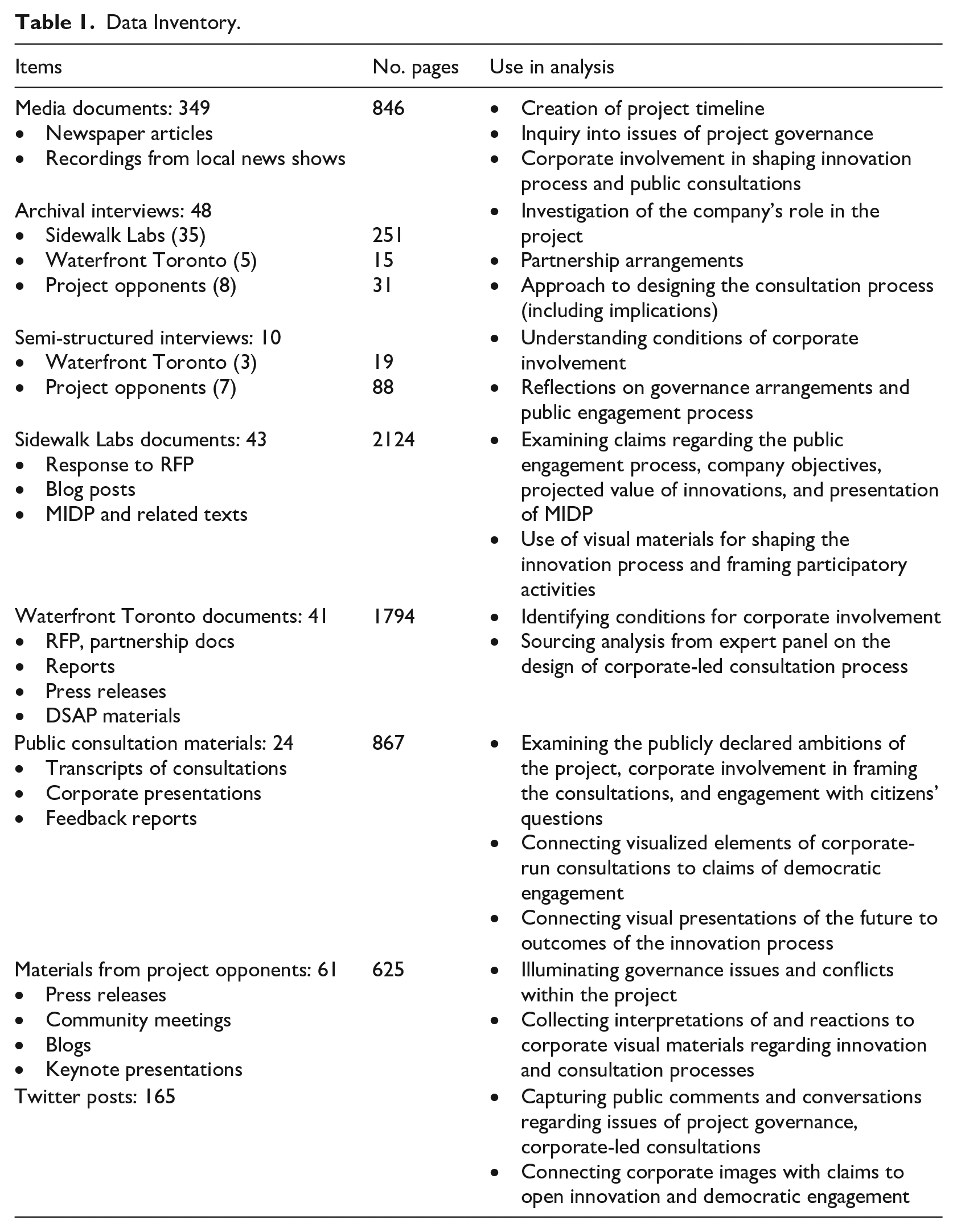
Data analysis
NVivo was used to manage, code and analyse both text and visual data. Collected images were examined as artefacts, or representations of a social reality enabling the reconstruction of meaning, and informing a deeper understanding of observed processes (Meyer, Höllerer, Jancsary, & van Leeuwen, 2013). To examine the potential influence of corporate capabilities for innovation on public deliberation, we combined strategic and archaeological approaches to multimodal data (Meyer et al., 2013). This decision reflected distinctions in our dataset between images produced by Sidewalk Labs to project an envisioned future, and images generated by observers (e.g. news media, public participants) documenting events that transpired. Although the data analysis proceeded inductively and iteratively, for the sake of clarity we describe it as progressing in three analytical stages.
Analytical stage 1: Project overview
Based on our analysis of project documents and news media articles, we constructed a project timeline to capture essential dates, events and actions (15 pages; 9,100 words). The timeline was used to bracket the data and map these elements against the different phases of the project.
Analytical stage 2: Conceptualization and theorizing
Following a phase of ‘initial’ (Charmaz, 2006), and ‘open’ coding (Corbin & Strauss, 1990), analytical attention centred first on the conditions for corporate involvement. An ensuing cycle of ‘provisional coding’ (Saldaña, 2016, p. 168) focused on three elements: Waterfront Toronto’s impetus for the Quayside project, its framing, and the partnership between Waterfront Toronto and Sidewalk Labs. A first group of codes clustered around Waterfront Toronto’s entrepreneurial conceptualization and handling of the project, leading to the second-order theme empowering corporate-led innovation. A second group of codes captured Waterfront Toronto’s need for technical and financial resources to realize the innovation outcomes, yielding the second-order theme accessing corporate capabilities and resources. A third group of codes related to the public debate about empowering corporate innovation in the public sphere. In conjunction with the inverted relationships between citizens and government, and the democratic expectations imposed on Sidewalk Labs, the second-order theme of delegating deliberative burdens emerged. Together, these second-order themes comprise the aggregate dimension of privileged corporate position.
Our investigation of Sidewalk Labs’ role in shaping the innovation process invited a more in-depth analysis of the visual data collected for this study. Acknowledging the nature of official communications as a ‘site of claims to power, legitimacy and reality’ (Lindlof & Taylor, 2011, p. 232), we adopted a holistic interpretative approach to the ‘reading’ (Banks, 2014) of both images and text. Guided by intuitive inquiry and strategic questions about the presence and absence of meaning, a process of careful interpretation, scrutiny, reflection and discussion ensued. This was accompanied by the coding of visual data and the production of analytic tables and memos linking evidence obtained from visual and textual data.
An analysis of how Sidewalk Labs introduced their vision for Quayside led to the emergence of the second-order theme, projecting a hypothesized future, which connected projective statements with increasingly detailed and ‘realistic’ visual renderings of an envisioned future featuring the company’s innovations. Emerging findings drew attention to the consultation process and how both textual and visual data privileged the role of technical expertise in ‘rendering technical’ a highly contentious project. When examining the relationship between these two second-order themes, we noted that this focus on how (corporate) technical expertise would drive the realization of the company’s future vision implied a focus on goal attainment rather than collaborative development, leading us to our second aggregate dimension of orientation towards anticipatory governance.
The inherent focus on project delivery conflicted with evidence that emphasized the deliberative capacity of citizens experienced in public consultation. Data from post-event surveys conducted by Sidewalk Labs and remarks from activists further demonstrated the significance of deliberation for the public, underscoring related demands for meaningful participation in the innovation process. Together, these themes formed the dimension expectation of deliberative governance.
This finding drove a deeper analysis of the public consultation process, including transcripts from public roundtables, summary reports, photos and images. Codes capturing the theatrical nature of this engagement led to the second-order theme of enacting exhibitions of corporate innovation. While Sidewalk Labs emphasized the open nature of this guided engagement process, participants characterized it as ‘scripted’, designed to overwhelm rather than inform, leaving an impression of ‘consultation as marketing’, captured in the second-order theme utilizing corporate innovation capabilities. Sidewalk Labs’ instrumental use of statistics documenting the scale of the consultation (e.g. numbers of Canadians engaged) to evidence its success yielded the theme of making self-referential claims of engagement. Together the three themes supported the aggregate dimension of innovation spectacle.
Analytical stage 3: Refinement
The final stage of the analysis was aimed at quality control. Coding and re-coding helped to refine the final data structure presented in Figure 1.
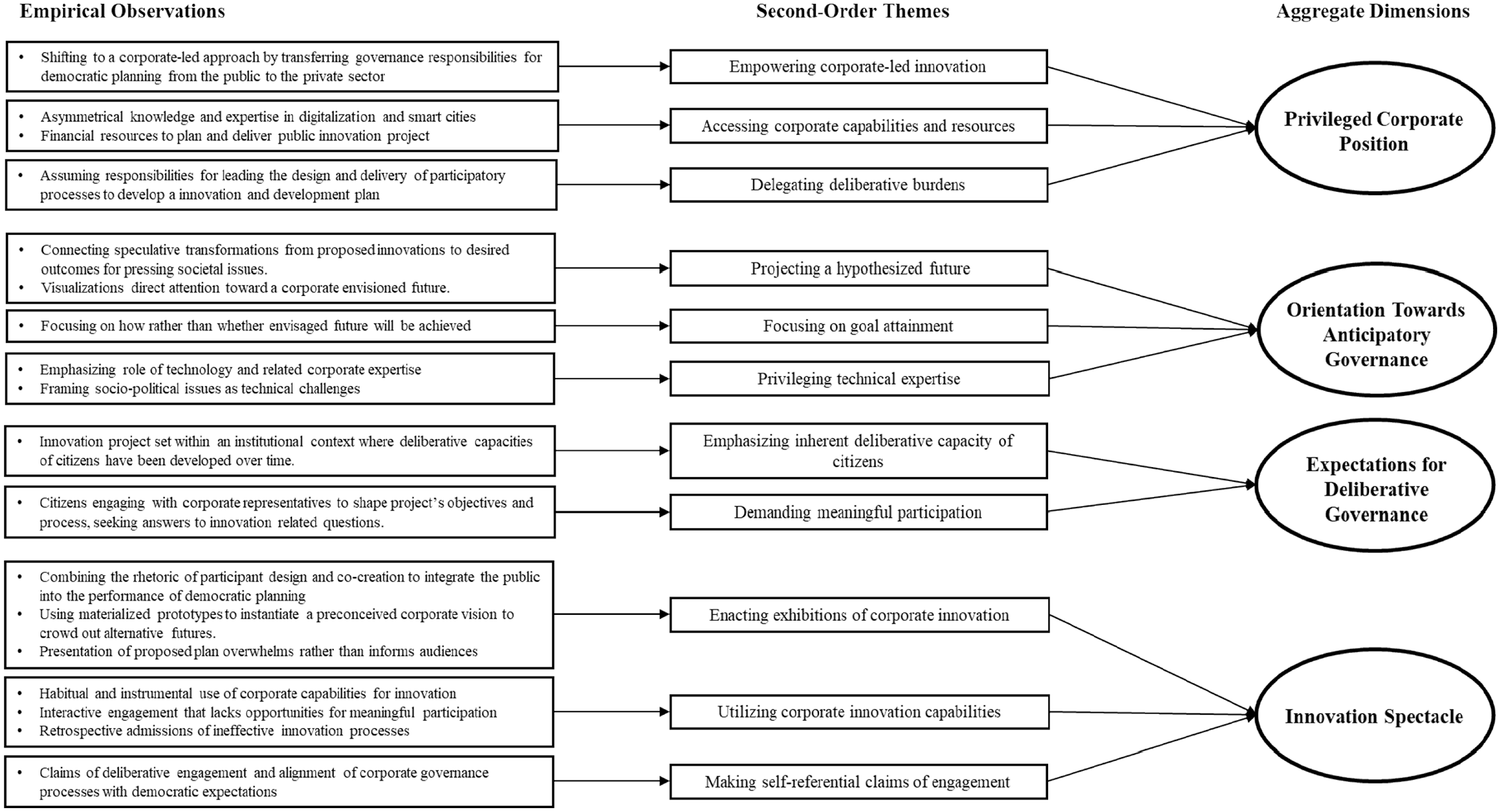
Coding structure.
Findings
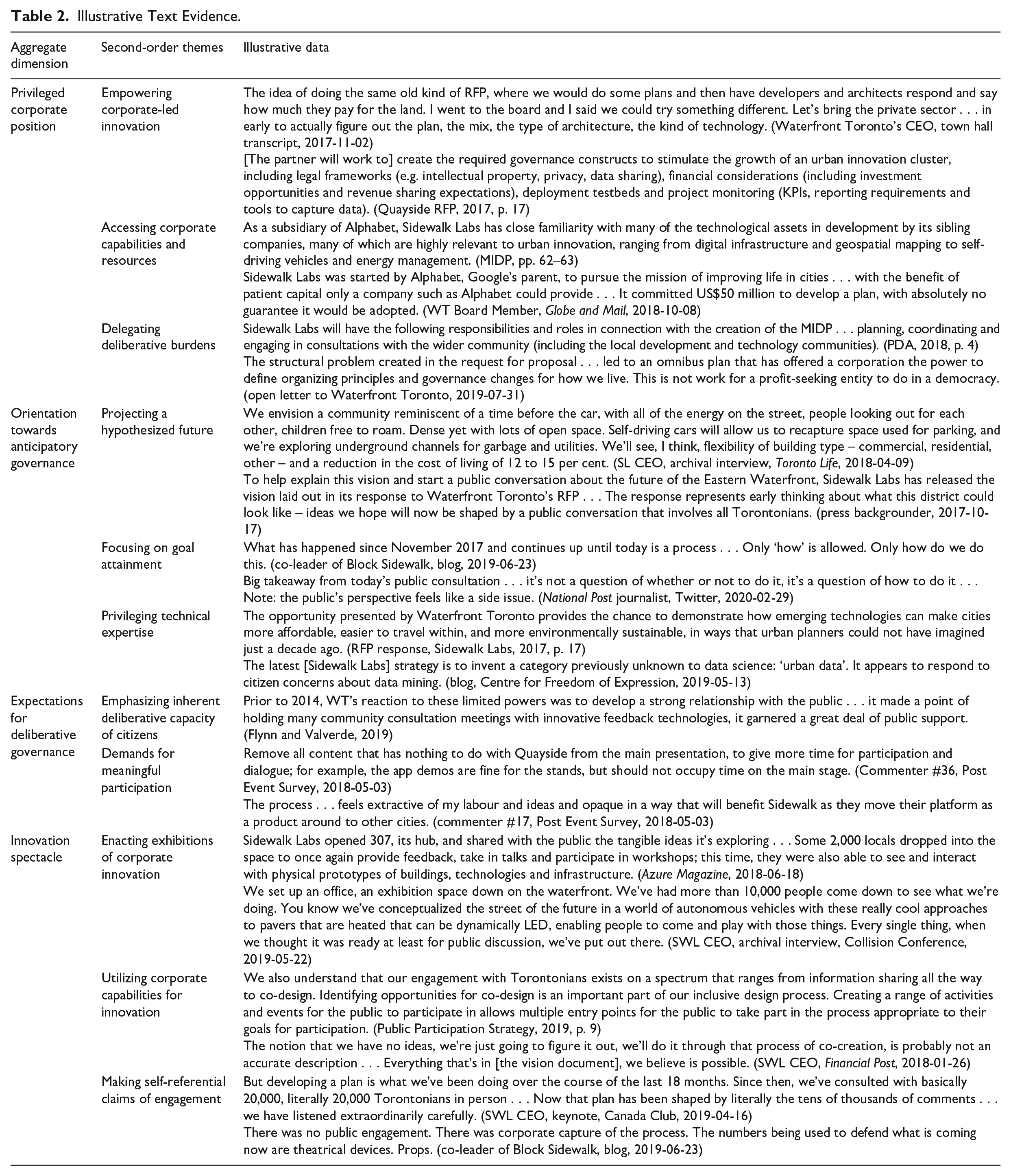
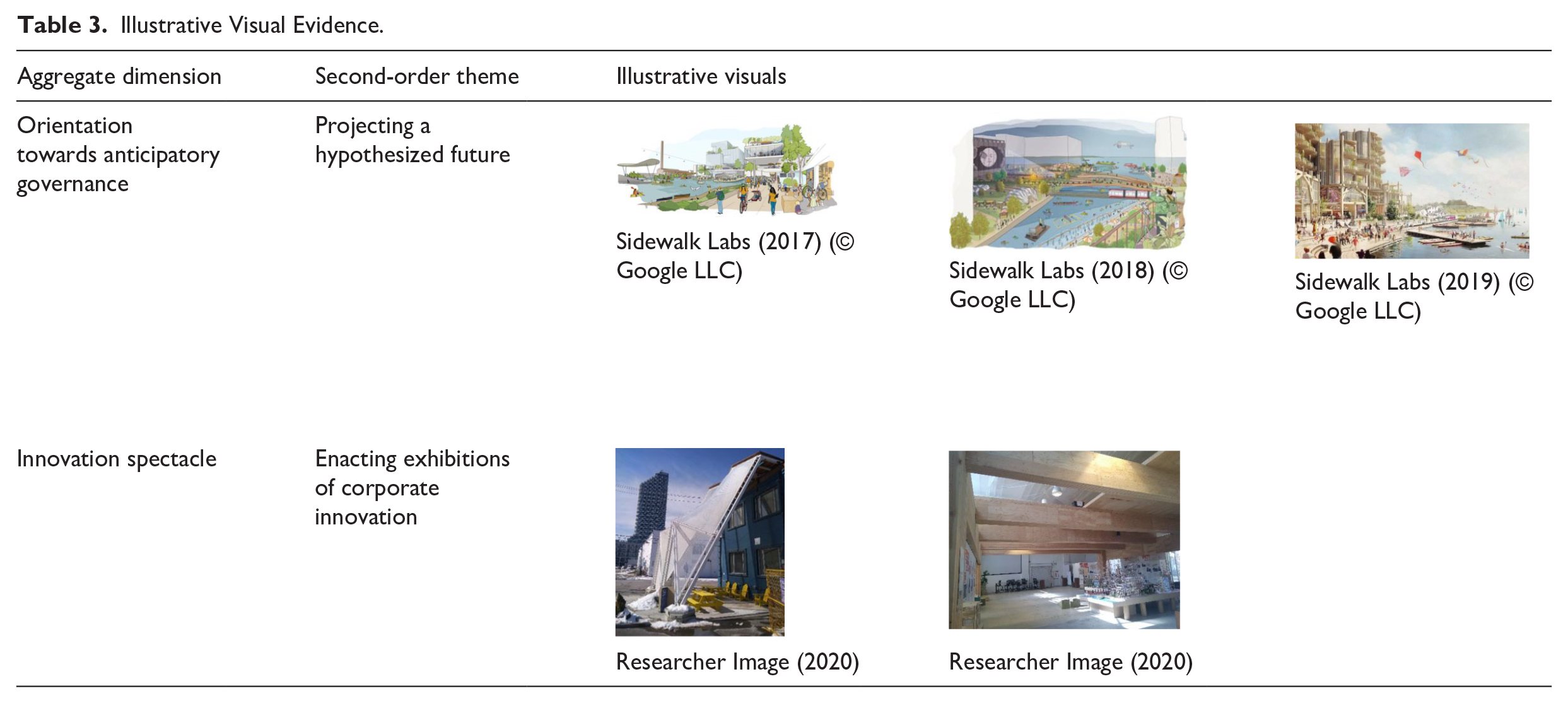
Our findings are organized around the four aggregate dimensions identified in Figure 1. They are supported by language-based and visual evidence provided in Tables 2 and 3, and in the text.
Illustrative Text Evidence.
Illustrative Visual Evidence.
Privileged corporate position
Quayside was promoted as a transformative project that would solve complex urban development challenges through ‘innovation and partnership’ to ‘build smarter, greener, more inclusive cities’ (Press Conference, 2017). The RFP issued by Waterfront Toronto emphasized empowering corporate-led innovation to achieve visionary outcomes. It promised prospective partners ‘access to an unparalleled test bed environment’ to showcase ‘advanced technologies, building materials, sustainable practices and innovative business models’, as well as the opportunity to financially benefit from the ‘significant revenue generation and sharing potential from the intellectual property derived from the project’ (Request for Proposal, 2017, pp. 6, 18). Realizing the entrepreneurial and technological ambitions of Quayside, however, rested heavily on Waterfront Toronto accessing corporate capabilities and resources.
Contrasting Waterfront Toronto’s previous projects (e.g. communal spaces, parks and affordable housing), the Quayside RFP had not been preceded by extensive consultation and exposed the organization’s limited expertise in developing digital technologies and data infrastructure. The RFP also situated the project in a context of ‘constrained’ government funding (RFP, 2017, p. 8), reinforcing the imperative of accessing financial resources from the private sector. Waterfront Toronto’s reliance on corporate expertise and resources contributed to the formulation of an RFP, placing the private partner in a privileged position to help determine project objectives, select technologies and evaluate investment and regulatory models (RFP, 2017, pp. 14–17). The RFP, coupled with the terms of the initial partnership agreements, enabled Sidewalk Labs to not only propose innovations but also lead the public engagement process. This was perceived as an opportunity for corporate leadership, as well as a case of corporate capture, especially from citizens who felt excluded by Waterfront Toronto’s closed-door approach to determining the goals of the RFP.
The selection of Sidewalk Labs was facilitated by its commitment to spend US$50m to develop the Master Information and Development Plan (MIDP) for Quayside (Ontario Auditor General Report, 2018). Waterfront Toronto’s success in attracting investment from an Alphabet company was applauded by proponents, while critics feared that the democratic city-building process would be undermined, expressing concerns that the company would act as a ‘broker’ between citizens and their government in ‘designing how [they] live’ (CBC, 2019-06-25). Sidewalk Labs’ influential position shifted the deliberative burden from Waterfront Toronto to the company, as illustrated by the CEO of Sidewalk Labs promising to lead a ‘democratic’ and ‘intense community conversation’ (Town Hall Transcript, 2017; NYT, 2017-12-29). This meant that Sidewalk Labs was expected to fund and lead the initial stage of a complex multi-sectoral project, which it hoped to translate into a successful demonstration of its ability to deliver a smart city.
Orientation towards anticipatory governance
By the time Waterfront Toronto issued its RFP seeking an Innovation and Funding Partner . . . Sidewalk Labs had spent more than a year creating this vision and searching the world for the right place to bring it to life. (MIDP, p. 60)
Following Waterfront Toronto’s announcement of Sidewalk Labs as the innovation and funding partner, the company publicly released its vision for Quayside. Conveyed through a stylized narrative and captivating visual renderings blending ‘The Jetsons’ and ‘Portlandia’ (NYT, 2019-11-01), their vision connected a suite of corporate innovations to desired policy outcomes (e.g. social, economic and environmental), thereby projecting a hypothesized future.
Our hypothesis is that a combination of technologies, thoughtfully applied and integrated, can fundamentally alter nearly every dimension of quality of life in an urban environment. To get there, we’ve surveyed innovations across a range of domains – mobility, infrastructure, buildings, public space, social and community programs, even governance – that are available today or will be soon. We’re convinced that by implementing a set of technologies – autonomous vehicles, modular building construction, or new infrastructure systems – we can, for example, reduce cost of living by 15 per cent. (SWL CEO, archival interview, 2018-01)
Sample images from Sidewalk Labs’ portfolio of renderings (see Table 3) supplied the public with a reifying visual narrative that became a defining feature of the project’s identity. Increasingly realistic images were deployed to heighten the project’s appeal and to strengthen claims about the superiority of Sidewalk Labs’ technical expertise. Sidewalk Labs rendered technical data governance and privacy issues by drawing on concepts such as ‘privacy by design’ and ‘civic data trusts’. By privileging technical expertise in this way, Sidewalk Labs sought to de-politicize the project, justifying its leading role in an innovation process with a predetermined goal. This focus on delivery and goal attainment is exemplified in Waterfront Toronto’s opening remarks at the third public roundtable: Roundtables 1 and 2 were really meant to introduce Sidewalk Labs to you all . . . to tell you about their vision, their innovation, what they bring to the table. The roundtable tonight is really to bring your ideas around the building blocks for Quayside, and then for roundtable 4, we’ll be bringing forward a draft master innovation and development plan for the Quayside project. (WT executive, roundtable transcript, August 2018)
Sidewalk Labs attempted to elicit encouraging feedback on predetermined aspects of its proposed innovations through a range of participatory activities (e.g. roundtables, resident panels, town halls and design jams). Its proclaimed aim was to present a plan reflecting the ‘aspirations and ideas of Torontonians’ (MIDP, p. 67) based on principles such as ‘inclusion’, ‘creativity’ and ‘learning’ (Public Engagement Strategy, 2019). Despite the company’s endorsement of open innovation, engagement activities were characterized by observers as ‘heavily scripted’ (interview, WT executive, 2020-05-21) and ‘lacking dialogue with experts’ (commenter # 12, Post Event Survey, 2018-12-08). This led to tensions between an orientation towards anticipatory governance and expectations for public deliberation.
Expectations for deliberative governance
Before Quayside, Waterfront Toronto had built a reputation for actively involving the local community in defining the scope and objectives of proposed RFPs.
[Waterfront Toronto] established a very good pattern of before anything, any plans were made to have huge public meetings and allow everyone to just dream in technicolour, what would you like to see on the East Bay front? . . . Hundreds of people showed up at those public meetings to have a say, and out of those public meetings plans are developed that would be the basis for the RFPs . . . we would argue plans . . . so the final RFPs for construction were built . . . on the expressed wishes of the community. (interview, community activist and resident)
Waterfront Toronto’s longstanding commitment to ‘put the public’s voice at the centre of its planning and revitalization efforts’ (Waterfront Toronto website) actuated the existing deliberative capacities of citizens, and their expectations to be active contributors to redevelopment projects. This extended to demanding meaningful participation in the development of project objectives, processes and governance.
Sidewalk Toronto [Quayside] is an ideal opportunity to dig in and push the envelope on community engagement and codesign of government tech. The politics and implementation of this work are on the table. This is a chance to make sure that Toronto defines the requirements of its waterfront tech, rather than Sidewalk only defining solutions that work best for them. (Torontoist, 2017-10-24)
Evidence collected from the company’s post-event surveys underlines citizens’ desire to have ‘two-way’ discussions between them and Sidewalk Labs on the substantial issues raised by the project, such as privacy and data collection. Yet, for many roundtable participants, the sessions were ‘perfunctory and superficial’ (commenter #10, Post Event Survey, 2018-12-08), provoking calls to amend public engagement to ‘actually, implement deliberative and participatory decision making with people involved’ (commenter #17, Post Event Survey, 2018-05-03).
Innovation spectacle
Sidewalk Labs’ privileged position and orientation towards anticipatory governance was misaligned with the deliberative expectations of Toronto’s citizens. What began as a promise for a public consultation process became an innovation spectacle – a carefully orchestrated performance of a preconceived vision. Bolstered by a US$11m budget for ‘communications, external affairs and engagement’ (Plan Development Agreement, 2018 p. 34), Sidewalk Labs engaged Torontonians by enacting exhibitions of corporate innovation in a way that blurred boundaries between listening, participating and marketing.
Sidewalk Labs went to great lengths to impress upon the public the innovative potential of Quayside. The company’s project headquarters, the ‘307 Studio’ served as an ‘interactive showcase’ to unveil large-scale prototypes (see Table 3). Visitors to the 307 Studio were encouraged to ‘experiment’, ‘explore’ and ‘generate plans’ using card games and digital mapping tools (Daily Tous Les Jour, 2018). Such tools were intended to make ‘contributing flexible, easy and inclusive’ (Frame Magazine, 2018-09-30). Design thinking tools such as pens, markers and sticky notes were used to create ‘feedback wall[s] full of sticky notes’ (Blog TO, 2018-06-26), maximizing the visibility of public participation, and contributing to the visual impression of a democratic process in action.
For 307, we went with the low-fi playing cards for multiple reasons . . . You can shuffle them around, see people’s ideas . . . It really feels like you’re part of the thinking and designing process, that you’re contributing to something that’s in flux and that is not engraved in stone. (designers of 307 Studio, SWL blog, 2018-09-06)
Yet, in actuality, the use of design thinking and open innovation techniques within a predetermined scope of engagement effectively conscripted the public into the performance of urban planning as opposed to promoting a meaningful democratic process.
The habitual and instrumental application of corporate innovation capabilities caused problems when observers started to question whether Sidewalk Labs’ consultation process provided citizens with opportunities for meaningful participation. Despite the dazzling array of potential innovations (e.g. heated sidewalks, robot trash collectors, mass timber construction, autonomous vehicles, building raincoats), structured discussions of generic urban themes and innovative technologies circumvented rather than enabled debate on contested issues such as privatization of public spaces, privacy and data governance. These images were not just aesthetic; they were key tools for framing citizens as passive consumers of technology rather than active participants in the deliberative process.
Moreover, Sidewalk Labs struggled to articulate how the feedback from citizens had informed their plans. As noted by Waterfront Toronto’s Digital Strategy Advisory Panel: How can we tell whether SWL’s proposals were genuinely informed by public consultation or whether SWL steered the process in its interests, cherry-picked favourable opinions or used the feedback to avoid criticism while claiming public support? (DSAP Preliminary Comments, 2019)
This reinforced the impression that planning materials like the MIDP had been designed for public persuasion rather than public discussion (Preliminary Commentary on MIDP, 2019).
In the face of such criticism, Sidewalk Labs defended its consultation process as ‘unprecedented’ and ‘robust’ (Public Engagement Process Report, 2019). Quantitative narratives (i.e. ‘interactions with thousands of people’) and related assurances of ‘listening’ and ‘reflecting’ underpinned the company’s self-referential claims of engagement: I think we’ve been actually pretty transparent you know over the course of the last year . . . We’ve had countless public meetings. We’ve literally met in person with 18,000 people over the course of a year. We received thousands and thousands of comments. We’ve digested those comments. We keep iterating. (SWL CEO, archival interview, The Agenda, 2019-02-21)
Such claims were rejected by civil society leaders involved with the project: There is no greater demonstration of not listening than what Sidewalk Labs has been doing . . . Instead, they did the exact opposite of listen – they turned the volume up on what they wanted to say . . . For a company with 11 million USD committed to stakeholder engagement they are making an active choice NOT to engage with the community, not to answer the questions, not to have the hard conversations. (Block Sidewalk blog, 2019-05-27)
The perceived lack of listening and reflexivity on the part of Sidewalk Labs was underscored by the company’s inability (or unwillingness) to explain why their innovations were germane to the policy challenges of the project.
Case epilogue: Irreconcilable differences
Sidewalk Labs pulled out of the partnership on 7 May 2020, citing the financial pressures of the Covid-19 pandemic (Sidewalk Labs blog, 2020-05-07). Case evidence suggests that in response to public feedback (or outcry), Waterfront Toronto attempted to correct flaws in the governance arrangements by re-asserting public control over the project. In the face of such pressures, Sidewalk Labs did not adjust their engagement approach, nor did they move away from their preconceived ideas about the focus and output of the innovation process. For observers, this resistance to efforts to democratically re-embed the project testified to Sidewalk Labs’ inability to engage reflexively with Toronto’s political and civic culture (The Logic, 2020-05-08). The company failed to grasp the deep investment of Torontonians in democratic city-building (Spacing, 2020-05-07). The fact that an intense public relations campaign, political lobbying and deployment of civic influencers did not enable Sidewalk Labs to meet the demands of key stakeholders likely contributed to its decision to abandon the project.
Discussion
Drawing on our findings, we have developed a theoretical model addressing our overarching research question: How do corporate innovation capabilities shape public deliberation in responsible innovation projects? Our model, structured around our four aggregate dimensions, reveals how conditions that afford corporations privileged positions in a public–private partnership create fundamental tensions between anticipatory and deliberative governance modes (see Figure 2).
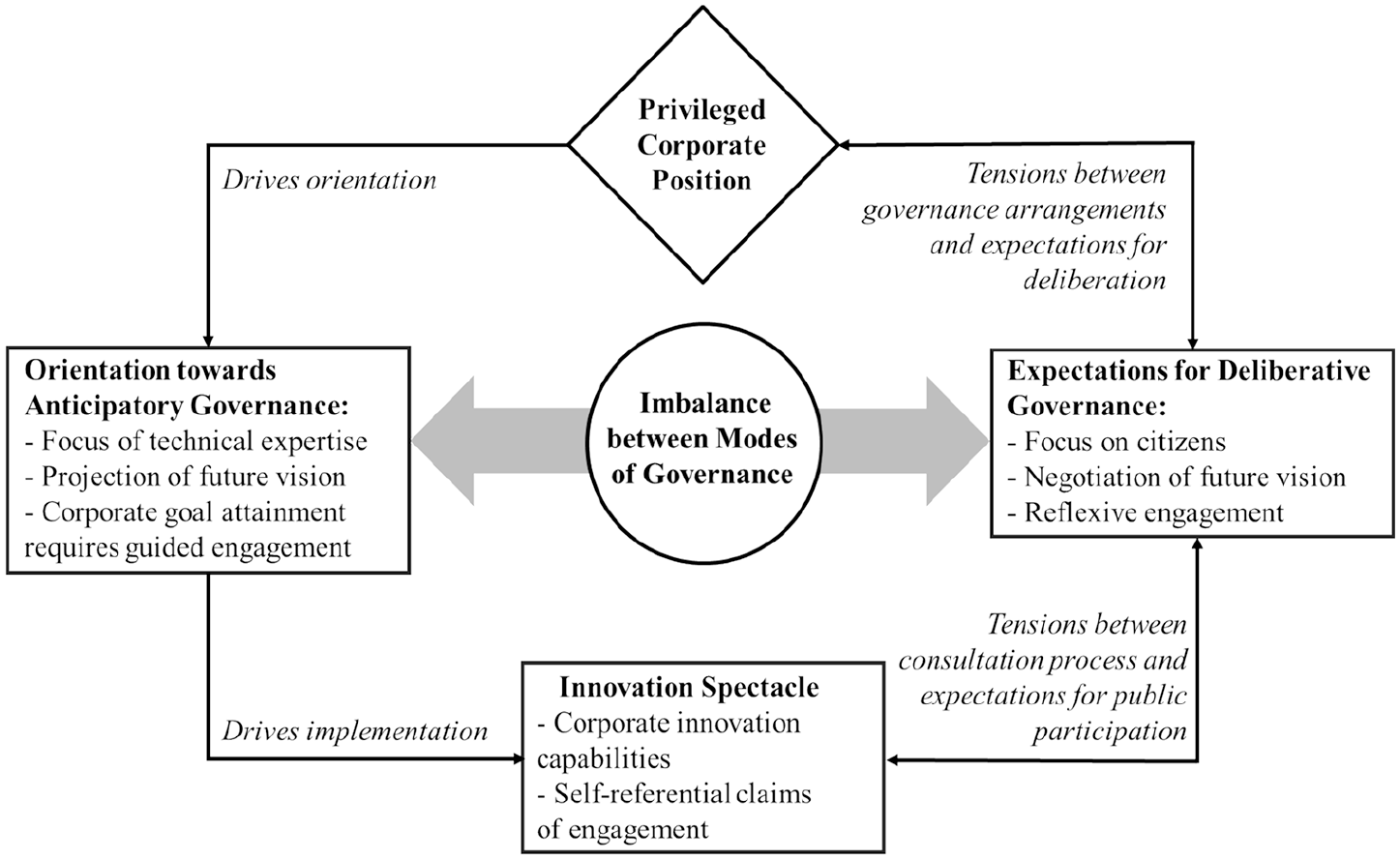
Theoretical model.
Our analysis shows that when corporations simultaneously hold responsibility for technological innovation and stakeholder engagement, they effectively become leaders of public deliberation. This ‘privileged position’ presents a critical challenge, insofar as it enables an orientation towards anticipatory governance that elevates corporate innovation capabilities as the central organizing mechanism and contributes to the framing of citizens primarily as consumers of innovation rather than as active participants in decision-making. This approach conflicts with the ideals of ‘deliberative governance’, where public engagement is meant to facilitate dialogue and input, not merely to validate corporate proposals. As a result, citizen involvement may be reduced to tokenistic events, or ‘innovation spectacles’ that do little to advance genuine public deliberation. Balancing anticipatory and deliberative governance, therefore, is critical for ensuring that responsible innovation processes are both forward-looking and inclusive.
Balancing anticipatory and deliberative governance
Anticipatory and deliberative governance are complementary modes for making innovation responsible by balancing expertise with public participation in decision-making (de Hoop, Pols, & Romijn, 2016; Toffler, 1970). While in theory both support responsible innovation, in public–private partnerships tensions arise when public organizations, constrained by resources, grant corporations significant authority. Corporations typically favour anticipatory governance, which is rooted in expertise and technological foresight, steering decisions based on future visions that align with corporate interests. Deliberative governance, by contrast, demands inclusive dialogue and consensus-building among diverse stakeholders, ensuring that innovation aligns with democratic values and societal needs (Arenas, Albareda, & Goodman, 2020).
Our findings reveal that achieving the right balance between anticipatory and deliberative governance is more complex than simply choosing between options such as preference aggregation and deliberation (Fung, 2006). When stakeholders hold diverging views on innovation’s purpose(s) and process(es), reflexive management becomes essential (Scherer & Voegtlin, 2020). This entails ongoing reflection on partnership structures, stakeholder roles, and societal impacts. As we will explore in the following section, corporate capabilities complicate achieving such reflexive management.
The role of corporate innovation capabilities
Companies are valued partners in public–private partnerships for their innovation capabilities. These capabilities are forged through years of experience and provide stability, enabling companies to consistently and successfully innovate in the market (Winter, 2003; Zollo & Winter, 2002). As revered best practices for innovation (Eisenhardt & Martin, 2000), such organizational capabilities also provide a bedrock for corporate identity (Glynn, 2000; Pandza & Ellwood, 2013; Rindova, Dalpiaz, & Ravasi, 2011). Both characteristics indicate that corporate innovation capabilities are entrenched. They are unlikely to be questioned, which makes it difficult to adapt these capabilities, let alone change them radically.
Reflexive adaptation is essential for leveraging capabilities such as open innovation or human-centric design in politically charged public deliberations. In the absence of such reflexivity, corporate innovation capabilities aim to achieve consensual agreement on the desirability of corporate proposals. Participatory tools and user-led methods may give the appearance of corporate compliance with democratic norms (Zyglidopoulos & Fleming, 2011). In practice, these tools often facilitate interactions with corporate ideas and products without truly opening them to debate (Nyberg, Spicer, & Wright, 2013). The theatrical use of methods that seem ‘participatory’, because they appear interactive, only ‘trivializes’ (Fung, 2015) public participation. It depoliticizes engagement with citizens, thereby transforming what should be a deliberative process into an innovation spectacle.
It may seem that corporations are simply using their innovation capabilities to strategically manipulate deliberation in their favour (Lee & Romano, 2013). However, our theorization draws attention to the deep-seated quality of corporate innovation capabilities. Corporate innovation capabilities have been developed to excel at soliciting external input to enhance business performance, but they fall short when the goal is to ensure high-quality public dialogue to foster (meta) consensus among diverse stakeholders. Integrating innovation with deliberation requires a shift in corporate identity, demanding critical engagement with values and practices. This integration requires profound reflexivity.
In corporate settings, reflexivity – defined as critical self-awareness that fosters adaptability – often contrasts with self-referentiality, where actions are driven solely by business imperatives. While self-referentiality leads corporations to impose their perspectives on others, reflexivity enables them to break free from entrenched thinking and respond more openly to new ideas and viewpoints (Holland, 1999, p. 482), including public concerns and values. When operating in the market, corporations may respond to changes in their environment, but they do so in a self-referential way in that they examine the challenges they encounter with a view to implications for their business. Without adopting a position of heightened reflexivity, corporate actors are limited in their ability to respond to demands for public deliberation, failing to recognize implications that may arise for how they operate. This makes it exceedingly difficult to support deliberative governance. Therefore, the adaptation of corporate innovation capabilities to foster deliberation is hindered by both the entrenched nature of these capabilities and the limited capacity of corporate actors to adopt a position of deep reflexivity, which conflicts with their self-referential orientation.
Implications for theory and future research
The responsible innovation literature advocates for a rethinking of who should shape innovation and who should be politically involved in its governance (Boenink & Kudina, 2020; Voegtlin & Scherer, 2017). This shift has underscored the centrality of anticipatory and deliberative governance as critical dimensions and brought with it an accompanying focus on the normative attributes of innovation processes and governance structures (Scherer & Voegtlin, 2020; Stilgoe et al., 2013; Voegtlin et al., 2022; Von Schomberg, 2011). While prior scholarship acknowledges the potential for conflict between anticipatory and deliberative modes (Stilgoe et al., 2013), this research sharpens our understanding of the institutional conditions and organizational factors that not only contribute to disharmony between these critical dimensions but complicate and even hinder the realization of collaborative, multi-sector responsible innovation projects (de Hoop et al., 2016). In clarifying the role of balancing anticipatory and deliberative governance, we add much-needed empirical insights regarding how imbalance-related tensions are shaped by the organizational arrangements that distribute governance responsibilities, particularly in public–private partnerships.
Corporate-driven anticipatory governance often leaves unchallenged the corporate logics shaping social relations (Zuboff, 2019), which risks transforming innovation into a technocratic, closed process rather than a democratic, inclusive one (Fung, 2015). Our findings underscore that this tension is rooted in differences in the reflexivity required by each governance mode. Anticipatory governance relies on limited reflection tied to strategic business objectives, whereas deliberative governance demands critical self-awareness and reflection on both the cognitive dimension (i.e. the fit between an innovation and an identified problem), the political dimensions of responsible innovation (i.e. the integration of perspectives and values of different actors) and related social processes that give meaning to both (Feindt & Weiland, 2018; Leach, Scoones, & Stirling, 2010).
Prior work has emphasized the need for anticipatory governance to drive technological solutions (Guston, 2014; Stilgoe et al., 2013), and deliberative and reflexive governance to enable innovation to be shaped by those affected by it (Scherer & Voegtlin, 2020; Voegtlin et al., 2022). However, the practical dimensions of how these governance modes play out in real-world partnerships have been largely overlooked. By focusing on corporate capabilities and their limitations in fostering deliberation, we show how the reliance on corporate expertise – at times treated as the gold standard – can overshadow the need for ‘value work’ enabled by public deliberation (Boenink & Kudina, 2020). Our work shifts the conversation from abstract ideals to the practical challenges of balancing governance modes in a way that can meaningfully incorporate public input. This practical lens helps address the often normative tone of the responsible innovation literature, which tends to assume the main challenge is aligning technology with ethical norms, rather than grappling with the questions of power and politics raised by public–private partnerships, and how they play out in the governance of responsible innovation (van Oudheusden, 2014).
Our second contribution extends the emerging literature on organizational capabilities for responsible innovation (Scherer et al., 2016; Voegtlin & Scherer, 2019), by showing how corporate capabilities for innovation may require radical adaptation to enable the democratic embedding of a (responsible) innovation project. We argue that the intrinsic properties of organizational capabilities – such as a systematic focus on future opportunities (Winter, 2003) – can constrain the adaptation of capabilities such as open innovation and human-centric design. These adaptations are, however, essential for effectively organizing innovation processes in multi-sectoral public–private partnerships. By highlighting this limitation, we provide a nuanced perspective, challenging assumptions about the adaptability of corporate innovation capabilities and advancing the dialogue on the governance of responsible innovation. While we acknowledge that established corporate innovation capabilities such as open innovation, human-centric design and lean start-up experimentation can contribute positively to responsible innovation (Voegtlin et al., 2022), we also show that it is essential to critically assess these methods, as they may be insufficient or even counterproductive when applied to public deliberation. For responsible innovation to succeed in democratic contexts, corporate innovation capabilities must undergo significant alteration. This requires moving beyond market-focused innovation strategies and developing practices that genuinely support democratic dialogue, ensuring that public deliberation is not merely a formality but a meaningful process.
Meeting the deliberative demands of public–private partnerships highlights the challenges of ‘internalizing democracy’ (Scherer, Baumann-Pauly, & Schneider, 2013) and the need to adapt corporate innovation methods when organizing responsible innovation processes. The concept of a ‘reflexivity deficit’, often used to describe corporate failure to recognize the social impacts of their actions (Voegtlin et al., 2022, p. 10), should be expanded to include the lack of critical reflection on whether corporate innovation practices are appropriate for fostering democratic participation in the innovation process. By addressing this reflexivity gap, we offer a novel direction for future research on responsible innovation, inviting scholars to explore how corporate innovation capabilities can be devised to better align with the pluralistic and democratic needs of the public sphere. Such a shift requires acknowledging that corporate innovation practices are not inherently democratic, deliberative or reflexive and thus must undergo significant transformation to enable meaningful stakeholder engagement. Efforts to understand how established corporate capabilities can be adapted would benefit from addressing the limited engagement with the concept of reflexivity in conversations about the micro-foundations of organizational capabilities (Felin & Foss, 2005). Research integrating the micro-foundational strategy literature with responsible innovation research could yield valuable insights into how strategic leaders may question established ways of thinking, and reflexively develop and adjust the capabilities necessary to ensure public–private partnerships for responsible innovation succeed.
Further research is also needed on the capabilities of public organizations to manage the complexities and participatory requirements of responsible innovation projects with the private sector. Public organizations are not just passive regulators or facilitators; they must bring critical orchestration capabilities to the table, such as managing stakeholder diversity, ensuring transparency and facilitating inclusive dialogue (Voegtlin & Scherer, 2017). Future research should examine how public organizations can develop these capabilities to strengthen their leadership in innovation processes and to better balance the governance dynamics of public–private partnerships. The examined case underscores the importance of developing such capabilities to mitigate concerns of undue corporate influence, especially when partnering with ‘big tech’, given the likelihood of pronounced asymmetries in technical knowledge and financial resources between public and private partners.
Finally, our research underscores the importance of multimodal research in understanding the ‘organizing effects’ of anticipatory governance in responsible innovation (Flyverbom & Garsten, 2021). In particular, the observed use of corporate images to promote innovation futures reinforces how visual tools can be used to not only shape public perception and engagement but also legitimize organizational capabilities needed to realize such futures (Christiansen, 2018; Höllerer, Jancsary, & Grafström, 2018; Meyer et al., 2013). However, our inability to gain access to Sidewalk Labs for interviews limited our capacity to fully explore their perspective on the use of visuals in responsible innovation projects, and the role in anticipatory governance. Future research in this area will benefit from a deeper engagement with visual data, specifically, in examining how it shapes the politics and governance of responsible innovation projects, possibly through collaborations with researchers from disciplines with strong traditions in working with visual materials, such as cultural studies and media science. While scholars should consider the challenges inherent in accessing and analysing such data, we believe our study testifies to the potential of visual research methods for achieving greater depth of insights in responsible innovation research.
Implications for practice
Our findings offer important recommendations for practitioners involved in public–private partnerships for responsible innovation. First, policymakers should carefully design public–private partnerships to balance anticipatory and deliberative governance. While corporations excel in driving innovation, they are often ill-equipped to manage the political and social complexities of public deliberation, especially in settings with established democratic norms (Hussain & Moriarty, 2018; Mäkinen & Kasanen, 2016; Sabadoz & Singer, 2017). Policymakers must ensure that public input and democratic accountability are central to innovation processes and not sidelined by corporate-driven anticipatory governance.
Corporations must evaluate whether their established innovation capabilities – such as open innovation or human-centred design – align with the democratic expectations of public deliberation. Although these capabilities are valuable in a market context, they may not be sufficient for fostering inclusive, reflexive dialogue in public settings. Companies need to critically assess whether their methods are adequate for facilitating true stakeholder engagement, not just participation that shapes corporate products. Reflexivity as an essential practice for adapting organizational capabilities, also extends to how corporations present their innovations. In our study, the visual data revealed how the anticipatory governance mode can be seductive and powerful, often framing innovation as an inevitable future. Without reflexivity, such visual representations can become a tool to depoliticize engagement, undermining genuine public deliberation. Corporate actors must reflect critically on the narratives and images they use, ensuring that these tools do not inadvertently marginalize public input or reinforce technocratic governance.
Conclusion
Empirical evidence from our case highlights the importance of understanding how anticipatory and deliberative governance may come to work at cross (or potentially complementary) purposes and the important role of organizational capabilities for responsible innovation. Although our findings are derived from a single case, we expect they may translate well to other contexts, given the continued expectations for public and private organizations to collaborate on responsible innovation initiatives. In this respect, our case offers an interesting point of reflection on the outcome of the partnership we studied. On one hand, our case study can be read as a cautionary tale regarding how public authorities collaborate with corporations, and under what conditions they may seek to leverage corporate capabilities to reify envisioned futures. On another hand, the dissolution of the partnership underscores the importance of the deliberative capacities of citizens in democracies, particularly when it comes to resisting corporate control within (responsible) innovation projects.
While the Quayside project suffered from a lack of democratic embedding, its conclusion provided Waterfront Toronto with an opportunity to re-align planning objectives with public expectations and re-engage with the private sector. This shows that resisting an innovation spectacle is not enough, especially against the backdrop of expanding corporate influence and control in the organization of social life (Barley, 2007; Whittington & Yakis-Douglas, 2020). The findings and issues raised in this paper underline the importance of continued scholarly engagement regarding how the normative ambitions of responsible innovation are implemented in practice. Additionally, it emphasizes the need for both public and private partners to develop the reflexive capabilities necessary to support effective stakeholder engagement and the balancing of governance modes to generate socially responsive innovations.
Supplemental Material
sj-docx-1-oss-10.1177_01708406251336023 – Supplemental material for Balancing Anticipatory and Deliberative Governance in Public–Private Partnerships for Responsible Innovation: The role of corporate innovation capabilities
Supplemental material, sj-docx-1-oss-10.1177_01708406251336023 for Balancing Anticipatory and Deliberative Governance in Public–Private Partnerships for Responsible Innovation: The role of corporate innovation capabilities by David Larkin, Lena Jaspersen and Krsto Pandza in Organization Studies
Supplemental Material
sj-docx-2-oss-10.1177_01708406251336023 – Supplemental material for Balancing Anticipatory and Deliberative Governance in Public–Private Partnerships for Responsible Innovation: The role of corporate innovation capabilities
Supplemental material, sj-docx-2-oss-10.1177_01708406251336023 for Balancing Anticipatory and Deliberative Governance in Public–Private Partnerships for Responsible Innovation: The role of corporate innovation capabilities by David Larkin, Lena Jaspersen and Krsto Pandza in Organization Studies
Footnotes
Acknowledgements
The authors would like to thank the editors Paolo Quattrone and Maxim Voronov for their guidance as well as the three anonymous reviewers for their thoughtful and constructive comments on previous versions of this article.
Funding
The author(s) disclosed receipt of the following financial support for the research, authorship, and/or publication of this article: This research has received funding from the European Union’s Horizon 2020 research and innovation program under the Marie Sklodowska-Curie grant agreement No. 675866.

Supplemental material
Supplemental material for this article is available online.
Author biographies
References
Supplementary Material
Please find the following supplemental material available below.
For Open Access articles published under a Creative Commons License, all supplemental material carries the same license as the article it is associated with.
For non-Open Access articles published, all supplemental material carries a non-exclusive license, and permission requests for re-use of supplemental material or any part of supplemental material shall be sent directly to the copyright owner as specified in the copyright notice associated with the article.
