




Abstract
Soil is being refigured across academia and society at large as a significant and lively yet fragile actor. Caring closely for soil appears increasingly vital to organizing sustainable and equitable economies, food systems and urban development. Soil is becoming a touchstone for a relational ethics of careful organizing with Earth’s non-human inhabitants, also encompassing animals, oceans and atmospheres. In this essay-style article I think with soil to problematize this wider relational ethics. My critique starts by explaining how soil has become central to this relational ethics and then recognizes that soil often does not fit within human narratives of attentive care. I read such soil refusals as an earthly invitation to explore forms of soil organizing that develop moral arguments for profound detachments and exclusions from non-humans. Exploring two such examples – Indigenous farming and proposals for soilless food production – I elaborate an alternative ‘more-than-relational’ ethics. This is an approach to non-human ethics where sometimes non-humans, like soil, are never known at all or become known only to then be ignored. Such a more-than-relational ethics acknowledges that while attentive care is preferable to ethical approaches that exploit non-humans, it is not sufficient to organize a more sustainable, prosperous and equitable planet. Thinking with a more-than-relational ethics instead acknowledges the moral case for profound exclusions and detachments of non-humans that do not serve attentive care but can help multi-species flourishing in a time of planetary ecological crises. This novel approach to ethics contributes to organizational theory by radically problematizing prevailing scholarship valorizing ever closer knowledge of non-humans and their practices of organizing. Instead, scholars should also explore knowledges and practices, including Indigenous ones, that can help us detach from and ignore some non-humans.
Introduction
Studies of soil across the social sciences (de la Bellacasa, 2015, 2019; Krzywoszynska & Marchesi, 2020), including Management and Organization Studies (MOS) (Abrahamsson, 2019; Beacham, 2018; Ergene & Calás, 2023), have become central to building a case for attentive care towards non-humans. Soils are shown to be lively and complex ecosystems – replete with bacteria, fungi, centipedes, earthworms and much more. These ecosystems sustain human organizational forms and processes across various scales from BMX jump parks (Smith, 2022) to global food networks (Beacham, 2018), as well non-human processes that are vital for human life, such as the sequestration and cycling of carbon and nitrogen. The colours, textures and chemistry of a soil also shape unique cultural identities – or ‘terroir’ – of a particular food, drink, or organization (Maréchal, Linstead, & Munro, 2013; Moser, Reinecke, de Hond, Svejenova, & Croidieu, 2021). And soils have also long been invested with deep cultural meanings, for example Indigenous Australians equate harming the soil with harming themselves (Minami, 2009). However, soils are increasingly vulnerable. Soil ecosystems are being ruptured by human organizing, in particular by industrialized agriculture. Thus, soil offers a compelling terrain for scholars inside and outside MOS to advance a stark relational ethics: unless humans attend more closely to such life-giving non-human organizing there will be no land – no soil – for humans to live (Latour, 2018).
My aim is to think with soil to problematize this relational ethics. This is an important yet radical undertaking, particularly for MOS. This relational ethics now inflects how we are being invited to approach all manner of non-human organizing, including that of animals (Labatut, Munro, & Desmond, 2016; Sage, Justesen, Dainty, Tryggestad, & Mouritsen, 2016), emotions and affects (Bell & Vachhani, 2020; Thanem & Wallenberg, 2015) and planetary ecosystems (Ergene & Calás, 2023; Muñoz & Branzei, 2021). Such MOS research combines relational ontologies – recognizing the mutual constitution of humans and non-humans – with a relational ethics wherein a more prosperous, equitable and hospitable planet is to be attained by ever more careful organizing with non-humans. Ergene and Calás (2023), for example, invite scholars to ‘become with Earth-others: transforming our conception of them as resources to be exploited by moving toward living with them as embodied companions to think and write with’ (p. 23; emphasis added). Similarly, exploring the relational affectivities of craft work, Bell and Vachhani (2020) surmise ‘human/nonhuman action and responsibility raises questions about how to engage with matter in ways that are more ethical and sustainable’ (p. 16). And opening a recent special issue of Organization and Environment on regenerative organizing, Muñoz and Branzei (2021) proclaim ‘The real threat is our growing disconnect from nature and increasing inability to reconnect with it . . .[thus]. . . rekindling . . . human–nature interfaces prepare us to tackle the grand challenges of our times’ (p. 508). Such ethical claims variously read longer-term detachment between human and non-human organizing as part of a pernicious anthropocentric project where a passive and external ‘Nature’ is imagined, instrumentalized and exploited for human use.
Challenging both this exploitative and relational ethics, I explore forms of non-human organizing that are somewhat less familiar to MOS, such as Indigenous agriculture and soilless food production. Such organizing contributes alternative imperatives for physical and epistemological detachment from non-humans. These practices problematize assumptions that ethical treatment of non-humans consists in choosing between exploitation or attentive care. Instead, I present a moral case for sometimes ignoring and neglecting non-human organizing. I term this approach ‘more-than-relational’ ethics as I do not want to deny the value of a relational ethics (and associated relational ontologies). Indeed, all forms of attentive care for non-humans also include forms of exclusion (Giraud, 2019). However, there is a profound difference between detachments and exclusions that are motivated by a logic of attentive care, such as killing pests in a vegetable garden (Ginn, 2014), and the looser forms of care that animate more significant detachments from non-humans. Consider, for example, the distantiated care that inspires passive rewilding projects (e.g. Pedersen, Schmidt, & Kepfer-Rjoas, 2023). Such inattentive care invites us to know significantly less, not more, about the non-human organizing within such abandoned agricultural landscapes; yet it can have significant ecological benefits (Pedersen et al., 2023). However, in debates around planetary ecological collapse within and beyond MOS, moral emphasis has predominately been given to attentive care for non-humans. Because of this narrowing of moral imaginations towards non-humans I propose a ‘more-than-relational’ ethics.
My argument builds across three parts. The first traces how soil has provided a touchstone for scholars and practitioners promoting a relational ethics towards non-humans. Here I explore arguments that a more sustainable and equitable world is to be accomplished by facilitating forms of human organizing that attend closely to non-human organizing. Second, I consider limits to these arguments. This involves reviewing studies drawing attention not only to how soil fails to care for our globalized industrial economy (Latour, 2018), but even to purportedly attentive practices of soil care, such as organic and regenerative farming (Monbiot, 2023; Tironi, 2020). Instead of mobilizing these moments to argue for closer attentive care for non-humans, I suggest that they constitute earthly calls to radically rethink such ethical imperatives. Third, and to that end, I explore such imperatives with the Indigenous swidden farming of the Erumanen people in the southern Philippines and plans for soilless food production. Such examples suggest a ‘more-than-relational’ ethics where non-humans should sometimes be placed beyond processes of human organizing for the longer term. By way of conclusion, I elaborate the implications of this ethics in rethinking the relationship between human and non-human organizing in a time of planetary ecological crises.
Amid Human–Soil Relations: Organizing with a relational ethics
Calls for a relational ethics towards non-humans have long preceded recent debates around planetary ecological crises and relational ontologies (e.g. Ergene & Calás, 2023; Muñoz & Branzei, 2021). In fact, these ideas can be traced back at least two centuries. Writing in Capital, Marx briefly explained how ‘capitalist production . . . disturbs the circulation of matter between man and the soil’ (Marx, 1867/2013, p. 352). This occurs because the industrialized export of food and clothing from rural to urban areas breaks the natural ‘return to the soil of its elements’, undermining ‘the conditions necessary to lasting fertility of the soil’ (Marx, 1867/2013, pp. 352–353). Moreover, any short-term ‘progress in increasing the fertility of the soil for a given time’ generates dependence on expensive industrial fertilizers while ‘ruining the lasting sources of that fertility’ (Marx, 1867/2013, p. 353). Declining soil fertility is thus also tied to social inequalities because it will inevitably further compound the ‘enslaving, exploiting, and impoverishing [of] the labourer’ (Marx, 1867/2013, p. 353). With his critique of what I term here an ‘exploitative ethics’ towards non-humans, Marx elaborated a relational ethics for working with non-human soil organizing. For example, he advocated industrial production and population centres be spatially dispersed into smaller-scale ‘agrotowns’ to facilitate the return of human waste to the soil. Marx’s thinking is salient to my argument here because it introduces a seductive justification for a relational ethics: if humans increase their detachment from non-humans, it can only serve an exploitative ethics towards both humans and non-humans.
Since Marx the connection between soil and a relational ethics has developed significantly. Human–soil relations has now become a widespread matter of concern for environmental activists, scholars, corporate leaders and policymakers. Before introducing my critique, it is necessary to unpack these arguments and explain in stark planetary terms what is currently at stake in debates around a relational ethics towards soil.
Perhaps the earliest MOS example of a relational ethics towards soil is Egri’s (1997) study of organic farming. Egri (1997) explains that all of the farming practices explored were framed by notions that soil ‘is not an inert medium [but] a living ecosystem which needs to be nurtured and cared for’ (p. 32). Echoing Marx, these farmers argued that shifts towards decentralized organizational forms can also improve soil care by more quickly adjusting to work with emergent non-human organizing (Egri, 1997). Egri (1997) does not mention Marx; however, the farmers in her study pursue the same relational ethics towards non-humans: the ‘desired relationship between human culture and Nature is one of integration and cooperation rather than separation and opposition’ (Egri, 1997, p. 32). More recent work on soil in MOS continues this relational ethics by variously lamenting how the division of human/non-human agencies, spacings and timings underpins the exploitation of soil by industrialized agriculture (e.g. Abrahamsson, 2019; Beacham, 2018; Vlasov, 2021).
MOS studies of soil have been strongly influenced by wider social studies of soil similarly critiquing the separation of human and non-human organizing (e.g. de la Bellacasa, 2015, 2019; Krzywoszynska & Marchesi, 2020; Latour, 2018; Salazar, Granjou, Krzwoszynska, Tironi, & Kearnes, 2022). For instance, de la Bellacasa (2015) highlights the disconnect between longer-term cycles of soil formation (pedogenesis) and the short-term depletion of soil by intensive industrial agriculture. But the contemporary thinker who has undoubtedly gone furthest to position soil as central to arguments for a relational ethics between humans and non-humans is Bruno Latour. Across numerous contributions (e.g. Latour, 2018, 2020, 2022), Latour has criticized how industrial organizing has not only become distant from soil nutrient cycling (as per Marx), but completely materially and symbolically detached from the Earth’s soils and their non-human inhabitants. Or, as he puts it: ‘there is no planet, no earth, no soil, no territory to house the Globe of globalization towards which all these countries claim to be headed’ (Latour, 2018, p. 5).
Latour recognizes that no infinitely abundant soil exists to cultivate indefinite global capitalist growth. Consequently, he argues, soil should be rematerialized within scholarly, political and public debate so that its fragile life-sustaining attachments and constraints on human organizing are better recognized (Latour, 2018, 2022). The reason being – soil ‘cannot be appropriated. One belongs to it; it belongs to no one’ (Latour, 2018, p. 92). As I will explore in the next section, where I start to problematize these ideas, Latour is not arguing here for harmony or ‘peace’ between humans and non-humans (as in Egri, 1997). Rather, he proposes extending a relational ethics across all human organizing so that human dependence on non-humans in general, and on soil in particular, becomes a paramount concern.
These arguments for a relational ethics with soil might feel overly abstract, even inconsequential, for MOS readers less familiar with soil studies. The problem here is that the signs of a severely stressed or near exhausted soil are hidden until they reach catastrophic tipping points (Beacham, 2018; de la Bellacasa, 2015). The list of hidden problems caused by industrial agricultural organizing, and its exploitative ethics is extensive: agricultural irrigation diverts water away from natural watercourses and increases soil salinity; livestock grazing causes soil erosion; and pollution, herbicides, pesticides, synthetic fertilizers, deforestation, construction, ploughing, and crop monocultures kill organisms that sustain soil structure and nutrient cycles – leading to over-concentrations and depletions of soil minerals (Beacham, 2018; de la Bellacasa, 2015). A further problem is that in an increasingly urbanized world soil is often sealed underneath layers of asphalt and concrete. This not only destroys soil ecosystems (Krzywoszynska & Marchesi, 2020) but also hides evidence of that destruction. As Marx and Latour stress, human soil organizing has left non-human soil organizing in a perilous state. Even normal environmental shocks, such as droughts or storms, let alone anthropogenic climate change, can lead to topsoil being washed or blown away (de la Bellacasa, 2015; Krzywoszynska & Marchesi, 2020). All of this has led some to declare a ‘global soil crisis’ where 90% of the Earth’s soils could be exhausted of their fertility by 2050 and all of the world’s soils in just over a century (Betancourt, 2020; Food and Agricultural Organization, 2023). Given that soil is vital to almost all food production and is the second largest carbon sink on Earth (after the oceans), these are calamitous scenarios.
It is this global soil crisis, along with related crises in Earth’s atmosphere and oceans, that has prompted academics within and beyond MOS to argue that responsible human organizing must revolve around a relational ethics of attentiveness towards non-humans. No universal solutions are offered to accomplish this task. However, importantly for MOS, this way of human organizing with non-humans is often said to demand smaller-scale, less bureaucratic, more dispersed, organizational forms that are elastic enough to engage with complex and unpredictable non-human organizing (Abrahamsson, 2019; Beacham, 2018; Egri, 1997; Vlasov, 2021). In the case of soil, for example, instead of pouring destructive synthetic fertilizers purchased from large industrial companies onto their fields, individual farmers might grow plants, such as clover, that redirect deeper naturally occurring nutrient flows towards their crops (Beacham, 2018). And community gardeners might grow plants such as willow to absorb and metabolize harmful industrial soil containments in urban landscapes (Abrahamsson, 2019). These ideas are sometimes heralded in public and media discourse as originating from new paradigms of agricultural organizing, such as ‘permaculture’, ‘organic’, ‘agroecology’ or ‘regenerative’. Yet, as most soil scholars and practitioners rightly recognize, practices of attentive care towards non-human soil organizing were also used for millennia by Indigenous peoples (Shiva, 1992).
Taken together, research on human–soil relations largely revolves around a relational ethics. Theories and practices of human organizing are to be morally valued on the basis of their capacity to attend to, connect with, and be transformed by, rather than ignore and exclude non-humans. Within this relational ethics any exclusions of non-humans are only admissible if they serve to enable greater attentive care towards more non-humans (and humans). For example, organic farmers might look to reduce invasive weeds on their land if it serves to increase their capacity to care for more non-humans (Monbiot, 2023). Consequently, any practices that involve sustained ‘distance between humans and nonhuman species’ are equated with an exploitative ethics contrasted to a relational caring ethics of ‘sensing and embracing surrounding living ecosystems’ (Muñoz & Branzei, 2021, p. 510). Soil is not a unique driver for this relational ethics but, like oceans, forests, or atmospheres, it is a sufficiently pervasive and vital social-ecological system to promote its advancement. Indeed, on a weekly basis the world’s largest food corporations now circulate press releases celebrating their ‘regenerative agriculture’ projects, often funded by the latest government environmental stewardship scheme. I do not want to dismiss these efforts. Clearly there are good reasons not to degrade soils to exhaustion with industrial fertilizers. However, dichotomizing environmental ethics into a choice between ruinous exploitation and ever closer care for non-humans offers a limited view as to how we might think with non-humans like soil to organize a planet that allows all species to flourish.
On the Limits of Human–Soil Relations: Organizing beyond a relational ethics
The starting point for my critique is an often-overlooked ethical dilemma: what should we do when soil ‘refuses’ to fit within narratives of relational human care and attention (cf. Tironi, 2020)? For many thinkers of soil these moments evidence the failure of care and the need for greater attention. However, as I will go on to explore in this section, what if they also constitute earthly calls from soil to remain apart from humans?
Within MOS a vivid case of soil refusal and the challenge it poses for relational ethical thinkers is Vlasov’s (2021) ethnography of regenerative farming in Sweden. Recalling the experiences of two farmers, Vlasov (2021) explains how they: . . . could not resist how secluded and beautiful the meadow was, surrounded by the forest . . . [and then] . . . they discovered that the land had very challenging conditions – the soil was very clayish, cold air was gathering in some areas, access to water was missing, and the area was abundant with vole, deer and other animals who would eat the young plants. (p. 571)
The farmers’ response to this soil refusal is instructive as to why relational ethics persists when soil or any non-human does not oblige human care. At first, they recognized ‘nature showed its real face setting tangible limitations to where this ecological succession could go’ (Vlasov, 2021, p. 571). But this did not lead them to leave non-human soil organizing alone. Instead, they continued to experiment with new ways to better attend to nature, for example by introducing uncommon crops that might work better with the needs of the soil. Ultimately, such refusals led the farmers and Vlasov (2021) to reaffirm a relational ethics: ‘How can entrepreneurs work with regenerative powers of nature and create value that benefits all life?’ (p. 577; emphasis added).
This brief example echoes how many thinkers inside and outside MOS look to overcome and thus overlook the radical potential of such soil refusals to rethink human–soil relations. A similar tendency can be found in the way Latour (2018) recognizes that the Earth is refusing to provide a soil, or home, for global capitalism. This soil refusal is not cast as a reason for abandoning or escaping soil, rather it becomes a reason for reconnecting with it. As Latour puts it, ‘Do we continue to nourish dreams of escaping, or do we start seeking a territory that we and our children can inhabit?’ (Latour, 2018, p. 5). This process involves describing attachments to the land: ‘It is essential to acquire as much cold-blooded knowledge as possible about the heated activity of an Earth finally grasped from up close’ (Latour, 2018, p. 74; original emphasis). The problem for Latour (2018) is that detachment from soil either equates to capitalist fantasies of an ever-abundant nature to be exploited or extra-planetary escapism. Accordingly, as with Vlasov (2021), the radical possibility of simply leaving the soil alone to organize with other non-humans is missed. For Latour the option is attach to soil or die: . . . it has become necessary to reclaim the call to belong to a land, but certainly not a land defined by identity or imaginary nostalgia; rather to a land, or rather an Earth, that is explored, day after day, for all the attachments we have with it. If those attachments are ignored or severed, ‘identity’ will not lead anywhere. (Latour, 2020, p. 2; original emphasis)
Yet despite his explicitly relational ethics there are hints in Latour that detachment from some non-humans may be preferable. For example, Latour’s (2018) ethics also involves asking: ‘As a terrestrial, what do you care most about? With whom can you live? Who depends on you for subsistence? Against whom are you going to have to fight? How can the importance of all these agents be ranked?’ (p. 96; emphasis added). It is this largely overlooked second question that I explore in the remainder of this essay. That is, clearly humans depend on soils, and should not destroy them. However, there may be good reasons to think caring for some non-humans, including certain soils, might best involve living apart from soils for extended, even indefinite, periods of time.
My argument here is that soil refusals, such as those recounted by Vlasov (2021), can also constitute a call from soil to live apart from humans. Hearing this call involves attuning to the ontological notion that non-humans such as soil are ‘not always available for relation – at least as defined when the “human” is foregrounded’ (Tironi, 2020, p. 27). In other words, although soil ‘is an element intimately necessary for human earthly existence, it is also radically and even violently other to humanness’ (Tironi, 2020, p. 28). Such soil refusals challenge the imposition of human ideas of relating (e.g. exploitation vs. attentive care) onto non-humans. More positively they point to what I term a ‘more-than-relational’ ethics. These are a broad range of ideas and practices acknowledging that human and non-human organizing should sometimes best proceed through extended forms of disconnection that do not increase human capacities for attentive care (Tironi, 2020). Thinking with a more-than-relational ethics recognizes that ‘certain things might need distance from certain relations in order to allow particular realities to be enacted and preserved – and creating this distance is a decisively ethico-political concern’ (Giraud, 2019, p. 173). The most familiar example regarding soil is the way that ‘for centuries much effort has been dedicated to . . . setting aside protected areas’ (Li, 2014, p. 590). Such efforts to exclude non-humans can only be judged as they preserve, create, or destroy particular human and non-human collectives (Giraud, 2019). Thus, the pressing question becomes what sorts of exclusionary practices and forms might be pursued alongside attentive care within an ethics of human/non-human organizing to help advance a more prosperous, equitable and hospitable planet? And how can researchers in MOS and beyond help contribute to understanding such practices and their political and ethical worth? To explore such questions, I explore Indigenous swidden agriculture and then soilless food production.
Disconnecting Human–Soil Relations: Organizing with a more-than-relational ethics
Positioned against the breadth of calls for an attentive relational ethics towards soil, it might seem odd to value any practices that exclude humans from soil. However, as Li (2014) reminds us, ‘land’s usefulness to humans depends on exclusion’ (p. 591). All manner of fences, walls, enclosures and land ownership rights have long been a necessary part of utilizing soil. But these practices usually enable an exploitative or relational ethics, allowing certain forms of human–soil relations to be valued over others – for example, excluding exploitative loggers while including organic farmers. In this section I explore a different set of practices of exclusion where soil is purposefully detached from more or less all human organizing. My purpose in exploring these exclusionary practices is to rethink the ethics of attentive care between human and non-human organizing. I turn first to Indigenous swidden agriculture and then soilless food production.
Indigenous soil organizing
Indigenous farming has been heralded for some time by soil practitioners and scholars (Shiva, 1992), and more recently within MOS (Bastien, Coraiola, & Foster, 2023). These practices are normally valued for how their relational ontologies – of cyclical and circular spiritual and material interconnectedness – better attend to longer-term natural cycles than shorter-term, linear, capitalist organizing (Bastien et al., 2023). What is considered less in these discussions is that Indigenous farming not only advances a relational ethics of care and attention towards natural systems within a ‘sacred circle’ of life (Bastien et al., 2023, p. 669). These practices also teach an ethics of longer-term detachment from non-human organizing, particularly related to practices of fallowing. Fallows are places and times where farming is suspended to allow soil and ecosystem recovery. Fallows are not unique to traditional Indigenous farming and are often supported within capitalist farming policies and subsidies. For example, they are one option for farmers to gain payments via the Ecological Focus Areas of the European Union’s Common Agricultural Policy. However, increased financial subsidies and returns on biofuels and nitrogen-fixing crops, as well as general increases in pesticides, and synthetic fertilizers to sustain soil fertility, have reduced their use (Tarjuelo, Margalida, & Mougeot, 2019). By contrast, the prevalence and length of fallowing is typically far higher within Indigenous soil organizing.
An informative case of the value of Indigenous fallowing is the pengengewiran agroforestry system of the Erumanen people in the southern Philippines (Neyre-Cabatac, Pulhin, & Cabanilla, 2012). Pengengewiran is an integral swidden system, meaning it consists of shifting cultivation within a forest. An area of vegetation is cut and burnt to produce a field for crops and then cultivation (and traditionally also settlement) shifts to another area of the forest, allowing the burnt area to recover to a near mature state. Forest clearing can only proceed if certain bad omens are not encountered, including: ants and termites; a tree with a prominent split; a soil mound shaped like a casket; broken tools during clearance; and the call of the alimukon bird. (Neyre-Cabatac et al., 2012). If these omens are encountered the land is ignored. If not, clearing proceeds to generate land for cultivation and to also increase light penetration and release nutrients into the soil. After three years of cycling different crops with different nutrient demands (e.g. rice then sweet potatoes), fields are then fallowed for several decades. Traditionally, this way of agricultural organizing demands a collectivist model of social organization without individual land ownership, allowing the free movement of people, communal ownership and the sharing of resources (Neyre-Cabatac et al., 2012).
Unfortunately, as with swidden farming across the world (Figure 1), the pengengewiran system has been derided in recent decades by social attitudes and laws as destructive ‘slash and burn’, while more socio-ecologically damaging capitalist logging and spatially fixed monoculture agriculture is promoted. However, at low population densities and in its traditional mobile form at least, swidden farming can enact ecologically and socially beneficial ways of organizing that are more-than-relational (Coomes, Takasaki, & Rhemtulla, 2017; Cotta, 2017). To be clear, the pengengewiran system does include periods of attentive care for soil – for example the cycling of different crops to prevent the depletion of specific soil nutrients. And it also includes certain practices of exclusion (burning, cutting) that serve to enable such attentive care. However, this system also involves other practices (long-cycle fallowing) and conditions (bad omens) where specific soils are neglected, excluded and abandoned in ways that do not increase attentive care but can allow forest ecosystems to return to a near original state. As with other Indigenous peoples, soil holds a sacred presence for the Erumanen (Minami, 2009) but this does not necessarily translate into the sort of attentive care that Marx and Latour once implored as vital to their relational ethics. Instead, non-human soil organizing is temporarily utilized, degraded and then more or less excluded from human knowledge and experience – facilitating ecosystem recovery and far looser forms of care.
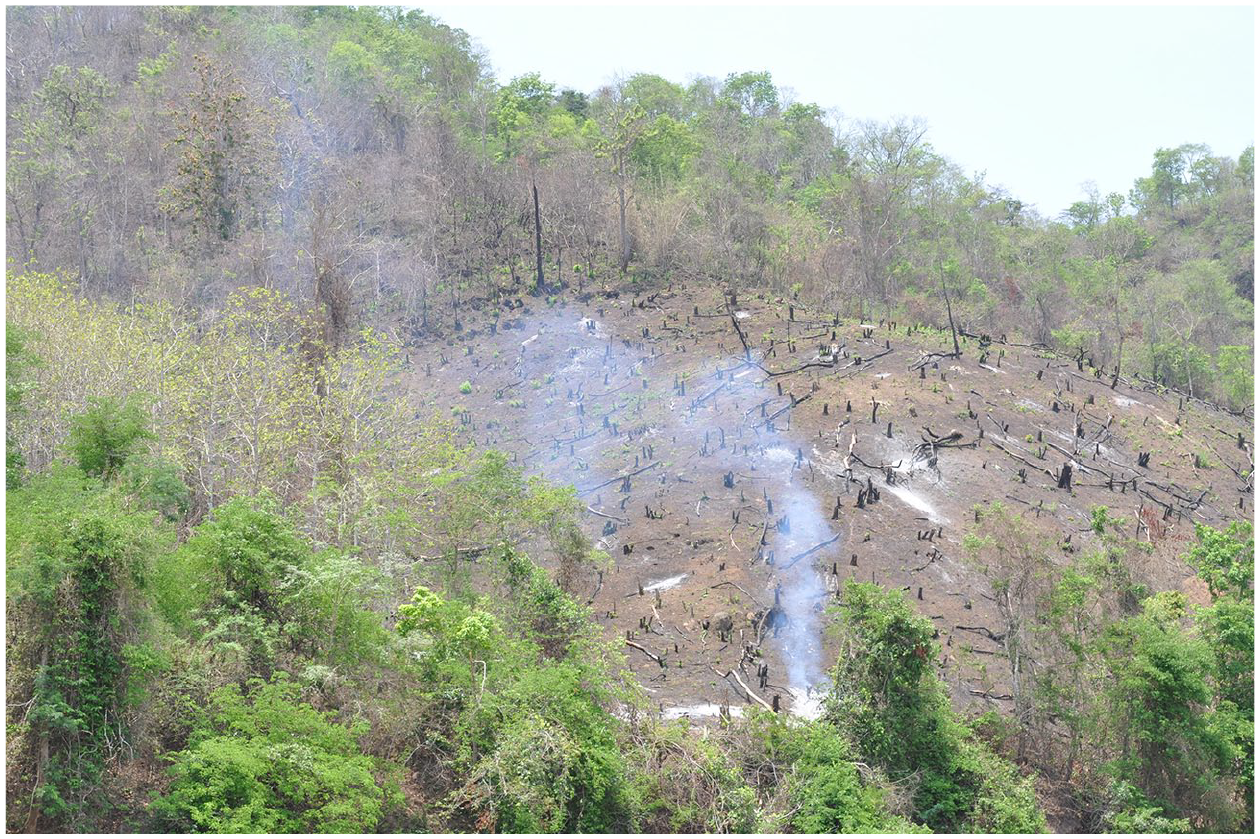
Swidden agriculture in Laos, April 2014, photograph by shankar.s, licensed under CC BY 2.0.
Pengengewiran organizing helps challenge ideas in MOS and beyond that a relational ethics of ever closer attentiveness to non-humans is sufficient for a more liveable, equitable and hospitable planet (Beacham, 2018; Ergene & Calás, 2023; Muñoz & Branzei, 2021). Such practices instead suggest the value of purposefully detaching from some non-humans. And importantly, pengengewiran organizing also brings to light wider forms of socio-political organizing that can facilitate such beneficial exclusions.
The challenge is that traditional swidden systems tend to degrade along with their soils (and nearby atmospheres) in the context of higher population densities, agricultural development, market opportunities and non-communal land ownership. These factors lead to shortened or abandoned fallowing and the cultivation of ecological damaging cash crops and an exploitative ethics (Coomes et al., 2017; Cotta, 2017; Neyre-Cabatac et al., 2012). Overcoming such degradations demands forms of organizing that can secure and expand Indigenous land rights, such as policing the exclusion of farmers and loggers from forests. However, as the land rights of Indigenous peoples have been persistently marginalized, such efforts often themselves require other forms of support such as training in land rights law, help cultivating shared social identities, and guidance on community decision-making (Goldman, Davis, & Little, 2016). This wider organizing can, in turn, support the lengthening of fallowing cycles and aid the recovery of ecosystems (Sze, Carrasco, Childs, & Edwards, 2022). In other words, what modulates the ethical possibilities of Indigenous swidden farming, and other ethical processes of excluding non-humans, are certain processes of organizing. All of this affirms the potential of MOS to inform and advance any more-than-relational ethics towards non-humans. To explain this potential further I turn to my next example, concerning developing proposals to exclude soil entirely from food production.
Soilless food production
In 2022 the British environmental activist George Monbiot suggested that livestock farming on soil should be replaced by precision fermentation in the production of dietary protein to avert the global soil crisis and cheaply feed a growing global population (Monbiot, 2023). Monbiot (2023) also recognized the dangers of these technologies being ‘captured by capitalist corporations’ (p. 209) and the need for open-source technologies and local control. Despite this, Monbiot was criticized by both green capitalists (Sustainable Food Trust, 2022) and socialists (Squire, 2022) for succumbing to a techno utopianism that would do little to feed the world’s poor. Inspired by this debate, in what follows I draw on existing research on soilless food production to present two opposing scenarios for excluding soil from food production. My purpose here is to explain how MOS researchers can contribute to what could become one of the most pressing socio-ecological debates around the exclusion of non-humans.
The first scenario serves here to reflect the concerns of Monbiot’s detractors. In this imagined future, urban hydroponics warehouses, like the existing 32,000 m2 Bustanica farm next to Dubai International Airport, proliferate globally. Soilless food production has become increasingly profitable within cities as surrounding soils are degraded by intensive capitalist agriculture (Szekeley & Jijakli, 2022). Within hydroponic warehouses air-conditioned ‘vertical farms’ are arrayed into racks containing relatively high-value crops, such as lettuces or strawberries, tended to by patented artificial intelligence (AI) controlled robotic systems and overseen by relatively well-paid engineers. Beneath their solar cell covered roofs AI systems ensure that nutrient levels, water, light, humidity and temperature remain optimal. When ready each tray of produce is packed by lower-paid labourers for regular deliveries by electric vans to stock nearby high-end restaurants promising their customers locally fresh, sustainably sourced, premium produce. As venture capitalists and large agribusinesses extract profits by artificially simulating soil nutrient cycles, the local topsoil that had nurtured cereals, vegetables and livestock, has been exhausted and these foods are now imported at ever higher costs as soils degrade further elsewhere. For much of the world’s population, social inequalities and planetary ecological collapse seem entrenched, while for an increasingly ‘soilless elite’ detachment from non-human soil organization inspires dreams of extra-planetary escape.
The second scenario resembles a world closer to that imagined by Monbiot (2023). Here farmers across some of the poorest regions of the world, including Sub-Saharan Africa, who are already familiar with small-scale hydroponic systems (Gumisiriza, Patrick, Nalunga, & Mbega, 2023), are provided with small grants and expertise by the UN Food and Agricultural Organization to install precision fermentation systems in small outbuildings. Systems are powered by community-scale solar cells that use electrolysis to produce hydrogen from local water that is then combined with carbon dioxide and nitrogen from the air to feed Xanthobacter soil bacteria in a tank that generates protein (Monbiot, 2023). The patent-free technology within these systems was designed to support space exploration in the 1960s but now provides a steady source of income and food. Consequently, the land area used for livestock rearing and growing livestock feed decreases significantly. Across SubSaharan Africa, soils that were once nearly exhausted are regenerating as new pioneer species, such as wild lettuce, grow. Active and passive rewilding projects, including the re-introduction of the northern white rhino to expanding grasslands, can expand, and UN ecological planetary crises’ worst case scenarios seem increasingly improbable.
These two scenarios both speak to ethical arguments to detach non-human soil organizing from human agricultural organizing, but they clearly differ in their ethical, political and ecological outcomes. This is not because of the technologies involved per se but rather the forms of organizing. In the first scenario, restrictive intellectual property and high financial barriers of entry for larger-scale complex proprietary systems translate soilless food into an exclusive product that furthers socio-ecological degradation and violence. In the second, patent free and relatively inexpensive, smaller-scale organizational-technological systems produce soilless food that is widely available, allowing soils now vacated by human agricultural activity to regenerate. Both scenarios highlight how organizational forms and processes are vital matters of concern in understanding how a more-than-relational ethics might proceed to support researchers, policymakers, farmers and citizens in working towards a prosperous, equitable and hospitable planet. Unfortunately, such organizational matters remain largely overlooked within the rather technological utopian (and determinist) orientation of much soilless food production research (Gumisiriza et al., 2023; Monbiot, 2023; Szekeley & Jijakli, 2022). The important point here is that thinking organizing with a more-than-relational ethics demands research not just into organizational theories, forms and processes that can attend to, entangle with and be transformed by non-humans (Beacham, 2018; Ergene & Calás, 2023; Muñoz & Branzei, 2021) but also those that can further certain desired human/non-human exclusions (e.g. soils vacated of human activity) while negating other exclusions (e.g. luxury soilless food). By way of conclusion, I explore further how this more-than-relational ethics has profound implications for MOS theories and methodologies related to the relationship between human and non-human organizing.
Contributions and Future Research
It seems obvious that averting anthropogenic planetary ecological collapse merely demands greater human–nature connectedness. This assumption is what I have sought to problematize. For environmentally minded practitioners my argument for a more-than-relational ethics contributes by offering lessons from examples such as Indigenous farming and community-level soilless food production to inspire and encourage greater reflexivity around when and how to profoundly detach from non-humans. This approach also constitutes a significant contribution to literatures on sustainability and environmental ethics across multiple scholarly communities, including MOS, where a relational ethics of care and attention towards non-humans dominates. Thinking non-humans with a more-than relational ethics indicates the need for a profoundly different strand of research on non-human organizing. Table 1 below explains possible ethical approaches to non-humans along with their potential and challenges:
Comparison of ethical approaches to non-human organizing.
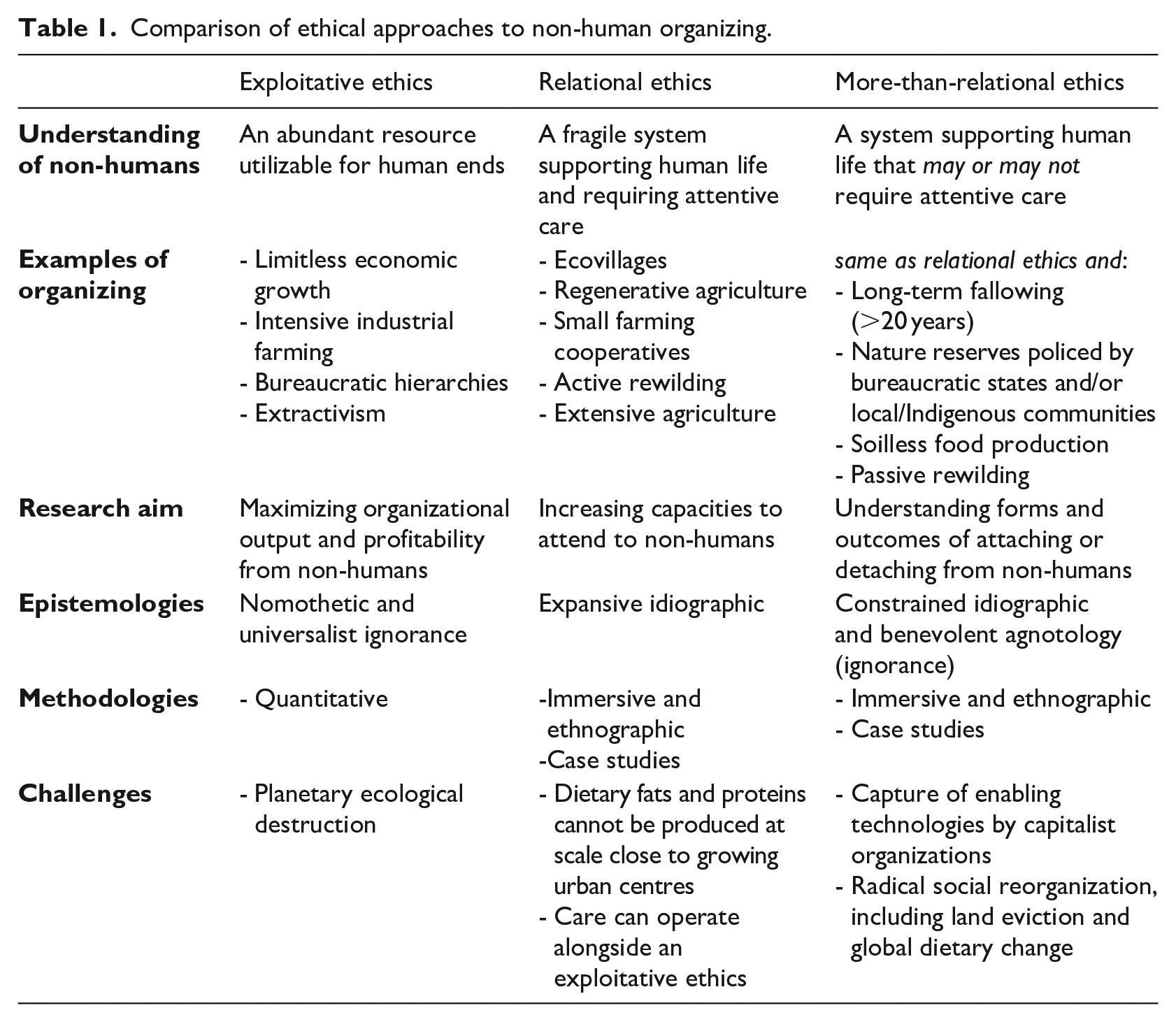
Exploitative approaches encourage nomothetic and universalist epistemologies that marginalize Indigenous and local knowledges of non-humans to maximize the extraction of profit and output from non-humans. Exponents of relational approaches instead adopt more expansive idiographic epistemologies and methodologies (e.g. ethnographies) to attend to variegated practices of non-human organizing and evaluate their potential to transform human organizing (e.g. Beacham, 2018; Bell & Vachhani, 2020). More-than-relational approaches draw on similar kinds of idiographic epistemologies and methodologies, but these are put to work differently to also explore how to live apart from some non-humans for extended, even indefinite, periods by better attuning to their radical alterity to suspend human ideas of relating (Giraud, 2019; Tironi, 2020).
More-than-relational approaches extend relational approaches towards non-humans that have occasionally questioned what actors are to be included or excluded within human efforts at relational attentiveness (Labatut et al., 2016). In these relational approaches the customary basis for excluding non-humans relates to those deemed harmful to humans, such as ‘pollutants’ or ‘pests’ (Ergene & Calas, 2023, Ginn, 2014; Sage et al., 2016). More-than-relational approaches differ by also highlighting the moral basis to exclude seemingly valuable non-humans, such as fertile soils, from human organizing. Nevertheless, as proposals for soilless food production indicate, separating non-human and human organizing is not innately beneficial. Rather, such exclusions also demand knowledge of the specific organizational forms and processes through which exclusions are executed to ensure that their benefits can support broad collectives of humans and non-humans. This is why MOS scholars can contribute significantly to developing a more-than-relational ethics.
This more-than-relational ethics contributes further to MOS by questioning the breadth of expansive and transformative epistemologies and methodologies which it is often said the field should adopt in the shadow of impending planetary ecological collapse. Of course, notions that progress is best achieved by increasing knowledge about new phenomena are long-standing in Western academia – traceable at least as far back as Socratic philosophies that morally value the pursuit of wisdom and knowledge. For their part, MOS researchers have long been invited to ‘Think with AND’ whereby ‘Concepts are never fixed, stable and safeguarded from changes, but are always in a state of becoming’ (Styhre, 2002, p. 469). It is this sort of expansive logic that underpins why Muñoz and Branzei (2021) suggest ‘human–nature interfaces prepare us to tackle the grand challenges of our times’ (p. 508) and Ergene and Calás (2023) call for concepts of sustainability ‘that are in constant flux and transformation’ (p. 23). Epistemologically, approaching non-human organizing with a more-than-relational ethics involves thinking with people like the Erumanen to acknowledge it can sometimes be preferable to detach from some non-humans, for several years, even decades, and never come to know certain others. All of this may seem a radical step – a kind of ‘anti-organization studies’ – but it is a vital one. It is not enough to de-centre exceptionalist ideas of human mastery over non-humans (Egri, 1997; Labatut et al., 2016) and develop expansive epistemologies of attentive care (Ergene & Calás, 2023; Muñoz & Branzei, 2021). We must also help curtail the destructive assault on non-humans that all human knowledge, all human organizing, renders possible.
Footnotes
Acknowledgements
I am very grateful for the support of the editor-in-chief Paolo Quattrone and the three anonymous reviewers in guiding the development of this essay.
Funding
The author received no financial support for the research, authorship, and/or publication of this article.
