




Abstract
Since production and consumption are co-dependent parts of the same system, businesses often need to complement their production-side sustainability initiatives with accompanying measures aimed at promoting sustainable consumption. As a potential, low-cost measure of steering consumer choice we studied the activation of injunctive social norms by conducting a field experiment (N = 1,289) in 19 workplace restaurants. The aim was to investigate whether the presence and absence of two injunctive norm messages relating to Baltic Sea protection and local food predicted the choice of a novel sustainable dish, roach fish patties. Results of nested analysis of variance and qualitative comparative analysis suggest that while injunctive norm activation was an ineffective measure to steer consumer choice in the overall population, it may have had an impact on smaller subgroups based on sociodemographic characteristics and previous consumption patterns. Furthermore, there was indication of a mutually reinforcing interaction effect when the two injunctive norms were activated in combination.
Keywords
Introduction
Sustainable production and consumption constitute an important objective, and also count as one of the UN Sustainable Development Goals adopted in 2015. However, as the actions of organizations and consumers are intertwined in systems of production and consumption, changes towards sustainability in those systems are co-dependent (McMeekin & Southerton, 2012). This means that business firms and consumers ought to move towards greater sustainability in tandem.
A pertinent example can be found in the domain of food. Food is among the most significant fields of human activity in terms of sustainability and increasingly recognized as such. It has been estimated that food causes 20% to 30% of environmental total impacts (Tukker & Jansen, 2006), and in the “World Scientists’ Warning to Humanity: A Second Notice” (Ripple et al., 2017), published in December 2017 and signed by more than 15,000 scientists, 2 out of 13 proposed steps towards sustainability transitions were directly related to food (food waste and dietary shifts) as well as many others indirectly. Sustainability transformations are therefore called for in the food system. What the organizations that are part of the food system do is of course central to those transformations but, crucially, the organizations can only do so much without the participation of consumers. Imagine, for example, a restaurant wishing to improve the sustainability of its offering by replacing less sustainable menu items with more sustainable ones: for such a measure to succeed, it is important that also the customers be on board with this change. Otherwise the customers may refuse to choose the sustainable foods, or switch to frequenting other restaurants, and the sustainability benefits of the measure will not be realized. Therefore, the mere introduction of sustainable dishes onto the menu may need to be accompanied by some additional measures by the restaurant in order to increase the acceptance and the uptake of those dishes by the customers. In general terms, an organization wishing to improve its sustainability performance also needs to address, and potentially shape, the sustainability of the choices made by its customers.
One important but sometimes overlooked consideration in this regard are social norms and how they influence consumer choice. Social norms have the potential to significantly shape human behaviour (e.g., Cialdini, Kallgren, & Reno, 1991), and there may thus be untapped potential for organizations to take advantage of social norms in their efforts to steer consumer choice. In particular, relevant norms can be made more salient by activating them with situational cues such as messages (e.g., Mollen, Rimal, Ruiter, & Kok, 2013; Thomas et al., 2017), and this could be a low-cost measure for organizations to influence consumer behaviour.
Indeed, there are non-sustainability-related examples where activating social norms has influenced food choices (i.e., promoting healthier eating habits, e.g., Stok, de Ridder, de Vet, & de Wit, 2014; Thomas et al., 2017) as well as examples where it has influenced sustainable consumer behaviour outside the context of food (e.g., reusing hotel towels, Schultz, Khazian, & Zaleski, 2008; Goldstein, Cialdini, & Griskevicius, 2008; curbside recycling, Schultz, 1999). Yet it is not evident how these findings would apply to sustainable food choices. First, the social norm is different from previous food choice studies: The norm does not relate to eating healthily where the consequences center on the individual, but to eating sustainably where the consequences center on society. McDonald, Fielding, and Louis (2014, p. 157, referring also to Göckeritz et al., 2010) argue that “the effects of norms may be unique in domains such as environmental behavior, in which the personal and collective interest may be at odds.” Second, also the choice situation may be more challenging for norms than that in previous sustainability studies since food choices are strongly characterized by being multimotive and habitual, and social norms therefore have to overcome many hurdles to have an impact on behaviour. For these reasons, the impact of social norms should be explored directly in the context of interest. Considering the significance of sustainable food choices for achieving sustainability, it is important to study this question, and extending previous findings to this context is already an important contribution. Although there is research about food and sustainability that does mention social influences (e.g., Klöckner, 2017; Richter, Thøgersen, & Klöckner, 2017; Wenzig & Gruchmann, 2018), to our knowledge there are no studies that specifically focus on how the sustainability of food choices could be affected by activating injunctive social norms.
Moreover, food is tied to sustainability in multiple simultaneous ways and is an exceptionally rich topic in this regard. Therefore, multiple sustainability-related norms may arise in any particular situation. This opens up an unexamined area: how do these multiple norms operate in conjunction? In sum, then, by studying social norms in the context of sustainable food choice our paper is able to examine how their impact plays out in this new, centrally important context, as well as to shed light on a new theoretical question about multiple norms.
In this study, we carry out a field experiment to examine the impact of activating injunctive social norms on sustainable food choices in real-life conditions. Injunctive norms refer to what is considered appropriate behaviour (e.g., “People should eat more vegetarian food”) as opposed to descriptive norms (e.g., “Most people in this restaurant choose a vegetarian dish”), which refer to how people actually behave (e.g., Cialdini et al., 1991). Our research question is: How do different sustainability-related injunctive norms affect food choice when they are activated individually and in combination? Field experiments can help establish causal relationships (Chatterji, Findley, Jensen, Meier, & Nielson, 2016), and there have recently been calls to extend this form of inquiry to management research as well, especially with regard to sustainability research (Crane, Henriques, Husted, & Matten, 2017; Zollo, Cennamo, & Neumann, 2013) and including to test the effectiveness of strategies to encourage sustainable behaviour (Delmas & Aragon-Correa, 2016). Through this study we aim to shed light on the potential of social norms activation as a tool for organizations to accompany and support their own sustainability initiatives by encouraging sustainable consumer behaviour.
Theory and Hypotheses
It is well established that social norms influence behaviour (Cialdini & Goldstein, 2004). Indeed, several theories that attempt to explain and predict sustainability-related behaviour also incorporate social norms among their elements more or less directly. We base our study on the focus theory of normative conduct (Cialdini et al., 1991; Cialdini, Reno, & Kallgren, 1990) and the model of social norm activation (Bicchieri, 2006) which together directly address the role of activated social norms in sustainable consumer behaviour. Figure 1 summarizes our theoretical framework where injunctive social norms, once activated, influence behaviour in a choice situation. We discuss the elements of the framework in more detail in the following sections.
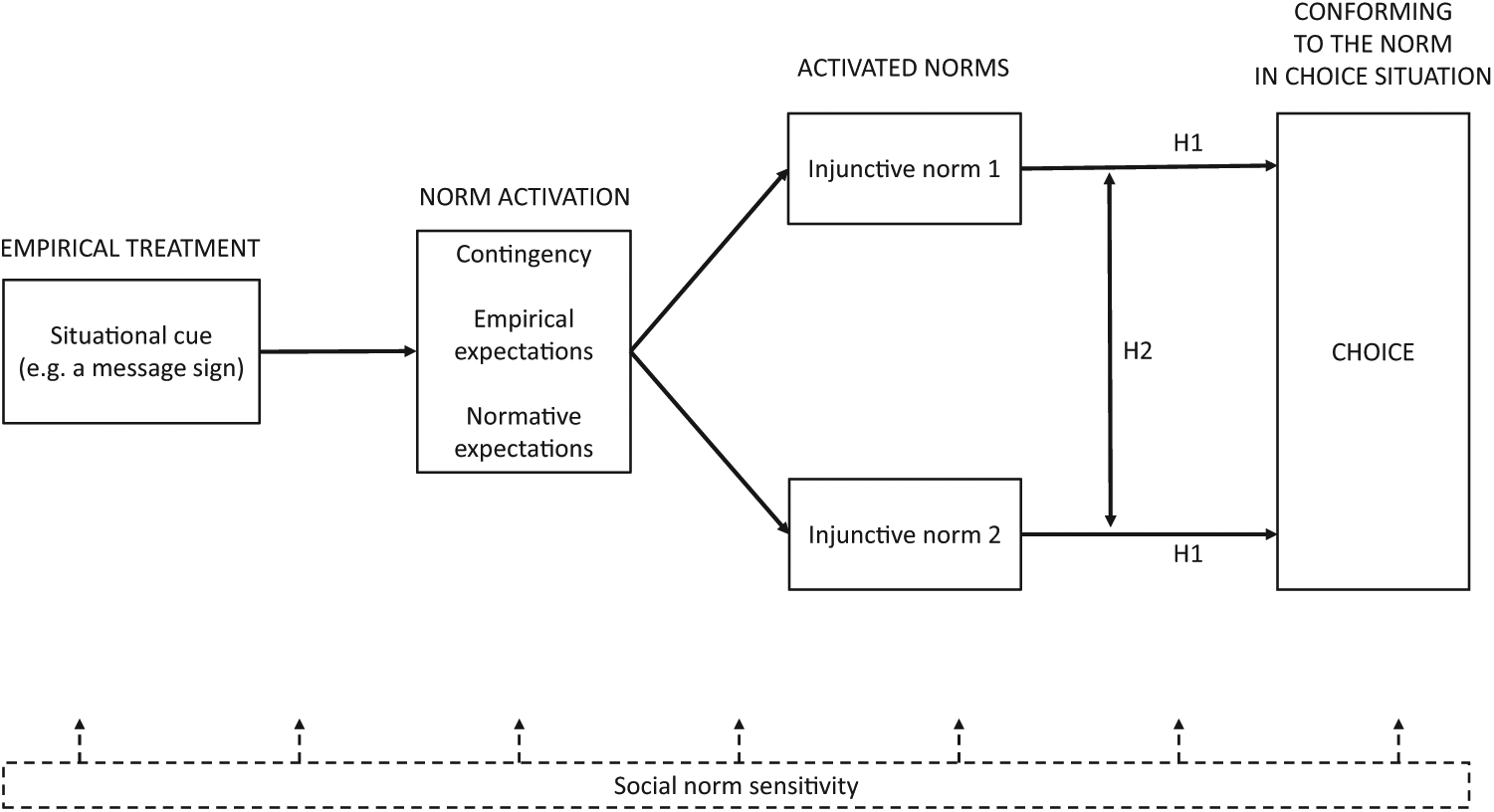
Theoretical framework combining the focus theory of normative conduct (Cialdini, Kallgren, & Reno, 1991; Cialdini, Reno, & Kallgren, 1990) with the model of social norm activation (Bicchieri, 2006).
Injunctive Social Norms
The focus theory of normative conduct developed by Cialdini and colleagues (1990; 1991) recognizes that individuals are surrounded by different norms; those norms that the individuals focus on guide their behaviour. The theory divides social norms in two categories, descriptive and injunctive (Cialdini et al., 1990), indicating that they transfer different kinds of information about behaviour and connect to different kinds of goals. Descriptive norms refer to how other people commonly behave, and they are associated with intrapersonal goals like making accurate decisions (Jacobson, Mortensen, & Cialdini, 2011). By contrast, injunctive norms—our focus in this article—state how people should behave (Cialdini et al., 1990). They focus on interpersonal aspects such as the goal of social approval, and behaving against the injunctive norm is perceived to cause discomfort and social punishment (Cialdini & Trost, 1998).
There are some notions about what influences the effectiveness of injunctive norms. As their effectiveness is based on serving an individual’s need to belong to a group and to be socially approved (Cialdini & Trost, 1998), the impact of injunctive norms is also influenced by how relevant the group is perceived to be (Masson & Fritsche, 2014). The more a person feels connected to the group, the more likely he or she conforms to its norms (e.g., Rimal & Real, 2003). However, identification with a group is not always obvious. For example, in a study by Goldstein et al. (2008), participants identified with the past guests of their current hotel room. Moreover, injunctive norms have been found to be effective when preventing undesired and non-sustainable behaviour, for example, in reducing littering (Reno, Cialdini, & Kallgren, 1993), the theft of petrified wood from a nature reserve (Cialdini et al., 2006), and plastic bag uptake (de Groot, Abrahamse, & Jones, 2013). In promoting certain proenvironmental behaviours such as energy conserving (e.g., Schultz, Nolan, Cialdini, Goldstein, & Griskevicius, 2007) they have been most effective when used in combination with and aligned with descriptive norms; that is, when there is information that a normative reference group in a similar situation conforms to the norm (e.g., Lapinski & Rimal, 2005). Finally, injunctive norms are robustly more effective across contexts than descriptive norms and also have an impact on long-term behaviour, since they capture what is approved or disapproved within a culture in general rather than in particular situations (Reno et al.,1993).
Norm Activation
As advanced by the focus theory of normative conduct, in order to be followed and to have an impact, norms need to be made salient through norm activation (Cialdini et al., 1990; 1991). For a norm to be activated means that “the subjects involved recognize that the norm applies” (Bicchieri, 2006, p. 59) or that the norms are “made salient or otherwise focused on” (Cialdini et al., 1990, p. 1015). According to the model of social norm activation (Bicchieri, 2006), norm activation requires three conditions: the belief that a norm exists and applies to the current situation (contingency condition), the belief that a sufficiently large subset of people conforms to the norm in similar situations (empirical expectations condition), and the belief that a sufficiently large subset of people expects conformance to the norm in similar situations (normative expectations condition) (Blay, Gooden, Mellon, & Stevens, 2018, p. 195).
Note that recognizing a norm or following it are not necessarily deliberate or even conscious processes (Bicchieri, 2006; Blay et al., 2018).
Manipulating situational cues may be used to activate a social norm. Consistent with the conditions for norm activation, above, such cues may make the norm more salient for the situation, increase beliefs that other people conform to the norm, and/or increase beliefs that other people expect conformance to the norm (Blay et al., 2018). Situational cues can take the form of written or pictured messages such as posters (e.g., Mollen et al., 2013; Nolan et al., 2008; Schultz, 1999; Stöckli, Stämpfli, Messner, & Brunner, 2016), other people’s behaviour (for a review see e.g., Cruwys, Bevelander, & Hermans, 2015), or environmental cues such as empty chocolate wrappers (Prinsen, de Ridder, & de Vet, 2013) or swept or unswept litter on the floor (Cialdini et al., 1991).
Based on the above, we posit our first hypothesis as:
Figure 1 contains one more element that we have not yet discussed, namely, social norm sensitivity. The norm activation model recognizes the possibility that individuals hold different degrees of sensitivity to social norms (Bicchieri, 2006; Blay et al., 2018). This means that individuals may differ in how they interpret situational cues as well as in how strongly they prefer to conform to norms. We come back to this point later in the article when we turn to examining individual-level influences on the impact of social norm activation.
Multiple Injunctive Norms
Sustainability is an immensely multidimensional topic. As it is an ambiguous concept with various ecological, social, and economic aspects, a number of different underlying sustainability issues may relate to a particular behaviour. This may be especially pronounced in the case of sustainable food behaviour where, for example, the meat-eating choices of a consumer may at the same time relate to land use, biodiversity, animal welfare, climate change, antibiotic resistance, and human health.
The fact that multiple sustainability issues may be intertwined gives raise to the question of how the activation of multiple injunctive norms affects behaviour as opposed to the activation of individual norms. In the complex context of sustainable food choices this is an essential question since it is likely that more than one sustainability issue is at stake at any time. Organizations that attempt to steer consumer choices towards sustainability would benefit from an improved understanding of what the activation of multiple norms would mean for those attempts. Indeed, there have already been calls to study the case of multiple injunctive norms (McDonald et al., 2014).
However, to our knowledge and supported by reviews by Farrow, Grolleau, and Ibanez (2017) and Robinson (2015), the question of the simultaneous activation of multiple injunctive norms within one in-group has not been researched before. What has been examined is the joint activation of injunctive and descriptive norms (e.g., Smith & Louis, 2008) which, as mentioned, has proven to be effective in pro-environmental promotion. What has also been examined is the simultaneous presence of multiple in-groups in which individuals belong, and congruence and conflicts between their descriptive norms (e.g., McDonald et al., 2014; McDonald, Fielding, & Louis, 2013). According to Smyth, Chandra, and Mavor (2018), concordant norms from multiple in-groups amplify the effect on behaviour. Conflicting norms from multiple in-groups may either motivate or demotivate pro-environmental behaviour intentions depending on group members’ attitudes (McDonald et al., 2013; 2014).
Generally speaking, the joint impact of two factors can occur with or without causal interaction. If there is no interaction between the factors their joint impact is additive, that is, the net of the individual impacts. If, on the other hand, there is interaction between the factors, this means that the impact of one factor depends on the presence of the other (Ahlbom & Alfredsson, 2005). Such interaction can be synergistic, or mutually reinforcing, where the joint impact is higher than the individual impacts combined. Another possibility is that the joint impact is mutually weakening (less than the sum of the individual impacts of the factors) and the total impact does not increase in proportion after the introduction of the first factor. In the context of the activation of multiple injunctive norms it becomes interesting to examine whether their impact is additive or whether there is some kind of causal interaction.
Building on the complexity evident in previous research on related topics described above, we hypothesize that the joint impact of the activation of multiple injunctive norms is not simply additive but rather of the interactive kind. Furthermore, we expect that the norms are mutually reinforcing and their simultaneous activation serves to increase their impact in a disproportionately large manner. Therefore, we put forward the following hypothesis:
Next, we turn to describing the field study that we designed to test our hypotheses in the context of sustainable food choice.
Data and Method
Experimental Design
To test the impact of injunctive norm activation on food choice we designed a field experiment that was implemented in 19 workplace restaurants in Helsinki, Finland. The features of the design were such that an ethical pre-review was not required for this study, as specified by the Finnish Advisory Board on Research Integrity. The target of the experiment was food choice around a newly launched sustainable dish, roach fish patties. In fact, the introduction of roach fish patties to these lunch restaurants for a test period was an intervention in itself, and our field experiment was built on top of this intervention. This novel dish was developed and launched in a project of John Nurminen Foundation (a nongovernmental organization active in the protection of the Baltic Sea) in cooperation with Palmia, the catering firm owned by the city of Helsinki. Both John Nurminen Foundation and Palmia collaborated with us in this field experiment. Their roach fish patties project had two objectives (1) to promote the well-being of the Baltic Sea, which suffers from severe eutrophication, by removing excess nutrients from the marine ecosystem through the targeted fishing of roach (Rutilus rutilus) and (2) to increase the supply of ethical local food and the utilization of roach fish for human consumption (John Nurminen Foundation, 2016). Consistent with the two objectives of the project, the roach fish patties incorporate the two sustainability elements of environmental friendliness and localness. 1
The experiments were conducted during lunchtime in the 19 workplace restaurants 2 run by Palmia and serving the novel dish, on the first day that it was being served. The typical daily lunch customer numbers of these restaurants range between about 50 and 800 per restaurant and together the restaurants serve about 5,000 lunches daily. The restaurants served the option of a fixed-price buffet with two main courses (on the experiment day: roach fish patties and lasagne) as well as salads, bread, drinks, and desserts. In these restaurants, customers serve themselves from a buffet before being seated at a table.
Our experiment followed a 2 × 2 between-subjects factorial design. We divided our subjects into different groups and manipulated two separate injunctive social norm activations (Baltic Sea protection and local food), each of which had two levels, injunctive social norm activation message absent versus message present. Accordingly, the 19 restaurants were randomly assigned to three treatment groups and a control group. We used stratified randomization based on size so as to obtain four groups of roughly equal size in terms of lunch clients.
The control group will be from now on referred to as Group A. The three treatment groups were each presented with a different norm-activating message promoting Baltic Sea protection (Group B), local food (Group C), and a combination of these two (Group D). The message signs (size A5) were printed on yellow paper to increase visibility. The control group was also presented with a similar yellow sign that, however, contained no norm-activating message.
The norm-activating messages (depicted in Figure 2 in their original Finnish language) were accompanied by a fish symbol and phrased as follows:
Control Group A: “Roach fish patties”
Treatment Group B: “Roach fish patties—A choice in favour of the Baltic Sea. By eating roach fish patties we reduce together the eutrophication of the Baltic Sea” 3
Treatment Group C: “Roach fish patties—A choice in favour of local food. By eating roach fish patties we support together the use of an under-utilizeded raw material as local food”
Treatment Group D: “Roach fish patties—A choice in favour of the Baltic Sea and local food. By eating roach fish patties we reduce together the eutrophication of the Baltic Sea and at the same time we support together the use of an under-utilized raw material as local food”
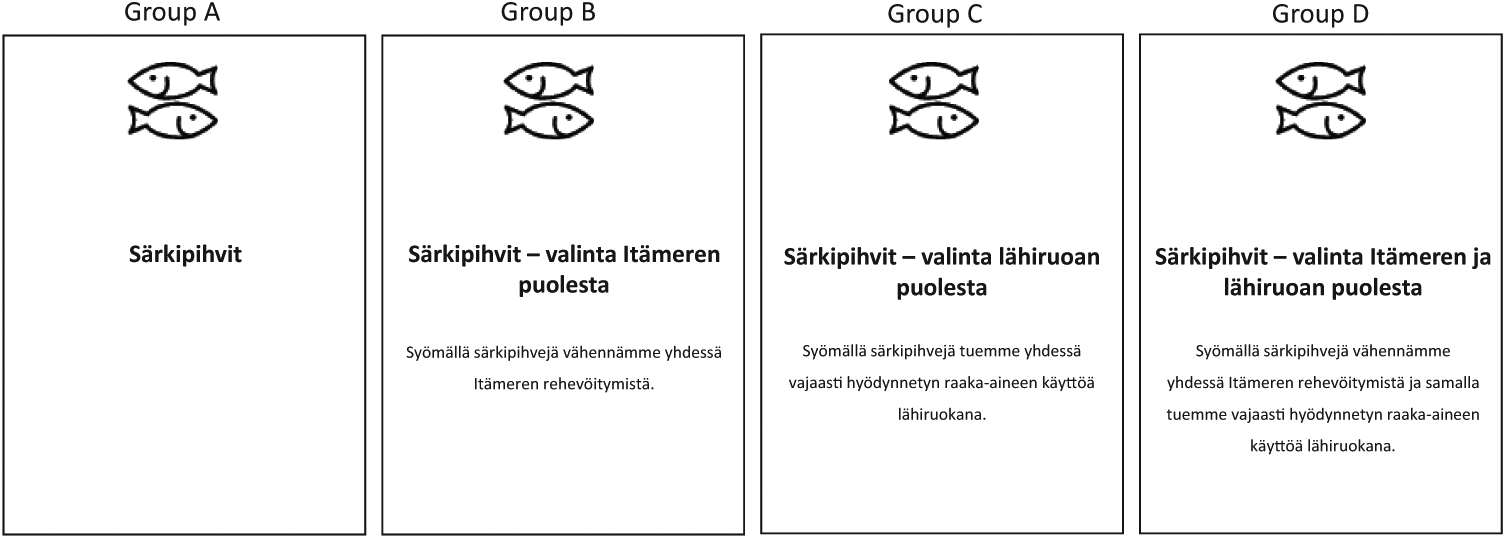
The norm-activating message signs.
Using “we” and “together” in the message we aimed to engage the interpersonal aspect, which should increase receptivity to injunctive norm activation (Jacobson et al., 2011; White & Simpson, 2013). Although there is evidence (e.g., Mollen, Holland, Ruiter, Rimal, & Kok, 2021) that negatively framed injunctive norms (“people should not behave in this unsustainable way”) are more effective than positively framed ones (“people should behave in this sustainable way”), we used positive framing since we could not claim the lasagne served by the restaurants to be unsustainable. As this was the first time when the dish was being served, we were not able to form a factual descriptive norm about consumers’ behaviour to accompany the injunctive norm message.
There are several strengths with this research design. Ours is a field experiment and not a laboratory experiment, which improves external validity (Harrison & List, 2004). Moreover, field experiments about food choice are often carried out in student cafeterias (e.g., Bucher et al., 2016; Wilson, Buckley, Buckley, & Bogomolova, 2016); thanks to our collaboration with Palmia, which runs a large number of workplace restaurants we are able to broaden the view to cover also other populations. Since in our design food choice occurs within a fixed-price buffet we are able to circumvent the question of price, which is usually a strong determinant of food choice (e.g., Januszewska, Pieniak, & Verbeke, 2011; Steptoe, Pollard, & Wardle, 1995). Finally, since our experiment takes place on the first day of serving the novel dish, we can avoid the question of taste (in the form of past experiences), which also tends to dominate findings about food choice (Steptoe et al., 1995).
However, our research design also introduces some complications to the statistical analyses. One challenge is the potential presence of unbalanced data since the response rate may differ between restaurants and since different numbers of people may actually notice and read the norm-activating messages. A second challenge is that ours is a cluster randomized design. This means that randomization takes place at the restaurant level, while the behaviour of interest occurs at the individual level. Cluster randomized designs are the desirable option in circumstances such as ours where the intervention cannot be administered to only some of the individuals within a group, but they create a potential source of intraclass correlation and lead to a multilevel structure in the data (e.g., Murray, Varnell, & Blitstein, 2004). In our methods section, we discuss how we have taken these design features into account in the analyses.
Experiment Day and Data Collection
The experiment was carried out on Tuesday, September 20, 2016. The appropriate norm-activating message (according to the group to which the restaurant was randomly assigned) was placed in a message holder and posted next to the roach fish patties before the restaurant opened for lunch. As the position and reachability of different food items may affect food choice (Rozin et al., 2011), the restaurants were all instructed to place roach fish patties similarly (as the first dish of the lunch buffet). The data were gathered with questionnaires that were placed on the tables together with pencils before the customers arrived. The restaurant staff were instructed to take care, with as little interference as possible, that enough questionnaires and pencils were available throughout the time that lunch was being served. The participants returned the filled questionnaires when returning their dishes. Book prizes and a set of five lunch vouchers were drawn among the participants who gave their contact information. The contact information was collected separately in order not to affect the anonymity of the responses.
We visited each restaurant before the experiment day, when we observed the restaurant layout and handed out the materials and instructions to the personnel, as well as after the experiment day, when we collected the completed surveys and had a short debriefing discussion with the personnel. In addition, on the experiment day itself, we visited at least one restaurant from each group to observe compliance with the experimental design. In the restaurants that we visited on the experiment day, compliance with the instructions was very good. Based on our debriefing discussions, compliance with the instructions was good also in those restaurants that we did not observe ourselves.
Our dependent variable to measure food choice behaviour was “Roach fish patties were my primary choice today,” measured on a 5-point Likert scale ranging from 1 = strongly disagree to 5 = strongly agree. We settled on this formulation since the customers who had purchased the lunch buffet were free to take any combination of roach fish patties, lasagne, and the other food items. This formulation best captures the choices made by the respondents within the context of this buffet. We also included the statements “If fish dish is served at a lunch restaurant, I usually choose it” and “I like to taste new dishes.” In addition, to measure perceptions of two injunctive norms we put forward the statements “The general opinion is that people should eat more environmentally friendly” and “The general opinion is that people should favour local food more.” Agreement with all these statements was measured on the same 5-point Likert scale as our dependent variable. The sociodemographic characteristics of the respondents, namely, age, gender, and educational level were also collected, together with certain filtering questions.
Analysis Methods
The choice of statistical methods is complicated by our design (cluster randomized, 2 × 2 factorial, between-subjects experiment) as well as the nature of our data (non-normal, unbalanced Likert data). While no method can simultaneously address all these features in an ideal manner, the most important consideration for us is the cluster randomized design. Ignoring this design and treating all data as one large group of observations would ignore intra-restaurant correlation and result in false positives (Picquelle & Mier, 2011). To take into account the hierarchical data structure where restaurants are nested within control/treatment groups we used a nested analysis of variance (ANOVA) model, also known as a hierarchical ANOVA. It is an analysis method where subordinate classification is nested within the higher (main) classification (Sokal & Rohlf, 1981, p. 273). SPSS Statistics Version 24 (IBM) was our principal tool for statistical analyses, but as it cannot handle a hierarchical ANOVA, this particular two-level ANOVA test was performed using a spreadsheet-based instrument developed and provided by McDonald (2014) for this very purpose. With a nested ANOVA we can examine whether the treatment has a significant impact on food choices, and if so, what share of the variation in the food choices can be attributed to the treatment. To obtain more accurate p values for unbalanced data we used the Satterthwaite approximation (McDonald, 2014, p. 170).
There is some long-standing debate around the question whether ANOVA can be used for non-normal Likert data such as ours. For example, Norman (2010) argues in his widely cited article that although it is strictly speaking true that ANOVA requires interval-scale data and normally distributed residuals, arguments against using ANOVA fail to account for the robustness of parametric tests. According to Norman (2010), using ANOVA with Likert data and without satisfying the normality assumption is perfectly appropriate in practice as the results will be nearly correct. Since there is no non-parametric counterpart to a nested ANOVA, and bearing in mind these arguments, we chose to use this method. Note also that we expressly presented the Likert items in the questionnaire with visible numbers in the response options to indicate the equidistance between these options for the respondents and thus to emphasize an interval-type interpretation of the underlying variable.
We also performed additional tests to examine the impacts of the treatment within each restaurant. Since for this purpose a non-parametric test was available (Mann–Whitney U test), we used that test to be conservative.
We ran two sets of analyses. First, we conducted “intention-to-treat” analyses with full samples. Second, we ran “as-treated” analyses with those respondents who had seen the message signs (and, in some analyses, who were able recall the messages correctly). The difference between these two is that whereas intention-to-treat analyses capture the effect of undertaking a policy (the catering firm putting up injunctive norm message signs about roach fish patties), as-treated analyses measure the impacts of a treatment, for those who actually did receive it. To be able to classify respondents for the purposes of the as-treated analyses, the questionnaire contained an item asking whether the respondent had seen the message sign and another asking the respondent to recite the key points in the message. Based on a predetermined assessment matrix the authors independently evaluated the written responses (N = 563) to assess whether those responses were “correct.” Initial inter-rater agreement was extremely high (99.8%) as the assessments deviated only with regard to one response. The classification of this remaining response was then agreed-upon jointly.
To complement our analyses with an examination of how the impact of the treatment may differ between subgroups in the population we turned to qualitative comparative analysis (QCA). QCA is a method that examines necessary and sufficient conditions for an outcome based on Boolean logic (Ragin, 1987; Rihoux & Ragin, 2009; Schneider & Wagemann, 2012). It suited our purposes well since here we had a configurational question, and since when our data are split across subgroups the number of observations in each subgroup becomes too small for statistical methods. QCA has certain advantageous features compared with statistical methods: equifinality, asymmetrical causation, and conjunctural causation. These mean, respectively, that QCA can identify multiple pathways to the same outcome, allows for different explanations for the occurrence and non-occurrence of an outcome, and portrays associations with an outcome in terms of “recipes” where conditions are examined not in isolation but in combinations. (Misangyi et al., 2017; Schneider & Wagemann, 2012). An additional advantage in our case is that unbalanced, non-normal data can be used, and Likert scores can be accommodated especially with the fuzzy-set version of QCA (fsQCA) that we use (Emmenegger, Schraff, & Walter, 2014).
Thiem, Baumgartner, and Bol (2016) point out that there are three fundamental differences between regressional analytic methods and configurational comparative methods such as QCA: in QCA, as opposed to regressional methods, the logic of inference is based on Boolean instead of linear algebra, hypotheses are about implication instead of covariation, and causal complexity is about conjunction rather than interaction. For us this means that with QCA we are not retesting our original covariational hypotheses but examining a different, complementary set of questions. Also, since QCA does not rely on covariation, we can ignore the fact that the design was cluster randomized.
Results
In the 19 restaurants, a total of 1,583 customers filled out the questionnaire. Calculated from the number of lunch buffets sold on that day this corresponds to an overall response rate of 36%. Between the 19 restaurants the response rate varied from 14.5% to 63.8%, and between the control and treatment groups from 33.2% to 40.5%. Before running the analyses, we filtered the data to exclude respondents who could not have chosen roach fish patties because of allergies or special diets, those whose food choices were affected by the restaurant running out of a main course, as well as those who had not purchased the fixed-price lunch buffet option. At the end we had 1,289 responses that this study is based on, representing 29.3% of buffet lunch customers.
Descriptive Statistics
The respondents consist of 38.6% of males and 60.2% of females (1.2% missing values). They were aged between 20 and 83 years, the median age being 50 years. To study lunch customers of all ages we did not control whether the respondents were inside or outside working life. The educational level was relatively high compared to the general population, with 68.7% having a bachelor’s degree or higher. The overrepresentation of higher educated people was expected as workplace restaurants tend to be used by highly educated people in the Helsinki area (Roos, Sarlio-Lähteenkorva, & Lallukka, 2004). Our study also exhibits an overrepresentation of women. This may be at least partly explained by the fact that the largest restaurants were located next to office buildings with highly educated female workers. The sociodemographic background of the respondents did not vary between the groups, except that the control group had more females and the age of the respondents was higher than in the other groups.
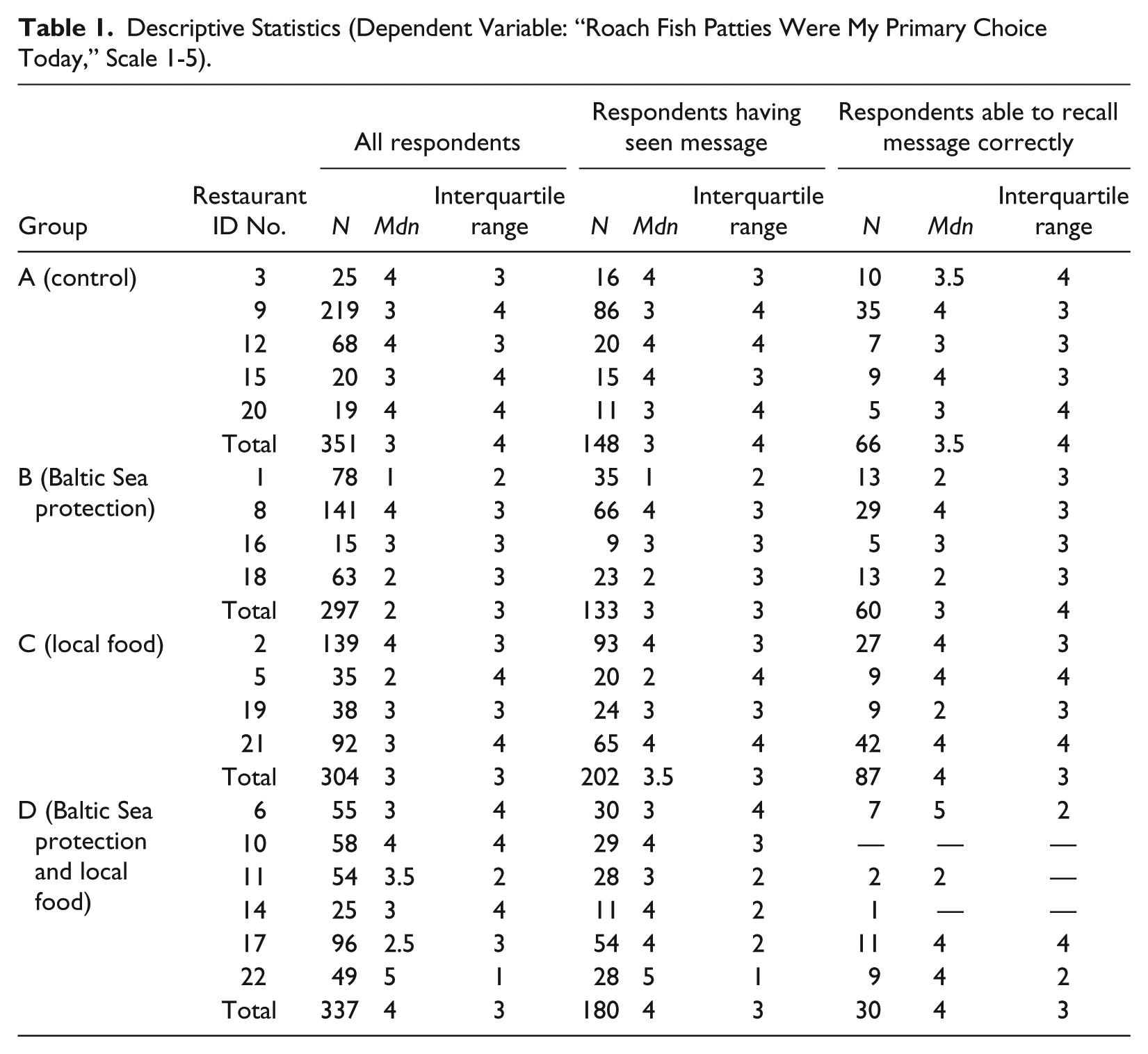
Table 1 presents descriptive statistics for the dependent variable. As the medians across the restaurants show, roach fish patties were chosen as the primary dish frequently, and there were only a few restaurants where the median was lower than 3 (Restaurants 1, 5, 17, and 18). However, the rather high interquartile ranges indicate that there was wide variability in the responses to this item.
Descriptive Statistics (Dependent Variable: “Roach Fish Patties Were My Primary Choice Today,” Scale 1-5).
Both injunctive norms were perceived as strong. The median of the variable “The general opinion is that people should eat more environmentally friendly” was 4 across all control/treatment groups. The median of the variable “The general opinion is that people should favour local food more” was 5 (strongly agree) in Groups A, B, and C, and 4 in Group D. Interquartile ranges were 1 in all control/treatment groups and for both injunctive norm variables. The medians of the variables for habit and novelty were 4 in all control/treatment groups. The interquartile range for habit was 1 in Group A and 2 in Groups B, C, and D. The interquartile range for novelty was 1 across all control/treatment groups.
Intention-to-Treat Analyses
First, we conducted the analyses using the full samples of respondents, that is, carried out the intention-to-treat analyses. We conducted a nested ANOVA to decompose the variance in roach fish patties choice into treatment, restaurant, and individual levels. The nested ANOVA results are reported in Table 2, Panel A.
Nested Analysis of Variance Results for the Intention-to-Treat Analyses (Panel A) and as-Treated Analyses (Panel B).
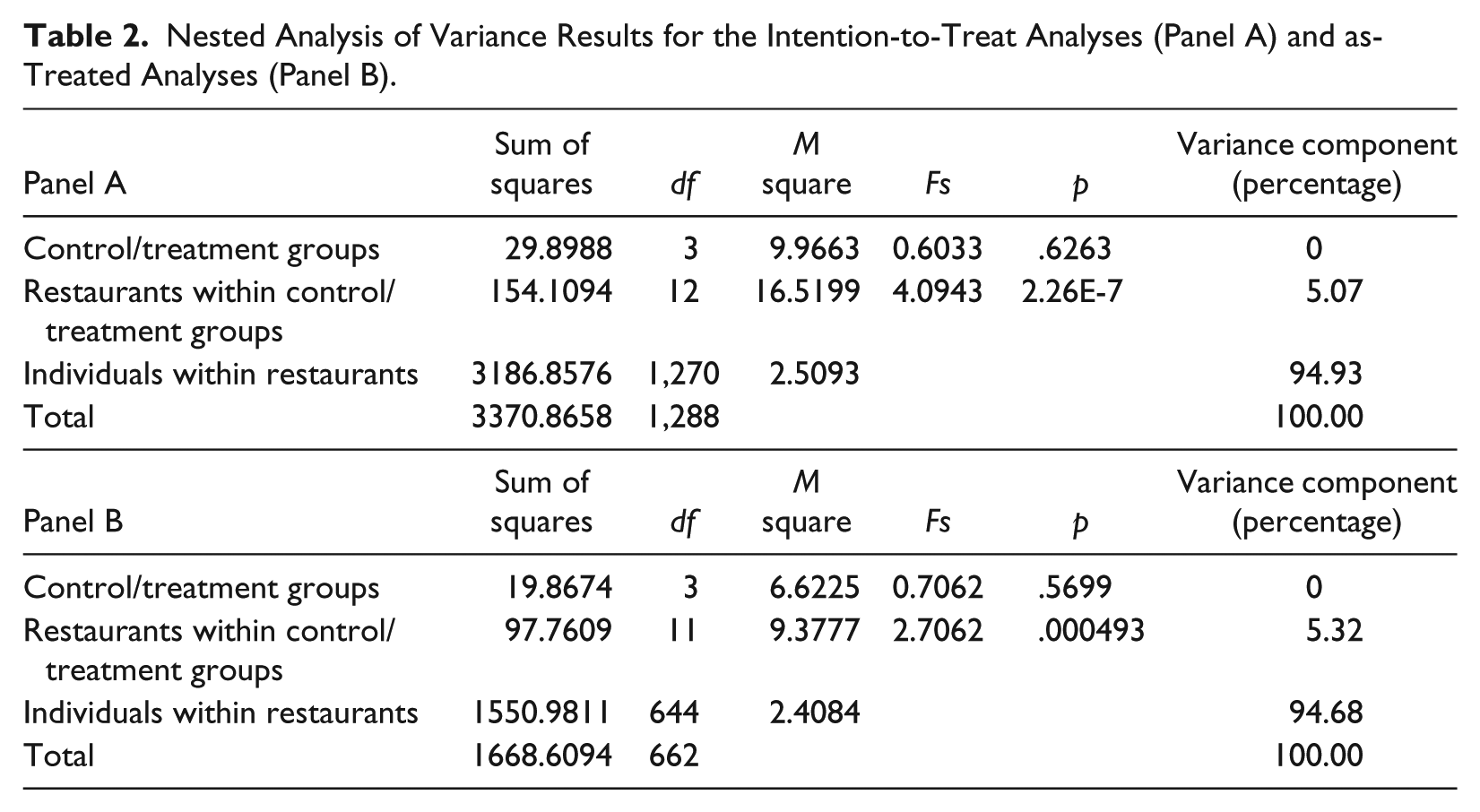
At the treatment level, no statistically significant differences in roach fish patties choice were identified among the control group and the treatment groups, F(3, 1270) = 0.6033, p = .6263. The restaurant level explained 5.1% of the variance, F(12, 1270) = 4.0943, p = 2.26E-7. 4 Individual-level differences explain the rest, almost 95%. In light of these results, it seems that the norm-activating messages did not affect the choice of roach fish patties. The results also indicate that the impact of activating norms with a message that included a combination of two injunctive norms was not significantly different compared to activation with one injunctive norm only.
To obtain further insight into the potential impact of the norm-activating messages, we wanted to find out whether they had an impact on norm perceptions even if not on food choice behaviour. Thus, we also conducted nested ANOVAs for the variables “The general opinion is that people should eat more environmentally friendly” and “The general opinion is that people should favour local food more.” The results showed no statistically significant differences in variances of the injunctive norms of environmentally friendly eating, F(3, 1252) = 0.4380, p = .7320, or eating local food, F(3, 1247) = 1.6467, p = .2638, among the control group and the treatment groups. 5
In sum, the results indicate that the norm-activating messages did not have any impact on roach fish patties as a primary choice, therefore suggesting that both hypotheses need to be rejected on the intention-to-treat level.
As-Treated Analyses
Second, we ran the nested ANOVA among those individuals who recalled they had seen the norm-activating message (N = 663). The results are reported in Table 2, Panel B. Ideally, we would have carried out the as-treated analyses among the individuals who had not only seen the norm-activating message but also recalled it correctly, but unfortunately this would have resulted in our sample becoming too fragmented (N = 243, divided into 19 restaurants in 4 control/treatment groups) for this particular statistical test.
Similarly to the intention-to-treat analyses, the results of a nested ANOVA showed no statistically significant differences in roach fish patties choice among the control and treatment groups, F(3, 644) = 0.7062, p = .5699. There were significant differences among restaurants, F(11, 644) = 2.7062, p = .0005, but the variance component size (5.3%) was again relatively small, individual-level differences explaining almost 95%. Furthermore, the results again showed no statistically significant differences in variances among the control group and the treatment groups for the injunctive norm of eating environmentally friendly, F(3, 639) = 0.6810, p = .5880, nor for the injunctive norm of eating local food, F(3, 635) = 1.2217, p = .3631.
To further corroborate the results, we ran the Mann–Whitney U test within each restaurant between the respondents who had seen the norm-activating message and recalled it correctly (N = 243) and the ones who had not seen the message at all (N = 606). In none of the restaurants was there a statistically significant difference in roach fish patties choice between these two groups of respondents. This strengthens the finding that the norm-activating messages had no impact on roach fish patties choice.
Based on the above we conclude that the treatments did not have any impact on roach fish patties choice and both hypotheses are rejected also on the as-treated level.
fsQCA Analyses
As it became clear in the statistical analyses above that the treatments did not produce any across-the-board variation in the choice of roach fish patties, but that the variation was almost entirely created at the individual level (as opposed to the treatment level), the question arose whether there could be some systematic patterns in how subgroups of individuals reacted to the social norm activation. Indeed, speaking of choice restriction in the context of food, Lombardini and Lankoski (2013, p. 166) write, “a focus on how bans change aggregate consumption may hide important differences in the effects of restricted choice on specific groups [. . .] the effects may be very different among individuals depending on factors such as age, gender, or frequency of consumption.” The same may apply to social norm activation and specific subgroups may thus react differently to our treatments; this would also be in line with Bicchieri’s (2006) notion of sensitivity to social norms in our theoretical model. For example, Schultz (2014) argues that normative messages have more influence on those who are not already motivated to behave according to the norm.
To better understand those individual-level differences in responding to social norm activation we run fsQCA analyses among the “treated” respondents, that is, those who noticed the message and could recall its main contents correctly. Our aim was to examine which configurations of conditions (individual characteristics and treatments) might be systematically associated with the choice of roach fish patties. Our outcome (Choice) was the same as in the statistical analyses: whether roach fish patties had been the respondent’s primary food choice. As is good practice with QCA (Schneider & Wagemann, 2012), we examined separately the configurations associated with the occurrence and non-occurrence of roach fish patties choice.
We examined two kinds of individual characteristics as conditions in the QCA. First, we included the sociodemographic characteristics of gender, age, and education, producing the conditions Female, Young, and Educated. Second, we included the individual’s previous consumption patterns. Two conditions are relevant here: Habit, for self-declared habitual fish eaters, and Novelty, for self-declared novelty-seeking eaters. Finally, our conditions included the treatments Baltic Sea protection and Local food, which together capture the four possible combinations of the presence and absence of these norm-activating messages.
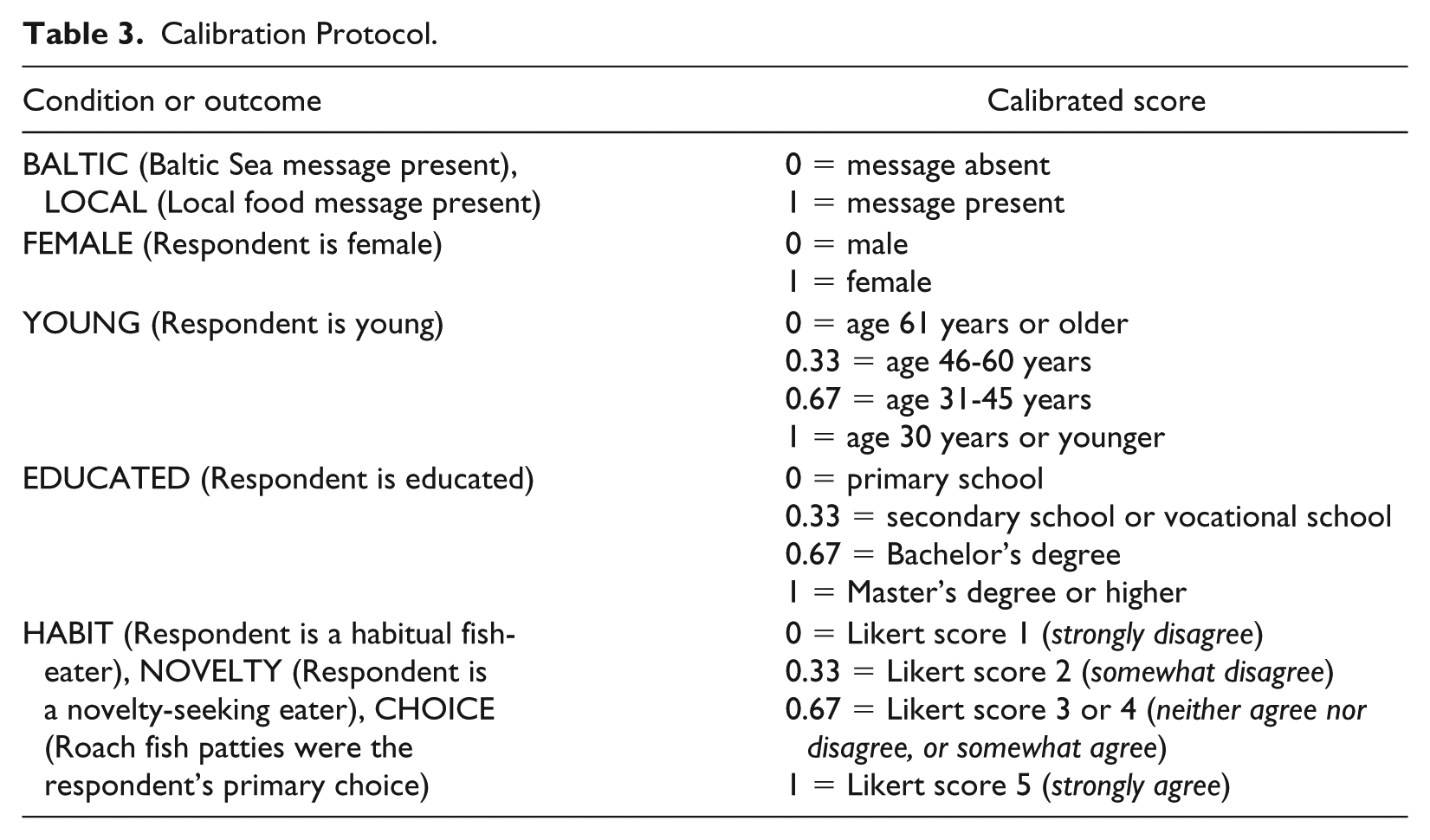
The outcome and the conditions needed to be calibrated for the purposes of the fsQCA analysis. Following, for example, Crilly (2011), we chose a four-value fuzzy set with membership scores 0, 0.33, 0.67, and 1, corresponding to “fully out,” “more out than in,” “more in than out,” and “fully in,” respectively, although some of our conditions are crisp by nature. Our calibration protocol is outlined in Table 3. Since QCA does not tolerate missing values, the number of cases (responses) was somewhat reduced (N = 237).
Calibration Protocol.
We used the software fs/QCA 3.0 (www.fsqca.com). First, we carried out the necessity analyses. Neither treatment (Baltic Sea protection or Local food) emerged as a necessary condition for roach fish patties choice, which was not surprising considering the statistical results. Instead, Habit (the respondent being a habitual fish-eater) was a necessary condition for the choice of roach fish patties with a consistency of 0.91 and a coverage of 0.71, and Novelty (the respondent being a novelty-seeking eater) with a consistency of 0.91 and a coverage of 0.66. There were no necessary conditions for the non-choice of roach fish patties.
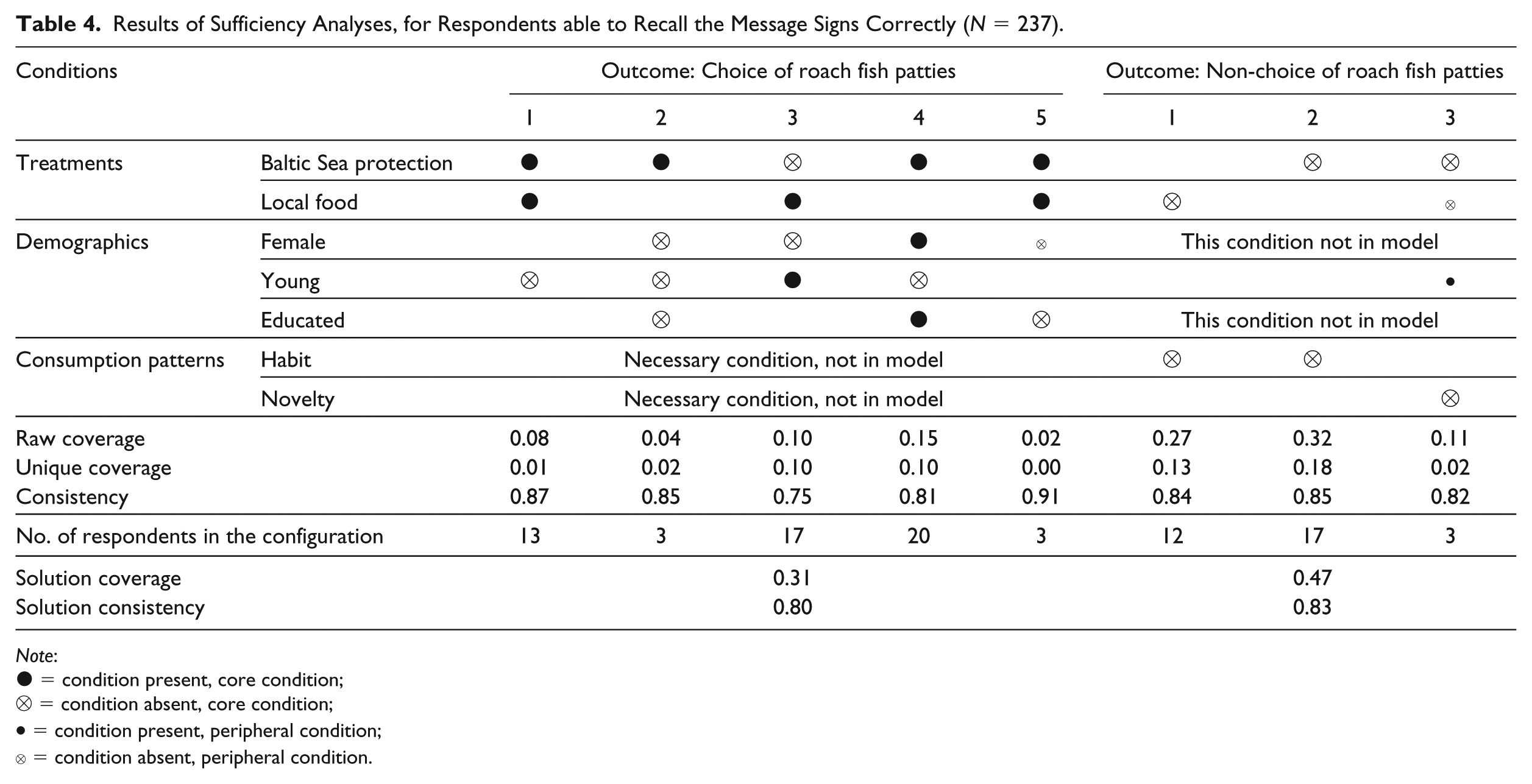
The frequency threshold for the sufficiency analyses was set as 1 and the consistency threshold as 0.80. In a large-N QCA the frequency threshold is often set to be higher, but it can also be 1 if the QCA is explorative as in this case (see Greckhamer, Misangyi, & Fiss, 2013). Limited diversity was 3% for choice and 28% for non-choice. We present our results in Table 4 which contains the intermediate solution but where also the parsimonious solution can be read as we distinguish between core and peripheral conditions. No counterfactual assumptions were made for choice; for non-choice the (easily defendable) assumptions were made that the absence of Habit and Novelty contributed to non-choice. In Table 4, a black orb indicates the presence of a condition in a sufficiency configuration, a crossed-out orb its absence, and an empty cell indicates a “don’t care” condition. Large orbs represent core conditions that figure in both parsimonious and intermediate solutions, and small orbs represent peripheral conditions that figure only in the intermediate solution (Fiss, 2011).
Results of Sufficiency Analyses, for Respondents able to Recall the Message Signs Correctly (N = 237).
Note:
= condition present, core condition;
= condition absent, core condition;
= condition present, peripheral condition;
= condition absent, peripheral condition.
Our key interest in the sufficiency analyses was to find out whether the conditions that relate to the treatments (Baltic Sea protection, Local food) emerge as “don’t care” conditions or whether they play a role in the configurations associated with the choice of roach fish patties. We find that all the five configurations do contain at least one of the treatments. Thus, within the overall population of restaurant clients, there seem to be subgroups, or population niches, where the treatments (their absence or presence in different combinations) are related to the choice of roach fish patties. The parameters of fit show that with the exception of Configuration 3, the configurations are consistent at or above the 0.80 benchmark (Ragin, 2008) and the consistency of the overall solution also reaches that threshold. Also, the consistency (0.75) of Configuration 3 may be considered adequate, since according to Ragin (2006) it is when consistency drops below 0.75 that it becomes increasingly difficult on substantive grounds to argue for a subset relation. The coverage of the individual configurations, however, is very limited, ranging from 0.02 to 0.15. Overall the solution covers 31% of the outcome. While the conditions in our fsQCA model are thus incomplete causal evidence in that they are unable to account for all the paths associated with the outcome (Greckhamer et al., 2013), these findings nevertheless suggest that there are subgroups of respondents for whom the treatments were associated with roach fish patties choice.
In addition to this general observation we can look at certain configurations more closely, namely, numbers 3 and 4 whose raw and unique coverage provide some empirical significance. Configuration 3 contains young males who see a treatment message about local food but not about Baltic Sea protection. Configuration 4 contains elderly educated females who see a treatment message about Baltic Sea protection. Recall also that Habit and Novelty are part of the results; since they were necessary conditions, they were not incorporated in the model.
We also run the sufficiency analysis for the non-choice of roach fish patties. Our non-choice model differed slightly from the choice model because there were no necessary conditions. We obtained three configurations. The consistency of each of them as well as of the overall solution is above 0.80. The coverage figures of the configurations range from 0.11 to 0.32 and the coverage of the overall solution is 0.47. Again, the treatments—but this time their absence—figure in all configurations. Configurations 1 and 2 have the most empirical relevance with their raw and unique coverage scores. They consist of individuals who do not have the habit of eating fish and who do not see a treatment message about local food (Configuration 1) or about Baltic Sea protection (Configuration 2).
In QCA, the configurations identified through truth table analysis should be linked back to the cases (types of cases in a large-N QCA) before establishing any causal inference (Schneider & Wagemann, 2010). In particular, when QCA is applied in a large-N context such as here, it loses its core characteristic of intimate case knowledge (Greckhamer et al., 2013), which reduces the ability to draw causal inferences. We did link the truth table analysis results back to the original responses and were able to confirm that the respondents within a configuration did not originate from the same restaurant, so the configurations indeed reflect individual-level associations between conditions instead of restaurant-level effects. We also carried out robustness tests to examine the sensitivity of the findings to certain alterations in frequency thresholds and calibration decisions; the qualitative picture remained similar. Nevertheless, we present the fsQCA in this article as a complementary and exploratory analysis. We do not claim to establish firm causal relationships but point to the possibility of there being consumer niches, relating to gender, age, education, and previous consumption patterns at least, that are not indifferent to the treatments.
Finally, in addition to the sufficiency analyses presented above we also carried out subset/superset analyses for combinations of the presence and absence of our treatment conditions (Baltic Sea protection and Local food) (Figure 3). These analyses show how consistently these combinations of conditions are associated with the outcome of roach fish patties choice. The consistency scores assess “the degree to which the cases sharing a given condition or combination of conditions [example omitted] agree in displaying the outcome in question” (Ragin, 2006, p. 292). They “can be used to compare alternate ideal typic formulations” (Ragin, 2006, p. 308); accordingly, we compared the four control/treatment groups and the degree to which they agree in displaying roach fish patties choice.
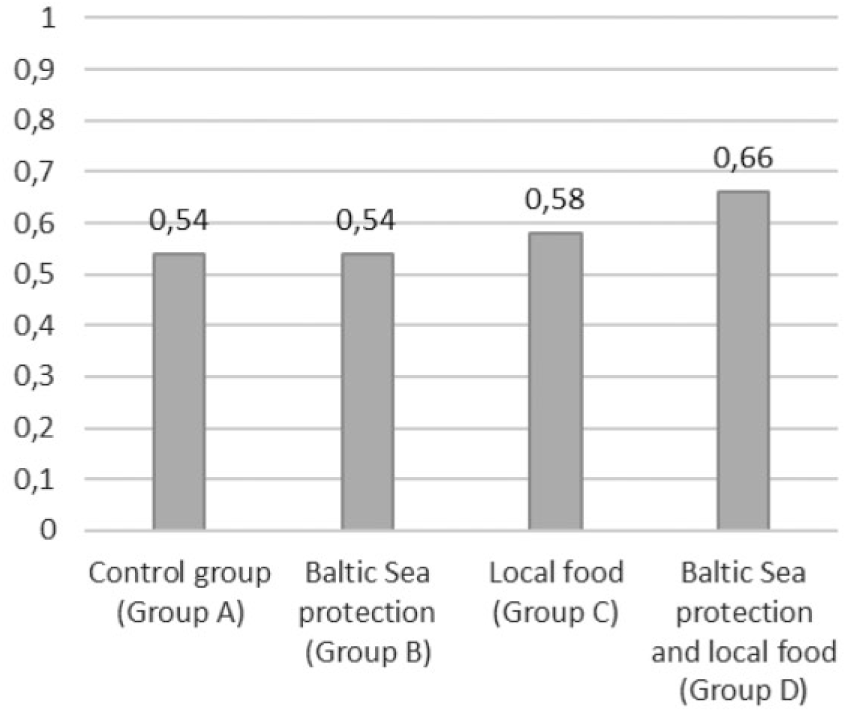
Results of subset/superset analyses for respondents able to recall the message signs correctly (N = 237); consistency values for the outcome “Choice of roach fish patties” for the different combinations of the conditions “Baltic Sea protection” and “Local food” in each control/treatment group.
Figure 3 repeats the finding, already obtained above, that none of the treatments were in themselves sufficient conditions for roach fish patties choice as their consistency figures remain greatly below the threshold of 0.80. However, Figure 3 also sheds interesting light on the question of multiple injunctive norms and their possible interactions. We can see that when presented alone, the message about Baltic Sea protection (Group B) did not increase the consistency figures compared to the control group (Group A). In contrast, the message about local food (Group C) did increase the consistency figures compared to the control group. In light of these findings, thus, Hypothesis 1 would be rejected in the case of Baltic Sea protection and supported in the case of local food. The combined message (Group D) increased those figures most of all. This would suggest that the impact of multiple injunctive norms is not simply additive but that there are causal interactions between the norms: when presented alone, the message about Baltic Sea protection did not have any positive impact on roach fish patties choice but adding it to the message about local food resulted in a clear additional impact. Therefore, Hypothesis 2 is supported by these findings. While the magnitude of the changes is very small, this analysis nevertheless allows us to get a glimpse into a phenomenon which in this case is existing beneath the surface but too subtle to manifest itself as statistically significant differences in roach fish patties choice in the experimental groups.
Discussion and Conclusions
Increasingly, it is being recognized that in order to achieve sustainability transformations, production and consumption ought not to be examined as isolated activities but instead they must be understood as co-dependent parts of the same system. Often businesses need to complement their production-side sustainability initiatives with accompanying measures aimed at promoting sustainable consumption, and it is against this background that we conducted our study. We focused on the food system, and as a potential, low-cost accompanying measure of steering consumer behaviour, we studied the activation of injunctive social norms that have been found to be important but perhaps somewhat neglected determinants of consumer choice. With a theoretical framework based on the focus theory of normative conduct (Cialdini et al., 1990) and the model of social norm activation (Bicchieri, 2006), we conducted a field experiment with a total of 1,289 respondents in 19 workplace restaurants to study differences in sustainable food consumption under different conditions of injunctive social norm activation. The experiment followed a 2 × 2 between-subjects factorial design where the dependent variable was the primary choice of a novel sustainable dish, roach fish patties, and the predictors were the presence and absence of a Baltic Sea protection-related injunctive norm message and a local food-related injunctive norm message.
Key Findings
We found that the activation of injunctive social norms was not entirely without influence on sustainable food choices but that there are three major caveats to this result. First, the impact that injunctive norm activation had in our study was extremely small. Looking at the lunch choices with statistical methods, we discovered that the norm-activation treatments had no impact on those choices. This was true regardless of whether the norm-activating message related to Baltic Sea protection, local food, or both; and of whether we relied on “intention-to-treat” or “as-treated” analyses. This means that overall, putting up message signs as situational cues to activate injunctive norms was not an effective measure to steer the choices of the lunch customers towards sustainability. Yet, probing deeper, we saw how the activations that contained the local food-related message or a combination of both messages did slightly increase the consistency with which roach fish patties were being chosen. Thus, while the impact of social norm activation was perhaps real, at least in this case it amounted to a mere whisper. It was discernible beneath the surface but too weak to be reflected as a statistically significant difference in the resulting food choices. A possible explanation for this result is that in a real-life situation the social norm activation has to compete with a number of other food choice motives that seem to have been more decisive in this case.
Second, the effectiveness of injunctive norm activation was different for different individuals. In our study, as much as 95% of the variation in roach fish patties choice could be traced to the individual level and we continued to examine subgroups within the respondents more closely. Through a configurational analysis with “treated” respondents we discovered that the norm-activating messages were associated with the choice of roach fish patties for specific subgroups of restaurant customers, although these groups were marginal in their size. Individuals may have a different sensitivity to social norm activation (Bicchieri, 2006), and in our experiment factors such as age, gender, education, and previous consumption patterns seemed to be related to this sensitivity. Particular subgroups that may have been incited to conform to the norm and choose roach fish patties by the injunctive norm messages were those who like to eat fish and to taste new foods; more specifically elderly educated females (for the Baltic Sea protection message) and young males (for the local food but not the Baltic Sea protection message).
Third, the effectiveness of injunctive norm activation was different for different norms, even in the case of two sustainability-related norms. While still bearing in mind that none of our treatments carried over to actual statistically significant impacts on food choice, we can make observations about what was going on beneath the surface. When applied individually, the norm about Baltic Sea protection had no positive effect on roach fish patties choice, but the norm about local food did. When applied jointly, the norm activations had the greatest positive impact, revealing a mutually reinforcing interaction effect. This was the case with these two norms that we had in our study; it is possible that some other two norms would behave differently in this regard. In any case, the findings invite the conclusion that multiple norms can have complex causal interactions and joint effects.
Recall that our study was not about social norms per se but about their activation with message signs as situational cues. In sum, our findings point to the message signs as an ineffective, blunt instrument from an overall perspective, but potentially affecting specific subgroups within the population of restaurant clients, and with a mutually reinforcing interaction in the case of the joint activation of multiple norms.
Contribution to Previous Knowledge
With this study we join the conversation in the broad field of promoting sustainability in consumer choice. We take the perspective of production and consumption as intertwined systems, and organizations therefore having to consider and shape also the actions of consumers as part of their own sustainability measures. Our work thus represents a microanalysis of consumer behaviour as it relates to sustainability, which according to Delmas and Aragon-Correa (2016) is among the most fruitful domains for field experiments in corporate sustainability. More specifically the study relates to injunctive social norms and their individual and joint activation. We contribute to the literature both by applying our theoretical framework to the new, centrally important context of sustainable food choice, and by extending previous knowledge through an examination of multiple injunctive norms.
The application of the question of injunctive norm activation to the context of sustainable food choices is both novel and important. As we outline in the introduction, it is not evident how the impact of social norms would play out in this context since it differs from those previously studied: the norm is different and so is the choice situation. The topic is very important for its practical implications because food choices have such large sustainability impacts. It is also interesting to explore the boundaries of the impacts of social norms in such a challenging choice situation.
We extend previous knowledge by examining the new theoretical question of how the joint activation of multiple injunctive norms affects behaviour. This question is highly relevant with many practical implications; yet it has not received scholarly attention, and more research has been called for on the topic (McDonald et al., 2014). The question is particularly relevant in the case of food where multiple sustainability issues tend to be intertwined within a single food choice. Our findings indicate that the impacts of multiple injunctive norms are not simply additive but that complex causal interactions may be present. In this case the interaction was mutually reinforcing, but other kinds of outcomes are also possible depending on which norms exactly we are talking about, as our findings about the differential impacts of the Baltic Sea protection norm and the local food norm suggest. All in all, we open a new line of enquiry and provide some first results in this important research area.
Finally, our article also makes a contribution by highlighting the value of field study results in directing alternative research questions and methods. Field experiments can produce disappointing results or even backfire when the interventions do not work as anticipated (Delmas & Aragon-Correa, 2016). In this study, somewhat unexpectedly, none of the norm-activating interventions had any overall impact on choices. However, field experiments can bring valuable insights even in such situations. For us, the finding that the variability in roach fish patties choice was not due to the treatments but mostly to individual characteristics made us focus our attention on subgroups within consumers. This exemplifies how the development of knowledge is a continuing journey where different research methods and approaches alternate. Meuer and Rupietta (2017) discuss how QCA and statistical analyses may be integrated in a study for added opportunities for theoretical contribution. In our case, while the statistical analysis and the QCA were not “integrated” in a strict sense, the statistical analysis guides the QCA by first establishing where the variability lies and what is thus the most fruitful level of analysis for the QCA, and the QCA steps in when statistical options come to a halt because of data concerns. Thanks to this combination (so far only rarely encountered in this order; Meuer & Rupietta, 2017) we are able to obtain a deeper insight into the impacts of social norm activation and strengthen our contribution to the field. Moreover, studies applying QCA to questions of corporate sustainability are only beginning to emerge (e.g., Chappin, Cambré, Vermeulen, & Lozano, 2015; Delmas & Pekovic, 2018; Halme, Rintamäki, Knudsen, Lankoski, & Kuisma, 2020; Misangyi, 2016) and with our study we add to this body of literature.
Implications for Management
Our findings have a number of direct practical implications for organizations attempting to steer consumer choice. The impact of social norms on consumer behaviour is real, and managers can attempt to leverage this impact for increased sustainability. Since the activation of multiple sustainability-related norms can bring disproportionately large impacts, their skilled use may be especially helpful. Managers should also bear in mind that even if they do not decide to try to activate a social norm, some norms will be more activated than others in any case. At the very least, therefore, managers ought to recognize this fact, identify which norms are likely to be activated in the choice situation, and make sure that this does not go against their sustainability objectives.
However, as our findings show, steering consumer choice through the activation of injunctive social norms is not necessarily straightforward and strong results are not automatically guaranteed. A measure like the one we studied here is a common, easy, low-cost alternative, and thus something that many firms realistically could (and do) resort to in practice. Unfortunately, as we illustrate, it may not be effective. To start with, the message may not reach all consumers. Indeed, of the 1,289 respondents, only 663 had seen the message and only 243, in other words 19%, could recall its contents. This fact underlines how difficult it can be to get through to consumers with a sustainability-oriented message in a choice situation. Even when the message is received and understood, and when it perhaps does create some effects beneath the surface, its impact may be buried under stronger influences against which the message has to compete in a “noisy” and complex real-life food choice setting. Also, the impact may be limited to specific subgroups which at least in this case were marginal in terms of volume. The results emphasize how important it is for managers to find strong measures to influence consumer choice that are at the same time feasible to use and effective in a real-world situation.
To increase the effectiveness of a norm-activating message, managers need to carefully consider the medium to be used and the formulation of the message. The medium should be suitable for the situation and able to capture sufficient attention in the target population. The message should not be overly complex but credible and understandable and such that the choice situation permits its cognitive processing (e.g., Cialdini, 2003; Mollen et al., 2013). Consumers are unlikely to process the message if it requires too much cognitive effort, and in such cases the impact of the norm will be limited; the same goes if the social norm conveyed is not believable (Melnyk, van Herpen, Fischer, & van Trijp, 2011). Messages should also be visually attractive and avoid any unintended impacts. When feasible, combining injunctive norms with factual descriptive norms is advisable especially if the situation is novel (White & Simpson, 2013). It is possible that our norm-activating messages were not at their most effective in some of these respects in the hectic and routine lunch choice situation and their impacts may therefore have been weakened. For example, one respondent wrote the open-ended comment that “I noticed the sign, but I did not have the patience to read it as I was hungry” and another one that “eutrophication made me lose my appetite.”
Limitations and Suggestions for Future Work
Our study had several strengths: it was carried out in a real-life rather than laboratory setting, it covered a diverse population rather than students only, and it was able to circumvent past taste experiences and price which tend to dominate food choice motives. As always, however, there were also limitations. One is that the behavioural measurement of choice (as well as that of seeing the message) is self-reported. Participation in the survey was voluntary, which may produce nonresponse bias in the data. One interesting potential source of bias is that vegetarians and vegans were outside the study since roach fish patties are not vegetarian food, but these groups may be especially receptive when it comes to social norms about sustainable eating. Finally, this was only a one-time experiment, and it could have had more impact if repeated.
Statistical complications arose quickly due to the cluster randomized design, which limited the analyses that could be carried out as well as reduced statistical power (Chuang, Hripcsak, & Heitjan, 2002). However, avoiding the cluster randomized design was impossible since the treatment had to be administered at restaurant level, and sampling more clusters to increase power was also not possible since there were no other comparable restaurants serving the novel dish.
The “messiness” of field experiments is present also in our study. We cannot rule out contamination (respondents talking to each other about the message signs or the roach fish patties), cannot control for environmental cues (e.g., popular foods running out more quickly), or ascertain and measure the impact of a descriptive norm in the environment when having lunch with colleagues versus alone (or more generally, observing what foods other people choose), or the impacts of other, competing salient injunctive norms. Studies that are not field experiments may not be as messy but then their external validity tends to be less strong (e.g., Delmas & Aragon-Correa, 2016). Considering that the ability of sustainability research to produce real impact has recently come under increasing questioning, this is an important point and the messiness of field research worth tolerating.
Based on our experiences we have some suggestions for similar future studies. First, there could be two control groups. Our control group had a sign without any norm-activating message, but another control group without any sign at all would have helped to ascertain whether it could be the sign itself, regardless of its contents, that entices the restaurant clients to choose roach fish patties. Second, conducting focus group interviews after the survey would have helped to better understand the reasons behind the choice and non-choice of roach fish patties under the different treatments.
We also have suggestions for different future studies around this theme. We have shown how nuanced the impacts of injunctive norm activation on consumer choice can be: They can depend both on the individuals and on the norms and norm combinations that are being employed. Given the complexity of social systems around food choice (Lorenz & Langen, 2018), such nuanced understanding is crucial. It could be taken forward by further studies that expand on the varying sensitivity to norms of subgroups of consumers and varying effectiveness of different norms. Also, we opened the study of multiple injunctive norms and as it points to complex interactions, the intriguing question of norm combinations is worth further investigation. These and other kinds of studies on how best to support organizational sustainability activities with measures to promote sustainable consumer choice would be welcome to identify effective, targeted ways to promote the hand-in-hand transformation of the production-consumption system.
Footnotes
Acknowledgements
We gratefully acknowledge the generous collaboration of John Nurminen Foundation, Palmia, and Dr. Chiara Lombardini in carrying out the field experiment. Our special thanks go to the personnel in Palmia restaurants and all the participants in the study. We also thank Editor Timothy Smith, the two anonymous reviewers, as well as participants in the Aalto Sustainability in Business seminar and the GRONEN 2018 Research Conference for their valuable comments.
Declaration of Conflicting Interests
The author(s) declared no potential conflicts of interest with respect to the research, authorship, and/or publication of this article.
Funding
The author(s) disclosed receipt of the following financial support for the research, authorship, and/or publication of this article: Laura Salmivaara gratefully acknowledges funding from the Finnish Cultural Foundation.