




Abstract
Collective action is essential during times of crisis. Yet, while some actors are able to use the momentum to initiate new collective action, others struggle to maintain existing collective action due to differences in immediate crisis responses. Thus, to act collectively in a crisis, it is a key challenge to understand what influences the emergence and interruption of collective action. We offer a temporal perspective to address this challenge. By conducting a longitudinal, inductive study based on qualitative data sources, including 80 interviews, we explore the emergence, continuation and interruption of collective action by actors providing social care to vulnerable people during the Covid-19 pandemic. Our study highlights interactions between Eigenzeiten, the unique temporal structures that entities or groups develop. Particularly, we find that the interaction between temporal structures at crisis, collective and organizational levels lead to the unfolding of two distinct patterns, ‘from coordinating to covering’ and ‘from covering to coordinating’, which depend on whether the starting point is new or existing collective action. We explain the key differences for the progression of collective action in a crisis by attending to the interactions between underlying temporal structures, including their pace and temporal depth, and changes in these structures.
Introduction
During the Covid-19 pandemic, some organizations joined forces to respond to the sudden challenges, while others struggled to maintain their long-standing collaborations. Thus, the pandemic required reconsideration of how collective action can be achieved (Comfort, Kapucu, Ko, Menoni & Siciliano, 2020), defined as ‘people doing something together . . . [and] having a collective intention to do that thing together’ (Gilbert, 2006, p. 3). We know that actors align their resources, environments, or interests to reach a joint goal, such as social care (Feldman, Worline, Baker & Lowerson, 2022; Ostrom, 2010). To achieve such a goal, recent research points towards the role of temporal synchronization (Blagoev & Schreyögg, 2019; Geiger, Danner-Schröder & Kremser, 2020; Pérez-Nordtvedt, Payne, Short & Kedia, 2008).
Temporality in our study reflects actors’ subjective experiences of time and how they perceive continuity among the past, present and future (Bluedorn, 2002; Hussenot & Missonier, 2016; Jacques, 1982). Understanding the temporality of collective action is particularly relevant during crisis times because crises create distinct, salient and challenging temporal dimensions (Williams, Gruber, Sutcliffe, Shepherd & Zhao, 2017) – including a focus on the present with demands for immediate action (Kornberger, Leixnering & Meyer, 2019). While urgency can spur new collective action, it might also interrupt existing collective action (Feldman et al., 2022), as actors develop different temporal structures when coping with a crisis (Kunisch, Blagoev & Bartunek, 2021). Building on Nowotny (1994), we refer to such unique temporal structures that organizations, collectives, or even a crisis can develop as Eigenzeiten, which can be understood as ‘the time inherent to a process itself’ (Burkeman, 2021, p. 33) or the ‘internal clock’ of an entity (Nowotny, 1994). To act collectively, actors need to find means to couple their own Eigenzeit(en) with those of other entities (see Blagoev & Schreyögg, 2025).
Prior research has shown that despite changes in temporal structures in a crisis, collective action can continue through temporal adjustments (Feldman et al., 2022). In contrast, Kunisch et al. (2021) suggest that some organizations prefer uncoupling from others’ temporal structures (see also Geiger et al., 2020), which could lead to the disruption of collective action. Yet, each crisis is different, and the Covid-19 pandemic highlights the plurality of temporal dynamics, enabling coupling and uncoupling in the same crisis (Kunisch et al., 2021). Unfortunately, it is unclear under which conditions collective action in a crisis emerges or gets disrupted. Therefore, we ask: How does temporality affect the emergence, continuation and interruption of collective action in a crisis? To answer this question, we adopt a longitudinal research design and inductively study temporality in collective action by actors who provided social care to vulnerable people during the Covid-19 pandemic.
We contribute to the collective action literature by providing a temporal understanding of how actors establish, maintain, pause and restore their collective action over time. First, we conceptualize the interactions between the Eigenzeiten that play a role in collective action, which enables us to theorize two different patterns that we observed. In the first pattern, ‘from coordinating to covering’, organizations establish new collective action and, after some time, reduce their collective efforts. The second pattern, ‘from covering to coordinating’, moves in the opposite direction and relates to the disruption and restoration of existing collective action. We explain the simultaneous temporal misalignment and alignment related to the development of collective action over time through the interaction of three Eigenzeiten (crisis, organizational and collective), including their pace and temporal depth. This unified explanation is an important contribution to existing literature, which has mostly separated alignment and misalignment (Danner-Schröder & Geiger, 2016; Feldman et al., 2022; Kunisch et al., 2021; Ramus, Vaccaro & Berrone, 2021). Second, we conceptualize how the interaction between the different Eigenzeiten evolves differently based on different starting points (i.e. new versus existing collective action). Interestingly, these different starting points give fundamentally different outcomes in terms of the emergence, continuation and interruption of collective action. In particular, the changing crisis Eigenzeit, depending on the government’s crisis communication, is noteworthy. When crisis Eigenzeit changes, it can both disrupt existing collective action (by uncoupling from the collective Eigenzeit) as well as support new collective action (by quickly establishing new collective temporal structures). While the initial effect of crisis Eigenzeit (in particular its urgency) has been noticed before (Geiger et al., 2020; Kunisch, Bartunek, Mueller & Huy, 2017; Skade, Lehrer, Hamdali & Koch, 2024), we show how its double-faced nature helps to explain these reversed patterns over time in relation to the different starting points.
Theoretical Background
In the following, we highlight the importance of temporality, a multifaceted concept that plays a crucial role in both the emergence and interruption of collective action. We begin by outlining prior studies of collective action in crisis contexts, followed by reviewing existing work on collective action and temporality.
Collective action and crises
Collective action requires single parties to form a collective intention with a shared goal (Gilbert, 2006), to synchronize their behaviour on dimensions such as ‘direction, velocity, tempo, and/or substantive content’ (McPhail & Wohlstein 1983, p. 581), and to develop a form of collective identity (Summers-Effler, 2002). However, there are significant challenges associated with finding common interests and joining forces to act collectively. For example, members often consider only their (immediate) self-interests instead of (future) joint interests (Bridoux & Stoelhorst, 2022). Actors may therefore suffer from others’ opportunistic behaviours or free riding (Olson, 1971; Ostrom, 2010), such that pre-existing solidarity among members may be required to achieve desired outcomes (Olzak, 1989). To develop and maintain a collective intention, actors can engage in collective activities, such as regular meetings and marches (Tilly, 1993), or adopt different roles (Olzak, 1989; Ostrom, 2010).
In crises, demand for collective action is prominent, but collective action ironically becomes more difficult to attain and maintain. For example, Philips and Markham (2014, p. 1181), point towards the ‘[t]he absence of a timely and effective humanitarian reaction’ when actors tried to collectively manage the Ebola crisis. Crises can disrupt predictable pathways between what actors have experienced in the past and what they can expect in the future, particularly in expectations of how others might behave (Etzion, Gehman, Ferraro & Avidan, 2017; Kornberger et al., 2019). Thus, a crisis might threaten shared value systems, which are critical to supporting immediate reactions in coping with unpredictable events (Ansell & Boin, 2019).
In a crisis, new ways of acting collectively might emerge, but they are often fragile. Van Ness and Summers-Effler (2016) argue that when institutional patterns and structures fail to provide direction for social action, actors can gather collectively to transcend conventional norms through events such as meetings. However, such events during a crisis tend to be loosely structured, which may make robust collective action unstable. Similarly, temporal alignment toward a shared goal can be especially difficult during crises (Geiger et al., 2020), which potentially hampers the emergence of new, and disrupts the continuation of existing, collective action. To address temporal aspects related to the emergence, continuation and interruption of collective action, we next review research into the role of temporality in collective action.
Collective action and temporality
In the absence of guidelines or frameworks for decision-making in a crisis, actors need to quickly orient themselves and align their interpretations (Kornberger et al., 2019). Temporal alignment on a collective level demands a calibration of different Eigenzeiten, represented in the unique temporal structures that entities or groups develop (Blagoev & Schreyögg, 2025; Goetz, 2009; Nowotny, 1989). In German, the term Eigen refers to self or proper (as in property); combined with Zeit, which means time, it forms Eigenzeit. It thus is ‘the time inherent to a process itself’ (Burkeman, 2021, p. 33), which can refer to the ‘internal clock’ or ‘life cycle’ of different entities, such as persons, teams and even technologies (Luhmann, 1976; Nowotny, 1994). According to Nowotny (2019, p. 67f) ‘Eigenzeit set out to demonstrate the qualitative changes in the individual perception of time and the corresponding experience in their manifold connections to the structuration society imposes on time’. This notion reflects the view that time is not uniform and can vary qualitatively per entity or group, along with varying opinions regarding the significance of one’s own time and that of others, which can lead to conflicts (Fraser in Nowotny, 1994). Studying Eigenzeiten offers a means to uncover the ‘qualitative changes in the perception of time, in the sense of time and in the social and individual structuring of time’ (Nowotny, 1994, p. 9).
Temporal structures, such as agreements about fixed meeting schedules, mould and form Eigenzeiten. Here, we follow Schultz and Hernes (2020, p. 108), who describe temporal structures as ‘particular to an organization’ because ‘[t]hey signify the patterns of events and activities that are descriptive of actors’ overall temporal orientations’. The temporal structures of Eigenzeiten consist of several dimensions and, in our study, we focus specifically on pace and temporal depth. Pace refers to the speed with which actors work, related to tempo (Reinecke & Lawrence, 2022) and break frequency (Bluedorn & Martin, 2008). Temporal depth pertains to ‘distances into the past and future that individuals and collectivities typically consider when contemplating events that have happened, may have happened, or may happen’ and is often expressed in the time frame (e.g. hours, weeks, months) to which actors are oriented (Bluedorn 2002, p. 114). For example, a common temporal structure that sets temporal depth is a deadline (Ancona, Okhuysen & Perlow, 2001).
Although prior work has emphasized the complexity of the coordination of multiple organizations with different temporal structures (Hilbolling, Deken, Berends & Tuertscher, 2022), there are still several ways to influence such alignment. One way is through entrainment (Blagoev & Schreyögg, 2025; Dille, Hernes & Vaagaasar, 2023), such that multiple actors couple to the same temporal structure(s) of their environment. For example, employees often accept and embrace powerful pacers that dominate temporal structures (Pérez-Nordtvedt et al., 2008; Waller, Zellmer-Bruhn & Giambatista, 2002), such as shared milestones (Granqvist & Gustafsson, 2016). In addition to pacers and explicit entrainment, actors can draw on implicit, existing repertoires of temporal structures (Reinecke & Ansari, 2016) to create temporal continuity between their past and imagined futures through their present actions (Hernes, 2014). In a study of mental health care after Hurricane Katrina, Feldman et al. (2022) note that adjustments that allowed for flexibility instead of controlled structures provided actors with continuity during the disruption. Such flexibility helped actors couple with old patterns and create novel ways to engage.
Organizations might also uncouple from temporal structures. In their study of extreme working hours, Blagoev and Schreyögg (2019) explain that actors reduced complexity by focusing on some temporal elements while disregarding others. Building on Luhmann (1995), they conceptualize this process as temporal uncoupling, defined as ‘the detachment of organizational temporality from broader societal rhythms’ (Blagoev & Schreyögg 2019, p. 1819). If organizations select and reinforce some and disregard other temporal elements, people find it difficult to escape the organizational temporal structure, even if it creates misalignment with other temporal aspects of their environment (Blagoev & Schreyögg, 2019).
Temporal alignment among actors tends to be a prerequisite for effective collective action, whereas misalignment can lead to poor performance (Turner & Rindova, 2018). Yet, if the surrounding conditions change, it affects organizations’ temporal structures (Hernes, 2014; Summers-Effler, 2002). For example, Kunisch et al. (2021, pp. 1411–1415) point out how during the Covid-19 pandemic, ‘apparently reliable temporal patterns, boundaries and routines have dissolved into thin air, while new routines based on the digitalization of work experiences have flourished’. Moreover, inconsistencies between temporal structures and the situation may require actors to negotiate adjusted temporal dimensions, such as pace and temporal depth (Kaplan & Orlikowski, 2013). Actors may collectively alter their understanding of how they interpret the temporal structures of their organization and thereby change them. Such changes may be especially problematic during crisis times when collective action is desperately needed, but previously existing temporal structures may crumble and external pacers may be lacking (Danner-Schröder & Müller-Seitz, 2020) or be excessively dominant (Geiger et al., 2020). As previous research has highlighted, temporal predictability and reliability are essential when managing crises (Turner & Rindova, 2018), and times of crises emphasize ‘the complex nature of time’ (Kunisch et al. 2021, pp. 1411–1415). Furthermore, each crisis might impose its own temporal dynamics, creating uncertainty for actors’ own and joint activities. When actors organize collective action in such uncertain settings, coordination problems seem likely (Reinecke & Ansari, 2016). Thus, we need further insights into how temporal alignment and misalignment across different temporal structures arise, including their effects on collective action during crises. As Nowotny (1994, p. 69) suggests, ‘through knowledge of the different (. . .) [Eigenzeiten] of systems or subsystems, better temporal coordination can be achieved’. Therefore, this study addresses the research question: How does temporality affect the emergence, continuation and interruption of collective action in a crisis?
Methodology
In this longitudinal inductive study, we examine how social care organizations (SCOs) in a Dutch city acted collectively during the Covid-19 pandemic. In particular, we apply a process perspective (Berends & Deken, 2021; Langley, 1999), with a focus on how collective action unfolds over time by considering the temporality that actors perceive when acting collectively (Hussenot et al., 2020; Hussenot & Missonier, 2016). We had a unique opportunity to follow different patterns of collective action over the course of the pandemic. This empirical context is well suited to develop theories about the role of temporality in collective action because the velocity and variability of the pandemic forced actors to continuously (re)interpret the past, present and future of how to work together.
Research setting
On February 27, 2020, the first confirmed case of Covid-19 was reported in the Netherlands, and on March 15, 2020, an ‘intelligent’ lockdown was enforced by the national government to limit physical contact among people. Restaurants, schools and offices were closed; physical meetings in care facilities were mostly limited to urgent cases. Vulnerable groups facing disproportionate disadvantages, even before the pandemic, seemed likely to suffer the most from such restrictions (The Lancet, 2020), as demonstrated among ethnic minorities (Subbaraman, 2020) and homeless people (Lima et al., 2020). Thus, it was important for SCOs to continue supporting vulnerable groups.
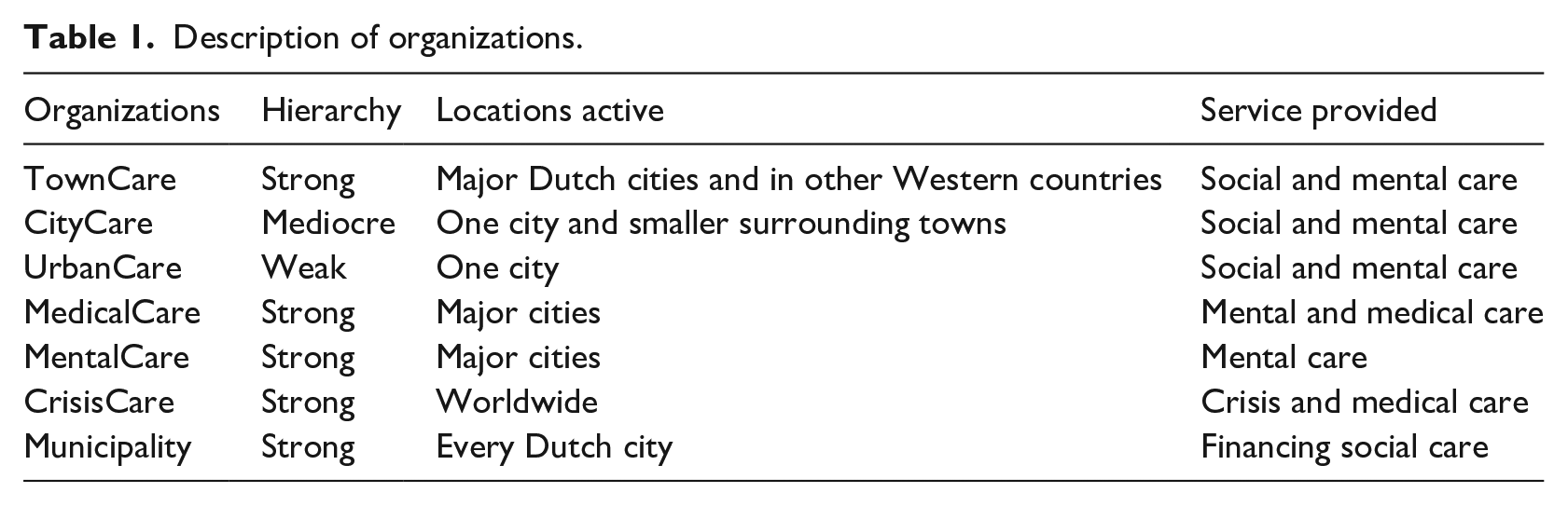
Many SCOs turned to their existing networks (Aluisio et al., 2020) to seek new capacities and collective responses to provide social care for vulnerable groups, including people with mental health issues or struggling with addiction, whom the organizations refer to as participants or clientele (in the remainder of this study we use participants consistently). Social care for these vulnerable groups in our case study was primarily provided by seven organizations. We refer to these organizations as TownCare, CityCare, UrbanCare, MedicalCare, MentalCare, CrisisCare and Municipality (pseudonyms).
TownCare is a large organization motivated by religious values. It seeks to find flexible solutions for problems as they arise. CityCare is known for its research-based work and mostly operates in the studied city and some neighbouring towns. UrbanCare is a rather informal organization and is known for its highly flexible and creative solutions, along with a strong reliance on voluntary work. MedicalCare is responsible for the medical care of vulnerable people, including their overall health, medications and vaccinations. MentalCare focuses on participants with mental health issues and is responsible for providing treatment, such as therapy. CrisisCare specializes in general health services and offers emergency care in crises, such as shelter during floods. Finally, the municipality of this Dutch city works closely with all the organizations to ensure support for vulnerable groups within the city. During the Covid-19 pandemic, the municipality received a government budget to support vulnerable groups. Table 1 offers an overview with more information about the organizations involved in our study.
Description of organizations.
Data collection
Our data included interviews, internal company documents, newspaper and magazine reports, and observations. We relied on 80 interviews as the main source of data: 41 initial interviews with members of the seven organizations, 15 follow-up interviews with some of these informants, and 24 participant interviews (for the distribution over the different organizations, see Table 2). Our informants represented a variety of hierarchical levels and functional roles (e.g. social workers, psychiatrists and managers).
Data collection.
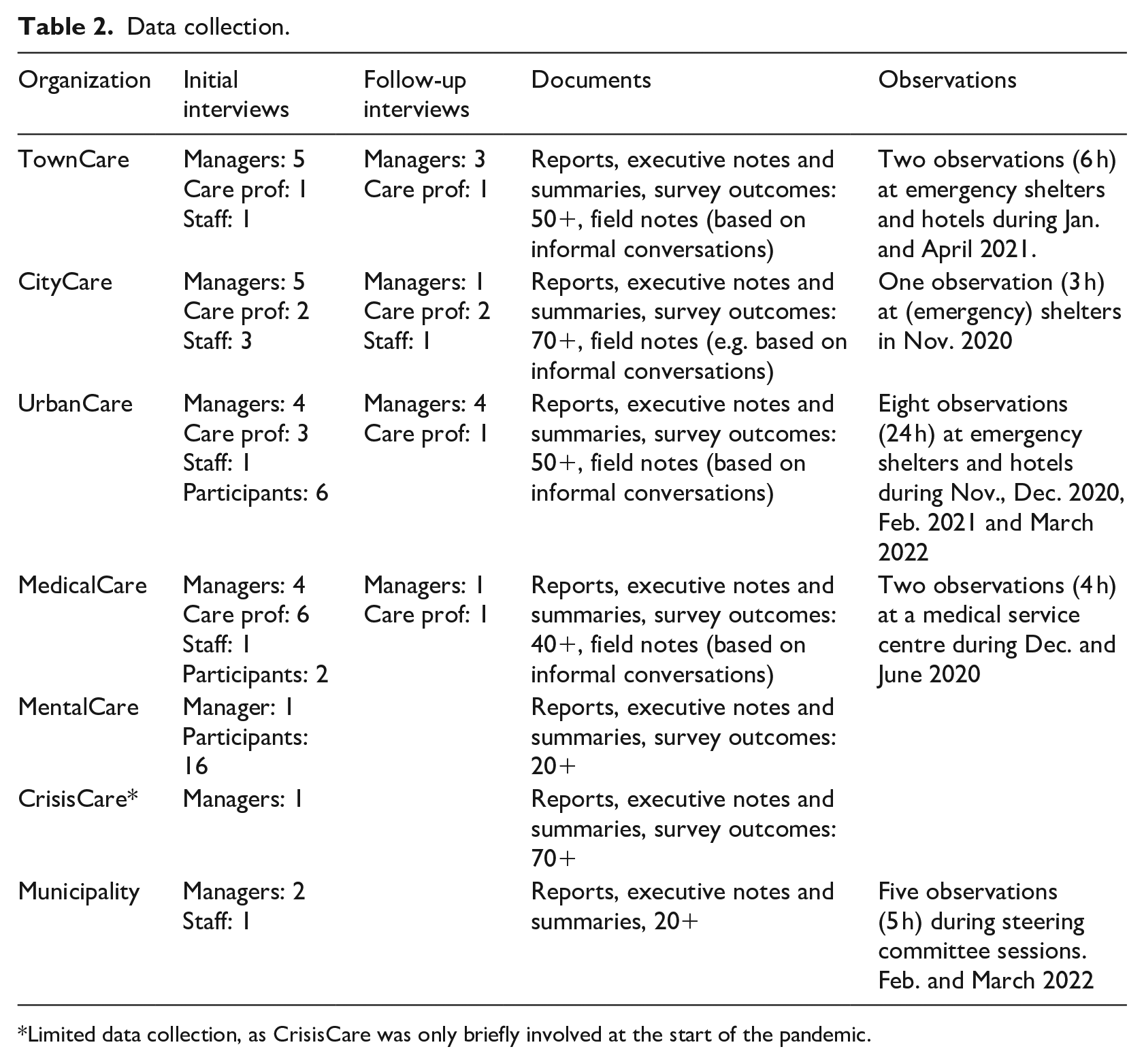
Limited data collection, as CrisisCare was only briefly involved at the start of the pandemic.
We interviewed informants between September 2020 and October 2022, which helped us capture pre-crisis experiences retrospectively, the initial crisis phase after March 2020, and then the ongoing crisis period roughly two years into the pandemic. Some interviews covered what was happening at that moment and, in others, respondents retrospectively reflected on what had happened. Most interviews were conducted by multiple researchers, enabling us to obtain an in-depth understanding of each interviewee’s perspective and ensuring a shared understanding of responses. Of all the interviews, 34 took place face-to-face, but due to lockdown measures most interviews were conducted as video calls over Zoom or Teams. All interviews were recorded and transcribed verbatim.
We allowed interviewees to share their own narratives and interpretations of collective action. The interview protocol included open questions regarding collective practices, such as: ‘How did you work together with other organizations?’ Over time, our interview questions evolved to address more specific issues, including temporal elements such as: ‘How did working together change from the first wave of the crisis to the second wave?’ Thus, we could delve into the emergence, continuation and interruption of collective action during the Covid-19 pandemic.
In addition to the interviews, we gathered observations related to how organizations planned collective responses to the ongoing crisis, what joint practices occurred, and how they interacted (see Table 3 in the Appendix). We mostly used these observations to triangulate the findings from our interview analysis. The total observation time was 42 hours (see Table 2). Field notes were taken to grasp temporal aspects, the organization of collective action and individual perceptions of change.
Other data sources included a wide range of documentation, such as published articles, internal organization documents and newspaper reports (see Table 2). These data sources mainly served to put the collective action into context and to create a timeline of governmental measures and SCOs’ responses (see Figure 1). Finally, we engaged in frequent conversations during site visits and on the phone, which served to triangulate emerging insights (Jick, 1979; Patton, 2002).
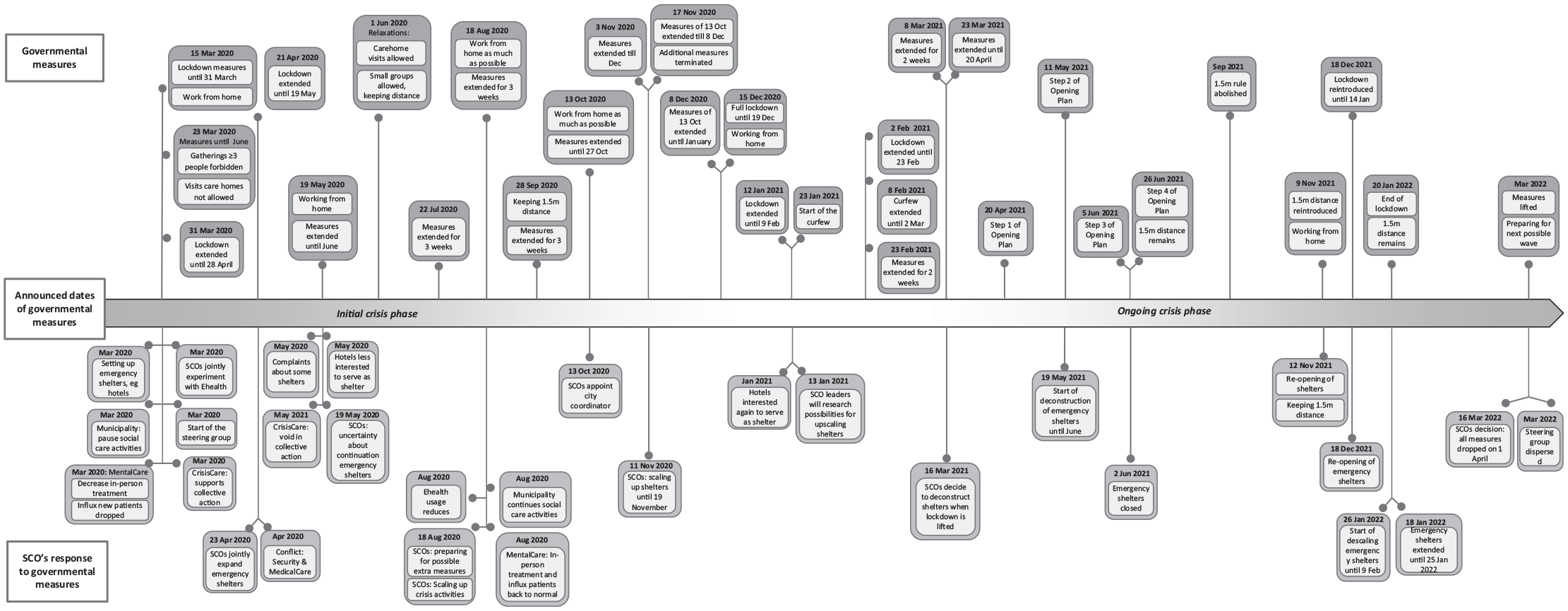
Timeline of governmental measures.
Data analysis
Because we understand collective action as an ongoing process, we used temporal bracketing (Langley, 1999) to identify meaningful analysis periods in our longitudinal data. The power of this method ‘lies principally in its capacity to enable the identification of specific theoretical mechanisms recurring over time’ (Langley, Smallman, Tsoukas & Van de Ven, 2013, p. 7). We constructed two temporal brackets: the initial crisis phase after March 2020 and the evolving crisis phase roughly two years into the pandemic. The initial crisis phase covers the shock that changed the SCOs’ temporal elements and perceptions in their ways of working, altering collective action. As the shock diminished, the ongoing crisis phase was characterized by frequent changes in governmental virus prevention measures, such as lockdowns (see Figure 1).
Our analysis proceeded in the following stages: (1) open coding of our data; (2) selecting collective action events; (3) identifying patterns of collective action; (4) inductive coding for explanatory concepts; and (5) constructing our explanation. First, we started with open coding of everything that seemed important. Each researcher coded multiple transcripts, analysed others’ coding approaches, and we discussed differences to reach a consensus on the coding. After coding 10 transcripts, we agreed on a code book, which remained open to additions and changes. The code book included descriptive codes about organizational characteristics and events, as well as specific codes on collective action and its coordination or interruption.
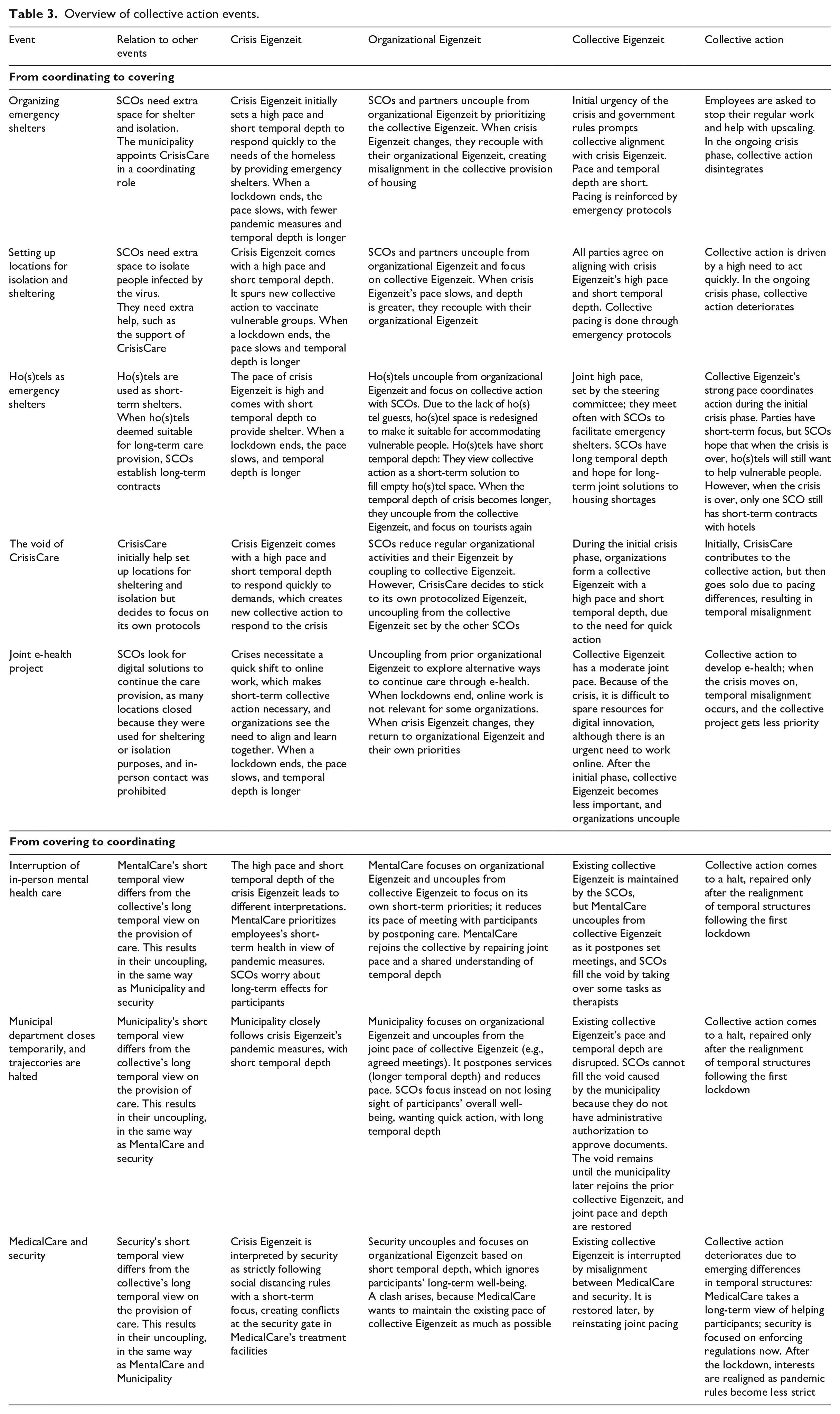
Second, we established an overview of events including salient changes in collective action, drawing on the interviews, field notes and documents. We identified eight, partly parallel, key events when collective action emerged or changed, such as the void in CrisisCare, and the MedicalCare and security interaction (see Table 3 in the Appendix).
Third, we identified two patterns of collective action with different starting points and outcomes. We identified these patterns through a detailed table of the key characteristics of all events, focusing on their temporal aspects, development of collective action and changes in these aspects over the two temporal brackets. By clustering events that showed similar temporal aspects and developed collective action, we identified two patterns. In the first pattern, organizations established (new) collective action which they were unable to maintain, and in the second pattern, organizations reduced their collective efforts in the previous joint provision of social care but restored their collective action soon after.
Fourth, we aimed to develop explanations for the specific dynamics in these two patterns by reading and re-reading the interview transcripts. Therefore, we coded aspects that could explain collective action and its changes in the two patterns, such as statements related to time pressure and differences in temporal schemes. Next, we formed theoretical concepts (second-order themes) based on our first-order observations, by consulting prior literature on collective action (e.g. Kornberger et al., 2019) and studies on the role of time and temporality in collective action (e.g. Geiger et al., 2020; Pérez-Nordtvedt et al., 2008). Insights from these studies (e.g. Bluedorn & Martin, 2008; Reinecke & Lawrence, 2022) informed the development of our theoretical concepts of pace and temporal depth.
We further found the notion of Eigenzeiten in the literature (e.g. Goetz, 2009; Nowotny, 1994). In our study, we identified three main types of Eigenzeit that influenced how collective action emerged, continued and was interrupted during the Covid-19 pandemic. For instance, an interview participant expressed what we conceptualize as crisis Eigenzeit: ‘In the first week, when a sports hall had to turn over all of sudden. It was there within 48 hours. (. . .) The municipality’s crisis organization was actually in the lead (. . .) and then you join as a [SCO]’ (UrbanCareManager2, 1 October 2020). Accordingly, crisis Eigenzeit is characterized by the pace and temporal depth set by external actors such as the government, through measures such as lockdowns, which changed frequently. Collective Eigenzeit is the joint understanding of pace and temporal depth across a collective of several organizations. Finally, organizational Eigenzeit is the developed pace and temporal depth within an organization, manifested, for instance, in the velocity of intra-organizational processes or planning horizons for internal projects. Figure 2 shows how we developed our codes based on our raw data and then moved to emergent theorizing (see Gioia, Corley & Hamilton, 2013).
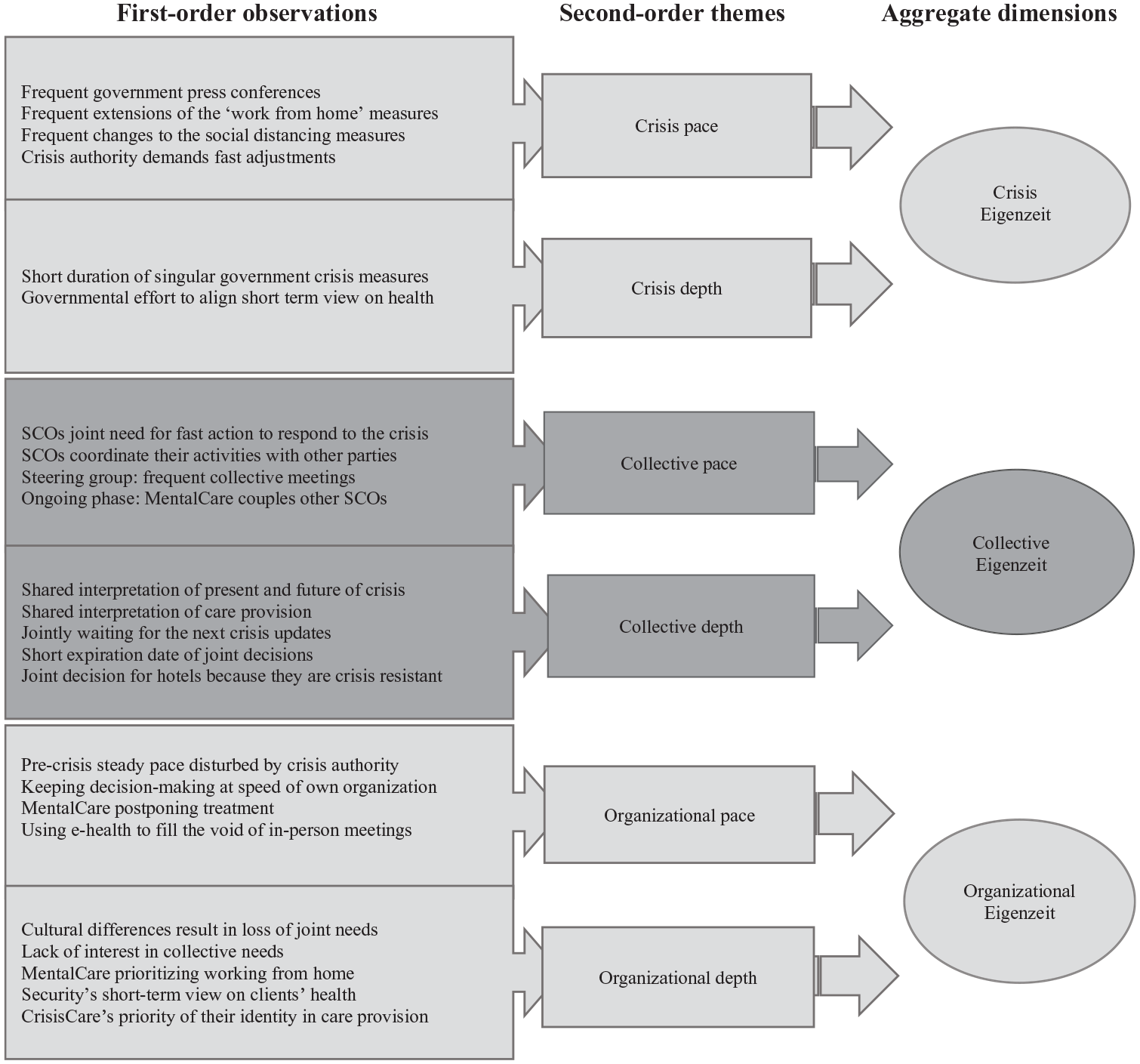
Data structure.
Finally, we constructed a narrative of the role of temporality in collective action (Berends & Deken, 2021; Langley, 1999) by moving from description to explanation and building generalizable theory from our evidence. We developed a conceptual model depicting the relationships across temporal dimensions and collective action (outcomes), which we then used to summarize our theory on the emergence, continuation and interruption of collective action in crisis situations.
Findings
Our findings demonstrate how the temporal structures of the Covid-19 pandemic changed the way that SCOs provided care to vulnerable groups. In the first pattern (from coordinating to covering), we identified organizations establishing new collective action, which we call coordinating, and after some time reducing their collective efforts again. Other organizations then had to fill the void, which we call covering (for others). In the second pattern (from covering to coordinating), organizations reduced their joint pre-crisis provision of care and needed some time to increase collective action again. These patterns illustrate the different ways organizations act collectively despite experiencing the same crisis environment. Next, we explored how the temporal dynamics of the crisis and the organizations can explain these two patterns of collective action. We selected two particularly salient events to illustrate these patterns of collective action, namely the setting up of emergency shelters and the interruption of mental health care. These events were of relatively long duration, provided rich data, and were regarded as critical by most interviewees and representatives at the city level.
Pattern 1: Emergency shelters – from coordinating to covering
The pattern from ‘coordinating to covering’ (which we find in five of the eight events in our study; see Table 3 in the Appendix) explains why organizations were able to act collectively initially but then struggled to continue. The initial crisis phase featured a high pace and short temporal depth of crisis Eigenzeit, which was set and reinforced by government crisis communication (e.g. through national press briefings; see Figure 1). The involved organizations interpreted the crisis Eigenzeit in a similar way and embraced a shared understanding of pace (e.g. ‘quick communication is needed’ (Doc40SteeringGroup, 20 March 2020)) and temporal depth (e.g. ‘we will communicate [actions] each Wednesday’ (Doc43SteeringGroup, 31 March 2020)). Thus, they jointly developed a new collective Eigenzeit that followed the pace and depth of the crisis Eigenzeit and they coupled their organizational Eigenzeiten with the collective’s. However, when the crisis became less salient, time perspectives and interpretations started to vary, which led organizations to uncouple from the collective Eigenzeit. Instead of working collectively, for instance, by jointly downscaling shelters, the SCOs returned to their pre-crisis pace and temporal depth. This created a void that eventually had to be covered. The example of emergency shelters illustrates this pattern clearly.
Initial crisis: Coordinating
At the start of the Covid-19 pandemic, different SCO leaders and the municipality joined a steering committee to ensure shelter for homeless people during the government’s lockdown orders. The steering committee had a history of acting collectively during the 2015 refugee crisis but had been inactive for seven years.
Crisis Eigenzeit: At the beginning, the crisis was characterized by a high pace urging quick action, and a short temporal depth of typically not more than three weeks: While everyone in the Netherlands must stay at home as much as possible (. . .), there is also a whole group of people who cannot stay at home, simply because these people do not have a home. (. . .) The municipality of [focal city], together with social care organizations, is quickly converting sports halls into emergency shelters. (Van der Meer, 2020)
The temporal structure of crisis Eigenzeit strongly impacted collective organizing, as SCOs always needed to be ready to adjust their plans. To coordinate the organization of emergency shelters in a few days, which demanded extensive logistics efforts, the SCOs came together in a steering committee meeting, to discuss their interpretation of the crisis. One interviewee shared how everyone was ready to take action: ‘It was like: “Okay, we’re working this out together and setting steps”’ (CityCareStaff1, 24 September 2020).
Collective Eigenzeit: The steering committee offered a crucial space in which the organizations could align their temporal structures, helping the SCOs to coordinate the process of providing social care. For example, ‘In the steering committee [on Wednesday] we agreed that everyone would be ready to host X participants on Friday’ (Doc67SteeringGroup, 30 November 2020). Because they had agreed on an interpretation of the government’s crisis communication, the SCOs developed a collective Eigenzeit, which followed the high pace and short temporal depth of the crisis Eigenzeit. A municipality staff member reflected as follows: Well, tomorrow we just need to make a decision. We cannot think about it for a month, as we did in the past. We just have to go forward quickly. That’s so different compared to what we were used to. (MunicipalityStaff1, 28 June 2021)
Furthermore, the decisions would never last long as ‘you were always looking [only] two or three weeks ahead’ (MunicipalityManager1, 30 June 2021). This limited horizon helped SCOs to establish new collective action, as decisions always had a foreseeable expiration date.
The steering group committee meetings were held on Wednesdays, the day after the government announcements. Thus, the different organizational members had little time to form individual conclusions about how to deal with the new government measures. This joint approach was supported by the higher management of the SCOs who relaxed existing schedules to push the development of a collective Eigenzeit: In times of crisis everything becomes fluid. And suddenly everyone is available to discuss every week. All people, also at managerial, director level, with full agendas, managed to create free time every Wednesday from one to two o’clock. (MunicipalityManager1, 30 June 2021)
The SCOs made setting the collective Eigenzeit a high priority on everyone’s agenda.
Organizational Eigenzeit: The original Eigenzeiten of the different organizations lost their force as ‘for the main part of the week, you were only working on that, (. . .) very intensively, with [TownCare] and with [CityCare] to see how we could set up all those facilities as quickly as possible’ (UrbanCareManager2, 1 October 2020). Eventually, the crisis enabled organizations to couple with the collective Eigenzeit and to decouple from their organizational Eigenzeiten: If you compare it with how things went normally, then I think you can say that the collective and the sense of collectivity became much more important than usual [pre-crisis phase]. (MedicalCareManager 4, 6 July 2021)
Hence, the temporal structures of single organizations were relegated to the background to make collective action possible: ‘Everyone gave in and thought: ok, you know, we will just do it like that, because we indeed need to get the shelters organized’ (MunicipalityStaff 1, 28 June 2021). A manager reflected that the pandemic ‘changed my job a lot (. . .). From being (. . .) someone who has to make the teams run well by arranging the conditions for [regular] work (. . .). Now everything became centered on corona’ (MedicalCareManager 4, 6 July 2021). Although they were not always pleased, SCO employees postponed their own interests for the time being: Internally, I would push it, as (. . .) I felt the obligation to actually deliver. (. . .) Yet internally, there was resistance: why do we need to solve this? (. . .) At the level where we [the steering committee] were, we, yes [we said:] what must be done, needs to be done. It has to be resolved. (TownCareManager1, 13 June 2022)
Most notably, the strong influence of the collective Eigenzeit became visible when steps of regular bureaucratic decision-making process were skipped to enable quick decision-making: During a crisis (. . .) you see what you can get done in a few days, which normally takes a week to discuss, and still no decision would be made. So the decisiveness [during a crisis] is very high, and very pragmatic. (TownCareMananager1, 26 October 2020)
Organizations would usually stick to their own temporal structures that took the form of long decision-making procedures and protocols. However, the high pace and short temporal depth of collective Eigenzeit caused and enforced by the crisis, helped to overcome bureaucratic barriers that would normally hinder collective action.
Ongoing crisis: Covering
With time, the crisis evolved, which had an effect on the temporal structures that we observed.
Crisis Eigenzeit: The pressure of the crisis faded away as soon as the government started softening the pandemic control restrictions (see Figure 1). In consequence, the crisis became less prevalent and the need for crisis-driven shelter for homeless people decreased. The steering committee next started to question the coordination of collective action: ‘Whether the corona team will continue to remain in existence is being questioned’ (Doc52SteeringGroup, 28 May 2020). Still, many steering committee members sought to continue providing shelter for homeless people collectively, but the SCOs started to decouple. Without crisis Eigenzeit, it became difficult for the steering committee to continue pushing the high pace and short temporal depth of collective Eigenzeit. Instead of coordinating, each organization embraced its own way of providing care.
Organizational Eigenzeit: In the ongoing crisis phase, the SCOs were reminded ‘that the cultural differences between the organizations are quite large. During a crisis, they are invisible’ (UrbanCareManager2, 22 July 2021), which made it easier to agree on a joint approach when the pace of the crisis was fast and the depth of each decision was foreseeably low. Further, organizations realized: ‘You can’t keep up with the intensity of the crisis forever (. . .) It’s about searching for a balance (. . .) You have to safeguard that balance’ (MunicipalityManager1, 20 October 2022). Eventually, the high pace of crisis and collective Eigenzeit was gradually experienced as conflicting with the steady (pre-crisis) pace of the organizational temporal structures. In particular, there was a need to get back to day-to-day activities, which were put on hold during the initial crisis phase, and with that, a slower pace and a longer temporal depth of work returned: Everyone naturally just dropped everything (. . .) and just started running really hard. (. . .) When that running stops, everyone picks up their [own] work again, and then, you have that transition phase from crisis to regular. And then, you just can’t always manage that. (TownCareManager1, 13 June 2022)
This focus on the previous organizational Eigenzeit also brought back old protocols and procedures. This was much to the frustration of a TownCare manager and steering committee member who would have liked to see the continuation of collective action: The crisis is not really gone, but the regular things also start again. And that does not work well. (. . .) Some urgent things [collective action of organizing emergency shelters] still have to be finished, but that does not fit anymore with the agreements that are there [inside the organization]. (TownCareManager1, 13 June 2022)
This tension between the organizational and collective Eigenzeit eventually also impacted the collective Eigenzeit.
Collective Eigenzeit: Several forces disrupted the collective Eigenzeit formed by the steering committee. Without the high pace and short temporal depth of the crisis Eigenzeit, the steering committee could no longer maintain the collective Eigenzeit’s temporal structure. Even though the steering committee still agreed on some follow-up actions, organizations uncoupled from the collective Eigenzeit, such that ‘it faded away a bit last summer. We then decided: we don’t meet every week, we meet once every three weeks’ (MunicipalityManager1, 30 June 2021). Moreover, organizational leaders went from allowing the steering committee to maintain the collective temporal structures during the initial crisis phase to prioritizing organizational Eigenzeit once the crisis became less pressing.
Although the short depth of collective Eigenzeit was an advantage during the initial crisis phase that enabled collective action, it made it difficult for organizations to plan ahead. No agreement had been reached for long-term collective action. This was also influenced by the fact that some actors expected that the crisis would continue in the same way as it did before: [The lockdown] was extended again and again. So many people started to think it will be extended again. So, when there was the moment that it really ended, people still thought: ‘yeah, but they will extend it again’. But yes, it does stop at a given moment. That was very difficult. We should have done more to prepare for that: what can we do when the emergency shelter stops? (MunicipalityStaff1, 28 June 2021)
A manager reflected: ‘We evaluated the collaboration and the way of organizing (. . .). It appeared that we were way too late made a difference between crisis [time] and the longer term’ (UrbanCareManager2, 22 June 2022). Collective action deteriorated without reaching any agreement about how to downscale emergency shelters, as notes from the steering committee showed (Doc170SteeringGroup, 1 June 2021).
This had a negative impact on providing housing for homeless people, as they had to leave their temporary homes without any interim arrangements. The lack of collective action created a void that needed to be filled: There is the internal procedure which people want to follow. And the emergency shelter is closing tomorrow, we could start doing intakes the day after tomorrow. But then the [Municipality] starts to call: ‘You can’t put those people on the street for two days. Can you do the intake a week earlier?’ (. . .) The [internal] department says: ‘We have our way of operating and we want to stick to that.’ The crisis phase is over, so we will just do the normal procedure (. . .) Then you experience a tension: (. . .) Nobody wants those people to live on the street (. . .). It is just a conflict about tempo. Would it be possible to speed it up? (TownCareManager1, 13 June 2022)
In the end, UrbanCare needed to cover for the shelter of those people, as the internal TownCare procedures could not be rushed. Eventually, all organizations returned to providing shelter to vulnerable groups at their own pace and temporal depth, thereby covering the social care that could have also been provided collectively.
Pattern 2: Mental health care – From covering to coordinating
Despite the same crisis context, a different temporal dynamic manifested in a reversed pattern, ‘from covering to coordinating’, which we found in three of the eight events in our study (see Table 3 in the Appendix). In contrast to the first pattern, these organizations had engaged in collective action before the start of the pandemic and agreed on a collective Eigenzeit with an established steady pace and a long temporal depth. However, during the initial crisis phase, they suddenly prioritized their own interpretation of what the crisis would mean for their practices, rather than agreeing on an adjusted collective Eigenzeit. Other organizations stepped in to cover for this lack of collective action and dealt with the resulting void. As the crisis evolved, organizations saw the consequences for their partnering organizations and their participants. This prompted a resumption of collective action through recoupling with, and restoring of, collective Eigenzeit. We turn to one vivid example of this pattern: the pause in the provision of in-person social and mental health care.
Initial crisis: Covering
Before the start of the Covid-19 pandemic, TownCare, CityCare, UrbanCare, MedicalCare and MentalCare collectively offered social care and psychiatric treatment to participants. MentalCare provided psychiatric specialists, while the other organizations arranged housing, counselling and daily activities.
Crisis Eigenzeit: To prevent the corona virus from spreading, the government communicated strict measures that impacted how care was provided: People are urged to work from home as much as possible or to spread working hours. There is also an urgent request to visit vulnerable persons as little as possible. (Het Parool, 2020)
Similar to the first pattern, the government measures set the temporal structures of the crisis with a high pace and a short temporal depth but, here, they had the opposite effect. While most organizations assumed that all parties would maintain the existing collective Eigenzeit, implying a steady pace of visiting participants and a long depth of planning ahead, they did not explicitly discuss their interpretation of the crisis and its implication for maintaining existing collective action with each other. Eventually, this assumption turned out to be wrong. MentalCare decoupled from the previously set collective temporal structures, as they had their own interpretation of what the crisis implied for the provision of care: Every organization makes very clear rules for itself and that someone from [MentalCare], for example, says: ‘We no longer go on a home visit, because that is no longer allowed’ (. . .) and what are you going to say? (. . .) Of course everyone also opts for the best in their own organization. (TownCareManager10, 26 October 2020)
Organizational Eigenzeit: MentalCare justified its decision by referring to the government pressure and their need to prevent the corona virus from spreading in their facilities. This led to a high willingness to follow the enforced rules: ‘Of course, we conformed to that request (. . .). [MentalCare] strictly followed the corona measurements’ (MentalCareManager1, 22 October 2021). Thus, instead of following the existing pace and temporal depth of collective Eigenzeit or working on a joint adjustment to the crisis, MentalCare immediately paused house visits to its participants. The organization expected that the lockdown would end soon, implying a short depth of how long the measurements would be in place. Thus, MentalCare believed that for a short while it would be fine that psychiatrists should take care of their own safety and postpone their meetings or, at best, hold online or telephone sessions: Quite a few people [at MentalCare] thought ‘Of course we need to provide support but it’s not that urgent.’ We also collaborate with other organizations so the question arose whether it is really needed to let every organization become involved: ‘If they [SCOs] already see the participants, why should we?’ But it turns out that it does matter. (CityCareProfessional3, 23 November 2020)
The other SCOs criticized MentalCare: ‘[MentalCare] gave the message, “we cannot, we are not allowed, so we will not do that [in-person treatment]”, while of course the vulnerable people were in need of that care (. . .). Its position was to protect their employees’ (TownCareManager1, 13 June 2022). MentalCare’s decision interrupted collective action.
Collective Eigenzeit: An employee of a partnering organization shared how the short notice of MentalCare pausing its participant visits made it difficult to continue the joint provision of care: ‘That was really devastating, that the entire treatment of trauma stopped, while people were in the middle of a trajectory. That was very sudden, very intense’ (TownCareManager4, 21 October 2020). The resulting void of mental care in the collective care provision was a shock for the other partners: ‘I saw that [MentalCare] withdrew (. . .) and we were like “okay and now what?”’ (CityCareStaff1, 2 June 2022).
The other SCOs prioritized continuation of the prior existing collective Eigenzeit with a steady pace and long temporal depth of treatment for their participants. For them it was difficult to comprehend MentalCare’s decision: ‘We really criticized [MentalCare]. They suddenly stopped providing [in-person] care, even in emergency situations. This made us angry’ (CityCareStaff2, 11 February 2020). MentalCare’s choice also had severe impacts on the well-being and psychiatric symptoms of participants who could not get the help they needed: ‘I called [MentalCare], the crisis response, the “hotline”, the suicide hotline several times (. . .). I called [MentalCare] but they were closed, forcedly’ (MentalCareParticipant11, 21 January 2021).
While MentalCare believed that the lockdowns would end soon and that they could temporarily pause long-term treatment, the other organizations interpreted the situation differently. They wanted to prevent long-term negative effects for participants: There are concerns about loneliness, neglect, mental well-being and lack of mental health guidance. Some locations report less drug use, others more drug and alcohol use (. . .) also because of the loss of structure and daytime activities. (CityCare internal report, July 2020)
Noticing the severe impact on their participants, the other organizations searched for innovative ways to continue providing in-person interactions. As one social care provider put it: ‘A battle emerged. MentalCare decided to downscale and we had to upscale activities. It was hard to arrive on the same page’ (MedicalCareProfessional5, 11 June 2020). The other SCOs wanted to maintain the steady pace and long temporal depth of the previously established collective Eigenzeit to provide participants with continuity.
By covering responsibilities that belonged to MentalCare, the other organizations tried to prevent participants’ psychological symptoms from worsening. This covering demanded significant effort: ‘In the very short term, all reins were pulled extremely tight’ (CityCareProfessional1, 20 November 2020). During this process, SCOs became anxious and time-sensitive about how long it would take MentalCare to take up their responsibilities again: The [MentalCare] practitioners did not show up and they were really strict: ‘We work from home and we don’t see our participants anymore’. Then, I really got this feeling: ‘What are you saying? Ok, so now I need to also take over the role of a practitioner?’, I really felt this pressure and I also thought this should not carry on for too long. (CityCareProfessional4, 10 November 2020)
It was clear that the SCO professionals were unable to keep covering for MentalCare.
Ongoing crisis: Coordinating
When the Covid-19 pandemic and the consequences of MentalCare’s withdrawal became foreseeable, collective action was restored again.
Crisis Eigenzeit: When the immediate pressure of the crisis faded away after the initial crisis phase, organizations started reflecting on what had happened. The public reacted negatively to MentalCare’s decision, noting: ‘There were stories going around about “[MentalCare] is not performing well” and “their participants are abandoned during treatment” (. . .) [MentalCare] always reaches the newspaper headlines’ (MedicalCareProfessional1, 1 October 2020). This led to a recalibration of MentalCare’s priorities.
Organizational Eigenzeit: MentalCare returned to providing in-person mental health care, coupling their organizational Eigenzeit again with the collective’s: We were a bit shocked about the effects of our decision to stop providing [in-person] care. So, we quickly restarted our treatment for the participants and concluded that we are not going to do the same as in the first wave of the crisis. When we started our activities again (. . .) every organization of course, (. . .) will turn inwards and look for solutions. (MentalCareManager1, 22 October 2021)
In recoupling with collective Eigenzeit, MentalCare agreed to restore the joint pace for in-person treatment, defined by a set schedule of meetings, even during subsequent lockdowns: ‘We saw in the first wave how quickly it could go wrong. And we’ve been so terrified by that, so for the second wave we thought: “this won’t happen to us again”’ (MentalCareManager1, 22 October 2021). Moreover, to ensure that MentalCare would couple again with the collective temporal structures, other organizations proposed a joint understanding of what future treatment plans would look like for each patient: Especially [MentalCare] plays a big role, because our participants mostly have a [MentalCare] background. So you try to synchronize with [MentalCare], and make clear ‘when will you see the participant, and when should we go?’ To make sure the participant sees enough people, and to have an eye on what’s going on. (CityCareProfessional3, 23 November 2020)
Collective Eigenzeit: By agreeing on a joint interpretation of the crisis the organizations were able to follow the original steady pace and long temporal depth of their work. This helped them to more effectively coordinate their actions: There is now actually an updated overview of [MentalCare] every week or even twice a week. That was not the case until now (. . .) it provided a push for cooperation with all parties. (. . .) So that’s a very clear result. (MedicalCareProfessional1, 27 July 2021)
Vulnerable participants who had previously complained about the lack of MedicalCare’s health services were seeing their caregivers again: ‘They come to my house and help me mentally (. . .) with conversations and also walking, for example, (. . .) once every two weeks now. If things get worse, you can always call, then they come more often’ (CountingCareParticipant10). Eventually, organizations returned to providing collective care.
Conceptual model of temporality in collective action during a crisis
Building on the analysis of all eight collective action events, including the events we have detailed above, we can theorize about how collective action moves between coordination and covering through the coupling and uncoupling of crisis, collective and organizational Eigenzeit. This approach establishes a better understanding of the emergence, continuation and interruption of collective action in different crisis phases. Figure 3 shows a conceptual model that illustrates the different emerging concepts and their interrelationships.
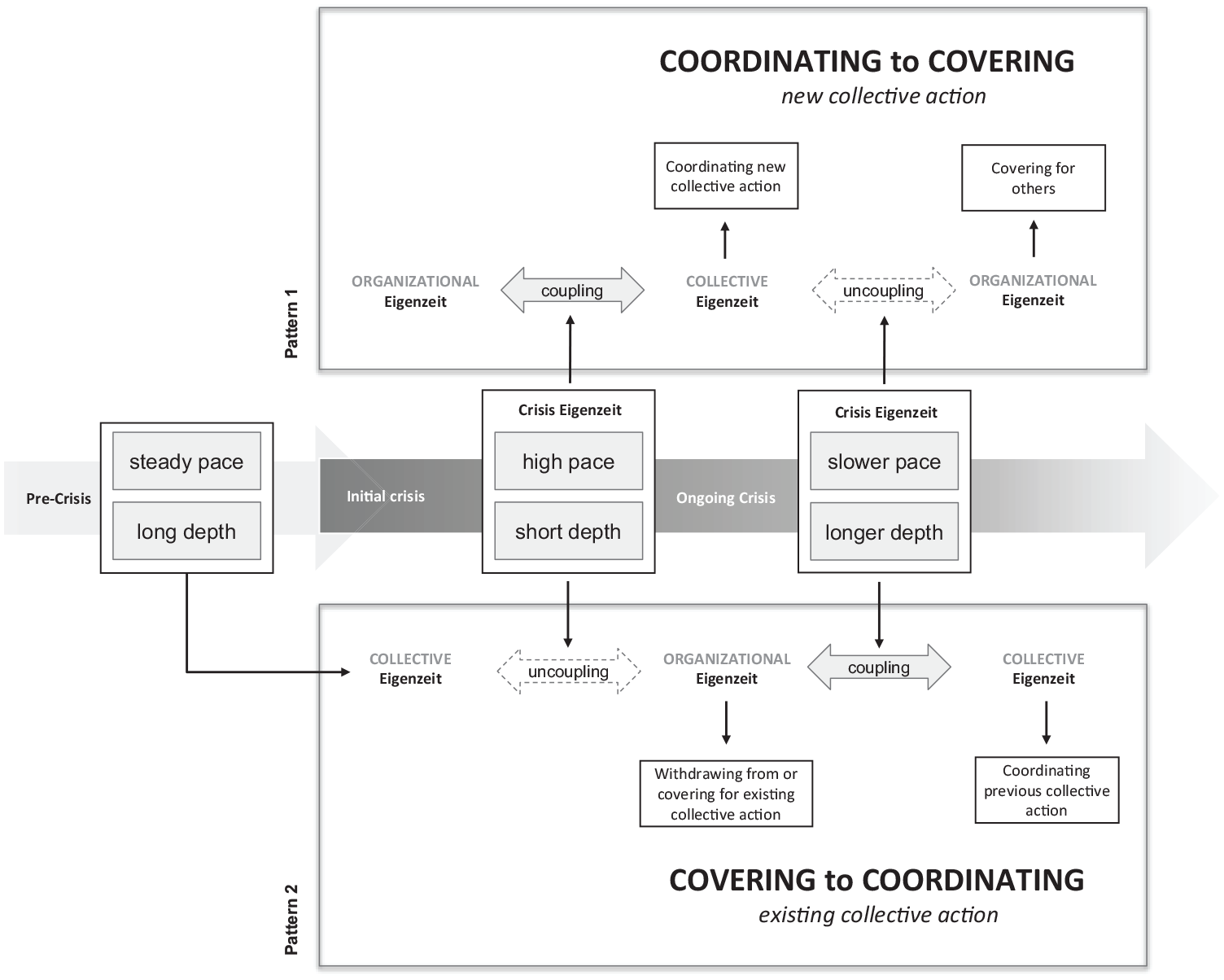
Conceptual model of temporality and collective action.
The two patterns of collective action highlight key differences for the progression of collective action in a crisis. In the first pattern, from coordinating to covering, the high pace and short temporal depth of the crisis Eigenzeit are able to push collective action during the initial phase of the crisis (see the top box in Figure 3). This high pace and short temporal depth of the crisis helps organizations to couple their organizational Eigenzeiten with a jointly set collective Eigenzeit. As a result, they are able to overcome barriers such as organization-specific protocols and to coordinate new collective action. During the ongoing crisis, however, when a slower pace and longer temporal depth of the crisis Eigenzeit unfolds, it is difficult for actors to maintain the high pace and short temporal depth of the collective Eigenzeit. If the collective is unable to jointly adjust or renegotiate their Eigenzeit to a slower pace and longer temporal depth, the original temporal structures of the single organizations resurface. The organizations consequently uncouple from the collective Eigenzeit and collective action deteriorates. Organizations then need to cover individually for the care that had previously been provided collectively. Thus, while the high pace and short temporal depth of the crisis were initially enablers of new collective action, it also hindered thinking about long-term agreements and consolidation.
The second pattern, from covering to coordinating, has a different starting point (see the bottom box in Figure 3). Whereas the first pattern is about urgent action in response to a crisis, the second pattern starts where collective action already existed. Here, the high pace and short temporal depth of the crisis disrupts the existing steady pace and long temporal depth of the collective Eigenzeit. In our case study, when the different organizations were unable to find a joint interpretation of the crisis to adjust their collective Eigenzeit, some of them ended up prioritizing their own organizational Eigenzeiten. This led to an uncoupling of organizational Eigenzeit from the collective. As a result, some organizations paused their contribution to collective action, which others tried to cover for. However, during the crisis there was time to align interpretations and synchronize the temporal structures again, making it possible to restore collective action.
Discussion and Conclusion
Our study addresses how temporality influences the emergence, continuation and interruption of collective action in a crisis situation. Our findings contribute two main insights to understanding collective action, along with important implications for practice and suggestions for further research.
Theoretical implications for understanding collective action
First, we contribute to knowledge about collective action in a crisis by elucidating the role of temporality in the emergence, continuation and interruption of collective action. A temporality perspective complements collective action theory by suggesting that it is not just aligning resources, environments, or interests that is needed to realize collective action but also the temporal synchronization of actions and experiences over time (Blagoev & Schreyögg, 2019; Geiger et al., 2020; Pérez-Nordtvedt et al., 2008). Even when the organizations have shared interests and goals – e.g. shared perceptions of the requirements of vulnerable people and the care they need to receive – parties’ collective actions can deteriorate if temporal alignment diminishes.
To understand temporality in collective action during a crisis, our temporal concepts need clarity and coherence (Blagoev, 2023; Blagoev & Schreyögg, 2025), and so we conceptualized the interactions of the different Eigenzeiten that play a role. Prior studies on temporal alignment generally highlight the conflict between clock time and process time within one system (Blagoev & Schreyögg, 2025; Pérez-Nordtvedt et al., 2008), for example, the tension between the standardized industry-imposed working hours versus actors’ desired working hours that align with their natural work rhythms (Blagoev & Schreyögg, 2019). We show that for collective action in a crisis setting, a more complex interaction is likely, because different temporal schemes (in our case, three different Eigenzeiten), each with its own pace and depth, play a role. Importantly, this interaction evolves differently when there are different starting points (i.e. new versus existing collective action), giving fundamentally different outcomes in terms of the emergence, continuation and interruption of collective action. Whereas the high pace and short temporal depth of the crisis Eigenzeit can be conducive to forming new collective action, we illustrate that it might also interrupt existing collective action with a steady pace and long temporal depth.
That crisis Eigenzeit can have simultaneously positive and negative effects on collective action is an intriguing finding, as others have predominantly argued either for alignment and continuation, or instead for misalignment and disruption (Blagoev & Schreyögg, 2025). Studies that focus on the formation of alignment and continuation outside a crisis context (see Hernes, 2014; Hussenot & Missonier, 2016) often lack sufficient attention to the formation of misalignment (Danner-Schröder & Geiger, 2016; Feldman et al., 2022; Geiger et al., 2020; Pérez-Nordtvedt et al., 2008). In contrast, studies on collective action in crises have shown both alignment and misalignment, but those studies have separated these two aspects, illustrating that in a crisis coordination can be achieved (e.g. Feldman et al., 2022), but that a sense of urgency also tends to create misalignment (Kunisch et al., 2017). Interestingly, we show that especially in the initial phase of a crisis, the high pace and short temporal depth of a crisis can interrupt existing collective action as it triggers organizations to uncouple from the existing collective Eigenzeit. At the same time, the high pace and short depth of the crisis help to quickly establish a new collective temporal structure because they help to overcome cultural and bureaucratic hurdles. In the end, only alignment with the jointly created collective Eigenzeit facilitated effective collective action.
Thus, by conceptualizing Eigenzeiten and coupling with or uncoupling from different Eigenzeiten, researchers gain a better understanding of the emergence, continuation and interruption of collective action in crisis contexts. Consider, for example, Danner-Schröder and Müller-Seitz’s (2020) study of differences and contradictions across temporary and permanent organizations’ responses to the refugee crisis in Germany. The authors show that combining temporary and permanent ways of organizing creates friction but that they are also co-dependent, because they work in the same context and address the same needs. Based on our conceptualization, we suggest that these frictions and changes in co-dependence and alignment over time can be better understood by identifying the Eigenzeiten of the different forms of collective action and their interactions.
Second, we add important insights to understanding temporality as we explain how temporal alignment and misalignment develop over time, mainly triggered by changes in crisis Eigenzeit, which can explain crucial variations in collective action throughout a crisis. As our first pattern showed, organizations can quickly form consensus on collective Eigenzeit, resulting in effective collective action. Yet, as crisis Eigenzeit changes to a slower pace and longer temporal depth, they tend to uncouple as they cannot maintain the high pace of the newly formed collective action, interrupting the collective action. The second pattern shows the opposite, as organizations uncouple from a previously agreed-on collective Eigenzeit and instead follow their organizational Eigenzeit and their own interpretation of the crisis. Notably, while uncoupling from the collective Eigenzeit may be deliberate, the effect on the collective action might be unexpected and unwanted.
Building on previous research on temporal coupling and temporal work under uncertainty (e.g. Blagoev & Schreyögg, 2019, 2025; Kent & Granqvist, 2024), we demonstrate that organizations transition between different temporal structures in the same crisis, but this does not always result in robust long-term collective action. We theorize about a pattern of temporal misalignment and alignment related to the interruption and restoration of collective action, using the same three Eigenzeiten while considering their pace and depth. The grounding of both patterns in our data shows the robustness of our perspective and emphasizes the importance of studying detailed patterns (see Geiger et al., 2020).
The most influential aspect we identified is the changing nature of crisis Eigenzeit in evolving collective action over time, which aligns with Hernes, Blagoev, Kunisch, & Schultz’s (2025) argument that crises not only create immediate impacts but importantly unfold across different temporal trajectories. Rather than viewing crises as isolated events, their evolving nature should also be understood. Although the initial impact of crisis Eigenzeit has been noticed before (e.g. Feldman et al., 2022; Kunisch et al., 2017; Skade et al., 2024), it has typically not been examined through the double-faced nature that we found. Thus, identifying and conceptualizing these reversed patterns over time is an important contribution. Crisis Eigenzeit is not stable; its pace and temporal depth change over time (see Skade et al., 2024), impacting organizations’ coupling with and uncoupling from collective Eigenzeit. Over time, one might expect that new collective action can be restored outside periods of high pace and short temporal depth of crisis Eigenzeit, as organizations learn to flexibly bridge different temporal structures (reflecting for instance the findings of Feldman et al., 2022). However, in our study it was striking that each wave of the crisis (and the associated lockdowns) brought back the same pattern. It appears challenging for the collaborating organizations to consistently and flexibly bridge between these temporal structures and to maintain coupling organizational to collective Eigenzeit when it comes to new collective action.
Thus, the patterns and explanations we offer help elucidate the interactions of different temporal structures, which then explain processes for the emergence, continuation and interruption of collective action. Our theory highlights how temporality establishes both alignment and continuity, as well as misalignment in collective action.
Implications for practice
A key practical implication of this study is that actors need to attend to both their own and their partners’ Eigenzeiten. Otherwise, they risk interrupting collective action due to potential misalignment or an inability to coordinate with partners. Such outcomes can arise regardless of joint interests and the need to act collectively. Therefore, in crises, organizations are advised to actively manage temporal alignment to coordinate collective action.
Moreover, some organizations can align through crisis protocols and training for crises so their staff and volunteers are well prepared (e.g. Geiger et al., 2020). However, the uncertainty of a crisis may require more flexible, ad hoc solutions so that actors can adapt to the quickly changing situation. This highlights the limitations of preparation and pacing through protocols.
Limitations and further research opportunities
We acknowledge limitations of our study. First, the specific contextual features of our SCOs might limit the transferability of our findings. The pace and temporal depth of Eigenzeiten may play a less critical role in other sectors, and the roles of multiple Eigenzeiten could be idiosyncratic. Second, our collection and analysis of the pre-Covid-19 data started after the first pandemic wave, which could introduce some retrospective distortion, potentially omitting some negative and positive experiences. Third, the Covid-19 pandemic is unique relative to other crises, so it is difficult to make comparisons. Fourth, although our findings highlight the important role of temporality in collective action, other aspects, such as the self-interest of organizations that leads them to focus on their own organizational Eigenzeit, may also exert influences. Therefore, a temporal explanation of collective action should be connected with other aspects involved in collective action.
Conclusion
Our study provides novel insights into the role of temporality for collective action during crises, highlighting the crucial role of the interaction between multiple Eigenzeiten for the emergence, continuation and interruption of collective action by organizational actors. We reveal that the starting point of collective action, new or existing, is crucial and we explain how it evolves throughout the crisis by emphasizing that misalignments in pacing and temporal depth can disrupt collective efforts. If managed effectively, aligning temporal structures between different organizations can help sustain and strengthen collective action, even when interpretations of crisis Eigenzeit change over time. Thus, addressing temporal dynamics can be a crucial puzzle piece to prevent interruptions and support continued collective action.
Footnotes
Appendix
Overview of collective action events.
| Event | Relation to other events | Crisis Eigenzeit | Organizational Eigenzeit | Collective Eigenzeit | Collective action |
|---|---|---|---|---|---|
|
|
|||||
| Organizing emergency shelters | SCOs need extra space for shelter and isolation. The municipality appoints CrisisCare in a coordinating role | Crisis Eigenzeit initially sets a high pace and short temporal depth to respond quickly to the needs of the homeless by providing emergency shelters. When a lockdown ends, the pace slows, with fewer pandemic measures and temporal depth is longer | SCOs and partners uncouple from organizational Eigenzeit by prioritizing the collective Eigenzeit. When crisis Eigenzeit changes, they recouple with their organizational Eigenzeit, creating misalignment in the collective provision of housing | Initial urgency of the crisis and government rules prompts collective alignment with crisis Eigenzeit. Pace and temporal depth are short. Pacing is reinforced by emergency protocols | Employees are asked to stop their regular work and help with upscaling. In the ongoing crisis phase, collective action disintegrates |
| Setting up locations for isolation and sheltering | SCOs need extra space to isolate people infected by the virus. |
Crisis Eigenzeit comes with a high pace and short temporal depth. It spurs new collective action to vaccinate vulnerable groups. When a lockdown ends, the pace slows and temporal depth is longer | SCOs and partners uncouple from organizational Eigenzeit and focus on collective Eigenzeit. When crisis Eigenzeit’s pace slows, and depth is greater, they recouple with their organizational Eigenzeit | All parties agree on aligning with crisis Eigenzeit’s high pace and short temporal depth. Collective pacing is done through emergency protocols | Collective action is driven by a high need to act quickly. In the ongoing crisis phase, collective action deteriorates |
| Ho(s)tels as emergency shelters | Ho(s)tels are used as short-term shelters. When ho(s)tels deemed suitable for long-term care provision, SCOs establish long-term contracts | The pace of crisis Eigenzeit is high and comes with short temporal depth to provide shelter. When a lockdown ends, the pace slows, and temporal depth is longer | Ho(s)tels uncouple from organizational Eigenzeit and focus on collective action with SCOs. Due to the lack of ho(s)tel guests, ho(s)tel space is redesigned to make it suitable for accommodating vulnerable people. Ho(s)tels have short temporal depth: They view collective action as a short-term solution to fill empty ho(s)tel space. When the temporal depth of crisis becomes longer, they uncouple from the collective Eigenzeit, and focus on tourists again | Joint high pace, set by the steering committee; they meet often with SCOs to facilitate emergency shelters. SCOs have long temporal depth and hope for long-term joint solutions to housing shortages | Collective Eigenzeit’s strong pace coordinates action during the initial crisis phase. Parties have short-term focus, but SCOs hope that when the crisis is over, ho(s)tels will still want to help vulnerable people. However, when the crisis is over, only one SCO still has short-term contracts with hotels |
| The void of CrisisCare | CrisisCare initially help set up locations for sheltering and isolation but decides to focus on its own protocols | Crisis Eigenzeit comes with a high pace and short temporal depth to respond quickly to demands, which creates new collective action to respond to the crisis | SCOs reduce regular organizational activities and their Eigenzeit by coupling to collective Eigenzeit. However, CrisisCare decides to stick to its own protocolized Eigenzeit, uncoupling from the collective Eigenzeit set by the other SCOs | During the initial crisis phase, organizations form a collective Eigenzeit with a high pace and short temporal depth, due to the need for quick action | Initially, CrisisCare contributes to the collective action, but then goes solo due to pacing differences, resulting in temporal misalignment |
| Joint e-health project | SCOs look for digital solutions to continue the care provision, as many locations closed because they were used for sheltering or isolation purposes, and in-person contact was prohibited | Crises necessitate a quick shift to online work, which makes short-term collective action necessary, and organizations see the need to align and learn together. When a lockdown ends, the pace slows, and temporal depth is longer | Uncoupling from prior organizational Eigenzeit to explore alternative ways to continue care through e-health. When lockdowns end, online work is not relevant for some organizations. When crisis Eigenzeit changes, they return to organizational Eigenzeit and their own priorities | Collective Eigenzeit has a moderate joint pace. Because of the crisis, it is difficult to spare resources for digital innovation, although there is an urgent need to work online. After the initial phase, collective Eigenzeit becomes less important, and organizations uncouple | Collective action to develop e-health; when the crisis moves on, temporal misalignment occurs, and the collective project gets less priority |
|
|
|||||
| Interruption of in-person mental health care | MentalCare’s short temporal view differs from the collective’s long temporal view on the provision of care. This results in their uncoupling, in the same way as Municipality and security | The high pace and short temporal depth of the crisis Eigenzeit leads to different interpretations. MentalCare prioritizes employees’s short-term health in view of pandemic measures. SCOs worry about long-term effects for participants | MentalCare focuses on organizational Eigenzeit and uncouples from collective Eigenzeit to focus on its own short-term priorities; it reduces its pace of meeting with participants by postponing care. MentalCare rejoins the collective by repairing joint pace and a shared understanding of temporal depth | Existing collective Eigenzeit is maintained by the SCOs, but MentalCare uncouples from collective Eigenzeit as it postpones set meetings, and SCOs fill the void by taking over some tasks as therapists | Collective action comes to a halt, repaired only after the realignment of temporal structures following the first lockdown |
| Municipal department closes temporarily, and trajectories are halted | Municipality’s short temporal view differs from the collective’s long temporal view on the provision of care. This results in their uncoupling, in the same way as MentalCare and security | Municipality closely follows crisis Eigenzeit’s pandemic measures, with short temporal depth | Municipality focuses on organizational Eigenzeit and uncouples from the joint pace of collective Eigenzeit (e.g., agreed meetings). It postpones services (longer temporal depth) and reduces pace. SCOs focus instead on not losing sight of participants’ overall well-being, wanting quick action, with long temporal depth | Existing collective Eigenzeit’s pace and temporal depth are disrupted. SCOs cannot fill the void caused by the municipality because they do not have administrative authorization to approve documents. The void remains until the municipality later rejoins the prior collective Eigenzeit, and joint pace and depth are restored | Collective action comes to a halt, repaired only after the realignment of temporal structures following the first lockdown |
| MedicalCare and security | Security’s short temporal view differs from the collective’s long temporal view on the provision of care. This results in their uncoupling, in the same way as MentalCare and Municipality | Crisis Eigenzeit is interpreted by security as strictly following social distancing rules with a short-term focus, creating conflicts at the security gate in MedicalCare’s treatment facilities | Security uncouples and focuses on organizational Eigenzeit based on short temporal depth, which ignores participants’ long-term well-being. A clash arises, because MedicalCare wants to maintain the existing pace of collective Eigenzeit as much as possible | Existing collective Eigenzeit is interrupted by misalignment between MedicalCare and security. It is restored later, by reinstating joint pacing | Collective action deteriorates due to emerging differences in temporal structures: MedicalCare takes a long-term view of helping participants; security is focused on enforcing regulations now. After the lockdown, interests are realigned as pandemic rules become less strict |
Acknowledgements
We express our gratitude to our consortium of partners, collaborators and participants for sharing their network, experiences and insights, which enabled us to study the activities of social care organizations. Additionally, we thank Christopher Wickert, Katie Stephenson, Marcus Valiant Lantz Prins and participants of the EGOS 2022 colloquium for their valuable feedback on earlier drafts of this paper. We are also very grateful for the guidance from the reviewers and editors of this special issue on collective action in crisis.
Funding
The author(s) disclosed receipt of the following financial support for the research, authorship, and/or publication of this article. This research was funded by ZonMw, the Netherlands’ organization for health research and development, as part of the Covid-19 programme, grant number 10430 03201 0020.
