




Abstract
Research on the lived experience of organisational temporalities has thus far overlooked the potential significance of what happens in the interstices that arise between temporal structures. To address this gap, we examined how individuals in three occupations experienced one such interstitial temporal form: waiting. Our analysis of waiting time uncovers two distinct and overarching temporal macro-structures that govern how workers use and experience time in organisations: intensified-organisational – the speeded-up, intensified temporality of modern forms of work organisation – and adaptive-organic, that represents natural and human temporalities. Waiting emerges as a paradoxical temporal experience which individuals simultaneously welcome yet seek to eliminate; one that stands outside temporal structures yet serves to reinforce them. From a human perspective, waiting furnishes moments during which time can be ‘undone’, affording us micro-moments to reclaim and re-centre time in organisations as human time.
I think the thing is sometimes by waiting you can reflect, your mind can wander and meander and you can seek inspiration . . . I think if everything was absolutely scheduled perfectly, I don’t know if I’d be able to breathe. (Fiona, ceramicist)
Introduction
Prior studies of the subjective experience of time in organisations has emphasised the significance of temporal structures, or the ‘ongoing patterning of activities and events that are particular to an individual, group or organization’ (Dille, Hernes, & Vaagaasar, 2022, p. 3). Temporal structures, which include enacted routines, meetings and deadlines (Shipp & Richardson, 2021) help to ‘guide, orient and coordinate [actors’] ongoing activities’ (Orlikowski & Yates, 2002, p. 684), signalling the appropriate rhythm and pace of work (Turner & Rindover, 2018). As Ylijoki and Mäntylä (2003, p. 57) argue, temporal structures ‘belong to the core of the cultural stock of knowledge according to which members construct their experiences and act in the world of everyday life’.
However, individuals’ ‘everyday encountering of time’ (Holt & Johnsen, 2019) includes not just patterns and routines, but also times when work rhythms and structures break down and fragment (Wajcman & Rose, 2011). During these unorganised, interstitial – or in-between – episodes, time appears to fall apart. Research on such interstitial periods has revealed organisations to be rife with temporal ‘white spaces’ (O’Doherty, De Cock, Rehn, & Ashcraft, 2013, p. 1427) or gaps that fall outside temporal structures. Such unstructured times are characterised by the suspension of the normal order of things (Turner, 1969), opening up the possibility for change, exploration and creativity (Swan, Scarborough, & Ziebro, 2016) as well as for dissent, opposition and subversion (Sturdy, Schwarz, & Spicer, 2006). They remind us that organisations are places of action where ‘spontaneous uncontrolled activities happen’ (Gabriel, 1995, p. 478) during the ‘unmanaged and ungovernable time’ that co-exists alongside the ‘routine walkways of practice’ (Holt & Johnsen, 2019, pp. 2–5). Given their importance, researchers have been urged to pay closer attention to such under-explored, in-between times (Söderlund & Borg, 2017), which include waits, delays and interruptions (Feldman & Greenway, 2021; Guenter, van Emmerik, & Schreurs, 2014; Trethewey & Ashcraft, 2004; Van Tienoven, 2018).
The salience of such unstructured time periods and how they inform temporal structures in organisations is, largely, unexplored. Consequently, our understanding of the lived experience of time remains incomplete. In this article, we turn to one unstructured time form that arises at the margins of temporal structures: waiting. Waiting at work has been defined by Bailey (2019, p. 594) as an experience that takes place
during the time when an employee is unable to proceed with one or more aspects of their work-related activity due to the temporary, semi-permanent or permanent unavailability of required information or resources. It may also arise when the individual makes a deliberate choice to pause before taking action or making a decision.
Although ‘waiting is an activity that is carried out by virtually everybody at every time and everywhere’, it is a phenomenon that has received scant attention in the organisational literature, arguably because it is regarded as a ‘low-action and uneventful time’ (Ayass, 2020, p. 1) that is of little interest (Efrat-Treister, Daniels, & Robinson, 2020; Guenter et al., 2014). However, Gasparini (1995, p. 29) notes that waiting can also constitute a time that is replete with a ‘wealth of meanings which can be attributed to it from the actor’s point of view’ and hence be transformed into a temporal phenomenon worthy of specific analysis in its own right (Farman, 2019).
We examine how waiting time is experienced by organisational actors from three diverse occupational groups – office workers, hairdressers and ceramic artists. Since different groups and occupations conceive of time in different ways (Kunzl & Messner, 2022; McGivern et al., 2018), and individuals’ temporal experiences are ‘shaped by the surrounding social environment’ (Blount & Janicik, 2001, p. 566), comparing the waiting experiences of actors in varied occupations and situations enables nuanced insights to emerge. What our study suggests is that waiting is not an isolated event, but rather a regular, albeit paradoxical experience that is folded through the fabric of the working day. The way that social actors use and experience their waiting time across divergent settings enables us to peel back the layers and reveal the broader and more ‘universalistic’ (Orlikowski & Yates, 2002, p. 690) temporal structures that underpin temporality in contemporary organisations.
The article proceeds as follows. First, we review the literature on waiting and temporal structures. We then explain the rationale for our three research sites, and outline the methods used to gather and analyse the data. Differences in time use and time experience during waiting periods across the organisational groups are compared. The article concludes with an elaboration of our contribution to theory in the domains of waiting and of temporal structuring.
Literature Review
Waiting
Waiting is a common experience in people’s daily work and home lives, to the point where it would be difficult for most of us to conceive of even a day when we do not wait for something (Schwartz, 1975). Yet, as a construct, waiting is still theoretically unspecified. Waiting has been defined as an interstitial time that can be considered ‘both as a gap and as a link between the present and the future’ (Gasparini, 1995, p. 30). As such, it is closely linked with expectation since, if we are waiting for a train, we do so expecting that it will arrive as otherwise there would be no point in waiting, yet it is not synonymous with expectancy because although we wait for the train, we cannot be certain that it will arrive on time.
Waiting may arise from a number of different causes, including scarcity of goods, services or time which then leads to a delay, for instance, in scheduling an appointment or performing a work task. Inefficiency may give rise to breakdowns or errors which, in turn, leave people waiting (Schwartz, 1975). Waiting can also be caused by the deliberate actions of others when they choose to withhold information or required resources, possibly as an exercise of power, status or control over another (Bourdieu, 2000). Actors may also wait simply due to the length of time it takes for something to happen – an experiment, a natural process or production schedule (Hernes, Feddersen, & Schultz, 2021; Otto & Strauss, 2019). Whatever the cause, the subjective experience of waiting typically arises from ‘chains of events running asynchronously’ (Bergmann, 1992, p. 110). Waiting may paradoxically constitute a temporal resource managed or directed by the waiting individual themselves such that, at the extreme, making oneself wait through delaying action may be a way to gain time and control uncertainty (Gasparini, 1995).
While the two are closely linked, waiting and delay are not the same. Delays have been defined in the context of information exchange as ‘negative workplace events that last from the moment that a focal employee expects to obtain information until the moment that the focal employee (knowingly) receives the information’ (Guenter et al., 2014, p. 284). Delays may therefore be viewed as exogenous events that give rise to the subjective experience of waiting (Efrat-Treister et al., 2020). There are also important differences between waiting time and slack time (Blagoev & Schreyögg, 2019). Slack is generally regarded as unorganised, less busy time during which extreme work pressures are lifted (Styhre, 2008) – social actors may or may not be waiting during slack time. Nor is waiting synonymous with a particular length of time: waiting might last for mere moments, ‘micro-waiting’ (Gasparini, 1995, p. 42), or become chronic and long-term, as in the case of migrants or asylum seekers (Rotter, 2016). Waiting is therefore a temporal experience of indeterminate length which, by its nature, implies the anticipation of some future outcome when the waiting will be over and a result achieved and we can move on. It thereby represents a pathway to an altered future state; it is not an end in itself since we are always waiting for something.
Thus far, the scant scholarship on waiting in the context of organisations has generally focused on isolated waiting experiences; for example, Svinhufvud (2018) shows how salespeople embody waiting through professional posture while waiting for customers to decide what to buy, and Efrat-Treister et al. (2020) demonstrate a link between perceived waiting time at the start of meetings and aggression. However, extant research has not considered how waiting relates to temporal structures in organisations. We might imagine that, for many individuals, the working day may be replete with a range of waiting times that serve to interrupt prevailing temporal structures as social actors wait for required pieces of information, for broken machinery to be repaired, or for processes to take their course. Such waits may be expected or unexpected and may also vary in frequency, significance and duration.
Two questions appear especially important when considering waiting within the context of temporal structures. The first is: what do social actors do while waiting? On the one hand, the literature has treated waiting as an empty ‘non-time’ during which other activities are impossible (Minnegal, 2009; Otto & Strauss, 2019; Tang, 2012). Thus, waiting may be conceived as an ‘interstitial time par excellence’ (Gasparini, 1995, p. 29). Conversely, it has been noted that waiting actors often put waiting time to good use; Gustafson (2012) highlights the substitute activities in which actors engage to ‘fill the time’ while waiting for a train. It might be conjectured that different types of wait, for example, in terms of the length, cause and context, may give rise to different options in terms of the use of the waiting time.
The second question is: how is waiting time experienced? Waiting has generally been conceived as a time that is ‘wearisome, boring and annoying’ (Schwartz, 1975, p. 843), associated with negative emotions such as tedium, lost motivation, anxiety or anger as individuals become ‘stuck’ in an interminable present (Tang, 2012; Turnbull, 2016); as Blount and Janicik (2001, p. 574) observe, ‘people generally do not like waiting’. On the other hand, waiting can be associated with hope and anticipation and thus constitute a future-oriented temporal experience galvanised by the expectation of a positive outcome (Liang, 2017). In sum, waiting emerges as a ubiquitous, yet poorly understood, temporal phenomenon that interrupts the flow of time in organisations.
Waiting in the context of temporal structures
Temporal structures comprise explicit work schedules, implicit rhythms and cycles and cultural norms about time-use experienced at the occupational or organisational level (Blount & Janicik, 2001; Dille et al., 2022). In line with this, waiting time is likely to be utilised and experienced in divergent ways depending on the prevailing temporal structures within which it arises (Gasparini, 1995). Perhaps the most ‘extreme cases’ across which the experience of waiting might be contrasted are fast-paced knowledge work on the one hand (McGivern et al., 2018) and craft work (Gasparin & Neyland, 2022) on the other.
Within the contemporary knowledge-intensive organisation, the emphasis is on speed and efficiency. Here, ‘time is money’ (McGivern et al., 2018) with action privileged over inaction (Rosa, 2014; Wajcman & Rose, 2011), and so waiting is likely to emerge as a temporal anomaly or failure (Gasparini, 1995). Despite claims that we may be witnessing the ‘collapse of waiting culture’ (Hassard, 2002), paradoxically, instances of waiting may be increasing rather than decreasing in the face of the hyper-speed associated with contemporary information technologies (Rosa, 2014) and the complexity of integrating and co-ordinating work in modern organisations (Forza, 1996).
Given assumptions of efficiency permeate not only the temporal rhythms of productivity in the workplace but also the felt need to be productive and efficient in those time-spaces, such as waiting, that are experienced outside the labour process (Roberts, 2012), waiting subjects within knowledge-intensive organisations are likely to feel pressured to keep busy and fill any waiting time that does arise via ‘governing’ processes of control (Kunzl & Messner, 2022). From a labour process perspective, we may conjecture that waiting may be positioned at the heart of the inherent temporal antagonism of the capitalist workplace, with employers seeking to maximise working time and eliminate pauses such as waiting, while employees seek to escape time controls (Bell & Tuckman, 2002). According to this view, the ever-increasing intensity of time experienced by knowledge workers thus serves to disrupt ‘the inner temporal unity of human activity’ (Noonan, 2015, p. 111), leaving individuals physically and mentally overwhelmed and unable to keep up (Rosa, 2014). As a marginal temporal experience, we conjecture that waiting might then also afford micro-opportunities to resist or stand aside from prevailing temporal structures (Costas & Grey, 2014), for example, by momentarily slowing down.
In contrast, craft is generally associated with ‘slow’ temporalities; ‘craftsman time’ (Sennett, 2008) arises through deep association and attunement between humans and materials (Bell & Vachhani, 2020). Processes of ‘sensible knowing’ (Gherardi & Perrotta, 2014) through haptic engagement with material objects tell the crafter how to structure their time and what can be achieved. Thus, for crafters, waiting may well arise through the working day as natural and material processes impose their own temporal structures on human ‘doings’ (Jalas, 2006). In this context, waiting may be viewed as intrinsic to the experience of time (Crawford, 2009; Hernes et al., 2021; Kroezen, Ravasi, Sasaki, Żebrowska, & Suddaby, 2021). Consequently, waiting has the potential to become transformed into a liminal time of renewal through the opportunities it provides for playful exploration (Swan et al., 2016; Van Gennep, 1960). Liminal periods arise ‘betwixt and between’ (Turner, 1969, p. 95) everyday structures and activities and constitute times that are qualitatively different to preceding and subsequent states yet which contribute to an understanding of them (Söderlund & Borg, 2017). The discontinuity represented by waiting may thereby create pockets of time where imagined future selves (Costas & Grey, 2014) are created and nurtured.
To address these issues, we set out to answer two research questions. First, we ask: What is the lived experience of waiting and how does this vary across occupational settings? We then build on this to examine: What does this reveal about temporal structures in organisations?
Research Context
Three occupational groups were purposively selected to participate in the study that embody these extreme situations in divergent ways: self-employed ceramic artists largely working alone; hairdressers working for an elite salon with around 50 employees; and administrative workers based in a university with approximately 10,000 employees.
The office is the primary locus of knowledge work (Giuliano, 1982). Daily tasks take place in ‘an environment thick with communication media’ (Wajcman & Rose, 2011, p. 942) which serves as an enabling condition for the intensification of working rhythms (Rosa, 2014). Space-time compression (Antonacopoulou & Tsoukas, 2002) and the imposition of strict temporal demands and routines (Gherardi & Strati, 1988), may mean white collar workers experience little ‘pure’ waiting (Gasparini, 1995) or times when no work can be done, while simultaneously being subject to a multitude of interruptions, shifts and rescheduling of work tasks (Wajcman & Rose, 2011). Administrative work is moreover heavily reliant on co-ordination and subject to hierarchical and bureaucratic controls which may introduce elements of waiting through rhythm asynchronies (Blagoev & Schreyögg, 2019).
Ceramic art inhabits one of the ‘oases of deceleration’ identified by Rosa (2014) where the production of crafted goods adheres to traditional working practices (Bell & Vachhani, 2020). Here, waiting has the potential to emerge as a core temporal experience in the rhythmic encounter between the social and material worlds as ceramicists engage with the materials and processes of their art (Crawford, 2009). However, crafters are generally self-employed (Luckman & Andrew, 2020) and, consequently, may still experience aspects of waiting arising through failures in co-ordination in running their businesses.
Hairdressing represents a complex, hybrid occupation. On the one hand, it is a form of transient yet skilled craft labour, yet it is also a form of interactive service work entailing both emotional and aesthetic labour as well as ‘body work’ (Chugh & Hancock, 2009; Shortt, 2015). Hairdressers are unlikely to enjoy the same autonomy and control over their labour as the self-employed ceramicists, but rather are employees whose time allocation is managed by the employing salon. These varying facets of hairdressing work signal the potential for waiting to arise organically through the materials of the hairdressing craft itself, the pacing of emotional labour (Hochschild, 1983) that may unfold according to the affective needs of the client, and the temporal demands of the employing salon.
Methodology
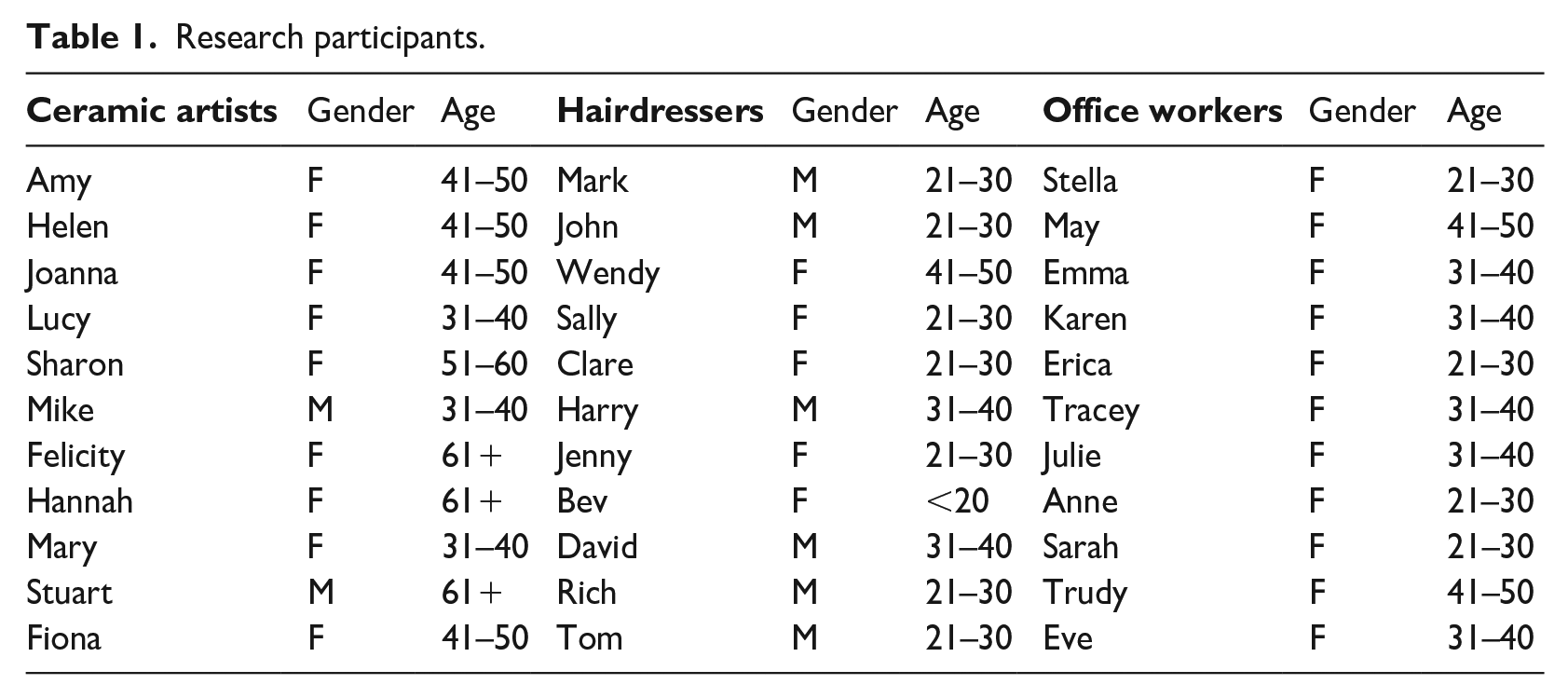
This article draws on data collected via an interpretivist study utilising a mixed methods qualitative study design. The dataset comprises 33 respondents, 11 within each of the three occupational groups. The demographic data of the informants are shown in Table 1, along with the pseudonyms used in this article.
Research participants.
Responding to calls for greater utilisation of visual methodologies (Boxenbaum, Jones, Meyer, & Svejenova, 2018), our methods comprised participant-led photography (Warren, 2002) and photo-elicitation interviews. Visual methods can be ‘a means of extending the epistemological foundations of management knowledge in order to generate insights into aspects of management and organisational life that have tended to remain under-explored in the field’ (Bell & Davison, 2013, pp. 171–172). Whereas traditional methods can result in ‘thin data’ (Butler, Doherty, Finniear, & Hill, 2015, p. 152), visual methods can shed light on unspoken situations and enable an exploration of the non-conscious along with the conscious (Bell & Davison, 2013). Notably, visual methods allow the ‘everydayness’ of working life to emerge and place control in the hands of participants (Shortt & Warren, 2012). Being asked to take photographs of instances of waiting as they happened meant that informants could become attuned to what might otherwise remain an invisible and unrecognised ‘backstage’ experience (Boxenbaum et al., 2018).
We asked informants to take photographs over the course of five working days that in some way depicted their experience of waiting, which were then discussed during the interview. We left it quite open to the respondents to determine which experiences constituted waiting, although we did give a few examples as prompts, such as ‘waiting for a piece of information’, ‘waiting for someone’, ‘waiting for clay to dry’. Informants took photos on their mobile phones; a total of 371 photos were submitted, ranging between 3 and 59 images per informant. The majority of images were from the ceramic artists (233), while the hairdressers took 70 and the office workers 68. Most informants took between 5 and 15 photos.
The images were then used as the basis of discussion in a photo-elicitation interview (Bell & Davison, 2013) where researcher and informant discussed each image in turn, focusing on the content of the image and the temporal and affective experiences that were associated with them, as well as capturing general observations and reflections on the experience of waiting during the informant’s wider working life. This process enabled the researcher to gain an understanding of the underlying meaning attributed to the images by the informant (Shortt, 2015) and to elicit information about other waiting experiences not included in the images. Interviews lasted between 45 minutes and two hours, on average one hour. Interviews were all recorded and transcribed verbatim.
In discussing the photos we sought to establish how and why participants viewed experiences as ‘waiting’. A small number were excluded, for example, some informants had photographed the bus on the way to work which we excluded on the basis that this was not part of the working day. In addition, we excluded those where informants discussed how they used time during formal breaks, such as lunch breaks, as these did not equate to waiting times. However, all other experiences were included in the analysis. We found that the instances of waiting reported by participants generally fell into three main types: delays in information exchange often caused by working rhythm asymmetries (e.g. waiting for an email from a colleague who was working on another task); resource shortages, including temporary unavailability of materials, people or time; and the entanglement of human and material temporalities as informants waited for natural processes to occur such as clay to harden or a kettle to boil. We also found some instances where actors themselves chose to wait. These are explained further below.
The data were analysed inductively following an iterative process of ‘pattern description’ (Cornelissen, 2017, p. 372). The photographs were logged and categorised, emphasising both what the photographs depicted and their underlying meaning. The interviews were loaded into NVivo and analysed via a thematic approach using the Gioia method (Corley & Gioia, 2004). This entailed an initial pass through the transcripts using in vivo codes which focused on surfacing first-order concepts. These first-order concepts were further analysed via axial coding and reduced into theoretically distinct second-order themes (Strauss & Corbin, 1990). We were able to distinguish between the use to which people put their waiting time, and the way in which waiting was experienced (Figure 1).
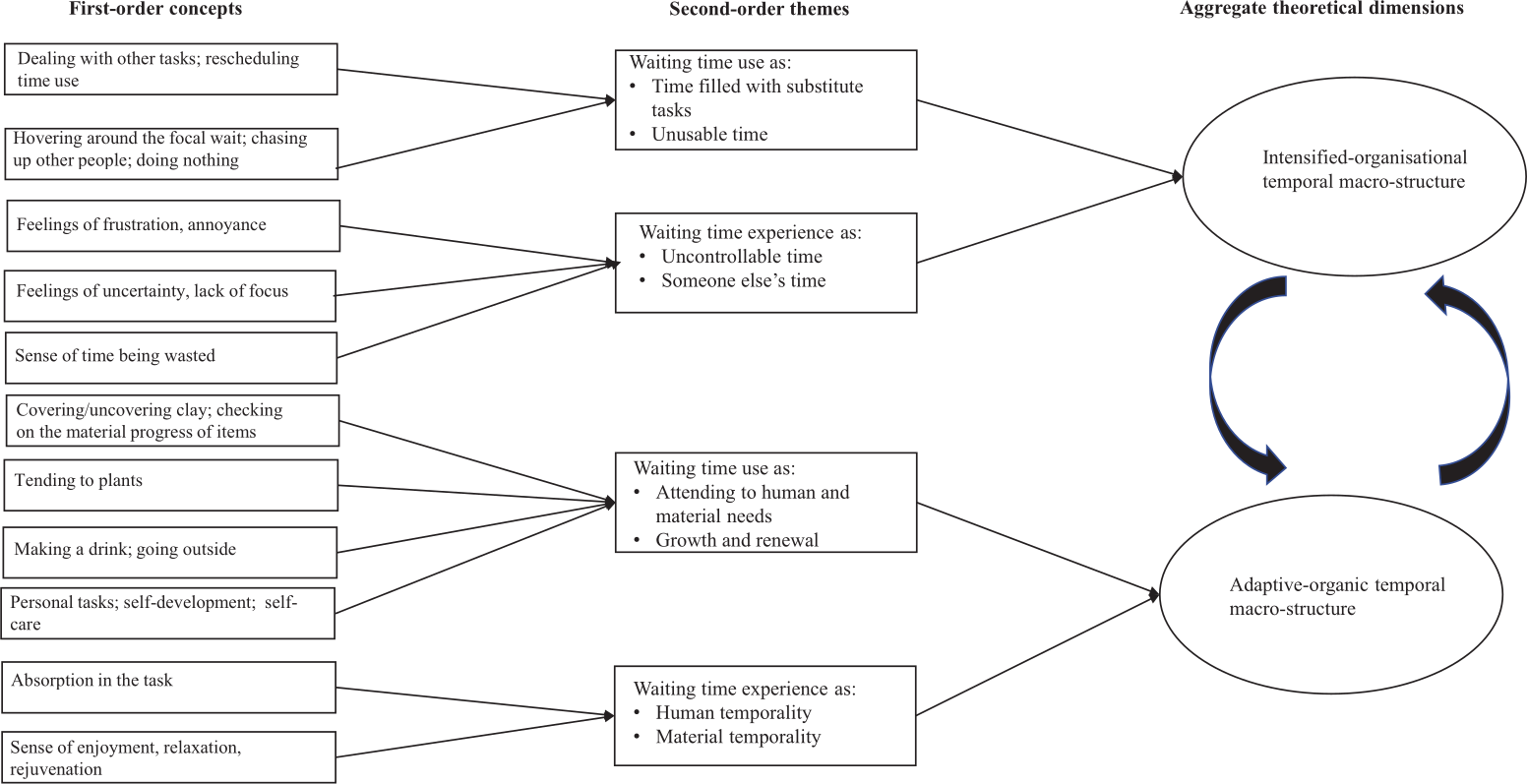
Data structure.
We began with an understanding of temporal structuring based on the extant research base, but through constant iteration between the literature and the data, our analysis of waiting times gradually unveiled the existence of two aggregate theoretical dimensions – intensified-organisational and adaptive-organic temporal macro-structures. We argue that these temporal macro-structures transcend the occupational- or organisational-level temporal structures that are typically considered in the literature (Shipp & Richardson, 2021). We define temporal macro-structures as broad socio-temporal structures which exert a normative role and inform time use and the experience of time at work at a general level. In doing so, we build on Orlikowski and Yates (2002, pp. 690–691) who argue that temporal structures ‘may become universalistic to the extent that multiple communities enact the same (or similar) temporal structure in their local practices’. In the next section, we define these further and explain how they become evident during waiting time.
Findings
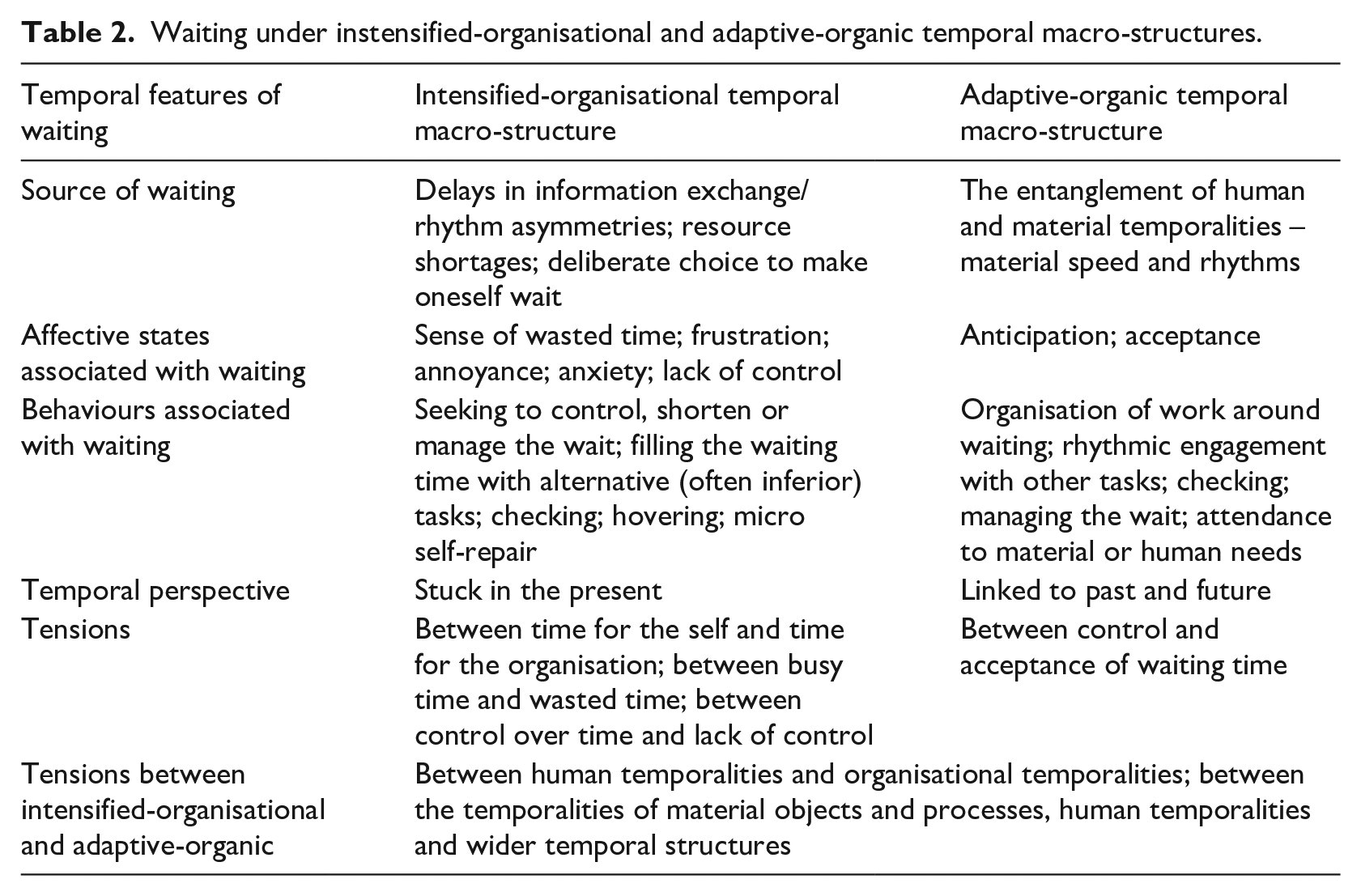
We define the intensified-organisational temporal macro-structure as a temporal macro-structure associated with complex forms of organisation that are characterised by close temporal co-ordination at speed, mediated by information technologies (Wajcman & Rose, 2011). Social actors in such environments experience hyper-intensified temporal demands arising from ‘oppressive acceleration’ and increased levels of surveillance (Rosa, 2014; Vostal, 2019). We define the adaptive-organic temporal macro-structure as a temporal macro-structure associated with material and human processes and rhythms (Butler, 1995; Hernes et al., 2021). Our study revealed that the office workers exemplified the intensified-organisational temporal macro-structure whereas the ceramicists exemplified the adaptive-organic temporal macro-structure. However, elements of both macro-structures were evident in all three occupations, as explained below. We provide a comparative summary of the main attributes of these temporal macro-structures in Table 2 and organise the presentation of our results in relation to the use and experience of waiting time under these two conceptual categories. Samples of the photographs generated by informants are provided in Figures 2 and 3.
Waiting under instensified-organisational and adaptive-organic temporal macro-structures.
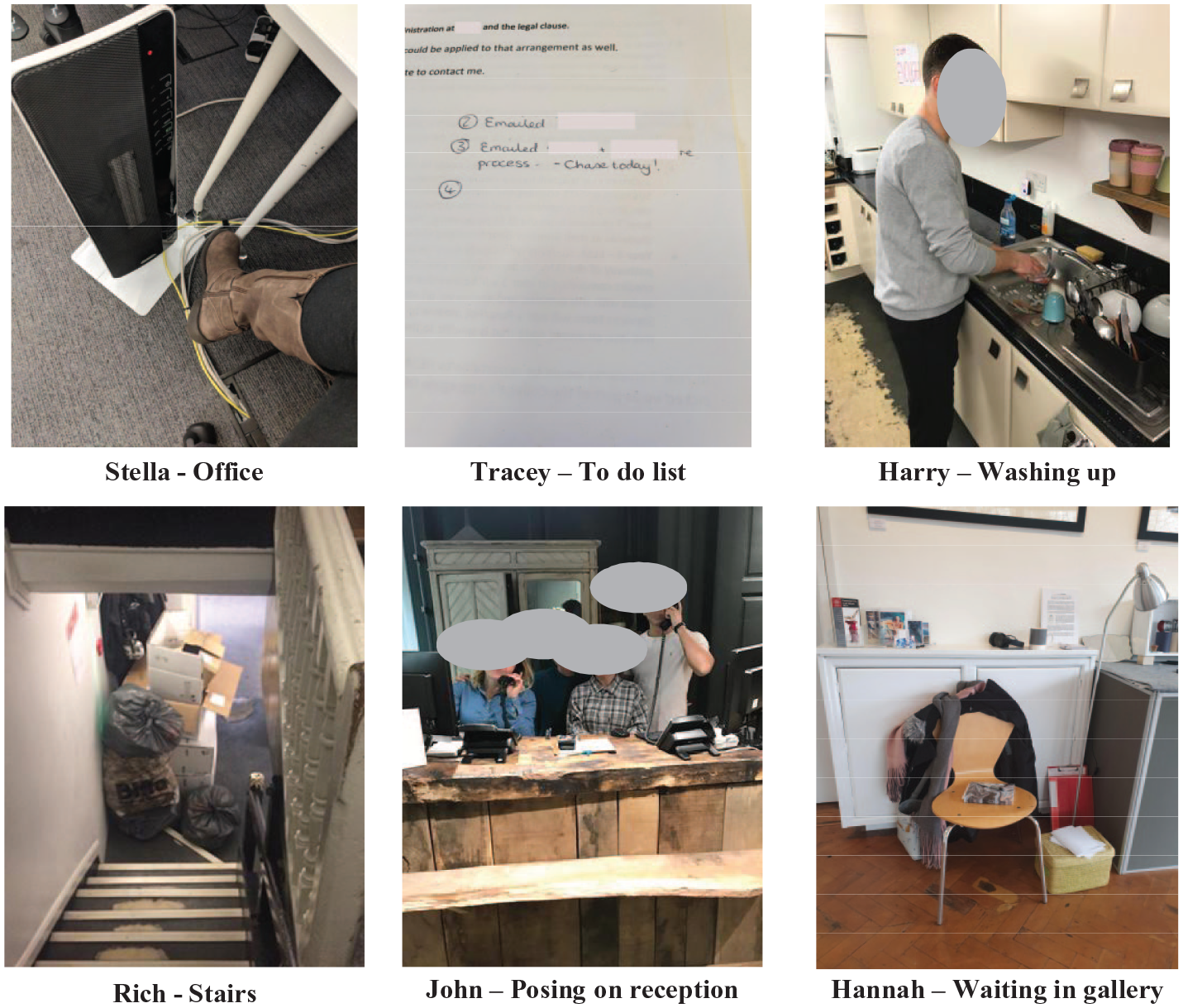
Waiting under the intensified-organisational temporal macro-structure.
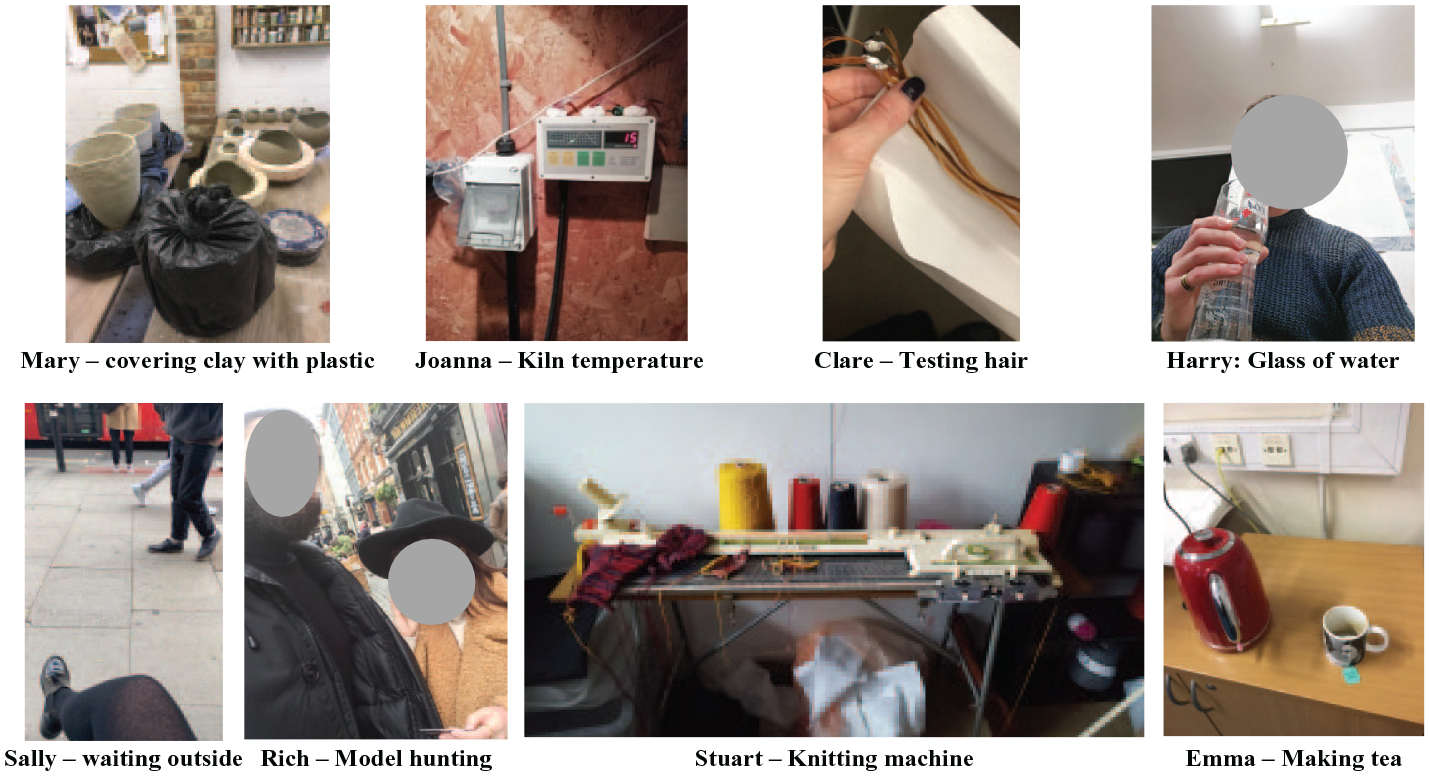
Waiting under the adaptive-organic temporal macro-structure.
Waiting under the intensified-organisational temporal macro-structure
A common response to the need to wait was for actors to seek out alternative work tasks to occupy waiting moments. However, the unpredictable length of waits caused by delays in information exchange or rhythm asymmetry led to a fragmentation of the working day. This was especially true for the office workers. For example, Tracey described how she would jump between her focal task and ‘filler’ tasks as she waited for responses to emails, conveying a sense of the rhythmic interruptions to the working day caused by waiting:
If I can’t do number two on the list I’ll go and work on number eight instead because that’s at least filling time . . . that’s the way my job has to be . . . I might get half-way through even thinking what I need to do with number eight before the emails come back on number two, and then OK, it’s drop number eight, we’re back on number two again.
Such short, unanticipated waits of indeterminate length posed particular dilemmas in terms of their effective use (Liang, 2017). Stella’s photograph (Figure 2: Stella) was taken during a short pause as she looked down at her feet while waiting for some information from her line manager without which she could not progress with her work and was consequently struggling to fill the time effectively. Despite her efforts to exert control over her waits, the image reinforces the sense she is stuck at her workstation, and highlights the ongoing paradox of digital working: even if work takes place virtually, social actors are still physically present in their working environments. Thus the speed of digital technologies rubs up against the embodied encounter between actor and machine. Office workers talked of feeling ‘very angry and very frustrated’ (Sarah) at such times, feelings which accumulated when reminders were sent but still no response was forthcoming, and options for filling the time effectively grew more limited. Even ceramicists were not immune to this, since information exchange was fundamental to their self-employed status. Ceramicist Fiona described the time she was waiting for a phone call from a photographer as: ‘this tiny little window of time . . . I just filled by going through old emails . . . with no sense of having finished anything’.
In addition to seeking effective ways to fill waiting time, waiting actors also frequently sought to control, shorten or eliminate their waits. Office workers had developed a range of practices, including the use of time-reckoning systems, for example, automated calendar reminders or post-it notes, such as the ‘to do’ list that Tracey regularly updated through the working day (Figure 2: Tracey). Ultimately, though, given that waits like these generally arose unpredictably and were dependent on others, efforts to manage them often proved futile; although reminders might be sent, responses would only be forthcoming at a time to suit the other party, creating knock-on effects as others were then forced to wait as well in a type of ‘chain waiting’ (Amy, ceramicist). In cases such as these, waiting actors reported devoting a portion of their waiting time to repeatedly checking whether the information they needed had arrived. However, this did little to alleviate the sense of distress and anxiety, and in fact often led to a heightened sense of powerlessness. Ceramicist Helen’s frequent checks on the progress of a fragile parcel of pots posted to an overseas customer served as a reminder of the ‘things could have gone wrong, so it made me more worried while I was waiting’.
For the hairdressers, normative pressures from the employing salon with its disciplinary rhetoric of ‘family’ (Costas & Grey, 2014) signalled that they were expected to occupy waiting interludes, such as waiting for their next client to arrive, with ‘filler tasks’ like cleaning and tidying the salon or unpacking boxes, tasks they regarded as inferior and undesirable. Harry explained, ‘We work as a family . . . so the environment around here is everybody tries to help’ (Figure 2: Harry). Hairdressers reported roaming the salon looking for such low-grade filler tasks that were ultimately unrelated to the practice of hairdressing and were emblematic of the experience of waiting as surplus time (Jeffrey, 2008). Rich described how during one such waiting period he had been asked to help unpack boxes of products:
I hadn’t unpacked products for around five years, it’s a physical job up and down the stairs carrying things . . . . I was wondering, ‘Is this my job now? Is this the right place for me? I’m back unpacking boxes again.’ (Figure 2: Rich)
The cramped and narrow space on the staircase together with the unpleasant and physically demanding task that was far removed from cutting hair called into question the value of his work, but also raised questions of identity. Although on occasion liminal spaces such as corridors and stairwells can constitute productive sites for respite or creativity (Shortt, 2015), here, the staircase became a site for negative affect and lack of autonomy. Rich noted that that ‘waiting and delay are in a sense a failure because you’re not dealing with clients. . . it’s extremely personal for us if someone isn’t in the chair’.
In many cases, working arrangements meant that tasks suitable to fill waiting time were not readily available. The office workers were frequently stuck in transitory spaces such as ‘in an empty room or someone else’s office’ (May), or beside malfunctioning printers and photocopiers, spaces that offered few affordances for alternate activity. For the office workers, waiting for meetings to start was time perceived as especially problematic (Efrat-Treister et al., 2020) since ‘it’s not enough time to get stuck into something else’ (Karen).
Hairdressers explained how the late arrival of customers left them waiting for uncertain periods of time in the transitory space of the reception area: John explained:
I was waiting [on reception] for a client to come in . . . I was probably talking to the receptionist or watching the [booking] system.
Why were you watching the system?
Just to check. I don’t know to be honest, I think to find something to do you know, while you’re there on reception. (Figure 2: John).
Thus, efforts to fill waiting time often amounted to little more than purposeless ‘hovering’ near the focal wait as individuals sought to ‘make do’ with the limited resources to hand.
Longer, more predictable waits offered greater affordances to fill effectively with alternative activities as waiting subjects had time to prepare ahead (Gasparini, 1995). Ceramic artist Hannah described the time when she had to take her turn to staff a small gallery where her work was being exhibited alongside those of other artists:
I’d come in, placed down my coat, made myself a cup of tea, got my sketchbook out, and I was literally getting ready to wait . . . I know I’m going to be there . . . waiting for hours and hours and hours for someone to come in. (Figure 2: Hannah)
Nevertheless, despite being able to use the time to engage in ‘equipped waiting’ (Gasparini, 1995, p. 35) making use of brought-along resources such as a sketchbook (Ayass, 2020), there were few spatial affordances for productive work. Being stuck generated not just anxiety about the focal wait but also a sense of boredeom and frustration that accumulated over time and thoughts of ‘lots and lots of things I could be doing, but I can’t because I’ve got to be here’.
Waiting under the adaptive-organic temporal macro-structure
Waiting arose under the adaptive-organic temporal macro-structure in two diverse ways; first, through the socio-material engagement between humans and material objects and, second, through human-centred temporalities.
The practices of the ceramic artists were governed by the temporalities of the materials of their craft (Jalas, 2006), including clay and glaze, and organic processes such as the heating up and cooling down of the kiln. Experiential knowledge arose through the performance of material encounters (Gherardi & Perrotta, 2014) concerning the likely duration of the wait. Waiting for clay to dry to exactly the right consistency to be workable (leather hard) was, however, an unpredictable exercise dependent on the vagaries of the weather, the temperature of the studio, humidity and other environmental factors which could lead to variations in terms of hours or even days. Some waits could be slowed down or speeded up, but only within the limits of the temporal affordances of objects or waiting situations. Ceramicists utilised a range of strategies to speed up the drying process such as placing items near a radiator, or alternatively to slow them down when they were drying too quickly, such as covering them with plastic (Figure 3: Mary). However, as Lucy pointed out, materiality may resist human intentions (Symon & Whiting, 2019) and constant checking was required:
If you’re working with clay you’re constantly gauging and judging . . . that’s where that sort of tacit knowledge comes in and that is so related to the waiting part of it. (Lucy)
Thus, monitoring progress formed a key strategy of wait management under adaptive-organic temporality, notably in the case of waiting for kilns to heat up or, even more importantly, to cool down, since opening the kiln too early could lead to cracking or breaking due to thermal shock, so timing was critical. This was often experienced as a time of anxious anticipation. Joanna, who rented a studio some distance from her home, described how she could not sleep when waiting for the kiln, and so would get up very early and drive to the studio:
I think I just feel far away [at home], I’d like to be closer to the kiln so that I can go and check on it . . . Once I’m in here early in the morning at 6 or 7 o’clock, I’m happy, it’s lovely being here . . . it’s warm and it smells all kilny . . . you know, I feel like I’m in control when I’m back here. (Figure 3: Joanna)
While primarily evident among the ceramicists, similar strategies were also utilised by the hairdressers; Clare (Figure 3) described how she would carry around a small hair sample from a new client to test how long the colour would take to ‘lift’ so she could keep checking on progress. However, in contrast with the checking that took place while waiting under the intensified-organisational macro-structure which was associated with feelings of powerlessness and a sense of wasted time, checking on waits under adaptive-organic temporality was experienced as part of the rhythmic natural cycles to which waiting actors became attuned as they accompanied material processes through time (Hernes & Schultz, 2020).
The second facet of waiting under the adaptive-organic macro-structure concerned the appropriation of waiting time to attend to human rather than material needs. Appropriation has been identified as an innate human need, freeing individuals from everyday constraints (Söderlund & Borg, 2017). However, such opportunities may be limited by the temporal and spatial affordances of work, driving appropriation to the margins and corners of organisational life (Costas & Grey, 2014). While attention has focused on work–life balance strategies at the boundary between work time and home time that enable individuals to rest and recover from the depletions of work, less attention has been paid to the temporal ‘micro’ work–life balance strategies in which actors may engage during the working day itself by creating Eigenzeit or time to oneself (Nowotny, 1992). Waiting emerged as a marginal time that offers affordances for ‘gear-shifting’ (Hopkins, 1986, p. 639), enabling individuals to escape time controls and reclaim fragments of time for recovery, personal care and enjoyable non-work activities, which we have termed micro-self-repair.
For the hairdressers, very brief moments waiting for a client to have their hair shampooed by a colleague would be appropriated to leave the salon floor and descend the staircase into the staff areas where they would chat with colleagues, use their phones, have a drink or something to eat. The predictable length of these waits meant the hairdressers experienced a degree of control over the process:
I had 10 minutes to relax, have a glass of water . . . because we’ve got a system here, we know it’s 10 minutes for a shampoo and I went up just after eight minutes. (Figure 3: Harry)
These personal activities tended to be fitted into the duration of the wait, indicative of the subordinated status of waiting time compared with regular work activities, entailing movement downstairs to the back-stage areas of the salon and away from the client-facing front-stage areas which required a polished presence (Shortt, 2015).
Self-repair through brief times of silence and escape from the emotional labour of hairdressing (Shortt, 2015) was not possible within the confines of the salon building; even the bench outside the salon was not far enough away because ‘sometimes people come out . . . or they’ll come and talk to you, and we’re in a job where we talk all day every day so it’s nice to be on our own for a bit’ (Figure 3: Sally). Instead, Clare described how she would take advantage of waiting between clients to move further away from the salon to sit outside a nearby café and smoke a cigarette, ‘it’s close enough that I don’t feel like I’ve gone too far from the salon, but it’s just far enough . . . I was just feeling like, “I’m out of the salon, thank God”,’ for a few moments of solitude. Others would seek out the green space of the local park, underlining the importance of the natural environment for stress recovery. Thus, spatially moving away from the salon at times of waiting emerged as a time for healing, suggestive of the limited affordances of both the rarefied client-facing zone and the shabbier, bustling staff areas for self-repair (Shortt, 2015). Nevertheless, these waits were circumscribed by the exigencies of clients and the temporal pacing of hairdressing processes, indicative of the tensions arising between intensified-organisational temporalities and efforts to carve out more organic time for the self.
Longer waits, on the other hand, created ‘free space’ for more purposeful activity. The hairdressers used these interludes to go out in small groups or pairs for ‘model hunting’, seeking people willing to have a free haircut or colour so they could practise their techniques and complete the salon’s training programme. These times were viewed very positively: ‘I was out in the fresh air with a colleague, it wasn’t claustrophobic . . . it’s about me, my training, my life’ (Figure 3: Rich). Model hunting thus emerged as a liminal time offering plentiful affordances for personal development and growth and investment in the imagined future self.
In contrast, the ceramicists did not need to appropriate their working time for personal activities or repair since their studios and their working practices had been designed and organised by them to meet their personal needs and those of their craft. The craft worker invests ‘his or her personality or self into the object produced’ (Campbell, 2005, p. 27), thus waiting becomes a project of the self. Working time was actively sought out as a period for the construction of their primary identity as artists and makers. Whereas the hairdressers sought to exit their workplace to reclaim the self, the ceramicists conversely described their workplace as somewhere to ‘hide’, a place to go ‘if I feel I need a bit of personal space and that kind of thing. It’s my shed as well as my studio’ (Fiona), a refuge from competing demands of family life on the one hand and the business side of ceramics on the other, with their divergent and conflicting temporal demands.
The rhythm of the working day with its ebbs and flows of socio-material waiting afforded the possibility of using waits to achieve a positive work–life balance or to move between work locations to foster creative energy. Amy explained how movement around and between her work and personal space enabled her to balance the waiting time necessitated by her enamelling work with her private activities: ‘I would start enamelling, do some cooking, go and do shopping, come back and do some enamelling’, while Stuart described how he used time waiting for his clay to dry to experiment with new forms of craft on his knitting machine (Figure 3: Stuart), reflecting the comparatively high degree of control experienced by the ceramicists. At the extreme, the practice of craft work and the connections among skill, physical processes and material objects became so absorbing that immersion in the rhythms of work obviated any personal needs, reflecting the transcendence of the creative act and the experience of flow (Csikszentmihalyi, 1990): ‘So if I am properly in the creative zone, I experience something like a warp on time, so I don’t feel hungry or thirsty’ (Fiona).
Such ‘enclaves of time’ (Hopkins, 1986, p. 640) were generally not available to the office workers. The mediating role played by ICTs in the workflow (Wajcman & Rose, 2011), and the management of these by continuously flipping between tasks, meant that they rarely experienced a few moments of ‘pure’ waiting as an opportunity for repair and recovery. Instead, office workers reported proactively carving out brief temporal interludes that forced them to wait (Gasparini, 1995) with the aim of gaining some respite from the incessant demands of work. Often this would entail snatching short moments of personal time while waiting alone at the confines of their workstations ‘sneaking in a little bit of browsing of news sites’ (Stella). Many office workers were found to engage in ‘temporal decoupling’ (Blagoev & Schreyögg, 2019) during waiting times, or intentional efforts to create a state of asynchrony with the dominant structure. Emma deliberately left her workstation around ‘once an hour’ to make a cup of coffee so that she was:
. . . forced to wait, even if it is less than a minute; it is a period where you can stop and think about what’s next and then go back to your tasks with a renewed sense of focus . . . just the fact that you can step away, even if it’s just for two minutes to the kettle in the corner, is still a feeling of control. (Figure 3: Emma)
Even though largely stuck at their workstations, office workers thus engaged in minor acts of temporising (Gasparini, 1995) that could serve to bolster the individual’s ability to cope with an intensive flow of work. Waiting thereby emerges as a form of ephemeral and covert individual resistant practice enacted in the face of ever-hastening workplace temporal rhythms.
Discussion
In our study, we respond to Turner and Rindova’s (2018) call for more research on the lived experience of ‘mundane’ time, and propose fresh insights into temporal structures via an inductive investigation that is the first to consider the daily experience of waiting in organisations.
First, we contribute to the literature on the lived experience of waiting. Whereas prior research, largely conducted within the social sciences, positions waiting as an isolated, conscious temporal happening (Ayass, 2020; Gasparini, 1995), actors who wait while working are rarely visibly or even consciously ‘waiting’. They are not assigned to specific waiting zones such as queues or waiting rooms (Schwartz, 1975), but rather find themselves in places where they must wait – at their workstation, in reception areas or corridors – or where they choose to wait, outdoors, in kitchens, beside kilns. The images in this article do not ostensibly ‘show’ people engaged in an ordered practice of waiting such as in a queue; nevertheless, wait they do. Our study contests the notion of waiting as a discrete, linear, temporal experience whereby we go to a specific location, wait for something which may ultimately be resolved, and the wait comes to an end, and instead positions waiting within time conceived as a ‘network of intentionalities’ (Merleau-Ponty, 1962, p. 417). Through the prism of waiting, we can reconceptualise the lived experience of time in organisations as an interconnected ‘web’ of both structured and unstructured time through which individuals navigate on a daily basis.
We extend this notion via our contribution to the literature on temporal structures. Our investigation of waiting reveals the existence of distinct, over-arching temporal macro-structures that serve a normative role in relation to the lived experience of time in organisational settings. The extant literature generally argues that temporal structures comprise taken-for-granted temporal norms of organising at the level of the occupation, organisation or work group (Kunzl & Messner, 2022; Shipp & Richardson, 2021). However, our study lends weight to Orlikowski and Yates’ (2002, p. 690) argument that temporal structures also exist at a higher, ‘universalist’ level of abstraction. These temporal macro-structures become observable in how social actors use and experience their waiting time. Such unstructured moments provide a fleeting ‘open matrix of possibilities for action’ (Noonan, 2015, p. 120) during which organisational temporal norms no longer apply and individuals have scope, albeit briefly, to exert agency over time use (Reinecke & Ansari, 2015; Rotter, 2016). ‘What organizational members actually do’ during these times (Orlikowski & Yates, 2002, p. 688) and how they experience them appear informed by broader temporal norms and concerns.
The intensified-organisational temporal macro-structure draws inspiration from the rich history of scholarship on the acceleration of time and the intensification of temporal control via digitalisation in contemporary society (Rosa, 2014; Vostal, 2015). However, we depart from the prevailing view of this as an underlying system and instead re-conceptualise it as a universalistic form of temporal macro-structure that serves an active, normative function in shaping the use and experience of time in organisations at the individual level. This is exemplified in extreme form in the context of office work. Here, waits were often occasioned by delays in information exchange (Guenter et al., 2014) and were illustrative of how the imperatives of co-ordination and speed pressure social actors to sustain constant and often unrealistically high levels of productivity through the working day (Holt & Johnsen, 2019), even during the temporal ruptures caused by waiting.
Viewed from an intensified-organisational perspective, waiting is a temporal interlude that paradoxically serves to pack the day with ever growing levels of activity and anxiety via the felt need to ‘keep busy’. While social actors proactively sought appropriate activities to fill these nooks and crannies of time, the unpredictability of waiting on the one hand often led to the acceptance of low-grade ‘filler’ tasks or, on the other, to ‘empty’ time that could not be put to effective use, leading to feelings of guilt and anger (Gustafson, 2012; Minnegal, 2009). Either way, under intensified-organisational temporalities, waiting serves to bolster a sense of being stuck in the present (Tang, 2012) and unable to progress. Although this was particularly the case for the office workers and, to a somewhat lesser extent the hairdressers, the ceramic artists were not immune to the demands of the intensified-organisational macro-structure either, since craft is pursued within the artisan economy of small-scale businesses (Luckman & Andrew, 2020). Such experiences drove waiting actors to become intensively focused on waiting as an anomalous experience and to seek to control or manipulate the source of their wait, often ineffectually, in an effort to achieve something – as Otto and Strauss (2019) note, being stuck is ‘hard work’.
Drawing on Butler (1995), we have coined the term adaptive-organic temporality to refer to the temporal macro-structure that arises out of the sequencing and pacing of work at the interface between the human and the material, one that is more closely aligned with natural rhythms of working and is exemplified in the temporalities that adhere to craft practices (Jalas, 2006; Thompson, 1967/2017). In line with prior research, we found that the craft labour of ceramic artists, and also to some extent that of the hairdressers, entailed alignment of human temporalities to the affordances of material objects (Bell & Vachhani, 2018; Gherardi & Perrotta, 2014). In this context, waiting is transformed into a vital temporal element of the lived experience of ‘craftsmantime’ (Sennett, 2008) and recast as a legitimate, engaged activity in its own right. It is a period of eager, albeit also at times anxious anticipation, when past experience and tactile knowledge are melded with projected future outcomes through consciously slow and deliberate practice in the waiting present (Jalas, 2006). Waiting, according to the adaptive-organic temporal macro-structure, thereby constitutes a liminal temporal experience (Söderlund & Borg, 2017) of growth and transformation.
Building on Hernes et al.’s (2021) assertion that human and natural systems are inextricably interwoven, we argue that the adaptive-organic temporal macro-structure also encompasses the ‘natural processes and organic rhythms of human activity’ that become disrupted under intensified-organisational temporalities (Noonan, 2015, p. 116). The notion of adaptive-organic temporality thereby re-centres human time in organisations and reminds us of the incompatibilities between the temporal exigences of the contemporary workplace on the one hand, and those of the human beings who inhabit it on the other.
We observed a number of tensions that arise as the two temporal macro-structures ‘collided’ (Reinecke & Ansari, 2015) during instances of waiting over the course of the working day in different occupational settings. Tensions have been defined as inescapable ‘practical dilemmas’ (Trethewey & Ashcraft, 2004, p. 32). For the ceramicists, the tensions arose when frustrating waits associated with running their business (under intensified-organisational temporality) took them away from the adaptive-organic temporalities of their art through which the self became manifest. In the case of the hairdressers and the office workers, on the other hand, waiting afforded fleeting opportunities to reclaim adaptive-organic temporality and re-centre human time to rest and recover from the personal depletions caused by the excessive demands of instensified-organisational temporality (Hassard, 2001). We have termed this micro-self-repair, or the use of short interludes to attend to human needs or work on the project of the self. In fact, waiting offers such vital affordances for human wellbeing, that under the ‘rushed’ rhythms (Wajcman, 2015, p. 163) of intensified-organisational temporality, office workers were found to proactively refashion their time to create fleeting waits that enabled them to step aside from the flow of work to snatch a few minutes for themselves. Although these acts of temporising (Gasparini, 1995) may appear as efforts to regain agency and reassert the importance of adaptive-organic temporality, their ephemeral nature signals the limits to self-determination in the ‘greedy organisation’ (Coser, 1974). What our study reveals is that the adaptive-organic temporal macro-structure represents the inexorable yet hidden pull to reclaim human time under the remorseless pressures of contemporary organisation.
Limitations and directions for future research
While our research has contributed to theory on waiting and on temporal structures, there are nevertheless some limitations. Although we included three diverse occupational groups, additional insights might be gained from including others – for example, what does waiting signify for individuals in zero hours contract occupations where waiting time is unpaid? Moreover, do those working in occupations whose core focus is on waiting, such as hospitality staff or taxi drivers, have a different orientation towards waiting experiences? Further research could incorporate groups such as these to extend our understanding of waiting in organisations.
Second, our findings indicate the existence of two temporal macro-structures that become evident during waits; however, it may be that other such macro-structures exist, and further research that explores this possibility would be welcome. Third, we found that intensified-organisational and adaptive-organic temporal macro-structures appear to co-occur in diverse work settings. Further research could explore the contextual conditions under which they conflict with one another and those under which they can be reconciled.
Finally, our study has brought to light how individuals use waiting time to engage in micro self-repair during the working day. In light of the ever-increasing intensification of work (Rosa, 2014), further research that explores the conditions under which individuals carve out such fragments of time for self-repair and their effectiveness would be welcome.
Conclusion
Our study shows that while waiting offers the emancipatory potential (Holt & Johnsen, 2019) for actors to ‘undo’ time, freeing themselves from the alienating pace of contemporary work (Rosa, 2014) and making that time their own, it also draws attention to the ‘problem’ of waiting times (Schwartz, 1975, p. 842) that serve to disrupt daily working lives. Waiting emerges as a paradoxical experience, at once inevitable yet unpredictable; a troublesome time over which we seek to assert control, yet one whose absence we nevertheless lament since a day without waiting of some kind can only be both undesirable and burdensome. It is an empty time that we struggle to fill, yet also a time replete with meaning during which we come to consider ‘the very condition of our being’ (Schweizer, 2008, p. 142). The ultimate paradox of waiting is that while it is ostensibly an interstitial temporal interlude, it is during moments of waiting that the otherwise hidden temporal macro-structures that inform our use and experience of time come to the fore.
Our research suggests that understanding what happens while we wait goes beyond even an appreciation of temporal structures and temporal experiences in organisations. It serves as a reminder that those workplaces that are the most humane are those that satisfy the human need to be present concretely in the world (Crawford, 2009) and that are attuned not to the relentless and intensified temporalities of contemporary organisations but rather to those of the human beings who inhabit them.
Footnotes
Acknowledgements
We also thank Jon Hindmarsh, Emma Bell, Dirk vom Lehn and David Chandler as well as delegates at the 2020 EGOS annual meeting for their helpful feedback on an earlier version of this paper. We are especially grateful to Senior Editor Prof Silviya Svejenova, Editor-in-Chief Professor Renate Meyer, and the three anonymous reviewers for their constructive guidance throughout.
Declaration of Conflicting Interests
The author(s) declared no potential conflicts of interest with respect to the research, authorship, and/or publication of this article.
Funding
The author(s) disclosed receipt of the following financial support for the research, authorship, and/or publication of this article. We gratefully acknowledge funding from the BA/Leverhulme Trust Grant no. SRG/170090 and extend our sincere thanks and appreciation to all those who participated in the research.
