




Abstract
Meaningful work is work that offers a degree of autonomy and the opportunity to receive recognition from others. It is traditionally associated with highly skilled jobs whereas low-skilled jobs are often equated with meaningless work. Previous research assumes that workers in low-skilled roles have little access to the autonomy or recognition characteristic of highly skilled labour. Rather it suggests that in their efforts to make their working lives more tolerable, such workers are limited to either discursively reframing the significance of their roles or engaging in acts of resistance against the organization. In this paper, based on an eight-month ethnographic study of a mould-producing company in France, we identify three processes through which workers in low-skilled roles find temporal opportunities to engage in anomalous craft where latent or underused craft skills and attitudes are utilized to enable them to work more autonomously and earn recognition from peers and supervisors, rendering their work more meaningful. Our work offers insights into how workers can use craft to activate or re-establish meaning in contexts where work has been stripped of significance.
Introduction
Work is one of the most important domains from which people derive meaningfulness in their lives (Michaelson, Pratt, Grant, & Dunn, 2014). Meaningful work has traditionally been associated with highly skilled roles, with low-skilled roles (role requiring minimal formal technical expertise, typically involving mundane tasks with limited opportunities for development) strongly associated with meaningless work (Laaser & Bolton, 2022; Sayer, 2007). Existing literature has suggested that the lack of meaningfulness in low-skilled work is related to the low levels of autonomy such workers have in daily tasks, and the absence of recognition from others for the value and contribution of their work (Bailey & Madden, 2017; Laaser & Bolton, 2022). Workers in low-skilled roles often carry out highly repetitive tasks or ‘gigs’ in controlled environments, and their work is frequently demeaned and perceived as ‘servile’ or ‘inferior’ (Bailey & Madden, 2017; Dutton, Debebe, & Wrzesniewski, 2016). In contrast, highly skilled work is replete with autonomy and recognition of skills and this ‘foundation for meaning [is] defended against all incursions’ (Hodson, 2007, p. 13; see also Vallas, 2006). As advancements in technology and artificial intelligence, alongside the growing global demand for service and care workers, continue to increase the proportion of individuals in low-skilled jobs, it is becoming increasingly important to understand how such work might be made more meaningful (Gibson et al., 2023; Manning, 2004).
The concept of meaningful work originates in the classical writings on industrial society, where thinkers like Marx, Durkheim and Engels all highlighted how the erosion of highly skilled craftwork and the subsequent forced division of labour led to worker alienation as workers lost autonomy and recognition (Hodgkiss, 2016; Hodson, 2007). Craftwork is considered an inherently meaningful form of work that prioritizes ‘human engagement over machine control’ (Kroezen, Ravasi, Sasaki, Zembrowska, & Suddaby, 2021, p. 5), since workers engage in ‘creative and meaningful productive activities’ (Hodson, 2007, p. 264) that rely on distinct craft skills and attitudes (Becker, 1978; Sennett, 2008). Craft workers have the autonomy to manage their time, investing it in refining their technique and perfecting their craft rather than being bound by rigid externally imposed schedules (Becker, 1978). When workers’ craft skills are removed and absorbed into organizational processes, autonomy is lost, and workers are reduced to carrying out simple, repetitive and mundane tasks governed by strict schedules and time constraints (Braverman, 1974). Without these recognized craft skills, workers are viewed as interchangeable and ‘denied respect and recognition’ that comes from engaging in skilful labour (Costas, 2022, p. 8). This includes not only workers in industrialized shopfloor or machine-controlled settings (Braverman, 1974) but also those who work in other low-skill jobs, such as stigmatized ‘dirty work’ (e.g. cleaners, carers, binmen), who are routinely controlled and devalued (Ashforth & Kreiner, 1999; Gibson et al., 2023).
The assumption in existing work is that the structural constraints imposed on workers in low-skilled environments including rigid work processes, close supervision and the low status afforded to such jobs means they cannot achieve the autonomy and recognition that characterize highly skilled or craft roles. Rather existing research suggests that in their efforts to make their work more bearable, workers in low-skilled roles are limited to either discursively reframing the importance of their roles (Tweedie & Holley, 2016; Wrzesniewski & Dutton, 2001) or resisting the control of the organization through informal, hidden tactics such as time-based rituals or games that regulate the intensity of work and offer opportunities for camaraderie (Korczynski, 2011; Roy, 1959). While providing some reprieve, these responses do little to allow workers to gain any control over their work or receive acknowledgement for their efforts. In this paper, we argue that workers may also agentially navigate these organizational constraints to carve out time for craft through self-initiated behaviours and informal activities which in turn offer more opportunity for autonomy and recognition. While existing work presents craft and low-skilled work in opposition to each other, we suggest such workers can in fact have significant craft skill and find ways to challenge the rigid structures imposed on them by organizations and exercise their craft skills within the confines of their jobs to make their work more meaningful (Kroezen et al., 2021).
We ask: How do workers in low-skilled roles find opportunities to gain autonomy and recognition within their work? Drawing on an eight-month ethnographic study of shopfloor workers engaged in highly typical low-skilled factory work at a mould-producing company in France, we identify three processes through which workers find temporal opportunities to do what we term ‘anomalous craft’, i.e. the agential implementation of latent craft skills and attitudes within the formal work process in low-skill controlled settings, leading to more autonomy and recognition from peers and supervisors. The processes include ‘Meeting self-determined quality standards to enhance autonomy’; ‘Creating work optimization tools to increase autonomy and peer recognition’ and ‘Revealing informal mastery to gain autonomy and supervisor recognition’. Our research challenges existing assumptions that autonomy and recognition are only to be found in highly skilled roles. We show that workers in low-skilled roles can draw on their considerable craft skill to improve the quality of products or work outputs and the efficiency of processes, and to solve unexpected organizational challenges, earning themselves autonomy and recognition. We also illustrate how workers use time as a resource to allow them to do anomalous craft by ‘time-hacking’ (i.e. carving out time or use of lag time to do supplementary work). We add to the craft literature by illustrating that even in environments where employees are officially designated as ‘deskilled’, they can find opportunities to retain, practise and share craft skills. We demonstrate that craft can manifest in unexpected ways within low-skilled job roles, challenging existing assumptions about the nature of craft and its applicability across different types of work.
The Search for Meaningful Work
Meaningful work has been identified as ‘the single most valued feature of employment for the majority of employees’ (Bailey, Madden, Alfes, Shantz, & Soane, 2017, p. 416) ahead of income, status and job security (Michaelson et al., 2014). It has traditionally been linked with highly skilled work, with low-skilled menial jobs such as mundane shopfloor work in controlled settings (Burawoy, 1979) and so-called ‘dirty work’ (Ashforth & Kreiner, 1999) largely assumed to be alienating and meaningless (Yeoman, 2014b). Low-skilled work is associated ‘with the production of a commoditized self where the individual is subject to the managerial gaze and work is routinised and controlled [and] alienation is the outcome’ (Harding, 2019, p. 133). Workers in such roles are frequently controlled, devalued and mistreated, experiencing discrimination from those with higher status in the workplace (Dolan, 2007). Although workers carrying out low-skilled work are the most likely to experience difficulty in finding meaning in their work, there is scant research focusing on the dynamics of how such workers might agentially construct opportunities for meaningful work despite the structural constraints they face (Laaser & Bolton, 2022; Rosso, Dekas, & Wrzesniewski, 2010). Instead, much of the existing meaningful work literature focuses on highly skilled work, adopting a psychological lens to examine individuals’ subjective cognitive-emotional interpretations of work experiences (Rosso et al., 2010). In this paper we draw primarily from sociological and philosophical perspectives which centre the alienating conditions of modern work and how workers respond agentially to make their working lives more meaningful (Hodson, 2007; Honneth, 1995; Yeoman, 2014a, 2014b; Yeoman, 2019).
Previous research has highlighted two overarching dimensions that are necessary for meaningful work but are largely assumed to be absent in low-skilled environments: autonomy in work and recognition by others of their work’s value and contribution (Bailey & Madden, 2017; Dutton et al., 2016; Laaser & Bolton, 2022). Autonomy and recognition are inherent in more complex, skilled or professional work, so work that requires distinct and recognized skill is more likely to be meaningful. As Sayer (2009, p. 2) puts it, ‘a complex, interesting job that demands the use of skilled, practical judgement enhances the capacities and satisfaction of the worker, whereas a boring, unskilled job dulls the mind. The former is also likely to bring more recognition than the latter.’ Autonomy relates to the worker’s status as a decision maker: the extent to which they have capacity to control the methods and techniques they use, the time needed to complete the work and the order in which it is completed, and the criteria upon which it is evaluated (Hodson, 2007; Rosso et al., 2010). Recognition is a more relational dimension: the ‘other-recognized worth acquired from . . . engaging in work activity’ (Lucas, 2017, p. 2549). It emphasizes the opportunities that work provides to gain respect or appreciation from significant others, such as co-workers, customers and managers (Honneth, 1995; Yeoman, 2014b). Existing research therefore assumes that workers in low-skilled settings struggle to achieve meaning in their work because they cannot develop autonomy and recognition in such settings where they are structurally limited.
While existing research assumes that autonomy and recognition are largely absent from low-skilled settings, it has also been highlighted that workers do not simply accept their alienated position; through ‘purposive, considered, and creative efforts’, they attempt to make their working lives more bearable by discursively creating alternative meaning systems or engaging in acts of resistance against the organization (Crowley, 2012; Hodson, 2007, p. 3; Pfeffer, 2010). The former involves the worker reframing the significance, value and importance of their role. It is an approach particularly common among those doing low-skilled stigmatized or ‘dirty work’, who reconceive the worth of their labour by connecting it to wider discourses related to ‘achieving organizational goals and benefiting society in general’ (Ashforth & Kreiner, 1999; Lucas, 2011, p. 362). Wrzesniewski and Dutton (2001) show how hospital cleaners view themselves as a vital part of a wider system that helps the sick and suffering, while Bailey and Madden (2017) illustrate how rubbish collectors employ a conservation-oriented discourse to give value to their work. Nevertheless, current work suggests that such workers continue to have little autonomy or recognition in their work roles (Slutskaya, Simpson, Hughes, Simpson, & Uygur, 2016). For example, Mao and Xue (2022, p. 1074) show that adult fast-food workers reframe their work by ascribing ‘moral implications’ to it but they continue to be denied the markers of adulthood, i.e. ‘autonomy, self-determination, and choice’, perceived by younger peers, customers and supervisors as inferior for doing ‘a job that is good only for a high schooler’.
Another strand of the literature focuses on resistance through oppositional ‘practices and relations beyond the gaze of formal management’ (Laaser & Bolton, 2022, p. 381). Such practices are particularly evident in low-skilled work that is highly routinized, such as on the industrial shopfloor where labour has ‘been emptied of any significance’ and workers are subjugated to machines (Burawoy,1979; Hodson, 2007; Vallas, 2001, p. 443). Workers are treated as human tools; the sequence and pace of their tasks are controlled, conveying ‘that they are not worthy or deserving of making decisions . . . they are fitted to routine, predetermined activity’ (Breen, 2019, p. 60). While worker resistance is often indirect and covert, it is nevertheless intentional and recognized as resistance by culturally aware observers (Prasad & Prasad, 2001). Workers may ‘misbehave’ through sabotage, removing resources, or using company materials for personal use (Anteby, 2008) in order to ‘take control rather than to be always subject of control’ (Ackroyd, 2012, p. 4). Denied the ‘experience of autonomy’, workers create ‘simulations of autonomy’ by engaging in time-based rituals or games (Yeoman, 2014b, p. 241). Roy (1959) illustrates how machine operators use temporality to punctuate the drudgery of their days and tame ‘the formidable beast of monotony’, creating ‘times’ (e.g. the eponymous banana time) that signal a specific form of social interaction. As Hassard (2002, p. 888) notes, even in the most ‘externally determined task processes’, workgroups can construct their own ‘time-reckoning’ system, ‘playing’ with the construction of time and regulating the amount and intensity of work (Burawoy, 1979; Holt & Johnsen, 2019).
Existing work shows that workers in low-skill environments continually face ‘dramas of dignity’ (Costas, 2022, p. 8) but try to make their work more bearable by reconstruing their roles in a more positive light or by engaging in resistance against the organization. The assumption is that the structural constraints that fetter such workers mean they cannot achieve the autonomy and recognition that characterize highly skilled or craft roles. We question this assumption and argue that workers in low-skill roles may agentially find opportunities for autonomy and recognition within their work through bottom-up, self-initiated behaviours and informal activities. We ask: How do workers in low-skilled roles find opportunities to gain autonomy and recognition within their work? We seek to examine how workers navigate organizational constraints to gain autonomy and recognition. We turn now to the literature on craft to help us explore the dynamics of how meaningful work might be constructed in low-skilled, controlled environments.
Craft and Meaningful Work
Craft can be defined as a ‘timeless approach to work that prioritizes human engagement over machine control’ (Kroezen et al., 2021, p. 5). It relies on human skills – mastery of technique, all-roundedness (a holistic understanding of how different aspects of making interrelate) and embodied expertise – as well as attitudes such as dedication to one’s work independent of expected economic rewards, a concern with communal interests and an explorative mindset open to experimentation (Kroezen et al., 2021, p. 5). Craft is recognized as an inherently meaningful mode of working (Crawford, 2009), and indeed the origins of the concept of meaningful work are found in writings of the industrial society’s classical theorists. Marx, Durkheim and Engels all highlighted how dismantling the pre-industrial craft ways of working had stripped work of its inherent meaning (Hodgkiss, 2016; Hodson, 2007). For Marx, work should not be an instrumental activity to sustain physical existence but a productive endeavour: ‘an expression and confirmation of our creative power’ realized through the development and use of skill (Marx, 1978; Sayers, 2021, p. 52; Yeoman, 2014b). The shift to industrial capitalism meant that the labour traditionally performed by skilled craft workers was reduced to a series of time-bound, repetitive and routine tasks closely monitored and controlled by management (Bolton, 2007; Braverman, 1974). Work organized ‘through exploitative and alienating relations’ to increase efficiency and productivity became ‘devoid of intrinsic meaning’ (Simpson, Hughes, Slutskaya, & Balta, 2014, p. 756) and the worker’s ability to exercise autonomy of judgement was eroded, resulting in an alienated self, unable to ‘proclaim who it is and receive recognition of that proclamation from another’ (Harding, 2019, p. 136; Marx, 1978).
While this binary presentation of craft in polar opposition to industrialization, a ‘static background’ against which the ills of modern work are projected, has been critiqued (Adamson, 2013), there remains wide acceptance that the dimensions necessary for meaningful work are inherent in traditional craftwork. This is evident in the modern revival of craftwork (Crawford, 2009), which asks, ‘What kind of work makes life worth living?’ and appeals to the ‘Marxist ideal of un-alienated labour through which workers can exercise the full extent of their humanity in a self-determining context’ (Bell, Mangia, Taylor, & Toraldo, 2018, p. 10). The craftsman ‘is recognised as having mastery over his skills, independence in his way of living . . . respected for his display of the virtues relevant to his practice’ (Yeoman, 2014a, p. 69). Much of this literature has focused on craft as a body of knowledge and skill used to produce useful objects where considerable time is invested in developing and refining technique, with often ‘many years required to master the physical skills and mental disciplines of a first-class practitioner’ (Becker, 1978, pp. 854/865). Craft workers are characterized as skilled workers engaged in ‘creative and meaningful productive activities’, with specific technical understanding that relies heavily on their tacit and embodied senses (Bell & Vachhani, 2020). They have full control over all facets of the work process and exercise judgement over the results. Their overview of the entire work process from conception to execution enables them to choose how best to prioritize their time and autonomously decide when it is completed satisfactorily (Hodson, 2007, p. 264; Sennett, 2008). Therefore, time plays a crucial role in both the development of craft skill and the production of craft objects.
While a substantial proportion of the craft literature has focused on the understanding of craft as a highly skilled ‘traditional’ approach to work (Crawford, 2009), craft has also been presented as a type of ‘work orientation’ – an internalized evaluation in which individuals make sense of their work as something worth doing (Pratt, Pradies, & Lepisto, 2013, p. 175). It thus differs fundamentally from a ‘dispassionate and utilitarian involvement with one’s work’ (Kroezen et al., 2021, p. 507). Defining craft as ‘an enduring, basic human impulse, the desire to do a job well for its own sake’, Sennett (2008, p. 9) argues that workers can approach their work with a sense of craft and commitment to the pursuit of quality. Here, craftsmanship does not denote a specific type of work but rather any work motivated by the desire to do a job to the best of one’s ability (Simpson et al., 2014). While craft is usually only linked with low-skilled work to act as a point of comparison, Tweedie and Holley (2016) draw on Sennett (2008) to illustrate how cleaners used a craft discourse to reframe the meaning of their work, taking care and pride in their activities despite being engaged in what is usually considered low value work. Despite their best efforts, they remained devalued, and the recognition they sought for their work from others was routinely denied (Costas, 2022).
While some work has focused on how workers can approach their jobs with a ‘sense’ of craft, research in the craft domain generally assumes that craft is synonymous with skilled labour or artisanal work, and antithetical to low-skilled work (Bell & Vachhani, 2020). We challenge this assumption and argue that workers carrying out work characterized as low skilled in controlled settings may have significant latent craft skill and can find ways to navigate structural organizational constraints and leverage their skills to make their work more meaningful. We present a case based on an eight-month ethnographic study of a mould-producing company in France where workers are engaged in highly typical factory work. We identify three processes through which workers manage to find temporal opportunities to engage in what we term ‘anomalous craft’ – the agential implementation of latent craft skills and attitudes within the formal work process in low-skill controlled settings. They can thus work more autonomously and earn recognition from their peers and supervisors, making their work more meaningful.
Methods
Research setting
The setting for our study is Formco, 1 a firm of just over seventy employees based in France. Formco produces moulds (mostly in aluminium or steel but also in polystyrene, resin or wood) for several industries, including packaged goods, automotive, medical and sports. The firm was established a century ago and is one of the few French-based thermoforming mould creation companies to survive intense competition from countries with lower labour costs.
The production of the moulds is highly standardized, with written procedures that outline a series of precise steps: designing, programming, machining and fitting. In the first step, a designer uses a computer program to create a 3-D image of a mould based on the customer’s product specifications. A programmer uses that image to develop a program for the operating machines, creating a ‘toolsheet’ that outlines the machine and specific tools to be used, and the order in which the tools should be used. The shopfloor workers (operators and fitters) then produce and finish the mould.
Shopfloor workers
Although all four groups of workers are subject to some degree of standardization in their work, our focus is on the 44 shopfloor workers, made up of 16 operators (1 woman and 15 men) and 28 fitters (all men). They carry out routinized low-skilled work via a series of pre-set tasks that follow objective measures of quality (based on ISO standards). They are monitored using a swipe-card system which registers when they begin a new task (installing the mould, starting the machining, sanding the mould, etc.). They have strict working hours and specified break times, and they work largely alone on the machines (operators) or at workbenches (fitters).
Operators are responsible for operating the computer numerical control (CNC) machines that make the moulds. Their main tasks are to position the raw materials (e.g. aluminium block) in the machine and follow the programmers’ instructions for hanging the appropriate tools inside the machine, positioning the machine and uploading the program. Before beginning the machining, the operator must sign each line of the toolsheet to confirm they have checked each tool and positioned it correctly. The time needed to machine one full mould can vary from two hours to several days, depending on how often the mould has to be repositioned as indicated on the toolsheet. The operator is not permitted to alter or change the program or modify any parameters (e.g. type of tool used). While the machine is running, the operator must stay beside it to ensure that the process runs as expected. After the machining process is complete, the operator signs the designer’s image to confirm that the mould has the indicated dimensions.
Fitters complete the mould by making any final changes to ensure it conforms to the designer’s initial drawing. These changes are those that cannot be made by the CNC machine, such as creating certain types of holes, adding screws, and sanding and buffing the mould to the required finish (e.g. highly polished, matte, or granular). Once they have finished, they have to confirm that the mould is of the required quality by signing a series of ‘control points’ on a control sheet (e.g. ‘Confirm that the numbers of screws added are the same as numbers indicated on designer’s drawing’ and ‘Confirm that the sanding finish is the same as the one indicated on designer’s drawing’).
Data collection and analysis
Interviews
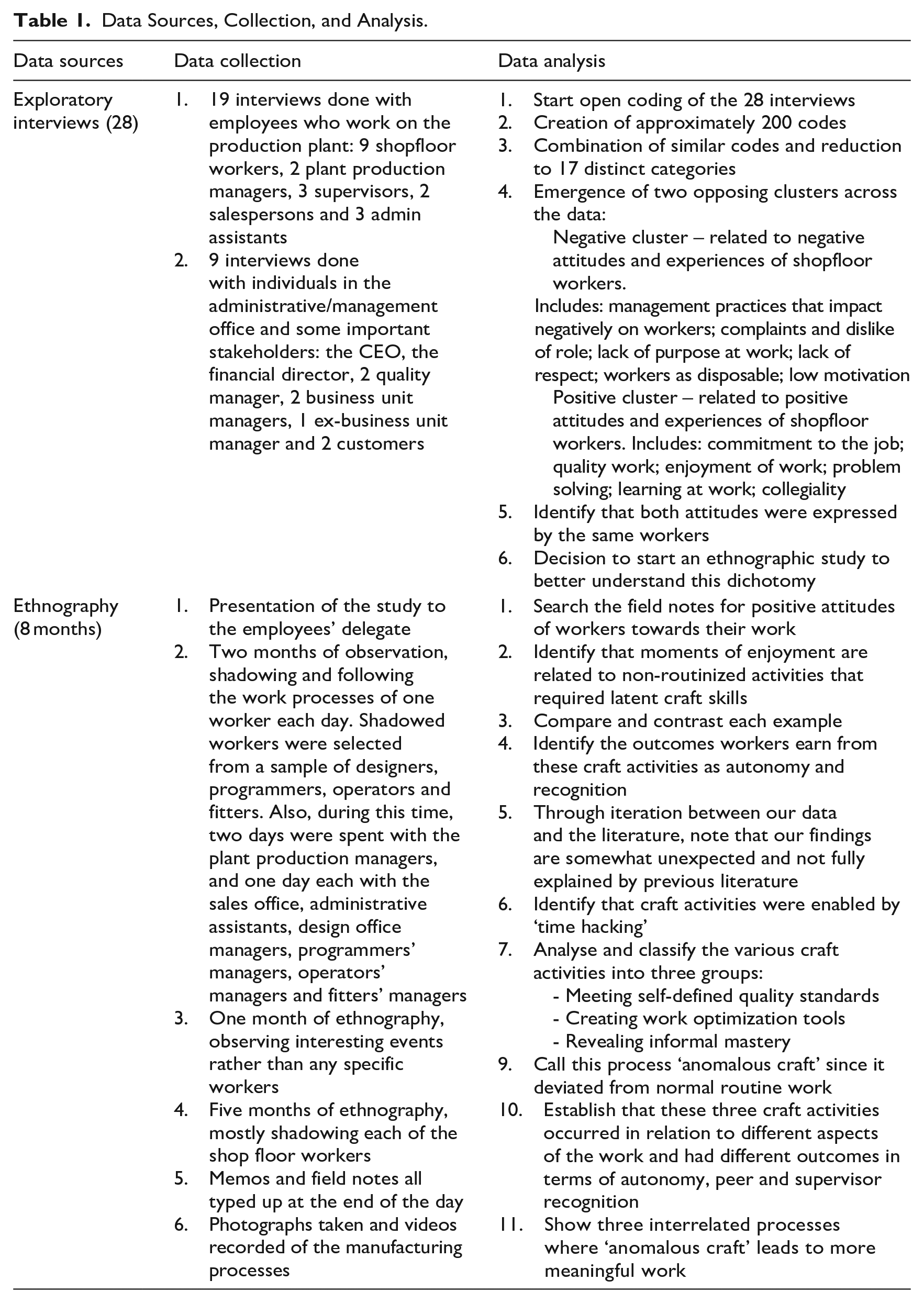
In order to gain insights from a diverse sample of participants with different roles (Patton, 2002), the first author initially conducted 28 exploratory interviews with employees who worked in the production site where the moulds were produced (19 interviews), individuals in the administrative/management office, and some important external stakeholders (9 interviews) (see Table 1 for details of interviewees). The interviews lasted between 45 minutes and 3 hours and were all recorded and transcribed. Each interview began with a broad question, ‘Can you tell me about your role here at/involvement with Formco?’ Subsequent questions were derived from the dialogue, with follow-up questions prompting the interviewees to elaborate further. Our initial interest was on innovation but it became clear as the interviews progressed that Formco was in fact a highly typical manufacturing firm. We were, however, intrigued to observe that although the work of the fitters and operators was identified by themselves and others as mundane, controlled and repetitive, they also took pride in it and attached great importance to producing quality products.
Data Sources, Collection, and Analysis.
Interviews analysis
The first author began to systematically code both sets of interviews, taking a grounded, inductive approach (Charmaz, 2008; Strauss & Corbin, 1997). From this early coding she developed more than 200 codes. The first and second authors then sought to reduce the codes into larger categories. They worked collectively to group together similar codes and relabelling the group to reflect the expanded category, continuing until they reached 17 distinct categories. In trying to make sense of how these categories were related, an interesting dichotomy between two clear clusters of categories came to light. One cluster reflected the negative attitudes and experiences of shopfloor workers, and the other related to more positive experiences (see Table 1). There was insufficient data to understand when and how workers approached and understood their work in such different ways and it was decided to conduct a longer-term ethnographic study.
Ethnographic study
The first author carried out an ethnographic study that lasted eight months, during which two to four days each week were spent at Formco. She observed workers in their daily roles, created detailed field notes with comprehensive accounts and descriptions of daily events, and conducted ongoing interviews in the form of conversations with workers (Barley & Kunda, 2006; Van Maanen, 2011). Prior to starting the ethnography, a meeting was organized with the employee delegate to explain the study and emphasize that all data would be anonymised and confidential, and that workers could refuse to take part or withdraw from the study at any point. A notice stating this was displayed on the shopfloor and the researcher reiterated this each time she interacted with a new individual. She examined internal and external documents relating to the organization to understand the history of the firm, its organizational structure and governance, the client base, the technology used and products produced.
During the ethnographic study period, she shadowed each of the 72 workers at least once (only one employee refused to be observed). To fully understand the mould production process and the division of labour across various employee roles, she spent the first two months moving from one work area to another, following the order of the production process (i.e. sales, designers, programmers, operators and fitters and their respective managers). She spent the third month of the ethnography on the shopfloor, observing interesting activities and events rather than specific individuals or groups. The final five months of the ethnography were predominantly spent observing and shadowing the shopfloor workers. She also informally interacted with the employees during breaks and lunchtime. While initially treated with some level of distance as an ‘interloper’ (Anteby, 2024) by shopfloor workers, the first author worked hard to build trust with her predominantly male participants. She wore their blue-collar uniform, did menial tasks like cleaning the floor at the end of the day, and assisted with simple but dirty tasks that often left her covered in debris. She also ‘proved’ herself by shadowing them for the entirety of the night shift, which is recognized as being difficult and exhausting for those unaccustomed to it. After each day of observation, she typed up her written field notes and wrote memos about important themes and questions that had emerged over the day. She also photographed the offices and workstations, and videoed various manufacturing processes as an aide memoire.
Analysis of ethnographic field notes
We began the analysis of the field notes mindful of the paradoxical positive and negative attitudes and experiences of shopfloor workers; the aim was to understand when and how workers approached and understood their work in such different ways. The field notes reflect numerous instances of shopfloor workers talking negatively to the researcher and each other about their work. Almost every shopfloor worker complained about pay, the coercive and controlled working conditions and their dislike of senior management. There were also examples of worker resistance. During the night shift, workers were authorized to take one break but if no supervisor was present, they often took three or four. Sometimes they left the shopfloor without swiping out, leaving the machine to run unsupervised. There were instances of ‘working to rule’ when workers did the bare minimum or slowed down if beneficial for pay. A small number of workers were observed stealing materials for their own use or creating ‘homers’ using workplace materials (Anteby, 2008). Overall, however, we did not find evidence of large-scale or systematic resistance.
What we did find were many instances of workers appearing to enjoy their roles, being engaged in their work and taking pride in producing quality work. We searched the field notes to see if there was a pattern to these incidents and observed that they occurred when workers had the opportunity to do additional tasks that were not part of their routinized work. We noticed that these tasks enabled workers to use latent craft skills that were underutilized in the normal production process. We started comparing and contrasting these examples of craft activities, returning to the literature to try to make sense of them. We worked iteratively in a ‘recursive, process-oriented, analytic’ manner (Locke, 1996, p. 240), moving between the data, the craft literature and other literatures related to workers in low-skill jobs, including labour process theory and dirty work. What began to emerge was that when workers engaged in craft activities, they could gain more autonomy in their work (i.e. they could control how they did it and judge when it was done satisfactorily) and that sometimes the value of their work was recognized by others. A return to the literature established that autonomy and recognition are two key dimensions of meaningful work that are often considered missing from low-skilled work. There was also very little in the craft literature relating to low-skilled work. Therefore, our emerging findings were somewhat surprising and current research could not fully account for them (Sonenshein, 2014).
In order to theorize from our data, we returned to our examples to better understand how workers were finding opportunities to engage in craftwork in the controlled environment, the various craft activities in which workers engaged, and how craftwork led to autonomy and/or recognition. We noticed that these craft activities were driven by workers’ own agency, and that opportunities to engage in craft were enabled by ‘time-hacking’, a term we use to describe the carving out of additional time or use of lag time to do supplementary work. We then analysed the various craft activities and classified the examples into clusters, creating three wider groups that drew on different craft skills and attitudes: ‘meeting self-defined quality standards’ ‘creating work optimization tools’ and ‘revealing informal mastery’. We call the craftwork we identified in this low-skill setting ‘anomalous craft’ since these instances of craft deviated from the standardized or normal work processes and should not, according to the planning processes, have been allowed to occur. We noticed that each cluster of craft activities related to different aspects of the work (the mould; the tools used to produce the moulds; or the wider production process) and had different outcomes in terms of autonomy, peer recognition and supervisor recognition. We therefore show three different but interrelated processes where anomalous craft leads to meaningful work. The entire data collection and analysis process is summarized in Table 1.
The first process, ‘Meeting self-determined quality standards to enhance autonomy’, occurred when workers perceived a need to further improve the mould, found time to carry out additional work, determined the order of tasks and their duration, deciding when the work was satisfactorily completed; they thus enhanced their autonomy. The second process, ‘Creating work optimization tools to increase autonomy and peer recognition’, occurred when workers decided that the tools for creating the moulds could be improved in some way and found time to carry out this work, engaging in more complex, non-routinized tasks and their creations were often shared with other workers; they thus increased autonomy and received peer recognition for their creations. In the third process, ‘Revealing informal mastery to gain autonomy and supervisor recognition’, we show how when wider production challenges caused time lags in the production process, workers had the opportunity to engage in craft, helping supervisors solve problems both within and outside of their own domain of tasks; they thus gained more autonomy and supervisor recognition. Across these three processes, workers used their latent craft skills and attitudes to both identify craft issues and engage in craftwork.
Findings
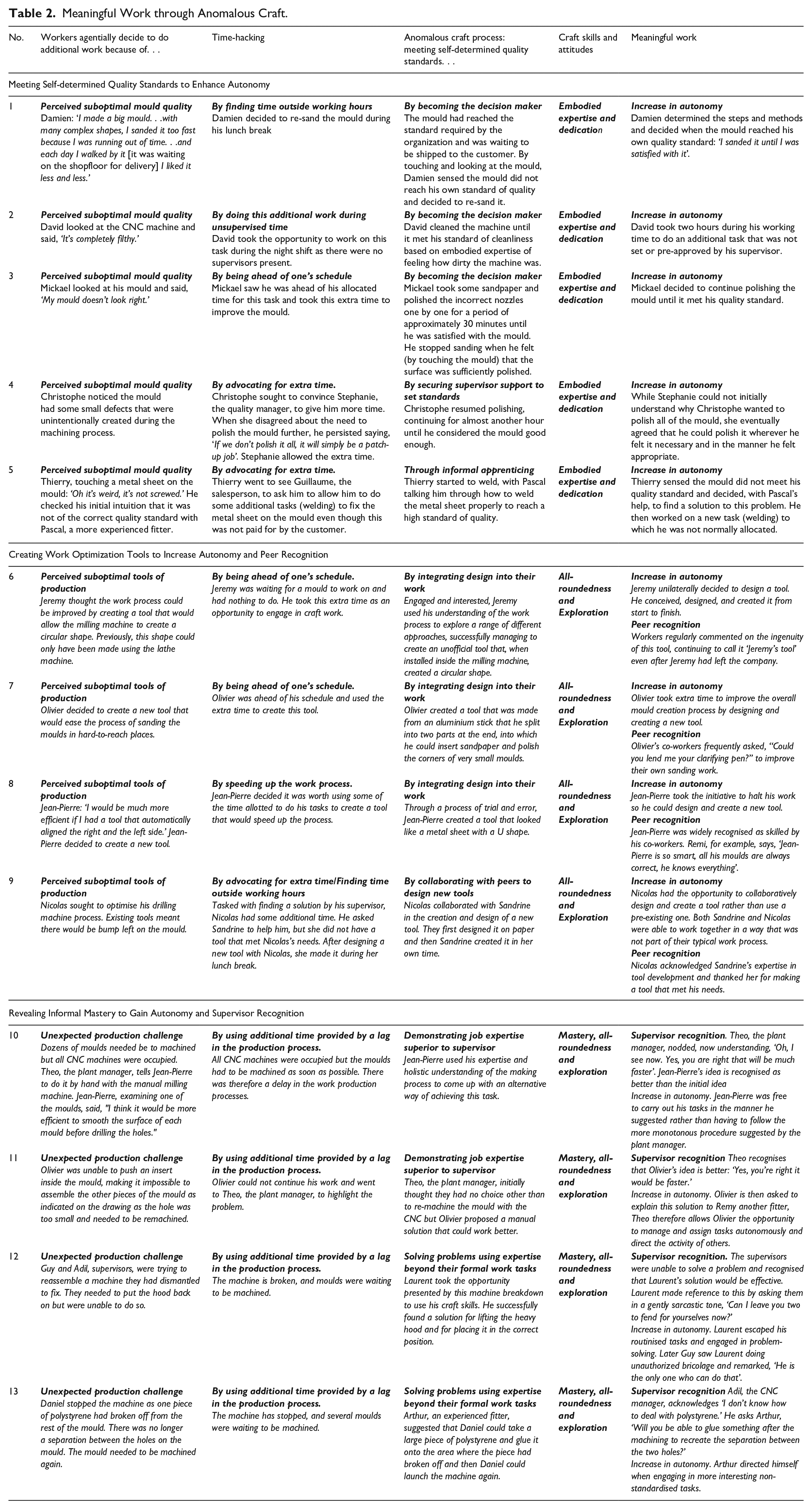
The shopfloor workers carry out what is classified as low skill, routinized work and the level of standardization and automation is such that they should simply follow each step in the outlined procedures without any possibility of deviation. We identify three processes through which workers find opportunities to move away from their routinized tasks and carve out time or use of lag time (time hacking) to engage in ‘anomalous craft’ i.e. the agential implementation of latent craft skills and attitudes within the formal work process in low-skill controlled settings, gaining more autonomy and receiving recognition. We outline the three processes below, further details of which are provided in Table 2. This table also offers supplementary examples of the processes, illustrating how workers identify opportunities for non-routine work, engage in time-hacking to find time to do that work, the craft activities they carry out, the related craft skills and attitudes, and the outcomes in terms of autonomy and recognition.
Meaningful Work through Anomalous Craft.
Meeting self-determined quality standards to enhance autonomy
The first identified process occurred when workers perceived the need for (usually cosmetic) improvements in a mould that already met the required external quality standard. Like craft workers, they took ‘pride’ in their work, ‘insisting on quality work, regardless of the pressures toward volume production’ (Hodson, 2007, p. 141; Sennett, 2008). Through time-hacking, they found time to meet their self-determined standards, judging for themselves when the work was satisfactorily completed. The opportunity to do quality-oriented craftwork is therefore created by workers by approaching their work with a craft attitude of ‘dedication’ where they seek to achieve a quality end product ‘independent of expected economic rewards’, agentially deciding that the current standard of the product or output is suboptimal and requires additional work (Kroezen et al., 2021, p. 72; Bell & Vachhani, 2020; Sennett, 2008). Workers made that judgement by relying on their latent craft skill based on tacit and embodied ways of knowing (Ewenstein & Whyte, 2007). The outcome of this process is that during these periods of craftwork, workers gain more autonomy because they can determine the tasks and their duration, organize their own work, and decide when it is satisfactorily completed; they can thus engage in more meaningful work.
Becoming the decision maker
Mickael (example 3, Table 2) is a fitter whose main task is to fix nozzles (cylinders of one cm3 with several small holes to allow the air to escape the mould during the production process) by hammering them into pre-existing holes in the mould. Workers who perform this fastidious and repetitive task are unofficially called ‘nozzlers’. On this particular day, Mickael had to insert more than three hundred nozzles into an aluminium sheet within a set period of time. After he had inserted approximately one hundred nozzles, he examined the mould, saying aloud, ‘My mould doesn’t look right; some nozzles are too long and don’t sit at the right height.’ The researcher was unable to see the problem and asked, ‘Does it matter for the mould or the customer?’ Mickael answered, ‘This mould is only for producing an isothermal box, so it wouldn’t bother the customer.’ Time-hacking, Mickael glanced at the clock, saw that he was ahead of schedule, and decided to use that time to sand and polish each incorrect nozzle until he was fully satisfied with the overall appearance of the mould. After 30 minutes of this, he said, ‘Now it looks much better; look, all the nozzles are at the same level.’ Although the mould had already reached a standard sufficient for the needs of the customer, by identifying concerns related to the appearance of the mould and finding additional time Mickael was able to engage in craftwork focused on improving the quality of the mould. This allowed Mickael more autonomy, enabling him to decide how to achieve his own quality standards. On other occasions when workers had insufficient time to work to their own quality standard within official production times, they were observed to use time during their breaks to complete a mould to their satisfaction (see example 1, Table 2).
In another example, during a night shift when there was no supervisor, David (example 2, Table 2) an operator, did not immediately begin the process of installing the aluminium block inside the machine as he was supposed to. Instead, he looked inside the machine, examining the panels (shaped like the bellows of an accordion) and drew on his embodied skill to judge the accumulation of dirt on each one by touching it to assess the thickness of grime. He then unilaterally decided that rather than dealing with the set work, he would use his time differently, deciding to clean his machine, doing so until it reached a level of cleanliness that he believed would no longer impact negatively on the quality of the mould. This process took more than two hours out of a six-hour shift. When asked why he had risked incurring his manager’s wrath by spending such a large proportion of his time cleaning the machine, he answered, ‘It is completely filthy; I cannot work like that. If the machine is dirty, it will affect the mould and the mould won’t look right.’ David therefore time-hacked by deciding how to allocate his time, working autonomously, and relying on his own judgement as to when the machine was fit for work.
We see in these examples how, by engaging in quality-driven craftwork, workers made decisions about the organization and execution of their work. They determined the steps and methods necessary for meeting their own quality standards, and judged when these were met, thus acquiring more autonomy in their work.
Securing supervisor support to set standards
Sometimes, workers may need to advocate to supervisors to convince them that worker-determined quality standards are necessary. For example, Christophe, an experienced fitter (example 4, Table 2), was polishing a huge mould to remove small defects that were by-products of the machining process. His supervisor Paul, believing this to be unnecessary and wanting to move Christophe onto his next allocated task, asked Stephanie, a commercial team member, for advice since she would complete the last check before sending the mould to the customer. Stephanie looked at the mould, turning it round to examine each of the marks pointed out by Christophe. She stopped at one mark and said, ‘Yes for this one, and [pointing to another small flaw] maybe this one.’ Christophe responded, ‘OK, I will polish everything.’ Stephanie answered, ‘There is no point polishing everywhere, it’s only cosmetic. If we do this, how much time will we spend doing solely cosmetic work?’ Christophe, unhappy with this response, argued, ‘But if we don’t polish it all, it will simply be a patch-up job.’ Stephanie looked again at the mould, touching the different marks. She then concluded: ‘OK, fine, polish it wherever you want’, adding, ‘Personally, I would start with the sander and then with the scraper.’ By raising concerns about the mould’s appearance and convincing his superiors this was important, Christophe secured extra time for quality-oriented craftwork. While Stephanie gave Christophe advice on how to do the work, she left it to his discretion how he carried it out. Christophe gained more autonomy because he had permission and time to carry out his work as he saw fit, and he could decide for himself when the quality of the output was sufficient.
Informal apprenticing
Workers could also find opportunities to work collectively to do quality-oriented craftwork. Thierry, a young fitter (example 5, Table 2), was tasked with repolishing part of a mould that a customer had sent back because its surface had become uneven and needed re-sanding. Thierry noticed that the small aluminium sheet that indicates the mould’s serial number had come loose. He remarked to the researcher, ‘Oh it’s weird, it’s not screwed.’ Although the control sheet did not state that this aspect of the mould should be modified, Thierry sensed that it would not meet the quality standard expected by the other fitters and went to consult Pascal, a more experienced fitter who worked close by. Pascal explained that the aluminium sheet had most likely been glued on because the two holes in the aluminium sheet were not aligned with the two holes in the mould, making it impossible to affix the sheet with screws. The only solution was to weld the sheet’s existing holes and create new ones that aligned with the mould’s holes. Pascal explained the welding process to Thierry since this task fell outside Thierry’s assigned tasks:
‘You would need to clean the mould with the air blower and then weld it, start the welding machine on a really high [amperage] setting’
‘100?’
‘No, at least 200.’
Since Thierry’s task was to sand, not to weld, he needed permission and time from the supervisor (Pierre) to carry out this extra task. Pierre told Thierry to consult Guillaume, the sales manager, to determine precisely what the customer had paid for. Thierry explained the issue to Guillaume who confirmed that the customer had not paid for this but nevertheless agreed that Thierry could fix it. Thierry had time-hacked securing the time needed to do the additional work and went back to his work bench and began to weld. After a few minutes, he looked at the aluminium sheet, which had become curved and misshapen, and said, ‘It’s gone weird.’ He returned to Pascal for advice. Pascal told him kindly that he needed to sand it, first with the rolling mill and then manually, and it would be fine. Thierry followed Pascal’s instructions and after a few minutes said, ‘Well, I think that’s enough.’ He went to show Pascal, who smilingly confirmed, ‘Ah, it’s fine now . . . no one will see [the error].’ Here, Thierry identified a quality issue and was able, with Pascal’s support, and time from his supervisor, to work more autonomously on a non-scheduled work task, creating a finished mould that aligned with the quality standards of the more experienced fitters.
Creating work optimization tools to increase autonomy and peer recognition
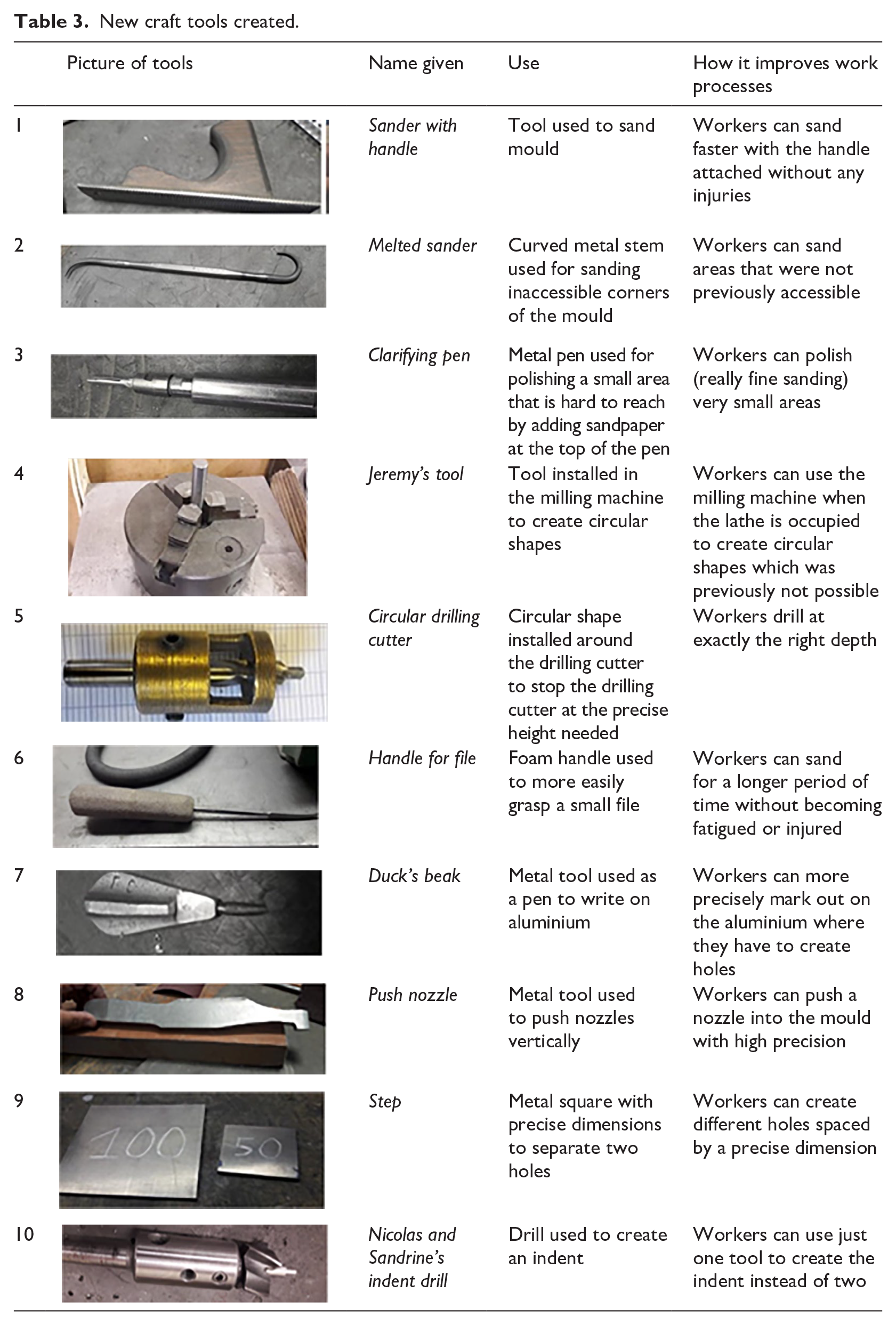
The second identified process occurred when workers realized that standardized tools and practices could be optimized or improved in some way. The opportunity to do this tool optimization craftwork was created by the worker agentially deciding that the process of creating the moulds could be improved, and then finding time for the extra work through time-hacking. Workers searched for solutions that would optimize their work processes by drawing on a craft mindset of exploration (‘openness to experimentation, improvisation and real-time variation, supporting by experiential learning’; Kroezen et al., 2021, p. 5) to create tools. They also drew on their ‘all-roundedness’ or the holistic understanding of how different aspects of the process interrelate (Becker, 1978; Kroezen et al., 2021; Sennet, 2008). Creating work optimization tools allowed workers to achieve more autonomy in their work by tackling more complex integrated tasks that involved both design and execution (Sennett, 2008). The tools, once developed, were often used and admired by other workers, who gave the creator due recognition. This autonomy and recognition provided workers with the conditions necessary for more meaningful work. See examples of several tools created by workers in Table 3.
New craft tools created.
Integrating design into their work
As fitters are the last step in the production process, they sometimes have to wait for a CNC machine to finish a mould if the planned machining runs over schedule. During this time, they have no official work but they are still expected to wait alone at their workbench for the moulds to be ready. We noticed that many of the fitters filled this time by creating hand-made tools that increased the efficiency of their work or decreased the risk of work-related injury, thereby improving the work process. Individuals keep these tools at their workbenches, and the more useful or creative tools are borrowed by other shopfloor workers.
Jean-Pierre (example 8, Table 2), a fitter working on the manual milling machine, had been allocated a large number of moulds to mill in a set period of time. Before milling a mould, workers need to verify that the right and left sides of the mould are aligned with the horizonal axis of the machine. Jean-Pierre surveyed the piled-up moulds, saying, ‘I would be much more efficient if I had a tool that automatically aligned the right and the left side.’ Time-hacking, he decided to use his time differently than allocated and to spend time creating a tool that would increase his efficiency. Through trial and error, he fashioned a tool that looked like a metal sheet shaped in a U. This he affixed to the horizonal axis of the machine table, and thereby ensured correct alignment of the mould every time. Engaging in this craftwork had taken time but since the new tool had made him more efficient, he completed his allocated work on schedule. Through this process, Jean-Pierre was able to undertake more complex tasks and work autonomously to design and create a new tool. Creation of the tool also afforded him the opportunity to be recognized by other workers as highly skilled. Remi, an operator, noted that ‘Jean-Pierre is so smart, all his moulds are always correct, he knows everything.’ This tool was one of several that Jean-Pierre had created and kept in his cupboard. Other operators often sought his permission to use his tools to enhance the quality of their own moulds or work processes. See also Jeremy’s tool for fashioning circular shapes on the milling machine (example 6, Table 2 and picture 4, Table 3), something that was previously only possible on the lathe machine.
Collaborating with peers to design new tools
Nicolas, a fitter (example 9, Table 2), was working on a particular mould when his supervisor, Charles, and the plant manager came to him to explain that the customer now wanted the mould to have a flat-bottomed indentation approximately 40 mm in diameter. He added that Nicolas should use the manual milling machine because it would take too long to reprogram the CNC machine. Nicolas searched the storage area for an appropriate tool, but none would create a flat indentation. He eventually found a tool that could potentially work (a type of rod with a blade at the bottom) but judged that it wouldn’t fit neatly in the milling machine and might create a bump on the indentation if it moved during the machining process. Nicolas explained the issue to Charles, and suggested he go to talk to Sandrine (the CNC lathe machine operator) who might be able to help. Nicolas, having been given the go-ahead from Charles to find a solution, now had some time to explore potential options and headed off to speak to Sandrine. Sandrine explained that she didn’t have the right tool but told Nicolas she could create one. She took a piece of paper and began to draw the tool following Nicolas’s instructions in terms of shape, asking him what length the rod should be and where the blade should be positioned. Nicolas showed Sandrine the tool he had found in the tool storage area, saying they could copy the length of this one but needed to change the diameter. Sandrine said, ‘OK, so 57[mm] here and 9[mm] there, that should work?’, showing two different areas on the drawing to Nicolas, who agreed. Once they had the dimensions, Sandrine said, ‘I can’t do it right now as I have something else to finish but you will have it after lunch, I’ll bring it to you.’ Sandrine spent part of her lunch break making the tool (Table 3, picture 10). When she took it to Nicolas’s workbench he thanked her, telling her it was exactly what he needed. She replied, ‘No worries, I loved doing it.’ To the researcher, she remarked, ‘I love doing challenging things at work where I have to figure things out.’
In this example, Nicolas realized that the existing tools were suboptimal and was allowed by his supervisor to take time to find alternative solutions. Whereas initiated by Nicolas, Sandrine also had the opportunity to break away from her routinized work and engage in an explorative activity that helped Nicolas devise a more effective tool. Sandrine also time-hacked by using additional time during her break to complete the tool. The exchange between Sandrine and Nicolas became an opportunity to work together on a more interesting task, in which they could conceive and design how the new tool should look and function. Through this collaboration, Nicolas and Sandrine engaged in more autonomous work that was not part of the scripted organizational process. Sandrine also received recognition from Nicolas, who expressed gratitude for her efforts. He emphasized that it precisely met his needs, acknowledging Sandrine’s expertise in tool development.
Revealing informal mastery to gain autonomy and supervisor recognition
The third process occurred when an unexpected organizational challenge disrupted or halted the routinized work processes, causing work to slow down or grind to a halt and workers agentially decided to involve themselves in solving these complex problems. They thus time-hacked by turning a work lag into an opportunity to escape their routinized work, revealing their informal mastery by utilizing craft skills to address challenges both within and beyond their formal job tasks. Informal mastery is a form of craftwork associated with the exceptional skill or competence of certain individuals that was not formalized (i.e. they had no formal qualification or status) and draws on experimentation, exploration and all-roundedness (Kroezen et al., 2021). Revealing informal mastery not only grants workers autonomy in their tasks but also garners recognition from their supervisors, as they propose novel solutions that are often better than those initially suggested by their supervisors or solve issues supervisors cannot.
Demonstrating job expertise superior to supervisors
When problems occurred that created production blockages or caused work to stop, workers often used the opportunity to illustrate their craft skills, offering solutions that demonstrated an in-depth knowledge and expertise often superior to that of their supervisors. For example, Olivier (example 11, Table 2), a fitter, was trying to push an insert into a mould. The insert should, according to the designer’s drawing, overhang each side of the mould, but the hole for it was too small, meaning that the mould had to be re-machined. Until this step was completed, the production process would be put on hold. Olivier alerted Theo, the plant production manager, to the problem. Theo, annoyed at being interrupted, demanded, ‘Where is the drawing?’ Olivier handed it to him. Theo looked at the drawing and told Olivier they would need to reprogram the CNC machine because the mould had to be resurfaced on the sides where the insert would sit so it could hang over the edges. Olivier examined the mould thoughtfully, then suggested, ‘But we could also do it on the manual milling machine, don’t you think that would be faster since we wouldn’t have to reprogram everything?’ Theo considered the idea, and said, ‘Yes, you’re right it would be faster, but we don’t have the right milling cutter to do it.’ Olivier responded, ‘But that’s not a problem. Rémi [the milling machine operator] could use a smaller cutter and instead of cutting straight down, he can gradually lower the cutter and move it from right to left to make the hole bigger.’ Theo nodded enthusiastically, ‘Yes, good idea. Can I let you handle it and explain it to Rémi?’
In this example, Olivier suggested a more efficient and easier solution than the one suggested by his supervisor, who acknowledged the superiority of Olivier’s idea. Not only did Theo recognize Olivier’s expertise, he also gave him permission to step away from his workstation and use the lag time to solve the issue by assigning and directing the work of another fitter. Although there are no official distinctions in skill level or pay among fitters, Theo had informally acknowledged that Olivier possessed the skills and ability to oversee and explain tasks to his peers.
In another example (example 10, Table 2), Theo asked Jean-Pierre to individually drill holes into dozens of identical moulds. This would normally have been done quickly on the CNC machine with one program, but all the CNC machines were occupied, creating a production blockage, so Theo decided that the best solution would be for Jean-Pierre to manually create the holes. Jean-Pierre picked up a mould, examined it and suggested, ‘It would be more efficient to smooth the surface of each mould before drilling the holes.’ Theo quickly responded, ‘That’s unnecessary, the customer isn’t bothered about what the finish of the moulds is like.’ Jean-Pierre placed the mould onto the machine and argued, ‘But if we smooth the surface of each mould, we could make all the holes all at once on the milling machine, which would save time.’ As he spoke, Jean-Pierre mimicked how positioning the moulds on the machine and smoothing their surfaces would optimize the process. Theo nodded, ‘Oh, I see now. Yes, you are right, that will be much faster.’ He added, ‘Alright, let’s do that, smooth the surface first, then drill the holes.’ Although Theo had initially dismissed Jean-Pierre’s idea, the demonstration of how it could work convinced him otherwise. Jean-Pierre’s idea was acknowledged to be better than his own, and Jean-Pierre was left to use his time how he saw fit carrying out the task in his preferred manner rather than having to follow the more monotonous procedure suggested by the plant manager.
Solving problems using expertise beyond their formal work tasks
Workers could also become involved in work that was unrelated to their own tasks if they came up with solutions for production challenges or blockages. In example 12, Table 2, Adil, the operators’ supervisor, was with Guy, the programmers’ supervisor, trying to reassemble a machine they had dismantled for repair. They needed to put the hood back on the machine, but it was too heavy to move. Laurent, an operator, was watching them as he launched a new mould on his CNC machine. He came over to them with ‘an idea’. He explained that they could create an elevator system made up of several wedges, threaded rods and a crowbar. The supervisors did as Laurent suggested and managed to lift the hood to the required level, but they could not put it in the right place; something was blocking it. They tried to push it and then pull it, but nothing happened. Laurent intervened, ‘I think I know what the problem is.’ He walked inside the machine, looked carefully, and told them ‘It is full of aluminium chips, and this is what is stopping it.’ Before returning to his machine, he enquired with gentle sarcasm, ‘Can I leave you two to fend for yourselves now?’ In this example, Laurent time-hacked by seizing the temporal opportunity presented by a machine breakdown to halt his routinized work and reveal his skill by successfully addressing two challenges that were beyond Guy and Adil. As such, Laurent not only had an opportunity to stop his routinized work, he also gained recognition from supervisors who had solved their problems following his advice, thus implicitly acknowledging his experience. Another day, Guy was walking through the plant and saw Laurent doing unauthorized manual bricolage. He was using a three-axis machine to manually machine a base for a mould in order to simplify subsequent machining on a five-axis machine, which was not normally allowed. Guy acted as if he hadn’t seen this, saying to the researcher, ‘He is the only one who can do that, I let him do it [even through its normally forbidden].’ Workers could therefore sometimes gain informal privileges that allowed them to do more autonomous craftwork. See also example 13, Table 2, in which Arthur became involved with solving a problem unrelated to his own work tasks, using his expertise in working with polystyrene to help another co-worker and his supervisor find a solution to a production problem.
Meaningful Work Through Anomalous Craft: Three interrelated processes
Anomalous craft is the agential implementation of latent craft skills and attitudes within the formal work process in low-skill controlled settings. We identify three interrelated processes through which anomalous craft can enable workers to enhance their autonomy and receive recognition leading to more meaningful work. These three processes and their impact on workers’ autonomy and recognition (i.e. meaningful work) are depicted in our theoretical model of ‘Meaningful work through anomalous craft’ (see Figure 1).
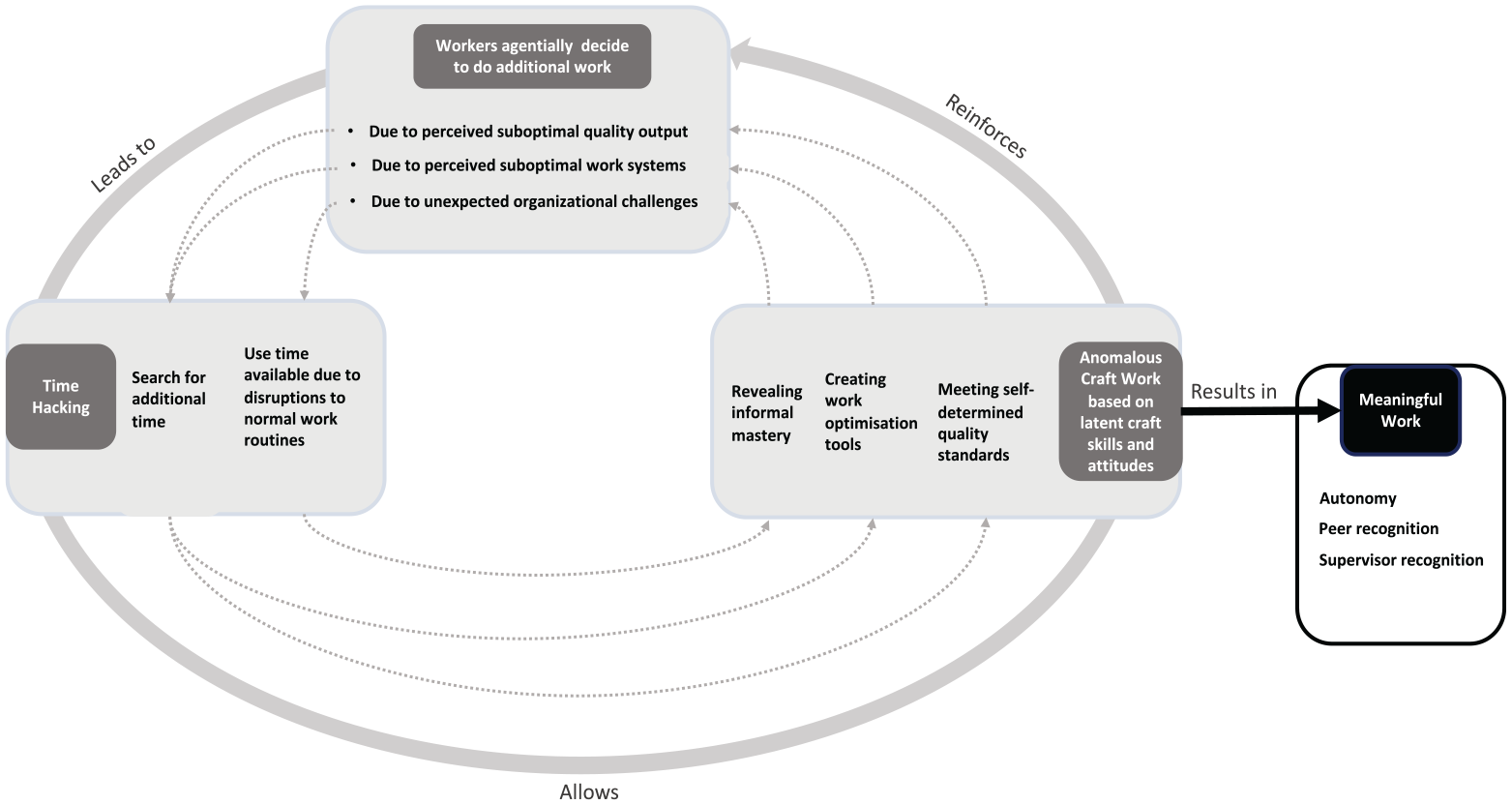
Meaningful work through anomalous craft.
In the first work process (Meeting self-determined quality standards to enhance autonomy) the focus of improvement is the product or output (i.e. the mould). Although the actual tasks (e.g. polishing, machining, welding) do not fundamentally change, workers navigate constraints in the system to gain additional time (i.e. time-hack) that provide opportunities to make decisions, secure supervisor support, and engage in informal apprenticing, thus making their work more autonomous.
In the second process (Creating work optimization tools to increase autonomy and peer recognition), the focus shifts to the tools or systems used to create the output. Workers identify aspects of the work systems or tools as suboptimal and engage in craftwork, and carry out more complex, non-routinized tasks to create new tools that optimize the existing ways of working. Through time-hacking, they can work independently and sometimes collectively on their creation. Engaging in this process increases workers’ autonomy and peer recognition.
Lastly, in the third work process (Revealing informal mastery to gain autonomy and supervisor recognition) the focus is on solving complex unexpected organizational challenges both within and outside their work domain using their informally gathered expertise. They use time that becomes available when the normal routinized work is disrupted. Engaging in this process earns workers autonomy and recognition from supervisors.
Frequent engagement in anomalous craft reinforces workers’ ability to determine when additional work is needed as they become more skilled. The more workers engage in anomalous craft the more they are recognized as having craft skill by their supervisors, allowing them further agency to identify suboptimal ways of working or to intervene to solve organizational challenges. Supervisors may even request workers to engage in anomalous craft to help solve organizational challenges if they have previously demonstrated their informal mastery.
Discussion
In this paper we have argued that two core dimensions of meaningful work are autonomy in terms of how workers carry out their work, and recognition of the value of their work from others (Bolton, 2007; Hodson, 2007). Existing work has shown that low-skilled work such as shopfloor work and some forms of ‘dirty work’ are strongly associated with alienated and meaningless work; such workers have little autonomy and are considered to be not ‘deserving of making decisions’ (Breen, 2019, p. 60). They are routinely ‘denied respect and recognition’ (Costas, 2022, p. 8). It is largely assumed that low-skilled work lacks the autonomy and recognition that are characteristic of highly skilled work and craftwork. We challenge these assumptions and show that workers may agentially find opportunities for autonomy and recognition by engaging in anomalous craft within their work roles through bottom-up, self-initiated behaviours and informal activities that draw on latent craft skills and attitudes.
Meaning in low-skilled work
First, our paper contributes to the meaningful work literature, which has largely ‘been framed around certain (more privileged) types of classes of work’; as a result, the prominent models of meaningful work focus on high-skilled workers, overlooking those in low-skilled or unskilled roles (Rosso et al., 2010, p. 117; Laaser & Bolton, 2022). Prior research on low-skilled labour suggests that individuals seeking meaning in such roles are limited to reframing the importance of their work (Dutton, Debebe, & Wrzesniewski, 2000) or engaging in acts of organizational resistance (Hodson, 2007). We challenge these assumptions by illustrating how, through anomalous craft, workers in low-skilled roles can gain autonomy and recognition (normally associated with high-skill roles) within their work. It could be argued that what we describe here amounts, to some extent, to a form of self-exploitation since the workers gain no formal additional benefits from exercising their craft skills to produce quality output and ensure the smooth running of the work processes; their work continues to be cast as low-skilled and poorly paid. However, in seizing opportunities to decide how best to prioritize, organize and complete their work, negotiating with their managers and making decisions bilaterally, the workers are creating an avenue to more meaningful work in that they acquire more autonomy and receive recognition of their skills from peers and/or supervisors (Hodson, 2007; Steiger & Form, 1991). Although (the importance of) their skills are not formally acknowledged by the organization, workers can become informally recognized as having skill through ‘mastery of the complexity of the tasks required of workers in their jobs, and mastery of the relations that coordinate activity across these tasks’, and sometimes gain privileges thought to be rarely afforded to workers in low-skill jobs (Adler, 2004, pp. 245/246).
Much of the existing literature of meaningful work is rooted in the fields of organizational behaviour and psychology, where the internal cognitive-emotional experience of individuals takes precedence over social and cultural factors (Rosso et al., 2010). Existing research on meaningful work has ‘largely ignored social, other-oriented, and community-based perspectives on the nature of work in favour of individual perspectives’ (Rosso et al., 2010, p. 119). By moving away from micro-level and intrapersonal mechanisms and following a more sociological and philosophical tradition, we are able to draw attention to the dynamic and changing social and contextual sources of meaning at play in low-skilled contexts. We therefore expand ‘understanding of how other persons and cultural norms matter for meaning’ and advance a ‘more integrative and dynamic model . . . [of] meaning’ in work (Rosso et al., 2010, p. 119). Traditionally, meaningful work has been seen as static and dichotomized into high-skilled jobs that are perceived as inherently meaningful (workers can express themselves and derive a sense of self-worth and respect; Hodson, 2007) and low-skill job roles that are perceived as meaningless (stringent managerial control limits workers’ autonomy to engage in meaningful tasks; Braverman, 1974). However, our paper demonstrates that the concept of meaningful work is more nuanced, as meaningful work can coexist with meaningless work within the same job roles. Even within low-skill and tightly controlled job roles, workers can find opportunities to exercise agency and engage in productive work activities that enhance the meaning of their work. We therefore challenge the binary view of organizational control and workers’ agency as opposing forces by showing how they co-exist and interact in complex ways in low-skilled work environments. We demonstrate the role of both context and social relations in moving work from meaningless to meaningful as engagement in anomalous craft is contingent on contextual (i.e. temporal) conditions and engagement with peers and supervisors, who are central to the process of creating more meaningful work.
Time as a resource to find meaning at work
Our paper also contributes by emphasizing the critical role of time in finding meaning at work, particularly for workers in low-skilled roles. We show how workers use temporality as a resource to engage in anomalous craft, allowing them opportunities to transcend their routinized tasks. Previous work has shown that workers often endure a ‘wretched struggle with time’, that time can be malleable and ‘drag’ or ‘fly by’ and that workers manage monotony and fatigue by playing with the construction of time (Holt & Johnsen, 2019, p. 11; Butler, 1995; Kent & Granqvist, 2024). In this paper we show how workers time-hack to reshape and change the time available to them and the tasks they should be carrying out according to their official work schedule in order to introduce moments of engagement and meaning through craftwork. In his seminal work ‘Banana time’ Roy (1959, p. 158) describes the time-based rituals used by machine workers to interrupt their schedules at fixed intervals, thereby introducing some variation and enjoyment to a workday otherwise characterized by drudgery and exhaustion. When these time rituals were disrupted, there came ‘the return of boredom, came a return of fatigue’ and ‘a succession of dismal workdays . . . creeping again at snail’s pace’ (Roy, 1959, p. 165). We extend this work by illustrating how through time-hacking workers carrying out low-skilled roles do more than just interrupt boredom and monotony – they can actually find space for partaking in and developing craft.
By engaging in anomalous craft, sometimes alongside colleagues and supervisors, workers can break free from the rigid, structured tasks typically associated with low-skilled labour. During these ‘times’, workers are able to structure their work activity according to their interests and preferences, carrying out their work in a manner more reminiscent of craftsmen than of low-skilled ‘hands’ engaged in routinized tasks where they are ‘told exactly what to do and how to do it’ and ‘supervised closely’ (Braverman, 1974, p. 431). This suggests that workers in low-skilled roles are not always mere ‘hands’ performing atomized tasks, closely supervised and denied the opportunity for creativity or quality control (Braverman, 1974). Rather these temporal opportunities for craftwork allow workers to derive meaning from finishing a product that meets their own standard of quality or from creating and designing a complete and ‘finished’ tool, a privilege that is normally assumed to be denied to workers carrying out low-skill work, whose work experiences conclude with the ‘mere cessation of activity’ (Roy, 1953, p. 511). Our contribution highlights how time-hacking to find opportunities for anomalous craft enables workers in low-skilled roles to gain autonomy and recognition, transforming their experience of time and labour. This contrasts with the dominant view of low-skilled labour as almost entirely routinized and controlled, showing that even within these roles there are opportunities for meaningful engagement with work activities.
The existence of ‘anomalous craft’ in low-skill work environments
We also add to the craft literature by illustrating that craft can manifest in unexpected ways within low-skilled job roles, challenging existing assumptions about the nature of craft and its applicability across different types of work. Even in highly industrialized and controlled environments where employees follow repetitive and routinized tasks, we show how workers can in fact use latent craft skills and attitudes within their work (Kroezen et al., 2021). We introduce the concept of ‘anomalous craft’ to describe how workers in low-skill settings agentially implement craft skills and attitudes within work processes, making their work more meaningful. While craft can be found in a variety of workplace settings, from traditional glassmaking (O’Connor, 2007) to contemporary software development (Martin, 2009), it invariably relates to roles that are seen as skilled, requiring a significant level of formal expertise. We question the binary assumption that craft and low-skilled work are polar opposites. We show that even in work that officially requires little or no specific skill, workers can nevertheless manage to find or create windows of opportunity for learning, retaining and practising craft skills within their formal role and sharing them through informal apprenticing arrangements.
In previous research that shows the emergence of craftwork in controlled shopfloor settings, craftwork occurs when management has reorganized the work to allow for more discretion and work autonomy. For example, Zuboff (1988) shows how blue-collar workers found renewed meaning in their work despite increased automation when they were empowered to explore, improvise, question and enhance their working processes. Workers whose craft skills are threatened by the introduction of new technology will also fight valiantly to retain their position. Vallas (2006, p. 1701) outlines a process of ‘craft usurpation’, in which maintenance technicians engaged in a jurisdictional dispute following the introduction of new computerized process control systems they viewed as an ‘affront to [their] dignity’. Anteby (2008) also shows how workers may utilize their craft skills outside of work to create ‘homers’ or artefacts for personal use (e.g. small trinkets or decorative items from scrap material on the shopfloor) to preserve traditional craft-like values and bolster their faltering occupational identity. In our paper, we identify ‘anomalous’ craft as a distinct form of craft that goes beyond the ‘remnants’ of craft (Anteby, 2008), the resistance to industrialized alienation through ‘craft usurpation’ (Vallas, 2006) or the resurgence of craft by the implementation of managerial practices (Kroezen & Heugens, 2019). Rather, workers designated as low-skilled can retain, develop and share craft skills, carving out increased opportunities to make decisions based on ‘individual judgment, that cannot be replicated by machines’ (Kroezen et al., 2021, p. 507) and receiving informal recognition for these skills.
Conclusion
Our work is based on a case study of a firm where the production process was highly standardized, repetitive and controlled, but where the output varied, and new outputs were frequently created. Future research could explore whether similar craft strategies can develop in other types of industrial settings (e.g. where there is mass production of thousands of identical objects). Our work also has implications for the new forms of technology (including artificial intelligence) that are increasing control over workers and reducing their engagement to highly specific ‘gigs’ requiring less and less skill, in turn rendering more domains of work potentially more meaningless (Kellogg, Valentine, & Christin, 2020; Zuboff, 2019). As Kroezen et al. (2021, p. 516) note, the ‘twenty-first century equivalent [of the 20th century factory floor worker] may be the gig worker controlled by digital platforms and algorithms’. While we know much about how such technologies extend the scope of organizational control and can lead to new forms of worker resistance (Cameron & Rahman, 2022), future work could examine how workers in such contexts use craft strategies to (re)engage in more meaningful work. It would also be interesting to examine how the notion of craft is being transformed in the era of automation and technology-driven work environments, and how craft can emerge and evolve in these contexts. Our work offers insights to organizations that routinely employ workers to carry out low-skilled work, or which seek to implement new technologies but also wish to ‘avoid violations of the fundamental value of being human’ (Gibson et al., 2023, p. 25). Building on our findings, organizations might proactively design opportunities for workers to have creative and meaningful outlets within their work, even in low-skill or highly automated contexts.
Footnotes
Funding
The author(s) received no financial support for the research, authorship, and/or publication of this article.
