




Abstract
While a large body of research explains how social movements elicit corporate change by focusing on confrontation of activists against targeted organizations, it remains unclear how the conflicts between activists and their primary targets affect non-target firms. Drawing on social movements research and non-market strategy literature, we examine how non-target firms respond to social contentiousness in the non-market environment in the context of the creation of automotive emissions controls in Japan in the early 1970s. Our findings challenge the somewhat linear assumption that confrontation and direct action against focal firms is a necessary condition for activists seeking change. Instead, our findings underscore the importance of also considering non-target firms in understanding the impact and influences of movements on the broader non-market environment. Moreover, our findings contribute to the non-market strategy literature by revealing that social value-based strategies can serve as an alternative way for corporate targets to exert influence in non-market environments. Specifically, we present a model that shows the linkages between intentional non-market strategies and strategic motivation in market competition, thus responding to calls to consider the linkage between non-market and market strategies.
Introduction
An ongoing struggle and tension between anti-corporate activism and the organizations that it targets is at the center of social movement theory and non-market strategy research (King & Pearce, 2010; McAdam, 1996). Past research has long explored confrontation between activists and firms, examining how activists deploy tactical repertoires to challenge their corporate targets (Eesley & Lenox, 2006; Frooman, 1999; King, 2008). Contentious challenges also provoke corporate targets to mitigate activists’ threat by implementing strategic actions that include tangible or symbolic concessions to activists (e.g., McDonnell, King, & Soule, 2015), impression management (McDonnell & King, 2013), and more aggressive corporate counter-mobilization activities (McDonnell, 2016). Recent work also suggests that firms can reduce the contentiousness of their social environments by forging cross-sector collaborations with activist organizations (Odziemkowska, 2022; Odziemkowska & McDonnell, 2024).
As conflict is an essential feature when activists target firms to promote corporate reform (King, 2008; Soule & King, 2015), scholars have argued that contentious interaction between non-market activists and their corporate targets can be viewed as non-market rivalry (Waldron, Navis, Aronson, York, & Pacheco, 2019). Scholars studying the issue from an economic perspective have referred to firms’ efforts to influence the way they are constrained as “non-market strategy” (Baron, 1995) and modeled it as a competition between activists and firms for control of the rules of the game (Baron & Diermeier, 2007). In this perspective, non-market rivalry occurs when value-rational social movement activists press firms to adopt more socially responsible practices and firms undertake their own efforts to alleviate the threat of being targeted (Pacheco & Dean, 2015).
When activists press the target organization to change its behavior, the conflict may transcend the boundaries of activists’ original target zone and wield influence over other players. Anecdotal evidence shows that when focal firms are targeted, non-target firms seek to take defensive actions to avoid becoming the next target (Shi & DesJardine, 2022; Yue, Rao, & Ingram, 2013). To date, scholarly work on the spillover effects of social movements has examined how different types of activist tactics effect change beyond the directly targeted organization (Delmas & Toffel, 2004; Sanders & Tuschke, 2007), or how activists opposing the targeted organization can motivate participants in other settings (Briscoe & Safford, 2008).
On the other hand, research on competitive dynamics emphasizes the importance of firms’ strategic motivation in understanding their responses to activists’ pressure, and suggests the need to incorporate a market-based perspective in explaining non-market activities (Pacheco & Dean, 2015). From this perspective, anti-corporate activism against its primary targets send signals of activists’ interests and preferences, and whether other organizations respond depends on the actions of competitors and the tactics of activists. All of these studies imply that conflicts between activists and primary target firms may affect other players; an important yet under-explored question is how non-target firms respond to contentiousness in their non-market environment.
To better understand this research question, we draw on work from social movements and non-market strategy literature to examine how firms who are not targeted respond to adverse socio-political events that affect the focal targeted firms in the context of framing and establishing automotive emissions controls in Japan in the early 1970s. Specifically, we find that the conflict between environmental activists and the targeted focal firms can give rise to a socio-political opportunity space for non-targeted firms to deploy competitive strategy that aligns with the social values of the activists. We define this approach as another form of non-market strategy that helps non-target firms to gain social advantages over market rivals in their relationship with activists. To this end, we encapsulated three specific actions taken by non-target firms, namely, “injecting social value into new products,” “boosting social influence through high-stakes events,” and “aligning with social activists’ causes to increase the cost of rivals’ response to activists demand,” which ultimately lead to activists attacking the targeted firms.
Leveraging our findings, we present a model to provide a theoretical explanation and make two key contributions. First, we contribute to the activists–firms rivalry perspective in social movement research with a specific focus on non-target firms. In contrast to previous arguments that focus on the contentious relationship between activism and its primary targets, we extend the argument to also include non-target firms by offering empirical insights into how conflicts between activists and primary targets can prompt less targeted firms to launch strategic actions against their rivals. We argue that paying attention to non-target firms can help in understanding how activists influence their targets and shape the outcome of activism through diverse mechanisms and pathways. In doing so, we respond to the research call to move beyond conceptualizing activist–organization interaction as a simple dyadic phenomenon by offering a more nuanced understanding of movement activism and its influences and resulting pathways on corporate targets responses.
We also add to the non-market strategy research by highlighting how less targeted firms, or firms in the peripheral space, can take proactive non-market actions in shaping the social-political environment. As prior research has provided considerable knowledge on corporate social responsibility (CSR) and corporate political activity (CPA) as two important non-market strategies for firms to manage their social and political domain, we add to this by arguing that a social value-based strategy can serve as an alternative pathway for corporate targets to exert influences on non-market stakeholders. Although we are not the first to argue that firms respond to non-market stakeholders in a variety of ways, our findings are unique in showing that firms can intentionally explore exogenous non-market opportunities to overcome competitive disadvantage in their competitive market.
The remainder of this paper is organized as follows. The next section reviews and summarizes the theoretical background. The research setting section describes the historical background of automotive emissions controls in Japan and outlines the context for understanding the conflict between environmental activists and corporations. Following the research methods section, the next section presents the findings of this study using a combined data set of semi-structured interviews and archival data from multiple sources. The final section discusses the findings and contributions of the study and suggests extensions for future research.
Literature Review
Activist–firm conflicts and non-target firms
The direct engagement of non-market activists with their corporate targets has been referred to as “private politics” (Baron, 2001; Baron & Diermeier, 2007) and is an important way to affect corporate behavior (Lenox & Eesley, 2009). To combat behaviors what they perceive as socially or environmentally harmful (den Hond & de Bakker, 2007; Eesley & Lenox, 2006), ideologically driven social activists employ a variety of tactics, including threats of material damage through boycotts, media campaigns to damage corporate reputation, and other tactics, such as activists employing strategic framing with morally charged frames to stigmatize specific organizations or industries for their negative effects on society (Galvin, Ventresca, & Hudson, 2004).
In the context of a dyadic focus, the conflict between activists and their targets can be viewed as a form of rivalry (Waldron et al., 2019), in which value-rational social movement organizations mobilize to compel concessions from corporations to change their practices (e.g., Gamson & Modigliani, 1989), while corporate targets, on the other hand, seek to mitigate activists’ threats to their business activities (McDonnell & King, 2013). The relationships between firms and activists have historically been strained, as conflict is characterized between actors with different goals and interests (Kraemer, Whiteman, & Banerjee, 2013)
Regarding the question of selecting targets, i.e., how some firms become targets of social movements while others largely fly under the radar, several studies have found that activists target specific firms for strategic reasons. Studies revealed that even when activists aim to influence an entire industry, they tend to select a single firm rather than multiple targets to reduce the cost of engagement (Yue et al., 2013). In general, activists selectively target corporations with high visibility (e.g., Starbucks and Amazon), whose practices raise specific social concerns. In particular, large and well-known corporations, which receive more media attention, are more likely to be targeted by social activists because of their potential to increase the visibility of the activists’ campaign (Briscoe, Chin, & Hambrick, 2014; Perrault & Clark, 2016).
Given its complexity and scope, activists targeting focal firms can have “an enormous range of unanticipated effects that far surpasses the explicit demands made by activists” (Tilly, 1998, p. 268). Scholars have recognized that anti-corporate campaigns can have spillover effects, affecting organizations outside of the activists’ original target zones (Ingram, Yue, & Rao, 2010). This line of research focuses primarily on the attributes of activist groups by examining how spillover effects vary by activist type (insider versus outsider activists) or whether the use of different types of tactics can stimulate the spread of activism (Briscoe & Gupta, 2016).
Despite the growing calls for attention to the spillover of activism to other organizations (Briscoe, Gupta, & Anner, 2015), the question of how the conflicts between activists and their primary targets affect non-targeted firms remains unclear in the prior research. As Yue and her colleagues claimed, “for the most part, the new literature on private politics has been concerned with the direct effect of protests on their intended target but has neglected the spillover effects of protests on other firms” (Yue et al., 2013, p. 670). In a similar vein, Briscoe et al. also argued, “yet the systematic relationship between activism against targeted organizations and changes in non-targeted organizations remains unclear” (Briscoe et al., 2015, p. 302).
Briscoe and Murphy (2012) further point out that even though the spillover effects may be unintended from activists’ perspective, the conflict between activists and their primary targets serves as a signal for other actors to estimate activists’ interests and predict their future actions; non-target firms, therefore, may find it necessary to develop non-market strategies in response to social pressure arising from spillover effects and the spread of activism. For example, protests against Walmart not only influenced Walmart’s decision to open stores in those neighborhoods, but also inadvertently influenced the location decisions of competitor, Target (Yue et al., 2013). In this regard, conflicts between primary targets and activists may trigger strategic actions by non-target firms, suggesting an increasing need to understand how those less targeted firms respond to contentiousness in a non-market environment.
Non-market strategies and social value
The engagement of corporate targets in the political and social spheres is often referred to as non-market activities, as distinguished from market activities (Baron, 1995). In its traditional route to examine the wider social and political context within which firms operate, non-market strategy seeks to understand how organizations respond to various types of non-market pressure in order to generate and maintain advantages by influencing legislatures, regulatory agencies, and social activists, thereby altering the rules of the competitive game (Baron, 1995). Baron (2009) also noted that the goal of non-market strategy is to help firms gain competitive advantage in the marketplace, as directly engaging with non-market entities through “doing good” is strategically linked to enhanced corporate financial performance (Sen & Bhattacharya, 2001).
Scholarly interest in non-market strategies has existed for several decades, largely focusing on the two pillars of non-market strategies, namely corporate social responsibility (for a review of the CSR literature, see Aguinis & Glavas, 2012) and corporate political activity (for a review of the CPA literature, see Lawton, McGuire, & Rajwani, 2013). Because firms are increasingly involved in publicly contested social and political issues that may not neatly fall squarely into CSR or CPA categories, scholars argue that the “non-market” label may ultimately be more useful than CSR and CPA (Frynas, Child, & Tarba, 2017). In reflecting the “the dynamic and reflexive nature” (Doh, Lawton, Rajwani, & Paroutis, 2014, p. 101) of the non-market environment and the need for firms to address these issues, scholars therefore increasingly call for studies to examine the various types of non-market strategies beyond the typical CPA and CSR (Lynn, Rosati, & Murphy, 2021; Frynas et al., 2017).
In particular, in the context of activists–firms conflicts, organization theorists have empirically demonstrated that ideologically driven activists influence market dynamics in various ways (e.g., Hiatt, Sine, & Tolbert, 2009; Sine & Lee, 2009; York & Lenox, 2014). The non-market strategies of corporate targets have been described as orchestrated responses to activists or other stakeholders (Reid & Toffel, 2009). Fearing potential threats from activist groups, firms may choose to take strategic actions, including greenwashing (Lyon & Maxwell, 2011), partnering with a “cooperative” activist group to fend off pressure from a “hostile” group (Baron, 2009), and making prosocial statements to ameliorate reputational damage caused by protesters (e.g., McDonnell & King, 2013).
Ample anecdotal evidence suggests that powerful incumbents tend not only to deflect activists’ claims, but also push back (McKie, 2019; McDonnell et al., 2015), for example, by questioning activists’ scientific evidence (e.g., Exxon’s responses to climate change in 2015), or through professional grassroots lobbying to create a more favorable regulatory and legislative environment (Walker, 2012). In one vivid example, Uber used grassroots mobilization calling for Uber users to send direct instant messages to New York City mayor Bill de Blasio’s office to sway the mayor’s decision on setting a cap on share-riding in the city.
In a more proactive view on the non-market strategies of corporate targets, firms are not only influenced or constrained by non-market stakeholders, but they can, in turn, “exert influence on individuals, shape communities, and transform their environments” (King, Felin, & Whetten, 2010, p. 292). In firms’ relationship with social activists, research also suggests that rather than waiting until being targeted by activists, they can invest in building positive relationships with activists by aligning with activists’ causes and thus cultivating positive beliefs about their organizations (Dorobantu, Henisz, & Nartey, 2017). For example, studies have shown that firms facing contention can seek to collaborate with social activists in order to “borrow from the superior social legitimacy of these organizations” (McDonnell, 2016, p. 56). Similar examples indicate that Starbucks and Whole Foods seek to position themselves at the social vanguard by building their identities around receptivity to activists (Briscoe & Safford, 2008) and even acting as activists themselves (McDonnell, 2016).
Since social movement organizations are seen as value-driven organizations, with activists prioritizing the pursuit of certain values over others (social values versus for-profit values), social value-based strategies thus can play an important role for corporate targets in managing conflicts and contentions in social and political environment.
Contexts and Methodology
Gray (2003) argues that environmental movement is a rich empirical backdrop for studying the intersection of social movements and non-market strategies, as the complexity of environmental issues tends to trigger conflicts between activists and corporations and is likely to lead to a variety of responses employed by corporate targets. Control of automotive emissions is one such “contested battleground,” where the interactive nature of the process is observable due to extensive coverage from a variety of sources.
The empirical context of our study is the establishment of automotive emission control standards in Japan in the early 1970s. As a by-product of the massive expansion of heavy industry in the postwar period, a number of Japanese cities began to face catastrophic pollution and its associated health problems, leading to confrontations between the victims of pollution in the polluted areas and the industries that produced it. Air pollution, such as photochemical smog in major cities, quickly became a highly controversial social issue and, as a result, stimulated a wave of environmental protests. In 1970, a survey found that people living in Shinjuku, an area of Tokyo with a high concentration of business and residential neighborhoods, had unusually high levels of lead in their blood. Scientists thus pointed to the use of lead in the preparation of gasoline as the culprit. In the early 1970s, Tokyo surpassed New York and was second only to Los Angeles in pollution levels. Another study also showed that most air pollution came from cars, with the automotive industry emitting about 33% of nitrous oxide, about half of all hydrocarbons and up to 90% of carbon monoxide.
Subsequently, the auto industry was tapped by journalists who saw its corporate logic (making money for shareholders at all cost) as contradictory to environmental protection and social welfare (McKean, 1981). Asahi Shimbun, one of Japan’s leading national newspapers, began to publish articles about the victims of air pollution, blaming their poor health on the automotive industry.
In response to public concern over declining air quality and related environmental issues in major urban areas, environmental activists formed anti-pollution campaigns to raise their voices with the goal of strengthening emissions control standards through legislative reform. However, because this new form of anti-corporate movement was still in its infancy, the legitimacy of environmental activists and their demands for strict emissions control were challenged by large corporations and the government under the ruling Liberal Democratic Party (LDP) (Schreurs, 2002). The LDP had a strong pro big business faction, and large corporations had direct influence over the LDP because of their dominant positions and political support. Environmental activists were perceived as left-wing radicals and enemies of industrialization and modernization (Schreurs, 2002). As a result, they faced a variety of difficulties in sparking legislative debate at the national level, as well as financial constraints to sustain their activities.
As one activist noted: The environmental movement is characterized, first, by its independent nature from any political party and, second, we are not full-time activists. We are working professionals and we only participate on a part-time basis. Third, we are not funded by any organizations; we are financially self-funded. (Michiba, 2006)
Conflicts and tensions between activists and the auto industry were magnified in setting up nitrogen oxide (NOx) standards. Environmental activists intensified their efforts to appeal to the LDP government on the urgency of emissions controls, by organizing protests and signing petitions. In Japan’s major cities, the anti-pollution movement gained widespread support, and activists launched campaigns to question the social responsibility of the auto industry and advocated for government support.
However, the central government designed policies to align with the interests of major manufacturers as much as possible. The Japanese Environmental Protection Agency (EPA) was “relatively powerless” to enforce further environmental regulation (Schreurs, 2002). The Ministry of Economy, Trade, and Industry also tried to protect industrial interests by insisting that emissions control standards should not place a burden on industry or the economy (Hashimoto, 1988).
Toyota and Nissan, the two largest companies in the Japanese market, were in direct conflict with environmental activists, staunchly resisting their calls for stricter emission controls. For example, environmental activists demanded that the two large manufacturers disclose technical data on greenhouse gas emissions and develop strategic plans to reduce them. Both companies, however, flatly refused these requests. As Nissan insisted, “We cannot release data that is still work in progress” (Nihon Keizai Shimbun, June 13, 1974). Nissan even attempted to deflect public criticism of the auto industry by distributing a pamphlet that listed more than 20 theories on the causes of air pollution and photochemical smog, “Automakers do not create pollution in their plants, and, if there is pollution, it is not caused by automobiles” (Matsuda, 1981).
At a hearing held by Japan’s EPA in June 1974, the two large companies made it clear that, “We have no technology or product plans that will meet the requirements”; “The time frame is too short”; and “No company can do it” (Asahi Shimbun, June 13, 1974). They refused to make any statements on future projections, adding, “If the government imposes emissions controls, we will have no choice but to stop selling cars. This will destabilize society and disrupt the economy, not to mention destroying the automobile industry” (Asahi Shimbun, June 20, 1974).
The original bill on the implementation of emissions controls was defeated by the Central Environment Council (CEC), an advisory committee to Japan’s EPA. Due to strong opposition from major automobile manufacturers and the oil industry, the CEC publicly recognized in its 1974 interim report that NOx emission standards were technically infeasible and should be delayed.
This decision infuriated environmental activists and opposition parties. Environmental activists began to challenge what they saw as the “closed and secretive” structure of the decision-making process for emissions control legislation. The goal was to break the LDP-led, business-friendly status quo and open up opportunities for third parties (e.g., environmental activists) to participate in the decision-making process.
Driven by calls for participation and inclusive social values, environmental activist groups and the emerging anti-LDP political forces quickly launched a campaign to “crush the large corporations’ demand for postponement” (Asahi Shimbun, August 26, 1974). Thus, the conflicts and struggles to establish emission control standards form an “extreme” and critical research setting (Eisenhardt, 1989; Yin, 2017), where the interactions between different players can be examined to gain new insights into the phenomenon (Corley & Gioia, 2011).
Data collection process
This study uses two primary data sources: (1) archival data to identify and characterize actions and interactions among various actors (e.g., industry players, environmental activists, and government agencies), and (2) semi-structured in-depth interviews to validate the events revealed in the archival materials and to identify additional information on different aspects of the actors involved. Table 1 summarizes the data sources in this study.
Data Sources.
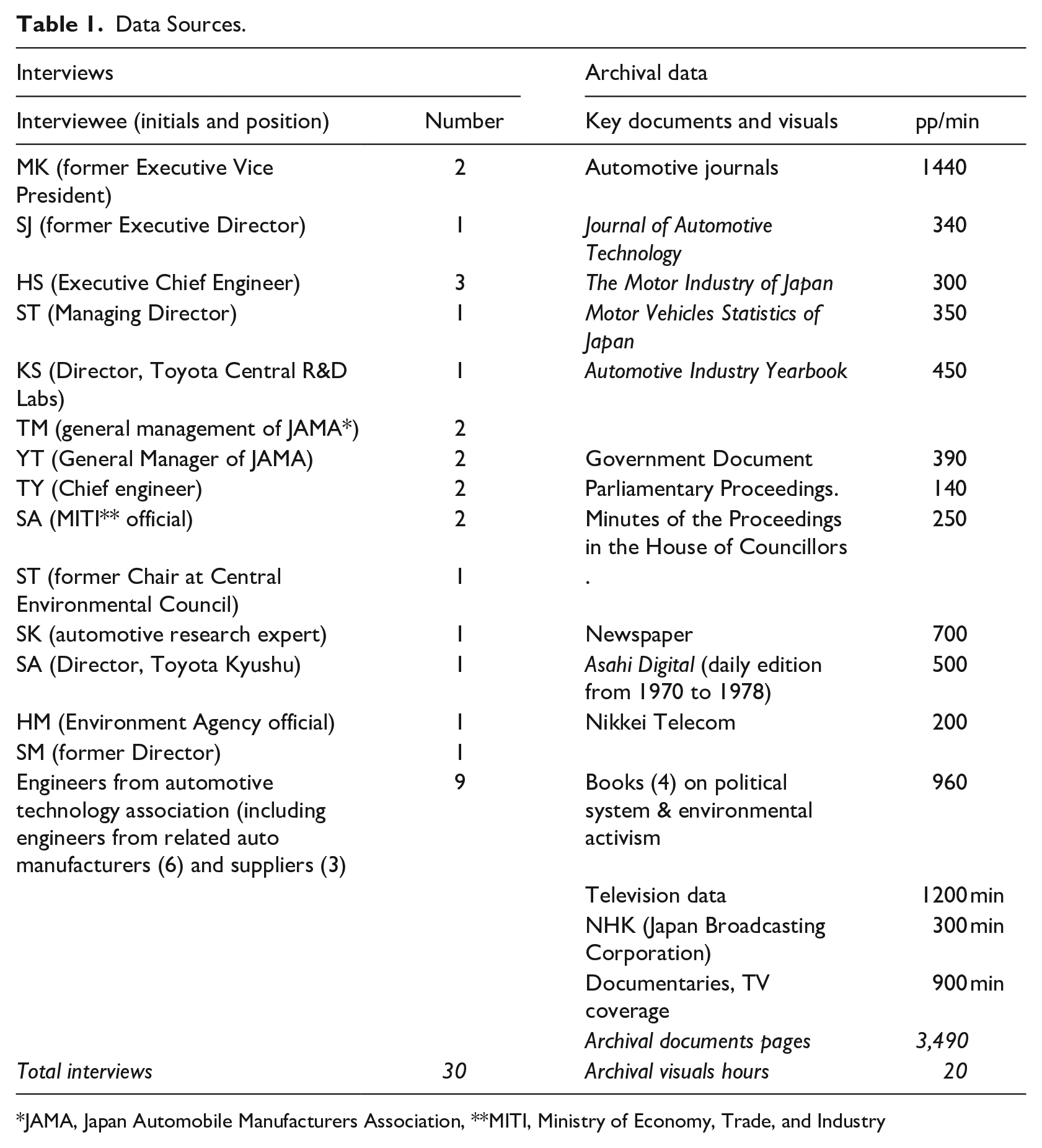
JAMA, Japan Automobile Manufacturers Association, **MITI, Ministry of Economy, Trade, and Industry
As Hargadon and Douglas (2001) point out in their study of Thomas Edison, historical cases can benefit from hindsight because the risk of competing narratives being managed by informants is reduced. In the data collection process, we first draw on publicly available archival data to understand the contextual depth of the overall story of setting up emission controls.
We collected archival data from a variety of sources, including industry journals, company histories, and government documents to identify key events and related players and their roles. These archival documents included newsletters and articles published in industry journals, such as Journal of Automobile Technology, Japan Automotive Statistics, and Automotive Industry, as well as monthly magazines published by the Japan Automobile Manufacturers Association. All of these are central to developing a historical record of the key events and the factors that motivated the various responses by corporate targets (Hoffman, 1999).
Newspaper data is one of the most commonly used data sources in social movement research because it serves as a forum “by identifying topics, issues, activities, and events that are considered noteworthy and salient” (Aharonson & Bort, 2015, p. 313). In particular, mainstream “quality media” is considered credible and reliable as it attracts relevant stakeholders and directly or indirectly represents their position statements and rationales (Earl, Martin, McCarthy, & Soule, 2004). When using newspaper data sources, researchers have long recognized that relying on multiple data sources can ensure broader coverage and a more accurate representation of events (Jenkins & Perrow, 1977; Myers, 1997). Koopmans and Rucht (2002) point out that the advantage of having access to two newspapers instead of one is that it not only allows researchers to capture more events, but also to evaluate the differences in coverage of the same event by the two sources.
We used the digital archive databases of two major newspapers: Asahi Shimbun, the country’s second-largest national newspaper, and Nihon Keizai Shimbun, the largest industry-focused newspaper. Since both newspapers have digital archives, we were able to trace the unfolding events and the actors involved.
In addition, we collected 20 hours of visual material from NHK (Japan Broadcasting Corporation), including interviews with management and video footage of public hearings. We were also able to obtain a variety of materials from the digital collections of the National Diet Library, including parliamentary materials, records of parliamentary hearings, and minutes of proceedings. The abundance of secondary data sources enabled data triangulation and provided a reliable and solid foundation for data analysis (Jick, 1979; Miles & Huberman, 1984).
Interview data were used to gain insights into key events and actors’ actions, and their rationale. The first author, who is fluent in Japanese, conducted 30 semi-structured interviews with 23 informants. They were selected from a wide range of organizations, including former executives and chief engineers at the focal organizations, former government officials, and industry association executives. Several measures were taken to avoid retrospective bias (Golden, 1992). First, multiple interviews were conducted to cross-check information. Second, interviews were conducted with different people involved in the events to compare and avoid blind spots (Eisenhardt, 1989; Patton, 2002). Third, archival data sources were supplemented and triangulated with information from the interviews to ensure consistency of results (Jick, 1979). In most cases, respondents shared useful information by providing technical papers, company meeting notes, and personal diaries to enhance the accuracy of their recall (Tulving, 2001). We also cross-checked the topics that emerged from the interviews by consulting several books written by business historians and business journalists.
Data analysis
In the first phase of data analysis, our goal was to develop a contextual and temporal understanding of the sequence of events that led to the establishment of emission controls (Kipping, Wadhwani, & Bucheli, 2014). By triangulating multiple sources of information (Jick, 1979; Miles & Huberman, 1984), we developed an extensive narrative and identified related multiple actors in the sequence of events over time. Figure 1 provides a virtual map for tracking and highlighting the specific events that led to the establishment of emissions controls.
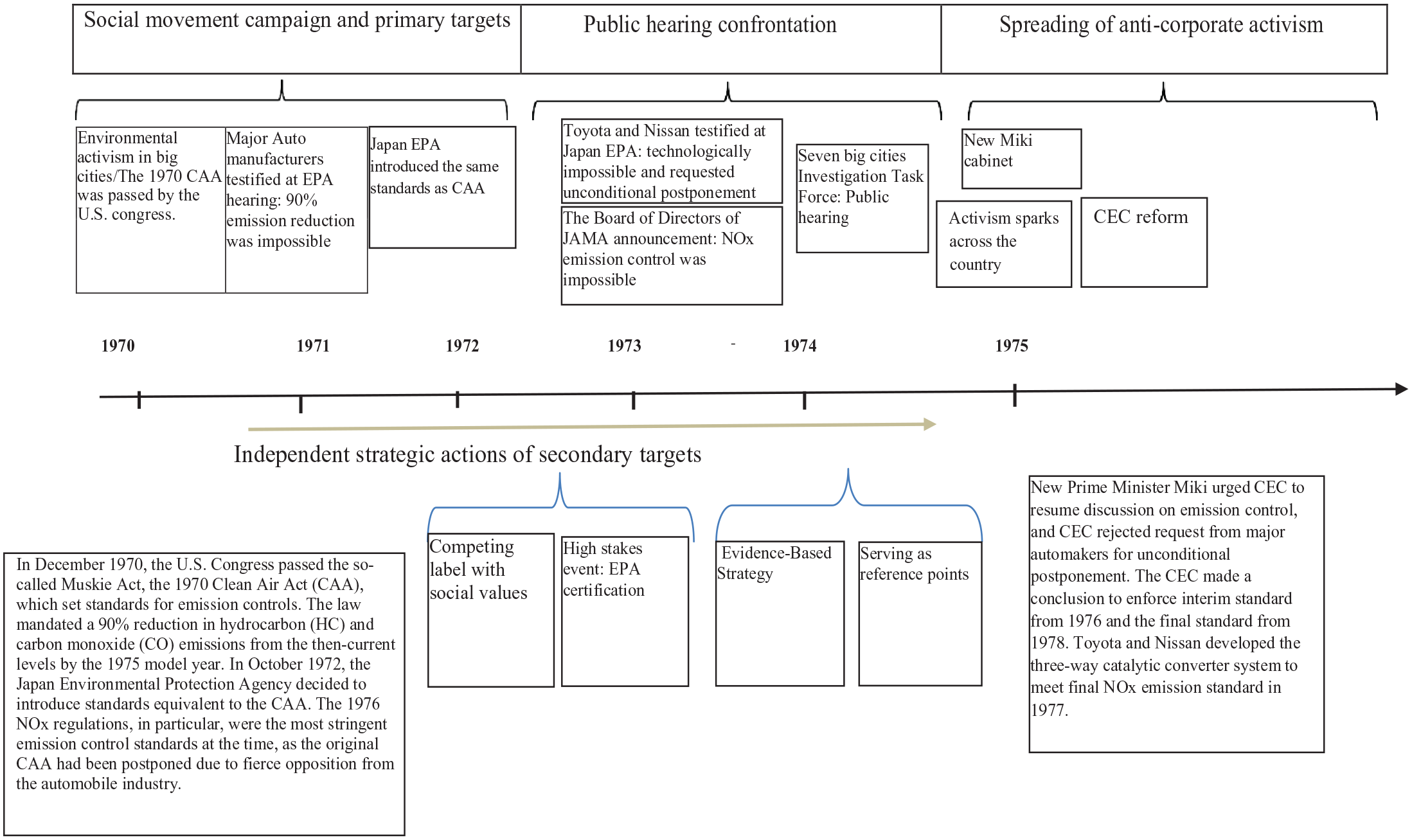
A timeline for establishing emissions control.
In the second phase of data analysis, we analysed the events with the aim of extracting “hidden patterns” and the forces driving the phenomena (Van de Ven & Poole, 2005), by focusing on how multiple actors (environmental activists, primary targets, and less targeted firms) were involved in multiple events. After an initial analysis of the events, we noted the different ways in which corporate targets responded to the activists’ calls, revealing underlying tensions and conflicts between environmental activists and their primary targets (large corporations).
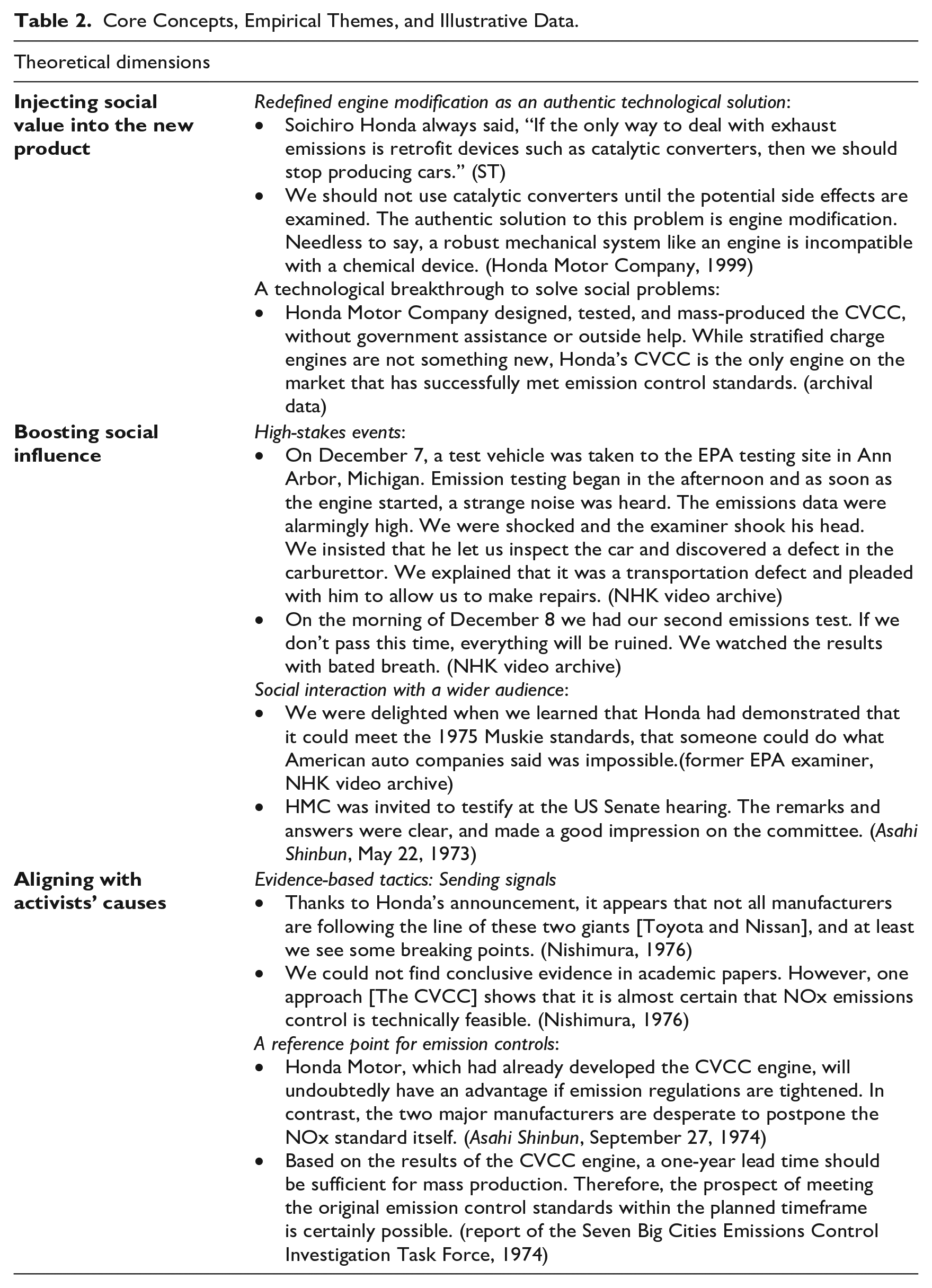
We also became cognizant that less targeted firms, such as Honda Motor Company (HMC), with a different market position, responded more proactively to activists’ demand. Therefore, we began to track and code HMC’s strategic actions to detect and describe the rationale behind these actions. After comparing and contrasting the first-order codes, we collapsed them into higher-level codes and distilled them into more theoretically informed themes and then integrated them into several aggregate dimensions. Table 2 presents the general theoretical dimensions and their empirical derivations.
Core Concepts, Empirical Themes, and Illustrative Data.
In the third phase of analysis, we focused on gaining a more general understanding of the observed phenomena. We linked theoretical themes with supporting evidence to develop a model that explains the relationships between environmental activists, primary corporate targets, and less targeted firms, and how they influenced events that led to the final outcome. The model serves as a theoretical explanation to “elicit fresh understandings about patterned relationships between social actors and how these relationships and interactions actively construct reality” (Suddaby, 2006, p. 636), i.e., in our case, the creation of emission controls.
Findings
Activists–primary targets conflicts
In the early 1970s, the automobile industry played an important role in the Japanese economy, accounting for 9.9% of manufacturing output and 13.3% of exports.
It also employed 3 million people directly and indirectly, accounting for 6% of corporate employment. The industry was highly dominated by the two largest manufacturers, Toyota and Nissan, with multiple smaller and medium-sized manufacturers competing in niche markets. Among these small manufactures, HMC was a newcomer and challenger in the industry with a share of 7% in the passenger car market, compared to 60% for Toyota and Nissan. HMC and the two large companies did not operate in overlapping markets and their products were not similar; HMC was struggling with one production model in the passenger car market, whereas the two large companies offered a full range of production models from the low end of the market to the high end. In terms of organizational identity, HMC, which started out as a motorcycle company, had distinctly different characteristics from the two large manufacturers, which had longer experience and reputation in car manufacturing.
While activists generally targeted the automobile industry for the introduction of emission controls, the two large corporations were the primary targets of environmental movements because of their enormous market power and economic and social impact (Michiba, 2006). In particular, both companies were active in every aspects of the automotive market in Japan with a full production line of models and brands, and introducing emissions controls will have required significant investment to redesign the internal combustion engine and change production lines and ultimately increase operating costs. It was therefore inevitable that these two large companies were strongly opposed to further restrictions on market competition, and as a result they became easy targets for activists.
At the heart of this conflict is the clash between societal values and the values of economic growth promoted by large corporations. Environmental activists called for stricter emission controls to promote “social harmony” and “social responsibility” in place of the “evil logic of capital,” whereas big corporations rejected additional regulations that were “technically infeasible.” As early as 1971, William D. Ruckelshaus, then Administrator of the US EPA, invited 28 automakers from around the world to testify at a hearing on the technical feasibility of the 1970 Clean Air Act, known as the Muskie Act. Toyota and Nissan, who were invited to testify, made a strong statement: “It is technologically impossible to achieve a 90% reduction in emissions compared to previous standards” (Nihon Keizai Shimbun, May 20, 1971).
The conflict began to escalate as activists launched citizens’ campaigns attacking the “unethical” automobile market for causing air pollution; as one activist put it: This horrendous motorization not only destroys the environment, but also wastes resources and has a profound impact on the basic structure of today’s society, economy, and cities. . . . The roads of cities are now occupied by cars, depriving citizens of their basic right to sleep at night and breathe clean air, not to mention the safety of walking as of a basic means of transportation. (Seven Big Cities Investigation Report, 1975)
HMC’s Social Value-Based Strategy
Injecting social value into the new product
The intensified conflict between activists and large corporations of course was of concern to less targeted firms. The inability of large corporations to respond immediately to the growing calls for “social responsibility” and the urgency of addressing emissions controls created an opportunity space for less targeted firms to take strategic actions. HMC, a late entrant to the Japanese automotive market, emerged as a surprising champion to explore the conflicts between activists and primary targets.
HMC originated in the motorcycle market with its superior innovative technologies affecting speed and engine combustion. Under the leadership of its entrepreneurial founder, Mr. Honda, the company was actively searching opportunities in the passenger car market. In the mid-1960s, HMC entered the K-car (light vehicle) market as a latecomer, and its N360, a K-car equipped with an air-cooled engine, became the best-selling model in Japan immediately after its launch in March 1968. However, it wasn’t long before the N360 suffered a serious recall in 1970, and sales dropped sharply. In addition, HMC’s first compact passenger car, the H1300, launched in 1969, was a market failure.
Losses from the K-car recalls and the H1300 product failure left the company in a weak market position with its survival at stake. Thus, for Mr. Honda, “issues related to emissions controls became a new opportunity to ‘break the fortress’ of the major automakers” (NHK, 2000). Given his background as an engineer, he believed that a technological innovation solving the engine emission control challenges could be a “one-in-a-million chance” to save his company from being selected out from the fierce competition in the passenger car market (Honda Motor Company, 1999).
According to one NHK document, HMC developed its emission control engine from various motives. At one point the engineers confronted Mr. Honda, claiming that the company needed to fulfill its social responsibility in addition to satisfying its economic ambitions: “The engineers confronted him, saying they wanted to bring back the blue sky” (NHK, 2000).
Other data shows that HMC began developing emission control solutions as an internal R&D project in the late 1960s, with the original concept targeting catalytic converters, as most major automakers did at the time. However, it is clear that HMC decided to take more proactive action to create a social advantage over its rivals by launching a “value fit” product and appealing to the social value domain sought by activists.
Mr. Honda apparently understood the importance of being a pioneer in fostering public expectations for innovative technological solutions. The uncertainty of catalytic converter development and criticism that major automakers were using catalytic converters as an excuse to “delay emission controls” led to Mr. Honda’s decision to discontinue the catalytic converter development and instead focus on engine modification by highlighting the priority of a social value-driven mission to achieve a technological breakthrough.
By focusing on and emphasizing its sincere motivation, HMC redefined engine modification as an authentic technological solution: We treat exhaust emissions from internal combustion engines as a real concept and it is important that we as automakers do not rely on additional devices. What would happen if many cars were equipped with catalytic converters and heavy metals such as platinum and palladium were emitted into the human body? The concept behind the technology is important, and technology without a concept is not real technology. (Honda Motor Company, 1999)
From an economic standpoint, the relatively small size of the company made it possible to focus on pinpoint modifications rather than spending vast resources looking for catalytic converters. HMC’s new competing label was based on a stratified charge engine, an off-the-shelf solution: After studying various ideas from the past, we turned our attention to stratified charge engines, which have a long history, such as the Russian Nilov engine. They were not designed for automobiles at the time, but a scaled-down version could be used. (interview with HS, executive chief engineer)
In order to implement a fast-speed technology development process, Mr. Honda pushed the development team to the limit and tightened the schedule, saying, “You people always say it is under development. If we wait any longer, the company will go bankrupt” (ST, interview data). As a result, HMC engineers attached an auxiliary combustion chamber to the main chamber in the existing stratified charge engine, and named it CVCC (compound vortex controlled combustion).
While the concept of a stratified charge engine is not new, HMC reinvented the product by highlighting its potential social value as “necessary, effective and appropriate” to address the social challenge of emissions controls. At the product launch press conference, with blue panels reminiscent of a clear blue sky, Mr. Honda unveiled his company’s new competing label to the public. The CVCC engine immediately attracted the public’s attention and became a market proposition for HMC’s expansion in the domestic market.
Boosting social influence through high-stakes events
The CVCC engine drew public attention but was not well received by HMC’s competitors. The big automobile companies posted their anti-CVCC claims: We are full-line manufacturers with a variety of engine production lines and car models. It is not like one day someone just pinpointed one product to one production line and say we can do it. We see this [the CVCC engine] as a temporary solution that doesn’t work for us. (interview with MK, former executive vice president of Toyota)
Others, such as automotive analysts, also expressed concerns about the functionality of the CVCC based cars, stating, “The stratified charge engine is also a lean-burn engine, an old concept. The problem is that with lean-burn you save gasoline but you don’t get as much power” (Motor Fan magazine, 1973).
Major American automakers also did not see much value in the CVCC and were skeptical that it could be used in a large American V8 engine. GM CEO Richard Gerstenberg wrote in a memo, “I have looked at this design, and while it might work on some little toy motorcycle engine. . . I see no potential for it on one of our GM car engines” (Rothfeder, 2014).
HMC decided to take a “high-stakes event action” to bring CVCC to the United States for EPA accreditation. The goal was to dispel the common doubts by connecting with a wider audience, thereby increasing credibility and social influence in the international community. As Mr. Honda stated, “The Muskie Act gave HMC a rare opportunity. We took advantage of it and armed ourselves with the powerful weapon of CVCC. Now we’re in a position to go face-to-face with anyone, even foreign companies.”
However, this decision was also high-risk because “the testing measures in the US were different from those in Japan. There was also a concern that engine problems might occur during international transportation” (NHK, 2000). Kiyoshi Kawashima, who was in charge of this certification mission, recalled how he was nervous and anxious before the EPA test: “It was hard to sleep. I kept thinking about what I would say to the press if we fail” (NHK, 2000).
As Schüssler, Rüling, and Wittneben (2014) stated, a “regular event” is characterized by routine interactions and modest outcomes, with a limited impact on institutional dynamics, whereas a “high-stakes event” is characterized by uncertainty and complexity, with no guarantee of the expected outcome; but, if it is achieved, it has a high social impact.
On December 7, 1972, HMC took the “high-stakes event action” by bringing its CVCC engine to Ann Arbor, Michigan for EPA testing. The engine failed the first test due to a serious carburettor defect, but HMC passed the test the next day and was officially certified by the EPA in February 1973 as the first engine to comply with the 1970 Clean Air Act.
The US media reported this significant event. Shortly thereafter, a report by the National Academy of Science highlighted the CVCC engine’s high performance in fuel economy and emissions controls. The value of the CVCC was amplified further when HMC was invited to testify before the US Senate.
Following the original spirit of the Muskie Act, emissions control standards were supposed to be enforced if a practical technology solution was available. At the hearings, HMC confidently stated that if US automakers ordered CVCC engines, HMC would be able to meet all their needs within 18 months. Senator Muskie was thrilled and congratulated HMC, calling it a “fantastic success” (US Senate Committee on Public Works Minutes, May 21, 1973).
EPA certification and congressional testimony also served as a form of social interaction with international audiences (regulators, certification agency, etc.), which in turn boosted HMC’s social influence in the international community. All of these social exchanges with non-market stakeholders potentially helped HMC gain cognitive validity in the socio-cognitive space (Rao, 1994).
Aligning with activists’ causes at the public hearing
The third set of strategic action taken by HMC was to align with environmental activists by subtly acting as tangible “evidence” and a reference point in support of the claims of activists and indirectly promoting activists’ backlash against large corporations.
After the CEC interim report in 1974, environmental activists intensified their opposition to the postponement of emissions controls. As natural allies of environmental activism, anti-LDP political forces and opposition parties began to win mayoral and gubernatorial elections (Sangyo Keizai Shimbun, 1973). As the anti-pollution campaign tended to be dispersed across cities, progressive mayors and governors of big cities crafted a “coalition plan for major cities,” with the slogan “Full implementation of emission controls to protect the lives of citizens.”
To this end, a task force was organized, and a decision was made to use public hearings as a temporary battleground to arouse public outrage and put pressure on the LDP and big corporations. As one activist put it: At the government hearings, [big corporations] always have a lot to say and get away with it. But this time, we decided to take a proactive approach. We won’t allow one-sided statements from them, and, instead, we ask them questions. By doing so, their attitudes and reactions will be fully exposed to the public. (Nishimura, 1976)
Evidence-based tactics: Sending signals
We found that HMC used evidence-based tactics to resonate with environmental activists, subtly providing information and technical evidence to enhance the credibility of activists’ claims.
The task force decided to invite their corporate targets to testify at a previously scheduled public hearing. Two large automakers were reluctant to accept the invitation. As the co-chair of the task force noted, “A witch hunt—that was what they said about this hearing” (Nishimura, 1976). In demonstrating their objections, two large automakers issued a joint statement prior to the hearing: “There is no scientific evidence to show that a full-line automaker can achieve this standard” (Nihon Keizai Shimbun, July 26, 1974).
As the big city coalition had a strong leftist orientation aimed at challenging the LDP, hardliners in the LDP government sought to discredit the task force’s investigation. One member testified at a hearing of the Diet (Japan’s legislature), “This unfamiliar organization, called the Seven Big Cities Emissions Control Investigation Task Force, is run by a bunch of amateurs” (Minute of the Special Committee on Environmental Pollution of the House of Representatives, October 23, 1974). In fact, the task force members had their own challenges, and one task force member admitted: “[The big corporations] refused to provide any useful data, and none of us were experts in gasoline engines” (Nishimura, 1976).
The task force believed that the theoretical approach to counter the two large manufacturers was to find scientific data showing the feasibility of NOx emissions controls. Nishimura, a key member of the task force, noted in his memo: If manufacturers insist this is impossible based on actual results, there are two ways to overcome this. One is to theoretically prove, based on experimental data, that it is possible to build an engine that meets the NOx standard. The second is to demonstrate in detail why the manufacturer’s prototype engine did not perform well, and in what areas the effort is lacking.
However, the task force struggled to find scientific data to support this hypothesis: During the preparation work prior to the public hearing, I went through a vast number of papers, one after another. However, none of them provided direct proof of our theory, i.e. that NOx emission control was achievable. None of the important data were available. There was no academic evidence to support the possibility of NOx emission controls. (Nishimura, 1976)
At this critical juncture, the EPA-certified CVCC became the only practical evidence that could be useful at the public hearing. In contrast to the wildly antagonistic reaction by the primary targets, HMC’s top management issued the following statement, “We have achieved interim NOx standards in laboratory and vehicle tests” (Nihon Keizai Shimbun, June 13, 1974). The CEO’s statement in major newspapers sent a clear signal that the auto industry was not united in its opposition to emissions controls, and some action by HMC was possible.
Although we could not determine whether HMC directly intended to cooperate with the task force, and we found no evidence of direct communication between the two parties, information about the feasibility of the technology and HMC’s position in the auto industry provided a valuable source for activists to develop their public hearing strategy. One task force member recalled, “after finding out about this, it became clear what our targets should be at the hearing” (Nishimura, 1976).
Serving as a reference point
At the hearing, HMC testified and answered questions, promoting its competing label, the CVCC engine, as the proof of “technical feasibility.” In its testimony, the management team stated that “emissions control is possible if the CVCC engine is more widely accepted.” This public exchange served as a reference point and provided ammunition for the task force to redirect its energies against Toyota and Nissan.
Conflict at the hearing was further exacerbated by the refusal of the two large companies to change their claims that the technology was not feasible. As one task force member recorded in his memoir, “Hours went by and we got almost nothing from them” (Nishimura, 1976). The task force, however, grasped the essence of HMC’s testimony and shifted its focus to questioning the technology development of large corporations and linking it to social responsibility: Toyota has failed to develop its own solution, although they claim they are making progress. Apparently, Toyota’s policy is to buy the best available technology. Of course, they bought the CVCC engine. However, we all know that Honda had already achieved success and demonstrated that a prototype based on the CVCC engine was fully capable of achieving emissions controls. Toyota simply copied this engine, but insisted that they could not achieve the same results in the lab and had no hope of meeting NOx standards. This is simply unbelievable. (Seven Big Cities Emissions Control Investigation Task Force, 1974)
Thus, HMC became a reference point for measuring the social responsibility of the two large companies: Toyota claimed that it hired 1,500 engineers, roughly twice as many as HMC, to develop emission control engines. But in reality, little has been accomplished. It is nothing more than an excuse! Did they really intend to develop new technologies to achieve NOx emission standards? (Matsuda, 1981)
The two largest manufacturers, Toyota and Nissan, invest only 17.3% and 15% of their recurring revenues in emissions control R&D, respectively, an extremely low percentage compared to Honda’s 65.4%. Yet they spend billions to tens of billions of yen each year on advertising. Can we believe their claim that “there is no technology for emissions controls”? Both companies prioritize the pursuit of profit over efforts to ensure the safety of citizens. (Nishimura, 1976)
Following the public hearings, the Task Force issued and distributed its report in October 1974 with specific conclusions: We, the task force, have overcome the difficulties of the technical secrecy by the two large manufacturers and, based on the track record of the CVCC engine, we believe that a one-year lead time should be sufficient to achieve mass production. Therefore, the prospect of meeting the original emissions control standards within the planned time-frame is certainly possible. (Seven Big Cities Emissions Control Investigation Task Force, 1974)
The task force went on to condemn the failure of R&D efforts by the two large manufacturers: “The extreme delay in technology development by the two large manufacturers and the lack of a sense of social responsibility due to their profit orientation is unacceptable” (Seven Big Cities Emissions Control Investigation Task Force, 1974).
Spreading of anti-corporate activism
The task force’s report sparked a massive environmental campaign that galvanized public anger against big business and the LDP. The involvement of a variety of players expanded the scale of the contentious campaign against the targeted corporations. Academics, politicians, and other prominent figures began calling for a change in the LDP’s pro-corporate stance. Activists launched protests and petitions in major cities, denouncing corporate targets and stigmatizing them as “bleeding cars” and “criminal enterprises.” In following this trend, anti-LDP political forces intensified their political campaign, attacking the LDP as a proxy for big business at the expense of civic life.
At this critical juncture, Prime Minister Kakuei Tanaka was forced to step down and a new cabinet was formed in December 1974 under his successor, Prime Minister Takeo Miki, former director general of Japan’s EPA. Miki was faced with the need to rebuild the credibility of the LDP. In his inaugural speech, Miki set forth his goal of establishing a green government, and automotive emissions controls became the first touchstone for the Miki cabinet. Miki directly instructed the CEC to reconsider and re-examine the possibility of tightening emission controls. Shortly thereafter, a decisive change occurred when CEC replaced all of the current committee members representing the interests of large corporations and industry trade associations.
Subsequently, the CEC reopened discussions on emissions controls and appointed new committee members, including researchers from academic and independent institutions, who were not affiliated with the business community. The revamped CEC took a new position of scientific neutrality and established an independent task force to oversee the technological developments of all automakers. Large companies eventually agreed to adopt stringent emission control standards and achieved NOx emission control standards in 1978.
Discussion and Conclusion
Theoretical model
To help interpret our findings, we constructed a theoretical explanation that illustrates how activists–primary targets conflicts influenced non-target firms to take strategic actions in the non-market environment (see Figure 2). Our findings shows that the conflict between activists and primary target firms created an opportunity structure for non-target firms to employ a social value-based strategy to counter their market rivals (i.e., primary target firms) by gaining a social advantage in the non-market environment.
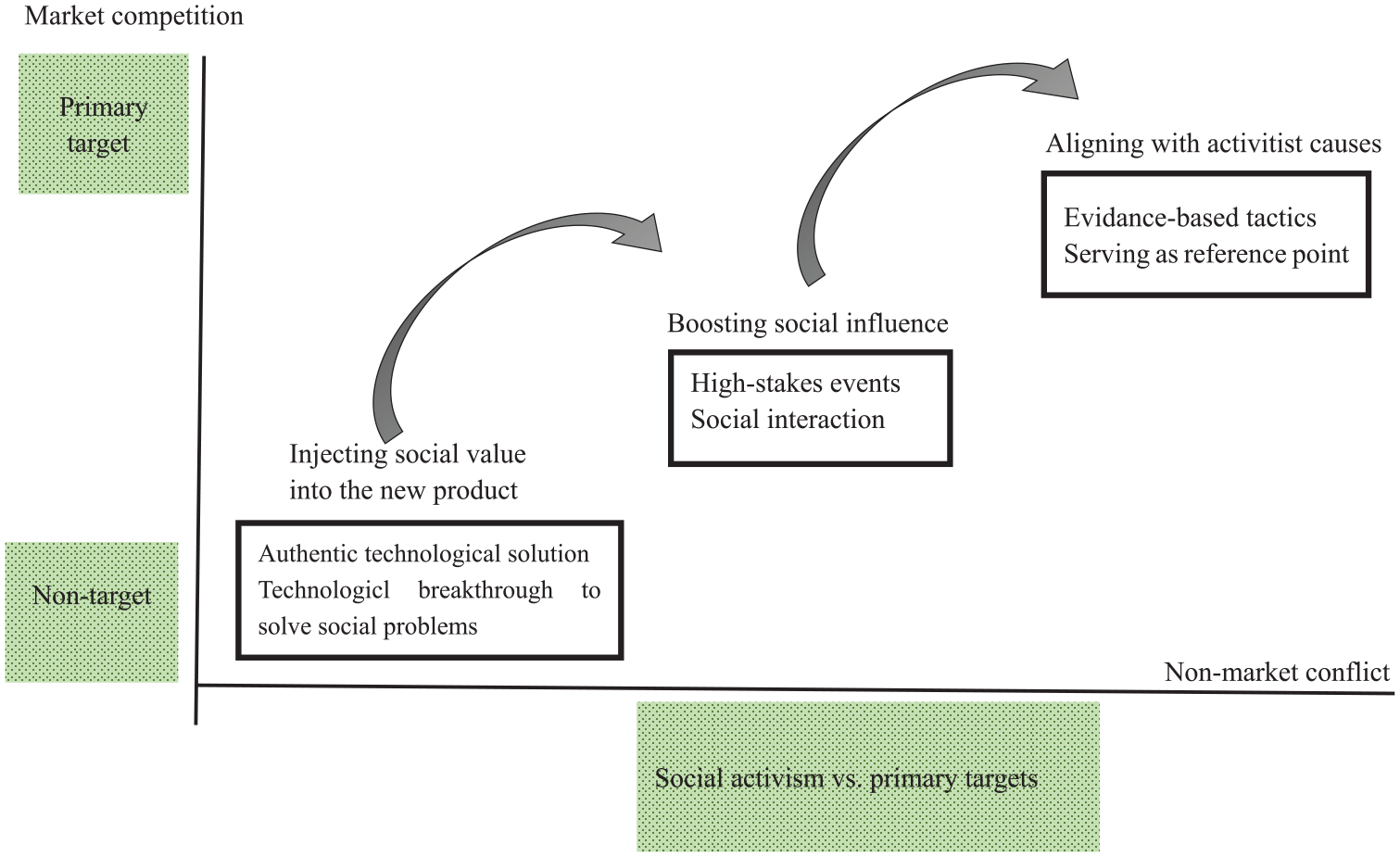
A model of how activists–primary targets conflicts can prompt non-target firms take strategic actions.
First, our model explains how non-targeted firms can purposefully shape their non-market environment to overcome their competitive disadvantages in the marketplace. We found that HMC employed three specific strategic actions, namely: injecting specific values (i.e. solving the social problem of emission controls) into its new product to shape social expectation in order to introduce its new competing label, the CVCC engine, to the marketplace; boosting social influences through high stakes events to gain legitimacy and recognition in the global marketplace; and finally, aligning with social activists at the public hearing to raise the cost for their rivals to respond to activists’ demands. Our findings reveal that the environmental activists’ goal of strengthening emission controls directly encroached on the corporate value of the two dominant corporations; thus, a social value-based strategy and its related actions served as an important mechanism to help HMC gain influence in the non-market environment by demonstrating its ability to launch a value-fit technological innovation (the CVCC engine) and its position in line with activists’ claims.
Second, our model highlights the importance of market-based dynamics in understanding non-market activities. HMC was experiencing severe market competition due to the failure of the H1300 model in the passenger car market and the recall problems in the light vehicle market. Therefore, management viewed conflicts in the non-market environment, i.e., the inaction by its two dominant market competitors in failing to respond to activists’ demand, as an opportunity. In this sense, HMC’s non-market strategy complements its strategic motivation to offset its competitive disadvantage in the marketplace by raising competitors’ costs in their relations with activists, and, in turn, to increase economic rents by promoting how its new CVCC engine innovation can contribute to solving an activist-defined societal priority and benefit society.
Theoretical contributions
We make two important contributions to the literature. First, we contribute to the activists–firms rivalry perspective in social movement research with a specific focus on non-target firms. While a large body of work explains how social movements elicit corporate change with a strong focus on the confrontation and conflicts of activists against targeted organizations (King & Soule, 2007; Rao, Morrill, & Zald, 2000; Soule & King, 2015), a new research direction has noted different types of corporate targets (primary targets vs. non-targets), calling for attention to a broader impact of activism beyond targeted organizations (Briscoe & Gupta, 2016). Nevertheless, while previous research has mainly focused on the activist side by examining how activist-specific tactics affect the diffusion process of movement participation, it has not adequately accounted for how the activist–primary target conflict affects non-targeted firms. Thus, it remained unclear how and why non-targeted firms respond to rising social activism and its implications.
Our findings generate important insights and elucidate how conflicts between activists and their primary targets could prompt less targeted firms to initiate non-market strategic actions, and how these actions change the social movement dynamics. While previous studies portray activists as rational decision makers with articulated tactics in pressuring their corporate targets (e.g., Eesley, Decelles, & Lenox, 2016), our findings, on the other hand, indicate that non-target firms can play an important role in the conflict between activist and target organizations by influencing the tactics of activists. For example, in our case by the way scientific technological information was introduced to question heretofore opponents’ “truth” and emerged as an anchor for reconsidering the feasibility of the technology, and in our case increasing the credibility of the activists’ claims.
These findings are important because they challenge the somewhat linear assumption in social movement research that confrontation and direct action against focal firms is a necessary condition for activists seeking change. In this paper, we show that the web of activists’ influence is not strictly defined by their relationship to the target organization, and that non-target firms can become involved and change the salience of an issue, influence the mobilization of activists targeting the focal firms, and change the outcome of activism. Thus, we argue that reframing the theoretical dialectic to include attention to non-target firms is necessary for a more comprehensive understanding of the diverse mechanisms and pathways through which activists elicit corporate change in the target industry.
These findings echo with current work on the shifting web of inter-organizational alliances and contentions between corporations and non-market stakeholders (Odziemkowska, 2022; Odziemkowska & Henisz, 2021). While this body of work examines the critical role of inter-organizational interactions and stakeholder influences among movement networks, we, however, focus on the interactions between movement activists and corporate targets by identifying specific strategic actions and the engagement of corporations in the wider connected non-market environment. More specifically, our model underscores the importance of considering non-target firms in understanding the impact and influence of movements on the broader non-market environment. Given that activists’ targeting of corporations can result in different paths or ways of influencing, a close look at the relationships between activists, primary targets and non-targets, and the forces that alter these relationships, may give us a better understanding of the situational influence of movements.
Second, we add to the non-market strategy literature by revealing a new form of non-market strategy that is not detailed in prior research. While a large body of non-market strategy research has been devoted to examining two pillars of firms’ non-market strategies, i.e., corporate social responsibility (CSR) and corporate political activity (CPA), scholars now argue that there might be “other categories of social and political engagement that have yet to be identified and developed” (Lynn et al., 2021, p. 63). We respond to this ongoing research call by explicitly identifying that social value-based strategies may serve as an alternative way for corporate targets to exert influence in non-market environments.
More broadly, social value-based tactics are central to the activities of social movement organizations when activists seek to change corporate behavior and practices by articulating and advancing social values into contentious issues, or by promoting value-based identities (Pacheco, York, & Hargrave, 2014; Sine & Lee, 2009; Weber, Heinze, & DeSoucey, 2008). Our findings extend previous findings on social value-based activities in the social movement dimension to the strategic action dimension of corporate targets, and demonstrate how economic actors or entrepreneurs can in reality exploit this new form of non-market strategy, i.e., by injecting social value into their strategic actions in responding to non-market pressures. In this sense, social value-based strategies provide important clues for firms to recognize the interests and concerns of non-market stakeholders, find ways to embrace them, and manage the social context of market competition in order to gain competitive advantage.
While social value-based strategies may have boundary conditions and we cannot argue that they are applicable to all firms under activist pressure, our findings may be transferable to those firms facing contested, unpredictable and controversial issues. Also, unlike the two major non-market strategies of CPA and CSR, which require huge resource investments, a social value-based strategy could be a useful advantage for firms in a peripheral position with limited resources. This insight echoes previous findings that smaller firms are more actively involved in controversial issues and take proactive social initiatives (Lynn et al., 2021). Future studies could examine how different types of corporate targets may engage in different ways to evaluate the advantages of aligning with activists’ social values.
Specifically, we present a model that shows the linkages between a firm’s deliberate non-market strategy and its strategic motivation in market competition, thus, answering the calls to consider the potential linkage between non-market and market strategies (Frynas et al., 2017). In general, our findings are consistent with previous studies showing that firms respond to social movement pressures in a variety of ways, but they are unique in showing the strategic motivations and activities of non-target firms in exploiting conflict in non-market environments to improve their competitive position in the marketplace. This opens up new opportunities for theoretical development and empirical analysis of the nature of non-market dynamics that occur when social activists target an industry.
Practical implications
The strategic actions of non-target firms and the resulting pathways that elicit corporate change provide a new explanation of the effectiveness of specific activist groups in achieving their goals and suggest that the involvement of multiple players—both activists and corporate targets—plays an important role in addressing social issues that cannot be addressed alone.
Practically speaking, our findings suggest that activists may achieve their goals by selecting a target firm that may align itself with some of the activists’ social values and, in the process, enhance the firm’s ability to redefine the conditions of competition within the industry. For example, activists can intentionally create opportunities for target firms to differentiate from, or even perform better than, their competitors by endorsing value-fit products.
Alternatively, our model suggests that it makes practical sense for economic actors to pursue a social advantage by promoting specific products with widely supported social value, thereby improving their market position relative to competitors. Thus, it is important for managers to develop social cognitive skills and non-market capabilities to deal with multifaceted competitive relationships in a highly complex social environment. In this sense, managers may find it important to develop another type of dynamic capability (Teece, 2009), relating to anticipating and engaging with non-market stakeholders with the intent of affecting market competitiveness.
Limitations and Further Research
Although this study provides important empirical insights into the intersection of social movements and non-market strategies, like all studies, ours is not without limitations.
First, our empirical investigation focuses on firms in a single industry that is arguably more vulnerable to public and political pressures than other industries. Second, although our theoretical model identifies a structure of relations between activists and their corporate targets, our focus on emission controls in a specific geographic region may not be equally applicable to other empirical settings.
However, as research increasingly recognizes the prevalence and impact of activists targeting corporations, our findings are relevant to various struggles in “private politics” when corporate targets are under pressure from non-market activism. Further research could build on the insights from this study and extend the analysis to other contexts. For example, to the extent that non-target firms do not face a direct threat from activists, the way these firms interact with non-market activists largely depends on the decision making of executives and managers. As our findings show, the CEO’s belief and personal values can shape these firms’ interpretations of social issues. Current research also suggests that not only top executives, but also employee activist groups inside the corporation sometimes have a significant influence on organizational choices and responses to social issues (Briscoe & Safford, 2008). Therefore, an extension can be made to explore whether different type of management logic within firms affect their interactions with non-market stakeholders.
While our findings imply that the interaction between non-target firms and activists was not direct but was mediated through public hearings, on the other hand, the spread of information technology in the digital age makes it possible for numerous non-target firms to exert direct influence. The digital age has broadened the scope of action for both corporate targets and non-market stakeholders, which also poses opportunities and challenges for both parties. Thus, examining the changing dynamics between activists and corporate targets that are more suited to the realities of the digital age is another interesting avenue to explore further.
Footnotes
Acknowledgements
We would like to thank OS Senior Editor Jörg Sydow and three anonymous reviewers for their dedicated support and constructive comments over three rounds of review to unpack the full potential of this paper.
Funding
The author(s) disclosed receipt of the following financial support for the research, authorship, and/or publication of this article: The open access publication of this article was supported by the Startup Research Fund of North China University of Technology (project number 11005136024XN147-71).
