



Abstract
How does agency emerge eventfully in processes of organizational becoming? This article aims to address this question by developing a process theory of agency based on Gilbert Simondon’s philosophical writings on individuation as a communicative phenomenon and Brian Massumi’s writings on affect. This theory views agency as an affective force, expressed as a communicative event, that governs the transition from one process of individuation to another, producing an enhanced ability to act and potentially leading to a collective process of transindividuation that is essential to organizational becoming. In turn, this article not only offers novel theoretical as well as methodological insights for organizational research, but also highlights researchers’ ethical responsibilities toward those whose individuation is precarious and who may not be able to partake in certain processes of organizational becoming.
Keywords
Some readers may object, “But where are the agents?”, “How can there be agency without agents?” (Hernes, 2014, p. 93)
Drawing on the writings of such philosophers as Gregory Bateson (Tsoukas & Hatch, 2001), Henri Bergson and William James (Tsoukas & Chia, 2002), Gilles Deleuze (Linstead & Thanem, 2007), and Alfred N. Whitehead (Hernes, 2014), several organizational scholars have suggested that organizations are ongoing processes of becoming. According to the process perspectives proposed by these scholars, the world is not composed of individualized, already-constituted beings, such as people and social collectives; rather, these formations are the effects of processes of becoming, and a scholar’s task is to explain how these processes unfold.
Process perspectives require novel conceptions of agency, ones that reject the idea that “actions, interactions and the local orchestration of relationships are. . .the incidental epiphenomena of basic social entities such as ‘individuals,’ ‘actors/agents’ or ‘organizations’” (Chia, 1995, p. 581, emphasis in original). To the casual observer, such perspectives could beg the question, “Who or what is acting when a being comes into existence?” Yet, for process organization scholars, agency happens in “streams” that “precede actors and not vice versa” (Hernes, 2016, p. 3). Thus, agency is a key aspect of the events that make up processes of becoming, rather than being attributed to actors that appear “larger, more central, more important, or more resourceful” (Hernes, 2014, p. 15; see also Hernes & Maitlis, 2011).
This conceptual shift is all the more relevant since organizational scholars have become increasingly interested in the concept of agency in the past 20 years. Adopting different perspectives (see Brummans, 2018), grounded in agency theory (Mitnick, 2015), neo-institutional theory (Battilana, 2006; Garud, Hardy, & Maguire, 2007), systems theory (Mohe & Seidl, 2011), structuration theory (McPhee, 2004; Nicotera, 2018), as well as critical, feminist, and postcolonial theories (Ashcraft, 2014; Hardy & Clegg, 2006), agency is typically defined as “the capacity to act” (Brummans, 2015, 2018; Cheney & Ritz, 2018) in this research, and a number of authors claim that agency depends on the actor’s intentionality, reducing it to human agency (Robichaud, 2006; Schlosser, 2018). What connects most strands of organizational scholarship on agency, including research by those who claim that nonhumans should be regarded as agents, is a focus on “who or what acts” in organizational settings (Bencherki & Cooren, 2011, p. 1581, emphasis original; see also Jansen, 2016). In turn, what continues to be challenging is to reconcile individual and collective “levels” of agency (Weik, 2011).
Process perspectives are useful in this respect, for they aim to explain the very existence of individual (human and more-than-human, see Haraway, 2016) as well as social/collective “becomings,” which requires a shift in how agency is conceived and investigated: If organizations are ongoing processes of becoming, there is no need “to invoke the existence of a centralized initiating agency endowed with intention, conscious choice, and deliberate goal-oriented behavior” (Chia, 2010, p. 116). However, to date, no “strong 1 ” process theory of the role of agency in organizational becoming has been developed. Hence, discussions of agency in process organization research remain scattered across publications, none of which explicate it as a central concept. Such theory would need to explain what goes on in the events that, as Tor Hernes (2014, 2016) suggests, are the locus of agency.
The current paper aims to address this question by developing a theory of agency that highlights its vital role in the communication that produces organizational becoming. Viewing communication, as well as information and meaning, in a more-than-human way moves our thinking beyond human agency and brings attention to the idea that agency is a key aspect of the communication through which organizational becomings are expressed. These becomings are not networks of individuals, or “set[s] of connected centres;” they are “meshworks [without] centres: their ‘points’ are merely sites of overcrossing, of images or information” (Linstead & Thanem, 2007, p. 1489). Similarly, Hernes (2014) points to a connection between agency and the articulation through which experience is expressed and shared with others. The entanglement of articulations creates an event and endows it with agency, such as when the expression of multiple voices during a meeting results in a decision (e.g., Bencherki & Snack, 2016). What Hernes’ work does not address, however, let alone theorize, is how exactly these articulations take place.
Drawing inspiration from the work of the French philosopher Gilbert Simondon (2020), we provide insight into this question by proposing that agency happens in the encounter of the ongoing individuation processes through which beings-in-becoming pursue their existence. We suggest that agency occurs when an individuation process incorporates, through/in communication, the excess action of another individuation process (the feelings you cannot deal with, unchanneled energy, skills in search of an outlet, etc.). By sharing the burden of this excess action, the individuation processes may achieve greater unity and lead to a greater capacity to act for each individuation process—to augmented agency. This view of agency is intimately related with the concept of affect, because it supposes that each individuation process affects other individuation processes (by sharing its excess action with them), but also allows these other processes to affect it (as it takes up their excess action). Agency, then, is the affective force, expressed in communication, that governs the transition from one process of individuation into another. And since individuation processes share action in this way, their encounter in communication constitutes an event that may create a new, collective individuation process. This transindividuation process, we suggest, is vital to organizational becoming. Conversely, lack of agency entails the incapacity of this affective force, equally expressed in communication that constitutes an event, to govern such a transition, which may induce a process of disindividuation. The latter corresponds to disrupted individuation, which hinders transindividuation, and thus organizational becoming.
The strong process theory of agency we develop here, then, parallels existing conceptions of organizational becoming (see Tsoukas & Chia, 2002), yet explicates the role agency plays in this process by situating it within the communicative encounters of individuation processes (events) through which organizational realities are formed (Bencherki & Iliadis, 2021; Iliadis, 2013). Agency is therefore not an individual (human) being’s capacity to act, but occurs through the expression of excess action (affect), which may augment the ability to act of different kinds of individuation processes, such as persons, teams, organizations, or other social collectives. Viewing agency as the affective force that produces these different kinds of becoming provides a useful theoretical lens, for it sheds light on the ways in which the individual and collective mutually constitute each other, thus allowing organizational scholars to account for “cross-level” granularities of action as a processual continuum (see also Bencherki & Iliadis, 2021; Rodriguez & Blanco, 2017).
Our paper unfolds as follows: In the next section, we will discuss how process organization scholars have conceptualized the “micro-practices of organizing” that “generate. . .effects of agency” (Chia, 1995, p. 596; emphasis original). Our literature review calls attention to an aspect that few have highlighted so far, namely that these practices are communicative in nature. Based on this insight, we explain that viewing agency as the affective force of the events that produce organizational becoming is congruent with the work of such philosophers as Whitehead and Bateson, which forms the basis of much process organization scholarship, but that Simondon’s writings provide the most suitable foundation for a strong process theory of agency because it emphasizes the importance of communication, information, and meaning. In the subsequent section, we consequently draw on Simondon’s writings to develop our theory and then show its value for organizational research by reanalyzing data from François Cooren’s ethnographic research on Médecins Sans Frontières. According to Cooren (2018, 2020), it is useful to ground organizational research in the terra firma of interactions, yet some have argued that such analysis creates the impression that already-constituted agents are interacting with one another (Wilhoit, 2016; see also Brummans & Vézy, 2022). The process theory of agency we develop here, we will show, offers a lens that does not entify actors as interacting interlocutors, but reveals their ongoing individuation, transindividuation, and disindividuation. To conclude, drawing on the insights from our reanalysis, we will discuss the implications of our theorizing for organizational scholarship.
Process Perspectives of Agency in Organization Studies
Organizational research typically defines agency as a human being’s ability to act within constraints, particularly social structures. Often drawing on Anthony Giddens’ (1984) work, it focuses on explaining how one side of the duality between agency and structure affects the other (see McPhee, 2004). Giddens (1984) proposed that “the tasks of social theory” are to understand “human agency and . . . social institutions” (p. xvii). Hence, the conventional view is that agency must be intentional; it entails the ability to “act otherwise” (Giddens, 1984, p. 14). Correspondingly, institutional theory supposes that individual action is constrained by “established, widespread systems of beliefs” (Lammers & Garcia, 2017, p. 1), which can be changed through institutional work (Lawrence, Leca, & Zilber, 2013). Along similar lines, critical views of agency suggest that the social structures that constrain human action are constituted through/in discourse (Ashcraft, 2007; Hardy & Clegg, 2006), and that individual (human) agency develops in relation to discursive formations that shape individual and collective identities (Ybema & Horvers, 2017).
Some perspectives have challenged these views of agency. For instance, organizational research inspired by Niklas Luhmann’s (2006) systems theory suggests decentering attention away from human agents and studying organizations by focusing on communication (Cooren & Seidl, 2020; Schoeneborn, 2011; see also Taylor, 2001). Moreover, perspectives that view agency in terms of matter or materiality challenge the privileging of human agency (Ashcraft, Kuhn, & Cooren, 2009; Carlile, Nicolini, Langley, & Tsoukas, 2013). Drawing on theories ranging from Latourian actor-network theory to Baradian entanglement, these views highlight “the double (social and material) dimensions of organizing” (Vásquez & Plourde, 2017, p. 2).
Especially these latter perspectives often draw inspiration from process organization research, which calls for the decentering human agency in the most explicit way. The question of human agency preoccupied early process organization scholars, including Robert Cooper (1976), who claimed that a process epistemology focuses on “understanding human action” (p. 999) and who viewed action as a means for “man [sic]” to reveal “the latent in himself [sic] and his [sic] world” (pp. 1002–1003). Cooper’s psychoanalytical view of processuality may explain his interest in human agency (see also Cooper, 1987), yet he also recognized that a human being “is as much part of his [sic] happenings as the other objects about him [sic], and what he [sic] creates turns back and creates him [sic]” (Cooper, 1976, p. 1008).
Contemporary strong process organization scholars view organizations as “the cumulative unintended consequence of a plethora of coping actions and interactions involving a multitude of individuals none of whom have any intention to contribute to any preconceived plan” (Chia, 2010, p. 116). Agency, as well as intentionality, are but “secondary effects of practices” (Chia, 2017, p. 111). Thus, while individual agency has been eulogized due to a penchant for heroic tales, especially—albeit not solely—in the West, action does not have a clear author. Instead, “action is a happening; before anything else—before meaning, significance, before it’s fitted into any schema—it simply happens” (Cooper & Law, 1995, p. 4, emphasis in original, cited in Chia, 1995, p. 599).
Such “happening” can also be called “an event.” The latter has been defined in different ways (cf. Derrida, 1988), suggesting two contrasting views: An event may interrupt the flow of things and be noticeable precisely because it interrupts “business as usual” (e.g., an important meeting during which key decisions are made); or an event may be seen as a temporary configuration of bodies, activities, and so on that transforms them, without being reducible to any one of them (e.g., champagne bottles popping, alcohol flowing, bodies dancing, music thumping, lips touching, and so on compose “a party,” and yet a party cannot be reduced to any of these bodies, activities, etc.; see Lecercle, 2005). The second view corresponds with Deleuze’s (1992b) view that events are not exceptional occurrences: “Something’s happening. Try as we might to gain an observer’s remove, that’s where we find ourselves: in the midst of it. There’s happening doing” (Massumi, 2011, p. 1).
A process view of agency begs the question of what exactly takes place during an event; or, put differently, “how agency got to be that way” (Chia, 1996, p. 48). Following this line of thought, for Hernes, agency is not attributable to this person or that thing (e.g., a structure), but results from their encounter in events: “[W]hat produces agency is the outcome of the encounter as it reaches closure and becomes an event, thereby giving meaning to other events, while defining the encounter as well” (Hernes, 2014, p. 93). Hernes explains that the event gains agency as it connects with other events while it creates itself, thus defining a temporal trajectory that orients its becoming (Hernes, 2016). By highlighting the connections through which events gain agency, Hernes hints at the important relation between agency and communication, yet does not theorize it. What happens “in the midst” of an event, Hernes seems to suggest, is communication, which enables an event to extend (its existence) into other events. In doing so, Hernes appears to say, an event “gains” agency. In what follows, we theorize the relation between agency, event, communication, and organizational becoming in a more precise way. As we will show, the roots of a strong process theory of agency can already be found in the work of the philosophers who have influenced process organization scholarship, such as Whitehead and Bateson.
Toward a Process Theory of Agency in Organizational Becoming
The philosophical roots of viewing agency as affective force
For Whitehead, agency is synonymous with creativity; that is, with the process of becoming itself (Hartshorne, 1958). Indeed, for Whitehead, “creativity. . .corresponds to ‘being’ as such” and “it is agency as such” (Hartshorne, 1958, p. 517, emphasis in original). Becoming, in turn, has a communicative dimension, for it consists in “symbolic reference” uniting the various regions of experience (see Whitehead, 1929/1979, p. 168). It is through/in communication, Whitehead seems to suggest (although he does not use the term), that diverse actions cohere to form what can be recognized as a singular actor’s agency (Hedrick, 2019; see also Hernes, 2014). A focus on communication, then, avoids the “the overvaluation of consciousness [that] generates many of the most famous problems of modern philosophy” and “tends to obscure the reality of process” (Weekes, 2010, p. 138).
Bateson shares this distrust of consciousness as a staple of purpose and intentionality. He prefers the concepts of information and communication over the concept of selfhood (Harries-Jones, 2017). For Bateson, “the idea of conscious purpose is a sort of a fake, an artifact or epiphenomenon, a biproduct [sic] of a disastrous process in the history of occidental thought” (Bateson, 1991, p. 228). In his view, thinking results from “interactions outside our body, in our communicative relations in our immediate environment” (Harries-Jones, 2017, p. 218). Rather than being the product of intentional minds, human agency is accordingly based on an “aesthetic (feeling-based) account of understanding” (Hedrick, 2019, p. 771), and the same principle extends to more-than-humans; it entails “a form of nonconscious feeling or affective tone that stems from being affected by and responsive to the world” (Meyer, 2017, p. 129, emphasis in original).
A strong process view must therefore explain how agency is conceptually related to affect. As the Canadian philosopher Brian Massumi (2015) suggests, affect is “a dimension of every event” (p. 47). Massumi consequently defines affect as “a power to affect and be affected [that] governs a transition, where a body passes from one state of capacitation to a diminished or augmented state of capacitation. This comes with the corollary that the transition is felt” (p. 48, emphasis in original). Affect is a response to another’s action on one’s body, prior to one’s attribution of meaning and signification to that action (Massumi, 1995). That response may induce an augmented or diminished ability to act. For instance, being the victim of psychological harassment at work may paralyze an employee or make them feel ill, affectively lessening their ability to act, even before they can themselves understand what is happening. Selfhood is not a condition for affect to happen, but results from it, which is precisely why harassment is so insidious: it prevents the person from continuing their existence meaningfully.
Extending Massumi’s work, we define agency as the affective force that governs the transition from a lesser to an augmented ability to act and, in doing so, may integrate different “levels” of action. For example, agency manifests itself when an employee calls her colleagues to protest against the lack of salary increases—in the moment when the expression of her feeling of injustice persuades others to organize a strike. In this case, communication does not (only) involve sending/transmitting bits of information (or messages). The employee does more than share the facts about the company’s low pay—of which colleagues are already well aware. What is communicated is (also) excess action, namely the indignation she can no longer contain. This indignation in-forms (i.e., gives shape to, see Manning, 2013) a field of relation (Massumi, 2015, p. 200; see also Brummans, 2022; Brummans & Vézy, 2022; Cooper, 2005) by integrating various “levels” of action and augmenting people’s ability (and determination) to act, as her anger spills over into her inert colleagues and turns them into active strikers. Thus, from our strong process view of agency as affective force, “the mode of conscious agency is not the initial moment of any action” (Meyer, 2017, p. 132); rather, agency results from a being-in-becoming’s need to reorganize itself as it deals with its own excess action (e.g., the feelings it cannot incorporate into its own becoming) and relates with other beings-in-becoming in order to creatively surpass what it has been so far. Agency is not a question of consciousness or intentionality, because it is coextensive with the very process of becoming through which beings are continuously formed.
In turn, communication is not only about a being’s exchanges with its environment; it is vital to a being-in-becoming’s continued existence, for it allows the affections that increase this being-in-becoming’s ability to act to be expressed and shared with others. Investigating agency therefore requires the investigation of communication “without” and “within.” According to Bateson, “there is internal information to account for[, which is] constantly created and destroyed, so it is necessary to examine its rhythms, codes, rules of sensibility and its habits” (Harries-Jones, 2017, p. 220). Communication is an effect within a system, and what a communicative act means depends on its contribution to the system’s becoming (see also Taylor & Van Every, 2000). Agency is thus not “bounded by the skin;” it consists of perceiving and making others feel “news of difference” (Bateson, 1991, p. 200) or “information about information” (Bateson, 1991, p. 202). It is intimately tied to how communication takes place and affects processes of becoming, both human and more-than-human, individual and collective.
Hence, the work of philosophers such as Whitehead and Bateson, as well as Massumi, point to the equivalence between communication, affect, agency, and becoming. However, their work does not present a strong process perspective on the role of communication in understanding agency, which is important for understanding how events constitute processes of becoming and why it seems that some actors “have” more agency than others. To develop such a perspective, we turn to the work of Simondon, “the first true philosopher of information [and communication]” (Iliadis, 2013, p. 1).
Simondon’s work as a basis for developing a process theory of agency
Simondon is mostly known for his doctoral dissertation, which was only published in its entirety in French in 2005 (Simondon, 1958/2005) and was translated recently into English (Simondon, 2020). In organization studies, few have drawn on Simondon’s work, and those who do tend to mobilize his ideas to theorize the constitution of organizations without theorizing the vital role of agency in organizational becoming (see Bencherki, 2017; Bencherki & Iliadis, 2021; Letiche & Moriceau, 2017; Styhre, 2010). Some of this work draws on Simondon’s writings on technics and technology, which were available in English before the rest of his work, especially because it strongly influenced the French philosopher Bernard Stiegler (1998), thus overlooking other aspects of organizational individuation, such as the role of communication. To develop our process theory of agency as affective force, it is useful to explain Simondon’s take on becoming through his central concept of individuation—“the constitution of new entities or collectives” (Bencherki & Iliadis, 2021, p. 445). After this, we will explain his idea that beings-in-becoming continue their individuation into that of others, which they do by communicating their excess action—all that a being-in-becoming is not able to incorporate into its individuation process, compelling it to reach out beyond itself. Based on this idea, we view agency as the affective force that enables beings’ mutual attempts to continue their individuations into one another.
Like other process philosophers, Simondon (2020) encourages his readers to stop granting “ontological privilege to the constituted individual” (p. 1, emphasis in original). Rather than taking individuals as the starting points of our inquiries, the process of individuation is what needs to be explained. In its most basic formulation, individuation is the “processual emergence of physical, technical, psychological, or collective entities” (Bencherki & Iliadis, 2021, p. 448). A key aspect of individuation is that it is “self-evolving, self-generating, and self-differentiating” (Letiche & Moriceau, 2017, p. 1). This implies that individuation is not “caused” by an “outside” agent; it rather occurs from within itself and in its encounter with other individuation processes in communication, which constitutes an event. More specifically, the energy for individuation stems from what Simondon calls the preindividual. The question becomes: “What were the affects and events from which individuation emerged?” (Letiche & Moriceau, 2017, p. 7). Similar to Whitehead’s claim that creativity is agency, for Simondon, agency is integral to the process of individuation. Although he does not refer explicitly to the concept of agency, the idea that permeates his theory is that “agency creates and destroys, frees and imprisons, all at once” (Letiche & Moriceau, 2017, p. 8). His writings allow us to deduce that agency consists in resolving differences in the way regions of one system-in-becoming (physical, biological, psychological, etc.) are organized in relation to the organization of another system-in-becoming. In what follows, we will unpack this idea by defining several of Simondon’s concepts and showing how they form a conceptual web.
For Simondon, every being is a “metastable” system: It contains various regions that are differently organized and have different densities of energy. For example, crystals or bureaucracies are organized relatively homogeneously, and are therefore relatively stable; sand dunes or tech start-ups are less stable because they are constituted by elements that are grouped in different ways and with different densities. Those elements—whether atoms and molecules forming crystalline solids, grains of sand, persons, or technologies—are themselves ongoing individuation processes that are preindividual with respect to other individuation processes. The individual is thus “only individual in relation to the multiplicity of preindividual potentialities that exist within it” (Bluemink, 2020, para. 6). As Deleuze (2004, p. 87) writes when discussing Simondon’s philosophy, a metastable system is a system in which there are “at least two different dimensions, two disparate levels of reality, between which there is not yet any interactive communication.” Individuation is the attempt to reach, through/in communication, greater unity by resolving those preindividual disparities.
Hence, individuation is always relative and is constituted through/in communication between preindividual elements that are themselves processes of becoming in their own right. The provisional outcome of individuation is the meaning that emerges from “a new informational structure, one that resolves a disparity between fields” (Iliadis, 2013, p. 13). What a preindividual element means depends on its participation in a “broader” individuation process. However, an individuation process does not “use up” or “consume” the preindividual it integrates. For example, atoms, cells, persons, and social collectives are simultaneously real at their respective level, and atoms and cells do not cease to exist as people and societies individuate. That is why, when a virus infects cells, countries and their governments may break down as they attempt to incorporate this new preindividual element into their own individuation. And since the virus is itself a process of becoming, it mutates, always challenging and overflowing attempts to incorporate it. The physical, biological, psychic, technical, and transindividual (Simondon’s term for the collective) therefore cannot be understood in isolation; they do not interact as discrete beings but pursue their individuation into each other—they are vitally related.
Preindividual elements may overflow a being-in-becoming’s ability to incorporate them into its individuation process and provoke disindividuating episodes (Simondon, 1989). Here, disindividuation refers to the experience of needing to reorganize in order to deal with a preindividual element that resists incorporation. In the case of human beings, disindividuation may correspond to averse affective experiences, such as moments of anxiety when someone cannot figure out how a preindividual element participates in their becoming as a person or as a self. When such disindividuation occurs, “[t]here is self-activity qualitatively expressed, presenting an affective order that is not yet ‘yours’ or ‘mine.’ There is event. There is anomaly. There are jilted expectations” (Massumi, 2002, p. 218). To resolve this situation, such “[a]ffective ‘exaggeration’” (p. 219) must be contained, ordered, distributed—between “yours” and “mine,” which is done by reaching out to other individuation processes and affecting them in their turn. For example, feeling a sudden urge to do something about the climate crisis while having never been an activist can raise the question: “How can I go on as the person I know to be ‘myself’ now that I feel this urge?” To resolve this disindividuation episode, the person may enlist friends with complementary skills and start a local nonprofit. In this case, the person relies on transindividuation: To reconcile the troubling preindividual element within their own individuation, they incorporate that urge into a broader individuation process, thus contributing to the constitution of a collective-in-becoming/becoming-collective—the same is true for an atom with an excess electron, which resolves this excess by forming a molecule (see also Mohe & Seidl, 2011). Continuing an individuation process thus requires other individuation processes, with whom new, meaningful systems can be constituted.
What “passes” or is communicated from one individuation process to another, both within and across “levels” of action, is an action differential that may reorganize those individuation processes, which we call “excess action” and which Massumi (2002, p. 219) calls “affective exaggeration.” A task with which one person needs help leads his colleague to change his schedule; my hunger leads me to suggest that we take an early lunch break; a client’s urgent request must be accommodated by the team. Simondon refers to this process as communication or transduction, “a concept introduced to explore the individuation of an organism, a technology,. . .a social system or a social formation such as an organization” (Styhre, 2010, p. 125). This concept highlights the fact that any communication also implies a transformation. A neural synapse, for instance, converts an electrical signal into a chemical medium (serotonin) and then into electricity; or a hunger pang is converted into the postponing of work until after lunch (see Simondon, 2010). Indeed, “[t]ransduction is potentially useful in organization analysis because it focuses on the folding of different forces and elements together in the individuating of individuals, collectives and entities” (Styhre, 2010, p. 120). As Letiche and Moriceau (2017, p. 1) point out, “No one in particular is the subject of transduction.” Someone or something does not do something “to” someone or something else; rather, one individuation process affects another one by bringing about the reorganization of that other process.
In Simondon’s view, each being-in-becoming/becoming-being can therefore be understood as a field of relation (Massumi, 2015), more or less densely assembling the preindividual action it has integrated thus far. Some fields, such as crystals or well-oiled bureaucracies, are so densely assembled that they cannot be reorganized easily when they meet other fields. They remain mostly unaffected and communication with them is challenging (think of Kafka’s Schloß/Castle). Other fields, such as water or a project team, can be reorganized more easily when encountering other fields, such as the blowing wind or a client’s urgent request, and allow them to continue their individuation into them by incorporating their surplus preindividual action.
This view presumes an equivalence between becoming and communicating, as individuation is “informational” in a dual sense. First, information can refer to a meaningful fact; its meaning depends on that fact’s contribution to the constitution of a new field of relation that incorporates it. For instance, lower university enrolment means that some programs may be downsized, part-time faculty may lose their job, and so forth. What the lower enrolment means corresponds to how it affects the ability of programs and people to continue their existence in the same way as they did before. Second, information can also refer to the idea that such mutual affection in-forms (gives shape to, see Manning, 2013) the new relational field. Here, information designates the university in its new form, with its smaller programs and fewer faculty members (see also Bencherki & Iliadis, 2021). Information is thus the process through which an action becomes meaningful and becomes “agential” as an affective force: action contributes to informing a system that, retrospectively, gives that action its meaning. In other words, communication is not about sharing private meanings between individuals, which has been the prevailing view of communication in organization studies—this view even underpins work that purports to adopt a more processual view of meaning (see Gioia & Chittipeddi, 1991; Hussenot & Missonier, 2016). It is rather about creating new, meaningful forms, at all “levels,” through the mutual affection of individuation processes. This is the case, for example, when ripples on a lake mean that the wind is blowing, or when a member asks what the changes in their client’s organization may mean for their project team’s current mode of operating. What a given linguistic and/or extralinguistic action means or signifies depends on the ways in which it affects another individuation process.
Acting meaningfully, then, entails acting agentially. It consists in sharing excess action with other processes of becoming to contribute to their individuation—and “theirs” contributing to “yours.” Without such communication of action between processes of becoming, there is no agency. Action gains meaning and becomes agential as it participates and makes a difference in new, joint individuation processes. “[T]here must be a more-than-being, a new individuation, so that sensations can coordinate into perceptions; there also has to be a more-than-being of the subject so that affections become affective world” (Simondon, 1989, p. 116; translated from French in Manning, 2013, p. 29). In short, agency is an affective force that is expressed when action is communicated from one individuation process to another and contributes to informing a new, joint individuation process that retrospectively gives it meaning: The fact that a scholar’s ideas circulate in their research community at once shapes that community and gives meaning to those ideas; the wedding that you help to enact by acting as a bridesmaid makes your role as a bridesmaid meaningful.
This process view of agency is more-than-human (non-humanistic) in the sense that it does not privilege individual(ized) human agency, since there are no already-constituted human beings prior to communication/becoming. Instead of opposing individual and collective agency, it accounts for individual as well as collective/organizational agency in a nondual manner. Describing an action by starting from a human being is but an analytical choice that isolates some aspect in a series of continuous individuation processes; it corresponds to an “agential cut” (Barad, 2003, p. 815) or the selection of a link in a chain of agencies (Brummans, 2006; Castor & Cooren, 2006). Hence, agency is a matter of perspective or perspectivism (Kuipers, 2022): Who or what has agency is a premature question, because agency happens before any becoming process can be recognized as an individual agent.
Studying Agency as Affective Force in Organizational Becoming
The view of agency we have outlined offers process organization scholars a useful theoretical perspective for studying how agency unfolds as an affective force and plays into organizational becoming. Communication-oriented traditions in organization studies tend to be strongly grounded in empirical research. For instance, some researchers adopting the view that communication constitutes organizations suggest looking for “the organization” in the communicative interactions during which actions are imbricated to form a collective agent (Brummans, Cooren, Robichaud, & Taylor, 2014; Taylor, 2011; Taylor & Van Every, 2014). Examining the communicative practices through which people attribute actions to an organization, a neighboring line of research has shown, reveals how those practices of attribution configure the relation between individual and collective action, thus moving agency from the individual to the collective (Bencherki & Cooren, 2011).
Our process theory of agency extends and enriches this research by suggesting that individuals should not be the starting point of organizational research on agency, but rather, echoing Deleuze (1992a), dividuals. The aim is not to explain the agency of the whole, complete person, or that of a more-than-human. Instead, what needs to be examined is the communication of ideas, feelings, words, actions, and so on, which affect a person’s or more-than-human’s ongoing becoming, as well as a social collective’s becoming. Agency happens in the eventful encounter between individuation processes, expressed in communication; it takes place before and beyond people or social collectives—indeed, “without agents,” as Hernes (2014, p. 93, emphasis added) pointed out.
This tenet has important methodological implications for process organization research. If there are no already-constituted agents, then there are no cognizant subjects who form meanings in their minds, who can be observed as they share those meanings with others, and to whom interview questions can be addressed. Research that is grounded in people’s understandings is unable to attune to the processual nature of the world—what Erin Manning (2013, 2016) and others call worlding; it rather attunes to the ways in which people “cope” with reality: “[H]umans may live in a processual world,” as Bakken and Hernes (2006, p. 1602) note, “but they cope in a processual world by means of an entitative understanding of process.”
Instead of starting with the understandings of already-constituted individuals or with already-formed social collectives, our theory requires that we start in the middle (Manning, 2013; Massumi, 2011); that is, in the midst of ongoing processes of communication. As we have suggested, agency happens when excess action is shared with other individuation processes and informs a new, joint individuation that retrospectively gives it meaning. What communication (and information) means is not so much what people think about it, but rather how it affects them—how it contributes to their individuation process, as well as to other ongoing individuation processes. Indeed, as Simondon (2020, p. 362) explains, “A theory of individuation must develop into a theory of sensation, perception, affection, and emotion.” Hence, individuation—and transindividuation, which, we believe, is key to organizational becoming—is not only about conscious and intentional meaning-making, but especially about corporality and affect/ion. Since several individuation processes contribute to transindividuation, several meanings can also coexist within a single system. As a system, a social collective such as an organization or institution is therefore not a collection of private meanings. When people seek to understand what something means, they try to figure out how an action affects their personal individuation as well as the individuation of the social collective they contribute to—un/intentionally, un/consciously, in/voluntarily, and so on (Massumi, 1995). Thus, organizational becoming is not constituted by the erasure of differences in meanings (or the reduction of equivocality), as research on organizational sensemaking suggests (Weick, 1995). Coexisting meanings of the same action indicate that several individuations are ongoing. Consequently, organizational becoming is constituted by the micropolitics of attempting to reach “a maximally inclusive co-patterning of contrasting tendencies, co-habiting the field in a way that facilitates each fully realizing itself” (Massumi, 2017, p. 64); it is about finding ways for different trajectories to inhabit the same space, rather than denying those differences.
Research that aims to adopt the theoretical perspective presented here therefore requires new methods/techniques to capture the more-than-human and non-intentional movements of encounters between individuation processes, expressed in communication (events). In the next section, we will reanalyze an excerpt from Cooren’s (2018) MSF data and develop an original analytical strategy to demonstrate how our theory of agency may play out in the context of an actual study. In doing so, we aim to show the value of our theory for the practice of empirical organizational research.
Illustrative Analysis: Tracing Agency as Affective Force in the Context of MSF’s Operations in the Democratic Republic of the Congo
For this illustrative analysis, we revisit an excerpt of ethnographic data that Cooren collected and analyzed to gain insight into how Médecins Sans Frontières (MSF) is constituted through/in everyday interactions (see Cooren, 2018, pp. 151–160). It shows a meeting between Robert, an MSF representative, and Drs. Tinga and Raaga, who managed the local health department in a region of the Democratic Republic of the Congo during a period of civil unrest in 2005. MSF has taken over a hospital in that region. The doctors are visiting to check how things are going, yet they also have a special request: They would like MSF’s surgeon to train Congolese physicians, a request that, in Cooren’s chapter, Robert seems to decline at first. However, his refusal becomes less clear-cut as the meeting goes on—which is not shown in Cooren’s 2018 chapter.
Cooren’s analysis examines how human and nonhuman agents act for, with, and through each other. It provides a form of interaction or conversation analysis (see Goodwin & Heritage, 1990; Pomerantz & Fehr, 1997) that traditionally does not question the status of interlocutors as agents (see Wilhoit, 2016). Consequently, conversation analysis has been critiqued for not being able to address issues of power. As some have argued (see Bencherki, Matte, & Cooren, 2019), it fails to account for the processes that precede the interaction in question and through which power/authority relations are established. In view of this critique, we aim to extend and enrich Cooren’s analysis and, in doing so, show how our theory can be used as an analytical lens for studying agency as an affective force in the becoming of a relational field, co-composed of individuation, transindividuation, and disindividuation processes.
In what follows, we present a simplified version of Cooren’s excerpt, as our analysis does not require the detailed transcription typically used in conversation/interaction analysis. Numbers in parentheses denote pauses (approximately timed in milliseconds; a single dot refers to a very short pause) and double parentheses indicate nonverbal cues. Hesitations are represented by a hyphen (“has- has already. . .”); elongated syllables are indicated by a series of colons (“in:::”); and an accelerated speech is marked by inverted angle brackets (“>we- we would like<”). Equal signs (“=”) indicate that a speaker has not completed their turn of talk before being interrupted by another person. Moreover, we rewatched Cooren’s original video recording to add nonverbal details that were omitted in Cooren’s 2018 chapter. Finally, our transcript continues for about a minute (lines 68–76) after Cooren ends his analysis. This part of the transcript shows that Robert turns out to be open to the doctors’ proposal. In fact, their conversation about how MSF could support the training of local physicians goes on even further, until Robert says that MSF’s budget has already been adopted. Hence, there are no resources to hire an additional doctor to cover for the one who would be trained. At this point, Robert asks the doctors to look for other sources of funding, and the conversation turns to another topic.
While our analysis resembles traditional interaction/conversation analysis, we depart from it in important ways. The latter focuses on how preexisting human interlocutors accomplish social order through their para/linguistic actions (esp. their turns of talk, see Goodwin & Heritage, 1990; Pomerantz & Fehr, 1997). In contrast, our analysis zooms in on how the meeting between Robert and the doctors (event) expresses itself in communication affectively; on how action moves across individuation processes and affects them in their turn.
Meeting between Robert and Congolese doctors
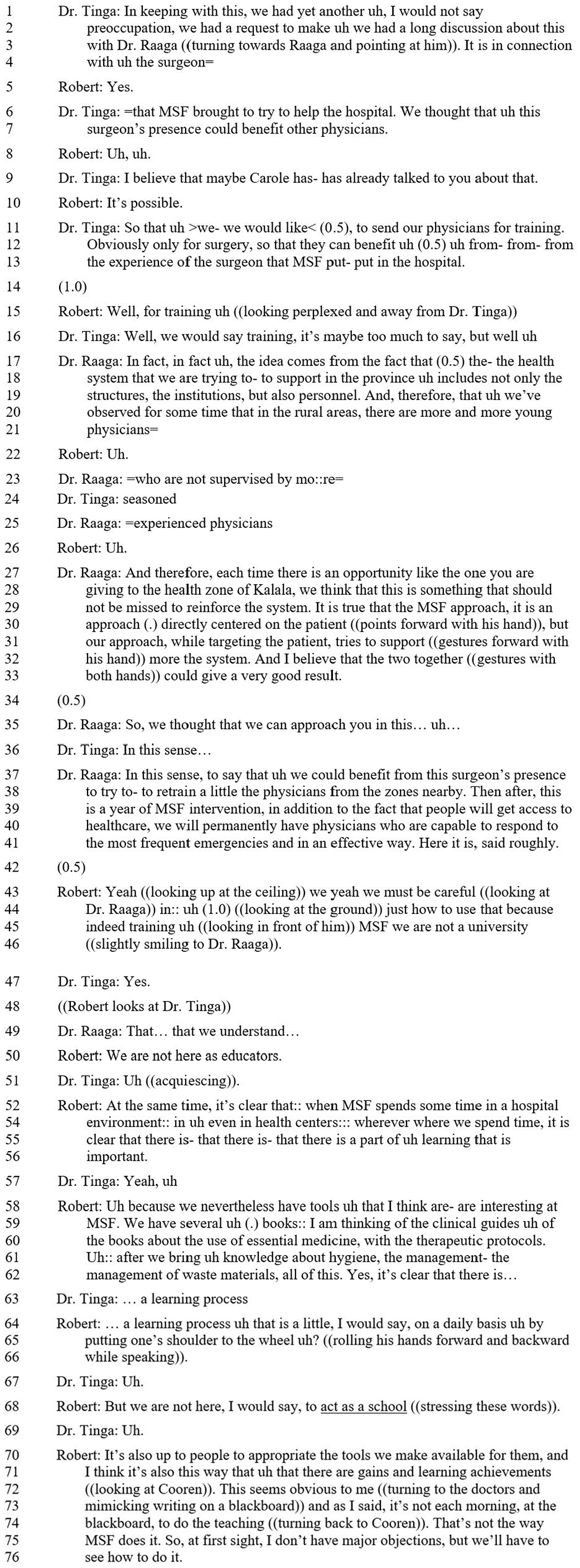
Cooren’s (2018) analysis shows how, in this meeting, not only three people are acting, but also MSF, the local health department, as well as the principles and feelings that animate the interlocutors and make them say and do things. For instance, Cooren analyzes how Robert, upon hearing the request from the doctors, looks at the ceiling, which suggests that a form of uneasiness expresses itself through him in that moment. While Cooren opens up the conversational scene to agencies that are usually excluded from interaction/conversation analysis (see also Cooren, 2008), it could be argued that his analysis, like most research on agency (see Brummans, 2015, 2018), focuses on who or what is acting.
Our reanalysis of this event aims to extend and enrich Cooren’s research by interpreting what is happening as a redirection of the “flow” or “stream” of each being-in-becoming: Individuation processes are attempting to continue into each other, yet are also interrupted or halted and must therefore find new paths of expression in order to sustain themselves. Thus, while the transcription method used to create this excerpt entifies the interlocutors (“Dr. Tinga:”, “Robert:”, etc.), the excerpt can also be read from in a more processual way, in which case different streams of individuation (e.g., Robert-in-becoming, Dr. Tinga-in-becoming), transindividuation (e.g., MSF-in-becoming), and disindividuation (moments when a stream of individuation is interrupted or halted) can be observed in the relations that are communicatively constituted. In this case, we focus on how different individuation, transindividuation, and disindividuation processes are expressed linguistically and extralinguistically (see also Brummans & Vézy, 2022).
From our strong process perspective, our analysis reveals points of inflection that signal a shift in the trajectory of an individuation process—inflection, as Deleuze (1992b) suggests, “is the pure Event” (p. 15). Arguably, the start of the excerpt constitutes such an inflection point: While Dr. Tinga begins the transition to the new topic (“In keeping with this. . .”), up to that point, it was mostly Robert who spoke and gave an oral report on the hospital’s activities to the doctors. Just before Dr. Tinga begins to speak, Robert mentioned that referrals from local health centers to the hospital are going smoothly. Their conversation thus takes a new direction (and tone), both in the change of speaker and in the fact that Dr. Tinga introduces a new “preoccupation” (although he distances himself from this word a few moments later, he still utters the word).
While expressing this preoccupation, which is also a request to Robert (and, through Robert, to MSF), Dr. Tinga notes that he spoke about it to Dr. Raaga, even turning toward him and pointing at him. Shortly thereafter, and before fully articulating the question at hand, he also says that another person called Carole could have told Robert about it, which further indicates that it is a shared concern. Hence, the presence of the MSF surgeon is not only a preoccupation for Dr. Tinga, but also for several other people, and arguably for the whole health department he represents.
Viewed through our theoretical lens, what Dr. Tinga says here is that Dr. Raaga, Carole, the physicians and he himself, along with many others, constitute a transindividual process that needs help training physicians. That action (training) is “excessive,” in the sense that the health department’s individuation cannot accommodate it. Transindividuation (their ability to continue to re/organize as a social collective), in other words, cannot move forward without MSF’s help; the potential (desired) agency of the health department, physicians, the doctors who are present during the meeting, and so on—which are themselves knots tying together multiple individuations—can only become actualized if their streams of individuation can continue into MSF’s individuation, which from their perspective is a question of transindividuation.
The next turn of talk shows how Robert-in-becoming is affected by this request. First, there is a one-second pause (line 14), and then he seems to be at a loss for words, while diverting his eyes from Dr. Tinga (line 15). For Cooren (2018), this is because he is about to express a “dispreferred” (p. 154) response—that is, a refusal, which is more socially awkward than accepting what the interlocutor suggests. Robert’s discomfort can also be understood without resorting to social norms, though. Assuming that on line 14, Robert is about to express a refusal, we may suppose that he knows his refusal will disrupt the individuation of the physicians-in-becoming as health professionals (by curbing their training), resulting in diminished agency. However, what is also at stake here is the local health department-in-becoming’s ability to continue individuating (agency), and even “its” two doctors-in-becoming’s ability to continue individuating (agency)—refusing their request would not only threaten their face (Goffman, 1967), but affect the vector of their becoming. On the other hand, we may also suppose that the request takes Robert by surprise, since his extralinguistic expressions suggest that he had never really thought about MSF as a provider of training. The remainder of the excerpt appears to support this assumption. From this viewpoint, the abilities of a number of beings-in-becoming, including Robert and MSF, to continue their individuation into each other is at stake here.
The doctors appear to notice the affective impact of their request on Robert. On line 16, Dr. Tinga attempts to reword the request, for he seems to realize that Robert is troubled by the word “training.” However, Dr. Raaga jumps in to explain, quite explicitly, that the training can play a crucial role in enabling the continuation of various individuation processes (agency): the health department, as well as its personnel, including young doctors in rural areas, who lack supervision. In turn, Dr. Ragga draws an interesting parallel: He says that while MSF is mainly concerned with patients, while they (the doctors) are concerned with “the system,” both approaches can be combined to “give a very good result.” Dr. Raaga seems to recognize that there might be a new path forward, one that promotes transindividuation (augmented ability to act), rather than disindividuation (diminished ability to act).
Again, the request visibly affects Robert—the transcript shows a half-second pause (line 42), followed by the fact that he cannot seem to decide where to look. He alternates between the ceiling, the ground, and Dr. Raaga, and he has difficulty finding the words. Robert explains that “we must be careful,” because “MSF [is]. . .not a university,” “[they] are not here as educators.” By stating what MSF is not (or rather, should not become), he appears to want to protect the organization from the reorganization that the doctors’ request could entail, and that would move the vector of MSF’s becoming into a direction he had not considered so far.
The remainder of the excerpt can be interpreted as an attempt by Robert to find ways for both individuation processes (MSF and the health system) to continue their individuation into one another—in the form of a new transindividuation process—to actualize the potential capacity to act proposed (and desired) by the two doctors. Indeed, Robert seems to gradually and hesitantly (as evidenced by the elongated syllables) discover that MSF, in fact, may also act as educator. First, he notes that whenever physicians spend time at the hospital, they are also learning. Second, MSF provides tools, books, and knowledge. This realization leads him to recognize that learning occurs due to MSF’s “mere” presence—although he then nuances this idea by specifying that it is not a school-like learning experience and that no formal blackboard-style teaching will be provided. After making this nuance, Robert arrives at the conclusion that he can actually agree with the doctors’ proposal.
This last part of the excerpt (lines 43–76) almost reads like a monologue (with only brief utterances from the two doctors) during which Robert seems to make sense of the effects of what has been linguistically and extralinguistically expressed during the past few minutes, which leads him to try to (linguistically) reorganize MSF, so that the health department-in-becoming can continue individuating into MSF’s individuation—which depends, for an important part, on the vector of Robert’s becoming. He connects different aspects of the MSF’s work to create what could be considered an ad hoc training program, thus responding to the doctors’ request without changing core aspects of how MSF has been individuating (i.e., not expecting the surgeon to offer formal teaching).
Discussion
Drawing on Simondon’s and Massumi’s writings, this paper has developed a strong process theory of agency and illustrated its analytical value for empirical organizational research—especially process organization research. For Hernes (2014), agency takes place as singular events are “articulated,” a form of communication that gives meaning to each event as it unfolds into a temporal sequence. By specifying how that communication takes place and contributes to augmenting (or diminishing) the ability to act, we have created a view of agency that is grounded in communication and that reveals its vital importance for organizational becoming. From this perspective, agency happens as preindividual action is communicated to other individuation processes that integrate it into their own becoming, and are, in turn, informed by it. Such communication therefore reorganizes these processes. Together, communicating individuation processes may consequently also inform a new transindividuation process, which retrospectively gives meaning to the action—for example, offering training might mean that MSF is becoming a “university.” Hence, agency does not entail intentional action, or action resulting from someone’s mental state, but an affective force that it is communicated to other individuation processes with which it forms a broader system and in which it is meaningful.
Process organization research already recognizes that there is no preexisting entity that acts as an agent. Agency has no point of departure; it is not the agency of someone or something; it is “without agents” (Hernes, 2014, p. 93, emphasis added; see also Choukah & Theophanidis, 2016). However, thus far, this research has not theorized what goes on in the events that are propelled by agency (Chia, 1995, 1996; Hernes, 2014). These events, we have shown, are communicative in nature. Communication, in this regard, refers to the movement of action from one process of individuation into another, enabling (or disabling) different individual and collective beings-in-becoming to pursue their existences. Agency can therefore be felt, observed, experienced in the middle/midst of ongoing processes of communication. Attention shifts to how action communicates—not only with words, but with bodies, feelings, and so on—to inform individuation processes and gain meaning. This view has several important implications for organizational research.
First, as we have illustrated by reanalyzing Cooren’s (2018) data, our theory offers a useful new lens for empirical analyses of the confluence of individual and collective becoming. This lens reveals that distinguishing these different “levels” becomes increasingly problematic and even untenable, thus providing more analytical precision to process organization research, which rarely embarks on empirical explorations. And when process organization scholars do ground their theoretical insights in empirical studies, at times the connection between their theoretical and empirical aspects of their work is somewhat difficult to grasp. For example, as Elizabeth Wilhoit (2016) noted, while Cooren (2010) theorizes agency from a processual perspective, his analyses still tend to entify agents. This is mainly attributable, Wilhoit suggested, to the interaction/conversation analytic approach he employs. This approach leads him—not unlike others seeking to ground process organizational studies in empirical data—to investigate who or what is acting in the interactions he studies (a common strategy adopted by others, such as Bencherki & Snack, 2016; Brummans, 2006, 2015; Nathues, van Vuuren, & Cooren, 2021). These agents may be human or more-than-human, and we may even question the distinction between the two. Yet, in the end, the aim is to identify different sources of action. Moreover, for many researchers adopting a similar approach to Cooren’s (e.g., Bencherki & Cooren, 2011; Bencherki & Snack, 2016), zooming in on agents is necessary in order to move from the individual to organizational/collective action—what Cooren and Fairhurst (2009, p. 119) call “scaling up.” By showing that when individuals act, the organization also acts through them, and that individual and collective actors share agency, they aim to account for this scaling up.
In contrast, we suggest that strong process research on agency in organizational becoming should not focus on creating agential inventories, or on explaining how different agents contribute to action, but on describing what happens when events express themselves through/in communication by identifying the passage of action from one individuation process to another. To this end, the strong process lens we have presented here enables researchers to observe how communication takes place, affects these individuations, and is affected by it in their turn. In the illustrative case we reanalyzed, we saw that the proposal to train physicians constituted an inflection point that affected the vector of Robert-in-becoming, leading him to try to (linguistically) reorganize MSF’s becoming, so it could accommodate for the health department’s becoming. In this event, Robert is not an agent, but a vector of becoming (Massumi, 2017) for these different individuation processes. What our lens reveals, in this case, is that individuation takes place concurrently at different “levels,” rather than scaling up from the individual to the collective—a question that has preoccupied organizational scholars for years (Kuhn, 2012; Weik, 2011). This question of scaling up is only relevant, in other words, when communication is regarded as an interaction between already-existing agents, operating at different levels, and vanishes the moment communication is viewed eventfully.
Consequently, as a second contribution, this paper offers process organization research a new conception of communication (see also Bencherki & Iliadis, 2021). Instead of conceiving communication as the exchange or interaction between beings, the theory we have developed here views communication as the continuity of action through beings who are in a perpetual state of becoming. Simondon (2020) calls this “transduction”. Seen this way, communication entails an action that continues from one process of individuation to another, just like one could say that a charismatic person communicates their energy to others or that a piston communicates movement. However, this communication is not simply the result of that person or that piston. The action began well before, preindividually: the person may have been energized by the crowd, by a coffee, by the beautiful sunny day. And the audience, in their turn, may communicate this energy to others. As for the piston, the movement may be induced by someone’s foot on the gas pedal, the engine, fuel, and so on, and it will continue to an axle, to wheels, until it moves a vehicle and its passengers. Communication, in this sense, yields various paths, trajectories, or vectors (like water carving a bed that becomes a river), but cannot be specifically attributed to any of the processes of individuation it enables.
At times, our reanalysis of Cooren’s (2018) data still bears traces of entitative thinking, as it is challenging to use the English language without falling into the traps of subject-verb-object constructions (see also Massumi, 2011). However, as Massumi pointed out in his correspondence with us about the current paper and, more specifically, our reanalysis, The individual bodies in conversation are carriers of an individuating relational knot tying them to other individuations[,] which they make present and active in the situation of the conversation (they are the vector for the partial ‘ingression’. . .of those assemblages into the conversational event). The individual life of each person is of course also an individuation, but it presents as part of that extended relationality, and not in its body-specific voyage through its own life as a whole. The conversation itself is also an individuation, of a different sort. . .Individuations implicated in an event that are of different natures overlap in it. Each is divided into sub-individuations, many of which do not have an active influence in that particular event. But their reality is part of the affective “excess,” and it is also possible that the texturing of the event shifts to bring some into relief that were at first only negligible factors. (Massumi, personal communication, May 1, 2024)
In line with Massumi’s commentary, as a third contribution, our view of agency is helpful for deepening understanding of the idea that an organization emerges through/in communication (see McPhee, 2004; Taylor & Van Every, 2000). From our process perspective, “the organization” is what emerges when the problem of individuation is resolved: (re)organization (or rather (re)organizing) happens in response to the communication of an action, which forces the incorporation/integration of this action into the ongoing process of individuation. Thus, our theory elucidates not only how organizational becoming occurs, but also why: transindividuation (in sharing action with other individuations) enables streams of individuation to move forward, to continue, to go on; transindividation is the key to agency (to the augmented capacity to act together), so to speak. For example, Robert-in-becoming sought to accommodate the doctors-in-becoming’s need for training by reorganizing MSF’s becoming, but MSF-in-becoming also reciprocally needs the local health system-in-becoming to continue individuating: an NGO cannot exist without those it helps, and its individual members cannot continue individuating without accounting for the individuation of the people they serve.
Fourth, while process organization research emphasizes the fact that organizational becoming is an ongoing process (e.g., Tsoukas & Chia, 2002), it focuses less on moments when individuation is interrupted, blocked, or halted—that is, when disindividuation is experienced. From our perspective, moments of disindividuation may constitute important inflection points that call for creativity (see also Whitehead, 1929/1979). This creativity is vital to the formation of new pathways, trajectories, or vectors for the continuation of individuation and transindividuation. For example, the doctors’ request initially destabilized Robert and made him reconsider whether MSF should offer training. However, the doctors probably also felt a sense of disindividuation when Robert appeared to question their request and was perhaps even considering rejecting it. Our theory of agency is therefore useful for research on disorganization (Cooper, 1986; Vásquez & Kuhn, 2019): When individuation encounters a hurdle, it requires reorganization to find a new way to share the excess action it cannot integrate.
Conclusion
In lieu of a conclusion, we would like to extend an invitation, as well as raise two important questions.
Let’s start with the invitation. We hope this article has shown the value of Simondon’s and Massumi’s philosophical writings, and we invite other process organization scholars to engage with their thought-feeling-provoking work in adventurous ways to explore different aspects of organizational becoming.
This invitation leads us to our first question, which concerns the development of new methodologies and methods or techniques for studying agency as an affective force in processes of organizational becoming. Our reanalysis of Cooren’s (2018) data focused on a communicative event that was external to us (the authors of this paper). Simondon writes that researchers must employ the very “tools” of individuation in their own work: Beings-in-becoming individuate as they sense, perceive, affect and are affected, emote and are emoted, and this is exactly what researchers must do throughout the research process. Consequently, researchers can only investigate individuation processes by/while individuating into others (e.g., the individuation processes they study), and accepting that these others continue their individuation into the researchers’ work (see Brummans & Vézy, 2022; Vézy & Brummans, 2021). Thus, research entails attuning to the overflowing preindividual load of others and, in letting ourselves be affected by them (see also Gherardi, 2019), individuate into them. Indeed, because researchers are also pursuing their own individuation, they are not the starting points of their investigations. Instead, the research process “consists in following the being in its genesis, in accomplishing the genesis of thought at the same time as the genesis of the object is accomplished” (Simondon, 2020, p. 14, emphasis in original). Simondon’s view therefore supposes a particular form of reflexivity, for researchers “can only account for the possibility of knowing individuated beings by providing a description of their individuation” (Combes, 2013, p. 8, emphasis in original). If we want to take this view to heart as organizational researchers, we should, in other words, find ways to express our own individuation in relation to the individuation of others in our work. What kind of methodologies and methods/techniques, we ask, would help us attune to agency as affective force in organizational becomings? Some have recently started to explore this question (e.g., see Brummans, 2022; Brummans & Vézy, 2022), but the field unfolding in front of us is limitless.
Second, the idea that agency has no already-existing, already-constituted agents may give the impression that no one is responsible for the events that take place and the actions that are taken. Hence, it may seem that the view we have put forward here is apolitical (Giladi, 2021). To the contrary, however, our view challenges traditional ways of understanding responsibility. Organizational scholars often reflect on responsibility from an agential perspective by trying to understand who or what is responsible for a particular action. Whether it is the responsibility to formulate an organization’s strategy (Sillince & Mueller, 2007), or a company’s social responsibility (Gond & Nyberg, 2017), research has focused on how discourses and materialities tend to attribute the burden of these actions to entities.
An alternative view of responsibility suggests that we have a duty to help “lesser existences” (to borrow a term from Lapoujade, 2021); that is, those whose process of individuation has not yet found its way into others and who are still at risk of disindividuation. Indeed, paying attention to how beings are ongoing processes of individuation highlights that people become responsible as they incorporate/integrate (or deny the incorporation/integration of) the actions of others into their own becoming, which enables those others to continue their individuation (see Bencherki & Elmholdt, 2022). Acknowledging that individual human beings and the social collectives they form are never “complete,” always surpassed, “always more than one,” as Manning (2013) put it, highlights the fact that they depend on each other to pursue their individuation, and it underscores the collective duty to foster each being-in-becoming, regardless of the “level” on which they are operating. Responsibility, in this regard, is not an abstract moral duty, but rather an invitation to remain open, collectively, to affective forces or affections; to exercise caution in the way our individuation might affect “weaker,” “lesser” existences that need our solicitude (Lapoujade, 2021), so that individuation can continue its course.
Such a vision of responsibility echoes that of Hans Jonas (1985), who proposes that we have a responsibility toward the future, particularly the future of our planet and humanity. This future does not yet exist, but that is exactly why we have responsibilities and obligations toward each other, to the human and more-than-human beings who do not yet exist and are in the process of becoming. With this view of responsibility, process philosophy reveals its political and critical potential, for it raises questions regarding which individuation processes are allowed to exist or thrive, compared to those whose existence is denied or thwarted. Thinking about the question of agency as we have proposed in this paper reveals that these choices must be made in “the present moment” (Stern, 2004). It is for this reason that we need to be aware and reflective about the ways in which our doings affect other processes of becoming, which affect our own becoming in their turn.
Footnotes
Acknowledgements
We are grateful to the guest editors of the special issue on Philosophy and Organization Studies as well as three anonymous reviewers for their thoughtful feedback on earlier versions of this paper, and we are especially grateful to Haridimos Tsoukas for guiding us through the review process with such insight and generosity. We also kindly thank François Cooren for sharing his data with us and allowing us to reanalyze them. Last, but not least, we thank Halbe Kuipers and Brian Massumi for thinking with us.
Funding
The author(s) received no financial support for the research, authorship, and/or publication of this article.
