




Abstract
In the context of debates about organizational space, this paper undertakes a multidimensional spatial analysis of everyday organizing. Drawing on an extensive ethnographic study of a housing estate, we use the territory, place, scale, network framework to reveal processes of everyday spatial production that occur through territorial, place-based, scalar and networked organizing. Foregrounding the interplay of these dimensions, we identify four resulting tensions at work in everyday organizing: conflict and resistance, boundaries and (un)boundedness, stasis and movement and alterity and diversity. We propose that centring attention on these dynamics manifest what might be termed ‘organizational geographies’. Thus, we contribute an empirical demonstration of the ways in which organizing as a sociospatial process occurs during everyday life in a more ‘informal’ site, thereby extending the contextual repertoire of organization studies. We also contribute a methodological approach for organization scholars to analyse everyday spatial production as a multidimensional process, pointing to the potential for greater cross-disciplinary fertilization with human geography in future organization research.
Keywords
A society is thus composed of certain foregrounded practices organizing its normative institutions and of innumerable other practices that remain “minor,” always there but not organizing discourses and preserving the beginnings or remains of different (institutional, scientific) hypotheses for that society or for others. It is in this multifarious and silent “reserve” of procedures that we should look for “consumer” practices having the double characteristic. . .of being able to organize both spaces and languages, whether on a minute or a vast scale. (de Certeau, 1984, p. 48)
Introduction
Studies of organization have tended to privilege ‘formal’ sites (typically, the workplace) in order to examine how work is organized in modern society. Yet, there are many ‘alternative’ arenas of social life where organizing occurs. The above epigraph hints at one: namely, ‘the everyday’, where a capacity to organize spaces is maintained – or, put differently, where stabilizations of sociospatial relations coalesce in the accomplishment of organization (Knox, O’Doherty, Vurdubakis, & Westrup, 2015). Taking our cue from de Certeau’s invitation, this paper seeks to uncover how a housing estate in Manchester (UK), known as ‘the Redbricks’, is organized, with our entry point being two distinct but interrelated phenomena: everyday life and shared spaces.
The Redbricks is a site where everyday life unfolds as a proliferation of de Certeau’s (1984, p. 48) ‘multifarious and silent “reserve” of procedures’, which underpin the organization in, and of, everyday life. Here, we define everyday life in relation to the rich varieties of unnoticed rhythms and mundane routines that form the basis of lived experience. Organization scholars have begun to make such everyday practices a subject of study, often in the context of formal organizations (Best & Hindmarsh, 2019; Hjorth, 2005), and we propose to extend such works by investigating how everyday life itself is organizational in character.
Moreover, as de Certeau suggests, to study everyday organizing is to study everyday spaces. Here, we engage with established efforts in organization studies to accommodate the ‘spatial turn’ (Beyes & Holt, 2020), which have yielded insights into, for example, streets (Cnossen, de Vaujany, & Haefliger, 2021; Munro & Jordan, 2013), playgrounds (Vermeulen, 2011), online platforms (Schiemer, Schüßler, & Theel, 2023), zero-waste practices distributed across space (Chertkovskaya, Hasselbalch, & Stripple, 2024), and other spaces of everyday organizing (see reviews by Beyes & Holt, 2020; Stephenson, Kuismin, Putnam, & Sivunen, 2020). Yet, we also agree with critiques that thinking of organizing in terms of space is not enough: space is more than a ‘common-sense’ category (Taylor & Spicer, 2007, p. 325), a ‘container’ for organization (e.g. Wilhoit, 2018), or a site of contestation (Beyes & Holt, 2020). Taken further, we would argue that the spatial turn in organization studies should involve tracing the openings and ‘twists’ (Beyes & Holt, 2020) that an organizational lens affords to studying spatiality. Thus, extending this increasing mobilization of space as a conceptual means for unfolding the ‘where’ and ‘how’ of organization, we propose to understand spatial organizing in the Redbricks as a multidimensional spatial – as well as social – phenomenon.
We thus build upon the renewed attention that spatial thinking has brought to the questions of ‘where’ and ‘how’ organizing occurs. For example, scholars are increasingly explicating the significance of place for organization (e.g. Courpasson, Dany, & Delbridge, 2017; Crevani, 2019; Guthey, Whiteman, & Elmes, 2014). Others have accommodated spatial notions such as territory (Daskalaki, 2014; Maréchal, Linstead, & Munro, 2013), scale (Taylor, 2011; Taylor & Spicer, 2007) and network (e.g. Haug, 2013; Ratner, 2020). Often drawing on human geography, these works consider the multiple spatial modes of organizing that generate robust and enduring (but also ephemeral) organizational phenomena, helping to further our understanding of organization as a spatial process with (contested) borders/boundaries, which becomes meaningful as a result of its situatedness in the world, and where different forces and connections come together (e.g.Beyes & Holt, 2020; Stephenson et al., 2020).
However, the investigation of organization’s spatialities solely in terms of a single concept (i.e. territory or place or scale or network) risks its privileging, and even reification. Instead, we recognize the need for contextualizing analysis to the spatial-organizational particularities and complexities of a given empirical context. Thus, this paper examines the Redbricks in terms of multiple spatial ‘registers’ (Beyes & Steyaert, 2012) of organizing: the ways organization produces and is produced by spatiality (Dale & Burrell, 2008) in what might be called ‘everyday spatial production’. To treat the everyday as a site where space is produced – and productive – is to follow de Certeau in recognizing that there is something inherently political about the ‘reserve’ of everyday life. Remaining open to spatial multiplicity helps unleash this politics by refusing to delimit, and thereby determine, the potential formations of organizational space.
We incorporate spatial multiplicity into our study of everyday organizing by adopting Jessop, Brenner & Jones’ (2008) territory, place, scale, network (TPSN) approach as a conceptual framework for ‘deciphering the variegated, polymorphic spaces of contention that have been produced through different types of social mobilization in different historical-geographical contexts’ (Jessop et al., 2008, p. 398). As we will explain, this provides a way to investigate everyday organizing through several (more) clearly defined topological shapes simultaneously, while also emphasizing their interplay. Our contention is that multidimensionality can provoke nuance and careful attention to the specific, multiple and interconnected spatial formations that organizing entails, albeit not without its own risks of reification – a point we return to in our conclusions. In other words, TPSN provides a multidimensional starting point, rather than finish line, for empirically analysing the spatial production of organizing (in) everyday life on the Redbricks. Thus, our paper aims to:
i) extend organizational space debates through our focus on everyday organizing;
ii) apply a multidimensional spatial analysis of everyday organizing to the ‘alternative’ arena of the Redbricks.
To meet these aims, we briefly situate our research within extant theorizations of everyday life, before reviewing how these resonate with spatial conceptualizations of organization/organizing. We then propose Jessop et al.’s (2008) TPSN framework as a multidimensional, polymorphic approach to analysing everyday spatial production. Next, we describe our methodology for investigating this question empirically: a 13-month ethnography on the Redbricks, which explored how shared spaces are of central importance to everyday organizing. Our findings analyse how spatial production involves territorial, place-based, scalar and networked organizing. Consequently, we identify several tensions which a multidimensional spatial analysis helps elucidate, particularly through analysing the interplay of the different dimensions of everyday spatial production. Bringing these multiple spatialities of everyday organizing to light constitutes an effort at seeking organizational geographies, a journey we invite others to join in our conclusions.
Our primary contribution to organization studies is to empirically demonstrate the varieties of spatial production entailed in everyday organizing, extending the repertoire of organization studies to more ‘informal’ sites. Our second contribution is methodological: showing how organization scholars can investigate and analyse everyday spatial production as a multidimensional process, which points to the potential for greater cross-disciplinary fertilization between human geography and organization studies in future research.
Everyday Life and Spatial Organization
Everyday life in organization
The notion of everyday life is centrally concerned with how the familiar and mundane can reveal something significant about our lives and existence. Lefebvre (2014, p. 109) proposes that, while not necessarily spectacular to passersby, the everyday has a ‘secret life and richness of its own’. In organization studies, considerations of everyday life have enjoyed significant (if somewhat delimited) interest, manifesting in an emerging scholarship studying the everyday in formal organizational settings (e.g. Courpasson, 2017; Hjorth, 2005; Ybema, Yanow, Wels, & Kamsteeg, 2009). Emblematically, Courpasson (2017) treats everyday life at work not as a context of study, but rather as a way of seeing the world through the interplay between alienating and creative moments. Uncovering this tension in workplaces – what Courpasson (2017, p. 847) calls the ‘extraordinary ordinary’ – provides insights into the ways people ‘make do’ at work (de Certeau, 1984).
Yet, notwithstanding advances made in studying everyday life of organizations, this begs the question: is everyday life itself organizational in character? There are certainly ways in which organizations exert control over the everyday. But, drawing on a processual understanding, it is also possible to discern how everyday life is organized through ‘micro-ordering processes’ which ‘serve to shape our identities and aspirations and to orient us towards ourselves and our environment’ (Chia, 2003, p. 98). This situates organizing as a broader phenomenon of social life, which has a long lineage in organization studies (e.g. Cooper, 1986), suggesting a way to ‘locate’ everyday organizing outside the ‘typical’ work organization (e.g. Reedy, King, & Coupland, 2016). Our research, situated on a housing estate, builds on this stream of thought, with our starting point being the ways organizing unfolds in-and-through everyday life. Importantly, everyday life, and organizing, must be understood as spatial phenomena (de Certeau, 1984; Lefebvre, 2014), an established insight in organizational inquiries (Beyes, 2018) that we critically scrutinize next.
Spatial understandings of organization and organizing
Building on the spatial turn (see reviews by Beyes & Holt, 2020; Stephenson et al., 2020; Weinfurtner & Seidl, 2019), scholars have begun to rethink questions of organization, such as: the way power and control are exerted over space (Dale & Burrell, 2008; Taylor & Spicer, 2007), how contestations over space reveal a simultaneous presence/absence of organizing (Giovannoni & Quattrone, 2018), tensions between openness and closure in uses of space (Holstein & Rantakari, 2023), the dynamic processual emergence of spacing in organization (Beyes & Steyaert, 2012; Knox et al., 2015), and – particularly relevant for this paper – everyday life as a spatial phenomenon (Beyes, 2018). There is a multiplicity of ways space is used, characteristic of the multiplicity of space itself (Massey, 2005; Ratner, 2020).
Indeed, organizational space debates at first seem to follow Massey’s (2005) crucial insight that space should be treated as relational and always-being-made. Yet, space is not a distinct or internally coherent notion, and is therefore elusive to resolution through a clear definition. To address this, and inspired by Lefebvre’s (1991) analysis of the production of space, organization scholarship has taken to mobilizing a triad of elements comprising space – conceived, perceived and lived – in what is now a firmly established area of research (e.g. Kingma, Dale, & Wasserman, 2018). While important contributions, the sustained emphasis on this triadic understanding of space in organization studies brings, we would argue, a risk of rigidifying the unsettled, unsettling, yet ultimately fructuous multiplicity offered by spatial thought (Beyes, 2018; Beyes & Holt, 2020).
Recently, organization research has acknowledged the need to extend our spatial lexicon to account for organization as a formation imbued with power, unique to particular locales, and both distinct from and connected to organizing elsewhere. Maréchal et al. (2013, p. 204) focus on the complexity of ‘territory’ for organization studies to demarcate ‘ground for combining understandings of space and time with power, embodiment, and materiality’. Similarly, Daskalaki (2014) explores the emergence of territories among self-organized communities as part of urban resistance in Greece. Alongside this, organization scholars have utilized notions of ‘place’ to interrogate the collective meanings ascribed to concrete geographical locations (Courpasson et al., 2017; Wilhoit, 2018). For example, Crevani (2019) discusses organizational presence as intimately tied to the meanings associated with place at an outdoor event, the Fjällräven Classic. Importantly, place is not conceptualized as specific, local, or contrasting with a generalized and globalized notion of space; instead, both are relationally constructed and co-constituting through Fjällräven’s ‘place work’ (Crevani, 2019; cf. Massey, 2005). Similarly, Nash (2020, p. 302) approaches space and place as interwoven when exploring the ‘relationship between meaning and materiality’ in the everyday rhythms of the City of London.
Others have mobilized the concept of scale to extend spatial analysis of organization (Taylor & Spicer, 2007), such as Taylor’s (2011) theorization of the ways communicative configurings of organization result in particular scalar levels (see critique by Ratner, 2020). Finally, scholars have conceptualized spatial organization in terms of ‘networks of relations’ (Haug, 2013; Ratner, 2020). Indicatively, Vásquez and Cooren (2013, p. 42) explain how a heterogeneous network unfolding across space manages to ‘assemble[. . .] in the singularity of “we”’ – the organization. Far from mere semantics, these works show the potential offered by more nuanced formulations of sociospatial relations for grappling with the complexity of organizing. Yet, to study spatial organization solely in terms of one of these concepts (i.e. territory or place or scale or network) brings several risks: namely, ontological privileging of one concept as the spatial dimension of organizational landscapes, unreflexive consideration of the consequences of such an assumption, and insufficient attention to the concrete (and complex) dynamics at play in specific empirical contexts (Jessop et al., 2008).
Therefore, against potentially reductive views of the multiple spatial dimensions of organizing, we suggest taking the spatial turn further still. In this vein, scholars have also urged a shift from studying spatial aspects of organization to interrogating the broader phenomenon of the organization of space (Chertkovskaya et al., 2024; Dale & Burrell, 2008; Kingma et al., 2018). Ratner (2020, p. 1516) makes an important contribution here, proposing a ‘topological’ approach to organization, which understands ‘space as something which is continually curving and deforming’ and therefore serves as ‘a way to extrapolate how organizational space can take up multiple shapes’. This approach ‘brings spatial imagination beyond that of the network’ (Ratner, 2020), using an empirical study of the interruption of a management meeting to illustrate how organizational topologies (de)form (in) space to bring about the situational achievement of scale. Here, multiple spatial dimensions are rooted in a topological understanding that extends beyond scale to a networked understanding, offering a means to grasp the ways spatial organization is made and remade – what has been called the ‘spatial production’ (Beyes, 2018) of organizing.
Building on Ratner’s (2020) topological understanding, our paper aims at elucidating how organizational phenomena might be understood through multiple spatial dimensions together – reflecting what Jessop et al. (2008) call the ‘polymorphy’, or many-shapedness, of sociospatial relations. For example, might Ratner’s (2020) interruption-events of meetings be explored as challenges to the territorial claims of different organizational actors via material demarcations (Maréchal et al., 2013)? Or as meaning-making moments which give meetings a(n interruptive) sense of place (Agnew, 1987)? Thus, we extend the insights broached in conceptualizations of ‘organizational topologies’, as well as the related proposal for ‘organizational topographies’ (Beyes & Holt, 2020), through a multidimensional approach, discussed below.
Everyday Organizing and Spatial Production: A Multidimensional Framework
As noted, organization scholars have already engaged with questions of spatial organization. Yet, as we have also seen, they are often ‘tempted to focus on one dimension of spatial relations, neglecting the role of other forms of sociospatial organization as presuppositions, arenas, and products of social action’ (Jessop et al., 2008, p. 391). At the same time, resonating with Lefebvre (1991, 2014), spatial production must be seen as inherently tied to everyday life, where ‘the question of organization therefore becomes one of the myriad and prosaic forms and processes of organizing and reorganizing the social, most notably as they take place in the urban everyday’ (Beyes, 2018, p. 39).
To weave a multidimensional spatial analysis of organization together with everyday life, in what we term ‘everyday spatial production’, we bring Lefebvre-inspired scholarship on organizational space into conversation with Jessop et al.’s (2008) territory, place, scale and network (TPSN) framework. A TPSN analysis calls for a polymorphic understanding of sociospatial relations (Jessop et al., 2008), with attention to their specific manifestations in concrete empirical contexts. The caution against reductionist, one-dimensional analysis embodied in TPSN has proven influential in human geography (e.g. Anderson, Kearnes, McFarlane, & Swanton, 2012; Waite, 2023), although some suggest that its four dimensions impose a rigidity to analysis that occludes further spatial nuances (e.g. Blakey, 2021; Malpas, 2012). Indeed, wary of this, we emphasize the interplay of TPSN dimensions and, more importantly, resist foreclosing other possible spatial twists entailed by everyday organizing, a point we return to in our conclusions. Nonetheless, in order to open up everyday organizing to the multidimensionality entailed by TPSN, while maintaining a ‘restless, indeterminate and as such inherently political’ (Beyes & Holt, 2020, p. 4) understanding of space, we propose a means for deciphering the complexities of everyday spatial production as an interplay between the territories, places, scales and networks of organization (Table 1).
How TPSN dimensions translate to everyday spatial production in organization studies.
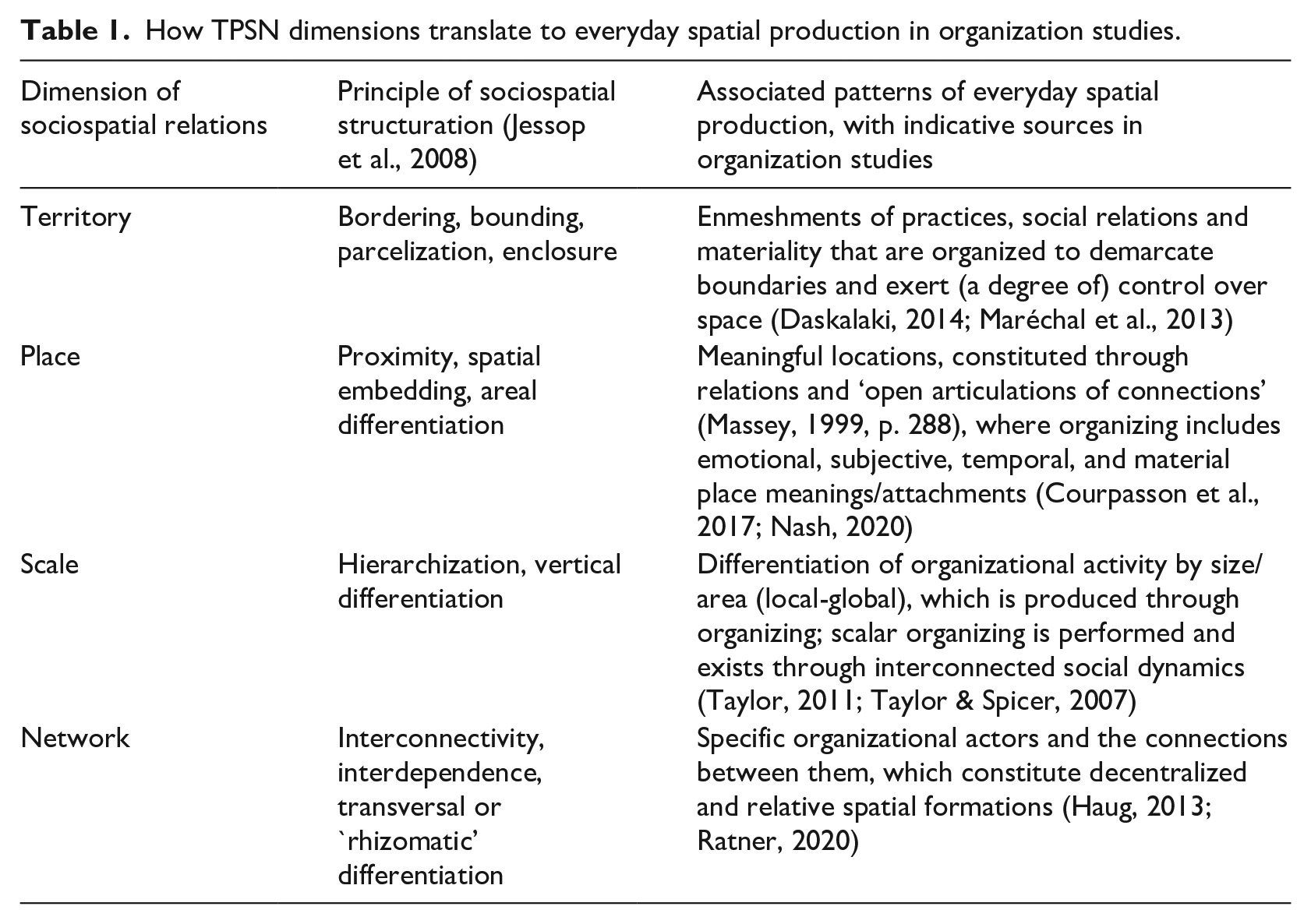
The multiple TPSN dimensions in Table 1 serve as sensitizing concepts for investigating the distinct and overlapping processes of everyday spatial production occurring in an empirical context. As is clear, a TPSN analysis incorporates the currents of spatially attuned research in organization studies reviewed previously. But, by considering these in concert, it is possible to delineate the coexistence of, for example, the material boundary-making of territorial organizing and the relational boundary-spanning nature of how places are organized – and how organizing is place-based. Similarly, the ‘local’ differentiation of everyday organizing activities occurs simultaneously as networks of organizational linkages span space. These distinctive territorial, place-based, scalar and networked dynamics of everyday spatial production formed a central component of our empirical analysis.
Moreover, with TPSN analyses recognizing the intersections between different spatial dimensions in the everyday production of space, reflexive attention must be paid to ‘combining different dimensions of sociospatial analysis’ (Jessop et al., 2008, p. 392, our emphasis). In practical terms, this involves considering different spatial dimensions as ‘structuring principles’ that have an impact on other dimensions (each as distinct ‘fields of operation’), with their intersections influencing how each field of operation is constituted, thus producing ‘structured fields’ (Jessop et al., 2008, p. 396). Therefore, an essential insight of TPSN for organizational analysis is to place different spatial dimensions of organizing into dynamic articulation, which can shed light on the contrasting organizational-spatial processes involved and reveal tensions that exist in/between different spatialities of organizing. For this reason, following the analysis, our discussion considers the intersections of multiple forms of everyday spatial production.
Based on the above, an empirical interest emerges in what new insights can be found when we are attuned to the many-shaped, polymorphic sociospatial relations producing, and produced by, everyday organizing. To investigate this further, we apply the TPSN framework to a novel empirical context, introduced next, and analyse multidimensional spatial organizing as it unfolds in everyday life. Through this empirical analysis, we shed light on everyday organizing as polymorphic spatial production.
Research Context and Methodological Approach
How does an interest in everyday spatial production translate into empirical inquiry, given the importance of focusing on contextual particularities (Jessop et al., 2008)? As stated, our interest lies in de Certeau’s (1984) silent reserve of the everyday, which organization scholars have argued to be amenable to ethnographic inquiry (e.g. O’Doherty, 2017; Ybema et al., 2009). This move beyond the formal organization per se refocuses the subject of inquiry, contemplating everyday organizational life which, through the ethnographer’s critical gaze, becomes imbued with a politics as it ‘participates in a wider ongoing reconstruction of social practices and organization involving new object/subjects and their relations’ (O’Doherty, 2017, p. 16).
Our ethnography of multidimensional sociospatial relations centered on the Redbricks housing estate – formally, the ‘Bentley House Estate’ – in Manchester (UK), which comprises around 250 apartments arranged in six parallel, three-story buildings, with substantial communal areas between, and along a pedestrianized street (Hulme Street) to the immediate north (Figure 1). Our immersion in the field began in November 2017 and lasted 13 months. Initially, fieldwork relied heavily on participant observation, including attending or volunteering at activities, events, and meetings of groups. During that time, we encountered everyday life on the Redbricks as a textured and multifaceted process, made meaningful through the many opportunities for social relations to flourish: from pre-planned meetings to spontaneous gatherings; from the ‘tinkering’ of single individuals in the communal gardens to events with well over 100 people in attendance; from flurries of activity to many moments where ‘organization’ was seemingly absent. These seemed to overlap and coexist both spatially and temporally, pushing us to move beyond the assumption that organizing occurs in space (Wilhoit, 2018) towards a more relational (Massey, 2005) and processual (Knox et al., 2015) spatial conceptualization.
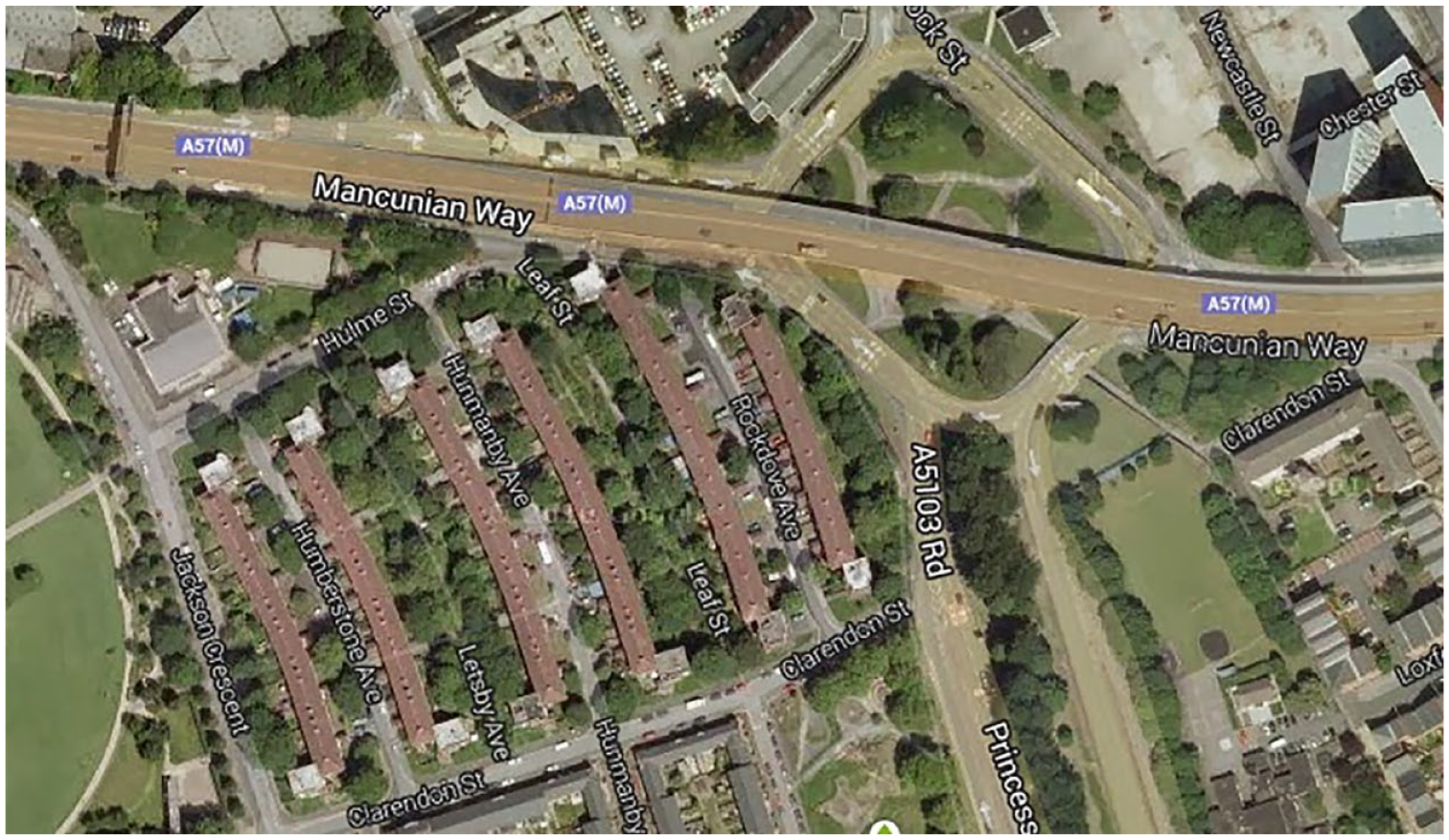
Aerial view of the Redbricks and surrounding area (Google Earth, 2017).
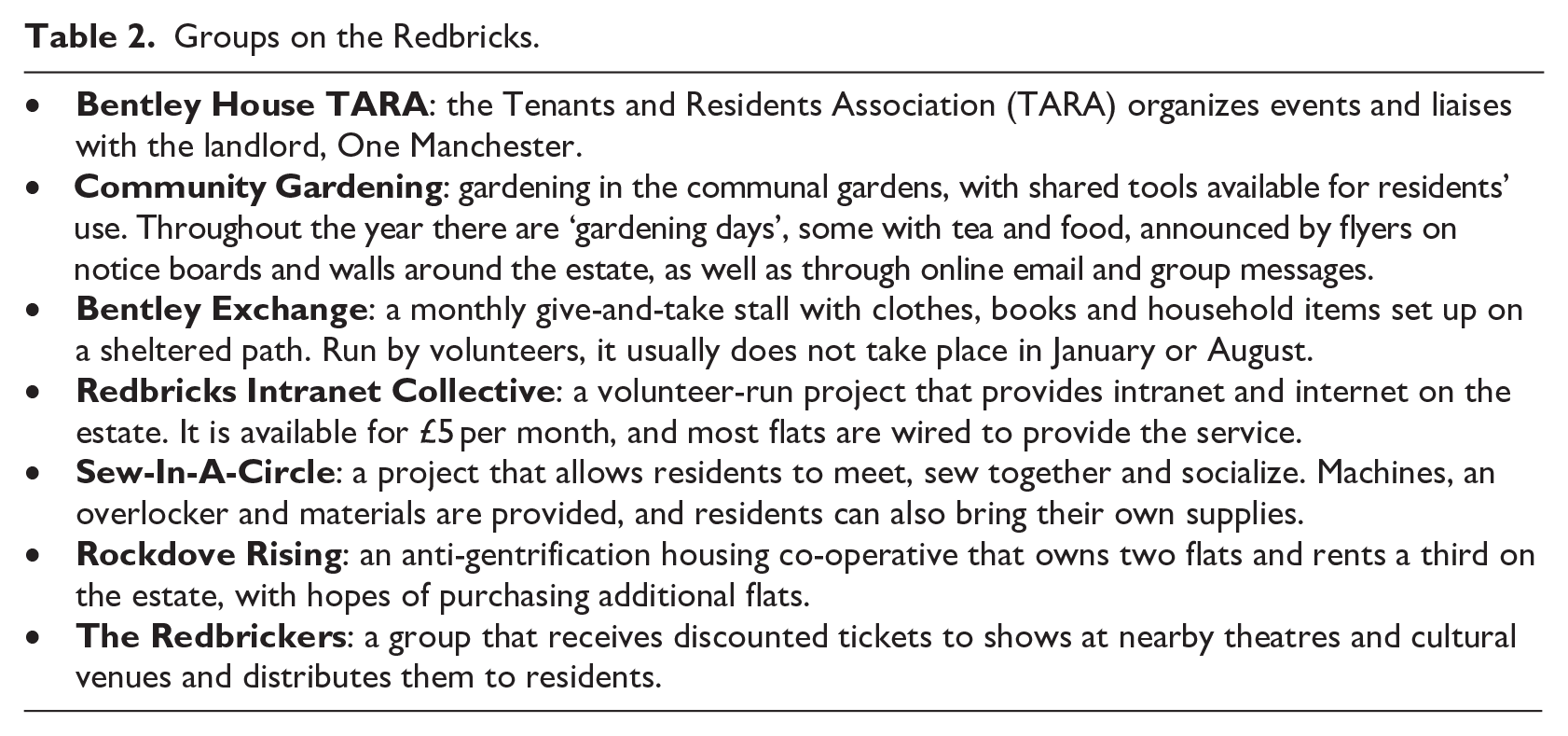
As fieldwork progressed, we sharpened our investigation into how communal areas are organized, with the concentration and sheer volume of self-organized collective activities occurring therein – particularly the large gardens (known as ‘Leaf Street’ and ‘Letsbe Avenue’), the pedestrianized Hulme Street, paths and walkways, and a shared office used by various groups – surprising and exceeding our expectations (Van Maanen, Sørensen, & Mitchell, 2007). This is not to say that participant observation revealed a constant ‘buzz’ of organizing. On the contrary, we began to recognize that the rhythms of everyday life impose their own organization of the estate. Evenings and weekends are preferred for many of the groups we encountered (Table 2) and whose meetings we attended. Residents with variable working hours, in contrast, coordinate via WhatsApp to more spontaneously organize gardening days (often weather-dependent) or to gather residents’ views ahead of planned meetings. In addition, coordination happens via dropping by the office during others groups’ meetings, exchanging view on social media, running into people in the communal gardens, and unexpectedly encountering others in the estate’s other regularly used spaces.
Groups on the Redbricks.
We already began to think of these everyday activities on the Redbricks as instances of ‘spatial experimentation that harbours the possibility of new forms of organizing’ (Beyes & Steyaert, 2012, p. 55). However, despite an increasing attunement to the everyday-in-common as a fertile humus for such experimentation, the progression of fieldwork posed several challenges to our ability to make sense of this from an organizational perspective.
First, we worked from the premise that multiple groups and individuals play some role in organizing communal spaces. But ethnographic immersion and our engagements during fieldwork relied on the extent of rapport built (Atkinson & Hammersley, 2007) – or lack thereof, with some residents expressing incredulity or scepticism towards academic research. For example, while TARA was overall amenable to our attendance at meetings, we respected other groups’ views towards our presence and only attended when invited. But immersion also depended on whether our patterns of activities overlapped; our particular desire to learn about some practices (such as gardening or re-use); and an emergent interest in the ways organizing on the Redbricks connects with other places. Such considerations were a key dimension of our ethnographic immersion. But inevitably, while our rapport meant more access and therefore deeper insights from certain residents’ perspectives, it also associated us with certain residents and ‘aligned’ us more to them and less to others – making visible how encountering and navigating group politics is part and parcel of ethnographic research into organization (O’Doherty, 2017).
In response, we began to nuance our methodological approach, at times pursuing what might be called purposive wandering through the estate, following the paths between buildings and visiting frequented spaces with the desire of running across residents. Sometimes this gave rise to serendipitous conversations, such as when we were invited to a show that several residents’ band was performing at a nearby venue, where we subsequently got to know other residents; but it also led to disconcerting moments, like the resident who showed us how shadows on parts of the estate are falling in the wrong direction – a result of light reflection off the glass from a new high-rise development. This methodological response to the challenges of studying everyday organizing proved fruitful for extending inquiry beyond the ‘usual suspects’, particularly as our involvement deepened.
Second, even when accounting for the polyrhythmic patterns of organizing outlined previously, our investigation often led us ‘off’ the Redbricks. These connections to other places began to take on a central importance, not so much as removed sites of resistance (Courpasson et al., 2017) but rather as a constitutive element to what happens on the Redbricks itself. We could not resolve this problematic through engagement with existing conceptualizations of place in organization studies (e.g. Crevani, 2019; Nash, 2020), which pushed us to engage with human geography debates about the relationality of place (Massey, 1999).
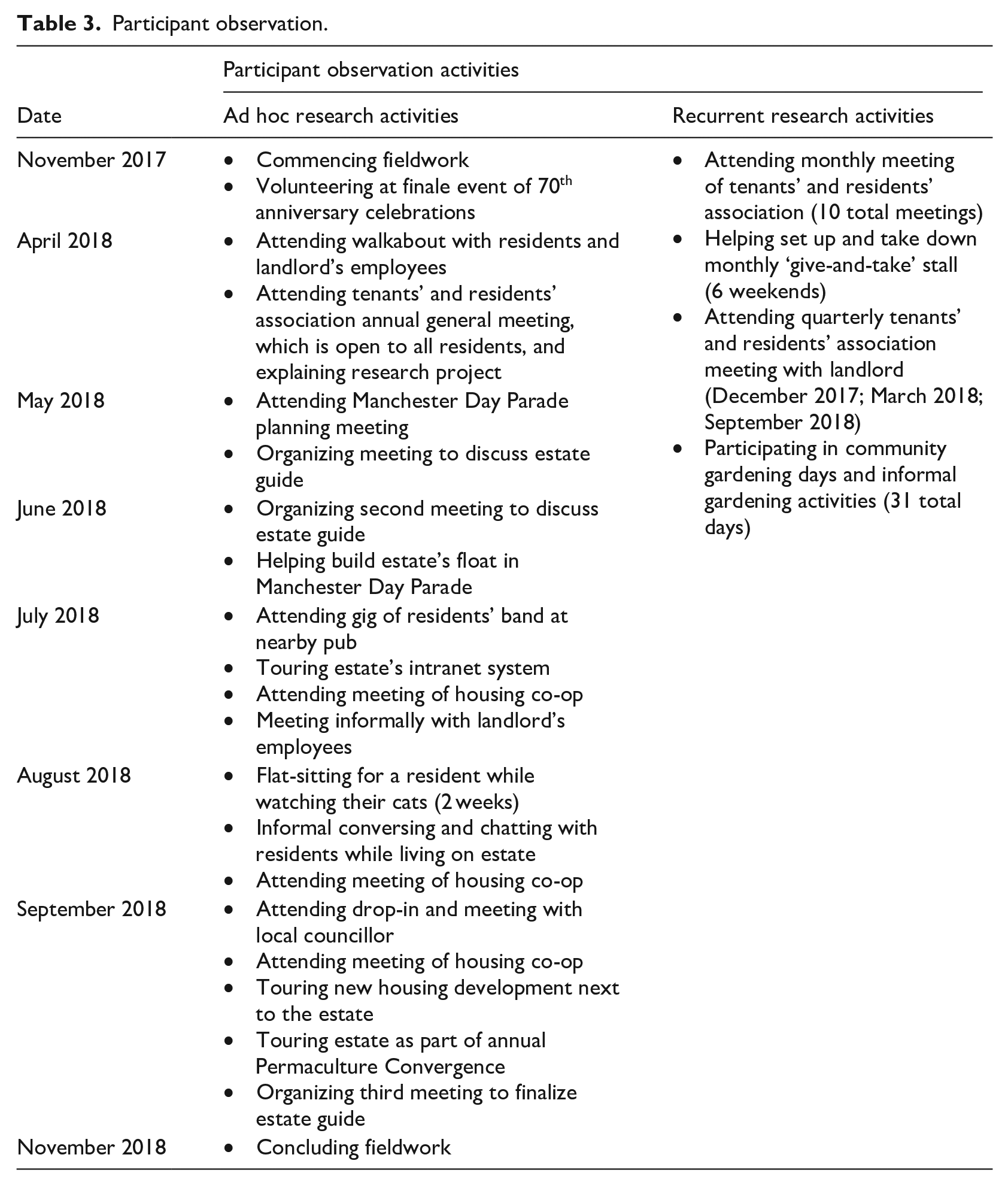
Finally, our fieldwork was overshadowed by an oft-repeated sentiment: residents frequently commented about the abundance of previous activities and the palpable sense that, as one resident noted, the Redbricks ‘were something’ in the past – implying, in effect, they are less something in the present. Yet, this was not what we observed during our extensive participant observation (Table 3), which culminated with the first author living on the estate for two weeks in August 2018. The arrangement involved watching a resident’s cats and tidying their garden, with a fieldnote reflecting on this experience: I ate dinner tonight in the garden, taking a moment to admire all the work I’ve done. A feeling of belonging came over me, sitting in the garden, like I don’t need to make an excuse for being around the estate. I feel at home here. (author’s fieldnotes)
Participant observation.
Here, belonging is revealed both a methodological challenge and feature of everyday life. Contrary to fatalistic diagnoses, the Redbricks still enfolds residents into a meaningful mode of being, which we (began to) embody during fieldwork. At the same time, the importance of work – for instance, clearing weeds and pruning trees – as a facilitator of belonging speaks to the importance of material interventions and demarcations: of territories (Maréchal et al., 2013). But a territorial lens is interwoven with the belonging and sense of place we felt, and which was substantiated extensively throughout the fieldwork. This simultaneous territory-place dynamic of organizing demonstrates how we were challenged to think with these multiple spatial dimensions together. Ultimately, we resolved this puzzle in an abductive process, moving between concepts and data continuously (Van Maanen et al., 2007) and arriving at the TPSN framework as a means to accommodate this spatial multidimensionality of our analysis.
Thus, the ethnography was far from a straightforward, one-directional process. On the contrary, to investigate everyday organizing required us to embrace methodological versatility; to grapple with multiple spatial dimensions as our empirical work was not wholly gratified by the conceptual resources available; and to gradually think in terms of interwoven multidimensionality – while conversing through the veil of double-blind peer review. These negotiations and our ‘unmet expectations’ (Van Maanen et al., 2007) comprised an important part of our data analysis, which we return to shortly. But they also speak to how we pursued our interest in treating the everyday as an object of legitimate attention for organization scholars, for whom the ‘reserve’ of everyday life often remains overlooked and unworthy of remark, yet maintains the pulse and mark of organization.
As our ethnography built an understanding of the organizational character of everyday life, we gathered data about how communal spaces are organized by: making ‘jottings’ (Madden, 2010) in a notebook during participant observation, which formed the basis for in-depth fieldnotes subsequently written up; collecting documents, photographs and archival materials; holding 16 ethnographic interviews with residents (Atkinson & Hammersley, 2007); and conducting a small photo-elicitation project with three residents (who were subsequently interviewed). These 19 interviews – ranging from 41 to 121 minutes, with an average length of just over 83 minutes – were transcribed (totalling 503 pages of single-spaced text) and uploaded with other textual and audio-visual data to qualitative data analysis software for analysis.
Our analysis, as outlined above, gradually centred on how self-organizing involves groups and residents’ imposition of orderings (i.e. organizing) on/in/through shared areas, with their distinct spatial dimensions taking on particular interest. Thus, during ethnographic interviews, a general arc was followed: ‘How did you end up on the Redbricks?’ led to questions such as ‘What are you involved in now?’ before finishing with ‘Where do you think things are going?’ These open-ended guides meant that the interviews took a similar general direction, while specific threads were pursued further as we sought to understand the complexities of how shared spaces are organized. In contrast, the photo-elicitation project asked residents to take photographs of ‘what is meaningful on the Redbricks’ to them. These photographs overwhelmingly focused on shared spaces, so the subsequent interviews provided a complementary way to interrogate meaningful and visual-material aspects of everyday organizing on the Redbricks – and to address the powerful nature of a researcher–researched relationship.
Data analysis involved an abductive approach (Dubois & Gadde, 2002; Van Maanen et al., 2007), moving between data and literature as we worked to connect our empirical data with theoretical and conceptual debates. Confronting the limits of our ability to understand everyday spatial production in terms of single spatial concepts, particularly insofar as this tendency characterizes organization scholarship, we turned to the four dimensions of the TPSN framework (Jessop et al., 2008) and the associated patterns of everyday spatial production we identified (see Table 1). Our coding process assigned in vivo codes to interview and fieldnote excerpts, documents and photographs, before applying more interpretive codes that connected individual aspects of everyday organizing to the spatial dimensions of TPSN.
For example, data relating to the history of the Redbricks portrayed the importance of past place-based activities, and the ‘sense of place’ afforded to the estate by residents. Yet, codes often overlapped: nostalgia for the past and its ties to the present was an embodied phenomenon at the scale of the body; organizing territories in the gardens often used plants acquired through the network of connections, particularly donations from a local garden centre. Distinguishing between multiple spatial dimensions therefore presented an analytical challenge, which we sought to resolve by working with the dimensional interplay of a TPSN analysis. Analytically, as we condensed codes into broader categories that establish organizing as a territorial, place-based, scalar and networked process, we paid attention the relative strength of association between fragments of coded data and a particular spatial dimension, to the frequency of fragments linking an organizational process with a category, and how each spatial dimension assembles into a coherent narration of one aspect of everyday spatial production.
The above led us to develop four spatial-organizational themes, described below. Yet, the proposal that TPSN dimensions are mutually influencing pushed our analysis to consider how the spatial multiplicity of organization generates persistent tensions and incommensurate demands between contrasting spatialities. Indeed, we are wary of the fact that applying the four TPSN dimensions and scrutinizing their interplay imposes its own ordering to organize the spatial multiplicity of everyday life. The complexity and flux of these organizational geographies are only ever accommodated, and never fully resolved, in the everyday practice of organization, a point which we elaborate in our discussion.
Findings and Analysis
Our findings combine ‘thick’ description of relevant phenomena, quotations from interviews, photos – including several elicited from residents – and accounts of our evolving entanglement. In doing so, we highlight (some of) the organizational processes unfolding on the Redbricks across the TPSN’s multiple spatial dimensions, which together reveal patterns of everyday spatial production.
Territories of organizing
On the Redbricks, territories are formed as residents’ everyday activities demarcate, and thus exert control over, space. These different forms of organizing, notable for their sheer quantity on an estate of its size, create a rich tapestry of territorial organization.
The Tenants’ and Residents Association (TARA), Redbricks Intranet Collective and Rockdove Rising housing co-operative all hold meetings in the shared office. These meetings are points of discussion and decision-making, often where additional activities are agreed upon, including community events and parties, issues to be raised with the landlord, maintenance plans for the estate’s intranet, and so on. In this sense, these groups create temporary territories of/for organizing both the office itself and, through the decisions taken, the estate more broadly. In contrast, other groups’ meetings to catalyse activity are not generally required; they more occasionally and opportunistically territorialize the estate. With more pre-defined objectives and remits, both the Bentley Exchange and the Sew-In-a-Circle sewing group occur on previously agreed dates – with the latter occurring in the office, coordinated with other groups to (usually) avoid conflicting use. For such groups, a combination of emails, posters, text messages and in-person reminders is used to remind or inform residents, pointing to the importance of virtual space for territorial organizing (Daskalaki, 2014). Together, everyday activities demonstrate territorial patterns of organizing that claim, and coordinate, creation of territories on the estate.
Throughout fieldwork, we became enrolled in this process, joining meetings, events, social media groups and the intra-estate mailing list, immersed in everyday territorial production. On many occasions, territorial organizing flowed together in the same space, such as when residents stopped off at gardening sessions or the Bentley Exchange to chat about a planned meeting or put up posters for an upcoming event. Equally, there were periods when no activities were discernibly taking place. These lacunae are instructive: due to these shared spaces’ situatedness in a housing estate, territorial patterns are temporary, inevitably following the rhythms of residents’ lives (working, socializing, at home, sleeping, and so on). Thus, the capacity and frequency of organizing is de facto limited because the territories of contention are shared spaces in the context of housing and everyday life (Jessop et al., 2008).
At the same time, the materiality of territories means they continue to exist beyond their temporary organization. Returning to the office, it is territorialized whenever filled with people, papers, cups of tea, bags and coats. At the same time, posters in the office betray another territory: employees of the estate’s landlord also use it, sharing access with residents. These posters (Figure 2) reveal how, though the office becomes a territory for resident groups, its territorialization is necessarily temporary as different groups inhabit the space. So, while the office alternates between resident groups, access and control also shift as a powerful actor (the landlord) exerts (temporary) territorial claims. Still, more permanent objects exist (see Figure 2): computers installed by Redbricks Intranet Collective; multiple shelves and cabinets filled with years’ worth of papers, tools, a researcher’s information sheets, other forgotten objects; and the central table where tea rings and stains remember past gatherings. In this sense, the legacy and endurance of temporary territories are found in the (un)intentional material markers that remain.
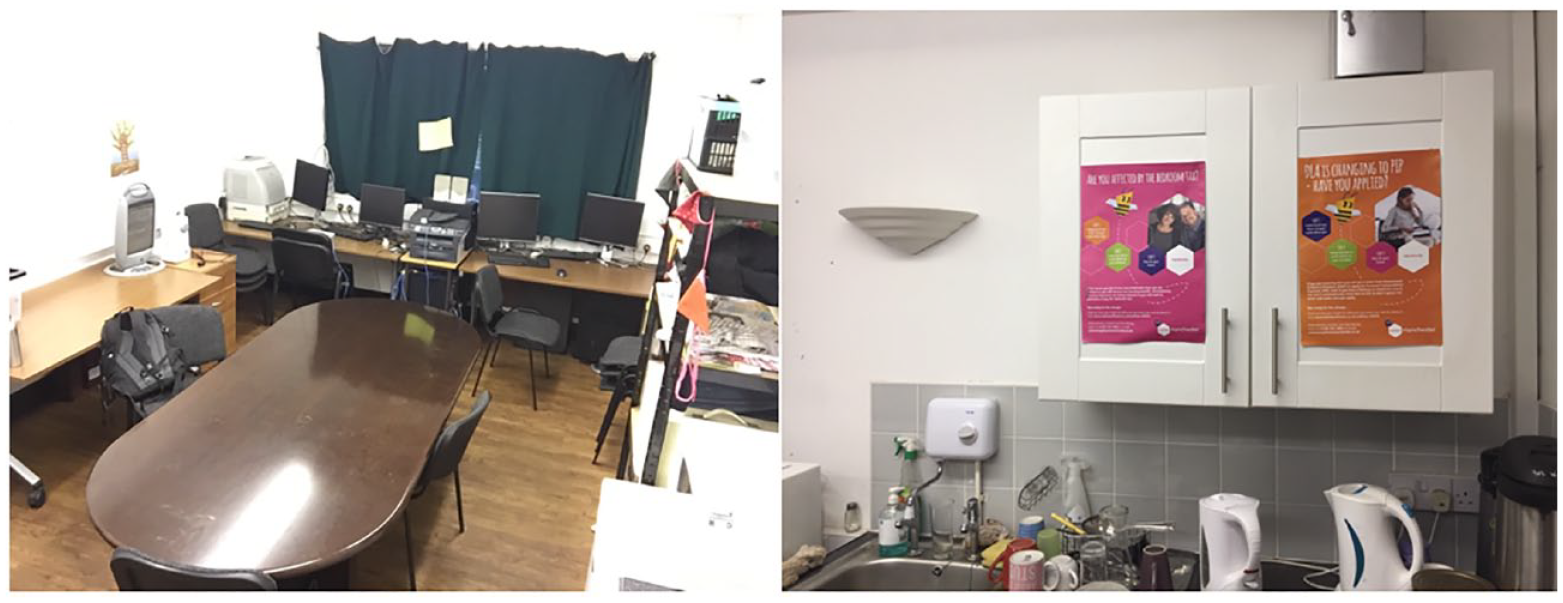
Shared office with territorial markings (author’s photo).
Other actors are inevitably involved in the control and contestation of territories. Certain residents have office keys at the behest of the landlord – who, interestingly, only renovated a flat to create the office following residents’ repeated requests for a communal area – revealing an inherent precarity to residents’ access to this territory. In contrast, the material impact of activities outside are less easily subject to control: gardening and transforming shared areas through resident-led organizing take place without the landlord’s approval. These territories result from residents’ planting and cultivating vegetation, building plantbeds with sticks and logs (to block the landlord’s occasional strimming back of plant life), gathering volunteers to set up the Bentley Exchange, and so on. And Hulme Street, where protests over commuters parking there led to its grant-funded pedestrianization, has a permanence derived from material inscriptions: the bollards blocking car access, planters running down the middle, small gardens along the side, and a ‘little library’ where books can be freely taken. These practices of territorial organizing involve work, with gardening activities overflowing from the communal gardens and the library requiring volunteers’ ongoing maintenance. In this sense, territorial production involves distinct and overlapping boundaries in everyday organizing.
While territorial organizing abounds, it also has limits. Though their spatial boundaries are materially demarcated in practice(s), territories are limited to residents’ (lack of) knowledge about them. Further, some residents are uncomfortable participating in parades, gardening, or other activities because they do not feel a sense of belonging to the intimate – and somewhat inflexible – community this knowledge engenders (Blokland, 2017). The extent of territories’ inclusivity is simultaneously determined by material markers, knowledge and degrees of belonging. That territories do not include the entire estate reveals a degree of absence of affective bonds and shared sense of belonging. Territorial organizing thus has a cultural aspect that ultimately must acquire support to be effective. Put differently, organizing is reliant upon the degree to which territories are produced in spatial, material and cultural relations.
Place-based organizing
If organizing on the Redbricks involves territorial patterns, it equally comprises an ‘open articulation of connections’ (Massey, 1999, p. 288) that organize the estate as a relational place, imbued with meaning and connected to the wider world (Massey, 2005). A multiplicity of connections exists, implicating organizing on the Redbricks with the past, the surrounding neighbourhood of Hulme, and elsewhere.
Organizing on the estate occurs through varied place-based practices and performances (Nash, 2020), including the aforementioned creation of territories. These practices define the estate as not simply a location, but a place rich with significance and history. Throughout our fieldwork, residents regularly recalled past projects, including: setting up the estate-wide intranet despite efforts to shut it down by Manchester City Council; transforming Leaf Street into a permaculture garden; holding a cinema in a basement, which was eventually shut down by the Council; the Hulme Street pedestrianization; a grant-funded ‘Green Zone’ sustainability project on the estate; and regular ‘People’s Kitchen’ low-cost meals, cooked by volunteers. By recalling these particular activities, organizing in the past is aligned with residents’ vision of the kind of place the Redbricks ought to be now. This is an inherently normative sense of place, re-enacted as memories are shared and channelled to etch place-based meanings into the present.
Importantly, however, the meanings of place are fluid and they have changed over time. Take the Bentley Exchange: a photo taken by a resident (Figure 3) prompts them to explain how, in the past: there was tables out all the time. But then it got really messy. People – undesirable people – started hangin’ about there, cats were peeing on the clothes and stuff and it just became a bit not very nice. So we decided to have. . .it the first full weekend of the month, and then it became a set kind of thing, rather than bein’ on all the time. And I think it gives a kind of a focus point.
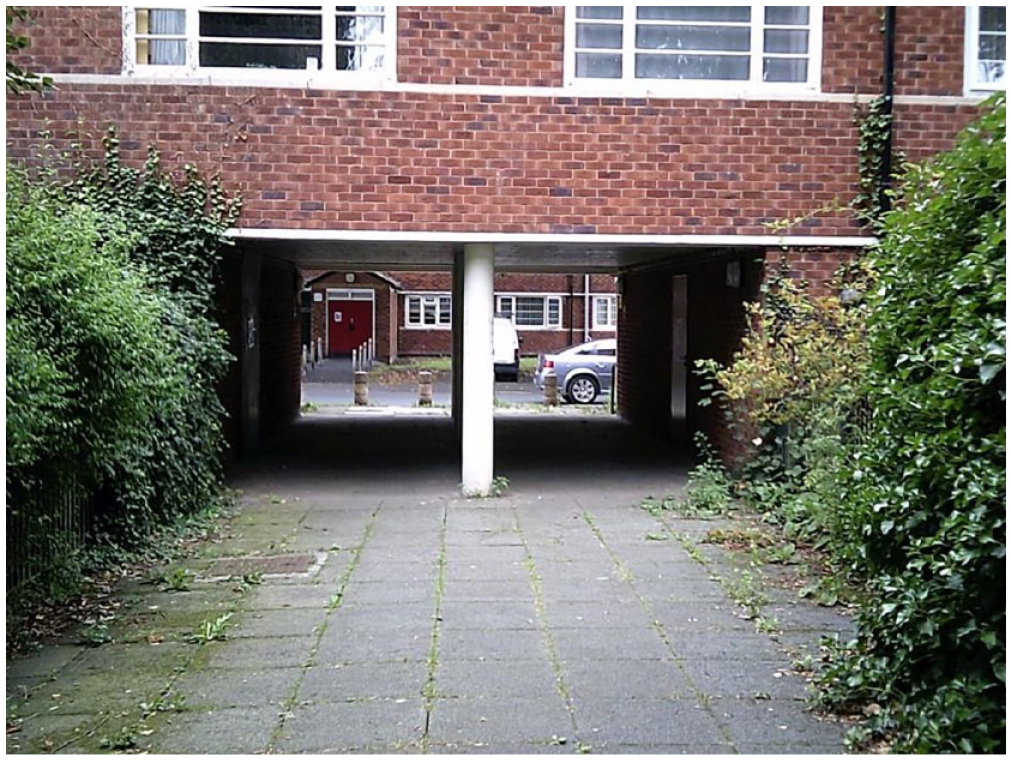
Passage where the Bentley Exchange occurs (resident’s photo).
We were surprised to learn that the Bentley Exchange was once a constant presence, with ‘tables out all the time’. Currently, the resident’s photo of the empty passage is a more common sight, and the timing of the Exchange (‘the first full weekend of the month’) was an oft-repeated, almost jokingly so, reminder in TARA meetings. The interview, and photograph, helped clarify how and why the Exchange shifted to a monthly frequency. Interestingly, the photo shows a moment where any evidence of the Exchange is absent, suggesting this place retains meaning as a ‘focus point’ and a ‘set kind of thing’ even when materiality is absent.
Further historical activities make the estate’s places meaningful as they reverberate in the present. Of particular importance during fieldwork was a series of events, called ‘Celebrate!’ (commemorating the estate’s 70th anniversary), which had just finished. One resident explains: We’re havin’ a quiet year now. Since the ‘Celebrate!’ stuff finished and we used up all our Lottery money. Which is good, cuz that went really well but that was loads and loads of work. So, we’re gonna have a quiet couple of years, not having big funding bids and stuff, I think. To just get on with the day-to-day stuff.
Coordinating the organizing of shared spaces relies not only on individuals’ effort, but also grant funding – and the relative priorities of funding bodies – as well as appreciation and commemoration of the estate’s origin in the post-war construction boom. In other words, the past is implicated in the present via ‘Celebrate!’ to create a depth of meaning to the Redbricks.
However, the significance of places for everyday life organizing in the Redbricks extends to the wider area, both the surrounding neighbourhood of Hulme – known for its alternative and radical character – and Manchester more broadly. Residents frequently expressed a sense of loss as their everyday organizing of the place continues while the city changes around them. Indeed, the 2014 completion of a university campus, two blocks from the Redbricks, has brought an influx of students and construction of student accommodation to Hulme. And as Manchester’s housing market has become increasingly attractive, many people involved in organizing on the Redbricks have ‘sold up’ and left. One resident noted in an interview: ‘If you want to know what happened to Hulme, go to Hebden Bridge. . .go to Todmorden.’ As residents have moved from the Redbricks and Hulme to these two Yorkshire towns, so the estate is reinvigorated by asserting ties to those other places. These provide a glimpse into the ripples the Redbricks has created in other places. Though ‘what happened to Hulme’ (and the Redbricks) was often portrayed as a loss, the Redbricks as a place, and the ongoing organizational placing in the present, is both productive of and produced by these relations. Place-based organizing, in this sense, involves spatial production through boundary-making – drawing distinctions and differentiations with Hulme, and with elsewhere –both spatially and temporally.
Thus, the confluence of ties on the Redbricks reveals a place where trajectories (be)come together, both a location made meaningful through place-based organizing and by virtue of its wider linkages. Organizing, in a sense, depends on these relations, which interweave past and present organizing activities and places with the Redbricks. This speaks to the temporal dynamism of organizing (Giovannoni & Quattrone, 2018) and of relational places (Massey, 2005). Further, while changes have wrought ruptures to the capacities for organizing on the estate, these were not total. It remains relationally interwoven with the material and geographical context of Hulme and Manchester and other places. The Redbricks endures.
Scales of organizing
The everyday organization of space also involves the activation of groups, individuals and objects that together demarcate organizing as occurring at the particular scale of the Redbricks. Reflecting on why they got involved in various groups, one resident describes: . . .it suits me to give something back. And it’s a bit more local and accessible for me. And I’m in a better place to do it. I wouldn’t have done it in my 20s when I first moved here. Cuz I was too busy fighting fires in the world, you know, rather than locally.
In this view, shared by many residents, the Redbricks is more local and therefore more amenable to the kinds of activities in which they want to participate. The scale of everyday organizing, and the spatial production it entails, is reinforced perhaps most obviously through groups’ names, many of which reference the Redbricks. While naming is not a prerequisite for all activities, there is one area where it is crucial: the name given to the estate itself. The Redbricks at once encompasses the whole estate – the bricks are red, after all – and evokes the multitude of present and past organizing that has occurred there.
For example, an image from the photo-elicitation project captured the ‘Celebrate!’ finale, with torches, fireworks, a band, and people mingling together, against the backdrop of trees and a night sky (Figure 4). In explaining the meaning of this photo, the photographer/resident explains how: . . .it felt, you know, that we still have that sort of edge. Because I think sometimes – the Redbricks used to be really, really alternative and now I wonder whether we’re, sort of, losing that edge a bit. But then things like this happen and I think, ‘No, we can still pull this together.’ You know?
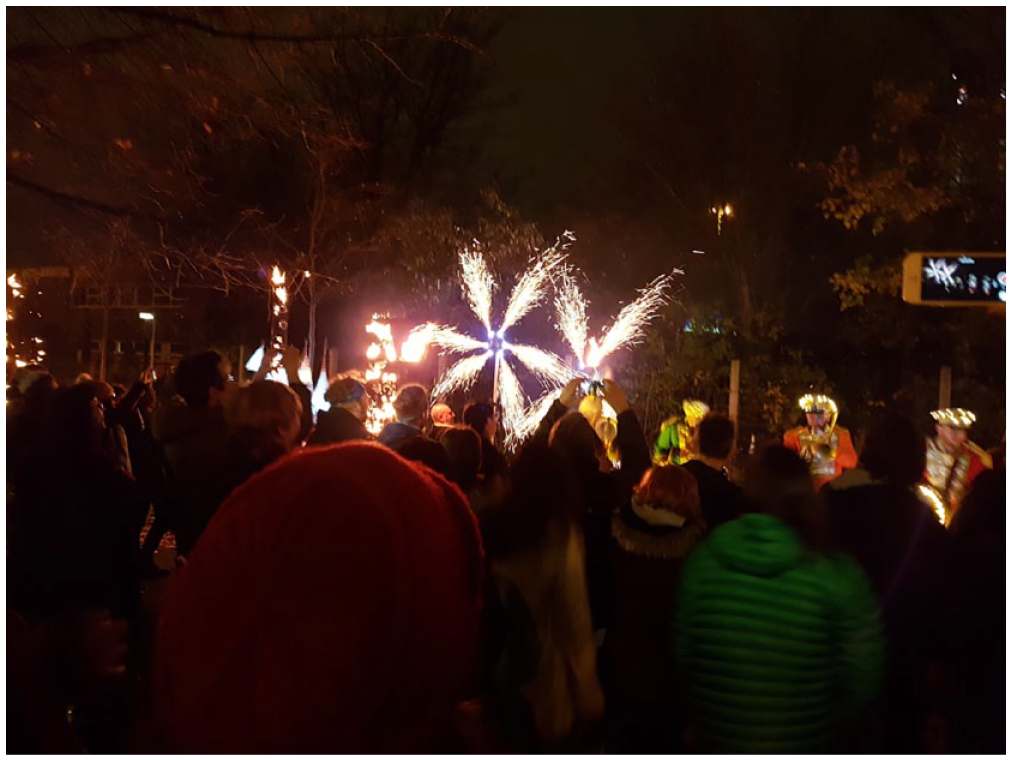
‘Celebrate!’ finale performance on Hulme Street with band and fireworks (resident’s photo).
Imbued with nostalgia, the ‘Celebrate!’ events function to (re)organize the estate by recalling how it ‘used to be’, showing that the Redbricks is still ‘alternative’ and with ‘edge’. Also present in the photo are bodies: another scale where spatial production invariably occurs (Beyes, 2018). And the differentiation of the Redbricks will be memorialized by those in attendance, or by audiovisual objects – note the cellphone user taking a video. Attending this event, we felt invigorated by our immersion in this ‘alternative organizing’ (Reedy et al., 2016). Of course, activities and groups often occur in overlapping and mobile ways with unclear boundaries, while requiring materials to realize them. This is true for organizing places, territories, as well as for the whole estate. But together, these suggest how everyday organizing becomes ‘local’ as it is (re)made through practices, relations, and materialities to (re)construct the spatial extent of organizational phenomena as being on the Redbricks. In other words, the Redbricks as a named and material area – as here, not there – is organized by contrasting organizational activities to other (apparently) different scales of activity.
However, a clear scalar distinction of organizing on the Redbricks is not always an unproblematic process. For example, Facebook group discussions about drug use on the estate oscillate from sympathetic comments about this aspect of a national social problem, to more critical views of drug paraphernalia as a risk to gardeners and children, to complaints about drug dealing – itself the result of transnational drug production and trade. Here, an axiological boundary – albeit fuzzy – is negotiated between different practices: on one hand, using drugs is tolerated while, on the other, selling drugs is not. In other words, (some) tolerance of using drugs is counterposed to selling them due to the scalar distinction between bodies and global processes.
Yet, discussions negotiating the boundaries of tolerance grated with our fieldwork experience uncovering a used injection needle. This led to a minute, yet impossible, choice: whether to place the needle atop a pile of garden waste where children playing in the area might mistake the bright orange cap for a toy. The possibility of hepatitis or worse became the trade-off for a vague, scale-confined tolerance. Because the gates to the large communal gardens on the estate are never locked, anyone can enjoy the gardens and play area. But they can also become sites for injecting or smoking heroin, relying on collective regulation of the normative boundaries of this practice. The same applies to homelessness, made visible when a person began living in a tent on the Redbricks during fieldwork. This was controversial, but also tolerated, as concerns for residents’ security clashed with the injustices of unaffordable housing.
These instances of drug use and homelessness challenge a strictly nested notion of scale: these activities certainly contribute to everyday spatial organization, but not through a clearly hierarchical distinguishing between the Redbricks as a ‘local’ area and processes occurring at the ‘city’, ‘national’ or ‘global’ scales. Instead, these ‘levels’ of activity meld together in specific moments, revealing scale’s ongoing construction (Marston, 2000). Taken further, such a sensitivity makes visible the ways everyday organizing undergoes de/reformation (Ratner, 2020) as a consequence of organizing elsewhere. For example, a significant actor implicated in everyday organizing is the estate’s landlord, a social housing provider which owns or manages over 12,000 homes across Manchester. During fieldwork, the landlord was constructing a market-rate housing development of around 100 flats adjacent to the Redbricks. But, proximal construction belies wider relations: the new development was financed through a loan from Barclays Bank, connecting building activity next to the Redbricks to Canary Wharf and financial markets. This distortion of space as cement trucks audibly rumbled past and construction dust settled on the estate and in people’s lungs – to the consternation of residents, who raised this repeatedly with the landlord – manifests the metabolic transformation of nature (Ergene, Calás, & Smircich, 2018) and the global scale of capital flows. Indeed, the topological (re)organization of urban metabolism voraciously returns to everyday life on the Redbricks via Manchester’s accelerating development and housing market financialization (Silver, 2018).
Other dynamics arising from a scalar sensitivity give further form to everyday organizing: some residents are owner-occupiers because they bought their flats through the government’s Right to Buy 1 policy, which likewise enrols them with banks, financial markets and global capital – a process the housing co-operative on the Redbricks (connected to the Radical Routes national network of co-operatives) seeks to forestall. Yet, through ownership, residents’ sense of belonging, knowledge and participation in everyday life tend to increase. National policy, international capital and the historical emergence of private property give rise to home ownership, which becomes an important factor for involvement in everyday spatial organization. Thus, while considering the Redbricks as a ‘local’ scale has important effects on solidarity-building among residents, everyday organizing is also undergoing constant deformation as shapes emerge that make visible the metabolisms and mobilities transforming everyday spatial production (Ratner, 2020).
Organizing as networked process
In addition to territorial, place-based, and scalar dimensions, everyday organizing is further constituted through the network of connections and interdependencies that come together on the Redbricks. The relational understanding of place-based organization discussed previously already begins to reveal some of the spatial interconnectivities that sustain everyday organizing. But there are others: residents volunteer at the nearby Hulme Community Garden Centre (HCGC), and staff there routinely donate plants for the Redbricks’ communal gardens. Also next door is Niamos, a ‘radical arts/music/culture’ centre, run by a group that includes current and former Redbricks residents. The Yellowbricks, across the street from HCGC, is a housing co-operative of several dozen flats, which has an affiliated and co-operatively managed workplace. One unit is occupied by Kim by the Sea, a café and pub where we often met Redbricks residents. This network has a relative density that, due to its proximity, extends and strengthens the capacities for everyday organizing on the Redbricks to participate in a more general networked production of difference.
During fieldwork, we continued to uncover connections further afield: residents described areas in the UK’s North West where former residents have settled, including Chorlton, Glossop, North Wales and Merseyside. These not only reiterate the previous sense that the Redbricks is a relational place, but also assert that residents leaving the Redbricks remain embedded in a network of organizing extending spatially and temporally beyond the estate. Indicatively, some former residents attended the Celebrate! finale, the brass band that performed was made up of several former residents, and the fireworks and stage were provided at a discount by Walk the Plank, an arts organization for whom multiple past and present residents have worked.
However, moments where the extensive ties of networked organizing become visible are rare; yet, more mundane evidence of networks of everyday organizing exist within the estate. Initiatives to coordinate physical activities (gardening, events, group meetings, etc.) occur online, including the intra-estate email list, Facebook group, and Twitter and Instagram accounts. These virtual spaces are, predictably, not clearly separate from the physical world. For example, gardening is at once both a virtual and physical activity: posts to the Facebook group inform residents of upcoming events to maintain the communal gardens, Instagram posts document the gardening days, and green spaces are cultivated through residents’ interventions. In fact, these modes of organizing are complementary: both virtual and physical activities can inform each other, whether gardeners reminding residents of an upcoming event posted on Facebook, or the topic of a meeting arising from online discussions. Everyday organizing relies on this entangled network to coordinate, share decisions and plan future activities.
In fact, the Redbricks itself is conducive to encouraging the continuous formation of connections, in what is akin to an ongoing networking of the estate. Particularly important is the estate’s layout. As one resident notes: . . .a couple of years ago, we just did a really random September thing because there hadn’t been a social for ages and we just did it, we did it in the office and out here on this bit [indicating outside the office] in September. Loads of people came. It was just like ‘Yay! Let’s just have a little random social.’
The Redbricks’ three-story layout, unsecured gates on the gardens, and ample pathways enable flows of movement around and between buildings, acting as a facilitator for this ‘random social’. Similarly, the Bentley Exchange, which is sheltered from Manchester’s often-inclement weather by a covered passage between buildings, becomes a node where networks meet and new connections can emerge. Here, while the buildings’ configurations are generative of organizing (Kornberger & Clegg, 2004), so too are the areas between buildings catalysts for networked organizing.
Examining how spatial production unfolds in networked ways enabled us to uncover the decentralized and loosely coordinated nature of everyday organizing. Networks form through both extensive and intensive ties, both in person and online, and often rely on material objects (computers, buildings) to further their ability to arrange an ordering for everyday life. These entanglements bestow a certain durability to everyday spatial production, though the strength or weakness of such networked processes relies on ongoing participation in their reproduction.
Discussion
Our analysis reveals the complex sociospatial dimensions of organizing in the context of everyday life. Extending Ratner’s (2020) topologies and Beyes and Holt’s (2020) topographies of organization, we show how a multidimensional analysis can enrich our understanding of everyday organizing with a combined focus on territory, place, scale and network. In doing so, our research embraces the polymorphic nature of different sociospatial processes and relations shaping the practices of everyday organizing on the Redbricks. To make sense of these complexities, we apply Jessop et al.’s (2008, p. 396) formulation that spatial dimensions serve as 'structuring principles’ which impact on other dimensions (‘fields of operation’), while their intersections contribute to constituting each field of operation as a ‘structured field.’ Conceptually, this extends our analysis of the Redbricks to consider how the interactions between different spatial dimensions are implicated in stabilizations of social relations through everyday organizing, captured in Table 4.
Intersections of sociospatial dimensions in everyday organizing on the Redbricks.
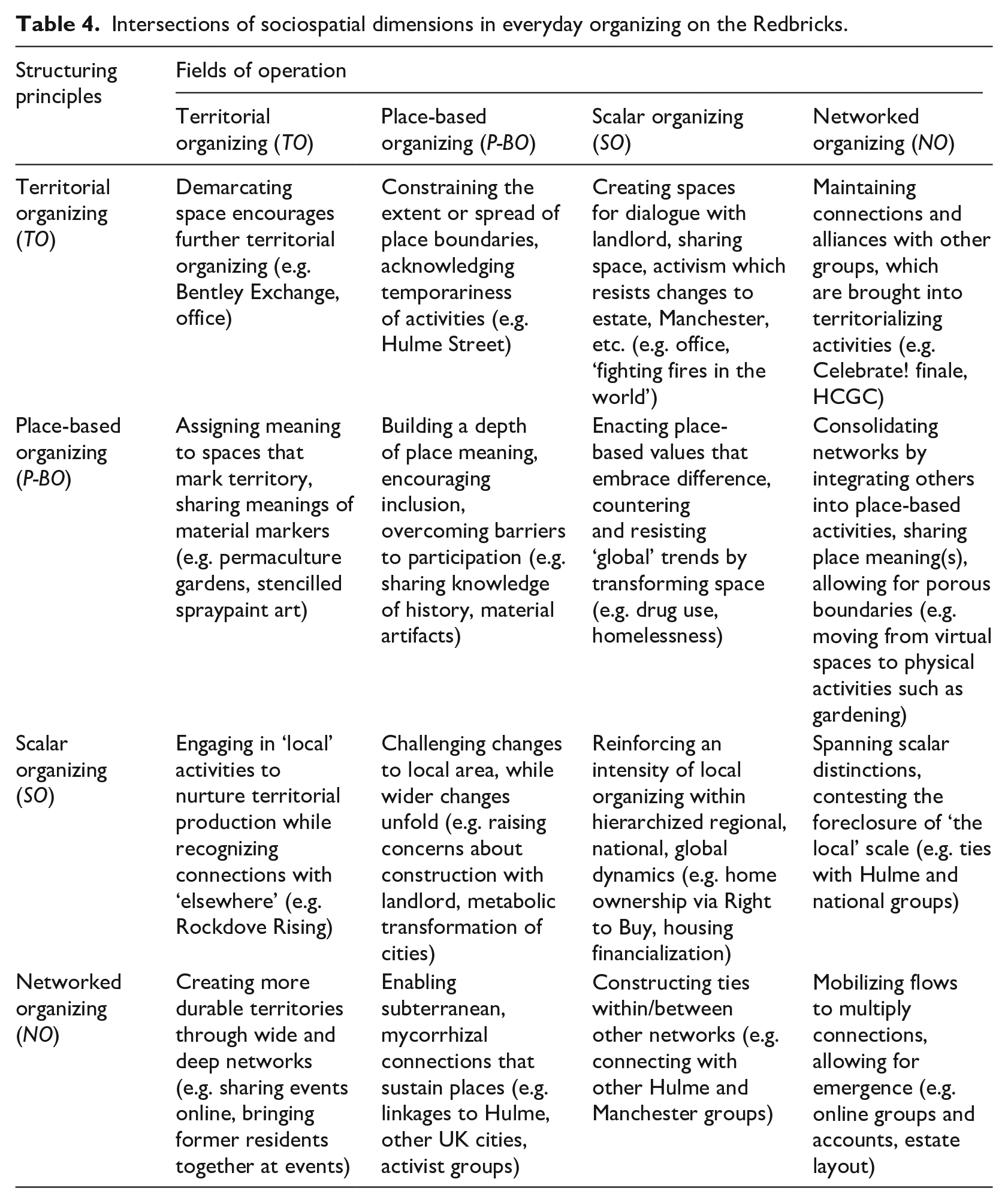
Table 4 adds a layer of complexity to the situation unveiled in our findings: not only do different forms of everyday spatial production occur simultaneously, but they also mutually influence and shape each other. For example, reading the SO row horizontally, its intersection with the SO column shows how the scalar dimension of organizing can be explored in itself as a product of local-global dynamics. But equally, material changes to the local area give residents impetus to raise the issue of construction dust settling on the estate with the landlord, whose building project is part of Manchester’s broader housing boom (SO→P-BO). Reading the place-based organizing column vertically, this scale-place interaction builds residents’ (and others’) understanding of the Redbricks as a ‘local’ place that is territorialized through boundary-making, made meaningful, and connected to elsewhere, contributing to P-BO as a structured field of spatial production as it interacts with other structuring principles (TO→P-BO, NO→P-BO, and P-BO→P-BO itself). Recognizing these multiple ways different sociospatial dimensions can be analysed provides a nuanced and complexifying frame for understanding everyday organizing as spatial production, avoiding reductive recourse to one dimension. Based on this analysis, we can identify several controversies, contradictions and tensions that complicate, but also sustain, the spatialities of everyday organizing on the Redbricks.
First, conflict and resistance both occur in everyday spatial production as spatial dimensions overlap and collide, which require organizing to coordinate. While the organization of territories can be self-reproducing (TO→TO) and becomes further structured through place meanings (P-BO→TO), conflicts occur as territories such as the office are subject to challenge over ownership and control (TO→SO). When the landlord’s caretaker began to use the office during weekdays, clashing with residents’ groups planned activities, TARA members felt compelled to raise this in a meeting with the landlord and a compromise was ultimately reached. Similar competing claims over space, and the values they embody (e.g. permaculture, tolerance), abound (P-BO→SO). Together, these make the Redbricks a durable instantiation of resistance in the context of powerful configurations that are transforming the surrounding areas (P-BO→SO, SO→SO). Therefore, our analysis of the Redbricks reveals places where everyday resistance is organized beyond the workplace (Courpasson et al., 2017) and how different kinds of coexistence can overlap, while also demonstrating that conflict can remain ‘fertile’ (Banerjee, Maher, & Krämer, 2023) in the face of powerful actors.
Second, examining spatial questions in everyday organizing confronts the boundaries and (un)boundedness of organization. Namely, our TPSN analysis moves beyond the confinement of organization to carefully demarcated, artificial boundaries. The Redbricks’ networked organizing is telling, particularly as it emphasizes cross-boundary linkages (NO→TO, NO→P-BO) and the ways virtual organizing overflows into places (P-BO→NO). Yet, boundaries should not be discounted: they strengthen the placedness of organizing (TO→P-BO) even as – or perhaps because – scales are transgressed (SO→NO) in everyday spatial production. Beyond office buildings (Kornberger & Clegg, 2004), or even work as conventionally defined (Dale & Burrell, 2008), an unbounded study of organization to encompass everyday life (Vaiou & Lykogianni, 2006) in the city (Knox, 2010; Nash, 2020) is part of the ongoing work of ‘unsiting’ organizational analysis (Beyes & Steyaert, 2013). When understood this way, emergence and potentiality, boundary-making and boundary-breaking, are moulded into everyday organizing from the outset.<marker>
Third, a tension between stasis and movement is evident in our findings. Spatial production is a material act which ‘fixes’ organization to particular areas of the Redbricks (TO→TO, P-BO→TO), albeit potentially mobile ones (NO→NO, cf. Daskalaki, 2014). In addition to generating conflict, these stabilizations give everyday organizing a spatial fixity. However, the dynamic relational connections of places (P-BO→SO) and the various ways organizing emerges as a networked process (NO as a structured field) reveal how spatial production is also ‘open’ and linked with the wider world (Massey, 2005). So, the question of where organization occurs is not resolved through static representations. On the contrary, careful attention to movement and dynamism, accomplished here by making use of multiple sociospatial dimensions in concert, gives renewed impetus to studying the processual spatialities of organizing (e.g. Chia, 2003). At a conceptual level, this relational ontology challenges human-centrism in the study of organization: the continuous movements in/of space encompass people as well as material objects, offering a ‘post-social’ reading of organization (O’Doherty, 2017) that (starts to) give(s) due consideration to materialities in the everyday of organizing.
Finally, alterity and diversity inhere in the Redbricks, where a range of place-based ethical values are enacted (P-BO→SO, P-BO→P-BO), giving material and organizational form to solidarity, environmentalism, tolerance, accessibility and conviviality fused with a sense of justice (Lloveras, Quinn, & Parker, 2018; Reedy et al., 2016). These would seem to be alternatives to dominant spatial organization, most evident in the city-scale transformation and metabolic throughput of Manchester; however, the possibilities of difference on the Redbricks only exist in articulation with this wider world (TO→SO, SO→P-BO, SO→SO). Residents’ practices of appropriation and solidarity create diverse economic spaces (Gibson-Graham, 2006) through territorial organizing: for example, spaces of sharing via the Bentley Exchange and Hulme Street ‘little library’ (TO→TO, TO→P-BO). These generate shared place-based meanings, while requiring territorial inscriptions and a commitment to being-in-common (P-BO→TO). Importantly, however, organizing (on) the Redbricks is subterranean (NO→P-BO) and interwoven with other places (NO→SO), by its very nature less easily mapped, measured and quantified. Instead, the everyday production of space is characterized by depth and intensity (P-BO→P-BO), while also remaining interwoven with the wider world (SO as a structured field). So, rather than discrete alternatives (Reedy et al., 2016) to some singular, hegemonic and never-fully-representable mode of organization, multiplicity, emergence and the realization of diversity is a quality comprising everyday organizing.
Thus, with the complementary lenses afforded by the TPSN framework, we are better equipped to understand the tensions involved in specific, mundane sociospatial configurations of everyday organizing, while also extending an understanding of everyday spatial production to the relational ties entangling the Redbricks with people, objects, neighbourhoods, cities, regions and elsewhere. Taken further, this points to the potential for geographical frameworks to enrich discussions and studies of spatial organization, which we return to below.
Conclusions: Seeking Organizational Geographies
Centring on the shared spaces of a housing estate, our paper has examined organizing in everyday life. Specifically, we used a TPSN analysis to foreground the interplay between multiple dimensions of everyday organizing on the Redbricks, complexifying our understanding of everyday spatial production. Having discussed several tensions and controversies which this approach reveals, we now consolidate our contributions to organization studies and suggest promising directions for further research.
Our paper’s primary contribution is empirical: we have shown the nuanced ways in which everyday spatial production occurs in everyday life on the Redbricks. Responding to calls for greater attention in organization studies to the ‘organization of space’ (Dale & Burrell, 2008) and organizing in the ‘urban everyday’ (Beyes, 2018), we have contributed to the study of organizational space in a novel empirical context: the mundane, yet exceptional, everyday activities – de Certeau’s (1984) silent, and in organization studies often-silenced, ‘reserve’ – that gather together as spatial accomplishments amid a changing urban condition. Following Beyes (2018), we would argue that the territorial, place-based, scalar and networked organizing processes found on the Redbricks provide insights into how organizing the urban everyday can (begin to) reclaim the ‘right to the city’ (Harvey, 2012). Our empirical site demonstrates that everyday organizing is politically generative on its own terms, while retaining awareness of the possibility for spatial production to give rise to conflictual, antagonistic, even violent, political confrontations in other settings. This suggests that the political potential in studies of partial organizing (Ahrne & Brunsson, 2019), temporary organizing (Bakker, DeFillippi, Schwab, & Sydow, 2016) and organizational landscapes (e.g. Ehrnström-Fuentes & Biese, 2023) can be expanded by accounting for spatial multiplicity, which our study helps to reveal. We thus provide a route for organization scholars to pursue further empirical studies into the self-organized/organizing ways in which participation in urban life is taken, appropriated, and redefined (Beyes, 2018).
Our second contribution is a methodological demonstration of how everyday organizing can be analysed as a polymorphic sociospatial process. In doing so, we have shown the productive potential of TPSN, a framework rooted in human geography, for organization studies, which has been applied in related fields such as marketing (Castilhos, Dolbec, & Veresiu, 2017). Foregrounding the interplay of territorial, place-based, scalar and networked organizing as both structuring principles and structured fields of everyday spatial production, Table 4 provides an impetus for further methodological advances in organization studies to examine organizational phenomena as spatial multiplicities. We therefore extend topologies (Ratner, 2020) and topographies (Beyes & Holt, 2020) of organization through attunement to the geographical complexities associated with a polymorphic sociospatial frame (Jessop et al., 2008). In doing so, we have taken up the challenge O’Doherty (2017, p. 252) poses to sociological analysis of organization when he calls for investigating ‘a radical immanence where one can explore the ever-finer lines of connection and association that hold us in organization’.
Capturing this immanence in spatial terms, our TPSN analysis constitutes a beginning, rather than a conclusion, to unlocking the possibilities for studying the geographies of organization. Future work might engage, for example, with rich geographical frameworks of ‘metabolism’ (Tzaninis, Mandler, Kaika, & Keil, 2021) or ‘imaginaries’ (Jessop & Oosterlynck 2008; Watkins, 2015; cf. Levy & Spicer, 2013) as ways to help investigate organization in a changing world. Our work has thus sought to develop one methodological avenue – and we encourage others – for studying ‘organizational geographies’ as spatial multiplicities: always unfinished, with unexplored potentialities, latent until activated, existing as mycorrhiza in the ‘folds’ of spatial-organizational formations. Pursuing these polymorphic spatialities of everyday organizing, seeking organizational geographies, is a journey on which we invite others.
While our contributions to the study of everyday organizing and multidimensional spatial production do not constitute a research agenda, they nevertheless call on organization scholars to take seriously the polymorphy of spatial production, to think organizational geographies. Equally, we would suggest that attention to organizing can expand the sites and empirical sensitivities of future work in human geography. Indeed, this compels us to reconsider how the spaces of scholarship are themselves organized. Can geographical analyses such as TPSN and organization scholars’ attentiveness to the multifarious unfolding of organizing form part of a broader effort to span the conceptual rupture between organization studies and human geography? We hope our paper spurs and invigorates such cross-disciplinary conversations.
To conclude, the controversies intrinsic to everyday spatial production on the Redbricks speak to a pull between multiple tensions in our field as well. Namely, the challenge for future organizational geographers is to navigate a space somewhere between, on the one hand, the prevailing focus on formal organization and the many manifestations of quotidian organizing in everyday life and, on the other, between a space-centric reading of organizing and a multidimensional spatial understanding. That is not to suggest, of course, the ontological equivalence of these poles. Rather, it speaks to the challenge of recognizing that where organizing occurs is a geographical question, pointing to the ways our understanding of organization can be revitalized with sensitivity towards their territorial, placial, scalar, networked and other elements, which begin to comprise the organizational geographies manifold.
Footnotes
Acknowledgements
Our thanks to Senior Editor Timon Beyes for patience, encouragement and support throughout the development of this paper. We are also grateful to the three anonymous reviewers, whose useful feedback pushed us to clarify our arguments. Finally, we acknowledge the residents of the Redbricks, without whose contributions this research would not have been possible.
Funding
The author(s) disclosed receipt of the following financial support for the research, authorship, and/or publication of this article. Javier acknowledges funding from the Ramón y Cajal programme [grant RYC2021-034823-I funded by MICIU/AEI /10.13039/501100011033 and the European Union NextGenerationEU/PRTR], and the European Research Council project PROSPERA [grant number 947713].
