




Abstract
This study addresses how violence is mobilized through wage theft in feminized workplaces thriving within the global value chain. Guided by Judith Butler’s concept of derealization, this longitudinal case study on the Bangladesh garment industry advances the current debate on violence in organization studies. First, it re-conceptualizes the notion of an ‘ideal worker’. Empirical evidence reveals that, unlike in Western societies, young and childless women in the Global South and their vulnerabilities woven into poverty, inequality, climate change, patriarchy, social stratification, and limited employment opportunities make them ‘ideal workers’. This status remains valid as long as they remain vulnerable and demonstrate no agency in resisting the discourse on dehumanization, dispossession, and displacement. Second, this study illuminates the practice of wage theft, which has emerged as a dominant form of violence in feminized workplaces. Organizations also deploy secrecy to continue theft, thereby inflicting further physical and psychological violence. This study highlights the fact that socioeconomic vulnerabilities and unresisted violence oppress a docile workforce to become ‘ideal workers’. It is a neoliberal myth that helps powerful actors shore up their power and privileges through derealization.
Prologue: Derealization of women workers in the Bangladesh garment industry
Hasina (pseudonym) is a 26-year-old worker who has worked in the Bangladesh garment industry for over 11 years. Her family lost their home and farmland to river erosion. Her parents and their five children were forced to migrate to Dhaka, Bangladesh’s capital city. Her father pulled a rickshaw, and her mother worked in a household whenever she managed to find ad hoc work. They rented a small room in a slum. In 2012, her father suffered a life-changing accident and became paralysed. This forced Hasina to find work in a factory at the age of 15. Currently, working in a factory producing men’s denim for leading brands, she arrives at the factory before 8:00 a.m. to secure a $4 per month attendance bonus which is important to her. On average, Hasina works 14 hours per day, six days per week. She has to produce 180–200 units per hour. If she fails to reach the target, her manager scolds her using abusive language. Sometimes, he publicly humiliates her, forcing her to become moorga [rooster], a form of violence in which workers are forced to hold their ears and squat several times in front of everyone else. Hasina recalls: When I resisted, he threatened me, ‘Either you become moorga or leave the factory now.’ I had no choice but to comply. It is better to die than be humiliated in this manner [she cries].
Public humiliation strips her of dignity and makes her less human. Furthermore, she does not receive the rightful wages, as she explains: Every day, I work six hours of overtime. But managers write ‘zero’ hours in my record book. It happens to all workers. You will not find a single worker who has received their correct wages.
According to Hasina, managers manipulate data in the records and threaten workers not to discuss it with anyone. Managers also try to keep this secret from the stakeholders. As a permanent worker, Hasina was entitled to receive 16 weeks of maternity leave and an allowance (i.e. $227); however, she did not receive anything from her employer. Instead, she was temporarily laid off, which caused her to go hungry and suffer from postpartum complications.
This begs the question: Can she resist violence, and are there no trade unions to protect her rights? In the Bangladeshi garment industry, workers can neither resist violence nor join trade unions. Hasina continues that whenever the owner visits the factory, he threatens the workers not to form a trade union or visit an NGO office. Managers frequently spew the same threats. Hasina shares: Nobody knows I am here talking to you. If the managers discover this, they will beat me first and then hand me over to the police. Our owner is a very powerful man [a member of parliament (MP) for the ruling political party]. Local police work for him. So, I must be watchful of where I go and to whom I talk!
Living in fear reduces her agency, as she believes that resistance would result in more violence. She has no capacity to endure further violence and has already suffered immensely. Feeling less than human and more like a ‘stray dog’ who is destined to be violated, Hasina says, ‘I do not have an ounce of dignity left.’ Occasionally, Hasina thinks of committing suicide, but does not because if she is not around, her own daughter will face more violence, including rape or child marriage, or may end up in a brothel.
Introduction
Recently, a growing number of studies have investigated violence in organizations and societies (see Arnold & Costas, 2024; Lobbedez, 2024; Soundararajan, Sharma, & Bapuji, 2023; Varman, Al-Amoudi, & Skålén, 2023; Zanoni & Miszczyński, 2023). According to Costas and Grey (2019, p. 1579), violence is ‘woven into an everyday organizational logic, that of maximizing productivity’ which can be found in various shapes and forms, including physical to symbolic, subtle to brutal, individual to collective, or legitimate to illegitimate. Indeed, violence is physical and brutal in the global value chain (GVC), particularly in the garment industry, where workers face circumstances such as forced labour, abuse, bullying and sexual harassment (Ahmed & Uddin, 2022; Alamgir, Alamgir, & Alamgir, 2022; Chowdhury, 2017). Covid-19 has further exposed workers’ inherent vulnerabilities and unleashed more violence, including starvation and death (Alamgir et al., 2022; Anner, 2022; Uddin, Ahmed, & Shahadat, 2023).
Yet, how and why violence is mobilized despite the presence of multi-stakeholder initiatives, social audits, or corporate social responsibility (Alamgir & Alakavuklar, 2020; Donaghey & Reinecke, 2018; McCarthy, 2017) remains largely neglected in management and organizational studies. Whether or how wage theft comprising ‘employers’ practices of not paying wages and benefits that their employees are legally entitled to’ (Kim & Allmang, 2021, p. 534) inflicts physical and psychological violence against women workers (like Hasina) in feminized workplaces (such as garment factories) also remains mostly uninvestigated.
To better understand wage theft and its relationship with violence, I adapt Butler’s (2003, 2004, 2010) notion of ‘derealization’, a condition where victims are ‘neither alive nor dead’ but are treated as less than human through the discourses of dehumanization, dispossession, and displacement. Varman and Vijay (2018) document that powerful actors and state agencies intensify the process of derealization by denying marginalized people status as ‘subject’, deeming their legal rights as ‘illegal’ and displacing them from ‘space’ with impunity. Marginalized people’s lives are also derealized and become ungrievable when the state overlooks corporate violence or encourages corporations to unleash more violence through codes of conduct, the Company Act, or local laws (Varman & Al-Amoudi, 2016). Market dynamics, class, patriarchy, and other social norms also support the processes of derealization (Varman, Skålén, Belk, & Chaudhuri, 2021). Grounded in this emerging literature, this study asks: How, and to what extent, can wage theft intensify the process of derealization of women workers in feminized workplaces in the global value chain?
Drawing on a longitudinal case study, this study makes two key contributions to the literature. First, it contributes to Butler’s notion of ‘derealization’ by reconceptualizing the Western notion of an ‘ideal worker’ (Brumley, 2014; Williams, 1999). This study argues that ‘ideal worker’ is contextualized depending on the economy, social structure, social stratification, labour relations, climate change, inequality and cultural vulnerabilities of marginalized workers. Their vulnerabilities make them ‘ideal workers’, but suppress their agency to resist the discourses of dehumanization, dispossession, and displacement. Second, this study illuminates wage theft by showing that it has become a dominant form of violence that derealizes the vulnerable workforce. To continue such theft, neoliberal organizations deploy informal and open secrecy that inflicts further violence against ‘ideal workers’. This study further highlights that the socioeconomic and cultural vulnerabilities of marginalized groups and their lack of agency to resist the process of derealization make them ‘ideal workers’ for society. They remain ‘ideal workers’ as long as they endure the discourses of derealization which help powerful actors to reinforce their capital and power.
This study comprises five steps. First, it explains how violence is embedded in precarious work and human rights violations in the GVC. It subsequently connects the concepts of ‘ideal workers’, workplace feminization, wage theft, and secrecy with the current debate on violence. Second, it theorizes how violence is derealized through the discourses of dehumanization, dispossession, and displacement. Third, it describes the data collection and analysis. Fourth, the empirical analysis is presented – recruitment of and violence against ‘ideal workers’, mechanisms of wage theft and culture of secrecy. Finally, the importance and implications of this study are discussed, and avenues for future research to advance our understanding of derealization are provided.
Precarious Work and Human Rights Violations of Women Workers
Precarious working conditions and human rights violations are embedded in existing outsourcing business practices (Reinecke & Donaghey, 2015; Zulfiqar, 2022). In neoliberal capitalism, Western companies’ search for profit has led to massive industrialization in the Global South, particularly in poor and politically violent countries that ignore labour standards (Anner, 2022). Indeed, Western importers have helped improve the economic conditions of some countries but abuse their power to control price, quality, and lead time (Alamgir & Banerjee, 2019; Zajak, 2017) which has an impact on workers’ rights and welfare. Similarly, manufacturing countries deny workers’ human rights but blame Western buyers for bullying (Ahmed & Uddin, 2022). The collapse of the Rana Plaza factory building in 2013 exposed the inherent precarious working conditions, unsafe factories, forced labour, sexual harassment, gender marginalization and workplace bullying in Bangladeshi factories (Ahmed & Uddin, 2022; Alamgir & Alakavuklar, 2020; Chowdhury, 2017).
Following the Rana Plaza, the Accord and Alliance (A&A) was formed to improve fire, building and worker safety. Indeed, A&A has improved factory working conditions, as ‘there has been no other major industrial accident in Bangladeshi garment factories’ (Donaghey & Reinecke, 2018, p. 38) 1 ; this has also provided a platform where unions can make powerful actors accountable (Reinecke & Donaghey, 2015). Several researchers are, however, critical of the A&A’s effectiveness, comparing it to a ‘double-edged sword’ (see Zajak, 2017). Rather than improving workers’ rights, A&A reinforces buyers’ power and restores their image (see Chowdhury, 2017). Hence, violence against female workers’ deregulated bodies (Alamgir et al., 2022) prevails and remains unreported in corporate social responsibility reports (see McCarthy, 2017). For a better understanding, we need to investigate the discourse on the rising feminization of workplaces with young female workers, especially in the GVC (Barrientos, 2019) which will be discussed critically in the following section.
Feminization of a workplace with ‘ideal workers’
In the GVC, buyers and suppliers are predominantly males (Munir, Ayaz, Levy, & Willmott, 2018) who prefer to recruit the ‘docile labor of women’ (see Ong, 1987). The International Labour Organization (2015) supports this observation, as nearly 190 million women work in the GVC. For Collins (2002), ‘the vulnerability of different groups of workers’ (p. 936) is masked through the discourse of skills that help managers maximize profits in a coded way and rationalize their search for inexperienced and vulnerable female workers who will accept the lowest wages. Moreover, patriarchy forces women to serve neoliberal capitalism, thereby making the workplace feminized and precarious in the Global South (Salzinger, 2003; Zulfiqar, 2022). Neoliberalism and patriarchy also restrict female workers’ mobility and make them disposable through subordination and subjugation (Ayaz, Ashraf, & Hopper, 2019). Alamgir and Alakavuklar (2020) observed that female workers in the Bangladeshi garment industry are misrecognized, misrepresented and excluded from decision-making because of the compliance culture embedded within the patriarchy. Corporeal violence has also been inflicted on women’s deregulated bodies during the Covid-19 pandemic (Alamgir et al., 2022).
Conversely, Ayaz et al. (2019) revealed that female workers in Pakistani factories improved their lives (e.g. by accumulating a dowry for marriage) through negotiations. This may create further employment for ‘nimble fingers’ (Salzinger, 2003). However, existing literature does not explain how feminized workplaces treat these women workers (Ong, 1987). For instance, in some Western societies, white men are recognized as ‘ideal workers’ because they are perceived as educated, knowledgeable, rational, strong, and committed to working extreme hours to improve organizational output. In return, they receive housing, cars, loans, food subsidies, onsite medical care and recreational facilities (Benard & Correll, 2010; Williams, 1999). According to Brumley (2014), the ideal worker is socially reinforced and embedded in employment relationships and masculinity. In consequence, women are labelled as weak and less rational, hence, less than ‘ideal workers’ despite their increasing presence in organizations (Brumley, 2014).
The construction of ‘ideal workers’ contests the reality in the Global South. On one hand, factories prefer female workers for their docility (Ong, 1987) or nimble fingers (Salzinger, 2003); on the other hand, women are denied rightful wages, and corporeal violence is inflicted against their deregulated bodies (Alamgir et al., 2022) through exclusion, misrepresentation, and misrecognition (Alamgir & Alakavuklar, 2020). Understanding the mechanisms of wage theft and secrecy in inflicting physical and psychological violence on female workers is important, and is reviewed in the next section.
Wage theft and organizational secrecy
Globally, employers steal billions of dollars from workers by paying less than the minimum wage, not paying overtime, not contributing to pensions and tampering with documents (Kim & Allmang, 2021; Yea & Chok, 2018). In Western countries, immigrant workers in low-wage industries, including agriculture, construction, hospitality, poultry production, retail and social care are the primary victims of wage theft, mainly because they lack legal documents (Segarra & Prasad, 2020). Yea and Chok (2018) reveal that many Asian organizations use manipulative practices such as ‘euphemisms in condition papers and contracts . . . to disguise illegal deductions as lawful’ (p. 933) to justify wage theft. Likewise, many Western organizations utilize ‘secrecy as a mechanism to create a protected space’ (Toegel, Levy, & Jonsen, 2022, p. 899) to conceal wage theft. For Costas and Grey (2014), secrecy is ‘the ongoing formal and informal social processes of intentional concealment of information’ (p. 1423) which ‘can fundamentally shape behavior and interactions in organizations’ (p. 1424). For instance, pay-related secrecy widens the gender pay gap and inequality in organizations (Brown, Nyberg, Weller, & Strizver, 2022).
This study argues that the secret practices of wage theft inflict physical and psychological violence on female workers when Western buyers pay unfair prices to suppliers (Alamgir & Banerjee, 2019; Zulfiqar, 2022). They also developed subcontracting, franchising and third-party arrangements to decentralize employment through secrecy (Weil, 2011). Such ‘archetypal buyer-led’ (Reinecke & Donaghey, 2015) business practices ‘set the stage for the proliferation of wage theft among businesses and employers’ (Kim & Allmang, 2021, p. 938), as observed in the GVC. Recently, Kelly (2021) reports that Western fashion giants collectively stole £41 million by not paying a minimum wage to 400,000 Indian workers. Workers were evicted from their homes and unable to pay rent. They and their children went hungry. Forcible eviction and starvation resulting from violence can lead to derealization (Butler, 2003; Varman & Al-Amoudi, 2016).
Violence and the Derealization Process
Violence has been investigated extensively in academic research (see Arnold & Costas, 2024; Costas & Grey, 2019; Galtung, 1969; Lobbedez, 2024; Zizek, 2008). For instance, Galtung (1969) provides a broader understanding of interpersonal and structural violence, which can be physical, psychological, intended, unintended, subjective, objective, manifest or latent. Zizek (2008) extends the typologies such as ‘systemic violence’ that can have ‘catastrophic consequences’ (p. 2); and ‘subjective violence’ that can be ‘enacted by social agents, evil individuals, disciplined repressive apparatuses, or fanatic crowds’ (p. 11). According to Chowdhury (2021), such categorizations limit our understanding of violence; hence, he coined the term ‘insensitive violence’, which is difficult to trace but leads to deep psychological trauma and helplessness. He shows that powerful actors, including corporations and the government, ‘abuse the political system and employ cultural manipulation’ while perpetuating insensitive violence that ‘disrupts the normal and peaceful lives of marginalized communities’ (Chowdhury, 2021, pp. 143–144).
For Butler (2003, 2004), violence is derealized through the discourses of dehumanization, dispossession, and displacement. Butler (2003) argues that dehumanization begins the process of derealization by denying the existence of a human being, which can then invoke further vulnerabilities. It can also inflict more violence against marginalized groups (e.g. prisoners, transgender individuals, and war victims) who are already precarious and vulnerable. Dehumanization further denies human flourishing and represses the development of human powers to reason, feel, or express emotions, love, or solidarity (Al-Amoudi, 2018). Butler (2003, p. 22) writes: On the level of discourse, certain lives are not considered lives at all, they cannot be humanized, that they fit no dominant frame for the human, and that their dehumanization occurs first, at this level, and that this level then gives rise to physical violence that, in some sense, delivers the message of dehumanization that is already at work in culture.
Dispossession is a neoliberal structure that privatizes the profits (i.e. accumulation of land, wealth, and financial assets) of powerful elites but normalizes the losses (e.g. lost jobs, exclusionary policies, and pollution) of marginalized communities (Harvey, 2003) which heightens the process of derealization (Butler, 2003). Furthermore, displacement involves the eviction of humans through humanmade (e.g. conflict, unemployment, poverty, war, and mining) or natural calamities (e.g. famine, floods, and cyclones) (Sassen, 2014) which intensifies the derealization process (Butler, 2003).
A few studies address the critical issue of the derealization of marginalized groups, such as villagers or household workers (Varman & Al-Amoudi, 2016; Varman & Vijay, 2018; Varman et al., 2021, 2023). However, they have overlooked the complex dynamics of the GVC, such as the rise of neoliberalism, precarity, wage theft, secrecy, and feminization of the workplace. For Butler (2003), derealization is inherently embedded within violence which can inflict more violence, particularly against women who are ‘subjected to violence, exposed to its possibility, if not its realization’ (p. 10). Understanding the derealization process of ‘ideal workers’ in feminized workplaces is, therefore, relevant for this study, as it offers a ‘theoretical prism’ (Tyler, 2019; Varman & Al-Amoudi, 2016) that normalizes violence and suppresses resistance in the GVC.
Research Method
When I was a child growing up in Bangladesh, I witnessed violence against women, migrant workers, and child labour perpetrated by men, rich households, factory owners, and state security forces. I heard the screams of Tazreen Fashion workers being saved from the blaze, which left a deep scar on my soul. The injured and dead bodies of Rana Plaza’s workers made me a victim of ‘insensitive violence’ (Chowdhury, 2021). This motivated me to conduct this study. I was aware of the ethical issues of interviewing marginalized workers; therefore, my discussion with the university ethics committee helped me conduct worker interviews ethically while ensuring my informants’ anonymity as well as their health and safety.
Hamid (2010) observes that Bangladeshi nationals working in Western universities are often recognized as high achievers, which I also observed and experienced while in Bangladesh. Being a researcher at a UK university, I thought my professional identity would provide me with the power and privilege to conduct interviews and observations. It was assumed that the participants would readily agree to be interviewed. In truth, initially, many participants neither considered me a high achiever nor trusted me. Instead, they called me a dalal (i.e. traitor) and accused me of destroying the ‘made in Bangladesh’ brand. Following the advice of the ethics committee, I requested that my network introduce me to friends and relatives who own factories.
After several meetings, 10 factory owners (out of 25) agreed to be interviewed under two conditions: first, they would not reveal their annual sales, profits and tax payments; and second, they would not show me any documents related to workers’ employment and wage payments. Having no alternatives, I agreed to conduct the interviews. However, their secretive behaviour encouraged me to investigate workers’ employment contracts and wage payments. Interviewing managers was also difficult without the owners’ permission. Upon request, the owners allowed me to interview 10 managers of their factories. Five of the owners also granted me a one-day observation of their factories’ operations and restricted me from talking to the workers and taking photographs. I conducted 40 hours of observations in five factories (eight hours in each factory).
Interviewing the workers was equally challenging. Initially, they perceived me more as British than Bangladeshi, elite, rather than a researcher. One worker asked, ‘Are you an owner’s friend?’ Another worker commented, ‘Talking to you will not change anything but put ourselves in danger.’ However, unlike Chowdhury (2017, 2021), I found that workers trusted small NGOs; therefore, I approached an NGO. The executive director of the NGO had been a victim of child labour and physical violence in clothing factories. She learned about this proposed research, checked relevant documents, including ethical approval, and agreed to introduce me to the workers. Her endorsement helped the workers trust me as a researcher, that this study was for academic purposes, and that I was not an agent of the owners. Using a snowball sampling approach, I interviewed 50 workers. To ensure their safety and well-being, interviews were conducted at the NGO offices and over the phone.
Hearing about the workers’ experiences of violence shocked me and disrupted my life during my field visits. Hiding emotions or avoiding epistemic judgements (Riach, Rumens, & Tyler, 2016) was not always possible. I stopped the interviews several times and shed tears with my informants. The NGO officials provided great support to the workers. I also sought support from my friends and colleagues. However, I remained objective, ethical and reflexive through my self-consciousness and critical awareness, not only during but also after the interviews (Riach, 2009). For instance, I did not act as a ‘grief counselor’ (Hamid, 2010) but provided workers with a safe space to pour out their emotions. I waited for their decision to continue the interview. They wanted to complete their stories, hoping that violence would stop if more people learned more about it. ‘Guilty me’ (Ahmed, 2022) felt that I had to document the derealization process.
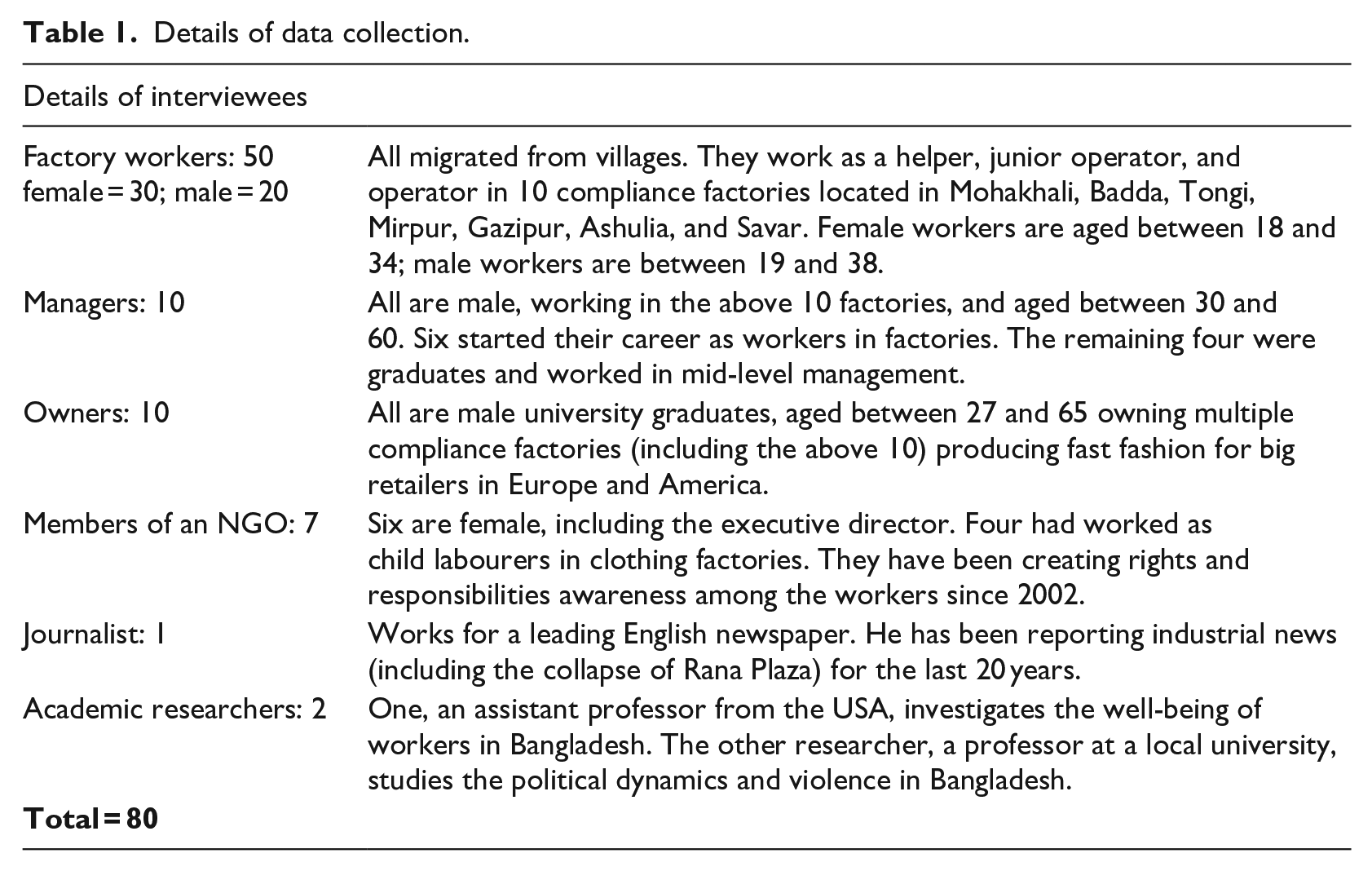
To remain impartial and develop a wider and deeper reflexivity, I interviewed seven members of the NGO, two independent researchers and one journalist. All 80 interviews (see Table 1) lasted between 20 and 140 minutes, were audio-recorded and transcribed verbatim, except for five, for which detailed notes were taken. I also conducted a focus group discussion with 10 participants (five workers, two supervisors, one NGO officer, one academic researcher and one journalist) that lasted for two and a half hours, was audio-recorded and transcribed verbatim. The interviews and observational data were supported by published documents, including from Human Rights Watch, the International Labour Organization, Transparency International, and local and international newspapers.
Details of data collection.
Reflecting on the outsourcing business model, precarious working conditions, and workers’ human rights violations in the GVC, I used thematic analysis (Braun & Clarke, 2006) to analyse the feminization of the workplace, wage theft, secrecy and violence, and their relationship with the derealization process. Thematic analysis was performed in six stages: familiarization with the data, generating initial codes, searching for relevant themes, reviewing themes, naming themes, and producing a report (Braun & Clarke, 2006). First, I familiarized myself with interview transcripts and observational notes, which are an important part of reflexivity (Riach, 2009). This helped me tease out the nuances of violence through the discourses of dehumanization, displacement, and dispossession. For instance, I observed that owners and managers referred to workers as animals, insects, uncouth and many other derogative terms, which inflicted psychological violence; as one worker said, ‘It’s better to die than listen to those words.’ Comparing a human being with a non-human is dehumanization (Butler, 2003).
Familiarization with the data further helped me develop the initial codes (economic dependency, migration, organizational policies, social stratification, wage deduction, violation of laws, etc.). For instance, one owner stated: We are making this country rich, not the government. So, they [the government] must remain silent. We have our policy to manage these animals [workers].
From this excerpt, I developed the following codes: violations of laws, organizational policies and social stratification. Again, I was reflexive and reflective (Riach, 2009) to ensure that the emerging codes were logically aligned with the coding framework and semantic or latent meanings (Braun & Clarke, 2006). For instance, many female workers explained that their managers often said kharap kotha, which they preferred not to share with me (a male). In Bangladeshi society, when a man says kharap kotha to a woman, this indicates sexual harassment. However, I confirmed this with the NGO officials and male workers before coding it as sexual harassment.
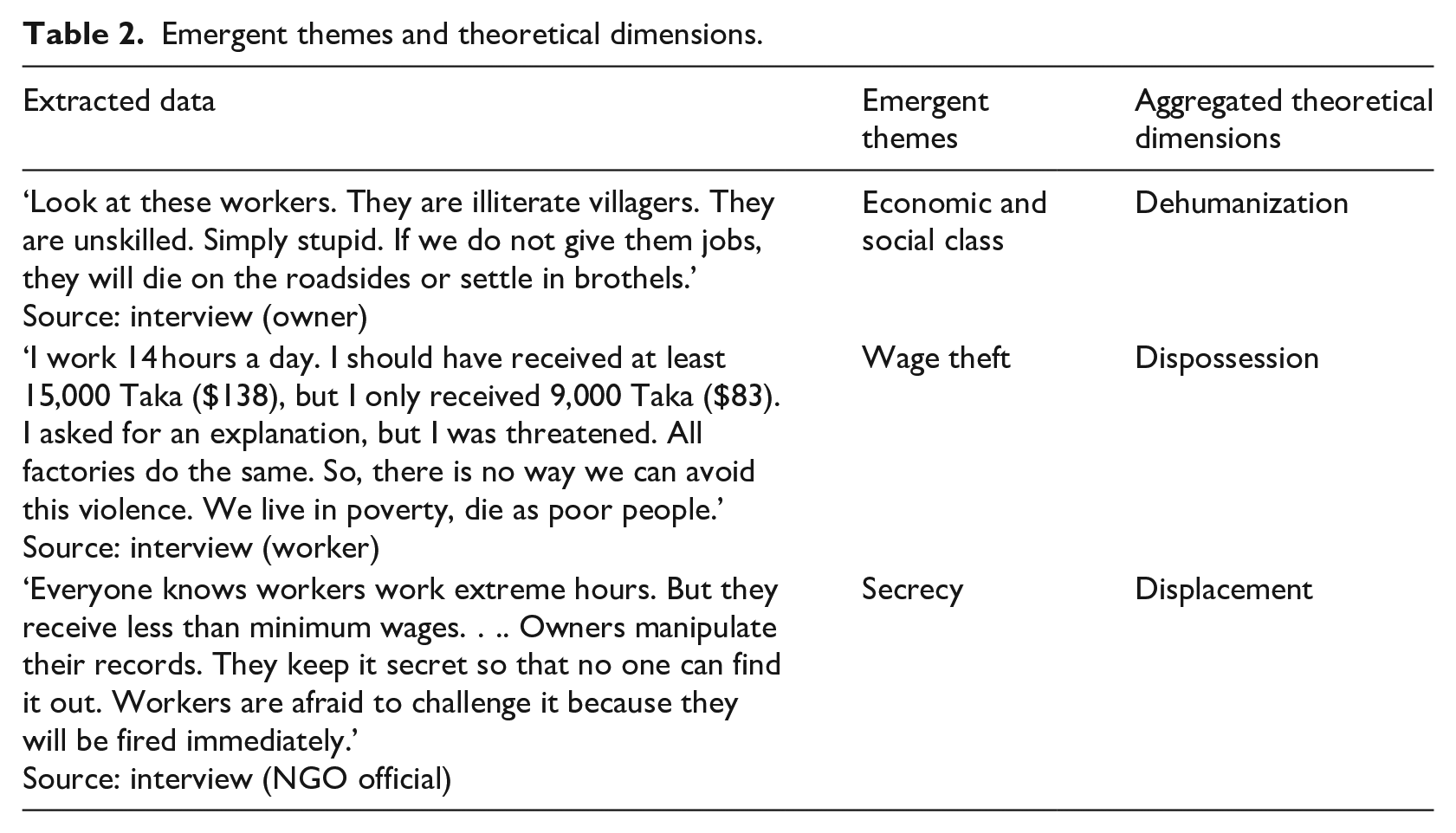
The emergent codes helped me develop themes (see Table 2). Braun and Clarke (2006) suggest that a theme should capture something important in relation to the research questions and objectives. Therefore, I paid particular attention to these themes and ensured that they provided a meaningful bridge between the data, research questions and research objectives. Later, I reviewed, revised and named the themes as the recruitment of ‘ideal workers’, violence against the ‘ideal workers’ in factories and beyond, the mechanisms of wage theft, and the culture of secrecy, to provide an accurate and coherent story. Finally, I present the findings of this study concisely, coherently, and logically (Braun & Clarke, 2006) in the next section.
Emergent themes and theoretical dimensions.
Perpetration of Physical and Psychological Violence in Factories
This section begins by illuminating the reproduction of the ‘ideal worker’ and how this is justified through the discourses of neoliberal capitalism, economic rationale, and empowerment of female workers. I also explain the dynamics between state politics and patriarchy which normalize the derealization of ‘ideal workers’. I then document the mechanisms of wage theft and provide detailed accounts of how wage theft inflicts violence which makes ‘ideal workers’ dehumanized, dispossessed and displaced in their own society. Afterward, I illustrate the culture of secrecy connected with wage theft that factories practise with the support of the government, which diminishes workers’ agency and derealizes them.
Recruitment of ‘ideal workers’
In the Bangladeshi garment industry, 2.42 (out of 4) million workers are women; 87% are aged between 15 and 34 (International Labour Organization, 2020). Similar to Hasina and her family, millions were dispossessed, displaced following climate change, and migrated to Dhaka (International Labour Organization, 2021). Upon arrival, they sought employment in households as domestic servants, which was not regulated by state laws. Several workers recalled facing violence, including being locked in, not receiving food, physical assault (e.g. scalding with hot water or burning with metal objects) and sexual harassment in households. Following exaggerated news stories in the media reporting on women’s empowerment enabled by opportunities in the garment industry, many workers in this study decided to secure employment in factories. However, one worker explained that this was not the case.
In one household, I was accused of stealing a gold chain. I was fired without receiving any wage. In another household, the owner attempted to rape me. However, his wife accused me of seducing him. She kicked me out at midnight. I thought that my life would change after I got a job in the factory. However, here more predators [owners and managers] wait for the opportunity to violate me.
It is an open secret that employers prefer to recruit young and childless women in the Bangladeshi garment industry. All owners and managers confirmed that the workers were hardworking, committed, and obedient. Many called these women ‘ideal workers’, and without them, maximizing factory profits and the country’s economic growth would be impossible. Accordingly, many factories deliberately terminate male workers. In one factory, approximately 180 male workers were terminated because they signed consent forms to establish a trade union. The manager of this factory confirmed that vacant positions were replaced by ‘ideal workers’. He justified it thus: We avoid recruiting men. They are like wild bulls, very hard to control. However, women are like domestic cows, they will give you enough milk and more calves without any trouble. Therefore, we prefer to have more domestic cows than wild bulls [laughter].
Several managers (and owners) shared similar views. For them, male workers are ‘troublemakers’; hence, they dispossess them from factories. Workers and NGO officials also explained that in Bangladeshi society, men exercise more agency than women, and are made redundant by factories. Observing male violence against women in Bangladeshi society (at home and at work), many women workers feared that resistance might portray them as notorious and, thereafter, as guilty of man-hating. Resistance also provokes violence, including sexual harassment and psychological torture. Hence, they endure violence in silence.
The findings of this study further reveal that many factories recognize pregnant workers as unproductive and hence terminate them. Several female workers stated that they hid their pregnancies as long as they could to avoid job termination. Employers have acknowledged the termination of male and pregnant workers and the recruitment of ‘ideal workers’. One owner said, ‘Pregnant workers are liabilities. They cannot walk properly, so how are they going to work longer hours?’ They also justified the replacement of ‘ideal workers’ through the discourses of economic growth and women’s empowerment. One owner commented: Women are very good at sewing and stitching. They are also vulnerable. They face violence at home. However, they don’t engage in nasty politics [unionization]. So, we recruit them. We save them. We empower them. In return, they help us to grow.
Unlike in Western societies, young and childless female workers are recognized as ‘ideal workers’ because of their vulnerabilities and subordination. Here, the construction of the ‘ideal worker’ is ingrained with the economic, social, cultural, and political vulnerabilities of young women who were already dispossessed and displaced from their villages because of climate violence. Migration to the capital city did not protect them from physical and psychological violence. Striving for emancipation remains a distant dream even after securing employment in the GVC.
Violence against ‘ideal workers’ in factories and beyond
The findings of this study challenge the rationale of women’s empowerment but reveal the extreme physical and psychological violence forced upon ‘ideal workers’. During factory visits, I acutely observed the voices and body language of ‘ideal workers’, sensing their fear and helplessness. They were afraid to look at me. Their eyes were glued to machines and fabrics. Their voices trembled while talking to the managers. It feels like a hostage situation in a movie. Under this disciplinary regime, they were forced to produce more units than they had agreed to during their job interviews. All workers confirmed that they had encountered violence if they failed to deliver to their target. One worker in the focus group discussion stated the following: My supervisor told us [40 workers] to produce 200 pieces every hour. After one hour, he started counting and found that we had failed. He abused us, calling us bitch, slut, and whore. When we protested, he began beating us with a wooden scale [she was crying].
Many ‘ideal workers’ also shared their experiences of being moorga in factories. Forcing a human to act like a moorga is dehumanizing, inflicts physical and psychological trauma, damages a woman’s dignity and makes her less human. Some workers compared this humiliation with gang rape and considered committing suicide.
However, all owners and managers supported stripping the dignity of ‘ideal workers’. Many said that young women lack discipline, which is not beneficial to factories. Others justified such violence as a necessary evil to improve factory productivity. One manager justified: We are doing nothing compared to what our managers did. They treated us as filthy animals. They did not hesitate to kick and punch the female workers. We are simply asking them to apologize for their failures, which caused us losses.
The participants’ narrations and my reflections confirm that patriarchal discourse is deeply embedded in Bangladeshi society. Powerful men deploy violence against women at home and in the workplace without any remorse. Instead, it makes them feel more masculine. Owners and managers objected to the accusation that they were perpetrators but rather portrayed themselves as saviours of workers and the country’s economy. One owner remarked, ‘We save them [workers]. If we had not hired them, they would have worked in the brothels.’ Another claimed, ‘For the sake of the country’s bright future, we must overlook these small incidents [assault and humiliation].’
Undeniably, factory owners have contributed to economic growth by generating 83% of the total export earnings, equalling 11% of Bangladesh’s GDP (Bangladesh Bank, 2022). However, this study’s findings contest their claim to be the saviours of female workers. For instance, the minimum wage is now $114 per month against the living wage of $271, which forces workers to live in poverty. Covid-19 re-exposed worker vulnerabilities and inflicted more violence. The closure of factories left workers unemployed for three months. They survived by borrowing at higher interest rates. Many were forced to skip at least one meal per day. Failing to pay rent resulted in eviction. Several people spent nights on the streets and experienced further violence, including mugging and sexual harassment. Covid-19 also forced many workers to revisit their previous trauma. One worker said: My father forced and beat me to marry an older man when I was 14. One night, I fled to Dhaka. I have never contacted him since. Covid-19 forced me to contact him as I had no place to sleep. It destroyed my dignity.
Amid the ongoing physical and psychological violence against ‘ideal workers’, employers were disappointed when the government increased the minimum wage in 2018. Several owners said that they already paid higher wages and demanded a minimum wage freeze for the next 10 years, believing that it would help Bangladesh become the number one exporting country in the world. They were also angry when labour laws allowed the establishment of trade unions. Employers support politically motivated and state-sponsored violence to prevent unionization. State agencies continuously reject workers’ applications or delay union registration, as has been confirmed by NGO officials. In the next section, I illuminate the mechanisms of wage theft that intensify physical and psychological violence against ‘ideal workers’.
Mechanisms of wage theft
Here, I document that, like immigrant workers in developed countries, ‘ideal workers’ are also victims of wage theft in their own country. I further capture how the three different mechanisms of wage theft are practised in the Bangladeshi garment industry. First, factories steal the rightful wages of workers. All workers confirmed working 12–14 hours a day, six days a week. Some worked 16–18 hours a day, seven days a week, but never received their rightful wages. One worker explained the following: For the last three months, I have worked 16 hours per day. After returning home, the first thing I do is write down the hours I have worked. My calculations show that I should have received 16,000 Taka [$147]. But last month, I received only 9,500 Taka [$87].
Second, factories steal workers’ attendance bonus – a form of allowance to ensure workers’ attendance. Depending on the size of the factory, workers receive between $4 and $6 bonus per month if they are late or absent on three days or fewer per month. However, all workers confirmed that if they were absent for only one day owing to illness, they would not receive their allowance. Many workers said that if they were a few minutes late, they would receive no attendance bonus.
Third, many factories steal maternity allowances from the workers. I interviewed 16 workers eligible to receive a maternity allowance for 16 weeks (24,608 Taka [$227]); however, one received 5,000 Taka and another received 3,000 Taka. Three workers were marked as unproductive because of their pregnancy and, hence, were laid off. They did not receive wages, overtime payment or attendance bonuses. The remaining workers also did not receive allowances, however, they were not laid off.
All factory owners (except one) and managers denied wage theft, but justified it through the discourse of skills, performativity, and economic viability. They also called these practices deductions rather than wage theft. One owner said: If workers finish 10 hours of work in 14 hours, what can we do? We could not pay for them for 14 hours. I would say that they should not be paid, even for 10 hours. This is because they increase the operating costs.
For owners, an attendance bonus is a reward rather than a charity payment. Many also believe that the Bangladeshi garment industry must not have benefits such as maternity allowance. This is a privilege for educated women working in public or private organizations. In believing so, they humiliated the workers by calling them animals, villagers, and liars who were also unskilled in producing the given targets. They further viewed themselves as ‘superior humans’ who are educated, patriotic and have high moral standards. As one owner boasted: I am a nobleman. I come from a renowned family. I have enough money to spend for the rest of my life, lavishly. I do not need to steal money from these savages [workers]. I give them jobs. They are alive because of me.
This rationalization reveals conflicting discourses. On one hand, owners claimed to be noblemen, saving millions of workers by creating employment opportunities and having enough money to live comfortably. On the other hand, they stole workers’ wages by violating their own rules and the country’s labour laws.
By deducting attendance bonuses, managers violate factories’ rules (i.e. late or absent on three days) as well as the country’s labour act (e.g. punishing workers for taking sick leave). They also force workers to attend work while ignoring their physical and mental health, which causes further health problems. One worker described: I experience chronic back and shoulder pain. However, I did not see a doctor. With this pain, I regularly attended work in a timely manner. Last month, I was late by three minutes because of bad traffic. Thereafter, my manager deducted my attendance bonus.
Workers also suffered from anorexia, nausea, fever, and epigastric pain, as confirmed by a doctor (who worked voluntarily as a counsellor for the NGO). Ignoring their health and extreme work also makes them dispossessed, as many female workers are rendered redundant in their mid-thirties. They are identified as unproductive workers who jeopardize factories and the country’s economic growth.
Wage theft also causes psychological trauma to workers. For instance, to secure an attendance bonus, they stop visiting doctors (if they are sick) or their parents, stop attending weddings and funerals. Their sacrifices were unsuccessful. Wage theft forces workers to live in extreme poverty. Considering their precarious wages, the attendance bonus enables them to purchase at least 10 kg of rice that they can live on for a week. Moreover, living in tiny rooms in slums with no basic amenities, they feel less human. As one worker said, ‘A cow in a shed has a better life than us.’ They fail to provide a bare minimum for their newborns, as another worker explained, ‘I am a terrible mother who cannot buy a new dress for her newborn’, when she was denied her maternity allowance. Another worker shared: My three-year-old daughter loves chicken. However, we have not had it for the last three months. Last week, I went to buy groceries . . . She was staring at a poultry shop. It rips my heart out. I am a terrible mother. [She starts crying.] I do not deserve to live.
Observing factories’ maternity policies and the suffering of working mothers, many ‘ideal workers’ postpone marriage plans or having children. Those who felt unworthy as mothers forgo celebrating birthdays, weddings, anniversaries, and religious and other festivals. This detached them from their social lives. Temporary or permanent unemployment (during pregnancy or Covid-19) forces them to resume working in households and revisit their previous trauma. ‘It was one of the most difficult times in my life’ said one worker. Sacrificing basic human pleasures such as getting married or becoming a mother is a loss that makes the ‘ideal workers’ tenuous (Butler, 2003). Their losses inflict more vulnerabilities on their ‘socially constituted bodies’ (e.g. pregnancy-related complication, separation, or loneliness) which puts them ‘at risk of violence by virtue of that exposure’ (Butler, 2003, p. 10).
The post-Covid-19 period and current rise in living costs have escalated their suffering. In the absence of alternative employment and state support, ‘ideal workers’ are constantly dehumanized, dispossessed, and displaced through wage theft. I observed immense pain, grievances, and self-blaming behaviours among the ‘ideal workers’. They were angry and frustrated at being unable to resist wage theft because resistance inflicts more physical and psychological violence with direct support from state agencies and ruling party members. The culture of secrecy helps factories intensify wage theft-based violence, as will be explained next.
Culture of secrecy
Nearly four million workers work in more than 4,600 registered factories in Bangladesh. Surprisingly, many factories did not have a formal payroll system or list of workers, which prevented them from receiving the government Covid-19 stimulus package (Uddin et al., 2023). It was found that factories informally recruited workers, as all worker participants confirmed that they did not receive appointment letters. Several questioned, ‘What is an appointment letter?’ Not issuing an employment letter violates the Bangladeshi Labour Act 2006 (amended in 2018). Many owners and managers, however, justified it through the discourses of ‘economic efficiency’. When I asked the owners, ‘Why do you not provide employment letters to your workers?’, one responded: Are you joking? Look at these workers. They are bo-kolom [illiterate]. They cannot read or write simple sentences. This would waste money [printing paper].
His statement reveals an urban discourse of humiliation in Bangladeshi society: ‘People who come from villages are illiterate and stupid.’ In fact, all the workers in this study were capable of reading and writing, and half had completed their secondary education. Many owners also prefer to keep worker recruitment informal because of the uncertain nature of the outsourcing business, as they do not know whether or when they will receive the next order, the order size, or the amount of money they make. In this precarious context, they believe it is not a good idea to make promises regarding wages and other rights in writing.
Not issuing appointment letters normalizes wage theft. For instance, by rationalizing workers’ vulnerabilities (e.g. lack of education, poverty, and migration), factory owners reject workers’ basic and legal rights. Consequently, workers could not demand or secure a minimum wage. One worker revealed: My wages were fixed at 8,560 Taka [$79]. But I received only 7,560 Taka [$70]. I asked my manager about it, he replied, ‘You must be mistaken. Your wage is 7,560, not 8,560.’ When I argued, he asked me to provide written documents. He knew that I did not have any documents.
The findings also reveal that employers manipulate the working hours and output of workers in both copies of the service books.
2
One worker explained: We [nearly 300 workers] work 14 hours a day. We started our shift at 8:00 a.m. and finished at 10:00 p.m. However, the managers recorded only 10 hours in our books.
All workers encountered this violence and received a common explanation from their managers as one worker mimicked, ‘It will become a legal problem for factories if government agencies find that you [workers] work more than the legal hours’ (i.e. as per the Labour Act 2006, amended in 2018, workers are allowed to work a maximum of 10 hours a day: eight hours regular and two hours overtime with double payments). However, workers were assured that they would receive their correct wages. ‘It was a big lie’, said a worker. An NGO director confirmed this manipulative practice: Everyone knows how many hours Bangladeshi workers work. However, it is recorded as between eight and 10 hours in worker copies. If the workers do not work during these hours, what do they do? They did not leave the factories. Therefore, owners must respond to the missing hours.
All workers confirmed that they were intimidated into not talking about this manipulative practice. Many workers hesitated to talk about this during the interviews because they had witnessed several colleagues being fired without compensation when they raised their voices regarding data manipulation. One worker described: We were given clear instructions not to say anything about this. If anyone asks, ‘Do you get your wages and benefits correctly?’, we must say yes. Otherwise, we will lose our jobs.
During factory observations, I also found a team (i.e. four members) in one factory that regularly coach workers on ‘what to say and what not to say’ when buyers or their representatives visit the factory. Widespread intimidation consumes workers’ lives. The fear of being jobless further invokes vulnerabilities, which reduces their agency in resisting further violence.
All owners (except one) and managers denied data manipulation. They also accused me of damaging the image of Bangladesh by spreading malicious propaganda. Nonetheless, one young owner revealed a secret practice: We do alter our records. So does everybody. Others would deny it. But it is an open secret. Otherwise, earning such profits would be impossible.
Factories’ manipulative but informal and open secrets of wage theft may contribute to owners’ profits, as the National Board of Revenue (NBR) awarded 13 factory owners for paying the highest amount of tax in 2021 (The Financial Express, 2021). Finally, it made sense that the owners restricted me from examining employment relationship documents. This would have revealed their secret wage theft practices. Unlike academic researchers or other stakeholders, government agencies have the power to investigate manipulative practices that help employers steal wages. However, they ignore this in their reports in exchange for bribes (Transparency International Bangladesh, 2013).
Derealization of ‘Ideal Workers’
This study extends the understanding of the process of derealization (Butler, 2003, 2004, 2010) of ‘ideal workers’ in feminized workplaces in the Global South, linked to the GVC. In doing so, I expose that the feminization of workplaces invokes vulnerabilities of ‘ideal workers’ through the discourses of dehumanization (Al-Amoudi, 2018), dispossession (Harvey, 2003), and displacement (Sassen, 2014). These discourses are achieved through the secret and open practices of wage theft that inflict physical and psychological violence against ‘ideal workers’. Grounded in my analysis, I present two important theoretical implications: (1) the construction of an ‘ideal worker’ in feminized workplaces, and (2) open and secret practices of wage theft in a developing country. Collectively, these factors have widened the vulnerabilities of marginalized workers in their own society by demanding absolute subordination, denying basic and legal rights, restricting mobility, inflicting violence against (their) bodies and minds and suppressing resistance. Consequently, millions of ‘ideal workers’ who make our clothes, perhaps those you are wearing while reading this article, are derealized (Butler, 2003; Tyler, 2019; Varman & Al-Amoudi, 2016; Varman & Vijay, 2018).
The empirical analysis of this study reveals that derealization (Butler, 2003, 2004, 2010) begins with the recruitment of ‘ideal workers’. In Western societies, the ‘ideal worker’ is constructed on the principles of quid pro quo (Benard & Correll, 2010; Brumley, 2014; Williams, 1999). Moreover, white males are praised as ‘ideal workers’ for their physical strength, loyalty to rigid hierarchies, and limited household responsibilities who, therefore, receive ‘a comprehensive set of benefits’ (Brumley, 2014, p. 806). Despite the increase in young women’s participation in organizations, they remain ‘none or less ideal’ in Western societies (Brumley, 2014). Previous studies observed similar practices in non-Western societies. For instance, Mair, Martí and Ventresca (2012) documented that patriarchal and patrilineal systems, kinship and community norms govern women’s lives, restrict their access to education, and control their property, income and labour in Bangladeshi society. Conversely, the findings of this study reveal that young and childless women are ‘ideal workers’ in feminized factories where all owners and managers are male. Employers not only prefer to recruit young women who migrate from rural villages but also recognize them as ‘ideal workers’. However, this identity does not provide them with benefits similar to those of ‘ideal workers’ in Western societies (Brumley, 2014). Instead, ‘ideal workers’ in the garment industry are dehumanized (Al-Amoudi, 2018), dispossessed (Harvey, 2003), and displaced (Sassen, 2014) through physical and psychological violence. They are expected to have no agency (Ayaz et al., 2019) but to surrender their bodies and minds to the process of derealization (Butler, 2003). If they resist, they become troublemakers and, hence, face more violence.
Indeed, the domino effects of climate change, a thin labour market, patriarchy, stereotyped gendered norms and social polarization have already dehumanized, dispossessed, and displaced women in Bangladeshi society. In this context, the garment industry has created the largest employment for young women and improved the country’s economic growth. The emergence of ‘ideal workers’ has also rejected certain patriarchal norms and values which Mair et al. (2012) observed in Bangladesh. This study, however, contests employers’ claims of women’s empowerment but argues that increasingly feminized workplaces that recruit young and childless women who are already oppressed, less educated, and unskilled or semi-skilled, and recognizing them as ‘ideal workers’, has little to do with women’s empowerment. Like microfinance, the feminization of workplaces or identifying women as ‘ideal workers’ is not a ‘magic bullet for women’s empowerment’ (see Kabeer, 2005). Instead, the construction of an ‘ideal worker’ is a façade to derealize young female workers through neoliberal discourses, including economic growth, skills, and empowerment. It is a neoliberal myth adopted by powerful patriarchs to derealize vulnerable young women to ‘shore up their own privilege’ (Butler, 2003; Tyler, 2019) through the justification of physical and psychological violence (Butler, 2010).
The derealization of ideal workers is further intensified by wage theft. Existing studies consider wage theft as an exploitative mechanism to steal immigrant workers’ wages in developed countries (Kim & Allmang, 2021; Segarra & Prasad, 2020), and the findings of this study reveal that it is organizational violence. Moreover, native workers who are not immigrants and require no legal documents (e.g. visas or work permits) to work are victims of wage theft in their own society. The findings of this study also reveal that informal and open secrecy plays an important role in normalizing wage theft across the GVC. For Costas and Grey (2014), secrecy is ‘associated with ethical wrong-doing’ (p. 1435) which can shape ‘discourse through information distortion, manipulation, and omission’ (p. 1439). Not providing employment letters and data manipulation in workers’ record books are unethical discourses that help organizations steal workers’ wages, thereby inflicting physical and psychological violence. Being treated (or feeling) like animals; being unable to buy a chicken or a new dress for their children; living in slums without having a private room in which to sleep or change clothes; forgoing marriage or motherhood; or not expressing love, emotion, or sorrow are examples of dehumanization (Al-Amoudi, 2018; Butler, 2003). Wage theft also dispossesses workers through job losses (during pregnancy or Covid-19), but maximizes the profits of powerful actors (see Harvey, 2003). Furthermore, it also displaces (see Sassen, 2014) ‘ideal workers’ through eviction (during the pandemic).
This study argues that the severity of wage theft arises from outsourcing businesses, particularly when top brands steal workers’ wages but remain unaccountable. Multi-stakeholder initiatives, social audits and other stakeholders as well as management and organization studies with a continuous focus on compliance regimes (Alamgir & Banerjee, 2019), workplace safety (Donaghey & Reinecke, 2018), misrecognition and misrepresentation of female workers (Alamgir & Alakavuklar, 2020), and violence against their deregulated bodies (Alamgir et al., 2022) have overlooked the practices of wage theft. Collectively, to some extent, they have exculpated Western buyers by shifting blame to manufacturers and manufacturing countries for the violence against female workers. This study also argues that the informal and open secret practices of wage theft are woven into the GVC. The existing socioeconomic conditions further normalize wage theft in manufacturing countries in the Global South. For instance, since the beginning of the Bangladeshi garment industry, the government has suppressed the minimum wage. Consequently, the minimum wage remained below the living wage. This does not make manufacturers happy, as many owners have asserted that ‘poor, illiterate, unskilled, and savages’ (workers) do not deserve the current minimum wage. In doing so, they not only engaged in wage theft but also demanded that the minimum wage be fixed for the next 10 years. Indeed, they know that, as there is no alternative employment available, ‘ideal workers’ will not leave the industry despite structural or systematic violence (Galtung, 1969; Zizek, 2008). They also know that the Bangladeshi government will always support violence against the country’s economic growth. Moreover, like buyers and owners, employees of state agencies (e.g. factory inspectors) also benefit from wage theft for not visiting factories or not reporting wage theft in their reports (Transparency International Bangladesh, 2013).
This study offers some implications to prevent wage theft and, thereafter, the derealization of ‘ideal workers’. First, Western buyers must stop stealing workers’ rightful wages. They must also pay fair prices to manufacturers. This will prevent manufacturers from blaming buyers for not paying fair prices and for wage theft. Second, Western buyers should emphasize the formal recruitment of workers and the digitization of workers’ attendance, working hours and wage payments. This will prevent informal employment and data manipulation. Third, because A&A has been successful in ensuring workplace safety, a similar multi-stakeholder initiative should be formed to oversee wage theft. Finally, stakeholders should pressure the government to pay the living wage and enforce existing laws to prevent wage theft.
Concluding Remarks
This study nuances Butler’s notion of ‘derealization’ through the lens of physical and psychological violence against women workers working in feminized workplaces linked to the GVC. It further highlights that the recruitment of young and childless female workers and their recognition as ‘ideal workers’ begins the process of derealization. This study contests the Western notion of ‘ideal workers’ and argues that it is contextualized and relies on the cultural, economic, natural, social, and political vulnerabilities of a workforce. The findings reveal that, unlike in Western countries, informal and open secret practices of wage theft have emerged as dominating forms of violence in organizations that dehumanize, dispossess, and displace millions of ‘ideal workers’ in their own society. The investigation indicates that young and childless women can remain ‘ideal workers’ as long as they have limited or no agency to resist the process of derealization. As violence is not an isolated, exceptional, or discrete phenomenon (Martí & Fernández, 2013) but rather a form of practice or control (Arnold & Costas, 2024), future research should unpack the process of derealization of a workforce or a community. For instance, how the ‘ideal worker’ is constructed and derealized in tea plantations or cocoa farming, and the extent to which ‘ideal workers’ resist the process of derealization.
Footnotes
Acknowledgements
The author is indebted to Martyna Śliwa, Melissa Tyler, Danielle Tucker, Jeremy Morales, and Thomas Ahrens for their helpful comments and guidance on the earlier drafts of this paper. The author is equally grateful to associate editor Ignasi Martí for believing in this paper and offering valuable guidance during the reviewing process. Finally, the author is thankful to the three brilliant reviewers for their constructive comments and support to unpack the full potential of this paper. The author dedicates this paper to the millions of ‘young and childless women workers’ of the Bangladesh garment industry.
Funding
The author received no financial support for the research, authorship, and/or publication of this article.
