




Abstract
Use-of-the-past research has advanced our understanding of how top managers instrumentalize past knowledge, events and rhetorical constructions to advance their present-day interests. However, it is unclear how they use the past when they have divergent understandings of the past and different visions of the future. Temporal tensions can lead to a period of unsettlement in organizations, undermine the top management’s power base, and open up space for middle managers to take a central role in using the past. Through a longitudinal case study of a Japanese craft firm with a history of over 200 years, we examine how middle managers progressively take an active role in using the past through three processes: temporal mobility, temporal socialization and coalescing the past. Our findings challenge the somewhat linear conception of time in the use-of-the-past literature by elucidating the emergent, in-the-moment evolution of middle managers’ strategic use of the past. By adopting a process-analytic lens, our findings extend current understanding of the strategic use of the past as not undertaken by a few powerful individuals in a given moment, but a continually changing process enacted by multiple middle managers with different temporal orientations. Moreover, our findings contribute to the use-of-the-past literature by taking a relational perspective of temporality. Finally, we reconceptualize the strategic flexibility of middle managers from a temporality perspective, showing that they can alter the temporal orientations of those at the top and the bottom.
Keywords
Introduction
Research on the use of the past (Suddaby, Foster, & Trank, 2010; Wadhwani, Suddaby, Mordhorst, & Popp, 2018) has advanced our understanding of how top managers instrumentalize past knowledge, events and rhetorical constructions to promote their present-day interests (Basque & Langley, 2018; Brunninge, 2009). In particular, recent studies have highlighted that the past can be used to control workers in organizations (Aeon & Lamertz, 2021), or be maneuvred through the power struggles of influential stakeholders (Cailluet, Gorge, & Özçağlar-Toulouse, 2018; Lubinski, 2018). While the literature suggests that top managers typically use the past, it is unclear how they do so when they have divergent understandings of the past and different visions of the future. This warrants attention, as temporal tension frequently manifests at the top (Geraldi, Stjerne, & Oehmen, 2020), and research shows it can lead to a period of unsettlement in organizations when the tension is destructive enough (Hampel & Dalpiaz, 2023; Kaplan & Orlikowski, 2013; Raffaelli, DeJordy, & McDonald, 2022). In this study, we put forward that such unsettlement undermines the top management’s power base, opens up space for middle managers to engage in cognitive reorientation, and takes a central position in transforming the past into a strategic asset.
Thus, we consider the important yet neglected role of middle managers – defined as ‘managers located below top managers and above first-level supervision on the hierarchy’ (Wooldridge, Schmid, & Floyd, 2008, p. 1192) – in using the past in a period of unsettlement when the temporal orientations of top managers collide. The opportunity for middle managers to play a subjective role in the use of the past arises when a process view of time is adopted (Hernes, 2014; Zerubavel, 2020), as such a view allows organizations to be seen as having multiple interpretations of temporality (Reinecke & Ansari, 2017), where the past, present and future are open to continuous reinterpretation by multiple individuals. Previous studies have suggested that, unlike top managers, middle managers embody strategic flexibility but also a fragile position and social identity (Ahearne, Lam, & Kraus, 2014; Azambuja, Islam, & Ancelin-Bourguignon, 2023; Delmestri, 2006). Thus, middle managers are more easily held in the contingent state of multiple and shifting temporalities (Holt & Johnsen, 2019; Hosking, 2011), where the experience of time, including the past, can vary and constantly change among different middle managers depending on their social position, engagement with other actors, and the contextual situation (Ancona, Goodman, Lawrence, & Tushman, 2001). Therefore, from a process theoretical perspective, middle managers may use the past in unique ways that merit further theoretical investigation. We, therefore, ask: How can middle managers use an organization’s past during a period of unsettlement when top managers have divergent temporal orientations?
To explore this question, we conducted a longitudinal single case study of organizational renewal at Funabashiya, a traditional Japanese craft firm whose history dates back over 200 years. When the new successor joined the company, he realized that due to its long and strong tradition, the firm was stuck in the past and unable to cope with changing customer needs. He not only faced extreme resistance when he attempted to reform the organization, but the changes implemented also led to his and the incumbent CEO’s estrangement for a prolonged period of time. Counterintuitively, the middle managers started to play an active role in the process of changing the firm from being stuck to its long and rich history to strategically using it. In conducting our study, we combined historical and real-time methodologies to analyse and unpack the focal process under way over the period 1993–2022 (Argyres, De Massis, Foss, Frattini, Jones, & Silverman, 2020).
Our findings provide theoretical contributions to the use of the past debate by explaining how middle managers, during a period of unsettlement when the temporal orientations of top managers diverge, can gradually leverage history through three processes: temporal mobility, referring to how they skilfully and flexibly alter their temporal orientations along the different phases of the process; temporal socialization, referring to how they increasingly bring together the relationships among organizational members with different temporal orientations; and coalescing the past, referring to the way they gradually weave together the new understanding of the past in the firm’s production processes and offerings.
In contrast to the literature that emphasizes how the past can be used in the present moment (Brunninge, 2009; Suddaby et al., 2010), our findings reveal the emergent, in-the-moment evolution of middle managers’ strategic use of the past. Thus, our findings challenge the somewhat linear conception of time in the use-of-the-past literature by elucidating how the co-existence of middle managers with multiple temporal orientations (custodians, prospectors and energizers), their strategic flexibility to change temporal orientations, and engagement in social dialogue are necessary to gradually find the use of the past that fits the organization’s temporal context. By adopting the process-analytic lens, we extend the current understanding of the strategic use of the past as not undertaken by a few powerful individuals at a given moment, but as a continuously changing process enacted by multiple middle managers with different temporal orientations.
Moreover, our findings contribute to the use-of-the-past literature by explaining that middle managers’ use of the past is not only an ever-changing process, but also a continuous process of relational engagement (Emirbayer, 1997), as individual temporal orientations influence or are influenced by temporal socialization throughout the long-term process of using the past. Finally, while prior research has implicitly assumed that middle managers can only deal with temporal work that involves shorter time horizons with less strategic importance (Kaplan & Orlikowski, 2013; Schultz & Hernes, 2013), our findings reconceptualize the strategic flexibility of middle managers (Azambuja et al., 2023) in a temporality perspective, showing that they can influence and change the temporal orientations of those above and below. As such, we theorize the multi-level, long-term process of mutual adjustment of temporal orientations led by middle managers.
Theoretical Framework
Strategic use of the past during a period of unsettlement
Research on the use of the past has advanced our understanding of how actors – typically top managers – can repurpose past knowledge, events and rhetorical constructions to serve their present-day interests (Wadhwani et al., 2018). This body of work has shown that the past is often used purposefully in organizations to legitimize strategic actions (Brunninge, 2009; Suddaby et al., 2010), enhance identification with the organization (Hatch & Schultz, 2017), recreate the organizational culture (Maclean, Harvey, Sillince, & Golant, 2014), support organizational renewal in different strategic contexts (Sasaki, Kotlar, Ravasi, & Vaara, 2020), harness the persistent tension between novelty and familiarity during transformative change (Dalpiaz & Di Stefano, 2018) and foster innovations (Ge, De Massis, & Kotlar, 2022).
On the one hand, scholars consider the past ‘a powerful resource that can be instrumentalized’ (Brunninge, 2009, p. 23); on the other hand, the strategic use of the past can lead to power struggles (Cailluet et al., 2018). In particular, research taking the stakeholder view describes how actors with different interests can use the past to advance their own agenda over others (Mordhorst, 2008). As remembering usually takes place in a collective social sphere (Halbwachs, 1992), and forgetting may occur in the context of forced remembering (Anteby & Molnár, 2012; Crawford, Coraiola, & Dacin, 2020), the strategic use of the past helps those in power build and maintain organizational identification during strategic change.
For example, Aeon and Lamertz’s (2021) study on the rhetorical use of the past of two Quebecois companies shows that top managers crafted historical narratives to control the workers’ involvement and identification with the organization, thus advancing their own agenda. Cailluet et al.’s (2018) case shows that different stakeholders, including opinion leaders and the press, argued for and claimed ownership of the legendary founder figure of a major charity organization in France. Similarly, Lubinski’s (2018) historical case study of a German business in colonial India is informative on how historical claims are validated and revised, creating rhetorical frictions through dialogue among multiple external audiences.
But what if top managers in the organization have a different understanding of the past and a divergent vision of the future? Research shows that incongruities in the temporal orientation of top managers can lead to a period of unsettlement characterized by conflicts over the interpretation of the past, present and future, and subsequent relationship and cognitive breakdowns as the top managers are unable to reconcile opposing visions (Raffaelli et al., 2022; Ybema, 2014). Raffaelli et al.’s (2022) study examines the dynamics of two leaders in Switzerland’s largest watch company, showing that their temporal orientations caused significant tensions fuelled by ‘interpersonal interactions, egos, anger, defensiveness, and cognitive commitments’ (p. 43). Their findings highlight the importance of redefining personal goals, subjugating egos, cultivating affective trust, interacting frequently, carving out shared territory, and synthesizing skills in sustaining the strategic paradox of integrating the organization’s modernization and preservation visions. In addition, Hampel and Dalpiaz (2023) explain that different understandings of the past in an organization undermine organizational identity and that leaders can restore it by recombining the conflicting interpretations of the past to support the desired identity claims. Similarly, other scholars emphasize long-term intergenerational tensions between the incumbent and successor CEO due to their differing temporal orientations, the former typically having a past orientation and the latter a future orientation (Magrelli, Rondi, De Massis, & Kotlar, 2022). More broadly, studies in sociology and organization theory suggest that the temporal orientations of individual actors are associated with the roles they occupy (Biddle, 1996), and the imprinting (Stinchcombe, 1965) or path dependence (Schreyögg & Sydow, 2011) attached to these roles, especially when having served in these roles for an extended period of time.
Visions with different temporal orientations can co-exist if the tension between leaders is not harmful and they are able to carve out common territory. However, studies show that this tension can be so destructive that they are unable to engage in meaningful relational exchanges or share a common vision (Kaplan & Orlikowski, 2013). Therefore, we believe it important to understand what happens when such tensions arise in top management.
Process view of time, middle managers and strategic use of the past
Prolonged periods of unsettlement may undermine the power base of top managers – or the ability ‘to carry out his [sic] own will despite resistance’ (Weber, 1978, p. 53) – and open up space for middle managers to act. The possibility for middle managers to take a subjective role in using the past arises when assuming the process view of time (Hernes, 2014; Zerubavel, 2020). Process thinking sees reality as an ever-moving, restless flux of becoming: things are not first in existence and then subject to time, rather time – apprehended in ever renewing occurrence of event in acts of selection – is the ground from which the institutional structures, objects and identities of practice are being continually organized (Holt & Johnsen, 2019, p. 1165).
In this sense, process time is seen as flowing beyond linear clock time, dependent on – and integral to – the experience of being human (Reinecke & Ansari, 2015). Thus, the passing of time puts actors in situations where they perpetually recreate the past and the future. Each individual maintains her or his subjective experience within the collective system and consciously reflects and changes the meaning of the past and demarcates a different future. Therefore, both the past and the future are as open as each individual holding and re-interpreting their own past (Hernes, 2014). In turn, this gives rise to the possibility of ‘multiple presents, multiple pasts, and multiple futures’ (Reinecke & Ansari, 2017, p. 404).
The process view of time is particularly useful for conceptualizing middle managers’ use of the past. Scholars emphasize that middle managers are able to enact and adjust multiple roles and identities (Azambuja et al., 2023) depending on the institutional domain (Delmestri, 2006), playing mediating roles within the organization and simultaneously influencing the top and the bottom (Burgelman, 1983; Gioia & Chittipeddi, 1991). This ability to enact strategic flexibility (Ahearne et al., 2014) may also influence which temporal orientations each middle manager embodies and how they enact them differently depending on their role, position, tenure and organizational context. For example, an organization may have some middle managers who are more past-oriented (e.g. a production manager seeking to maintain traditional production methods) and others who are more future-oriented (e.g. a sales manager seeking to meet changing customer needs).
This multiplicity of pasts, presents and futures among middle managers may constantly shift and change, creating multiple self–other realities (Hosking, 2011), compared to powerful top managers, due to the fragile position and social identity associated with strategic flexibility. For example, top managers may at times undermine the authority of middle managers (Mantere, 2008), and at other times, the greater involvement of frontline workers in organizational decision-making may erode their role identity (Splitter, Jarzabkowski, & Seidl, 2021). Indeed, Emirbayer and Mische (1998, p. 974; see also Emirbayer, 1997) argue that human agency is simultaneously processual and relational in that ‘actors immersed in temporal passage engage with others within a collectively organized context of action’.
Therefore, applying the process view of time, we understand middle managers as being in the ‘contingent and often paradoxical condition of having multiple presents’ (Holt & Johnsen, 2019, p. 1565), where the experience of time, including the past, varies according to each middle manager, their social position, their engagement with other actors and the contextual situation (Ancona et al., 2001). In this respect, contrary to the use-of-the-past literature, which equates the temporal perceptions of individual leaders or top management with organizational perceptions (Ancona et al., 2001; Brunninge, 2009), middle managers may engage in a more complex and dynamic process of interpreting and mobilizing the past through ‘multiple indeterminate trajectories and plural timelines’ (Reinecke & Ansari, 2015, p. 621). Although prior research implicitly suggests that while middle managers can engage in temporal work (Kaplan & Orlikowski, 2013), they are less effective at doing so than top managers (Schultz & Hernes, 2013), and their unique social position may allow middle managers to engage in cognitive reorientation and move forward (Kaplan & Orlikowski, 2013), fill the vacuum at the top and engage in the temporal work that top managers cannot otherwise engage in.
Overall, these studies indicate that middle managers embody strategic flexibility but also a fragile position and social identity, and are therefore simultaneously open to multiple and diverging temporal orientations. However, we do not know enough about how middle managers can use an organization’s past. Therefore, our empirical study, using middle managers as an empirical anchor, aims to understand how these actors take a central position in using the past.
Methods
Research setting and design
We conducted a longitudinal single case study of organizational renewal at Funabashiya, a traditional Japanese craft family firm whose history dates back over 200 years. The production process of the flagship product, arrowroot cake, has remained largely unchanged for over 200 years, as reflected in the ingredients, production process, the way the product is aged and the ritual-like actions of how it is packaged. Due to a strong attachment to tradition, in the early 1990s the company was stuck in the past and unable to cope with changing customer needs.
This was when the 8th generation successor (henceforth 8th) joined the firm in 1993 as Senior Executive Vice President, directly reporting to the 7th generation incumbent leader (henceforth 7th). 1 When 8th first joined the firm, he decided to learn from scratch how the firm operated, especially in areas associated with the firm’s tradition. However, the more he learned, the more he became determined to modernize the firm. By his own admission, 8th found the organization old-fashioned and ‘not fitting in with the current world’.
He called all the banks to negotiate removing collateral and reducing the interest rates. He also called all suppliers and terminated their contracts if they refused to reduce their prices. As a result, he delivered visible initial results. He then began to extend his initiatives into the delicate domain of consolidated traditions. 8th believed that changing this old-fashioned firm required a radical turnaround and that those not following him should leave the firm (Watanabe, 2017).
The dry attitude toward experienced workers who had contributed to the firm for many years upset his father, 7th. In the end, 8th and 7th tried to minimize their interactions to avoid further disruptions. Consequently, the firm encountered a serious communication chasm between the two leaders. Furthermore, the change initiatives of 8th provoked a defensive reaction from most middle managers. At that time, their fervent desire to defend the old ways created tensions with 8th. However, over time, the increasing involvement and strategic initiatives of middle managers gradually enabled the firm to use the past as a strategic asset. Table 1 offers a detailed timeline of the events.
Timeline of events.
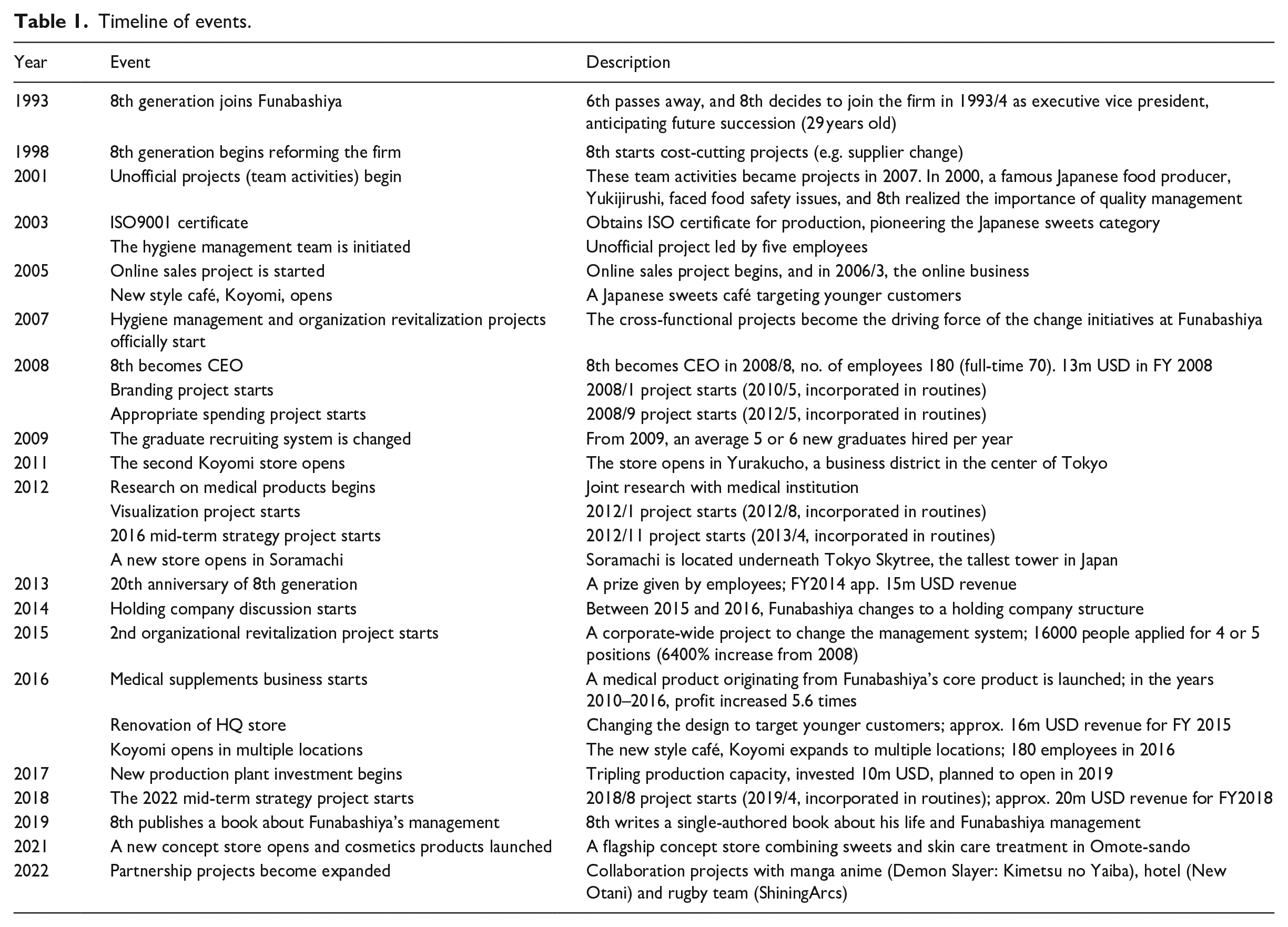
Following Langley, Smallman, Tsoukas, and Van de Ven (2013), we adopt a process perspective that involves theorizing based on the temporal progression of activities as elements of explanation and understanding. We combined historical and real-time methodologies to analyse and unpack the focal process between 1993 and 2022. First, for the 1993–2009 period, we relied on a historical methodology to collect all publicly available and privately held archival material, combining these insights with the recollections of informants (Argyres et al., 2020). For the 2010–2022 period, we triangulated in-depth interviews, real-time observations and archival material. The longitudinal data collection, combining the historical methodology with real-time repeated research visits to the same site (Soulsby & Clark, 2011), enabled us to make sense of the process that unfolded over time.
Data collection
Stage 1
Our investigation began when one of the authors took a part-time internship in the company for three months in 2010, consisting of approximately eight working hours for three to four days a week. During the first few weeks, she familiarized herself with the way the assembly line worked by consulting with senior employees. After a few weeks, she was allowed to visit and observe the activities of other departments, such as ordering and delivery, marketing, planning and new products. During the second and third months, she attended top management meetings in which aspects related to the modernization of the firm’s management were discussed. Developing personal relationships with a number of workers provided informal insights. In total, 384 hours of participant observation were conducted with 400 pages of handwritten notes taken in 2010.
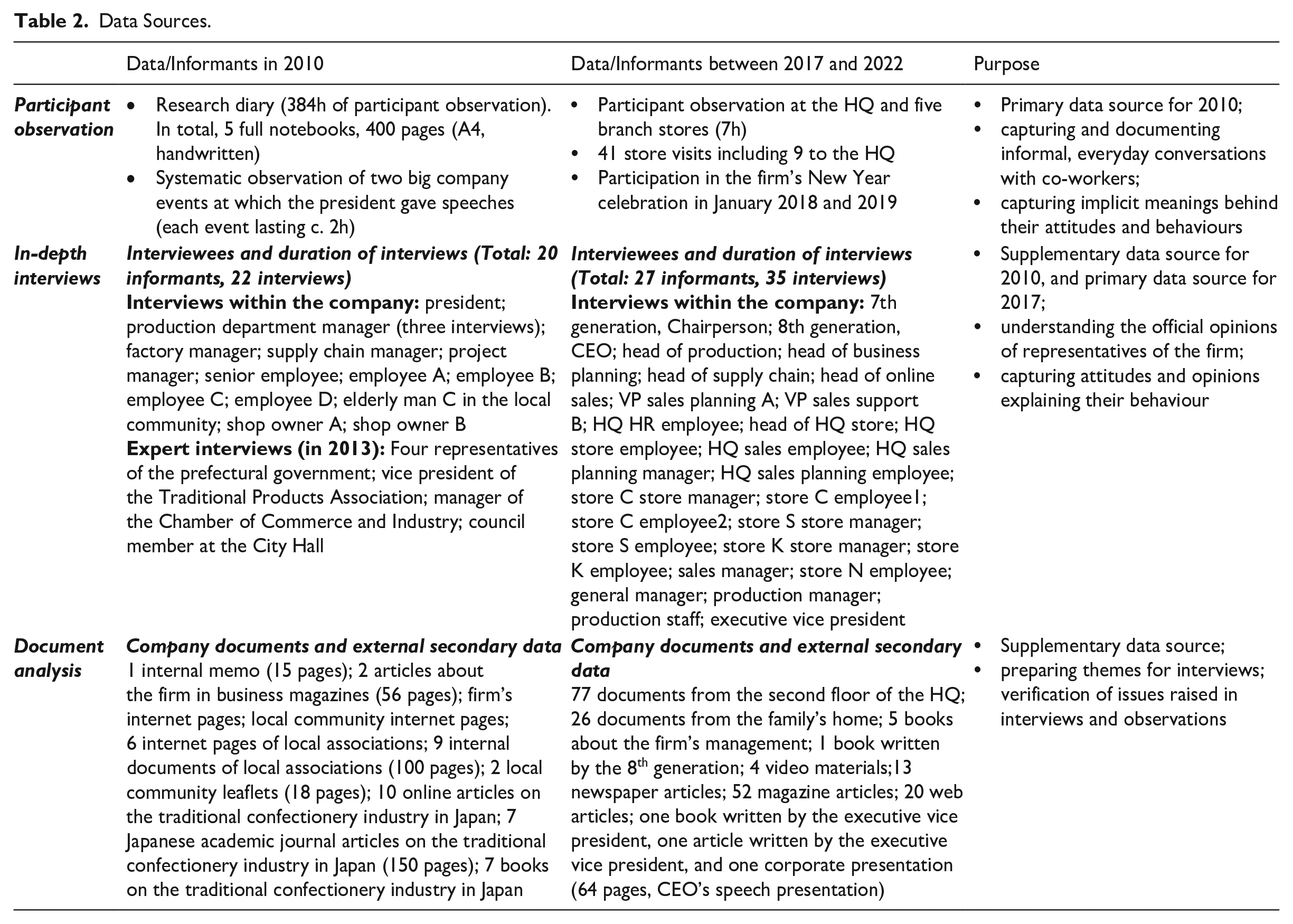
She complemented participant observation with formal interviews with people from different departments at various levels, from the cleaning staff to department managers, from executive managers to the president. However, it was not possible to record the interviews due to the participant observation research context and the related spontaneity of data collection. Instead, she took detailed notes transcribed in a research diary on the same day the interviews were held. She conducted 15 interviews with 13 informants. In addition, she collected archival and external secondary data (see Table 2) to supplement the primary data. In 2013, to deepen our understanding of this case, we conducted seven in-depth interviews with Japanese officials familiar with the traditional confectionery industry.
Data Sources.
Stage 2
In January 2017, one of the authors regained access to the company for a follow-up study. He interviewed key informants, including the current and prior leadership, the heads of production, business planning, supply chain and online sales managers. He also interviewed multiple store managers and employees. Some informants were the same as in 2010, while others had not been interviewed before. In total, he conducted 35 interviews with 27 informants. He also visited the headquarters nine times as well as all the stores (29 as of 2022) between 2017 and 2022, observing the store operations, customers and employees. He had informal conversations with employees and customers where possible. The researcher was also invited to the firm’s New Year celebrations as one of the guests of honour. As such, the data collected in stage 2 not only confirmed the earlier findings but also built on these, completing the missing information and yielding new findings.
We also searched the article databases of all major business magazines and the National Diet Library for additional archival material. Moreover, we obtained permission to collect information on the 6th and 7th generations from the firm’s archival storage and the owning family’s home. This material was crucial to analyse the 1993–2009 period when we did not have real-time access to data.
Data analysis
Data analysis involved triangulating multiple data sources and iterations between the data and theory to generate possible explanations of the phenomena. The initial data analysis phase was conducted by one of the authors during the three-month ethnographic data collection. At this stage, she aimed to find out as much as possible about the organization, its traditions, the problems it was facing and how changes were implemented. New themes constantly emerged, and the initial interview protocol evolved daily to include new questions and omit irrelevant ones. Consequently, she found that the firm had stubbornly protected some of its core traditions but had undertaken major initiatives since the successor joined the firm, starting with a top-down (i.e. initiated by the family CEO) followed by a bottom-up approach (i.e. initiated by middle managers).
The second stage involved all the authors. Based on the generic understanding attained in the initial data analysis stage and the additional data collected in stage 2, we chronologically unpacked how the successor’s roles and strategic initiatives evolved over time, and how the incumbent responded. We inductively ascertained five distinct phases, but after multiple interactions, decided to focus on the last three, treating phases 1 and 2 as the starting conditions, as they did not seem theoretically distinct enough. Initially, we compared our analysis with the family business succession literature and noted that the evolving pattern largely followed the literature (Handler, 1989).
However, what we found counterintuitive was the active role that middle managers played in the process of changing the firm from being stuck to its long and rich past to strategically using it for the future. We carefully read the interview transcripts, archival material and observation notes, coding how each employee talked about their perception of the company’s past, the future directions, and how they felt and acted in each phase of the organizational renewal. This open coding enabled us to categorize middle managers into three types: (1) custodians who stubbornly defended the long-standing traditions, reflected in consolidated routines and social hierarchies; (2) prospectors who gradually changed their minds and came to champion future-oriented change initiatives; and (3) energizers who were newly recruited and not part of the conflicts, therefore open to understanding the desire to protect tradition while also supporting the future-oriented change initiatives. Through iterating between the data and the literature, we decided to adopt the term ‘custodians’ from Dacin, Dacin and Kent’s (2019) work on the custodianship of traditions. The other labels are ours.
Subsequently, we coded how each type of actor manifested their (a) temporal orientation, defined as ‘how individuals, groups, and organizations characteristically direct their attention to the past, present, and/or future’ (Kunisch, Bartunek, Mueller, & Huy, 2017, p. 1035 – emphasis added), (b) ways of socially engaging with other organizational members with different temporal orientations, (c) how they gradually embedded the new understanding of the past in the firm’s production processes and offerings over time, and (d) how and why the key processes behind middle managers’ strategic use of the past evolved from one phase to the next. To ensure transparency and rigour in our analysis, we organized the data in a MAXQDA 2020 database, discussed the results in regular team meetings to interrogate the codes, and occasionally engaged informants to discuss the findings to ensure that our interpretation resonated with their own experiences. We examined how and why these three processes changed over time and interacted to explain how middle managers can turn an organization’s rich and long past into a strategic asset during a period of unsettlement when top managers have divergent temporal orientations. In this vein, we moved from descriptively identifying the change phases, typologies and roles of middle managers to more analytically explaining the processes that led to moving from one stage to another. Through several iterations between the data and literature, we investigated the relationships among the emergent concepts and studied how these were linked, leading to a process framework.
Findings
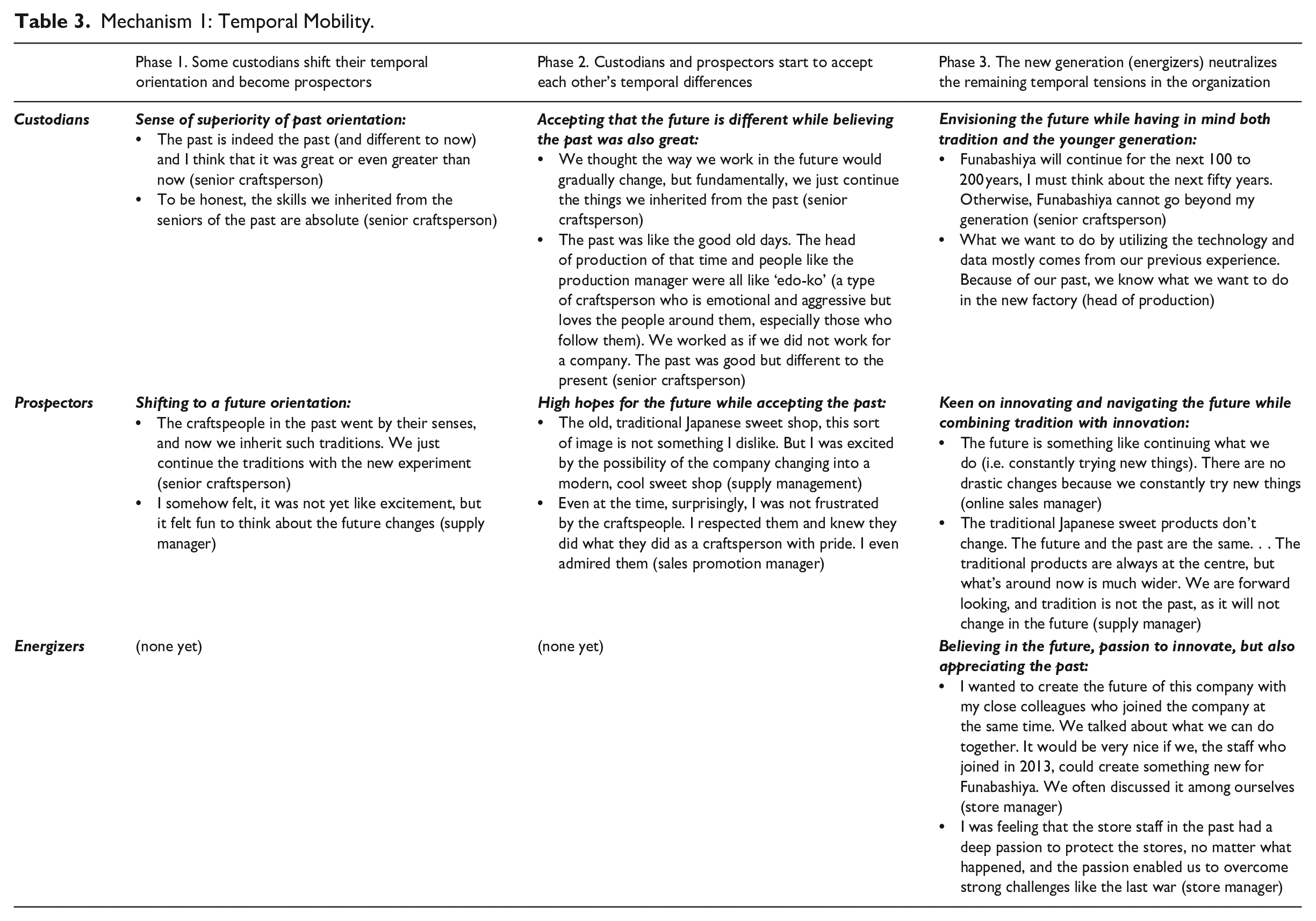
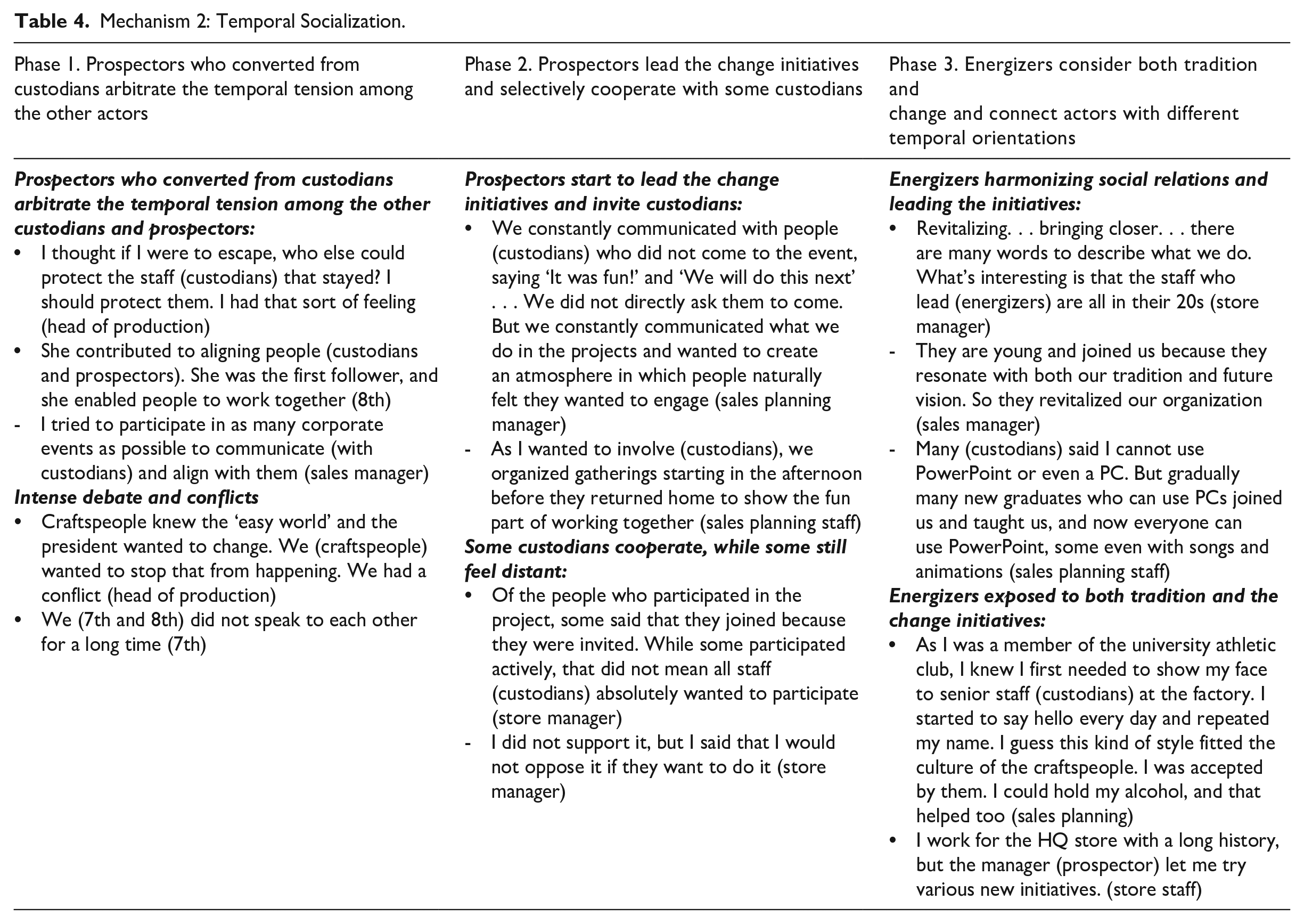
In this section, we present our analysis of how middle managers transitioned from being stuck in the past to employing it strategically as a competitive asset. We bracket the overall process into three phases. For each phase, we describe the reinforcing relationship between temporal mobility and temporal socialization, and how it enables different forms of coalescing the past. Further supportive evidence of our narrative is provided in Tables 3 to 5.
Mechanism 1: Temporal Mobility.
Mechanism 2: Temporal Socialization.
Mechanism 3: Coalescing the Past.
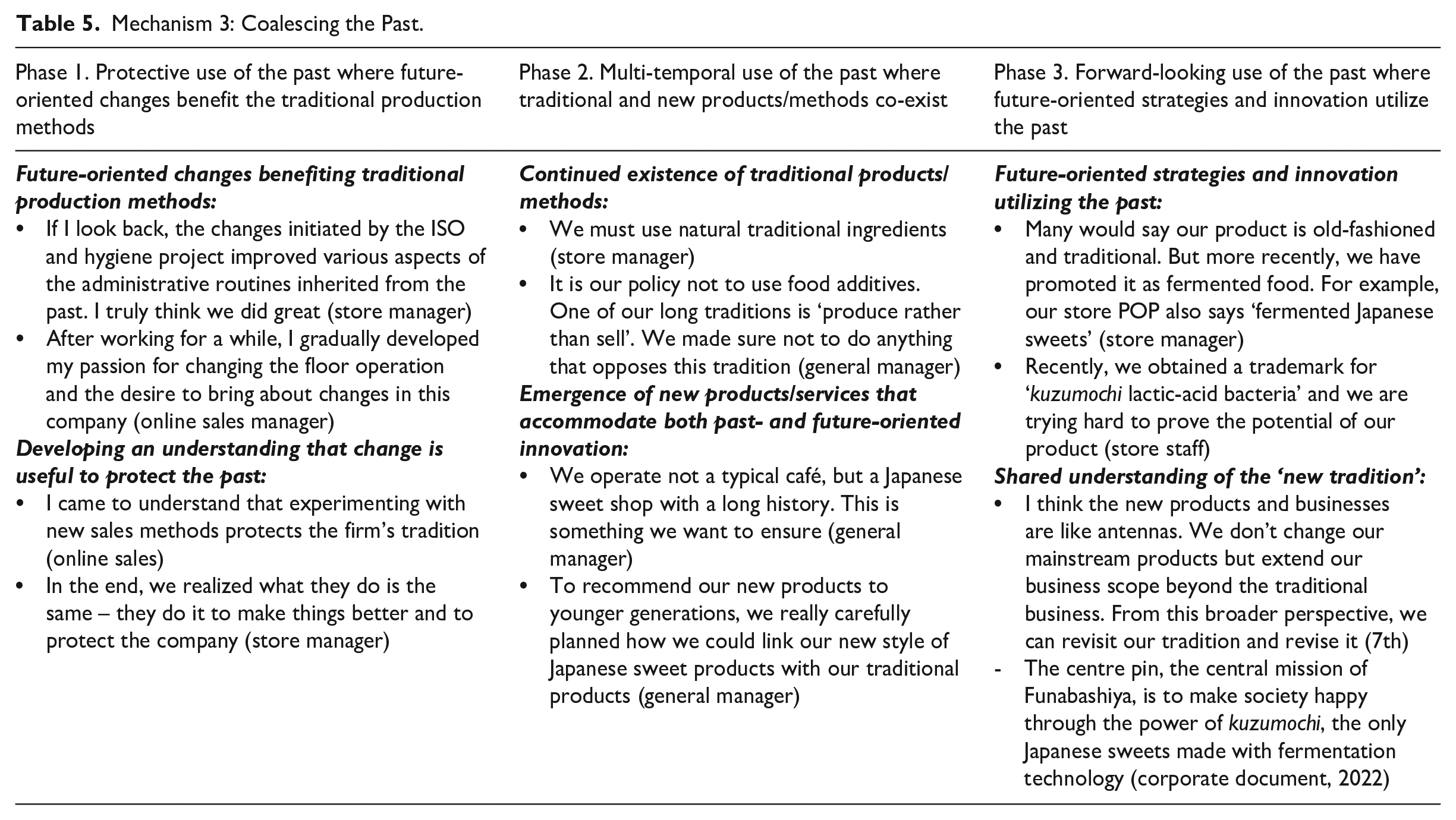
Phase 1: Legitimating the future (2001–2004)
In this phase, we observed how the temporal tension between the custodians and the prospectors gradually dissipated as some custodians shifted their temporal orientation and became prospectors (temporal mobility). This process of custodians changing their temporal orientations was reinforced by the temporal socialization process in which the newly converted prospectors began to mediate the temporal tension among the other actors who did not yet understand each other’s views of the firm’s past and future (temporal socialization). This positive cycle enabled a protective use of the past, where future-oriented change initiatives began to benefit and improve the traditional products and production methods (coalescing the past).
Temporal mobility
At the beginning of this phase, most middle managers felt ‘the firm had changed and lost the old days’ family-like feeling’ (production manager). This was because 8th questioned the practices inherited from the past and started to modify the internal operating procedures that many employees believed were an integral part of the firm’s tradition and past. We refer to these types of middle managers as custodians of the past, given their inclination to defend the incumbent leader’s past-oriented ways.
However, a turning point occurred when the firm decided to introduce ISO 9001 certification to minimize production risks. Certification required the firm to standardize and formalize the production process through developing new procedures, recording information and documenting factory operations. This was a substantial challenge for custodians in the production department. As the head of production observed, ‘many craftspeople just simply refused the new ways and insisted it is to destroy our tradition and history’. Most of the craftspeople believed in what they had learned from the past and ‘refused to accept the instructions given by the ISO instructor’ (production manager). Unfortunately, ‘many craftspeople actually left the firm, as they could not accept the future prospects’ (production manager).
However, some gradually shifted their temporal orientation. First, several middle manager custodians realized the value of the additional procedures and instructions because they understood that, ‘what the past craftspeople practiced in a different way can now be done by numbers and systems’ (senior craftsperson). For example, a senior craftsperson recalled, ‘The room temperature was high in those days. . . When we could identify the cause, we felt this is the value of ISO.’
These craftspeople who used to be against changes understood that change actually enabled protecting the past, ‘I took the role to initiate the required changes for the production methods inherited from the past. I did so to continue our tradition’ (senior craftsperson). They realized that, ‘We were afraid of the changes in the past. We were not flexible and were attached to things that did not change for a long period’ (general manager).
Gradually, they understood that to protect the past, they needed to adapt to the future and became convinced of the value of ISO and related change initiatives. We label these types of middle managers as prospectors, as they contributed to building a new future for the firm. Prospectors included several core managers who later became key executives, including the executive vice president, head of production and head of online sales, as well as many store managers. They were a subset of custodians who switched from the custodian role to the prospector role, converted by the realization of the tangible benefits (e.g. improved product quality), and serious efforts (e.g. ISO project) made by 8th and later by other leading prospectors.
Temporal socialization
The process of shifting the temporal orientations of custodians was reinforced by the mediation of temporal tension by the newly converted prospectors. In the initial phase of the ISO project, there was still mounting temporal tension within the firm. 8th recalled, ‘I was stressed, as the staff did not understand the instructions and could not follow the procedures in the guidelines’. 7th said to 8th, ‘The senior staff of the factory are from high school or even junior high school. Nobody reads books or uses pens or notes to study.’ 7th argued, ‘All of them do their best with the instinct and skills of a craftsperson. What would happen if we said to them that they should study again to change the traditional methods?’ However, 8th did not listen. ‘Whenever I forcefully told him things, he used to listen to me and change his mind. But this time he did not withdraw’, 7th recalled.
After the chaos in the early stage, the prospectors who understood the benefits of ISO attempted to instigate a more cheerful mood to mitigate the demanding change process. The prospectors realized that they needed to act to mediate the temporal tension between the custodians and other prospectors. For instance, ‘When 8th was preaching that the speed of change was slow, senior craftspeople (custodians) were about to leave the room. But the head of production at that time stopped them and helped us calm down’ (head of production). Furthermore, a sales manager recalled, ‘7th wanted to express his opinion, 8th also wanted to express his opinion. It would have been great if they could have discussed it with each other. But I had to be the middleman trying to bridge the gap.’
Prospectors also tried to ‘explain the need to change in various ways’ (planning manager) to engage custodians. A prospector explained, 8th was often misunderstood by senior staff. So, I explained that 8th may want to do this and that. I said why don’t we do them, as they were all interesting and fun. Senior staff who didn’t want to change the past (custodians) often reacted reluctantly, and some said they just wanted to sell kuzumochi. But I patiently tried to constantly communicate what 8th wanted to do. (sales manager)
After a long period of dispute, a middle manager confronted 8th, telling him that the changes were too tough. 8th and many staff remembered the moment as a turning point. 8th replied by asking the entire group whether they should then terminate the project. On this occasion, managers who had converted to prospectors appealed to the entire group by explicitly voicing their support, ‘I don’t want to stop here’ – he recalled them saying – ‘We did great until now. What do we get if we end now’, and ‘We are making every effort on this project, and if we stop here, then all our labour will be in vain.’ This was the turning of the tide: ‘Several people said they wanted to continue, and in a breath, all the employees over there started to repeat a clear yes. I was so happy that tears started to fall’ (Watanabe & Torikai, 2010).
Coalescing the past
In this phase, while most custodians did not accept the new strategic direction, enabled by the temporal mobility and temporal socialization processes, the prospectors could make sense of it. The new initiatives were understood as ways to improve and protect the products and production methods that continued from the past (e.g. Figure 1). As the head of production recalled, We did not know exactly how we mixed the three types of starch. The most experienced craftspeople did so through intuition, and we had no record of what the best mix is. I knew we couldn’t learn if we continued like that.
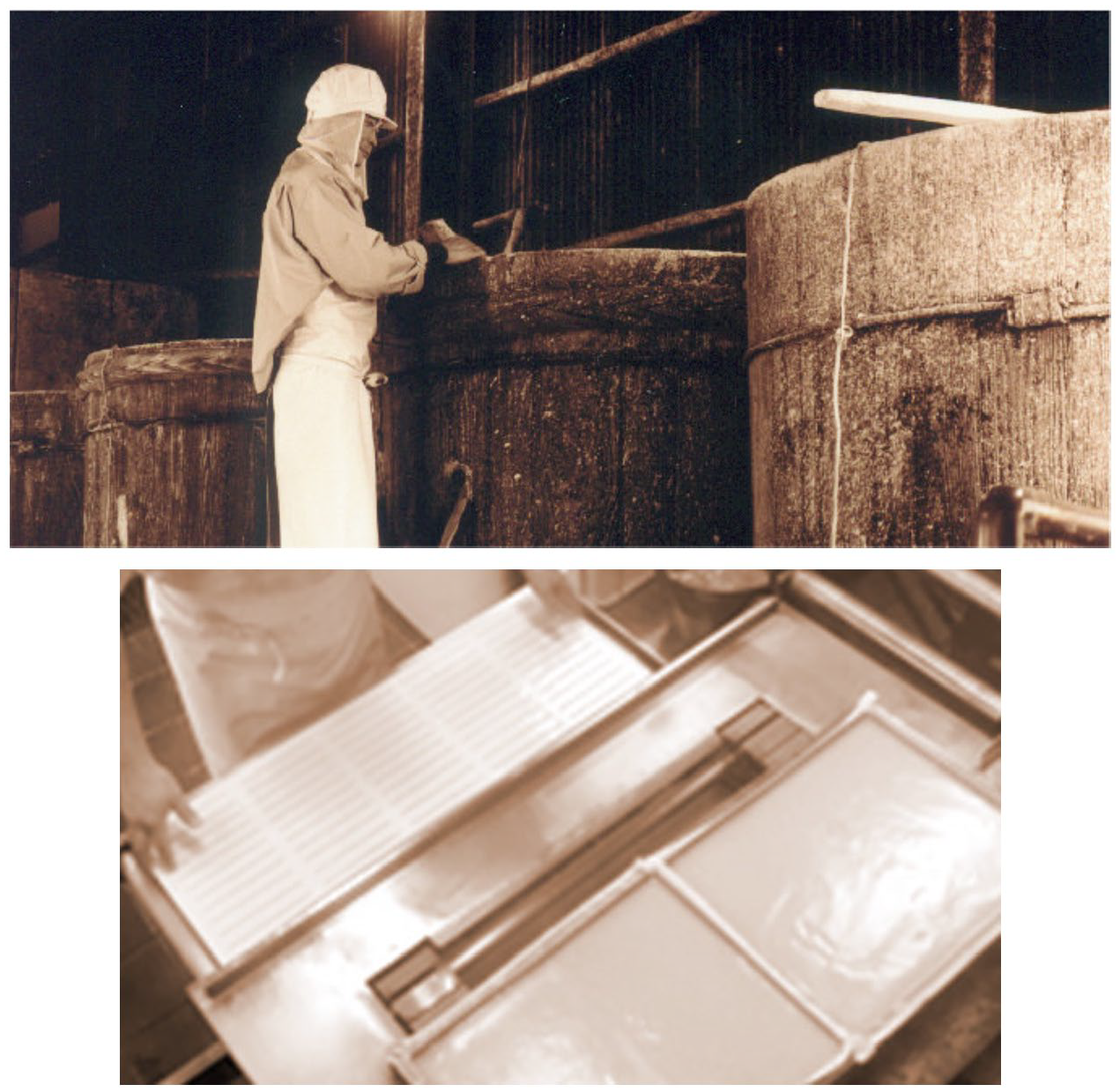
Phase 1. Pictures of the traditional kuzumochi production process.
After numerous discussions and gradual learning, he realized the ISO project was aimed at protecting the firm. The scientific method could solve the problems he could not resolve through many years of experience and improve the quality standard of what the firm offered. Similarly, ‘On summer days, our customers often claimed our products smelled bad or tasted sour. With the new process, we could check the record and investigate the reason’ (senior craftsperson). At first, many employees did not understand the reasons but simply followed the instructions given by the person they trusted. However, the change initiatives subsequently delivered material benefits that allowed them to understand the reasons.
Trust and respect worked as a trigger for the organizational members to believe in the changes that differed from what they had practiced for many years. The prospectors convinced 7th and the custodians about the importance and value of the new strategic direction. 7th understood that, ‘while the approach is different, they also want to protect the tradition.’ Another middle manager recalled, If I show the result and the efforts associated with the result, I know everyone will just stop complaining. . . I was determined to work very hard. . . I continued and gradually, we started to feel we were a team. I came to respect the part-time staff, as well as the store manager. We felt we wanted to work together forever.
The prospectors gradually began to have the power to influence the others around them. For example, a sales planning manager said, ‘I just said yes to the things they proposed because I thought they probably have certain experience or values behind what they say.’ Gradually, more employees in the firm understood that the changes were not aimed at destroying but at protecting the past and started to follow the prospectors, as one of the members of the online sales team stated on changing his mindset, ‘I started to develop my interest in the firm and think that I would like to be more involved.’ This change in the firm’s atmosphere paved the way for the next phase.
Phase 2: Reconciling the past and the future (2005–2008)
In this phase, we observed that the middle managers gradually became the drivers of change, and custodians and prospectors started to accept each other’s temporal differences (temporal mobility). As the momentum for change increased, along with their profile in the firm, prospectors selectively cooperated with some custodians, the more reluctant and past-oriented employees, in the company-wide transformation, also involving frontline workers (temporal socialization). As a result, the improved temporal understanding and the cooperation of custodians and prospectors enabled a multi-temporal use of the past where traditional and new products and production methods co-existed (coalescing the past).
Temporal mobility
The first change initiative that the prospectors conducted was the organizational revitalization project. The greater authority and opportunities fostered in prospectors a stronger future orientation. A production manager recalled, ‘I was excited by the fact that what I do influences what the firm will do’. The prospectors agreed and began to believe that ‘the future can be changed’ (supply manager), and ‘Funabashiya is changing toward something exciting and big’ (store manager). They started developing high hopes for the future, increasingly harnessing their ideas, and began driving the firm’s innovation.
Still, a sales manager elaborated on the gap between the two types of middle managers, ‘Those involved in the projects believed it was important to think about future trends, but others thought more of what customers wanted for the next month, or what encouraged customers to come in today.’ However, through regularly socializing with prospectors, custodians gradually acknowledged the value of what the prospectors were doing. The head of production recalled, ‘When we understood the fundamentals won’t change, we naturally accepted what Funabashiya started to do.’ A craftsperson felt that ‘technology does the same thing we have been doing for generations, but at a very fast speed’, meaning delivering the same quality but more efficiently. Another added, ‘Probably we (started to) feel the past was just the past (and so we should start to look ahead).’ On the other hand, the prospectors also showed understanding toward the custodians who maintained their temporal orientation, as another informant explained, ‘they protected tradition by focusing on their field tasks’ (planning manager). While the custodians were still proud of what they had been doing and were motivated to protect the traditional methods, many of them gradually accepted the new direction and started thinking it was time to renovate what they had been doing for many years.
Temporal socialization
The gradual acceptance of one another’s temporal orientations was reinforced by the prospectors and custodians selectively cooperating with each other. In the organizational revitalization and the subsequent projects, people selected from different departments cooperated to develop the plan to change the firm’s existing systems and routines. 8th recalled, ‘The purpose of the projects was to involve as many staff as possible to collect their voices, including compliments and new ideas. So that’s why I became a supporter. I decided not to say what I wanted to say.’ By this time, 7th ‘started to totally trust him, as he is the President’, and was ‘determined to stay completely silent’, asking them to ‘treat me as if I am not here’.
In these projects, prospectors were at the centre of the change initiatives. They met after work and discussed various topics, such as branding, supply management and mid-term business planning. Participation in the projects became ‘like a tradition, especially for relatively younger members who are passionate about the future of Funabashiya’ (sales planning). By this point, projects became the hub of prospectors who were driving the change.
Not all employees, however, fully understood the firm’s new direction, and some retained a neutral or negative attitude, ‘I helped because the President said we must’ (planning manager), or ‘. . . collaborated with the project teams and did not deny the benefits of what the project teams did. Yet, they did not proactively nor spontaneously act’ (sales manager). An internal survey indicated that there was still a gap in the overall satisfaction rate between custodians and prospectors. A senior director said, To be honest, there was a gap between them. But we didn’t want to leave them [custodians] behind. Even if the people didn’t want to associate [with the projects], we wanted them to feel involved, to feel that they were part of the entire change initiative.
Thus, prospectors invited custodians to participate in the change initiative despite their differing temporal orientations. They tried various ways to improve the participation of more past-oriented employees, via, for example, in-house media and frequent store visits. The executive vice president recalled, ‘Their opinion was not all bad. We just had to understand how we should explain to let them understand why we do this. I had a feeling that we shared the foundation.’ She continued, I first said this was just experimenting, and then said we do this just once or twice. I tried to develop immune systems inside them to slowly depart from past-oriented thinking. After three or four times, they [custodians] started to listen. Then the fifth or sixth, we could convince them.
As a result, the two groups of actors with different temporal orientations – custodians and prospectors – started to selectively cooperate to protect the firm’s future in the way that each believed, the latter by ensuring its survival in a changing environment, the former by ensuring the preservation of those core operations that conferred the firm its historical identity.
Coalescing the past
The improved temporal understanding and cooperation of custodians and prospectors enabled the co-existence of traditional and new products. While prospectors researched the latest trends in the confectionery industry, custodians began revisiting their idea of tradition in line with the firm’s future-oriented activities. As a planning manager said, ‘we had to catch up with the trend among the young, but I reminded the staff that our starting point should always be our tradition’.
Consequently, the firm started to offer a variety of products, from the purely traditional inherited from the past (e.g. kuzumochi) to the more modern (e.g. kuzumochi pudding, cheesecake and gelato), and shops that reflected the changing customer preferences (e.g. Koyomi, a casual Japanese confectionery café targeting young female customers; Figure 2). However, the Koyomi store manager stated, ‘When we make new products and services, at Koyomi, we always put kuzumochi up front. Kuzumochi is the product that has existed for two centuries. I wanted to respect and value this important product.’ She continued, Yes, 200 years. For example, I cannot imagine 200 years with kuzumochi pudding. Kuzumochi continued from when we had no information tools like social media. Kuzumochi is the reason why many customers support our store. That’s what I feel.
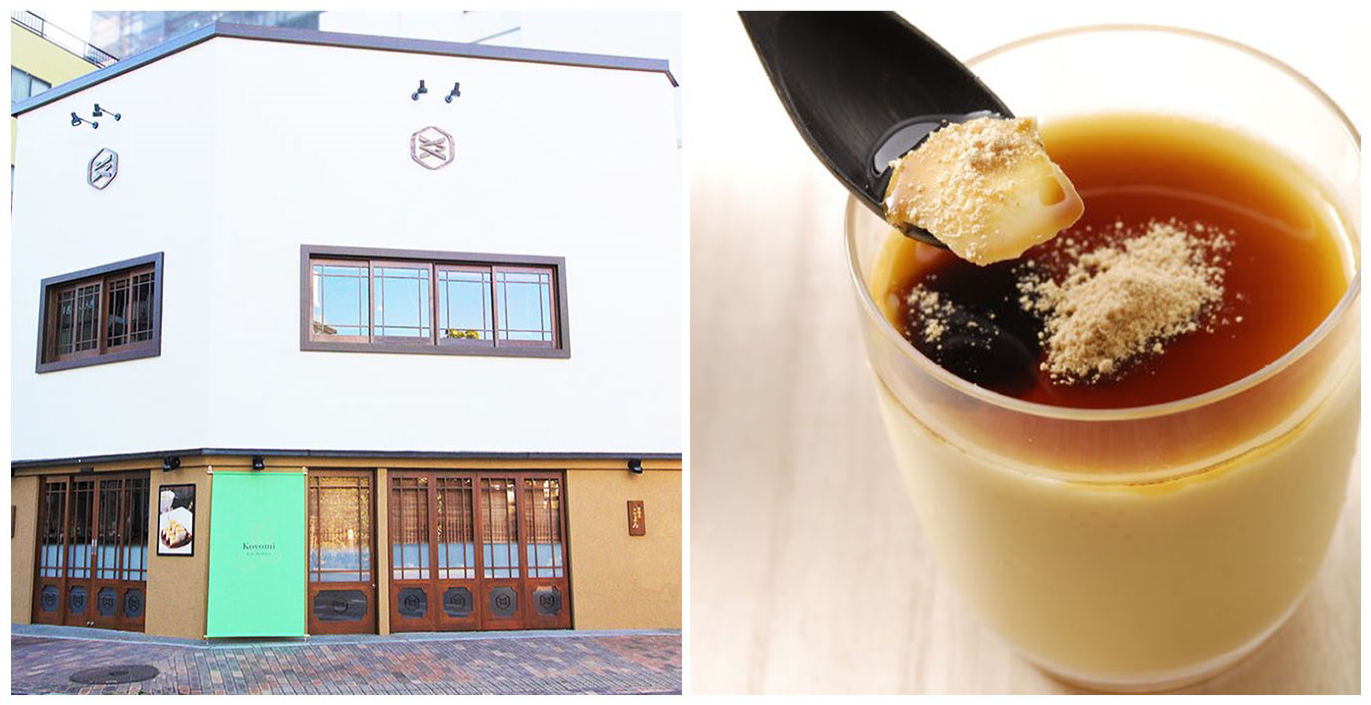
Phase 2. Koyomi café and kuzumochi pudding.
This quote shows how the store manager valued the past, and precisely because of this, proactively engaged in developing new products and services to accommodate changing customer trends. Simultaneously, the prospectors made constant efforts to legitimize the change initiatives. As a result, more custodians changed their stance. One even said, ‘I always help them if asked, as I know what they do is different but what they believe is the same as me.’
The improved participation of past-oriented employees, both middle managers and frontline workers, combined with the informal relationships among employees in different functions, resulted in an improved sense of community. This allowed prospectors to accelerate the pace of change, thereby enhancing their power base, which paved the way from phase two to phase three. As a sales planning staff member recalled, ‘Rather than enforcing our power on others, we made our approach more enjoyable and tried to invite the people who resonated with us. We increased our centripetal force and, through that, involved more people.’
Phase 3: Materializing the past (2009–2022)
In the final stage, the new cohort (energizers) that had not been part of the tensions and conflicts in the previous phases neutralized the remaining temporal tension between prospectors and custodians (temporal mobility). They did so by showing respect and protecting the firm’s traditions while contributing to and driving some of the change initiatives. In so doing, they managed to connect actors with different temporal orientations and create a sense of unity (temporal socialization). The prospectors came to believe that only constant innovation would drive a future with tradition, while custodians started to seriously consider the future of tradition, beyond what they currently did with existing methods and technologies. This improved the unity and harmony in the firm, and enabled a forward-looking use of the past where future-oriented strategies and innovation use the past (coalescing the past).
Temporal mobility
In 2009, the middle managers took the lead in re-designing the recruitment process to hire ‘people who could share the passion with us and be in the same boat’ (planning manager). We label them as energizers, as they helped stimulate interactions among prospectors and custodians by working with the former on projects they voluntarily joined and with the latter in their daily work through on-the-job training. When energizers joined, they felt the firm was not a typical long-established confectionery producer but a company that did something new, innovative and visionary. They were attracted by ‘the long history and tradition’ (store employee) combined with ‘the atmosphere that resembles an IT start-up’ (store manager). These new employees played an important role in refining the balance between the past and the future. They were invited to participate in the corporate-wide change initiatives even in their first year. Many of them delivered material value (e.g. offering an English menu, proposing new marketing programmes, developing new products and organizing informal staff meetings).
Their presence reinfused many past-oriented employees, namely custodians, with energy and motivation to pass down the traditions they cherished. Their eagerness to learn comforted custodians that the traditions were still valuable and valued, viewing energizers as the future of the firm because they felt, ‘The younger craftspeople in the new factory will further improve what we do today. Perhaps they will change the taste by using different ingredients’ (senior craftsperson). The participation of energizers enabled custodians to think beyond the current generation and foster a future-oriented mindset. The general manager added, ‘The future is something that the younger members build. I must not deny them but should help them, as they are the next generation leaders.’
The energizers also revitalized prospectors by bringing in ideas for further innovation utilizing the past. A production manager admitted, ‘We often learned from the younger generation because how they think is different from how we think.’ The interactions with the new generation with a passion for the future allowed them to ‘think about the future’ (store manager) and ‘feel if we don’t change the tradition, we have to constantly change’ (general manager).
Temporal socialization
The neutralization of the outstanding temporal tension was reinforced by the energizers’ efforts to socialize with the prospectors and custodians and create a sense of unity. After recruitment, the energizers initially engaged in on-the-job training to learn the traditional practices and techniques, since many activities, especially in production and storefront customer management, still relied on tacit knowledge and understanding of the processes. As a result, storefront and production maintained an apprentice-type system where new employees ‘learned by just following what senior employees were doing’ (sales manager). They ‘just watched and captured how the more experienced ones managed the task’ (head of production), or ‘listened to the stories told by older generations such as the head of the HQ store and 7th’ (store manager).
At the same time, energizers dedicated their free time to projects, socializing with prospectors with a changing future-orientation mindset. As a recent graduate explained, I participated in the hygiene management project because I had an interest in quality control and hygiene control as part of my research on lactic-acid bacteria at university. As we were told that we could join from the first year, I asked to be taken in. (store manager)
Energizers socialized with experienced store staff and factory craftspeople (mostly custodians at that time) adopting a highly respectful and learning attitude, proactively and enthusiastically engaging with managers and staff from the planning and marketing functions (mostly prospectors). Their openness and respect for both prospectors and custodians led to them being trusted by managers and staff alike.
As a result, energizers were exposed to both the traditional processes and the change projects, gradually but relatively quickly becoming middle managers of projects and special initiatives to innovate operations by socializing with staff from different functions. They became the communication hub within the firm, facilitating harmonization between custodians and prospectors. By 2022, energizers were ‘a large group of employees who really understood our future-oriented direction’ (planning manager). By 2023, all managers were considered either prospectors or energizers, although some on the storefront and on the factory floor remained custodians.
Coalescing the past
This improved temporal unity and harmony enabled a forward-looking use of the past in which future-oriented strategies and innovation leveraged the past. By this phase, Funabashiya was no longer an old-fashioned confectionery firm. It became a fermentation-based technology company with products ranging from Japanese sweets to pharmaceuticals based on the firm’s expertise in lactic acid bacteria and fermentation technology (Figure 3 shows an example of the newly developed kuzumochi supplement). In fact, a corporate strategy document explains 11 business domains, including social media and buzz marketing, advertising, video production and human resource development, with the production of kuzumochi clearly positioned at the centre of the diverse business portfolio. The firm also collaborates with companies in different business domains, notably luxury hotels, rugby teams and manga comics.

Phase 3. Kuzumochi supplement (dietary supplement).
In 2014, a company store report stated, ‘While kuzumochi is the base of Funabashiya, we go beyond kuzumochi’ (8th). In 2022, one of the middle managers became the 9th CEO, with the owning family maintaining the controlling stake. The new CEO, a prospector, promised that the past would still be referred to and utilized, but as a strategic asset to empower the firm’s future products, strategy and direction, ‘We are determined to protect the tradition by researching kuzumochi with our craftspeople, and will also try to connect the value of kuzumochi to the future through our kuzumochi-based lactic acid bacteria business’ (Fukushima, 2022).
In the final phase, we observed that most actors shared the same understanding of what the firm’s tradition should be and why it was engaging in new initiatives. The organizational members expressed the same idea in different words, for example, ‘The roots are the same’ (7th), ‘Innovate to protect’ (general manager), ‘We have updated our history’ (store manager) and ‘This firm will survive the next 100 years’ (store employee). They had the same understanding that constantly updating the products and systems helps or renews, not harms, the tradition.
Others said, ‘Constant change is our new tradition’ (online sales manager) and ‘What the new generation create will be our new tradition’ (production manager). They were forming a new tradition that was no longer something from the distant past. Moreover, all informants asked about the future responded that kuzumochi will still be the foundation of Funabashiya in the future. A production manager said, ‘We have kuzumochi, and from there, various other concepts emerged. . . In the end, Funabashiya has the ultimate brand, kuzumochi, and that is the starting point of everything.’ A store manager explained, ‘I believe all of us really have confidence in our history and kuzumochi. We believe we provide great service. This is our foundation.’
Theoretical Model
To help interpret the various concepts and their relationships in our data, we constructed a process model (Figure 4) that illustrates how the three types of middle managers (custodians, prospectors and energizers) gradually leveraged history in contexts of disagreement and unsettlement at the top. We identified three phases through which middle managers progressively learned to use the past via three core processes and how they evolved over time: temporal mobility, temporal socialization and coalescing the past.
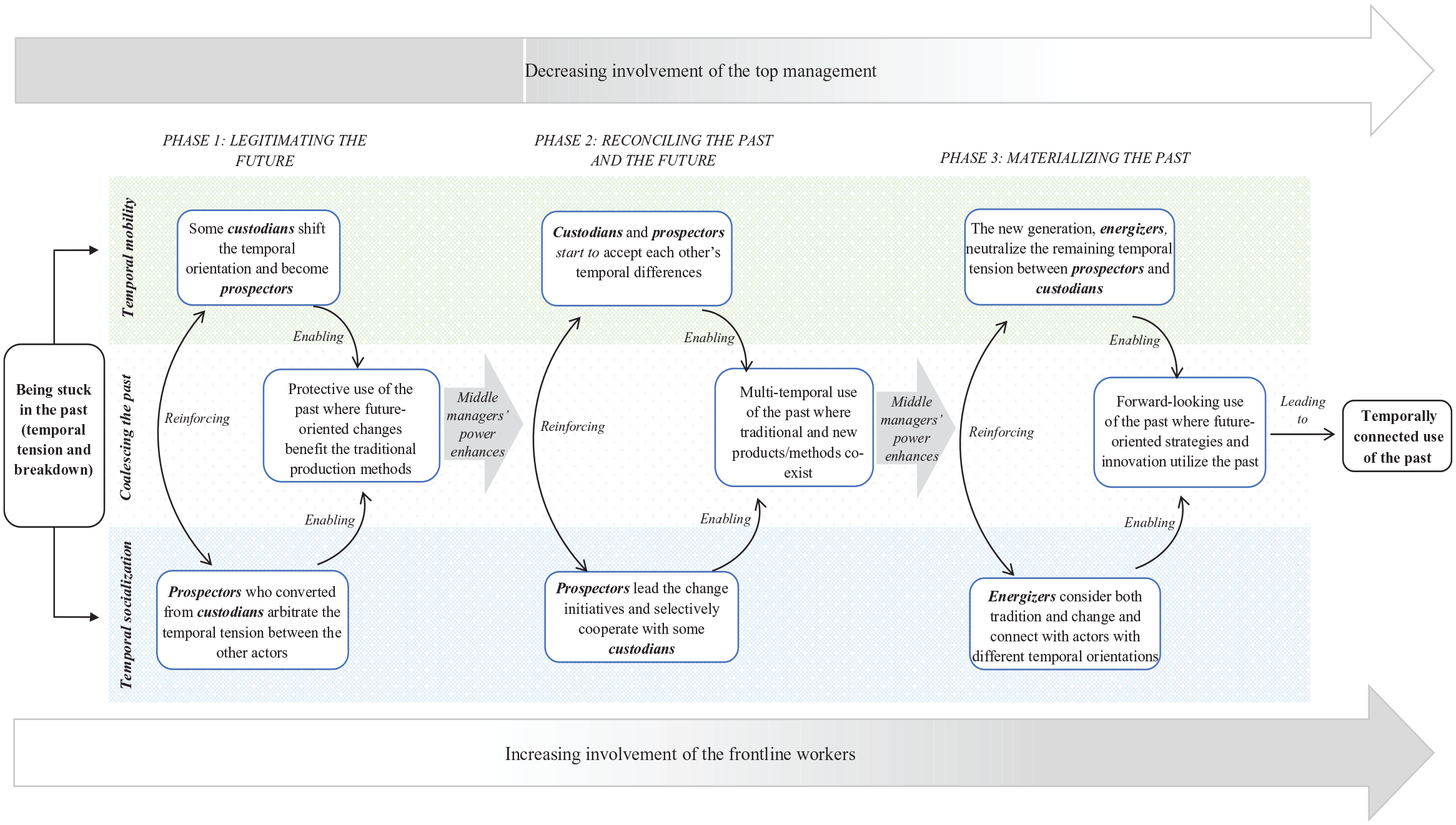
A model of how middle managers can turn the past into a strategic asset during a period of unsettlement.
Temporal mobility
First, our process model explains how middle managers can alter their temporal orientation over the different phases of the process. In the first phase, middle managers flexibly shift their original temporal orientation based on the recognition of the problem and the need for change. Subsequently, thanks to the temporal socialization process where a selected subgroup of custodians and prospectors begin to cooperate, a smaller group of middle managers starts accepting the temporal orientation of others. Finally, based on the diffused sense of community, their temporal mobility accelerates whereby custodians and prospectors gradually share similar temporal orientations with the help of energizers.
Temporal socialization
Second, our analysis suggests that temporal mobility occurs over time, reinforced through what we conceptualize as temporal socialization. This process explains how middle managers increasingly engage in social dialogue specifically with actors with differing temporal orientations, which facilitates expanding the scope of cooperation in the organization. Our analysis shows that at the start of the process, temporal socialization is reinforced through middle managers who convert from custodians to prospectors. Subsequently, the scope of cooperation increases as a selected subgroup of middle managers (both prospectors and custodians) collaborates to implement the strategic change initiatives and facilitates mutual temporal understanding among other middle managers and frontline workers. However, larger-scale cooperation is enabled by the new generation of middle managers, the energizers, who are not constrained by the firm’s past conflicts. They engage in temporal socialization with both groups and harmoniously connect actors with different temporal orientations.
Coalescing the past
Third, our analysis indicates that temporal mobility and temporal socialization enable middle managers to engage in gradually weaving together a new understanding of the past in the production processes and offerings. Our model shows that the successful use of the past by middle managers over time increases their power base (as the power base of top managers decreases and middle managers increasingly involve frontline workers), in turn paving the way to engage in a more substantive use of the past in the next phase. Our analysis reveals that, at the start, they might use the past protectively, continuing to rely on outdated norms and routines. Subsequently, they shift to embrace multi-temporality – that is, the co-existence of past-oriented and future-oriented products and production methods (Le Breton-Miller & Miller, 2011). Our findings, however, reveal that a multi-temporal orientation may not be enough, and a forward-looking use of the past becomes more effective when the organization is able to undergo a deeper organizational renewal that involves the creation of a new tradition that rests on a future orientation.
Discussion
Theoretical contributions to the use-of-the-past literature
Our research provides novel contributions to the use-of-the-past literature. This body of work explains how top managers strategically use the past to build, maintain and advance their own agenda and present-day concerns (Cailluet et al., 2018; Mordhorst, 2008). Nevertheless, prior research also acknowledges that top managers do not always have convergent views of the past and future, leading to a period of unsettlement (Hampel & Dalpiaz, 2023; Kaplan & Orlikowski, 2013; Raffaelli et al., 2022). Therefore, the literature suggests that the strategic use of the past is not straightforward when top managers are unable to reconcile contrasting temporal orientations. Our findings provide new insights into this dilemma of how an organization’s past can be turned into a strategic asset during a period of unsettlement when the temporal orientations of top managers collide. The cornerstone of our theorization rests on the central role of middle managers. We explain how they gradually leverage history in contexts of disagreement and unsettlement through three processes as the strategic role of top managers lessens: temporal mobility, temporal socializing and coalescing the past.
While the literature emphasizes how the past can be used in the present moment, typically by top managers (Brunninge, 2009; Suddaby et al., 2010), the process-analytic lens we employ elucidates how middle managers can gradually learn to move from being stuck in the past to using the past as a strategic asset. Process theorizing (Holt & Johnsen, 2019; Reinecke & Ansari, 2017) is key to theorizing how middle managers’ multiple experiences of the past differ, evolve and eventually find consensus. This process theorizing challenges the somewhat linear conception of time in the use-of-the-past literature by showing that the co-existence of middle managers with multiple temporal orientations (custodians, prospectors and energizers), their strategic flexibility to alter the temporal orientations and their engagement in social dialogue are necessary to gradually find the use of the past that fits the temporal context of the organization. In some ways, the fragile position and social identity of the middle managers proved useful for their flexible and collective use of the past.
More specifically, our theorization explains how such multiple temporal orientations shift over time (temporal mobility) via the socialization process among actors with varying temporal orientations (temporal socialization). These two processes are theoretically important as they conceptualize the distinct ways in which middle managers interpret and enact temporal resources. Our analysis shows that these two processes enable middle managers to gradually evolve their strategic use of the past. As such, as encapsulated in the third process (protective use of the past in phase 1, multi-temporal use of the past in phase 2 and forward-looking use of the past in phase 3), our findings allow us to look at the emergent, in-the-moment evolution of middle managers’ strategic use of the past. These findings are significant as they extend current understanding of the strategic use of the past as not undertaken by a few powerful individuals in a given moment but as a continually changing process enacted by multiple middle managers with various temporal orientations.
Second, our analysis suggests that middle managers’ use of the past is not just an ever- changing process, but a continuous process of relational engagement (Emirbayer, 1997), as individual temporal orientations influence or are influenced by the temporal socialization process. While previous studies indicate that actors need to be open to multiple temporalities, simultaneously navigate different temporal demands (Jarvenpaa & Välikangas, 2021) and achieve temporal congruence in order to avoid relational conflict (Freeney, van der Werff, & Collings, 2022), we explain how and why different types of middle managers influence and are influenced by their temporal orientations, top managers and frontline workers over time and come to agree on how to use the past. Thus, unlike studies that apply relational constructionism (Hosking, 2011) and highlight the competitive (Cailluet et al., 2018) and authoritative (Aeon & Lamertz, 2021) ways in which top managers tend to use the past, our findings shift the emphasis to the flexible and collaborative ways in which middle managers use the past. This finding is important because it offers a different perspective on the use of the past that assumes a higher degree of agency for middle managers, rooted in a relational and pluralistic process of interpreting, mobilizing and embedding the past in concrete products and production processes through the ongoing social engagement (Emirbayer & Mische, 1998) of actors’ multiple and divergent temporal orientations that drive the development of the use of the past over time. Thus, we show how middle managers both influence the temporality of others and are influenced by others, generating multiple possible temporal positions and practices (Emirbayer, 1997; Polletta, 2022).
Finally, our study provides theoretical contributions by explaining how middle managers enact their strategic flexibility (Ahearne et al., 2014; Floyd & Wooldridge, 1997) from a temporality point of view. Prior studies implicitly assume that middle managers can accomplish temporal work (Kaplan & Orlikowski, 2013), but with shorter time horizons and less strategic importance than that of top managers (Schultz & Hernes, 2013). The process point of view we adopt enables us to reconsider middle managers’ ability to engage in using the past. According to our analysis, middle managers are able to enact and adjust multiple temporal realities over a long period of time, and mediate the temporal tension among top managers, ultimately influencing the temporal orientations of frontline workers across the organization.
This finding is theoretically novel because although the literature extensively discusses the simultaneous upward and downward influence that middle managers typically exercise (Harding, Lee, & Ford, 2014; Jarzabkowski, Lê, & Balogun, 2019), it focuses predominately on the interplay between top and middle management in the context of strategic renewal. Our study extends these findings by specifically reconceptualizing the strategic flexibility of middle managers from a temporal standpoint, showing that middle managers influence and alter the temporal orientations of the top and the bottom. Therefore, our study theorizes the multi-level process of mutual adjustment of temporal orientations led by middle managers.
Boundary conditions and future research suggestions
Our findings may be transferable to other organizations infused with a rich history and tradition but unsure of how to strategically use the past. Being stuck in past success and unable to adapt to changing environmental needs is a common phenomenon in any organization (Johnson, Scholes, Whittington, Regnér, & Angwin, 2017). However, this tendency may be more pronounced in firms relying on traditional skills, products and services, such as craft firms (Kroezen, Ravasi, Sasaki, Żebrowska, & Suddaby, 2021) and those with a long history (Sasaki, Ravasi, & Micelotta, 2019). It is not easy for firms whose competitive advantage rests on the past to adapt to a changing environment, as it calls for simultaneously attending to the opposing demands of protecting the past and changing the organization to survive (De Massis, Frattini, Kotlar, Petruzzelli, & Wright, 2016; Raffaelli et al., 2022).
Nor is it easy to change the temporal orientations of members of such organizations, as this may negatively affect their professional identity based on long traditions and established norms and routines sometimes inherited over generations (Wallace & Kalleberg, 1982). Our findings suggest that middle managers occupy a strategically important position in such firms as key actors who can gradually turn the past into a strategic asset. Indeed, we found that even custodians can slowly reinterpret the past and their professional identity via the three processes that emerged in our study.
Moreover, our theory could be transferred to cases where the temporal tension among top managers creates a period of unsettlement and a leadership vacuum. In such cases, different types of middle managers could play a central role in gradually using the past, even if the process may take longer than when top managers implement the change. For example, phase three of our process model shows that a generational change among employees is required to implement an organization-wide, forward-looking use of the past. Therefore, a boundary condition of our theory is that organizations need to have the resources and time necessary to survive the lengthy organizational renewal process. Future studies could examine how the process unfolds differently depending on the firm’s resource constraints and the composition of the organizational hierarchy (top management, middle management and frontline workers).
Finally, we suggest that while the Japanese national culture is known for its long-term and collective orientation (Hofstede, 2001), our theoretical insights may be transferable to other national contexts and industries in which history and tradition matter in strategic decision-making and their daily operations (e.g. Italy and France’s fashion industry, heritage tourism, or cultural and creative industries across Europe where products and services are based on heritage-derived content). Future studies could thus examine how the broader institutional environment differently affects the intra-organizational processes.
Footnotes
Acknowledgements
We express our deepest gratitude to Funabashiya for the generous research collaboration and support. Without their time, commitment and efforts, it would not have been possible to generate new knowledge on this important phenomenon. We are also grateful for the friendly feedback on the earlier versions of the paper by colleagues from Warwick Business School, UK, Lancaster University Management School, UK, Turku University School of Economics, Finland, particularly, Professor Trish Reay, Dr Sarah Woolley, Professor Davide Ravasi, Professor Gerardo Patriotta, Professor Niina Nummela, Dr Peter Zettinig and Dr Birgitta Sandberg. Moreover, we thank the Italian Association of Family Enterprises (AIDAF) and Family Business Risorse per l’Italia (FABRI), as their associate firms contributed to inspiring our thoughts and refining our thinking. Last but not least, we are grateful to Professor Nina Granqvist and the three anonymous reviewers for their extremely insightful feedback and guidance over three rounds of review.
Funding
The author(s) disclosed receipt of the following financial support for the research, authorship, and/or publication of this article. We express our gratitude for the funding from the Japan Society for the Promotion of Science (JSPS KAKENHI Grant Number 18K12847).