




Abstract
This article combines insights from the organizational institutionalist (OI) literature on the complexity of transnational institutional streams and the power-based approach of the comparative employment relations (CER) literature to better explain diversity in human resource (HR) practices across organizations embedded in different societal contexts. Building on the insights from both literature strands, the article argues that societal institutions, by providing power resources to labour vis-a-vis management, influence the settlement of contradictions in HR practices in the workplace, with implications for the internal consistency of HR systems. The findings are based on the comparative case study of three metal companies in Germany, Italy and the United Kingdom that implemented lean management systems. They suggest that labour-supporting institutions at the sectoral and organizational levels in the German metal company contribute to a more ‘balanced’ settlement of the tensions between the (ideo)logics of empowerment, cost-cutting and Taylorism, which characterize lean management systems, compared to the Italian and British companies. The article contributes to cross-fertilization between the OI and CER literature because it demonstrates the value of integrating the power resource perspective in (comparative) OI studies, and of taking into greater consideration the role of transnational (ideo)logics in CER research.
Keywords
Introduction
This article responds to recent calls for greater cross-fertilization between the organizational institutionalist (OI) literature and the comparative institutionalist (CI) literature and combines these perspectives to better explain diversity in organizational practices across societal contexts (Hotho & Saka-Helmhout, 2017; Jackson, Helfen, Kaplan, Kirsch, & Lohmeyer, 2019; Tempel & Walgenbach, 2007). Building on insights from both literature strands, this article argues that societal institutions influence the settlement of multiple logics through the implementation of human resource (HR) practices in the workplace, with implications for the internal consistency of HR systems.
The OI literature developed an in-depth understanding of tensions between logics in organizational fields. Logics are defined as sets of ‘assumptions, values, beliefs and rules’ that are associated with meaningful practices (Thornton & Ocasio, 1999, p. 804); their organizing principles and attached behaviours might contradict each other but also co-exist within fields and organizations (Thornton, Ocasio, & Lounsbury, 2012). While a broad literature explains variation in practices across fields and organizations by looking at how actors solve these tensions when implementing logics (Thornton et al., 2012; see literature review), the role of power dynamics between organizational actors is limited (Munir, 2015). The rare power-based analyses point at societal macro-structures such as racism and classism (e.g. Creed, Gray, Höllerer, Karam, & Reay, 2022) and their effect on individual experiences (Soundararajan, Sharma, & Bapuji, 2023); thus, the OI literature has disregarded how societal institutions at the micro and meso levels can influence the settlement of logics across organizations by providing actors, particularly labour and management, with power resources (Morgan & Hauptmeier, 2014).
Given the absence of mid-range power-based explanations for cross-organizational diversity in the OI literature, this article suggests integrating the insights of a specific strand of the CI literature, comparative employment relations (CER), on societal institutions’ influence on organizations: institutions are conceptualized as power resources and constraints at the organizational, sectoral and national levels, which influence the micro-politics between labour and management that underlie organizational arrangements (Doellgast & Marsden, 2019; Frege & Kelly, 2020). Scholars used this approach to study the diffusion of global HR practices across institutional contexts within multinational corporations (e.g. Becker-Ritterspach, Blazejewski, Dörrenbächer, & Geppert, 2016) and across organizations (e.g. Krzywdzinski, 2017). Yet, when considering global HR models as convergence forces, the CER literature neglects the tensions between logics within these ‘transnational institutional streams’, which consist of ‘dis-embedded institutional ideo-logics that transcend and affect specific organizational fields’ (Delmestri, 2009, p. 119). Thus, existing analyses do not explore how the empowerment of some organizational actors over others might undermine the balanced co-existence of multiple ideo-logics in the transnational ‘HR model’, and create contradictions between HR practices once implemented, leading to inconsistent HR systems. Internally consistent HR systems are constituted by coherent ‘bundles’ of practices that support each other’s effectiveness, making them better able to achieve organizational objectives (Delery, 1998; Macduffie, 1995).
The empirical analysis, mainly based on 100 interviews with union representatives and managers, focuses on the implementation of lean management in three metal companies in Germany, Italy and the United Kingdom. The findings confirm the value of integrating the OI and CI literatures to understand how multiple ideo-logics in transnational streams are implemented in organizations embedded in different societal contexts: in the German metal company the settlement of the multiple logics constituting lean management systems was more balanced thanks to societal power resources supporting labour; in contrast, the implementation of lean HR practices was characterized by contradictions in Italian and British companies due to the institutional contexts favouring management. In the Italian case, in particular, company-level – rather than national-level – institutional arrangements affected workers’ access to power resources. Thus, the findings cannot be easily explained using the National Business System (NBS) approach (Hall & Soskice, 2001; Whitley, 1999), which is widely applied in comparative OI studies; this strengthens the case for adopting the multilevel power resource approach of the CER literature.
The article advances both literature strands. On the one hand, it contributes to enrich the OI literature because it demonstrates the value of integrating societal institutions in the analyses of struggles around the settlement of multiple logics within organizations by reconceptualizing them as power resources. On the other hand, it enhances the debate on the institutional effects on the implementation of global HR models because it points out the tensions between logics within transnational institutional streams, and shows that societal institutions, by influencing their settlement in the organization, can affect the internal consistency of HR systems.
The article proceeds as follows. The next two sections discuss, respectively, the OI literature and the CER literature, and the multiple ideo-logics co-existing in lean management systems. After the methodology section, we illustrate and compare the case studies. The final section offers theoretical implications and outlines directions for further research.
Societal Institutions and Contradictions in Organizations
There is a broad OI literature on the tensions arising from the co-existence of multiple logics in organizational fields, and on how organizations settle them, with implications for their practices (Delmestri, 2009; Friedland & Alford, 1991; Rao, Monin, & Durand, 2003; Thornton et al., 2012). While early studies argued that the tension between logics is solved when a logic becomes dominant in the field (e.g. Rao et al., 2003), OI scholars now acknowledge that organizations can compromise between co-existing logics (Battilana & Dorado, 2010; Greenwood, Raynard, Kodeih, Micelotta, & Lounsbury, 2011; Nicolini et al., 2016). Their settlement depends on a range of factors. The field environment can influence how organizations respond to multiple logics: for instance, the pressure to adopt a specific logic depends on whether the organization is peripheral to the field or whether the field is centralized (Greenwood et al., 2011; Pache & Santos, 2010), or on the nature and power of constituents in the field (Oliver, 1991). The nature of logics might also exert an effect; for example, if they contradict logics internal to the organization, especially those that entail a change in values rather than practices, or if they pose excessive constraints, organizations are more likely to resist incoming logics (Oliver, 1991; Pache & Santos, 2010). Other scholars instead point out the role of the constituencies within organizations, for instance, the ambitions and identities of managers (Delmestri, 2006; Vidal, 2017), or the level of commitment of (dominant) organizational actors (Pache & Santos, 2010).
However, the role of power, and especially the (structural) power asymmetries between organizational actors, has been under-researched (Munir, 2015). On the one hand, OI scholars recognize that the co-existence of multiple logics derives from the support of powerful actors in the field; thus, logics perpetuate the status quo (Reay & Hinings, 2009, pp. 631–632). While scholars also argue that actors supporting a new logic, even if marginal to the field, can acquire power by manipulating the logics to legitimate their actions (Reay & Hinings, 2009; Thornton et al., 2012), this conceptualization of power is episodic rather than rooted in the social structures outside organizations (Hudson, Okhuysen, & Creed, 2015). Only recently have OI scholars highlighted how hegemonic power structures influence the ability of organizational actors to shape the settlement of multiple logics, such as racism and classism, that characterize all societies (Creed et al., 2022). However, these macro-level power-based explanations do not clarify the cross-organizational variation in the settlement of multiple logics; for this, a conceptualization of power resources based on societal institutions at the national, sectoral and organizational levels is required (Morgan & Hauptmeier, 2014).
Indeed, there are few OI studies that explore the influence of societal institutions on the settling of tensions between logics (Hotho & Saka-Helmhout, 2017; Jackson et al., 2019), and those studies do not illustrate how institutions influence power struggles within organizations by redistributing power resources to actors. Rather, they focus on how national-level institutions influence organizational structures or field-level dynamics; institutions provide a ‘corridor of possibilities’ (Nicolini et al., 2016, p. 244) by supporting distinct logics that legitimize certain actors over others in shaping the settlement of multiple logics (Meyer & Höllerer, 2016; Nicolini et al., 2016; Schrage & Rasche, 2022; Vasudeva, Zaheer, & Hernandez, 2013). Due to the limited number of studies considering institutional contradictions in HR systems (see Lewis, Cardy, & Huang, 2019), this critique especially applies to the (neglected) power dynamics between labour and management, which are central to organizations (Munir, 2015) and are critically shaped by the societal context.
This blind spot could be addressed by integrating insights from the CER literature. This literature is related to the NBS approach (Hall & Soskice, 2001; Whitley, 1999), because it focuses on ‘hard’ institutions, such as collective bargaining structures, union strength and labour market regulation, and acknowledges the cross-national variety of those institutional configurations. Yet, there are important differences. First, CER scholars highlight the heterogeneity of sub-national institutions and adopt a multilevel analytical approach. Second, the literature is characterized by a power-centred framework (Frege & Kelly, 2020) similar to the societal effects literature, which preceded the NBS literature and used to dominate the field of organization studies (Sorge, 1991; Sorge & Streeck, 1987). Indeed, while the NBS literature understands organizational arrangements as a result of actors’ preferences formed within the structure of incentives and opportunities set by their institutional system, CER scholars interpret them as a result of conflicts among organizational actors (especially labour vs capital; Morgan & Hauptmeier, 2014), which are differently empowered depending on the national and local institutions (e.g. Sorge, 2005).
Like the societal effects literature, CER research explores how convergence pressures are filtered through societal institutions and, in particular, how global HR practices are implemented across contexts, and their implications for workers. In one of two prominent research strands, scholars looked at how similar HR practices and technology-driven workplace innovations were implemented in organizations or sectors embedded in different institutional contexts (Doellgast & Marsden, 2019; Krzywdzinski, 2017). In the other, the literature on multinational corporations analysed how institutional influences from the host country and home country and from global practices affect the diffusion of HR practices within the organization (T. Edwards, Sánchez-Mangas, Jalette, Lavelle, & Minbaeva, 2016; Ferner, Edwards, & Tempel, 2012; see literature review by Lewis et al., 2019).
Even when not explicitly using the concept of institutional logics, these literature strands emphasize tensions between societal institutions and global HR models. The latter are conceived of as homogeneous pressures for change, with features that are distinct from those of the context of embeddedness. In contrast, the OI literature argues that different logics, in tension with each other, can co-exist in transnational institutional streams at the global level (Delmestri, 2009). Considering that this complexity has theoretical implications for the CER literature because it allows a more nuanced understanding of convergence on ‘global’ HR models, shedding light on the effect of societal institutions on the internal consistency of HR systems once global HR models are implemented in the organization, an aspect largely neglected in the literature. Indeed, when transnational institutional streams entail different ideo-logics, (powerful) actors can exploit their ambiguity to their advantage, implementing those practices reflecting the logic(s) that suit(s) their interest best. Thus, depending on the power dynamics, the balanced co-existence of multiple logics within a transnational stream can be undermined when these are implemented in HR practices; if the latter are contradictory, they undermine the internal consistency of the HR system itself, hindering the achievement of organizational objectives (Delery, 1998; Macduffie, 1995).
This discussion highlights the mutual benefits of cross-fertilization for the OI and CER literatures. On the one hand, the OI literature would benefit from integrating the multilevel power-resource approach of the CER literature because it uncovers power dynamics, especially between labour and management, that influence the settlement of multiple logics in organizations. On the other hand, the CER literature would gain from a conceptualization of global HR practices as transnational institutional streams entailing different logics to better understand how societal institutions filter global HR practices and contribute to the (in)consistency of HR systems. We now turn to a case study of how lean management practices were implemented in three metal companies in Germany, Italy and the United Kingdom.
Lean as a transnational institutional stream
Lean management is a transnational institutional stream; it originated in Japan during the 1970s but quickly diffused as a best practice in manufacturing and beyond (Smith & Vidal, 2020). Lean management is characterized by the co-existence of multiple core ideo-logics, which are translated into practices when embedded in an organization. These ideo-logics are in tension and, unlike hard regulations, can easily travel across borders (Delmestri, 2009). In the literature, three main ideo-logics are identified as core to lean management systems: empowerment, Taylorism and cost-cutting. On the one hand, workers should be provided opportunities for involvement, for autonomous working and for improving their skills. At the same time, managers are supposed to pursue zero-error production through a strictly monitored and standardized labour process. By following cost-cutting goals, they should aim at cutting ‘waste’, such as waiting time and staff buffers, to reduce costs (Macduffie, 1995).
As core principles of ‘textbook’ lean management systems (Womack, Jones, & Roos, 1990), these ideo-logics should co-exist within lean organizations. Thus, lean management systems must be balanced once translated into HR practices for internal consistency (Smith & Vidal, 2020; Vidal, 2020). The potentially contradicting practices resulting from the implementation of those multiple ideo-logics might pose conflicting demands on workers and managers because the practices set inconsistent incentives and prescribe clashing behaviours. This is particularly notable in two core HR areas: internal flexibility and employees’ involvement in process improvement (Anderson-Connolly, Grunberg, Greenberg, & Moore, 2002; Vidal, 2020).
On the one hand, workers embrace empowerment while managers have the ultimate power to discipline workers and cut costs (Vidal, 2020). As for internal flexibility, assembly-line workers need to be able to rotate across tasks: this is empowering because it breaks the routine and allows acquiring new competences (Batt & Appelbaum, 1995); furthermore, it reduces ergonomic risks (Padula, Comper, Sparer, & Dennerlein, 2017). Yet, the work pace is fast and quality standards are strict, so workers might resist rotation and defend their routine (Vidal, 2020). Employees’ involvement in process improvements is also empowering because it provides opportunities to contribute and take responsibility (Adler, Goldoftas, & Levine, 1997). However, workers may not want to be involved, as the management might use those suggestions to intensify work (e.g. by eliminating non-value-added activities) without providing a reward in exchange for increased responsibility and effort (Stewart et al., 2009). On the other hand, managers operate under competing pressures too. While lean systems require delegating responsibility to employees (Macduffie, 1995), managers must implement strict quality standards; thus, they might have reservations regarding rotation because it increases the risk of errors (Vidal, 2007). Similarly, managers pursuing cost-cutting might neglect investing in practices that support workers’ empowerment: training is crucial to internal flexibility and greater autonomy, while job security and/or monetary rewards are incentives for process improvement (Delbridge, 2000).
This discussion suggests that lean HR systems’ consistency is undermined if Taylorism and cost-cutting prevail over empowerment. Excessive emphasis on standardization, unilateral decision-making and failure to share the returns of efficiency improvements undermines employees’ commitment and willingness to participate (P. K. Edwards, 2008, p. 3; Vidal, 2020, p. 190). Given these potential contradictions, managers need to perform a ‘balancing act’ when translating the ideo-logics of lean into HR practices (Smith & Vidal, 2020; Vidal, 2017).
The implementation of lean and the resolution or exacerbation of those tensions is arguably influenced by the power relations deriving from organizational, sectoral and national contexts. While Womack et al. (1990) predicted that HR practices would converge on the lean textbook model, CER research demonstrated the persisting divergence of lean HR systems across societal and organizational contexts (Boyer, Charron, Jürgens, & Tolliday, 1998; Freyssenet, Mair, Shimizu, & Volpato, 1998). Yet, this literature did not theorize the tensions between co-existing logics within the transnational institutional stream of lean management and the potential contradictions resulting from its implementation in different settings. The empirical analysis explores this further.
Methodology
Case studies
The study compares three metal companies in Italy, Germany and the UK (referred to as METAL-IT, METAL-GER and METAL-UK, respectively). Cases were selected to hold constant certain factors across organizations that could explain variation in HR practices while highlighting societal differences. The consumer market of METAL-IT is mixed, while those of METAL-UK and METAL-GER produce for upper market segments; however, the main differences in lean HR practices are between METAL-GER, on the one hand, and METAL-IT and METAL-UK on the other, so the market segment can only partly, if at all, explain those differences. Furthermore, all three companies produce for mass markets. As their products are highly standardized, their assembly lines – mostly either ‘stop ’n’ go’ or continuous flow – feature similar technologies and automation degrees (e.g. high automation in production segments such as press and paint, where companies even use robots from the same suppliers, and lower levels of automation in the final assembly). The companies use similar work design techniques (method-time measurement) at the assembly line and have no specific vocational skill requirements for manual routine positions.
Each of the companies was founded (disregarding successive mergers) over 90 years ago, so they are similarly embedded and prominent nationally and internationally (Greenwood et al., 2011), and are not subject to pressures from a different home country, which could influence, for instance, employment relations and HR practices. The companies were similarly exposed to the diffusion of lean best practices, which they all progressively adopted during the 1990s.
In contrast, the societal institutions in which the three companies are embedded are different. The industrial relations and skill formation systems differ at the national and sectoral levels, and each company has distinctive institutional arrangements that can affect power dynamics in the workplace (Table 1).
Overview of the case studies.
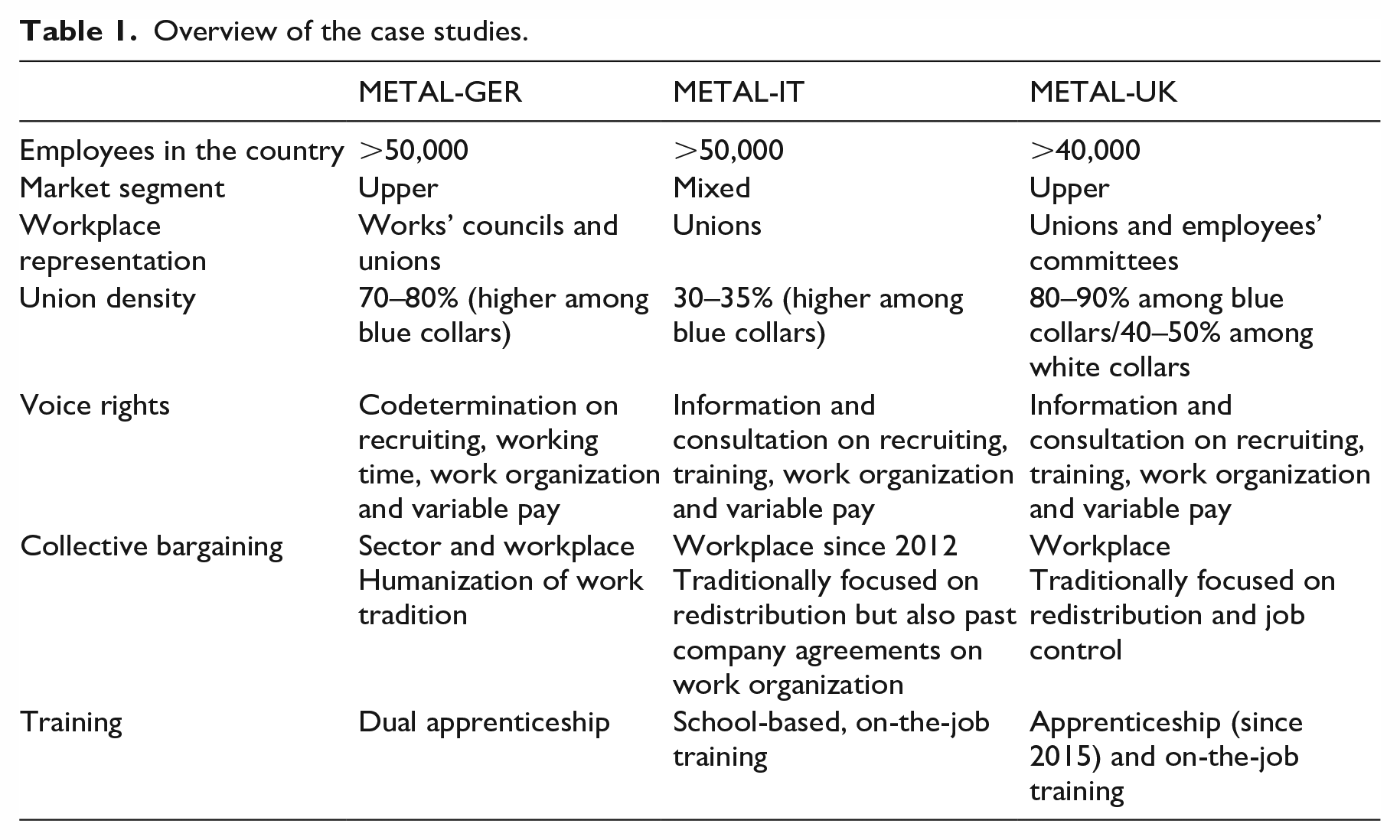
METAL-GER is covered by the metal agreement and has a high unionization rate – over 90% among blue-collar workers. The works council, the main representative body for workers, has codetermination rights on issues such as working time, staffing and some aspects of work organization, and information and consultation rights on other issues. The company employs around 6,000 trainees in Germany (over 600 trainees in production at one of the visited sites) through the dual apprenticeship system, whose curriculum includes in-school education and training in the internal training centre and in production. Collective bargaining in METAL-GER is influenced by the tradition of the ‘humanization of work’, which in the 1970s–1980s focused on the improvement of working conditions and changes in work organization to create meaningful skilled work in routinized positions (Kern & Schumann, 1984). In those years, work organization was characterized by vertically and horizontally integrated tasks, so production workers performed several assembly tasks and maintenance and quality control tasks (Kern & Schumann, 1984; Sorge & Streeck, 1987). Groups included production workers and specialized workers, and members elected a group speaker in charge of rotation and task distribution; they also benefitted from dedicated time for quality circles (Schumann, Baethge-Kinsky, Kuhlmann, Kurz, & Neumann, 1994). Since the 1990s, however, due to increased competition at the global level and to labour market and welfare reforms, labour’s bargaining power declined. Thus, as negotiations at the sectoral and company levels were unable to influence the work organization as in the past, work became more standardized and routinized (Jürgens, 2004).
Both METAL-IT and METAL-UK have weaker industrial relations than METAL-GER but their institutions are different. While large Italian manufacturing companies are usually embedded in the sectoral system, industrial relations at METAL-IT differ by company. METAL-IT has an average union density of 35% and has not been covered by the sectoral agreement since 2012, when they entered a company-level agreement with the moderate unions while the major Italian metal union refused to sign it. The new agreement limits the ability to call a strike and to negotiate over working time by increasing the overtime hours that can be unilaterally requested by the management. This is important because bargaining power over working time is typically used as leverage to negotiate over aspects of work organization or staffing, which are not covered by formal collective bargaining rights. Furthermore, the new agreement superseded pre-existing company-level agreements. Even though bargaining was traditionally more focused on income redistribution (Butera, 2016), in the 1970s the unions bargained using open conflict and mobilization, company-level agreements regulating work organization, and especially the pace of work. As these were lifted, the unions, in absence of codetermination rights and weakened by the new industrial relations system, were unable to bargain for similar agreements. Such bargaining now takes place in committees that consist of 50% worker representatives from moderate unions and 50% management, and have exclusively consultative functions on specific issues identified by the new company agreement. As Italian vocational training is school-based and beyond the remittance of social partners, collective bargaining covers only on-the-job training at METAL-IT, which has a more limited scope than that of METAL-GER.
Within the British manufacturing sector, METAL-UK has a more ‘typical’ institutional setting than METAL-IT. Union density among blue-collar workers is around 85% and 20%–30% lower among white-collar workers. There is no sectoral collective bargaining in manufacturing, so companies are covered only by an agreement setting wages and working conditions, which is bargained every two years at the company level by a joint national committee of over 30 shop stewards (UnionRep, 12 March 2018). Plant-level joint committees including union representatives and management monitor and discuss changes in working practices, but the rights of workers’ representatives are limited to information and consultation.
METAL-UK does not have a tradition of bargaining over work organization, and unions were historically more focused on redistributive conflict and job control (Mair, 1998). METAL-UK used to have a Fordist work organization characterized by limited employees’ involvement, a hierarchical workforce structure and standardized assembly-line tasks, with little opportunity for job enrichment through vertical and horizontal rotation. Given the presence of several craft unions in the workplace, unions wanted to keep the job demarcations to defend employment; therefore, they did not push for more vertical and/or horizontal task integration (Lane, 1988). Lean manufacturing was first introduced in the 1990s when unions were weaker and industrial relations in the workplace were more compromise-oriented (Rose & Woolley, 1992). Training was on-the-job and informal until the recent revitalization of the apprenticeship system, but it still remains a managerial prerogative.
Data collection and analysis
The author conducted 100 semi-structured interviews with HR managers, workers’ representatives, sectoral- and workplace-level union officials, and employers’ associations between January 2017 and February 2019 (see online Appendix). Data also include fieldwork notes from site visits; informal conversations with the respondents; participant observation in meetings of unions, employers and training providers; secondary literature; company reports; and collective agreements.
The interviews were conducted in more than one company to explore the relevance of the national, sectoral and organizational contexts. While practices were broadly comparable across similar metal companies in the UK and Germany, organizational-level differences linked to their past collective bargaining traditions, ownership and governance structures, and local circumstances were discernible. METAL-IT distinguished itself from other similar companies in Italy because there are few metal companies in that product segment 1 and because of the specificity of the company’s industrial relations.
Interviews were conducted in person or over the phone in the native language of the respondents and lasted approximately 30–180 minutes. They were professionally transcribed verbatim. A report was distributed to the participants, who were able to provide feedback. The transcripts and other materials were coded using NVivo12. First, descriptive and provisional codes were used to categorize the content, especially related to the HR practices used in each organization (Saldana, 2009, pp. 122–125). This phase was crucial for developing the theoretical framework and identifying the three ideo-logics reflected in the HR practices.
Second, the codes related to the HR practices were attributed to two sets of second-level codes: (1) to the nodes of ‘Taylorism’, ‘empowerment’ or ‘cost-cutting’; and (2) to HR macro areas including training and work teams (see first column of Table A2 in the online Appendix). These second-level codes were then attributed to the third-level nodes of ‘employee involvement’ and/or ‘internal flexibility’. Table A2 in the online Appendix lists the second- and third-level codes, the observable implications of each idea (when present), and a short explanation of the relationship between the idea and the observable implication. Any reference to industrial relations (e.g. sectoral- or company-level agreements, legislation) was coded as a first-level node under the second-level node of ‘societal institutions’, while any reference to the tensions between Taylorism, cost-cutting and empowerment or to conflicts between labour and management were coded as distinct nodes.
Case Studies
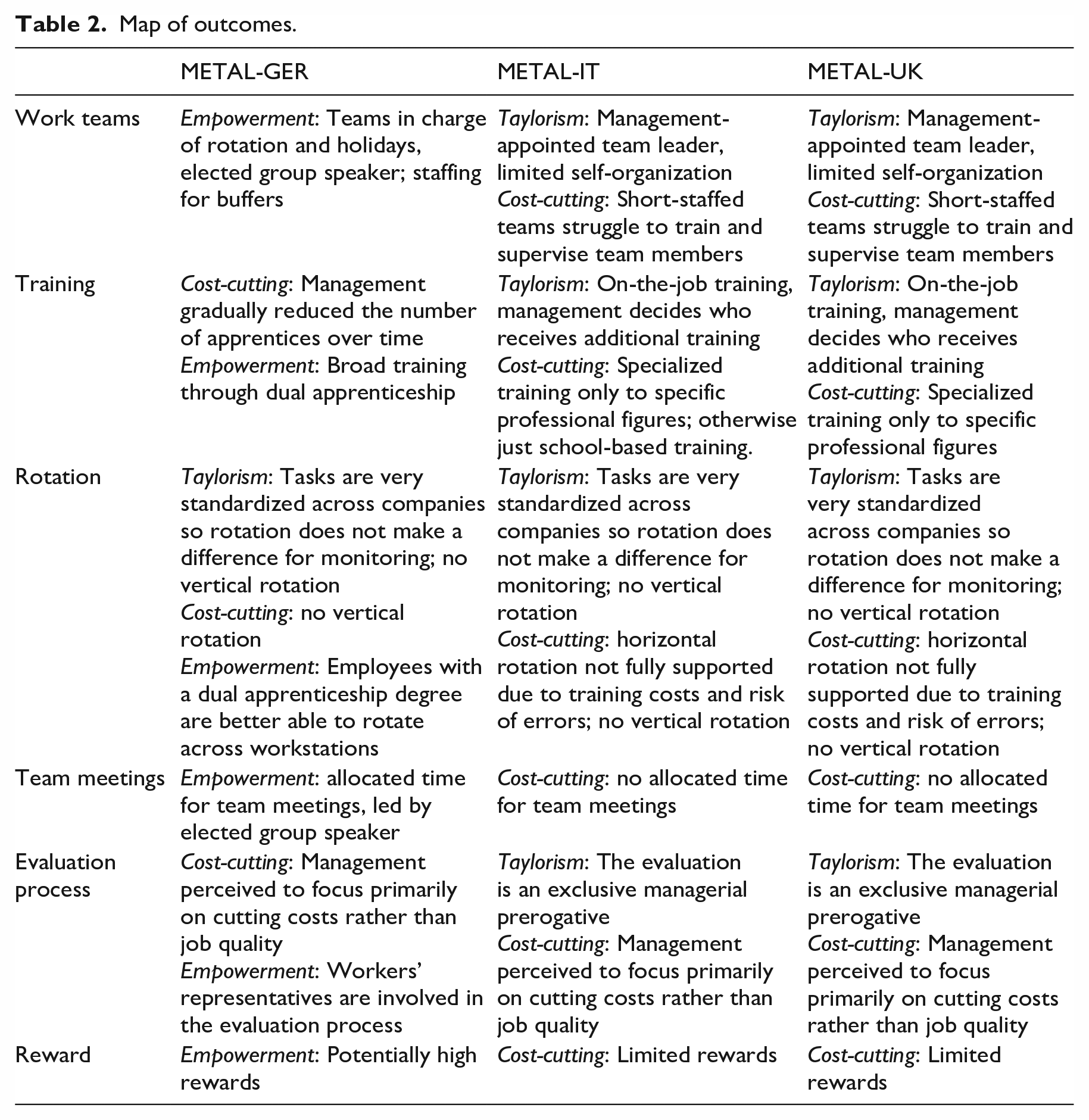
Each case description below contains distinct subsections on the settlement of logics in the HR areas of internal flexibility and employee involvement. A summary of the variation across cases is presented in Table 2, which shows that METAL-GER is characterized by more balanced settlement than METAL-IT and METAL-UK. A discussion and summary table conclude the empirical analysis.
Map of outcomes.
METAL-GER
Internal flexibility
At the assembly line, groups are constituted by an average of 12 members and have an elected group speaker (WorksCon, 6 September 2017). Typically two forepersons are responsible for quality control and for training new hires – together with the group speakers. The Meisters, who represent the first managerial level and have a two-year specialized qualification, are responsible for four to five groups. The large group size and the presence of the group speaker reflect METAL-GER’s tradition of quality circles and integrated group work. Still, works councils need to defend such structures: they are involved in decisions regarding the employment of cover personnel, whose presence ensures that forepersons and group speakers can dedicate themselves to quality control and training. A works council member offered the following example: It can happen that the industrial engineers say that in this unit we need to work with 16 people. And the works council thinks that we need to work with 18 people. Does he have objective arguments? Then, there is the possibility to say, in mutual agreement, ‘OK, we go and check the report together. Or the so-called performance standards.’ Then, the works council is consulted and asked what is still missing. (WorksCon, 17 November 2017)
These negotiations over staff numbers are conflictual but evidence-based so they are conducted by works councillors who acquired extensive knowledge of work organization through specific training courses funded by the union or company. Typically, the management wants to keep lean staffing practices to ‘save on the staffing costs’, while the works council pushes to maintain a certain staffing buffer to maintain ‘surplus’ staff, deemed as necessary to ‘keep the production process fluid’ (WorksCon, 19 July 2017).
The management tried to introduce more capillary control structures at the assembly line but, due to the council’s opposition, they could only start a pilot project in one plant, introducing smaller teams headed by a management-appointed leader. Even in that plant, the works council managed to maintain the group speaker to keep ‘workplaces where there still is some humanity’, as ‘the team leader . . . would only represent the interests of the firm, also because he is chosen by the company’ (WorksCon, 6 September 2017). Indeed, this counterbalance is significant because the management, while aware of the importance of workers’ involvement, puts cost-cutting first and is happy to use its decision power to impose such projects without bargaining. The following quote shows how the management ranks empowerment against cost-cutting and a Tayloristic logic: You just do an analysis here and see where else I can get something out of . . . If the whole thing goes hand in hand with an economic improvement, then the employees go along with it. If it just leads to, let’s say, more effort, then probably not. Yes, but, as I said, ultimately the head of department decides with his managers where we’ll do a lean production process, that is, where we’ll do a project. (MGMT, 31 May 2017)
Works councillors were nostalgic about the previous ‘great human system’ characterized by vertically integrated tasks and longer cycles (WorksCon, 19 July 2017) because they allowed workers to ‘work more with their soul’ and to ‘use their knowledge and qualifications’ (WorksCon, 6 September 2017). However, their codetermination rights do not cover the work organizations beyond health and safety. For instance, they can intervene if changes in the work organization increase pressure on workers and require excessive physical effort, but could not prevent the management from suspending vertical rotation. The management’s motivation depended on organization-specific characteristics including the high standardization and automation of the assembly line, while in companies with a higher degree of manual work, vertical integration is still practised (WorksCon, 5 May 2017); furthermore, management wanted to reduce the potential for errors in the quality check because they thought specialists are quicker at solving disruptions and ‘bring the highest profitability’ (WorksCon, 6 September 2017). Still, the management promotes horizonal rotation across tasks at the assembly line.
Despite these changes, assembly-line workers are still well trained. While horizontal rotation does not require high-skilled workers because workstations are standardized and characterized by short Takt time 2 (around 90 seconds), most of these workers have a dual vocational training qualification (though not always in metal occupations; WorksCon, 19 July 2017, 5 May 2017). Many assembly-line workers were even trained in the plant, including young workers who had just obtained their dual vocational degree but had not found a specialized position, and final-year apprentices often employed on the assembly line.
This phenomenon of ‘overtraining’ results from negotiations between works councils and management. Even though the management mentioned their responsibility, as a large German manufacturing company, to not ‘leave young people on the street without a qualification’ and therefore to overtrain (MGMT, 5 September 2017), investment in training is the subject of ‘constant discussion’, according to a works councillor (5 May 2017) because the management has been reducing the number of apprentices or has been training production workers on cheaper two-year apprenticeships. Thus, the works council recently prioritized vocational training in negotiations. As they do not have codetermination rights on apprenticeships, the council exploited their influence on other issues; in particular, they refused to negotiate overtime if the management did not commit to increase the number of apprenticeships or to provide three-year apprenticeships (MGMT, 31 May 2017; WorksCon, 5 May 2017). Thus, they strategically used organization-specific contingencies (e.g. demand peaks or the ramp-up phases, which require overtime) as bargaining leverage. This political process is illustrated as follows: We have a social partner and our works council does not want two-year apprenticeships. There it does not have codetermination rights, so we can . . . Very concretely, in 2018 we wanted to introduce two-year apprenticeships. We told the works council. It was against it. We said, ‘We’ll do it anyways.’ What did the works council do? They cancelled all overtime for the following two weeks . . . The plant manager then said, ‘Before I stop the production, let’s do again the three-year apprenticeships.’ This is how it works here. It’s not satisfying, it makes me endlessly upset, but that’s how it is. (MGMT, 31 May 2017)
On the one hand, the works councils want employees to be empowered by learning skills they can use ‘in their life’ (WorksCon, 5 May 2017). On the other hand, the works councils believe that skilled workers are beneficial to the lean company because they are better able to rotate across workstations (WorksCon, 19 July 2017). While the management stated that overqualified employees experience boredom and frustration and represent a waste of resources (MGMT, 5 September 2017), they also share the works councils’ position, as illustrated in this quote: ‘When it is important to be flexible and to cover different workstations – there is always rotation in the production. If it is important to maintain certain quality standards . . . someone with a dual vocational qualification is always better’ (MGMT, 5 September 2017).
Employees’ involvement
Employees’ involvement in process improvements takes place through different channels, as defined in company-level agreements that focus on three aspects: working time is allocated to employees’ involvement; workers’ representatives participate in evaluating improvement suggestions; and employees benefit from the gains derived from improvements. Employees, individually or in teams, can submit their proposals through an online platform or to the group leader. A company-level agreement sets 30 minutes a week for group discussions for each shift, maintaining the tradition of inclusive quality circles. Each shift also has a 5-minute meeting before the start, dedicated to discussing the problems encountered in the previous shift.
The evaluation process is also regulated by company-level agreements. The Meister evaluates the improvement suggestions first. If their reach is limited but the implementation is worthy and straightforward, the Meister can award vouchers and small cash prizes to the group or individual (WorksCon, 17 November 2017). If the proposal has greater potential, it is submitted to the appropriate HR unit. The evaluation is supervised by a designated committee of workers’ representatives and managers; a worker whose proposal was rejected can request feedback from the management through the committee. If the proposal’s impact is significant, blue-collar workers are awarded a cash prize based on the company’s resulting savings. In one of the plants, a worker was awarded €60,000 (Meister, 31 May 2017). Only blue-collar workers receive incentives, and Meisters are not awarded any bonuses for their improvement suggestions, which are considered part of their job (WorksCon, 19 July 2017).
However, a works councillor noted that improvements consist of, according to the management, ‘personnel reduction’ while ‘optimization’ means (also) ‘an improvement of health, an improvement of processes, and an improvement of products’, which is not the same as ‘saving’ even though the two often are ‘mixed up’ (WorksCon, 19 July 2017). Thus, production workers might fear that certain improvement suggestions contribute to intensifying work or to downsizing the group: ‘Everyone needs to really switch on their brain when they suggest improvements because otherwise you cut the branch you’re sitting on’ (WorksCon, 19 July 2017). Works councillors pointed out the important role of the group speaker and of the Meister, who do not have direct incentives to encourage suggestions whose implementation would ultimately damage workers while improving plant efficiency (WorksCon, 19 July 2017, 6 September 2017). Indeed, the introduction of the team leader through the above-mentioned pilot project was opposed because their role was seen as aimed only at ‘optimizing and lifting the buffer time’ (WorksCon, 6 September 2017).
METAL-UK
Internal flexibility
As mentioned above, collective bargaining rights in the workplace are limited, which puts labour at an even greater disadvantage vis-a-vis management because collective bargaining is fully decentralized so sectoral-level institutions cannot support the unions by setting, for example, minimum standards. Furthermore, the interviews revealed that union officials have less expertise and interest than German works councillors in work organization and training. Historically, unions focused on redistribution and job control and now, given their limited bargaining power, they focus on ‘core’ issues, such as pay.
Thus, decisions on work organization are unilaterally taken by management. Teams typically include six members led by someone appointed by the management. Their role includes quality control and covering for absentees if alternate staff are not available; due to the shortage of the latter, team leaders often work on the line (UnionRep, 5 June 2018). Process leaders, who are responsible for five or six teams, share training responsibilities with team leaders and are in charge of rotation and planning leaves of absence (UnionRep, 12 March 2018). Yet, neither the team leaders nor the process leaders can reportedly perform their off-the-line tasks of supporting the team and training due to the high absenteeism and the lean recruitment practices, which lead to what a union representative called ‘vertical flexibility’: ‘You tend to have [a situation where] the person above where they should be is doing the job below them, so the group leader becomes an associate, the supervisor becomes a group leader’ (UnionRep, 5 June 2018).
There is a rigid separation between quality control, maintenance tasks and direct activities. Assembly-line workers are only expected to signal errors to team leaders, who are not always able to intervene immediately due to the above-mentioned lean staff practices (UnionRep, 12 March 2018, 25 July 2017). The official company policy is that workers should rotate horizontally among at least three workstations (UnionRep, 12 March 2018), showing a formal commitment to textbook management principles. Yet, often rotation is left to personal choice and depends on informal agreements at the team level unless there are stringent ergonomic reasons for rotating (UnionRep, 25 July 2017, 12 March 2018). As a union representative reported, rotation is implemented weakly: ‘I think if you talk to them at the top they will say they do, but they don’t. When it comes to enforcing it, managing it, really wanting people to do it, it’s too much strain’ (UnionRep, 12 March 2018).
Another challenge to rotation is the lack of time and personnel for training employees on their workstations. In contrast to METAL-GER, the UK union did not push to expand the apprenticeship to assembly-line workers. Reflecting the past tradition of on-the-job training discretionally offered by management, METAL-UK union representatives considered training as ‘kind of given’ and ‘never had an issue with it’ (UnionRep, 13 March 2017). This is striking as METAL-UK was famous, until recently, for poaching skilled workers along the value chain, in contrast to other companies in the same sector that typically train more than the average. 3 The management confirmed that a team including apprentices, ex-apprentices and HR professionals – but not union members – is involved in developing the training programme and in identifying the number and type of training positions (MGMT, 9 January 2017).
As a result of their training strategy, METAL-UK uses apprenticeships only to develop skilled profiles such as maintenance technicians. The management at METAL-UK – different from the experience of a similar local metal company, which instead was developing a traineeship for assembly-line workers – was convinced that the expansion of the apprenticeship was not necessary given the high standardization of the line, which he expected, eventually, to fully automate (MGMT, 20 February 2018). Thus, assembly-line workers undergo only a 1–2-week on-the-job training, making rotation possible only if (a) either the team leader or the process leader are off the line and can dedicate more time to training, or (b) there is a cover person available to replace the new hires while they are learning other workstations. However, union representatives report that these conditions are rare due to the above-mentioned ‘lean’ recruitment practices (UnionRep, 5 June 2018, 12 March 2018). According to union representatives, ‘to have flexibility, to have rotation we would need more people than we have got in the first place’ (UnionRep, 5 June 2018).
Employees’ involvement
Unions in METAL-UK did not bargain on decisions over employees’ involvement initiatives and their implementation. Employees are encouraged to provide improvement suggestions through their team leaders, the whiteboards in the production areas, or the online platform. Despite METAL-UK being a promoter of lean best practices, including involvement, also through the provision of training to other companies, the implementation of involvement practices suffers from lacking implementation, suggesting mainly a formal commitment by the management to workers’ empowerment. Different from METAL-GER, teams do not have any dedicated time to discuss improvement suggestions and only a 5-minute meeting before the shift. Hence, workers are expected to develop improvement suggestions during the breaks or after work (UnionRep, 25 July 2017). Suggestions are evaluated by process leaders first: if the idea is implemented, they offer a small reward, referred to as ‘a token gesture’, such as letting employees take the car produced in the factory for the weekend (UnionRep, 5 June 2018). These improvement suggestions are not rewarded through individual performance pay, as the union opposed its introduction for assembly-line workers and agreed only to a yearly performance review to assess training needs. Thus, workers have limited incentives in terms of both bonuses and career progression (UnionRep, 12 March 2018, 28 November 2017, 25 July 2017).
According to a union representative, the management could do more to engage workers ‘in terms of teams and having team meetings, start-up meetings, regular down time to improve processes’ (UnionRep, 12 March 18). The managerial expectations that employees want to contribute to continuous improvement are unrealistic for different reasons. As a works councillor (25 July 2017) explained, ‘historically, factories in this company have been very much a case of “well, you give me the sheet and I’ll work to it”, so employees are resistant’. They don’t want to ‘give themselves more work’ and ‘don’t necessarily want to engage too much in what happens in the plant’ (UnionRep, 28 November 2017). They contrasted the attitudes of both union representatives and management with other factories that were built in the 1990s in the UK by, for example, Japanese manufacturers, where they argue there is more collaboration between the parties around the success of employees’ involvement initiatives. Another major problem is that union representatives and employees fear that the management could intensify work, given that workers cannot influence the implementation of suggestions and the team leader, who collects the suggestions, needs to increase team efficiency (UnionRep, 12 March 2018, 25 July 2017, 28 November 2017). The following quotes illustrate this: I don’t think we are necessarily as keen to help do that and there is always a little bit of suspicion about quality circles . . . ‘I have spotted that you could do your job a little bit quicker so I tell the boss that you can do a little bit more.’ That’s not really the way. (UnionRep, 28 November 2017)
This underlying suspicion regarding the improvement process is related to the central question of ‘who owns the improvement?’, which is always the management, and ‘it depends on the level of control the union keeps of it as well’, which is fairly limited in the case of METAL-UK (UnionRep, 12 March 2018).
METAL-IT
Internal flexibility
As mentioned in the method section, committees constituted 50% by the moderate unions and 50% by the management are consulted over decisions on work organization; while they aim at promoting ‘consensual’ decision-making within the company, the interviews revealed that in the new industrial relations system the management is mainly responsible for work organization. These changes to the company’s industrial relations system were justified to avoid the conflictual industrial relations, which traditionally characterized the company and the ‘ideological’ opposition of unions to workplace innovation. Yet, even representatives of the most left-wing, now marginalized, union declared that they are ‘not ideologically against lean’, but they are conscious that ‘there is not one lean’, there are several ‘interpretations of lean’; moreover, the company is unwilling to listen to the unions’ interpretations (UnionRep, 13 June 2017). Indeed, even the representatives of the moderate unions demonstrated interest in regaining influence over work design and raised doubts about the ability of the internal joint committees to monitor, let alone influence, changes in work organization to the benefit of the workforce (UnionRep, 15 June 2017).
Thus, the workforce structure is mainly decided by management and is similar to METAL-UK. Teams consist of six workers plus the team leader, who is appointed by the management (UnionRep, 7 September 2017). While the management stressed that team leaders are primus inter pares, in the salary scale they are categorized as professionals rather than workers and they receive individual incentives based on team improvements (UnionRep, 13 June 2017; MGMT, 21 April 2017). Union representatives perceive them as ‘company representatives’ and ‘hierarchical figures’ (UnionRep, 8 September 2017, 13 June 2017). Above the team leader, the head of the operational unit is responsible for several teams and, similar to the team leader, for quality control and problem-solving on the line (UnionRep, 8 September 2017).
The joint committee does not influence the definition of job roles and tasks. Assembly-line workers are not involved in maintenance and quality control; they should only signal problems to team leaders, who were defined by a manager as the ‘problem-solvers of those gentlemen’ (their team colleagues; MGMT, 19 June 2017). However, union representatives report that team leaders often work on the line so their intervention is delayed and the line needs to be stopped or the piece sent for rework (UnionRep, 8 September 2017, 23 July 2018, 7 September 2017).
Horizontal rotation is encouraged, and managers expect rotation between three workstations (MGMT, 19 June 2017, 21 April 2017). Yet, union representatives reported that rotation often takes place only ad hoc, such as when colleagues need replacement at their workstation (UnionRep, 8 September 2017, 7 September 2017), and questioned the extent to which management invested in preparing employees for rotation. Even though assembly-line workers in METAL-IT might have a relevant technical education from a local state school, new hires receive only a two-week company-specific training that covers technical and behavioural aspects (MGMT, 21 April 2017; UnionRep, 15 June 2017). Longer and more specialized training is limited to technical figures (UnionRep, 15 June 2017). Unions tried to expand training to all workers to give everyone an opportunity to progress, but they were unsuccessful because the company thought that training should be ‘provided to those who are useful to them’ and they want to have complete discretion (UnionRep, 15 June 2017). Thus, workstations are learned when workers are already on the production line, possibly in the upward or downward phase of production, when there are more opportunities to shadow because the line flows more slowly. Similar to METAL-UK, union representatives also complained that team leaders do not have time to train staff on new workstations because they often work on the line due to staff shortages.
As a result, workers can be reluctant to rotate because they have not gained enough confidence beyond their own workstation (UnionRep, 8 September 2017, 13 July 2017, 8 September 2017), as illustrated by this quote: If I have an appropriate training, in which I have time to learn my job, it’s [rotation] OK. Because the dexterity and my way of working at the stations and being knowledgeable about doing that task give me time to breathe. If I change, I need to start acquiring dexterity on a new workstation. (UnionRep, 8 September 2017)
Employees’ involvement
In the last 10 years the management has put greater emphasis on employees’ involvement, which is seen by the union as a ‘breakthrough’ for the company and is therefore supported (UnionRep, 13 June 2017). During the interviews, the management explained that ‘the ability of involving everyone’ is fundamental for a process of continuous improvement (MGMT, 21 April 2017) and claimed that, through the involvement initiatives, they ‘turned the pyramid upside down’ so ‘it’s the assembly line that leads’ (MGMT, 19 June 2017). Yet, this commitment to employees’ empowerment is not reflected in practice. Similar to METAL-UK, workers can provide improvement suggestions through an online platform or the team leader. However, by contract, there is no time dedicated to developing suggestions, which is supposed to occur during breaks or after the shift (UnionRep, 8 September 2017, 15 June 2017). Only team leaders meet with group leaders every day, for 5 minutes at the beginning of the shift (MGMT, 21 April 2017).
Similar to METAL-GER and METAL-UK, union representatives in METAL-IT pointed out that workers fear work intensification for various reasons. They cannot co-decide over the work organization and are under pressure due to a fast pace of work, as indicated by workers’ surveys conducted by the unions in all establishments (UnionRep, 13 June 2017). Team leaders are perceived as ‘chiefs’, with an incentive to intensify work, while material incentives (e.g. sweaters, small cash prizes, or vouchers for petrol) for workers to provide suggestions are limited. The union tried to propose a system similar to that of METAL-GER that links the company’s savings to the workers’ bonuses. Unfortunately, the company stuck to a ‘unilateral reward system’, so the award of those prizes is at managerial discretion (UnionRep, 15 June 2017, 7 September 2017).
The company preferred it like that (a unilateral symbolic reward system) . . . We tried to create bonuses that related to the dimension of the individual contribution. In this way, we wanted to translate the big savings that the company achieved through the suggestions that workers gave them . . . also into our contractual terms. At the beginning the company had said, ‘Let’s do it’ . . . but then . . . ’ (UnionRep, 7 September 2017)
Thus, these prizes might not be considered enough by everyone for suggesting improvements, as this quote suggests: I would also like that, if my brain is required beyond my arms, the [use of the] former is acknowledged. And it can’t be a baseball cap . . . Because if I engage with my brain, someone else is going to benefit from it. (UnionRep, 8 September 2017)
Discussion
The empirical analysis explored how three metal companies in Germany, Italy and the UK settle the tensions between empowerment, Taylorism and cost-cutting in their lean management systems. It showed how institutional resources available to labour exacerbated or mitigated the contradictions between HR practices.
The findings (Table 3) indicate that the lean HR systems in METAL-IT and METAL-UK are characterized by more contradictions than those of METAL-GER, as workers were provided with limited support for rotating and mixed (or no) incentives for suggesting improvements. Thus, the implementation of HR practices is unbalanced towards Taylorism and cost-cutting; therefore, the contradictions between lean HR practices are more acute. In contrast, METAL-GER distinguishes itself because the contradictions between Taylorism, cost-cutting and empowerment are mitigated through a ‘balanced’ implementation of lean HR practices; indeed, workers benefitted from greater training and rotation, a fairer reward scheme, and more opportunities to voice concerns even though the tasks were standardized similarly to METAL-IT and METAL-UK. Thus, the lean management system in METAL-GER is characterized by greater internal consistency as HR practices are designed to contribute more effectively to the achievement of typical objectives of lean organizations, including greater internal flexibility and quality improvement.
Overview of the cases.
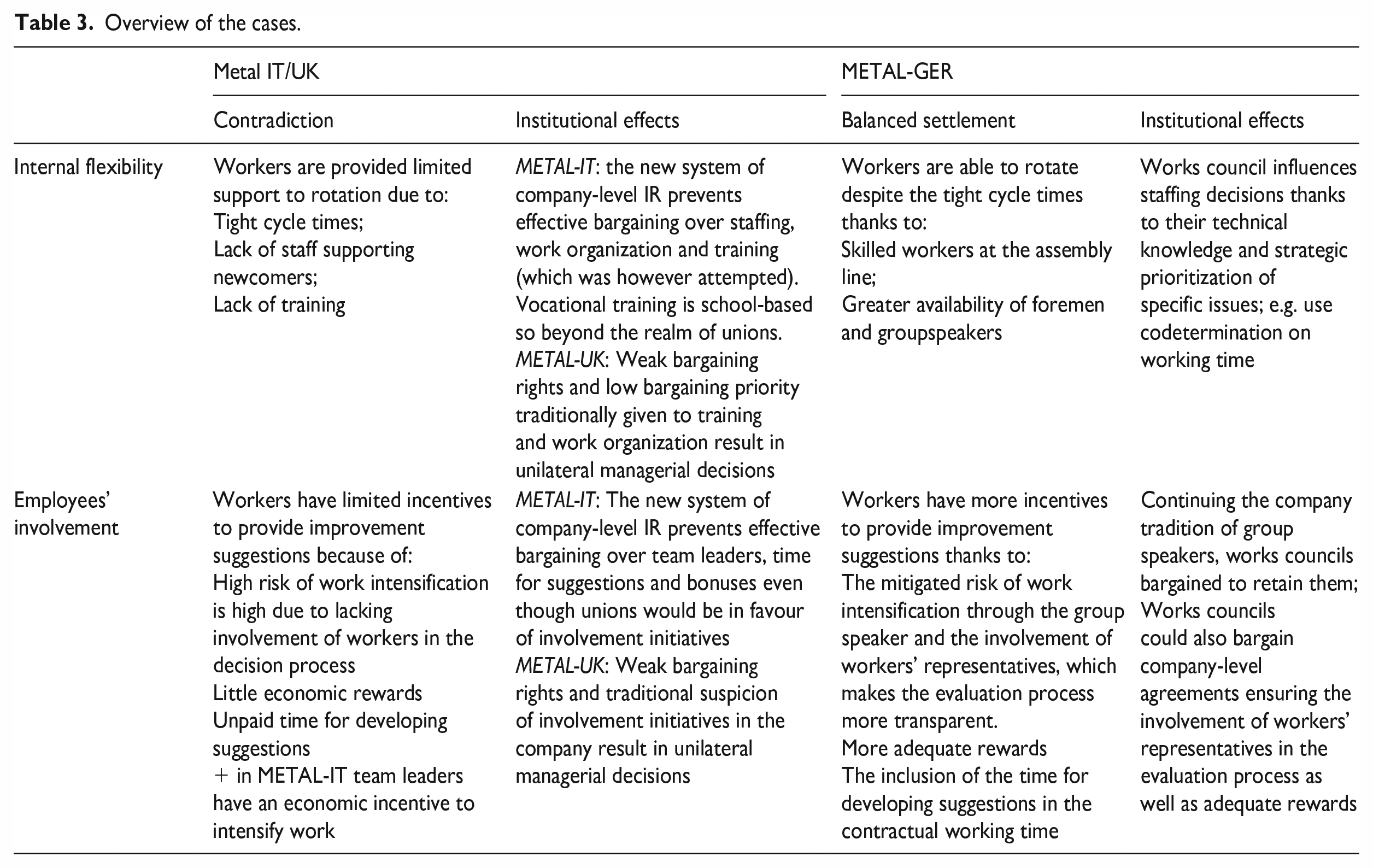
The power relations between labour and management resulting from the societal context of each organization are crucial to explaining these outcomes. Evidence showed that workers’ representatives in METAL-GER were more often involved in decision-making and better able to negotiate HR practices thanks to their institutionalized bargaining rights; furthermore, given the company’s past involvement in the humanization of work ‘movement’, works councils were also used to prioritize issues such as training and work organization in the negotiations, and were able to use the available institutional resources ‘creatively’ to increase their bargaining leverage; for example, in critical production phases for the company, they agreed to bargain over working time only in exchange for concessions over training.
There are commonalities between METAL-IT and METAL-UK in the implementation of lean management due to the power imbalance between labour and management, which can be explained through the lack of power resources available to labour at different levels. In METAL-IT labour weakness is mainly due to the specific organizational context, while in METAL-UK industrial relations are weak across the whole sector. Furthermore, in METAL-UK, there is little tradition of bargaining over work organization and training, so workers’ representatives did not prioritize those issues and did not try to use their (limited) resources creatively to improve those HR areas. In contrast, there was such a bargaining tradition at METAL-IT, which relied on unions’ high mobilization potential for its implementation, and it was then lost due to the changes in the company’s industrial relations system.
Thus, while the differences in the societal context of METAL-IT and METAL-UK confirm the importance of a multilevel analytical framework, their commonalities in the implementation of lean management compared to METAL-GER provide evidence that the power dynamics in the workplace are crucial to settling the tensions between multiple logics within lean management.
Findings on METAL-GER provide some evidence of institutions still serving as ‘beneficial constraints’ (Streeck, 1991). In the societal effects literature, the concept of ‘beneficial constraints’ originally implied that institutional constraints, by preventing labour cost compression, forced management to invest in their workforce and move to high-quality market segments (Sorge & Streeck, 1987; Streeck, 1991). Along with others (e.g. Lloyd, Warhurst, & Dutton, 2013), this article suggests that the links between institutions, high-road HR practices and market segment do not necessarily hold anymore, as METAL-UK competes in the same market segment as METAL-GER; furthermore, due to a lack of productivity data for the assembly line, the article cannot draw any conclusions on the superior organizational performance of METAL-GER compared to METAL-UK and METAL-IT. However, thanks to the works council’s bargaining, METAL-GER still relies on ‘redundant capacities’ (Streeck, 1991) such as skilled workers and more generous staffing at the assembly line, which are important for internal flexibility; similarly, the greater democratic participation of workers in the improvement process through the group speaker, the team discussions and the works councils, and the greater economic incentives are reportedly helpful to ‘solve’ the tension workers perceive between contributing to process improvement and risking work intensification. Thus, the greater consistency of HR systems seems to be better able to achieve the objectives of organizations that adopt lean management systems, such as process improvement through employees’ involvement and internal flexibility; at the same time, it entails better outcomes for workers, especially in regard to the opportunities for team engagement (and therefore off-Takt work) and rewards for improvement suggestions (see also Krzywdzinski, 2017).
Conclusion
This article demonstrates the benefits of cross-fertilization between the CER literature and the OI literature to explain how multiple ideo-logics are settled within organizations across societal contexts. On the one hand, it enriches the existing strand of comparative OI studies (Nicolini et al., 2016; Vasudeva et al., 2013): while the literature largely adopts the NBS approach, looking at differences in national-level institutions but neglecting the effects those institutions have on power relations, this article argues that explaining the settlement of multiple ideo-logics in the organization requires a multilevel understanding of institutions as power resources that actors can use in micro-political bargaining processes. The findings support this argument and confirm the value of integrating the insights of the power-resource approach used in the CER literature. Thus, the article answers the call to integrate power-based explanations in organization studies (Munir, 2015) by proposing a mid-range explanation for the variation in how ideo-logics are settled across organizations. The explanation advanced in this article considers how institutions at organizational, sectoral and national levels affect power dynamics in the workplace. It can also usefully integrate studies of collective resistance in organizations that have so far mostly focused on the role of practices and discursive forms of mobilization (Daskalaki & Kokkinidis, 2017; McCabe, 2023).
On the other hand, this article contributes to the CER academic debate on the persistent influence of societal institutions on the diffusion of global best practices, in particular, lean HR systems (Edwards et al., 2016; Krzywdzinski, 2017). Drawing on the OI literature, the article argues for greater attention to the multiple ideo-logics constituting transnational institutional streams rather than conceptualizing them as homogeneous global pressures. The findings illustrate how, during the translation of these ideo-logics into HR practices, societal institutions can either exacerbate the tensions between these logics, leading to contradictions between HR practices, or settle them (to some extent). In the case of lean management, the evidence suggests that societal institutions supporting labour can improve the internal consistency of lean HR systems by settling those internal tensions.
While the analytical approach used here is applicable to other comparative case studies (between organizations across and within sectors and countries), the reliance on three qualitative case studies implies that the results are contingent on the choice of companies. For instance, manufacturing suppliers, which are subject to greater cost pressures and are characterized by weaker industrial relations institutions, are more likely to adopt lean HR systems that emphasize Tayloristic control mechanisms and cost-cutting even in Germany (Doellgast & Greer, 2007). On the other hand, studies on small-batch producers found societal effects for their HR systems (e.g. Brumana & Delmestri, 2012), possibly because they had more room to decide how to organize production as they do not directly compete in international mass markets like the companies considered in this study. Future research could investigate the interactions between the type of product or market and the quality of societal effects.
Supplemental Material
sj-docx-1-oss-10.1177_01708406231203296 – Supplemental material for Societal Institutions and Contradictions in the Workplace: A comparative analysis of lean management systems in Germany, Italy, and the United Kingdom
Supplemental material, sj-docx-1-oss-10.1177_01708406231203296 for Societal Institutions and Contradictions in the Workplace: A comparative analysis of lean management systems in Germany, Italy, and the United Kingdom by Chiara Benassi in Organization Studies
Footnotes
Acknowledgements
The author is grateful to the three anonymous reviewers, the editors Jasper Hotho and Renate Meyer, Riccardo Peccei, Salil R. Sapre and Matt Vidal for their comments on previous versions of the paper.
Funding
The author disclosed receipt of the following financial support for the research, authorship, and/or publication of this article. This project was supported by the Economic and Social Research Council (PI: Chiara Benassi, Ref: ESN01605X1).

Notes
Author biography
References
Supplementary Material
Please find the following supplemental material available below.
For Open Access articles published under a Creative Commons License, all supplemental material carries the same license as the article it is associated with.
For non-Open Access articles published, all supplemental material carries a non-exclusive license, and permission requests for re-use of supplemental material or any part of supplemental material shall be sent directly to the copyright owner as specified in the copyright notice associated with the article.
